One of the best ads during the lockdown last summer from Smart.
What a wonderful lesson we have today from St. Paul about your wisdom, O God our Father that is found in the scandal of the Cross of your Son Jesus Christ!
Brothers and sisters: Let no one deceive himself. If anyone among you considers himself wise in this stage, let him become a fool so as to become wise. For the wisdom of this world is foolishness in the eyes of God, for it is written: God catches the wise in their own ruses, and again: The Lord knows the thoughts of the wise, that they are vain.
1 Corinthians 3:18-20
This we have realized at the start of this pandemic when everything in the world stopped and forever changed because of microscopic COVID-19 virus, affecting even the most advanced countries of the world.
Most of all, everybody – rich and poor alike – suffered greatly from this virus, teaching us to value persons more when people we took for granted for so long have become our “saviors” during this prolonged quarantine periods like vendors and delivery personnel, our househelpers, and others we used to look down upon who continued to serve us with food and other needs.
Not to be forgotten too are the members of neglected sectors of our society, specially those in the medical and healthcare system and the agriculture who showed us the importance of human and natural resources over imports and technology as well as entertainment.
What a great lesson about wisdom of God and foolishness of man in this modern time!
One thing very clear, O Lord, that to be a fool for you is first of all to let go of our foolish pride and be humble before you and others.
It is the only way we can let you do your work of changing us and the world when we learn to let go of our foolish pride like St. Peter in today’s gospel when he as an experienced fisherman heeded your command to cast his nets into the deep even though you are the carpenter’s son.
When we review the lives of all saints, they are all men and women of exceptional humility before you, Lord; like St. Gregory the Great who focused more on you that he was able to reform our liturgy, set up schools and monasteries, sent missionaries to England, and instill holiness among the clergy in his “Pastoral Instructions.”
Help us to believe more in you than in ourselves so that you may do your work in us and through us. May we value your Cross, Lord Jesus, considered as foolish in this sophisticated age yet has continued to prove that it is the only path to our transformation as persons and nations. Amen.
Photo by author, XVth Station of the Cross, the Resurrection, Mount St. Paul, La Trinidad, Benguet, February 2020.
The Lord Is My Chef Breakfast Recipe for the Soul by Fr. Nicanor F. Lalog II
Wednesday, Week XXII, Year II in Ordinary Time, 02 September 2020
1 Corinthians 3:1-9 <*(((><< || + || >><)))*> Luke 4:38-44
Van Gogh’s “The Sower” from wikimediacommons.org.
Thank you very much, Lord Jesus Christ for the words by St. Paul today that remind us of something hidden among us, something we take for granted that prevents us from maturing fully in you as disciples which is our tendency towards factionalism.
While there is jealousy and rivalry among you, are you not of the flesh, and walking according to the manner of man? Whenever someone says, “I belong to Paul,” and another, I belong to Apollos,” are you not merely men? What is Apollos, after all, and what is Paul? Ministers through whom you became believers, just as the Lord assigned each one. I planted, Apollos watered, but God caused the growth. For we are God’s co-workers; you are God’s field, God’s building.
1 Corinthians 3:3-6, 9
So many times, we remain “infants” in our spirituality as we continue to see more of ourselves and of other persons than YOU, O Lord, in our mission and ministry. Instead of being united as one, we move towards being on our own, towards factions so we can choose whom to follow among us.
There are times we forget we are your stewards, that we are all co-workers in your field that we try to “own” everything, specially people and God himself. We idolize people, setting you aside from the whole picture.
We cannot let go of our labels and tags for each other, forgetting the more essential name of being Christians, of just belonging to YOU alone.
Lord Jesus Christ, forgive us also when we try so hard to always “keep you” or “box” you like the people of Capernaum who tried to prevent you from leaving their town for selfish interests like healing of the sick.
Let us grow deeper in your mind, Lord Jesus Christ by reaching out to more people to proclaim your good news of salvation meant for everyone. Amen.
Lawiswis ng Salita ni P. Nicanor F. Lalog II, Ika-02 ng Setyembre 2020Halaw sa mga pagbasa mula sa 1 Corinto 3:1-9 at Lukas 4:38-44Miyerkules sa Ikadalawampu't-Dalawang Linggo sa Karaniwang Panahon
Larawan kuha ng may-akda, Pulilan, Bulacan, Pebrero 2020.
Panginoong Hesus,
tulungan mo kaming makalaya
sa aming sakit ng pagkakanya-kanya
liwanagan aming mga puso at kalooban
upang iwanan mga hinahangaan naming sinusundan
na nagiging sanhi ng mga kampi-kampihan at labanan
mula sa tahanan hanggang paaralan,
sa pamayanan at maging sa simbahan
lalong-lalo na sa larangan ng pulitika.
Buksan mo ang aming mga isipan at kalooban,
punuin ng Iyong Espiritu Santo ng katotohanan
na kaming lahat ay pawang Iyong mga manggagawa
sa iisang bukirin na tanging Ikaw lamang
ang nagpapatubo at nagpapalago
 sa pananampalataya at mabubuting gawaing
aming inihahasik at dinidiligan (1Cor.3:8-9).
Higit sa lahat,
amin sanang mapagtanto
sa tuwing kami ay mayroong iniidolo
maliban sa Iyo, Panginoong Jesu-Kristo,
lalo kaming nagiging palalo
tulad ng kuwento sa Ebanghelyo:
ayaw kang paalisin ng mga tao sa kanilang lugar
hindi lamang sa sila'y bilib na bilib sa Iyong kapangyarihan
kungdi dahil higit silang makikinabang
sa Iyong kapanatilihan.
Amen.
The Lord Is My Chef Breakfast Recipe for the Soul by Fr. Nicanor F. Lalog II
Tuesday, Week XXII, Year II in Ordinary Time, 01 September 2020
1 Corinthians 2:10-16 >><)))*> || >><)))*> || >><)))*> Luke 4:31-37
Photo by author, Chapel of Holy Family, Sacred Heart Novitiate, Novaliches, May 2017.
Lord Jesus, let me be focused on you alone, on your suffering and death for my sins, on your love for me, on your dying on the Cross for me. Breathe in me your Holy Spirit so I rely on you alone to have your “mind”.
Brothers and sisters: The Spirit scrutinizes everything, even the depths of God. Among men, who knows what pertains to the man except his spirit that is within? similarly, no one knows what pertains to God except the Spirit of God… The one who is spiritual, however, can judge everything but is not subject to judgment by anyone. For “who has known the mind of the Lord, so as to counsel him?” But we have the mind of Christ.
1 Corinthians 2:10-11, 15-16
What is this “mind of Christ”, O dear Jesus, that astonished the people of Capernaum at your preaching because you spoke with authority that even the unclean spirit of the possessed man rightly recognized you?
So many times, we fail to experience and manifest your mind because we have been so preoccupied with our very selves, so confident in our wild thoughts about you despite our claims that you are beyond human comprehension.
Photo by author, inside our parish at sunrise, 2019.
Yes, many of us are so conceited in knowing you so well, Lord, preaching all about health and wealth, the good life minus your Cross and sufferings that have sadly continued to mislead so many people today like during the time of Paul at Corinth.
Refresh your mind of Christ in us, Jesus by instilling in our hearts and minds that everything is grace from the Father, that whatever gift we have received from him is perfected when we are one with you in your suffering and death on the Cross.
That is the mind of Christ, dear Jesus: a beautiful mind so faithful and trusting in the Father who makes everything possibly good and wonderful, even the most painful experiences or darkest moments we ever had.
Keep us attuned with your Spirit so we may always follow the depths of God and be one in him through you, Lord Jesus. Amen.
Photo by author, CICM Retreat House, Taytay, Rizal, 2007.
Praise and glory to you, O God our loving Father! Please, keep us open to your coming in Jesus Christ. Surprise us always with your simplicity, silence, and hiddenness.
You know how we are always attracted with people’s credentials and titles, outward appearances, and great talents in speaking and explaining things that we get carried away, leaving you behind.
I came to you in weakness and fear and much trembling, and my message and my proclamation were not with persuasive words of wisdom, but with a demonstration of spirit and power, so that your faith might rest not on human wisdom but on the power of God.
1 Corinthians 2:3-5
Let us come to you and meet you in Jesus by forgetting our self, taking our cross and following him in his passion and death.
Sometimes we forget your simple invitation to come to you with our sinful selves minus our pretensions and masks because all you want is our total selves. You do not ask for our perfections but imperfections, nor for our virtues and talents but for our lacking and sins.
And through this all, Lord, you give us life and freedom, fulfillment in you in our hearing:
Photo by Fr. Gerry Pascual at Yvoire, France, 2018
Jesus unrolled the scroll and found the passage where it was written: The spirit of the Lord is upon me, because he has anointed me to bring glad tidings to the poor. He has sent me to proclaim liberty to captives and recovery of sight to the blind, to let the oppressed go free, and to proclaim a year acceptable to the Lord. Rolling up the scroll, he handed it back to the attendant and sat down, and the eyes of all in the synagogue looked intently at him. He said to them, “Today this Scripture passage is fulfilled in your hearing.”
Luke 4:17-21
Come, Lord Jesus, you are most welcomed in me. Amen.
Jesus in the gospel today makes his first prediction of his coming pasch or Passion, Death and Resurrection but it was such a terrible “bad news” for Peter that he
… took Jesus aside and began to rebuke him, “God forbid, Lord! No such thing shall ever happen to you.” He turned and said to Peter, “Get behind me, Satan! You are obstacle to me. You are thinking not as God does, but as human beings do.”
Matthew 16:22-23
With Jesus, there is no such thing as “good news, bad news” because all is good news with him. The good news/bad news question is really a non-question to disciples of Christ because whatever suffering we go through and embrace in him is a sharing in his very life. The key is to think as God does, not as a human beings do as Jesus told Peter (https://lordmychef.com/2020/08/29/when-good-news-bad-news-do-not-matter-at-all/).
And that means avoiding being so vain.
That is why we have Carly Simon singing to us this Sunday her 1972 classic “You’re so Vain” that have left our generation guessing who was she referring to in this superb music and poetry. (Personally, I think there is something “genetic” about this guessing game on whomever Ms. Simon was referring to: it was a non-issue among us males even when I have gone working in a radio station for six years. It has been the women who have kept on raising the issue on who could be that man so vain Ms. Simon was narrating in her number one song. And even if Ms. Simon had already identified him as Warren Beatty 40 years after, I still do not care because the song is so good, filled with gospel values too.)
How many times in our being so vain have we refused to embrace pain and sufferings in life, preferring noise than silence, and popularity than hiddenness that are some of the ways of God taught us by Jesus Christ?
Oh, you had me several years ago When I was still quite naive When you said that we made such a pretty pair And that you would never leave But you gave away the things you loved And one of them was me I had some dreams, they were clouds in my coffee Clouds in my coffee, and
You’re so vain You probably think this song is about you You’re so vain (you’re so vain) I’ll bet you think this song is about you Don’t you? Don’t you? Don’t you?
About ten years ago, Al Pacino played the role of Satan in the movie “The Devil’s Advocate” where at the end after tempting the gullible small-town lawyer Keanu Reeves, he proclaimed “vanity… vanity is my most favorite sin.”
This Sunday, Jesus is telling us all is good news with him, no bad news and you can never lose in him. Just come to him with our true self, no matter how sinful and incomplete we are. A blessed week to everyone and happy listening!
Maybe you have been asked so many times with the question, which do you prefer to hear first, the good news or the bad news? Usually we say it all depends to our mood and temperament or to the gravity of the situation. Sometimes, we ask for the bad news first so we can suffer earlier and enjoy the good news later. Or, we ask for the good news first to soften the impact of the bad news.
Our gospel this Sunday is still set in the pagan city of Caesarea Philippi and we heard Jesus giving his disciples – including us – with a strong dosage of “bad news” after hearing last week the good news that he is “the Christ, the Son of the living God.”
Jesus began to show his disciples that he must go to Jerusalem and suffer greatly from the elders, the chief priests, and the scribes, and be killed and on the third day be raised. Then Peter took Jesus aside and began to rebuke him, “God forbid, Lord! No such thing shall ever happen to you.” He turned and said to Peter, “Get behind me, Satan! You are obstacle to me. You are thinking not as God does, but as human beings do.” Then Jesus said to his disciples, “Whoever wishes to come after me must deny himself, take up his cross, and follow me. For whoever wishes to save his life will lose it, but whoever loses his life for my sake will find it.”
Matthew 16:21-25
Our gospel today seems to be a very big, bad news for everyone, with things getting worst before getting any better which the Lord had promised to be only in the end that nobody knows when!
See how Jesus started by saying he would “suffer greatly at the hands of elders, the chief priests, and the scribes and be killed and on the third day be raised again.” Not only that: he now calls Peter as “Satan” from being the Rock last Sunday after giving the right answer as to who he is.
Like Peter, we would probably say the same thing to Jesus why make suffering and death central to life that is meant to enjoy?
Like Peter, the Lord is inviting us today to focus more on the good news than on the bad news of suffering and death which for him – the Paschal mystery we call – is actually the best of good news!
Photo by author, altar flowers in our parish, January 2020.
Jesus Christ’s pasch is the best of good news!
What we have heard as “bad news” from the Lord is his first prediction of his coming pasch or Passion, Death and Resurrection. He would be announcing this prediction of his pasch two more times as they near Jerusalem.
From the He brew word pesach that means to pass over, it connotes suffering and death into new life. It came from the Exodus experience of the Chosen People from Egypt into the Promised Land during the time of Moses, taking its fullest meaning in Jesus Christ, the Son of God who became human like us in everything except sin, “passing over” from eternity to temporal, from Passion and Death to Resurrection.
Authentic discipleship does not require us to seek suffering; no, God is not sadistic as some people with twisted minds would say. However, being faithful to Jesus, witnessing his gospel values bring enough of these sufferings and deaths but on a different level and meaning. We realize that life is a daily exodus, a passing over from darkness into light, from ignorance into wisdom, from sickness into health, from death into new life.
Like the prophet Jeremiah in the first reading, we discover that the more we follow God, the more sufferings we encounter in life but at the same time, we cannot let go of him because his attraction is so powerful! There is something so deep within, so profound and fulfilling in us we realize that living in the ways of God, in the gospel values of Christ can we truly find lasting joy and peace – even if we have to die in our very selves in the process.
You duped me, O Lord, and I let myself be duped; you were too strong for me, and you triumphed. all the day I am an object of laughter; everyone mocks me… But then it becomes like fire burning in my heart, imprisoned in my bones; I grow weary holding it in, I cannot endure it.
Jeremiah 20:7, 9
Photo by author, Gaudete Sunday in our parish, December 2019.
Thinking in God’s ways
Today Jesus is assuring us that there is no such thing as “good news, bad news” with him. The good news/bad news question is really a non-question to disciples of Christ because whatever suffering and death we embrace in him is a sharing in his very life.
Hence, Jesus Christ’s good news is in fact the bestest news we can ever have. Always.
The key is to think as God does, not as human beings do as Jesus pointed out to Peter.
Three things I wish to share with you about thinking in God’s ways:
First is to accept and embrace pains and sufferings not for their own sake but as a way to cleanse our selves to greater glory. As we have said, God is not a sadist; we need to be cleansed like every thing in order to bring out the best in us like diamonds or any precious stone or any material.
Polishing and honing always mean “subtractions” with so many shaving and cutting of the rough edges to bring out the beauty and sharpness of a thing.
Man’s ways has always been to avoid every pain and suffering. No wonder, the most prescribed medicine worldwide is said to be the pain killer. But, experience has taught us this is not true and cannot be the norm of life. Like every gym enthusiast would tell you, “no pain, no gain”. Pain and suffering is part of life and the good news is, Christ has made it holy for us.
Second is to be silent in order to be able to listen to every sound and thus, heighten our sensitivities not only with our true selves but also with God and with others. In this age of social media and instant communications, silent has become a rare commodity. It is always easier to speak even without thinking much than be silent. That is the way of the world: speak out loud, make noises, and let everyone hear you — until they get tired of you.
Photo by author, our parish ceiling at sunset, 25 August 2020.
Third is the most precious in God’s ways of thinking — the way of hiddenness. This is God’s most evident way of making himself felt, experienced, and yes, seen by being hidden and invisible.
Last Thursday we celebrated the memorial of St. Monica, the mother of St. Augustine who narrated the story of how she got sick at Ostia in Italy with his brother hurrying to get back home to Tagaste in Africa so that when she dies, she would be buried there. St. Monica “reproached him with a glance because he had entertained such earthly thoughts”; then, she looked at St. Augustine and told him to bury her anywhere, asking one thing only from him: that he remembers her always in his celebration of the Holy Mass.
So many times, we are so concerned with our popularity that whatever we do has to be made known to everyone to see specially by those so-called “followers” with their “likes” that even up to death, some would spend a fortune for lavish funerals and even mauseleoum.
That’s the way of the world of everybody making a statement, of being known as present, always seen. In the movie “The Devil’s Advocate”, Al Pacino played the role of satan who said it so well at the end after tempting Keanu Reeves, “vanity…vanity is my most favorite sin.”
See the life of Jesus Christ: more than half was spend in hiddenness and silence. He worked only for three years characterized by so many instances of silence and hiddenness too and yet, his impact continues to this day and hereafter.
Beginning with last Sunday after asking us who do we say he is, Jesus is inviting us to follow him in his Passion and Death to be one in his Resurrection. This is also the call by St. Paul in the second reading:
I urge you, brothers and sisters, by the mercies of God, to offer your bodies as a living sacrifice, holy and pleasing to God, your spiritual worship. Do not conform yourselves to this age but be transformed by the renewal of your mind, that you may discern what is the will of God, what is good and pleasing and perfect.
Romans 12:1-2
Jesus is not asking too much from us, no need for any fanfares on our part; simply come to him with our true self, no matter how sinful and incomplete we are. Remember, all is good news with him and you never lose in him. Amen.
A blessed week to everyone!
Photo by author, parish ceiling at sunset, 25 August 2020.
“The Beheading of St. John the Baptist” by Pierre Puvis de Chavannes (1869) from WikiArt.org.
Immediately after our Mass for the Passion of John the Baptist this morning, Lord, I am leaving for the celebration of funeral Mass for a very kind woman I have known since high school seminary, Dra. Nenita San Diego who succumbed to COVID-19 three weeks ago.
Yesterday after praying the Holy Rosary, another parishioner passed away, more than a month after I have visited her on her birthday to anoint her with oil for the sick and receive the Holy Viaticum. I was told it was a peaceful death, so true to her name which is “Puring”, from “Purita” for “pure”.
I am not complaining, Lord, but, what is with death – with “Christian death” – that we “celebrate” it, be it for the martyrdom of saints or the demise of ordinary mortals like us?
Thank you for the experience, Lord.
In this time of pandemic when death comes easily almost daily, we are not only reminded of our mortality but most of all, our eternity and victory in Jesus Christ, making every death an image of hope in you.
John the Baptist stood and died speaking for what is true because he had hope in Jesus Christ, the truth, the way and the life.
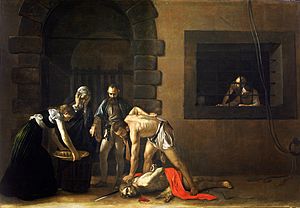
Caravaggio’s painting of the beheading of John the Baptist. From wikimedia.org.
So many people like him are suffering today, refusing to give in to the pressures and whims of modern Herods among us because they believe in you that they stand for what is true.
O good Jesus, we pray for those suffering for truth and for life like John the Baptist in this time of pandemic; bless them and keep them always for they remind us like your precursor that you have come, that you are among us.
Keep our hopes vibrant and alive in you and to a more just tomorrow, Lord, so that we may persevere in speaking your words of truth no matter what others would say. Amen.
Lawiswis ng Salita ni P. Nicanor F. Lalog IIPaggunita sa Pagpapakasakit ni San Juan Bautista, Ika-29 ng Agosto 2020
Ama naming mahabagin,
ngayong ginugunita namin
pagpapakasakit ni San Juan Bautista,
Inyo sanang dinggin aming panalangin
para sa maraming kapatid namin na ginigipit, iniipit;
ang iba sa kanila ay nakapiit
marami ang lugmok sa pait at sakit na sinapit
mula sa mga makabagong Herodes at Herodias
na prinsipyo at pagkatao, ipinagpalit sa ginto.
Inyong patatagin paninindigan sa katotohanan
katulad ni San Juan Bautista
upang ipagpatuloy pakikipaglaban
nasaid man ang kabuhayan
at tanging pinanghahawakan
dangal ng katauhan.
Ikaw lamang Panginoon
ang nakaaalam ng higit na mainam
kami ay Iyong turuan at tulungan
katulad ni San Juan loob mo ay masundan
kami ma'y maging palatandaan
ng Iyong kapanatilihan sa gitna ng mga
pag-uusig at kahirapan.
Amen.
*Mga larawan sa itaas: una ang painting ni Caravaggio ng pagpupugot sa ulo ni Juan Bautista mula sa wikimedia.org; biktima ng tokhang mula sa Philippine Daily Inquirer; umiiyak na empleyado ng ABS-CBN mula sa Reuters.org; at mga locally stranded individuals sa ilalim ng flyover malapit sa NAIA kuha ni G. Raffy Tima ng GMA-7 News.
The Lord Is My Chef Breakfast Recipe for the Soul by Fr. Nicanor F. Lalog II
Friday, Memorial of St. Augustine, Doctor of the Church, 28 August 2020
1 Cortinthians 1:17-25 <*(((><< ||+|| >><)))*> Matthew 25:1-13
Philippe de Champaigne’s painting “Saint Augustine” (1645-1650) from wikimedia.org.
Whenever I look back in my life, Lord, the more I realize the truth that it is YOU who finds us when we are lost. Even before we searched for you, you have been asking us to come home to you. In fact, to look for you is a grace in itself because that is when you have finally found us!
Late have I loved you, O Beauty ever ancient, ever new, late have I loved you! You were within me, but I was outside, and it was there that I searched for you. In my unloveliness I plunged into the lovely things which you created. You were with me, but I was not with you… You called, you shouted, and you broke through my deafness. You flashed, you shone, and you dispelled my blindness… You touched me, and I burned for your peace.
From the Confessions of St. Augustine
Thank you dearest Jesus in giving us the great St. Augustine, another version of St. Paul who started so wrong in life but ended right on your side.
Please be patient with us, Lord, specially in those times we feel so wise, thinking we know everything, that we can direct our own lives without you.
Open our hearts and our minds that we may heed the words of St. Paul like St. Augustine:
For Jews demand signs and Greeks look for wisdom, but we proclaim Christ crucified, a stumbling block to Jews and foolishness to Gentiles, but to those who are called, Jews and Greeks alike, Christ is the power of God and the wisdom of God. For the foolishness of God is wiser than human wisdom, and the weakness of God is stronger than human strength.
1 Corinthians 1:22-25
We pray, O Jesus, for the gift of wisdom like the wise virgins of your parable that even in the darkness of our lives, our hearts may always be aflame with your love. Amen.
Photo by author inside our parish at sunset, 25 August 2020.