The Lord Is My Chef Daily Recipe for the Soul by Fr. Nicanor F. Lalog II
Friday, Memorial of San Padre Pio de Pietrelcina, Priest, 23 September 2022
Ecclesiastes 3:1-11   ><000'> + ><000'> + ><000'>   Luke 9:18-22
From Quotefancy.com
Thank you, dear God our
loving Father for your words
today of the most common thing
we all have and share but
misunderstood and
taken for granted,
TIME.
There is an appointed time for everything, and a time for every affair under the heavens… He (God) has made everything appropriate to its time, and has put the timeless into their hearts, without man’s ever discovering, from beginning to end, the work which God has done.
Ecclesiastes 3:1, 11
Indeed, there is a time for everything,
but you alone O God has determined
the perfect time for every event
to happen in our lives and in history
to which we have miserably failed to
respond properly, rightly as we
manipulated "each" time we have without
recognizing the uniqueness and
blessedness of every past,
present and future; there are times
we cling to the past, refusing to
learn its lessons that we find it hard
to move forward to the present as we
likewise deny the beauty and fulfillment
of the future in you; forgive us for being
foolish not to see and recognize you in our time
that we often miss that great mystery
and reality that we are in your time.
From Quotefancy.com
Thank you, dear God,
in giving us your Son Jesus Christ
that we are now able to understand
and accept not only his words but
also the reality of his Passion, Death
and Resurrection unlike the Twelve
in their time; but, unlike them,
until now we could not own
and live that reality of Christ's pasch
in our very selves and own life that
up to this time, many people are still
confused and could not find Jesus
truly present in our time.
Dearest Jesus,
I do not ask for the special
graces you gave our most
loved San Padro Pio; I do not need
stigmata nor powers to heal nor
read people of their sins; all I ask
you is the grace to live in your
presence always to experience
San Padre Pio's prayer,
"My past, O Lord, I entrust
to your mercy; my present
to your love; my future
to your providence."

San Padre Pio,
Pray for us!
Amen.
The Lord Is My Chef Daily Recipe for the Soul by Fr. Nicanor F. Lalog II
Tuesday, Memorial of St. Andrew Kim Taegon & Korean Martyrs, 20 September 2022
Proverbs 21:1-6, 10-13     <*((((>< + ><))))*>     Luke 8:19-21
Photo by Dr. Mai B. Dela Peña, Santorini, Greece, 2014.
God our loving Father,
today I offer myself to you,
everything I have,
all my plans and undertakings
because everything is ultimately
in your hands!
Like a stream is the king’s heart in the hand of the Lord; wherever it pleases him, he directs it. All the ways of a man may be right in his own eyes, but it is the Lord who proves hearts. To do what is right and just is more acceptable to the Lord than sacrifice.
Proverbs 21:1-3
Slow me down,
caution me,
and if necessary,
stop me to yield to
your Holy Will and
better plans especially
when I am overwhelmed
by my many preparations,
when I feel stressed and
compelled by people and
situations; remind me, Lord,
people and their welfare
are better than programs
and things; open my heart
and my ears to listen to your
words, to your voice always the
faintest one deep in my heart
covered by the noises of the world
and of my many confusions and
selfish ambitions.
Like the first martyrs of Korea
whom we remember today,
grant me courage and perseverance
to hold on to what is true and good,
to remain steadfast in faith
in the face of persecutions
and trials,
ready to sacrifice and
let go of my pleasures and
comforts, so inspire others
to find and follow you, dear Jesus.

St. Andrew Kim Taegon and
companion Martyrs,
Pray for Us!
Amen.
St. Andrew Kim Taegon, first Korean priest with his lay associate St. Paul Chong Hasan with 113 other Koreans died as martyrs between 1839 and 1867. There are now about four million Korean Catholics, one of the most vibrant in the world, ranking fourth with the most number of saints.
The Lord Is My Chef Sunday Recipe for the Soul by Fr. Nicanor F. Lalog II
Twenty-Fifth Sunday in Ordinary Time, Cycle-C, 18 September 2022
Amos 8:4-7  ><}}}}*>  1 Timothy 2:1-8  ><}}}}*>  Luke 16:1-13
Photo by author, sunrise at Lake Tiberias, the Holy Land, May 2019.
Our first reading this Sunday from the Book of Amos sounds like coming from a recent publication denouncing the corruption and social decadence in most countries these days, of the rampant injustice and exploitation of the poor, of how hypocrisies thrive among the rich and powerful and religious too!
Hear this, you who trample upon the needy and destroy the poor of the land! “When will the new moon be over,” you ask, “that we may sell our grain, and the sabbath, that we may display the wheat? We will diminish the ephah, add to the shekel, and fix our scales for cheating! We will buy the lowly for silver, and the poor for a pair of sandals; even the refuse of the wheat we will sell!”
Amos 8:4-6
How sad that long before the coming of Jesus Christ and more than 2000 years after his birth with all the civilization and religion all over the world, nothing has really changed at all: greed for power and money continue to divide peoples and nations, causing many losses of lives from crimes and wars that have ensued.
"Everything has a price,
everything has to be summed up
that sadly in the process,
God and people are commodified
while things are personified! "
Photo by Mr. Jay Javier, April 2022.
Throughout history, we have never learned and perhaps, have continued to refuse to learn from God, beginning from his prophets like Amos down to his own Son Jesus Christ, the important lesson of giving more value to him and to one another. We have always put more premium and value on things that perish than on those of true value that remain even to eternity, none other than God and one another.
“If, therefore, you are not trustworthy with dishonest wealth, who will trust you with true wealth? If you are not trustworthy with what belongs to another, who will give you what is yours? No servant can serve two masters. He will either hate one and love the other, or be devoted to one and despise the other. You cannot serve God and mammon.”
Luke 16:11-13
True wealth vs. dishonest wealth
Jesus continues his journey to Jerusalem, intensifying his teachings on discipleship with two parables this Sunday and next week to deepen our knowledge and relationship with him and others as disciples.
We have heard today his parable of the wise steward who reduced the debts of his master’s creditors to ensure he could find employment in them when fired from his job. Jesus did not approve of his wily scheme but praised him and those like him of the world in finding ways to “win hearts” of people with their pakikisama as we call in Pilipino which is often a wrong sense of camaraderie when people help each other even in shenanigans and other corrupt practices.
(Photo by Lauren DeCicca/Getty Images)
If we could just find means in truly helping each other in life with the same ardor, we could probably have a better and more humane society where we value persons more than things. That is the kind of discipleship Jesus is teaching us today with his sayings after narrating this parable — of having God and one another as our true wealth in life, not dishonest wealth of money, power and fame that feed on our pride and ego. Having God and others as our true wealth means valuing them most in our lives through Jesus Christ.
Problem happens when we value things like money and fame more than God and persons like in the time of Amos that continues to this day as we focus more with how much we shall earn, of what’s in store for us in terms of profits and returns without giving the slightest concern for people and God. Everything has a price, everything has to be summed up that sadly in the process, God and people are commodified while things are personified!
Sorry to say this but the clearest example of our commodification of God is this online Mass when we make him like a canned good or a video on-demand like in Netflix we take out to watch and consume when we just have a feel for it. No relationship at all. Just like that, as in ganun lang… in case of an emergency, we take out God like a life vest tucked under the plane seat.
In the same manner, we commodify people when we see them in utilitarian perspectives, in their usefulness for us in attaining our selfish goals. We commodify people when we totally disregard them as “no body”, as if they do not exist that we do not recognize them at all, not caring for them as “some body” like in next Sunday’s parable of the rich man and Lazarus.
Even us in the Church contribute in this commodification of God and of people long before the advent of online Masses in the way we regard parish assignments. How do we priests look at the people and the parish, really?
What a shame at how we priests persist that unChristian frame of mind in distinguishing parishes as “big parish” and “small parish” in reference to their income and collections, never in terms of population or number of souls and their pastoral needs! This results in the tragic mire we are stuck called careerism fueled by the never-ending competition among priests for parish assignments, forgetting altogether our sense of service and mission.
Sad. Very, very sad.
"True wealth and riches are God and people.
We live to love.
Let us put an end to restrictions on whom to love,
whom to value for we are all brothers and sisters in Christ..."
Photo by author, 12 August 2022.
This Sunday, Jesus is blessing us with the grace and challenge of examining deeply in our hearts what and who do we value most?
If we consider material things as riches, then, we have not moved away from the time of Amos; we are still living in ancient time of decadence and immoralities despite the sophistications we now have like hi-tech gadgets we use for cheating others as we hide in our fine clothes and air conditioned homes, offices, and vehicles.
True wealth and riches are God and people. We need more people, more children, more family, more friends to share and celebrate life with. Not more money nor more houses and cars we cannot use at the same time; we do not need more food nor more clothes for we live not to eat.
We live to love. Let us put an end restrictions on whom to love, whom to value for we are all brothers and sisters in Christ as St. Paul reminds us in the second reading today. Most of all, the great apostle tells us to value everyone, from our leaders down to the common tao we meet everywhere, praying for one another for it is God’s design that in the end, we shall all together dwell in him in heaven, the true wealth and riches we must all aspire. Amen.Have a blessed weekend everyone!
The Lord Is My Chef Sunday Recipe for the Soul by Fr. Nicanor F. Lalog II
Twenty-Fourth Sunday in Ordinary Time, Cycle-C, 11 September 2022
Exodus 32:7-11, 13-14 ><}}}}*> 1 Timothy 1:12-17 ><}}}}*> Luke 15:1-10
Photo by author, 2018.
Last Wednesday morning during breakfast, we heard on television news the interview of the undersecretary of agriculture blaming our farmers for the recent oversupply of garlic in Batanes and cabbage in Benguet, saying “they plant crops but they don’t think about the market for their harvests.”
We have been so used to such comments by many heartless government officials ever since; and, they also happen everywhere like in our schools where teachers blame students, at homes with parents blaming children and siblings blaming one another and of course, not to be left out is our church where priests always blame people for whatever problems and mishaps that happen in the parish.
No wonder, we feel more comfortable with God depicted in the Old Testament like in our first reading today when God was so angry and instructed to immediately get down from the mountain to punish the people who have created a golden calf to worship.
We find it so difficult to fully and truly accept despite Christ’s words and assurances that God our Father finds joy in forgiving as depicted today in our gospel. So often, we are like the Pharisees and scribes who could not understand why we have to share in the joy of God when a sinner repents.
Tax collectors and sinners were all drawing near to listen to Jesus, but the Pharisees and scribes began to complain, saying, “This man welcomes sinners and eats with them. So to them he addressed this parable.
Luke 15:1-3
Photo by author, 2018.
Jesus reminded us these past two Sundays of the demands of discipleship, of the need for us to conform to his very person and not just with morality and even religiosity. Discipleship is being like Jesus, always having him as our top priority in life.
This progression of Christ’s teaching on discipleship reaches its peak as we move into the 15th chapter of Luke’s gospel account considered as the “heart” of the Gospel in presenting to us three parables showing God full of mercy and forgiveness for sinners. Actually, it does not merely present God as forgiving but in fact as the One who finds joy in forgiving, who is inviting us to share in his joy of forgiving repentant sinners.
There are three parables in Luke chapter 15: the lost sheep, the lost coin and the lost son known as prodigal son. We have opted to consider the shorter form of the gospel which skips the third parable which we have already reflected in the recent Season of Lent.
Photo by Dr. Mylene A. Santos, MD, in Quezon, July 2022.
The first two parables deal with things that are lost, a lamb and a coin; both deal with only one person like “one of you” and “a woman”. On surface, the two parables seem very ordinary but Jesus – and Luke – have a very captivating manner of narrating them, similarly ending each parable with great sense of rejoicing after finding the lost sheep and lost coin.
Simply put, Jesus is appealing to our common experience of how one lost item would surely claim our attention, no matter how small or even insignificant it may be compared with the rest of what we have.
How do you feel when after losing something you were so worried and disturbed searching for it then someone tells you, “para yun lang?”
We feel so mad, like being rubbed with salt on our wounds because such comment “para yun lang?” betrays their lack of concern and love for us, of not knowing at all or at least recognizing how much that missing thing means to us!
How much more with persons like family and friends who have gone wayward in life like the prodigal son and suddenly coming back to us, saying sorry, trying to pick up the broken pieces of our lives to be whole again as friends and family? Would we not also rejoice when they come home, when we finally find them again?
Photo by Dr. Mylene A. Santos, MD, 2020.
In narrating the two parables in such manner so common with us, Jesus now affirms the incomparable value of every repentant sinner. Moreover, Jesus is showing us in these parables the more deeper ties we have with each other that we must rejoice when a sinner is converted. Hence, the demand too on the part of the sinner, of everyone, to recognize our sinfulness first.
Notice how Luke began this new chapter by telling us how “Tax collectors and sinners were all drawing near to listen to Jesus, but the Pharisees and scribes began to complain, saying, ‘This man welcomes sinners and eats with them.’ So to them he addressed this parable.”
Look at the attitudes of the Pharisees and scribes that are not just snobbish but recriminating against the tax collectors and sinners; for them, those kind of people were hopeless, improbable to change that no one should be socializing with them like Jesus.
But, what really got to their nerves that they were complaining why Jesus was sharing meals with them was the fact that tax collectors and sinners were not turning to the Law but to Jesus himself, following him, and even preferring him more than everything! They felt left out when in fact they were the first to separate themselves from everyone.
That’s what they could not accept, that they were no longer relevant.
And the main stumbling block to that was their lost their sense of sinfulness as they have believed so much with themselves as if they were like God, so pure and so clean. Due to their lost sense of sinfulness, they have been totally detached from God and from others as well because they were playing gods, setting them apart from everyone even from God himself because they believed they were sinless. In that sense, they felt God had nothing to do with them because they were sufficient in themselves.
There is nothing God cannot forgive.
This is the grace of this 24th Sunday in Ordinary Time.
Whenever we admit and confess our sins to him,
it is God who is first of all filled with so much joy
 for he has long been searching
and waiting for us to return to him.
Photo by author, 2019.
This is the problem we have in this modern time, when we have all kinds of excuses and alibis, reasons and arguments in doing just everything, losing our sense of sin that unconsciously, we feel like God, in fact always playing God when we presume to know everything that we would neither rejoice when people change for the better nor sympathize with those suffering and in misery. Like the Pharisees and scribes and those heartless people in power and authority in government and schools, at home and in the church, they have no time to even see and review why and what have caused people to sin.
In the first reading, Moses is teaching us the attitude of a true disciple, of one who intercedes for the people by confessing the tender mercy and fidelity of God to his promises and to his people; Moses did not bargain with God to relent in punishing the people. Notice his language, his manner of praying to God, appealing to him as “Lord” filled with faith in God’s boundless mercy and forgiveness. We all know how in a twist of humor, it was Moses who was so furious later when he saw the people worshipping the golden calf that he threw on them the two tablets of stone of God’s Ten Commandments.
In the second reading, St. Paul reminds us through Timothy of God’s boundless love expressed in his mercy and forgiveness to us all sinners. We can never experience this unless we first realize and admit and own our sinfulness like St. Paul who may be considered the worst of sinners for having persecuted the early Christians. There are so many other saints who followed after him with so dark and sinful pasts but became great men and women of faith because they first admitted their sins and sinfulness. As the saying goes, there is no saint without a sinful past and there is no sinner who is denied of a saintly future.
There is nothing God cannot forgive. This is the grace of this 24th Sunday in Ordinary Time. Whenever we admit and confess our sins to him, it is God who is first of all filled with so much joy for he has long been searching and waiting for us to return to him. Amen.
Have a blessed week ahead!
Photo by author, Mount Sinai at the Monastery of St. Catherine, Egypt, 2019.
The Lord Is My Chef Daily Recipe for the Soul by Fr. Nicanor F. Lalog II
Friday in the Twenty-Third Week in Ordinary Time, Year II, 09 September 2022
1 Corinthians 9:16-19, 22-27   ><]]]]'> + <'[[[[><   Luke 6:39-42
Photo by Mr. Jim Marpa, 2019.
Your words today from St. Paul
are so timely, dearest Lord Jesus;
in a time when so many of us have
become so complacent and even
lazy in this life characterized by
comfort and ease, please reset our
perspectives and points of view,
Jesus, when all we think is ourselves,
of being famous and popular;
worst of all, like in your stern warning
in the gospel, we have become self-
righteous, blinded by our ego that
we see ourselves better than everyone
when all we see are others' faults
without noticing our bigger faults.
Brothers and sisters: If I preach the Gospel, this is no reason for me to boast, for an obligation has been imposed on me, and woe to me if I do not preach it! No, i drive my body and train it, for fear that, after having preached to others, I myself should be disqualified.
1 Corinthians 9:16, 27
Grant me the grace,
O Lord, to be truly your follower,
your disciple, a person of
discipline who treads the path of
truth and mercy, light and understanding,
justice and mercy, honesty and sincerity;
give me the courage to persevere in
following you amid all pains and
difficulties.  Amen.
Lord My Chef Daily Recipe for the Soul by Fr. Nicanor F. Lalog II
Monday, Memorial of the Queenship of Mary, 22 August 2022
Isaiah 9:1-6   ><}}}*> + ><}}}*> + ><}}}*>   Luke 1:39-47
Photo by author,Makati skyline at sunset from Antipolo City, 13 August 2022.
It is a very busy Monday
for everyone, O God,
our loving Father:
it is the first day of school
for most students,
another first day of work
with all the traffic and woes
of life slowly going back
to normal.
And I really wonder,
what could surprise us today,
Lord, like Mary when your
angel announced to her the
coming of Jesus Christ by
being his mother?
But she was greatly troubled at what was said and pondered what sort of greeting this might be.
Luke 1:29
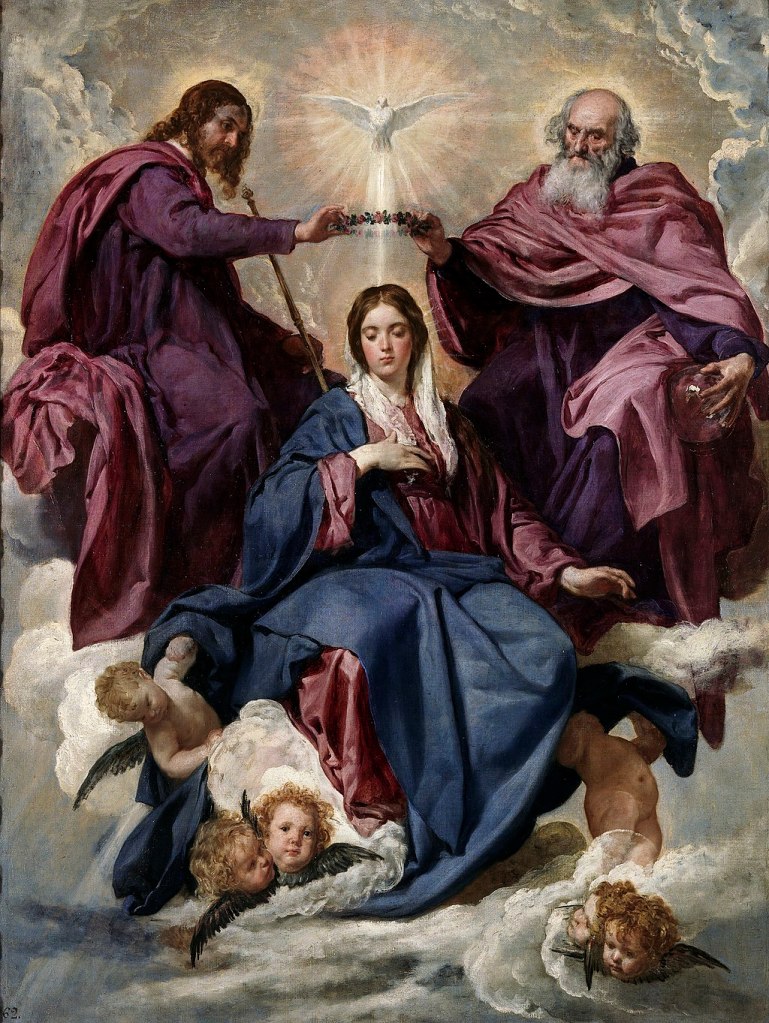
“Coronation of the Virgin” by Diego Velazquez (ca.1635/1636) from en.wikipedia.org.
On this memorial of the
Queenship of Mary,
let us rejoice and be grateful
to you for the grace of being
favored to be up and going this day
no matter how busy we may be;
let us be surprised by the
tremendous blessings you
shower upon us like Mary
when deep in our hearts we know
we are nothing before you;
surprise us, Lord, of your
presence, of your life, of your love,
most of all, of your trust;
enable us to say yes to your call
for us to serve you today,
to bring light in this dark world,
to share Jesus Christ like Mary
who is our "Prince of Peace and
Wonder-Counselor" (Is.9:5).
O most blessed Virgin Mary,
help us to welcome Jesus Christ
daily in our lives in order for us to
share him with everyone like you;
as the first of the human race in rank
before God's presence and as the
Mother of Christ our King, you are
given the title of Queen not only as an
honor but an example of discipleship in
your Son Jesus.  Amen.

O, Mary Queen of heaven,
Pray for us!
Quiet Storm by Fr. Nicanor F. Lalog II, 18 August 2022
Photo by author, Sacred Heart Spirituality Center, Novaliches, QC, 2018.
Intimacy with God and with others is a journey that is often long and difficult, painstaking but so wonderful. It is a process with highs and lows but something that could come out as a precious gift we must keep and nurture.
Mr. Webster defines intimacy as “close familiarity or friendship” or simply, “closeness”.
But being close does not necessarily mean intimacy. True closeness in intimacy means finding and sharing a “sacred space” with someone that is built on mutual trust and sincerity where we bare our true selves to offer it to the other person. It is in this sacred space where intimacy grows as we become “engaging” with the other person, even with God, like in bantering.
There is one beautiful incident in the gospel I always love relating with the topic of intimacy, the story of the Canaanite woman who begged Jesus to heal her daughter.
At that time Jesus withdrew to the region of Tyre and Sidon. And behold, a Canaanite woman of that district came and called out, “Have pity on me, Lord, Son of David! My daughter is tormented by a demon.” But he did not say a word in answer to her. His disciples came and asked him, “Send her away, for she keeps calling out after us.”
Matthew 15:21-23
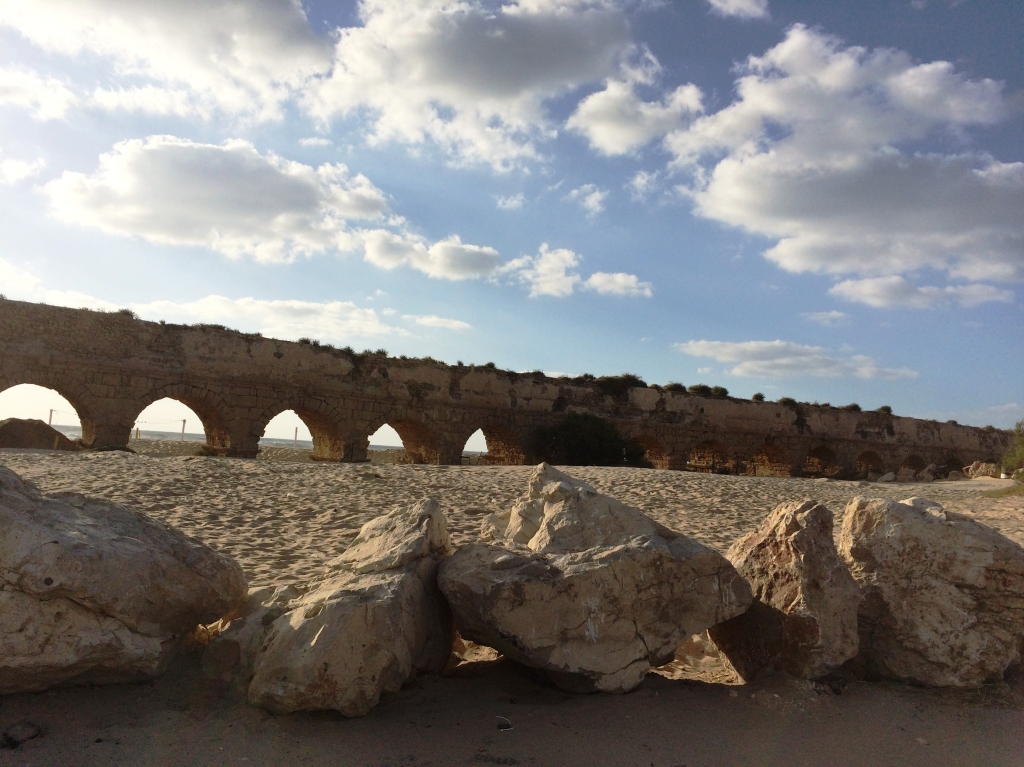
Photo by author, Caesarea in Israel, May 2017.
Here we find the first difficulty with intimacy which happens often in the most unexpected situations like Jesus going to a foreign territory where we are not most comfortable or most at home, where we are so uncertain with everything and everyone.
Is it not that is when we grow intimate with others and with God, when we were in the most desolate situations, when we were weakest when suddenly somebody came to strengthen us in our journey?
It was not a simple walk in the park though because it was as if like adding salt to our injuries when at our lowest point in our lives we were asked to even go lower, bare our vulnerabilities further until we were stripped naked of our pretensions and defenses, standing naked and true.
"That is intimacy, of still believing, of being sincere, of still being beautiful and good in the worst situations with one's self with the other person. It is a sacred space where anyone can come and be welcomed, be affirmed, or simply be safe for a moment while the storm is passing through you."
Photo by Dr. Mylene A. Santos, MD, 2021.
Notice how Jesus tested the Canaanite woman to see how engaging she could be in their conversation, of how willing was she to get closer to him and be intimate to gain his healing.
But the woman came and did him homage, saying, “Lord, help me.” He said in reply, “It is not right to take the food of the children and throw it to the dogs.” She said, “Please, Lord, for even the dogs eat the scraps that fall from the table of their masters.” Then Jesus said to her in reply, “O woman, great is your faith! Let it be done for you as you wish.” And her daughter was healed from that hour.
Matthew 15:25-28
I like this part; it was more of the woman bantering with Jesus than bargaining. Try situating yourself there as if the woman was already feeling close with Jesus, engaging him in their conversation when he used the colloquial expression “dog” used by Jews at that time to refer to Gentiles or pagans. Of course, there was no any racial or malicious intent on the part of Jesus in using that common expression of his time; in some translations, he used the word “puppies”.
And that is where intimacy kicked in: when the Canaanite woman told him how dogs – or puppies – eat just the scraps from the master’s table. Here is a woman baring everything to Jesus, taking off all her defenses totally accepting the realities of life, of them outside the own circle of Jesus who was a Jew but still believing in him and in herself that she is worthy of attention, of healing for her daughter.
Photo by author, sunrise at Lake Tiberias, Israel, May 2017.
That is intimacy, of still believing, of being sincere, of still being beautiful and good in the worst situations with one’s self with the other person. It is a sacred space where anyone can come and be welcomed, be affirmed, or simply be safe for a moment while the storm is passing through you. This is very true for those who had undergone surgery when you were there on the narrow operating table, naked and everything, just praying and hoping everything would go well, without any complications later. That is why I admired doctors more than ever because after a surgery and you visit them for follow up consultations, it is as if he had not seen the worst in you, still friendly and casual. Most of all, trying so hard to keep you well and healthy!
"Intimacy is the reason why everyone says life is a journey."
To be intimate with Jesus is like continuing the journey with him in foreign territories like when a man and a woman get married not knowing what’s really in store for them or a young man getting ordained as priest or a lady taking religious vows without realizing the real weight of Christ’s cross to carry. Many times in life, we just forge on in life with our family and friends, and with God most especially, engaging him in conversations even debates to show him how convinced we are in ourselves, in our cause, in our prayers. We grow intimate only with someone who is willing to accept us.
Intimacy is the reason why everyone says life is a journey – you always have a companion, somebody you break bread with which is the literal meaning of “companion” from the Latin terms cum panis.
The most beautiful part of this journey in intimacy, whether with God or with another person is that as we become one in being intimate with the other, the more we become free, not constricted nor limited because the more we love, the more we trust each other that even when we are not together physically, we can still be intimate — because intimacy is actually a spiritual reality, a gift only God can give for those willing to take the difficult journey.
That is why, we priests remain celibate: our celibacy is the clearest sign of our intimacy not only with Jesus our Eternal Priest but also with you, our flock, the people of God which is the Church.
When parishioners give their pastors a good chance to pray and recreate to nurture their intimacy with Jesus, the more priests value their celibacy, the more they are true and faithful in serving the people, the Body of Christ, the Church.
Anyone who finds true intimacy finds true love who is God alone. That is the essence of our celibacy as priests. And that is why, priests and religious, as well as married couples and singles joyful in their state of life too who have found intimacy would never venture to look for other “loves” because they have already found God, our true intimacy. It would be madness to any priest to break his vow of celibacy or, even to married couples to go on extra-marital affairs when you already have God. Amen.
May you find and experience intimacy in your life journey.
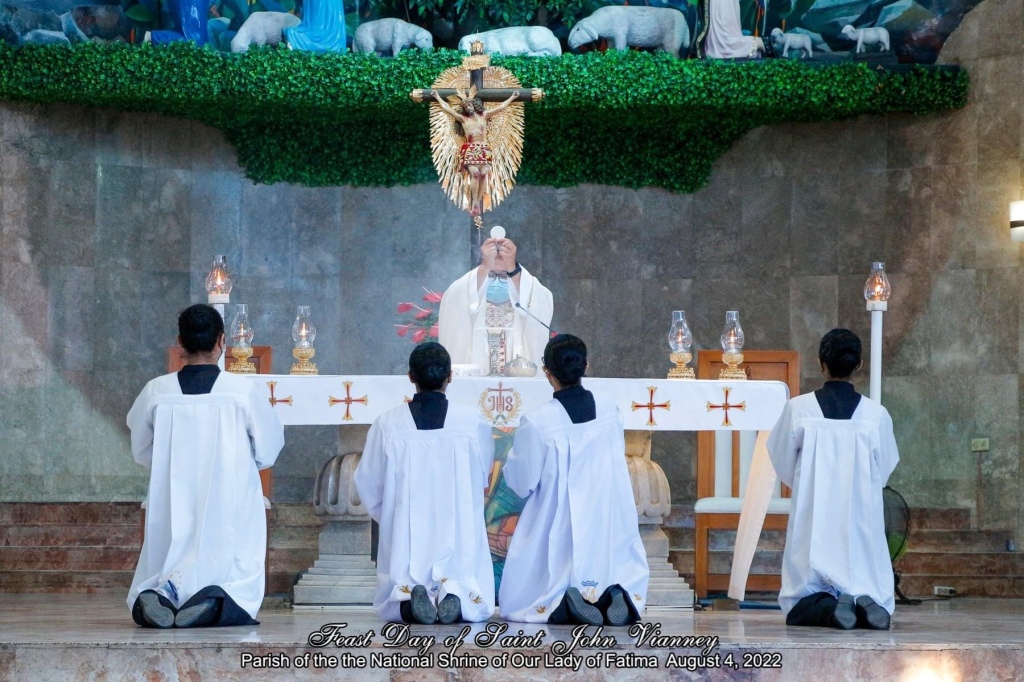
Photo by Ka Ruben, National Shrine of Our Lady of Fatima, Valenzuela City, 04 August 2022.
The Lord Is My Chef Daily Recipe for the Soul by Fr. Nicanor F. Lalog II
Monday, Solemnity of the Assumption of the Blessed Virgin Mary, 15 August 2022
Revelation 11:19, 12:1-6, 10 ><}}}*> 1 Corinthians 15:20-27 ><}}}*> Luke 1:39-56
Photo by author, view of sunrise from Our Lady of Fatima University in Antipolo City, 14 August 2022.
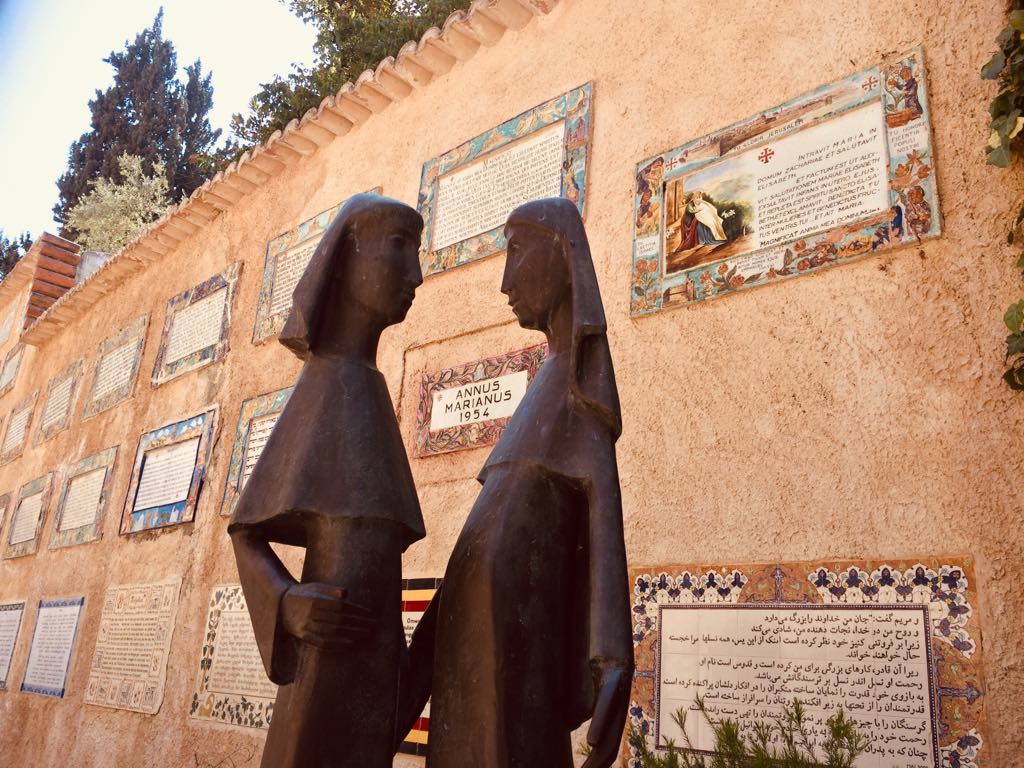
It is very rare to find in the Bible a story of two women together, conversing, blessing each other. And that rarity happens in our gospel scene today of the Visitation of Mary to her cousin Elizabeth in a town in Judah as we celebrate the Solemnity of the Assumption of Mary.
What kind of greeting did Mary say that when Elizabeth heard her, the child in her womb leaped in joy, filling her with the Holy Spirit to call Mary blessed? This could have not been any ordinary greeting to elicit such a response from Elizabeth, for her to be filled by the Holy Spirit!
Luke does not tell us how Mary greeted Elizabeth who was six months pregnant at that time with John the Baptist, the forerunner of Jesus who was also in the womb of Mary at that time. Most likely, she must have said something too close or similar with Gabriel’s greeting to her during the Annunciation, “Hail favored one! The Lord is with you” (Lk.1:28).
As we await of that future glory,
part of the basis for our assumption
 into heaven like Mary someday depends
 in the way we greet others because
that is an indication of our generosity
and selflessness to a great extent.
Perhaps some of you are wondering why the Church is using this story of the Visitation on this Solemnity of the Assumption of the Blessed Virgin Mary. One reason is of course, there is no written account of the Assumption of Mary into heaven.
However, the Visitation story which includes Mary’s Canticle of the Magnificat that she sang as a response to Elizabeth’s praises reflects the meaning of the Assumption: it is a celebration of the great things that God has done for Mary and for us including which he would also do in the future like our “assumption” into heaven like we profess every Sunday in the Apostles’ Creed, “the resurrection of body and life everlasting.”
“The Assumption of the Virgin” by Italian Renaissance painter Titian completed in 1518 for the main altar of Frari church in Venice. Photo from en.wikipedia.org.
Mary became the first human to experience fully the salvation by her Son Jesus Christ, from her Immaculate Conception which speaks of our lost glory from the beginning, and unto her Assumption which promises us of the future glory we shall have in heaven.
As we await of that future glory, part of the basis for our assumption into heaven like Mary someday depends in the way we greet others because that is an indication of our generosity and selflessness to a great extent.
When Elizabeth heard Mary’s greeting, the infant leaped in her womb, and Elizabeth, filled with the Holy Spirit, cried out in a loud voice and said, “Blessed are you among women, and blessed is the fruit of your womb. Blessed are you who believed that what was spoken to you by the Lord would be fulfilled.”
Luke 1:41-42, 45
To greet is to recognize God working in us, among us.
It is thinking more of the other person and God than one's self.
Have you noticed these past several years of a silly and inane trend especially in many churches of commentators greeting the congregation with “Magandang umaga po sa ating lahat” or “Good morning to us all”?
What kind of a greeting is that?
To greet somebody is to share something with others. In the Visitation, Mary shared Jesus Christ who was in her womb to Elizabeth that even John in her womb felt him, leaping for joy.
To greet means to extend goodwill to someone, to desire blessings and good things to others.
That was the reason Mary went to visit Elizabeth; she was thinking more of her cousin who was old and barren yet pregnant for six months by the grace of God. Mary visited Elizabeth to affirm the goodness and kindness of God, to recognize that God’s plans for Elizabeth and her baby in her womb have direct correlations with God’s plans for her and her baby in the womb, Jesus.
To greet is to recognize God working in us, among us. It is thinking more of the other person and God than one’s self.
Now, how did it happen that we Filipinos have retrogressed especially in our religious gatherings as well as civic activities when those holding the mic would always say, “Magandang gabi sa ating lahat… Pagpalain tayong lahat ng Diyos” (Good evening to us all or May we all be blessed)?
Photo by author, Church of the Visitation, Ein-Karem, Holy Land, May 2017.
Keep in mind the greeter is sharing what he/she has like a “good morning” or a “blessed day”. Then why is it there are so many among us especially commentators who include their very selves when greeting the congregation, saying “good morning to us all” and other inanities?
To greet others where the greeter includes self in the greeting is like giving a sandwich or coffee to everyone yet takes a bite first or sips too! It is very much the same as replying “me too” when someone tells you “I love you”.
If you include yourself in a greeting, it is not a greeting at all but an insult, a clear sign of callous ego and selfishness to the highest degree that one cannot wait for others to be greeted back.
See the humility and wisdom of Mary: after she had greeted Elizabeth who praised her in return by calling her “blessed” – the first to call her as one – Mary praised God. Not Elizabeth.
When we greet anybody with good morning or good evening or whatever, we do not include ourselves in the greeting because the very fact we are greeting others means we have a lot of good and blessings in us. Like Mary and Elizabeth, we feel so blessed by God that we share Jesus freely to others. Like Mary, we believe and trust that God will never forsake us, will never forget us.
If we can’t even greet somebody so well and so freely, how can we be truly Christian like Mary?
Photo by author in Nazareth, Israel, May 2019.
The Solemnity of the Assumption reminds us today of that great and powerful greeting by Mary to her cousin Elizabeth that led to an encounter and revelation to happen between two women, one old and barren to bear a child with the other too young and unmarried virgin yet both bore children in their wombs by the grace of God.
And it was not just an encounter between the two mothers-to-be but also between their two infants still in their wombs!
In their greetings, God’s mighty deeds became evident, truly present and felt through their mutual exchange of believing, of saying “yes” to Jesus.
The blessedness of this celebration today is found in God’s mighty deeds now resounding in the eternal greeting Mary gives her Son Jesus in heaven.
Photo by author, sunset with the Makati skyline from Antipolo City, 13 August 2022.
Do we hear Mary’s greetings in our own greetings to one another?
Do our greetings elicit responses from others?
Do our greetings lead others to leap for joy?
Or, do our greetings annoy them because we do not greet them at all, we refuse to share Jesus because we have become too conceited?
How can we be assumed into heaven body and soul if we are so filled with our very selves, when we can’t even freely and truly give away greetings to others?
Then, it must be a case of too much presumptions, of assuming everything for us. Amen.
The Lord Is My Chef Sunday Recipe for the Soul by Fr. Nicanor F. Lalog II
Twentieth Sunday in Ordinary Time, Cycle C, 14 August 2022
Jeremiah 38:4-6, 8-10 ><}}}*> Hebrews 12:1-4 ><}}}*> Luke 12:49-53
Photo by author, Chapel of the Holy Family, Sacred Heart Spirituality Center, Novaliches, QC, 2017.
Following Jesus, being a true and good Christian is always difficult. This I realized on my first month as a priest 24 years ago when I gave a “marriage encounter” (ME) to several married couples from the parish of my former professor in the seminary.
Part of the marriage encounter is the writing of one’s sins on a piece of paper with a symbolic burning before going to confession later in the evening; problem was, as a new priest, I gave a wrong instruction asking the spouses to exchange paper with their partner to see each others sins. That was when a wife collapsed after reading the sins of her husband! Actually, she had long suspected him of infidelities but that afternoon, all her doubts and suspicions were proven very true that her blood pressure shoot up, losing her consciousness in anger and pain.
After she had been revived, she kept on saying, “akala ko ME magpapatatag sa aming samahan; ito na yata maghihiwalay sa aming dalawa ng tuluyan” (I thought the ME will make our marriage stronger but it seems this will finally cause our separation as husband and wife).
I tried explaining things to her, prayed so hard for her and eventually after six months, I met them at a wedding as they thanked me how their marriage had gone stronger after surrendering everything to Jesus Christ.
Photo by author, Chapel of the Holy Family, Sacred Heart Spirituality Center, Novaliches, QC, 2017.
"Every Christian is a prophet...
a sign of contradiction."
Many times in our lives we have experienced that our faithful service in the Lord often leads us to distressing and painful situations, even tragic choices. In the first reading, we have heard how Jeremiah’s own folks threw him into a cistern to die because they could not take his preaching against their sinfulness and prophecies of the impending fall of Jerusalem which eventually happened. He was momentarily rescued from the cistern but later was eventually killed by his own people for speaking against their sinful ways and life.
Every Christian is a prophet like Jeremiah, a sign of contradiction among the people, even in one’s own family and circle of friends. To live against the corrupt and sinful ways of the world, to uphold what is true and just, to stand for what is honorable and good surely earn a lot of criticisms and condemnation from everyone. Even in the Church!
Jesus said to his disciples: “I have come to set the earth on fire, and how I wish it were already blazing! There is a baptism with which I must be baptized, and how great is my anguish until it is accomplished! Do you think that I have come to establish peace on the earth? No, I tell you, but rather division
Luke 12:49-51
Photo by author, Chapel of the Holy Family, Sacred Heart Spirituality Center, Novaliches, QC, 2017.
With all of these words, we now wonder what is good with our Good News this Sunday? Remember, Jesus Christ is on his way to Jerusalem to face his suffering and death. Today he tells us three things to remember to remain focused with the End.
First is the fire he had brought into the world. It is not a fire of destruction but fire of heat and light that give life; fire that purifies and cleanses like silver and gold that bring out its beauty and magnificence; and most of all, the fire of God’s presence like in the burning bush of Moses and the pillars of fire/cloud that guided the Chosen People in the wilderness into the Promised Land.
Fire gives light and heat that lead into life; we can survive without food and water for several days but we cannot last even ten minutes without heat! This is the kind of fire we Christians need these days, fire that will lit us up with courage ands joy in Jesus Christ by witnessing his gospel in a world that seems to be dying and lifeless despite the noise and affluence around.
As a purifying fire, it always brings pains that lead into conversion and liberation like what that couple in my first Marriage Encounter have experienced. The fire of Christ’s mercy and forgiveness taught them to forgive each other and enabled them to lead holier lives. The more we get closer to Jesus our light, the more we see our sinfulness and weaknesses, then we change and mature. That is when we are filled with the light of Christ to become his presence in the world.
Second teaching of Jesus today is about his “other baptism” which is his Passion, Death, and Resurrection. This is the reason why he was “resolutely journeying to Jerusalem” – he was so eager, so decided to face his pasch not for the pains it would bring but for its glorious effects for us.
Photo by author, Chapel of the Holy Family, Sacred Heart Spirituality Center, Novaliches, QC, 2017.
That is the real meaning of baptism, from the Greek baptizein which is to immerse in water; hence, baptism before was a literal immersion in water. In our immersion into the passion and death of Jesus Christ, we enter into a communion in him and with him so that in his Resurrection, we too rise with him and in him into new life.
Third pronouncement by Jesus this Sunday is perhaps the most baffling, especially when we consider the statistics that more than half of the conflicts going on in the world today are due to religious beliefs.
Jesus never meant to bring people apart; in fact, he came to bring us all together, to gather us again as beloved children of the Father. However, it happens that the moment we stand for Jesus, for what is true and just, inevitably, we will be with odds even with those dearest to us. Jesus himself had said that “If anyone comes to me without hating his father and mother, wife and children, brothers and sisters, and even his own life, he cannot be my disciple” (Lk.14:26).
That is one of the beautiful imageries of the Cross of Jesus Christ: it marks the end of our sinfulness and the beginning of our oneness in God.
It is the difficult aspect of discipleship when our loved ones are into sins and evil, when they are in darkness and injustice. Are we going to side with them or side with Christ?
At the Last Supper, Jesus gave us his peace (Jn.14:27) that according to him is not like the peace offered by the world that is often based on compromises; Christ’s peace is the fruit of love, of sacrifices. Love and sacrifice are one, always together; when you love, there is sacrifice, there is pain and suffering. That is why it is love!
Parents and lovers know this very well: many times they suffer and cry in silence because of their great love for their children or beloved. It is no wonder that in the Beatitudes, Jesus called the peacemakers and the persecuted blessed because to work for peace entails persecution and division.
Photo by author, Chapel of the Holy Family, Sacred Heart Spirituality Center, Novaliches, QC, 2017.
"God is dangerous."
-Fr. Hans Urs von Balthasar (+)
Last Sunday we have reflected how Jesus used the setting of night for our vigilance because faith is tested and deepened in the darkness of life like during nighttime. And, the darker the night, the longer the night always.
But, we have so many people who have gone ahead of us in this life who have found light and life amid the darkness in life, emerging victorious in their faith in God, from the patriarchs in the Old Testament and in Jesus himself and his Apostles and saints as well.
Brothers and sisters: Since we are surrounded by so great a cloud of witnesses, let us rid ourselves of every burden and sin that clings to us and persevere in running the race that lies before us while keeping our eyes fixed on Jesus, the leader and perfecter of faith.
Hebrews 12:1-2
Wonderful! Jesus is the leader and perfecter of faith. Very often, we hear the gospels and the Bible speaking always of our having faith in Jesus. But, it is only here and in some instances in Paul we find Jesus having faith; how can Jesus, the Son of God have faith when he is the object of faith?
Let us remember that Jesus is truly human, truly divine. Like us, he also had faith as the gospels attest: he had faith in the Father who sent him. He is the best example of having faith, entrusting everything to the Father that he did not feel ashamed of the Cross. In that sense, Jesus is also the perfecter of faith because in him, with him and through him, we are able to walk in faith, sustain our faith in the most difficult and trying moments of life when we felt our relationships, our world falling apart because we have stood by his Cross. As we look back, we have emerged better, stronger, and most of all, joyful, free and faithful after all those trials in life. Thanks to our faith in Christ!
One of the friends of Pope emeritus Benedict XVI and St. John Paul II was the Swiss theologian and priest named Hans Urs von Balthasar who said in his 1945 book “The Heart of the World” that God is dangerous.
Photo by Mr. Jay Javier, Acacia trees in UP-Diliman, April 2022.
Indeed, it is very true especially when Fr. Balthasar noted how God “is inviting you to lose your soul in order to gain it. He always thinks in terms of love. He offers us the impossible… He presents his victory over death as an example to be imitated, he draws us beyond our limits, into his adventure, which is inevitably fatal.”
The blessedness of this Sunday is that Jesus had become like us to lead us the way in a life of faith, perfecting our faith in the process so that we may overcome all obstacles and trials in life like him and be with him in eternal glory in heaven in the End.
Let us keep in mind the worthy reminder of the author of the Letter to Hebrews that “In your struggle against sin you have not yet resisted to the point of shedding blood” (Heb.12:4). Amen.
Have a blessed, fiery week of faithful adherence in Christ!
The Lord Is My Chef Daily Recipe for the Soul by Fr. Nicanor F. Lalog II
Friday in the Nineteenth Week of Ordinary Time, Year II, 12 August 2022
Ezekiel 16:1-15, 60, 63   ><]]]]'> + ><]]]]'> + ><]]]]'>   Matthew 19:3-12
Now, more than ever,
I am convinced dear God
that we are indeed "beings of forgetfulness";
we easily forget, and sadly, we enjoy,
we choose and we "love" so much
forgetting the past,
forgetting people,
forgetting our roots,
and worst, forgetting you
our loving Father.
How striking are your words
to the Prophet Ezekiel today,
"making known to Jerusalem
her abominations", of how as a
nation like a newborn child left
in the dirt with her umbilical cord
still uncut, wrapped in her blood
and all until you O God took her,
bathed and dressed her with
finest clothes, fed with good food,
bestowed with your dignity
that nations loved her (Ezekiel 16:3-14)
only to forget you, O God...
just like us today.
But you were captivated by your own beauty; you used your renown to make yourself a harlot, and you lavished your harlotry on every passer-by, whose own you became. Yet I will remember the covenant I made with you when you were a girl, and I will set up an everlasting covenant with you, that you may remember and be covered with confusion, and that you may be utterly silenced for shame when I pardon you for all you have done, says the Lord God.
Ezekiel 16:15, 60, 63
Let us remember you
Lord always;
teach us to make you a
"member", a "part"
 of each present moment,
thus, "re" + "member"!
Let us enter into communion
in you, with you in Christ Jesus,
remembering, honoring
your divine plans since
the beginning like marriage;
forgive us for the "hardness
of our hearts" that we have relished
in forgetting and disregarding you
 and your plans in the past,
your blessings and plans for the future.
Let us stop "separating"
not only husbands and wives
but most especially our lives,
our selves from you, dear God,
 for you are our life, our being,
our origin and end.
Amen.


























 lordmychef.com