God is the reason

The Lord Is My Chef Sunday Recipe for the Soul by Fr. Nicanor F. Lalog II
Eighteenth Sunday in Ordinary Time, Cycle C, 31 July 2022
Ecclesiastes 1:2, 2:21-23 ><}}}*> Colossians 3:1-5, 9-11 ><}}}*> Luke 12:13-21
My former parish, photo by Mr. Gelo Nicolas Carpio, January 2020.

Last Friday I officiated at the funeral Mass of a younger first cousin; a week earlier, I had anointed him with Oil for the Sick with general absolution of his sins, commending him to God as he was afflicted with a rare disease that attacks the autoimmune system.

It is one of the difficult part in our lives as priests, when sickness and death come closest at home considering that fact that I officiated his wedding about 20 years ago and baptized his eldest son now grown up. That is why our readings today are so timely for me because my cousin Gilbert was only 49 when he died, being the most silent and “goodest” of my cousins who never got into any trouble nor any sickness while we were growing up together in Bocaue, Bulacan. How I felt like Qoheleth, saying….

Vanity of vanities, says Qoheleth, vanity of vanities! All things are vanity. Here is one who has labored with wisdom and knowledge and skill and yet another, who has not labored over it, must leave the property. This is also vanity and a great misfortune.

Ecclesiastes 1:2, 2:21
Photo by author, Pangasinan, April 2022.

Qoheleth is what the author calls himself which is not a proper name but a function of a speaker or a preacher to an assembly which is in Latin ecclesia; hence, it is called the Book of Ecclesiastes.

Despite the tone of his message of “vanity of vanities”, the author is not a “kill joy” or KJ who is provoking a culture of pessimism; in fact, he is trying to search for what truly lasts, for the Absolute good who is God. We have seen how in literature and music that poems and songs of despair are often the most beautiful because the anguish we feel can paradoxically be expressions of our burning desire for something, someone more permanent, more lasting and unchanging – who else and nothing else but God who is not vanity!

If we try to own every line of Qoheleth and reflect deeply on it, we somehow feel a strong similarity with our own cries of despair in life when nothing matters anymore especially with the lost of a loved one, or something so precious that deep inside us we felt with certitude that only God could fill that void.

Yes, all is vanity if we are cut off from God, when all our efforts and our very lives are separated from him because he alone is the Reason. Everything, everyone is meaningful because of God. That is why in the second reading, St. Paul is asking us to “seek what is above, where Christ is seated at the right hand of God” (Col.3:1).

In this world where everything is measured in popularity, in being viral or trending that are all vanities because of their temporariness, so many have fallen into the trap of empty promises of modern lifestyles. See how despite the affluence we now enjoy, we have become more empty in life, more alienated from each other even from one’s self, lacking in meaning and depth in life and existence. Sometimes, results can be fatal when people realize what they have been seeing and hearing in media are not at all true and so far from reality that death becomes an escape than a direction that leads us to the Absolutely Perfect, God and eternal life.

Someone in the crowd said to Jesus, “Teacher, tell. my brother to share the inheritance with me.” He replied to him, “Friend, who appointed me as your judge and arbitrator?” Then he said to the crowd, “Take care to guard against all greed, for though one may be rich, one’s life does not consist of possessions.” Then he told them a parable.

Luke 12:13-16
Photo by Dr. Mylene A. Santos, MD, 2020.

Like Qoheleth, here we find Jesus acting like a “kill-joy” to the man requesting his help to have his share of the inheritance. His responses seems so abrupt and worst of all, very cold! But, it was not really addressed to the man asking the Lord’s intervention. Notice how Luke tells us Jesus addressing the man as “friend” before turning to the “crowd”.

Jesus is still on his way to Jerusalem and saw another opportunity today to teach the people – the crowd – not just the man asking his help of something of high importance in this life which is of being “rich in what matters to God” (Lk.12:21).

Jesus is just and fair, so loving and merciful, very mindful of our needs; however, in the light of the previous gospel scenes we have reflected, we find that Jesus concerns himself only in what matters to God. He does care about our bodily and material needs that he assures us to not worry so much about these because God will never forsake us.

Jesus had come not to be our judge and arbiter on matters about our material and worldly concerns like getting rich and famous and other vanities in life; Jesus came to teach us about what matters to God like love and mercy, kindness and care, justice and freedom. Jesus came to teach us ways of how we may inherit eternal life!

We do not have to spell out and enumerate one by one these things that matters to God of which Jesus is most concerned with; eventually, as we journey with him in life, as we carry our cross, we realize slowly in life these things that matter to God are for sure not material possessions, most often things that matter after death.

That is the grace we find ironically in every death – when somebody dies, we realize deep inside what truly matters to God. As they say, death is the best equalizer in life. And best teacher.


Last week we have the beautiful series of readings from the Book of the Prophet Jeremiah, teeming with life and assurances of love and protection from God. We see how the loving hands of God are like of the potter who molds us into fine earthen vessels of his majesty and glory.

Photo by author, March 2019.

Sometimes we sink into so much self-pity when things are not turning out according to our plans in life, forgetting how God loves us so much, of how he uses even the most tragic and painful events in our lives for our own good because he believes in us.

Yes. God believes in you! Everything is vanity without him, without you!

Would you rather spend everything just for a piece of land or some money or level of fame than living in peace, the greatest gift we can all have in life? That is the whole point of God in telling Jeremiah about being a clay in the potter’s hand – many times in our lives we have to be crushed and mashed, even reduced to being grounded for us to emerge finer and refined, better and more beautiful than before.

Recall those trying days of the past when you chose to bear it all, to be silent and patient. Maybe for a while or a few moments our opponents seemed to have won, or have the upper hand but in the long run, we find we are more fruitful, we are more peaceful because everything and everyone has become meaningful in God. That is because we love.

Photo by Pixabay on Pexels.com

Of all that things that matter with God that we should be rich is love. Love, love, love. As the Beatles said, all you need is love! True. Sometimes it could be foolish to love, to let go of things and insults and pains and hurts.

But, God is greater than our hearts (1 Jn.3:20) and can never be outdone in generosity.

The more we love, the more we are given with more love. That is when we become truly rich in what matters to God. Amen.

Have a blessed week ahead, everyone!

We are “earthen vessels” handled with care by Jesus

The Lord Is My Chef Daily Recipe for the Soul by Fr. Nicanor F. Lalog II
Monday, Feast of St. James the Greater, Apostle, 25 July 2022
2 Corinthians 4:7-15   ><)))*> + ><)))*> + ><)))*>   Matthew 20:20-28
Photo by author, 2018.
Praise and glory to you,
Lord Jesus Christ for your
saint and apostle, James the
Greater!
His martyrdom and holiness
are testaments to your
gentleness, Lord, 
for we are all earthen vessels
keeping you, proclaiming you
to all nations.

Brothers and sisters: We hold this treasure in earthen vessels that the surpassing power may be of God and not from us. We are afflicted in every way, but not constrained; perplexed, but not driven to despair; persecuted, but not abandoned; struck down, but not destroyed; always carrying about in the body the dying of Jesus, so that the life of Jesus may also be manifested in our body.

2 Corinthians 4:7-10
Despite his weaknesses
in having a big ego as seen
in many instances like when he 
his brother John told you to send 
fire to a Samaritan village that have
refused you to pass through and
making a request through their mother
to be seated at your right later when
you have established your kingdom,
you never dismissed James as a 
hopeless case; instead, full of love and
mercy, kindness and patience, you
"handled him with so much care" by 
bringing him along during your transfiguration
and agony in the garden; you let him
experienced your gentleness and humility
that after you have gone back in heaven,
he became the first bishop of Jerusalem
and because of that, the first among 
your Apostles to die like you, 
for you and your flock.
Dearest Jesus,
please be patient with me,
with my pride and arrogance;
let me realize that I am nothing
but like an earthen vessel, a claypot
so privileged not because of my own
merit but due to your own choosing
to be a vessel of your love and mercy.
Thank you, Jesus,
for taking care of me, 
for handling me with care
the way you did with James
the Greater and all the others saints
who were all like us - sinful and weak
but so loved and blessed by the Father
in you.  Amen.

Santa Maria Magdalena, kaagapay sa kadiliman sa buhay

Lawiswis ng Salita ni P. Nicanor F. Lalog II, Ika-22 ng Hulyo, 2022
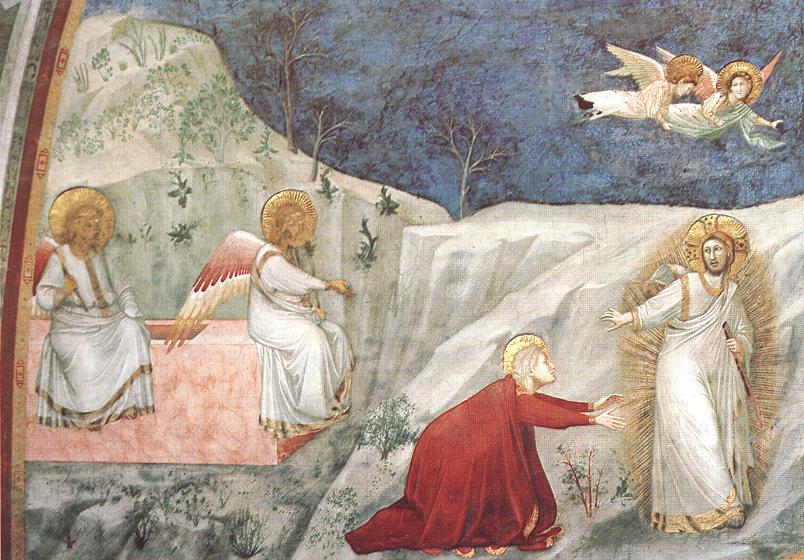
Larawan ng fresco sa Simbahan ni San Francisco sa Assisi, “Noli Me Tangere” na ipininta ni Giotto de Bondone noong ika-13 siglo. Mula sa commons.wikimedia.org.
Ngayong palaging makulimlim 
ating panahon, ulan ay bumubuhos
katulad ng unos at kadilimang
bumabalot sa buhay ng karamihan,
kay gandang paglimi-limihan
at dasalan tagpo sa libingan ni Jesus
nang ito'y puntahan ng mga kababaihan
sa pangunguna ni Maria Magdalena
noong Siya ay muling nabuhay.

Madilim-dilim pa nang araw ng Linggo, naparoon na si Maria Magdalena sa libingan. Naratnan niyang naalis na batong panakip sa pinto ng libingan. Si Maria’y nakatayong umiiyak sa labas ng libingan; yumuko siya at tumingin sa loob. May nakita siyang dalawang anghel na nakaupo sa pinaglagyan ng ng bangkay ni Jesus, and isa’y sa gawing ulunan at ang isa nama’y sa paanan. Lumingon siya… at nakita niya si Jesus na nakatayo roon, ngunit hindi niya nakilalang si Jesus iyon.

Juan 20:1, 11-12, 14
Larawan mula sa GettyImages/iStockphoto.com.
Maraming pagkakataon
kapag labis ang aming hapis
Panginoon, ika'y hindi namin
nakikilala gayong katabi ka namin pala!
Katulad ni Santa Maria Magdalena marahil
ay mugto aming mga mata sa pagtangis
at dalamhati sa pagpanaw ng mahal
namin sa buhay o dili kaya habang 
nagbabantay sa naghihingalong mahal sa buhay.
Hindi ka rin namin makilala, Panginoon
katulad ni Santa Maria Magdalena
sa tuwina kami'y nagbabata ng hirap
at sakit dahil mahigpit aming kapit,
pilit ibinabalik nagbabaka-sakaling
mapanatili mga nagisnang gawi,
pakikipag-ugnayan sa pumanaw naming
mahal o sa nag-aagaw buhay na tiyak
kami'y iiwanan nang lubusan.

Tinanong siya ni Jesus, “Bakit ka umiiyak? Sino ang hinahanap mo?” Akala ni Maria’y siya ang tagapag-alaga ng halamanan, kaya’t sinabi niya, “Ginoo, kung kayo po ang kumuha sa kanya, ituro ninyo sa akin kung saan ninyo dinala at kukunin ko. “Maria!” ani Jesus. Humarap siya at kanyang sinabi, “Raboni!” – ibig sabihi’y “Guro.” “Huwag mo akong hawakan, sapagkat hindi pa ako nakakapunta sa Ama,” wika ni Jesus. “Sa halip, pumunta ka sa aking mga kapatid at sabihin mong aakyat ako sa aking Diyos at inyong Diyos.” Kaya’t si Maria Magdalena’s pumunta sa mga alagad at sinabi, “Nakita ko ang Panginoon!” At tuloy sinabi sa kanila ang bilin ni Jesus.

Juan 20:15-18
Larawan kuha ng may-akda,pagbubukang-liwayway sa Camp John Hay, Baguio City, Nobyembre 2018.
Panginoon, kami ay tulungan
kung maari tawagin din sa pangalan
upang ikaw aming makilala at 
maranasan sa piling namin
kung kami'y nabibigatan at
nadidiliman dahil iyong dahilan
sa pagparito ay upang kami ay samahan
pagaanin mga pasananin at hanguin 
tungo sa bagong buhay kaloob mo sa tanan.
Nawa katulad ni Santa Maria Magdalena
ikaw ay lubusan naming makilala
upang sa amin mabanaagan sinag ng
iyong galak at katuwaan, mga palatandaang
tunay ngang ikaw ay aming nakita,
maihayag sa salita at gawa Iyong mga
habilin huwag matakot sa dilim,
krus ay palaging pasanin,
yakapin kamatayan upang ika'y makapiling.
Santa Maria Magdalena
kay Jesus kami ay ipanalangin
kasamaan tuluyan na naming lisanin
kabutihan pawang aming gawin;
mga pumanaw naming mahal sa buhay
ipanalangin mo rin, Diyos ay sapitin
habang mga naghihingalo sa amin
loob ay palakasin, buhay na sasapitin
walang kahulirip at maliw!  Amen.
Larawan kuha ng may-akda, Jerusalem, 2017.

Light amid darkness: the grace of grieving in Mary Magdalene

The Lord Is My Chef Daily Recipe by Fr. Nicanor F. Lalog II
Friday, Feast of St. Mary Magdalene, 22 July 2022
Song of Songs 3:1-4   ><}}}}*> + ><}}}}*> + ><}}}}*>   John 20:1-2. 11-18
Photo from GettyImages/iStockphoto.com
Praise and glory to you,
O Lord Jesus Christ in giving
us today this Feast of St. Mary
Magdalene, the "apostle of the
apostles" who proclaimed to Peter
and company that you have risen
on that Easter morning!
Thank you most especially in 
showing us through St. Mary Magdalene
the grace in that state many of us find
ourselves so often especially these days
of the pandemic - that of grieving.

On the first day of the week, Mary of Magdalene came to the tomb early in the morning, while it was still dark, and saw the stone removed from the tomb. Mary stayed outside the tomb weeping. And as she wept, she bent over into the tomb and saw two angels in white sitting there, one at the head and one at the feet where the Body of Jesus had been. And they said to her, “Woman, why are you weeping?” She said to them, “They have taken by Lord, and I don’t know where they laid him.” When she had said this, she turned around and saw Jesus there, but did not know it was Jesus.

John 20:1, 11-14
Dearest Lord Jesus,
I pray for those weeping, 
for those grieving for the lost
of a beloved wife or husband,
a son or a daughter, a brother or
a sister, a friend or a colleague;
I also pray, Jesus, for those 
who are weeping in silence,
fighting their tears, hiding when
they cry as they attend and care 
for a dying loved one at home or
in the hospital.
Like St. Mary Magdalene, death
from its approach and coming
always has that dark presence in
us; mourning and weeping become
more difficult when nights become
longer we could hardly know morning
is coming or has broken.
And many times in those dark moments
we do not recognize you, Jesus, 
present among us in our weeping,
right in our grieving for our loved ones.
Open our eyes, open our hearts,
enkindle our faith and hopes in you, Lord
in these long, dark hours of our grieving.
You know very well how difficult it is
to let go of a loved one like St. Mary Magdalene
when you have died; like her, we continue
to "cling" and "hold" to our beloved 
in our old ways of relating with them 
in the hope of again hugging them,
touching them, and perhaps telling them 
how we love them and if given a chance,
to say sorry too for our sins and lapses.
“Noli me tangere” (touch me not) fresco in the Lower Basilica of St. Francis Assisi Church in Italy painted by Giotto de Bondone in the 13th century from commons.wikimedia.org.

Jesus said to her, “Mary!” She turned and said to him in Hebrew, “Rabbouni,” which means Teacher. Jesus said to her, “Stop holding on to me, for I have not yet ascended to the Father. But go to my brothers and tell them, ‘I am going to my Father and your Father, to my God and your God.'” Mary of Magdalene went and announced to the disciples, “I have seen the Lord,” and then reported what he told her.

John 20:16-18
Call us with our name again,
dear Jesus; call us anew with your
reassuring voice of love and kindness,
of mercy and forgiveness no matter
who we really are 
for you are the only one sent by the Father 
to assure us we are accepted despite and
in spite of our sins and weaknesses.
Let us exclaim again "Rabbouni" like
St. Mary Magdalene, filled with joy in
finding you amidst the darkness 
in our lives as we learn to stop "holding"
on to our departed and dying loved ones
as we recall and realize your teaching 
that every death is a sharing in your pasch,
a passing over into eternal life,
of leveling up our ties with them 
in you, Christ Jesus
to the Father and the Holy Spirit.
Amen.
Photo by author, sunrise at Camp John Hay, Baguio City, November 2018.

Knowing Jesus like the Apostles

The Lord Is My Chef Daily Recipe for the Soul by Fr. Nicanor F. Lalog II
Tuesday, Feast of St. Philip and St. James the Less, Apostles, 03 April 2022
1 Corinthians 15:1-8   ><}}}}*> + <*{{{{><   John 14:6-14
Jesus teaching his Twelve Apostles, from GettyImages.
Lord Jesus Christ,
on this feast of your apostles 
Philip and James the Younger, 
grant me the grace to discover 
your true identity the way they
got to know you too; draw me
closer to you to be familiar with
you and your ways, to always
"come and see" you in prayers
and experiences in life.
Keep me close to you, dear Jesus,
so that I may truly lead people to you
and not to me nor to my beliefs; 
let me lead seekers of you find you 
both in your glory and in your Cross 
for without your sufferings and death,
everything becomes a novelty and
a fancy, or a philosophy and never 
a life and a union in you.

For I handed on to you as of first importance what I also received: that Christ died for our sins in accordance with the Scriptures; that he was buried; that he was raised on the third day in accordance with the Scriptures; that he appeared to Cephas, then to the Twelve.

1 Corinthians 15:3-5
Like Philip, keep me open in
expressing to you my views
when asked like at the wilderness
when you tested him where to find
food for the crowd; in another instance,
let me be like Philip entertaining requests
from others to see you like those Greeks 
who have come to Jerusalem;
most of all, keep me open to you,
dear Jesus to accept and treasure
your words and teachings even if I
do not understand immediately if that
is the way to know you more clearly
and eventually see and experience
God our Father. 
Like your cousin James the Younger,
let me keep in mind that closeness 
with you does not come  through mere
affiliations nor with names because 
knowing you is a habit that we must strive 
and work for by coming to you daily, 
following you even up to the Cross;
it is only in following you, becoming
like you we truly become your 
disciples like James who taught
and witnessed your love for everyone
by working so hard with Peter to 
intervene in the difficult relations 
between the early Christians of Jewish
origins and those of pagan converts; 
in practice and in his writings, James
showed that faith in you is fulfilled 
in a life lived in love and respect 
for each other:  "As the body apart 
from the spirit is dead, so faith apart 
from works is dead" (James 2:26).
Philip and James were not perfect,
just like me; but in their humility
and obedience, you perfected 
them in their lives of witnessing
that cost their lives; keep me
faithful to you, dear Jesus,
and let others see you in me
in words and in deeds.  Amen.

“Cut to the heart”

The Lord Is My Chef Breakfast Recipe for the Soul by Fr. Nicanor F. Lalog II
Tuesday within the Octave the Easter, 19 April 2022
Acts 2:36-41   ><}}}}*> + <*{{{{><   John 20:11-18
This photo by Mr. Red Santiago of his son Caden praying in my former parish shortly before the pandemic in March 2020 always “cuts me to the heart”, an image of child-like faith in God.
Praise and glory to you,
Lord Jesus Christ for you are
truly alive that whenever your
Resurrection is proclaimed in
words and in deeds, we are still
"cut to the heart", so moved to
act on on your good news!

On the day of the Pentecost, Peter said to the Jewish people, “Let the whole house of Israel know for certain that God has made him both Lord and Christ, this Jesus whom you crucified.” Now when they heard this, they were cut to the heart, and they asked Peter and the other Apostles, “What are we to do, my brothers?”

Acts 2:36-37
What a beautiful expression,
"cut to the heart":
You know what cuts me 
to the heart, Lord?
It is when I am so aware of my
sinfulness, of having betrayed
you or denied you, Jesus, I
feel so anxious and worried
you might leave me; like Mary
Magdalene in the gospel today,
I feel so cut to the heart, almost
weeping when I could not find you,
when I feel I have lost you because 
in this new life in you, the most
painful cut to the heart is to lose you.

And they said to her, “Woman, why are you weeping?” She said to them, “They have taken my Lord, and I don’t know where they laid him.” When she had said this, she turned around and saw Jesus there, but did not know it was Jesus.

John 20:13-14
So many times, dear Lord
and Teacher, I fear of losing you,
of not finding you especially
when life has become dark due
to my sins and failures, trials
and sufferings, sickness and 
confusions; but, you are always there,
Jesus, always calling me by name,
still loving me, still forgiving, still
present.  Teach me to be more 
persevering, to be more open in
recognizing you especially when 
life is dark and gloomy.  Amen.

Love is going down, not up

The Lord Is My Chef Recipe for Holy Thursday by Fr. Nicanor F. Lalog II, 14 April 2022
Exodus 12:1-8, 11-14  ><}}}}*>  1 Corinthians 11:23-26  ><}}}}*>  John 13:1-15
Photo from aleteia.org, Cathedral of Monreale, Italy.

Tonight we enter the holiest three days of the year, the Triduum of the Passion, Death and Resurrection of Jesus Christ with the Mass of the Lord’s Supper that leads us into Easter on Sunday, the mother of all our feasts.

It was during the Lord’s Supper on Thursday evening before he was arrested when he gave us the commandment to “do this in memory of me” referring to the celebration of the Holy Eucharist which is the sacrament of love because on that Supper of the Lord, it was then when Jesus gave himself to us in signs what he would do on Good Friday. It was during that supper known as the Last Supper when Jesus showed His “love in action” for us in all time made present in every celebration of the Eucharist. This is the reason why Holy Thursday is also known as “Maundy Thursday” from the Latin word mandatus, mandatum or commandment/law.

Unlike in the Gospel accounts of Matthew, Mark, and Luke along with Paul who mentioned the institution narrative of the Eucharist in our second reading tonight, John opted to tell us what we might describe as a “sidelight” to Holy Thursday, the washing of the feet of the disciples; but for John, the “beloved disciple” of Jesus, the washing of the feet is the core and essence of the Last Supper – not a sidelight – for it shows us and even makes us experience how Jesus “loves us to the end.”

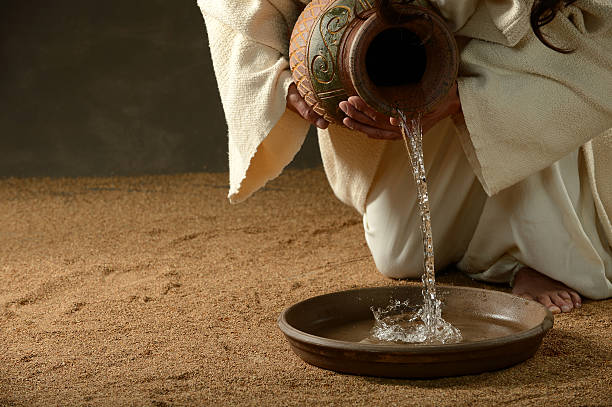
“Before the feast of Passover, Jesus knew that his hour had come to pass from this world to the Father. He loved his own in the world and he loved them to the end…He rose from supper and took off his outer garments. He took a towel and then tied it around his waist. Then he poured water into a basin and began to wash the disciples’ feet and dry them with the towel around his waist.”

John 13:1, 4-5
The lower we go down, the greater our love is.

True love is always a downward movement. Unlike in our society today when love is equated with selfish interests and materialism that calls for “upward mobility” for more wealth and power, knowledge and freedom and fame measured in likes and followers, true love is actually a “passing over”, a pasch or a passion like that with Jesus Christ.

When we let go of our positions, of our titles, of our very selves to go down with the rest, to go down with our students, with our followers, with our subordinates — that is when we truly love like Jesus Christ. It is what we mentioned last Fifth Sunday in Lent (03 April 2022) when Jesus bended down twice, first before the woman caught committing adultery and second to her accusers who left the scene when Jesus dared the sinless among them to cast the first stone on her. Now at the washing of his disciples’ feet at the last supper, Jesus again bended down reaching his lowest bending tomorrow on the Cross.

In all the bending down by Jesus – to the woman caught committing adultery, to her accusers, to the washing of feet of the Twelve and to his crucifixion – he shows us his immense love and mercy to us sinners, bending down to save our face and uplift those down in shame and pain among us (https://lordmychef.com/2022/04/02/the-joy-of-meeting-god/).

Note the movements by Jesus at the washing of his disciples’ feet were in itself a “passing over”, expressions of his love: “he rose from supper, took off his outer garments, took towel then tied it around his waist, poured water into a basin and began to wash his disciples’ feet and dry them with the towel around his waist.”

In Israel at that time, washing their master’s feet was not part of the servants’ “job description” because it was – and still – demeaning. But for those who truly love, for those who love to the end like Jesus, the most demeaning acts can also be the highest expression of love! When you take care of your sick parent, when you give yourself in service to people you hardly know and would not care for at all, when you try to bear all the pains and hurts in silence – these can be all so demeaning but meaningful to others and to God.

Photo from GettyImages/iStockPhotos.

Imagine the great love of Jesus for us, no matter how sinful we may be like Judas Iscariot whose feet Jesus still washed before betraying him. In its original Greek, “to betray” means to hand over a beloved to extreme pain and suffering, the opposite of Passover when we go down to love; to hand over is to break away, to break ties, to discard, to stop loving.

And this is the good news of this Holy Thursday: we have all been cleansed by Jesus in his pasch, in our baptism, and for those who have gone to confession, in the Sacrament of Reconciliation. Would we still remain to be in sin, outside of Jesus?

Tonight, there are two persons with supporting roles in the Supper of Jesus Christ: Peter and Judas. The former denied the Lord thrice while the latter betrayed Jesus. Peter repented and thus became the Rock of the Church while Judas grieved and took his own life.

We too can be either Peter or Judas when we deny or betray friends and loved ones or when they deny or betray us. It may have taken some time for Peter to finally stoop down before Jesus at the shore of the Lake of Tiberias to admit his sin of denying the Lord three times. But the fact remains that he bent low before Jesus in repentance that before the flock could be entrusted to him, the Lord asked him thrice if he loves Him. In Peter we have seen that before we could love the Church, the sheep, we must first of all love the Lord. Judas remained high in his pride; though he felt sorry for his sins, he could not go down on his knees before Jesus for he had lost his love for Him that made him decide to take his life instead.


Lord Jesus Christ, you love us so much 
and yet we love you so little;
you have gone so low for us, 
not only emptying yourself 
by taking the form of a slave 
to come in our human likeness 
but even humbled yourself in obedience until death. 
We always try to look so strong and powerful, 
refusing to bend our knees to go down before You and others, 
always trying to save face and honor; 
but, the truth is we are so weak inside, 
so ashamed to admit our faults and sinfulness. 
Give us the grace this Holy Thursday 
to be one with you again, 
to go down in you with our brothers and sisters, 
especially those whom we have denied or betrayed. 
Give us the grace to imitate your love 
and be heralds of your gospel of salvation to others. 
Amen.

Photo by author, 2016.

The Cross, our door to heaven

The Lord Is My Chef Sunday Recipe for the Soul by Fr. Nicanor F. Lalog II
Palm Sunday of the Passion of the Lord, 10 April 2022
Isaiah 50:4-7  +++  Philippians 2:6-11  +++  Luke 23:1-49
Photo by Mr. Chester Ocampo, ICS Chapel, 2016; sculpture by National Artist Ed Castrillo.

Officially we begin today the Holy Week leading to the Triduum of the Lord with Easter, the Mother of all feasts in the Church. Today we enter the “innermost room” of the house of God our Father after our 40 day journey in Lent.

We are actually celebrating today two distinct rites merged into one, the procession and blessing of palms to commemorate Jesus Christ’s entry into Jerusalem that led to his arrest and crucifixion on Good Friday which we heard in the gospel proclaimed earlier. As early in the fourth century, Christians in Jerusalem have been commemorating the Lord’s entry to Jerusalem from the city gate while a hundred years later, the Pope ushered in the Holy Week in Rome by proclaiming the long gospel we have heard of the Lord’s crucifixion and death. With the reforms of the liturgy in 1963 at Vatican II, these two celebrations were merged as one with the designation as “Palm Sunday in the Passion of the Lord”.

More than a going back to the past, our celebration today reminds us of the ever-newness of Christ’s saving work and love for us while at the same time assuring us of the future that would bring us into the fullness of life in him with the Father in heaven. This we find in the last three words recorded to us by Luke while Jesus was on the Cross.

Photo by author, Chapel of the Holy Family, Sacred Heart Spirituality Center, Novaliches, QC, 2016.

The mercy and forgiveness of God

Then Jesus said, “Father, forgive them, they know not what they do.”

Luke 23:34

Very consistent with his theme of the mercy and forgiveness of God to us as shown the other Sunday in the parable of the merciful father, a.k.a. the parable of the prodigal son, Luke presents to us again this most wondrous and touching trait of God in Christ even while crucified.

Again, only Luke has this detail of Jesus praying forgiveness for his enemies while being reviled and mocked by them on the cross.

It is another example of Luke’s artistry in presenting to us God’s mercy and forgiveness in Christ in a sort of play of words, “Father, forgive them, they know not what they do” as we confront our selves with the question, “what do we really know?”

What do we really know at all that we continue to crucify Jesus today, nailing him on the cross with our many sins as we pretend and assume to know so many things in life?

Until now, we still have wars raging in various parts of the world, and more than half of these conflicts according to studies are ironically due to our different religious beliefs! Until now debates continue as everyone would want to have the power to decide for themselves who shall live and who shall die, from abortions to artificial contraceptives to capital punishment. Until now we pretend to know the truth and yet the more we have shown our ignorance as our problems become more complex than ever leading to more deaths, more disillusions, more anxieties and more emptiness in life.

And right there on the cross, Jesus continues to pray to the Father to forgive us for we do not know what we are doing to pave the way for the conversion of more others like Paul who realized he “acted out of ignorance in my unbelief” (1 Tim. 1:13). In his other book the Acts of the Apostles, Luke tells us how Peter said in a speech to the people how they “acted out of ignorance in putting Jesus to death” (3:17). Here we find Luke driving at the basic truth how so often it is in our sinfulness and “ignorance” that eventually we come to “know” and realize God who is always ready with his unfailing mercy and forgiveness. The key is to emulate Dimas, the good thief crucified at the other side of Jesus on that Good Friday.

Photo by author, Chapel of the Holy Family, Sacred Heart Spirituality Center, Novaliches, QC, 2016.

The promise of Paradise

He replied to him, “Amen, I say to you, today you will be with me in Paradise.”

Luke 23:43

Imagine the evil that men do portrayed by Luke in Christ’s crucifixion, of the relentless insults and mockery by the people on the ground and even up there on the cross when one of those hanging reviled Jesus, saying, “Are you not the Christ? Save yourself and us”(Lk.23:39).

See how we are not contented and satisfied in putting others to shame but would even bury them deeply with insults as we say in Filipino, “baon na baon”. But, all is not lost as there is always a glimmer of hope. especially among the sinners and the ignorant who open themselves to god’s grace like Dimas who rebuked his fellow criminal, reminding him how they deserved the punishment but not Jesus “who has done nothing criminal” (Lk.23:41). It was at that instance when he snatched heaven by telling the Lord, “Jesus, remember me when you come into your kingdom” (Lk.23:42).

And we all know the response of Jesus, “Amen, I say to you, today you will be with me in Paradise.”

What a great God do we really have in Jesus Christ! Despite the pains and sufferings of being nailed on the cross, he not only begged the Father for our forgiveness because we do not know what we are doing but most of all, readily handed our salvation, promising Paradise to anyone who would humbly surrender one’s self to him like Dimas.

See that Jesus was very precise in assuring Dimas and us with Paradise – right at the very moment we are in him, with him on the Cross of pain and suffering, of truth and righteousness – not later when they die nor on Sunday when he rises from the dead but TODAY, right now!

The very moment we open ourselves to accept Jesus Christ our Savior, that is also precisely the very moment he is very present in us and among us. The other moment Luke used the word TODAY to indicate the very moment of here and now was at the birth of Jesus when the angels told the shepherds “For today in the city of David a savior has been born for you who is Messiah and Lord” (Lk.2:11).

What a beautiful reminder to us all of God present among us in every here and now, not yesterday nor tomorrow, but today for indeed our God is “I AM WHO AM”!

Anyone who is always one in Jesus, one with Jesus is assured of Paradise, in fact already entering Paradise, our end and ultimate destination in life. This leads us to the third important words of Jesus on the Cross according to Luke…

Photo by author, Chapel of the Holy Family, Sacred Heart Spirituality Center, Novaliches, QC, 2016.

Coming home to the Father

Jesus cried out in a loud voice, “Father, into your hands I commend my spirit”; and when he had said this he breathed his last.

Luke 23:46

All four evangelists attest in their respective gospel account that Jesus died on the cross at the ninth hour or about 3:00 PM. Most of all, they tell us that Jesus died while praying.

In Luke’s account, Jesus’ final prayer was from Psalm 31:6, “Into your hands I commend my spirit.” As we have mentioned in our previous reflections, Luke presents Jesus always at prayer like during the second Sunday of Lent during his transfiguration; only Luke tells us why Jesus went up that high mountain with his three Apostles in order to pray. Inasmuch as the transfiguration was a prayer moment, the crucifixion is the Lord’s prayer moment par excellence. Recall how we truly learn to “pray” when in deep pain and trials like before a surgery, when we no longer know how to pray or even have forgotten what is prayer all about except that we give ourselves entirely to God and to our doctors.

There on the Cross at his final moments, Jesus never ceased from doing good, always praying, always united and one in his Father in heaven. In commending his spirit into the Father’s hands, Jesus shows us exactly what discipleship is all about: everything we have, all we are are God’s. We have nothing to lay claim as ours in this life and that is the challenge to us daily: to live for God in Jesus through our loving service to others.

In this long passion narrative we heard today is the gospel, the very good news of our salvation as proclaimed by Paul in the second reading of how Jesus gave his total self in love to the Father for us all.

May we keep our eyes and our hearts open to Jesus, relying only in him like the Suffering Servant for he shall never put us to shame. We cannot experience the joy of his Resurrection unless we imitate Simon Cyrene, Dimas, John and the Blessed Virgin Mary in welcoming and following him in our daily life whether in the comforts of Jerusalem or the sorrows of Calvary for that is where we truly enter Paradise with Jesus, in Jesus. On the Cross. Amen.

The joy of meeting God

40 Shades of Lent by Fr. Nicanor F. Lalog II
Fifth Sunday in Lent-C, 03 April 2022
Isaiah 43:16-21 ><}}}*> Philippians 3:8-14 ><}}}*> John 8:1-11
Photo by Ms. Jo Villafuerte, Atok, Benguet, 20 February 2022.

From the joy of coming home to the Father last Sunday in the parable of the merciful father, we now celebrate the joy of meeting God in Jesus Christ in the story of the woman caught in adultery.

We are now into the final week of Lent, getting closer to the innermost room of the Father’s house but this time with John as our guide as we skip Luke’s gospel. The shift is hardly noticeable as the story of the woman caught in adultery seamlessly jibe with Luke’s parable last Sunday. The Pharisees and scribes are again present but this time more bold in their opposition to Jesus.

From pinterest.com.

Then the scribes and the Pharisees brought a woman who had been caught in adultery and made her stand in the middle. They said to him, “Teacher, this woman was caught in the very act of committing adultery. Now in the the law, Moses commanded us to stone such women. So what do you say?” They said this to test him, so that they could have some charge to bring against him. Jesus bent down and began to write on the ground with his finger.

John 8:3-6

Only John records this story of the woman caught in adultery but one can clearly recognize its similar tone and perspective with the parable last Sunday that only Luke had, the parable of the merciful father, more known as parable of the prodigal son. Both stories tell us the gospel of God’s mercy proclaimed in words and in deeds by our Lord Jesus Christ.

But what makes this story of the woman caught in adultery a stand out is its simplicity amidst the profound texts by John often identified as the beloved disciple. He was able to compact in few words and simple gestures the many realities in life we forget and take for granted.

As I prayed over this scene, one word persisted in my reflections: kindness.

Photo by author, 2018, Davao City.
The kindness of God.

The word “kind” is from kin or kindred as in family or tribe. When we say a person is kind, we mean that person treats us as one of his family, of his same kind, that he deals with us like we are not “others” or iba as we say in Filipino (hindi ka naman iba).

How sad that at the start of this pandemic in 2020, that was when all news and stories spread of how we have become so unkind with each other especially the poor, the sick and the old, children and women treated unkindly like Mang Dodong of Caloocan.

How sad that in our country, it has become a sin, an error or a failure to be poor and disadvantaged that even the poor and disadvantaged look down at each other, too! There is always that feeling among us that we are different, that we are not of the same kind that it has become so difficult to find kindness among everybody. We have forgotten we are all human, imperfect and sinful but also beloved children of God.

This is what the Sunday gospel is telling us: the woman caught in adultery is not the only sinner in this scene. John described her as “caught in adultery”, not merely an “adulteress” to show that she was in fact caught into adultery. It is a serious sin but there’s more to be caught in that act than meets the eyes. Here, there is no mention about the woman’s “lover”.

Like in our gospel last Sunday, we have the Pharisees and scribes present again, forgetting their very roles in the story itself. Recall that Jesus told the parable of the merciful father for them last Sunday to remind them that they were both the prodigal son and elder son. And that included us today, of course. Today, they are back and we wonder what were the evidence they have against that woman. Where were they while the woman was committing the sin of adultery? Were they peeping toms? Or worst, have they had some trysts with her too in the past?

Both the woman caught in adultery and her accusers, the Pharisees and the scribes stand for us all – we are sinners. We have all sinned and how dare are we to act like the Pharisees and scribes pretending to be different from others, to be so clean and pure when deep inside us are also rotten with sins that could even be worst than the people we accuse.

This is the reason why Jesus bent twice to show everyone how God had chosen to go down to us, to be like us in everything except sin so we can see again everyone as our kin, our same kind as children of the Father.

But when they continued asking him, he straightened up and said to them, “Let the one among you who is without sin be the first to throw a stone at her.” Again he bent down and wrote on the ground. And in response, they went away one by one, beginning with the elders. So he was left alone with the woman before him.

John 8:7-9
Photo by news.ag.org, Jesus writing on the sand in the story of the woman caught in adultery.
Bending to washing of feet to dying on Cross.

In bending down twice, Jesus showed everyone – the accused and the accusers – the kindness of God, his being our kin, his being one of us even if he is Divine. To bend down is to go down, like Jesus coming down from heaven, being born as a child to show us that the path back to God is in being human which is underscored by Matthew in his genealogy of Jesus Christ at the start of his Gospel which is proclaimed every December 17 and December 24 Christmas Eve.

Here in this scene we are reminded by his bending as an imagery of the mystery of Incarnation just like his coming down to Jordan River at his baptism by John.

This bending of Jesus will happen again on Holy Thursday when he washed the feet of his apostles where he gave his commandment to love (hence, it is called as Maundy Thursday, from Latin mandatum for commandment). It will reach its highest point when he bent lowest on Good Friday by offering himself on the Cross for us all out of his immense love and mercy. And kindness.

That is the greatest expression of God’s love and mercy, in his kindness, in his becoming one of us in Jesus Christ who took upon himself our sins so we may be clean again and be able to rise and stand with dignity and honor as beloved children of the Father.

This is the fulfillment of Isaiah’s words in the first reading that God is doing something new for us.

Jesus is not telling us to stop fighting sin and evil, to cease from pursuing criminals and people who have committed crimes and grave sins against us and others. The fight goes on but should always be tempered with being humane.

Photo by Pixabay on Pexels.com

The beautiful story of how Jesus resolved the case against the woman caught committing adultery assures us of the endless mercies of God to us sinners, not a passport to sin. See how Jesus recognized the sinfulness of the woman when he told her, go and sin no more – the most humane reprimand perhaps in history.

It is only in our being kind like Jesus that we become truly human and humane.

According to John, the first to leave the site after Jesus challenged them to cast the first stone were the elders that may stand for having wisdom, not necessarily being aged. The first to leave the site were the wise, those who must have realized their own sinfulness and saw how gravely wrong they were in being so harsh with the woman.

Many times in life, it is difficult to be kind in this unkind world because we have stopped seeing our commonality, our shared humanity, our links with one another, our relationships. We have become so competitive that we always want to be distinct from everyone to the point that we have ceased becoming humans, playing gods most of the time.

Photo by Ms. Jo Villafuerte in Atok, Benguet, 2019.

The grace of this final week of Lent is the kindness of God that remains with everyone, even with the most harsh among us, the most sinful. Jesus is inviting us to bend down with him, see him even down below when we are in sins. He is not condemning us nor hurting us with words nor actions. Ever the most humble and gentle of all, our most kind Lord Jesus is telling us today to take up his yoke and learn from him, always kind with everyone.

And that begins with our very selves. Many times, we cannot be kind with others because in the first place we are so unkind with our very selves. We cannot see our true selves that we compete within ourselves, that we should be somebody else.

What a wonderful gift to be our true selves again and still loved by God.

Let us heed Paul’s call in the second reading: “forgetting what lies behind but straining forward to what lies ahead. I continue my pursuit toward the goal, the prize of God’s upward calling, in Christ Jesus” (Phil. 3:13-14).

Have a blessed week ahead, be kind to yourself first of all. Amen.

The Cross looming at Bethlehem

The Lord Is My Chef Quiet Storm by Fr. Nicanor F. Lalog II
A Funeral Homily, 29 December 2021
Photo by author, Basic Education Department chapel, Our Lady of Fatima University, Valenzuela City, 24 December 2021.

The Christmas liturgy offers us valuable lessons about life, of essentially the meaning of Christ’s coming into the world: He did not remove death and suffering but instead came to suffer and die with us so we may rise with him to eternal life.

Looming over the Nativity scene at Bethlehem is the Cross of the Calvary as we immediately see (except this year) the following day after Christmas on December 26 when we celebrate the feast of the first martyr of the Church, St. Stephen and again on the 28th when we wear red vestments during the Mass for the feast of the Holy Innocents massacred by Herod after being duped by the Magi.

These lessons of our Christmas liturgy become more real, even surreal for some, when there is death happening during this most joyous season of the year.

On this fifth day in the octave of Christmas, we heard from the gospel of Luke the story of the Presentation of the Child Jesus at the temple met by two elderly people promised by God to see the Christ before dying, Simeon and Anna.

Now there was a man in Jerusalem whose name was Simeon. This man was righteous and devout, awaiting the consolation of Israel, and the Holy Spirit was upon him. It had been revealed to him by the Holy Spirit that he should not see death before he had seen the Christ of the Lord. He came in the Spirit into the temple; and when the parents brought in the child Jesus to perform the custom of the law in regard to him, he took him into his arms and blessed God, saying: “Lord, now you let your servant go in peace; your word has been fulfilled: my own eyes have seen the salvation which you prepared in sight of every people, a light to reveal you to the nations and the glory of your people Israel.”

Luke 2:25-32

What a matter-of-fact story this Christmas of awaiting death, awaiting Christ’s coming!

What a beautiful scene reminding us of the realities of life and of death, coexisting side by side.

“Presentation at the Temple” painting by Italian Renaissance artist Andrea Mantegna done around 1455; Mary holding Baby Jesus while St. Joseph at the middle looks on the bearded Simeon. Photo from wikipedia.org.

Life is like our two hands, the left and the right, always with ironies and paradoxes: life and death, light and darkness, joy and sorrow, triumph and defeat, gains and losses.

That is how life is wonderfully portrayed today by Simeon who held in his arms the Child Jesus, filled with joy, basking in the sacred moment with the Savior, and the words that came from his mouth was about dying: “Lord, now you let your servant go in peace; your word has been fulfilled: my own eyes have seen the salvation which you prepared in the sight of every people.”

That is the “moment of Christmas” we mentioned last Saturday: “Christmas is therefore a blessed event, a most sacred moment of holy communion of man and God in Jesus Christ that continues to this day in the most regular yet miraculous reality of life going on amid many joys and pains, victory and defeats, prosperity and poverty, health and sickness, light and darkness and even in death” (https://lordmychef.com/2021/12/24/rejoicing-christmas-moments-all-year-through/).

Simeon shows us that it is only when we have fully appreciated this life we have in God do we fully accept and welcome death which is eternal union with God. Coming to terms with life is coming to terms with death and the same holds true vice-versa. That is why like Simeon we have to strive to live attuned to the Holy Spirit always to be aware of those sacred moments when Jesus comes to us in our daily living.

Photo by author, 18 November 2021.

I know, these are easier said than done… and, yes, it is doubly painful when our loved ones leave us during this Christmas season but when we try to reflect on it deeply, we find it more meaningful.

Ten years ago I met a family in my previous parish who have come to gather for 41 years every Christmas since their mother passed away on Christmas day. They told me how they were celebrating Mass on a bright sunny Christmas day when they have to immediately leave to rush to the hospital where their mother had died after a lingering illness. It was then I learned that their mother was born on March 24, the eve of the Solemnity of the Annunciation of the Birth of Jesus; that’s when I told them of how blessed they must be: their mother was born on the date we celebrate the Incarnation of the Son of God while she entered eternal life on the date we celebrate Jesus came to earth! They loved the imagery I have shown them and from then on until now, I have been invited to their family reunions….

That is the main blessing of Christ’s coming here on earth: he sanctified death that before was a curse. Recall how we have mentioned that Jesus Christ’s Pasch actually began at Christmas, when he passed over from heaven to earth, from eternal to temporal which reached its highest point in his Passion, Death and Resurrection that led to our salvation.

Photo by author, Basic Education Department chapel, Our Lady of Fatima University, Valenzuela City, 24 December 2021.

When the pandemic came last year, everybody laughed at the year 2020 with all kinds of memes and jokes, describing the year supposed to signify “perfect vision” as the worst and most disastrous. It was labelled so bad and almost cursed that everybody eagerly awaited 2021. Now, the jokes and memes are back, calling 2022 sounds like “2020 too”, insinuating another round of disasters as COVID surges happen in Europe and the States.

But, that is life.

As we have said at the start, it is like our two hands, the left and the right. There is always life and death, light and darkness, joy and sadness. That is why Jesus came and from then on we have reckoned time to his birth because every year is an Anno Domini, the year of the Lord.

Whenever we put our hands together at prayer, life and death becomes one along with joy and sorrow, light and darkness in Jesus Christ who gives meaning and fulfillment in everything.

Handle life with prayer. God bless you all!