Quiet Storm by Fr. Nicanor F. Lalog II, 02 October 2020
Photo by author, resthouse in Silang, Cavite, 22 September 2020.
Methinks the saddest thing of this pandemic
is not in the restrictions it had imposed on us
from social distancing to other methods of quarantine
but more on the restrictions we have within
when we can be more loving and kind with others
then still choose to be harsh and brash.
We wash our hands to be clean
but the virus of sin clings deeper than skin
when forgiving or apologizing
can wash away that sting
of any guilty feeling within.
Even if we have to maintain social distancing
it does not mean we have to be apart;
it would be wonderful and most amazing
to everyone's part if we can let our hearts
sing the feelings deep inside like
"I love you, I miss you, I care for you"
than wring all the aching
and sufferings we are enduring.
Lastly, always put on your masks
for everyone's safety
but let us trust and bask
in the warmth of our humanity
to keep our sanity.
In this time of COVID-19
when death is no longer lurking
but closing into our very being,
let us be more of feeling than of thinking,
loving and caring, affirming each other
enjoying life together.
Photo by author, antique door of a resthouse in Silang, Cavite, 22 September 2020.
The Lord Is My Chef Breakfast Recipe for the Soul by Fr. Nicanor F. Lalog II
Saturday, Week XXV, Year II in Ordinary Time, 26 September 2020
Ecclesiastes 11:9-12:8     <*(((><<   +   >><)))*>     Luke 9:43-45
Photo by author, sunset at Silang, Cavite, 22 September 2020.
It is officially the end of the week, and how true are your words through Qoheleth that everything comes to an end, that we must strive to make every ending a happy one. Especially our very lives.
Rejoice, O young man, while you are young and let your heart be glad in the days of your youth. Follow the ways of your heart, the vision of your eyes; yet understand that as regards all this God will bring you to judgment. Ward off grief from your heart and put away trouble from your presence, though the dawn of youth is fleeting.
Ecclesiastes 11:9-10
God our Father, grant me the gift of ageing gracefully by having the grace of being excited and surprised each day while still young. It is said that it is not really time that is passing by if we waste it but us who are passing by because lost time can never be recovered or brought back.
Keep me excited and full of enthusiasm of following my heart, pursuing my vision of a better and beautiful future by celebrating every present.
Let me bear in mind Lord that I am not perfect so that I may always have room for my mistakes and those of others; keep me simple so as not to be demanding and exacting. Just let me enjoy life, trust more in you, worry less among us.
And in all my pursuits in life while still young, be at the center, Lord Jesus.
Let me keep in mind as you reminded your disciples in the gospel today, that I may not be so focused and amazed with great and wondrous deeds but most of all in how you have bore all pains and sufferings to save us.
After all, you saved the world by dying on the Cross, O sweet Jesus, and not with so many activities.
And that is the meaning of ageing gracefully: that towards the end of our lives when we sum up everything, we can always look back to the past, to our youth with pride and joy at how we have followed you Jesus in your Passion and Death while awaiting our glorious resurrection in you like the twin brothers Sts. Cosmas and Damian and others saints. Amen.
The Lord Is My Chef Breakfast Recipe for the Soul by Fr. Nicanor F. Lalog II
Friday, Week XXV, Year II in Ordinary Time, 25 September 2020
Ecclesiastes 3:1-11  >><)))*>  >><)))*>  >><)))*>   Luke 9:18-22
The wildfires created a natural Instagram filter across California. Photo from MediaNews Group/The Mercury News via Getty Images; 10 September 2020.
There is an appointed time for everything, and a time for every affair under the heavens. He (God) had made everything appropriate to its time, and has put the timeless into their hearts, without man’s discovering, from beginning to end, the work which God has done.
Ecclesiastes 3:1, 11
Thank you, dear God our Father in appointing time for everything, in creating the dimension of time and space so we can have a grasp of your vast reality in this universe. We are finite and you are not whom time and space cannot limit and hold.
Teach us to be open to your presence and grace in every moment of our lives, to make that constant effort to pray like your Son Jesus Christ our Lord.
Prayer is so difficult for us because in our limited time and space, we try to be one with you who is infinite and eternal. We find it boring and a waste of time not only because it is difficult, requiring discipline on our part but because it requires a lot on us to truly love you.
Only love can bridge the finite and infinite, the temporal and eternal. When we are with our beloved, time neither rushes nor slows but seems to stand still like eternity as if we are holding it – when time is not. It is the same experience we have when we are deeply absorbed in prayer, when we feel that intense love for you inside when time passed so easily that an hour seemed like an instant, exactly like what you have said in the Bible that a thousand years are just a day for you.
Because you love. And we also love.
How lovely it is to read in the gospel today that once when Jesus was praying in solitude and the disciples were with him, that is when he surveyed them about what people were saying who he is, later asking them the same question up and personal.
Help us to appreciate and value silence and stillness, to befriend time and eternity in prayer to express our love for you and for others. Amen.
Photo by Dr. Mylene A. Santos, MD at Katmon Harbor Nature Sanctuary, Infanta, Quezon, May 2020.
The Lord Is My Chef Breakfast Recipe for the Soul by Fr. Nicanor F. Lalog II
Thursday, Week XXV, Year II in Ordinary Time, 24 September 2020
Ecclesiastes 1:2-11     >><)))*>  +  +  +  <*(((><<     Luke 9:7-9
Photo by author, Shambala in Silang, Cavite, 22 September 2020.
Vanity of vanities, says Qoheleth, vanity of vanities! All things are vanity! What has been, that will be; what has been done, that will be done. Nothing is new under the sun. Even the thing of which we say, “See, this is new!” has already existed in the ages that preceded us.
Ecclesiastes 1:2, 9-10
Praise and glory to you, O God our loving Father for this brand new day that offers us with fresh opportunities to become better and the best. Most of all, a call to be more loving, more gentle, and more kind like you.
Yes, it is true that “Nothing is new under the sun. Even the thing of which we say, ‘See, this is new!’ has already existed in the ages that preceded us.” Everything in life becomes a vanity if lived without you.
In the beginning at Genesis, you have made everything beautiful, entrusting it all to us with the sacred task of keeping that beauty making us your co-workers in the world. But, alas! We have turned away from you in sins that we have disfigured ourselves and destroyed nature in the process.
The temptation to be like you, O God, that tempted Adam and Eve continues to this day and the more we pretend to be all-knowing and all-powerful like you, the more everything becomes a vanity.
Like Herod in the gospel, the more we try to set the new order of things in life, the more we are disturbed of the past because it is only in you O God our Father through Jesus Christ your Son has everything been made new again. You were the one who have designed everything in this life and had ordered it all to one definite direction of ending in you because everything is yours after all.
Forgive us for playing gods, manipulating not only ourselves but even others and nature.
Teach us through Jesus to be humble, to welcome the good news of salvation into our lives for it is only in our hearts full of contrition for our sins where everything becomes new again in this world as we begin seeing everything and everyone in your light. Amen.
Photo by author, sunset at Shambala in Silang, Cavite, 22 September 2020.
The Lord Is My Chef Breakfast Recipe for the Soul by Fr. Nicanor F. Lalog II
Monday, Feast of St. Matthew, Apostle and Evangelist, 21 September 2020
Ephesians 4:1-7, 11-13   >><)))*>   +   <*(((><<   Matthew 9:9-13
Photo by author, Lake of Galilee at the side of Capernaum where Jesus called Matthew the tax collector, May 2019.
Glory and praise to you, O God our loving Father! Your Son Jesus Christ never fails to surprise us with your wondrous plans for us, with your ways of calling us, and of coming to us!
As we celebrate today on this first working day of the week the feast of St. Matthew, you fill us with hope and inspiration to work harder and pray hardest in life to find fulfillment in you our God.
Thank you for being so kind to come and call us like St. Matthew, Lord Jesus. It was a very extraordinary call not because we are so special but actually unimportant with Matthew also known as Levi belonged to the most despised group of people at that time in Israel, the tax collectors who were always mentioned along with sinners and prostitutes. And so were Matthews’s contemporaries at Capernaum, the brothers Simon and Andrew, James and John who were all fishermen, the most ordinary folks doing the most ordinary jobs of that time.
We were all just like them – nothing special and unimportant! If not for your call, we would be nobody at all even in our family circles.
What a joy that even if some people reject us for various reasons, you O Lord never exclude anyone of us from your friendship. Most of all, you even defend us.
While he was at table in his (Matthew’s) house, many tax collectors and sinners came and sat with Jesus and his disciples. The Pharisees saw this and said to his disciples, “Why does your teacher eat with tax collectors and sinners?” He heard this and said, “Those who are well do not need a physician, but the sick do. Go and learn the meaning of the words, I desire mercy, not sacrifice. I did not come to call the righteous but sinners.”
Matthew 9:10-13
Give us the readiness and firmness of St. Matthew in leaving everything behind to follow you, Lord.
Like St. Matthew who “got up (rose in some translations) and followed you” (Mt.9:9) right after you have called him, help us realize that following you requires our detachment from our sinful situations, from things and people who prevent us from totally loving you and serving you.
Help us Lord to arise from our dark, sinful past so we can radiate your light in our version of your gospel like St. Matthew. Amen.
“The Calling of St. Matthew”, painting by Caravaggio (1599-1600) said to be one of the favorite pieces of art Pope Francis used to frequent while still a student in Rome. Photo from Wikipedia.org.
The Lord Is My Chef Sunday Recipe for the Soul by Fr. Nicanor F. Lalog II
Week XXV-A, Ordinary Time, 20 September 2020
Isaiah 55:6-9   >><)))*>   Philippians 1:20-24, 27   >><)))*>   Matthew 20:1-16
Photo by the author on the way to Petra in Jordan, May 2019.
There was something amusing I realized while praying this Sunday’s gospel of how in our time we no longer hear or use the word “generous” anymore — except when the topic is about food like in the expression “generous servings”!
We all love and enjoy “generous servings” of food and drinks whether in restaurants or at home or at parties because it means something more than what we pay for or come for. And that is the essence of generosity: the giving of more than what is required and just. It is love in the real sense like the prayer for generosity by St. Ignatius of Loyola.
Dearest Lord:
Teach me to be generous.
Teach me to serve you as you deserve,
To give and not to count the cost,
To fight and not heed the wounds,
To toil and not seek for rest,
To labor and ask not for reward, except
To know that I am doing your will.  Amen.
Photo by Mr. Jim Marpa, 2019.
Generosity bonds every community in Christ
Sorry if I have to start our reflection through the stomach because today is our “Pistang Pasasalamat” (Thanksgiving) in the Parish…
Going back to our reflection, my dear reader, recall how in the past two weeks we have heard Jesus teaching us important lessons how our relationships must be based on mutual love through fraternal correction and forgiving of those who have sinned against us.
This Sunday through another parable, Jesus teaches us the importance of generosity as a wonderful expression of love we forget most in our relationships and dealing with others.
Generosity is the glue that keeps our ties stronger and keeps us filled with joy because it is thinking more of the other person than of self. It is love at its finest – charming and elegant as in suave – but so disarming and revealing when overlooked as we shall see in this parable.
Jesus told his disciples this parable: “The kingdom of heaven is like a landowner who went out at dawn to hire laborers for is vineyard. After agreeing with them for the usual daily wage, he sent them into his vineyard. Going out about nine o’clock, he saw others standing idle in the marketplace, and he said to them, ‘You too go into my vineyard, and I will give you what is just.’ So they went off. And he went out again around noon, and around three o’clock, and did likewise. Going out about five o’clock, he found others standing around, and said to them… You too go into my vineyard.’ When it was evening the owner of the vineyard said to his foreman, ‘Summon the laborers and give them their pay, beginning with the last and ending with the first.’ When those who had started about five o’clock came, each received the usual daily wage. So when the the first came, they thought that they would receive more, but each of them also got the usual wage. And on receiving it they grumbled against the landowner, saying, ‘These last ones worked only one hour, and you have made them equal to us, who bore the day’s burden and the heat.’ He said to one of them i reply, ‘My friend, I am not cheating you. Did you not agree with me for the usual daily wage? Take what is yours and go. What if I wish to give this last one the same as you? Or am I not free to do as I wish my own money? Are you envious because I am generous?'”
Matthew 20:1-15
Notice how Jesus again elicited our feelings to drive home his lesson today about love as basis of our relationships. Last week we totally agreed with the king in punishing the merciless servant whose debt he had forgiven but was unmerciful to a fellow servant and debtor.
This Sunday, with whom did we take sides with? Be honest. Did you side with the workers hired in the morning and worked all day only to receive a pay exactly the same with those who worked only for an hour? Did we also feel treated unfairly like them?
But, why are we reacting the same way as those workers who toiled under the sun? What is our complaint? Are we envious because the owner is generous?
Recall our reflections last month about the parable as a simple story conveying deeper truths about life and our selves. From the French parabolein -along the way – Jesus is inviting us to read anew this parable we have heard so many times in the past so we may enter into a dialogue with him to purify and cleanse us to get its whole picture. And hopefully, become generous too.
Nuns bringing goods to the poor during the height of the Luzon-wide lockdown last summer.
Human justice, Divine kindness
The parable is not about social justice and just wages: it is about the immense love of God for us all. Jesus said it at the start, “The kingdom of heaven is like a landowner…” – it is a parable about God and his kingdom.
See the great love of the landowner who went out five times during the day, even at late afternoon so people may have a job to earn some money for the day. We have to keep in mind that the workers were hired because the owner is kind. Period.
The owner is like the good shepherd Jesus described as who would leave the rest of his flock to search for one missing sheep.
How many times have we acted like those early workers, complaining to God when we feel “shortchanged” for our work and efforts, or being better and more good perhaps than others?
It happens so many times when we question him even in the Church and specially in the society and government when we cannot understand how God who is supposed to be just and fair is allowing all injustices and evil to happen like during this time of COVID-19.
The first reading reminds us that to think that way as if we know everything is dangerous because we could be very wrong and mistaken after all. God sees and knows everything that in the end amid all the twists and turns in history and in our personal lives, it is always his will that prevails which proves best for us and mankind. In times like these, we need to have faith in God and trust him more through prayers and reflections.
Seek the Lord while he may be found, call him while he is near… As high as the heavens are above the earth, so high are my ways above your ways and my thoughts above your thoughts.
Isaiah 55:6, 9
Photo by author, Jaffa in Israel, May 2017.
We keep on saying that one immediate fruit of having a prayer life is the heightening of our sensitivities when we see more of God in others than more of ourselves. The problem with those workers hired earlier in the day that instead of thanking God for his kindness in hiring them, they even wanted more in their pay than what they have agreed upon — so selfish and feeling so entitled like some among us!!!
God as the landowner is teaching us not only to be thankful for the blessings we have received from him but also to rejoice when others aside from us are also blessed. As everyone would say these days, “sana all” are blessed, not only a selected few.
Again we find here a similar situation in the parable of the prodigal son where the father told the elder one that “everything I have is yours” (Lk.15:31) when he refused to come home to celebrate the return of his younger brother, citing how he had obeyed the father all his life without being given a young goat to feast with his friends.
Like that loving father of the prodigal son, God is reminding us this Sunday in this parable to rejoice that others have been blessed, instead of grumbling and complaining, demanding for more than what we have, forgetting everything is out of God’s goodness, never because of our merits.
Looking inside our hearts
My dear friends, this time of the pandemic invites us to be generous by looking deep into our hearts, of seeing God more and others than just our self. At this time when life is so difficult and death is so closest to home with everyone, the best thing we can do is to thank God for his gift of life to us each day and to deepen our faith in him.
Lately I have been praying to God to grant me St. Paul’s clarity of mind and purity of heart as we find ourselves in his similar situation of being imprisoned: him for the gospel, us due to COVID-19.
See the faith of St. Paul in God that even in prison with his death approaching each day, he continues to rejoice and experience peace within because he had realized that the success of the gospel is not on human efforts but in Jesus whom we cannot box in our little worlds and beliefs, rites and rituals. In fact, he was so confident that even with his death, the more the gospel would spread.
Photo by Dra. Mylene A. Santos at Katmon Harbor Nature Sanctuary, Infanta, Quezon, March 2020.
Brothers and sisters: Christ will be magnified in my body, whether by life or by death… conduct yourselves in a way worthy of the gospel of Christ.
Philippians 1:20, 27
Last Sunday, Jesus taught us to forgive from the heart, that is, to see one another as a brother and sister in God our Father who forgives us without limits for our many sins.
Today, Jesus is asking us to give from the heart – to be generous – not for anything else but because we are brothers and sisters in God our Father who blesses us without limits despite our sinfulness.
Generosity comes from the heart when in that heart is Jesus whom we find dwelling, giving us peace and joy no matter how much suffering we go through because him alone suffices that we are willing to let go of everything.
Share a generous serving of God’s blessings today to someone in need. Amen.
The Lord Is My Chef Breakfast Recipe for the Soul by Fr. Nicanor F. Lalog II
Friday, Week XXIV, Year II in Ordinary Time, 18 September 2020
1 Corinthians 15:12-20   ///   Luke 8:1-3
Photo by author, “private Mass” during lockdown, March 2020.
Another week is about to close, loving Father. Praise and thanksgiving to you for the grace of making it through, of passing over doubts to certainty, darkness to light, sickness to health, and death to new life in Jesus Christ your Son.
What a pity indeed if there is no resurrection of the dead nor resurrection of Jesus Christ.
Brothers and sisters: If Christ is preached as raised from the dead, how can some among you say there is no resurrection of the dead? If there is no resurrection of the dead, then neither has Christ been raised. And if Christ has not been raised, then empty too is our preaching; empty, too, your faith.
1 Corinthians 15:12-14
In this time of so much divisions fueled by dictatorship of relativism without any absolute truth nor good, many among us have stopped believing not only in resurrection of the dead but even in you, O God. Many have created themselves as their own god or have turned to other gods and idols. Sadly, many even have the guts to blaspheme you and dare challenge you and your precepts.
We are sorry, Lord , at how many of us have gone astray from you, relying more on science and technology and modern thoughts, leading lives empty of meaning, without directions. Aimless and worst, homeless.
Show us, Lord, the path we have to take to lead people back to you.
Give us the clarity of mind, purity of heart and intentions of St. Paul in leading our lives in Christ Jesus.
Enable us to embrace the new life in Christ like those women who followed Jesus in his ministry, “providing for them out of their resources” (Lk.8:3).
May our lives glow with your loving presence Jesus to lead others back to you. Amen.
The Lord Is My Chef Breakfast Recipe for the Soul by Fr. Nicanor F. Lalog II
Wednesday, Memorial of St. Cornelius (Pope) and St. Cyprian (Bishop), Martyrs,
16 September 2020
1 Corinthian 12:31-13:13   ///   Luke 7:31-35
Photo by author, Mt. St. Paul Spirituality Center, La Trinidad, Benguet, January 2020.
Praise and glory to you, God our loving Father!
Thank you for the rains these past three days. Thank you for the feasts of the Exaltation of the Cross and of Our Lady of Sorrows, respectively these past two days.
Most of all, thank you for the present moment!
As I prayed on your words for today, I got fixed on St. Paul’s description of love as the greatest of all your gifts:
It bears all things, believes all things, hopes all things, endures all things. Love never fails.
1 Corinthians 13:7-8
I just prayed on these verbs, Lord. I do not know if I make sense. But, through them I felt your love!
Love bears all things when you keep on carrying, having someone just because you love the person, you feel a link with the person like a brother or a sister, a friend, a parent. Like you, our Father. Or Jesus our brother.
Love believes all things when you give more room, more space for something to be realized and fulfilled in a person just because you love. Like when we feel unworthy with all our sins, you still welcome us back to you, you let us “shower” and clean up to begin anew in you and with our loved ones.
Love hopes all things when you know even if things get worst, you still love us, Lord. I know some things in me and my loved ones will not get any better. Some day we shall die and everything will end. But, you will always love us, dear God, because you are love.
Love endures all things because it bears all things, it believes all things, it hopes all things. That is why love never fails.
Photo by author, Petra, Jordan, May 2019.
In all of these, Lord, I found love is everything because it is the present, the here and the now – the meaning and reality of your name “I AM WHO AM”.
All these verbs describing love are all in the present tense, not in the past nor in the future.
And that is love, always present, also a present — a gift. A most wonderful gift leading to eternity!
That is why love is the greatest!
Teach me, Jesus, to be always present in you, to you, and with you through others around me as you implied in the gospel today. Amen.
The Lord Is My Chef Breakfast Recipe for the Soul by Fr. Nicanor F. Lalog II
Monday, Feast of the Exaltation of the Cross, 14 September 2020
Number 21:4-9   >><)))*>   Philippians 2:6-11   >><)))*>   John 3:13-17
Photo by author, Lent 2019.
Thank you very much, God our loving Father, for this Feast of the Exaltation of the Cross of your Son Jesus Christ. Please increase our patience lest we complain like your people at the desert to Moses.
With their patience worn out by the journey, the people complained against God and Moses, “Why have you brought us up from Egypt to die in this desert, where there is no food or water? We are disgusted with this wretched food!
Numbers 21:4-5
You know, dear God, how we feel right now after seven months of journey in the pandemic: we are tired and exhausted, wearied and anxious, most of all, afraid of how things can go worst specially with the incompetence of our government officials.
Please, grant us patience to continue with the journey but allow us too to complain from our hearts, to cry out our pains and fears to you because it is only you who can help us in our situation. Most of all, let us complain from our hearts as an expression of faith and hope in you, Lord.
We are convinced of your love and presence but sometimes we are overwhelmed by the sufferings and difficulties on this period of the pandemic that we think more of ourselves, of our well-being that we forget you are our companion in the journey.
We fail and even refuse to see you in this journey as we complain from our minds, when we are filled with pride, believing in our ourselves that we question you, when we dare you, when we think of ways of manipulating you in our favor.
Open our eyes to see again on this feast and celebrate how you have transformed the worst signs of death and torture in history to be the doorway to life and healing like snakes becoming medicines to snake bites and the cross becoming the sign of love.
Open our minds that instead of complaining of the death of Jesus Christ, we celebrate his resurrection and glory in heaven. Instead of dwelling on pain and suffering, we focus more on healing and salvation.
May we keep in our minds that taking the form of a slave, of carrying our crosses leads to your exaltation, our loving and merciful Father. Amen.
Photo by author of Brazen Serpent Monument on Mt. Nebo inside the Franciscan Monastery in Jordan, May 2019.
Quiet Storm by Fr. Nicanor F. Lalog II, 10 September 2020
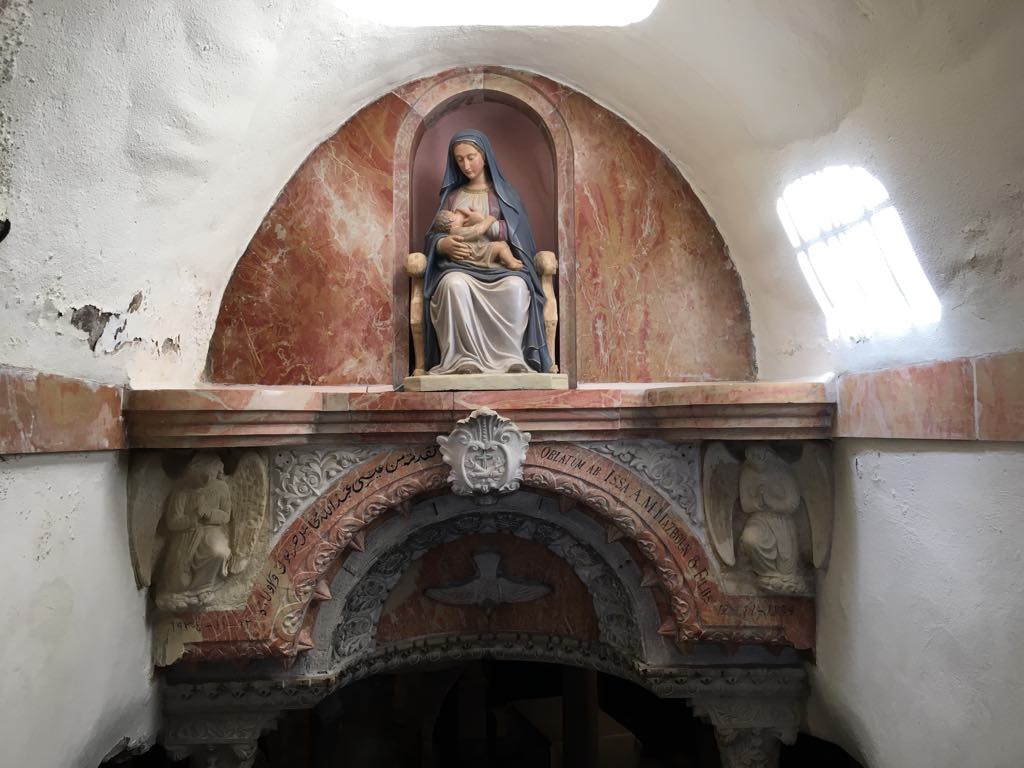
Chapel of the Milk Grotto in Bethlehem where the Holy Family hid before fleeing to Egypt to escape Herod’s murder of innocent babies. According to tradition, a drop of milk from the Virgin Mary fell on the floor of the cave that turned color of the stones to white.
We have just celebrated the Feast of the Birth of the Blessed Virgin Mary, the most perfect example of one who had experienced God’s hiddenness in her life, teaching us with some important lessons in rediscovering and keeping God’s hiddenness specially in this age of social media when everything is shown and has to be seen.
We have mentioned in our previous blog that hiddenness is different from being invisible that simply means “not visible”; hiddenness is more than not being seen per se but that feeling with certainty that God is present though hiding because he wants to surprise us. If God were not hidden, we would have not found him at all. And the more God is hidden, the more we are able to see him and experience him too as seen in the life of Mary (https://lordmychef.com/2020/09/04/the-hiddenness-of-god/).
The hiddenness of Mary.
Simplicity and humility of Mary as venue for the perfect setting of God’s coming in Jesus Christ. Consider her origins: her town of Nazareth in the province of Galilee was definitely outside the more popular city of Jerusalem that was the place to be at that time. Most of all, it is the only town in the New Testament never mentioned in the Old Testament nor by the prophets for lack of any significance in the coming of the Messiah.
Nazareth was largely unknown with some hint of notoriety as expressed by Nathanael (aka, Apostle Bartholomew) when he expressed disbelief to Philip who told him they have found the Christ, Jesus of Nazareth, by saying “Can anything good come from Nazareth?” (John 1:46)
Photo by author of chapel at the grotto believed where Mary received the good news of bearing Jesus Christ in her womb underneath the Basilica of the Annunciation at Nazareth, Israel (2019).
But that is how God works in his hiddenness, coming to us in the most ordinary places and circumstances, even least expected like Mary who was definitely not “in” if we go by today’s popular standard of “who’s in and who’s out?”
In fact, she was so “outside” the circle of influence of their time with her being promdi as we say these days, without any illustrious lineage to be proud of like her spouse Joseph who was from the royal Davidic line or her cousin Elizabeth from the priestly branch of Aaron, the brother of Moses whose husband, Zechariah belonged to another priestly clan in Israel.
Yet, God chose Mary to be the Mother of Jesus Christ because of her hiddenness expressed in her simplicity and humility. It is a far cry from our extreme “Marianism” when we almost worship Mary forgetting Jesus Christ her Son and our Savior! Worst still is the growing trend of “triumphalism” in many parishes racing for the so-called “episcopal” and “canonical” coronation of their various images of the Virgin Mary that come in all kinds of names and titles that has come to look more of a fad than authentic Marian devotion.
Without any intentions of denigrating the role and stature of the Blessed Virgin Mary in our faith as well as her proper place in the life of the Church defined by Vatican II’s Lumen Gentium, I dare ask the following questions:
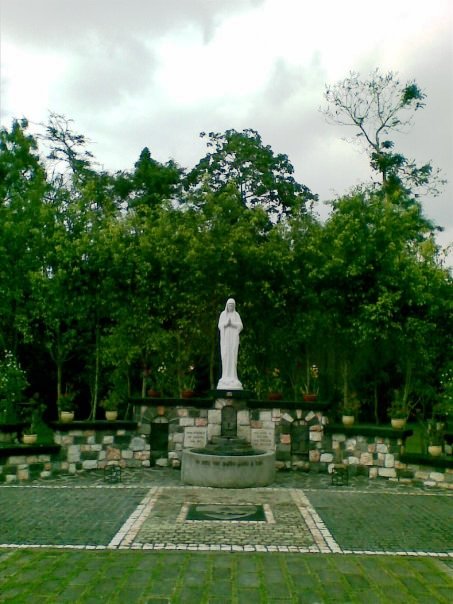
Photo by author, a replica of Our Lady of the Poor of Banneux, Belgium at Girlstown, Cavite (2009).
Is her coronation in heaven as Queen of heaven and earth not enough?
Why the need for these lavish spectacles for the coronation of the most simplest and humblest woman to have lived on earth?
It is a clear case of triumphalism – that exaggeration or overdoing our worship and rituals – especially if the Marian image is less than 200 years old without widespread devotions like the ones at Sto. Domingo (Quezon City) and Manaoag (Pangasinan).
I do not think the Blessed Mother would favor this considering her simplicity and solidarity with the poor and marginalized peoples seen in her many apparitions.
See the quaint and charming simplicity of Mary at Fatima in Portugal (1917) and lately at Banneux in Liege, Belgium (1933) where she identified herself as “Lady of the Poor”.
Note how the Virgin Mary reads “the signs of the times” in her apparitions and appearances when during the 1500’s at the height of European royalties and expeditions, she was always portrayed as victorious in regal clothes; but since Fatima in the 20th century as the world sank into the excesses of Industrial Revolution and affluence, Mary appeared simple, always in solidarity with the poor and suffering.
It is a cue we are sorely missing and sad to say, instead of renewing the world as St. Paul had asked us, we have allowed ourselves with the Mother of God to be transformed into the ways of the world by immersing in its showbiz frenzies, focusing on the material aspects like expensive clothes and jewelries.
Second example of Mary’s hiddenness is her oneness with Jesus Christ. She was never on her own, always seen in Jesus, with Jesus her Son and Lord. She believed in him so much, making him the focus at the wedding feast at Cana as well as at the foot of the Cross where she expressed in the most strongest terms her solidarity with the Savior of the world.
This has always been insisted by the Church since Vatican II regarding our devotions to Mary that must always be in relation with Jesus and his mission — never on her own.
Photo by author, 2019.
In all her apparitions, the Blessed Mother has always been consistent with her messages of conversion and return to God through her Son Jesus Christ, the frequent reception of the Sacraments of the Eucharist and Confession or Reconciliation.
Mary’s Christocentricity is best seen in her oneness with him in pains and sufferings like in the Pieta and the Mater Dolorosa where Jesus is the one standing out, not her. Nor anybody else.
When Mary, or anybody else for that matter goes on one’s own, Jesus is no longer hidden but removed from the scene. Then his Cross disappears and all that is seen is Mary in all her “beauty and glory” that are empty, very secular because these attributes come precisely from her communion in Jesus!
Perhaps, this pandemic is teaching us today to review our Marian devotions and processions that have become more of a show and a spectacle for Instagram than for deepening of our faith.
I pray that the Cofradia that holds the annual December 8 processions at Intramuros would take a rest this year until 2022 to discern their noble efforts before that have degenerated to pomp and pageantry among “devotees” specially camareros and camareras trying to outshine and outclass each other with some participation at the sidelights of their pastors and sacristans.
Keeping the hiddenness of God while we remain hidden in contemplation.
Of all the qualities of Mary we all must imitate to help people rediscover God’s hiddenness is her being hidden in prayer and contemplation.
St. John Paul II noted in Rosarium Virginis Mariae when he launched the Luminous Mysteries in 2002 that although the scriptures are silent about where was Mary during the other significant moments of the life of Jesus, especially at the institution of the Holy Eucharist, it was most likely that Mary was also present deep in prayer.
This we find clearly at the Pentecost when the Holy Spirit descended upon the apostles and the Blessed Virgin Mary while they were praying at the Upper Room in Jerusalem (Acts 1:13-14).
Modern rendition of the Pentecost with Mary among the other disciples of Jesus. From Google.
Pope emeritus Benedict XVI shares with us his profound insight in his second Jesus of Nazareth book series (Birth of Jesus) how after the annunciation of the the birth of Christ to Mary, the angel left her totally without ever coming back to warn or instruct her unlike with Joseph. After saying “Yes” to the plan of God to be the Mother of Jesus, Mary immersed herself deep in prayers and contemplation, becoming hidden herself in God.
Since then, she never doubted Jesus her Son as the Christ, nurturing her faith with prayers beautifully expressed by St. Luke in saying how “Mary treasured things in her heart” when facing difficult situations like during his birth and his finding at the temple. It is not surprising that in the contemplation by St. Ignatius of Loyola, the Risen Lord must have first appeared to his Mother upon rising from the dead because she was the first to believe totally in him (which became the basis of our tradition of the Salubong).
Mary has always been present in the hiddenness of Christ from his coming in the darkness of the night on a manger in Bethlehem, to his hidden years in Nazareth, to his ministry when he would always retreat to a deserted place to pray, to his Crucifixion and death and burial on Good Friday and finally, in the darkness of Easter.
In this age of social media where everyone and everything has to be seen and shown with nothing hidden anymore even without qualms and shame at all, part of our mission and ministry as priests and religious is to lead people back to God’s hiddenness like the Virgin Mary so they may realize anew that the best things in this life are not always seen.
To fulfill this is for us first of all to imitate God like Mary — be hidden!
How unfortunate that instead of leading the people back to God’s hiddenness, we priests and religious have in fact joined the secular world, imitating the “influencers” like bloggers and vloggers that instead of focusing on God who is hidden, we are concerned with our selves and all the “porma” for the sake of number of “likes” and “followers” we have in our posts.
The more we try so hard to make God visible in our ministry by imitating the styles and gimicks of some media personalities that make our liturgy look like a variety show complete with song and dance numbers with our altars heavily decorated like a studio set with giant tarpaulins like in EDSA, that is when we remove God totally – not only his hiddenness – from the scene and inverse proportionately, the more we priests and pastors become more popular than the Lord himself.
“The Assumption of the Virgin” by Italian Renaissance painter Titian completed in 1518 for the main altar of Frari church in Venice. Photo from wikidata.org.
And that is how cults begin, with or without Jesus. It is very sad, even tragic and ironic because we have removed God himself – even Mary! – by unconsciously making ourselves the center of attention like pop icons and idols.
Mary had shown us the most perfect example of discipleship which is more of Jesus, less of self.
Can we not post without using our own pictures – no matter how profound our thoughts are – so the people may see the hiddenness of God in a photo of a lovely flower or a magnificent sunset? Unless you are a bishop or the Pope himself, having your photo published specially in the news is part of the information process about the person in focus. It is totally different in Church communications which is all about God and his message of love, not us.
The quarantine period invites us in the Church to appreciate and share this wonderful hiddenness of God by first becoming incognito, unknown and hidden from others, preferring to be at the background or “behind the camera” as we follow God in his hiddenness until we go to that great beyond of totally hidden from everybody except God.
Do not worry. We have Mary in every step along the way. Amen.















 lordmychef.com