The Lord Is My Chef Breakfast Recipe for the Soul by Fr. Nicanor F. Lalog II
Tuesday, Week XVI, Year II in Ordinary Time, 21 July 2020
Micah 7:14-15, 18-20 >><)))*> ] + [ <*(((><< Matthew 12:46-50
Photo by author of sheep grazing at Sacred Heart Novitiate in Novaliches, QC, 2018.
What a beautiful prayer today to you, O God our Father by your prophet Micah:
Shepherd your people with your staff, the flock of your inheritance that dwells apart in a woodland, in the midst of Carmel. Let them feed in Bashan and Gilead, as in the days of old; as in the days when you came from the land of Egypt, show us wonderful signs.
Micah 7:14-15
Shepherd us like a true father, God, the old fashioned and right way symbolized by your staff: strong and sturdy to discipline us especially when we wander far from you, and yet at the same time, so tender and forgiving – full of clemency as Micah mentioned – when we are lost or stuck in a cliff or a crevice.
This is probably the one combination we are terribly missing these days, discipline and tenderness, the cornerstone of formation in every family expressed in the adage from the Sacred Scriptures, “Spare the rod, spoil the child” which the modern society strongly objects and frowns upon:
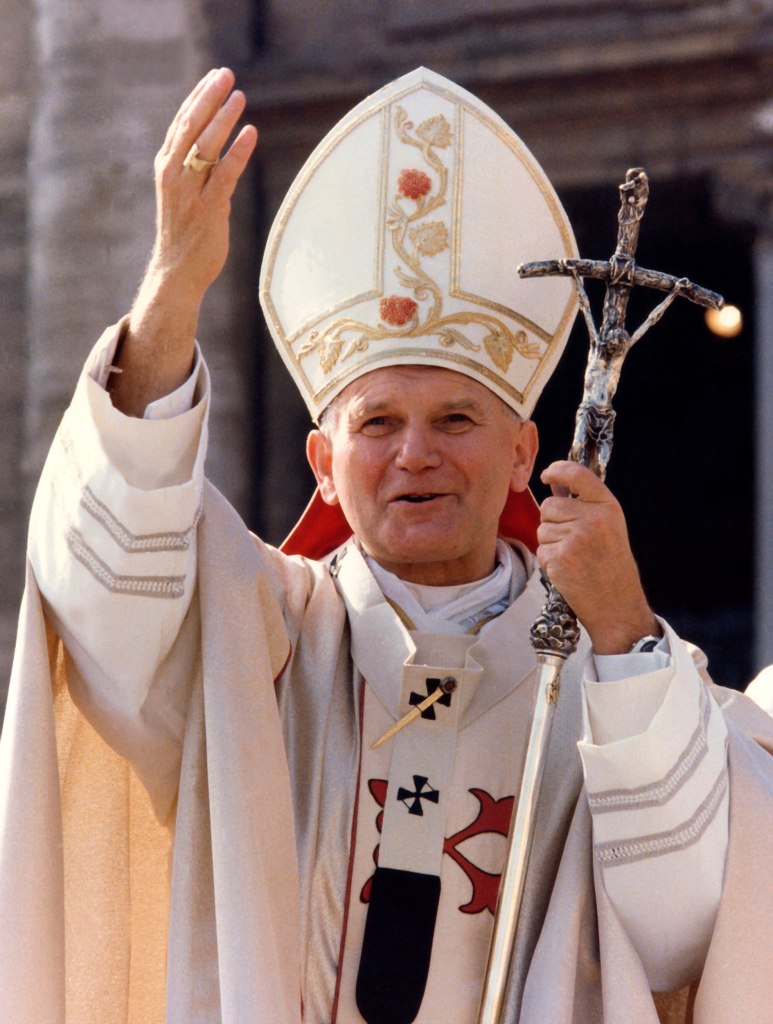
St. John Paul II waves to well-wishers in St. Peter’s Square at the Vatican in 1978 when elected as Pope, holding his staff, symbol of his being a shepherd.
He who spares his rod hates his son, but he who loves him takes care to chastise him.
Proverbs 13:24
Discipleship or being a disciple is primarily about discipline, of following not only the steps of the Lord and Master but also his ways.
From the word discipulos or to follow came the words follower and discipline alike.
Jesus Christ your Son perfectly said it in our gospel today when he rightly claimed that “whoever does the will of my heavenly Father is my brother, and sister, and mother” (Mt.13:50).
Give us the grace, O Lord, to take the right path anew of discipline to form our moral backbones tempered with your tenderness and mercy so we may truly work for a just and humane society here on earth so that your kingdom may finally come! Amen.
The Lord Is My Chef Sunday Recipe for the Soul by Fr. Nicanor F. Lalog II
Week XVI, Cycle A in Ordinary Time, 19 July 2020
Wisdom 12:13, 16-19 >><}}}*> Romans 8:26-27 >><}}}*> Matthew 13:24-43
Our Lord Jesus Christ invites us today to join him into a different kind of journey that would take us deep into God’s mystery in our very selves through the parables he has started to tell us last Sunday.
Recall, dear readers, that parables constitute the heart of the Lord’s preaching.
We have defined these as simple stories with deep realities that must be cracked open through prayers and reflections to get its meaning. From the French para bolein that literally means “along the path”, a parable is likewise a bridge that leads us into something unknown to us before.
In itself, a parable is a journey calling us to walk through it into our inner selves to discover the many inner beauties that lie within us but we take for granted. Ultimately, as we discover these giftedness within us, we then uncover God dwelling within us.
This is the reason why Jesus would always tell his audience after narrating his parables that “Whoever has ears ought to hear” (Mt.13:43) to insist on them to go deeper inside themselves for their meaning.
And that is when we are transformed, when our lives are changed into true disciples of Jesus Christ.
Greatness in littleness
First thing we notice in the three parables of Jesus today is his insistence on the coming of the kingdom of heaven or kingdom of God through him as the mysterious seed.
This kingdom of heaven is used interchangeably with “kingdom of God” that Jesus would always speak of in his entire ministry until his crucifixion is not according to our understanding of a kingdom: it is not about a territorial domain or the exercise of power over subjects using force.
St. John Paul the Second expressed it beautifully by declaring the person of Jesus Christ himself is the kingdom of God. No wonder, Christ would always liken himself and the kingdom of God with the seed being sown.
It is always good. It is for everyone as the sower scatters the seeds everywhere. And it is always small like Jesus who was born like any infant so fragile and even poor like most of us. He is like the seed we take for granted from which comes forth all kinds of plants like trees, big and small.
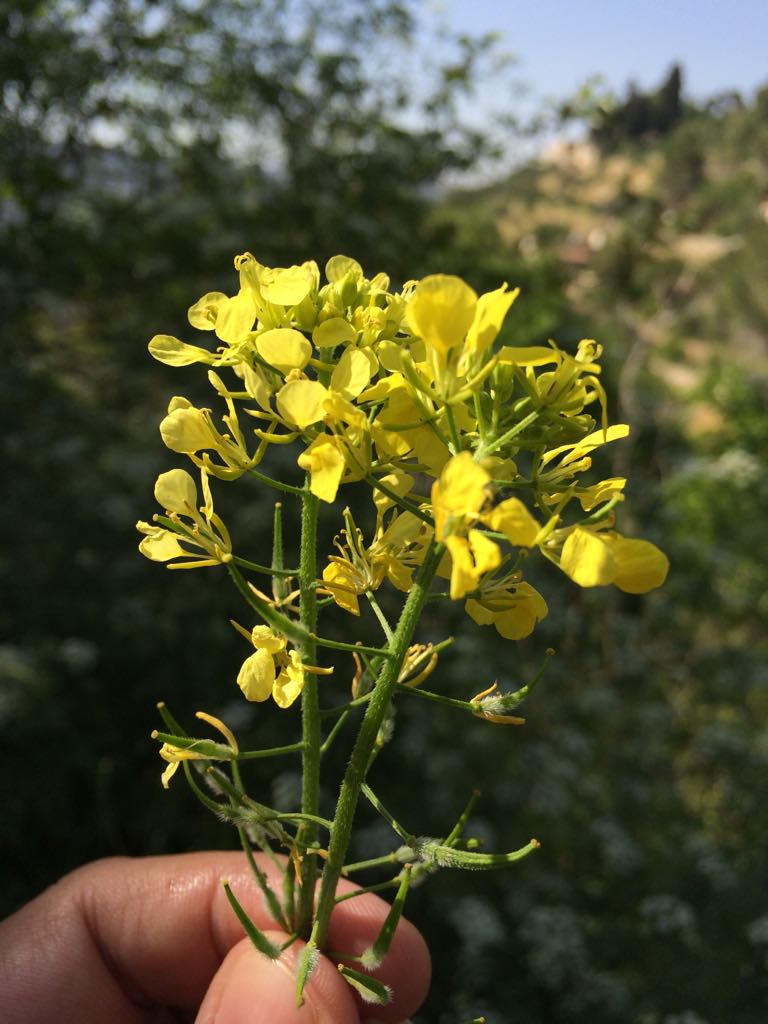
Flowers of a mustard plant from which seeds are taken. Photo by author, Israel, 2017.
Or most specially, like those seeds that turn into crops of wheat and shrubs like the mustard with leaves and branches where birds may dwell that describe the first two parables today.
Jesus then added a third parable of the yeast mixed into flour that leavened the dough into a bread.
Like him our Lord, we his disciples are also like the small seeds packed with great possibilities in God.
In all these three parables today, there is that element of smallness, of littleness that remind us how everything that is great always starts small.
When we come to think of this, we realize how we embarked on this great mission of making Jesus Christ known: it started like a small spark within us, perhaps from a single word we have heard or read, a simple inspiration by God through the most ordinary persons and situation.
Not only in things regarding our spiritual lives but even our personal lives when we recall those humble beginnings of our family and of our business.
Like a little seed or yeast, they just grew!
Now we are surprised, even amazed, how we have changed, how we have grown. Of how we are now reaping the fruits of our labors and sacrifices.
Most of all, how we have known and experienced Jesus Christ who fulfills our lives.
Weeds among the wheat
But not all days are bright and sunny. There are dark clouds that hover above us bringing storms and heavy rains that lead into floodings. A lot often in life, the darkest nights turn out to be the longest nights too.
And this is the meaning of Christ’s main parable for today.
Jesus proposed another parable to the crowds, saying: “The kingdom of heaven may be likened to a man who sowed good seeds in his field. While everyone was asleep his enemy came and sowed weeds all through the wheat, and then went off. When the crop grew and bore fruit, the weeds appeared as well. The slave of the householder came to him and said, ‘Master, did you not sow good seed in your field? Where have the weeds come from?’ He answered, ‘An enemy has done this.’ His slaves said to him, ‘Do you want us to go and pull them up?’ He replied, ‘No, if you pull up the weeds you might uproot the wheat along with them. Let them grow together until harvest; then at harvest time I will say to the harvesters, ‘First collect the weeds and tie them in bundles for burning; but gather the wheat into my barn.'”
During my prayer periods this past week, I have been filled with anger and disappointments at how things are going on in our country and even in my personal life. It pains me so much why at this time of the pandemic when we have to go through all these bad things.
Last Friday morning before our daily Mass, we discovered the glasses shattered in our windows near the office door and at the side door of the church. There were scratches outside indicating attempts to unlock the doors inside and steal from the church.
After the Mass, I grew more angry as we inspected the damages, thinking so negatively harsh against whoever tried to burglarize us.
By night time during prayers, I remembered Victor Hugo’s Les Miserables where Valjean was caught by the police stealing silver from the good bishop who had welcomed him into his rectory with food and accommodations. Instead of pinning him down for his crime, the bishop told the police he had given Valjean the silver found in his bag, even chastising him he had left behind the other silver candlesticks he had asked to take!
The wheatfield owner in our parable and the good bishop of Les Miserables are both the merciful God mentioned by the author of the Book of Wisdom in our first reading today:
But though you are master of might, you judge with clemency, and with much lenience you govern us; for power, whenever you will, attends you. And you taught your people, by these deeds, that those who are just must be kind; and you gave your children good ground for hope that you would permit repentance for their sins.
Wisdom 12:18-19
Think of our parents and elders, our mentors or those we look up to for their wisdom gifted with wonderful insights in life called perspicacity which means “a penetrating discernment… a clarity of vision or intellect which provides a deep understanding and insight.”
Being perspicacious or having perspicacity like the wheatfield owner or the good bishop of Les Miserable means having a deeper wisdom that one can keenly see and understand things beyond ordinary perception following a long process of silent reflections in life.
Many times, our sights can be limited that we do not see the other repercussions and even ramifications of our decisions on certain situations. There are times we think only of finding solutions, of winning the battle but not the war.
It is also along this line that Jesus added the third parable: the yeast is mixed with the flour to leaven the dough.
We are like the yeast who have to mix with others, including the evil ones to become bread that will feed the world.
We are the wheat, the mustard seed, the yeast thrown into the world to make a difference in Christ! We are not the ones who will change the world but Jesus Christ, the mysterious seed, the yeast in the dough who grows and effects the changes in us and among us.
Parables as inner journey in Christ Jesus
With Jesus living and nurturing within us, that is when we become fruitful like the wheat and mustard plant or leavened bread that we are able to feed more people who would eventually become bearers his in the future. That is how the kingdom of heaven comes into this world, when God is seen and felt by everyone through us
This we achieve in prayers as St. Paul reminds us in the second reading. It is not just reciting our basic prayers as Christians including the novenas we love to collect and follow through. The kind of prayer that St. Paul speaks here is a prayer guided by God’s Holy Spirit who perfectly knows God’s will.
Photo by Dr. Mylene A. Santos of kids she’s teaching on the values of health, education and nature at Katmon Harbor Nature Sanctuary, Infanta, Quezon.
Brothers and sisters: The Spirit comes to the aid of our weakness for we do not know how to pray as we ought, but the Spirit himself intercedes with inexpressible groanings.
Romans 8:26
In this time of too much weeds among the wheat, of so many evil and sins prevailing over us, we can feel frustrated at times that make it so difficult for us to pray.
Sometimes, the evil and sins, or the plain sufferings we go through in our own family, in our community or at work and in school can be so overwhelming that we feel our prayers are useless, that God is not listening at all to us.
Then we stop praying, we stop journeying within even with weeds among the wheat. How can the flour be leavened if the yeast is not mixed with the dough to become bread or cake.
Remain in the Lord!
Pulling out the weeds will not solve the problem; worst, it may endanger us all too in the process that we become like our enemies in the end. Never lose hope in God who knows very well of the presence and source of weeds. Sometimes, these pains and sufferings from evils we go through from others may actually lead us to our being fruitful!
Evil and sins are a parable in themselves that can teach us so well in life if we handle them with prayers.
Photo by Dr. Mylene A. Santos, Infanta, Quezon, May 2020.
Praying in the Holy Spirit is when we spend time with Jesus to reflect and crack open his words that come to us in the Sacred Scriptures and ordinary events in daily life through long hours of silent meditation and contemplation.
The more we dive into God’s mysteries in the parables he sends us in daily living, the more we see the beauty and wonder of life because our horizons are widened and get clearer.
Praying into our parables in life is like looking into a telescope or binoculars that enable us to see something distant within reach.
Lawiswis ng Salita ni P. Nicanor F. Lalog II, Ika-15 ng Hulyo 2020
Sa gitna nitong mga balita
sa garapal at walang kahihiyang
ginawa ng pitumpung mambabatas
na nagkait ng prangkisa sa Kapamilya
aking naalala sa Banal na Bibliya
kuwento ni San Lucas na ebanghelista
nang ang Panginoong Hesus humirang noon
pitumpung alagad o pitumput-dalawa
na sinugo Niya ng dala-dalawa
sa bawat pook at bayan na patutunguhan Niya.
Sinabi Niya sa kanila
"Sagana ang aanihin, ngunit kakaunti
ang mga manggagawa... Humayo kayo!
Sinusugo ko kayong parang mga kordero
sa gitna ng mga asong-gubat.
Huwag na kayong magdala ng lukbutan,
supot, o panyapak.  Huwag na kayong titigil
sa daan upang makipagbatian kaninuman.
Pagpasok ninyo sa alinmang bahay,
batiin ninyo ng kapayapaan;
Manatili kayo sa inyong tinutuluyan,
huwag kayong magpalipat-lipat ng bahay.
Pagalingin ang mga may karamdaman
sa bawat bayan na inyong pupuntahan
mga taumbayan ay sabihang nalalapit na
ang paghahari ng Diyos sa tanan."
Inyong tingnan sa Banal na Kasulatan
ito ay malalaman, matatagpuan sa Lucas 10:1-12
kahanga-hangang misyon ng pitumpung alagad
ng ating Panginoon noong unang panahon
hatid sa tao pag-asa at pag-ahon;
inyong tingnan ngayon mga pahayagan
pakinggan mga balita ng labis na kasamaan
kawalan ng kahihiyan ni pakundangan
nitong pitumpung nilalang
turing sa sarili at mga kasamahan "kagalang-galang"?
Sila ma'y pinahayo, sinugo
ng pinapanginoon nilang Poncio Pilato
asal nila masahol pa sa asong-gubat
kaayusan at kapayapaan tinapakan
at niyurakan ng kanilang kapalaluan;
sa bawat halalan pangako paglilingkuran
nasasakupan agad namang tinatalikuran
palipat-lipat ng kakampihan kung saan makikinabang
sa sama-samang pagsamsam sa kaban ng bayan;
kunwari'y mabuti ang kalooban
kaban-kabang bigas pinamimigay
milyung-milyong kapalit naman ang dinudugas;
kunwari'y malasakit para sa may-sakit
pakilala sa lahat ay kuya na tila kapamilya
pati turo ng Diyos sinasalaula
manang mana sa kanyang ama.
Sa pagsusugo ni Hesus sa pitumpung alagad Niya
binigay din Kanyang babala
Araw ng Paghuhukom malapit na;
kaya sana itong pitumpung kongresista
pati na kanilang mga kasama
mabatid ang usapin ay hindi lang prangkisa
kungdi kanilang pagmamalabis;
huwag ninyong punuin ang salop
dahil ang Diyos Siyang kakalos
at baka sapitin ninyo ay kalunus-lunos.
The Lord Is My Chef Sunday Music by Fr. Nick F. Lalog II, 05 July 2020
At that time Jesus exclaimed: “Come to me, all you who labor and are burdened, and I will give you rest. Take my yoke upon you and learn from me, for I am meek and humble of heart; and you will find rest for your selves. For my yoke is easy, and my burden is light.”
Matthew 11:28-30
If there is anything we all wish this first Sunday of July 2020, it must be rest from all the worries and burdens in this time of the corona. We all want something that would be lighter in this second half of the heaviest year we have ever had in decades or even a generation.
Being light does not mean being worry-free, no problems nor sufferings. Dr. M. Scott Peck insists in his book Road Less Travelled that “life is difficult” – the sooner we realize and accept this, the better for us (see our homily, https://lordmychef.com/2020/07/04/we-are-disciples-of-a-meek-and-humble-lord/).
Being light is having a companion to share with our burdens and woes in life because having these all by ourselves is so difficult and impossible. Most of the time, our problems need not be solved at all but simply be accepted and shared with someone who loves us, cares for us, and believes in us.
Jesus Christ is that only companion par excellence we can have for he is meek and humble of heart.
Van Morrison’s lovely ballad Someone Like You released in 1987 captures this essential desire among us all to seek and forge many relationships.
I've been searching a long time
Someone exactly like you
I've been traveling all around the world
Waiting for you to come through

Someone like you makes it all worth while
Someone like you keeps me satisfied
Someone exactly like you
Though the song has become a staple in many weddings and in many romantic movies covered by various artists, Someone Like You sounds more like a spiritual song longing for God through our loved ones for he is always faithful and loving to us despite our many weaknesses and sins.
I've been doin' some soul searching
To find out where you're at
I've been up and down the highway
In all kinds of foreign lands

Someone like you makes it all worth while
Someone like you keeps me satisfied
Someone…
May Van Morrison’s song bring you closer to God through your loved ones as we continue to hurdle the many obstacles and trials ahead in this time of COVID-19.
The Lord Is My Chef Sunday Recipe for the Soul by Fr. Nicanor F. Lalog II
XIVth Sunday in Ordinary Time, Cycle A, 05 July 2020
Zechariah 9:9-10 >><)))*> Romans 8:9, 11-13 >><)))*> Matthew 11:25-30
From Google.
We now come to the conclusion of our series of teachings of Jesus about discipleship that began two Sundays ago when he asked us not to be afraid and to be “possessed” or overtaken by him to fulfill our mission of proclaiming his good news of salvation.
And so, we now ask, “Why should we follow Jesus and be his disciples, forgetting our very selves and still carry our cross? Have we not suffered enough especially in this pandemic?”
His answer: because unlike other lord and master, Jesus is the only one who is meek and humble of heart, full of compassion to everyone!
He is the only one truly with us in our pains and cries because before all these trials have come to us, Jesus was there first to suffer and die for us on the Cross so we can share in the grace and peace of his Resurrection, calling us with these comforting words….
“Come to me, all you who labor and are burdened, and I will give you rest. Take my yoke upon you and learn from me, for I am meek and humble of heart; and you will find rest for your selves. For my yoke is easy, and my burden is light.”
Matthew 11:28-30
Our desire for everything “lite” and easy
If there is anything that we all want at this time is a rest, a break from the heavy burdens 2020 has brought upon us all as individuals and as a nation, not only in the country but the whole world.
We all want things to be “light” and easy like before COVID-19.
The world has long been offering us everything that is “light” (also spelled as “lite”), claiming it to be the key to a healthy and fulfilling life that many products are labelled as lite — from cooking oil to mayonnaise, cheese and ice cream, soda and even brandy, beer, and cigarettes!
But they are all lies!
We still get fat and even sickly with those lite products because being light does not necessarily mean removing or taking away things that are heavy and “toxic” or difficult. Being light does not mean free from responsibilities and duties, or not having a cross and sufferings in life.
Life is difficult as M. Scott Peck insists in The Road Less Travelled, telling us that the sooner we accept this reality, the better we are in life.
It is the truth Jesus Christ has long been telling us, so timely to be reminded again this first Sunday of the second half of 2020 as we continue to hurdle more difficulties ahead in fighting COVID-19 as well as in dealing with a hosts of other problems it had created in the many aspects of our lives.
Today, the Lord is telling us that to be light in life, we have to come to him, be his disciple by taking his yoke and learning from him.
We all know from experience that anything becomes light, especially a burden and a problem, when shared with someone who loves us, someone who cares for us, someone who believes in us. Many times, our problems and burdens need not be solved at all; they simply have to be shared with any one willing to accompany us.
Being light in life is having a companion to share with our burdens and woes because having these all by ourselves is indeed so difficult and impossible. That is the literal meaning of the Latin origin of the word companion – cum panis – someone you break bread with in a journey.
Jesus Christ is that only companion par excellence we can have for he is meek and humble of heart
Photo by Ezra Acayan of Getty Images, Baclaran Church, February 2020.
The gentle mastery of Jesus Christ
In the past two Sundays, Jesus spoke about ourselves and our dispositions to become his disciples. This Sunday, he speaks about himself as our Lord and Master, describing himself as “meek and humble of heart”.
Earlier at the start of his preaching in his Sermon on the Mount, Jesus spoke of true blessedness in the Beatitudes that actually gave us an image of himself as the Blessed One. Each beatitude speaks of Jesus Christ being poor in spirit, being meek, being merciful, being clean of heart, being a peacemaker, and being persecuted.
See that the third beatitude is how he also described himself today in the gospel, “Blessed are the meek for they shall inherit the land” (Mt. 5:5).
Very interesting is the fact that in his Sermon on the Mount when he preached the Beatitudes, Jesus was presenting himself to the people as the “new Moses” who gave them the Ten Commandments of God at Mount Sinai. As the most towering figure among the Jews, Moses is also described as “very meek, more than all men that were on the face of the earth” (Numbers 12:3)!
Meekness of Jesus: focusing more on persons than letters of the law
In calling us to come to him to take his yoke and learn from him for he is meek and humble of heart, Jesus is telling us that indeed, he is the new Moses in whom pure goodness is found. And even more surpassing than Moses because Jesus himself is the Law and its fulfillment. Unlike in Moses wherein the people focused more on the letters of the laws, Jesus our Lord insists more on the person, always reminding us that “Sabbath was created for man, not man for sabbath.”
But the most beautiful key in understanding the meekness of Jesus is found in our first reading which we also hear proclaimed on Palm Sunday:
Thus says the Lord: Rejoice heartily, O daughter Zion, shout for joy, O daughter Jerusalem! See, your king shall come to you; a just savior is he, meek, and riding on an ass, on a colt, the foal of an ass. He shall banish the chariot from Ephraim, and the horse from Jerusalem.
Zechariah 9:9-10a
Photo from Google of an ass considered as the dumbest creature on earth.
Unlike the proud masters and rulers of the world, Jesus our Lord and King entered Jerusalem riding on an ass in fulfillment of this part of the Old Testament.
Here we find Jesus as the exact opposite of the kings and rulers of the world whose kingship does not depend on political and military might, no exercise of brute force and power characterized by the chariots and horses of his time.
Meekness of Jesus: oneness with us his people
In this beautiful imagery of Jesus riding an ass considered as the dumbest creature on earth we find Christ’s inmost being of humility and meekness before God and men. No display of arrogance and shameless feelings of entitlements like our officials in the government and military. Most of all, Jesus riding on an ass illustrates his oneness with us all because the ass is the means of transportation of the poor, of the common tao.
Here is the meekness and humility of Jesus Christ — his being one with us in our brokenness and poverty, pains and hurts. You can really experience him especially in this time of the corona when everything seems to be getting worst than better, when everybody is trying to make ends meet amid the economic crisis with Jesus never abandoning us in our darkest moments of uncertainties, fears, hunger, and sadness.
At the rate things are going, we have nobody else to turn to at this time but Jesus our Lord. We have to muster all our faith in him, deepen ourselves in prayer because we cannot rely on our officials who cannot even get a clear data on COVID-19 infections nor even a sound plan in addressing this pandemic despite the longest days of lockdown in the world and loans from abroad.
And we all feel so hopeless, disgruntled and so disgusted especially with the public officials and those from congress and the police who are oblivious to our sufferings and hardships in this time of the corona as they shamelessly flaunt their privileges and exception to the rules.
How can we heal as one when in the first place they are not one with us?
Discipleship in Christ is life in the Holy Spirit
Despite all the irresponsibilities and inanities of the government, we choose to be like our Lord and Master Jesus Christ in bearing all pains and hardships in his holy name, always hoping that this experience can lead us to more meaningful lives as citizens of the republic.
We choose the path of non-violence despite the government’s militaristic response to the crisis aggravated by the legislative’s dangerous foray into more draconian measures to silence critics of the administration.
It is so tempting to fight back and forget all about meekness and humility but that is not the way of Jesus Christ.
In the second reading, St. Paul reminds us of the fundamental choice that lies before every disciple of the Lord: to live in solidarity with Christ empowered by his Spirit, or to live in solidarity with the old humanity enslaved to sin.
May we choose Jesus because he alone is meek and humble of heart, in him alone can we find rest because his yoke is easy and his burden light. Amen.
The Lord Is My Chef Breakfast Recipe for the Soul by Fr. Nicanor F. Lalog II
Friday, Feast of St. Thomas, Apostle, 03 July 2020
Ephesians 2:19-22 >><)))*> <*(((><< >><)))*> <*(((><< John 20:24-29
Thank you very much, dearest Jesus, in founding your church upon your Apostles who were all like us: full of flaws and weaknesses, faults and failures, sins and imperfections.
Every time we celebrate their feasts, you remind us of your call to be near you like the Apostles despite our sins and inadequacies, to be sorry and make amends to return to you to be built into a dwelling of the Holy Spirit.
Brothers and sisters: You are no longer strangers and sojourners, but you are fellow citizens with the holy ones and members of the household of God, built upon the foundation of the Apostles and prophets, with Christ Jesus himself as the capstone. Through him the whole structure is held together and grows into a temple sacred in the Lord; in him you are also being built together into a dwelling place of God in the Spirit.
Ephesians 2:19-22
Help us, Lord Jesus, to be like St. Thomas your Apostle who came but doubted, returned and saw you a week later and believed, declaring “My Lord and my God” upon seeing you.
But what did St. Thomas really see that he believed?
Then he said to Thomas, “Put your finger here and see my hands, and bring your hand and out it into my side, and do not be unbelieving, but believe.” Thomas answered and said to him, “My Lord and my God!”
John 20:27
Through St. Thomas, you have blessed us and helped us, dear Jesus to believe in you not in seeing your face but more in seeing and feeling your wounds.
How wonderful, O Lord!
It is not your face but your wounds that enable us to recognize you and believe in you.
We will never see your face in this lifetime, Lord, but every day in our trials and sufferings, in our pains and hurts, in our wounds and woundedness, in our brokenness — there you are most present in us and among us.
Heighten our awareness of your presence, to accept pains and sufferings for your love and mercy so we may deepen our faith in you, following you always in your path of the Cross.
Like St. Thomas, may we follow you closely at your Cross, offering ourselves like you to be broken and shared so that in our wounds and woundedness, others may find healing, most especially you, sweet Jesus. Amen.
The Lord Is My Chef Breakfast Recipe for the Soul by Fr. Nicanor F. Lalog II
Thursday, Week XIII, Year II in Ordinary Time, 02 July 2020
Amos 7:10-17 >><)))*> >><)))*> >><)))*> Matthew 9:1-8
Photo by author, Bible Sunday, January 2020.
Again, O God our loving Father, we pray that you send us prophets especially in this time of so many “spokespersons” who do not know how to listen, like Amaziah the priest at Bethel and the scribes in Capernaum.
Like many of our public figures and even some of us priests who speak a lot in public these days, we all claim to be speaking the truth, speaking for you.
But to speak is always a gift from you, a sharing in your power that whatever you speak happens like in creation and in Jesus Christ, the Word who became flesh presented today in the gospel healing a paralytic by simply speaking the words of forgiveness and then telling him to rise and walk.
How funny that in your words today, dear God, are two groups of people claiming to be speaking for you and yet too far from your words and realities, Amaziah and the scribes; and on the other hand, another group, that of Amos and Jesus, claiming nothing for themselves but doing everything in your name.
Teach to be like Amos and Jesus your Son, to speak and do only your Holy Will.
Amos perfectly explained the giftedness of being your prophet:
Amos answered Amaziah, “I was no prophet, nor have i belonged to a company of prophets; I was a shepherd and a dresser of sycamores. The Lord took me from following the flock, and said to me, ‘Go, prophesy to my people Israel.'”
Amos 7:14-15
Make us realize, Lord, that to speak for you, we must first listen to your voice, wait and listen to your words.
To be your prophet or spokesman is to never harbor evil thoughts on others.
And most of all, like Amos and Matthew, to be your prophet means to leave everything behind especially fame and honor in order to follow you — even to the Cross! Amen.
The Lord Is My Chef Breakfast Recipe for the Soul by Fr. Nicanor F. Lalog II
Tuesday, Memorial of the First Martyrs of the Holy Roman Church, 30 June 2020
Amos 3:1-8, 4:11-12 >><)))*> <*(((><< >><)))*> <*(((><< Matthew 8:23-27
First Martyrs of the Holy Roman Church photo from ucatholic.com.
As we remember today, O Lord our God, the courage and fidelity of the first martyrs of Rome, we also pray for more martyrs and prophets who may inspire us to be your witnesses in this troubled time.
Or better still, make us one!
How sad that until now, we live in a time so similar with ancient Israel and ancient Rome where many of us turn away from you to worship money and other false gods, blinded by the material wealth and prosperity around us.
Many of us have become greedy and unjust in our ways to others especially the poor and marginalized.
Send us a prophet, Lord, like Amos who would dare to speak your words of truth, warning people who have gone astray.
The lion roars — who will not be afraid! The Lord God speaks — who will not prophesy! I brought upon you such upheaval as when God overthrew Sodom and Gomorrah: you were like a brand plucked from the fire; yet you returned not to me, says the Lord. So now I will deal with you in my own way, O Israel! And since I will deal thus with you, prepare to meet your God, O Israel.
Amos 3:8, 4:11-12
Increase our faith in you, O God, while at the middle of this great storm of COVID-19 pandemic worsened by many social upheavals happening around the world and right in our country.
Sometimes, we feel like the disciples of your Son Jesus, so terrified with the violent storm going on with waves almost swamping us.
Forgive us, Lord, when we panic because we sometimes feel that you do not care at all that we are perishing in the storm while you are “sound asleep”.
Fill us with your courage, sweet Jesus, to give witness to you like the martyrs of Rome who chose death than be one with the modern Neros of our time who lie and mislead many others into evils and sin. Amen.
The Lord Is My Chef Sunday Recipe for the Soul by Fr. Nicanor F. Lalog II
XIIIth Sunday in Ordinary Time, Year A, 28 June 2020
2 Kings 4:8-11, 14-16 >><)))*>Romans 6:3-4, 8-11 >><)))*> Matthew 10:37-42
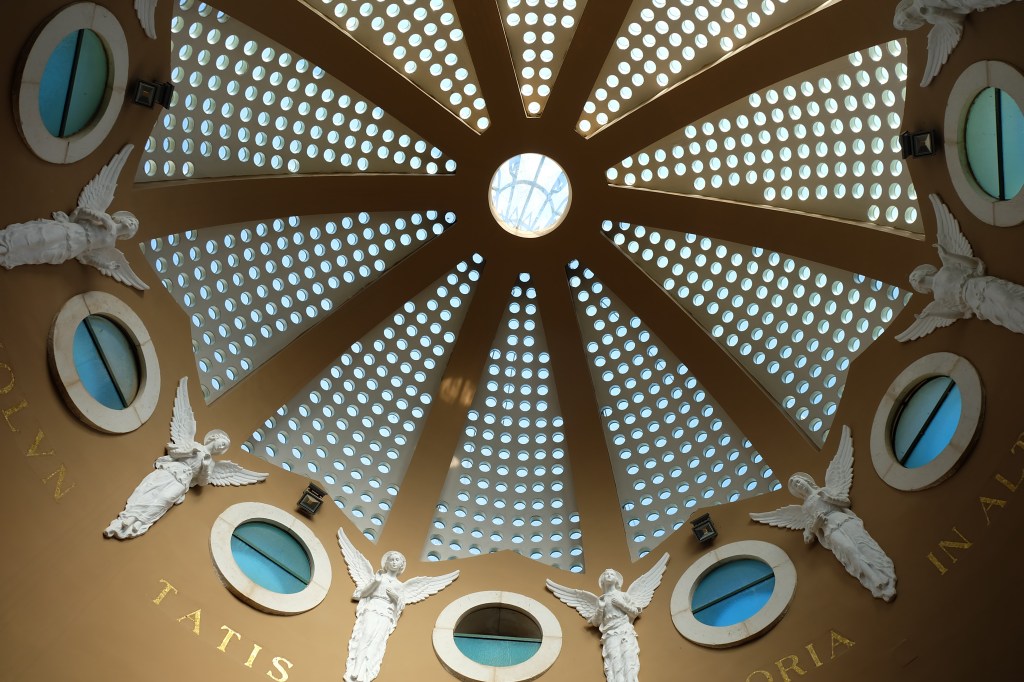
Photo by author, Dome of the Chapel of Nativity at Shepherd’s Field, Bethlehem, the Holy Land, May 2019.
Jesus continues his lessons to us his disciples being sent to look for the “lost sheep of Israel”, to be not afraid for he is with us in this journey and mission. But, it is not enough that we have Jesus on our side and be present among us: we have to allow Jesus to take possession of us completely!
From having no fear because Jesus is here, Christ now deepens his presence by inviting us to be possessed by him, to be in communion with him.
Jesus said to his disciples: “Whoever loves father and mother more than me is not worthy of me, and whoever loves son or daughter more than me is not worthy of me; and whoever does not take up his cross and follow after me is not worthy of me. Whoever finds his life will lose it, and whoever loses his life for my sake will find it.”
Matthew 10:37-39
Photo by author, processional Cross at the altar, 2019.
The Mystery of the Cross
Discipleship in Jesus Christ is more than a total allegiance to him who is neither a demanding nor exacting Lord and Master for he does not arbitrarily impose himself upon us.
Nothing like that of subservience but something more lofty because it is wrapped in a mystery — a mystery of love freely given and shared to us by God even if we do not deserve it all. Remember the mystery of the Blessed Trinity four Sundays ago (June 07)?
Ever since, God has never imposed himself upon us, that we should love him back in return for he does not really need our love. He gave us the gift of freedom so that we may love him freely for he never imposes on us.
And here lies the beauty of discipleship, of this relationship we have with God that is based solely on love expressed to us in the most personal manner by giving us his Son Jesus Christ who suffered and died on the Cross but rose again on Easter. This we were reminded by the Solemnities of the Body and Blood of Jesus and of his Sacred Heart last June 14 and 19 respectively.
Now you see my dear readers the clearer picture of our liturgical celebrations expressing our concrete experiences of being loved by God in Jesus Christ most especially during times of trials and sufferings like in this COVID-19 pandemic.
It is Christ who made the initiative to be one with us in our pains and sufferings; God did not remove our crosses in life but made them holy in his Son Jesus Christ so that every time we go through life’s many difficulties, we share in the Lord’s Passion, Death, and Resurrection.
That is why, we are invited to take and carry our cross every day for it is through the Cross we are saved. It is not enough to simply believe in the person of Jesus but we need to accept and embrace his Cross because it is through which he had won our salvation by dying on it and rising again.
This is easier said than done. It is so difficult to love Jesus more than our loved ones like family and friends. And it is most difficult to love the Lord more than our selves, when we have to let go of our plans and agenda.
Letting go and letting God in itself is already crucifying — but that is when this mystery of Christ’s love and of his Cross deepens further when we lose ourselves in him!
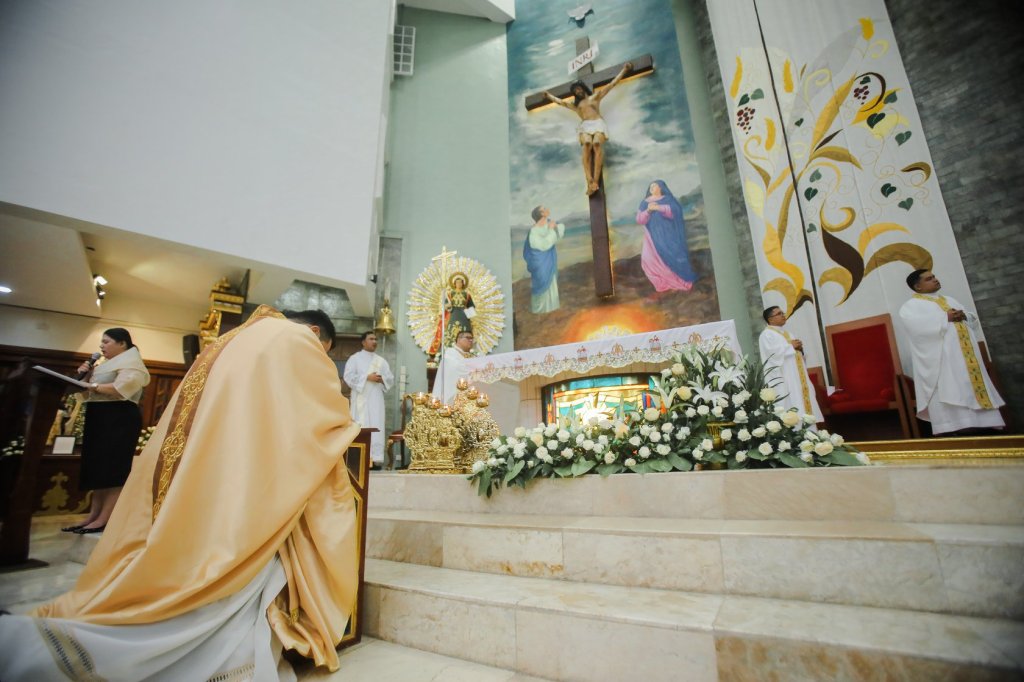
Celebrating Mass without te congregation during the ECQ, March-April 2020.
Possessed by Christ
To be possessed by Jesus is to receive God and his gift of salvation through the mystery of Christ and his Cross. Like our Christian life, proclaiming the gospel carries with it the sign of the Cross of Christ.
We are not asked to reenact or reproduce his Crucifixion nor is Jesus asking us to be suicidal or go against our natural aspirations and dreams.
To be possessed by Jesus means we continue to take care of ourselves without neglecting the needs of others.
To be possessed by Jesus means being generous to others in the same manner Jesus has always been generous to us.
To be possessed by Jesus means to realize that every act of self-giving is really an act of receiving!
Photo by author, Malagos Park, Davao City, 2018.
That is the paradox of the Cross, of discipleship in Christ: “Whoever finds his life will lose it, and whoever loses his life for my sake will find it” (Mt.10:40).
And that is also where the mystery of Christ’s love deepens because whatever we give is not really ours but Christ’s.
Every time we give love, it is the love of Jesus.
When we are kind and generous with others, it is the kindness and generosity of Jesus we give and share.
When we are patient and understanding to others, it is still the patience and understanding of Jesus in us.
Even if we give and share material things like money, food, clothing… whatever good we share and give are all from Jesus not from us.
And the more we give, the more we receive!
Have you noticed especially during this pandemic how the generous among us are now more blessed?
Wonder no more because you have allowed yourself to be possessed by Jesus Christ!
This is what the woman at Shumen had realized after welcoming the Prophet Elisha into her home in our first reading. She even gave him a room to stay every time he comes for his mission while the Lord provided all her needs, even rewarded her with a son as promised by Elisha.
When we allow Jesus to take over us, when we enter into communion in him and with him in his very life, we become more free to love, we strengthen our relationships with others, we wander less and worry less in life; most of all, we feel lightened in our burdens with the presence of Jesus giving us fullness of life in him.
This is the grace I hope we have seen from this quarantine period, especially those two months of lockdown when were freed from our usual grind and busyness with more time to be silent and still, to pray and reflect on our relationships with God and with others. It was a difficult and very trying period that had given in return a lot of opportunities to others.
Photo by author, Marcos Highway, 2019.
Dead to sin, alive to God
Brothers and sisters: We know that Christ, raised from the dead, dies no more; death no longer has power over him. As to his death, he died to sin once and for all; as to his life, he lives for God. Consequently, you too must think of yourselves as dead to sin and living for God in Christ Jesus.
Romans 6:9-11
It has been four months since houses of worship were ordered closed to help stop the spread of the corona virus. Somehow, the lockdown had made us realize the importance of receiving the Sacraments especially the Holy Eucharist.
But, sacraments are not everything for we have the bigger roles of putting into practice its reality of being the saving presence of Jesus Christ.
Now that lowly life is beginning to go back to its usual grind especially the traffic, soon we might forget again the more important things in life like God and our relationships in our family and friends that it is hoped we have rediscovered during the quarantine period.
That is why I strongly feel the government must now allow Churches to open so the people may experience again God in the sacraments and in our rites and rituals lest they get busy again with so many things only to miss finding anew the meaning of our lives found in silence and stillness before the Cross of Christ.
It is my hope that in this quarantine period, may we find through the Cross of Jesus that when we learn to submit and surrender to him, that is when we truly become free; and, when we lose and give away our lives to him, that is when we gain fullness of life in him. Amen.
A blessed week and a more abundant July to everyone!
The Lord Is My Chef Sunday Recipe for the Soul by Fr. Nicanor F. Lalog II
Thirteenth Sunday in Ordinary Time, Year A, 21 June 2020
Jeremiah 20:10-13 ><)))*> Romans 5:12-15 ><)))*> Matthew 10:26-33
Photo by author at Pulilan, Bulacan, January 2020.
Finally, today we can truly feel the Ordinary Time as we celebrate Sunday in shades of green with a new sequence of readings from the gospel of St. Matthew who will guide us in our journey with Jesus this year until the Solemnity of Christ the King in November.
Set after the naming of the Twelve Apostles who were sent to search for the “lost sheep of Israel”, the Lord now warns them of persecutions and dangers; hence, today until the next two Sundays, Christ will encourage his disciples including us to take on the challenges of his mission, assuring us of his loving presence and protection.
Notice how the Lord tells us three times to be not afraid of the mission:
Jesus said to the Twelve: “Fear no one… And do not be afraid of those who kill the body but cannot kill the soul; rather, be afraid of the one who can destroy both soul and body in Gehenna… So do not be afraid; you are worth more than many sparrows.”
Matthew 10:26, 28, 31
Photo by Mr. Jim Marpa, 2018.
The problem with our fears
Christ’s words today suit us so perfectly in this time of the COVID-19 pandemic made worst by the growing social unrests not only in our country but also elsewhere in the world that proves how the Lord’s mission remains unfulfilled in us.
Almost everywhere we hear reports of continued oppression of peoples in various forms of discrimination, disrespect and injustices.
But we do not need to look far to do our mission. We start with ourselves first — for we are the “lost sheep of Israel” in so many ways. All oppression and injustices going on around us are the reflections of what is within us that often result from our fears.
So often, the many fears within us push us to be selfish, forgetting others in the process. And that is when we start hating each other, creating this vicious circle of sufferings as the Jedi Master Yoda warned Anakin Skywalker in “Star Wars Episode One: The Phantom Menace.”
From Google.
We all have fears. It is normal to feel afraid especially when threatened by a grave danger or threat to life.
Being brave, having courage does not mean having no fears; on the contrary, courage is facing one’s fears in life. Cowardice, on the other hand, is refusal to face our fears.
Jesus is asking us today to face our fears with him and in him so we can be free to follow him in his mission.
Facing our fears in Jesus Christ
What are our fears that lead us to anger and hate, that immobilize us to reach out to God and others? Let us examine them in the light of Christ’s reassuring words this Sunday.
“Fear no one. Nothing is concealed that will not be revealed, nor secret that will not be known. What I say to you in darkness, speak in the light; what you hear whispered, proclaim on the housetops.”
Matthew 10:26-27
Photo by author, 2019.
Fear of not being loved and appreciated
One of the things I fear most is not being loved and appreciated, of being neglected and taken for granted.
It is a fear akin with low self-esteem or self-worth that make me afraid of others I deem as better and superior than me.
There are many contributing factors to this fear, mostly not of our own making like growing up in a very strict environment where we are not able to measure up to the expectations of those around us. Sometimes it is due to traumatic experiences that have truly hurt us inside and outside.
As I grew up meeting so many people from various walks of life, including those I looked up and admire including some personalities, I have realized that indeed nobody is perfect. No one has the monopoly of every good thing — looks and intelligence, wealth and health. We all need one another, and we are also needed. And loved as well as appreciated too!
We are all broken and lost, wounded and hurt; no need to fear anyone. What is most important is to always remember God loves us very much — no matter what.
At night before we sleep, do not just count your sins and failures; think also of the good things you have done, people you have helped and made happy. Listen to God thanking you for being so nice with someone. That is what Jesus is telling us to “speak in light” what he said to you in darkness!
Every morning when you wake up, be silent and still, pray and little, listen to God whispering to you the words “I love you… I believe in you” to inspire your for the brand new day. These are the words Jesus is asking you to “proclaim on the housetops”.
Forget those pains inflicted on us by others, in words or in deeds — they must be hurting too, feeling more unloved and unappreciated than us, more fearful than us!
Afraid of getting hurt, physically and emotionally
Another fear I always have is being hurt because I might not be able to take or absorb the pains. Worst, adjust to changes and disturbances that may result.
I was a very sickly child when growing up that I dreaded injections and other medical procedures. Aside from getting hurt, I feared that things could never be the same again, altering or disturbing what I have been used to.
But, as I aged fighting many battles in life, enduring so many pains and hurts with some help from family and friends, I have learned that pain is part of growing up. In fact, growing up becomes nicer with more pains and hurts that make us stronger and wiser with the many lessons we can learn. Most of all, pains and hurts have opened up many doorways to new beginnings that made me grow and mature as a person and as a priest.
Indeed, as the Lord had told us, do not be afraid of those who can kill the body but not the soul. It is what is inside that makes us who we really are. Replace those fears with Jesus and dare to get hurt and bruised that may destroy you outside but stronger inside.
Photo by Mr. Jim Marpa, 2019.
Fear of getting lost, of being alone.
This fear has recurred in me lately during this quarantine period when I am all by myself in my parish with no one to talk to or share whatever may be inside me.
Sometimes it is so tempting to just vanish and die than be lost and alone!
Recently I celebrated a funeral Mass for a young man who committed suicide: he came from the Visayas last February to try his luck here in our barrio to work as a helper in a small candy shop. With the imposition of lockdown in mid-March, he lost his job and had to stay with his cousins who were also laid off from work. The teenager grew homesick, getting depressed later that no amount of alcohol of their nightly drinking sessions could give him a sense of mission that he decided to hang himself on a tree while his drinking companions were all drunk.
Sad that nobody had reminded him of his mission in life that he decided to just end it all. He had forgotten not only his dreams and mission but also his parents and six other siblings in the province looking up to him.
Even if we are in our worst situations in life, for as long as we are alive, still breathing, may we never lose that sense of mission from God because that means we are important, that God believes in us in entrusting us with a mission. Truly, we are worth more than a thousand sparrows that God takes care of.
From QuoteMaster.com
Experiencing God in the midst of trials
Life is like a rollercoaster: it is something we all fear but we still keep on riding because it is so fulfilling, very liberating, so exciting. It knocks out all the fears in us, making us so aware of life, of being alive.
That was the experience of the Prophet Jeremiah in the first reading: he would always complain to God of his own inadequacies, especially his many fears for the mission and yet, he could not let go of God’s call because he is so in love with him! He could not resist God like a rollercoaster.
I really hoped the lectionary had included the first three verses to the start of our first reading today:
You duped me, O Lord, and I let myself be duped; you were too strong for me, and you triumphed. All the day I am an object of laughter; everyone mocks me. Whenever I speak, I must cry out, violence and outrage is my message; The word of the Lord has brought me derision and reproach all the day. I say to myself, I will not mention him, I will speak in his name no more. But then it becomes like fire burning in my heart, imprisoned in my bones; I grow weary holding it in, I cannot endure it.
Jeremiah 20:7-9
Jeremiah was a timid man who was also hypersensitive; yet, God called him to an impossible mission. And despite a long process of purifications marked by arrests, imprisonment and public humiliations, Jeremiah remained faithful to his mission to God that later cost his life. Eventually, the more he became great after his death that he is regarded a major prophet in all three major religions of the world, Judaism, Christianity, and Islam.
That is the joy of staying in love with God who is like a rollercoaster: he “seduces” us to come to him and then “scares” us, sometimes “hurts” only in the end to surprise us with greater things beyond our imaginations.
We come to experience God most and closest in darkness and trials where he is so real as another person to us. The key is to let go of our fears in Jesus Christ who was no stranger too to fearful situations.
It is nice to know that the greatest and holiest men and women of God were all like us — people so fearful yet brave enough to face their fears in Christ who never fails to provide us with the courage and strength needed in fulfilling our mission.