Quiet Storm by Fr. Nicanor F. Lalog II, 21 October 2020
Statue of St. Paul at the Malolos Cathedral by the famed ecclesiastical artist Willy Layug.
Today we conclude our reflections – or “postscript” – to St. Paul’s Letter to the Galatians about faith we heard proclaimed in the weekday readings two weeks ago from October 05-14, 2020.
A truly faithful personis one who is also free.
We have said that faith is a relationship with God and with others like in marriage and friendship. When our faith with God and with persons is strong with conviction and realistic, then the more we become free because there is no room for doubts that we are not loved.
Brothers and sisters: Scripture confined all things under the power of sin, that through faith in Jesus Christ the promise might be given to those who believe. Before faith came, we were held in custody under law, confined for the faith that was to be revealed. Consequently, the law was our disciplinarian for Christ, that we might be justified by faith. But now that faith has come, we are no longer under a disciplinarian.
Galatians 3:22-25
Recall those times we have felt imprisoned and chained by the past with all of our broken and toxic relationships, sickness and handicaps, failures and sins, and other painful memories: that was when we wavered in our faith, when we lacked conviction in our faith.
We have to be convinced that Jesus came to set us free from all forms of slavery that prevent us from growing and maturing in faith and freedom in him. When our faith is strong, then we are able to break the many barriers that imprison us like gender, color, language, social status and even religion.
Nourish our faith to be free to become our true selves!
Photo by author, 2019.
Faith works through love.
It is God’s gift of faith that enables us to do good, to do our works of charity and love. And because we are faithful and free, then we also love!
Incidentally, being faithful and free are always tied up with being able to love because love is a choice, a decision we make, not just feelings or emotions.
Every choice is made out of freewill and here is the most interesting part of being faithful and free and loving: like love, man is able to believe and trust because it is God who first believed and trusted us!
A faithful person is always a loving person because he is free to choose what is good, what is right. And the more faithful we become to God, to your spouse, to your family and friends, the more loving you become like them!
For in Christ Jesus, neither circumcision nor uncircumcision counts for anything, but only faith working through love.
Galatians 5:6
Without faith, it is difficult for us to love because of the pains that come always in loving.
Without faith, it is impossible to forgive and be merciful, to let go of others’ infidelity and lack of love and concern because these are virtues and values that come only from within, from a loving heart that is also faithful where Jesus Christ dwells and reigns.
A few years ago, GMA-7 launched its talent search called Starstruck inviting young people to… Dream. Believe. Survive.
For us Christians, it is… Dream. Believe. Live.
The moment we believe, then we are able to see, even God hidden among each one of us. Amen.
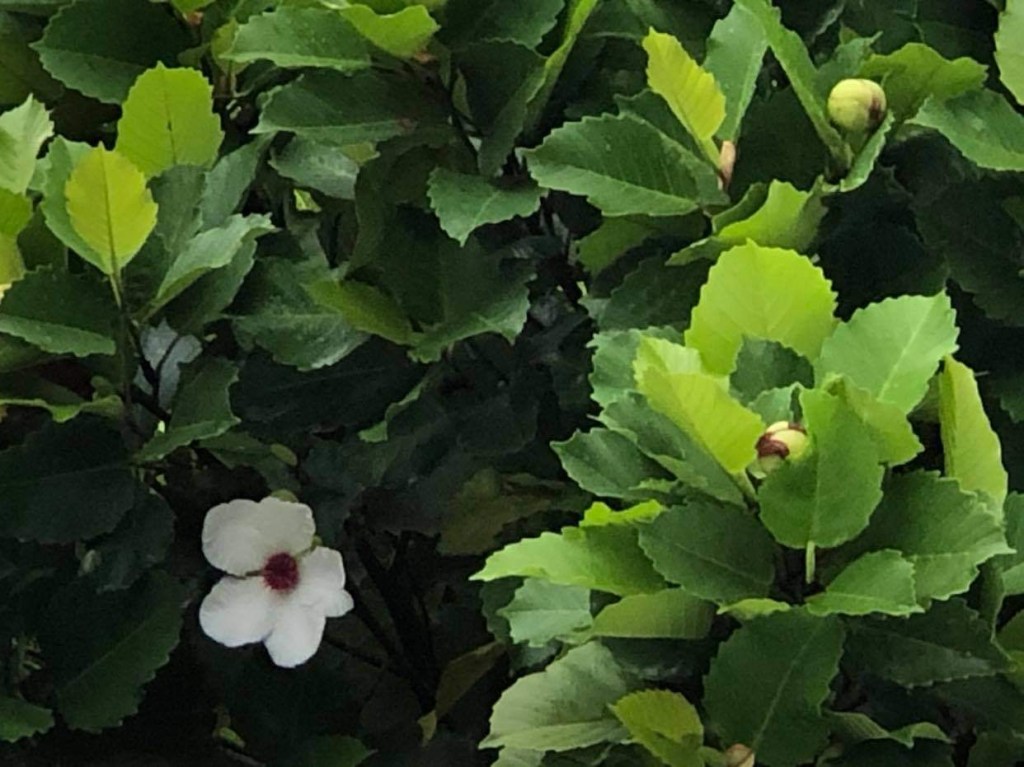
*All photos by Dr. Mylene A. Santos, MD at Katmon Harbor Nature Sanctuary, Quezon, 2020.
Quiet Storm by Fr. Nicanor F. Lalog II, 22 September 2020
Photo by Ms. Ria De Vera of our parish church, August 2020.
Lately I have been watching old movies that I wonder why I still cry even if I have seen them more than twice before at the cinema and cable TV. It seems that my being born with “mababa ang luha” (easy to cry) is getting more “mababa” as I get old.
Tears are a gift from God, the most beautiful prayer we can ever express courtesy of the Holy Spirit because when we run out of words for our pains and sadness or when we are overjoyed, he makes us cry to heal and comfort us or complete our joys, assuring us of his loving presence.
That is the reason why we call “home” in Tagalog as “tahanan”: home is where we “stop crying”, that is, “tahan na” because that is where we find all the support we need in times of crisis. Indeed, home is where the heart is.
True to its function, tears cleanse us physically, emotionally and spiritually. I have read two decades ago that researchers at a university in the US have found the chemical composition of our tears differ if we cry because of pain and sadness or due to joy and laughter.
Is it not wonderful and amazing how we take for granted crying and tears without realizing its chemical process within that can transform our very selves?
Photo from Reuters.com, July 2020.
Tears and crying mark our life's coming to full circle.
When I was five years old, I saw the picture of a newborn baby crying in the Book Section of the Reader’s Digest. I asked my mom why the baby was crying. In her usual motherly way of explaining things, she told me that if the baby cries upon birth, it means he/she is alive; if the baby does not cry, he/she is dead.
“Kapag umiyak, buhay; walang iyak, patay.“
My young mind easily absorbed her words that would remain to be one of the most profound lessons I had ever learned about life at a very young age. As I grew up watching TV and movies, I would always sigh with relief whenever I heard the sounds “uha-uha” because the story would surely be nice and not tragic.
Imagine the great inverse that happens with crying and tears to signal the coming to the outside world of life of another human, of how we have to cry to be alive from then on until we die when it becomes our family and friends’ turn to cry and shed tears for us when we are gone.
But there is something more deeper than this great inverse on crying in life and death I had learned only in 2013 through my best friend Gil, a classmate in our minor seminary.
It was late February of that year on the 40th day of the death of his youngest sister Claire when he was diagnosed with cancer. We could not believe the news because Gil was the most health conscious in our “band of brothers” from high school who never smoked, rarely ate meat, and was active in sports like golf and badminton. Unlike most of us, he was never overweight, looked so healthy in our mid-40’s.
Imagine the hurt within him that every time we would visit him, he would cry not really in pain but more on the why of getting cancer. We tried visiting him as often as we can to cheer him up and lift his spirits specially after his surgery when his chemotherapy sessions began.
By September on that same year, we all had to rush and visit him at Makati Med one Sunday afternoon when informed by his Ate Lily that doctors have given up on him. His cancer cells were “ferocious” and nothing could be done anymore except to wait for the inevitable.
That was when I noticed the greater inverse about crying when Gil had finally accepted his condition and life direction, that was when he was most joyous and peaceful too while we were the ones so sad and worried, crying. How our roles were reversed with Gil now telling us to stop crying – tahan na – which we used to tell him months earlier! (Gil died peacefully the following Sunday, 22 September 2013.)
“Mater Dolorosa” as “Blue Madonna” (1616) by Carlo Dolci. Photo from Wikimedia Commons.
I noticed it happening so many times with some friends and parishioners I have come to love in my ministry, those I have pastorally cared for some time after being diagnosed with serious conditions like cancer.
Yes, I have cried despite holding my tears for them while administering the Holy Viaticum and Anointing of Oil. The patients in turn would just glance at me, so dignified and calm like Mary our Lady of Sorrows as if trying to comfort me with their sweet thank you.
As I prayed on those experiences, I realized how life comes to full circle through our crying and tears.
I believe that patients cry when they start undergoing treatment of their sickness due to fears and uncertainty of what would happen next to them; later as they come to terms with their condition, they stop crying because they already knew where they were going, of what was coming next.
We who would be left behind cry and begin to shed tears at thoughts of their dying because admittedly, we are actually the ones more uncertain of where we are going to or how our lives would go through when our loved ones are gone.
That is the greatest pain we feel in the death of a beloved when we grapple with the realities of the many uncertainties of life without them.
And that is why we need to love as much as we can our family and friends while still alive. This quarantine period of the pandemic are grace-filled moments to shower them with our love and presence we have taken for granted for so long as we pursued many things in our lives.
Photo by Dr. Mylene A. Santos, MD at Infanta, Quezon, April 2020.
Tears and crying lead us to heaven.
Death and sickness, like life, become a blessing if we are filled with gratitude not regrets because we have truly loved. When a beloved is gone and we begin to cry, the tears wash away our pains of losing them, cleansing us within to leave us with all the beautiful memories and love we have shared. Then, every remembering becomes truly a re-membering, making a lost loved one a member of the present again.
When we cry, tears polish the love we have shared with everybody until later when our time comes, our visions are also cleared of what is going to happen next, of where we are going. Crying becomes wonderful and truly a grace after all not only in sharing and being one with the grief and pain of another in the present but sooner or later, in having a glimpse of the life after.
In the Gospel of John (11:1-44), we find the story of the raising of Lazarus whom Jesus loved so much that he wept – not just cried – at his death. Jesus raised him up back to life, his final miracle – or “seventh sign” according to John – to show he is the Christ before his own Resurrection at Easter after his “final hour” of Crucifixion on Good Friday.
From then on, Christ sanctified crying and tears to enable us to see beyond pains and hurts, even death especially if you have truly loved.
Sometimes in life, it is always good to let those tears flow, like love even if it is painful, to have a good cry and real cleansing inside. A blessed day to you!
The Lord Is My Chef Sunday Recipe for the Soul by Fr. Nicanor F. Lalog II
Week XVI, Cycle A in Ordinary Time, 19 July 2020
Wisdom 12:13, 16-19 >><}}}*> Romans 8:26-27 >><}}}*> Matthew 13:24-43
Our Lord Jesus Christ invites us today to join him into a different kind of journey that would take us deep into God’s mystery in our very selves through the parables he has started to tell us last Sunday.
Recall, dear readers, that parables constitute the heart of the Lord’s preaching.
We have defined these as simple stories with deep realities that must be cracked open through prayers and reflections to get its meaning. From the French para bolein that literally means “along the path”, a parable is likewise a bridge that leads us into something unknown to us before.
In itself, a parable is a journey calling us to walk through it into our inner selves to discover the many inner beauties that lie within us but we take for granted. Ultimately, as we discover these giftedness within us, we then uncover God dwelling within us.
This is the reason why Jesus would always tell his audience after narrating his parables that “Whoever has ears ought to hear” (Mt.13:43) to insist on them to go deeper inside themselves for their meaning.
And that is when we are transformed, when our lives are changed into true disciples of Jesus Christ.
Greatness in littleness
First thing we notice in the three parables of Jesus today is his insistence on the coming of the kingdom of heaven or kingdom of God through him as the mysterious seed.
This kingdom of heaven is used interchangeably with “kingdom of God” that Jesus would always speak of in his entire ministry until his crucifixion is not according to our understanding of a kingdom: it is not about a territorial domain or the exercise of power over subjects using force.
St. John Paul the Second expressed it beautifully by declaring the person of Jesus Christ himself is the kingdom of God. No wonder, Christ would always liken himself and the kingdom of God with the seed being sown.
It is always good. It is for everyone as the sower scatters the seeds everywhere. And it is always small like Jesus who was born like any infant so fragile and even poor like most of us. He is like the seed we take for granted from which comes forth all kinds of plants like trees, big and small.
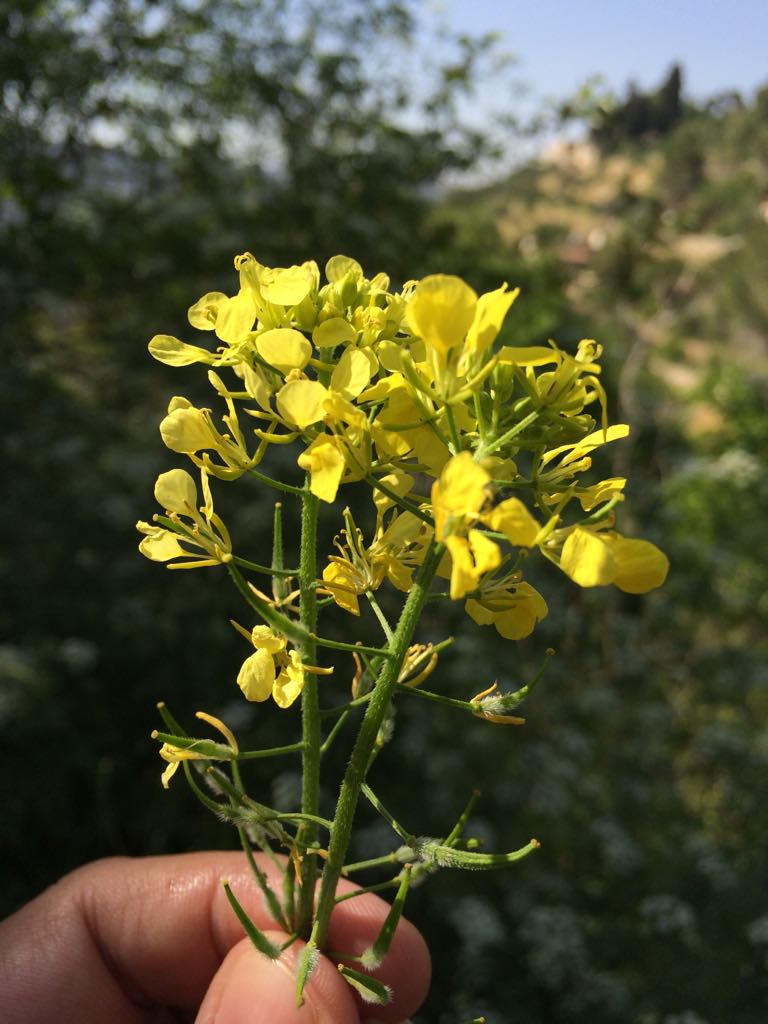
Flowers of a mustard plant from which seeds are taken. Photo by author, Israel, 2017.
Or most specially, like those seeds that turn into crops of wheat and shrubs like the mustard with leaves and branches where birds may dwell that describe the first two parables today.
Jesus then added a third parable of the yeast mixed into flour that leavened the dough into a bread.
Like him our Lord, we his disciples are also like the small seeds packed with great possibilities in God.
In all these three parables today, there is that element of smallness, of littleness that remind us how everything that is great always starts small.
When we come to think of this, we realize how we embarked on this great mission of making Jesus Christ known: it started like a small spark within us, perhaps from a single word we have heard or read, a simple inspiration by God through the most ordinary persons and situation.
Not only in things regarding our spiritual lives but even our personal lives when we recall those humble beginnings of our family and of our business.
Like a little seed or yeast, they just grew!
Now we are surprised, even amazed, how we have changed, how we have grown. Of how we are now reaping the fruits of our labors and sacrifices.
Most of all, how we have known and experienced Jesus Christ who fulfills our lives.
Weeds among the wheat
But not all days are bright and sunny. There are dark clouds that hover above us bringing storms and heavy rains that lead into floodings. A lot often in life, the darkest nights turn out to be the longest nights too.
And this is the meaning of Christ’s main parable for today.
Jesus proposed another parable to the crowds, saying: “The kingdom of heaven may be likened to a man who sowed good seeds in his field. While everyone was asleep his enemy came and sowed weeds all through the wheat, and then went off. When the crop grew and bore fruit, the weeds appeared as well. The slave of the householder came to him and said, ‘Master, did you not sow good seed in your field? Where have the weeds come from?’ He answered, ‘An enemy has done this.’ His slaves said to him, ‘Do you want us to go and pull them up?’ He replied, ‘No, if you pull up the weeds you might uproot the wheat along with them. Let them grow together until harvest; then at harvest time I will say to the harvesters, ‘First collect the weeds and tie them in bundles for burning; but gather the wheat into my barn.'”
During my prayer periods this past week, I have been filled with anger and disappointments at how things are going on in our country and even in my personal life. It pains me so much why at this time of the pandemic when we have to go through all these bad things.
Last Friday morning before our daily Mass, we discovered the glasses shattered in our windows near the office door and at the side door of the church. There were scratches outside indicating attempts to unlock the doors inside and steal from the church.
After the Mass, I grew more angry as we inspected the damages, thinking so negatively harsh against whoever tried to burglarize us.
By night time during prayers, I remembered Victor Hugo’s Les Miserables where Valjean was caught by the police stealing silver from the good bishop who had welcomed him into his rectory with food and accommodations. Instead of pinning him down for his crime, the bishop told the police he had given Valjean the silver found in his bag, even chastising him he had left behind the other silver candlesticks he had asked to take!
The wheatfield owner in our parable and the good bishop of Les Miserables are both the merciful God mentioned by the author of the Book of Wisdom in our first reading today:
But though you are master of might, you judge with clemency, and with much lenience you govern us; for power, whenever you will, attends you. And you taught your people, by these deeds, that those who are just must be kind; and you gave your children good ground for hope that you would permit repentance for their sins.
Wisdom 12:18-19
Think of our parents and elders, our mentors or those we look up to for their wisdom gifted with wonderful insights in life called perspicacity which means “a penetrating discernment… a clarity of vision or intellect which provides a deep understanding and insight.”
Being perspicacious or having perspicacity like the wheatfield owner or the good bishop of Les Miserable means having a deeper wisdom that one can keenly see and understand things beyond ordinary perception following a long process of silent reflections in life.
Many times, our sights can be limited that we do not see the other repercussions and even ramifications of our decisions on certain situations. There are times we think only of finding solutions, of winning the battle but not the war.
It is also along this line that Jesus added the third parable: the yeast is mixed with the flour to leaven the dough.
We are like the yeast who have to mix with others, including the evil ones to become bread that will feed the world.
We are the wheat, the mustard seed, the yeast thrown into the world to make a difference in Christ! We are not the ones who will change the world but Jesus Christ, the mysterious seed, the yeast in the dough who grows and effects the changes in us and among us.
Parables as inner journey in Christ Jesus
With Jesus living and nurturing within us, that is when we become fruitful like the wheat and mustard plant or leavened bread that we are able to feed more people who would eventually become bearers his in the future. That is how the kingdom of heaven comes into this world, when God is seen and felt by everyone through us
This we achieve in prayers as St. Paul reminds us in the second reading. It is not just reciting our basic prayers as Christians including the novenas we love to collect and follow through. The kind of prayer that St. Paul speaks here is a prayer guided by God’s Holy Spirit who perfectly knows God’s will.
Photo by Dr. Mylene A. Santos of kids she’s teaching on the values of health, education and nature at Katmon Harbor Nature Sanctuary, Infanta, Quezon.
Brothers and sisters: The Spirit comes to the aid of our weakness for we do not know how to pray as we ought, but the Spirit himself intercedes with inexpressible groanings.
Romans 8:26
In this time of too much weeds among the wheat, of so many evil and sins prevailing over us, we can feel frustrated at times that make it so difficult for us to pray.
Sometimes, the evil and sins, or the plain sufferings we go through in our own family, in our community or at work and in school can be so overwhelming that we feel our prayers are useless, that God is not listening at all to us.
Then we stop praying, we stop journeying within even with weeds among the wheat. How can the flour be leavened if the yeast is not mixed with the dough to become bread or cake.
Remain in the Lord!
Pulling out the weeds will not solve the problem; worst, it may endanger us all too in the process that we become like our enemies in the end. Never lose hope in God who knows very well of the presence and source of weeds. Sometimes, these pains and sufferings from evils we go through from others may actually lead us to our being fruitful!
Evil and sins are a parable in themselves that can teach us so well in life if we handle them with prayers.
Photo by Dr. Mylene A. Santos, Infanta, Quezon, May 2020.
Praying in the Holy Spirit is when we spend time with Jesus to reflect and crack open his words that come to us in the Sacred Scriptures and ordinary events in daily life through long hours of silent meditation and contemplation.
The more we dive into God’s mysteries in the parables he sends us in daily living, the more we see the beauty and wonder of life because our horizons are widened and get clearer.
Praying into our parables in life is like looking into a telescope or binoculars that enable us to see something distant within reach.
The Lord Is My Chef Sunday Music by Fr. Nick F. Lalog II, 12 July 2020
Van Gogh’s “The Sower” from Wikimedia Commons.
It is a very lovely Sunday with Jesus Christ continuing to shower us with his good seeds to make us fruitful despite the many setbacks we may have had lately due to the COVID-19 pandemic and sad turn of events.
His parable of the sower proclaimed today in all churches throughout the world reminds us that inasmuch as we have to be a good kind of soil, we need to examine the kind of seeds we have become.
Seeds are so small that we often take for granted, like our very lives and most especially God.
In a sense, Jesus is telling us today what Des’ree sang in 1994, “You Gotta Be”…..
Listen as your day unfolds Challenge what the future holds Try and keep your head up to the sky Lovers, they may cause you tears Go ahead release your fears
Stand up and be counted Don’t be ashamed to cry
You gotta be You gotta be bad, you gotta be bold You gotta be wiser, you gotta be hard You gotta be tough, you gotta be stronger
You gotta be cool, you gotta be calm You gotta stay together All I know, all I know, love will save the day
You Gotta Be was first released as a single in 1994 and instantly became a hit worldwide staying on top of almost every chart in the US, Europe and Australia. Music is warmly smooth, at the same time infectious with a sort of hypnotic effect from its sophisticated upbeat set in the cool and soothing voice of Des’ree who also wrote its lyrics.
I have used the song in my classes in our school for girls a decade ago and in many recollections and retreats to young people as it presents to us this great mystery of life packed in a seed that must fall and die to give way to new life and eventually bear fruit.
You gotta hear and feel it to appreciate this wonderful music that sounds like Jesus Christ’s parable of the sower.
I have uploaded the video with lyrics so you can follow and sing. And dance if you wish. Have a blessed day!
The Lord Is My Chef Sunday Recipe for the Soul by Fr. Nicanor F. Lalog II
Week XV, Cycle A in Ordinary Time, 12 July 2020
Isaiah 55:10-11 >><}}}*> Romans 8:18-23 >><}}}*> Matthew 13:1-23
“The Sower” painting by Van Gogh, photo from Wikimedia Commons.
Parables constitute the heart of Jesus Christ’s preaching. From the French para bolein which means “along the path”, parables are simple stories with deep realities that must be cracked open through prayers and reflections to uncover its meaning.
In fact, every parable by Jesus is a word of God that is like a seed that must be received, planted, and nurtured so we may eventually see and experience what is within it who is God himself!
On that day, Jesus went out of the house and sat down by the sea. Such large crowds gathered around him that he got into a boat and sat down, and the whole crowd stood along the shore. And he spoke to them at length in parables, saying: “A sower went out to sow. As he sowed, some seed fell on the path, and birds came and ate it up. Some fell on rocky ground, where it had little soil. It sprang up at once because the soil was not deep, and when the sun rose it was scorched, and it withered for lack of roots. Some seed fell among thorns, and the thorns grew up and choked it. But some seed fell on rich soil, and produced fruit, a hundred or sixty or thirtyfold. Whoever has ears ought to hear.”
Beginning today until the last Sunday of this month of July we shall hear different parables by Jesus taken from this 13th chapter of the gospel according to St. Matthew.
It is very interesting that as Jesus now begins to preach in parables, we also notice his usual usage of this image of the seed, especially of the mustard seed to stress to us what we have mentioned earlier about the significance of parables as simple things with deeper realities. Every seed is so small, easy to overlook and taken for granted. Yet, we all know how every seed is also the presence of what is to come in the future, of something so big and huge that we can never imagine.
That is how Jesus would always portray the Kingdom of God, which is himself, his very person who is always taken for granted but full of mysteries that later in the fourth gospel he would reveal a deeper reality of this seed akin his Cross:
“Truly, truly, I say to you, unless a grain of wheat falls into the earth and dies, it remains alone; but if it dies, it bears much fruit.”
John 12:24
That is the mystery of the seed, the mystery of Christ: something so ordinary we take for granted with immense possibilities when given up, when it dies. In this parable of the sower, Jesus shows us a hint of this profound truth about himself as a mysterious seed, someone who must be broken to die in order to grow and bear fruit.
If we read the full text of today’s gospel, we find Jesus explaining the meaning of this parable and we discover that he himself is both the sower and the seed: he goes out everyday to bring us the good news of salvation, providing us with seeds we must plant so we can have food in the future.
Every seed Jesus sows in us is always good as the first reading assures us.
Thus says the Lord: Just as from the heavens the rain and snow come down and do not return there till they have watered the earth, making it fertile and fruitful… so shall my word; my word shall not return to me void.”
Isaiah 55:10-11
Most of the time, we reflect on this parable on the importance of the soil on which the seed is sown.
This Sunday, let us reflect on what kind of a seed are we, of how we waste or put into good the enormous potentials packed in each of us by God.
“A sower went out to sow. As he sowed, some seed fell on the path, and birds came and ate it up.“
Jesus the sower does not make distinctions on different kinds of soil; he just scatters the seeds freely. His words concern everyone.
Unfortunately, there are some of us who do not care at all, as hardened as the path or pavement.
These are the people who has no plans in life, no directions, spending their lives watching days pass without knowing that they are really the ones passing by.
Sometimes, they just go wherever the winds would lead them while once in a while, they step out of themselves a little to join friends or peers wherever they may be going. Eventually they leave when the journey gets farther.
They are literally wasting their lives.
“Some fell on rocky ground, where it had little soil. It sprang up at once because the soil was not deep, and when the sun rose it was scorched, and it withered for lack of roots.“
They are the “spur of the moment” type who eventually end up as what we call ningas-cogon (a kind of local grass when dried is highly combustible; quick to start fire but quick to extinguish too).
Beware of them who are at the beginning very enthusiastic in every project and endeavor but when the goings get tough and difficult, they are the first to leave.
No roots, no foundations in life. Easy to give up. Just as hard as those seeds on the pavement.
Photo by author at Petra, Jordan, May 2019.
“Some seed fell among thorns, and the thorns grew up and choked it.”
These are the people who thrived a little but eventually the “thorns of the world” choked them that they eventually dried and died.
They are the kind of people we lament and sometimes grieve, wondering what have happened within them that their hearts have suddenly turned away from God and others with their noble causes we used to share with them at the beginning.
Oh, they are well represented in Congress, especially the party-list representatives of various advocacies for the marginalized and less privileged who eventually come out with their true colors and ugly features. Some of them simply stopped thinking and feeling the other persons, blinded with power and wealth selling off their souls completely to any golden calf willing to pay them.
The modern Judas Iscariots.
“But some seed fell on rich soil, and produced fruit, a hundred or sixty or thirtyfold.“
Photo by Ms. Jo Villafuerte, flower farm at Atok, Benguet, 2019.
We now come to the better seeds (because all are good seeds, remember?).
They are the ones who fell on rich soil and produced fruit because they were the ones who willingly gave themselves up to the Sower. They are the ones who let go and let God, those who let themselves “die” and fell on the ground to give way to new life.
They are fruitful, not successful; the former relied on the powers of God, patiently bearing all pains and sufferings while the latter relied on their own powers, own intelligence and even connections that on the surface may seem to have the upper hand but totally empty inside.
The fruitful seeds are those willing to fall and be broken by God according to his divine plan. Many times, what is fruitful to God may be failures to us humans. Being fruitful is not about results and accumulations we have made but what have we become.
Fruitful people are focused on with the future glory to revealed by God through our pains and sufferings as St. Paul reminds us in the second reading today.
Let us not put into waste this good seed sown in us by Jesus Christ, allow it to be cracked open and broken to let the new life within us spring forth and lead us to becoming fruitful. Amen.
The Lord Is My Chef Breakfast Recipe for the Soul, Tuesday, Easter Week-IV, 05 May 2020
Acts of the Apostles 11:19-26 +++0+++ John 10:22-30
Photo from Reddit
Our loving God and Father, as countless men and women are now searching for the cure and vaccine against this corona virus that have hit us, you have also given us opportunities to look inside ourselves to examine the things and persons we are searching for in this life.
Today’s first reading reminds us how Barnabas went to Antioch to see for himself the power and grace of the gospel of your Son Jesus Christ being preached there among the gentiles.
When he arrived and saw the grace of God, he rejoiced and encouraged them all to remain faithful to the Lord in firmness of heart, for he was a good man, filled with the Holy Spirit and faith. And a large number of people were added to the Lord.
Acts of the Apostles 11:23-24
Not only that: Barnabas also “went to Tarsus to look for Saul, and when he had found him he brought him to Antioch” (Acts 11:25).
What a remarkable attitude by Barnabas to search for the truth, to find the realities going on in Antioch!
Most of all, his efforts to look for Saul – a person feared and perhaps hated at that time – to bring him into the church in Antioch that eventually led to his baptism and adoption of the new name of Paul.
Give us, O Lord, the same desire for you! That we may always look for you in every situation we are into especially in this time of the corona. May we also look for those people we can bring closer to you through our communities, especially those suspected of so many things like St. Paul before.
How sad that sometimes, we are more like those in the gospel who kept on looking for you, Jesus, not because of a desire to really know you and follow you but to test you.
Give us a heart and the eyes of faith that truly search for what is true and good, that look for you in people and events because, like the deer that yearns for streams of water, our soul thirsts for you. Amen.
The Lord Is My Chef Breakfast Recipe for the Soul, Memorial of St. Pius V, 30 April 2020
Acts of the Apostles 8:26-40 <*(((>< 000 ><)))*> John 6:44-51
Photo by Mr. Raffy Tima of GMA-7 News, 2020.
It is the last day of April 2020 and we still cannot rejoice, Lord, because we still have to continue with our enhanced community quarantine until the 15th of next month to further control the spread of the dreaded COVID-19 virus.
Yes, it is very difficult and sad for everyone but deep inside each one of us is the excitement too of seeing that day finally when the pandemic is finally over and the corona virus wiped away.
And that is why we have to believe in you, O God our Father for you alone is the God of history, you have the final say at how things are in this life and the good news is, you always ensure that even tragedies and miseries end for our own good.
“Amen, amen, I say to you, whoever believes has eternal life.”
John 6:47
Yes, Lord Jesus, we believe in you because we want to see how all these things will end, if not in this life then in the eternity.
We have to believe to understand further and accept how things are in this life.
Like St. Pius V, the first Dominican Pope, he believed in your presence and power in the praying of the Holy Rosary that helped the Spanish Armada crushed the Ottoman Turks in Lepanto Bay to finally stop them from getting into Europe any further.
Incidentally, every Rosary begins with the Credo, “I believe in God…”
He believed in your works, O Lord, that despite the gargantuan tasks ahead of him, St. Pius pushed for the reforms of the Council of Trent that revitalized the whole Church after the Protestantism movement that swept the whole of Europe at that time.
We have to believe because believing is the starting point of everything in you; without it, we can never see through and look beyond to discover more meanings in life here and thereafter. Amen.
The Lord Is My Chef Breakfast Recipe, Tuesday, Easter Week-II, 21 April 2020
Acts of the Apostles 4:32-37 ><)))*> +++ 0 +++ <*(((>< John 3:7-15
Posted by Marivic Tribiana on her Facebook 18 April 2020 when a huge fire hit “Happyland” in Tondo district, Manila, leaving 450 families homeless with one fatality.
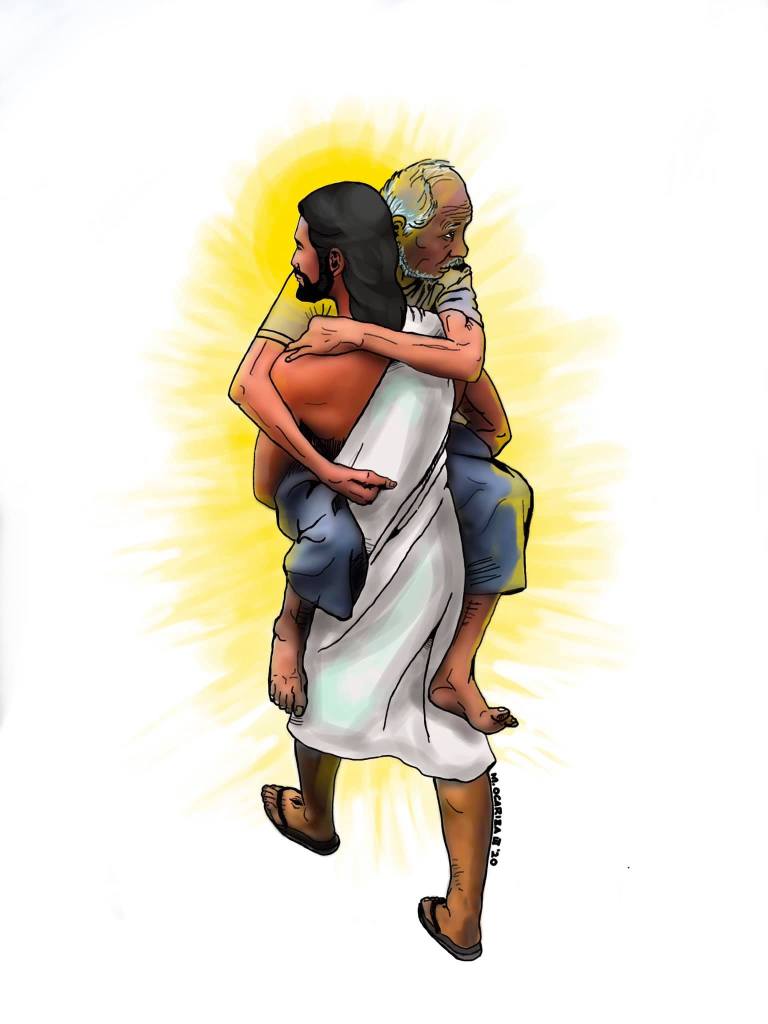
Artwork by Fr. Marc Ocariza using Digital Art Timelapse after seeing photo at left, claiming it was like seeing Jesus Christ carrying the old man as he contemplated the Divine Mercy that Saturday.
Glory and praise to you, O Lord Jesus Christ for coming to us, and continuing to come to us most especially amid this COVID-19 pandemic.
Increase our faith in you, awaken our being “born from above” in you in the Holy Spirit so that we may continue to find you and follow you in the ordinary things that happen to us.
It is not enough that we as a “community of believers be of one heart and mind, having everything in common” (Acts 4:32).
As a community united in you, Lord Jesus, keep us strong in fulfilling our mission from you.
Remind us always that we merely represent you in this mission.
We are not the ones who will change the world but you, O Lord.
Give us the grace to forget ourselves and carry our cross daily so we can follow you more closely every day.
Most of all, give us the courage to seek your ways and follow wherever your Holy Spirit leads us to so we can best serve you without ever thinking of our very selves or anything in return except that we are doing your most holy will. Amen.
The Facebook post by Marivic Tribiana that inspired Fr. Marc to make a digital representation of the scene amid the huge fire with thick, black smokes billowing above visible kilometers ahead in a city under an extended lockdown due to Covid-19.
He dubbed his artwork “Nag-aalab na Pag-Ibig” (Burning Love), an interplay between the raging fire in the area and the burning love of Jesus to the old man being carried.
That is why we need to be “born from above” to be able to understand teachings of Jesus about heavenly things on earth (Jn.3:12), remaining open to leading of the Holy Spirit to follow the Lord closely, not our selves, nor our plans, nor our personal agenda.
What a beautiful way to end the week of work and studies, O Lord, when you asked us to read the signs of the times.
Jesus said to the crowds, “When you see a cloud rising in the west you say immediately tat it is going to rain — and so it does; and when you notice that the wind is blowing from the south you say that it is going to be hot — and so it is. You hypocrites! You know how to interpret the appearance of the earth and the sky; why do you not know how to interpret the present time? Why do you not judge for yourselves what is right?”
Luke 12:54-57
In this age of social media where everything is being shown and seen by everyone, it is very unfortunate that we still fail to see beyond the physical realities.
In an age when everything and everyone is seen, we have become more superficial than ever and have refused to see more deeper than what appears to the eyes.
We look outside of us to explain everything like in the news and in the internet, at YouTube and Facebook, Google and Wikipedia.
Rarely do we look deep inside ourselves like St. Paul to realize the greater battle going on deep within each one of us between good and evil.
Teach us Lord to see more the spiritual meanings of the things happening in us and around us, to always look deep into our hearts to see and realize the need to be good and just, kind and loving.
Maybe if we can look more often into our hearts and look piercingly into the heavens to find you, perhaps we can have a better world with lesser crimes and hatred among peoples. Amen.
The Lord Is My Chef Sunday Music, 29 September 2019
Our gospel today speaks a lot about our eyes, of what we see and recognize, of sights and vision. For the third straight consecutive Sunday, we hear again another parable by Jesus proper only to St. Luke called “the rich man and Lazarus”.
Jesus said to the Pharisees: “There was a rich man who dressed in purple garments and fine linen and dined sumptuously each day. And lying at his door was a poor named Lazarus, covered wit sores, who would gladly have eaten his fill of the scraps that fell from the rich man’s table. Dogs even used to come and lick his sores. When the poor man died, he was carried away by angels to the bosom of Abraham. The rich man also died and was buried, and from the netherworld, where he was in torment, he raised his eyes and saw Abraham far off and Lazarus at his side.”
Luke 16:19-23
The rich man went to hell because amid his affluent lifestyle, he did nothing to help the poor Lazarus. He was so blinded by his wealth that he was so oblivious of the plight of Lazarus. Sadly, the same scene continues in our days despite the social media around us.
The famous blind American Helen Keller wrote, “the only thing worse than being blind is having sight but no vision.”
Very true!
Many people are like the rich man who only have sight that can only see what is material and temporary, failing to see the face of God especially among brothers and sisters in need. Only a few people are like Lazarus with a vision who dare to look at things beyond what can be seen, even beyond time. They are the visionaries who dream with eyes wide open, working hard to make their dreams a reality.
Having a vision, of seeing beyond what is material and physical is essential in being a Christian tasked with a mission to lovingly serve others especially those living at the margins of the society.
No one can truly love and serve without having a vision, of seeing beyond the ordinary and the present moment. This is the reason why I always tell young people in choosing a wife or a husband, choose someone with a vision who would always look beyond sights and time.
This is the message too of American singer-songwriter Joshua Kadison’s 1993 hit “Beautiful in My Eyes” that delighted the romantic side of us Filipinos in 2009 and 2007 when Christian Bautista and Jericho Rosales respectively covered the song.
The song speaks of the great vision of the lover in seeing in his beloved everything wonderful and lovely. Most of all, the man is also a dreamer and a visionary who could see their future as a couple still in love because she’s always “beautiful in his eyes”.
You’re my peace of mind, in this crazy world. Your’re everything I’ve tried to find, your love is a pearl.
You’re my Mona Lisa, you’re my rainbow skies, and my only prayer, is that you realize, you’ll always be beautiful, in my eyes.
The world will turn, and the seasons will change. And all the lessons we will learn, will be beautiful and strange.
We’ll have our fill of tears, our share of sighs. My only prayer, is that you realize. You’ll always be beautiful, in my eyes.
You will always be, beautiful in my eyes. And the passing years will show, that you will always grow, evermore beautiful, in my eyes.