The Lord Is My Chef Christmas Recipe by Fr. Nicanor F. Lalog II
Wednesday in the Christmas Weekday, 04 January 2023
1 John 3:7-10     ><]]]]'> + ><]]]]'> + ><]]]]'>     John 1:35-42
Photo by Mr. Ryan John Jacob, 02 January 2023 in Paco, Obando, Bulacan.
I have always wondered, Lord Jesus,
what have you shown Andrew and his
companion that day you invited them
to "come and see"?
He said to them, “Come, and you will see.” So they went and saw where he was staying, and they stayed with him that day. It was about four in the afternoon. Andrew, the brother of Simon Peter, was one of the two who heard John and followed Jesus. He first found his own brother Simon and told him, “We have found the Messiah,” which is translated Christ.
John 1:39-41
Everyday, you also invite me
to come so that I will see you but
rarely do I really COME to experience
you; rarely do I come to feel you;
rarely do I come to listen to you;
rarely do I come to just sit beside you
nor watch the day go by; forgive me,
Jesus for always refusing to come to you
especially when you are down and sad,
sick and aching inside, when you are
boxed by people, imprisoned in wrongful
thoughts, or simply because you are poor,
not like me and my friends who are cool
and hip and modern...
That is why, many times,
I also fail to SEE you in person,
Lord Jesus that I do not see your smiles
and your tears; I do not see
your sufferings and pains;
I do not see your point of view;
I cannot see your reasons and your
situations nor plight; most of all,
I fail to see your love and trust in me
because I keep on spending more time
coming to see the make believe world of media.
What did Andrew and companion
see that whole day, Jesus?
It must be a lot of you!
A lot of you in yourself,
a lot of you in themselves,
and a lot of you in others
as well as in life and in nature!
Dearest Lord Jesus,
bless me and let me
this 2023 to always come
and see where you stay
so that at the end of each day
I may also say or exclaim like Andrew
"We have found the Messiah"!
Amen.
The Lord Is My Chef Sunday Recipe for the Soul by Fr. Nicanor F. Lalog II
Second Sunday in Advent, Cycle A, 04 December 2022
Isaiah 11:1-10 ><}}}*> Romans 15:4-9 ><}}}*> Matthew 3:1-12
Photo by Ezra Acayan/Getty Images, 09 February 2020, Baclaran Church.
Many years from now, future generations will surely discuss these years of our COVID-19 pandemic, with everyone talking about the face masks we wore. Imagine your great grandchildren repeatedly asking their parents why we were covering our faces during this time.
But, these face masks were also the signs of blessing during this pandemic, teaching us to look onto the face of one another, to recognize each one as brother and sister in Christ. I believe these face masks are reminders from God of how we have forgotten to look and value each one as persons to be loved and cared for, respected and protected.
What a beautiful sight when people meet, exchanging glances, adjusting their glasses and face masks to recognize each one again!
In the Book of Genesis, we are told how God created us in his image and likeness that remind us of his “face” even if we know God is spirit. Face means more than the physical face of the person. It reveals in the most undeniable manner one’s state or condition, of what is in him/her. When a person is filled with goodness and love, joy and contentment or, bitterness and hate, evil and sin, we say it is “written all over his/her face”.
Remember Mang Dodong of Caloocan City who was detained for almost a month in Navotas for not having proper ID’s during the lockdown of March 2020 after he tried to buy fish in order to sell in their neighborhood? At the same time when it happened, there was the shameless news of police throwing a birthday bash to their chief in total disregard of the protocols? The injustice against the poor prevailing then and now was all written in Mang Dodong’s face in the news.
Mang Dodong of Caloocan City, photo by Mr. Vincent Go, May 2020.
Here lies the challenge of Advent 2022, the first face-to-face Christmas we shall have in two years since the pandemic when we have to cover our faces with face masks: have I shown God with others on my face? Or maybe, the better question should be, do I see the face of God in the people I meet?
This Second Sunday of Advent, the gospel invites us if like John the Baptist, do we see Jesus Christ coming among us? Do we see him in ourselves and in others?
John the Baptist appeared, preaching in the desert of Judea and saying, “Repent for the kingdom of heaven is at hand!” It was of him that the prophet Isaiah had spoken when he said: A voice of one crying out in the desert, Prepare the way of the Lord, make straight his paths.
Matthew 3:1-3
“St. John the Baptist Preaching in the Wilderness” by German painter Anton Raphael Mengs (1728-1779) from commons.wikimedia.org.
John is our second guide during Advent next to the Prophet Isaiah. John did not only see the coming of Christ but he also showed the Christ had come.
Why did people come to listen to him and be baptized from all over Israel at that time?
His preaching must be so powerful and convincing because people must have also seen in him Christ’s coming. In fact, people of his time thought he was already the Messiah everyone was awaiting. But John was very clear in his preaching that he was not the One.
Such was the power of John’s preaching. Everyone believed him because he did not merely point to the coming of Christ but showed them too Christ already present in him. No wonder, he would be the first to die for Jesus and like Jesus by standing for what is true and good.
How was John able to do this?
Aside from the power of the Holy Spirit that came upon him while still in his mother’s womb during Mary’s visitation, John went to a sort of quarantine too – an Advent – when he left the comforts of his affluent family to live a simple life in the desert.
John wore clothing made of camel’s hair and had a leather belt around his waist. His food was locusts and wild honey.
Matthew 3:4
Last Sunday, we have reflected that Advent is a Sabbath when we rest to be breathed on by God, to be filled with God and his Spirit by first emptying ourselves of our sins and pride. Most of all, in coming to the wilderness empty and simple, John showed the importance of prayer, of relying solely to God. It was prayer that sustained John in the desert and it is prayer that would sustain us during this Advent. In fact, we need to handle life with prayer in order to see Christ coming and most of all, to show Christ to others.
In calling for conversion, John challenged the people of his time too to bear fruits in their efforts of seeing the coming Messiah. All these emptying and sacrifices and being breathed on by God must always be evident not only for everyone to see but for each one to truly experience Christ’s coming.
A painting based on Is.11:1-10 called “Peaceable Kingdom” by American EdwardHicks, a Quaker pastor (1780-1849).
In the first reading, Isaiah reminds us that Advent is a time also of healing when we learn to be small again, even to die in our selves to give way for the coming of the Lord.
On that day, a shoot shall sprout from the stump of Jesse, and from his roots a bud shall blossom. The spirit of the Lord shall rest upon him… Not by appearance shall he judge, nor by hearsay shall he decide, but he shall judge the poor with justice, and decide aright for the land’s afflicted… Justice shall be the band around his waist, and faithfulness a belt upon his hips. Then the wolf shall be a guest of the lamb, and the leopard shall lie down with the kid; the calf and young lion shall browse together, with a little child to guide them. The cow and the bear shall be neighbors, together their young shall rest; the lion shall eat hay like ox. The baby shall play by the cobra’s den, and the child lay his hand on the adder’s lair. There shall be no harm or ruin on my holy mountain; for the earth shall be filled with knowledge of the Lord, as water covers the sea.
Isaiah 11:1-2, 3, 4, 5-9
This for me is one of the loveliest scenes in the Old Testament: aside from the poetry of Isaiah, imagine how God envisions for us a “peaceable kingdom” where humans and animals live together in harmony, when there would be no more harm or ruin on everyone!
So beautiful!
And so possible if we can be like John the Baptist with our eyes seeing more beyond the physical realities of this world by being small again like the shoot, even of dying to one’s self like a stump.
It is only in our littleness, in our barrenness and death can we truly see and find Jesus. But, the moment we see Christ in us, it is no longer difficult to recognize him on others as well as find him in all creation. If we could fine tune our eyes to Jesus and live in one accord with God and everyone as St. Paul calls us in the second reading, then Christ becomes present among us in the world with his peace.
Let us pray on this Second Sunday of Advent that we not only see Jesus coming but also show him present in us and among us so that when we go to our places of work, we do not just “earn a living” but also work on building the kingdom of God here on earth.
Let us pray that beginning this second Sunday of Advent that we not only see Jesus but also show him present in us and among us so that whenever we post on social media, we also build relationships in Christ.
Have a blessed week everyone!
Let us pray on this Second Sunday of Advent that the next time we give donations and help to people in need, it is Jesus whom we find in them so that we go the extra mile in our efforts to uplift them and truly make a “shoot sprout forth from the stump” of this dying earth so that the bud of God’s kingdom may finally blossom in us. Amen.
The Lord Is My Chef Daily Recipe for the Soul by Fr. Nicanor F. Lalog II
Wednesday, Memorial of St. Lawrence, Deacon & Martyr, 10 August 2022
2 Corinthians 9:6-10   ><}}}*> + ><}}}*> + ><}}}*>   John 12:24-26
God our loving Father,
just this Monday I have prayed,
telling you how I sometimes wished
to find you in strange visions like
your prophet Ezekiel; today, as we
celebrate the Memorial of your
great Saint, Lawrence, the gospel
speaks so well of finding you
when some Greeks approached Philip,
asking him to help them see Jesus
while in Jerusalem:
Jesus said to his disciples: “Amen, amen, I say to you, unless a grain of wheat falls to the ground and dies, it remains just a grain of wheat; but if it dies, it produces much fruit.”
John 12:24
Lord Jesus, so much have changed
in this world in terms of freely worshipping you
 unlike during the early centuries of Christianity
 when your followers shed blood witnessing you;
today, there are no more lions to devour us
nor executioners to crucify or decapitate us
or roast us on gridiron like St. Lawrence;
but your call for martyrdom remains.
Give us the courage to "let go and let God"
in our lives which is to become fruitful
like the grain of wheat to see you
by allowing you dear Jesus to make us become
 everything you want us to be, that is,
a bread produced by grains of wheat
grounded and disintegrated to become
food for others.
“Whoever loves his life loses it, and whoever hates his life in this world will preserve it for eternal life.”
John 12:25
Help us realize, dear Jesus,
that to see you means to think more
of eternal life than of this present life
that is passing; that we own nothing at all
in this world, not even our very lives;
like St. Lawrence who faithfully served
 the poor and disadvantaged the world refuses
to recognize until now as your presence
and "life" because "life" has always been
seen in glitz and glamor revolving around one's self
as the center of everything;
help us realize that we cannot find meaning of life
in ourselves, by being self-centered;
it is in finding you in others, in valuing them too
 that we find life and its meaning!
“Whoever serves me must follow me, and where I am, there also will my servant be. The Father will honor whoever serves me.”
John 12:26
Finally, finding you dear Jesus
and the Father is entering into your very person,
getting into a communion that "it is no longer I
who live but you, O Christ, lives in me"
(Gal.2:20);
let me welcome you, Jesus into myself,
let me embrace you and your Cross,
join you in your Passion and Death to be
one in you more than ever in your Resurrection.

Pray for us, most blessed
St. Lawrence that like you,
we may generously offer our lives
to God and inspire others
to experience and see Jesus Christ
present in this world so blinded
by vanities and fantasies.
Amen.
“Martyrdom of St. Lawrence, Deacon” by Hipolito de Rioja (16th c.) from commons.wikimedia.org
The Lord Is My Chef Daily Recipe for the Soul by Fr. Nicanor F. Lalog II
Friday, Solemnity of the Most Sacred Heart of Jesus, 24 June 2022
Ezekiel 34;11-16 ><}}}}*> Romans 5:5-11 ><}}}}*> Luke 15:3-7
Photo by author, Sacred Heart Novitiate and Spirituality Center, Novaliches, Quezon City, 2017.
The three solemnities we have been celebrating these past three weeks in the resumption of Ordinary Time after the great Season of Easter – the Blessed Trinity, the Body and Blood of Jesus Christ and now the Most Sacred Heart of Jesus are meant to invite us to share in the mysteries of life and love of God himself.
Two Sundays ago we learned in the Solemnity of the Holy Trinity that God is not just a Being but most of all a Person relating within himself and with us humans despite our weaknesses and limitations, even sinfulness. And there lies the greatness of God who chose to share his life with us and love us even if we worth nothing at all by sending us his Son Jesus Christ who gave us himself, Body and Blood to be shared so that we too may be like him to give ourselves to others.
Today’s Solemnity of the Most Sacred Heart of Jesus celebrates the love of God revealed by Christ who died so that we may have life in him.
Jesus addressed this parable to the Pharisees and scribes: “What man among you having a hundred sheep and losing one of them would not leave the ninety-nine in the desert and go after the lost one until he finds it? And when he does find it, he sets it on his shoulders with great joy.
Luke 15:3-5
From todayscatholic.org.
The Sacred Heart captures the beautiful imagery of the good shepherd who leaves the “ninety-nine sheep in the desert and go after the lost one until he finds it” (Lk.15:4) because he first of all sees with his heart, not with his mind.
It is the image of Jesus Christ’s loving sacrifice for us all by dying on the Cross, offering us forgiveness of sins and redemption as Paul explained in the second reading that we have become beloved children of God, forgiven sinners for each one of us is of great worth in the eyes of God that are actually his very heart.
That is how God sees us. Always with his heart, the Sacred Heart of Jesus that even a single soul, a single sheep getting lost has to be searched and saved because every one is of great worth and value!
Anyone who had searched for a missing loved one or ever a pet had experienced the more difficult and more dangerous situation of searching than actually being lost. When we search for a missing beloved like that shepherd in the parable, it is as if the whole world is on our shoulders with our heart beating so wild while racing in our thoughts are all the dangers and worst scenarios that may happen. There are times that the one searching for the missing person or sheep or any pet is the one put at more risks than the missing person or animal.
But, when the beloved is found or like in the parable of Jesus, instead of punishing the errant sheep, the good shepherd tenderly carries it on his shoulders to bring it home full of joy. That is all because of the love, tenderness, and joy flowing from the Sacred Heart that we celebrate today.
When we see with our hearts, that is when we begin to see the goodness and beauty of everyone that our intellect cannot accomplish. Many times when we use our minds, we see people and the world as so dark and so evil. But, if we have hearts that can see, we are surprised that there are more goodness, more beauty in this world than what we hear and see in the news and social media.
Like God who knows everything about us – our sins, our past, even our thoughts – but he chooses to see with his heart because he is love himself who loves us truly.
Life and love are the most common yet most profound and deep mysteries we have as persons. And the more we dwell into its beauty and majesty, the more we are absorbed into the mystery of God, a mystery we are able to grasp little by little of how God fills us with his life and love (https://lordmychef.com/2022/06/11/the-holy-trinity-our-life-and-love/).
See how these feelings and experience of being alive, of being loved and so in love are difficult to explain and even understand but so very true that we dwell in them and even keep them to relish and enjoy often in our hearts. Let the love of Christ which is the fire that purifies and cleanses our hearts unify our intellect, will and emotion to enables us to see our oneness in ourselves before God; as we see more of our goodness, then we begin to see our oneness with others or those around us that our love is translated concretely into our loving service to others like what Ezekiel had prophesied and fulfilled in Jesus Christ.
The heart is the wholeness of the person not just concerned with feelings but translating these emotions into actions. Like that prophecy by Ezekiel fulfilled in Christ, God did not merely feel nor long to be one with his people but he did make it happen in Jesus who came to search and rescue us, heal and care for us so that we may be whole again and eventually find fullness of life in him by dying on the Cross.
Thus says the Lord God: I myself will look after and tend my sheep. As a shepherd tends his flock when he finds himself among his scattered sheep, so will I tend my sheep. I will rescue them from every place where they were scattered when it was cloudy and dark. The lost I will seek out, the strayed I will bring back, the injured I will bind up, the sick I will heal but the sleek and the strong I will destroy, shepherding them rightly.
Ezekiel 34:11-12, 16
Photo by author, 2017.
In this age of “practical atheism” when we live as if there is no God according to St. John Paul II under a “dictatorship of relativism” put forth by Pope emeritus Benedict XVI when there are no more absolute values and morality, the Solemnity of the Most Sacred Heart invites us to allow ourselves to be wrapped in the many mysteries of life and love to see again the wonder and joy of our humanness found in God.
Contrary to what most people believe or perceive, God is not controlling nor competing with us in life. In fact, in Jesus Christ, God is living with us, guiding us and leading us to fullness of life that the world has always tried but failed to give us with its many lures of power, wealth and fame now so intense with the new technologies available that have left us more empty and more lost than ever.
COVID-19 had taught us that it is not the mind but the heart that matters most in life, that we need more of love than reasons and logic, more of giving than receiving, and most of all, more of courage that comes from the heart to go out to the middle of the street to walk with Jesus in loving service and self-giving to his flock than by merely standing idle as bystanders.
Jesus meek and humble of heart, make our hearts like thine! Amen.
The Lord Is My Chef Daily Recipe for the Soul by Fr. Nicanor F. Lalog II
Wednesday, Week V, Year II in Ordinary Time, 09 February 2022
1 Kings 10:1-10   ><))))*> + <*((((><   Mark 7:14-23
Photo by author, 2018.
Praise and glory to You,
God our Father in heaven
that you see more what is inside
than what is outside,
what is essential
than what is accidental.
Purify and cleanse my heart,
Lord, so I may also see beyond
what is external, what is on the surface
and everything that is superficial;
give me the drive to probe
deeper into the heart to see
the many wonders of every person
instead of criticizing and judging everyone
like the Queen of Sheba who travelled far
to verify for herself King Solomon’s wisdom.
Bless me with courage
to face and change things
not pleasing within me like
“evil thoughts, unchastity, theft,
murder, adultery, greed, malice,
deceit, licentiousness, envy,
blasphemy, arrogance, folly” (Mark7:21).
It is only with a clean heart,
dear God through Jesus your Son
when we are truly good and wise
because it is YOU, not us,
who must be seen and eventually
be praised by those who can see
the inner reality like the Queen of Sheba
who told King Solomon,
“Blessed be the Lord, your God,
whom it has pleased to place you
on the throne of Israel…
to carry out judgment and justice”
(1Kings10:9).
Moreover, it is only those
who live inside your heart,
Lord, like the psalmist today
who can murmur with ones lips
your wisdom and majesty.  Amen.
The Lord Is My Chef Daily Recipe for the Soul by Fr. Nicanor F. Lalog II
Wednesday, Week II, Year II in Ordinary Time, 19 January 2022
1 Samuel 17:32-33, 37, 40-51   ><)))*> + <*(((><   Mark 3:1-6
Photo by Dr. Mylene A. Santos, MD, 2020.
Your words today, O Lord,
invite me to examine and reflect
sincerely how do I look at others,
what do I think, what do I search
on others I meet or encounter?
With his shield bearer marching before him, the Philistine advanced closer and closer to David. When he had sized David up, and seen that he was youthful, and ruddy, and handsome in appearance, he held David in contempt.
1 Samuel 17:41-42
Forgive us, dear God our Father
when so often we "size" up everyone
we meet, when we always try competing
with everyone, examining their outward
appearances to compare them with our
very selves, with our competencies and
abilities, or records and backgrounds.
Jesus entered the synagogue. There was a man there who had a withered hand. They watched Jesus closely to see if he would cure him on the sabbath so that they might accuse him.
Mark 3:1-2
But the most unkindest look we make
at others is when we condition ourselves
at finding faults and sins and slightest malice
against others for whatever they do;  what
a shame when our hearts and minds "see"
evil when what our eyes truly "see" is all good.
How difficult it must be for you, merciful Jesus,
to experience it happening even among us who
claim to be your disciples and followers, that until
now you are "filled with anger and grieving
for our hardness of heart" (Mk.3:5).
Cleanse our minds and our hearts to find your
image and likeness in everyone we meet,
purify our biases with others so we start
to mean what we keep on hearing
and saying to one another,
"may the Lord be with you".
Amen.
The Lord Is My Chef Daily Recipe for the Soul by Fr. Nicanor F. Lalog II
Monday, Memorial of St. Lucy, Virgin and Martyr, 13 December 2021
Numbers 24:2-7, 15-17   ><]]]]'> + <'[[[[><   Matthew 21:23-27
Photo by Fr. Pop Dela Cruz, June 2021, Binuangan, Obando, Bulacan.
Dearest God our Father:
with the days fast-approaching
to Christmas, we pray you open
our eyes to see you more clearly
so that we can love you dearly
and follow you more closely each day.
As celebrate the memorial of St. Lucy,
your Virgin Martyr who chose to see
the glory of heaven than sin, open our
eyes to see you more in others and in
many occasions in our lives.
Clear our eyes and vision of pride
and evil like Balaam who first came
to curse the Israelites but in your
divine power, he instead blessed
your people upon seeing the coming of
Jesus Christ!
Then Balaam gave voice to his oracle: The utterance of Balaam, son of Beor, the utterance of the man whose eye is true, the utterance of one who hears what God says, and knows what the Most High knows, of one who sees what the Almighty sees, enraptured and with eyes unveiled. I see him, though not now; I behold him, though not near: a star shall advance from Jacob, and a staff shall arise from Israel.
Numbers 24:15-17
Forgive us, Lord, despite your coming
we remain and insist in being stubborn
like the chief priests in your time who
refused to see the hand of God in your
mission nor in John's preaching; let us be
open and willing to find you coming,
to hear your speaking through unexpected
channels and occasions.  Amen.
The Lord Is My Chef Breakfast Recipe for the Soul by Fr. Nicanor F. Lalog II
Monday, Week XIV, Year I in Ordinary Time, 05 July 2021
Genesis 28:10-22   ><)))'>+><)))'>+><)))'>   Matthew 9:18-26
Photo by Dr. Mylene A. Santos, MD, at Quezon Province, 2020.
When Jacob awoke from his sleep,
he exclaimed,
"Truly, the Lord is in this spot,
although I did not know it!"
In solemn wonder he cried out:
"How awesome is this shrine!
This is nothing else but an abode of God,
and that is the gateway to heaven!"
(Genesis 28:16-17)
Surprise us, O Lord, today
like Jacob after his dream.
Gift us with the sense of
wonder and awe,
open ourselves to realize
and experience your presence;
teach our hearts and minds
to be observant and sensitive
of your coming in Jesus Christ
who is filled with life and joy
from whom flows healing
and fullness of life.
We pray, dear God
for the gift of faith
so we may be surprised again
with the usual things in life
like the tassel of the cloak of Jesus;
help us imitate that
hemorrhaging woman
so convinced of
Christ's extraordinary powers
present in the most ordinary
happening daily if we believe
then we can see clearly your majesty!
Amen.
40 Shades of Lent by Fr. Nicanor F. Lalog II
Fifth Sunday in Lent-B, 21 March 2021
Jeremiah 31:31-34  +  Hebrews 5:7-9  +  John 12:20-33
Photo by author, details of the Seventh Station of the Cross at the St. Ildephonse Parish Church in Tanay, Rizal, January 2021.
In the beautiful church of the town of Tanay in Rizal is found a most unique Seventh Station of the Cross where one of those depicted when Jesus fell for the second time is a man with dark glasses looking afar. Local residents say the man with sunglasses is Caiaphas, the chief priest during the time of Jesus who led the Sanhedrin at his trial leading to his crucifixion.
Nobody can explain exactly why the artist portrayed that man wore sunglasses that was popular among people of stature and position in the country when the carving was made in 1785. Also interesting aside from the man in shades are the soldiers with him shown with Malay features of brown color and wide eyes opened, all looking somewhere except for one looking at the Lord while clutching his garment as he fell looking heavenwards.
I remembered this piece of work of art inside the Tanay Parish Church declared by the National Museum as “National Cultural Treasure” because our gospel today speaks about a request by some pagans to see Jesus. Seeing has many meanings, always leading to believing. And sometimes, it is in believing we are able to see most of all!
Some Greeks who had come to worship at the Passover Feast came to Philip, who was from Bethsaida in Galilee, and asked him, “Sir, we would like to see Jesus.” Philip went and told Andrew; then andfrew and Philip went and told Jesus. Jesus answered them, “The hour has come for the Son of Man to be glorified. Amen, amen, I say to you, unless a grain of wheat falls to the ground and dies, it remains just a grain of wheat; but if it dies, it produces much fruit. Whoever loves his life loses it, and whoever hates his life in this world will preserve it for eternal life.”
John 12:20-25
Seeing to believe
Photo by Dr. Mylene A. Santos, MD, Infanta, Quezon 2020.
As we have been mentioning three Sundays ago, the fourth gospel uses poetic expressions and symbolisms to convey deeper truths and realities about Jesus and our very selves, our having or lacking faith in God. Like the act of seeing by those Greeks who requested Philip “to see Jesus”.
If they simply wanted to catch a glimpse of Jesus, they could have easily seen the Lord who was always at the temple area at that time. Jesus had always been available to everyone like last Sunday when Nicodemus went to see him at night.
But, John often used the verb to see in many senses that also mean to believe like in his appearance a week after Easter to his disciples along with doubting Thomas: Jesus said to him “Have you come to believe because you have seen me? Blessed are those who have not seen and have believed” (Jn.20:29).
Most mysterious for me in John’s use of the verb to see is in the call of the Lord’s first disciples led by Andrew: He said to them, “Come, and you will see.” So they went where he was staying and saw where he was staying… Andrew followed Jesus. He first found his brother Simon and told him, “We have found the Messiah” (Jn.1:39-41).
What did Andrew see that he later told his brother Simon that they have found the Messiah?
Of course, John’s most notable use of the verb to see is from that scene at the empty tomb on Easter Sunday when the perfect model of the believer is the “other disciple” whom Jesus loved “went in, and he saw and believed” (Jn.20:8).
Very clear in the mind of John that the request of those Greeks to see Jesus was one of faith, of meeting and speaking with Jesus to be enlightened more like Nicodemus last Sunday. Here we find our important role of being another Philip and Andrew, leading other people to see Jesus.
Those Greeks described as “God-fearing” were pagans attracted to the teachings of Judaism and came to Jerusalem to observe the Passover Feast. They already have faith in God that must have been awakened further when they heard the teachings of Jesus; hence, their request to see Jesus.
It happens so often that when by the grace of God people are illuminated with faith even in the most personal manner, they still need Philips and Andrews who would enable them “to see” Jesus to grow and be deepened in faith. There will always be a need for an apostle who could lead others to “see” Jesus because faith happens within a community, within the Church and through others’ mediation.
And here lies the bigger challenge for us disciples for us to make Jesus “seen” in our lives and in our community.
Jesus answered them, “The hour has come for the Son of Man to be glorified. Amen, amen, I say to you, unless a grain of wheat falls to the ground and dies, it remains just as a grain of wheat; but if it dies, it produces much fruit. Whoever loves his life loses it, and whoever hates his life in this world will preserve it for eternal life. Whoever serves me must follow me, and where I am, there also will my servant be. And when I am lifted up from the earth, I will draw everyone to myself.” He said this indicating the kind of death he would die.
John 12:23-26, 32-33
In a sudden twist, John tells us nothing if those “God-fearing” pagans saw Jesus at all because the Lord immediately went on a discourse after being told by Andrew and Philip of the request, briefly interrupted by God’s voice speaking from heaven that everybody heard in the temple area.
Speaking in the parable of the grain of wheat dying first in order to produce much fruit, Jesus tells us how we can lead others to truly see him in us and through us by having the same determination and perseverance to follow him, stay with him, and be like him by dying to ones self for others. For the grain of wheat to die and spring forth to new life, it has to be detached. And so are we.
Notice Jesus repeating that sign of his being lifted up on the cross he mentioned last Sunday to Nicodemus. John mentions it again in this part of his gospel adding an explanation at the end because for him, the Crucifixion is Christ’s greatest sign and revelation of his glory, opening a path for us back to God in his Cross, through his Cross.
In teaching us about the parable of the grain of wheat dying and linking it with his being “lifted up”, Jesus now tells us and every “God-fearing” person that we can only “see” him in the scandal of the Cross.
Did those God-fearing Greeks remained in Jerusalem and saw Jesus on the Cross?
We do not know but we are sure that anyone who requests to see Jesus always sees him if we believe first in his crucifixion which is when everyone is drawn to him as he had said. We must first believe Christ died so we may see him risen to life.
It was on Christ’s dying on the cross when God established a “new covenant” among us as prophesied by Jeremiah in our first reading today, giving us all an access to him in Jesus, through Jesus, with Jesus which we celebrate daily in the Holy Eucharist.
Photo by author, 2020.
Grappling with death to see life
We have never seen the crucifixion of Jesus except in its portrayals in the many movies we used to watch in Holy Week; but, its realities are etched and impressed in our hearts through the many trials and difficulties we have gone through in life that we believe Jesus truly died. And because of that, we have also seen him alive!
Such is the reality of seeing Jesus that every time we describe something so difficult, so trying, we equate it with death like when we say “we felt like dying” taking the exam. And the good news is when we overcome the tests that we use again the word or concept of death to describe something so good as it leads us to glory like when we say a pizza or a steak or a cake to die for.
Such is the paradox and scandal of the Cross of Jesus: we can never see him risen in glory if we avoid and refuse seeing his Passion and Death right in our own selves, in our painful experiences.
Going back to that unique Seventh Station of the Cross at the Tanay Parish Church, I realized how the unbelievers and others among us could not see Jesus as the Christ because they have refused to believe in him first especially when they are down with all kinds of problems and trials, looking somewhere else instead of seeing Jesus fallen in front of them.
Let us believe in Jesus so we may see him in this final week of Lent as we prepare for Palm Sunday next. Amen.
The Lord Is My Chef Recipe for the Soul by Fr. Nicanor F. Lalog II
27 December 2020, Feast of St. John the Apostle and Evangelist, Patron of our Parish
1 John 1:1-14  >><)))*> John 20:2-8
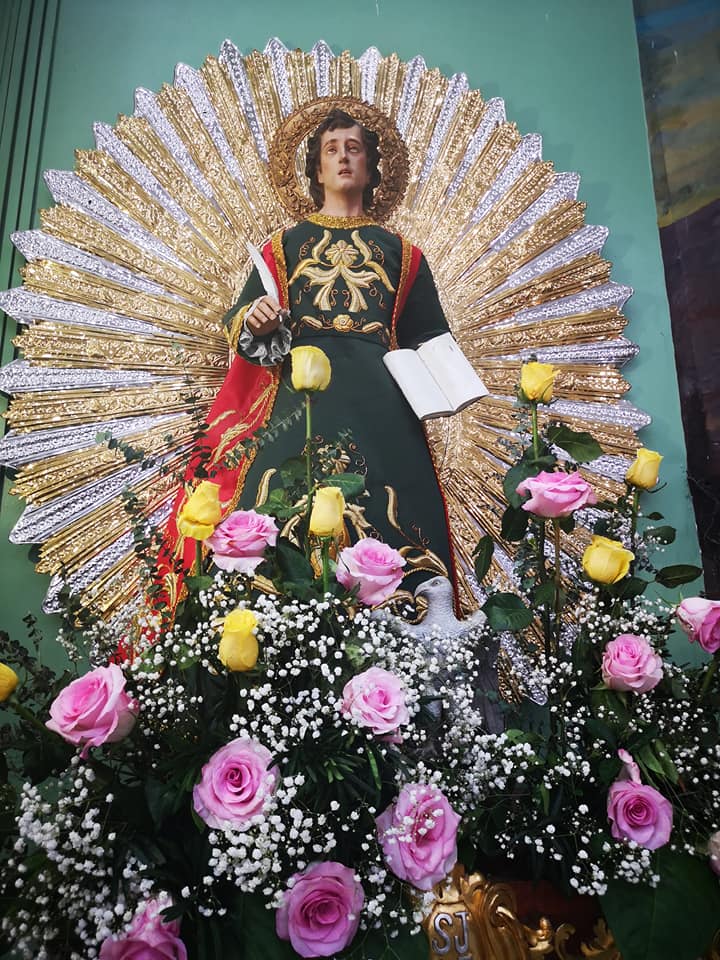
Our Parish Patron, the beloved disciple of the Lord, St. John the Apostle and Evangelist (Photo by Ms. Jo Villafuerte, Sept. 2018).
Today we celebrate in our Parish the feast of our Patron Saint, John the Apostle and Evangelist also known as “the beloved disciple of the Lord”. Although it is a Sunday in the Christmas octave when the Feast of the Holy Family is celebrated by the universal Church, parishes and dioceses with the beloved disciple as patron as exempted. Perhaps, it is St. John’s gift to me before I move to my new assignment in February next year that I celebrate his feast for the last time this Sunday.
I tell my parishioners to love St. John; that is their first task as parishioners, to love and support their Patron Saint. Moreover, I have always stressed to them how St. John the Apostle is so special, and not an ordinary saint or Apostle. Next to his being the beloved disciple of Jesus, he is the only Apostle to have not died a martyr but grew old to witness the growth of the Church; he was the one who took care of the Blessed Virgin Mary as per instruction by the Lord Himself before He died on the Cross on Good Friday; and though there are only a few parishes dedicated to him, mostly are Cathedrals like the one at Dagupan-Lingayen in Pangasinan, at Naga City in Camarines Sur, and of course, the Cathedral of Rome, the St. John Lateran, the Mother of all churches in the world.
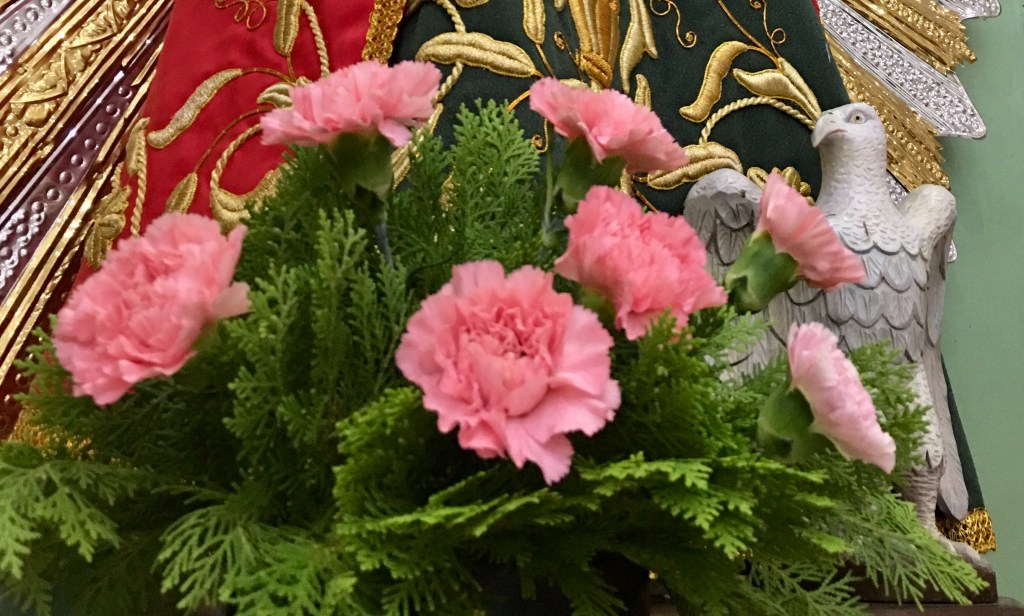
He is often symbolized by the eagle for his sharp and incisive way of looking at things and events in the life of teachings of Jesus that he is the only one able to tell us about the wedding feast at Cana, the man born blind, the raising of Lazarus as well as the more detailed account of the teachings after the feeding of five thousand people.
The great American writer Helen Keller, a blind woman, said it so well, “The only thing worse than being blind is having sight but no vision.”
I wish to reflect on that vision of St. John, on what had he seen in our Lord Jesus that hopefully we may always try to look into in our own lives.
Photo by author, Gaudete Sunday 2020.
Seeing Jesus, a real man among us
I used to say in my wedding homilies that women should always look for men who not only has sights but also vision. We all have sights but not everyone has a vision, the ability to see and look beyond what is on the surface, on what can only be seen but also perceived further.
St. John the Evangelist had a great vision of who Jesus Christ is. No wonder towards the end of his life while a prisoner at the island of Patmos off Greece, the Lord offered him a vision of heaven which he had recorded to us in the most difficult book of the Bible, the Revelation; his other four writings, the Gospel and three letters are also difficult to understand due to the different layers of meaning that only the beloved disciple was able to perceive.
Such is the kind of the vision of St. John said to be like the eagle, believed to be the only creature that can stare directly into light without getting blinded — very sharp and keen, as we say in Filipino, “matang-lawin” or eagle sight.
Being the only Apostle of the Lord to have grown old and spared from dying a martyr like the rest, St. John witnessed the first errors or heresies of early Christians concerning the humanity of Jesus Christ. They could not accept the Son of God took on a genuinely human body so that in a mistaken zeal for spirituality, they condemned everything material as evil, claiming the humanity of Jesus was just an appearance. As a result, these heretics like the gnostics taught that to be fully united with God meant to withdraw as much as possible from everything material.
St. John wrote his letters primarily to address this wrongful and erroneous views (which would persist for 400 years, still echoing in our present time), insisting that Jesus Christ is true God, and true man. We have heard him declare that on Christmas day when his prologue was proclaimed when he claimed “the Word became flesh and dwelled among us” – that Jesus Christ fully entered into our humanity and material condition by blessing and making it holy!
Today St. John insists on this contact with the real, bodily Jesus, repeating the words “seen” and “visible” about five times in four verses, emphasizing contact with a real, bodily Christ.
What was from the beginning, what we have heard, what we have seen with our eyes, what we looked upon and touched with our hands concerns the Word of life — for the life was made visible…
1 John 1:1-2
Here we find what St. John tells us also after the Resurrection in his gospel account how Jesus invited the doubting Thomas to touch and feel him, “Put your finger here and see my hands, and bring your your hand and put it into my side, and do be unbelieving, but believe” (Jn.20:27).
It is this physical, truly human, touchable Jesus that the Church proclaims every Christmas. Yet, how tragic that through the ages, we in the Church had always had that tendency to withdraw from the material that perhaps had led to so many problems with the human body and sexuality so that we have all these sex scams happening even long before.
Part of the mystery of the Incarnation is for us to be at home with our humanity like Jesus our Lord because everything God had made is good. Mention SEX, even in seminaries or Catholic schools, you hear for sure that rising crescendo of whispers and impish laughters.
Everything that God made is good. That is why Jesus became human to show us it is good to be a human being, it is the path back to God, into heaven. If we cannot accept Jesus as truly human, how can we truly love God whom we do not see? Hence, we find this beautiful flow of reason and reflection of St. John in his first letter:
No one has ever seen God. Yet if we love one another, God remains in us and his love is brought o perfection in us. God is love, and whoever remains in love remains in God and God in him. We love because he first loved us. If anyone says, “I love God,” but hates his brother, he is a liar; for whoever does not love a brother whom he has seen cannot love God whom he has not seen.
1 John 4:12, 16, 19-20
Photo by Mr. Marc Angelo Nicolas Carpio, Christmas 2020.
In short, to love God and to love others, we must first love our very selves, accept our “human-ness” like Jesus, a real man in everything except sin. The more we accept each other, the more we “see” God among us as a community, as a Church, the Body of Christ.
The Church, the Body of Christ
This vision of the Church as the body of Christ by St. John came from the empty tomb of Jesus at Easter, when the Lord was paradoxically not in sight!
When Simon Peter arrived after him, he went into the tomb and saw the burial cloths there, and the cloth that had covered his head, not with the burial cloths but rolled up in a separate place. Then the other disciple also went in, the one who had arrived at the tomb first, and he saw and believed.
John 20:6-8
What did our Patron Saint “see” that he believed, not like Simon Peter who was the leader of the Apostles?
Photo by author, August 2020.
This is the best example of St. John’s vision, of seeing beyond the physical, of seeing the significance of the folded cloth that covered the Lord’s face that has its basis in the story of Moses who had to put on a veil whenever he would converse with God face to face (cf. Exodus 34) due to the immense brightness of God, of His overwhelming presence. This the Israelites have seen every time after Moses had spoken with God, his face shone so brightly.
With the cloth that covered the head of Jesus folded and separated from the burial cloths, it meant that Jesus had met the Father, the veil to cover His face was no longer needed.
At that instance, everything became clearer for St. John – from the cleansing of the temple to His conversations with that Samaritan woman at Jacob’s well – convincing him that Jesus had risen to new life, to new level of existence. Years later, we find Jesus appearing to Saul on his way to Damascus, asking him, “Saul, Saul, why are you persecuting me?(Acts 9:1-5)” to indicate that whatsoever you do anyone, you do unto Jesus (Matt. 25:40).
In His glorified body, we are now able to look at God also in the new body of Jesus, the Church. It is in this aspect that we have to learn so much from the beloved disciple, St. John. Our lack of any sense of community like the collective effort in stopping the spread of COVID-19 shows of the great need for us to have wider and sharper vision of Jesus among us especially in the Church. May we strive to love more Jesus to find Him in our humanity. Amen.
Photo by author, Malolos Cathedral, September 2020.