Anamnesis

Quiet Storm by Fr. Nicanor F. Lalog II, 21 August 2025
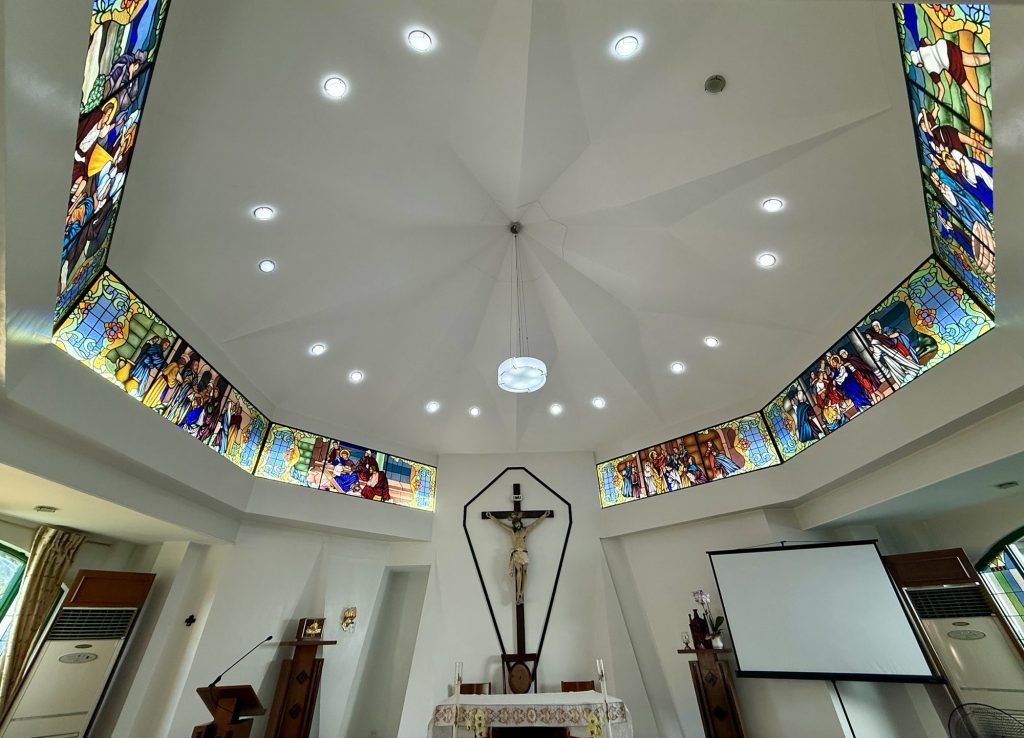
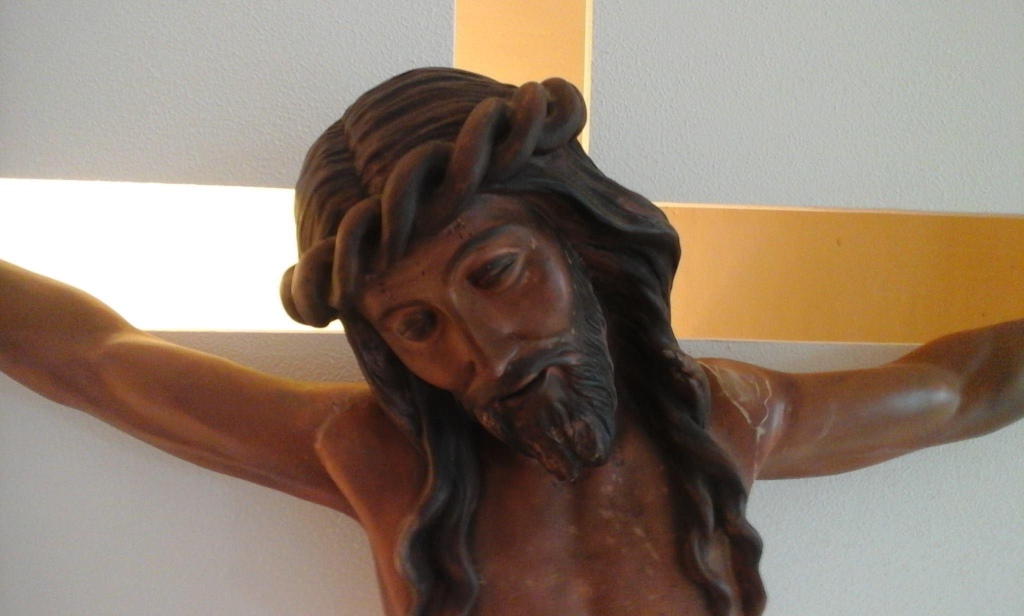
Photo by author, St. Joseph Chapel, St. Paul Center for Renewal, Alfonso, Cavite, 20 August 2025.

As we ended our annual clergy retreat today when we remembered in the Mass a saint, Pope Pius X and a hero, Benigno “Ninoy” S. Aquino Jr. , I wish to reflect on the word “remember”, a very lovely word worth remembering always.

From the prefix “RE” that connotes repetition as in again and the root “MEMBER” that means a part, to remember literally is to make someone or something a part again. What and who we remember are those gone and away from us, a history in the past. More than mere recalling of a person, event or thing, remembering is making those absent present.

Though the philosopher Martin Heidegger rightly claimed that we humans are “beings of forgetfulness,” God actually programmed us for remembering: from infancy to childhood, our parents drilled into us to remember our name and address, the names of people around us, of things, and everything as we grew. That is why the expression “kalimutan mo na yun” is the most useless piece of advice anyone can give. It is impossible to forget, whether it is so good or so bad. What we need is to harness the power of remembering, to continue learning from the past whether good or bad because whatever is remembered for all its worth is always the best teacher anyone can have.

Photo by Taryn Elliott on Pexels.com

Remembering is a power because it is a grace, a gift from God himself. When we remember, we not only time travel to the past but make it present in order to perfect us. The past cannot be changed anymore as insisted by Japanese writer Toshikazu Kawaguchi in his series of novels Before the Coffee Gets Cold.

Remembering changes the person, not the past. It is in remembering the bitter lessons of the past we learn most in life because that is when we experience healing and fulfillment. Hence, remembering is at the very core of George Santayana’s warning that whoever does not learn from history is condemned to repeat it. Remembering enables us to move on in life by finding our ways and ultimately our very selves anew especially when lost and confused.

Of God’s many gifts to us, remembering is the most unique because it is never lost at all. People who refuse to remember are the most difficult to deal with like politicians, crooks and low-lifers. And the more corrupt and evil people are, the more they are forgetful, remembering or knowing nothing at all!

God meant us to keep this gift of remembering to be always reasonable and just, or simply good and sane because it keeps us in touch with reality, making us grow and mature in his love. Actually, it is remembering that continues to operate among us despite our faltering memory or even with those afflicted with Alzheimer’s and dementia because remembering is more than keeping information and details like names of people but most of all of God’s interventions through persons and events in our lives individually and collectively that significantly made us experience joy and gladness so crucial for our growth and maturity, eventually in the achievement of our goals.

Photo by author.

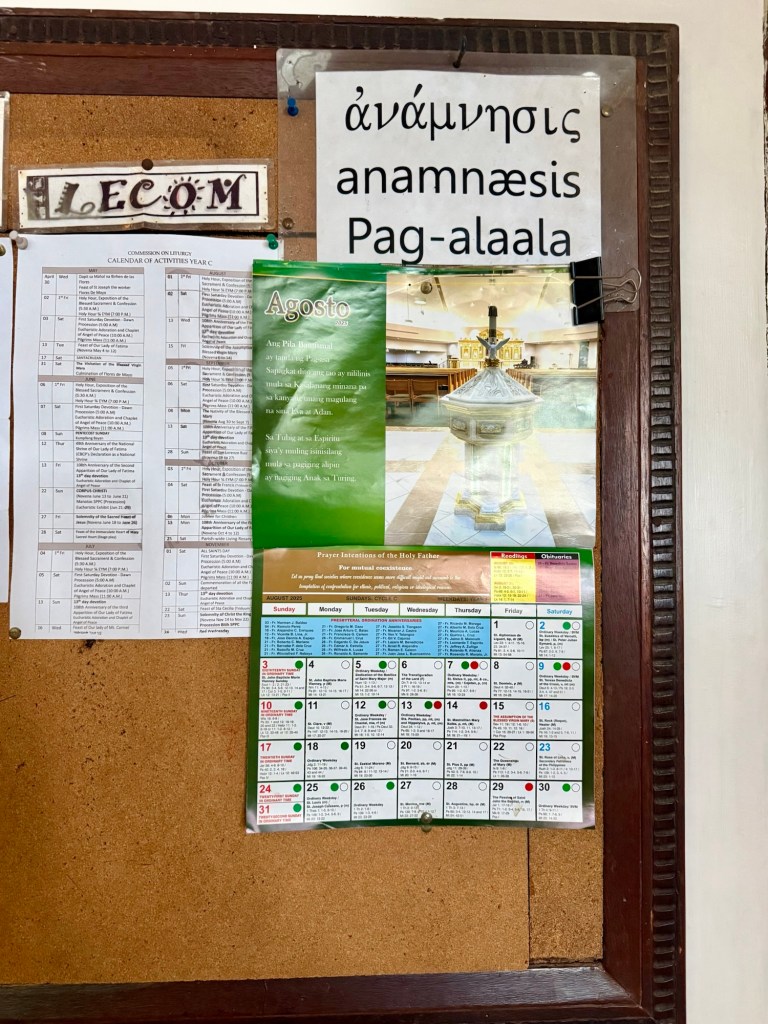
On the bulletin board of our sacristy at the National Shrine of Our Lady of Fatima in Valenzuela City is a laminated piece of bond paper with the Greek word “anamnesis” written in Greek.

It was personally printed and posted on Holy Thursday 2010 by the former rector and parish priest of the Fatima Shrine Msgr. Bart Santos now the Bishop of Iba, Zambales. I remember that so well because that was the first time I was assigned as an attached priest at the Fatima Shrine in June 2010 to June 2011 under Bishop Bart.

According to Bishop Bart who used to teach Sacred Scriptures in the seminary, he wanted to instill in all their servers of the Mass the value and meaning of the Eucharist as an anamnesis or remembering. I was so glad upon my return in February 2021 at the Fatima Shrine again as an attached priest while working full-time as chaplain at the Our Lady of Fatima University and the Fatima University Medical Center that the sign of Bishop Bart was still there – until now! I just hope the people here realize and still remember that word anamnesis as Bishop Bart had explained to them during the Holy Thursday Mass ten years ago.

Photo by author.

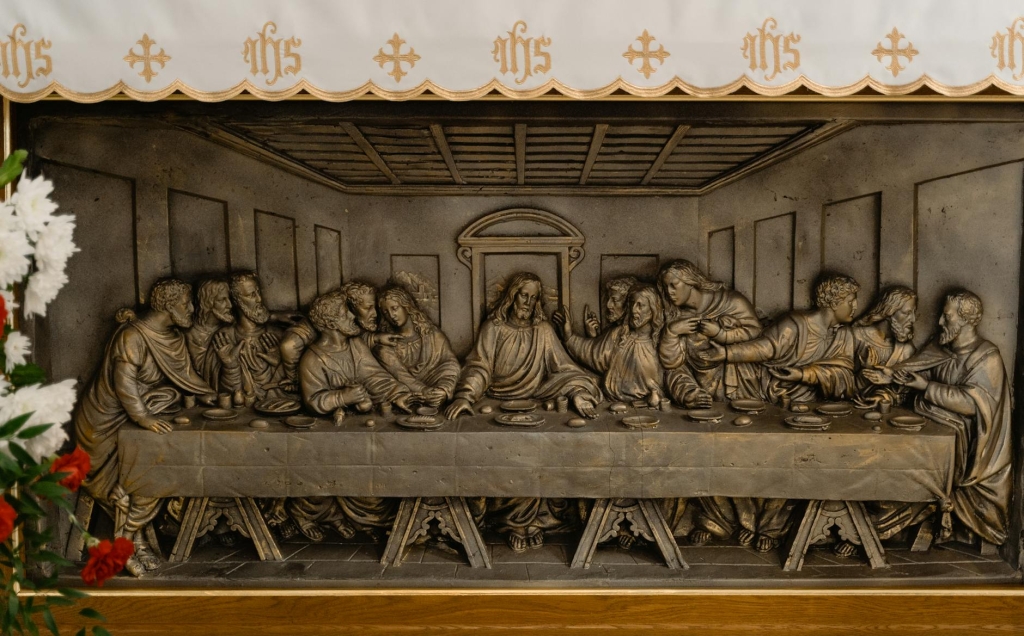
When everything seems dark in life with family and friends betraying us, when people we have helped turn against us, denying having known us, try remembering Jesus went through all these first at his Last Supper.

When you feel lost for directions in life, when you are into a burnout, when nothing seems to be working in your favor that you can’t find sparks of inspiration and zeal anymore, remember that first day when you embarked on this journey in life. Remember the people, the places and the things that bring you gladness and joy in pursuing your passion or fulfilling your mission. Most of all, remember when God called you to whatever mission he sent you.

Remembering is a form of stepping back to stop, to create a space and let God work in us as we have reflected last Monday (https://lordmychef.com/2025/08/18/steps-to-god/). This is what we need most in our selves and in our country as a people: the virtue of remembering, of making present the movements of God in our history. Ninoy Aquino did the supreme sacrifice of coming home in August 21, 1983 because he remembered the country he most loved; he remembered his call and mission to serve; he remembered the ideals and mission fought for by our heroes like Jose Rizal and Andres Bonifacio.

It is in remembering we remain anchored to our call and mission in life, both individually and communally. Without remembering, we cannot progress because we lack reference points of what we have covered, of where we are. That is why even the angels at Easter had to remind Mary Magdalene and companions, “He is not here; he has risen! Remember how he told you while he was still with you in Galilee…” (Lk.24:6). Most of all, let us remember always the words of Jesus at his Ascension so we may keep on pursuing our mission in him, “And remember that I am with you always until the end of time” (Matt. 28:20). May God bless you always!

From Pinterest.

Re-membering Jesus, Body & Blood

Lord My Chef Sunday Recipe for the Soul by Fr. Nicanor F. Lalog II
Solemnity of the Most Holy Body & Blood of Christ, Cycle C, 22 June 2025
Genesis 14:18-20 ><}}}}*> 1 Corinthians 11:23-26 ><}}}}*> Luke 9:11b-17
Photo by FlickrBrett Streutker from catholic365.com.

From the highest truth of our faith last Sunday which is the Blessed Trinity in one God, we now celebrate in the resumption of Sundays in Ordinary Time the Solemnity of the Most Holy Body and Blood of Christ.

This feast highlights our faith in God who truly exists and had come to us in Christ Jesus, the Second Person of the Holy Trinity. In Christ through the Sacrament of the Eucharist he established at the Last Supper, we are given the “taste” of heaven literally speaking under the signs of bread and wine that become his Body and Blood we share. This was his command on that Holy Thursday evening to always remember him as St. Paul tells us in the second reading, the oldest account of the institution of Eucharist:

Brothers and sisters: I received from the Lord what I also handed on to you, that the Lord Jesus, on the night he was handed over, took bread, and after he had given thanks, broke it and said, “This is my body that is for you. Do this in remembrance of me.” In the same way also the cup, after supper (1 Corinthians 11:23-25).

Photo by MART PRODUCTION on Pexels.com

Two words I wish to share with you on this Solemnity of the Body and Blood of Christ.

First is the word “remembering” or to remember. A very common word we use often but perhaps never aware of its deeper meaning from its root word “member” which means a part. Literally, to remember means “to make part again”. When we remember a person, an event in life, a thing from the past or long gone or not with us, we make them a part of the present moment.

The Eucharist is the highest form of remembering because literally speaking, we make Jesus a member of our present moment. When we re-remember Jesus in the Eucharist, he truly comes to us in Body and Blood! Truly present with us, in us after receiving him in the Holy Communion. Whenever we remember a loved one or a friend long gone or not with us at the moment, all we have is a memory. They become a member of the present but only in the mind unlike Jesus truly present with us, in us, and before us in his words, in his Body and Blood and in one another celebrating the Eucharist.

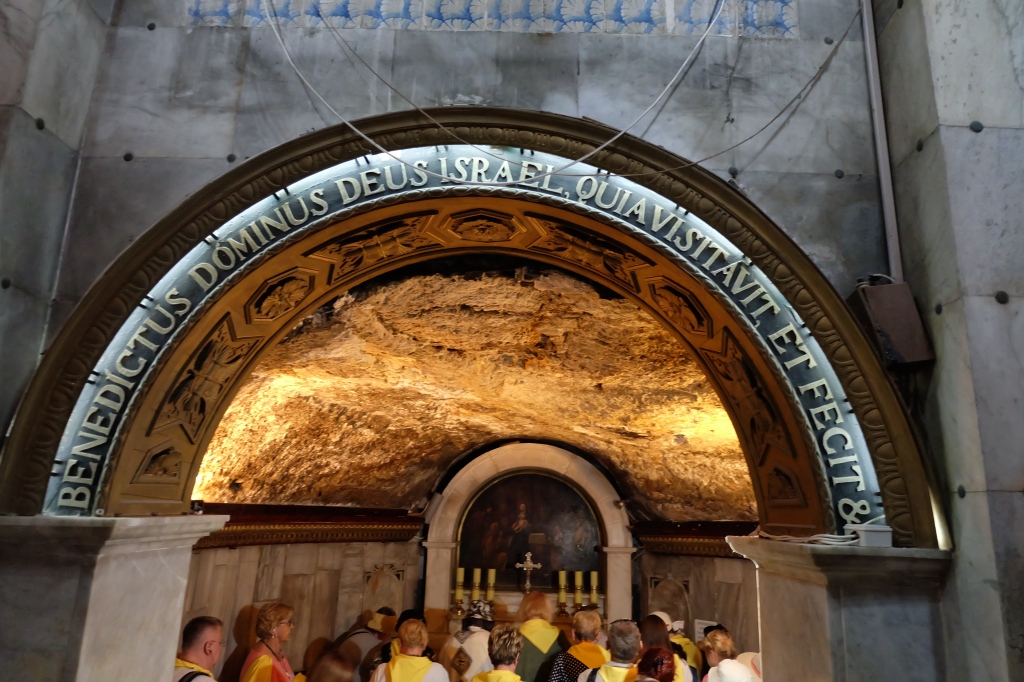
Photo by author, Old Jerusalem seen from Church of Dominus Flevit, May 2017.

It is not magic but a work of faith, a gift through and through from God in Jesus Christ. By his dying on the Cross and Resurrection at Easter, Jesus superseded and transcended time and space, sharing with us that sacred reality.

St. John Paul II beautifully called that “cosmic reality” when he described in his encyclical Ecclesia De Eucharistia how he felt transported in time and space when the temporal becomes divine because of God’s true presence anywhere he celebrated the Eucharist. We too experience the same cosmic reality in every Mass we celebrate when we are properly disposed, especially the priest and the servers.

That is why I always demand the highest order from priests and servers in celebrating most solemnly as possible the Holy Mass. I can stand kids playing inside the church but what gets to my nerves are servers talking or moving unnecessarily during the Mass and worst of all, when lectors proclaim the word of God incoherently and wrongly. Lest we forget also the choir members feeling so magaling forgetting they are in the Mass not in a concert that they make it a show, forgetting all about God and the people.

What a tragedy when we priests and liturgical ministers are the ones who forget to re-member Jesus in the Eucharist with our too much attention to ourselves. Exactly like the Twelve in our gospel!

As the day was drawing to a close, the Twelve approached him and said, “Dismiss the crowd so that they can go to the surrounding villages and farms and find lodging and provisions; for we are in a deserted place here.” He said to them, “Give them some food yourselves.” They replied, “Five loaves and two fish are all we have, unless we ourselves go and buy food for all these people” (Luke 9:12-13).


Imagine that scene of how the Twelve have totally “forgotten” the more than five thousand people gathered there with them. They were just thinking of themselves because they were in a “deserted place”. What a disrespect!

Respect is lost and disregarded when there is no remembering of others, when we forget others. Respect is from two Latin words re (again) and specere (to look/see) from which the words spectacle and spectacular came from. Re + specere or “respect” means to look again in order to see!

The Twelve were just concerned with themselves, not only forgetting but without respect at all with the people they have failed or refused to recognize as humans too who get tired and hungry like them. As we have cited in earlier, this continues right in our eucharistic celebrations when priests and ministers celebrate unprepared, unmindful of the sanctity of the Mass.

Remembering is not merely “thinking” of others in our mind and memory.

Remembering is making others present in our very selves!

Remembering is making every-body a some-body by giving our very selves to them to be the Body of Christ. Unless we are able to truly share our very selves in person, in body and blood too, then every Mass will remain merely a rite or a ritual. Worst, an activity we just have to fulfill.

The Eucharist is the summit of our Christian life because of this aspect of remembering Jesus Christ that leads us into a true communion of sharing of persons and experiences, in our joys and sorrows, in our hopes and belief. When this happens, then every remembering becomes a thanksgiving too.

And that is our second word I wish to instill in you today – thanksgiving which is the meaning of the Greek word eucharistia.

When there is a real experience of each others’ presence in love and mercy, kindness and care, justice and fairness, gratitude flows naturally resulting in peace and harmony. It is the whole meaning of our first reading when the priest of God named Melchizidek who was also the king of Salem which means “peace” blessed Abram after winning in a battle.

This short scene is a story of remembering God’s goodness to Abram who thanked Melchizidek by giving him a tenth of everything he had won in the battle. In the Holy Mass, what do we really share from our very selves? Not just treasures but even our very time to give totally to Christ without texting.

Now we see the series and cycle of remembering and thanksgiving in sharing of gifts of self which the Body and Blood of Christ signify to us.

This coming Friday we shall celebrate the third consecutive Solemnity in the resumption of Ordinary Time with that of the Most Sacred Heart of Jesus, a reminder to us all to make Jesus present always in ourselves with others especially at this time the world has been deleting from its every aspect God.

Lord Jesus Christ,
transform me like the
bread and wine
into your Body and Blood
to be offered and shared
with others
especially those
in most need.
Amen.
Photo by Pixabay on Pexels.com

Lent is not forgetting God

40 Shades of Lent by Fr. Nicanor F. Lalog II
Wednesday, Third Week in Lent, 26 March 2025
Deuteronomy 4:1, 5-9 + + + Matthew 5:17-19
Photo by author, Sacred Heart Novitiate, Novaliches, QC, 21 March 2025

“However, take care and be earnestly on your guard not to forget the things which your own eyes have seen, nor let them slip from your memory as long as you live, but teach them to your children and to your children’s children” (Deuteronomy 4:9).

God our loving Father,
you encompass the whole Earth
and universe where nothing
is hidden from you
nor escapes your notice
even the smallest of particles
in your whole creation
most especially us,
your beloved children,
that, though we are sinful,
you loved us beyond measure,
mindful of us always.
But, we are all beings
of forgetfulness.
easily forgetting even
your most recent blessings
as well as intimacy and bond
with us in Jesus Christ your Son;
many times, we get distracted
by so many concerns we forget
you that we disregard one another
in love and kindness;
we easily forget your mercy and
forgiveness that we return to our
wayward life of sin quickly;
most of all, we turn away from you
as we refuse to love you when
we get impatient in life,
believing there could be
better and other ways to
fulfillment.
Direct us, dear God
into becoming more loving like you,
into desiring the Cross of
your Son Jesus Christ
for our love in him so that
we may never forget to love
you always in others
for it is in our love for one another
especially the weakest where
our greatness as a nation is recognized.
Amen.
Photo by author, Sacred Heart Novitiate, Novaliches, QC, 17 March 2025

Lent is remembering

40 Shades of Lent by Fr. Nicanor F. Lalog II
Wednesday in the Third Week of Lent, 06 March 2024
Deuteronomy 4:1, 5-9 ><}}}}*> + <*{{{{>< Matthew 5:17-19
Photo by Pixabay on Pexels.com
Lent is remembering
especially because we are
beings of forgetfulness;
but, teach us Father,
that to remember you
is not like in remembering
an equation or a formula
as a task of the mind
or intellect;
to remember you, O God,
in the spirit of Lent is
to surrender ourselves to
you whom we do not see
but present among our
brothers and sisters;
to remember you, dear God,
is to surrender ourselves
to your Holy Will
that are not mere laws
and decrees
but the very person
of your Son Jesus Christ.

Jesus said to his disciples: “Do not think that I have come to abolish the law or the prophets. I have come not to abolish but to fulfill. Amen, I say to yo, until heaven and earth pass away, not the smallest letter or the smallest part of a letter will pass from the law, until all things have taken place.”

Matthew 5:17-18
To remember and keep your laws,
dear God is to remember and keep you
found in our brothers and sisters
through your Son Jesus Christ;
indeed, the greatness of any
nation is measured to a large part
in its legal system, in how it is justly
implemented and observed:

Moses spoke to the people and said: “Observe them carefully for thus will you give evidence to your wisdom and intelligence to the nations, who will hear of all these statutes and say, ‘This great nation is truly wise and intelligent people.’ For what great nation is there that has gods so close to it as the Lord, our God, is to us whenever we call upon him? Or what great nation has statutes and decrees that are just as this whole law which I am setting before you today?'”

Deuteronomy 4:1, 6-8
Father, in this season of Lent,
may we recover and put into practice,
not just remember that your laws
are fulfilled in Christ when we love;
how sad that love of God
and love of neighbors
is your law we often forget,
and find hard to remember
because we keep it in our minds
than in our hearts where you dwell.

Most of all, to remember
means to make one a member
of the present moment again:
help us remember in making
you present always in our love
and good works.
Amen.

Christ our King & our overcoming of sin

The Lord Is My Chef Sunday Recipe for the Soul by Fr. Nicanor F. Lalog II
Solemnity of Christ the King, Cycle C, 20 November 2022
2 Samuel 5:1-3 ><000'> Colossians 1:12-20 ><000'> Luke 23:35-43
Painting of Christ’s Crucifixion by Tintoretto in 1565 portraying Jesus so “kingly”; interesting too were the people dressed as Venetians of his time as reminder that the evils that crucified Jesus continue in our own time. Photo from wikiart.org.

We now come to the final Sunday of our liturgical calendar called the Solemnity of Christ the King with a scene from his crucifixion on Good Friday. All these Sundays since June “When the days for Jesus’ being taken up were fulfilled, he resolutely determined to journey to Jerusalem” (Lk.9:51), Luke had been showing us that Christ’s crucifixion and glory are one just like John in his gospel account.

But the most beautiful part of our gospel on this solemn celebration is the fact that inasmuch as Jesus had clearly showed in all eternity his kingship while dying on the Cross, it is also right on the cross of sufferings as we strive to resist temptations of turning away from God that we proclaim Christ’s kingship. Please bear with me, my friends in reflecting Luke’s artistic presentation of Christ’s crucifixion as the expression of his kingship.

Notice how Jesus was “sneered, jeered, and reviled” at the cross, reminding us of the devil’s three temptations in the wilderness after his baptism at Jordan by John. After failing to tempt Jesus at the wilderness, Luke said the devil “departed from him for a time” (Lk.4:13), returning at his crucifixion as the most opportune time to test him.

In the wilderness, the temptations by the devil to Jesus applied very well with us too but, here on the cross, it was totally different. The devil himself was nowhere to be found because he was in the person of the rulers, the soldiers, and the thief! And that is how evil and sin have become so “powerful” in a pernicious manner among us when many times we are the devil in fact.

Here, we are reminded to be aware always of that opportune time when the devil attacks us when we see or face many sufferings in life by reflecting the last three temptations of Jesus on the Cross.

Photo by author, 2017, Sacred Heart Novitiate, Novaliches, QC.

The rulers sneered at Jesus and said, “He saved others, let him save himself if he is the chosen one, the Christ of God” (Lk.23:35).

Just like at the wilderness when the devil tempted Jesus with what he can do as the Son of God by changing stone into bread, at the Cross it was the same temptation hurled on him by the rulers of Israel, the priests and the scribes.

How sad that amid the many sufferings in the world today we contemptuously mock others like the poor for not working so hard to liberate themselves from poverty and hunger. There is the tendency among us blessed with better living conditions to look down at others without considering how they never have the same opportunities in life like us in having good education or a caring family or worse, not having the right connections.

The tragic part of this “sneering” by the rulers on Jesus is when we look at others as if they are not humans and persons like us who play gods knowing everything even who should live and who should die like in the systematic approach by state rulers to come up with what St. John Paul II called as “culture of death” in solving poverty and crime with abortions and capital punishments.

Let us examine our attitudes at the way we look at those going through sufferings and pains like sickness, poverty and other social ills we do not go through. Let us stop the mockeries of blaming them for their plight because many times like Jesus Christ, they were betrayed by loved ones like us, by the society, or even by the institutions meant to uplift them.

Photo by author, 2017.

Even the soldiers jeered at him. As they approached to offer him wine they called out, “If you are King of the Jews, save yourself.” Above him there was an inscription that read, “This is the King of the Jews” (Lk.23:36-38).

Sneering and jeering are both contemptuous mocking or insulting of others; they are both employed by those in vantage positions of power and control like the rulers of Israel. Going “higher” than the priests, the Roman soldiers sneered Jesus by rudely mocking him in loud voice. Sneering is a superfluous display of might, of superiority, of power. It is a kind of vanity that is why in the wilderness, the devil tempted Jesus to have all the kingdoms in the world for him to be famous and popular in exchange of worshipping him.

Sneering is something so prevalent these days in our use of the social media where we practically scream and insist on everyone to notice and recognize us, that we have “arrived” in having the latest and most expensive clothes, food, gadgets and everything. There is so much wild attitude among us like the soldiers at the cross when we use social media in too much talks, even of spewing foul languages and invectives as well as lies. Fake news and lies spread so fast and are sadly taken as true to the detriment of its victims because we have been so gullible for gossips and rumors too.

But the worst part of our imitation of the soldiers jeering at Jesus is when many of us are afflicted with this perversion called exhibitionism – from those salacious posts in TikTok to those “food porns” and too much display of everything about ourselves and of our loved ones. When do we get tired of all these selfies that have become so sickening that we do not realize of how we make known to everyone of our emptiness and lack of the more essential things like love and self-respect? Like the soldiers, the more we promote ourselves, the more we affirm the obvious that Jesus indeed is the King we needed most.

Photo by author, 2017.

Now one of the criminal hanging there reviled Jesus, saying, “Are you not the Christ? Save yourself and us” (Lk.23:39).

Reviling is also kind of of mocking others like sneering and jeering; however, to revile is the lowest kind because it is to insult somebody you are with in a same situation. To revile is the lack of recognition of one’s faults and sins that he would rather insult others like this thief traditionally identified as Hestas. In reviling Jesus while also hanging on the cross, Hestas went down deeper his lowest point as a convicted criminal when he had the gall to insult Jesus!

And that is the most unkind evil of all when we become so numb, so dense and stupid to even mock others we are with us in a similar situation. It happens daily when even we are in deep shit, we still see ourselves cleaner and better than others! Just read or watch the news about our politicians.

In the wilderness, the final temptation of the devil to Jesus was to jump from the top of the temple because his angels would not let him fall and even touch ground; here at the cross, Hestas saw himself no different from Jesus, feeling so entitled to be liberated. Many times, this is the problem why evil continues among us: when people from below are promoted to higher positions, they forget their roots that they also forget to fix the problems of inequalities and injustices down below where they came from. The key is to always remember. Like Dimas, the good thief.

Photo by author, 2017.

The other, however, rebuking him, said in reply, “Have you no fear of God, for you are subject to the same condemnation? And indeed, we have been condemned justly, for the sentence we received corresponds to our crimes, but this man has done nothing criminal.” Then he said, “Jesus, remember me when you come into your kingdom.” He replied to him, “Amen, I say to you, today you will be with me in Paradise” (Lk.23:40-4).

See how Luke inserted here the fourth verb “to rebuke” to break the series of sneering, jeering, and reviling of Jesus. Like Dimas, we have to strive in breaking the cycle and series of evil especially in this time.

To rebuke means to express sharp disapproval. Imagine Dimas contradicting Hestas and even the rulers and soldiers as well by defending Jesus Christ while hanging there on the cross.

How sad when we remain silent, when we just walk away from people sneering, jeering and reviling Jesus in those who suffer in life because we are afraid to make a stand for what is true and good, what is right and just. How ironic that another thief hanging on the cross was the only one who made a stand for Jesus on that Good Friday along with the Mary and the beloved disciple below.

Every time we make a stand for life and dignity of every person, when we stand for what is true, right and just, that is when we imitate the tribes of Israel in the first reading coming to David to pledge their loyalty and allegiance to him as their king.

When we submit ourselves to Jesus Christ as our only King to be obeyed and followed, that is when our celebration today becomes a daily reality.

That is when we also earn heaven right on the Cross of our sufferings like Dimas when we “remember” Jesus.

Normally in the whole Bible, it is God who remembers. People always forget. When we sin, we forget consciously and unconsciously God and all the good things he had done to us. We forget others too.

There on the Cross, see the reversals of roles Luke has presented so beautifully, from the devil replaced by the rulers, the soldiers and the other thief; and now Dimas sort of assuming God’s role who remembered everything and everyone, especially Jesus our Savior. Dimas remembered what St. Paul expressed to the Colossians that Jesus is Lord in whom, with whom and through whom everything was created and renewed because he is the Christ!

From Google.

The word “remember” literally means to make member or part again, that is, “re” + “member”.

When we remember somebody, we make that person present with us again.

In asking Jesus to remember him when he comes into his kingdom, Dimas was assured that right now as he remembered everything including his sins, he already becomes a member, a part of his kingdom.

May we not forget and always remember Jesus and others always to experience Paradise even when we are on the cross. Amen. Have a blessed week ahead!

Praying to remember, to never forget

The Lord Is My Chef Daily Recipe for the Soul by Fr. Nicanor F. Lalog II
Friday in the Nineteenth Week of Ordinary Time, Year II, 12 August 2022
Ezekiel 16:1-15, 60, 63   ><]]]]'> + ><]]]]'> + ><]]]]'>   Matthew 19:3-12
Forget-me-nots photo by Pixabay on Pexels.com
Now, more than ever, 
I am convinced dear God
that we are indeed "beings of forgetfulness";
we easily forget, and sadly, we enjoy,
we choose and we "love" so much 
forgetting the past, 
forgetting people,
forgetting our roots, 
and worst, forgetting you
our loving Father.
How striking are your words
to the Prophet Ezekiel today,
"making known to Jerusalem
her abominations", of how as a 
nation like a newborn child left 
in the dirt with her umbilical cord
still uncut, wrapped in her blood
and all until you O God took her, 
bathed and dressed her with
finest clothes, fed with good food,
bestowed with your dignity 
that nations loved her (Ezekiel 16:3-14) 
only to forget you, O God... 
just like us today.

But you were captivated by your own beauty; you used your renown to make yourself a harlot, and you lavished your harlotry on every passer-by, whose own you became. Yet I will remember the covenant I made with you when you were a girl, and I will set up an everlasting covenant with you, that you may remember and be covered with confusion, and that you may be utterly silenced for shame when I pardon you for all you have done, says the Lord God.

Ezekiel 16:15, 60, 63
Let us remember you
Lord always;
teach us to make you a 
"member", a "part"
 of each present moment,
thus, "re" + "member"!
Let us enter into communion
in you, with you in Christ Jesus,
remembering, honoring
your divine plans since
the beginning like marriage;
forgive us for the "hardness
of our hearts" that we have relished
in forgetting and disregarding you
 and your plans in the past,
your blessings and plans for the future.
Let us stop "separating"
not only husbands and wives
but most especially our lives,
our selves from you, dear God,
 for you are our life, our being,
our origin and end.
Amen.

Easter is “re + membering”

The Lord Is My Chef Daily Recipe for the Soul by Fr. Nicanor F. Lalog II
Thursday within the Octave of Easter, 21 April 2022
Acts 3:11-26   ><)))*> + <*(((><   Luke 24:35-48
Photo by author, Easter 2018.
Praise and glory to you,
Lord Jesus Christ, for the
most wonderful gift of memory:
more powerful than any memory
card or computer chip, you have
made our memories so powerful
not only in keeping the past alive
within us but most of all, enabling
us to make these memories present
again in every here and now - the gift
of "re + membering".
Thank you dear Jesus for this most
wonderful gift of all that even if 
our memories fail due to age and
sickness, we always re + member
those dearest people to us from
the past:  we make them a member
of today, that is, re-member!

The disciples of Jesus recounted what had taken place along the way, and how they had come to recognize him in the breaking of the bread. While they were still speaking about this, he stood in their midst and said to them, “Peace be with you.”

Luke 24:35-36
Before Easter happened,
during supper on the night you
were betrayed, you commanded 
your disciples to always remember,
to "do this in memory of me":
at Emmaus, the two disciples did
remember and recognized you,
Lord Jesus and from then on, we have
always re-memebered your commandment
and you yourself who becomes present
most especially in the Holy Eucharist and
when we live its essence of love.
Refresh always our memories,
Jesus, so we may keep re-membering you,
making you a member anew in every
present moment in our witnessing to
your very person and your most loving act
of self-giving.  Amen.

Lest we forget or miss others…

The Lord Is My Chef Daily Recipe for the Soul by Fr. Nicanor F. Lalog II
First Friday, Week XXXI, Year I in Ordinary Time, 05 November 2021
Romans 15:14-21   ><]]]]'> + ><]]]]'> + ><]]]]'>   Luke 16:1-8
Photo by author at Silang, Cavite, 2020.
On this First Friday of November,
I thank you dear God our Father
for the enriching and comforting words
of St. Paul these recent weeks as we
come to the penultimate installment of his
beautiful Letter to the Romans:

I myself am convinced about you, my brothers and sisters, that you yourselves are full of goodness, filled with all knowledge, and able to admonish one another. But I have written to you rather boldly in some respects to remind you, because of the grace given me by God to be a minister of Christ Jesus to the Gentiles in performing the priestly service of the Gospel of God, so that the offering up of the Gentiles may be acceptable, sanctified by the Holy Spirit.

Romans 15:14-16
You have reminded us these past weeks
through St. Paul not only of the need to
have sound doctrine on what we believe
but most of all to have much love in our
faith and hope in you.
As he begins to close his letter to the
Romans, may we imitate his great love
and concern for the Gentiles and those 
others to whom the Gospel has not been
proclaimed yet; many times in our lives,
we only remember those with us, those like
us, forgetting and missing out those not
with us, those living in the margins, those in
the fringes of the society and Church.
Give us, dear Father, such attention 
of St. Paul in seeking those not yet in our fold,
those neglected and taken for granted; how sad
that we only remember others when we are already
in dire need and extreme situations like that wise
steward in the gospel today:  at the height of his
power and influence, he never thought of the
creditors of his master, milking them dry of their
resources; but when he was in danger of being
terminated, he suddenly remembered them.
Most of all, he dealt with them with charity and
leniency to win their favors and sympathies.
Before any calamity or storm befall us,
when unfavorable circumstances happen 
to us or anyone, remind us, loving Father, 
to think of others,
to search for the lost 
and little ones
lest we miss them totally 
as if they do not exist.
Amen.