The Lord Is My Chef Sunday Music by Fr. Nick F. Lalog II, 13 December 2020
Photo by author, Tabernacle, Gaudete Sunday, 2020.
Today is Gaudete Sunday, the third week of Advent known as “Rejoice Sunday” when our readings and pink motifs invite us all to rejoice because Jesus is coming.
And so, here we rejoice with some hard hitting old-school music with Daryl Hall and John Oates’ cover of the Spinners’ 1972 hit I’ll Be Around.
Yes, we have always preferred the original and the Spinners really did a good one that made I’ll Be Around now a classic but Hall and Oates really “kicked ass” on this one along with other hit classics from their 2004 album Our Kind of Soul.
I was watching Live from Daryl’s House the other day when their featured guest sang this and right away felt its energy but I still preferred this 2004 cover that featured the the dynamic duo’s kind of old-school music especially the signature guitar riff wrapped up in Daryl’s superb voice and performance.
I’ll Be Around was written by Phil Hurtt who clarified he was not “hurting” (pun intended) or into any emotional transition in composing the lyrics of this song that speak of the undying devotion of a brokenhearted man to his ex-girlfriend, that despite their parting of ways, he assured her that
Whenever you call me, I'll be there
Whenever you want me, I'll be there
Whenever you need me, I'll be there
I'll be around
In our gospel reflection, we have said that life is a perpetual Advent of Jesus – he had come, he will come again at the end of time, and he continues to come to us in our lives, among peoples and events.
And in this perpetual coming of Jesus, he needs us as new John the Baptist who shall guide others because “there is one among you whom you do not recognize” who could be Christ after all!
We find this song joyful, upbeat, and very much like the role of John the Baptist, the Lord’s Precursor and Awakener preparing the way of Jesus Christ even in our own time when this Season of Advent has become a parable of our life (https://lordmychef.com/2020/12/12/advent-a-parable-of-our-life/).
So, let us rejoice amid the pandemic, Jesus continues to come to bless us, to save us!
Uploaded to YouTube by LOGONDOR (83,138 views as of 18 June 2015); [Merlin] Absolute Label Services (on behalf of U-Watch Records); CMRRA, BMI – Broadcast Music Inc., Warner Chappell, PEDL, UNIAO BRASILEIRA DE EDITORAS DE MUSICA – UBEM, LatinAutor – Warner Chappell, Sony ATV Publishing, LatinAutorPerf, and 3 Music Rights Societies
The Lord Is My Chef Sunday Recipe for the Soul by Fr. Nicanor F. Lalog II
Third Sunday of Advent-B (Gaudete Sunday), 13 December 2020
Isaiah 62:1-2, 10-11 >><)))*>  1 Thessalonians 5:16-24  >><)))*>  John 1:6-8, 19-28
Photo by author, Gaudete Sunday at the Parish, Advent 2019.
Advent is a parable of our lives. Three months ago we reflected every Sunday the many parables of Jesus and we have learned that a parable is a simple story that contains deep meanings. Just like Advent: a season that comes in our church calendar every year that we take for granted not realizing the deeper meanings it teaches in the four weeks before Christmas or the Second Coming.
On this third Sunday of Advent also known as “Gaudete (Rejoice) Sunday”, joy is the motif of all our readings for indeed, we are moving too closely to Christmas – and parousia. The lovely shades of pink remind us that we have to be alert to experience the advent of Jesus. Once again, its precursor John the Baptist guides us this Sunday in grasping the parable of Advent during his time and in our own time.
We are all a John the Baptist -
a reminder of Christ present among us.
All four evangelists mention John the Baptist in their gospel version before telling the ministry of Jesus Christ; but there is something so different with the approach of the author of the fourth gospel in introducing the Lord’s precursor.
In the fourth gospel, he is simply called “John”, omitting his title “the Baptist” for he is the only John in this gospel. The author of the fourth gospel never named himself preferring to be known as the “disciple whom Jesus loved” or simply “beloved disciple”. We learned his name is John through the other three gospel accounts, that he is the brother of another apostle James, both being the sons of Zebedee.
Why the author of the fourth gospel never identified himself with his name John is another topic; what matters to us is that there is only one man named John in his gospel and that is no other than John the Baptist whom he presented in the most unique manner like an official pronouncement, full of solemnity by declaring that this “man named John was sent from God. He came for testimony, to testify to the light, so that all might believe through him” (Jn.1:6-7).
Photo by author at Silang, Cavite, 20 September 2020.
Here we find John the Baptist clearly being placed by the author of the fourth gospel in relation to the Christ that is essentially the meaning of our being a baptized Christian — we are another John to remind people of Jesus present among us. It is one of life’s parables we always miss, something that can elicit joy in everyone.
And the more we find ourselves like John the Baptist in his mission, the more we experience Jesus closest to us too!
Life is a perpetual Advent
of Jesus who needs a
John the Baptist in us.
After formally introducing to us John as man sent from God to testify for the Christ, our gospel today skipped the rest of the Prologue and jumped into the mission of John to introduce the ministry of Jesus Christ. See how in a few verses we find transitions from John to Jesus then to us.
Painting by Raphael of John preaching in the wilderness; photo from wikicommons.
John said: “I am the voice of the one crying out in the desert, make straight the way of the Lord, as Isaiah the prophet said. I baptize with water; but there is one among you whom you do not recognize, the one who is coming after me, whose sandal strap I am not worthy to untie.”
John 1:23, 26-27
John is the fulfillment of the Old Testament prophecy. But, at the same time, he is the continuation of the Old into the New as he stood present pointing to Jesus Christ who had come and would come again!
This we find in his last reply to the query of the Pharisees: “I baptize with water; but there is one among you whom you do not recognize, the one who is coming after me, whose sandal strap I am not worthy to untie.”
This is the parable of Advent: it is a perpetual event, something that keeps on happening even in our time that needs a John the Baptist to remind us that Jesus had come, that he is coming and most of all, he is come!
Aside from preparing others for Jesus Christ’s coming – we need to be like John the Baptist who also prepared himself for his Lord and Master!
In telling us that “there is one among you whom you do not recognize”, John humbly prepared himself to recognize and receive Jesus when he identified the Lord while coming to him for his baptism as “the Lamb of God who takes away the sin of the world”, saying “He is the one of whom I said, ‘A man is coming after me who ranks ahead of me because he existed before me'” (cf. Jn.1:29-30).
But most of all, we find the most beautiful lesson of John in preparing for the Lord’s coming when like him, we allow Jesus to reveal himself to us, always saying “He must increase; I must decrease” as he taught his disciples asking him about Jesus’ ministry.
“The one who has the bride is the bridegroom; the best man, who stands and listens for him, rejoices greatly at the bridegroom’s voice. So this joy of mine has been made complete. He must increase; I must decrease.”
John 3:29-30
Advent is being alert
and open to the Holy Spirit
who always comes with Jesus.
Advent is a parable of life when we hope in joy and humility for the Second Coming of the Lord who also continues to come to us in so many ways we never expect. It is a time of prayer and reflections when we try to become more open to the leading of the Holy Spirit.
In the first reading we are reminded of the exact words of the Prophet that Jesus proclaimed in their synagogue when he came home to preach that,
The spirit of the Lord God is upon me, because the Lord has anointed me; he has sent me to bring glad tidings to the poor, to heal the brokenhearted, to proclaim liberty to the captives and release to the prisoners, to announce a year of favor from the Lord and a day of vindication by our God.
Isaiah 61:1-2
Photo by author, Advent 2018.
After proclaiming those beautiful words of the prophet, while people were all eyes on him, Jesus declared “Today this scripture passage is fulfilled in your hearing” (Lk.4:21).
That is the power of the word of God, it is always effective and performative as the very sign of his presence among us. That is why Advent is the season when we are encouraged to cultivate that habit of praying the Sacred Scriptures that cleanse our hearts to be empty and ready to receive Christ in his coming. We encounter God first in his words filled with parables that enrich our lives.
To be open for the word of God and to the Holy Spirit means being alert that Jesus is “one among you whom you do not recognize” as John had told us.
Like John, it is finding the “whole” of God’s plan for us from the Old Testament to the New Testament and into our own time in the Church. It is the joy of discovering in this myriad of events and happenings, there is a God personally coming to us, loving us in the most personal way.
Like John, we are sent from God to give testimony to Jesus who had come, will come again and always comes.
That is the parable of Advent: when we realize deep within that we are able to rejoice and be glad to be alive to meet Jesus. May we heed to the words of St. Paul in the second reading:
Brothers and sisters: Rejoice always. Pray without ceasing. In all circumstances give thanks, for this is the will of God for you in Christ Jesus. Do not quench the Spirit. Do not despise prophetic utterances. Test everything; retain what is good. Refrain from every kind of evil.
The Lord Is My Chef Breakfast Recipe for the Soul by Fr. Nicanor F. Lalog II
Saturday, Week XXV, Year II in Ordinary Time, 26 September 2020
Ecclesiastes 11:9-12:8     <*(((><<   +   >><)))*>     Luke 9:43-45
Photo by author, sunset at Silang, Cavite, 22 September 2020.
It is officially the end of the week, and how true are your words through Qoheleth that everything comes to an end, that we must strive to make every ending a happy one. Especially our very lives.
Rejoice, O young man, while you are young and let your heart be glad in the days of your youth. Follow the ways of your heart, the vision of your eyes; yet understand that as regards all this God will bring you to judgment. Ward off grief from your heart and put away trouble from your presence, though the dawn of youth is fleeting.
Ecclesiastes 11:9-10
God our Father, grant me the gift of ageing gracefully by having the grace of being excited and surprised each day while still young. It is said that it is not really time that is passing by if we waste it but us who are passing by because lost time can never be recovered or brought back.
Keep me excited and full of enthusiasm of following my heart, pursuing my vision of a better and beautiful future by celebrating every present.
Let me bear in mind Lord that I am not perfect so that I may always have room for my mistakes and those of others; keep me simple so as not to be demanding and exacting. Just let me enjoy life, trust more in you, worry less among us.
And in all my pursuits in life while still young, be at the center, Lord Jesus.
Let me keep in mind as you reminded your disciples in the gospel today, that I may not be so focused and amazed with great and wondrous deeds but most of all in how you have bore all pains and sufferings to save us.
After all, you saved the world by dying on the Cross, O sweet Jesus, and not with so many activities.
And that is the meaning of ageing gracefully: that towards the end of our lives when we sum up everything, we can always look back to the past, to our youth with pride and joy at how we have followed you Jesus in your Passion and Death while awaiting our glorious resurrection in you like the twin brothers Sts. Cosmas and Damian and others saints. Amen.
The Lord Is My Chef Sunday Recipe for the Soul by Fr. Nicanor F. Lalog II
Week XXV-A, Ordinary Time, 20 September 2020
Isaiah 55:6-9   >><)))*>   Philippians 1:20-24, 27   >><)))*>   Matthew 20:1-16
Photo by the author on the way to Petra in Jordan, May 2019.
There was something amusing I realized while praying this Sunday’s gospel of how in our time we no longer hear or use the word “generous” anymore — except when the topic is about food like in the expression “generous servings”!
We all love and enjoy “generous servings” of food and drinks whether in restaurants or at home or at parties because it means something more than what we pay for or come for. And that is the essence of generosity: the giving of more than what is required and just. It is love in the real sense like the prayer for generosity by St. Ignatius of Loyola.
Dearest Lord:
Teach me to be generous.
Teach me to serve you as you deserve,
To give and not to count the cost,
To fight and not heed the wounds,
To toil and not seek for rest,
To labor and ask not for reward, except
To know that I am doing your will.  Amen.
Photo by Mr. Jim Marpa, 2019.
Generosity bonds every community in Christ
Sorry if I have to start our reflection through the stomach because today is our “Pistang Pasasalamat” (Thanksgiving) in the Parish…
Going back to our reflection, my dear reader, recall how in the past two weeks we have heard Jesus teaching us important lessons how our relationships must be based on mutual love through fraternal correction and forgiving of those who have sinned against us.
This Sunday through another parable, Jesus teaches us the importance of generosity as a wonderful expression of love we forget most in our relationships and dealing with others.
Generosity is the glue that keeps our ties stronger and keeps us filled with joy because it is thinking more of the other person than of self. It is love at its finest – charming and elegant as in suave – but so disarming and revealing when overlooked as we shall see in this parable.
Jesus told his disciples this parable: “The kingdom of heaven is like a landowner who went out at dawn to hire laborers for is vineyard. After agreeing with them for the usual daily wage, he sent them into his vineyard. Going out about nine o’clock, he saw others standing idle in the marketplace, and he said to them, ‘You too go into my vineyard, and I will give you what is just.’ So they went off. And he went out again around noon, and around three o’clock, and did likewise. Going out about five o’clock, he found others standing around, and said to them… You too go into my vineyard.’ When it was evening the owner of the vineyard said to his foreman, ‘Summon the laborers and give them their pay, beginning with the last and ending with the first.’ When those who had started about five o’clock came, each received the usual daily wage. So when the the first came, they thought that they would receive more, but each of them also got the usual wage. And on receiving it they grumbled against the landowner, saying, ‘These last ones worked only one hour, and you have made them equal to us, who bore the day’s burden and the heat.’ He said to one of them i reply, ‘My friend, I am not cheating you. Did you not agree with me for the usual daily wage? Take what is yours and go. What if I wish to give this last one the same as you? Or am I not free to do as I wish my own money? Are you envious because I am generous?'”
Matthew 20:1-15
Notice how Jesus again elicited our feelings to drive home his lesson today about love as basis of our relationships. Last week we totally agreed with the king in punishing the merciless servant whose debt he had forgiven but was unmerciful to a fellow servant and debtor.
This Sunday, with whom did we take sides with? Be honest. Did you side with the workers hired in the morning and worked all day only to receive a pay exactly the same with those who worked only for an hour? Did we also feel treated unfairly like them?
But, why are we reacting the same way as those workers who toiled under the sun? What is our complaint? Are we envious because the owner is generous?
Recall our reflections last month about the parable as a simple story conveying deeper truths about life and our selves. From the French parabolein -along the way – Jesus is inviting us to read anew this parable we have heard so many times in the past so we may enter into a dialogue with him to purify and cleanse us to get its whole picture. And hopefully, become generous too.
Nuns bringing goods to the poor during the height of the Luzon-wide lockdown last summer.
Human justice, Divine kindness
The parable is not about social justice and just wages: it is about the immense love of God for us all. Jesus said it at the start, “The kingdom of heaven is like a landowner…” – it is a parable about God and his kingdom.
See the great love of the landowner who went out five times during the day, even at late afternoon so people may have a job to earn some money for the day. We have to keep in mind that the workers were hired because the owner is kind. Period.
The owner is like the good shepherd Jesus described as who would leave the rest of his flock to search for one missing sheep.
How many times have we acted like those early workers, complaining to God when we feel “shortchanged” for our work and efforts, or being better and more good perhaps than others?
It happens so many times when we question him even in the Church and specially in the society and government when we cannot understand how God who is supposed to be just and fair is allowing all injustices and evil to happen like during this time of COVID-19.
The first reading reminds us that to think that way as if we know everything is dangerous because we could be very wrong and mistaken after all. God sees and knows everything that in the end amid all the twists and turns in history and in our personal lives, it is always his will that prevails which proves best for us and mankind. In times like these, we need to have faith in God and trust him more through prayers and reflections.
Seek the Lord while he may be found, call him while he is near… As high as the heavens are above the earth, so high are my ways above your ways and my thoughts above your thoughts.
Isaiah 55:6, 9
Photo by author, Jaffa in Israel, May 2017.
We keep on saying that one immediate fruit of having a prayer life is the heightening of our sensitivities when we see more of God in others than more of ourselves. The problem with those workers hired earlier in the day that instead of thanking God for his kindness in hiring them, they even wanted more in their pay than what they have agreed upon — so selfish and feeling so entitled like some among us!!!
God as the landowner is teaching us not only to be thankful for the blessings we have received from him but also to rejoice when others aside from us are also blessed. As everyone would say these days, “sana all” are blessed, not only a selected few.
Again we find here a similar situation in the parable of the prodigal son where the father told the elder one that “everything I have is yours” (Lk.15:31) when he refused to come home to celebrate the return of his younger brother, citing how he had obeyed the father all his life without being given a young goat to feast with his friends.
Like that loving father of the prodigal son, God is reminding us this Sunday in this parable to rejoice that others have been blessed, instead of grumbling and complaining, demanding for more than what we have, forgetting everything is out of God’s goodness, never because of our merits.
Looking inside our hearts
My dear friends, this time of the pandemic invites us to be generous by looking deep into our hearts, of seeing God more and others than just our self. At this time when life is so difficult and death is so closest to home with everyone, the best thing we can do is to thank God for his gift of life to us each day and to deepen our faith in him.
Lately I have been praying to God to grant me St. Paul’s clarity of mind and purity of heart as we find ourselves in his similar situation of being imprisoned: him for the gospel, us due to COVID-19.
See the faith of St. Paul in God that even in prison with his death approaching each day, he continues to rejoice and experience peace within because he had realized that the success of the gospel is not on human efforts but in Jesus whom we cannot box in our little worlds and beliefs, rites and rituals. In fact, he was so confident that even with his death, the more the gospel would spread.
Photo by Dra. Mylene A. Santos at Katmon Harbor Nature Sanctuary, Infanta, Quezon, March 2020.
Brothers and sisters: Christ will be magnified in my body, whether by life or by death… conduct yourselves in a way worthy of the gospel of Christ.
Philippians 1:20, 27
Last Sunday, Jesus taught us to forgive from the heart, that is, to see one another as a brother and sister in God our Father who forgives us without limits for our many sins.
Today, Jesus is asking us to give from the heart – to be generous – not for anything else but because we are brothers and sisters in God our Father who blesses us without limits despite our sinfulness.
Generosity comes from the heart when in that heart is Jesus whom we find dwelling, giving us peace and joy no matter how much suffering we go through because him alone suffices that we are willing to let go of everything.
Share a generous serving of God’s blessings today to someone in need. Amen.
The Lord Is My Chef Breakfast Recipe for the Soul by Fr. Nicanor F. Lalog II
Monday, Memorial of St. Lawrence, Martyr and Deacon, 10 August 2020
2 Corinthians 9:6-10 >><}}}*> // + \\ <*{{{><< John 12:24-26
Photo by Mr. Jim Marpa, 2019.
Dearest Lord Jesus, teach me to be generous and cheerful too, because sometimes our generosity is filled with sadness or bitterness as it is comes from having excess of anything that we have. Worst, it is only when we are forced to become generous by others or due to circumstances.
True generosity is always borne out of joy when our only reason in giving and sharing is due to our faith in you — that no matter what happens to us, you will never abandon us, Lord, providing whatever we need in this life.
Moreover, God is able to make every grace abundant for you, so that in all things, always having all you need, you may have an abundance for every good work.
2 Corinthians 9:8
Most of all, generosity with cheerfulness is always a choice, a decision freely made in imitation of you, Jesus Christ like St. Lawrence your deacon. Those who give or share anything with a heavy heart, if given the choice, would rather keep whatever they have to remain like a grain of wheat without dying.
Like St. Lawrence, teach us generosity that is naturally human and divine, that like him while being roasted alive, he had the sense of humor to ask his persecutors to turn him so that his grilling may be perfect and even. Amen.
“Martyrdom of St. Lawrence, Deacon” by Hipolito de Rioja (16th c.); from commons.wikimedia.org
The Lord Is My Chef Breakfast Recipe for the Soul by Fr. Nicanor F. Lalog II
Wednesday, Feast of St. Mary Magdalene, 22 July 2020
2 Corinthians 5:14-17 >><}}}*> >><}}}*> >><}}}*> John 20:1-2, 11-18
Painting by Giotto of the Risen Lord Jesus Christ appearing to St. Mary Magdalene from commons.wikimedia.org.
Dearest Lord Jesus Christ:
Today as I prayed on the feast of your beloved Saint Mary Magdalene, my sights were focused on your beautiful exchange of names on that Easter morning at your tomb.
It is so lovely and so deep, and very personal for all of us whom you love so much despite our many sins like St. Mary Magdalene.
When she had said this, she turned around and saw Jesus there, but did not know it was Jesus. Jesus said to her, “Woman, why are you weeping? Whom are you looking for?” She thought it was the gardener and said to him, “Sir, if you carried him away, tell me where you laid him, and I will take him.” Jesus said to her, “Mary!” She turned and said to him in Hebrew, “Rabbouni,” which means Teacher.
John 20:14-16
You called her by her name, “Mary” and she called you by your title “Rabbouni” – what a beautiful scene of two people loving each other so deeply, so truly! You – humbly and lovingly accepting the sinner, and she – submitting herself to you as disciple.
You have expelled seven demons from her, you have known her so well even her darkest secrets and sins, and despite all these knowledge, Lord Jesus, the more you have loved her that you called her by the sweetest word she could ever hear in her life, “Mary”.
The same with us, sweet Jesus: every day you call us by our names, each one of us as a person, an individual, a somebody not just a someone. You love us so much in spite and despite of everything. We are not just a number or a statistic to you but a person with whom you relate personally.
From Google.
Help us to realize this specially when darkness surrounds us, when self-doubts and mistrust abound in us without realizing your deep trust in us, in our ability to rise again in you and follow you.
Teach me to trust you more and love you more like St. Mary Magdalene, to give and offer my self to you totally as yours, calling you “Rabbouni” or Teacher and Master.
Let me give up whatever I still keep to myself, whatever I refuse to surrender so that I may enjoy the intimacy you offer me as a friend, a beloved, and a family in the Father.
What a joy indeed to be like St. Mary Magdalene, fully known and fully loved by you, dear Jesus.
May I learn to know and love others too like you so I may proclaim you to them. Amen.
The Lord Is My Chef Breakfast Recipe for the Soul by Fr. Nicanor F. Lalog II
First Friday, Week IX, Year II in Ordinary Time, 05 June 2020
2 Timothy 3:10-17 ><)))*> 000 + 000 <*(((>< Mark 12:35-37
Photo by author, Sleeping Sto. Niño, January 2020.
I wonder, dear Jesus, what delighted the people of your time when they heard you teach at the temple area, telling them:
“How do the scribes claim that the Christ is the son of David? David himself, inspired by the Holy Spirit, said: The Lord said to my lord, ‘Sit at my right hand until I place your enemies under your feet.’ David himself calls him ‘lord;’ so how is he his son?”
Mark 12:35-37
What delights me these past few days still in quarantine, still by myself, still uncertain when our churches would be opened?
As I prayed, O Lord, I realized YOU are the only one who delights me in these past days and weeks, even months since the pandemic and this quarantine.
Jesus, meek and humble of heart, make my heart like thine!
Despite the loneliness, the fears of getting sick, the insecurities of where to get so many things, the lack of concern and care from some people I care for, when I think of you, when I feel you inside my heart, that is when I am delighted like those people you taught at the temple.
I am delighted, Lord, because no matter what happens to me, you are always here with me, loving me, caring for me, forgiving me, accepting me most especially when persecution comes as St. Paul warned us in the first reading.
How is the Lord called by David as lord is his son?
That’s the wonder of you, sweet Jesus! You have allowed yourself to be small, to be weak, to be human like us so you can be in us and be with us.
Dwell in my heart, sweet Jesus, now and forever. Amen.
The Lord Is My Chef Breakfast Recipe for the Soul, Friday, Easter Week-VI, 22 May 2020
Acts of the Apostles 18:9-18 <*(((>< + 0 + ><)))*> John 16:20-23
Photo by Ms. Ria De Vera, Sunrise along Halili Ave. in front of our Parish, 21 May 2020.
Your words today, dear Jesus, are very mysterious, so difficult to understand but so delightful to dwell on, or chew — as St. Ignatius of Loyola reminded us in his “Spiritual Exercises”.
There are many tensions present in your words today, Lord.
And that is where I have found you — in the many tensions that come into our lives!
So often, we find the word “tensions” so negative as they lead to wars and troubles of all sorts. But in deeper reflection, tensions are like frictions that without them, we can never experience life at its fullest.
The beauty of every sunrise and sunset is due to the tensions between light and darkness.
Tensions often occur between good things, never between good and evil. Tensions help us purify our intentions, clarify our priorities because tensions lead us to deeper discernment of your plans and will for us.
In the first reading, there was the tension among St. Paul and the Jews about your good news of salvation. The division resulted into more conversions and baptisms that made Corinth so dear to St. Paul.
Photo by author, altar of our Parish at sunrise, 2019.
But what is most beautiful about tensions is found in the gospel, of how joy is borne out of pain and sufferings like a woman in the pangs of childbirth:
Jesus said to his disciples: “Amen, amen, I say to you, you will weep and mourn, while the world rejoices; you will grieve, but your grief will become joy. When a woman is in labor, she is in anguish because her hour has arrived; but when she had given birth to a child, she no longer remembers the pain because of her joy that a child has been born into the world. so you also are now in anguish. But I will see you again, and your hearts will rejoice, and no one will take your joy away from you.”
John 16:20-22
Lord Jesus Christ, there are so many tensions in our lives these days since the start of quarantine period due to the pandemic.
Help us first identify the tensions in our lives these days.
Some of these tensions are between the need for us to pray more and immerse ourselves with those in need; the tension of going out to help and staying indoor to plan for our actions.
Send us your Holy Spirit, Jesus, to enlighten our minds and our hearts so we may identify the tensions we encounter that lead to life and joy in you. Amen.
The Lord Is My Chef Breakfast Recipe for the Soul, Thursday, Easter Week VI, 21 May 2020
Acts of the Apostles 18:1-8 ><)))*> ><)))*> ><)))*> John 16:16-20
Photo from yourteenmag.com.
Thank you dear Jesus in speaking to us today in our readings about rejection we all detest due to its deep and painful hurts that affect us even for a lifetime.
In the first reading, St. Paul was successively rejected in his preaching about your Good News of salvation while in the gospel, you remind us of our coming rejection by the world that had first rejected you.
Indeed, you were the first to be rejected and that is why you can speak so well of its nature; but, at the same time, you encourage us to be strong because when we are rejected, that is when we are led into joy.
You know how sad and even tragic is the feeling of being rejected by others, of being turned down, of being driven out, and worst, of being crucified simply because others refuse to accept us for so many reasons, from our skin color to our hairstyle to our religious beliefs and everything.
That is the saddest part of rejection: when we are rejected for reasons we have no control of, for being who we are.
But, you also teach us today, Jesus, that the worst part of rejection is “self-rejection” — when we ourselves affirm our rejection by others!
That happens when we stop pursuing our dreams and fulfilling our mission, when we stop living and give in to the rejection of others, when we go into self-pity that we are worthless, that we are nothing, that we are useless.
Like yesterday when the Athenians scoffed and rejected St. Paul’s teachings of your resurrection, they could not accept that there is always a chance in life in you, that we are all your beloved, forgiven and saved.
Give us the drive and determination of St. Paul to never lose sight of our mission in life despite many rejections by others. Keep us strong and persevering despite the many rejections we go through in life.
“Amen, amen, I say to you, you will weep and mourn, while the world rejoices; you will grieve, but your grief will become joy.”
John 16:20
Most of all, let us always be filled with the grace and power of the Holy Spirit to keep in mind we are your Father’s beloved children, saved and forgiven in you Jesus Christ from our many sins and shameful past, ensured of a better tomorrow because you always believe in us, you always trust us, and you always give us each morning as a new chance to make up for our losses and mistakes yesterday. Amen.
40 Shades of Lent, Saturday after Ash Wednesday, 29 February 2020
Isaiah 58:9-14 +++ 0 +++ Luke 5:27-32
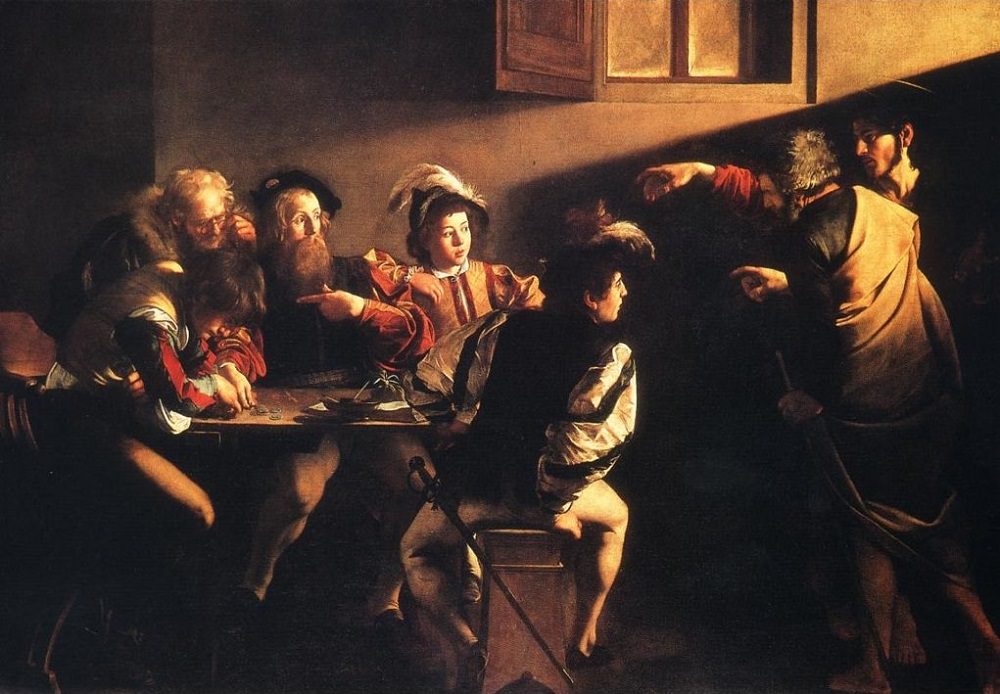
“The Calling of St. Matthew” by Caravaggio. From Google.
Dearest Jesus: I have been imagining in prayer of myself being Levi the tax collector sitting at his post.
It must be so lonely being like him, rich but deep inside longing for something deeper and meaningful than money and wealth. He had been thinking of making a “lifestyle shift” but he felt hopeless with nobody to help him.
Like in the first reading, your invitation Lord through the Prophet Isaiah seem to be too good to be true that anyone like Levi – or me – could make a big difference in life by “giving food to someone hungrier, abandoning my own comfort to care for someone afflicted, substituting a kind word for a malicious gossip, and worshipping you than pursuing my own interests”(Is.58:10,13).
I felt like Levi – there in his little customs post – that is impossible because everything is hopeless and there is no chance to change. Everything is doomed, especially for me, a sinner, Lord.
Then, suddenly you came, saying, “Follow me” (Lk.5:27).
How I love looking back, Lord, to those dark days when you suddenly came calling me to follow you!
It was so simple.
Like Levi, I just stood and followed you and everything changed in my life!
That was so nice of you, Lord Jesus, to take such a bold step of coming to Levi’s post to call him and, me. It was – and still is – a gamble on your part to call us sinners to follow you. And since then, you have never stopped calling us sinners Lord Jesus to follow you, even on our darkest and lowest days and hours, Lord, when everything seemed to be so doomed.
As we prepare for the first Sunday of Lent, remind me, O Lord, that this holy season is not all that drab and dry. After all, Lent originally means “springtime”, the coming joy of Easter which happens every time we turn our hearts to you like Levi. Amen.














 lordmychef.com