Lord My Chef Daily Recipe by Fr. Nicanor F. Lalog II
Thursday in the Fifth Week of Easter, 07 May 2026
Acts 15:7-21     ><)))*> + ><)))*> + ><)))*>     John 15:9-11
Photo by author, Anvaya Cove, Bataan, May 2023.
Let me abide in you,
Jesus,
our true vine;
let me abide in you,
so that my joy
may be complete
in you,
Jesus.
More than mere
happiness when our lips
express our good feelings,
joy comes from the heart,
deep down there where
we feel wholeness,
security,
contentment,
and assurance of
being one in you,
Jesus,
our way,
our truth,
our life.
Joy is fulfillment
in you, Jesus,
in standing by your truth,
bearing all pains of
being misunderstood,
of fighting for what is
right and just,
most of all,
of simply loving
beyond measure
by seeing you on the
face of those different
from us like during
the Council of Jerusalem
in the first reading.
Today,
we debate a lot,
Jesus, without even
facing each other,
throwing insults,
invectives and
threats in social media;
true discussions result
in joy, unity and
magnanimity,
not anger
and animosity;
grant us the grace
to seek you, Jesus,
in our discussions of
everything that are often
centered on our own
selfish interests;
make us open to others
and to you, Jesus,
so that our joy
may be complete
in you by adhering
to your gospel of life
and love.
Amen.
Lord My Chef Sunday Recipe for the Soul by Fr. Nicanor F. Lalog II
Feast of the Sto. Niño, Cycle A, 18 January 2026
Isaiah 9:1-6 ><]]]]'> Ephesians 1:3-6, 15-18 ><]]]]'> Matthew 18:1-5, 10
On this Second Sunday in Ordinary Time, we extend for a day our Christmas celebration with the Feast of Sto. Niño (Child Jesus), a special feast granted to us by Rome in honor of the crucial role in our evangelization by that image gifted by Magellan to Queen Juana of Cebu over 500 years ago.
As Nick Joaquin claimed in many of his writings, it was the Sto. Niño who actually conquered our country to become the only Christian nation in this part of the world which shows indeed as Christ had declared in today’s gospel that whoever humbles himself like a child is the greatest in the kingdom of heaven.
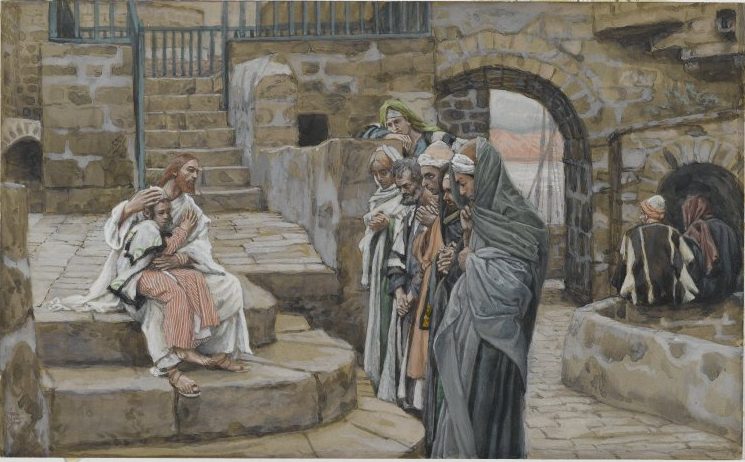
At that time the disciples approached Jesus and said, “Who is the greatest in the kingdom of heaven?” He called a child over, placed it in their midst and said, “Amen, I say to you, unless you turn and become like children, you will not enter the kingdom of heaven. Whoever humbles himself like this child is the greatest in the kingdom of heaven. And whoever receives one child such as this in my name receives me” (Matthew 18:1-5).
“Jesus and the Little Child” painting by James Tissot between 1886-1894 now at Broolyn Museum; from wikimedia.org.
One of the things I cherish in my hospital ministry since 2021 is visiting new born babies: now I know why there are called a “bundle of joy” and always a sight to behold for me whenever I see them yawning and stretching then curling their little hands and arms when I sprinkle them with Holy Water.
Babies and children have something so uniquely in them that elicit joy in everyone even the most hardened criminals. They are so lovely because they speak to us of the beauty of life, of the joy of living, of the bright future still coming for us all. That is why experts are worried anywhere there is a falling or zero birth rate because that paints a bleak future of all kinds of problems and disaster to any nation or society so evident these days among developed countries that lack younger generation to care for their elderly and workforce to run their economy.
The sight of every child and baby is always a celebration of life, most specially in the arrival of Jesus Christ, the eternal Word in time and space over 2000 years ago. This Sunday, Jesus is inviting us to remember that scene at the first Christmas when he was born, to see him in every child like that one he had called in the midst of his apostles with flesh, bones, and blood pitched among us.
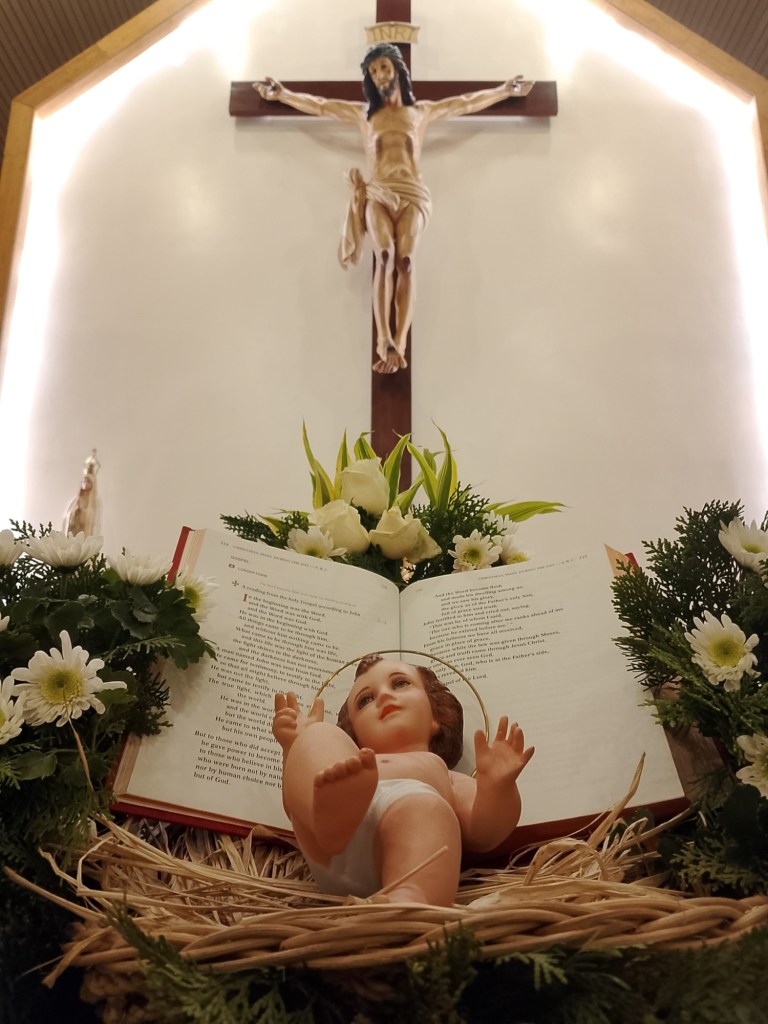
Photo by Mr. Darwin Arcilla, Chapel of the Angel of Peace, RISE Tower, OLFU-Valenzuela, Christmas 2025.
Here is the Son of God so intimate with our own lives including all its mess especially sickness and death itself.
Here is the Child Jesus we fondly call Sto. Niño who came to be born among us because he loves us so much.
Here are the children of the world, the greatest among us because they assure us of continuity in the future.
Looking at the Child Jesus and the child he had called in the midst of the apostles, we are challenged today to feel and realize what is to be with a baby or a child as another person with breath, body and a purpose yet to unfold throughout his/her life. Being like a child is the greatest of all because that is when we are fully human, entrusting everything to God. Que sera, sera!
It is said that in ancient Egypt, people cried aloud whenever a baby was born because of the sufferings every newborn is due to undergo in life. So true! In fact, my earliest lesson about life came through an illustration in a Reader’s Digest magazine of a newly delivered baby crying while being held by a doctor in the OR. I asked my mother why the baby was crying and she told me that when a child is born and cries, then it is alive; if a baby does not cry at birth, it could be dead that is why the doctor has to spank to make him/her cry. That lesson had remained until now with me as a priest – that life is difficult and growing up is always painful.
And how ironic as in the gospel today that Jesus directs us to becoming like children to fully grasp these realities. It is not only Jesus but also the little children who enlighten our unclear minds with such great light that “shone in darkness” (first reading) because of their simplicity. We adults tend to complicate things by overthinking while children remind us of all the beautiful possibilities in life despite the mess and chaos we are into.
Photo by author, 2022.
It is this simplicity of children that also disarm us of our false securities and pretensions when they playfully smile and laugh at us as they simply live in the present moment enjoying our company. In their fragility and vulnerability is their strength making us so concerned with them that we can’t stand leaving a baby or a child alone especially when he/she is crying, when in need.
There lies the good news of the Sto. Niño and of being like a child: he calls us to stay because Jesus too like children remain with us. There is no turning back for Jesus and for every child here today.
Jesus is here along with every child that is why we too are here gathered today to receive them and to ensure every life is safely protected and lovingly cared. It is in our staying, in our remaining we become child-like as we realize the tremendous blessings God has bestowed on us as his children (second reading) called to grow and mature in Christ by making him felt and known in this world that has slowly become so unwelcoming of babies and of God.
Notice how with the growth of what St. John Paul II called as “culture of death” promoting artificial contraceptives and abortion to control population growth, there is the corresponding turning away of people from God and eventually from one another. In this age of “Do-It-Yourself” Christianity, deciding on the number of kids to raise depend more on the couple’s financial capabilities than faith in God’s grace and power so that couples and people in general have unconsciously considered babies more as things to have than persons to love.
We end our reflection on this Feast of Sto. Niño with this Christmas song we have always taken for granted, “Joy to the World”. Written in 1719 by the English minister Isaac Watts, “Joy to the World” expresses the very joy not only of Christ’s coming but also of the birth of every child who reminds us of God among us in Jesus and of the need for us adults to be one with God always.
Photo by author, Sto. Niño Exhibit at the Malolos Cathedral, January 2022.
Joy to the world,
the Lord is come
Let Earth receive her King
Let very heart prepare him room
And heaven and nature sing
And heaven and nature sing
And heaven and nature sing.

Joy to the world,
the Savior reigns
Let men their songs employ
While fields and floods,
rocks, hills and plains
Repeat the sounding joy
Repeat the sounding joy
Repeat the sounding joy

He rules the world
with truth and grace
And makes the nations prove
The glories of his righteousness
And wonders of his love
And wonders of his love
And wonders of his love
For heaven and nature to sing anew of this joy, we have to be like the children welcoming Jesus in our hearts without any ifs and buts.
For us to repeat the sounding joy in life, we have to be like children in trustingly following Jesus in his Cross; notice how the gospels are silent about children calling for the crucifixion of Jesus. Only the adults demanded his death!
Finally, for us to experience the wonders of God’s love, we have to become like children who let truth and grace be the rules in life, not lies and powers. That is the greatness of being like a child – of trusting more in God than in man and his sciences and technologies, ideologies and philosophies that all fall short in bringing true joy and fulfillment in life. Amen. A blessed week ahead of everyone!
Lord My Chef Sunday Recipe for the Soul by Fr. Nicanor F. Lalog II
Third Sunday in Advent-A (Gaudete Sunday), 14 December 2025
Isaiah 35:1-6, 10 ><}}}}*> James 5:7-10 ><}}}}*> Matthew 11:2-11
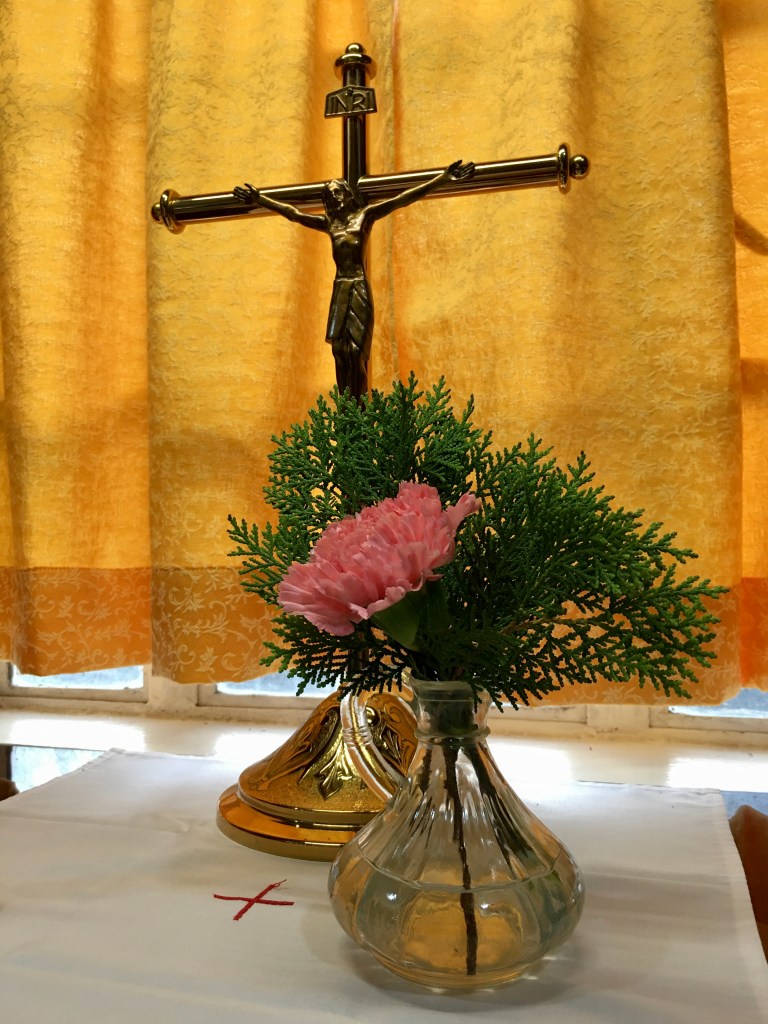
Photo by author, December 2019.
Our churches are bursting in hues of pink this Third Sunday of Advent rejoicing not only in the fast approaching Christmas but most especially in the Lord’s Second Coming already happening in our midst.
Like John the Baptist in today’s gospel who was imprisoned at the time, we could feel in our own waiting for Jesus his saving presence in the many good things happening within us and around us.
When John the Baptist heard in prison of the works of the Christ, he sent his disciples to Jesus with the question, “Are you the one who is to come, or should we look for another?” Jesus said to them in reply, “Go and tell John what you hear and see: the blind regain their sight, the lame walk, lepers are cleansed, the deaf hear, the dead are raised, and the poor have the good news proclaimed to them” (Matthew 11:2-5).
Remember our reflection last Sunday of John’s preaching in the desert of Jordan signifying our own desert where amid the dryness and emptiness Jesus comes to us, Jesus is most present with us and in us. That is because more than an imagery of nothingness and death, the desert signifies too our intimacy with God. Many times in life, God brings us or allows us to get lost in our own desert to experience his intimacy with us, his immense love for us because when we are sufficient and strong, we rarely feel him nor even desire him. But, when we are like in a desert with nothing, that is when we long for God, and most especially feel him present.
That is why every prophet in the Bible including our Lord Jesus Christ frequented the desert and wilderness to show their intimacy and communion with God. The desert is thus transformed into a greenery filled with life like what Isaiah prophesied in the first reading today:
The desert and the parched land will exult; the steppe will rejoice and bloom. They will bloom with abundant flowers, and rejoice with joyful song. The glory of Lebanon will be given them, the splendor of Carmel and Sharon; they will see the glory of the Lord, the splendor of our God… Then will the eyes of the blind be opened, the ears of the deaf be cleared; then will the lame leap like a stag, then the tongue of the dumb will sing (Isaiah 35:1-2, 5-6).
See now the transformations found in our readings: in the last two Sundays we heard Isaiah speaking of the dried and barren desert but today he spoke of its transformation into a lush and verdant stretch of land; in the gospel we find John still in the desert, firm and unchanging in his preaching though his situation had changed a lot.
Last Sunday John was freely proclaiming the coming of the Christ in the desert as he sternly warned the Pharisees and Sadducees of their judgment; this Sunday, John was still in the desert but imprisoned awaiting death when he reproached King Herod in taking his brother Philip’s wife Herodias. But despite that clear danger daily hanging on his head, John was not disturbed at all as he patiently awaited the coming of the Messiah that he sent emissaries to Jesus to ask if he is already the Christ.
Here we find something so human in John the Baptist, so much like us when we sort of doubt ourselves not because we lack faith but simply we just want to be sure of what we are hearing, what we have seen, of what God is really doing.
Photo by author, December 2021.
Let it be clear: like John, most often we doubt ourselves not really God when things happen not according to our plans or expectations. Inasmuch as life is a mystery, God is more mysterious! Most of the time, we cannot understand his ways because he moves so differently, even unpredictably from what we know and expect.
Perhaps, John had a different scenario in his mind about the arrival of the Messiah like in the Old Testament tradition of judgment day, of action-packed events punishing evil people. Recall how called the Pharisees and Sadducees “You brood of vipers…Even now the ax lies at the root of the trees. Therefore every tree that does not bear good fruit will be cut down and thrown into the fire (Mt.3:10).
But something totally different was happening at that time as he heard while in prison – many people and their lives were being transformed. John realized something deeper than expected was going on in Judea and Galilee. And when his emissaries relayed to him the reply of Jesus, John realized that indeed the Christ he was proclaiming had arrived in Jesus. As a prophet well-versed with the scriptures, John found Jesus as the fulfillment of the prophecy by Isaiah when the blind can see, the lame can walk, dead are raised and the good news proclaimed to the poor.
It must have been a Nunc Dimittis experience of Simeon for John that soon enough, he died a martyr ahead of his Lord and Master Jesus Christ. John indeed prepared the way of the Lord in his birth and in his death, showing us the importance of patience in awaiting Christ and in experiencing the joy in his coming.
Be patient, brothers and sisters, until the coming of the Lord. See how the farmer waits for the precious fruit of the earth, being patient with it until it receives the early an the late rains. You too must be patient. Make your hearts firm, because the coming of the Lord is at hand (James 5:7-8).
Photo by author, December 2020
Before the COVID pandemic, my brother and I used to rest at Camp John Hay in Baguio where he would buy in one of the shops there a line of local and organic perfumes. His favorite scent was called “Patience” but one time when we went there, it had ran out of stock that he said wryly, “maski ba naman pabango na patience, wala na rin?”
So true! Patience seems to have been almost extinct in this age of instants. Nobody wants to be patient anymore especially if one can have almost everything instantly. Even during the time of the early church, people have been impatient in life that St. James wrote them on the importance of patience in our journey of faith, in awaiting the Lord’s return.
From the Latin word patior that means to suffer, patience is a kind of suffering, of bearing the pain of waiting especially over a long period of time that we doubt if it is still worth the waiting at all. But we fail to “see” or realize as St. James pointed out like the farmer that waiting is never passive nor empty; there is always something wonderful happening that we do not see like the germination, growth and blooming of crops and plants. The more patient we are, the more suffering in waiting, the greater always the joy that comes when our waiting is finally fulfilled!
Advent teaches us this third Sunday that we need to be patient for waiting itself is a holy ground where we experience God’s coming and intimacy. Though patience tests our limits, it transforms us too!
Think of the stalactites and stalagmites in caves formed millions of years by drops of water. Or the great natural wonders of earth that took thousands of years of formation, transformation. Most of all, our very selves. Who we are and what we are today are long years of patient efforts to be healthy or successful or simply be alive. And that’s a great reason to rejoice.
Photo by author, December 2020.
Patience is so difficult to practice like in our daily experiences of horrendous traffic everywhere but with patience, we arrive at our destination. Patience transforms us into better persons and disciples of Jesus, enabling us to rejoice no matter what is the situation we are into. It is in the midst of sufferings and waiting, of patience and impatience that Jesus calls us to experience his silent and steady presence resting upon us like the rains every farmer is so familiar with. Our joy is doubled, becoming a rejoicing when we practice patience in our endeavors, in life itself.
Let me end this reflection with a quotation I memorized as a child on the wall of our former family dentist’s office in Meycauayan, Bulacan that said:
Time is fast for people who rush;
time is slow for people who wait;
time is not for people who love.
The most loving persons are also the most patient ones. Always. And first among them is Jesus Christ who patiently awaits us to return to him so we can experience his joy. Amen. Have a joyful week ahead!
Lord My Chef Daily Recipe for the Soul by Fr. Nicanor F. Lalog II
Monday, Solemnity of the Immaculate Conception, 08 December 2025
Genesis 3:9-15, 20 ><}}}}*> Ephesians 1:3-6, 11-12 ><}}}}*> Luke 1:26-38
“Cestello Annunciation” by Botticelli painted in 1490; from en.wikipedia.org.
We praise and thank God today on this Solemnity of the Immaculate Conception of Mary that formally kicked off the process of the fulfillment of his promised salvation in Jesus born by the Virgin Mother.
According to our official Church teaching called dogma, Mary was conceived by her mother St. Anne without any stain of original sin through the merits of Jesus Christ our Savior. Mary has to be pure and clean because she would bear the Son of God who is perfect and spotless.
God chose Mary to be the Mother of Jesus not because of her having any special traits but purely out of God’s goodness “who has blessed us in Christ with every spiritual blessing in the heavens” (Eph.1:3).
Hence, this feast reminds us too to imitate the Blessed Virgin in saying “yes” to God’s invitation to cooperate in his wonderful plans of bringing Jesus into this world so darkened by sin that has left us broken and fragmented from each other. Rejoice, therefore, because everyday, God sends us his angel to greet us with “Hail, full of grace! The Lord is with you” (Lk.1:26), inviting us into an intimacy with him like Mary.
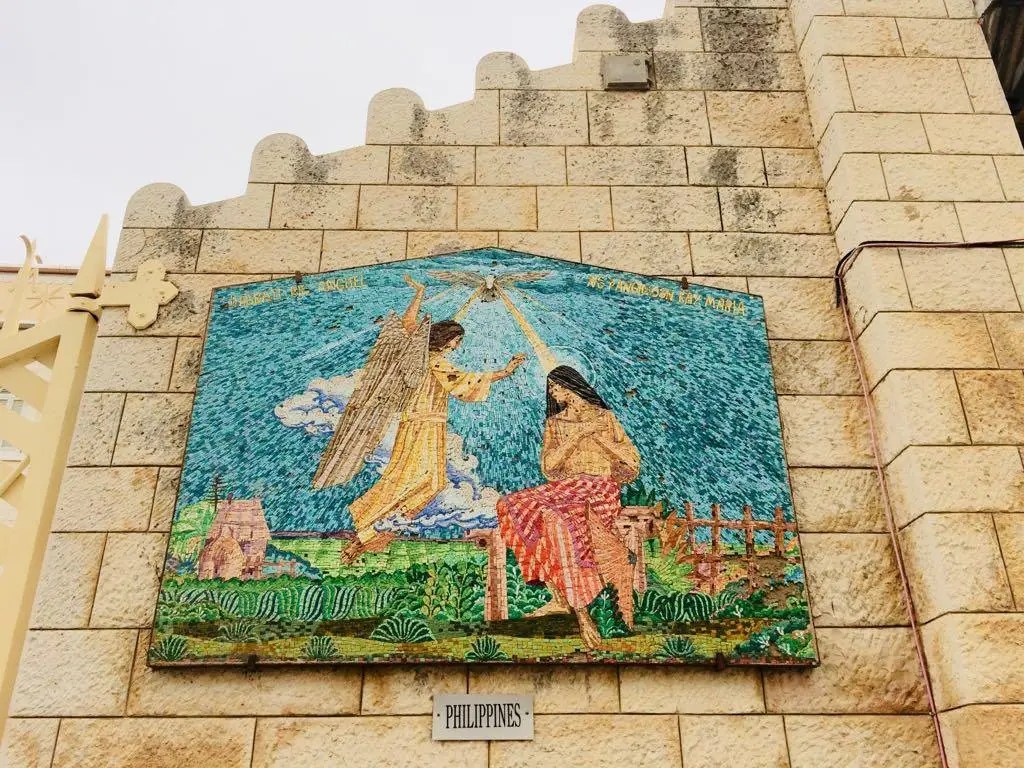
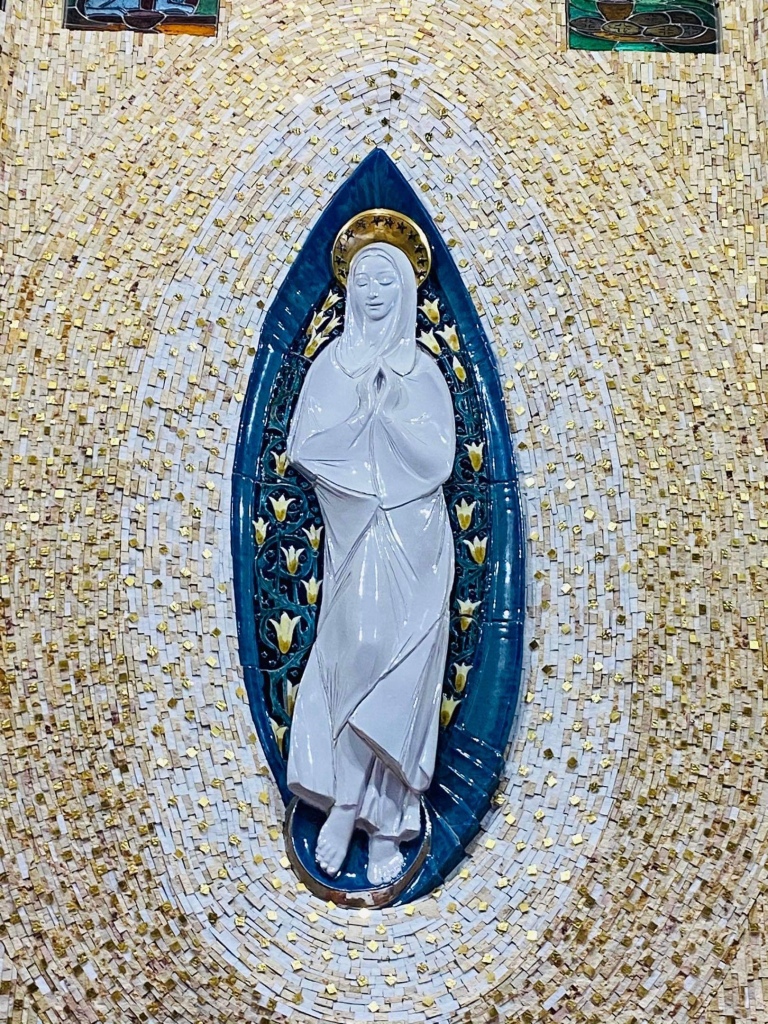
Photo by author, left side of the facade of the Basilica of the Annunciation in Nazareth, Holy Land, May 2019.
Intimacy is more than being close with another; it is an expression of love that is willing to sacrifice, to suffer and get hurt for the sake of the beloved.
God was the first to express his intimacy with us not just by expressing his immense love for us in words by the prophets in the Old Testament but by sending us his Son Jesus Christ who became human like us in everything except sin. Actually, God does not need to become human like us to save us but he chose to be one of us because he loves us so much. As an expression of his intimacy and solidarity with us, Jesus suffered and died on the Cross while going through every pain and hurt we go through in life like grief and sadness in losing a friend, betrayal by a friend, abandonment by friends, no to mention being terrified, going hungry and thirsty. Jesus became like us so that we may become like God – intimately loving him through others.
Actually, God does not need us but he chose to love us, to be with us, to be intimate with us because he loves us so much. God remains God even without us. When we do not pray, when we do not go to Mass on Sundays, when we are bad and not good, God is still God. It is us humans who are lessened when we turn away from from God.
That’s the intimacy of God with us.
How about us, are we willing to be intimate with God in Jesus Christ?
Sadly, many people “create” and “force” intimacy which is a grace, a gift of God freely given to everyone. Like friendship, we cannot force intimacy into someone not meant to be. And like friendship too, intimacy begins in Christ, blooms in Christ.
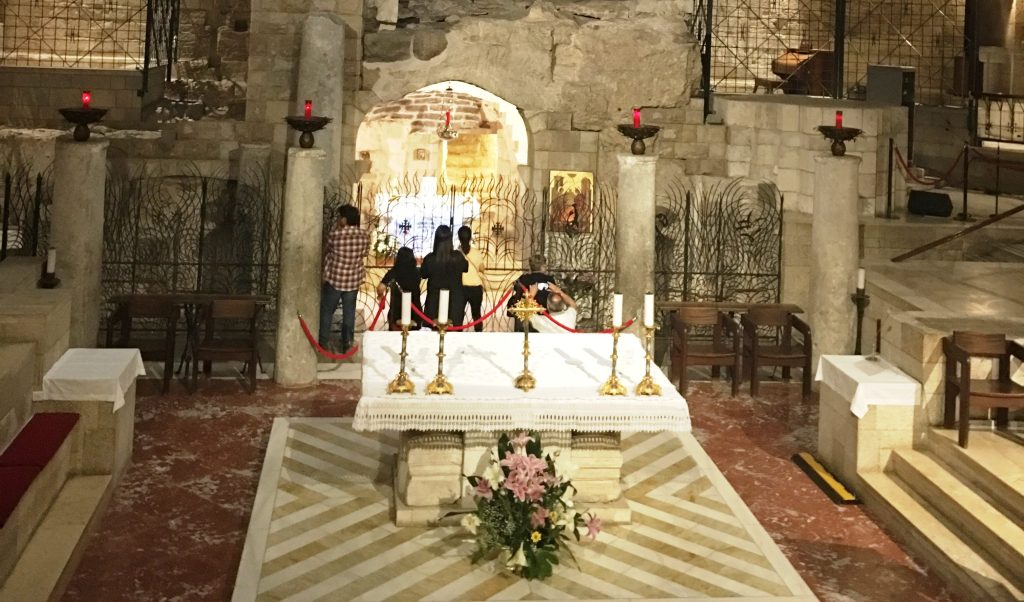
Photo by author, chapel beneath the Basilica of the Annunciation in Nazareth; see those pilgrims praying behind iron grills at the back of the sanctuary which is the site where the Angel announced to Mary the birth of Jesus Christ.
Underneath the Basilica of the Annunciation in Nazareth is a chapel near the very site where the angel is believed to have appeared to Mary to announce the coming of the Savior. At the back of the sanctuary of this chapel is that holy site of the Annunciation enclosed by iron grills with an altar table at the center with the declaration in Latin, Verbum Caro Hic Factum Est (The Word became flesh here).
Mary’s intimacy with God began long before the Annunciation to her by the Angel cultivated in her prayer life. Every time I pray this scene of the Annunciation, I always imagine Mary deeply absorbed in prayer. Most likely, she must be praying about her coming wedding to Joseph. Luke and Matthew were both consistent about their status as being “betrothed to each other” when God announced through the Angel the birth of the Christ.
Photo by author, close up of the Annunciation site beneath the Basilica of the Annunciation in Nazareth; written on the altar table that says in Latin, “The Word became flesh here.”
Imagine the excitement and joy of two faithful Jews getting married soon when suddenly the Angel appeared to them on separate occasions and diverse situations to announce God’s plan of sending his own Son Jesus Christ for the salvation of the world?
It must have been most painful to both Mary and Joseph but as being truly faithful and loving of God, they both agreed to the Divine plan! And that is the great sign of their immense love for God – eventually for each other. Moreover, in saying yes to God, both Mary and Joseph showed the kind of intimacy they have with the Divine.
Let us focus on the intimacy of Mary with God on this Solemnity of the Immaculate Conception found in our gospel account of the Annunciation.
Photo by Rev. Fr. Gerry Pascual of Iba, Zambales at Santuario di Greccio, Rieti, Italy in 2019.
Then the angel said to her, “Do not be afraid, Mary, for you ahve found favor with God. Behold, you will conceive in your womb and bear a son, and you shall name him Jesus (Luke 1:30-31).
Notice that in many scenes and prayers about the Blessed Virgin Mary, we find the prominence of her “womb” like here in the Annunciation and when Elizabeth praised her during her Visitation as “blessed is the fruit of your womb” (Lk.1:42).
In Hebrew, the word for womb is “racham, rachamin” which is their word too for “mercy” because for them, God’s mercy comes from his innermost being. Hence, whenever the Jews speak of mercy of God, they point their fingers downward into the womb or uterus and moves it upward to the heart to indicate the flow of mercy of God from his innermost being expressed in love which is he’s very being and core.
This is the reason the Church Fathers translated mercy into “misericordia” from the Latin verb to move or to stir – “misereor” – and word for heart “cor” that literally means “to move or to stir one’s heart”. It is more than a feeling like compassion; mercy is deeper as it encompasses one’s being leading to intimacy that is a communion or oneness with others which is also intimacy.
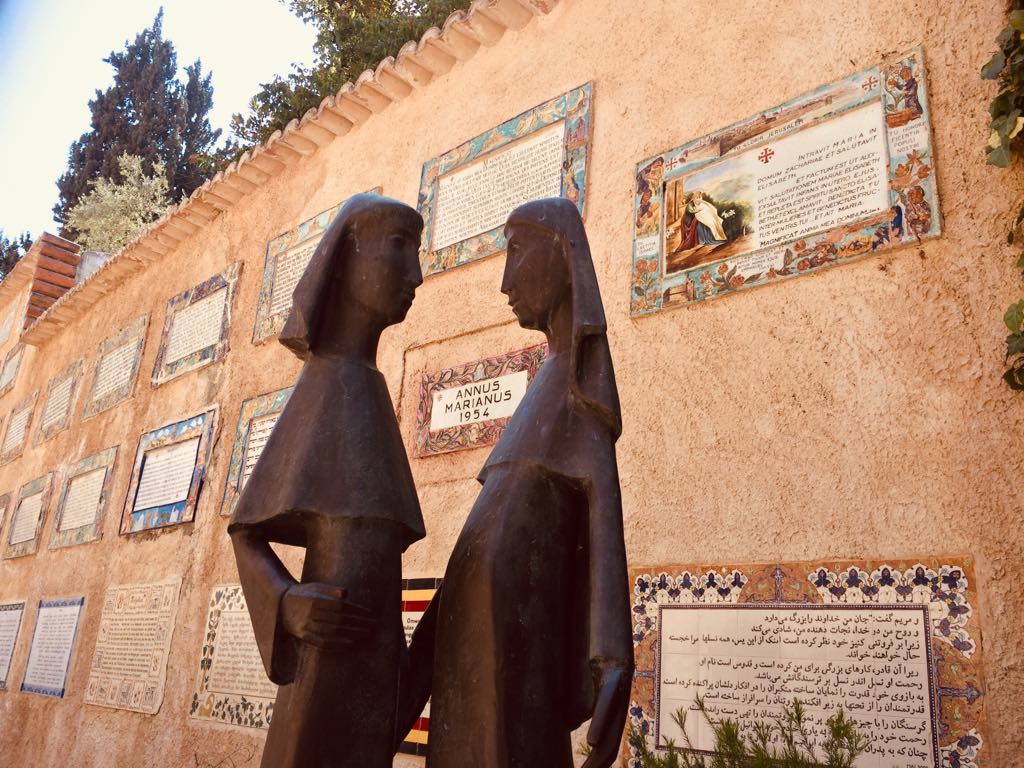
Photo by author, Church of the Visitation, Ein-Karem, Israel, May 2017.
Where there is love, there is always intimacy with the lover willing to bear all pains and hurts for the beloved. And vice versa. Like Jesus. Then Mary who was willing to sacrifice her wedding and marriage to Joseph by being the Mother of the Son of God.
But why? Because we have experienced too that true joy comes only when there is giving of self, when there is willingness to let go and suffer. At the Last Supper, Jesus described joy as like a mother in the pangs of childbirth when she goes through a lot of pains and worries and fears almost like dying but once the baby is delivered, joy happens because she had brought forth a new life into the world.
True joy is having the firm belief that no matter what happens even in the worst scenarios, God would never leave nor forsake us. Joy happens when we find new life, new directions because there is another person willing to remain with us, assuring us we are never alone. That again is intimacy when you feel not alone especially in the most trying times.
Without intimacy with God and another person, there can be no true joy because no one would dare to take risks in this life like mothers. This is what modern women are missing when they see childbearing more as a chore or a burden or a suffering they can always avoid than self-giving borne out of love which happens in the context of an intimacy. No wonder too that sex has been so trivialized, reduced to an activity and act instead of as a gift of self because there is no more responsibility and intimacy. We cannot have lasting and meaningful relationships without intimacy.
Photo by author, 2021.
On this Solemnity of the Immaculate Conception, we are reminded of God’s mercy and intimacy with us, of his loving relationship with us that continues in Christ Jesus with Mary.
Let us nurture this beautiful relationship with God that flows and bears fruit in our relationships with one another.
Like Mary, may we finally say yes to God into an intimate relationship with him through our selflessness. Like Mary, we are blessed and full of grace. The joy awaiting far outweighs the pains and sufferings we shall go through in our gift of self in our relationships. Have no fear for Jesus had suffered first before us so that we can love and be intimate like him. Amen. Have a blessed week.
Lord My Chef Daily Recipe for the Soul by Fr. Nicanor F. Lalog II
Friday in the Sixth Week of Easter, 30 May 2025
Acts 18:9-18     <*((((><  +  ><))))*>     John 16:20-23
Photo by author, Cabo da Roca, Pundaquit, San Antonio, Zambales, 14 May 2025.
In a few days you are
going to "leave" us, Jesus;
this Sunday is your Ascension,
your physical departure from us
and you described so well our situation:
Jesus said to his disciples: “Amen, amen, I say to you, you will weep and mourn, while the world rejoices; you will grieve, but your grief will become joy. When a woman is in labor, as she is in anguish because her hour has arrived; but when she has given birth to a child, she no longer remembers the pain because of her joy that a child has been born into the world. So you also are now in anguish. But I will see you again, and your hearts will rejoice, and no one will take your joy away from you. On that day you will not question me about anything. Amen, amen, I say to you, whatever you ask the Father in my name he will give you” (John 16:20-23).
What has been "born"
in me in your Rising from the dead?
What is that joy like a woman
in the pangs of childbirth
suddenly becoming a joy so
incomparable?
Oh, it is that joy of having you
in my heart, Jesus:
I have found joy more in my heart
than outside of me;
your joy is that assurance
you are with me always
no matter what,
as certain as the rising and
the setting of the sun,
as lovely as the blooming of flowers,
soothing like the hush of the wind
or the gushing of water in a river
or the rush of the waves to
the shore.
Keep that joy in my heart,
Jesus that no one can take away;
a joy in my heart that even
if I do not receive the things
I ask in prayer,
I still believe,
I still hope,
I still rejoice
in you.
Sorry, Jesus,
I still question you on anything
despite that joy of knowing you,
 of having you
but many times I wonder
why all the pains and sufferings
with me and those close to me;
there are times,
Lord that I lose my heart
that I could not feel that joy of you
when you don't answer
my prayers.
But,
to still keep on praying
even if it not answered at all
is already pure joy in you,
Jesus!
Like peace,
true joy is so difficult
and elusive when not found
in you, Jesus
that we always have to wait
for you,
feel you,
suffer and cry with you
and sometimes die in you
so that joy shall be
born in us
again
and again
and again.
Amen.
Photo by author, Cabo da Roca, Pundaquit, San Antonio, Zambales, 14 May 2025.
Lord My Chef Daily Recipe for the Soul by Fr. Nicanor F. Lalog II
Thursday in the Fifth Week of Easter, 23 May 2025
Acts 15:7-21     <*((((><  +  ><))))*>     John 15:9-11
Photo by author, Sacred Heart Novitiate, Novaliches, QC, 20 March 2025.
Make my joy complete,
Lord Jesus,
let your joy be in me
(John 15:11)!
True joy comes only
in union with the Father
like you, dear Jesus;
in a world that had shrunk
into one global village
due to modern technology
that has spawned so many forms
and kinds of connections among peoples,
we are not yet filled with joy, Lord;
in fact, the more we have been
separated than ever because
our "connections" are fleeting,
empty of any love at all;
true connections in you,
with you Jesus lead to joy
as we have seen in the experience
of the early Church:
After much debate had taken place, Peter got up and said to the Apostles and the presbyters… “Why, then, are you now putting God to the test by placing on the shoulders of the disciples a yoke that neither our ancestors nor we have been able to bear? On the contrary, we believe that we are saved through the grace of the Lord Jesus, in the same way as they” (Acts 15:7, 10-11).
When we keep your commandments,
then we remain in your love, Jesus;
that's the only basis and most essential
in every connection and relationship
because when there is love even if in
the midst of pain and suffering,
there is always joy which is more
than a feeling but an assurance that
no matter what, there is God always
on our side, loving us, blessing us
as Peter explained in the Council of Jerusalem;
grant us the grace to remain in your love,
Jesus, to examine in what areas of our life
we remain and grow in your love.
Amen.
Photo by author, Chapel of the Angel of Peace, Our Lady of Fatima University, Valenzuela City, 28 March 2025.
The Lord Is My Chef Sunday Recipe for the Soul by Fr. Nicanor F. Lalog II
Third Sunday in Advent (Gaudete Sunday), Cycle C, 15 December 2024
Zephaniah 3:14-18 ><}}}}*> Philippians 4:4-7 ><}}}}*> Luke 3:10-18
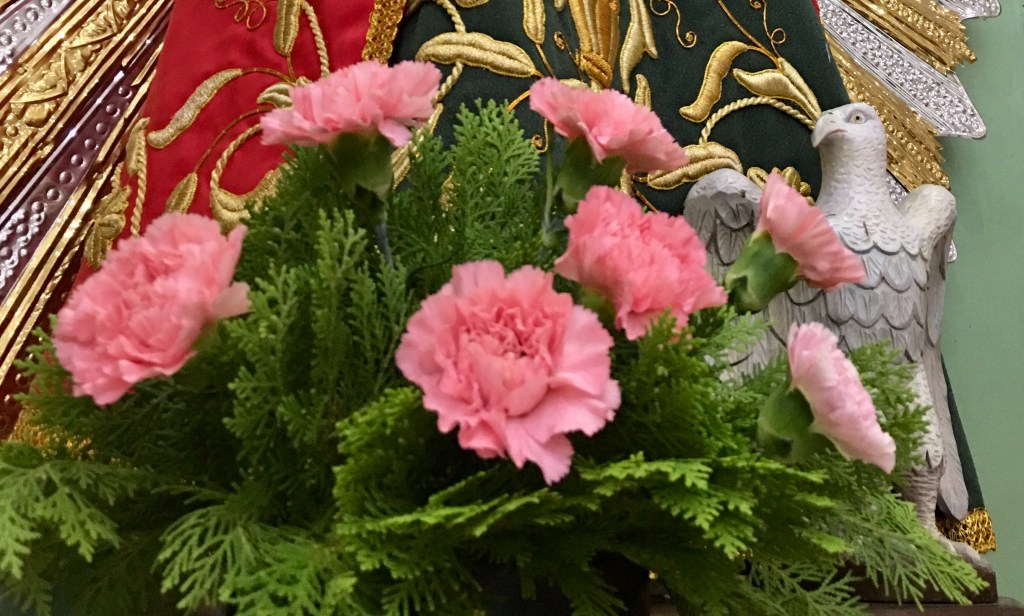
Photo by author, Gaudete Sunday, Advent 2018.
Our altars are bursting in shades of pink this third Sunday in Advent known as Gaudete Sunday from the entrance antiphon in Latin of today’s Mass meaning “Rejoice in the Lord”.
To rejoice means to intensify joy which is a world apart from “happiness” many have mistaken as synonym for joy and rejoicing. Happiness is fleeting and superficial, dependent on the outside “stimulus” that makes us happy while joy comes from within one’s heart.
Joy is that feeling of certainty that no matter what happens to us, God would never forsake us, leading us to serenity and peace. That is why one can still rejoice and be joyful even in pain and sufferings like the elderly, the sick, or those struck with tragedy and failures. We can only rejoice when we have that deep faith in God, filled with hope that even if things get worst, our final salvation is in Jesus Christ who had come, would come again, and continues to come to us.
Photo by author, Advent 2021, BED Chapel, Our Lady of Fatima University, Valenzuela City.
Joy and salvation always come together as expressed by the Prophet Zephaniah in the first reading today which is fulfilled in Jesus Christ who renewed us all in the love of God our Father.
Shout for joy, O daughter Zion! Sing joyfully, O Israel! Be glad and exult with all your heart, O daughter Jerusalem! The Lord has removed the judgment against you, as he turned away your enemies… The Lord, your God, is in your midst, a mighty savior; he will rejoice over you with gladness, and renew you in his love (Zephaniah 3:14-15, 17).
True rejoicing can only happen in Jesus our Savior as St. Paul insisted in our second reading today, “Brothers and sisters: Rejoice in the Lord always. I shall say it again: rejoice!” (Phil. 4:4).
In His sermon on the mount about the beatitudes, Jesus taught us that true blessedness that leads to joy is not in having everything but in being empty and poor for God, being free from the trappings of this material world. Just ask those above 50 years old today: we have less of material things when growing up but we have so much fun so unlike these days of so many gadgets and things when suicides and mental cases are on the rise. People may be happy today but not joyful.
With our Campus Ministry members after our Advent Recollection, 12 December 2024, Chapel of the Angel of Peace, RISE Tower, Our Lady of Fatima University, Valenzuela City.
At His Last Supper as well as after Easter in His appearances to His disciples, Jesus assured us of joy and peace if we remain in Him by keeping His commandments especially the celebration of the Eucharist until He comes again. But, in a recent Christmas party I attended, a parlor game surprised me when the host asked participants to “bring him” the first thing we look for upon waking up when everybody rushed to him bringing their cellphones!
I thought the answer were eye glasses which I first look for upon waking up to check the time. As a result, I made an informal survey when I took the elevator and during our Mass at the university when I asked the students, “what is the first thing you look for upon waking up?”
And, cellphone again was their unanimous answer which I find very alarming. Is the cellphone the new god of our modern time, replacing not only Jesus but even ourselves! It has slowly robbed us of our true joy, often caused many of our sorrows and breakdown of relationships.
We rejoice because of Jesus Christ and in our union in Him, we become one with others in whom we experience joy and rejoicing too.
Photo by Mr. Jim Marpa, 2018.
Now we go to another dimension of joy and rejoicing – its personal and relational aspect. Have you experienced there are times we find it difficult to rejoice with others having fun or enjoying something while on the other hand, we are easily moved to sympathize with anyone crying or feeling api and forlorn even if we do not know them?
Is it not ironic we easily unite with strangers in sadness but not in joy? I think that perhaps, God designed us to sympathize with anyone in pain because there is a thread that connects and binds us together in times of sorrow. It is a lot different with rejoicing which presupposes a relationship, a sort of oneness to experience the others’ joy. Joy is never solitary unlike sadness that is often kept inside by the person. Joy to be really joyful has to be made known. That is why we can easily share in the joy of others when we know them. We turn sarcastic even jealous when we find others we do not know rejoicing simply because we are not part of them nor of their joys.
Photo by author, Gaudete Sunday, Advent 2019.
Rejoicing is not about what we or anyone can do but all about relationships as Luke shows us in his account on John’s baptism at Jordan that is so upbeat that we too could feel the rejoicing of the people in John’s coming and preaching that some of them thought John was the Messiah. The people felt a deep sense of belonging, of relating and knowing that they asked John what they must do to continue rejoicing!
The crowds asked John the Baptist, “What should we do?” Even tax collectors came to be baptized and they said to him, “Teacher, what should we do?” Soldiers also asked him, “And what is it that we should do?” Now the people were filled with expectation, nd all were asking in their hearts whether John might be the Christ… Exhorting them in many other ways, he preached good news to the people (Luke 3:10, 12, 14, 15, 18).
In telling us how John answered the queries of the people on what they must do to experience the coming of the Messiah, Luke teaches us that God is not asking great things from us but only simple acts of charity and mercy for one another like being kind and loving because we are already related in Him in the first place. Hence, we all can rejoice in Christ!
Here is our common misconception that if we do what is good and right, then we shall be filled with joy. Wrong. We are already filled with joy and we just have to intensify that into rejoicing because we are already God’s beloved children in baptism. When we live out our status as beloved children of God in Christ, everything follows.
Don’t you feel rejoicing just before communion, praying, “Lord, I am not worthy to receive you under my roof but only say the word and I shall be healed”?
Imagine that immense love of God in Christ for us when nobody among us even the priest officiating the Mass is worthy to receive Jesus and yet, He came and made it a reality because He loves us so much! All we have to do is be sorry for our sins, reform our lives, apologize to those we have wronged, forgive those who have sinned against us… it is God who does everything for us in Jesus Christ. We do only so little but sadly, we could not even do the little things so well like coming on time for the Mass every Sunday, much less be silent to pray and listen to Jesus coming to us in Holy Communion because we are so busy conversing with those beside us or checking our cellphones.
This third Sunday in Advent, Jesus invites us to imitate John the Baptist His precursor who “preached good news to the people” with his warm and joyful presence. Spread the joy of Jesus by being kind and warm to others especially those in pain, those alone, those who are lost. After all, we are all one in Christ who is our joy and salvation. Amen.
The Lord Is My Chef Daily Recipe for the Soul by Fr. Nicanor F. Lalog II
Wednesday in the Twenty-eighth Week of Ordinary Time Year II, 16 October 2024
Galatians 5:18-25     ><))))*> + ><))))*> + ><))))*>     Luke 11:42-46
Photo by author, Fatima Ave., Valenzuela City, 25 July 2024.
Lead and guide us,
O Most Holy Spirit;
set us free from "the works
of the flesh: immorality,
impurity, licentiousness,
idolatry, sorcery, hatreds,
rivalry, jealousy, outbursts of fury,
acts of selfishness, dissensions,
factions" (Galatians 5:19-20);
cleanse our nation now facing
the realities of the truth of what we
have long suspected of filth and evil
that have shrouded the past
administration's drug war;
so many lives were lost
and destroyed not only by
the deaths but all the lies
that were glorified;
be the courage and strength,
O Holy Spirit, of those finally
given the chance to stand for what is true
so that never again such reign of
darkness and terror be repeated.
Woe to us
and everyone who continue
to overlook the good of others!

Let your Spirit, dear Jesus,
bear fruit in us with "love, joy,
peace, patience, kindness, generosity,
faithfulness, gentleness, self-control"
(Galatians 5:22-23); fills us with your
Spirit today, Jesus, so we may be
more loving, thinking always of the
good of others above all.
Amen.
Photo by author, Fatima Ave., Valenzuela City, 25 July 2024.
The Lord Is My Chef Daily Recipe for the Soul by Fr. Nicanor F. Lalog II
Thursday in the Twenty-fourth Week of Ordinary Time, Year II, 19 September 2024
1 Corinthians 15:1-11     ><))))*>  +  <*((((><     Luke 7:36-50
Photo by author, St. Scholastica Spirtuality Center, Tagaytay City, 21 August 2024.
Praise and glory
to you, God our loving Father!
Thank you for your unending
gifts of grace for us
despite our many sins
and our being undeserving.

Truly like St. Paul,
we too feel so small,
"the least" for our so many sins
yet you never denied us with
that immense grace of
mercy and forgiveness,
redemption and new life in
Christ Jesus our Lord
that we so often forget.

Let us affirm
and be grateful
by cultivating this great grace
you have given us in Jesus
be who we are in your sight,
never making your grace "ineffective"
like the Pharisees in today's gospel
who could not stand
the sight of Jesus
interacting with a sinful woman,
of Jesus speaking to a sinner,
of Jesus forgiving so great a sin.
May we keep in our
heart and mind your tremendous
gift of grace to be near you,
to be like you,
to be filled with you
by living out your grace
in grateful witnessing
of loving and joyful service
to others.
Help us remember
that like in the Annunciation
to Mary, rejoicing and grace
are always together:
from the Greek words
charis for grace and
chara for rejoicing,
rejoicing and joy
are clearest signs of
grace anywhere
like that woman
who washed
and anointed
the Lord's feet.
Amen.
I have reflected last Sunday that Pentecost is not just an event in the past but a daily coming of the Holy Spirit upon us, enlightening us of so many things in life we used to take for granted. Like the value of every person, especially when there is a death of a loved one.
In fact, death is a Pentecost when the Holy Spirit comes to remind us that we never – and can never – replace our departed loved ones. Every person is irreplaceable, especially family members. The sooner we realize this, the better for us to avoid those guilty feelings later that we should have been more loving and kind, that we should have said “I love you” more often because we never know for how long we can be with our loved ones. One thing is for sure: we do not replace our deceased loved ones but simply re-member them.
Photo by author, Bgy. Kaysuyo, Alfonso, Cavite, 27 April 2024.
The word “remember” is very interesting.
It is from the root word “member” or “part”. When we put the prefix “re” which means “again”, “remember” means to make a part again of the present moment.
Every time we remember a person or an event, we make them part of our present moment. And they are most real, most present when our re-membering happens in the context of a family or a community. Re-membering someone by one’s self surely does happen a lot but very often, it is more of looking back to the past, recalling the days we used to be together. But when we remember somebody as a family or a community, the one we remember is indeed re-membered in our present, becomes real in everyone around celebrating his/her memory. Something concrete happens and the joy is more intense, leading to freedom from past, from pains and hurts of losing a loved one.
That is when death becomes a Pentecost. When the Holy Spirit came down upon the Apostles and the Blessed Virgin Mary in Jerusalem 50 days after Easter, the Third Person of the Blessed Trinity did not come to replace Jesus. The Holy Spirit is a distinct Person of the Trinity in whose power all the followers and believers of Christ have been empowered to make Him present until now in our collective re-membering of Him in the Church and the Sacraments. In the Holy Spirit who comes to us daily, we overcome and transcend every death we go through in life, enabling us to re-member our departed loved ones by being a member of those left behind.
Photo by author, Sacred Heart Novitiate, Novaliches, QC, 18 March 2024.
Since mommy’s death, I have gone home thrice already. How I loved to walk inside her room, trying so hard to get those feelings or vibes when she was still alive I miserably miss most as the days moved on.
One thing I have noticed, though, is that strange feeling of our home suddenly so empty as in “kakalog-kalog” as we say in Tagalog. Mommy ko lang nawala sa amin pero parang nawala ang lahat sa bahay?
Now I know better why the mother is the light of the family or “ilaw ng tahanan” because after she had died, her light in our home was turned off that seemed to have made our home so dark, so light and hollowed. However, when we gathered as siblings together with our nieces and nephew and relatives, the warmth of our home returns as if mommy is with us , still with us.
That is when the Holy Spirit comes amid the darkness of every death. A Pentecost when we are reminded of those still with us who must band closer together to make our departed more present in our collective re-membering. No wonder, it was also the final instruction of Jesus to His disciples at their Last Supper when He told them as He gave them the chalice to “Do this in memory of me” or “in remembrance of me”. In Greek, it is called anamnesis which is more than remembering or recalling but making present, making a reality.
Photo by author, Sacred Heart Novitiate, Novaliches, QC, 20 March 2024.
And the reality is this – every person is valuable beyond measure.
So fragile too! Because we can easily lose them in a snap.
We realize and feel this most true in death when we experience deeply “someone like me” whom I love, whom I care for is gone because in every death of a beloved, a part of us dies too. Even if he/she is an enemy or somebody we are not in good terms with, we feel a loss within because for better or worst, the deceased made us feel our humanity.
It is said that “one life is too many.” Very true. Today God gives us the gift and power to re-member those not with us by connecting with those still living with us. Make that connection now and soon you too shall see the face we sorely miss together. Have a blessed remaining half-week!