The Holy Rosary for Conversion & Peace

Lord My Chef Daily Recipe for the Soul, 07 October 2025
Tuesday, Memorial of Our Lady of the Holy Rosary
Jonah 3:1-10 <*{{{{>< + ><}}}}*> Luke 1:26-38
Photo from canningliturgicalarts.com.

On this day of the Memorial of Our Lady of the Holy Rosary, our bishops have rightly set this as the National Day of Prayer and Public Repentance in the light of the grotesque corruption and its investigations along with the natural calamities that have hit our country recently.

For hundreds of years, the Rosary has always been used to intercede for peace and conversion not only in Church but also world history. In fact, this feast has its origin in the victory of Christian forces against the Ottoman Turks in the Battle of Lepanto Bay in 1571 that decisively stopped the Moslems from occupying Europe. The first Dominican Pope, St. Pius V attributed that victory to the recitation of the Holy Rosary that further led to its popularity and devotion that greatly spread when subsequent other victories in various parts of the world like the La Naval in the Philippines were attributed to our Lady of the Most Holy Rosary. 

From Facebook post by Dr. Tony Leachon, “KLEPTOPIROSIS: When Corruption Becomes a Public Health Crisis”, 08 August 2025.

At this time when our country is again at the crossroads of great dangers and threats to its democratic institutions, it is very timely that we celebrate this feast with deep devotion and firm resolve to be converted.

Although we have a proper reading on this celebration, we have preferred to use the first reading of the day from the Book of Jonah when God sent the reluctant prophet to Nineveh to call on its people to be converted lest God destroys the city. Notice the immense love of God in this beautiful story of conversion: God never gave up on Jonah, calling him to go to Nineveh to proclaim his message.

Jonah began his journey through the city, and had gone but a single day’s work announcing, “Forty days ore and Nineveh shall be destroyed,” when the people of Nineveh believed God; they proclaimed a fast and all of them, great and small, put on sackcloth. When the news reached the king of Nineveh, he rose from his throne, laid aside his robe, covered himself with sackcloth, and sat in the ashes. When God saw by their actions how they turned from their evil way, he repented of the evil that he had threatened to do to them; he did not carry it out (Jonah 3:4-6, 10).

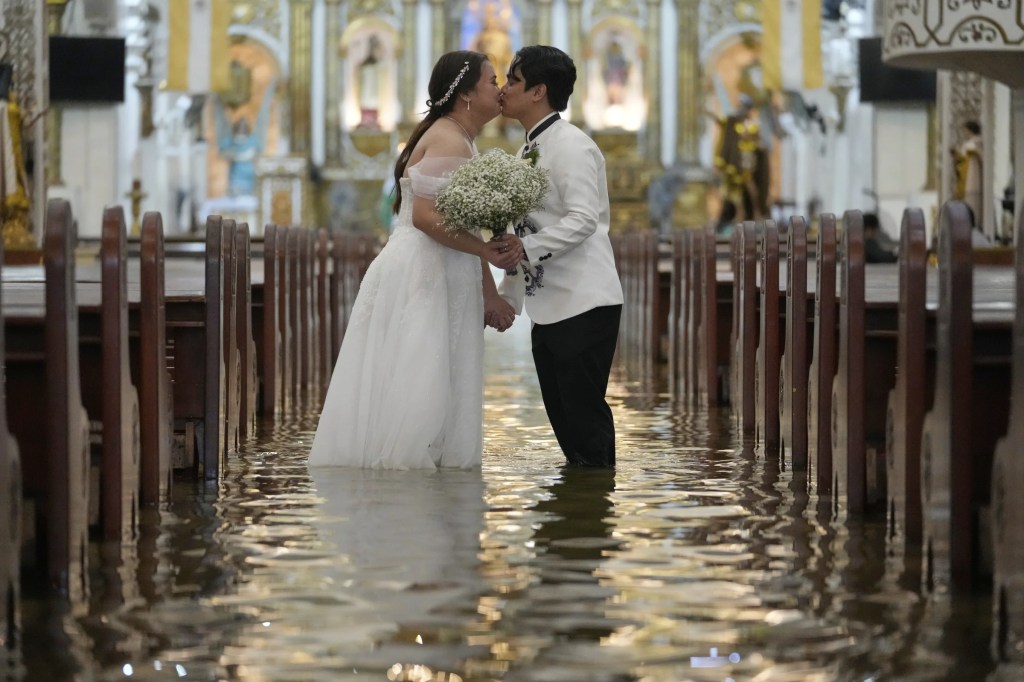
Photo by Aaron Favila, Associated Press, Barasoain Church, Malolos City, 22 July 2025.

Remember, God never gives up on us. That is why he keeps sending us the Blessed Virgin Mary Mother to appear on various occasions especially these past 120 years to keep on reminding us of his call for our conversion essential to having peace.

See how in all of these apparitions of Mama Mary, there has always been the praying of the Holy Rosary. At her final apparition on October 13, 1917 at Fatima, she revealed herself as the Lady of the Rosary, proving once more the great power and lessons of this devotional prayer that has proven over and over again that indeed, “More things are wrought by prayer than this world dreams of” (Lord Alfred Tennyson). How?

Photo by author, Sacred Heart Novitiate, Novaliches, 20 March 2025.

At the center of our Christian faith and spirituality is the invitation of God for us to “lose” ourselves to him, to trust him more than ourselves.

Jonah had to lose himself literally from the ship to be swallowed by the whale and spitted out after three days. And of course, the people of Nineveh from the king down to the poorest of the poor among them have to “lose” themselves by admitting their sinfulness and being sorry for them to be converted that resulted in God foregoing his plans to destroy their city. They actually won and did not lose in the process despite their sitting on ashes and wearing sackcloth.

In the gospel, we saw how Mary had to “lose” herself so that Jesus Christ may finally come by being born through her into the world when after the angel had explained to her the plan of God, she humbly said, “Behold, I am the handmaid of the Lord.  May it be done to me according to your word.”  Then the angel departed her (Lk.1:38). 

Mary “lost” herself to God and eventually became an instrument for our victory in the salvation through her Son Jesus Christ who also “lost” by dying on the Cross only to emerged gloriously victorious after three days when he rose from the dead to win over death and sin for us.

In life, it is when we “lose” that we actually “win”, something we often fail to realize, especially the corrupt government officials and lawmakers. The only peaceful path to resolving all this mess we are into and preventing further escalations of the anger of the people is for those in powers to finally “lose” themselves in humility, to repent and be converted. Snap elections will never restore the confidence of people with them unless those tainted with corruption take the high road of stepping down as a first sign of their decency and statesmanship.

Residents of Hagonoy Bulacan walk their way to flooded portions of premise surrondings St. Anne Parish as they protested following exposes of flood control anomalies. Bulacan has been under scrutiny for receiving multi million worth of flood control projects but still suffers severe flooding. (Photo by Michael Varcas)

Let us pray for their conversion; let us pray for the judges and justices of all courts be fair and just in evaluating the evidence against these people blinded by money and power. Let us pray for them to realize that for a moment, they may “lose” face and money but eventually win salvation and peace. Only God knows what awaits them, if they repent and be converted or remain proud and sinful.

Let us pray for the conversion of Sec. Recto and government economists of the need for the State to “lose” in order to “win” especially the people by cutting our so many taxes. It is about time for the government technocrats to reduce our taxes that have mostly gone to corruption without serving truly the people who have contributed these with their blood and sweat. We are the most taxed country in this part of the world while our neighbors have shown how reducing taxes actually leads to more spending by the people that partly keeps a more vibrant economy.

Let us pray also for ourselves, for one another to realize the need for us to lose ourselves for higher values than material things that are eventually lost. We as a nation, like the Prophet Baruch our bishops have cited must admit our own sins to be “flushed with shame” (Bar.1:15) that all these mess we are into is due to our sins, to our turning away from God as we focused more in pursuing power, wealth and fame that now come so easily via social media.

Photo by Pete Reyes, Sr. Porfiria “Pingping” Ocariza (+) and Sr. Teresita Burias praying the Rosary to protect mutineers during the EDSA People Power Revolt in February 1986.

When we “lose” in God, for God, it is always a “win” in everything. Of course, it is always a difficult path to take that calls for daily conversion in Christ with Mary.

The praying of the six Our Fathers, 53 Hail Mary’s and six Glory Be’s are invitations to the Rosary’s rhythm of daily conversion by meditating the joyful, luminous, sorrowful, and glorious mysteries of the life of Jesus Christ with his Blessed Mother. That is not what not Jesus referred to as “meaningless repetition” of prayers (Mt.6:7); the Rosary is also a prayer method that helps us enter into union in Christ with Mary as guide.

The Rosary, though clearly Marian in character, is at heart a Christocentric prayer. In the sobriety of its elements, it has all the depth of the Gospel message in its entirety, of which it can be said to be a compendium. It is an echo of the prayer of Mary, her perennial Magnificat for the work of the redemptive Incarnation which began in her virginal womb. With the Rosary, the Christian people sits at the school of Mary and is led to contemplate the beauty on the face of Christ and to experience the depths of his love. Through the Rosary the faithful receive abundant grace, as though from the very hands of the Mother of the Redeemer (St. John Paul II, Rosarium Virginis Mariae, #1)

True, a lot often we may seem to “lose” many battles when we try to stand for what is true and good but in the end, we actually “win” the war against evil, the greatest victory Christ had gifted us, our salvation. That is why in Marian prayers like the Rosary as well as in hymns in her honor we ask her prayer for us sinners to be saved from hell and be brought to her Son Jesus Christ in eternity.  That’s the final victory we all hope for in praying and living out the Holy Rosary with Mary. But first, lose ourselves to Jesus like Mary, even Jonah. Happy feast of our Lady of the Holy Rosary! Fr. Nicanor F. Lalog II, Our Lady of Fatima University, Valenzuela City (our email, lordmychef@gmail.com) 

Artwork by Mr. Darwin Lance Arcilla, Campus Ministry, OLFU-Valenzuela City.

The heart of the priest

Lord My Chef Daily Recipe for the Soul, 04 August 2025
Monday, Memorial of St. John Baptiste Marie Vianney, Priest
Numbers 11:4-15 <*{{{{>< + ><}}}}*> Matthew 14:13-21
St. John Baptiste Marie Vianney from https://liturgiadashoras.online/.

People complain and ask me why our patron saint, St. John Baptiste Marie Vianney is always portrayed “unattractive” as old, balding and so thin who seemed to be so tired, even sad. Para daw hirap na hirap.

Usually I smile at them because when I entered the seminary, I felt the same way too upon seeing his images. But as I learned about his life and teachings, the more I realized St. John Baptiste Marie Vianney is actually one of the original “rock star” saints of the Church with his white, balding hair so much like Jimmy Page of Led Zeppelin!

There is something so deeply within him when we try to feel and observe his portrayals in the arts as more than images but a reality and experience of a man deemed weak yet so strong with an intensity of a Michael Jordan in his life and ministry. He was another St. Paul who had truly let “Christ lived in him” (Gal. 2:20), “strongest when weakest” (2Cor.12:10) who declared with conviction that “the priesthood is the love of the heart of Jesus.” Hence in my prayers last night and today, I asked Jesus to give me a heart “so big, so wide to welcome everyone and life’s many challenges” (https://lordmychef.com/2025/08/03/praying-with-our-patron-saint-john-baptiste-marie-vianney/).

Detail of a painting of the Sacred Heart of Jesus at Visitation Monastery, Marclaz, France from godongphoto / Shutterstock.

The readings this Monday of the eighteenth week in Ordinary Time perfectly jibed the celebration of the Memorial of St. John Baptiste Marie Vianney as they spoke of the heart of the priest.

In the first reading we heard of Moses lamenting to God of the difficulty in dealing with his people who were so stubborn and refused to recognize God’s immense love for them, so similar with us priests in many occasions when we feel so frustrated and sad when parishioners fail to see the good things we are doing for them.

When Moses heard the people, family after family, crying at the entrance of their tents, so that the Lord became very angry, he was grieved. “Why do you treat your servant so badly?” Moses asked the Lord. “Why are you so displeased with me that you burden me with all this people?”… I cannot carry all this people by myself, for they are too heavy for me. If this is the way you will deal with me, then please do me the favor of killing me at once, so that I need no longer face this distress” (Numbers 11:10-11, 14-15).

Many times, we priests feel like Moses who cannot voice out problems with the people who would never understand it at all. Worst, people would even blame us priests why we work so hard or why do we bother at all with their lives. “Pabayaan na lang ninyo kami…sanay na kami” are what they often say. It can be frustrating when people refuse to match the fire and ardor of their priests.

In this scene, we find one of the many instances in the life of Moses that was centered on God in prayers. The heart of the priest is a heart in prayer. The attitude of Moses in the first reading conversing with God in prayer shows us that in our life and ministry, there is no one to turn to except God alone with whom we can be our most personal self, even dare God to “take us” or “kill us” when we are so fed up. The good news is, God never took those words seriously as he knew Moses and the prophets including us who spoke to him that way never knew what we were saying at all.

There is a saying that goes, “if you can’t bear the heat, leave the kitchen”; but, it cannot be applied with the priesthood that is neither a profession nor a job one can easily walk out from and start into another venture or career. Priesthood is a call or a “vocation” from God; however, priesthood is more of the Caller than the call. It is a life centered on prayer to become like Jesus Christ who alone feels and understands and appreciates all our ups and downs in the ministry. The more we get closer to Jesus in the Cross, the more we experience fulfillment that we would never dare to trade it for anything or anyone else, not even the prettiest woman on earth.

Photo by author, Chapel of St. Francis Xavier, Sacred Novitiate, Novaliches, QC, March 2024.

Priesthood is the love of the heart of Jesus that continues to be wounded and hurt by sins of men and women in this modern age so selfish and materialistic. Thus, every priest is called to be a “wounded healer” too like Christ who in his woundedness healed the wounds of others. We remind people of the paradox and scandal of the Cross of Jesus, of life itself by taking into heart Christ’s teaching, “For whoever wishes to save his life will lose it, but whoever loses his life for my sake will find it” (Mt. 16:25).

Let us now reflect on our gospel.

When Jesus heard of death of John the Baptist, he withdrew in a boat to a deserted place by himself. the crowds heard of this and followed him on for from their towns. When he disembarked and saw the vast crowd, his heart was moved with pity for them, and he cured their sick (Matthew 14:13-14).

Observe the brevity of Matthew in narrating the situation at the scene without losing its very soul and meaning especially for us priests: Jesus did not have any intentions to go after Herod nor to challenge him for his execution of John the Baptist who spoke the truth.

Instead, Jesus sought solitude. Like Moses in the first reading, Jesus turned to God in his grief and anguish of the death of John the Baptist. He crossed the lake to pray and be one with the Father to pour out his sadness and most of all, to reflect on what to do next after John’s death.

Jesus shows us in this scene of his going into solitude that our low points in life as priests are also our high points like Christ’s Transfiguration. Every prayer moment is a transfiguration moment because that is when we get closest with Jesus. It has been consistently proven in our collective and personal experiences as priests verified by studies that crises in the priesthood happen when we stop praying because that is detaching from Jesus Christ, our Caller.

Priesthood is not only difficult but very difficult starting with the vestments we have to wear. What a shame when priests prefer to do away with the proper vestments as well as wearing of shoes during celebrations of the Mass and other sacraments because the weather is so hot. What then are we going to bear if the weather is already a big issue for us? One of the teachings of St. John Vianney that I have always followed is the value of putting on good vestments in the celebration of Sacraments because they are a homily in themselves, proclaiming the glory and love of God for us all.

Photo by FlickrBrett Streutker from catholic365.com.

Many times, people forget priests have personal concerns and problems too, that we get hurt, get lonely, get sick and grieve at the death of family and friends. Despite all these lows in our life as priests, we go and follow the Caller Jesus Christ when people come and ask for our help and service. Woe to our brother priests who forget this and think more of themselves especially of their comfort!

See how when Jesus was praying in solitude and the crowd followed him, it was not difficult for him to forget his own worries that his heart was moved with pity upon seeing them disembarked from their boats. Despite his sadness at the death of John, Jesus taught the crowd who have followed him and healed the sick among them. And when the Twelve told him to drive away the crowd to search for their own food and lodging, Jesus told them to give them food themselves. What followed was the great miracle of the feeding of over five thousand people from five loaves of bread and two pieces of fish. It was the event that prepared the Twelve and the people to the Last Supper of the Lord and the road to Emmaus where Jesus was recognized at his “breaking of bread”.

The whole life of St. John Baptiste Marie Vianney was a prayer of praise and thanksgiving to God in Christ’s priesthood. He had a heart so big and wide, hearing confessions daily up to 16 hours! Pray for us your priests to have big hearts too to bear all the wounds and hurts because only the heart that suffers, that is “broken” can truly sing of the joys and pains of living, of the sense and meaning of serving to the point of being emptied, and of the healing and transforming power of Christ’s love and mercy. Amen. Pray for us your priests. Salamuch. Fr. Nicanor F. Lalog II, Our Lady of Fatima University, Valenzuela City (lordmychef@gmail.com).

 have not been to France nor do I know French but while searching for images of St. John Marie Vianney, I found this from the French website, https://www.notrehistoireavecmarie.com/; it is perhaps the depiction of the new pastor speaking to the young Antoine whom he asked for directions to Ars.

The inner journey in Christ of St. James the Greater

Lord My Chef Daily Recipe for the Soul, 25 July 2025
Friday, Feast of St. James the Greater, Apostle
2 Corinthians 4:7-15 <*{{{>< + ><}}}*> Matthew 20:20-28

Something struck me while praying the gospel for today’s feast of St. James the Greater – of how his mother approached Jesus with a request for him and his brother James “that these two sons of mine sit, one at your right and the other at your left, in your Kingdom” (Mt. 20:21).

It must be a very interesting company that Jesus had organized during his ministry composed not only of the Twelve and other disciples but most likely with so many others too that included their families like the mother of James and John believed to be the beloved disciple of Jesus. Traditionally known as Salome, their mom could easily be the patroness of “stage mothers” that abound most especially in the Philippines!

But kidding aside, it must be wonderful to tag along with them in following Jesus where everyone is welcomed. It is a journey not meant to cover distances and places but actually an inner journey inside one’s self that we shall see in the life of James the Greater. It is a journey that begins right here in our heart when we too, like James leave everything to follow Jesus.

For astonishment at the catch of fish they had made seized him and all those with him, and likewise James and John, the sons of Zebedee, who were partners of Simon. Jesus said to Simon, “Do not be afraid; from now on you will be catching men.” When they brought their boats to the shore, they left everything and followed him (Luke 5:9-11).

Photo by author, San Juan, La Union, 26 July 2023.

It must have been difficult for James to leave everything including their father Zebedee and follow Jesus. See that in the description by Luke of their call by Jesus, James and John as well as the brothers Simon and Andrew were all “rich kids” with their own fishing boats with hired men as workers at that time!

Clearly, money was not a problem with James and his buddies; however, one thing was missing in them – meaning and direction in life which they found in Jesus while listening to his preaching and finally in that miraculous catch of fish. I have always felt that perhaps, Zebedee allowed his two sons to leave him and their business for the same reasons so that they mature in life and be more responsible. We find this trace of attitudes or sense of entitlement in the brothers James and John when they asked Jesus to rain fire upon a Samaritan village that have refused them passage on their way to Jerusalem (Lk.9:54-56). Hence, Jesus named them as Boanerges for “sons of thunder” (Mk.3:17) due to their temperament.

In following Jesus, James had to learn the hard way the process of formation and transformation in Jesus that began in his heart. All along their journey from the shores of Galilee to Jerusalem, James remained by the side of Jesus Christ, probably unaware of that inner journey taking place right inside his heart to truly become a part of God’s Kingdom by sharing in the Lord’s Passion, Death and Resurrection. He had seen and experienced along with the other Apostles the great powers of Jesus not only in preaching but most especially in calming the storms, walking on sea, exorcising evil spirits, healing all kinds of sickness, and even raising to life some who have died.

Most of all, James was privileged to have witnessed along with his brother John and Peter the two important stops in Jesus Christ’s journey to the Calvary: first, on Mount Tabor for the Transfiguration and second, at Gethsemane for the agony in the garden. In both events in the life of our Lord, James was a privileged witness of his coming glory and then of his passion and death. Our gospel today on his Feast is sandwiched between these two major events of the Transfiguration and Agony in the Garden as this is set shortly before Palm Sunday when Jesus entered Jerusalem that led to his sacred pasch.

Jesus said in reply, “You do not know what you are asking. Can you drink the chalice that I am going to drink?” They said to him, “We can.” He replied, “My chalice you will indeed drink, but to sit at my right and at my left, this is not mine to give but if for those for whom it has been prepared by my Father.” When the ten heard this, they became indignant of the two brothers. But Jesus summoned them and said, “You know that the rulers of the Gentiles lord it over them, and the great ones make their authority over them felt. But it shall not be also among you. Rather, whoever wishes to be great among you shall be your servant; whoever wishes to be first among you shall be your slave. Just so, the Son of Man did not come to be served but to serve and to give is life as a ransom for many” (Matthew 20:22-28).

Painting by El Greco, “Pentecostes” (1597) from commons.wikimedia.org.

It would only be after Easter and the Pentecost when all these major stops in James’ personal journey with Christ would become clear to him and the other Apostles. Eventually, he became the first Apostle to be martyred as Bishop of Jerusalem during the persecution by King Herod of Agrippa in 40 AD (Acts 12:1-2), fulfilling Christ’s words to him that he would indeed “drink from his chalice” to be with him in his Kingdom.

A thousand years later, devotion to James the Greater would spread far and wide in Spain after relics of his body were discovered in Santiago de Compostela. It is one of the world’s oldest and most popular pilgrimage site known as the Camino de Santiago de Compostela (the way of St. James).

Every year, pilgrims from all over the world do the camino from various points of Europe to the Cathedral of Santiago de Compostela where the Apostle’s body is buried as a spiritual hike or retreat and journey for spiritual growth.

Like James the Greater, the camino is more than the kilometers or miles covered but the journey within one’s self that leads to deeper faith in Christ by living out his gospel as portrayed in its marker and symbols of a staff and scroll of the gospel proclaimed by the Apostle .

A marker along the camino de Santiago de Compostela.

It is my fervent prayer that some day I will be able to do a camino de Santiago de Compostela but for the mean time, we strive to continue in following the steps of James the Greater in making that inner journey within one’s self, beginning in our heart by leaving our “boats” of security to remain always at the side of Christ even if he has to smoothen our rough edges as a person and cleanse us of our sins that prevent us in drinking his chalice to be one in his Kingdom. The key is to serve, not to be served as Jesus insisted.

Sometimes in life, we just have to make “sakay” as we used to say as in “sakay lang ng sakay” or “ride on, man, ride on” without really knowing where our trip would lead us.

James the Greater simply made “sakay” in Jesus without knowing Christ was already fulfilling his wish of “drinking from his chalice” which proved that, indeed, the longest journey in life is the distance between the mind and the heart (Dag Hammarskjold). Amen. Have a blessed weekend! Fr. Nicanor F. Lalog II, Our Lady of Fatima University, Valenzuela City (lordmychef@gmail.com).

*All photos from Camino de Santiago de Compostela courtesy of Fr. Jigs Sta. Rita.

Full presence in Christ

Lord My Chef Sunday Recipe for the Soul, 20 July 2025
Sunday in the Sixteenth Week of Ordinary Time, Cycle C
Genesis 18:1-10 ><}}}*> Colossians 1:24-28 ><}}}*> Luke 10:38-42
Photo by author, Tagaytay City, February 2023.

After telling us what we must do to inherit eternal life through his parable of the Good Samaritan last Sunday, Jesus continued his journey to Jerusalem with his disciples with a stop over today in the home of the sisters Martha and Mary.

The visit became an occasion for Jesus – the Good Samaritan – to expound on the more important things we his disciples must “do” as exemplified in the contrasting attitudes of the two sisters.

“Jesus in the House of Martha and Mary”, painting by Johannes Vermeer (1654) from en.wikipedia.org.

Jesus entered a village where a woman whose name was Martha welcomed him. She had a sister named Mary who sat beside the Lord at his feet listening to him speak. Martha, burdened with much serving, came to him and said, “Lord, do you not care that my sister has left me by myself to do the serving? Tell her to help me.” The Lord said to her in reply, “Martha, Martha, you are anxious and worried about many things. There is need of only one thing. Mary had chosen the better part and it will not be taken from her” (Luke 10:38-42).

This is the third consecutive Sunday Jesus gives us the top things we his disciples must always “do”: two Sundays ago he instructed us to represent him well by greeting everyone with peace while proclaiming that the kingdom of God is at hand (14th Sunday); last week, Jesus asked us to consider everyone especially those in need as a “neighbor” with whom we must show mercy at all times.

Today’s teaching of Jesus is of capital importance in this series on discipleship before the Lord caps it next Sunday with the very foundation of discipleship which is prayer.

An icon of Jesus visiting his friends, the siblings Sts. Lazarus, Mary and Martha. Photo from crossroadsinitiative.com.
"Martha, 
burdened with much serving,
came to him and said..."

Only Luke has this unique story in the home of Martha and Mary.

Far from the simplistic views of a distinction between “contemplative” and “active” approaches in discipleship, Luke invites us not only to enter the home of Martha and Mary but most of all our Lord and Master Jesus Christ to experience and realize the deeper realities of being his disciple.

There is more at issue here than a conflict of duties of listening to the Word like Mary and doing the work like Martha. Jesus is not telling us to be like Mary listening more to the word – and forget all about the work to be done and accomplished? Not at all.

Jesus reproached Martha for being anxious and upset about many things in life that she had forgotten the more essential which is to listen to Christ himself.

Luke’s gospel teems with instances where we find Jesus warning his disciples against being overwhelmed with cares of the world like in the parable of the sower where he mentioned those seeds that fell among thorns were choked by the anxieties and pleasures of the world that they failed to be fruitful (Lk.8:14). In chapter 12 we find Jesus twice repeating in asking his disciples “not to worry” on how to answer their persecutors for the Holy Spirit will teach them (Lk.12:11-12) and immediately after that, “not to worry” again about what to eat or wear for life is more than food and body is more than clothing (Lk.12:22-23). There are many other instances in all gospel accounts we find Jesus denouncing too much focus on things of the world that are passing and worst, detract us his disciples in confessing faith in him as the Christ who had come and will come again at the end of time.

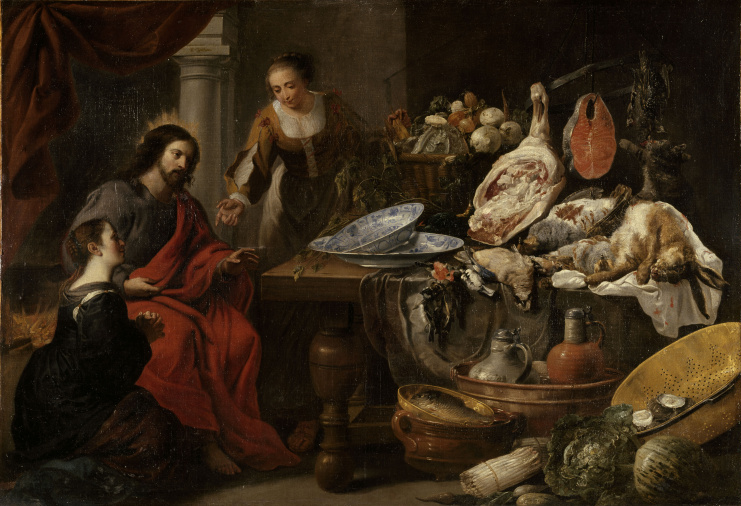
“Jesus in the House of Martha and Mary”, painting by Erasmus Quellinus II and Jan Fyt (1650) from en.wikipedia.org. See the folly of Martha’s worries and distractions with the enormous amount of food being prepared.

Jesus clarifies in the example of Mary that the first priority of every disciple is to listen to the Word who is himself. More than the division of time allotted for “contemplation” and “action” by every disciple, Jesus reminds us that the more we listen to him, the more we do his work; and the more we do his work, the more we desire to return to him and listen again and again to him.

Contemplation and action always go together. We cannot overdo the other and neglect the other. The moment we make a distinction between the two, problems arise like what we find in the church.

When priests and bishops concentrate only in contemplation, oblivious to the social conditions of the people, their proclamation of the Gospel is diluted as they fail to represent well Jesus as the Christ, the Son of the living God. When they are so immersed into social action and advocacies, business endeavors including entertainment in the Mass without contemplation, Christ is detached from the whole picture that people could no longer see nor feel the spiritual nature of the Church with everything becoming a show, empty of any sense of the divine and sacred. In both instances of abuses, either of contemplation or action in the Church, it is her credibility that is eroded as the Body of Christ with a growing number of the faithful disillusioned with priests and bishops more identified with the rich and powerful.

"There is need of only one thing."

Abraham in today’s first reading showed us the most beautiful example of discipleship. Like Martha, Abraham was also gracious in receiving his visitors at Mamre believed to be the Blessed Trinity in the form of angels; but, unlike Martha who was so concerned with her chores that she had forgotten Jesus, Abraham was intently focused on his visitors as “he waited on them under the tree while they ate” (Gen.18:8).

Like Mary listening at the feet of Jesus, Abraham was fully present in God while in Mamre. That is discipleship – to have that full presence in the Lord which is the “only one thing needed” of us which is to receive God’s gift of himself to us, of his Word who became flesh Jesus Christ who enables us to do his works by first recognizing him in ourselves and in one another as our neighbor.

This is the reason why even inside prison, St. Paul felt Jesus Christ’s coming and presence that he rejoiced in his sufferings as part of his ministry in proclaiming Christ as the hope for glory (Col.1:24, 27).

Photo by author, Sacred Heart Novitiate, Novaliches, QC, 20 March 2025.

Last week I read in one of the blogs I follow by an American nun, of how she attended many years ago to a delivery man who died of a heart attack in the ER of a Philadelphia hospital. Part of her ministry was to gather the things found in the chest pocket of the man’s shirt so she could inform the relatives of his death: there was a well-used prayer book, a thin wallet with a few dollars inside, a lottery ticket and a picture of his grandchildren. It was so touching how she narrated these simple things found in the man’s chest pocket as those closest to his heart (https://lavishmercy.com/2025/07/12/the-amoroso-man/).

That hit me so hard because even in this age of smartphones, I still carry a little notebook and pen in my chest pocket where I write my schedules as well as occasional notes on everything I notice and read. Deep inside me after reading that blog, I wondered where is Jesus Christ in all those notes and activities in my pocket notebook closest to my heart.

Dearest Lord Jesus,
make me fully present before
you always, even in my activities
and distractions for it is only in you
I am fulfilled. Amen.

Fr. Nicanor F. Lalog II
Our Lady of Fatima University
Valenzuela City

Sacred Heart para sa “cold heart” at “heartless world”

Lord My Chef Daily Recipe, Fr. Nicanor F. Lalog II
Solemnity of Sacred Heart, 27 June 2025
Detalye ng painting ng Sacred Heart of Jesus sa Visitation Monastery, Marclaz, France mula sa godongphoto / Shutterstock.

Nag-senior citizen ako noong Marso at masasabi ko na sa tanang buhay ko, itong 2025 ang pinaka-mainit at maalinsangang taon sa lahat. Mula pa man noong dati, gabi lang ako gumagamit ng aircon ngunit mula nitong Abril, maghapon na ako kung mag-aircon sa silid. Kung minsan nga ay pati electric fan binubuksan ko kapag gabi sa labis na init ng panahon nitong nagdaang tag-araw.

Hindi lamang minsan ko narinig ang maraming nagsabing parang “impierno” ang summer 2025 dahil para sa atin, sukdulan ang apoy sa impierno kaya napaka-init.

Subalit ayon kay Dante Alighierri, isang batikang makata ng Italya noong unang panahon na sumulat ng Divine Comedy, ang kailaliman daw ng impierno ay hindi naman pagka-init-init dahil sa apoy kungdi pagkalamig-lamig parang yelo!

Ayon sa kanyang tula na nobela, ang pinaka-masaklap aniya sa lahat ng kasalanan at kasamaan magagawa ng tao ay ang manlamig ang puso. Magkaroon ng “cold heart” sa Ingles hanggang sa mawalan na ng puso ang mga tao gaya ng sinasaad sa isa pang English expression na “heartless world.”

Larawan mula sa forbes.com 2018, fashion week sa New York.

Ang mga katagang ito na cold heart at heartless world ay mas mainam na huwag nang isalin sa ating sariling wika sapagkat mas mananamnam at mailalarawan natin ang kahulugan sa wikang Ingles kesa sabihing malamig na puso o daigdig na walang puso. Kapag sinabing cold heart o malamig na puso, ito ay patay na puso, walang buhay parang bangkay. O bato. Kapag ang mga tao ay naging ganito, mismo ang daidig ay wala na ring puso, walang pagmamahal, walang awa, walang malasakit, walang pakialam.

Gayon ang kahulugan ng puso para sa sangkatauhan – hindi lamang ito sumasagisag sa pag-ibig at pagmamahal kungdi sa buhay. Sa malasakit, sa kabutihan, maging sa kaalaman gaya ng sinasaad ng English expression na “to know by heart” na ibig sabihin ay makabisado, matandaan.

At paano natin tinatandaan ang mga bagay-bagay? Ito ay ating inire-record na mula sa dalawang kataga ng wikang Latin, re (uliting muli) at cord na mula sa cor o puso. Alalaong-baga, ang tandaan, ang memoryahin at kabisaduhin ay isapusong muli sapagkat dito sa ating puso natatago ang lahat-lahat ng ating alaala at kaalaman maging pakiramdam gaya ng kutob na nagsasaad ng pakiramdam at kaalaman na di maipaliwanag ngunit totoo.

Higit sa lahat, dito sa ating puso nananahan ang Diyos sa atin gaya ng sinasaad ng dokumento ng Vatican II sa makabagong mundo (Gaudium Spes). Kaya ngayong Dakilang Kapistahan ng Kamahal-Mahalang Puso ni Jesus, pinapaala sa atin ng pagdiriwang ito ang hiwaga ng katotohanan ng pag-ibig ng Diyos sa lahat ng tao sa lahat ng panahon.

Hindi tayo nabibigo sa ating pag-asa, sapagkat ang pag-ibig ng Diyos ay ibinuhos sa ating mga puso sa pamamagitan ng Espiritu Santo na ipinagkaloob sa atin. Sapagkat noong tayo’y mahihina pa, namatay si Cristo sa takdang panahon para sa mga makasalanan. Mahirap mangyaring ialay ninuman ang kanyang buhayn alang-alang sa isang mabuting tao. Ngunit ipinadama sa atin ng Diyos ang kanyang pag-ibig sa atin nang mamatay si Cristo para sa atin noong tayo ay makasalanan pa (Roma 5:5-8).

Gayon na lamang ang pagmamahal ng Diyos sa atin – hindi masukat gaya ng pahayag ni Jesus kay Nicodemo dahil ito ibinubuhos hindi inuunti-unti, hindi tinitingi. Binubuhos. Palaging marami ang pag-ibig na kanyang binibigay sa atin sapagkat napakalaki ng kanyang puso ni Jesus.

Lahat tayo kasya sa kanyang napakalaking Puso kaya tayo man ay inaanyayahan ni Jesus na lumusong at maglublob sa kanyang puso kung saan ang kanyang pag-ibig ay naghahanap sa nawawala at naliligaw; pag-ibig na umuunawa at umiintindi sa naguguluhan at nalilito; pag-ibig na palaging bukas at tumatanggap sa sino mang ibig manahan, tumahan kung umiiyak sa lungkot at hapis.

Ito ang Puso ni Jesus na sinasaad ng larawan ng isang Mabuting Pastol gaya ng propesiya ni Ezekiel sa Unang Pagbasa at mismong kinukuwento ni Jesus sa kanyang talinghaga sa ebanghelyo ngayon.

Makakapasok lamang tayo sa Kamahal-Mahalang Puso ni Jesus kapag atin munang pinasok ating sariling puso kung saan mismo siya nananahan sa atin. Palagi nating sinasabi ang puso ang sentro ng ating katauhan at iyan ay totoo kasi nga doon din nananahan si Jesus.

Subalit dahil sa ating mga kasalanan, sa marami nating hilig at kagustuhan at sinusundang ibang diyus-diyosan, nawawala tayo sa puso ni Jesus dahil ang totoo, nawawala na rin ating puso. Ang pinaka-simpleng paliwanag ng kasalanan na aking ginagamit palagi ay ito: sin is a refusal to love.

Ang kasalanan ay pagtanggi na magmahal. Mula sa salitang ugat na sala na ibig sabihin ay sumala o magmintis o hindi magampanan dapat gampanan, ang kasalanan ay sumala sa iisang atas ni Jesus na magmahal. Sa tuwing hindi tayo nagmamahal, tayo ay nagkakasala. Kapag tayo ay nababad sa kasalanan, nagiging manhid tayo kaya di na tayo makaramdam ng iba at kapwa. ?Dito na manlalamig ang ating puso dahil tayo ay mahihiwalay na sa iba at kapwa, wala na tayong pakialam. Tayo ay napuputol at nag-iisa, hiwalay sa Diyos at kapwa, maging sa ating sariling katauhan kaya madalas ang mga makasalanan ay hindi makapagmahal kasi nga nawawala sa sarili.

At ganyan ang takbo ng daigdig ngayon, kanya-kanya, wala sa sarili tila baga bawat isa kaya lahat na lang dinaraan sa pera-pera. Ang lahat na lamang ay sinusukat, kinukuwenta, tinatantiya katulad ng algorithm sa social media kung saan nakukuha ang marami nating pattern sa buhay gaya ng mga hilig at gusto. Nagiging “commodity” na lamang ang tao ngayon, parang produkto at kasangkapan na ginagamit, binebenta at binibili.

Huwag nating hayaang magpatuloy na lamang ito na ang mundo ay manatiling materyal lamang – malamig at manhid, walang pakiramdam. Ibalik natin ang buhay, ang ating pagkatao na pakikibahagi sa buhay ng Diyos na nanahan dito sa ating puso. Gaya ng talinghaga ni Jesus, ang Diyos ay hindi isang observer na tagamasid o spectator na manonood lamang ng takbo ng ating buhay ng mga tao. Kaya sinugo ng Ama si Jesus sa atin sapagkat mula pa man noon ibig niyang makilahok sa buhay natin dangan lamang ay lagi natin siyang pinupuwera. Lalo ngayon sa makabagong panahon na pilit inaalis na ang Diyos sa buhay ng tao!

Larawan mula sa Pinterest.com.

Sa Sacred Heart ni Jesus, muling nabubuo ang tao sa kanyang sarili at ang sangkatauhan sapagkat ang pag-ibig niya ay pag-ibig na hinahanap ang mga sira at pira-piraso nating sarili upang makumpuni at mabuong muli. Ipinapaalala sa atin ng Kamahal-Mahalang Puso ni Jesus ang pag-ibig ng Diyos ay hindi isang ideya lamang o dalumat na nakalutang sa alapaap kungdi nakatapak sa lupa – isang pag-ibig na aktibo, marubdob at matalik na nakikipag-ugnayan gaya ng ating mga naranasan noong tayo ay gulung-gulo, litong-lito, nawawala at halos wala nang saysay ang buhay. Buhaying muli ating mga puso upang maranasan tunay na kagandahan ng buhay ng tao, hindi ng robot o makina. Ating dasalin palagi:

O Jesus na mayroong
maamo at mapagkumbabang Puso,
Gawin Mong ang puso nami'y
matulad sa Puso Mo!
Amen.

“Pick Up the Pieces” by Average White Band (1974)

Lord My Chef Sunday Music by Fr. Nicanor F. Lalog II, 20 April 2025
Photo by author, Atok, Benguet 27 December 2024.

Blessed happy Easter everyone!

We have long been planning to have this instrumental piece in our featured music every Sunday but it was only now we have realized this is most perfect during Easter when Jesus Christ in his Resurrection is telling us to “pick up the pieces” of life amid its many darkness and emptiness.

That is the grace and surprise of Easter: in Christ’s dying and rising to life, death has become a blessing to us all as we have come to share in his glorious resurrection too.

Despite that feeling of emptiness within and in our homes, of the irrevocable reality they are gone forever never to join us in our meals and bonding like Christmas, of never hearing their voices again nor be able to hug and embrace them can be shattering, the angel’s reminder to Mary Magdalene and companion women at the empty tomb echoes in our hearts too: “Why do you seek the living one among the dead? He is not here, but he has been raised. Remember what he said to you while he was still in Galilee, that the Son of Man must be handed over to sinners and be crucified, and rise on the third day.” And they remembered his words (Luke 24:5-8). https://lordmychef.com/2025/04/20/easter-is-god-surprising-us/

Released in 1974 in the UK by a group of Scotsmen musicians who called themselves as Average White Band or AWB, “Pick Up the Pieces” did not perform well in the charts until it was released later in October that same year in the US where it stayed on the top singles in February 1975. According to the late Molly Duncan who was the band’s saxophonist, he had disagreed in releasing the song that had no lyrics only other than the shout “pick up the pieces.”

Moreover, the title spoke so well of their situation at that time when they were hardly noticed in the music scene, not making any money at all until it was released in the US where radio stations took notice of its funky beat’s good vibes. The single eventually became AWB’s turning point that is why the more we find it so appropriately Easter in nature.

We have been aware of the music itself in the 1970’s but it was only in 2010 when we found out its artists –AWB – after Daryl Hall guested AWB bassist-guitarist and co-founder Alan Gorrie in his internet show Live From Daryl’s House. It was a superb performance as usual by Daryl Hall and his musicians but of course, we always prefer the original. Here is AWB with their classic “Pick Up the Pieces” which we believe Jesus would also approve as part of his Easter soundtrack. Amen.

From YouTube.com.

Life is a direction, a daily Lent

40 Shades of Lent by Fr. Nicanor F. Lalog II
Ash Wednesday, 05 March 2025
Joel 2:12-18 ><}}}*> 2 Corinthians 5:20-6:2 ><}}}*> Matthew 6:1-6, 16-18

Life is a daily Lent, a journey towards Easter.

We go through a pasch everyday like Jesus Christ’s Passion, Death and Resurrection when we “pass over” from sin into grace, from darkness into light, from death into life.

Life is a daily Lent because everyday, we go through an “exodus” from another day to the next new day, from sunset to sunrise. However, Lent as a journey is about direction, not destination. This we find clearly at the start of our 40-day journey of Lent with Ash Wednesday.

“Even now, says the Lord, return to me with your whole heart, with fasting, and weeping, and mourning; Rend your hearts, not your garments, and return to the Lord, your God” (Joel 2:12-13).

It is strange that while Jesus Christ asked us in the gospel to “Take care not to perform righteous deeds in order that people may see them; otherwise, you will have no recompense from your heavenly Father” (Mt.6:1), what we are doing this Ash Wednesday is exactly the opposite!

Alam na this… that if you meet anyone with ashes on his/her forehead, definitely he/she is a Catholic who had gone to Mass or at least had observed Ash Wednesday.

There are some who would surely be teased by friends as being too serious as they practice abstinence by avoiding meat today and on Fridays this Lent. Most likely too, many would be giving alms today in the collections for the poor in the parishes all because for the reason it is Ash Wednesday.

These three pillars of Lent – prayer, fasting and alms-giving are not only meant for this Season that lasts only for 40 days but something we are hoped to practice the whole year through until we are slowly transformed into the likeness of Jesus Christ.

The purpose of Jesus in asking us in the gospel to do these all in secret is to avoid falling into the trap of the people of His time who flaunted to everyone their prayer, fasting and alms-giving, forgetting God in the process because focus had been on them. And yes, it continues among us that we have religiosity without spirituality, devotion without evangelization.

Moreover, to practice these in secret is actually to enter into our very selves, into our hearts where God dwells, where we meet Him personally.

Our Lenten journey becomes a direction when we take it into our hearts, when we open and rend our hearts to let Jesus come and dwell within by letting Him empty us of our pride to be filled with His humility, justice and love.

Lent then becomes a direction leading us not only to daily Easter but ultimately to our eternal salvation not just in heaven or any “place” but to be one with the Person of God Himself and the persons along the way we shall meet with whom we are called by Christ to be one with in Him.

Therefore, Lent as a direction is an inner transformation as companions in Christ.

In this age of WAZE and GPS, we can easily seek directions to a particular destination. Problem with being focused more on destination is we miss the fun and adventure of every journey. When we reach our destination, what do we do? 

We cross out from our list of travel goals every destination that we make and start looking for new places to visit until we have been to every place on earth that we plan to visit the Moon and Mars next! Eventually we get tired with travels and after covering so many distances and destination, we still feel lacking and incomplete. There is no more destination to go to that we confront ourselves with the existential question, is this really what I need most in life? Is this all?

To see life more as a direction means to find its meaning in God that we keep on maturing, we keep on sustaining our journey in Him and with Him. It does not matter wherever He leads me or where I go or stay because what matters most is I am in and with God.

Lent is entering God in and through Jesus Christ.  It is going back to Him, staying in Him and with Him in love. This is the reason why we fast, we empty ourselves even our sights and other senses so that we become more sensitive to God’s presence. There are no flowers, no decors, no Alleluia, no Gloria in the church and liturgy. Everything is bare essential so we are not distracted in finding and following God right in our hearts.  

Recall the first time you truly fell in love, when truly loved that you literally see and hear even smell your beloved everywhere and in everyone. You always thought it is your beloved whom you saw walking or speaking somewhere but it wasn’t really she! Akala mo lang…

When we truly love, the time and place are not important because all we have are the here and the now together.

Oh how easy to say we love God or somebody!  But if we try to probe deeper into ourselves, we find that we have not truly loved God or anyone that much because in many instances, we always prevail over them.  We choose our own will than God’s or our beloved’s.

That is when we sin as we turn away from God and our beloved. To sin is not just to break laws and turn away from God and our beloved but ultimately a refusal to love which is actually losing one’s direction in life.

Lent is the wonderful season of finding again our direction in life, our true love, God.  Love needs no justifications.  And we can only love persons, not things. Hence the need for oneness, for reconciliation as St. Paul asked us in the second reading to be “reconciled with God” (2 Cor.5:20).

Working together, then, we appeal to you not to receive the grace of God in vain. For he says: In an acceptable time I heard you, and on the day of salvation I helped you. Behold, now is a very acceptable time; behold, now is the day of salvation (2 Corinthians 6:1-2).

Now is the best time to find our life direction in God in our personal and communal worship and practices this Lent. When you find your direction, you find God, yourself and others. And that is when you find joy and peace which is Easter, the direction of every Lent and life. Amen.

Love your enemies

Quiet Storm by Fr. Nicanor F. Lalog II, 23 February 2025
Photo by author, Hidden Valley Springs Resort, Calauan, Laguna, 20 February 2025.

Jesus said to his disciples: “To you who hear I say, love your enemies, do good to those who hate you, bless those who curse, pray for those who mistreat you… But rather, love your enemies and do good to them, and lend expecting nothing back; then your reward will be great and you will be children of the Most High, for he himself is kind to the ungrateful and wicked. Be merciful, just as your Father is merciful” (Luke 6:27-28, 35-36).

yes, i hear you Lord.
love my enemies.
i have tried
and continue to strive
at loving my enemies;
but, who are my enemies?
yes, it is easier said than done,
loving my enemies
who are most easy to identify
as those i hate and do not agree with,
those who have hurt me,
those who do not believe in me,
those who simply differ with me
both outside
and inside.
as i rested in you, Jesus
i have realized
something deeper,
and pernicious:
my worst enemies
are those within me
like a sin i refuse to admit,
a sin i continue to justify,
a darkness i'm afraid to look into.
yes, Jesus!
my worst enemy
is actually myself
when i deny your love
and presence in me;
let me look deep inside me
where in my life
is God asking me to love
more like you, Jesus?
yes, it is terrifying,
disturbing and difficult
but it is only when i love more
like you Jesus
that i experience your love more
and begin loving my enemies within!
Photo by author, Hidden Valley Springs Resort, Calauan, Laguna, 20 February 2025.

Advent is freedom from enemies

The Lord Is My Chef Daily Recipe for the Soul by Fr. Nicanor F. Lalog II
Simbang Gabi-9 Homily, 24 December 2024
2 Samuel 7:1-5, 8-12, 14, 16 <*((((>< + ><))))*> Luke 1:67-79
Photo by author, Advent 2022.

Finally! This may be the word and expression today, the 24th of December. Finally, a lot of you would be bragging about having completed the nine-day novena to Christmas. Finally, it would be Christmas day. And finally, we could sleep longer.

But then, finally what?

When Zechariah’s tongue was loosened after naming his son John in fulfillment of the angel’s instruction to him, it was not the word “finally” that came from his mouth but “Blessed be the Lord, the God of Israel!”(Lk.1:68). After being mute for nine months, Zechariah’s silence became praise with gratitude and wonder giving him the voice to speak again.

Zechariah his father, filled with the Holy Spirit, prophesied, saying: “Blessed be the Lord, the God of Israel, for he has come to his people and set them free. He has raised up for us a mighty Savior, born of the house of his servant David. Through his prophets he promised of old that he would save us from our enemies, from the hand of all who hate us, He promised to show mercy to our fathers and to remember his holy covenant. This was the oath he swore to our father Abraham: to set us free from the hand of enemies, free to worship him without fear (Luke 1:67-74).

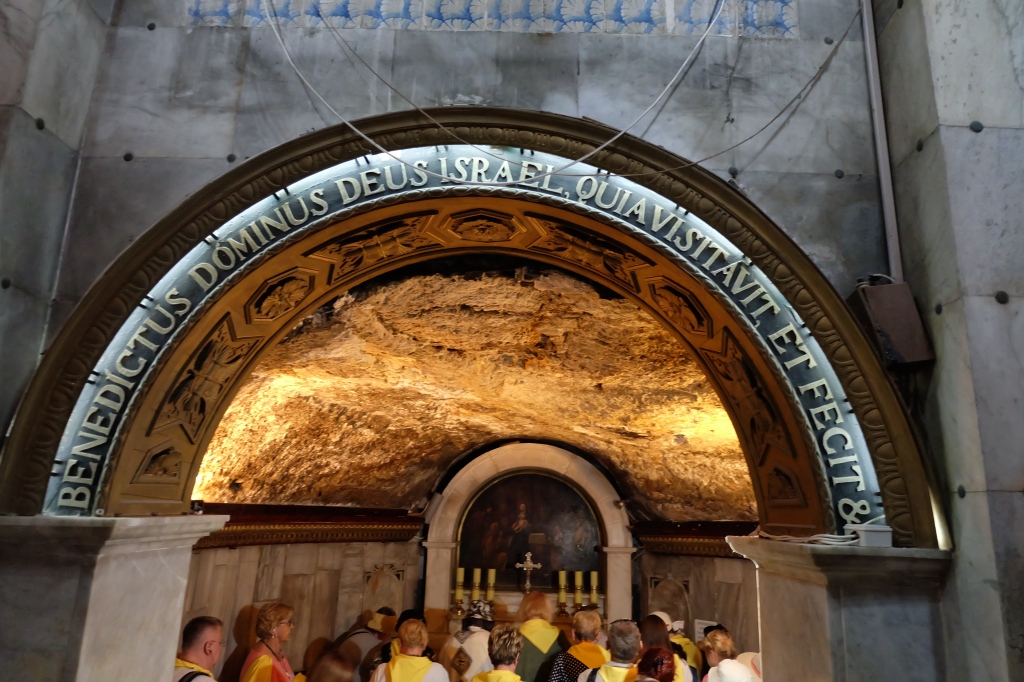
Photo by author, birthplace of St. John the Baptist underneath the church dedicated to him in Judah.

We have reflected last Thursday that Advent and Christmas is a journey that begin in the church, in the celebration of the Mass as Luke opened his Christmas story with the annunciation of John’s birth to Zechariah during their Yom Kippur at the Jerusalem Temple.

Luke’s artistry and mastery in weaving stories brought us right into every scene leading into Christmas – from Jerusalem to Nazareth then to the hill country of Judah in the home of Zechariah until John’s birth where our scene remains today. Tonight and tomorrow, he will be leading us along with Matthew and John to Bethlehem for the birth of the Lord.

But this journeys Luke recounted to us were not only about places but most of all an inner journey into our hearts. As we all know, the destination does not really matter but the journey, the trip. It is most true with our Simbang Gabi too – it is not about completing the nine-day novena that matters most but what have we become!

After tonight and tomorrow’s Masses, our churches would be empty again, only to be filled up on Ash Wednesday, and then Palm Sunday and Holy Thursday. How tragic that on Easter which is “the Mother of all feasts in the Church”, people are miserably absent because they are out in the beach and resort enjoying summer. In fact, more people come to Christmas (Pasko ng Pagsilang) than with Easter (Pasko ng Pagkabuhay) when it is actually the very foundation of our faith.

With our students after Simbang Tanghali last year at the Medicine Lobby of Our Lady of Fatima University, Valenzuela City.

So, what have we become after these nine days of waking up early or staying up late at night, praying, listening and reflecting on the word of God, sharing our material blessings in the collections and gift-giving if we stop going to Mass the whole coming new year?

American Trappist monk Thomas Merton wrote that seeking God is not like searching for a “thing” or a lost object because God is more than an intellectual pursuit or a contemplative illumination of the mind. Merton explained that God reveals Himself to us in our hearts through our communion and fellowships in the Church. 

We come to church to celebrate the Mass and pray with the whole community to express our communion with one another in Jesus Christ. It is in this communal aspect of prayer we become holy, when we are transformed and as Zechariah prophesied, we are “set free” by Jesus Christ who is the main focus of his Benedictus.

Who are those enemies Zechariah mentioned twice in his Benedictus? Who are those enemies we have to be set free for God and free to love?

Photo by author, Church of St. John the Baptist, Israel, May 2019.

Again, look at this minute detail Luke used in composing Zechariah’s Benedictus when he spoke twice of the word “enemies”: first of “saving us from our enemies, from the hand of all who hate us” (Lk.1:71) and then, the fulfillment of God’s promise to Abraham “to set us free from the hand of enemies, free to worship him without fear” (Lk.1:74).

Surely, those “enemies” were not just the Romans and other pagans around Israel at that time nor the Pharisees and scribes, the priests and Sadducees of the temple who had hands in Christ’s death for they are now gone. The gospel accounts were written in the past but remain true and relevant at all time in history, especially now more than ever in our own time.

Are we the “enemies” within who think only of our selves even in our religious and spirituality, manipulating God, controlling God?

A friend asked me last week if their priest was right in saying that the Simbang Gabi is the most effective means to obtain special favors from God. I emphatically told her “no”, adding that their priest’s claim is misleading. We cannot dictate God. God blesses everyone, including sinners who do not even go to Mass. We do not need to multiply our prayers as Jesus warned us because God know’s very well our needs before we pray. Then, why pray at all?

We pray and most especially celebrate the Mass especially on Sundays to know what God wants from us because we love God. Period. And that love for God must flow in our loving service and kindness with others. If gaining favors is the main reason we go to Mass or even pray, then, we are the “enemies” who prevent ourselves to freely worship God!

Mr. Paterno Esmaquel of Rappler rightly said it in his Sunday column:

“We are a society obsessed with achievement and success, command and control… Even we who try to complete the Simbang Gabi can plead guilty. During the Simbang Gabi, for example, we are tempted to focus on achieving all the nine days and succeeding for another year. By fulfilling this tradition, we can then ask God (or “command” God, like a genie) to grant our wishes. We can therefore wield greater control over life that is otherwise unpredictable (https://www.rappler.com/voices/thought-leaders/the-wide-shot-missed-simbang-gabi-found-christmas-grace/).

And who are feeding all these misleading and erroneous thoughts on the people? We your priests and bishops!

How sad as we have mentioned last week when many priests have totally lost any sense at all of the sacred in the celebration of the Mass. Some of them not only come unprepared for the celebration without any homily, even so untidy and shabbily dressed and worst of all, make fun of almost everything and everyone that the Mass has become a cheap variety show. Online Masses continue not for evangelization for “shameful profits” in the Sacrament through “likes” and “followers” that some priests are now more concerned in finding ways to be trending and viral instead of how to effectively evangelize the people with our good liturgical celebrations flowing into our witnessing of life.

Yes, we priests and bishops are the enemies right here in the church when we align more with the rich and powerful, when we have no qualms asking/receiving gifts and favors from politicians and still, would want to collect more money and donations from people with our endless envelops that have totally alienated the poor from the church. The poor are the ones who suffer most, paying for the corruption of the politicians who help the clergy in their projects for the poor. Poor Jesus Christ!

Perhaps, on this last day of our novena to Christmas, let us all force ourselves – especially us priests and bishops – to go into silence to identify, to weed out those enemies within and outside us that prevent us from welcoming Jesus Christ in our hearts.

Let us pray to God that He may set us free from these enemies within us, around us so we can be like John the Baptist who will “go before the Lord to prepare his ways, to give his people knowledge of salvation.” Amen. See you tonight or tomorrow, Christmas in the Holy Mass!

Photo by author, Dumaguete City Cathedral, November 2024.

Advent is fulfillment

The Lord Is My Chef Daily Recipe for the Soul by Fr. Nicanor F. Lalog II
Simbang Gabi-8 Homily, 23 December 2024
Malachi 3:1-4, 23-24 <'[[[[>< + ><]]]]'> Luke 1:57-66
Photo by author, Church of St. John the Baptist, the Holy Land, May 2019.

We are now in our penultimate day of our Simbang Gabi. I love that word “penultimate” so often found in the sports page that means second to the last of the series.

From the Latin prefix pen- meaning “almost” + ultimatum for “last”, penultimate literally means “almost last” which gives a sense of fulfillment and of completion – exactly how we feel this eighth day of Simbang Gabi that is almost over with everything already fulfilled in our readings and prayers for Christmas.

When the time arrived for Elizabeth to have her child she gave birth to a son. Her neighbors and relatives heard that the Lord had shown his great mercy toward her, and they rejoiced with her. When they came on the eighth day to circumcise the child, they were going to call him Zechariah after his father, but his mother said in reply, “No. He will be called John.” But they answered her, “There is no one among your relatives who has this name.” So they made signs, asking his father… He asked for a tablet and wrote, “John is his name.” Immediately, his mouth was opened, his tongue freed, and he spoke blessing God. All who heard these things took them to heart, saying, “What, then, will this child be?” For surely the hand of the Lord was with him (Luke 1:57-62, 63-64, 66).

Painting of “Saint Luke Drawing the Virgin” by Flemish painter Roger van der Weyden (1400-1464); photo from en.wikipedia.org.  

See again the artistry and advocacy of Luke as an evangelist and a journalist. We can imagine the scene, experience the joy and excitement of the event in the tight-knit community with all the wonderful elements of a drama in real life.

Leading the scene is Elizabeth, the priest’s wife barren for years and beyond hope now gives birth to a son, creating excitement and gossip among the many Marites. Then Zechariah the priest who was silenced for nine months due to his doubts with the good news announced to him by the angel finally spoke praising God, filled with gratitude and wonder. And of course, the uzis (usiseros), the neighbors who shared in the joy and for a good reason and intentions wanted the baby named after his father.

That’s when Luke showed his skillful mastery of weaving together a wonderful piece of tapestry clearly designed by God that surprised everyone, including us today. “When they came on the eighth day to circumcise the child, they were going to call him Zechariah after his father, but his mother said in reply, “No. He will be called John.” But they answered her, “There is no one among your relatives who has this name.” So they made signs, asking his father… He asked for a tablet and wrote, “John is his name.” Immediately, his mouth was opened, his tongue freed, and he spoke blessing God.

Again, notice another minute detail mentioned by Luke when he called Elizabeth “his mother”.

Photo by author, Church of St. John the Baptist, the Holy Land, May 2019.

Of the four evangelists, Luke is the one who gave a lot of emphasis on the role of women in the society, especially the ancient Jewish one that was strongly patriarchal.

In the Visitation story yesterday, it was only Luke who had written a scene in the whole Bible with two women together conversing and in very positive mood. Women were so rarely put together in one scene especially in the Old Testament, a sort of what we may call as “gender bias” because women were always at odds with each other, even quarreling. Except for the Book of Ruth where we find two women not only in a single scene but a whole book and yet very pronounced there how it was Naomi the mother-in-law always portrayed in control or leading, always speaking while Ruth was silent, giving an impression of being so lovely yet very soft even submissive to elders and men.

Luke wrote the Visitation scene to clarify all these gender bias of their world then that persists even to our own time. Luke made a loud and clear statement in putting together Elizabeth and Mary in this one scene, an old, barren woman and a virgin, unmarried maiden both so blessed by God with infants in their wombs. Not only men are called by God to a special mission but most especially women who give birth. Elizabeth and Mary represent all the women of the world to remind everyone for all time that they are created in the image and likeness of God, with same dignity as men who must be respected at all times as indwelling of the Holy Spirit.

Photo by Pixabay on Pexels.com

Notice how throughout the scene from the annunciation to Zechariah and the Visitation, the wife of Zechariah was referred to by her name Elizabeth but, when controversy arose about the name to give her son, Luke emphatically wrote “his mother” to show that she has every right over her son, reaching its climax when Zechariah affirmed the mother as he wrote “John is his name.”

Think of those moments in your life when there are reversal of roles and suddenly God threw you – catapulted you – to a major role in life you only entertained in your wishful thinking and daydreaming because you have given them up, you have surrendered it due to a very long time of being disappointed like Elizabeth or Zechariah?

Think of those times when you realized, when you felt being at the center of attention for a good reason because you are good, you are so blessed, you did the right thing? How do you feel of the grace of God?

Think of those times when you did something so good that prompted others to “prepare the way of the Lord” like John the Baptist, when people around you were wondering what else you would achieve because clearly, God is with you?

On this penultimate day to Christmas, take time to speak God from your heart as you prepare for the fulfillment of His promise to you. I tell you, claim it now whatever you are asking God for Christmas. Remember what the angel told Mary at the annunciation, “nothing will be impossible for God.” Dare to open yourself to God, create a space within you for Him alone and let Him lead you like Zechariah whose name means “God remembers”, Elizabeth which means “God has promised” and John, “God is gracious.”

On this penultimate day to Christmas, we are assured God is gracious because God remembers His promise always. Amen. Have a blessed week ahead.

Photo by author, birthplace of St. John the Baptist underneath the Church of St. John the Baptist, the Holy Land, May 2019.