We are John the Baptist, a Suffering Servant of God too.

Lord My Chef Daily Recipe for the Soul by Fr. Nicanor F. Lalog II
Wednesday in the Twelfth Week of Ordinary Time,
Solemnity of the Birth of John the Baptist, 24 June 2026
Isaiah 49:1-6 ><}}}}*> Acts 13:22-26 ><}}}}*> Luke 1:57-66, 80
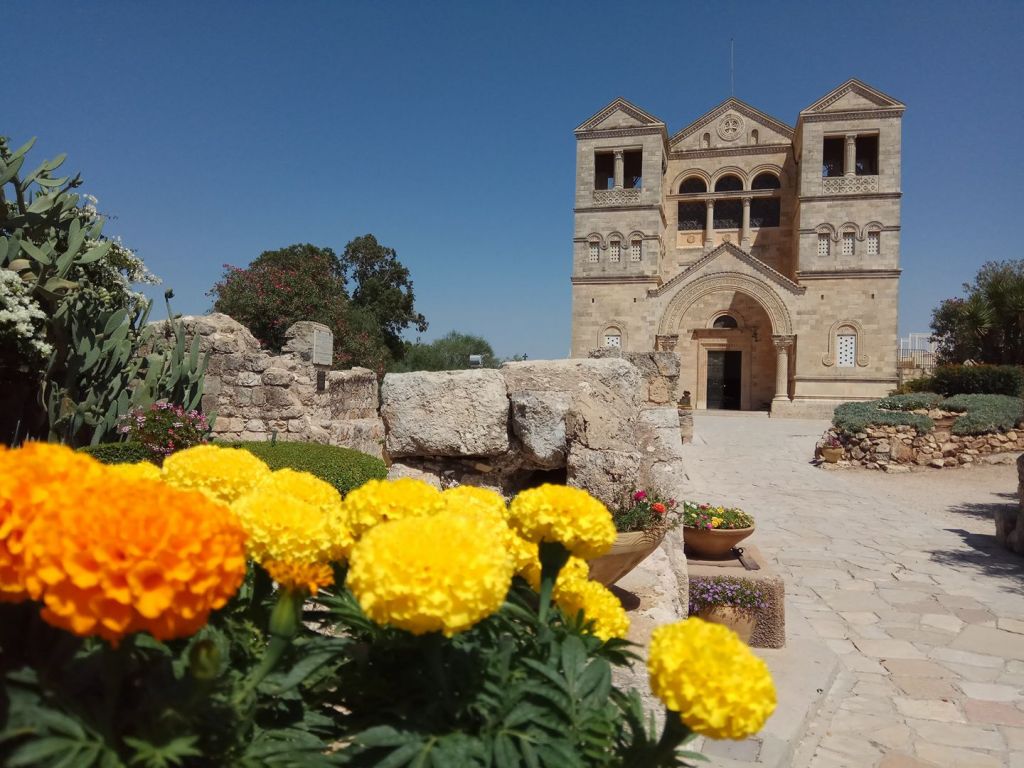
View of a decorated Christmas tree and tower of the Franciscan Monastery of St Saviour locally also known as San Salvador monastery in the Christian Quarter Old city East Jerusalem

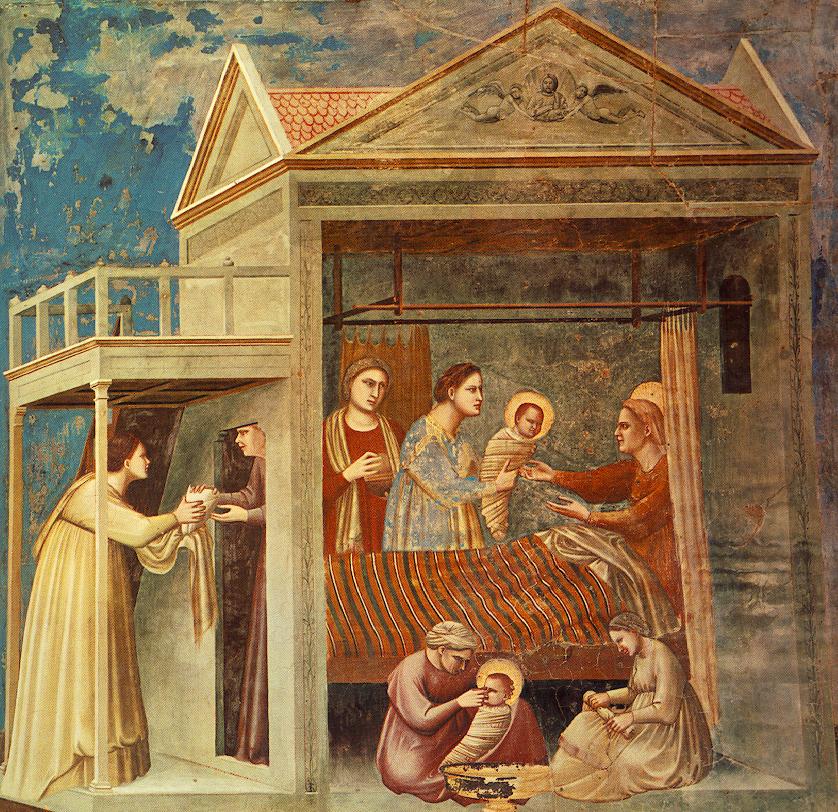
Six months from now we celebrate Christmas because today is the birthday of the Lord’s cousin and precursor, St. John the Baptist; but, before we rejoice at the fast approaching Christmas, let us reflect first on the joy of John’s parents, relatives and local folks following his birth.

When the time arrive for Elizabeth to have her child she gave birth to a son. Her neighbors and relatives heard that the Lord had shown his great mercy toward her, and they rejoiced with her (Luke 1:57-58)

It was indeed a great celebration for everyone in the hill country of Judah when John was born: his parents were both old and his mother Elizabeth was already barren when she conceived John.

Both parents were from the priestly family, very prominent with a great lineage. Most likely, they were the envy of their relatives and neighbors in practically having every good thing in life except a child to inherit and propagate their good name and wealth; when John was born, God gave them more than a child – here was the precursor of the Messiah, the promised Elijah who returned to prepare the way of the Lord Jesus Christ!

Photo by author, May 2019, Church of St. John the Baptist, Ein Karem, Israel.

It was a joy that did not come easily, with much pains and sufferings and self-doubts along the way that took a long time of waiting too.

This birth of John teaches us that behind every joy is always a great deal of sufferings, doubts, and darkness in life.

Imagine the inner turmoil within Zechariah when the angel appeared to him announcing the birth of John while incensing the Holy of Holies on the most important Jewish feast: he doubted the angel’s good news not because he had lost faith in God but simply got “tired” with God.

Zechariah was having a sort of tampo as we call it in Filipino because God did not seem to listen to his prayers for a son.

It happens with us when we have turned indifferent in our faith even with God when he seems not to care at all to our prayers and requests that we keep on failing the board exam or gets denied repeatedly in our job or visa applications. We still pray with our lips not with our heart just for the sake of praying without really believing in its efficacy, if God listens to us at all.

Or like Elizabeth who went into a self-imposed silence, withdrawing from public view during her pregnancy with John because she felt herself so unworthy of God’s blessing.

Today, the birth of John the Baptist teaches us that every disciple as a precursor of Christ is an image of God’s Suffering Servant prophesied by Isaiah:

Though I thought I had toiled in vain, and for nothing, uselessly, spent my strength, yet my reward is with the lord, my recompense is with my God (Isaiah 49:4).

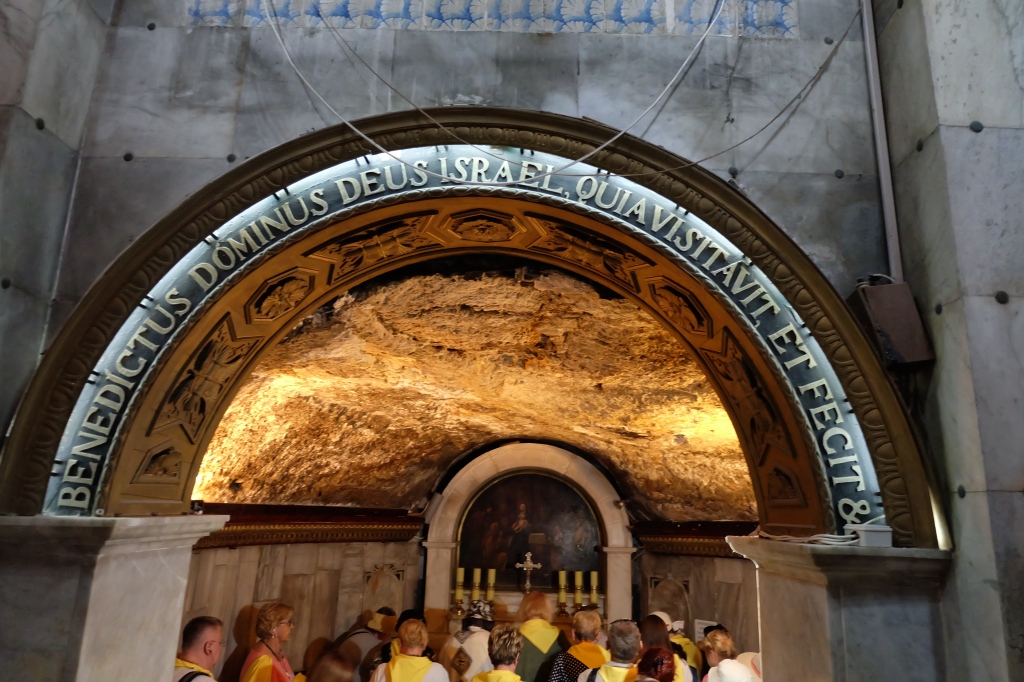
Photo by author of the site believed to be the birthplace of St. John the Baptist at the side of the Church of St. John the Baptist in Ein Karem, Israel, May 2019.

There are actually three songs of the Suffering Servant in the Book of Isaiah that prefigure Jesus Christ who suffered and died and rose again on the third day. However, it is widely believed and interpreted that in the second song of the Suffering Servant we heard today, the Servant referred to is John the Baptist.

Although John recognized Jesus as the promised Christ during his baptism at Jordan, he was the first to suffer and die a martyr when thrown into prison for speaking the truth against Herod’s taking of his brother’s wife Herodias. There we find that image of God’s Suffering Servant in John’s mission and ministry, reminding us of the great difficulties and dangers in preparing the way of the Lord.

We are all a John the Baptist and a Zechariah and Elizabeth rolled into one like the Suffering Servant for we are all a forerunner of Jesus Christ.

Photo by author, St. Michael Retreat House, Antipolo City, 16 June 2026.

Many times we too have felt like them in doubting our efforts in witnessing Christ and his gospel, when these seemed to have gone in vain especially today when the world is trying hard to delete God from every aspect of life.

Witnessing the gospel of Christ, speaking and fighting for what is true and good, for what is just and fair, even in simply being human and decent can already be strenuous, exhausting and often discouraging.

There are times we feel ineffective, even at the losing end only to realize later how our little efforts have actually contributed in making God’s kingdom to truly come with our life of mission and witnessing Christ because like the Suffering Servant, we have felt deep within us the certainty of God working in us, most especially of him being the Almighty One.

We have proven many times God prevails, how good always triumphs for it is when we are weak that we are strongest in Christ as St. Paul declared in one of his writings.

The next time you feel so down in life, in your mission whether in your personal life or family, in your work or in your apostolate and ministry, have a heart: like Zechariah and Elizabeth keep focused on the Lord for Christ surely comes. Rejoice in all your efforts, though little even insignificant for you and for others, they are God working in us.

Keep in mind too the meaning of the names of our main personalities today: Elizabeth in Hebrew is “God promised” while Zechariah is “God remembered” while John means “God is gracious”. Indeed, God is gracious all the time because he always remembers his promise to us. Amen. May God bless you abundantly today like Zechariah and Elizabeth!

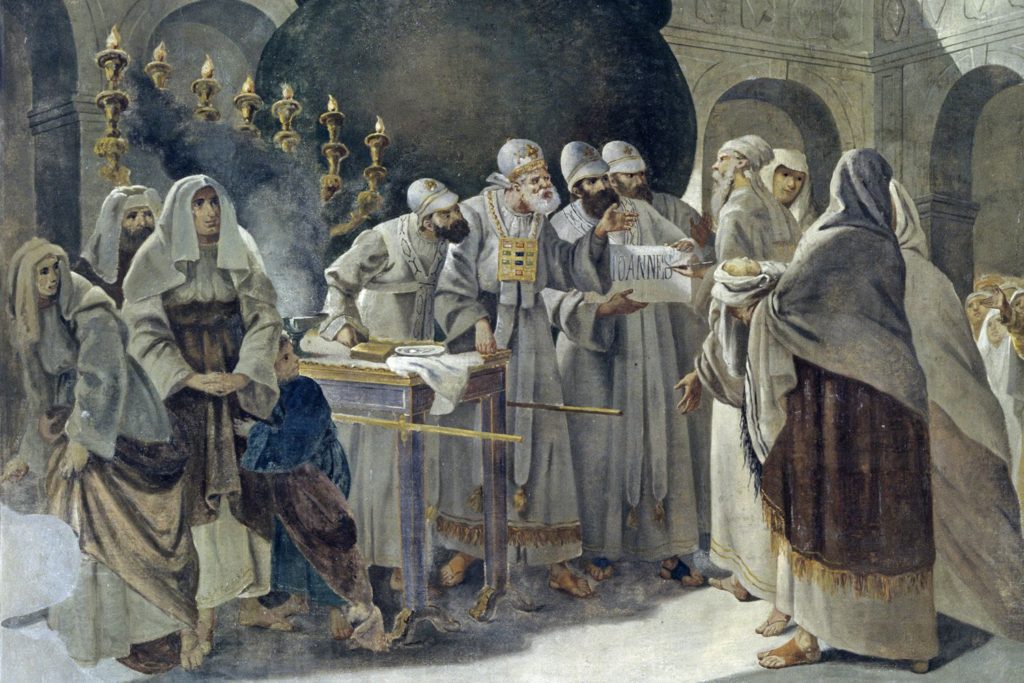
Painting of Zechariah giving name to his son John by Italian painter Riccardo Cessi (1892) from commons.wikimedia.org.

Heaven knows I’m miserable now

Lord My Chef Daily Recipe for the Soul by Fr. Nicanor F. Lalog II
Friday, Solemnity of the Sacred Heart of Jesus, 12 June 2026
Deuteronomy 7:6-11 ><}}}*> 1 John 4:7-16 ><}}}*> Matthew 11:25-30
Photo by author, Sacred Heart Novitiate, Novaliches, QC, March 2026.

You read it right. The title of our reflection on this Solemnity of the Sacred Heart of Jesus is the same title of The Smiths’ 1984 classic Heaven Knows I’m Miserable Now.

It is one of my all-time favorite songs, my theme song after graduating in 1986, landing on my first and only job as it captured my exact situation of the period:

I was happy in the haze of a drunken hour
But Heaven knows, I'm miserable now
I was looking for a job, and then I found a job
And Heaven knows I'm miserable now

Since then, the song has remained relevant with me especially after learning how the young generation appreciate a lot The Smiths that I have used their other music in my spiritual conferences and recollections as a university chaplain. That’s why during our Sacred Heart Novena in our university chapel, the same song kept playing at the back of my mind especially while meditating on the second reading on this feast of the Sacred Heart.

Beloved, let us love one another, because love is of God; everyone who loves is begotten by God and knows God. Whoever is without love does not know God, for God is love. In this is love: not that we have loved God, but that he loved us and sent his Son as expiation for our sins (1 John 4:7-8, 10).

How lovely and simple is our second reading from the letter of the beloved disciple, John who gives us the deepest theological grounding of the Sacred Heart of Jesus: “God is love.”

Pope Benedict XVI used to say Christianity is the only religion is the world with that kind of declaration about God; it is not merely that God loves but that love is God’s very nature!

And what does it mean to us? The older I get, the more I realize and experience that I live because of God’s love: it is the reason I wake up and sleep; why I strive to be my best in everything despite my weaknesses and limitations; why I still love even if I am not loved or misunderstood and even maligned; why I still go in living even if I am sure one day I shall die. 

We live because we are loved by God.

Simply loved because he is love himself.

Not because we are good or does something important or fulfills his divine will.

God loves because it is his very essence as Moses reminds us in the first reading, “It was not because you are the largest of all nations that the Lord set his heart on you and chose you, for you are really the smallest of all nations. It was because the Lord loved you” (Dt.7:7-8).

Hence, John insists that in this is love – not that we loved God but that God loved us first. Our love for God and for one another is a response to his very love.

Would there be any difference at all to begin with God’s initiative rather than our own love?

Surely a lot. Even unthinkable to just rely on our own love and initiative because it is never enough for we humans are imperfect.

Human love is imperfect; only God can love us perfectly. That is why love is always initiated by God. We can’t love on our own. No matter how good and holy we may be. Mayroon palaging maisusumbat ating minamahal sa ating pagmamahal. Sa Diyos wala.

That is why I love the song Heaven Knows I’m Miserable Now.

We humans are so miserable in loving but because of our loving God who is love himself, we are able to love, to keep on loving despite and in spite of everything because to live is to love. Jesus came so that we can continue to love, to keep loving even if the world tells us it is foolish. Even if people don’t care at all for us and do not love us as Morrissey sang it so well in the chorus of Heaven Knows I’m Miserable Now:

In my life, why do I give valuable time
To people who don't care if I live or die?

Very true – fascinatingly – is Morrissey’s third chorus line because he openly brings out the usual thoughts we hide in dealing with people we hate or do not like:

In my life, why do I smile
At people who I'd much rather kick in the eye?

Funny is it not? But very true! And that’s because of God’s love in us, of his grace that despite the many people who hurt us and do not love us, we still choose to be loving and kind, at least smile at them than stoop down to their low levels.

Photo by author, Sacred Heart of Jesus Novitiate, Novaliches, QC, 20 March 2024.

The feast of the Sacred Heart is an invitation to look at the heart of God – at what God most desires for us and for our world. It is not a sentimental image but a radical one: a love that goes all the way to the Cross.

God knows how miserable we are these days when things like positions and power, fame and wealth have become more important than persons to be loved and cared for. Despite the many technological advances we have achieved that promised to make life easier, the opposite proved to be more true. Life has been reduced to mere lifestyle, persons have become objects to be possessed by companies and brands, even by schools!

Today’s celebration of the Sacred Heart feast invites us to go back to Jesus who knows fully well our miseries; songs like Heaven Knows I’m Miserable Now can identify and express them to offer respite for a while but only Jesus can uplift and change us for he alone truly loves us because he is love himself.

“Come to me, all you who labor and are burdened, and I will give you rest. Take my yoke upon you and learn from me, for I am meek and humble of heart; and you will find rest for your selves. For my yoke is easy, and my burden light” (Matthew 11:28-30).

Amid the many miseries we are all going through these days, let us take time today to respond to the love of Jesus Christ in the most honest and true ways that will make others experience his love. Many times, it is the simplest gesture of just being gentle with others in words and in deeds, of not adding to their many burdens in life. Jesus, meek and humble of heart, make our hearts like yours! Amen.

From Youtube.com.

Body & Blood of Christ for the life of the world

Lord My Chef Sunday Recipe for the Soul by Fr. Nicanor F. Lalog II
Solemnity of the Most Holy Body & Blood of Christ-A, 07 May 2026
Deuteronomy 8:2-3, 3:14-16 ><}}}*> 1Corinthians 10:16-17 ><}}}*> John6:51-58
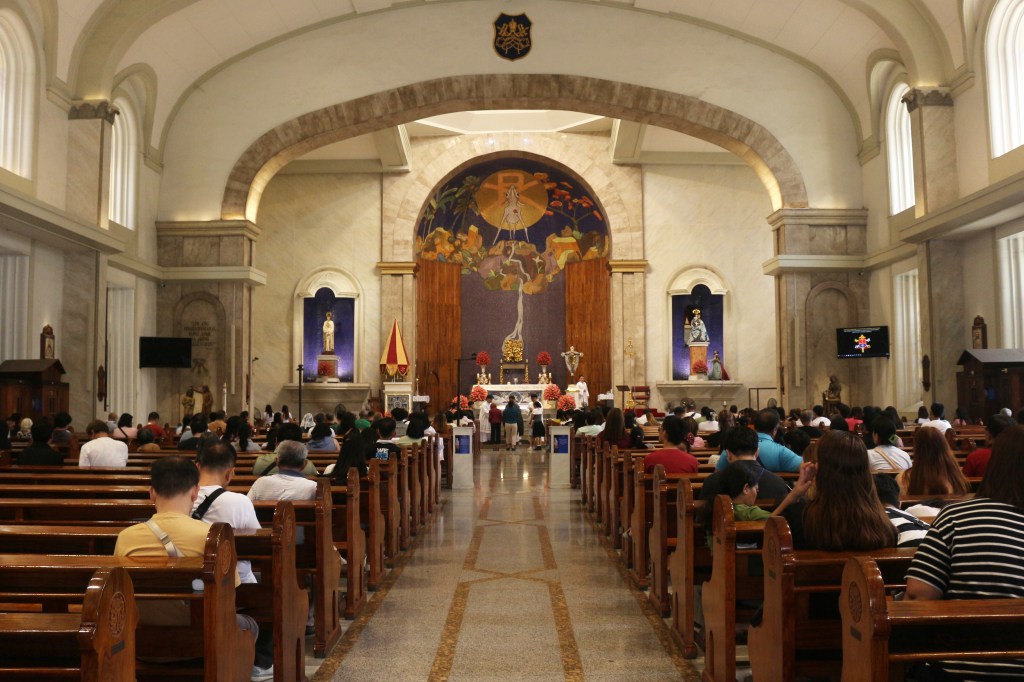
Photo from wikimedia.org of the nave with the classic altar of the Sta. Cruz Church in Manila.

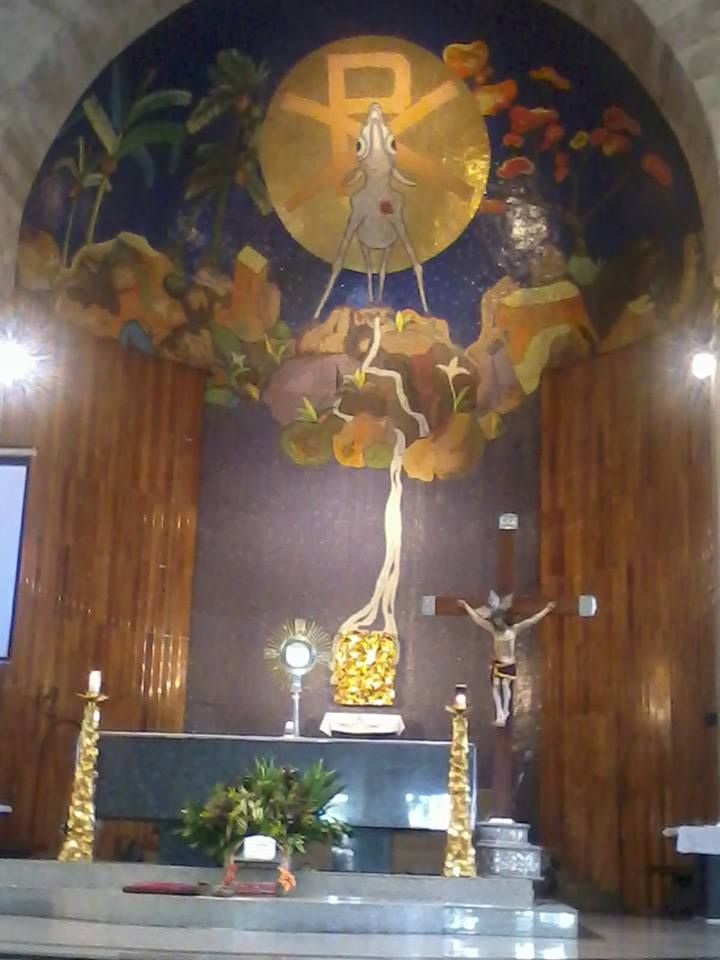
Of the many churches I have been to, the Sta. Cruz Church in Manila remains my favorite. Since childhood, I have always loved its beautiful apse of Byzantine glass mosaic of a sacrificial lamb symbolizing Jesus Christ whose blood flows like a river to the tabernacle amid a setting of mango, banana and fire trees.

Photo from Pinterest.com.

The mosaic gives that feeling of the divine presence that may be a contributing factor too in keeping the solemnity of the many successive Masses celebrated there daily.

After leaving the high school seminary in 1982 while in college at UST, I still went to Sta. Cruz church by taking the Love Bus to Escolta after which I would walk across the street to my dad’s barber for a haircut then lunch at Panciteria Ramon Lee. It remained my refuge whenever I found myself deep into sins and troubles, with problems and difficulties, feeling lost and empty especially later in life while working.

It had played a significant role in my vocation story and that is why I remembered it while reflecting this Sunday’s gospel on the Solemnity of the body and Blood of Christ.

More than a gift offered to us individually in the Eucharist, Jesus intends his Body and Blood “for the life of the world” like that sacrificial lamb depicted at the apse of the Sta. Cruz church.

Jesus said to the Jewish crowds: “I am the living bread that came down from heaven; whoever eats this bread will live forever; and the bread that I will give is my flesh for the life of the world” (John 6:51).

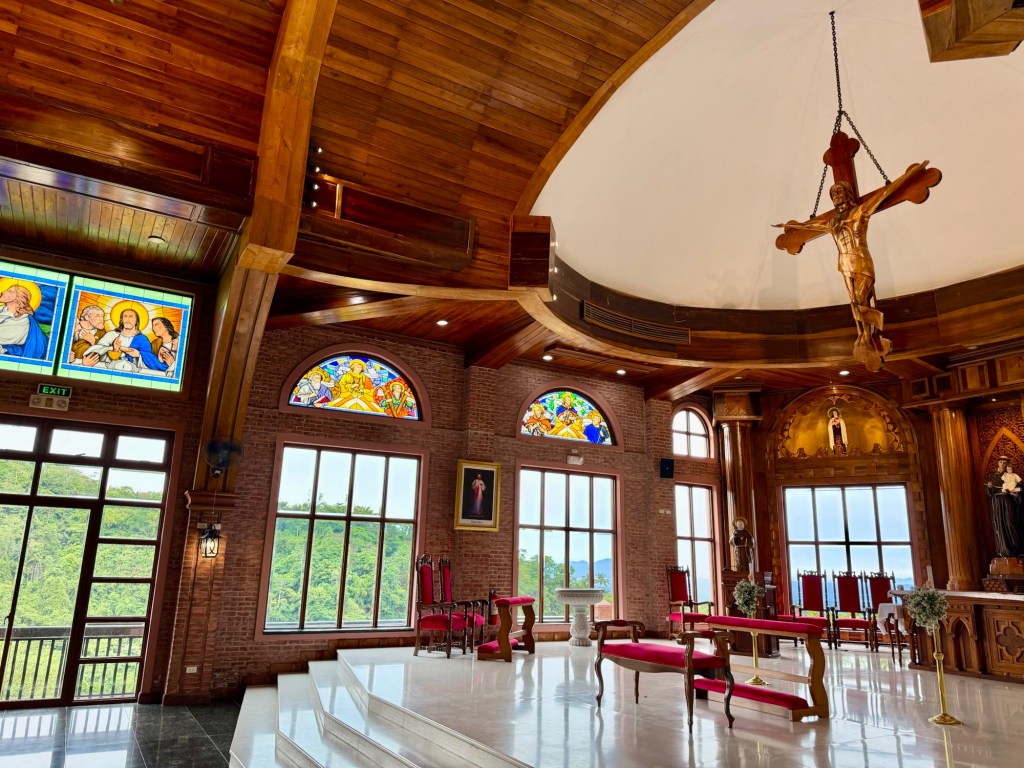
Photo by author, Chapel of St. Anthony De Padua, Alta D’Tagaytay Hotel, 02 June 2026.

On this Solemnity of the Body and Blood of Christ, we are invited to reflect on the meaning of the Holy Eucharist in our lives where the mystery of God in Three Persons, the Blessed Trinity we celebrated last week is revealed and becomes most real.

Faith in God is faith in the Incarnation of Jesus Christ present to us in the Eucharist under the signs of bread and wine. But, what does it mean really for us especially in the light of today’s gospel where Jesus said “and the bread that I will give is my flesh for the life of the world.” How can our individual life contribute in giving the life of the world, Jesus Christ himself?

In his encyclical letter Ecclesia de Eucharistia issued in 2003, St. John Paul II beautifully expressed that if Jesus can transform the bread and wine into his Body and Blood in every Eucharistic celebration, then he can transform us into better persons too.

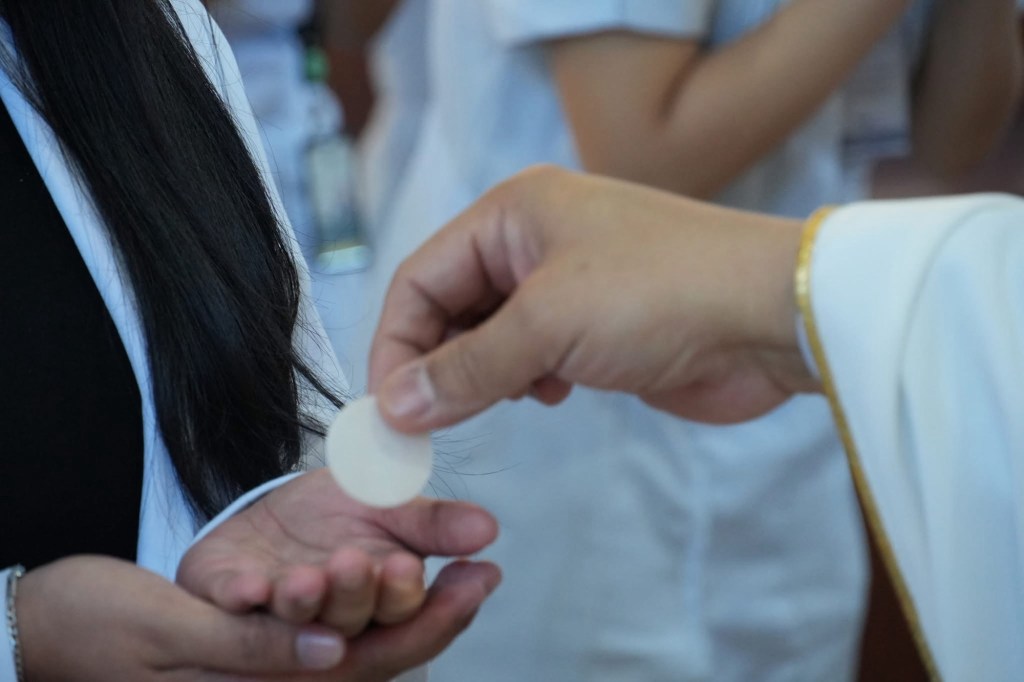
So true! That is why the bestest time to pray is right after receiving Holy Communion because that is when Jesus Christ, Body and Blood, is present in our own body – speak to him in your most natural way. If you want, complain to him. Magsumbong ka rin sa kanya. Pour your heart out to Jesus who is Body and Blood inside you.

However, make sure too that you listen intently to him. When we listen to Jesus, we then enter into a relationship with him as we make him part of our lives as we too become part of his very life. That is when we are filled with his life which we in turn share with others and thus, give life to the world.

Photo by Pixabay on Pexels.com

In the first reading we heard Moses calling us to “remember” not only those forty years in the wilderness by the Israelites but our own journey in the many desert of this life.

The word “remember” is from the root word “member” which means “part” plus the prefix “re” meaning again; to re + member a person and an incident is to make them a part of the present moment again which is the very commandment of Jesus at the Last Supper, “do this is remembrance of me.”

Now look: every week we go through our many exodus like in the first reading. We remember them especially at the start of every week because life is a daily exodus, of coming out from sickness into health, of darkness into light, of slavery into freedom, of sin into grace, of death into life. Yes, our many desert experiences in life were painful but they were all moments of grace too because that is when we realized that we do not live by bread alone, by material things alone – that we need God.

Hence, the first step for us experience this life of Christ as life for the world is to go back to the church, go back to the Holy Mass. These online Masses must be stopped. COVID pandemic is long gone.

The Mass presupposes actual presence because Christ is truly present with us in every celebration. We must learn anew to desire Jesus more in the Eucharist especially on Sundays.

In the Mass, we re-member Jesus in our lives after a week of busy activities and work; as we make Jesus a part of our lives anew, we see also ourselves needing much needed rest and comfort too in Jesus! Inasmuch as we re-member Jesus into our lives, it is actually us being re-membered into Christ who is also our food and drink to nourish us in this daily exodus in life.

Notice how in verse 14 Moses reiterated his call to the people to “remember” but this time what he told them including us today is “do not forget the Lord”: every Mass as our exodus is a way of casting off the temptation to live one’s life without God.

When we come to celebrate the Mass, especially when we are well disposed and prepared, we realize that we are always poor before God who alone can satisfy all our longings and needs.

To forget this is the sure path to catastrophe as many of us would attest.

With God, life; without God, no life.

This we find so clear with the Corinthians during the time of St. Paul that is why he addressed them in the interrogative tone:

Brothers and sisters: The cup of blessing that we bless, is it not a participation in the blood of Christ? The bread that we break, is it not a participation in the body of Christ? Because the loaf of bread is one, we, though many, are one body, for we all partake of the one loaf (1 Corinthians 10:16-17).

The Corinthians at that time were already well aware of how the Eucharist make the Church whose head is Jesus Christ. Hence, the need for a communion or “participation” which is the word used in our translation. St. Paul was reminding them of what they knew in faith, that is, a Holy Communion in Christ which they must put into practice. This communion among the Corinthians would be put into risk when quarrels and divisions plagued their community later that prompted St. Paul to write them a second letter.

As part of the Mass, the Communion is when we receive the Body and Blood of Christ; but, in a deeper sense, Communion is unity in charity. It is Jesus Christ becoming human like us in everything except sin so that we can become holy and divine like him. This mysterious exchange of ourselves with Jesus, in Jesus, and through Jesus happens in the Eucharist where we are nourished and filled with the life of Christ whenever we receive the Holy Communion. May we share this life we have gained in Christ with others by witnessing his Gospel to give life to this sick and dying world – like that sacrificial lamb at the apse of my favorite church in Sta. Cruz. Amen. Have a blessed week ahead.

Lent is greeting, announcing Christ

40 Shades of Lent by Fr. Nicanor F. Lalog II
Wednesday, Solemnity of the Annunciation of the Lord, 25 March 2026
Isaiah 7:10-14, 8:10 +++ Hebrews 10:4-10 +++ Luke 1:26-38
“Cestello Annunciation” by Botticelli painted in 1490; from en.wikipedia.org.

A friend informed me last Monday of the death of a former classmate in elementary named Nilo; his brother Mar had sent me a message asking me if I could possibly celebrate Mass at his wake: “A long time ago we met in a Mass in our Barrio chapel when you approached us and greeted ‘kumusta, Nilo, classmate!’ And I never forgot that smile on his face after you acknowledged him. Nilo was so happy with your coming to him… we will greatly appreciate if you can celebrate Mass for him in his wake.”

I was so touched with the message and despite my toxic schedule this week, I promised to come today to offer a Mass for Nilo.

That’s why while praying over today’s Solemnity of the Annunciation, I realized how in every greeting we also bring Jesus Christ, of how we make him present in others too.

In the sixth month, the angel Gabriel was sent from God to a town of Galilee called Nazareth, to a virgin betrothed to a man named Joseph, of the house of David, and the virgin’s name was Mary. And coming of her, he said, “Hail, full of grace! Then Lord is with you.” (Luke 1:26-28)

Photo by Ar. Philip Santiago, Annunciation Basilica in Nazareth, October 2025.

The Solemnity of the Annunciation of the Lord often falls in Lent, adding more meaning in our inner journey into our hearts to meet Christ in this blessed season.

Notice how in our Sunday and daily readings we find God greeting us, inviting us to come to him to set things right in our lives (Is.1:18). Here is a God so loving, pointing out our sins but never judging us but actually believing in us that we could change and be converted to become better persons.

The past three weeks have been so tiring but fulfilling for me as a university chaplain giving recollection and hearing confession later in our various university campuses. First thing I tell every penitent is how God is so happy with us when we come to the sacrament of reconciliation because he has long been waiting for us. God rejoices because we finally welcome him in our lives!

Though it could be painful and shameful to confess our many sins, it is actually the sign of grace working in us too because the moment we change our sinful ways, then we grow! When we see our sins, our weaknesses and limitations as humans yet still forge on in life to become better persons, to achieve greater things for others, that is God working in us.

That is why Luke tells us today how the angel greeted Mary during the annunciation using the Greek words “kaire” which is to rejoice and “charis” or “karis” for grace:  “Hail (or rejoice), full of grace!  The Lord is with you” (Lk.1:28). 

This is actually unusual because Jews greet each other with “shalom” for peace; why did Luke use kaire?

Because wherever and whenever there is grace, surely there is rejoicing like in those beautiful gospel stories we have heard the past three Sundays this Lent: the Samaritan woman, the healing of the man born blind, and the raising to life of Lazarus who had been dead for four days. In all these instances, it was Jesus Christ who came on his own to bring grace to everyone that everybody rejoiced.

Photo by Ar. Philip Santiago, Annunciation Basilica in Nazareth, October 2025.

Lent is the time to get real, to stop pretending. It is the time for us to finally admit our own limitations and weaknesses in order to create a space in our hearts and in our lives to let God fill us, to let God possess us. That is the purpose of the lenten practice of fasting.

Mary became the Mother of Jesus Christ not because of any special qualities in herself but simply because God is so good, so loving. Despite her fears and questions, she welcomed the angel Gabriel by saying “yes” to God’s plan of giving birth to the Messiah and Savior of mankind.

Can we be like Mary who said yes and allowed God’s power to “hover over us” to renew our lives in welcoming Jesus Christ? 

This was the problem of Isaiah with King Ahaz in the first reading who pretended to refusing God in asking for signs of his presence when actually he had already entered into alliances with other pagan kings in the region as the Babylonians were closing in them; he had doubted God already. Hence, Isaiah’s prophecy to insist that God is our protector: “Listen, O house of David! Is it not enough for you to weary men, must you also weary my God? Therefore the Lord himself will give you this sign: the virgin shall be with child, and bear a son, and shall name him Emmanuel: God is with us” (Is.7:13-14; 8:10).

Photo by cottonbro studio on Pexels.com

How sad that in this modern time when we rely more with our science and technology, we have not only shut out God from our lives but we have even refused to welcome him in his coming to us, asking us to open ourselves anew to him and his powers and plans. We have not only become impersonal but worst, we seem to have chosen death more than life, darkness than light. Just check on the news going on everywhere and we see how heartless we have become.

The late American spiritual writer and monk Thomas Merton rightly said, “We live in a time of no room, which is the time of the end.  The time when everyone is obsessed with lack of time, lack of space, with saving time, conquering space… The primordial blessing, ‘increase and multiply’ has suddenly become a hemorrhage of terror… In the time of the end there is no longer room for the desire to go on living.  Why?  Because they are part of a proliferation of life that is not fully alive, it is programmed for death” (Raids on the Unspeakable, pp. 70-72).

What a tragedy in our modern time when we are supposed to be more intelligent with so many inventions, more affluent with so many money, more real with everything being shown in social media, the more we are empty and lost. Our communications are all mass mediated, no more person to person that is warm, so filled with life that is vibrant and dynamic giving us so much reasons to believe, to love, to hope in life and the future.

The Solemnity of the Lord reminds us today of God’s coming among us like one of us in everything except sin. In Christ’s coming through the Blessed Virgin Mary, we are reminded how each one of us is a sign of God’s presence and coming. Every time we greet one another, every time we reach out to others in love and kindness, every time we are one with others especially the marginalized and neglected, we do the will of God (second reading) and become an Emmanuel, a God-is-with-us. Amen.

Photo by author, Sacred Heart Novitiate, Novaliches, QC, 20 March 2026.

Welcoming 2026 with Mary

Lord My Chef Daily Recipe for the Soul by Fr. Nicanor F. Lalog II
Thursday, Solemnity of Mary, Mother of God, 01 January 2026
Numbers 6:22-27 ><}}}}*> Galatians 4:4-7 ><}}}}*> Luke 2:16-21
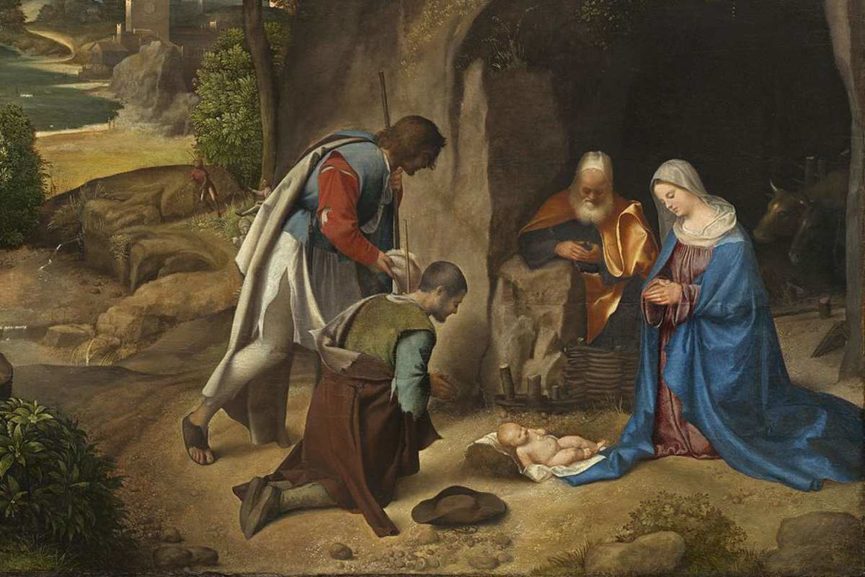
“The Adoration of the Shepherds”, a painting of the Nativity scene by Italian artist Giorgione before his death at a very young age of 30 in 1510.

Still a blessed Merry Christmas to everyone! Please continue greeting one another with a Merry Christmas until January 11, 2026, the Feast of the Lord’s Baptism that closes the Christmas Season.

Keep greeting Merry Christmas even on this new year’s day because what we celebrate today is the Solemnity of Mary, Mother of God – not the New Year! Remember we had our new year last first Sunday of Advent, evening of November 29 and the 30th.

Stop announcing our New Year’s Mass. Our Mass today is Solemnity of Mary, Mother of God which is the Eighth Day within the Octave of Christmas.

It is the oldest feast of the Blessed Virgin Mary that celebrates the mystery of her being the Mother of Jesus Christ who is true God and true Man following the Council of Ephesus in 431 AD. Since Jesus remained fully God and fully human in his conception by the Blessed Virgin Mary, it is right and proper too as the Council affirmed to call Mary the “Mother of God” (Theotokos). Since the birth of Christ is also our point reference in reckoning time that we have the terms “BC” (Before Christ) and “AD” (Anno Domini or Year of the Lord), this celebration teaches a lot on how to welcome this 2026 like Mary.

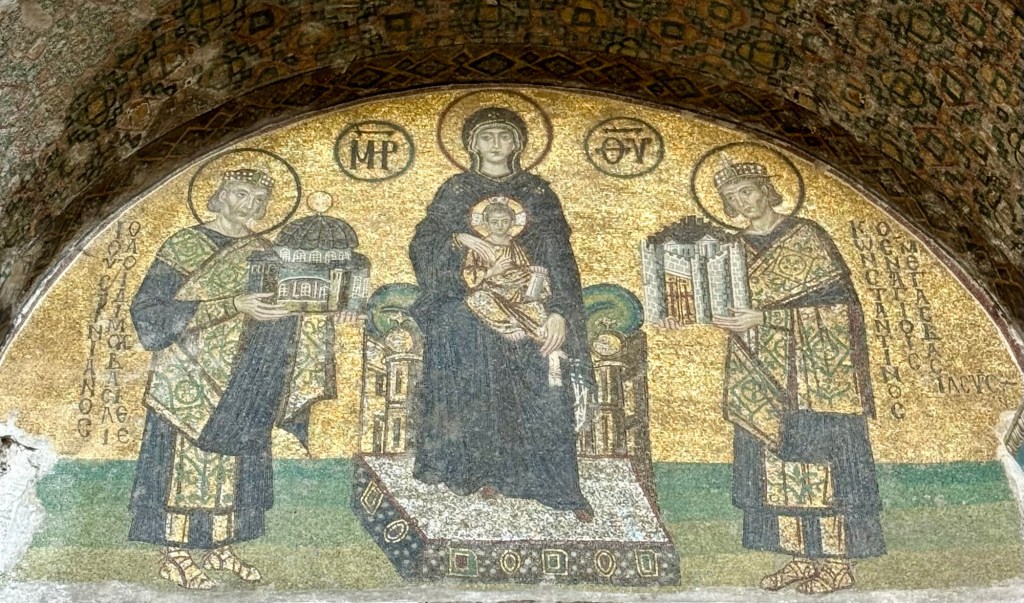
Photo by author, mosaic of Mary with Jesus, Hagia Sophia, Istanbul, Turkiye, 01 November 2025.

First lesson the Blessed Virgin Mary teaches us this new year in Christ is what we have mentioned last Christmas – if there is anything that merits haste, it is those of things of God. How sad that these days we are so preoccupied with what is trending and viral or we race for what is “in” in fashion and everything. In an age of instants, we rush everything that we miss out life itself, God and one another, especially our very selves.

The shepherds went in haste to Bethlehem and found Mary and Joseph, and the infant lying in the manger. When they saw this, they made known the message that had been told them about this child (Luke 2:16-17).

Mary went in haste too for the Lord. Recall her response to the Angel at the Annunciation, “Be it done unto me according to your word.” Her response was immediate. She did not dare the Angel like Zechariah. After the Annunciation, Mary went in haste to visit her cousin Elizabeth pregnant with John the Baptist.

Photo by author, December 2020.

It is true that “haste makes waste” because doing things too quickly leads to mistakes that result in greater losses in time, effort, and materials. The great St. Francis Sales cautioned us that haste is the biggest enemy of growth in spirituality.

However, during the Christmas season, we find that haste is not that totally bad at all.

As shown to us both by Mary and the shepherds, there is something so good with making haste to find Christ, to share Christ, to be with Christ.

We have a prayer formula now rarely used in public prayers wherein the leader says “O God come to my assistance” with the people responding, “O Lord make haste to help me” while making the sign of the Cross like in the praying of the Rosary. It is a beautiful prayer that tells us how God would always hasten to come to us even before we have called Him!

How sad that we rush to everything and everyone except to Jesus our Lord and God! More sad is the fact so many people have been in making haste to these days for the more mundane things without even spending some quality time in the church to pray.

This 2026, let us go in haste in the Lord for He has so many things in store for us as the shepherds and Elizabeth realized.

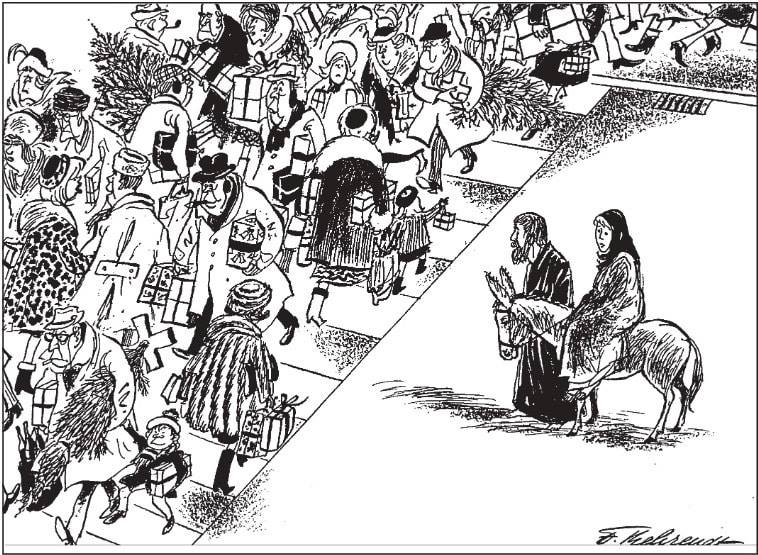
From forwarded cartoon at Facebook, December 2020.

Second important lesson the Blessed Mother is teaching us in welcoming Jesus Christ this new year is the value of silence which is a prerequisite in cultivating a prayer life, in making haste to God.

Though I grew up from the very barrio that manufactures most of the pyrotechnics sold in my hometown of Bocaue in Bulacan dubbed as the fireworks capital of the Philippines, I never liked these popular products every new year. Aside from being so dirty, these are so dangerous as I have seen many of our neighbors who have lost their arms, hands or fingers in manufacturing and playing with fireworks. Worst of all are the many lives of people lost following explosions of some factories in our barrio.

When I became a priest, I kept telling people including my barrio folks that welcoming the new year with fireworks is pagan practice, not Christian. And the most Christian way of welcoming new year like Mother Mary is always in silence, silent prayer like before the Blessed Sacrament.

Photo by Ar. Philip Santiago, Chapel at the Angels’ Field in Bethlehem, October 2025.

All who heard it were amazed by what had been told them by the shepherds. And Mary kept all these things, reflecting on them in her heart (Luke 2:18-19).

It is very interesting that Luke had told us how people were amazed at what the shepherds spoke about that night on the birth of Jesus Christ they have found on a manger with his Mother Mary and her husband Joseph. Keep in mind that the shepherds were among the least trusted people of that time but their story went “viral” and “trending” so to speak. Amid all these talks was Mary, the Mother of Jesus, silently meditating everything in her heart!

Tonight or today, try to spend some silent moments of prayer before the Blessed Sacrament to thank God for all the blessings of 2025 as well as to listen to Christ’s instructions and plans for us this 2026. Jesus has always something to tell us but we always go in haste somewhere else or to somebody else. Jesus is right there in our hearts, the faintest voice you always dismiss and take for granted.

Let us cultivate a prayer life like Mary who always kept in her heart the words and experiences she had with Jesus. Let us not be like the shepherds who were there only at Christmas, never came back to Jesus specially when he was preaching in Galilee and when crucified on Good Friday wherein his constant companion in silence was Mary his Mother.

Photo by Ar. Philip Santiago, Basilica of the Annunciation, Nazareth, October 2025.

Third important lesson the Blessed Mother Mary is teaching us this first day of 2026 is to have faith in God in Jesus Christ His Son our Savior. Therefore, please stop all those superstitious beliefs of pampasuwerte like feng shui and fortune telling that are pagan practices.

When eight days were completed for his circumcision, he was named Jesus, the name given him by the angel before he was conceived in the womb (Luke 2:21).

Mary was very much like us when Mary gave birth to Jesus on that first Christmas: she too was totally unaware of what was in store for her, of what would happen to her Son. She was totally unaware of what would happen in the future. The only thing she was certain was the name to be given to her child, “Jesus” which means “God is my Savior”.

All blessings come only from God, not from any other spirits. We drive all the malas and bad spirits and negative vibes of the past year not with noises and blasts of trumpets or fireworks but with silence that is rooted in deep faith in Christ Jesus.

Such was the attitude of Mary on that first Christmas until her glorious Assumption into heaven: she never knew Jesus would be betrayed by one of his trusted friends and apostles; she was never told by the angel how after Jesus would feed and heal so many people He would later be arrested and crucified like a criminal except that she believed in Him until the end, remaining with Christ at the foot of the Cross.

All Mary had was a deep faith in Jesus as told her by the angel as the name to be given to her child is also the child of the Most High. Like Mary, let us keep our faith in Christ alone, not to round fruits nor stones nor other stuffs peddled to us to bring luck this new year.

Let us imitate Mary, the Mother of God, so human like us except in sin who was always in haste with things of God, silently meditating his words and workings, and most of all, trusting wholly in her Son Jesus. Amen. May your new year be filled with Christ’s peace and grace!
Photo by Ar. Philip Santiago, Basilica of the Annunciation, Nazareth, October 2025.

Christmas Stable, stability of mankind

Lord My Chef Christmas Eve Recipe, 24 December 2025
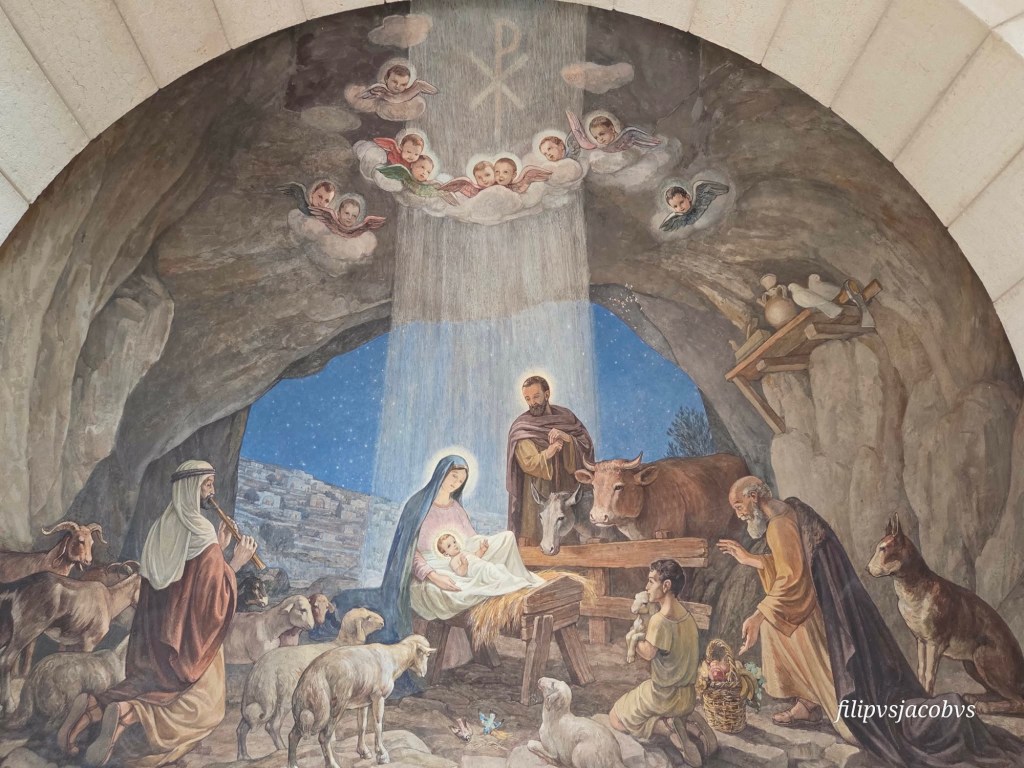
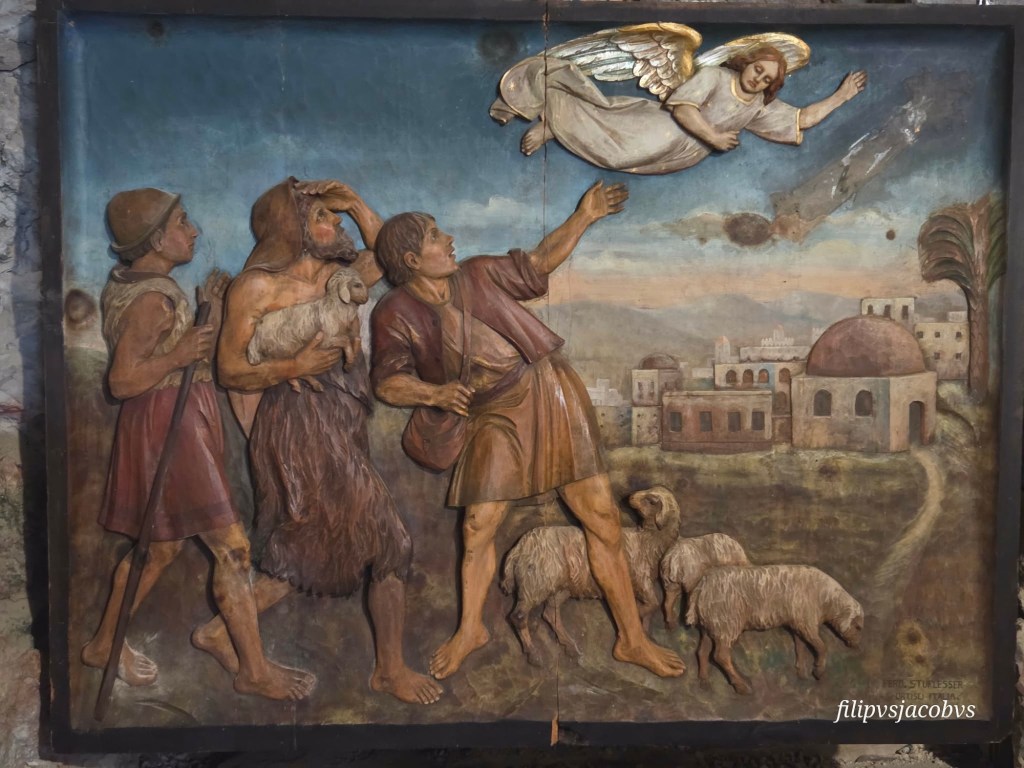
Photo by Ar. Philip Santiago, a mural of angels announcing the birth of Jesus Christ to shepherds in the field, Angels’ Field Chapel in Bethlehem, October 2025.

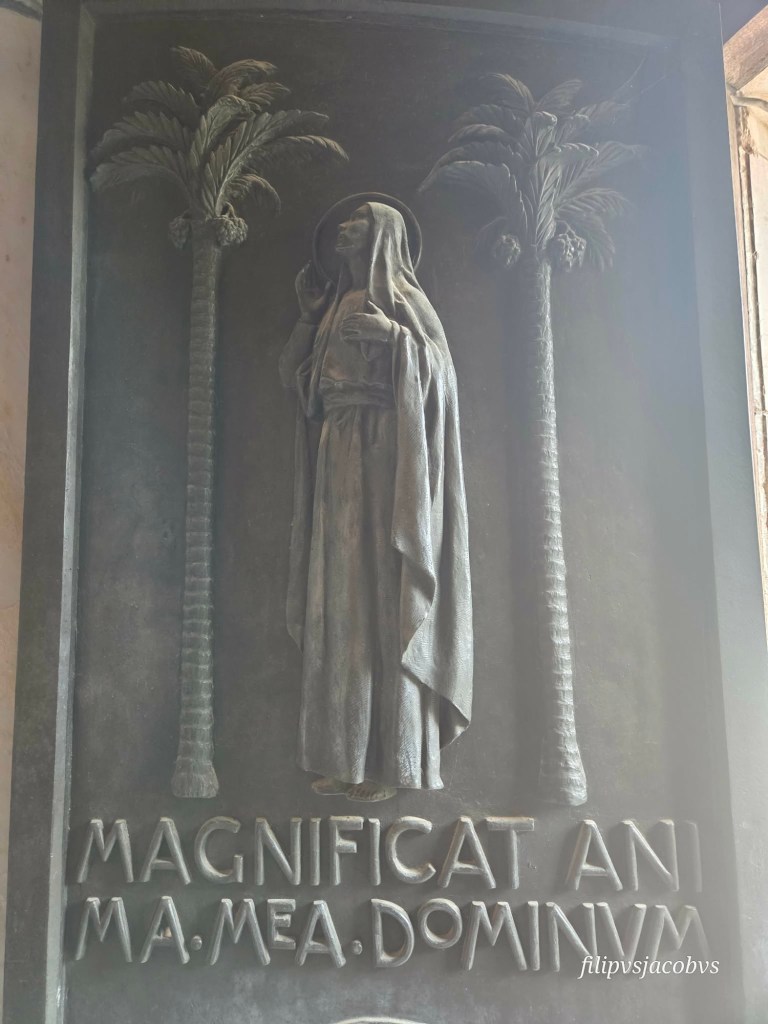
A blessed Merry Christmas, friends ad relatives, especially our followers. In our Monday’s Simbang Gabi when Mary sang her Magnificat during her Visitation of Elizabeth, we reflected how songs not only express our innermost thoughts and feelings but reveal our very person, too.

Allow me this Christmas to share with you a song I have recently heard to reflect on the meaning of Jesus Christ’s birth. The song is called “My Lord Has Come” written in 2010 by Will Todd, a renowned contemporary British composer and pianist who blends melodic classical compositions with jazz elements. Check YouTube to feel its moving music but for now, experience the sense of wonder in its inspiring lyrics.

Shepherds, called by angels,
called by love and angels:
No place for them but a stable.
My Lord has come.

Sages, searching for stars,
searching for love in heaven;
No place for them but a stable.
My Lord has come.

His love will hold me,
his love will cherish me,
love will cradle me.
Lead me, lead me to see him,
sages and shepherds and angels;
No place for me but a stable.
My Lord has come.
Photo by Ar. Philip Santiago, a mural of shepherds as first visitors to the newborn King of kings, Angels’ Field Chapel in Bethlehem, October 2025.

I learned and heard this song last week while researching for materials this Christmas. And the word “stable” struck me.

See its varied meanings. First, “stable” means firm and sturdy, unshakeable like a stable table, stable ground, and stable truth or opinion. But during this period, we know a “stable” also refers to the Nativity scene or creche which we Filipinos call as a Belen that is actually a translation of the Lord’s birthplace of Bethlehem.

In those days a decree went out from Caesar Augustus that the whole world should be enrolled. This was the first enrollment, when Quirinius was governor of Syria. So all went to be enrolled, each to his own town. And Joseph too went up from Galilee from the town of Nazareth to Judea, to the city of David that is called Bethlehem, because he was of the house and family of David, to be enrolled with Mary, his betrothed, who was with child. While they were there, the time came for her to have her child, and she gave birth to her firstborn son. She wrapped him in a manger, because there was no room for them in the inn (Luke 2:1-7).

How lovely that God manifested to us in the most humble way, being born on a manger, at a stable for animals!

And see now why Christmas is the greatest exchange gift of all time when God became human like us born in a stable so that we too may become divine like Him.

But, it is no easy exchange gift we often do in our Christmas parties when we just have to buy gifts that fall within the range of prices we have agreed upon. Jesus Christ the Son of God came not for any price that can be bought and paid by humans for He came with His whole life and being.

Picture the Christmas stable, of how the eternal entered the temporal, the infinite and perfect became flesh and bones and blood among us, so intimate with life and all the mess and chaos of living including death itself. He was born because He loves each one of us immensely.

And listen now to Will Todd telling us, “The Lord has come in a stable… anyone searching for Him – whether angels or shepherds or sages like the Magis, there’s no place except the stable.

Even for me and for us searching for stability in life, meaning in life, direction in life that can be found only in the stable where the Lord has come. How lovely!

In the silence of the darkest night of the year, amid the loud claims of everyone being the greatest and most powerful, the best and brightest, unknown to them the only true great and mighty one is in the stable.

In the gospel we heard too how the shepherds went in haste to visit the newborn Messiah in the stable, rejoicing afterwards at the great sight and good news they have found.

But, how about us today? How sad nobody cares at all to go to the Holy Mass which is actually the modern Christmas stable of Bethlehem which means “house of bread”. Jesus is the Bread of life as He preached later in life in the Gospel of John. On the eve of His death at the Last Supper, Jesus gave Himself as the Bread broken and shared for all lifetime to lead us to eternity.

How sad that we search for life’s meaning and sense in the most unstable of all instances like science and technology, new thoughts and ideas that overextend our rights without any regard for responsibilities and true freedom. If there is anything that merits haste these days, it is the things of God like the Mass and prayers and Sacred Scriptures. Not social media and all those viral and trending reels of our follies and stupidities we love to follow.

Photo by author, Christmas 2021 at Basic Education Department Chapel, OLFU-Valenzuela City.

See also the animals in the Christmas stable especially the ox and donkey who all symbolize our blindness to God who humbly came to us in the stable. Isaiah and the other prophets in the Old Testament lamented how animals particularly the ox and donkey “know” so well where to go when hungry and thirsty which is the stable while we humans wander far because we are so blinded by many things.

Christmas tells us humans to stop looking so far as Will Todd insists in his great composition My Lord Has Come inspired by our readings last night and today: it is only in Bethlehem that we find the true stable reality of life where the Son of God was born so that we now reckon time according to His birth with BC and AD because humans and civilizations do not last. “Jesus Christ is the same yesterday and today and forever” (Hebews 13:8).

Our only stability in life is found in the Christmas stable especially when the nights are dark and long. Amen. A blessed and stable Merry Christmas to you!
Our song, our music – our self

Lord My Chef Simbang Gabi Recipe for the Soul by Fr. Nicanor F. Lalog II
Monday, Simbang Gabi-VII, 22 December 2025
1 Samuel 1:24-28 <*((((>< + ><))))*> Luke 1:46-56
Photo by author, Church of Visitation, Ein-Karem, Israel, 2017.

One of the most beautiful and touching sites in the Holy Land I have always loved is the Church of the Visitation at Ein-Karem outside Jerusalem where Mary visited her cousin Elizabeth.

It sits atop of a hill and there’s no other way to get there except by foot due to the narrow road but, it is worth all the effort for anyone going up there with the beautiful scenes all the way with cool breeze soothing your face and lovely flowers delighting your eyes and senses. It somehow gives every pilgrim a taste of the great love and joy of Mary pregnant with out Lord Jesus Christ visiting her cousin Elizabeth on the sixth month of her pregnancy with John the Baptist.

Photo by Ar. Philip Santiago, Church of Visitation, the Holy Land, October 2025.

Perhaps we could say the Visitation was the first Christmas party in history as Luke tells us today how Mary rejoiced in God singing the Magnificat after Elizabeth praised her:

“My soul proclaims the greatness of the Lord, my spirit rejoices in God my savior.  For he has looked upon his lowly servant.  From this day, all generations will call me blessed:  the Almighty has done great things for me, and holy is his Name.  He has mercy on those who fear him in every generation.  He has shown the strength of his arm, and has scattered the proud in their conceit.  He has cast down the mighty from their thrones and has lifted up the lowly.  He has filled the hungry with good things, and the rich he has sent away empty.  He has come to the help of servant Israel, for he has remembered his promise of mercy, the promise he made to our fathers, to Abraham and to his children forever” (Luke 1:46-55).

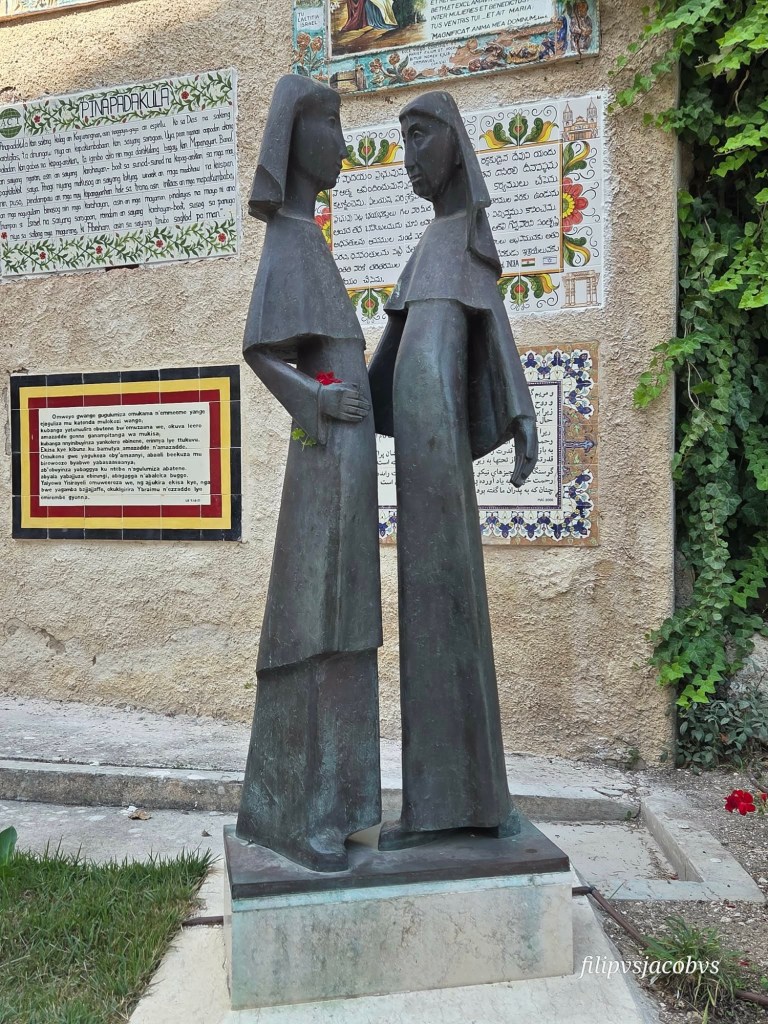
Aside from this beautiful bronze statues of Mary and Elizabeth at the patio of the Church of the Visitation are the translations of the Magnificat in different languages, including in our very own Filipino which is one of the most popular songs we often sing in our Masses.

Photo by Ar. Philip Santiago, Church of Visitation, the Holy Land, October 2025.

But, do we really realize the meaning of this song of Mary?

Actually, the Magnificat was composed by Luke that he placed on the lips of Mama Mary. It is part of his artistry, of putting songs on the lips of some of his Christmas characters like Zechariah after John’s circumcision (the Benedictus) and later on Simeon (Nunc Dimittis) at the Presentation of Jesus in the temple.

Why? Because singing, like dancing, is the highest expression of our feelings to the one we love. Mothers sing lullabies to their infants, suitors compose and sing songs to their beloved, and we Filipinos sing and dance in whatever mood we are wherever we may be! There is always music in us from the simple gesture of washing the dishes, ironing of clothes to driving and taking a shower. When we sing and dance, we not only show what’s inside us but most of all who we are!

Photo by Ar. Philip Santiago, Church of Visitation, the Holy Land, October 2025.

In singing the Magnificat which St. Luke patterned after a similar song by Hannah at the birth of her son the Prophet Samuel who’s story we heard in the first reading, Mother Mary expressed her joy and gratitude in the nearness of God among us not only with the coming birth of her Son Jesus Christ but also through her!

The late Fr. Raymond Brown, one of the great biblical scholars of our time noted in his classic “Birth of the Messiah” that Mary as the first Christian is teaching us in her Magnificat the essential task of every disciple of the Lord which is, after hearing the word of God and accepting it, we must share it with others, not by simply repeating it but by interpreting it so that people can see it truly as the good news

Here we wish to mention something we have read recently about singing and dancing that the best singer or best dancer is one who can listen or hear – and fill the silent gaps in every piece of music. That’s amazing because singing and dancing are not about having super beautiful voice or precise steps. Singing and dancing are more of attitude, of claiming and owning a piece of music as yours. That’s why it is called an interpretation or as young people these days refer to as “cover”.

As we have mentioned earlier, one of the most popular Mass songs in the country is Mary’s Magnificat called Ang Puso Ko’y Nagpupuri but does it reflect our spirituality as a Christian nation?

Photo by Ar. Philip Santiago, Church of Visitation, the Holy Land, October 2025.

Have you noticed how this 2025 that we heard so little of Mr. Jose Mari Chan his Christmas in Our Hearts?

I feel sorry for Mr. Chan when suddenly this 2025 he is more heard and seen in the McDonald’s commercial shouting “George!” to a fellow senior citizen. We as a nation momentarily forgot about Mr. Chan’s classic line “whenever I see girls and boys selling lanterns” because we as a nation is so disgusted with the ghost project scams of flood controls. We could not even emphatize with the family of the former Undesecretary of DPWH who had died of an apparent suicide because of the “breadth and depth and height” of their corruption running into trillions of pesos. They have cheated on us big time and we really wonder why the big “congtractors” and senators are not yet in jail?
But God has been so good to us this Christmas that we can all sing with conviction the Magnificat for indeed, “the Almighty has done great things for us” like putting into jail in a far away land the former president who called God as stupid not once nor twice but multiple times on television. That is aside from ordering the bloodiest anti-drug campaign he shamelessly likened to Hitler’s Holocaust of Jews in World War II.
The Lord invites us to make this 2025 as the last Christmas we allow corrupt and inept people get elected, that we finally put an end to political dynasty, and stop the stupidity and callousness of people in government who set a budget of 500pesos for people to enjoy noche buena.

Photo by Ar. Philip Santiago, Church of Visitation, the Holy Land, October 2025.

This Christmas let us sing like Mary, as faithful disciple of Christ, sharing Jesus, always Jesus and only Jesus in singing the Magnificat in our daily witnessing to the Gospel, making Jesus come in our life of loving service to everyone especially those in need. Let us actively cooperate with Jesus like Mary his Mother to make these lines a living reality in our midst – “he has mercy on those who fear him in every generation, showing the strength of his arm by scattering the proud in their conceit, casting down the mighty from their thrones, lifting up the lowly, filling the hungry with good things, sending the rich away empty, coming to the help of Israel, for he has remembered his promise of mercy”.

More than a song and hymn, the Magnificat reveals us as the signs of the Christ, the Emmanuel, God-is-with-us! Amen. A blessed week ahead of everyone!

Advent is allowing God to overshadow us like Mary

Lord My Chef Simbang Gabi Recipe for the Soul by Fr. Nicanor F. Lalog II
Saturday, Simbang Gabi-V, 20 December 2025
Isaiah 7:10-14 <*((((>< + ><))))*> Luke 1:26-38

Basilica of the Annunciation in Nazareth, Israel; photo by Ar. Philip Santiago, October 2025.

On this fifth day of our Simbang Gabi we hear the second Christmas story by Luke, telling us how six months after announcing to Zechariah the coming of their son John, the angel Gabriel went to Nazareth to announce the birth of our Savior Jesus Christ to the Blessed Virgin Mary who was betrothed to St. Joseph.  Unlike Zechariah who doubted the angel’s message, Mary was more open with her response by asking how it would all take place.  

And the angel said to her in reply, “The Holy Spirit will come upon you, and the power of the Most High will overshadow you.  Therefore the child to be born will be called holy, the Son of God” (Luke 1:35).

We reflected the other day how Matthew ended his story of the genealogy of Jesus Christ with Mary to show her as the new beginning of everything in the world. Through Mary’s giving birth to Jesus, we now share with Him one common origin in faith who is God as our Father so that despite our many sins and failures, we are given with a fresh start, new opportunities in life daily. Luke bolsters this today with his account of the annunciation of the birth of Jesus to Mary. 

Photo by Ar. Philip Santiago, Annunciation Basilica in Nazareth, October 2025.

As a Jew, Mary must be totally aware of the words of the angel about herself being “overshadowed by the Most High” like in the Old Testament stories of God’s presence in the cloud during their journey in the wilderness after their exodus from Egypt.  Even Moses could not enter the tent when “the cloud covered it and the glory of the Lord filled the tabernacle” (Ex.40:34-38). 

To be filled and overshadowed by the presence of God is to be to be possessed by God and eventually to be transformed by God. 

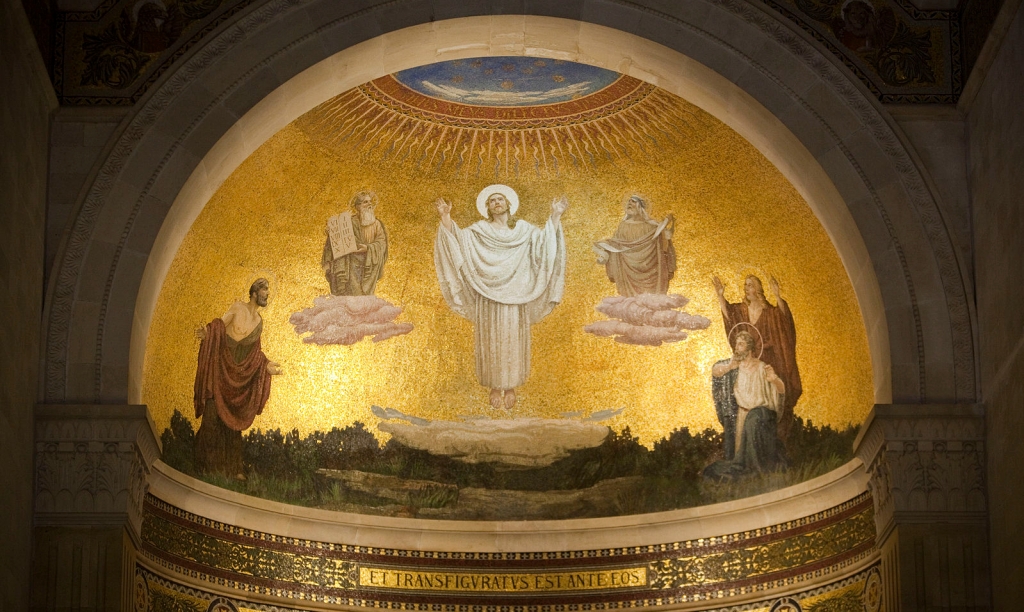
Remember how in the movie “The Ten Commandments” when the face of Moses was transformed after meeting God. In the New Testament, the three synoptic gospels record a similar incident of God’s presence in a cloud hovering with Jesus during His transfiguration at Mount Tabor witnessed by Peter, James and John. The two great prophets of Israel were there, Elijah and Moses conversing with Jesus when a cloud overshadowed them with a voice declaring “this is my beloved Son, listen to Him.” Matthew, Mark and Luke tell us how the apostles were all terrified at the sight of the Transfiguration. 

And we can also surmise how terrifying it must be to experience God’s presence, to be filled with God.  But that is how grace works! 

Photo by Ar. Philip Santiago, Annunciation Basilica in Nazareth, October 2025.

At the start of our Simbang Gabi we have reflected how under the light of Christ we are able to see our sinfulness and weaknesses that sometimes we feel so sorry for ourselves but that is actually when grace works in us – the moment we change our sinful ways, then we grow!

When we see our limitations as humans yet still forge on in life to achieve greater things, to become better persons, that is God working in us. That is why Luke tells us today how the angel greeted Mary during the annunciation using the Greek words “kaire” which is to rejoice and “charis” or “karis” for grace:  “Hail (or rejoice), full of grace!  The Lord is with you” (Lk.1:28). 

This is actually unusual because Jews greet each other with “shalom” for peace; why did Luke use kaire? Because wherever and whenever there is grace, surely there is rejoicing like in our Third Sunday of Advent called Gaudete Sunday: we rejoice because the Lord who is pure grace is near!

The late American spiritual writer and monk Thomas Merton rightly said, “We live in a time of no room, which is the time of the end.  The time when everyone is obsessed with lack of time, lack of space, with saving time, conquering space… The primordial blessing, ‘increase and multiply’ has suddenly become a hemorrhage of terror… In the time of the end there is no longer room for the desire to go on living.  Why?  Because they are part of a proliferation of life that is not fully alive, it is programmed for death” (Raids on the Unspeakable, pp. 70-72).

Photo by Ar. Philip Santiago, Annunciation Basilica in Nazareth, October 2025.

Advent is the time to get real, to stop pretending. Advent is the time for us to finally admit our own limitations, to create a space in our hearts and in our lives to let God fill us, to let God possess us. 

Can we, like Mary allow God’s power “hover over us” to renew our lives in welcoming Jesus Christ? This was the problem of Isaiah with King Ahaz in the first reading who pretended to refusing God giving signs of his presence when actually he had already entered into alliances with other pagan kings in the region as the Babylonians were closing in them; that is why Isaiah uttered the prophecy to insist that God is our protector: “Listen, O house of David! Is it not enough for you to weary men, must you also weary my God? Therefore the Lord himself will give you this sign: the virgin shall be with child, and bear a son, and shall name him Emmanuel” (Is.7:13-14).

Let me end this reflection by inviting you dear friends to pray for Fr. Flavie Villanueva, an SVD priest so active in caring for the poor especially the orphans left by victims of tokhang. He was recently awarded the Ramon Magsaysay Award considered as Asia’s equivalent of Nobel Peace Prize for his works for the poor.

Yes, he had a very dark past, being a former drug dependent but God used that chapter in his life to make him turn around and become a missionary priest. Fr. Flavie had never hidden nor sanitized his dark past because it was during those years when he also found the light and grace of God’s love and mercy for him. Perhaps, he is most effective in his works among the poor and the addicts precisely because he used to be one of them! He is now under attack for his works by the dark elements of the past administration, the most decadent in our history.

From Facebook via Political Insight Today, 18 December 2025.

Fr. Flavie is no Virgin Mary but like her, he opened his heart to God who eventually overshadowed him with His powers to do all these great things for the poor who now feel Christ’s presence.

Recall now the many instances in our lives where we have learned our most important lessons in life and most surely, these were also the moments we have faced many hardships and sufferings but, instead of being down, these have inspired us and transformed us into better persons.

Let us imitate Mary in saying yes to God – “Behold I am the handmaid of the Lord.  May it be done to me according to your word!”  Let us open our hearts to God so the Holy Spirit may hover on us to fill us with Jesus Christ we can share with others broken like us. Amen. A blessed weekend everyone! 

Christ comes in the Mass

Lord My Chef Simbang Gabi Recipe for the Soul by Fr. Nicanor F. Lalog II
Friday, Simbang Gabi-IV, 19 December 2025
Judges 13:2-7, 24-25 <*((((>< + ><))))*> Luke 1:5-25
View of a decorated Christmas tree and tower of the Franciscan Monastery of St Saviour locally also known as San Salvador monastery in the Christian Quarter Old city East Jerusalem

From Matthew, we now shift to Luke’s account of the story of Christmas which is the most complete and detailed of all gospel accounts. In fact, most artistic renditions of Christmas were inspired by Luke’s gospel.

Very surprising in his Christmas story, Luke started it with the annunciation of the birth of John the Baptist to his father Zechariah who was then serving at the temple of the Lord in Jerusalem, a beautiful reminder to us all these days that Christ comes in our Holy Mass.

And I wonder – what if I imitate Zechariah in the gospel on this Simbang Gabi: come out late in the altar… totally silent, unable to speak?

Meanwhile the people were waiting for Zechariah and were amazed that he stayed so long in the sanctuary. But when he came out, he was unable to speak to them, and they realized that he had seen a vision in the sanctuary. He was gesturing to them but remained mute. Then, when his days of ministry were completed, he went home (Luke 1:21-23).

Photo by author, December 2023.

A priest recently posted on Facebook an appeal to us all priests to truly pray and reflect to have a good homily this Simbang Gabi and Christmas Season because the people deserve more than jokes, hugot lines and gimicks during these ten days of celebrating the Mass.

And we totally agree with him!

Let us accept the fact that majority of Catholics in the world – not only in the Philippines – celebrate Mass only on Christmas. At least in our country, there is the Simbang Gabi when many Catholics try to complete its nine-days of Masses plus the Christmas Day itself and, that’s it for them – ten consecutive days in December and absent every Sunday from January to November with a few who would return to Mass on Palm Sunday, fiestas and birthdays. Especially these days, most people have no qualms at all of skipping Sunday Masses while there are still some who wrongly believe the online Mass suffices.

The challenge and call for us priests this season is indeed very true when we are able to pray and prepare well our homilies to catechize the once-a-year-Catholics so that they may experience the love and mercy of God in Jesus Christ who had come and continues to come during our celebrations of the Mass and other sacraments.

Problem is, very often we priests are indeed so much like Zechariah on that day when he doubted the good news of John’s birth announced by an Angel. Not only are many priests notoriously late in their Mass schedule, worst of all as the people complain, either they have nothing or too much to say during their homily!

Photo by Ar. Philip Santiago, Jerusalem, October 2025.

Like the people awaiting Zechariah during that important feast, people are amazed today why some priests could not say anything substantial at all except to continuously ask people to clap their hands and praise God with such cues as “God is good…” and “all the time…” and soon enough what’s next, collection, then after communion special collection!

On the other hand, like the people awaiting Zechariah during that feast, people are also amazed when their priests speak a lot without any sense at all. Worst, many times, the priests are like Jollibee – puro pabida either by converting the altar into a stage for his stand-up jokes and entertainment or turn the sanctuary into a videoke bar because Father is so bilib in his voice.

Sorry, my brother priests. Let’s listen to what people are saying. Let’s listen especially to God when he speaks to us. Or, do we have time to listen to him in prayers?

One truth we priests could not admit or refuse to admit despite its glaring realities is that many of us have become just like politicians – so corrupted that we simply entertain people, keep them ignorant of the more essential things in life and about God because many of us do not pray or are not even interested of going to heaven at all.

Maybe like Zechariah, many priests have been burned out not only of the tasks and living in near isolation but also due to the long wait for answers to our prayers coupled with the many pains and hurts that came along with the ministry that has become more of duties than relationship with the Caller, Jesus Christ.

Photo by Lara Jameson on Pexels.com

In telling us this story of the annunciation to Zechariah, Luke had touched on something very timely and sensitive among us priests including the faithful in this age of social media: we have been so detached from God and the divine, many times so impersonal with one another, and, worst of all, so attached with material and worldly things.

As a result, many people have stopped looking up to some priests as models and inspiration for upright living because we have become so much like them in almost every aspect from clothing to speaking and even thinking!

“Pari pala yun!” is what some people often remark these days when they find priests making tambay dis oras ng gabi in almost every cafe or worst, in places we should not even go like casinos and bars, whether with GRO’s or macho dancers.

A growing concern among us these days is the complaint of lay faithful who feel lost and could not guidance like find definitive answers from their pastors about moral issues so blurred by the modern technologies and Western thoughts like wokism. Imagine a Catholic school allowing gay pride festivities? Or relativistic priests to issues of abortion and contraceptives, sex change and gender manipulations, even cases of pornography and other modern addictions. A growing number of laypeople openly express their disappointment at how lately priests have become so lenient with sins that they are already confused on what to confess!

Photo by author, March 2024.

Zechariah and us priests today face the same problem before God: we talk too much and pray so little that perhaps, we need to be silenced too in order to pray more, to listen more to God, his words, his plans and his people as envisioned by synodality now in oblivion.

Imagine all his life as a priest, Zechariah had been praying for a son but when it was finally answered by God, he refused to believe it. Suddenly, he was so lost at what he was supposed to be an expert like spirituality and prayer, most of all, of God’s goodness.

What happened to Zechariah?

And that is what our gospel is asking us priests today, what happened Father?

In the first reading we have heard of the wife of Manoah who felt “a man of God” approached and told her of the good news of the birth of a son (Samson); how lovely if people could feel the same way like in the old days of their priests as “man of God”!

It is very sad when laypeople complain their priests have become so “ordinary” without any sense of holiness or at least of the holy, from simplest wearing of clerical shirt and proper Mass vestments to good grooming and tidiness.

Maybe because we priests have been so concerned so much with palabas than of paloob, when like the social influencers, many among us are so carried away by media chasing content than substance, especially theology.

Photo by author, Jerusalem, May 2017.

One of the most painful cuts in the ministry today that hurts so bad is when priests striving to be holy, speaking and doing what is right and proper would then be called as pharisaical. This is very evident in the celebration of the Mass as some priests would belittle even insult those who follow rubrics as well put on proper vestments.

Luke invites us today, both ordained priests and laypeople who share in the priestly office of Jesus in their baptism, that we look into ourselves, into our hearts amid our worship of God like Zechariah in the very presence of God in the Holy of holies: are we present in the Lord?

Do others feel Christ’s coming in our presence especially in the word and later in our life of witnessing and loving service to them?

Let us strive to have meaningful celebrations of the Mass and other communal worship not only this Advent and Christmas because people await from us ministers of the altar like Zechariah of old the good news of the coming of Christ in every Mass we celebrate with them. Help us your priests, our dear lay faithful by giving us the chance to pray more and serve more instead of inviting us in your activities and other affairs we are not needed. Amen. Have a blessed Friday!

Bloodlines do not bring Christmas

Lord My Chef Simbang Gabi Recipe for the Soul by Fr. Nicanor F. Lalog II
Thursday, Simbang Gabi-III, 18 December 2025
Jeremiah 23:5-8 ><}}}}*> + ><}}}}*> + ><}}}}*> Matthew 1:18-25
Photo of St. Joseph with Child Jesus from vaticannews.va.

After presenting to us the genealogy of Jesus, Matthew now gives us the very essence of Christ’s origin who is God himself making him truly Divine but at the same time coming from the lineage of Abraham and David, truly human like us in everything except sin.

But, in the light of the corruption so rampant in our country, I find Matthew’s genealogy so timely as it also shows us so clearly the need to break away from the much vaunted and abused powers of bloodlines and kinship so common in most nations and societies where key positions and status are considered as hereditary.

Sociologists call it “familism” which is too much emphasis on one’s family line that leads to abuses like nepotism in offices, dynasty in politics and even caste systems that all degrade of the value of every human person. We reflected yesterday how in the genealogy of Jesus, we are all beloved children of God; when some people cling to power and positions as if they are the only ones capable of doing things even in bringing Christmas, they are totally wrong.

See how in our country politicians shamelessly abuse their power in a family dynasty occupying all elective positions aside from controlling major businesses in their town or city, region or province. A classic example of kawalan ng kahihiyan. And thank God Jesus was not born in the Philippines!

Sorry for the rant but let us recall Matthew’s shift yesterday in the flow of Christ’s genealogy at the end: “Eliud the father of Eleazar. Eleazar became the father of Matthan, Matthan the father of Jacob, Jacob the father of Joseph, the husband of Mary, of her was born Jesus who is called the Christ” (Mt.1:15-16). See the break from the rhythmic cadence of “is the father of, is the father of” to stress that Jesus is from God, not from any man like St. Joseph, biologically speaking. This, I think, is crucial for Matthew so that no one can ever claim an exclusive family tie or bloodline in Jesus nor brag being a “relative” or even the “son” of God like that pastor now in jail in Manila.

Francisco Goya’s painting, “Dream of St. Joseph” (El Sueno de San Jose) done in 1772; from en.wikimedia.org.

With the birth of Jesus by Mary, all mankind by faith in Christ can now trace our origin in God – thanks to both St. Joseph and Blessed Virgin Mary! They showed us that Christmas did not happen by mere bloodlines but through active cooperation in the work of God.

This is how the birth of Jesus Christ came about. When his mother Mary was betrothed to Joseph, but before they lived together, she was found with child through the Holy Spirit. Joseph her husband, since he was a righteous man, yet unwilling to expose her to shame, decided to divorce her quietly. Such was his intention when, behold, the angel of the Lord appeared to him in a dream and said, “Joseph, son of David, do not be afraid to take Mary your wife into your home. For it is through the Holy Spirit that this child has been conceived in her (Matthew 1:18-20).

Photo by Deesha Chandra on Pexels.com

Men are seldom described by their relationship to a woman as it is more often the other way around like in the tradition of wives assuming their husband’s surnames.

Most notable exception anywhere in history is St. Joseph who is known more because of his connection to Mother Mary; however, it is in this unique aspect that we also find his greatness, his holiness.

Like in any patriarchal society, it is always the father who gives the identity to the child especially among the Jews. Every pilgrim who had gone to the Holy Land knows this so well when you look at the ID of tour guides and bus drivers that always include the lines that says “bar” followed by one’s father’s name as “son of so and so.” Unlike men, women easily claim motherhood for a child as part of her nature; a man would never give his name to any child not his.

But not Joseph who was really an exception for being “righteous” according to Matthew.

Photo from vaticannews.va, 2020.

Righteousness among the Jews is also holiness which is to keep and abide by the laws of God.

Here we find Matthew as a Jew writing to his fellow Jewish converts to Christianity that holiness is more than obedience to the Ten Commandments and its over 600 precepts every pious Jew must first follow.

For Matthew, righteousness or holiness is always complementary to justice which is more than legal fairness but having the character of God who is fair and merciful, compassionate and kind especially with the weak. In the first reading, we hear Jeremiah speaking about the coming Messiah to be called “the Lord is justice” who shall restore what’s broken, primarily his people.

Actually we got this thought on the complementarity of justice and righteousness from one of our favorite bloggers at WordPress, Sr. Renee Yann who in her “Lavish Mercy” issue in March 19, 2019 cited a Protestant exegete about the matter:

“Justice in the Old Testament concerns distribution in order to make sure that all members of the community have access to resources and goods for the sake of a viable life of dignity…. Righteousness concerns active intervention in social affairs, taking an initiative to intervene effectively in order to rehabilitate society, to respond to social grievance, and to correct every humanity-diminishing activity” (Walter Brueggemann, Journey to the Common Good).

That complementarity of justice and righteousness in St. Joseph is best expressed by Matthew when he said that “When Joseph awoke, he did as the angel of the Lord had commanded him and took his wife into his home.”

When Mary was found pregnant with a child not his, St. Joseph already displayed his righteousness when he took the concrete and painful step of quietly leaving her to spare her of all the shame and even punishment their laws imposed on such cases. And after the angel had explained to him everything about the pregnancy of Mary, St. Joseph all the more showed the depth and reality of his holiness or righteousness that was willing to forget his total self for the greater good of Mary and everyone!

Photo by author, “St. Joseph Protector of the Child Jesus”, 2024.

As a sign of his righteousness in accordance with his deep sense of justice, St. Joseph showed in his very life that true relationship with God is expressed in our love for others which would become later a major teaching by Jesus Christ.

Moreover, it was in accepting Mary as his wife that Jesus finally came into the world as our Savior. Today, St. Joseph is teaching us that Christmas happens whenever we respect and accept each other because that is when Christ comes in our midst like in their eventual marriage.

It was not the first time that St. Joseph displayed his kind of righteousness complemented by the virtue of justice. After the Nativity, St. Joseph took the difficult and perilous task of fleeing to Egypt to protect and save Mother Mary and the Infant Jesus from the murderous wrath of King Herod.

Twice St. Joseph acted as a righteous man in the temple: first at the presentation of Jesus when he allowed Simeon and Anna to take the Holy Infant into their arms and praised him; and second in the finding of Jesus in the temple when St. Joseph chose to step into the background to let the Child Jesus assume his teaching vocation among the learned men there, an apparent anticipation of the ministry of Jesus later. (Recall in that scene that St. Joseph was totally silent while it was the Blessed Mother who did all the talking by speaking to Jesus how worried they have been looking for him.)

Based on these few instances found in the gospel wherein the Holy Family were presented together, St. Joseph remained righteous and just during their hidden years in Nazareth as he worked hard to provide for Mary and Jesus, actively doing good for his family and community while silently fostering, forming the personality and ministry of Jesus Christ.

Let us imitate St. Joseph working hard in silence amid the great temptations of glamor in this social media age, always rooted in Christ, our only Savior and Mediator. True holiness is purely grace and part of that is our hard work in actively bringing Jesus into this world so sick, so dark with evil and sin. Amen. Have a blessed Thursday!

Photo by author, site of the Nazareth of the Holy Family underneath the Church of St. Joseph in Nazareth, Israel.