Eating well, living well

The Lord Is My Chef Sunday Recipe for the Soul by Fr. Nicanor F. Lalog II
Twentieth Sunday in Ordinary Time, Cycle B, 18 August 2024
Proverbs 9:1-6 ><}}}}*> Ephesians 5:15-20 ><}}}}*> John 6:51-58
Photo by author, James Alberione Center, QC, 15 August 2024.

It is our fourth consecutive Sunday listening to the sixth chapter of John’s gospel that opened with the miraculous feeding by Jesus of more than five thousand people in a deserted place; Jesus fled from there, went back in Capernaum where people caught with Him and disciples as He began three Sundays ago His “Bread of Life” discourse now getting deeper while the drama among the crowd is heating up.

From murmuring last Sunday about Jesus who said “I am the bread that came down from heaven” (Jn.6:41), the people today quarreled among themselves after Jesus said “I am the living bread that came down from heaven; whoever eats this bread will live forever; and the bread that I will give is my flesh for the life of the world” (Jn. 6:51).

Photo by author, James Alberione Center, QC, 15 August 2024.

Notice the beautiful contrast of reactions by people to Jesus: from murmuring last Sunday, they sank deep into quarreling while Jesus leveled up to “the living bread from heaven” from merely “the bread from heaven” last week. For us to live well, we have to eat well by having Jesus Himself as our food and drink.

The Jews quarreled among themselves, saying, “How can this man give us his flesh to eat?” Jesus said to them, “Amen, amen, I say to you, unless you eat the flesh of the Son of Man and drink his blood, you do not have life within you. Whoever eats my flesh and drinks my blood has eternal life, and I will raise him on the last day. For my flesh is true food, and my blood is true drink. Whoever eats my flesh and drinks my blood remains in me and I in him. Just as the living Father sent me and I have life because of the Father, so also the one who feeds on me will have life because of me” (John 6:52-57).

Photo by Ms. Ria De Vera in Banff, Alberta, Canada, 07 August 2024.

Eating is the most common human activity anywhere, any time. Human life basically revolves around eating as we have seen since time immemorial how we have progressed following our search for food. We work to feed ourselves and loved ones. Without food, we die. Food is so essential that there is always food to share in our gatherings.

That is why Jesus chose the bread and wine as the signs of His living presence among us in the Holy Eucharist He established during the Last Supper on Holy Thursday. In the Eucharist, Jesus elevated the most ordinary human activity of eating as most sublime and Divine. In the Holy Mass, we share in Christ’s Body and Blood so we too may share our very selves with one another.

When Jesus said in Capernaum that the bread He is giving is His own flesh with His blood as drink, He was already preparing the people for the Eucharist while at the same time teaching them that eating is not everything. We have to eat well to live well. When tempted by the devil in the wilderness, Jesus right away taught us to remember that man does not live by bread alone but with every word from God. At the start of this discourse last August 04, Jesus challenged the people, “Do not work for the food that perishes but for the food that endures for eternal life, which the Son of Man will give you” (Jn.6:27).

Photo by Ms. Ria De Vera in Banff, Alberta, Canada, 07 August 2024.

Many times, we get so used in our many activities that unconsciously, we miss life itself as we punish ourselves with exhaustion and sickness as well as emptiness.

Food is not just something that fills our stomach but must also lead into our heart and soul. Observe any cuisine and you get a taste of the culture and people it represents, even with strong hints of its geographical origin. In the first reading we find how the Book of Proverbs personified Wisdom as God to remind us that though He is transcendent and so above us, God is easily accessed even in the most ordinary instances like eating.

Wisdom has built her house, she has set up her seven columns; she has dressed her meat, mixed her wine, yes, she has spread her table. She has sent out her maidens; she calls from the heights out over the city: “Let whoever is simple turn in here; to him who lacks understanding, I say, Come, eat of my food, drink of the wine I have mixed! Forsake foolishness that you may live; advance in the way of understanding” (Proverbs 9:1-6).

How lovely is that part of God calling us to come like Jesus in the gospel when He said “come to me all who are burdened” or when He ordered to “let the children come to me”. Is it not the same thing we say when we are about to eat, to come and get it?

Sadly these days, we seem to have retrogressed in our manner of eating. Social media rightly labeled it as “food porn” when we are flooded with everything about food and drinks minus its deeper meanings. Food is sadly seen in its material aspect that eating is more on filling the stomach, forgetting the soul because we have totally forgotten God and the people around us. No wonder that despite the growing food production and plethora of food we have these days, many still starve while the rest of us remain lost in life, more sick.

Photo by Ms. Ria De Vera in Banff, Alberta, Canada, 07 August 2024.

See, my dear friends, the great coincidence on the very Sunday Jesus began his bread of life discourse, it was also the opening of the Paris Olympics with a mockery of the Last Supper that led us into a kind of “quarrel” as organizers and their supporters insisted it wasn’t the Last Supper at all despite the clear indications and proofs.

“How can this man give us his flesh to eat?” Suddenly, we heard anew that same question by the people in Capernaum to Jesus reechoed in the Olympics at the capital city of the Church’s so-called “eldest daughter”, France. Of course, we know this bread of life discourse by Jesus refers to the Holy Eucharist and surely, the many defenders of the Paris Olympics are aware for many of them are Catholics. But, Jesus must have willed this gospel be proclaimed at this time coinciding with the Olympics for us to evaluate anew our faith in Him because at the very core of this bread of life discourse is the mystery of faith.

“How can this man give us his flesh to eat?” In the gospel of Luke, we find a similar question by Mary at the Annunciation that is filled with faith, “How can this be?” (Lk.1:34); but today, like in Capernaum as exemplified by the Paris Olympics, that question is a renewed refusal to believe in the words of Jesus Christ. Worst of all as we noted earlier in our perceptions of food and eating these days, that question shows modern man’s insistence on everything material, totally disregarding our spiritual nature.

Photo by Ms. Ria De Vera in Banff, Alberta, Canada, 07 August 2024.

Like in Capernaum, many people today who refuse to believe Christ’s words resort to malicious and insidious arguments that it becomes useless to really converse with them as they would rather insist on their grossly material understanding and perception of life these days. Many prefer to quarrel these days than accept life’s many mysteries not merely seen nor tasted by the senses but experienced and realized through faith in God.

Life for them has become merely material which in Greek is bios as in biology. There is another Greek word for life which is zoe that refers to the eternal, divine life of God that Jesus repeatedly used in our gospel today.

Like last Sunday, Jesus did not engage Himself into debating with the crowd in Capernaum by simply repeating the words living and life to emphasize the total acceptance of Him – Body and Blood – in faith: “I am the living bread… my flesh for the life of the world. Just as the living Father sent me and I have life because of the Father, so also the one who feeds on me will have life because of me.” These are the very same words too, life and living that Jesus would mention before His Passion and Death as well as after His Resurrection because eating His flesh and drinking His blood is to share in His life that is also the fullness of life. It is only in Christ Jesus can we find fulfillment in life. Let us pray:

Lord Jesus Christ,
help me watch carefully
how I live, not as a fool
but as wise as St. Paul taught
us today in his letter to the Ephesians;
let us not be intoxicated
with life's pleasures and worldly pursuits
but let us be filled with the Holy Spirit.
Amen.

Photo by author, 15 August 2024.

Consider your ways!

The Lord Is My Chef Daily Recipe for the Soul by Fr. Nicanor F. Lalog II
Thursday, Feast of St. Lorenzo Ruiz & Companion Martyrs, 28 September 2023
Haggai 1:1-8   ><]]]]'> + ><]]]]'> + ><]]]]'> + ><]]]]'>   Luke 9:7-9
Photo by Mr. Jay Javier, August 2023.
Teach me,
O God our Father,
to be sincere and true,
humble and docile
to heed your call 
today to "consider
my ways" in relating
with you and others:

Now thus says the Lord of hosts: Consider your ways! You have sown so much, but have brought in little; you have eaten, but have not satisfied; you have drunk, but have not been exhilarated; have clothed yourselves, but not been warmed; and he who earned wages earned them for a bag with holes in it. Thus says the Lord of hosts: Consider your ways! Go up into the hill country; bring timber, and build the house that I may take pleasure in it and receive my glory, says the Lord.

Haggai 1:5-8
I confess, Lord,
so many times in life
I have been thinking more of
myself and less of you,
less of others,
 and yet,
the more I get
everything and all
the attention, the more
I feel lost and empty
because I do not have you.
How true are your 
words to Haggai, Father:
it is not really working 
on so much but doing
everything for you and 
in you; it is not simply
eating but also feeding 
my soul that is truly
filling; more than drinking
is the reason for celebrating;
better than clothes is
the warmth of another
person; and better than
all the fruits of our labor
are the treasures of
kindness we save
in heaven that is never
lost.
Let us consider
our ways in the light
of Jesus Christ; 
like Herod, many times
we just keep on trying
to see him without 
any firm resolve 
to follow him like
St. Lorenzo Ruiz and
companion martyrs
we celebrate today.

You are so kind,
O God; all you ask us
is to consider our ways
to become witnesses 
of your love without any need
to shed our blood
like St. Lorenzo and
company; make us see,
dear Father, the life 
and joys you offer us
freely, compared to
the ways of the world
that is misleading
and utterly empty,
lacking in meaning.
Amen.

Seeing Jesus

The Lord Is My Chef Daily Recipe for the Soul by Fr. Nicanor F. Lalog II
Wednesday, Memorial of St. Lawrence, Deacon & Martyr, 10 August 2022
2 Corinthians 9:6-10   ><}}}*> + ><}}}*> + ><}}}*>   John 12:24-26
Photo by Onnye on Pexels.com
God our loving Father,
just this Monday I have prayed,
telling you how I sometimes wished
to find you in strange visions like
your prophet Ezekiel; today, as we
celebrate the Memorial of your
great Saint, Lawrence, the gospel
speaks so well of finding you
when some Greeks approached Philip,
asking him to help them see Jesus
while in Jerusalem:

Jesus said to his disciples: “Amen, amen, I say to you, unless a grain of wheat falls to the ground and dies, it remains just a grain of wheat; but if it dies, it produces much fruit.”

John 12:24
Lord Jesus, so much have changed
in this world in terms of freely worshipping you
 unlike during the early centuries of Christianity
 when your followers shed blood witnessing you;
today, there are no more lions to devour us
nor executioners to crucify or decapitate us
or roast us on gridiron like St. Lawrence;
but your call for martyrdom remains.
Give us the courage to "let go and let God"
in our lives which is to become fruitful
like the grain of wheat to see you
by allowing you dear Jesus to make us become
 everything you want us to be, that is,
a bread produced by grains of wheat
grounded and disintegrated to become
food for others.

“Whoever loves his life loses it, and whoever hates his life in this world will preserve it for eternal life.”

John 12:25
Help us realize, dear Jesus,
that to see you means to think more
of eternal life than of this present life
that is passing; that we own nothing at all
in this world, not even our very lives;
like St. Lawrence who faithfully served
 the poor and disadvantaged the world refuses
to recognize until now as your presence
and "life" because "life" has always been
seen in glitz and glamor revolving around one's self
as the center of everything;
help us realize that we cannot find meaning of life
in ourselves, by being self-centered;
it is in finding you in others, in valuing them too
 that we find life and its meaning!

“Whoever serves me must follow me, and where I am, there also will my servant be. The Father will honor whoever serves me.”

John 12:26
Finally, finding you dear Jesus
and the Father is entering into your very person,
getting into a communion that "it is no longer I 
who live but you, O Christ, lives in me"
(Gal.2:20);
let me welcome you, Jesus into myself,
let me embrace you and your Cross,
join you in your Passion and Death to be 
one in you more than ever in your Resurrection.

Pray for us, most blessed
St. Lawrence that like you,
we may generously offer our lives
to God and inspire others
to experience and see Jesus Christ
present in this world so blinded
by vanities and fantasies.
Amen.
“Martyrdom of St. Lawrence, Deacon” by Hipolito de Rioja (16th c.) from commons.wikimedia.org

Listening attentively, selectively

The Lord Is My Chef Breakfast Recipe for the Soul by Fr. Nicanor F. Lalog II
Wednesday, Week XVI, Year I in Ordinary Time, 21 July 2021
Exodus 16:1-5, 9-15   ><]]]]'>  +  <'[[[[><   Matthew 13:1-9
Photo by Mr. Jim Marpa, 2018.
Every day God, 
we pray to you
"Our Father in heaven
hallowed be thy name...
Give us each day
our daily bread"
without realizing the daily bread 
you give us that truly nourishes us:
your words of truth and of life
that became flesh in Jesus Christ.
On that day, Jesus went out of the house
and sat down by the sea.
Such large crowds gathered around him
that he got into a boat and sat down,
and the whole crowd stood along the shore.
And he spoke to them at length in parables.
(Matthew 13:1-3)
Thank you very much, dear God
for listening to our prayers,
in giving us the food we need
to nourish our bodies
and your words that sustain us
especially in these trying times.
May we hunger more
for this daily bread from heaven,
listening attentively,
fulfilling your words as you willed them so.
Then the Lord said to Moses,
"I will now rain down bread 
from heaven for you.
Each day the people are to go out
and gather their daily portion;
thus will I test them,
to see whether they follow
my instructions or not."
(Exodus 16:4)
But most of all, O God
teach us to be like you: to be more
selective in our listening,
to be more circumspect with what
to hear and process wherein 
we listen more on essential things 
that matter most than on trivial
and mundane words that are
divisive, preventing our growth
and maturity in our relationships.
If you would listen and act
on everything we say, especially 
our grumblings and complaints, 
no one among us would still be alive;
but you are kind and understanding,
unlike us who listen more on petty
than essential things said by others.
May we be like the good soil
that is open to listen and nurture
words that build and give life.  Amen.

Pakanin nagugutom, huwag pakialaman nagluluto

Lawiswis ng Salita ni P. Nicanor F. Lalog II, Ika-14 ng Hulyo, 2021
Larawan mula sa inquirer.net, 11 Hulyo 2021.
Isang katatawanan na hindi malilimutan
sa taong 2021 nang pagdiskitahan ng ilan
pagkain ng bayan
patunay na marami sa pamunuan
hindi ramdam pintig ng mamayan
lalo na ang kalam ng tiyan.
Unang katatawanan 
bunsod ng kayabangan nang 
paratangan na ang lugaw 
ay non-essential
pagkaing hindi mahalaga
kaya buong bayan nag-alma.
Heto na naman
mga henyo sa kalakalan
ibig nama'y magtakda ng batayan
sa pagluluto ng mga paboritong ulam ng bayan;
ngunit anumang paliwanag
kanilang sabihin
walang kabuluhang pakinggan
mga pinag-iisip nila'y walang katuturan
patunay lamang na manhid at mga payaso
 mga tao ngayon sa gobyernong ito.
Maari bang itakda ninuman
mga sangkap na ibig malasap,
sarap at linamnam na ibig namnamin
ng bawat kumakain?
Alalahaning hindi lamang laman ng tiyan
ang pagkain kung ating susuriin
inihahain pa nga lang, lasap na natin
diwa at katauhan nagigising
ng maraming alaala at kuwento
ng pagkaing bumusog sa atin.
Suriin bawat kalinangan
nasasalamin sa lutuin at pagkain
dahil doon sa mesa nagsisimula
 lahat ng ating kapatiran at kaisahan:
walang kumakain kasama ang kaaway,
ano mang kasunduan ay may handaang kasabay,
higit sa lahat, sa pagdulog sa hapag
doon nagaganap tunay na pagdadaop-palad
dahil sa tuwing tayo ay mayroong piging,
sarili ang ibinabahagi natin sa anyo ng pagkain at inumin.
Maging ang Panginoong Hesus natin
pinili ay pagkain at piging
upang gamitin tanda ng kapanatilihan
niya sa atin:  kanyang itinatag 
hapag ng Eukaristiya
doon sa mesa ng Banal na Misa.
Tangi niyang tagubilin
tinapay na walang lebadura gagamitin
sa bawat pagdiriwang ng piging
kung saan pinapaging-ganap natin
pagmamahal niya sa atin
nang ihandog sarili bilang ating pagkain.
Kaya, huwag nang pag-isipan
ng mga nagmamagaling
paano lutuin mga paboritong pagkain
bagkus kanilang isipin
paano mapapakain
mga nagugutom na kapatid natin.

Pantry for the body, pantry for the soul

Quiet Storm by Fr. Nicanor F. Lalog II, 22 April 2021
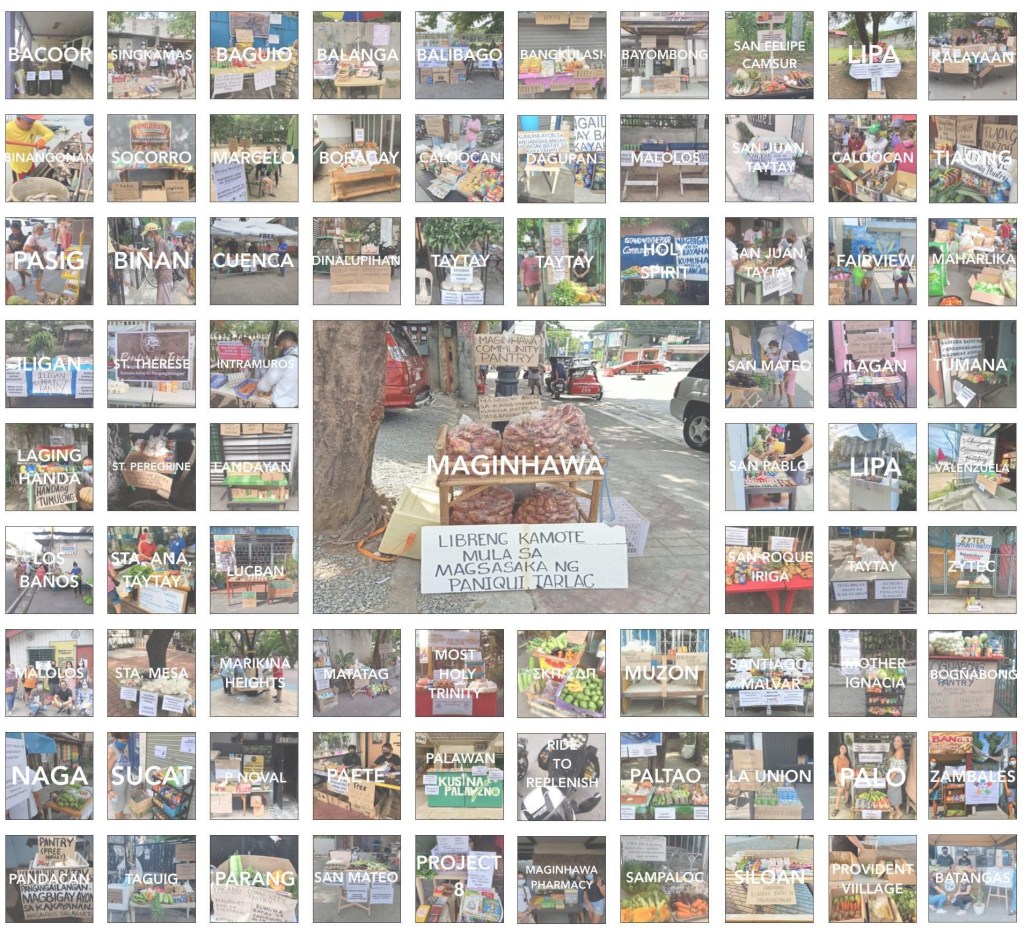
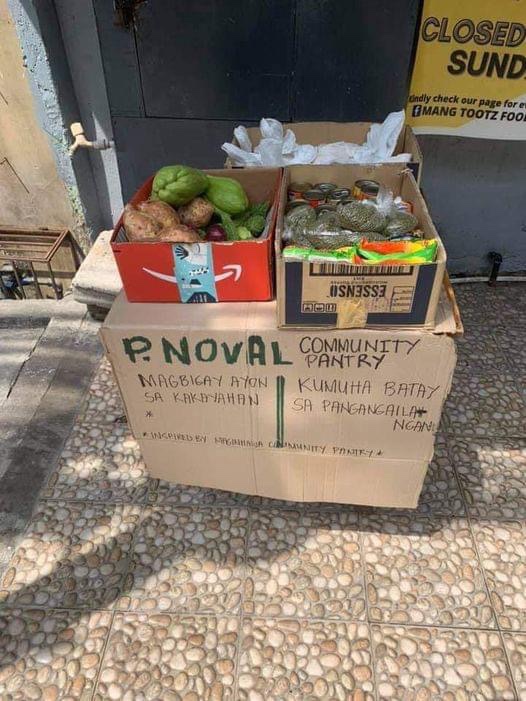
The beauty of this community pantry
that have sprouted all over the country
in just a week exactly
is not found only in the wide variety 
of food to the needy but most of all
for food that enrich so many souls:
kindness and tenderness are aplenty
with everyone considered a family.
It was the Lord Himself 
who gave us the first community pantry 
intended for soul when he said:
"All you who are thirsty,
come to the water!
You who have no money,
come, receive grain and eat;
Come, without paying and without cost,
drink wine and milk!
Why spend your money for what is not bread;
your wages for what fails to satisfy?
Heed me, and you shall eat well,
you shall delight in rich fare.
Come to me heedfully,
listen, that you may have life."
(Isaiah 55:1-3)
What is so amazing now happening in the country
is how those with least to offer
are always the ones with most to share
like that widow praised by Jesus in her poverty
gave her all in the temple treasury:
for the community pantry
there was so much camote
coming from hard pressed farmers
from Paniqui and another load from Mindoro
shared by the child of a Mangyan aged nine
while an elderly man peddling chicharon for a living
asked for two cans of sardines
leaving the pantry with a precious smile of gratitude
with a plenitude of goodwill,
donating two packs of his precious chicharon.
Like manna in the wilderness
the community pantries were heaven-sent;
like the feeding of five-thousand in the wilderness
the community pantries of sharing was the miracle;
like Jesus Christ at the Last Supper,
the community pantries have taught us 
to be the bread ourselves, broken and shared
if only to prove there is enough for everyone's needs.


What the Holy Spirit does vs. what we can do

The Lord Is My Chef Breakfast Recipe for the Soul by Fr. Nicanor F. Lalog II
Tuesday in the Third Week of Easter, 20 April 2021
Acts 7:51-8:1   <*(((><  +  ><)))*>   John 6:30-35
Posted by Jean Palma on Facebook, 18 April 2021 with the caption: “All these community pantries in four days, and counting. What a powerful movement.” #CommunityPantry

Praise and glory to you, O God our loving Father in heaven! Thank you in sending us your Son Jesus Christ our Bread of life who taught and showed us how to be a food ourselves to one another by giving and sharing our very selves in loving service especially in times of crisis like this pandemic.

Thank you very much for the grace and inspiration by the Holy Spirit for the people behind this movement fast spreading called “Community Pantry” teaching us to see one another as a brother and a sister who needs to be helped, that each can be of help to anyone in need.

So many times, in our search for food that perishes like wealth and power, we get more focused on “doing” than “being” and “becoming” like those people who have followed Jesus in Capernaum after being fed with bread and fish at the wilderness last week.

The crowd said to Jesus:
"What sign can you do, that we may see and believe in you?
What can you do?"
(John 6:30)

Forgive us, Father, when until now we still ask the very same question to you and one another, “What can you do?” like the devil’s first temptation of Jesus in the wilderness, “If you are the Son of God, command this stone to become bread” (Lk.4:3).

Make us aware of this ploy of the devil to keep us doing everything, to claim everything as our work in order to forget you or even discredit you.

How sad that we are so concerned with doing than with being and becoming, forgetting the value of every person, asking more of “what you can do” than “who are you?” which is more essential because we are all from you, O God our Father, our image and likeness.

No wonder, we have become like the members of the Sanhedrin addressed by Christ’s first martyr, St. Stephen during his trial:

"You stiff-necked people, 
uncircumcised in heart and ears,
you always oppose the Holy Spirit;
you are just like your ancestors."
(Acts 7:51)

We have never grown and matured in our relationships because we have refused to see each one’s worth as a person, measuring our value in what we can do than in who we really are as your beloved children. As a result, we continue to refuse surrendering ourselves to the Holy Spirit for you to do your work in us. Unfortunately, as we keep on doing everything, the results are always miserable. And the more we get into bigger mess in life.

Teach us, especially our leaders in government, to open their minds and their hearts to what your prophets are saying from the various sectors of the society, especially the masses involved in the Community Pantry movement.

May our government officials led by the President realize that ever since this pandemic started, what we have been saying has always been for the good of one another as brothers and sisters, valuing life above all, and not for any achievement nor fame at all that they are so intent on having.

How sad that the more government officials dare and insult people with what they can do, the more it becomes truer that they cannot do anything good at all. Amen.

Photo by Toots Vergara, Philippine Daily Inquirer, 16 April 2021.

Postscript to Holy Thursday: that non-essential “lugaw” is essential!

Quiet Storm by Fr. Nicanor F. Lalog II, 05 April 2021
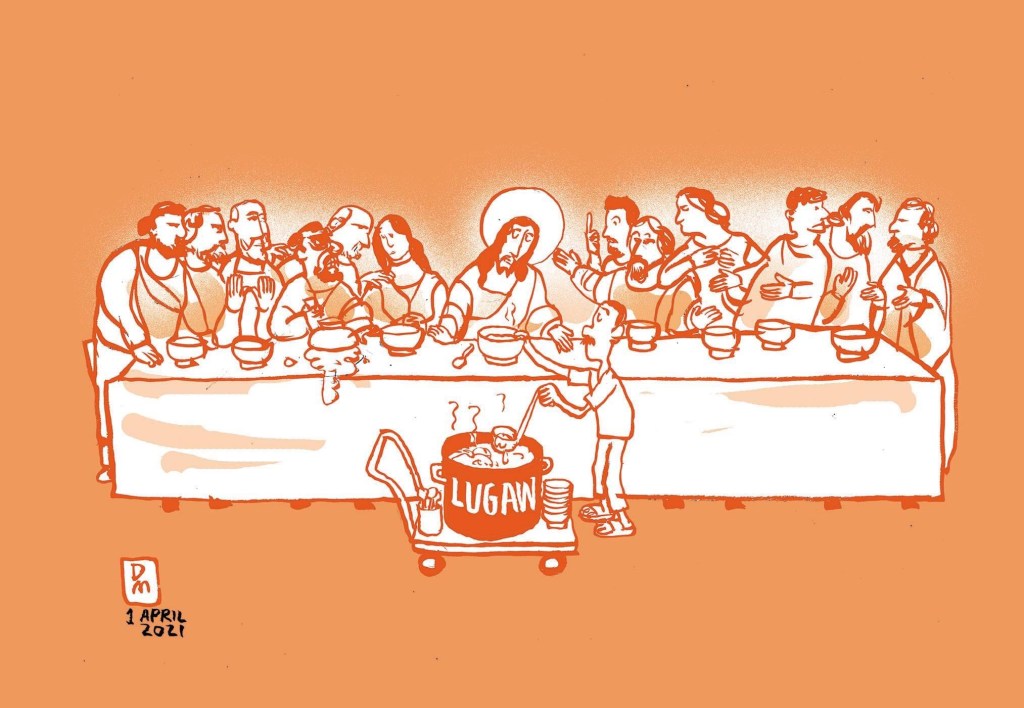
“An Essential Holy Thursday Transubstantiation” by artist DengCoy Miel posted on his Facebook, 01 April 2021.

It was a Holy Wednesday when the incident went viral as picked up by network news that evening when the previous night some barangay officials in Muzon, San Jose Del Monte, Bulacan insisted that lugaw is “not essential”, that man can live even without lugaw.

The timing was so perfect being a “Spy Wednesday” or the night of traitors when Judas Iscariot struck a deal with the chief priests to hand them over Jesus for 30 pieces of silver (Mt.26:15).

And so, there were the three barangay officials handing over to their power trip the common lugaw not knowing they have in fact betrayed us Filipinos in their arrogant insistence that lugaw is a non essential food.

The following Holy Thursday, another Judas Iscariot not only betrayed but crucified si lugaw as non-essential without knowing his remark was a self-indictment of this government’s preoccupation with politics, disregard for the people and lack of any definitive plan regarding the year-old pandemic. Trying to sound a smart aleck and clown rolled into one this administration has too much of, his explanations only made him look like the lowest kind of lugaw – rice leftovers boiled in water.

The benighted souls who have denigrated our favorite food have just proven that this pandemic is something we have to see in the light of spirituality and morality, not just a medical and social issue to be addressed.


Any food is always essential because every food signifies a person, has life and sustains life.

Recall that during his Last Supper on the night before he was betrayed, Jesus had chosen the most ordinary but very essential food to be the sign of his loving presence among us until the end of time – the bread. An unleavened bread, to be exact, which was the food taken by the Jews during their exodus from Egypt at the time of Moses.

The bible teems with so many references to the lowly food of bread as something divine with deeper meaning as a sign.

Consider that Jesus was born on a manger which is an open box or a trough for animals like horses and cattle to eat from to signify his being our very food in this life journey. He was born in Bethlehem that literally means “house of bread”; thus, at his last supper, Jesus gave himself to us under the sign of a bread.

In establishing the Sacrament of the Holy Eucharist which St. John Paul II emphasized in 2002 by adding the Mysteries of Light in praying the Rosary, Jesus elevated the meal into the most sublime human activity making our food divine and holy. As a result, the table had become one of the most intimate places in our lives that every time there is a meeting or any gathering, there is always the meal to be shared. I used to tell my students before that every first date is always in a restaurant – if possible a fine dining one – because what matters most is the moment to be shared together by you and your date.

It is always easy to know when couples and parents are not in good terms with each other: they never eat together or during meals, they do not talk or speak to each other. The same is true when people decline our invitations for dinner or party or simple meal: they do not want to be with us. Period. That is why Judas Iscariot had to leave and not finish the Lord’s supper!

See that we never call people as “enemies”: like Jesus Christ, as much as possible we welcome everyone to our table to share meal with us and it is only then when we realize who is our enemy when like Judas, some people stab us in our backs while sharing meal.

When we eat and share food and drinks, we actually share our very selves to our guests and friends. We host parties because we want to share our very selves with our family and friends, to share and be a part of our lives, of our achievements, of our important stages in life. Their coming signify the same willingness to share us their lives too.

Photo by desiringgod.org, April 2019.

The food we share are signs of our bonding, of our relationships, of how we care and respect for one another. It does not really matter what food we share. More often, the most simple and ordinary food are the ones that truly delight us like tuyo. Or lugaw!

How I wish parents today would bring back those days of old when nobody is supposed to waste not even a single grain of rice or any food for that matter because it is from God.

When we were growing up, every meal was the most awaited family time not because of the food but more of the bonding and exchanging of stories. As we age, it has become more truer than ever! That is why we all wish this pandemic would end so we could all eat together as families and friends, is it not?

Any food is always essential because every food signifies a person who has life and sustains life of others.

Every one of us is a companion to each other. From the two Latin words “cum panis” that mean someone you break bread with, a companion is a friend, a fellow traveler who sustains and nourishes you like food in your journey!

In that beautiful story of the road to Emmaus when Jesus appeared to two disciples disappointed with his death and news of his empty tomb on Easter, they recognized him only after he had broken bread but simultaneously disappeared because at the table of the Lord, we also become his Body meant to be shared with everybody.

The recent issue that went viral on whether lugaw is a non-essential or not is a tragic indication of the kind of people we are, of how we categorize persons like food.


There seems to be a direct correlation 
between food and humans:  
when there are plenty of food, 
that is when people are taken for granted, 
while where there is scarcity of food, people are valued. 

Take the case of ice cream. When somebody is rich and young and beautiful or handsome, they are the “flavor of the month” or the “all-time favorite” and “classic” or “premium”.

Photo by Marc Schulte on Pexels.com

And how do we call our ordinary ice cream peddled by Mamang Sorbetero? “Dirty ice cream” – dirty because ordinary and cheap like the street kids, the poor, the “wa-class” and opposite of the more expensive sosyal ice cream.

Worse, with so much food available these days unlike before when we valued every food so much because we can only have apples (and softdrinks) when sick or chocolates when relatives from the States sent packages or some rich neighbors brought you as pasalubong from Dau’s PX stores outside Clark Air Base in Pampanga, things today have also changed in the way we relate with one another.

There seems to be a direct correlation between food and humans: when there are plenty of food, that is when people are taken for granted while where there is scarcity of food, people are valued.

As more food are readily available these days, the more we have become choosy, the more we categorize food as essential and non-essential that at the same time, the more we denigrate humans.

Such was the plan of Satan with his first temptation to Jesus – turn stones into bread after fasting for 40 days in the wilderness.

For Satan, let us have more food and things to satisfy our body so we forget God and one another, and everything of higher value. When food is retained in the stomach and becomes an end in itself, it then becomes an occasion for sin like gluttony, exactly what Satan was pushing for so that we just keep on filling our stomachs with food, satisfying the cravings and desires of the body until we destroy ourselves and our image as likeness of God.

Jesus put food into the right perspective that God is our real and true food that in two instances at least, he fed vast crowds of people in the wilderness after seeing them rightly disposed for material food.

Call it as generation gap but I am shocked when I hear some people especially the young describing handsome men and pretty women as “yummy” and “delicious” like food. Problem with that kind of mentality is how it shows we have come to regard everybody like food that if we are no longer “fresh” or “new”, becoming “old” and stacked in the cold fridge, later to be discarded or thrown out like old people being sent to retirement homes totally unknown to us 40 years ago.

Worst of all is how this administration launched its bloody campaign against drugs when addicts and other criminals were considered as non-essentials to be eliminated or killed like animals – exactly the deeper implication of what that government official kept saying last Holy Thursday that “non essential si lugaw”!

Since last year’s Holy Week when we first went into this lockdown, I have been telling friends to avoid as much as possible posting their lavish food on Facebook as a sensitivity to others with almost nothing to eat. And I maintain it is still valid to this time of this worsening crisis.

Let us be food to everyone as source of strength and nourishment, of inspiration. We do not have to make extraordinary efforts. Simply be human as yourself. Be present with a text or a phone call to those suffering. Pray for them and let them know you care for them.

Be a lugaw who could warm someone’s cold body freezing in fear and anxiety, offering quick relief from whatever suffering others may be going through.

Most of all like a hot, steamy lugaw, giving hope that Jesus is with us, his salvation is coming soon.

Remember, friends, lugaw is essential.

And so is everyone.

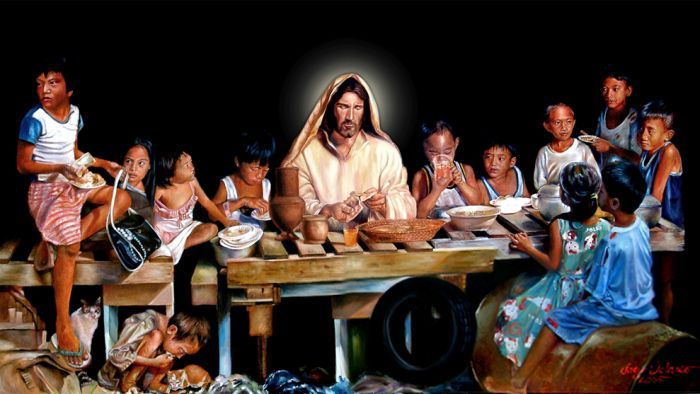
The late Joey Velasco’s 2005 painting “Hapag ng pag-Asa”.