Lord My Chef Daily Recipe for the Soul, 06 October 2025
Monday in the Twenty-Seventh Week in Ordinary Time, Year I
Jonah 1:1-2:1-2, 11     <*((((><  +  ><))))*>     Luke 10:25-37
Lord Jesus Christ:
with so many things
going on in our country
these days, I also ask like
that scholar of the law,
"who is my neighbor?"
when we are so divided
not really with politics
and beliefs but with
your truth; nobody is
trustworthy among our leaders,
even with those in media
with many of them influencing
us whom to believe and not;
give us the courage and
strength of that Samaritan traveller
to dare cross the street,
to get down from our vantage
points to do something for those
below, those in the margins,
the poor often exploited by
the corrupt and powerful;
teach us, Jesus,
"to go and do likewise"
(Luke 10:37).
Then they said to one another, “Come, let us cast lots to find out on whose account we have met with misfortune” (Jonah 1:7).
Before we can
"go and do likewise"
like the good Samaritan,
we have to be like Jonah
and his companions in the ship
first: to admit our own role,
our own misgivings and failures
why our country had turned
into this mess; we have turned
away from you, Lord Jesus;
we have been so focused with
our many pursuits that we
have forgotten those around us
like those crying in hunger and pain;
we have always been on the go,
riding high on our horses
refusing to see those below us
needing our compassion
and presence.

Show us,
Jesus, where do we have
"to go and do likewise."
Amen.
Lord My Chef Sunday Recipe for the Soul, 14 September 2025
Feast of the Exaltation of the Cross
Numbers 21:4-9 ><}}}}*> Philippians 2:6-11 ><}}}}*> John 3:13-17
*This is an updated version of our reflection last year; pray for our Marriage Encounter this weekend.
Via Crucis at Fatima University Medical Center, Valenzuela City, 2025.
This Sunday we have a unique celebration, the Feast of the Exaltation of the Cross that falls on the 14th day of September. It is so important that even if it falls on a Sunday, the more it must be celebrated as it is most central in the teachings of Jesus Christ.
It is so unique because despite its being made up of two ordinary pieces of wood, the Cross is most unique with its deeply extraordinary in meaning as sign of God’s immense love for us humans through Jesus Christ’s Passion and Death.
From being the sign of the most inhuman punishment in history, the Cross is now the very sign of how God “so loved the world that he gave his only Son, so that he who believes in him might not perish but might have eternal life” (Jn.3:16). It encapsulates the whole mystery of Jesus Christ, of how this all-powerful God beyond the ordinary became weak like us in everything except sin so that we too may be like Him, divine and more than ordinary. In His suffering and death on the Cross, Jesus made the lowly wood so ordinary to be so exalted to become His sign of love and mercy, power and majesty.
Photo by author, Jerusalem, May 2017.
Hence, in the Cross is the power of God’s love to transform us to better persons.
In the Cross is God’s power to lead us closer to Him with its vertical beam and to others with its horizontal beam.
In the Cross is the power of good if we choose to embrace it with Christ Jesus as our Lord and Master.
The Cross is most unique of all signs in the world because underneath its ordinariness, that is where we see God’s glory and majesty. It was underneath the Cross of darkness and gloom on Good Friday that humanity began to see light and hope in life’s many absurdities. Most of all, it was underneath that Cross of suffering and death of Jesus Christ that we feel and experience the assurance of the Resurrection.
How?
Through our own pains and sufferings that are most uniquely ours too!
With their patience worn out by the journey, the people complained against God and Moses, “Why have you brought us up from Egypt to die in this desert, where there is no food or water? We are disgusted with this wretched food!” In punishment the Lord sent among the people saraph serpents, which bit the people so that many of them died (Numbers 21:4-6).
Photo by author, Dominican Hills, Baguio City, January 2018.
You must have heard that old story of a man who came to Jesus to return the cross given for him to carry; he asked Jesus to have it replaced with a lighter one. Jesus then led the man to a huge room with all kinds of crosses for him to choose which he prefers as the best one for him so that he would stop complaining.
After closely examining the specs of so many crosses, the man finally decided to pick one he deemed as perfect for him after considering its weight and other dimensions, only to find out from Jesus Himself that it was the same cross he had actually returned for exchange!
Many times in life we are like those people in the first reading, never ending in their complaints to God, even challenging Him, accusing Him of forsaking us, of being unfair when life becomes difficult and unbearable. There are times we feel being on the distaff side of life always like a flat tire, never on top. We cry foul to God especially with all our hurts and pains inflicted by others, asking Him where was He when most needed?
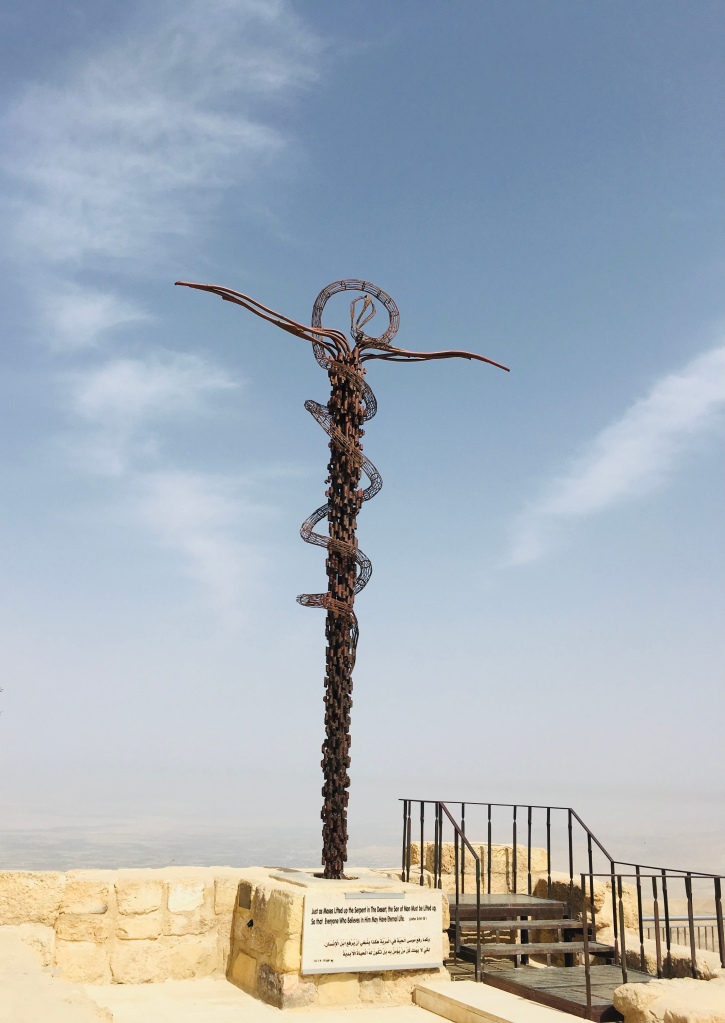
Photo by author in Jordan near the Israeli border where Moses put up the bronze serpent as instructed by God to heal those bitten by the snakes after they have complained of their conditions in the wilderness, May 2019.
While it is true life is indeed difficult, the cross reminds us of the fact that the pains and hurts we have are uniquely ours too, something we have to accept and most of all, own.
There are pains that are so deep and won’t go away that have in fact affected us dismally in our lives already. Instead of self-blaming and self-pity, we just have to ask for God’s grace to accept and own them like Jesus Christ. We just have to “bring it home” – that imagery of the Cross planted on the Calvary – into our very selves, in our being as something so true and real. And uniquely ours.
Stop thinking of others’ pains and hurts. We are not all the same. If ever we have similar experiences, the hues and shades even gravity and circumstances are not same because each pain and hurt, like the cross, is uniquely ours. Like every person, every cross is unique because it is also a gift, a mystery, and life. We have to “befriend” our pains and hurts, our own cross instead of resist it. It is in “befriending” our pains and hurts, our cross in life that we grow and mature, becoming more free to love and to be joyful because that is when the cross triumphs over its disgrace and shame in us and with others. That is when our pains and hurts, when our crosses begin to reveal to us the many beautiful truths of Easter awaiting us.
The Cross of Christ triumphed because Jesus carried it wholeheartedly, allowing those two pieces of wood to reveal not only to Him who knew everything beforehand its meaning but most of all to everyone of us the deeper truths the Cross signifies as St. Paul eloquently expressed in our second reading.
The Cross of Christ atop the church of our Lady of Lourdes in France. Photo by my former student Ar. Philip Santiago during his pilgrimage, September 2018.
One thing I realized after my mother died May last year is the fact that while there are so many pains and sufferings in this world, my own pain and suffering in losing her are most difficult to bear; hence, something I must carry because it is uniquely mine.
But, one thing so unique I noticed is that the more I see my cross following my mother’s death, the more I saw also the cross of others. The Cross of Jesus triumphed truly in me when I embraced and owned my cross, when I befriended my pains and hurts that eventually led me to recognize and see, to feel more and experience too the crosses of others.
When we become conscious of each one’s unique cross, slowly we are able to reveal to them the meaning of their personal crosses too because we become more sympathetic, more open, more silent to listen more, love more, care more and be more present with those in their own unique cross. No wonder, I find conversing more engaging with others who also grieve because we can see each other’s unique crosses!
Jesus calls us to imitate Him that by embracing and owning our cross, we too may lead others to finding the meaning of their own cross and thus experience Easter soon. Let us pray:
Give us the grace,
dear God
to always embrace the Cross
like your Son Jesus Christ
where we can all be empty
of ourselves to be filled
with your Holy Spirit
and make your love
visible in us.
Amen.
A blessed week to everyone!

Fr. Nicanor F. Lalog II
Our Lady of Fatima University
Valenzuela City
(lordmychef@gmail.com)
Lord My Chef Daily Recipe for the Soul, 11 August 2025
Monday, Memorial of St. Clare, Virgin
Deuteronomy 10:12-22     <*((((><  +  ><))))*>     Matthew 17:22-27
Photo by author, Sonnen Berg Mountain View, Marilog, Davao City, August 2018.
What a beautiful way
to start our first day in school
and work this week
examining our attitudes
with our rights and privileges
vis-a-vis your example of compassion
and solidarity,
Lord Jesus.
Moses said to the people: “For the Lord, your God, is the God of gods, the Lord of lords, the great God, mighty and awesome, who has no favorites, accepts no bribes… So you too must befriend the alien, for you were once aliens yourselves in the land of Egypt” (Deuteronomy 10:12, 17,19).
You play no favorites,
indeed, Lord
but many times your love
and blessings get into our heads
that we not only forget others
but even you in the process;
we forget what we have gone through,
we disregard our wounds
especially how you saved us
that we think more
 of our rights and privileges
 than of our responsibilities
that come with every good gift
from you.
When they came to Capernaum, the collectors of the temple tax approached Peter and said, “Does not your teacher pay the temple tax?” “Yes,” he said. When he came into the house, before he had time to speak, Jesus asked him, “What is your opinion, Simon? From whom do the kings of the earth take tolls or census tax? From their subjects or from foreigners?” When he said, “From foreigners,” Jesus said to him, “Then the subjects are exempt. But that we may not offend them, go to the sea, drop in a hook, and take the first fish that comes up. Open its mouth and you will find a coin worth twice the temple tax. Give that to them for me and for you” (Matthew 17:24-27).
What a shame,
Lord Jesus!
In this world where
everyone insists on each one's
rights and privileges,
so many are maligned,
and much more are misled
by some people specially in media
with bloated egos;
in this world that had shrunk
into a global village,
many brains have shrunk too
with hearts turned into stone
without any compassion and
sense of true solidarity at all!
Instruct me,
dear Jesus,
like Peter to drop in
a hook to catch the
first fish that comes up
for surely,
many times
I have missed finding
a "coin" inside its mouth
worth than what we are required;
many times,
I see only myself,
my rights and my privileges
that I forget to be compassionate
and be one with others;
teach me to be like you:
totally "indifferent" in a positive
sense in whatever the world offers
choosing only the Father's will
for God's glory.
Amen.

Fr. Nicanor F. Lalog II
Our Lady of Fatima University
Valenzuela City
(lordmychef@gmail.com)
Photo by author, Sonnen Berg Mountain View, Marilog, Davao City, August 2018.
The Lord Is My Chef Sunday Recipe for the Soul by Fr. Nicanor F. Lalog II
Solemnity of Our Lord Jesus, King of the Universe, Cycle A, 26 November 2023
Ezekiel 14:11-12, 15-17 ><}}}*> 1 Corinthians 15:20-26, 28 ><}}}*> Matthew 25:31-46
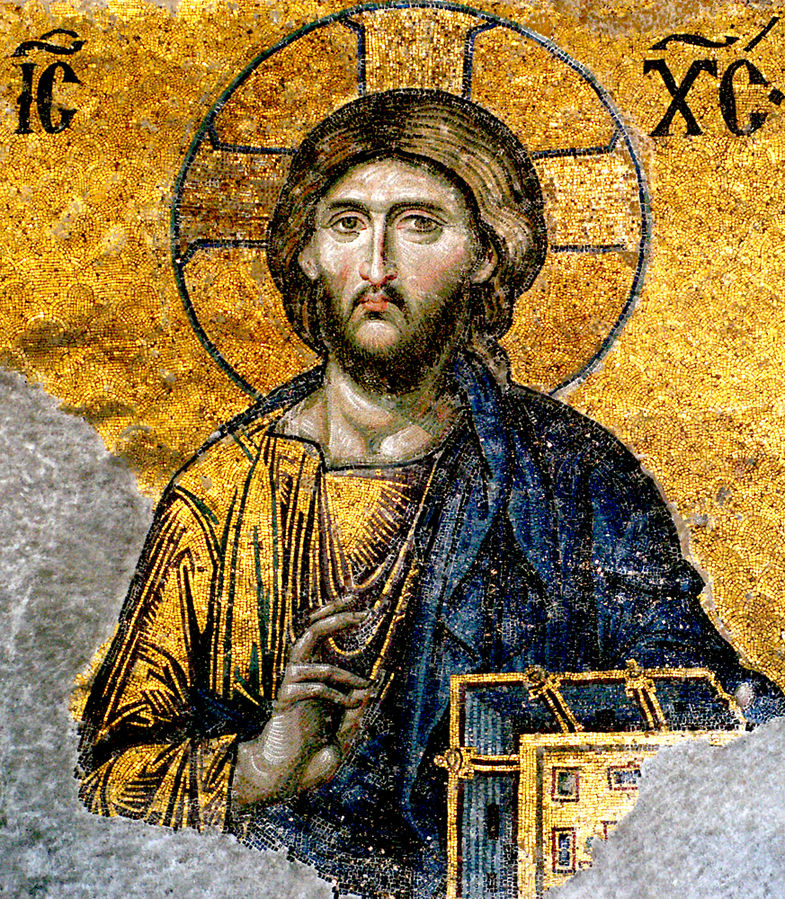
Detail of Jesus Christ at the Hagia Sophia in Istanbul, Turkey; photo from wikipedia.org.
We now come to the final Sunday celebration of the year, the Solemnity of Christ the King. See how we close the liturgical calendar celebrating Christ’s kingship, only to open it anew next Sunday with Advent Season in preparation for Christmas, the birth of the King of kings.
Far from the connotations of power and authority of kings of the world, Christ’s kingship is more pastoral in nature by taking its cue from the image of a shepherd prevalent in the ancient Middle Eastern culture. In fact, Jesus is more perfect than any shepherd being the Good Shepherd himself, the fulfillment of the promise of God we heard in the first reading who would come to personally tend his flock.
As I prayed over our readings of this Solemnity which is one of the youngest feasts we have in the church at less than 100 years old since its introduction in 1925 by Pope Pius XI, my thoughts wandered during that first year of the COVID-19 pandemic in 2020 when churches were closed and public Masses were prohibited.
Photo by Ms. Ria De Vera, Christ the King celebration in our former parish during pandemic, November 2020.
Right on the first Sunday when lockdown was imposed, we started our weekly “motorized procession” of the Blessed Sacrament around our former parish in Bulacan. I was so moved at the piety of our parishioners who knelt on the streets whenever we passed by.
We continued the practice until the Solemnity of Christ the King on that year of 2020. As usual, the people knelt on the streets when we passed by with the Blessed Sacrament. Even passengers of buses and other vehicles that chanced upon our procession paid homage to Jesus in the Blessed Sacrament.
Photo by Ms. Anne Ramos, March 2020.
Looking back to those days during my prayer periods this week, I realized that it was on that first year of the pandemic when we had the most meaningful liturgical celebrations in the Church when people felt intensely the need for God, when they clearly had Jesus alone as King and Lord.
Everyone’s faith was put to test as we were all gripped in fears and uncertainties with the deadly effects of COVID virus. Almost every family prayed the Rosary daily or nightly, so many trying to sneak inside churches to attend Mass celebrations. Of course, there were still some who went on their evil ways during those difficult times with the tokhang still implemented while those in power shamelessly grabbed the opportunity to rake in millions of pesos from corruption at the expense of the poor and suffering people.
When we recall that year 2020 of the pandemic, it was at that time we experienced Christ’s Second Coming as everyday was a judgment day, the end of the world — though not entirely fearful because it was also during that time we felt closest to God in Jesus our Lord and King!
Behind all those acts of kindness and goodness of the people are the immense love and mercy of God in Jesus Christ we have experienced in the recovery of infected loved ones or in the simple negative results of our COVID tests.
It was during those days when we experienced and felt Jesus truly present in us and among us that we simply radiated him on many occasions. That first year of the pandemic proved to many of us that being good, being kind, being helpful would never destroy nor diminish our person but had actually strengthened us as individuals and as a community. Recall how the “community pantry” caught the whole country on fire in just a matter of weeks when a young lady started it in their neighborhood at Maguinhawa Street, UP Village in Quezon City.
When families and communities banded together in love and kindness to help the poor and needy, the sick and those who have lost loved ones, the experience did not pulverize them but actually crystallized them as family or friends or neighbors. Walang nadurog sa pagdadamayan bagkus nabuo ang lahat ng nagtulungan!
That is the kingship of Jesus Christ. His power and authority were never meant to destroy us. In fact, when he came to us, he showed us and made us experience that the power and authority of his kingship is found not in force but in love and mercy that sadly many see these days as weaknesses.
Then the righteous will answer him and say, ‘Lord, when did we see you hungry and feed you, or thirsty and give you drink? When did we see you a stranger and welcome you, or naked and clothe you? When did we see you ill or in prison, and visit you?’ And the king will say to them in reply, ‘Amen, I say to you, whatever you did for one of these least brothers of mine, you did for me.’
Matthew 25:37-40
Photo by Ms. Marivic Tribiana, April 2020.
Christ the King today reminds us that true authority and power lead to humility which is more than being lowly but also of seeing the other person as another human in need, vulnerable and weak. Being humble is not only accepting our humanity but recognizing the humanity of those around us who need to be respected, loved and cared too.
Moreover, Christ the King reminds us that whatever authority and power we have is a sharing in God’s power and authority; hence, these must be used to help others, not lord over them. True power and authority lead to compassion, enabling us to feel the sufferings of others that move us to do something for them like Jesus.
This is what St. Paul reminds us in the second reading: the kingship of Jesus Christ – his power and authority – are a sharing in God. Unlike the worldly kings, Christ’s kingship is intimately related to the rule of God and ultimately subjected to the Father that is why it is transformative and performative to borrow one of Pope Benedict XVI’s favorite terms.
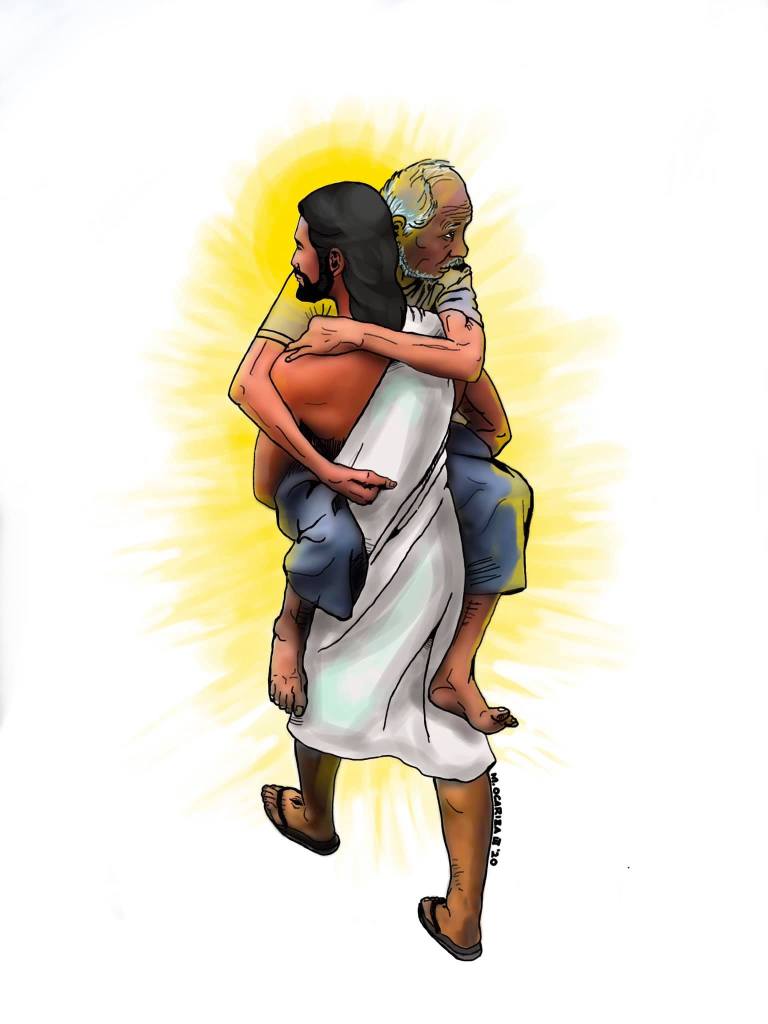
Artwork by Fr. Marc Ocariza based on Ms. Tribiana’s photo, April 2020.
The Kingship of Jesus Christ is the power to love, the most potent force in the universe. Yes, there are still evil and sin in the world today but soon, they shall be finally removed in Christ’s return as king. The present moment calls us to see Jesus in everyone we meet so that we act like him in loving service to others.
Notice how Jesus ended today his teachings at the temple area with a parable of the judgment of nations where people are separated according to their deeds. At the end of time, that is what Jesus will ask and judge us: how much have we loved like him? What have we done in this world, in life?
For us to better answer that, let us keep in mind what Jesus had done and still does to us and for us, of how much he loves us as our King and Protector. Recall the countless times he poured us his love for us. The moment we see his kingship in God’s way, then we follow Christ’s power and authority in the name of love and mercy, kindness and gentleness. Amen. Have a blessed week ahead!
The Lord Is My Chef Daily Recipe for the Soul by Fr. Nicanor F. Lalog II
Tuesday in the Twenty-Second Week of Ordinary Time, Year I, 05 September 2023
1 Thessalonians 5:1-6, 9-11   <*((((>< + ><))))*>   Luke 4:31-37
Photo by author, sunrise at Camp John Hay, Baguio City, 12 July 2023.
Praise and glory to you,
God our loving Father
for this wonderful day!
Please, we pray, for lesser
rains today,
for a better weather
today for everyone
to make up for the
many losses we have
incurred since the
rains and floods came
two weeks ago.
In this time of calamities,
we pray for those in authority;
enough with excessive display
of authority by anyone vested
with any kind of authority
by the law who throw their
weight around even in
public; help us realize,
dear God that authority
is not about having powers
that set them apart from us,
of those in the higher up;
authority is about being
one with us below like
Jesus Christ your Son.
Jesus went down to Capernaum, a town of Galilee. He taught them on the sabbath, and they were astonished at his teaching because he spoke with authority. They were all amazed and said to one another, “What is there about his word? For with authority and power he commands the unclean spirits, and they come out.”
Luke 4:31-32, 36
Help us realize,
dear Jesus,
that to have authority like you
is being nearer your subjects,
that true authority is not power
but solidarity with those subject
to one's authority.

Authority is not power but
mercy and compassion with
subjects deep in miseries
and sufferings.

Authority is walking
and feeling the joys and pains,
sharing the hopes and desires
of the subjects to be liberated
and freed.

Authority is empowering
others to discover their giftedness
"encouraging one another
and building one another up"
(1 Thess. 5:11).
Amen.
The Lord Is My Chef Sunday Recipe for the Soul by Fr. Nicanor F. Lalog II
Eleventh Sunday in Ordinary Time, Cycle A, 18 June 2023
Exodus 19:2-6 ><}}}}*> Romans 5:6-11 ><}}}}*> Matthew 9:36-10:8
Photo by Ms. April Oliveros at Mt. Pulag, March 2023.
I recently had a long lunch that extended to a longer dinner recently with a good friend who was widowed last January. It was the first time we met again after the funeral of her husband who died three weeks after I had anointed him last Christmas Day.
She was still grieving and yes, angry with God why her husband had to go at an early age. She told me how during her daily prayers she would complain to God, and how she wanted her husband to be still alive, not minding at all of nursing him again.
Likewise, she was worried God might be fed up with her, even mad and angry with her negative feelings and attitudes even though she prays and celebrates Mass more often these days since her husband’s demise.
Photo by Ms. April Oliveros at Mt. Pulag, March 2023.
Does God get angry with us?
The psalmist says, “But you, Lord, are a merciful and gracious God, slow to anger, most loving and true” (Ps. 86:15). If God is slow to anger, does it mean he gets angry, even sometimes?
No. Never.
God does not get angry at all because God is love. God is perfect unlike us who easily get angry and could remain angry over a long period of time because we are imperfect. But God, who is also spirit, does not have emotions, neither gets angry nor irritated with us and yet, always one with us in our feelings especially when we are down in pain and sufferings.
In Christ Jesus who became human like us in everything except sin, God became more one with us to prove his love and oneness for us.
At the sight of the crowds, Jesus’ heart was moved with pity for them because they were troubled and abandoned, like sheep without a shepherd. Then he said to his disciples, “The harvest is abundant but the laborers are few; so ask the master of the harvest to send our laborers for his harvest.”
Matthew 9:36-38
Photo by Mr. Raffy Tima, GMA-7 News, June 2020.
See how Matthew noted that “At the sight of the crowds, Jesus’ heart was moved with pity for them because they were troubled and abandoned, like sheep without a shepherd.” So beautiful. So powerful.
That expression his “heart was moved with pity” is the literal meaning of the Latin word misericordia – mercy in English – that means “a heart moved strongly” like disturbed or thrown off perhaps. More than just a feeling, that virtue of mercy is expressed into compassion which is another Latin word that means “to suffer with” or cum patior. Matthew here is telling us it was more than a feeling for Jesus to have his heart moved with pity but a firm resolve to uplift the crowds because in the first place he has that oneness with them.
Until now in our own time, that heart of Jesus is moved with pity for us whenever he sees us troubled and abandoned, like sheep without a shepherd. Just like my friend grieving the loss of her husband. Or anyone who had lost a beloved, a leg or a part of the body, maybe a job or a career, a dream or a future.
For Jesus, it is always the person who matters that is why his proposal has always been to send us another person, another companion, a fellow to accompany us in our brokenness and darkness. There is his move of gathering us, calling us, and sending us forth to a mission.
Jesus never taught us to ask for more money nor food nor gadgets to solve the problems of the world. Recall his temptation in the desert when he rejected the devil’s challenge to change stones into bread because man does not live by bread alone but with every word from God.
For the world, everything is a problem to be solved, including mysteries of God and of the human person. As we have reflected the past two Sundays, mysteries are not problems and therefore not solvable at all. Mysteries are non-logical realities we must embrace or even allow ourselves to be wrapped with to discover the richness and meaning of this life like God and persons.
When people are down and lost in this life, feeling troubled and abandoned, where do we focus more, to their woes and problems or their very persons? Try thinking of the people you consider as “heaven sent” and helped you in your darkest moments. Are they not the ones who brought out our giftedness as a person, as a beloved child of God with Christ’s gospel?
Photo by author, December 2022 at the National Shrine of Our Lady of Fatima, Valenzuela City.
Problem these days, many people no longer believe in God totally, not giving a care at all with the value and meaning of justification and salvation, of reconciliation and communion in Christ through one another that St. Paul explained in the second reading.
Modern man has become so complacent that he would be saved by a loving and merciful God. It is a wrong kind of confidence because it is a confidence in one’s own powers than in God’s saving act through Jesus Christ as St. Paul preached.
Sad to say, such kind of confidence afflicts mostly the so-called religious and pious ones in the Church, especially us priests and bishops who lose sight of the flock and of Christ in the process. No synod nor meetings and documents would make the local even Philippine Church attuned with the present time unless we the clergy and other disciples must first have our confidence in God, not in ourselves.
How tragic that we are still a Church so steeped in being a hierarchy, lightyears away from being any of the other models of the Church proposed by the late Jesuit Cardinal Avery Dulles: sacrament, herald, communion, and servant. Despite our many denials, priesthood is power and prestige where ministry is more of an office and a privilege. We are more concerned with the call, the vocation of priesthood totally ignoring the Caller, Jesus Christ. Visit any parish and chances are, you find the priest throwing his weight around – literally and figuratively speaking so that the sheep remain without a shepherd.
In the Old Testament, the image of Israel as a lost sheep was the result of failures and even of sins of infidelity of their religious and political leaders. History has proven not only in Israel but everywhere especially the Philippines that when there are failures in leadership in both the political and religious spheres, it is always the common people who suffer most.
Photo by Mr. Mon Macatangga, 12 May 2023.
If we think about it, Jesus could have reacted negatively at the sight of the crowds and even with us today. He could have felt angry and irritated, even annoyed, frustrated and disappointed with how we are wasting all his gifts and grace, his call and his mission. But Jesus chose empathy and sympathy because he always looks into our hearts, into our total person than to our sins and failures, mistakes and errors.
Let us return to our “desert of Sinai” spoken of in the first reading, a reminder of our turning point in life and history when God called and sent us to be a “kingdom of priests, a holy nation” whose confidence is in him alone, not in our very selves nor our programs and structures to find again the many lost sheep of our flock. It is never too late to make a U-turn for God is full of mercy and compassion, slow to anger, loving and true. Amen.Have a blessed week ahead!
The Lord Is My Chef Sunday Recipe for the Soul by Fr. Nicanor F. Lalog II
Third Sunday in Easter, 22 April 2023
Acts 2:14, 22-33 ><)))*> 1 Peter 1:17-21 ><)))*> Luke 24:13-35
The Road to Emmaus” painting by American Daniel Bonnell from fineartamerica.com.
As I have been telling you, the beauty and joy of Easter is in its “nothingness” like the empty tomb of Jesus and its “darkness” found in the setting of the Lord’s appearances. We have found these in the past two Sundays when Jesus appeared to the Twelve “on the evening of the third day” and “eight days later” amid locked doors.
This Sunday is very different. It is the story of two disciples going back home to Emmaus whom St. Luke did not identify except the one named Cleopas. There is still the setting of darkness as it happened at sunset to early evening while news of the empty tomb was still trending amid reports Jesus had appeared to some women but still nowhere to be seen. But this time, darkness is more evident inside the two disciples walking away from Jerusalem – sad, disappointed and frustrated, forlorn.
Now that very day two of them were going to a village seven miles from Jerusalem called Emmaus, and they were conversing about all the things that had occurred. And it happened that while they were conversing and debating, Jesus himself drew near and walked with them, but their eyes were prevented from recognizing him. He asked them, “What are you discussing as you walk along?” They stopped, looking downcast.
Did you feel the sadness of the two disciples? Today, Jesus assures us of his companionship especially when we are in a “perfect storm”, when everyone and everything are against us, when it is all darkness within us, when we are at our lowest low awaiting for the next worst thing that could happen to us.
It is during these times we think of quitting, of just going home, going back where we have been before, abandoning everything because it seems better to start all over again as everyone/everything have been lost. There need not be tragedies in life for these to happen. Many times it could be when we are in the midst of grave sins or even with our most common sins repeated over and over like venial sins. We feel discouraged, even depressed we could not see any sense at all in going back to God in prayers and the sacraments especially the Holy Eucharist. Those moments we tell ourselves and everyone, “para que?” or “para saan pa?” that we would go back to God, our Jerusalem.
Like the two disciples, we have become so nega that as we walk to the opposite direction in life, we fail to notice Jesus accompanying us, making sakay (ride on) with our trip, just listening to our woes and complaints, stories of sins and failures, pains and hurts, disappointments and frustrations.
Here we find Jesus our only true friend who allows us to be our truest self, even our worst self. He walks with us not only in darkness but in the opposite direction, waiting for the prefect timing to gently bring us back to the right path to Jerusalem. And sometimes, he does it with a splash of humor like when he told the two disciples “Oh, how foolish you are! How slow of heart to believe all that prophets spoke!” (Jn. 21:25).
Many times, we fail to bring back to God and to the right path our lost family and friends because we lack the compassion and gentleness of Jesus. Very often, fail because we react than act like Jesus who’s companionship and compassion opened the hearts of the two disciples: it was only after they have unloaded their burdens when Jesus loaded them or filled them with his words and eventually with his very presence at the breaking of the bread.
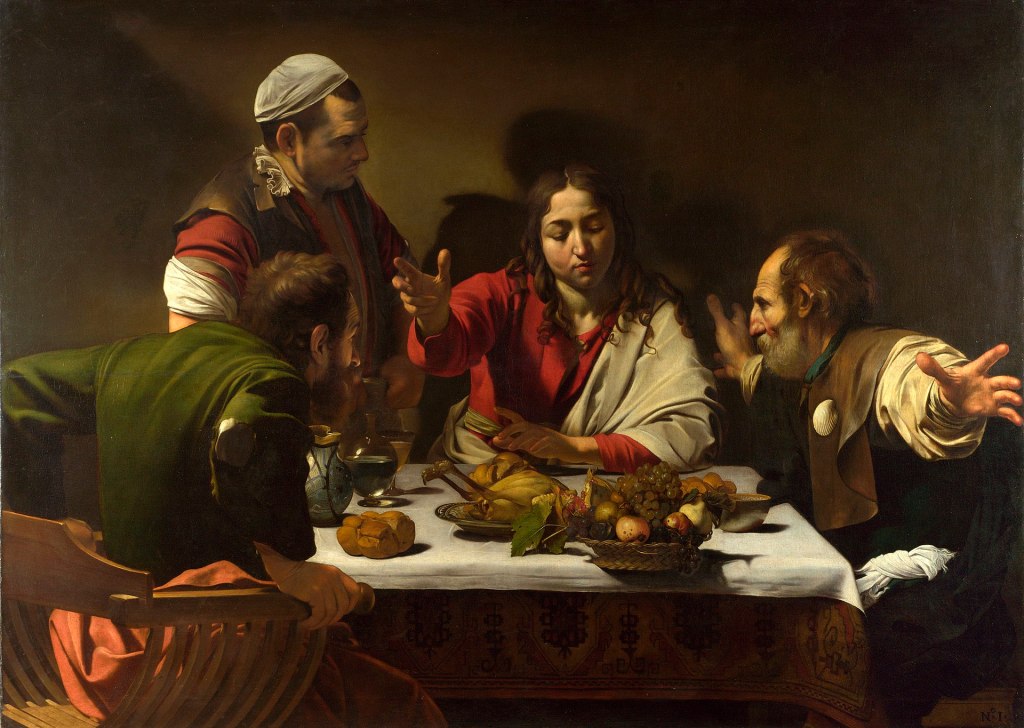
“Supper at Emmaus” by renowned painter Caravaggio from en.wikipedia.org. See the emotion depicted by Caravaggio with his trademark of masterful play of light and shadows. At the center is the Risen Lord blessing the bread that caught the two disciples who are seated in disbelief, one outstretching his arms and the others pushing back in his chair. The third character in the painting is the innkeeper unaware of the significance of the gesture of Jesus. It was at this instance that the two disciples recognized Christ as the traveling man with them to Emmaus.
Human transformation happens only in Christ, with Christ and through Christ in the Eucharist where we also experience a reversal of roles in our relationships with God and with others. Notice how the attitudes and perspectives of the two disciples changed when Jesus broke the bread. Remember it was the two disciples who invited Jesus inside to stay because it was getting dark, hosting a meal for him as their guest but that changed at the table: the two disciples ended up as guests of Jesus who merely joined them in their journey!
And it happened that, while he was with them at table, he took bread, said the blessing, broke it, and gave it to them. With that their eyes were opened and they recognized him, but he vanished from their sight. Then they said to each other, “Were not our hearts burning within us while he spoke to us on the way and opened the scriptures to us?” So they set out at once and returned to Jerusalem where they found gathered together the eleven and those with them who were saying, “The Lord has truly been raised and has appeared to Simon!” Then the two recounted what had taken place on the way and how he was made known to them in the breaking of the bread.
John 21:30-35
One thing I have found in life these past 25 years as a priest is that we can only realize and understand, even see the clearer and bigger picture of our life later after so many years of series of trials and tribulations, joys and celebrations. And often, what we see is the Lord, the companionship of Jesus Christ even in those times we were in sin and away from him. St. Peter said it so well in the second reading that we are in a “sojourning, realizing that you were ransomed from your futile conduct with the precious blood of Christ” (1 Pt. 1:17, 18, 19).
Photo by author, Sacred Heart Novitiate, Novaliches, QC, 20 March 2023.
Many times in life we feel as if we are really the captain of our ship, we direct everything, we control everything but it is actually Jesus. There is always Christ our companion in this journey of life, our true host and we are his guests who shared himself with us on the Cross so we can share in the mystery and victory of his Resurrection. In being one with us in our brokenness, Jesus immediately vanishes the moment we recognize him so we may keep on following him by changing course and direction in our lives.
In this time when people have lost interests in the Church, the Sacraments especially the Holy Eucharist, and the Scriptures along with prayers and devotions, we who are inside the church especially us priests are reminded of this important truth by Jesus, that he is the one in command, he is our host. We only share him in our co-journeyers in life, he is the one who opens our eyes, the one who effects transformation and changes within us. Not us.
Are we one with Jesus, especially in the Eucharist we manipulate so much with our many rituals and acts not necessary? See that the more we manipulate the Mass and other devotions, the more Christ disappears and persons especially priests become the focus.
In Emmaus, Jesus walked with the two disciples going the opposite direction to lead them back and never the other way around as it happens when we priests and volunteers are the ones who mislead people away from Jesus with our lack of warmth and charity for people like the unchurched.
Jesus is truest in the Eucharist when we touch people literally with our hands, when we get our hands dirty in taking care of the sick and needy, when we are truly present with them especially in their griefs, emptiness and sinfulness. That is when they experience, not just know that Jesus is real and true in the Eucharist when they first experience him in us his disciples, in our companionship and compassion with those suffering.
Nobody is perfect. As St. Peter had noted in the first reading, we are all responsible for the suffering and death of Jesus with our sinfulness; however, God’s love for us is far greater than our sins so that in our darkness and emptiness, we are able to see and have fulfillment in Jesus his Son. Amen. Have a blessed week!
Photo by author, Sacred Heart Novitiate, Novaliches, QC, 20 March 2023.
40 Shades of Lent by Fr. Nicanor F. Lalog II
Palm Sunday of the Passion of the Lord, 28 March 2021
Isaiah 50:4-7  +  Philippians 2:6-11  +  Mark 14:1-15:47
Photo by Mr. John Karol Limjuco, Parish of the National Shrine of Our Lady of Fatima, Valenzuela City, 26 March 2021.
For the second straight year, we are again celebrating our holiest week in the most unholy time of our lives in this COVID-19 pandemic. The timing could not escape everybody’s suspicion of something so sinister, if not diabolic, that religious gatherings are again limited.
But on a closer look and deeper reflection, we find what is happening right now is something similar with what Jesus went through that made these days so holy.
Notice that the official designation of our celebration today is “Palm Sunday of the Lord’s Passion” when Vatican II fused the two earliest preparations by the Church for Easter: the palm procession by Christians at Jerusalem in the fourth century and the proclamation of the long gospel of the Passion of the Lord in Rome by the Pope in the fifth century.
Both ancient celebrations set our sights to the Paschal Mystery of Jesus beginning this Sunday stretching it through this whole week to remind us of the triumph and tragedy, of darkness and light, of death and life. These contrasts shall be most pronounced when we enter the Triduum of the Lord’s Passion, Death, and Resurrection on Holy Thursday evening, Good Friday, and Easter Vigil.
Then everything becomes light and pure joy in Easter!
And the key to understanding, appreciating, and deeply imbibing the meaning of all these confluences of mixed emotions and feelings, colors and hues like our situation while under this time of the corona is to have the same attitude of Jesus Christ expressed so beautifully by St. Paul in our second reading:
Have among yourselves the same attitude (mind) that is also yours in Christ Jesus, though he was in the form of God, he did not regard equality with God something to be grasped. Rather, he emptied himself, taking the form of a slave, coming in human likeness; and found human in appearance, he humbled himself, becoming obedient to death, even death on a cross.
Having the mind and heart of Jesus Christ is opening ourselves to the Father by trying to see everything in his light as we go through life especially during this pandemic. It is what Jesus has always reminded us of “reading the signs of the times”.
God is telling us something in this pandemic but we are not listening to him as we continue to see it as a medical and social issue, refusing to recognize its spiritual and moral implications. In a lot of senses, this pandemic and quarantine we are undergoing is similar with situation when Jesus entered Jerusalem more than 2000 years ago when Israel under Roman rule and life was so difficult but nobody recognized him as the Christ and Savior!
In his entire life here on earth, Jesus always saw everything in the light of his Father in heaven. He never got involved into politics and other temporal concerns or subject but throughout the course of history since then until now, his teachings remain relevant in addressing our social issues and problems.
Seeing things and events in our lives and history in the light of God demands that we have the same attitude of Jesus of opening ourselves to be empty of our pride, of our plans and agenda, of our self-interests as well as of our illusions and insecurities in life.
We will never see God nor find him when we are filled with our selves, especially with our bloated egos when we think we know everything, when we presume we are always right, when we play gods.
Like the people who welcomed Jesus entered Jerusalem holding palms, singing “Hosanna in the highest!”, soon we would also be shouting “Crucify him!” unless we get emptied of ourselves and be filled with God.
St. Paul could eloquently present the mind and heart of Jesus in this beautiful hymn because he himself went through a process of kenosis, of self emptying. He had experienced in himself how when Jesus emptied himself and went down to his lowest point obediently accepting death on the cross, that is also when he was at his closest union with the Father who raised him to his highest glory at Easter.
That is why St. Paul called it the “scandal of the cross” for when we empty ourselves and offered everything to God out of love for him and for others that we are willing to go down to our lowest point in life, that is when God raises us up to “meet” him, to be one in him that miracles begin to happen, when things change for the best not only for us but also for others and those around us.
Hence, while we are in the most unholy period of our history, the Lord is giving us every chance to have the holiest Holy Week of our lives by examining our very selves in this time of quarantine to cleanse and empty ourselves of sins and evil to be filled with God of his holiness and grace through Christ’s cross.
Photo by author, St. Joseph Parish, Baras, Rizal, 15 January 2021.
The logic of the Cross
As we go to another Enhanced Community Quarantine (ECQ) or lockdown like last year, I am convinced that while we are sad at how things are going on, it is actually God who is most “sad” of all as we go through all these pains and difficulties due to the COVID-19 pandemic.
God cannot suffer because he is perfect; but, he can suffer with us that is why he sent his Son Jesus to become human like us to join us in all our sufferings including death and thus, “console” us in Christ.
“To console” is from the Latin terms “con” (with) + “solatio” (solace/comfort) that means not only to comfort or delight those in suffering but to also “strengthen” or make strong those weakened by trials and difficulties which is the literal meaning of cum fortis, with strength.
And here lies the “logic” of Christ’s Cross: Jesus died by the hatred of others so that we may live again by his love. Only God can give us the evidences of his love to render us capable through Jesus Christ to forge on amid our pains and sufferings, hoping against all hope that love is always stronger than suffering, death, and sin.
When we persevere in our sufferings, especially in silence for the sake of others out of love, imitating the self-emptying of Jesus, that is when God showers us with more of his love and mercy, strength and vigor to overcome everything in Christ.
This he had promised and fulfilled in Christ who is the “Suffering Servant” we heard in the first reading from the Prophet Isaiah:
The Lord God has given me a well-trained tongue, that I might know how to speak to the weary a word that will rouse them. Morning after morning he opens my ear that I may hear; and I have not rebelled, have not turned back. I gave my back to those who beat me, my cheeks to those who plucked my beard; my face I did not shield from buffets and spitting. The Lord God is my help therefore I am not disgraced; I have set my face like flint, knowing that I shall not be put to shame.
Isaiah 50:4-7
See how everything Isaiah had written was fulfilled in Jesus as we heard in the gospel today when at the praetorium “They clothed him in purple and, weaving a crown of thorns, placed it on him. They began to salute him with, ‘Hail, King of the Jews!’ and kept striking his head with a reed and spitting upon him. They knelt before him in homage” (Mk.15:17-19). It went on up to the calvary when “They gave him wine drugged with myrrh, but he did not take it. Then they crucified him…” (Mk.15:23-24).
In my reflections this Lent, I have been dwelling lately on tenderness and compassion as mercy of God in action, as mercy of his hands. To be tender and compassionate is to be one with the suffering even if you are suffering too – just like our medical frontliners who risk not only their very lives but even their families.
Last Friday I was asked to give a talk via webinar about development of compassionate teachers and staff at Our Lady of Fatima University where I serve as chaplain. A doctor asked if there is such a thing as “over compassion” wherein she can already feel chest pains in seeing and hearing all the sufferings of their patients in this time of the pandemic.
I was so touched by her question because I felt it too; I told her she is not alone feeling that way when I also feel overwhelmed with the sufferings of the people but cannot do so much. I told her it is a grace to feel that way, that she had to find ways how her mercy in the heart can flow to mercy of the hands while ensuring safety protocols as a doctor.
But that is where the grace of God works fullest, when we believe and trust more in Jesus Christ when the chips are already down, when we feel defeat is inevitable that we just surrender everything to Divine grace and intervention.
“Ecce Homo” by Murillo from wikipediacommons.org.
That is the meaning of Palm Sunday of the Lord’s Passion when we see life in its total weakness and even wreak, whether in our selves or among others, and yet we continue to persevere, to hope against hope because deep in us we know God is with us, God is working in us, and God will save us.
French poet Charles Péguy wrote in one of his great poems at the turn of the century that hope is God’s favorite virtue because “hope surprises him”.
Péguy described hope like the end of a play or a movie in our time; we know the show had ended but we stay on refusing to leave the theater because we believe that something is still coming up like a preview or a surprise scene!
See how St. Mark tells us at the end of his Passion Story when everything was so dark after Jesus had died when “he breathed his last” that the centurion standing there believed that “Truly this man is the Son of God!” (Mk.15:39)
Sometimes in life, God becomes clearest and most truest when we have lost everything, including what is most precious and dearest to us.
Have a heart with a lot of faith, hope and love that this may be the holiest Holy Week in our lives because it is the most unholy period in our history like when Jesus entered Jerusalem more than 2000 years ago. Amen.
Keep safe, be blessed, and be a blessing to others!
The Lord Is My Chef Simbang Gabi Recipe for the Soul-9
by Fr. Nicanor F. Lalog II
Thursday, Advent Week IV, 24 December 2020
2 Samuel 7:1-5, 8-12, 14, 16     >><)))*>  +  <*(((><<     Luke 1:67-79
Photo by author, altar at our sacristy, 19 December 2020.
One thing that have really made this pandemic so bad and so sad is the lack of tenderness of our many officials to the people they are supposed to serve. Consider all these pains and inconveniences they have caused us the public from the fatal shooting of that Marawi veteran in Quezon City to the detention of Mang Dodong at the height of the lockdown to the closure of the largest network in the country mid-year then on to stupidities of first the motorcycle barrier, then the closure of U-turn slots at EDSA capped by the insane RFID at NLEX and now the inhuman shooting of mother and son by an off-duty policeman.
As one of my friends wrote on his FB page last April, “bakit kung kailan panahon ng pandemya na dapat magtulungan at magmahalan saka puro karahasan?” (why all the the violence happening during pandemic when we are supposed to be helping and more loving to one another?).
What a year indeed of natural calamities worsened by some public officials so detached from the sufferings of the people.
And that, my friends, is why we have to celebrate all the more – meaningfully – Christmas.
God is perfect and cannot suffer; hence, He sent us His only Son Jesus Christ to be one with us in our sufferings and miseries, to suffer with us – cum passio – express His compassion.
On this last day of our novena to Christmas, we see how Zechariah comes into full circle singing praises to God (called Benedictus in Latin) after being forced by the angel into full silence becoming speechless when he doubted God’s gift of a child to him and his wife Elizabeth.
Zechariah his father, filled with the Holy Spirit, prophesied, saying: “Blessed be the Lord, the God of Israel; for he has come to his people and set them free. He has raised for us a mighty Savior, born of the house of his servant David.”
Luke 1:67-69
Photo by author, Advent Week IV, 20 December 2020.
Jesus already present among us in the coming of John
During the Visitation of the Blessed Virgin Mary, Luke never mentioned Zechariah around the house so that Elizabeth and her baby in her womb were the only ones were filled with the Holy Spirit upon hearing Mary’s greeting.
Now, after naming his son “John”, Luke tells us how Zechariah was filled with the Holy Spirit too that he prophesied the meaning of the coming of his son as “prophet of the Most High” in 1:76.
See the three verbs he used after blessing God in his canticle called Benedictus: “Blessed be the Lord… he has come to his people and set them free. He has raised for us a mighty Savior, born of the house of his servant David.” The verbs are all in the past tense when in fact, what he was saying was supposed to be of what would happen after the birth of John, the coming of Jesus Christ.
Here we find the complete faith and trust of Zechariah to the plan of God like Mary in her Magnificat. Zechariah had seen something so big, something momentous taking place while still in the midst of darkness of his time and world just like us in this pandemic and calamities, callous officials in government and police.
Dear friends: Jesus has come, had set us free (saved us), and had risen to work all His wonders! Let us keep our faith and hope like Zechariah that God has already started working in our favor to turn the tide and soon, things will surely get better if we remain consistent to our response to His calls, standing for life and dignity of every person through whom Jesus comes, for what is true and just.
Photo by author, Church of St. John the Baptist at Ein-Karen, Israel (2019).
From the hand of God into the heart of God
Yesterday we reflected on how we have to allow ourselves to be “the hand of God”, to let Him do His work among us through our hands. Today in Zechariah’s Benedictus we find a movement from the hand of God to His very heart in Jesus Christ our Savior.
“In the tender compassion of our God the dawn from on high shall break upon us, to shine on those who dwell in darkness and the shadow of death, to guide our feet into the path of peace.”
Luke 1:78-79
After seeing the coming of the Christ in the birth of his son John, Zechariah now summarizes to us the very essence of Jesus our Savior, of God Himself: tender compassion or in the original Greek, splaghna or “tender mercy” of God.
It is not just compassion which is to suffer with us but at the same time be filled with tenderness that one is so moved to reach out, to do something by going down with the one suffering.
Like courage, mercy is a movement in the heart called misericordia in Spanish from the Latin mittere, meaning to be moved, to be stirred. It is something dynamic, not static. It is a deep feeling that moves toward someone in pain and suffering. An identification of Jesus with every person going through so much hardships and sufferings in life.
Zechariah’s heart is no longer hardened with negativity and cynicism – it was so stirred by God that he mentioned His tender mercy or compassion because he had personally felt it as he recovered his voice and speech. With the birth of John, he now believes that God’s love for his suffering people is deep and personal. As we say in Filipino, “tagos o sagad sa buto” which may be translated as “through and through”.
And that is perhaps one of the things we sorely miss so much these days from everyone, tenderness. The tender compassion, tender mercy of Jesus. Recall how during His ministry all four evangelists would narrate how Jesus was moved with pity and compassion to the people who were lost, tired and sick “like sheep without a shepherd” that no matter how tired He may be, He would always find time to teach them, heal their sick, and even feed them.
That is the mercy of God that Jesus had brought forth to us in His coming, experienced by Zechariah himself that he could foresee its coming at the birth of John.
Photo by author, Advent Week IV, 20 December 2020.
We priests and religious pray the Benedictus in our morning prayer called lauds (Latin for praises). It is so fitting because at the start of each day, that must be the one thing clear with us always – that the Lord is come to save us, to forgive us, to love us.
One saying I have always loved mentioning in my talks to people came from an anonymous writer I found on the table of a good friend long before I became a priest. It says: “If you have love in your heart, you have been blessed by god; if you have been loved, you have been touched by God.”
That is the Benedictus, the song of every faithful disciple of Jesus introducing His coming, His birth. So many people have forgotten God, do not know God, refused to believe in God because many among us He had lavishly loved have refused to share His love with others.
Have a blessed and meaningful Christmas! Thank you for following our reflections. Share it if you have been blessed.
The Lord Is My Chef Sunday Recipe for the Soul by Fr. Nicanor F. Lalog II
Week XVIII, Cycle A in Ordinary Time, 02 August 2020
Isaiah 55:1-3 >><}}}*> Romans 8:35, 37-39 >><}}}*> Matthew 14:13-21
Remember our reflection last Sunday? Of how parables teach us that “less is always more” because to have the kingdom of God – Jesus Christ himself – we have to learn to appreciate the little things in life?
Beginning this Sunday until August 16, our gospels will start telling us who is Jesus Christ by showing us his powers and abilities that are exactly opposite the way we see and understand them. This new series of stories are so relevant to us in this time of pandemic, giving us wonderful insights into God’s ways of responding to our human situations.
St. Matthew now leads us with Jesus to the wilderness after teaching us in parables to experience his power in transforming us like the five loaves and two fish to feed more than five thousand people.
Multi-layered story of the multiplication of bread
All four evangelists have recorded this story of Jesus Christ’s multiplication of the loaves of bread with their particular focus and stress, showing us that it truly happened and was a major event in the Lord’s ministry.
Very unique with St. Matthew’s version of this miracle story – which has not one but two! – is his economy of words in narrating it like a straight news as if it were a developing story or a “breaking news” unfolding before us, calling us to follow its updates and details due to its multi-layered meanings.
When Jesus heard of John the Baptist, he withdrew in a boat to a deserted place by himself. The crowds heard of this and followed him on foot from their towns. When he disembarked and saw the vast crowd, his heart was moved with pity for them, and he cured their sick. When it was evening, the disciples approached him and said, “This is a deserted place and it is already late; dismiss the crowds so they can go to the villages and buy food for themselves.” Jesus said to them, “There is no need for them to go away; give them some food yourselves.” But they said to him, “Five loaves and two fish are all we have here.” Then he said, “Bring them here to me,” and he ordered the crowds to sit down on the grass. Taking the five loaves and the two fish, and looking up to heaven, he said the blessing, broke the loaves, and gave them to the disciples, who in turn gave them to the crowds. They all ate and were satisfied, and they picked up the fragments left over — twelve wicker baskets full. Those who ate were about five thousand men, not counting women and children.
Matthew 14:13-21
Photo from iStock/Studio-Annika.
The consolation of Jesus.
Our situation in this time of the corona pandemic is so similar with that of Jesus. With the increasing number of COVID-19 cases, it has finally hit us hard, so close to home with news of those we know getting infected and worst, dying from this disease.
Like Jesus upon hearing the death of John the Baptist, we are all saddened that we wish to withdraw away from everyone.
We want to mourn but there are more people in need of our presence and help in this time of pandemic like the countless medical frontliners and health workers who must be so tired – even sick, physically and emotionally – by now with the growing number of COVID-19 patients and yet have chosen to remain in their posts.
And there are still the other casualties of this pandemic like those who have lost their jobs, those evicted from their rented apartments, those stranded and separated from their loved ones, those begging for food, and those afflicted with other sickness going through dialysis and physical therapy.
Jesus knows so well the “wilderness” we are all going through and he is right here with us, one with us in our sufferings, in our fears and anxieties, and in our exhaustion.
To be one with us is consolation, from the Latin “con” or with + “solare” or alone, to be one with somebody feeling alone.
Jesus did not remove our pains and sufferings, even our death; he joined us to be one with us in these that he can call us to “Come to me, all you who labor and are burdened, and I will give your rest. Take my yoke upon you… For my yoke is easy and my burden light” (Mt.11:28-30, 14th Sunday, 05 Jul 2020).
Compassion of Jesus.
Still with Christ’s reaction of being “moved with pity” at the sight of the crowds who have followed him to the wilderness, we find something more deeper with his being one with us, in consoling us that he had forgotten all about himself, his tired body that he went on to heal the sick among them.
To be moved with pity is more than a feeling of the senses but a response of his total person.
You respond for help, you reply to a call.
Ever wondered why we have the “responsorial psalm” after the first reading in the Mass? Because those words from the Psalms express our total assent and commitment to God, involving our total self like body, mind, heart and soul.
Photo by Dra. Mai B. Dela Peña, Carmel Monastery, Israel, 2016.
God cannot suffer because he is perfect.
That is why he became human like us in Jesus Christ to be one with our suffering and death so that we would one with him in his glorious Resurrection.
In the wilderness, Jesus stayed with the people, not allowing them to leave as suggested by the Twelve because he was moved with pity with the crowd because he wanted to suffer with them.
That is compassion, literally means to “suffer with” from cum + patior. Here in the wilderness, Jesus showed his compassion for the people which will reach its highest point in giving himself on the Cross on Good Friday.
Have we “responded” to God’s call to serve, to a call of duty, and to a plea for help from the poor? Have we truly given ourselves to somebody without ever thinking our own comfort or rewards? Or, are we running away from his Cross?
What a shame in this time of pandemic there are some among us who rejoice at the losses of others like the Twelve who wanted the crowd to be sent home because they were afraid of responsibilities, of taking care of the suffering people.
Consolation and compassion are the two most needed from each of us in this time of crisis.
Our scarcity mentality, the God of plenty.
We now come to the miracle of the feeding of five thousand. According to the late Fr. Henri Nouwen, this story is an example of our “scarcity mentality” when we think of not having enough, of finding what we have as too little, always looking for more; hence, our tendency to hoard everything.
The Twelve were thinking more of themselves, afraid they could go hungry with the five loaves of bread and two fish they have. They were so afraid of difficulties ahead of them in their situation where to find and how to feed those great number of people.
They were focused on what was lacking than on what they have, and who was with them, Jesus Christ! They were hungry for food in the stomach than for food to the soul unlike the crowds who have followed Jesus.
Worst of all, the Twelve got “mad” upon seeing the crowds who have followed them to the wilderness when in fact, it was Jesus who needed most to rest to mourn John’s death!
But through all these, Jesus patiently bore the people’s woes and the Twelve’s selfishness to teach them all in a very nice way something so essential in our response to every human suffering and extreme situation: opening and entrusting our selves totally to God.
And that was actually the greatest miracle that happened that day.
In doing it, Jesus simply asked the Twelve what they have, never asking how much they have or its condition. Just whatever they have to give everything to Jesus like those five loaves and two fish that he took, and while looking up to heaven, blessed and broke the loaves, and gave them to the Twelve to distribute to the crowd.
And everyone was satisfied with a lot of left overs too!
Matthew nor any of the other Evangelists ever explained how it happened because it does not really matter at all. What is most important is what are we willing to give up to Jesus so he can transform us into better persons.
That is what we continue to do this day in every celebration of the Holy Eucharist- whatever we have, even not the best or the worst and littlest we have, when given to Jesus becomes holy and multiplied!
The power of God is immense, without doubt. But, in this miracle of the feeding of five thousand, Jesus is showing us that his power is not meant to satisfy our material or bodily needs but our deepest desires that lead to our fulfillment in him as prophesied by Isaiah in the first reading.
Why spend your money for what is not bread; your wages for what fails to satisfy? Heed me, and you shall eat well, you shall delight in rich fare. Come to me heedfully, listen, that you may have life.
Isaiah 55:2-3
Amid the pandemic worsened by our government officials’ inanities, irresponsibilities, and sheer lack of compassion with us in this wilderness, the Lord assures us today that he is with us for “nothing can separate us from the love of Christ” (Second Reading) if we are willing to give him all that we have.
It is our spiritual transformation first that leads us to our material blessings. We can all have it if we are willing to give everything to Jesus and believe in him always. What do you have for miracles to happen?
A blessed August ahead for you!Amen.
Photo by Dra. Mai B. Dela Peña, Carmel, Israel, 2016.

























 lordmychef.com