The test of love

The Lord Is My Chef Sunday Recipe for the Soul by Fr. Nicanor F. Lalog II
Week XXX-A in Ordinary Time, 25 October 2020
Exodus 22:20-26  |+++|   1 Thessalonians 1:5-10   |+++|   Matthew 22:34-40
Nuns bringing relief goods during the lockdown due to COVID-19 last summer. Photo from Facebook.

Our gospel this Sunday is a very usual scene happening daily in our modern world when we keep on testing Jesus Christ like the Pharisees for so many things about life we feel we know better than even God.

We keep on “pushing the lines” to avoid crossing them lest we break the laws and commandments when our hearts are clearly bent more on the legalisms than their spirit and sense.

How unfortunate that until now, when we would rather see the small parts than the whole that we keep on breaking down everything specially laws as if they are entities unto themselves, forgetting that each part leads to greater good.

Such is the essence of the one law of love, love of God is always love of neighbor and vice versa. They cannot be separated, like a face with two cheeks.

But more important than understanding the nature of the law of love which is the inseparability of love of God and love of others is passing its final test of loving.

I have always loved this actual photo of a banana vendor during the lockdown who kept his prices low as part of his effort in alleviating the sufferings due to COVID-19 pandemic. Photo from Smart, March 2020.

We keep on testing Jesus
who has passed every test we have
subjected him into...
Can we pass his test of love, too?

As we come to close our liturgical calendar in the coming weeks, our Sunday gospel today challenges us to examine our very selves too if like Jesus, can we pass the test of love?

When the Pharisees heard that Jesus had silenced the Sadducees, they gathered together, and one of them, a scholar of the law, tested him by asking, “Teacher, which commandment in the law is the greatest?”

Matthew 22:34-36

The scholar’s question to Jesus was partly a result of the confusion among people of his time when their experts and scholars of the Laws broke down into minute details and parts the Decalogue that eventually ended having over 600 precepts including those rituals of cleansing of things Jesus and his disciples were often accused of disregarding whenever they came to gatherings.

The sad thing is that instead of simplifying them so the people may find more the spirit of the Laws than its legalisms, the Jewish leaders “did not lift a finger” about it for selfish motives.

And now they were using it to test Jesus which we sadly continue in our present time.

While it is true that evil exists in lawlessness or when we live lawlessly, God’s law is directly opposed to a legalistic understanding that must be seen always in the light of faith.

This is perhaps the main point of Pope Francis in his recent statement proposing for “civil coexistence law” (convivencia civil) that will protect homosexual people from mistreatment and social rejection even from among their own family circles. The Pope is not calling for same sex civil union nor same sex marriage. We have to go beyond the legalese and legalisms of laws to see the Holy Father’s genuine concern and love for people with homosexual tendencies he had longed to bring back to the fold.

We cannot separate law and love if either is to bring deepened relationships and unity among peoples that are in fact the goals of both law and love. Law and love always take into consideration the other person often forgotten when we have an excess of our very selves.

In the first reading, we are reminded how the laws themselves are manifestations of God’s love for his people, of laws coming directly from him without any hint whatsoever of the distant lawgiver we have always seen and experienced among men.

See how he admonished everyone to be kind with everybody specially aliens for after all, we are all immigrants and travelers of this earth whom he takes care of. In declaring “I am compassionate” (Ex.22:26), God assures everyone of his oneness with us, that to love him is to love others, to hurt others is hurting him too! The very same thing Jesus is telling us today!

He said to him, “You shall love the Lord, your God, with all your heart, with all your soul, and with all your mind. This is the greatest and the first commandment. The second is like it: You shall love your neighbor as yourself. The whole law and the prophets depend on these two commandments.”

Matthew 22:37-40

Jesus easily passed the “test” by the Pharisees at that instant and would prove it more decisively and concretely on the Cross when he gives himself up to the Father for our salvation as the supreme sign of love that is true.

His answer takes us all to the very foundation of all the laws we have which is loving God with one’s total self expressed in loving others as we love our selves. Here we find Jesus doing away with our legalisms that focus on the letters and individual laws and commandments, summing them all in love.

Again, following the background and personality of Pope Francis, here we find his love in action being bogged down by legalisms and limitations of the language.

What does he really mean with convivencia civil or civil coexistence law minus any romantic meanings in adherence to our moral laws?

I do not know but in my heart, I could feel the love and compassion of this Pope for homosexuals we have long ostracized from the Church and even society, making fun of them, forgetting their feelings and well-being and persons. It might still take some time before the Pope’s idea is realized even in the Church. What we need at the moment is openness to the leading of the Holy Spirit to finally find those words and terms to encapsulate the love and compassion Pope Francis has for them.

That is the problem with love — always beyond words. One has just to do it, to just “love, love, and love” as Leo Buscaglia would always say.

In the second reading, St. Paul reminds us how the world continues to frown upon us Christians striving to live the life Christ had called us to. We can see the continuing biases in the society even in social media against us Christians standing for what is just, moral and true. It is in this context where we are challenged to be true witnesses of the love of Jesus Christ that the credibility of his gospel is proven daily as the only path towards peace and harmony.

Jesus passed the tests of his enemies about his love for God and love for us; all the past Popes have proven too their complete love for God and for others in their lives of holiness. Pope Francis has striven while still in Argentina to witness this immense love of Jesus for the marginalized. Instead of wasting our energies debating about his recent statements despite his being passed the same test of love, let us now examine ourselves how are we faring in this test of love too?

And loving and lovely week ahead of everyone in Jesus!

Photo by author, 2019.

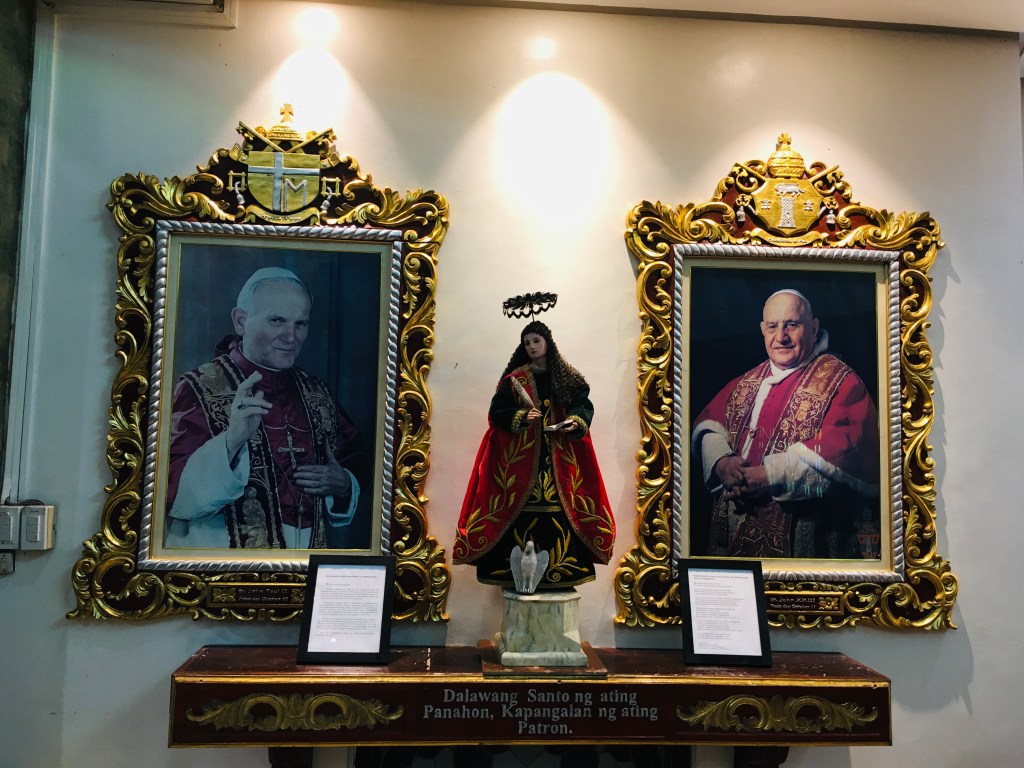
Dalawang makabagong santo, kapangalan ng aming Patron

Lawiswis ng Salita ni P. Nicanor F. Lalog II, Ika-22 ng Oktubre 2020
Larawan nina San Juan Pablo II at San Juan XXIII kasama isa sa mga matandang imahen ng aming Patron San Juan Apostol at Ebanghelista sa likuran ng aming simbahan sa Bagbaguin, Santa Maria, Bulacan.

PANALANGIN KAY SAN JUAN APOSTOL AT EBANGHELISTA KAUGNAY NG MGA BAGONG SANTO NG SIMBAHAN: PAPA JUAN PABLO II at PAPA JUAN XXIII (Bahagi ng aming mga Panalangin sa Parokya ni San Juan Apostol at Ebanghelista, Bagbaguin, Santa Maria, Bulacan mula nang itanghal bilang Santo ang dalawang naturang dating Santo Papa noong 27 Abril 2014, Linggo ng Dakila Awa ng Diyos.)

Minamahal naming Patron na Banal, 
Juan Apostol at Ebanghelista po ang inyong ngalan!
Ngayo'y aming ipinagdiriwang sa buong Simbahan 
dalawang bagong Banal: Kapwa sila pastol ng kawan, 
nang manungkula'y pangalan mo ang hiniram.

San Juan Beinte-tres nang sa kanyang katandaan tuladmo,
Sinikap maging makabuluhan at buhay na palatandaan ng Diyos
sa gitna ng makabagong panaho nitong InangSimbahan
nang kanyang simulan ang Ikalawang Konsilyo sa Vatican. 

Kasabay niyang tinanghal bilang Banal 
ang tinaguriang Dakilang San Juan-Pablo Ikalawa;
Labis na pagtitiis ang kinamit sa kanyang sakit, 
Krus ay sinapit, katulad mo’y naging malapit
sa Ina ni Hesus kaya’t “Totus Tuus” ang kanyang awit.

Itulot mo aming Mahal na San Juan Apostol at Ebanghelista,
kaming iyong mga anak sana’y matularan,
pinagsikapan ng dalawang bagong San Juan:
pamilya’t sambayanan mabuklod sa nagkakaisang pag-ibig
katulad ng dalangin ni Hesus doon sa Huling Hapunan. AMEN.

San Juan Ebanghelista, ipanalangin mo kami.
San Juan Beinte-tres, ipanalangin mo kami.
San Juan-Pablo Ikalawa, ipanalangin mo kami.

Our heavenly citizenship

The Lord Is My Chef Breakfast Recipe for the Soul by Fr. Nicanor F. Lalog II
Tuesday, Week XXIX, Year II in Ordinary Time, 20 October 2020
Ephesians 2:12-22     >><)))*> + >><)))*>  +  >><)))*>     Luke 12:35-38
Photo by Dr. Mylene A. Santos, MD in Quezon, 2020.

Glory and thanksgiving to you, God our Father, through your Son our Lord Jesus Christ in the power of the Holy Spirit for reconciling us all in you, making us one despite our many differences.

How lovely to the ears, to our being the words of St. Paul today, Lord Jesus, assuring us of our citizenship in heaven through the salvation you have brought us all, regardless of our color, race, status or even religion!

So then you are no longer strangers and sojourners, but you are fellow citizens with the holy ones and members of the household of God, built upon the foundation of the Apostles and prophets, with Christ Jesus himself as the capstone. Through him the whole structure is held together and grows into a temple sacred in the Lord; in him you also are being built together into a dwelling place of God in the Spirit.

Ephesians 2:19-22

Help us, O Lord, to embody and manifest this unity of peoples in you in the Church, your Mystical Body here on earth.

Heal us of our many divisions and make us truly Catholic by helping everyone enter into communion with you through one another.

Keep us on guard for your return, Jesus, by “girding our loins and lighting our lamps” (Lk.12:35) ready to welcome you with our good works each day, leading others closer to you.

Let us start by going back to you in prayers and silent meditations that many have forgotten or taken for granted in this 24/7 world saturated by media with all the cacophony of sounds and blinding visuals that have blurred our vision of who we really are as citizens of heaven, beloved children of God our Father in heaven.

Help us find our way back home to the Father in heaven here on earth by finding our way back home to our true selves and to our brothers and sisters in you, dear Jesus. Amen.

Trees are “shaken” to get its fruits

The Lord Is My Chef Sunday Recipe for the Soul by Fr. Nicanor F. Lalog II
Week XXVII-A in Ordinary Time, 04 October 2020
Isaiah 5:1-7     ||+||     Philippians     ||+||     Matthew 21:33-43
Photo by Mr. Jim Marpa, 2018.

To all the plantitos and plantitas: happy feast day this Sunday, the fourth of October which is also the feast of St. Francis of Assisi, patron of those in the green movements.

Part of the grace of this pandemic is the new awareness and interests of many among us for all kinds of plants borne out of the prolonged quarantine periods these past seven months. I remember growing up in our barrio where fences were all plants like santan, San Francisco and gumamelas whose flowers we used to mix with Tide to play bubbles. Who would have thought that after several decades those plants we used to take for granted like the gabi varieties and others along with cactus found almost everywhere would cost a fortune today?

But what I really miss and hope the plantitos and plantitas will be able to revive and bring back are the fruit trees every home used to have even in vacant lots like guava, santol, atis, aratiles, mabolo, achesa, duhat, kamias and of course, mango. Whenever me and my cousin would trek to the mini forest at the back of our compound called “duluhan” near a swampland to shoot birds and everything with our slingshots (tirador), we always had some fruits to munch in our little adventures.

And part of that adventure was to “shake” until we break branches of trees to get fruits and local beetles called salagubang (on mango trees).

Shaking of tree. Exactly the same thing that Jesus did today in his next parable addressed to the chief priests and elders of the people who would soon have him arrested, tried, and crucified: after telling them parable of the wicked tenants who killed the servants and the son of the owner, Jesus shook and shocked his listeners who later realized the parable was about them!

“What will the owner of the vineyard do to those tenants when he comes?” They answered him, “He will put those wretched men to a wretched death and lease his vineyard to other tenants who will give him the produce at the proper times.” Jesus said to them, “Did you never read in the Scriptures: ‘The stone that the builders rejected has become the cornerstone; by the Lord has this been done, and it is wonderful in our eyes?’ Therefore, I say to you, the kingdom of God will be taken away from you and given to a people that will produce its fruit.”

Matthew 21:40-43

We are the vineyard of the Lord


From Google.

Jesus had already entered Jerusalem and was teaching at the temple area. Among his audience were the chief priests and elders of the people trying to gather evidences against him for his arrest and execution. Unknown to them, Jesus knew what was in their hearts.

Last Sunday the parable was directed to them so they may realize how wrong they have been in regarding them so highly above the publicans and prostitutes who repented for their sins and went to receive the baptism by John the Baptist.

Today, Jesus “shook them” with this second parable taken from a well known song and lament of a beloved to his vineyard by the Prophet Isaiah which we have heard at the first reading.

Vineyards are very common in Israel as in the rest of the Mediterranean and Europe where grapes and wine symbolize life. Hence, the vine is always considered as a highly prized plant that biblical authors have taken as the image of the people whom God cultivates and from whom he expects beautiful fruits.

In the first reading, we find God lamenting why after investing his vineyard with the best of everything, the grapes it produced were so bad that it had to be burned. It was a very strong warning against Israel who have gone wayward in its ways of living that aside from worshipping idols, they also killed the prophets sent by God.

Notice the transition by Jesus using the same imagery from the Old Testament of the vineyard as the people of God but this time bearing fruits at harvest time. By that time, the chief priests and the elders of the people felt they were better than their ancestors who had the prophets killed. In fact, they felt proud that they have been faithful to God, and therefore, fruitful — thinking they were a far cry from Isaiah’s lament. Unknown to them, Jesus could read their hearts, how they were all planning to kill him like the son in the parable so they can have the vineyard, the people and lord it over them!

Everything fell into right places at the end of the parable when Jesus asked them:

“What will the owner of the vineyard do to those tenants when he comes?” They answered him, “He will put those wretched men to a wretched death and lease his vineyard to other tenants who will give him the produce at the proper times.”

Matthew 21:40-41

Try to imagine the scene with Jesus face-to-face with the chief priests and elders of the people – and with us – discussing the present time, not the past.

Here is Jesus Christ shaking us all to find whatever fruits we have, telling us that this parable is about me and you (see v. 45), asking us, why are you trying to remove me from the people? Why are you easing me out, creating all these cults around yourselves like celebrities, getting the people’s money and approval for your own sake?


Sometimes we need to be shaken – even shocked – to bring out our fruits


Photo by author at Silang, Cavite, 22 September 2020.

See again my dear Reader the beauty of the Lord’s parables wherein he invites us to be involved with it to see how we felt with certain situations like in the merciless debtor and early workers at the vineyard; today, Jesus is asking us our opinion on what the vineyard owner must do against the wicked tenants.

He knows what to do and wants us to realize that we could be those tenants too because like the chief priests and elders, we easily see the sins and shortcomings of others, the fruitlessness of others without realizing our own darkness within, even our sinister plans to dominate.

See how the chief priests and elders of the people called the tenants “wretched men” deserving “wretched death”, not realizing that the more we talk of other people, the more we actually talk of ourselves!

Every parable by Jesus is always set in the present moment with sights set to the future, to eternal life.

Sometimes, God has to shaken us, even shock us so we may bring out and give him his share of harvest of fruits like our faith, hope and love that will build the community in him, not take people away from him. Problem with us is like with those tenants and the chief priests and elders: “masyado tayong bumibilib sa ating sarili”, that is, we believe too much on ourselves that unconsciously we feel like God, forgetting we are mere stewards or tenants of his vineyard.

St. Paul reminds us in the second reading that we strive to imitate Jesus, be like Jesus so that people may find in us a model in following Jesus. Very clear with St. Paul: nobody is replacing Jesus Christ whom we must all imitate.

This time of the pandemic is a time of harvesting, of showing others our fruits like love and kindness so we may lead more people to God, not to ourselves or anyone else trying to lord over us.

This is the time we are asked to feel more than think more like those tenants, a time to lead people back to God who truly owns us, his vineyard (see https://lordmychef.com/2020/10/02/on-being-kind-and-loving-during-covid-19/).

When shaken by the Lord, will there be fruits found in us to share with others?

Have a blessed Sunday and brand-new week ahead! Amen.

Mary in the hiddenness of God

Quiet Storm by Fr. Nicanor F. Lalog II, 10 September 2020
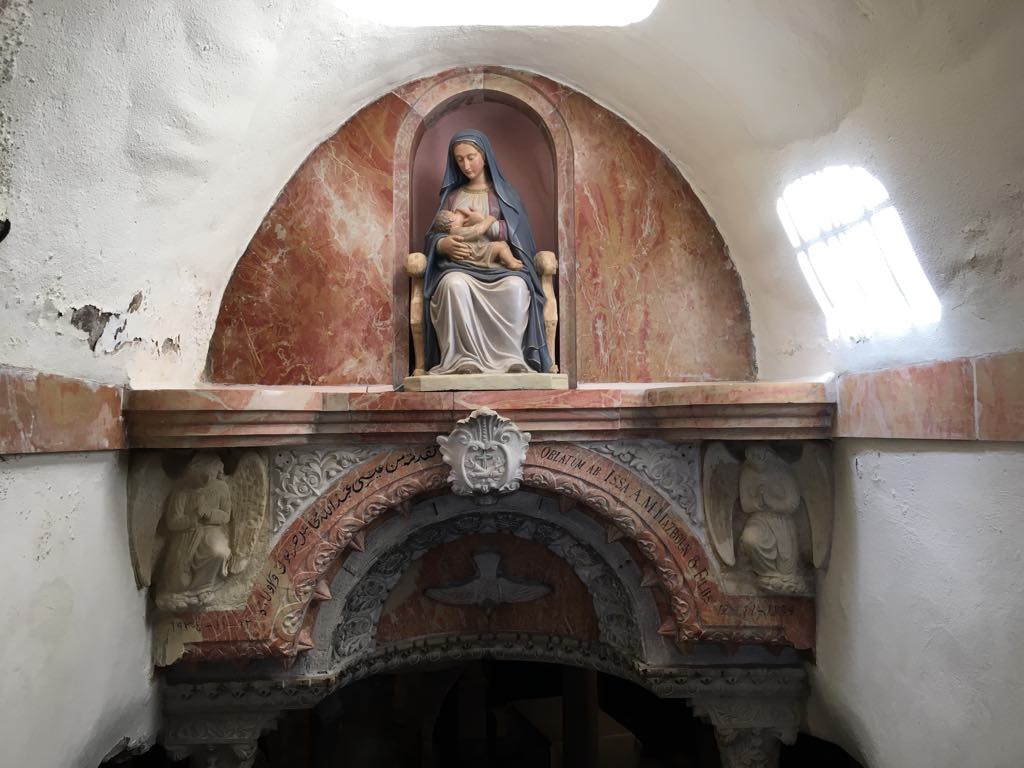
Chapel of the Milk Grotto in Bethlehem where the Holy Family hid before fleeing to Egypt to escape Herod’s murder of innocent babies. According to tradition, a drop of milk from the Virgin Mary fell on the floor of the cave that turned color of the stones to white.

We have just celebrated the Feast of the Birth of the Blessed Virgin Mary, the most perfect example of one who had experienced God’s hiddenness in her life, teaching us with some important lessons in rediscovering and keeping God’s hiddenness specially in this age of social media when everything is shown and has to be seen.

We have mentioned in our previous blog that hiddenness is different from being invisible that simply means “not visible”; hiddenness is more than not being seen per se but that feeling with certainty that God is present though hiding because he wants to surprise us. If God were not hidden, we would have not found him at all. And the more God is hidden, the more we are able to see him and experience him too as seen in the life of Mary (https://lordmychef.com/2020/09/04/the-hiddenness-of-god/).

The hiddenness of Mary.

Simplicity and humility of Mary as venue for the perfect setting of God’s coming in Jesus Christ. Consider her origins: her town of Nazareth in the province of Galilee was definitely outside the more popular city of Jerusalem that was the place to be at that time. Most of all, it is the only town in the New Testament never mentioned in the Old Testament nor by the prophets for lack of any significance in the coming of the Messiah.

Nazareth was largely unknown with some hint of notoriety as expressed by Nathanael (aka, Apostle Bartholomew) when he expressed disbelief to Philip who told him they have found the Christ, Jesus of Nazareth, by saying “Can anything good come from Nazareth?” (John 1:46)

Photo by author of chapel at the grotto believed where Mary received the good news of bearing Jesus Christ in her womb underneath the Basilica of the Annunciation at Nazareth, Israel (2019).

But that is how God works in his hiddenness, coming to us in the most ordinary places and circumstances, even least expected like Mary who was definitely not “in” if we go by today’s popular standard of “who’s in and who’s out?”

In fact, she was so “outside” the circle of influence of their time with her being promdi as we say these days, without any illustrious lineage to be proud of like her spouse Joseph who was from the royal Davidic line or her cousin Elizabeth from the priestly branch of Aaron, the brother of Moses whose husband, Zechariah belonged to another priestly clan in Israel.

Yet, God chose Mary to be the Mother of Jesus Christ because of her hiddenness expressed in her simplicity and humility. It is a far cry from our extreme “Marianism” when we almost worship Mary forgetting Jesus Christ her Son and our Savior! Worst still is the growing trend of “triumphalism” in many parishes racing for the so-called “episcopal” and “canonical” coronation of their various images of the Virgin Mary that come in all kinds of names and titles that has come to look more of a fad than authentic Marian devotion.

Without any intentions of denigrating the role and stature of the Blessed Virgin Mary in our faith as well as her proper place in the life of the Church defined by Vatican II’s Lumen Gentium, I dare ask the following questions:

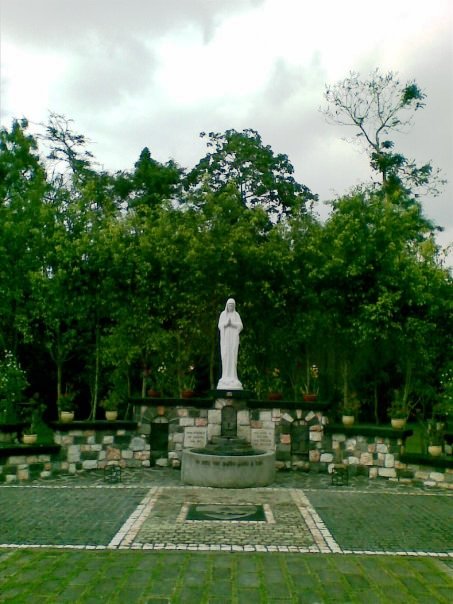
Photo by author, a replica of Our Lady of the Poor of Banneux, Belgium at Girlstown, Cavite (2009).

Is her coronation in heaven as Queen of heaven and earth not enough?

Why the need for these lavish spectacles for the coronation of the most simplest and humblest woman to have lived on earth?

It is a clear case of triumphalism – that exaggeration or overdoing our worship and rituals – especially if the Marian image is less than 200 years old without widespread devotions like the ones at Sto. Domingo (Quezon City) and Manaoag (Pangasinan).

I do not think the Blessed Mother would favor this considering her simplicity and solidarity with the poor and marginalized peoples seen in her many apparitions.

See the quaint and charming simplicity of Mary at Fatima in Portugal (1917) and lately at Banneux in Liege, Belgium (1933) where she identified herself as “Lady of the Poor”.

Note how the Virgin Mary reads “the signs of the times” in her apparitions and appearances when during the 1500’s at the height of European royalties and expeditions, she was always portrayed as victorious in regal clothes; but since Fatima in the 20th century as the world sank into the excesses of Industrial Revolution and affluence, Mary appeared simple, always in solidarity with the poor and suffering.

It is a cue we are sorely missing and sad to say, instead of renewing the world as St. Paul had asked us, we have allowed ourselves with the Mother of God to be transformed into the ways of the world by immersing in its showbiz frenzies, focusing on the material aspects like expensive clothes and jewelries.

Second example of Mary’s hiddenness is her oneness with Jesus Christ. She was never on her own, always seen in Jesus, with Jesus her Son and Lord. She believed in him so much, making him the focus at the wedding feast at Cana as well as at the foot of the Cross where she expressed in the most strongest terms her solidarity with the Savior of the world.

This has always been insisted by the Church since Vatican II regarding our devotions to Mary that must always be in relation with Jesus and his mission — never on her own.

Photo by author, 2019.

In all her apparitions, the Blessed Mother has always been consistent with her messages of conversion and return to God through her Son Jesus Christ, the frequent reception of the Sacraments of the Eucharist and Confession or Reconciliation.

Mary’s Christocentricity is best seen in her oneness with him in pains and sufferings like in the Pieta and the Mater Dolorosa where Jesus is the one standing out, not her. Nor anybody else.

When Mary, or anybody else for that matter goes on one’s own, Jesus is no longer hidden but removed from the scene. Then his Cross disappears and all that is seen is Mary in all her “beauty and glory” that are empty, very secular because these attributes come precisely from her communion in Jesus!

Perhaps, this pandemic is teaching us today to review our Marian devotions and processions that have become more of a show and a spectacle for Instagram than for deepening of our faith.

I pray that the Cofradia that holds the annual December 8 processions at Intramuros would take a rest this year until 2022 to discern their noble efforts before that have degenerated to pomp and pageantry among “devotees” specially camareros and camareras trying to outshine and outclass each other with some participation at the sidelights of their pastors and sacristans.

Keeping the hiddenness of God while we remain hidden in contemplation.

Of all the qualities of Mary we all must imitate to help people rediscover God’s hiddenness is her being hidden in prayer and contemplation.

St. John Paul II noted in Rosarium Virginis Mariae when he launched the Luminous Mysteries in 2002 that although the scriptures are silent about where was Mary during the other significant moments of the life of Jesus, especially at the institution of the Holy Eucharist, it was most likely that Mary was also present deep in prayer.

This we find clearly at the Pentecost when the Holy Spirit descended upon the apostles and the Blessed Virgin Mary while they were praying at the Upper Room in Jerusalem (Acts 1:13-14).

Modern rendition of the Pentecost with Mary among the other disciples of Jesus. From Google.

Pope emeritus Benedict XVI shares with us his profound insight in his second Jesus of Nazareth book series (Birth of Jesus) how after the annunciation of the the birth of Christ to Mary, the angel left her totally without ever coming back to warn or instruct her unlike with Joseph. After saying “Yes” to the plan of God to be the Mother of Jesus, Mary immersed herself deep in prayers and contemplation, becoming hidden herself in God.

Since then, she never doubted Jesus her Son as the Christ, nurturing her faith with prayers beautifully expressed by St. Luke in saying how “Mary treasured things in her heart” when facing difficult situations like during his birth and his finding at the temple. It is not surprising that in the contemplation by St. Ignatius of Loyola, the Risen Lord must have first appeared to his Mother upon rising from the dead because she was the first to believe totally in him (which became the basis of our tradition of the Salubong).

Mary has always been present in the hiddenness of Christ from his coming in the darkness of the night on a manger in Bethlehem, to his hidden years in Nazareth, to his ministry when he would always retreat to a deserted place to pray, to his Crucifixion and death and burial on Good Friday and finally, in the darkness of Easter.

In this age of social media where everyone and everything has to be seen and shown with nothing hidden anymore even without qualms and shame at all, part of our mission and ministry as priests and religious is to lead people back to God’s hiddenness like the Virgin Mary so they may realize anew that the best things in this life are not always seen.

To fulfill this is for us first of all to imitate God like Mary — be hidden!

How unfortunate that instead of leading the people back to God’s hiddenness, we priests and religious have in fact joined the secular world, imitating the “influencers” like bloggers and vloggers that instead of focusing on God who is hidden, we are concerned with our selves and all the “porma” for the sake of number of “likes” and “followers” we have in our posts.

The more we try so hard to make God visible in our ministry by imitating the styles and gimicks of some media personalities that make our liturgy look like a variety show complete with song and dance numbers with our altars heavily decorated like a studio set with giant tarpaulins like in EDSA, that is when we remove God totally – not only his hiddenness – from the scene and inverse proportionately, the more we priests and pastors become more popular than the Lord himself.

“The Assumption of the Virgin” by Italian Renaissance painter Titian completed in 1518 for the main altar of Frari church in Venice. Photo from wikidata.org.

And that is how cults begin, with or without Jesus. It is very sad, even tragic and ironic because we have removed God himself – even Mary! – by unconsciously making ourselves the center of attention like pop icons and idols.

Mary had shown us the most perfect example of discipleship which is more of Jesus, less of self.

Can we not post without using our own pictures – no matter how profound our thoughts are – so the people may see the hiddenness of God in a photo of a lovely flower or a magnificent sunset? Unless you are a bishop or the Pope himself, having your photo published specially in the news is part of the information process about the person in focus. It is totally different in Church communications which is all about God and his message of love, not us.

The quarantine period invites us in the Church to appreciate and share this wonderful hiddenness of God by first becoming incognito, unknown and hidden from others, preferring to be at the background or “behind the camera” as we follow God in his hiddenness until we go to that great beyond of totally hidden from everybody except God.

Do not worry. We have Mary in every step along the way. Amen.

A holy déja vu?

The Lord Is My Chef Breakfast Recipe for the Soul by Fr. Nicanor F. Lalog II
Monday, Solemnity of St. Peter and St. Paul, Apostles, 29 June 2020
Acts of the Apostles 12:1-11 >><)))*> 2 Timothy 4:6-8, 17-18 <*(((><< Matthew 16:13-19
Photo from americamagazine.org.

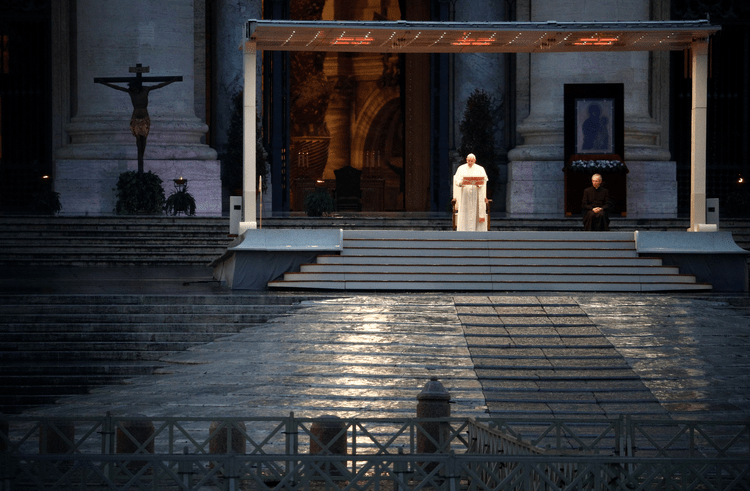
As I prepared to celebrate today’s Solemnity of the two pillars of the Church you have established, Lord Jesus Christ, that image of your Vicar and St. Peter’s successor, Pope Francis delivering his extraordinary Urbi et Orbi message last March 27, 2020 before an empty St. Peter’s Square flashed into my mind, something like a deja vu.

It is a holy deja vu, Lord, of St. Peter’s experience in prison on a Sunday night…

In those days, King Herod laid hands upon some members of the Church to harm them… he proceeded to arrest Peter also – it was the feast of the Unleavened Bread – he had him taken into custody and put in prison under the guard of four squads of four soldiers each. He intended to bring him before the people after the Passover. Peter thus was being kept in prison, but prayer by the Church was fervently being made to God on his behalf. Suddenly the angel of the Lord stood by him and light shone in the cell. He tapped Peter on the side and awakened him, saying, “Get up quickly.” The chains fell from his wrists. The angel said to him, “Put hi on your cloak and follow me.” So he followed him out, not realizing what was happening through the angel was real; he thought he was seeing a vision.

Acts of the Apostles 12:1, 3-5, 7-9

It is happening again, Lord, when we are all in great darkness due to this COVID-19 pandemic.

How blessed are we, O Lord, here with us in the midst of this pandemic is Pope Francis, St. Peter’s successor and St. Paul’s reminder to continue in proclaiming your Gospel in season, out of season.

Keep him strong and inspired always in order to lead us through this dark 2020.

We pray, O dear Jesus, for our Church especially here in the Philippines.

Our churches remain closed, some of our leaders are under attack while some of them along with our fellow workers are so afraid, so timid, abandoning their flock in this crucial moments of tests. Others are so concerned with trivial things, pursuing positions, fame, and wealth.

Have mercy on us, Jesus in veering away from your person and your Cross.

Strengthen us your Church, Lord, especially Pope Francis and all the bishops and priests, to always be aware of the angels you are sending us to deliver us from so many dangers in this time of crisis.

May we avoid “over thinking” that results into “analysis paralysis” that we forget to focus and do the more important things at this time which is to accompany, to be one with your flock now under various attacks not only by the corona virus but the diseases of indifference and convenience.

May we your body, the Church continue to pray with confidence, remembering your own pasch that brought us to salvation as we thank you too in keeping us safe and alive since March.

Give us the courage of St. Paul to take this period of pandemic and crisis as a form of pasch for each one of us, that we may willingly die in our selves and offer ourselves to you through others as an offering through worship with our loving service to one another.

May we keep our sights focused on you alone, Lord Jesus, the Christ of the living God sent to make us one.

Like St. Peter and St. Paul, though they were poles apart in their personalities and backgrounds, they were united in serving you, working for you by seeking only your face, your voice, your will and your presence.

May we keep in mind that when we fail to know you, Lord, that is when people fail to know and meet you too like the people of your time who claimed you were one of the prophets

Yes, the situations today may be like a holy deja vu from the past but you are definitely and truly present among us in this time of crisis.

St. Peter and St. Paul, pray for us!

Amen.

St. Peter by ecclesiastical artist Willy Layug at the Malolos Cathedral.
St. Paul by ecclesiastical artist Will Layug at the Malolos Cathedral.

St. Paul in time of COVID-19: need for pastoral communication

Quiet Storm by Fr. Nicanor F. Lalog II, 11 June 2020
Painting by Raphael (1515) of St. Paul preaching at Areopagus in Athens, Greece. From wikipedia.

With houses of worship still closed despite the opening of most business establishments, here is the final installment of reflection in our series on how the life and teachings of St. Paul may help us in our ministry during this time of COVID-19 amid a perceived government “persecution” of the Catholic Church.

There is no doubt that like during his time, St. Paul would be using modern means of communication to preach the Gospel of Jesus Christ especially in this most trying time of our history, using the internet as the new “Areopagus” with social media in particular.

Then Paul stood up at the Areopagus and said: “You Athenians, I see that in every respect you are very religious. For as I walked around looking carefully at your shrines, I even discovered an altar inscribed, ‘To An Unknown God.’ What therefore you unknowingly worship, I proclaim to you. The God who made the world and all that is in it…”

Acts of the Apostles 17:22-24

Social Communication

Perhaps before we go into our reflection, it is imperative especially for bishops and priests to be reminded anew of some important terms in communications; this is more than about names or nomenclature because for as long these terms of communications are not clear with us, all our evangelization efforts would be askewed as it is now showing with an explosion of online Masses and other religious celebrations.

First priority is to stop using the words “mass media” and even “social media” in our church communications because these are very limited in scope and context.

It is important to note that in the 2000-year history of the Church, it was only in Vatican II that we have issued a conciliar document on communication wherein the Fathers also introduced the term social communication as a new name for communications in the Church.

How sad that there are still bishops and priests using the terms “mass media” or “media” and lately “social media” when more than 50 years ago the Church through the inspiration of the Holy Spirit coined social communication to refer to “the communication of and in human society including all the ways and means used in this process” (Fr. Franz-Josef Eilers, svd, 2009 BISCOM-FABC, Bangkok).

Social communication is a very prophetic term because it is theological and rooted in God who is communication himself, sharing with us his power to communicate so we may also communicate with him and with others. Most of all, God continues to communicate with us and from that lies our task as a Church to communicate him to the world.

This is the reason why we have to keep on using this term “social communication” in our Church communications to keep us Christocentric, meaning, every communication in the Church and by the Church has Jesus as Message.

And that is essentially the kind of communication process followed by St. Paul the Apostle. In fact, reviewing his letters and the various accounts about him would show us that early, this great apostle has been into social communication, specifically “pastoral communication” that is an emerging field in Church communications whose realities have long been espoused by St. Paul himself.

Pastoral Communication

Pastoral communication is anchored on Jesus Christ, the “Good Shepherd” who sets himself as the norm and standard of our Church communications.

Jesus said, “I am the good shepherd. A good shepherd lays down his life for the sheep… I am the good shepherd, and I know mine and mine know me, just as the Father knows me and I know the Father; and I will lay down my life for the sheep.”

John 10:11, 14-15
Photo by Pixabay on Pexels.com

St. Paul has always been very clear with this in all his communications that towards the end of his life, he had beautifully written his disciple this wonderful piece:

Beloved: I charge you in the presence of God and of Christ Jesus, who will judge the living and the dead, and by his appearing and his kingly power: proclaim the word; per persistent whether it is convenient or inconvenient… For I am already being poured out like a libation, and the time of my departure is at hand. I have competed well; I have finished the race; I have kept the faith.”

2 Timothy 4:1-2, 6-7

Communicating Jesus Christ is always about self-sacrifice, about giving of one’s self like our Lord and Master. In whatever form of communication we use, it is always a call to “enflesh” the Word. In short, communication is spirituality that indicates the kind of relationship we have with God. How we reflect that relationship with God in words and in deeds, in our clothings and everything is communication.

Like St. Paul, he was able to offer himself wholly to God as reflected in his writings and preaching because he was more concerned with the needs of the flock and not with his own needs.

And this is where I sadly feel our bishops sorely absent and silent except for just two, Lingayen-Dagupan’s Archbishop Soc Villegas and Manila’s Apostolic Administrator Bishop Broderick Pabillo.

Where are the other bishops?

Business establishments are almost all opening, even dine-in restaurants and yet, until now for no valid reason, the government continues to ban religious mass gatherings except for maximum of ten persons in areas under GCQ.

When are the bishops and priests going to speak out against this and open the churches so people may be spiritually nourished?

What an auspicious time for the clergy and hierarchy to speak against this continued closure of churches as we are on the eve of our 500th year of Christianization when under serious persecution. Has the Church grown timid in the face of an unfriendly government?

Worst are some priests who seem to follow more the secular world in their digital presence but empty of Jesus Christ, concerned only with popularity measured in number of likes and shares as well as followers.

Many of us have become more of personalities than as priests and ministers, unconsciously trying to be more popular than the Lord himself that we no longer have sacrifice of the Mass but a variety show, complete with sound effects and digital characters, some wit dance numbers and raffles!

When God is displaced, then our love is misplaced, then, we lose all communications too.

Communication is more than the expression of ideas and the indication of emotion. At its most profound level it is the giving of self in love. Christ’s communication was, in fact, spirit and life.  In the institution of the Holy Eucharist, Christ gave us the most perfect and most intimate form of communion between God and man possible in this life, and, out of this, the deepest possible unity between men. Further, Christ communicated to us His life-giving Spirit, who brings all men together in unity. The Church is Christ’s Mystical Body, the hidden completion of Christ Glorified who “fills the whole creation”.  As a result we move, within the Church and with the help of the word and the sacraments, towards the hope of that last unity where “God will be all in all”. 

Communio et Progressio # 11
From Google.

Problem with online Masses and religion

Every communication presupposes presence. That is essentially the meaning of God’s “I AM” in the burning bush to Moses and the “I AM” declarations by Jesus in the New Testament, especially in the fourth gospel where we find him saying “I am the good shepherd”.

Even St. Paul in his letters always began with his standard salutations like “I, Paul…” to indicate his very presence among his “parishioners”.

However, in the digital media, presence is not so essential and can even be faked both ways, either by being “taped” or “replayed” by viewers.

And there lies the great danger of online Masses and other celebrations: whether we like or not, online religious celebrations give the impressions on people that God is a “consummable”, a product or a show that can be had when most convenient to us like video on demand or the streamed shows of Netflix.

That is why we have to open churches soon to stop these online Masses except for those in the Cathedrals and in existence long before COVID-19 that cater to the needs of the sick and elderly in their homes.

Pope Francis has always been clear with this, stressing that these online Masses and religious celebrations are very temporary due to the extraordinary situation brought about by the pandemic.

From Pinterest/Aleteia.

Imagine the problem at Corinth that reached St. Paul’s attention, prompting him to write them another letter to reprimand them but at the same time to encourage them to mend their ways. It was a problem of abusing the Eucharist when St. Paul was no longer with them.

It is the same thing happening in many of our online Masses that have become variety shows to impress viewers. Long before we got into this lockdown, many priests have crossed the boundaries without knowing they have made fools of themselves as they rely more on “likes”, on being viral or trending, dishing out shallow reflections covered with cute song numbers, litany of greetings on air, and so many other inanities that Jesus is lost in the process.

Unfortunately, many laypeople are now also having their own digital preaching or evangelization with their own “productions” taking their cue from their showbiz pastors.

If St. Paul were with us today, he would surely write again to express his dismay at the people seeking more of entertainment than having Jesus Christ.

“But I am afraid that, as the serpent deceived Eve by his cunning, your thoughts may be corrupted from a sincere and pure commitment to Christ. For I think that I am not in any way inferior to these “superapostles”. Even if I am untrained in speaking, I am not so in knowledge; in every way we have made this plain to you in all things.

2 Corinthians 11:3, 5-6

Church communication is Jesus Christ and his Cross as St. Paul reminds us in his writings (1Cor.15:1-3); it is never about techniques or gadgets.

Though we need to be present online, the cutting edge of real communication remains in pastoral communication that means being present with others who need us most including those without internet access, witnessing to the values of Jesus in relating with people, bringing people together into a communion and helping them find answers in their search for meaning and directions in life, in making the right choices and in living their convictions and faith.

What we are speaking of are real people, persons and lives that matter so much, more precious than goods and commodities.

Let us not fall into the trappings of this “media revolution” that made one futurologist describe our contemporary society as

Technologically Intoxicated Zone defined by the complicated and often paradoxical relationship between technology and our search for meaning.

John Naisbitt

According to Naisbitt and other experts, while people prefer quick fixes online of everything, from religion to nutrition, while at the same time fearing and worshipping technology that had blurred the distinction of what is real and fake, the more they live their lives distanced and distracted — something we are already seeing even before the coming of social distancing!

To communicate in the Church at this time is to imitate St. Paul: be present for and with the people wherein we help them find their way to God by being their companions and “co-journeyers” in life, witnessing to them the Cross of Jesus Christ with our very lives as an offering and sacrifice, not as a commodity or a show to be “liked” on Facebook and Instagram.

And, lest we forget, it is God whom people must follow and worship, not us.

So be imitators of God, as beloved children, and live in love, as Christ loved us and handed himself over for us as a sacrificial offering to God for a fragrant aroma.

Ephesians 5:1-2
Pope Francis praying before an empty St. Peter’s Square last March 27, 2020 at the height of COVID-19 in Italy.

St. Paul in time of Covid-19: fighting with the sword of Christ

Quiet Storm by Fr. Nicanor F. Lalog II, 08 June 2020
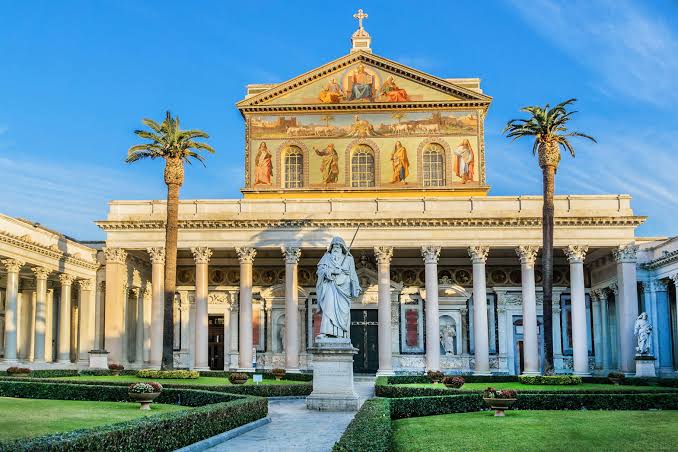
Basilica of St. Paul Outside-the-Walls, Rome, Italy. Photo from Google.

My earliest memory of St. Paul was not really so good; it was even scary.

It was summer of 1972 when we settled in our new house in my mother’s hometown of Bocaue in Bulacan. I was so skinny then (believe me, I can prove this with my pictures) and shy when my mother brought me to apply for Grade 1 at the only Catholic school there known as “SPCB” or St. Paul College Bocaue.

A male, dark teacher wearing those dark glasses like Leopoldo Salcedo clad in a barong interviewed me (the late Mr. Martin De Guzman, aka, Bagyo for typhoon). I cannot recall what he had asked me which I could not answer that made him say I cannot enroll in their school; but my mother angrily told me not to listen to him and, angrier told me to always speak louder.

That’s when I saw the statue of St. Paul at the window of the registrar’s office, eyes so intense while resting his right hand on a sword in front of him with the other hand clutching a bible with the Latin words, “Caritas Christi urget nos” – the love of Christ impels us (2 Cor. 5:14).

I stayed at SPCB for seven years and formed me into who I am today, making me so proud of being a Paulinian. Until now, that image of St. Paul with a sword is etched in my mind reminding me of how he fought so hard for Jesus Christ and his Body, the Church.

The Apostle Paul

Sometimes called the “Thirteenth Apostle”, St. Paul always stressed in his writings and teachings that he was personally called by the Risen Lord to be his Apostle sent to preach the gospel to everyone. That is why Jesus is so central in his life, declaring “whatever gains I had, these I have come to consider a loss because of Christ” (Phil.3:7), desiring only “omnia omnibus” — that is, to “become all things to all men” (1 Cor. 9:22) without any reserve.

As we have mentioned in our earlier reflection, St. Paul’s sole focus in his ministry and very life was the person of Jesus Christ: everything in our lives, especially us priests, is marked essentially by our encounter and communion with the Lord and his Word.

It is only in the light of Christ that we measure every other value in our lives and ministry.

Red Wednesday Mass and prayers in our parish for the Church persecuted last November 2019.

Even in this highly diversified and pluralistic society, while we join hands in promoting and working for a more humane and inclusive society, the more we must stand up for Jesus Christ like St. Paul as quoted by St. Luke while addressing the presbyters of the Church at Ephesus with these words:

“I served the Lord with all humility and with the tears and trials that came to me because of the plots of the Jews, and I did not at all shrink from telling you what was for your benefit, or from teaching you in public or in your homes. I earnestly bore for both Jews and Greeks to repentance before God and to faith in our Lord Jesus Christ… for I did not shrink from proclaiming to you the entire plan of God.”

Acts of the Apostles 20:19-21,27

I am so struck with that word “shrink” that St. Paul used twice to stress his dedication, fervor, and conviction in being centered in Jesus Christ alone. In what aspect did he not “shrink”? Did he raise arms and fought back against his detractors? Did he align with other forces to pursue his mission?

No! St. Paul did not shrink in proclaiming Jesus Christ by fighting back with force or with harsh words but by being more like our Lord and Master — more loving and understanding, more patient and more persevering, yet more intense in insisting the Gospel.

He did not shrink by running away from his detractors or diluting the gospel message by pleasing some powerful people or accommodating prevailing thoughts and culture. As we have mentioned in our previous reflection, St. Paul saw opportunities for the gospel in the midst of the hostile environment he lived during his time.

Despite all the pains and scars he had gone through, one can still find the light of Christ shining in this great apostle who bore everything filled with joy and pride without any complaint.

We are afflicted in every way, but not constrained; perplexed, but not driven to despair; persecuted, but not abandoned; struck down, but not destroyed; always carrying about in the body the dying of Jesus, so that in the life of Jesus may also be manifested in our body. For we who live are constantly being given up to death for the sake of Jesus, so that the life of Jesus may be manifested in our mortal flesh.

2 Corinthians 4:8-11

Standing for Christ and his Church

From 2006 to 2018, I was so blessed to have worked at our Church-run Radio Veritas as a co-host in a morning program once a week and as a host of another show on Saturdays. Aside from bishops and priests, we interviewed experts and advocates in a lot of various topics affecting our faithful in particular and our society in general.

So many times I felt something so wrong when we have to interview whom we considered as “allies” or “kakampi” in some of our advocacies because I have found no single person fully believing in our Church teachings even if some of the issues they fight for jibe with ours.

Can we really ally ourselves with lawmakers and cause-oriented groups fighting capital punishment which we strongly support and yet support artificial means of contraception for population control? Can we align with those fighting repressive laws like this anti-terror bill and yet support same-sex marriage and divorce?

And please, spare us with those labels on these people that they insist on putting on with us priests and bishops: let us keep in mind we are only for Christ, no progressives or liberals, conservatives or whatever.

We are neither lobbyists nor cause-oriented advocates pushing for something because we only stand for Jesus Christ and his Word at the Cross. There can be no any instance of partisan politics or traces of strange bedfellows whatsoever because we are either for or against Jesus Christ:

Jesus said: “Whoever is not with me is against me, and whoever does not gather with me scatters.”

Matthew 12:30

Here lies one of the greatness of St. Paul who never shrunk to other forces except Christ.

St. Paul statue at Malolos Cathedral by renowned ecclesiastical artist Mr. Willy Layug. Photo by Mr. Lorenzo Atienza, June 2019.

What a tragedy especially in our country that no amount of explanations can remove from the thoughts of ordinary people that priests and bishops do not even dabble their hands in partisan politics when it is so glaring they are beholden to these modern charlatans.

What moral ascendancy is left of our being pastors when after speaking against corruption and ineptitude in the government we turn to solicit from the same politicians and bureaucrats not only for parish projects and charities but even for our personal needs like vacations and trips abroad?

How can we reconcile all these immediate reactions by bishops and priests against the anti-terror bill urgently passed by Congress last week when not even a whimper was ever heard from them for the longest time to open our churches to serve the spiritual needs of the people?

Let me clarify like in my previous reflection that I am not saying we must be quiet about social issues; my point is, it must always be primary the Church as the Body of Christ that is primary in all our concerns.

This was very clear with St. Paul because it is the first reality he faced when he was called by Christ:

On his journey, as he was nearing Damascus, a light from the sky suddenly flashed around him. He fell to the ground and heard a voice saying to him, “Saul, Saul, why are you persecuting me?” He said, “Who are you, sir?” The reply came, “I am Jesus, whom you are persecuting.”

Acts of the Apostles 9:3-5

Next to our Lord, it is the Church that St. Paul had considered so much in his activities as subject of his thoughts and reflections. For him, adherence to the Church was directly caused by Jesus Christ himself, not by any chance or moments of realization and conversion.

And see the words of the Lord to him: “I am Jesus, whom you are persecuting.”

He was the first to speak of the Church as the Body of Christ, illustrating for us in his many Letters our being “one in Christ” (Gal.3:28) deeply rooted in the Holy Eucharist, “Because there is one bread, we who are many are one body” (1 Cor.10:17).

Pope Francis blessing the world at an empty St. Peter’s Square last March 27 when COVID-19 was ravaging the whole of Italy and many parts of the world. Photo from Vatican News.

Until now our churches remain closed in many parts of the only Christian nation in this part of the world. It behooves us priests and bishops to first fight and insist, without shrinking, the opening of our houses of worship to allow the people to experience Jesus Christ anew in this pandemic.

Most of all, may the people feel and realize at the resumption of our public Masses that God is truly in us and with us because of our deep communion in our Lord Jesus Christ and with one another when we celebrate the Sacrament of our unity, the Holy Eucharist.

Our final installment of the series this Thursday, “St. Paul in time of COVID-19: Communicating Jesus Christ”.

St. Paul in time of Covid-19: need to be focused more on Jesus

Quiet Storm by Fr. Nicanor F. Lalog II, 05 June 2020
Ceiling of the main altar and dome of the Malolos Cathedral, 12 June 2019. Photo by Mr. Lorenzo Atienza.

The COVID-19 pandemic is the most severe test the Roman Catholic Church in the Philippines has ever faced, striking on the final year of her preparations for the quincentenary of the coming of Christianity in the country.

Making things worst is the “unfriendly” Administration whose policies contradict almost every known Church teaching, from the most basic GMRC and decency to the sanctity of human life.

In this three-part series of reflections, I wish to share with you my brother priests and lay partners in our ministry some lessons I have found in the life and teachings of St. Paul the Apostle that is centered on the person of Jesus Christ.

He never gave specific instructions and answers in dealing with the many issues and problems that confronted the early Church that may help us in the present generation; but, he had taught us to be always centered on Christ, measuring everything in him and his Cross.

Now I am reminding you, brothers, of the gospel I preached to you… Through it you are also being saved… For I handed on to you as of first importance what I also received: the Christ died for our sins in accordance with the scriptures.

1 Corinthians 15:1-3
A sculpture of St. Paul the Apostle upon the entrance to the Malolos Cathedral by the renowned ecclesiastical artist Mr. Willy Layug. Photo by Mr. Lorenzo Atienza, 12 June 2019.

The gospel thrives most in hostile environment

St. Paul lived in a time very similar with ours when great developments and changes were overtaking the world with the usual problems of poverty and inequalities due to growing materialism, and persecution of the Church.

Instead of seeing them as problems, St. Paul saw them as opportunities to spread the Gospel because his sole focus was the Lord Jesus himself and his Cross.

In fact, all who want to live religiously in Christ Jesus will be persecuted. But wicked people and charlatans will go from bad to worse, deceivers and deceived. But you remain faithful to what you have learned and believed…

2 Timothy 3:12-14

When the former Mayor of Davao City assumed the presidency and started lashing out us priests and bishops with his profanities and vitriol including blasphemies against God and Pope Francis, we all expressed our indignation and opposition.

And rightly so! – even in fighting for Kian and those fallen by tokhang as well as the victims of injustice and fake news.

As days moved into months and years, with more vulgarities and lies dished out by the man at Malacañang, there also appeared some silver linings over Pasig River but many of us in the clergy have refused to see and admit— that some of his accusations are true. Although these are more of the exception than the rule, there are indeed some priests leading inauthentic lives far from their vows of poverty and celibacy with others pretending to be shepherds of souls who do not smell like their sheep because they are more keen in amassing wealth and gaining fame and popularity.

Worst of all are those who have sold their souls to politicians for some petty favors and a taste of power, of being seen with the rich and famous.

I am not putting down our priests. There are more good and holy priests working faithfully and silently not only in our country but everywhere in the world.

What I am trying to say since our “persecution” by the present Administration began, this is a wake-up call for us priests to shape up and regain our bearings in Christ.

Actually, it had been coming since the previous Administration, too. For the longest time we have been lording it over the people with our abuses and excesses hiding in the excuse as “alter Christus” but, now the changing times have finally caught on us, demanding more transparency and honesty on our part.

Like with the experience of St. Paul, these situations of “persecution” with a pandemic are calls for our conversion in Christ anew, something that Pope Emeritus Benedict XVI has been insisting that we priests go back to Jesus, especially in the Blessed Sacrament.

Photo by Mr. Lorenzo Atienza, ordination to the diaconate at the Malolos Cathedral, 12 June 2019.

Like St.Paul, priests are first a witness of Jesus Christ

This time of crisis due to COVID-19 and the continued “persecution” by an unfriendly administration that has continued to keep our churches closed for no sane reason at all can be a grace-filled moment for us if we allow Jesus Christ to shine in us by bringing hope and inspiration to our people saddled with so much burdens due to COVID-19 and the government’s inconsistencies in managing the pandemic.

It is here where we are most expected by the people to be at the forefront but – unfortunately – we have been silent in asserting our religious freedom to worship within the rules and protocols to prevent the spread of COVID-19.

Only Bishop Pabillo of Manila had spoken against the “laughable policy” of allowing only five and ten people inside the church in areas under ECQ and GCQ, respectively.

Making matters worst was how the CBCP issued its statement reminding us priests and bishops to follow the directives and guidelines set by the Inter-Agency Task Force (IATF) on Emerging Infectious Diseases regarding the celebration of the Mass! Instead of supporting the lone voice championing our rights to celebrate Mass in public, the CBCP just repeated the same situation when Jesus saw the crowd who have followed him to the wilderness, “sheep confused and lost without a shepherd” (Mt.9:36).

How sad we have given up the fight so easily to have our churches opened in the transition from ECQ to GCQ.

More sad now are the bishops and priests again in the news – filled with fire and courage – speaking out loudly against the anti-terror bill recently passed by Congress.

No problem fighting oppressive measures by any administration but to miss out that same fervor and zeal for our own rights and duties to provide the essential spiritual nourishment of our people at this time is something disturbing, something St. Paul would not allow to happen.

Yes, it is part of our priesthood to fight for people’s rights but always in the light of Jesus Christ.

St. John Paul II had shown us in recent history what it is when while still a priest and later as bishop in Poland, he spoke only of the words of God in the scriptures and fruits of his prayer that he was able to tore down the Iron Curtain his homeland and eventually throughout Europe.

St. Paul never played partisan politics like our Lord Jesus Christ, considering how they have lived at a time rife with occasions to be politicized. He never missed addressing social issues in the light of the gospel as he wrote one of his friends – presumably rich and influential – regarding a slave named Onesimus:

To Philemon, our beloved and co-worker… Perhaps this is why he was away from you for a while, that you might have him back forever, no longer as a slave but more than a slave, a brother, beloved especially to me, but even more so to you, as a man and in the Lord.

Philemon 1, 15-16

How sad when we priests speak of so many things like current events and other trends without giving the people the Word of God.

It is even a scandal when we priests are more busy with social advocacies forgetting we are first of all a “man of the Word” according to Vatican II.

Let us not forget St. Paul’s reminder that though we are in the world, we are not of the world:

Do not conform yourself to this age but be transformed by the renewal of your mind, that you may discern what is the will of God, what is good and pleasing and perfect.

Romans 12:2

The gospel of Christ thrives most in hostile environment and situations but that does not mean going out like activists with clenched fists and raised voices walking the streets. We are not going to change the world; Jesus will — if we can proclaim him in words and in deeds.

The other week as we neared the conclusion of the Easter Season, one of the first readings on weekdays touched me so much, wondering if we priests can also say with all sincerity St. Paul’s words at Miletus when he spoke to the presbyters of the Church of Ephesus before sailing to Jerusalem for his trial:

So be vigilant and remember that for three years, night and day, I unceasingly admonished each of you with tears… I have never wanted anyone’s silver or gold or clothing. You know well that these very hands have served my needs and my companions. In every way I have shown you that by hard work of that sort we must help the weak, and keep in mind the words of the Lord Jesus…

Acts of the Apostles 20:31, 33-35

According to St. Luke, after those words, the people wept loudly as they threw their arms around St. Paul and kissed him. He was so loved by the people because of Jesus Christ, not of his very self.

Surely, like Jesus, St. Paul stretched out his arms and hands more to pray over people after hearing their confessions and problems, spent longer hours praying in silence or writing his letters to the various churches he founded, strengthening and inspiring them in Christ than be out on the streets seething with anger against any despot and regime.

On Monday our second part in the series, Fighting our detractors like St. Paul in time of COVID-19.

St. Paul saying goodbye to Ephesians at Miletus on his way to Jerusalem to face trial.

At home with Mary our Mother

The Lord Is My Chef Breakfast Recipe for the Soul, Mary, Mother of the Church, 01 June 2020

Genesis 3:9-15.20 ><)))*> ><)))*> ><)))*> John 19:25-34

Mary Mother of the Church. From Google.

Dearest Lord Jesus Christ:

Today is a very crucial period in our life as a Church here in the country moving into transition from Enhanced Community Quarantine to the lower case of General Community Quarantine. Some businesses and industries are slowly being allowed to open and operate.

Except our churches.

Today our Church leaders are meeting with the government to continue their talks for the opening of our churches to allow the faithful to celebrate the Holy Mass as a community.

We pray for the Holy Spirit to enlighten the minds and hearts of our officials in their meeting to see the importance of spiritual nourishment in this time of the COVID-19 pandemic.

We pray for the intercession of the Blessed Virgin Mary your Mother and our Mother too whom you have entrusted to your beloved disciple to care for us your Body here on earth.

Thank you very much Lord Jesus in giving us Mary your Mother to be our Mother too.

On this first day of the resumption of Ordinary Time, a day after Pentecost Sunday when we celebrated the coming of the Holy Spirit to launch the Church, we also offer this day in honor of the Blessed Virgin Mary as Mother of the Church.

Indeed, inasmuch as she had stayed by your side at the foot of the Cross, Mary has always been with us in our journey as your Mystical Body here on earth. She has always been home for us, taking care of us, looking after us, and reminding us of our mission in you.

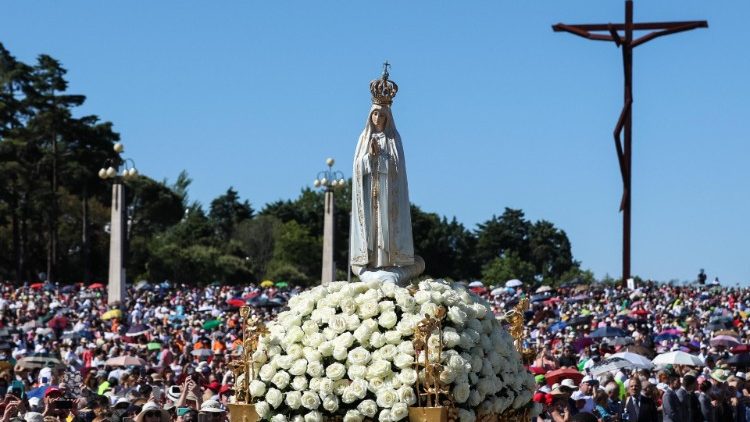
Our Lady of Fatima in Portugal.

It is so unfortunate that we have always taken her granted.

Worst, some people have maligned and derided her important role in cooperating with all your plans for the Church.

May her charity and fidelity to you, Lord, inspire us to work further for the mission of the Church to make you present in the world now in pandemic, seeking the best ways to pick up the pieces and start anew their lives.

May the world be ready now to listen to the teachings of Mary your Mother to return to you and turn away from sins and evil. Amen.