Romans 3:21-30 ><)))*> ><)))*> ><)))*> Luke 11:47-54
Photo by Mr. Jim Marpa, September 2019.
O God our loving Father, we worship you and praise you for your majesty and kindness.
In this world where the self-made person is the ideal and economic achievement is the benchmark of success, everybody has become so busy in achieving something, carving a name for one’s self that we forget you.
We have become so proud and vain, O Lord!
Once we have tasted the sweet elixir of “success” in life, the more we thirst and work for so many other things until we finally forget you.
And that is when we become so proud, claiming everything is because of us – that, we are good, we are talented, we are brilliant. We are god, in fact.
But, Lord, I felt it too that when I boast of something in myself, I always run out of many other good things to be proud of myself! I just noticed that whatever we boast in life, it is always the same we thing just boast over and over again to make it big because the truth is, we have nothing to be proud of by our mere selves alone apart from you.
Worst, like in the gospel today, behind every boast we brag is a “woe” from Christ, of trails of evil and sin behind the “success” we are so proud of.
Forgive us, O Lord, for being so proud, for feeling like you, a God.
And this is the funny thing I have realized too about boasting: the more I see whatever I have in life as a grace from you, the more I see so many other good things in me to be proud of because of YOU!
St. Paul was absolutely right: we have all been redeemed and save by God in Christ Jesus. We are all forgiven and beloved sinners of God.
Should we brag or boast of anything, we can only do so in Christ because we all live in utter dependence in you, God.
There is nothing we can do in this world without your grace, O loving God. Amen.
Photo by Mr. Jim Marpa at Panglao, Bohol, September 2019.
Which is more difficult to confront, the fact of dying or that of suffering through a serious sickness? I have been thinking these for the past couple of days following my recent visitations of sick parishioners.
Today I visited a parishioner sick for the past three months with a lung disease. She’s 76 years old.
Right upon seeing me, Lola Milagros cried, telling me to ask God to take her because she’s so tired of suffering and waiting for death.
I just let her cry, holding her hands, as I listened to her pouring out of her aches and pains.
After that, I whispered to her the words of St. Teresa de Avila whose feast we are also celebrating today:
Nada te turbe… Solo Dios basta! (Let nothing disturb you… only God suffices!)
St. Teresa De Avila
So beautiful to hear and yes, easier said than done.
Can anybody with a serious ailment be not disturbed?
Been asking myself the same questions too. It is difficult not to be disturbed when one is sick. Aside from the costs of treatment are the enormous pains and sufferings one has to go through with the medical procedures and its many effects to the patient, who eventually would die.
It is a reality getting closer to home with me and I must confess, I am disturbed. Worried. And afraid.
The other week I visited another sick parishioner named Charlie, a former cook paralysed waist down due to a spine injury. He is only in his early 50’s.
What struck me when I saw him were the ropes tied to his both feet. I could not figure out how he could be restless when he is paralysed that his feet have to be tied?
He explained, “Father, I pity my wife when I have to wake her up every night just to move my legs. So, I improvised these ropes tied to my feet so I can just pull them with my hands in case I have to change positions even at night.”
Oh God! What a great love of a man to his wife!
Charlie loves his wife so much that he does not want her to be disturbed with his ailment and condition.
When there is love, we are not disturbed. And the only true love that can make us undisturbed is the love of Jesus Christ, the only perfect love we can have and find.
Whenever we think of Christ we should recall the love that led him to bestow on us so many graces and favors, and also the great love God showed in giving us in Christ a pledge of his love; for love calls for love in return. Let us strive to keep this always before our eyes and to rouse ourselves to love him. For if at some time the Lord should grant us the grace of impressing his love on our hearts, all will become easy for us and we shall accomplish great things quickly and without effort.
St. Teresa de Avila
“Love calls for love in return.”
So beautiful words by St. Teresa de Avila.
We can only truly feel that personal love of Jesus if we are also personally in love with him.
We are disturbed with so many things in life when there is not enough love in our hearts, when we have not felt loved enough by others too.
Without love, we would always be disturbed.
I told Lola Milagros this morning to thank God for the gift of tears because they are prayers coming straight from her heart. That God knows very well all her pains and sufferings. Most of all, I told her tears are clear signs of love in her heart.
Later on my way home, Lola Milagros’ daughter was also teary-eyed as she told me she was so glad to see her mother cried. According to her, Lola Milagros is a very tough woman of the “old school” who tried to bear everything and even hide what’s inside her so as not to disturb them. She always wanted them to be assured all’s fine.
Lola Milagros and Charlie do not want to disturb their respective family because they love them. It is love that moves the sick not to disturb others and it is also love that enables us to assure them not to be disturbed.
The challenge therefore is not to reflect on whether to die instantly or slowly but to always love truly!
Sacred Heart Novitiate (Novaliches), 2017.
Human love is always imperfect. Only God can love us perfectly. This he did exactly to us when he sent us Jesus Christ who died on the Cross for us.
To love truly is be personally one in Jesus Christ. When we were still seminarians, Fr. Memeng used to tell us in our class “Priestly Spirituality” that “if we can really cultivate a deep prayer life, we can also experience Jesus Christ in the most personal way.” It is the experience of St. Teresa de Avila and all the other saints.
Nothing can disturb us in this life when our love is borne out of a personal relationship with Jesus in prayer.
Prayer life is more than reciting prayers by following a schedule. Prayer life is a relationship, a communing with God, of being our true selves before him, seeing ourselves as he sees us. And because of this assurance of his love despite our many sins and flaws, that is when we are not disturbed because God loves us no matter what.
When we are not disturbed, then we become silent. Presence is more than enough to share and experience God’s love. St. Paul said “love is not pompous” because true love is always silent, more on deeds than on words.
One thing amusing with death is that it always comes in silence, when we least expect it. Whether we die instantly or slowly, it always happens in silence. And that is also why many are disturbed of dying.
But, if we love patiently our self, others and God, nothing can ever disturb us because when we love, we are already in God. That is when we realize too the wisdom and truth of St. Teresa’s contemporary who claimed that
A soul that walks in love is neither tired nor gets tired.
San Juan dela Cruz
From Google.
Let us love, love, and love until the end onto eternity.
The Lord Is My Chef Sunday Recipe Week XXVIII-C, 13 October 2019
2 Kings 5:14-17 ><}}}*> 2 Timothy 2:8-13 ><}}}*> Luke 17:11-19
Photo by Mr. Jim Marpa, September 2019.
This Sunday readings tell us about the skin, the healing of people afflicted with the dreaded “Hansen’s disease” or leprosy. Since ancient time, it has always been seen with deeper implications than mere wounds on the skin that scars not only the leper but also the community. At its worst, it is regarded as a divine punishment that lepers have to be separated from others to live in designated areas for their treatment.
Skin plays a major role in our social status and mobility. Being the largest organ of the human body, the skin is always the first to be seen and noticed that whatever its condition would always have a big impact on the person, for better or for worst.
This is specially true for us Filipinos who are so concerned with our skin color that we still regard being white or maputi is maganda (beautiful) and having dark skin or maitim is pangit (ugly). No wonder everybody is going crazy to get whiter skin with all those soaps and creams and medicines advertised on billboards everywhere!
In a very funny twist unknown to most Filipinos who idolise white skin, many of our popular devotions in the Catholic faith actually have dark skin like Quiapo’s Black Nazarene and Our Lady of Antipolo?!
But, that’s another story of how skin-deep we can be…..
Going back to our reflection of today’s readings, Jesus is inviting us to go deeper than the skin to realize the richer meaning of having faith in him.
As Jesus continued his journey to Jerusalem, he traveled through Samaria and Galilee. As he was entering a village, ten lepers met him. They stood at a distance from him and raised their voice, saying, “Jesus, Master! Have pity on us!” And when he saw them, he said, “Go show yourselves to the priests.” As they were going they were cleansed. And one of them, realizing he had been healed, returned, glorifying God in a loud voice; and he fell at the feet of Jesus and thanked him. He was a Samaritan.
Luke 17:11-16
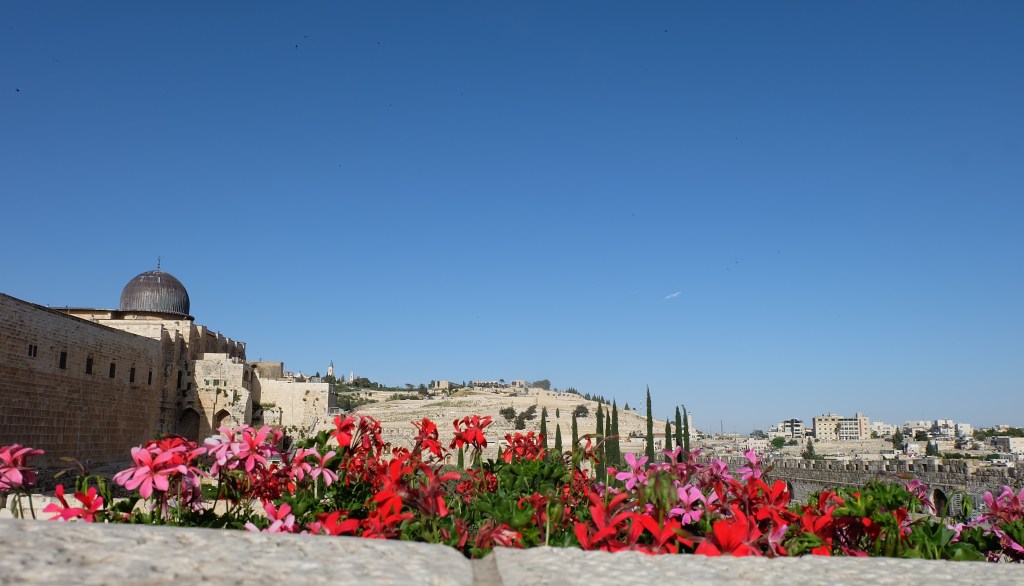
View from the walled city of ancient Jerusalem, May 2019.
Since June 30 of this year, the 13th Sunday of Ordinary Time, we have been following Jesus when “he resolutely determined to journey to Jerusalem” (Lk.9:51). More than a destination to reach, Christ’s journey to Jerusalem is about directions in life because it is spiritual and theological in nature than spatial or geographical.
It is the same truth every pilgrim to the Holy Land realizes too!
And now that Jesus is nearing Jerusalem to fulfill his mission, his teachings are getting clearer and closer to home, indicating also our own “passing over” or pasch with him with the many verbs and movements found in our gospel scene today.
Let’s try reflecting on them one by one. Please bear with me…
“As Jesus continued his journey to Jerusalem” …. Jesus never stops in his journey to Jerusalem to suffer with us, to cry with us, to die with us. He is committed in being one with us in our many struggles and battles in this life until we make it with him to heaven.
“he travelled through Samaria and Galilee.” This is beautiful. Samaria and Galilee are the regions where the poor and marginalized lived, where sinners abound. But, that is where Jesus would always come. When we are in our darkest moments in life due to sickness, failures and disappointments, especially sin – that is when Jesus comes closest to us! In the first reading, we have heard how God’s Prophet Elisha told the Syrian Army General Naaman to bath in the Jordan River to be healed of his leprosy even if he were a pagan and an enemy of Israel! God loves us all.
“As he was entering a village, ten lepers met him.” Keep in mind that Jesus came for the lost like us. Be open and ready for him for he is always passing by. Jesus surely comes to those who patiently wait for him.
“They stood at a distance from him, and raised their voice, saying, ‘Jesus, Master! Have pity on us!’ and when he saw them, he said, ‘Go show yourselves to the priests.’ As they were going they were cleansed.” This episode of the healing of ten lepers can only be found in St. Luke’s gospel filled with many meaningful expressions. First is how “the lepers stood at a distance from Jesus.” This is our usual stance with the Lord when we are full of sin, so ashamed to look at him. But, it does not really matter with the Lord who looks more into is our hearts full of contrition than into our ego full of pride as we shall hear three weeks from now in the parable of the Pharisee and tax collector (Lk. 18:9-14).
The lepers cried to him, “Jesus, Master! Have pity on us!” and when Jesus saw them, he told them to see the priests and they were cleansed. This is an extraordinary profession of faith in Christ by the ten lepers who were crying out not only for pity but also mercy. There are only three instances in the gospels when Jesus is addressed in his name, once in Matthew and twice in Luke. This is the first and the second is when Dimas the thief called on him saying, “Jesus, remember me when you come into your kingdom.” To say his name “Jesus” in itself is a prayer, an admission of guilt and sin. That is why, as the ten lepers went their way to the priests, they were “cleansed” like Dimas on the cross was instantly promised with paradise.
“And one of them, realizing he had been healed, returned, glorifying God in a loud voice; and he fell at the feet of Jesus and thanked him. He was a Samaritan.”
Here we find every encounter with Jesus in prayer and the sacraments as well as in various events in our life is a passage to salvation and new life. See the transition from being cleansed into being healed: that is something deeper than the skin, so to speak. The Samaritan was not merely cleansed of his skin blemishes but most of all, his soul and inner being that Jesus later told him to “Stand up and go; your faith has saved you.”
Sometimes in life, we stop at being cleansed by the Lord; after obtaining our prayers and wishes, we never go back to him until we face another problem again. Are we willing to keep on going back to Jesus to kneel before him and to thank him?
Last Sunday we prayed to Jesus to increase our faith and today like the ten lepers from a distance, we cry out to him as our Master to have pity on us. We always have that gift of faith in us but we have to deepen and cultivate it daily in our prayer life and most especially in the Sunday Eucharist, the highest expression of giving thanks to God.
Let us live in our faith and trust in God’s gift freely given to everyone regardless of who we are. Let us rely in the words of St. Paul that
“if we have died with him we shall also live with him; if we persevere we shall also reign with him. But if we deny him he will deny us. If we are unfaithful he remains faithful, for he cannot deny himself.”
Lawiswis ng Salita ni P. Nicanor F. Lalog II, 07 Oktubre 2019
Larawan ay kuha ni Rdo. P. Gerry Pascual sa Basilica of the National Shrine of the Immaculate Conception, Washington, DC, 09 Setyembre 2017 .
Maraming salamat,
mahal naming Ina,
Birheng Maria sa iyong pagsama
sa amin tuwina
ngayong inaala-ala
iyong himala
sa pakikipag-digma ng mga Kastila
sa Look ng Lepanto
dinarasal iyong Santo Rosario.
Kay sarap namnamin
damang-dama namin
sa bawat butil ng Rosario
pakikiisa mo sa amin
upang higit naming sundin
butihin mong anak
at Panginoon namin
na siyang kapanatilihan
ng Diyos sa piling amin.
Dahil kay Kristo Hesus
na isinilang mo sa amin,
Panginoong Diyos naging kapiling namin
palaging dumarating
maging sa gitna
ng mga unos at sigwa
nitong karagatan
ng buhay namin
tumatawag para kami ay sagipin.
Mula sa panganib
ng karagatan at latian
hanggang sa katihan
kailanman ay hindi kami
iniwan ni Kristo Hesus
na iyong isinilang
upang kami ay pangunahan
pabalik sa aming tahanan
doon sa kalangitan ikaw ngayon nakapisan.
Maraming salamat
Mahal naming Ina
Birheng Maria
nawa amin kang matularan
si Hesus ay masundan
sa nakakatakot na karagatan
at kapanatagan ng kapatagan
kanyang mukha sa ami'y mabanaagan
kami rin mismo maging misteryo ng iyong Santo Rosario.
Monday, Memorial of Our Lady of the Rosary, 07 October 2019
Jonah 1:1-2:1-2.11 ><)))*> ><)))*> ><)))*> Luke 10:25-37
Part of a painting in a church in Seville, Spain depicting the Battle of Lepanto Bay won through the intercession of Our Lady of the Rosary. From Google.
O God our loving Father, as we celebrate the memorial of Our Lady of the Rosary, you have assured us again through the readings of today of your abiding love and presence among us.
In the first reading, you remind us how you continue to call us and send us to many missions and tasks in life even if we often doubt and refuse to follow you like Jonas.
Sometimes, we have to wait for the storms to hit us in this sea of life before we can realize that indeed, you are calling us, that you do believe in us to entrust us with specific tasks and mission in life.
Photo by Mr. Raffy Tima, Batanes, 2018.
And yet, in the many turbulence in this sea of life we are into, you never fail to save us and assure us of your love and mercy like at the Battle of Lepanto Bay in 1571 when the Holy League of Christians crushed the much feared and powerful navy of the Ottoman Turks.
Thank you in giving us the Blessed Virgin Mary as our Mother too to calm our many fears while in the high seas of life.
On the other hand, you dare to challenge us dear God to find you and share you among the most needy of this long and perilous road of life in the Parable of the Good Samaritan.
From Google.
So often, we refuse to leave the security and comfort of our lives than cross the road to reach out to those in the margins left to die in sickness, hunger, and pain- alone.
Through the Blessed Virgin Mary, Mother of Christ, may our eyes be opened, our faith be deepened to find and serve you Lord and Master in the storms of the high seas and in the security of the roads ahead us. Amen.
Lawiswis ng Salita ni P. Nicanor F. Lalog II, 04 Oktubre 2019
Mula sa Be Like Francis Page sa Facebook.
Minsan daw ay nagimbal
kaibigang Kardinal ni San Francicso
na banal
nang kanyang malaman
dukha nilang pamumuhay
na sa kanyang palagay
labis na kahirapan hindi naman
dapat nilang pagdaanan.
Katuwirang ipinaliwanag
ni San Francisco kay Kardinal Hugolino
kay gandang pagnilayan
sa malalim nitong kahulugan:
"kung tayo'y maraming kayamanan,"
aniya ng ating banal
"kakailangan din natin mga sandata
upang mga ito'y ipaglaban at pangalagaan."
Sa kanyang isipan
at banal na kalooban,
ang pag-ibig ay namamatay
kapag tao'y nagkamal maraming ari-arian;
hanapin kanyang paliwanag
kung masasagot kanyang mga katanungan
na tila bugtong di lamang sa isipan
kungdi pati na rin sa puso at kalooban:
"Mapagnanakawan mo ba
na tao na walang ano man?
Maari mo bang gutumin
ang nag-aayuno?
Mayroon ka bang sisirain
sa taong namumuhi
sa parangal at pagkilala?
Ano nga ba magagawa sa taong aba at dukha?"
Para kay San Francisco
ang mga dukha ang tunay na malaya
kayang ipaubaya lahat
pati sarili sa Bathala
upang makagawa
ng kabutihan sa kapwa
na siyang simula ng ating kapatiran
at ugnayan pati sa kalikasan.
Mula sa Reuters.
Sa ating panahon ngayon
karukhaan ay pinag-uusapan
batay sa kawalan
ng ari-arian na kabaligtaran
ng kung ano mayroon
ang mayayaman na kadalasan
mga bagay nabibilang
at nabibili gaya ng kapangyarihan.
Ngunit kung ating pagninilayan
ano mang mayroon ang mayaman
ay wala pa rin o "NOTHING"
kung Inglesin natin
dahil ang higit na mahahalaga
ay hindi nakikita
ni nabibili o nabibilang
gaya ng pera at iba pang kayamanan.
Gayun din naman
hindi masasabi ng sino man
na siya ay dukha
at "walang wala" ika nga
dahil kung tutuusin natin
ang lahat ay palaging mayroon pa rin
o "SOMETHING"
kung Inglesin din natin.
Harinawa'y mapagtanto natin
sa pagdiriwang ng kapistahan
ni San Francisco na butihin
ito mismong buhay natin
ay dakilang kayamanan
na dapat ipagpasalamat natin
sa karukhaan ng loobing maialay
gaya ng Panginoon Hesus natin.
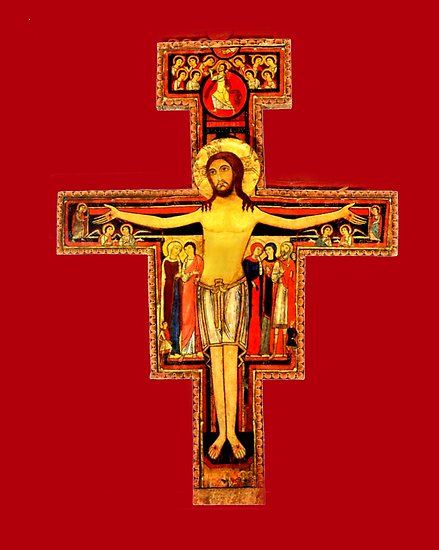
Ang Krus ng kapilya ng San Damiano na isinaayos ni San Francisco batay sa tinig na kanyang narinig habang nananalangin doon.
Friday, Feast of St. Francis of Assisi, 04 October 2019
Baruch 1:15-22 ><)))*> 0 <*(((>< Luke 10:13-16
One of the scenes from Benozzo Gozzoli’s series of frescoes from the life of St. Francis (1450) that captures the saint’s “Sermon to the Birds” and the dedication of his basilica at Assisi. Photo from Google.
Praise and glory to you, Lord God our loving Father for this week about to close with the celebration of another great saint, Francis of Assisi.
Two things I wish to thank you in giving us St. Francis of Assisi.
First is his total dedication in listening to you alone.
St. Francis accomplished so much for you and had so much impact not only to the Church but for the whole world until now because he intently listened to your voice, to your calls, and to your instructions.
It does not really matter if he got your words literally or figuratively speaking like when he was praying inside San Damiano chapel and heard your voice saying, “Go, Francis, and repair my house, which you see, is falling into ruins.”
Or, when St. Francis finally found his vocation in life after listening to Matthew 10:9 in the Mass and felt you Jesus speaking directly to him to go preach the kingdom of God without extra clothes and money that right after that, he threw everything away to preach penance, brotherly love, and peace.
How ironic that in this world of modern means of communications, the more we have become fragmented than ever because we have lost the values of silence, prayer and listening to self, others, and you, O Lord.
Jesus said to them, “Whoever listens to you listens to me. Whoever rejects you rejects me. And whoever rejects me rejects the one who sent me.”
Luke 10:16
Teach us, dear Jesus to be poor and empty like St. Francis so we may always open our ears and our hearts to seek your voice, to listen to your words, and most of all, to follow your will.
From Be Like Francis at Facebook.
Second thing I am so grateful with you Lord in giving us St. Francis is his deep sense of gratitude to you that he was able to see our universal brotherhood in you God our Father.
Did he really preach to hundreds of birds and told them to be thankful to you dear God for their freedom and for your care to them? I believe it must be true because where there is gratitude, there comes peace and serenity that attract than dispel people and animals alike.
Teach us to be grateful with whatever we have, Lord because the moment we learn to thank you and anyone here on earth, then we we realize our being one. In his gratitude for your wonderful gifts to him, St. Francis not only embraced you Jesus on the Cross but also saw everyone as family with brother Sun and sister Moon, brother Wind and sister Water. And even cousin Death.
Again, O Lord, in this age of affluence, the more we feel empty and lacking as we tend to acquire more of material things. Teach us to repent for our sins like St. Francis and Baruch in the first reading, to acknowledge everything we have including our sins.
It is only in being thankful that we are able to realize who truly reigns in us like St. Francis. Amen.
“See that you do not despise one of these little ones, for I say to you that their angels in heaven always look upon the face of my heavenly Father.”
Matthew 18:10
Almost all the religions in the world believe in the existence of guardian angels who guide people and protect them from harm.
From the Greek angelos that means “messenger”, angels are exactly that: messengers from God or “divine apps” who work like Messenger!
Last summer break, I have learned something “millennial” and at the same time very theological or spiritual when some of our former teachers in a school where I used to be assigned reprimanded me – even scolded me – for putting them always on “seen zone”. If you are a dinosaur like me, seen zone is when you send somebody a message (PM) and that person sees it but refuses to give any reply, to the extent of ignoring not only your message but most of all, you. I still have contentions against this but, that’s how most of people take a seen zone: a kind of disrespect, that you are not important.
What was so embarrassing with my new learning was the realization of how stupid I have been until recently when I would “seen zone” people with pathetic late response saying, “sorry just saw your message now”. How I wish I could turn back the time…
Anyway, I have learned my lesson so well that since May I have been very careful with “PM’s” as I tried to be more kind and gentle in Messenger.
But, there is something very interesting in this popular app in relation with our celebration today of the memorial of the guardian angels.
So many times, we give our guardian angel or God’s messenger with the “seen zone” like in Messenger. We ignore the angel’s admonition to avoid sin and do what is good. Like in Messenger’s seen zone, we totally ignore and disregard our guardian angel until we get into the “sin zone”.
Ignore what you have read in Messenger, you go into a seen zone that may be temporary and not really that serious at all. But, lo! worse is the “sin zone” when you ignore the Divine messenger because you ignore God who sent us his angels with his messages of love and mercy, peace and salvation!
Today we are reminded that inasmuch as we try to behave properly in social media where we interact virtually in real time, God and his angels do relate with us in real time but not in virtual but actual reality.
If we try hard doing everything not to hurt our friends with seen zone, all the more we must try to avoid the sin zone that have more serious repercussions up to eternal life. Amen.
Para sa henerasyon ngayon
wala sa kanilang isipang puntahan
ni pasyalan mga perya at karnabal ng kabukiran;
katawa-tawa at walang kuwenta sa kanila
ang sumakay sa tsubibo at ruweda,
panoorin mga salamangkero at payaso
at mas gusto maglaro ng mga video.
Mga dambuhalang kahon ng sapatos
na ginawang pamilihan,
tinaguriang mall naging pasyalan
kung saan natatagpuan pinagtatawanang
perya at karnabal ng kabukiran
naging sosyal na pasyalan
ng mga kabataan.
Ngunit hindi alintana, lingid sa mga mata
higit katawa-tawa mga pormahan at pasiklaban
masahol pa sa mga peryaan at karnabal
ating kalagayan nang mismo ating buhay
naging isang malaking palabas na lamang
mistulang mga salamangkero at payaso na rin tayo
inaasam-asam ay palakpakan at hangaan.
Saan man pumunta ay kapuna-puna
tila ang lahat nang-aagaw pansin
ibig sa kanya lamang nakatingin
kaya anu-ano gagawin, iba-iba sasabihin
pananamit at asta di mawari
ngunit kung susuriin, agad mabubuking
parang ampaw, wala kungdi hangin.
Hindi na ba natin napapansin
nangyayari sa atin saan man tumingin
tila lahat nagiging palabas na lamang
walang laman ni kahulugan mga pinagtutuunan;
nahan ang kadluan ng karunungan
at kabutihan na pinabayaang matuyuan
maubusan ng katangiang kapitag-pitagan?
Walang nasasagwaan ni kinikilabutan
pangangalandakan ng kapalaluan at kawalang kabuluhan
loob kinalimutan, panlabas pinahalagahan
perya at karnabal di na nga pinupuntahan
dahil tayo na mismo ang katatawanan!
Hindi ba natin alam iyan ang malagim na katotohanan
dapat tayong kabahan kung di sumasagi sa ating kalooban?
The Lord Is My Chef Sunday Music, 29 September 2019
Our gospel today speaks a lot about our eyes, of what we see and recognize, of sights and vision. For the third straight consecutive Sunday, we hear again another parable by Jesus proper only to St. Luke called “the rich man and Lazarus”.
Jesus said to the Pharisees: “There was a rich man who dressed in purple garments and fine linen and dined sumptuously each day. And lying at his door was a poor named Lazarus, covered wit sores, who would gladly have eaten his fill of the scraps that fell from the rich man’s table. Dogs even used to come and lick his sores. When the poor man died, he was carried away by angels to the bosom of Abraham. The rich man also died and was buried, and from the netherworld, where he was in torment, he raised his eyes and saw Abraham far off and Lazarus at his side.”
Luke 16:19-23
The rich man went to hell because amid his affluent lifestyle, he did nothing to help the poor Lazarus. He was so blinded by his wealth that he was so oblivious of the plight of Lazarus. Sadly, the same scene continues in our days despite the social media around us.
The famous blind American Helen Keller wrote, “the only thing worse than being blind is having sight but no vision.”
Very true!
Many people are like the rich man who only have sight that can only see what is material and temporary, failing to see the face of God especially among brothers and sisters in need. Only a few people are like Lazarus with a vision who dare to look at things beyond what can be seen, even beyond time. They are the visionaries who dream with eyes wide open, working hard to make their dreams a reality.
Having a vision, of seeing beyond what is material and physical is essential in being a Christian tasked with a mission to lovingly serve others especially those living at the margins of the society.
No one can truly love and serve without having a vision, of seeing beyond the ordinary and the present moment. This is the reason why I always tell young people in choosing a wife or a husband, choose someone with a vision who would always look beyond sights and time.
This is the message too of American singer-songwriter Joshua Kadison’s 1993 hit “Beautiful in My Eyes” that delighted the romantic side of us Filipinos in 2009 and 2007 when Christian Bautista and Jericho Rosales respectively covered the song.
The song speaks of the great vision of the lover in seeing in his beloved everything wonderful and lovely. Most of all, the man is also a dreamer and a visionary who could see their future as a couple still in love because she’s always “beautiful in his eyes”.
You’re my peace of mind, in this crazy world. Your’re everything I’ve tried to find, your love is a pearl.
You’re my Mona Lisa, you’re my rainbow skies, and my only prayer, is that you realize, you’ll always be beautiful, in my eyes.
The world will turn, and the seasons will change. And all the lessons we will learn, will be beautiful and strange.
We’ll have our fill of tears, our share of sighs. My only prayer, is that you realize. You’ll always be beautiful, in my eyes.
You will always be, beautiful in my eyes. And the passing years will show, that you will always grow, evermore beautiful, in my eyes.







 lordmychef.com