Loving, living, leaving

The Lord Is My Chef Sunday Recipe for the Soul by Fr. Nicanor F. Lalog II
Sixth Sunday in Easter-A, 14 May 2023
Acts 8:5-8, 14-17 ><}}}*> 1 Peter 3:15-18 ><}}}*> John 14:15-21
Photo by author, sunrise at Katmon Nature Sanctuary & Beach Resort, Infanta, Quezon, 04 March 2023.

Jesus continues with his final teachings at their last supper on that Holy Thursday evening. This Sunday we hear him giving an aspect of his most important lesson of all which is to love: “If you love me, you will keep my commandments… In a little while the world will no longer see me, but you will see me, because I live and you will live. On that day you will realize that I am in my Father and you are in me and I in you. Whoever has my commandments and observes them is the one who loves me. And whoever loves me will be loved by my Father, and I will love him and reveal myself to him” (Jn.14:15,19-21).

Today is the last installment of the important lessons Jesus gave during their last supper because next Sunday will be his Ascension. That is why our gospel today is so compact and so rich we could summarize into three words – loving, living, and leaving.

Photo by author, sunrise at Katmon Nature Sanctuary & Beach Resort, Infanta, Quezon, 04 March 2023.

Loving is more than a feeling that may sometimes be high, sometimes low. Or even zero. Love is a decision, a choice we make everyday which we affirm with our actions, not just with mere words nor intentions. And the truest sign that we love is when we are able to love another person more than our self.

Love is having less of “I” and “me”, and more of “others”. If we put it in an equation, when the word “live” is replaced with an “o”, it becomes love. That is, to live is to love. When we love truly like Jesus Christ, that is when we are living meaningfully.

There comes a time in our lives that material things, even fame and name, honor and titles would no longer satisfy us. There comes a time in our lives when despite everything we have we still feel empty inside because no one is an island. No one lives by himself nor for himself alone. We live for others. We can never find our life’s meaning simply in ourselves. All our careers, passion, and dedication are propelled by our finding meaning in others that is why we serve, we sacrifice, we share and give ourselves to others.

It is difficult but that is the way it is with love. Love is always outward bound in movement, never inward. It is never private but always expressed with others. That is why Thomas Merton wrote that “Love is not only a special way of being alive, it is the perfection of life. He who loves is more alive and more real than he was when he did not love.”

The other Sunday we have reflected that when we love, there is the movement of getting nearer with the one we love which leads to oneness and unity so that his/her joy becomes your joy, his/her pain becomes your pain too. Hence, true love always entails suffering especially when more than being near, we become obedient to show and prove how far can our love go for our beloved. (See https://lordmychef.com/2023/04/29/jesus-the-good-shepherd-our-gate/)

That is why Jesus asked his disciples including us today to obey his commandments which is all about loving God through others.

Most of all, inasmuch as loving leads to living, deeper loving is found in every leaving. If we truly love Jesus, we must be willing to suffer too like him. And always, a greater part of that suffering in every loving and living is in leaving.

Photo by author, sunrise at Katmon Nature Sanctuary & Beach Resort, Infanta, Quezon, 04 March 2023.

Love entails suffering. Like life. From the very start we all came into this world in pain and suffering – kicking and crying from our mother’s womb to be alive. That is why it is proper the world has designated every third Sunday of May as mothers’ day because they know very well that love entails suffering. And the greatest suffering we go through in life, in love is leaving or separation.

In a little while the world will no longer see me, but you will see me, because I live and you will live.

Simple words yet so mysterious. Literally speaking, Jesus was telling his disciples about his coming Passion, Death, Resurrection and Ascension. He is leaving them soon physically yet would remain with them, living with them so they would live fully. Leaving may be painful but it is also a prelude to a deeper relationship. As they say, absence makes the heart fonder.

Leaving is the most painful part of loving because every time a beloved leaves us, he/she takes a part of us, leaving us hollowed for the rest of our lives. The pain remains, leaving a hole in us. We merely transcend and move on but that hole remains. This is where loving and living become most challenging, most beautiful as they lead us to more amazing revelations as Christ had promised: “And whoever loves me will be loved by my Father, and I will love him and reveal myself to him” (Jn.14:21).

When we continue to love and live despite our loved ones leaving us, we soon realize that life is actually more of a series of coming than of leaving. When children leave home to go to college, they come to new sage in their lives; when they get married and leave home, they come to form their own family too! When a beloved leaves us in death, he/she comes to eternal life.

Meanwhile, we who are left behind live on, loving amid the pains of a beloved’s leaving, risking and hoping in love. That is when new things open up for us as we slowly discover many other things that do not necessarily replace the one we love and left us but actually make them more present in their absence. That is because we sooner or later find out that we have become like the ones we love who have left us! We are slowly transformed by their physical absence because their leaving had pushed us to love more that in the process, we have become like them. Is it not that is the reason of love, that we become like the one we love, be it God or another person?

Lately as I age, every morning as I looked at the mirror, the more I see my beloved late dad. Old relatives. especially his siblings and cousins always tell me whenever we would meet that I am a carbon-copy of my late dad.

That is how the gospel spread as we heard in the first reading: after the Pentecost, the disciples went on to love and live as Jesus had taught them. Many of them were like us who have never seen Jesus physically yet have kept on loving and living in him, being transformed somehow like him that caused many others to be added and kept in the fold of the Church.

Surely one of them who have mastered this art and grace of loving and living amid the many leaving are the mothers who made us experienced being touched and loved by God.

May we heed St. Peter’s call in the second reading to “Sanctify Christ as Lord in your hearts. Always be ready to give an explanation to anyone who asks you for a reason for your hope” (1Pt.3:15) making the Lord really present among us in little acts of kindness and goodness in this world filled with so many sins and evil that many wonder where God is. Our little steps of loving and living are like little candles in the dark; we may not see the whole path ahead but when we look back, we find we have advanced greatly, almost nearing our destination. Amen. Have a blessed week ahead!

Jesus our home, our tahanan

The Lord Is My Chef Sunday Recipe for the Soul by Fr. Nicanor F. Lalog II
Fifth Sunday in Easter-A, 07 May 2023
Acts 6:1-7 ><}}}*> 1 Peter 2:4-9 ><}}}*> John 14:1-12
Photo by Ms. April Oliveros, March 2023, Mt. Pulag.

From being our “gate” as the Good Shepherd last week, Jesus today introduces himself as our “home”, our dwelling by being “the way and the truth and the life”. Our scene is still at the last supper with Jesus teaching his disciples including us today with some of his important lessons expressed in words so touching and full of mysteries.

Jesus said to his disciples: “Do not let your hearts be troubled. You have faith in God; have faith also in me. In my Father’s house there are many dwelling places. If there were not, would I have told you that I am going to prepare a place for you? And if I go and prepare a place for you, I will come back again and take you to myself, so that where I am you also may be.”

John 14:1-3

Though the apostles were still at a loss at the meaning of the words spoken by Jesus that night, they knew and felt something so bad would happen, that life for them would no longer be the same as before that troubled them so deeply inside.

To be troubled here means more than the feeling but experience itself of confrontation with the power of evil and death, when we get that existential feeling of our mortality, when we feel so helpless in a situation, asking “paano na ito?” or “paano na kaya ako/kami?” Like the apostles that night, we too have been into similar situations of being troubled deep inside when we realize in no uncertain terms something so sweeping is happening, altering our lives “forever” like when we or a loved one is diagnosed with cancer, gets a stroke, or has to undergo a major surgery of the heart or brain, and losing a loved one.

Jesus is telling us this Sunday like on that holy Thursday evening to stand firm because these evil and death will just have momentary control over us, a passing over that is why we have to summon all our strength and courage, confidence and perseverance in him as he himself had already triumphed with his own passion, death, and resurrection.

And that is the good news! Jesus had won over all our worst fears like death. It is the gift of Easter, of the Lord’s Resurrection right there inside our hearts, already in our very core we only need to recover by abiding in him always. But before going any further, let us first confront one important lesson this gospel scene offers us: When are we really most troubled in life?

Photo by Ms. April Oliveros, March 2023, Mt. Pulag.

When we examine the many troubles we have been through, we find that more than the difficult and harsh situations we have faced were the many troubles within our very selves. What really trouble us most are not those outside us but within us. These are those little guilt feelings we used to take for granted, little details in life we used to ignore and dismiss as nothing for so long that suddenly now under our very nose as so serious, so important after all.

The most troubling experience of all is when we realize how we have wasted so many opportunities to love and be kind, to be more forgiving and understanding, when we know we have done something wrong and have done nothing to rectify it. We are troubled when outside conditions throw us into situations that make us confront not only death and evil but our very selves that suddenly, we feel unprepared and inadequate especially sickness and death that both surely come. Always.

And here is the big difference: Jesus was not surprised, was never caught unaware of his pasch because all his life he has been one in the Father and one with us. See in all four gospel accounts how Jesus had total control over everything that is why he was so prepared for his passion, death and resurrection because he never turned away from the Father and anyone in need of healing, of forgiveness, of comfort, of his presence. Jesus never turned away from his very essence, his mission which is oneness in the Father and oneness with us his beloved.

Jesus was so at home, so to speak, with himself and with the Father that he never fell into sin despite the devil’s temptations nor the scheming traps and plots of his enemy. This is what Jesus is telling us of preparing a room for us in the Father’s house, that we be at home with our true selves in the Father in him.

We are most troubled when we are not home, literally and figuratively speaking. And sadly, many times as we have experienced in this pandemic that even in our own homes we could not be at home because we are detached and away from our families and loved ones.

“In my Father’s house there are many dwelling places… Do you not believe that I am in the Father and the Father is in me? The words that I speak to you do not speak on my own. The Father who dwells in me is doing his works.”

John 14: 2, 10
Photo by author, Katmon Nature Sanctuary & Beach Resort, 04 March 2023.

The word “dwelling” is a favorite of John especially in this part of his gospel. For John, dwelling is more than a home but unity of Jesus and the Father as well as unity of Jesus and his disciples including us. In his prologue he spoke of Jesus as the Word who became flesh and “dwelled” among us. So beautiful an imagery of the Son of God living among us, being one with us and in us, not just physically present but through and through like going through our human experiences except sin.

To dwell is not just to reside but most of all to abide in Christ, to be united, to be one in him which he would say in the following chapter when he identified himself as the true vine and we are his branches.

Therefore, to dwell is to be one, to commune in the Lord. That is why heaven is not just a place but a condition, a being of eternal union with God where Jesus assures us of a dwelling. And because Jesus is our dwelling, our home, that is why he is also our way because he alone is the truth and the life.

Now, if anyone lives in Jesus, he/she lives in the Father too as he clarified with Philip who asked him to show them the Father and that would be enough.

How lovely that Jesus taught these lessons of unity and oneness in him and the Father and with one another in the context of the table, of a meal.

Here we find his last supper was not just a prelude to his coming Passion, Death and Resurrection but to his Ascension into heaven too when Jesus was already speaking of his entrance into a new and higher level of relating with the Father and with us his disciples, his Body as the Church.

This “dwelling” continues in our Eucharistic celebrations especially the Sunday Mass and even right in our own homes too during meal time. And there lies the challenge of our gospel this Sunday.

The first major problem in the early church came in the context of the table when “the Hellenists complained against the Hebrews because their widows were being neglected in the daily distribution” (Acts 6:1) of food. The Hellenists were the Jews who have lived outside Israel that when they returned home, they have become so alienated because of language barriers even of outlook in life. The Apostles resolved the issue by ordaining the first seven deacons.

It is interesting that the word “deacon” came from the Greek word diakonia which means “to serve at the table”. In Latin, diakonia is ministerium which is service in the table too. How lovely that to serve is actually rooted in the table found in homes!

We say home is where the heart is. In that case, God is our home. Jesus is our dwelling. We are troubled when we are not at home with God in Jesus and with our own families. Any problem at home takes priority in us too because family is important to us. How sad that some people could reject their own family without realizing that no matter what happens to us, it is still our family who would save us and stand by us in the end. This is what St. Peter’s was saying in the second reading of Jesus being the stone rejected to become the cornerstone when often we dismiss our family but in the end remain with us when our chips are down.

This Sunday, let us go home in Jesus our true home found in our own families. Home in Filipino is tahanan from the root word tahan which means to stop crying. To dwell in Filipino is manahan, from the same root too. We stop crying in our home because that is where we find security and comfort, love and acceptance, most of all, life and direction. Amen. Have a blessed week ahead!

Jesus the Good Shepherd, our Gate

The Lord Is My Chef Sunday Recipe for the Soul by Fr. Nicanor F. Lalog II
Fourth Sunday in Easter-A, Good Shepherd Sunday, 30 April 2023
Acts 2:14, 36-41 ><}}}*> 1 Peter 2:20-25 ><}}}*> John 10:1-10
Photo by author, Baguio City, January 2018.

Beginning this Sunday, all our gospel readings will be about the major teachings of Jesus before his arrest that led to his Passion, Death, and Resurrection. Like the Apostles, we are reviewing the Lord’s final teachings in the light of Easter to fully appreciates its meaning and significance.

First of these teachings is the Lord’s declaration, “I am the good shepherd” (Jn. 10:11).

This is very significant in the fourth gospel where we find Jesus using the phrase I AM. It was not just reminiscent of God identifying himself as I AM WHO AM to Moses in the Old Testament but most of all, for Jesus it is his self-identification as the Christ, the Son of God whom his enemies refused to accept nor recognize.

More interesting in our gospel this Sunday is how the Good Shepherd discourse of Jesus actually began with his claim as being the gate or door through whom the sheep enter and pass through.

Jesus said: “Amen, amen, I say to you, whoever does not enter a sheepfold through the gate but climbs over elsewhere is a thief and a robber. But whoever enters enters through the gate is the shepherd of the sheep. I am the gate. Whoever enters through me will be saved, and will come in and go our and find pasture. A thief comes only to steal and slaughter and destroy; I came that they might have life and have it more abundantly.”

John 10:1-2, 9-10
Photo from https://aleteia.org/2019/05/12/three-of-the-oldest-images-of-jesus-portrays-him-as-the-good-shepherd/.

Jesus spoke twice “I am the gate” in vv. 7 and 9 to emphasize and clarify that flock belongs to him, never to us. That is why Jesus is the gate, the only way through whom the sheep pass through. Hence, the true mark of a good shepherd is one who passes in Jesus as the gate, the owner of the sheep. Whoever does not pass through Jesus is a thief, a robber. A fake shepherd.

Nobody else could ever replace Jesus as Shepherd of the flock but he wants us all to be shepherds like him, passing in him our gate. This we can understand when we fast-forward to his third and final appearance to the seven disciples at Lake Tiberias after Easter. After their breakfast at the lakeshore, Jesus asked Simon Peter thrice, “Do you love me?” In every question, Peter professed his love for Jesus who asked him only for one thing, “feed my sheep” until finally adding at the end, “follow me” (cf. Jn. 21: 15-19). His call to follow him came after describing to Peter how he would suffer and die for him.

To pass in Jesus as the door to the sheep is first of all to love Jesus.

We all have experienced that loving calls for nearness which Nat King Cole described perfectly in his hit “The Nearness of You”. Whenever we love somebody, we want to be always near our beloved. The same desire we must possess if we truly love God. Furthermore, being near demands that we share feelings with the one we love – his/her joy is our joy, his/her pain is our pain. No wonder when we love somebody, we are willing to suffer. That is the first true mark of our love for Christ – we are willing to suffer for him and with him on the Cross!

That is the first meaning of Jesus is the gate of the sheep as the Good Shepherd: his Cross is our path to fulfillment, to true joy in this life and to eternal life eventually. We can only have a true relationship with him through others when we are willing to share in others’ sufferings like Jesus. Because of his Passion, Death and Resurrection, Jesus has turned suffering into a grace itself and a source of grace too because to suffer with somebody else is love. Anyone who avoids suffering does not love at all and can never be a shepherd like Jesus.

The second meaning of Jesus is the gate flows from that nearness with him – it is not enough to be close but most of all, to be obedient, submitting our total self to him in the same manner he obeyed the Father as expressed in St. Paul’s beautiful hymn found in Philippians 2:6-11.

How close can we come to Jesus is the sum of our obedience to him. Or to anyone we love. It is only in being obedient can we truly follow Christ and those we love. When we love, we are not presented right away with everything that could happen in our relationship and journey in life. Love is a wholesale, a package deal always without ifs nor buts. Nobody knows to where our lives would lead to as most couples could attest. That is why, more than being close and near to Jesus or our beloved, we need to be obedient too because that is the mark of true love when we humbly submit ourselves to the one we love.

Obedience calls us to go down to our lowest level because that is the highest mark of our love too. Recall how Jesus at their last supper “loved his own in the world and he loved them to the end” (Jn.13:1) by washing their feet. See how the Son of God went so low, lower than what slaves were not supposed to do, that is, wash feet of others. Jesus showed this in no uncertain terms the following Good Friday by dying on the Cross, of literally going under earth at his burial that led to his highest glory, his Resurrection.

That is why Jesus is the Good Shepherd by first being the gate because in him, we have shared in his pasch to share in his glory. As the gate or door, we enter in Jesus by sharing in his paschal mystery of loving, suffering, and following.

Photo by Dr. Mylene A. Santos, MD, 2020.

Today we are reminded that our being the flock of Jesus, a sheep of the Good Shepherd is not our choice but a gift of God himself.

Our coming together in the church, in our celebrations and sacraments is not a mere social function out of our own volition. It is a gift and a call from Jesus. That is why it is very important to celebrate the Sunday Mass.

It is Christ himself we refuse and turn down when we skip Sunday Masses because when we love somebody, we show it by being present, being near, ready to suffer and obey to show our love.

Jesus is not asking us too much except an hour each week to immerse ourselves in his life giving words, to find him with others we meet and live with.

Peter said something still very true especially in our time, “Save yourselves from this corrupt generation” (Acts 2:41) where God is totally disregarded as if we can live without him, without loving like him. Let us return to Jesus, pass in him our door to life and fulfillment by loving, suffering and following him our Good Shepherd. Amen. Have a blessed week and month of May ahead!

The companionship of Christ

The Lord Is My Chef Sunday Recipe for the Soul by Fr. Nicanor F. Lalog II
Third Sunday in Easter, 22 April 2023
Acts 2:14, 22-33 ><)))*> 1 Peter 1:17-21 ><)))*> Luke 24:13-35
The Road to Emmaus” painting by American Daniel Bonnell from fineartamerica.com.

As I have been telling you, the beauty and joy of Easter is in its “nothingness” like the empty tomb of Jesus and its “darkness” found in the setting of the Lord’s appearances. We have found these in the past two Sundays when Jesus appeared to the Twelve “on the evening of the third day” and “eight days later” amid locked doors.

This Sunday is very different. It is the story of two disciples going back home to Emmaus whom St. Luke did not identify except the one named Cleopas. There is still the setting of darkness as it happened at sunset to early evening while news of the empty tomb was still trending amid reports Jesus had appeared to some women but still nowhere to be seen. But this time, darkness is more evident inside the two disciples walking away from Jerusalem – sad, disappointed and frustrated, forlorn.

Now that very day two of them were going to a village seven miles from Jerusalem called Emmaus, and they were conversing about all the things that had occurred. And it happened that while they were conversing and debating, Jesus himself drew near and walked with them, but their eyes were prevented from recognizing him. He asked them, “What are you discussing as you walk along?” They stopped, looking downcast.

Luke 24:13-17
From https://www.clarusonline.it/2017/04/29/i-discepoli-di-emmaus-andata-e-ritorno/

Did you feel the sadness of the two disciples? Today, Jesus assures us of his companionship especially when we are in a “perfect storm”, when everyone and everything are against us, when it is all darkness within us, when we are at our lowest low awaiting for the next worst thing that could happen to us.

It is during these times we think of quitting, of just going home, going back where we have been before, abandoning everything because it seems better to start all over again as everyone/everything have been lost. There need not be tragedies in life for these to happen. Many times it could be when we are in the midst of grave sins or even with our most common sins repeated over and over like venial sins. We feel discouraged, even depressed we could not see any sense at all in going back to God in prayers and the sacraments especially the Holy Eucharist. Those moments we tell ourselves and everyone, “para que?” or “para saan pa?” that we would go back to God, our Jerusalem.

Like the two disciples, we have become so nega that as we walk to the opposite direction in life, we fail to notice Jesus accompanying us, making sakay (ride on) with our trip, just listening to our woes and complaints, stories of sins and failures, pains and hurts, disappointments and frustrations.

Here we find Jesus our only true friend who allows us to be our truest self, even our worst self. He walks with us not only in darkness but in the opposite direction, waiting for the prefect timing to gently bring us back to the right path to Jerusalem. And sometimes, he does it with a splash of humor like when he told the two disciples “Oh, how foolish you are! How slow of heart to believe all that prophets spoke!” (Jn. 21:25).

Many times, we fail to bring back to God and to the right path our lost family and friends because we lack the compassion and gentleness of Jesus. Very often, fail because we react than act like Jesus who’s companionship and compassion opened the hearts of the two disciples: it was only after they have unloaded their burdens when Jesus loaded them or filled them with his words and eventually with his very presence at the breaking of the bread.

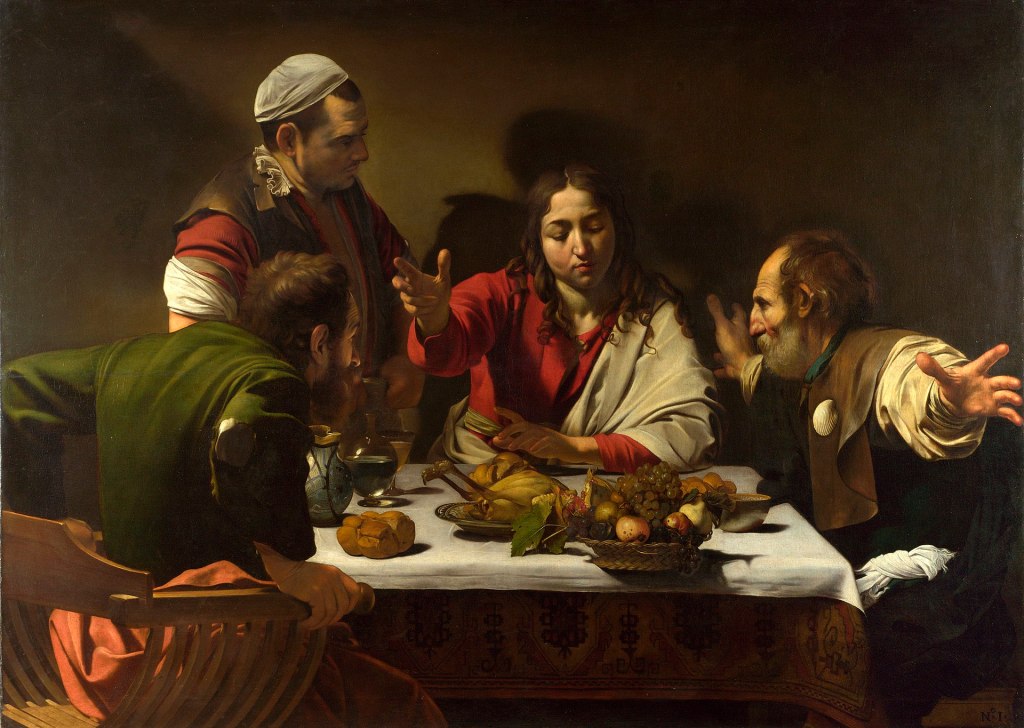
“Supper at Emmaus” by renowned painter Caravaggio from en.wikipedia.org. See the emotion depicted by Caravaggio with his trademark of masterful play of light and shadows. At the center is the Risen Lord blessing the bread that caught the two disciples who are seated in disbelief, one outstretching his arms and the others pushing back in his chair. The third character in the painting is the innkeeper unaware of the significance of the gesture of Jesus. It was at this instance that the two disciples recognized Christ as the traveling man with them to Emmaus.

Human transformation happens only in Christ, with Christ and through Christ in the Eucharist where we also experience a reversal of roles in our relationships with God and with others. Notice how the attitudes and perspectives of the two disciples changed when Jesus broke the bread. Remember it was the two disciples who invited Jesus inside to stay because it was getting dark, hosting a meal for him as their guest but that changed at the table: the two disciples ended up as guests of Jesus who merely joined them in their journey!

And it happened that, while he was with them at table, he took bread, said the blessing, broke it, and gave it to them. With that their eyes were opened and they recognized him, but he vanished from their sight. Then they said to each other, “Were not our hearts burning within us while he spoke to us on the way and opened the scriptures to us?” So they set out at once and returned to Jerusalem where they found gathered together the eleven and those with them who were saying, “The Lord has truly been raised and has appeared to Simon!” Then the two recounted what had taken place on the way and how he was made known to them in the breaking of the bread.

John 21:30-35

One thing I have found in life these past 25 years as a priest is that we can only realize and understand, even see the clearer and bigger picture of our life later after so many years of series of trials and tribulations, joys and celebrations. And often, what we see is the Lord, the companionship of Jesus Christ even in those times we were in sin and away from him. St. Peter said it so well in the second reading that we are in a “sojourning, realizing that you were ransomed from your futile conduct with the precious blood of Christ” (1 Pt. 1:17, 18, 19).

Photo by author, Sacred Heart Novitiate, Novaliches, QC, 20 March 2023.

Many times in life we feel as if we are really the captain of our ship, we direct everything, we control everything but it is actually Jesus. There is always Christ our companion in this journey of life, our true host and we are his guests who shared himself with us on the Cross so we can share in the mystery and victory of his Resurrection. In being one with us in our brokenness, Jesus immediately vanishes the moment we recognize him so we may keep on following him by changing course and direction in our lives.

In this time when people have lost interests in the Church, the Sacraments especially the Holy Eucharist, and the Scriptures along with prayers and devotions, we who are inside the church especially us priests are reminded of this important truth by Jesus, that he is the one in command, he is our host. We only share him in our co-journeyers in life, he is the one who opens our eyes, the one who effects transformation and changes within us. Not us.

Are we one with Jesus, especially in the Eucharist we manipulate so much with our many rituals and acts not necessary? See that the more we manipulate the Mass and other devotions, the more Christ disappears and persons especially priests become the focus.

In Emmaus, Jesus walked with the two disciples going the opposite direction to lead them back and never the other way around as it happens when we priests and volunteers are the ones who mislead people away from Jesus with our lack of warmth and charity for people like the unchurched.

Jesus is truest in the Eucharist when we touch people literally with our hands, when we get our hands dirty in taking care of the sick and needy, when we are truly present with them especially in their griefs, emptiness and sinfulness. That is when they experience, not just know that Jesus is real and true in the Eucharist when they first experience him in us his disciples, in our companionship and compassion with those suffering.

Nobody is perfect. As St. Peter had noted in the first reading, we are all responsible for the suffering and death of Jesus with our sinfulness; however, God’s love for us is far greater than our sins so that in our darkness and emptiness, we are able to see and have fulfillment in Jesus his Son. Amen. Have a blessed week!

Photo by author, Sacred Heart Novitiate, Novaliches, QC, 20 March 2023.

Ultimate joy of Easter: the Divine Mercy of God

The Lord Is My Chef Sunday Recipe for the Soul by Fr. Nicanor F. Lalog II
Divine Mercy Sunday in the Octave of Easter, 16 April 2023
Acts 2:42-47 ><}}}*> 1 Peter 1:3-9 ><}}}*> John 20:19-31
Photo by author, 08 February 2023.

The ultimate joy of Easter is God’s Divine Mercy, of how his Son Jesus Christ became human like us in everything except sin, searching and finding us to bring us back to the Father by dying on the Cross. Now he is risen, Jesus overflows us with his Divine Mercy right here, right now.

Unlike other religions, Christianity is so unique because it is about God looking for us humans by becoming like us so that we may become like him in Jesus Christ. In Christ, we have come to know and experience God as a person, relating with us in all tenderness and love because he himself had gone through all our pains and hurts, betrayals and disappointments, even death! Read the Bible and you shall see from the Old Testament to the New Testament, we find series of stories of God searching for man, beginning with Adam and Eve who hid after eating the forbidden fruit reaching its highest point in the coming of Jesus Christ who on this second Sunday in Easter came looking again for us represented by the disciples who have gone hiding in a locked room for fears of their leaders who have threatened to arrest them following reports of the empty tomb.

On the evening of that first day of the week, when the doors were locked, where the disciples were, for fear of the Jews, Jesus came and stood in their midst and said to them, “Peace be with you.” When he had said this, he showed them his hands and his side. The disciples rejoiced when they saw the Lord. Thomas, called Didymus, one of the Twelve, was not with them when Jesus came. So the other disciples said to him, “We have seen the Lord.” But he said to them, “Unless I see the mark of the nails in his hands and put my finger into the nailmarks and put my hand into his side, I will not believe.” Now a week later his disciples were again inside and Thomas was with them. Jesus came, although the doors were locked, and stood in their midst and said, “Peace be with you.” Then he said to Thomas, “Put your finger here and see my hands, and bring your hand into my side, and do not be unbelieving, but believe.” Thomas answered and said to him, “My Lord and my God!”

John 20:19-20, 24-28
“The Incredulity of St. Thomas”, painting by Caravaggio (1601-02) from commons.wikimedia.org.

“The disciples rejoiced when they saw the Lord.” But we wonder, what kind of rejoicing was it? It must have been more than the rejoicing of passing the Bar or any board exam. There was something else in their rejoicing if we try to imagine being there on that Sunday evening of the third day.

What do I mean? Have you ever felt being the one actually lost when some friends or loved ones as well valuable things have gone “missing”?

That feeling of being the one actually lost because the “missing” persons and things have never left us entirely but just there waiting to be found and rediscovered like when things get hidden underneath the car seat or misplaced somewhere else and forgotten. Once “found” again, there is that deep sense of joy coupled with a sense of wonder and astonishment because the truth is, it was not us who have found the lost person or thing but they were the ones who actually found us too! Here is a case more profound than the “eureka” experience for we were the ones who were lost and finally found again.

And that’s the rejoicing of the disciples in seeing Jesus again that evening of Easter Sunday! They were the ones who were actually lost and found by Jesus!

Just like us today in many instances in life when we have been running away from God, locking ourselves inside our very selves because of fears, insecurities and false securities, pride and sinfulness, as well as doubts and incredulity, unbelief and disbelief in God and in one another. Like Thomas, many times we have been so unreasonable in our demands for proofs of God and everything, insisting that “to see is to believe” without realizing that it is when we believe that we actually see.

Recall during the ministry of Jesus in Galilee how he kept telling his disciples to search for the “lost sheep” of Israel first and later everyone who have sinned and been away from God. That was Divine Mercy in action. Consider these other concrete expressions of Divine Mercy by Jesus:

At the Last Supper, John told us that Jesus “loved his own in the world and he loved them to the end” (Jn.13:1); this he proved by washing the feet of the Twelve! He further proved his love the following Good Friday by dying on the Cross and immediately at Easter, to prove his love again, he looked for Mary Magdalene to break the news of his resurrection to his disciples.

Jesus is the one who finds us unaware of his presence like on this second Sunday after Easter when he appeared to Thomas who was so shocked and surprised that all he could tell Jesus was “my Lord and my God”! I doubt if ever had the chance to examine the Lord’s wounds at all!

Next Sunday we shall hear in the gospel how it is always Jesus who searches and finds us when we least expect him like in the opposite directions in life when he walked with the two disciples to Emmaus Easter evening, only to be recognized by them at his breaking of bread.

Last Friday we have heard in the gospel how Jesus again for the third time appeared after finding them in a fruitless night of fishing in Lake Tiberias by telling them to cast their net to the right side of the boat; their nets almost teared with the bountiful catch of fish!

“The Road to Emmaus” painting by American Daniel Bonnell from fineartamerica.com.

In life, it is always Jesus who searches and finds us. We are the ones always getting lost. Many times in life we cry, asking where is God but the fact is he never leaves us, he is always with us, coming to us everyday, especially on Sundays in the Holy Mass where Jesus leads our celebrations.

On Tuesday, I will celebrate my 25th year of ordination to the priesthood. How I got ordained was a long story of getting lost for nine years when I was sent out of the high school seminary after graduation in 1982. I went to college in UST and finished AB Journalism in 1986, working as a writer then a reporter for GMA Channel 7 News until 1991 when I gave my vocation a second chance by entering the seminary again.

All those years from 1982 to 1991, I felt lost and empty despite a promising career with good pay and all the perks that went with it and a sense of security but, deep inside me was a big hole of being incomplete. That was how I went back to God in prayers, then slowly to the Mass and Confessions, and the more I moved closer to God, the more I felt empty yet eager for him that I finally consulted some priests. After a few years of discernment, I decided to leave everything and started anew in God in the seminary in 1991.

It was not easy going back to the seminary but God had such wonderful ways of finding me, even at the nick of time, to save my vocation. My turning point happened during our Ignatian retreat of 30 days when I finally committed myself to God as I felt his love and presence so irresistible, even himself so true. In 1998 with six other classmates, we were ordained priests at the Malolos Cathedral. Again, it was not an easy 25 years with so many times I often felt lost and empty mostly by my own making when I sin. But like before, Jesus in his Divine Mercy has always been the One searching and finding me even in the opposite directions when I hid amid rejections, failures, fears, sadness and weeping.

Like the early Christians in our first reading, I have found God most present in those 25 years as a priest and as an individual in the communal celebrations of the Holy Eucharist, aka, the breaking of bread as I realized too that priestly celibacy is lived in a community not only of priests but with you the laity.

With the responsorial psalm this Sunday as our prayer, “let us give thanks to the Lord for he is good, his love is everlasting” because as Peter tells us in the second reading, God our Father “in his great mercy gave us a new birth to a living hope through the resurrection of Jesus Christ from the dead” (1 Pt. 1:3). Let us rejoice in him who finds us always when we are lost. Amen. Have a blessed week ahead. Say a prayer for me this Tuesday. Thank you.

Prayer I have composed after our 30-day retreat in 1995 that until now, I still pray because it is so personally true. That is Divine Mercy for me. And hope with you too!

Fulness in emptiness

The Lord Is My Chef Sunday Recipe for the Soul by Fr. Nicanor F. Lalog II
Easter Sunday, Cycle A, 09 April 2023
Acts 10:34, 37-43 ><}}}"> Colossians 3:1-4 ><}}}"> John 20:1-9
Photo by author, sunrise at Katmon Nature Sanctuary & Beach Resort, Bgy. Binulusan, Infanta, Quezon, 04 March 2023.

Blessed happy Easter everyone! Rejoice, the Lord is Risen! I know it is very difficult to greet everyone with Happy Easter compared with Merry Christmas primarily due to our weather. Most of all, because Easter is so empty unlike Christmas so filled with many signs and symbols, even with gifts and other things.

But that is the mystery – and joy – of Easter.

Emptiness. Even nothingness.

Because when we are empty, when we have nothing, that is when God fills us with his abundance.

On the first day of the week, Mary of Magdala came to the tomb early in the morning, while it was still dark, and saw the stone removed from the tomb. So she ran and went to Simon Peter and to the other disciple whom Jesus loved, and told them, “They have taken the Lord from the tomb, and we don’t know where they put him.”

John 20:1-2
Photo from GettyImages/iStockphoto.

How amazing that we Filipinos are so fond of using the expression “wala lang” for nothing or empty. When a man texts a woman with a simple hi or hello plus the words, wala lang, do not believe him because that’s something! There is something in simply texting you out of the blue! Meron yun kasi di ka niya text kung wala talaga.

In the provinces if you come for a lunch or dinner, whether there is an occasion or none, it is common to hear the hosts especially the poorer ones apologizing for not having a lot of food when in fact there are more than two viands like the freshest fish and vegetables we urbanites miss most. They would always say, “wala po kaming nakayanan, mahina po ang ani/huli, pasensiya na po.” Such kind of superb graciousness among us Filipinos in the provinces is so ordinary.

Perhaps, it is a beautiful sign we have imbibed from our deep faith in Jesus Christ who was nowhere to be found inside the empty tomb.

His absence from the empty tomb meant he was present somewhere. That was what Magdalene implied when she said “They have taken the Lord from the tomb, and we don’t know where they put him” (Jn.1:2).

Though the tomb was empty, Jesus was not missing at all. He had risen from the dead! In fact later, they would meet him along the way and that very evening too until his ascension into heaven.

Emptiness and nothingness can be positive or negative.

Positive emptiness means nothingness for God who alone suffices. There is an inner feeling of emptiness for something or Someone bigger, greater. That is how a man feels when he texts a woman of his dream with wala lang: he feels empty and nothing without her! The same with God. St. Augustine perfectly said it, “my heart is restless until it rests in you, O Lord.”

Henry Osawa Tanner’s painting, “The Three Marys” (1910), photo from biblicalarchaeology.org.

Easter is positive emptiness: Jesus is no longer in the tomb because he is risen. It is the definitive sign we have been freed from the clutches of evil and sin, of death and decay. Death is not the final statement in life. The gospel at Easter Vigil is more picturesque when Matthew narrated how Magdalene saw an angel seated on the empty tomb of Jesus, a beautiful reminder of how suffering and death have become Christ’s crowing glory. From being a tomb to becoming a Throne!

Every time we experience pains and sufferings, of emptiness and nothingness in life that all we could do is surrender everything to God like Jesus on the Cross, that is positive emptiness. We know for sure and feel it inside us that there is something in this nothingness. That is why never say “walang-wala ako” (I got nothing) because we always have God in us.

Positive emptiness/nothingness is the virtue of hope which is not positive thinking that things would get better. In fact, to have hope in God is to believe and accept that things could get worst like Jesus during the days leading to his arrest and crucifixion because to hope is believe that even if everything is lost, there is always God loving us in the end.

Hope is positive emptiness because it is creating a space within us for God and for others in love. Positive emptiness and nothingness is seeking God right in that emptiness like Peter and John running into the tomb after learning it was empty because we love, we have a relationship that continues after one is gone and not seen.

That ultimately is what positive emptiness/nothingness is all about, love.

It is similar to that feeling at the end of a movie when we refuse to stand and leave the cinema because we believe – we hope – there is still another final scene, there is still a coming sequel to what we have seen. We are not totally saddened with the end of the movie as we strongly feel, there would be a part two, a part three, and a part four which has been the trend all these years of the great movies of our youth! How funny that after exhausting the sequels, there came also the prequels. Why? Because we have all established a relationship, a love among us the fans of a movie franchise like Star Wars or Die Hard and its creators.

Photo by Ms. April Oliveros, Mt. Pulag, 25 March 2023.

That is what Easter is all about. We do not simply give up for life’s many sufferings and pains, trials and tribulations because we feel and know deep inside we have Jesus Christ who have risen from the dead. We are emptied daily in order to be filled with Jesus himself every day too. There is no need to see much things. Enough to feel deep inside like what Peter explained to the people at the first reading. Their very lives proved amid the physical emptiness or absence of Jesus in the world that Jesus was present, was Someone with Something.

This is the great challenge for us these days. More and more people are spending the Holy Week and Easter in the beach or somewhere else to bond as family where they could see more of each other and see more sights than the ordinary we have during this time of the year at home and in the parish that are usually bland and dry. More people prefer to go somewhere here and abroad in the hope of still being able to pray and celebrate the sacraments there because they feel empty here at home. We really hope they have positive emptiness than negative emptiness.

Negative emptiness is feeling empty amid the plethora of things and pleasures in life. Many times these days due to mobility, it is so easy to go hiking to the mountains or to some exotic destinations to fill the emptiness we have inside, to search for our “lost selves” (hanapin ang sarili). But very often, after some time of relief, the same emptiness and nothingness occurs. Nothing happens because what we really have is positive emptiness, our desire for God, the most essential in life who cannot be replaced by anything at all.

Negative emptiness is seeking things, sights and sounds, things of the senses to fill up curiosities, to settle doubts, to find happiness not realizing it is totally different from joy and fulfillment.

Negative emptiness is insisting on holding on to what can be seen, to what is tangible despite the inner directions we have been feeling inside toward God. For some time, we can refuse to follow its directions but there are times, positive emptiness and nothingness impose itself on us like when there is death or serious illness in the family. At first, it can be scary, so frightening but eventually, liberating like in the experiences of the first disciples of Jesus.

May we heed St. Paul’s words this Easter from the second reading, “Brothers and sisters: If then you were raised with Christ, seek what is above, where Christ is seated at the right hand of God” (Col. 3:1).

Dearest Lord Jesus,
grant us the grace to seek and find
you in emptiness and nothingness,
even in darkness;
many times, our senses blur 
our sight of you;
how sad that even in our celebrations
we are so fascinated with all the colors
and antics in the rituals and processions 
we keep in our cameras and cellphones
but never in our hearts and memories
that soon enough, they fade, we forget
and see them only as pictures
bereft of meaning because it lacked relationship;
let us see you more beyond 
to have sights and insights
as well as hindsight and foresight
of your loving presence
in emptiness and nothingness
because what we have and keep
is your relationship,
your love and mercy.
Amen.

God saves

40 Shades of Lent by Fr. Nicanor F. Lalog II
Palm Sunday of the Lord's Passion, 02 April 2023
Isaiah 50:4-7 > + < Philippians 2:6-11 > + < Matthew 27:11-54
Photo by author, Palm Sunday of the Lord’s Passion 2019, Parokya ni San Juan Apostol at Ebanghelista, Bagbaguin, Sta. Maria, Bulacan.

We now enter the holiest week of the year, the height of our Lenten preparations for Easter. What we have today are two ancient celebrations merged by Vatican II in 1963: the blessing of palms practiced in Jerusalem as early as the fourth century and the papal tradition of proclaiming the very long gospel of the Lord’s Passion in Rome about year 500. Hence, the title “Palm Sunday of the Lord’s Passion”.

And it is a beautiful innovation in our liturgy showing us so many truths in our lives like we begin Holy Week with the triumphal entry of Jesus to Jerusalem, leading to the Holy Triduum of Passion and Death on Maundy Thursday and Good Friday into the bursting joy and glory on Easter.

That for me is life itself.

We come into this world in triumph like Jesus with everybody rejoicing with our birth until we grow up, going through a lot of pains and sufferings with little deaths right in the hands of those supposed to love us but always, there is the joy of maturity, of fulfillment in Christ with many Easter moments of triumphs and consolations. Today’s celebrations remind us that while there will always be the disappointing manifestations of sin and evil in life, overall, there is always the immense and immeasurable love of God expressed in Jesus Christ dying on the Cross.

“Ecce Homo” painting by Vicente Juan Masip (1507-1579) from masterapollon.com

Our gospel is very long even in its shorter version. Let us focus on the Lord’s silence from his arrest to His crucifixion.

The Lord God has given me a well-trained tongue, that I might know how to speak to the weary a word that will rouse them. I gave my back to those who beat me, my cheeks to those who plucked my beard; my face I did not shield from buffets and spitting. The Lord God is my help, therefore, I am not disgraced; I have set my face like flint, knowing that I shall not be put to shame.

Isaiah 50:4, 6-7

Jesus is the fulfillment of the so-called Suffering Servant of God in the Book of Isaiah. What is striking is how he claims to have been given with a well-trained tongue but He rarely spoke when tried and crucified, choosing to be silent in the midst of great sufferings. What a great display of love for us!

In a world drowning in a cacophony of sounds and noise with everyone and everything speaking like elevators and cellphones, the more God is silent, waiting for us to stop and listen to Him in Jesus Christ who speaks within us. From Pilate to the soldiers to the Pharisees and priests with their rabid packs of demagogues who ceaselessly mocked Jesus even while slowly dying on the Cross, Jesus remained silent.

Because He loves us.

Because He waits for us to stop and listen.

Because life is more true and fulfilling in silence, not in sounds and noise.

Last Monday we celebrated the Feast of St. Joseph where we heard in the gospel how an angel told him to take Mary as wife with the specific task of naming her child “JESUS” which means “God saves”. See how God gave that specific mission to the most silent man in the Bible, St. Joseph who must have taught Jesus the value of silence!

That is how God saved us in Jesus by remaining silent even on the Cross. If ever He spoke, it was mostly to pray the psalms. In Jesus, God saves us in silence while we are in the din of noises of sin. Oh how we speak a lot these days against God, still putting Him on trial, blaming Him for all the problems and woes we have in our lives and in the world.

Photo by author, August 2020.

Like Pilate and the crowd with their religious leaders, we say a lot about God that are often not true but He never argued nor debated with us just like then because Jesus loves us, because His name means “God saves” and that was exactly the meaning of His silence.

How could be God so demanding as many would claim with His many words of instructions and commandments of things to do and not to do plus warnings against sin just to obey Him when He has always been silent?

Today we are reminded how we talk too much and accomplish so little, even nothing, while Jesus is silent because His name means “God saves”, witnessing it in fact in silent sufferings that was a scandal for many at that time.

Moreover, Jesus showed us today in His sufferings how silence is ultimately the expression of trust in God. When we are able to slow down and be silent in the face of many trials, that is a clear indication of our deep faith and trust in God. People who trust are the most silent because simply wait for their deliverance or salvation. Like Jesus Christ.

Christ Jesus, though he was in the form of God, did not regard equality with God something to be grasped. Rather, he emptied himself, taking the form of a slave, coming in human likeness; and found human in appearance, he humbled himself, becoming obedient to death, even death on a cross.

Philippians 2:6-8
Photo by author, Betania-Tagaytay City, 2018.

More scandalous than the silence of Jesus Christ during His trial was His crucifixion, the supreme expression of His name’s meaning, “God saves”. See how since the fall of Adam and Eve, sin has always been an attempt by humans in becoming like God. There has always been that conscious or unconscious feeling of competition with God whom many see as controlling, manipulative and even power-hungry.

But right there on the Cross, Jesus showed us that indeed, in His very Person how God saves by utterly being weak and powerless.

God saves us in Jesus through the path of powerlessness and weakness, docility and humility, of simplicity before men and before His Father.

That is why even at His triumphal entrance to Jerusalem, He rode a lowly donkey never been used by anyone, a fulfillment of many Old Testament allusions and prophecies that “your king comes to you, meek and riding on an ass, and on a colt, the foal of a beast of burden (donkey)” (Mt. 21:5; Zech. 9:9). His triumphal entry into Jerusalem was the fulfillment of the words of God to his prophets, showing us that indeed, everything Jesus did and said were in accordance with the Father’s will, never on His own.

Photo by author, 2018.

Because His name Jesus means, “God saves”.

What is most beautiful in the reading earlier at the blessing of palms was how Matthew described the Lord’s triumphal entry into Jerusalem – exactly just like the coming of the wise men from the East!

And when he entered Jerusalem the whole city was shaken…

Matthew 21:10

Imagine how a very large crowd welcomed Jesus, spreading their cloaks on the road where He passed, chanting “Hosanna to the Son of David” (Mt.21:9).

Like when Jesus was born and Magis from the East came to Jerusalem inquiring about the newborn king of Israel, they were also shaken! And the irony then at His birth and at His triumphal entry, the learned have refused to recognize Him despite their having all the knowledge and writings available to them.

Is it not the same thing continues to happen to us in our lives, when despite all the kindness and mercy of God, we refuse to recognize His Son’s coming Jesu Christ including the salvation He had gained for us? Where have all the people gone on Sundays? Does God still matter to us? Do we not care at all whenever Jesus comes to us most especially in the Eucharist during the Sunday Mass?

Both the rites of the blessing of palms with the procession and the Mass on this Palm Sunday of the Lord’s Passion are not merely a recalling of a past event, but a making present, a re-membering of Jesus our King triumphantly coming daily – still in silence – to us in the simplicity of bread and wine to become His Body and Blood for us to offer and share in order to experience Him, our Resurrection and Life because His name means “God saves”.

In the Eucharist, Jesus comes to us as “God saves us”, fulfilling us, blessing us.

This Holy Week, especially at the Holy Triduum of Holy Thursday, Good Friday and Easter Vigil, we are reminded of our task to witness to everyone the meaning of the name of Jesus, “God saves” by being present to Him in the Eucharist. Inside the church. With our family. Not in the beach nor a resort unmindful of history’s greatest moment when God saved us from sins by dying on the Cross. Amen. Please, have a meaningful Holy Week to experience the joy of Easter!

Lent is for delaying.

40 Shades of Lent by Fr. Nicanor F. Lalog II
Fifth Sunday in Lent-A, 26 March 2023
Ezekiel 37:12-14 + Romans 8:8-11 + John 11:3-7, 17, 20-27, 33-45
Photo by author, 22 March 2023, Sacred Heart Novitiate, Novaliches, Quezon City.

We conclude this Sunday the three Johannine readings during this Lenten season with the story of the raising of Lazarus from the dead. More powerful than the healing of the man born blind last Sunday, St. John shows in this raising of Lazarus who had been dead for four days that Jesus is truly the Christ, the awaited Messiah. Most of all, it is in this raising of Lazarus that Jesus also made his greatest “I AM” statement of all, “I am the resurrection and the life”.

Like the two previous long stories from St. John, let us focus on the opening paragraph of this long narrative that right away gives us a hint of something very striking, of why Jesus delayed his coming to Lazarus supposed to be his friend, someone so dear to him.

The sisters of Lazarus sent word to Jesus, saying, “Master, the one you love is ill.” When Jesus heard this he said, “This illness is not to end in death, but is for the glory of God that the Son of God may be glorified through it.” Now Jesus loved Martha and her sister and Lazarus. So when he heard that he was ill, he remained for two days in the place where he was. Then after this he said to his disciples, “Let us go back to Judea.”

John 11:3-7
An icon of Jesus visiting his friends, the siblings Sts. Lazarus, Mary and Martha. Photo from crossroadsinitiative.com.

Don’t you find it striking that after asserting that “Now Jesus loved Martha and her sister and Lazarus”, then, “he remained for two days in the place where he was” (vv.5-6)? How could Jesus loved Martha and Mary and Lazarus yet delayed his coming in visiting them, especially Lazarus who was sick? His love for Lazarus as his friend should have made him proceeded to visit him right away and had he gone soon enough, Lazarus would have not died at all!

Many times we are also baffled with God who claims to love us so much but too often, delays his coming to us, in answering our prayers, and even seems to allow us to suffer so much before finally coming to our rescue!

The key, my dear friends, is found in verse 4 when Jesus said “This illness is not to end in death, but is for the glory of God that the Son of God may be glorified through it.” Like in the healing of the man born blind last Sunday when Jesus told his disciples that “Neither he nor his parents sinned; it is so that the works of God might be made visible through him” (Jn.9:3), St. John is reminding us in this raising of Lazarus from the dead that the love of Jesus Christ for us is manifested in works that show the glory of God by which we his disciples come to deeper faith.

When bad things happen to us making us feel in dire need of help and deliverance from God immediately, we tend to focus on what’s wrong, what’s broken and what needs help, expecting God to do something quick about it. But Jesus is teaching us this Sunday to approach situations of tragedy and deep crises like when somebody is too sick, even death by first seeking means how we can be an instrument who manifest God’s glory in this moment of great danger and need. Jesus is governed by something greater than human affection and expectations but by the Father’s will.

See at a very young age after Jesus was lost and then found in the temple when he clarified to his parents that he had to be in his Father’s home?! As he matured and later with his disciples, he would always insist on the need to seek, follow, and stand by the truths of the Father for he does and says nothing not known by the Father. When it seems to take time so long in receiving God’s assistance, never think he loves us less. In fact, he loves us so much that he finds something else so beautiful in such situations that he opts to delay in answering our prayer requests immediately.

Remember how the Israelites spent 40 years wandering in the wilderness before entering the Promised Land after their exodus from Egypt when they could have accomplished that in less than a month maybe or even a year. But in their wandering in the desert for 40 years, they were purified and bonded as a nation. It was during those years they developed their language and culture and most especially, the composition of the first five books of the bible! Many times, God delays his coming to us so as to make us stronger and deeper in our faith like Martha and Mary. Just because God does not act quickly to our needs does not mean he loves us less that we begin doubting his love for us.

“The Raising of Lazarus”, 1311 painting by Duccio de Buoninsegna. Photo by commons.wikimedia.org

The love of Jesus for everyone, especially his friends, Lazarus, Martha and Mary is best expressed in giving glory to the Father by helping them come into deeper faith. That is the greatest gift we can also give our family and friends – deepened faith through a life that points to God and not us.

There are times we feel like being grounded and even pulverized by God – dinudurog – not because he does not love us but primarily to transform us into better persons. In the first reading, God assured Ezekiel which was fulfilled in Christ that he would make us rise not only at the end of time but even in our little deaths daily in life by breathing into us his Spirt. This is the goal of every Lenten journey that leads to Easter, that amid all the sufferings and pains, even deaths we experience in life, we always emerge better, living more in the Spirit of God (second reading) than in flesh.

Hindi lang tayo mahal ng Diyos. Mahal na mahal na mahal tayo ng Diyos kay Jesus!

After each darkness in life, there is always new life in each new day with Jesus calling us to “come out” like Lazarus as a better disciple. Amen. Have a blessed week!

Photo by author, 22 March 2023, Sacred Heart Novitiate, Novaliches, Quezon City.

More than sight, Lent is insight, hindsight and foresight in Christ

40 Shades of Lent by Fr. Nicanor F. Lalog II
Fourth Sunday in Lent-A, 19 March 2023
1 Samuel 16:1, 6-7, 10-13 + Ephesians 5:8-14 + John 9:1, 6-9, 13-17,34-38
Photo by author, sunrise at Katmon Nature Sanctuary & Beach Resort, Bgy. Binulusan, Infanta, Quezon (04 March 2023)

We continue to journey with Jesus and his disciples towards Jerusalem for the fulfillment of his mission and like last Sunday, we take on a short stop-over today with him in the healing of a man born blind. It is another long story in these last three weeks of Lent that we hear from the gospel by St. John, filled with so many layers of meaning about our sense of sight or seeing which we often take for granted. Many of us are misled by the world’s insistence that to see is to believe when so often, we still fail to really see persons, things, and situations.

Experience has taught us that it is not enough for us to have eyes to be able to see, that after all, what Jesus has been teaching us is most true – believe and you shall see which is what our story of his healing of a man born blind is all about.

As Jesus passed by he saw a man blind from birth. He spat on the ground and made clay with the saliva, and smeared the clay on his eyes, and said to him, “Go wash in the Pool of Siloam” – which means Sent. So he went and washed, came back able to see. His neighbors and those who had seen him earlier as a beggar said, “Isn’t this the one who used to sit and beg?” Some said, “It is,” but others said, “No, he just looks like him.” He said “I am.” They brought the one once blind to the Pharisee.

John 9: 1, 6-9, 13
Photo from freebibleimages.org

Like last Sunday, let us just focus at the beginning of this long, beautiful story with many details still relevant to our own time like the apostles asking Jesus who’s to be blamed for the man being born blind, himself or his parents? Jesus clearly tells us how we must stop our blaming game and start believing and trusting God who makes himself visible even in unfortunate circumstances.

In the story of Jesus with the Samaritan woman, St. John revealed to us how God would come to our lives at “noontime” when we are hot or in the heat of our worldly pursuits including sins; in this healing of the man born blind, we are shown how God through Jesus comes to us right in our most sorry plight in life, when we are in darkness. See how so disadvantaged is that man born blind who not only had no sight but practically a nobody as he had nothing in life, begging for food and money in order to live.

And that is when Jesus Christ comes to us, when we are nothing and practically down in the dumps.

Photo from freebibleimages.org

And here the story gets better. In the original Greek text, we find that “he was blind from his genesis” which has double meaning of both birth and creation. In using the term genesis, St. John is telling us that Jesus is not someone who had come to bring back the world to its original set up before the Fall of our first parents by destroying earth.

Jesus came not to destroy earth and us to start anew but to restore us to our original status of blessedness by being like us so we could be like him. Here in this instance, Jesus created a new beginning for the man when he touched the man’s eyes with mud and having him wash in the waters of Siloam which mean the “Sent One”. We are reminded how Adam the first man was formed from the dust of the earth as Ash Wednesday would always tell us at the start of Lent.

In Genesis, after forming man from dust, God breathed on Adam and he became alive.

Photo from freebibleimages.org

In today’s gospel, Jesus spat on the mud and “smeared the clay on his eyes” to show the process of new creation. Spitting is Jesus infusing himself on the mud or earth that was put on the eyes of the man born blind. He then instructed the man to “Go wash in the Pool of Siloam – which means Sent” (Jn.9:7), a complete reference to him too as the Christ or the Messiah long awaited.

Clearly in this scene we find the sign of water like last Sunday, an image of the Sacrament of Baptism where we are all re-created into new persons in Jesus Christ who is himself the water who cleanses us of our sins and impurities, re-creating us into new persons with unlimited possibilities and chances in life because of our union with God.

The healing of the man born blind was his salvation, his being saved through his union with God in Jesus Christ.


The man born blind represents us all who need cleansing by Jesus Christ. Everyday, Jesus comes to us in our lowest points in life, when we are so sick and weak, when we are losing all hopes and inspiration in life, when we are lost and defeated, when we are deep into sin. Jesus gives us himself as our saving gift.

But it is just the beginning.

See how the man born blind did not have his sight right away with Jesus putting mud on his eyes; it happened after obeying the Lord’s instruction to wash himself in Siloam. We have to cooperate with Jesus Christ like the man born blind.

Recall how Jesus reminded Peter on Holy Thursday of the need for him to wash his feet in order to have “inheritance with me” (Jn.13:8). We have been washed and cleansed by Jesus in our Baptism which is perfected in our celebration of the Holy Eucharist he established on Holy Thursday. The more we immerse ourselves in Jesus in the Eucharist, the more we are cleansed, the more we have faith in him, enabling us to see clearer not just have sights of things before us but its meanings in the light of Christ.

We need to go back to Jesus in the Eucharist to be washed clean, especially our eyes to be able to see clearly.

How funny if you have entirely read this story of how the people could not believe with their eyes what they saw after the man born blind was healed by Jesus. They could not agree among themselves they have to consult their authorities, the Pharisees to verify if he was really the man born blind who was healed; but, when summoned the Pharisees questioned the man, they too refused to believe him, even insulted him. The worst part of the story was when the parents of the man born blind were called to verify if he was really their son who was born blind and now can see. Unfortunately, the parents refused to vouch for him, insisting they ask him personally for he was old enough to speak.

There are times in our lives that we could be left alone standing for Jesus Christ for what is true, what is right, what is just, and what is good because it is only us who could see everything clearly like that man born blind after his healing. That is why, it is not enough to have sights only but also insight to see the meaning of things happening at present, as well as hindsight to see the meaning of the past and foresight to find its meaning in the future. We need faith in God in order to see beyond the surface and superficial, to see the deeper meaning of persons and events like what God told Samuel in anointing Jesse’s youngest son David to be Israel’s new king.

But the Lord said to Samuel: “Do not judge from his appearance or from his lofty stature, because I have rejected him. Not as man sees does God see, because man sees the appearance but the Lord looks into the heart.”

1 Samuel 16:7

To see things and events including persons, of finding Jesus working in the present moment (insight), in the past (hindsight) and the future (foresight) requires a lot of courage too to stand for Christ and his values of truth and justice, mercy and love, life and persons like that man born blind and later healed. Here we find American writer Helen Keller’s words ringing so truly, “The only thing worse than being blind is having sight but no vision.” Visionaries are people who dream with eyes wide opened, those who dare to see beyond because of their deep faith and conviction in their beliefs or whatever they held as true. Very much like our saints too who gave their lives for the sake of Jesus Christ.

Beginning this Sunday, let us heed St. Paul’s call for us to “Live as children of light”(Eph. 5:8) by following the light of Jesus Christ. Let us leave our blindness and darkness as well as shortsightedness by seeing to it we “Take no part in the fruitless works of darkness” (Eph. 5:11). Amen. Enjoy a blessed and insightful week ahead, everyone!

Photo by author, early morning rains at Katmon Nature Sanctuary & Beach Resort, Bgy. Binulusan, Infanta, Quezon (04 March 2023)