Welcoming Jesus

Quiet Storm by Fr. Nicanor F. Lalog II, 28 December 2020
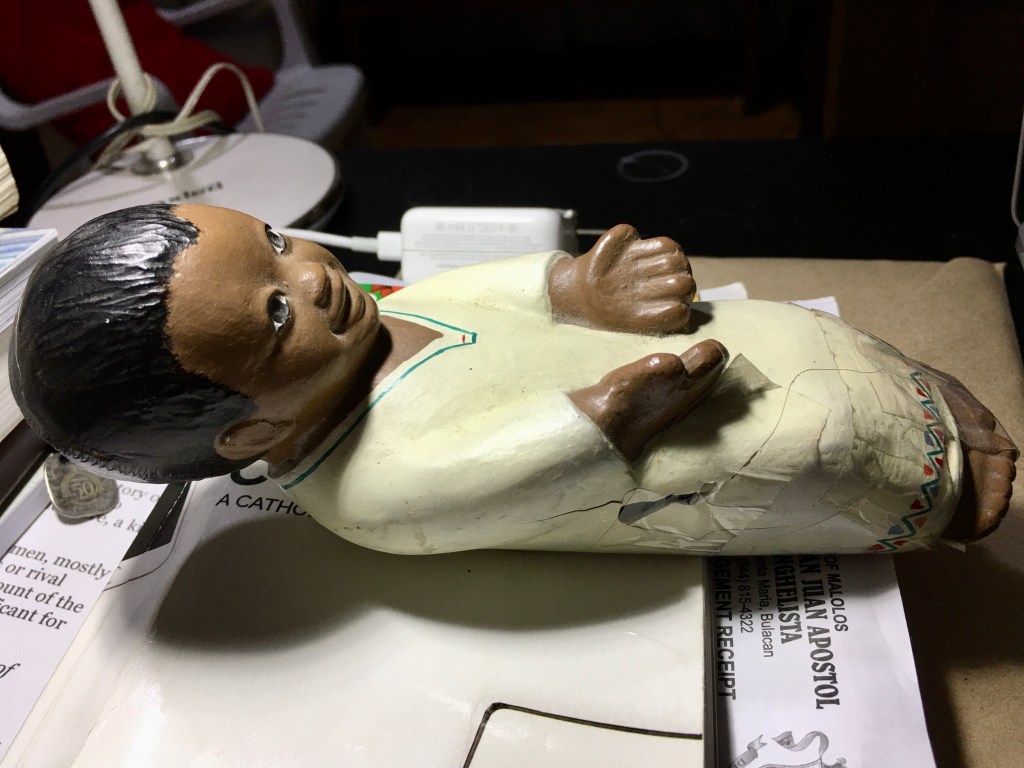
Photo by author, 28 December 2020.

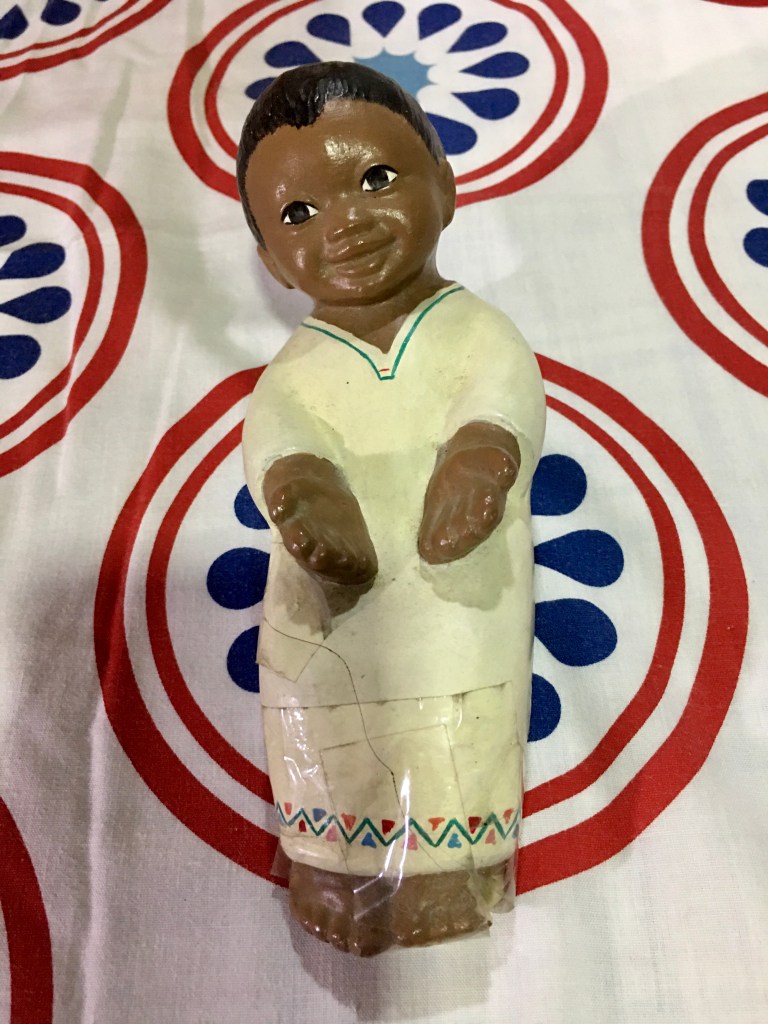
“Welcoming Jesus”.

It is not really the title of this piece but the name of this image of the baby Jesus above.

See His smiles and open hands with eyes exuding with warmth and joy to anyone who sees Him. Even with the dusts and cracks held intact by scotch tapes, it is one of my most loved and cherished possessions I would never trade for anything.

Given to me by a brother priest in Christmas 2017, Welcoming Jesus measures about eight inches and seems to be Mexican or African inspired with his dark skin and lively colorful design of baby dress. I have always loved this Baby Jesus who seems so alive that I have kept Him on my desk, giving me so many inspirations and “kicks” in my studies in the past three years.

Small and handy, and so fragile, I have always imagined Him to be just like the infant Jesus when He was born in Bethlehem more than 2000 years ago.

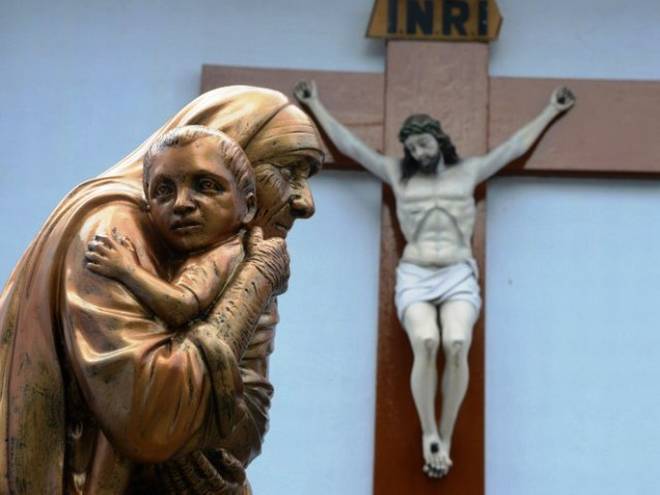
As I turned off my lamp last night before retiring, I saw Him, smiling and yes, “welcoming” to remind me of a story I have read ten years ago about St. Mother Teresa of Calcutta, India when one of their patients threw to her a crucifix in a fit of tantrum. After pacifying the patient, St. Mother Teresa picked the crucifix and pieced together with a scotch tape an arm of Jesus that was broken. She then gave it to one of her nuns with instructions to hang it again on their wall with a note that says, “Let me heal your broken arm”.

In the same manner, as I looked onto my little image of “Welcoming Jesus”, I felt it my Christmas message for 2020 as we celebrate Holy Innocents’ Day: “Let me show you tenderness, Baby Jesus.”
If there is one thing we all need at this time of the pandemic, this Christmas 2020, it must be tenderness. Like the tender compassion of God, His mercy.

Tenderness is being merciful, being soft in the heart in a very positive sense. Some people think that being tender, being merciful and forgiving is a sign of weakness; on the contrary, it is pure power and strength.

The former US President Theodore Roosevelt who was a military officer before getting into politics used to tell that in any argument or discussion, the first to use one’s fist is always the one with less intelligence, less power who resort to force because they have ran out of reasons to argue.

Very true! Exactly with that off-duty cop who brutally shot and killed mother and son in Paniqui, Tarlac whose tiny brain could not control his humongous body much less understand everything that was going then.

Mercy and tenderness, like courage, are movements within the heart. The Latin word for mercy perfectly captures its meaning: misericordia or a stirring of the heart, a moving of the heart. More than a feeling, it is taking concrete actions to bow down and be one with those suffering.

That is why the Son of God became human, chose to be born as an infant like everybody else, to be one with us, to suffer with us, that is, compassion from cum and passio, to suffer with.

The eminent theologian Fr. Hans urs Von Balthasar, a good friend of Pope Emeritus Benedict XVI, wrote before he died that “the central mystery of Christianity is our transformation from a world-wise, self-sufficient ‘adults’ into abiding children of the Father of Jesus by the grace of the Holy Spirit. All else in the Gospel – the Lord’s Incarnation, his hidden and public lives, his miracles and preaching, his Passion, Cross, and resurrection – has been for this” (Unless You Become Like This Child).

A baby is always welcoming to almost everyone, and vice versa, anyone even the most hardened criminal would always welcome and be moved by the sight of a baby or a child.

How sad that until now, there are still King Herods among us who are insecured with children and infants. Worst are those who abuse and molest children, the single most damning crime by some in the clergy this century because it is directly opposite the central theme of Christ’s teachings and warning – “See that you do not despise one of these little ones, for I say to you that their angels in heaven always look upon the face of my heavenly Father” (Matt.18:10).
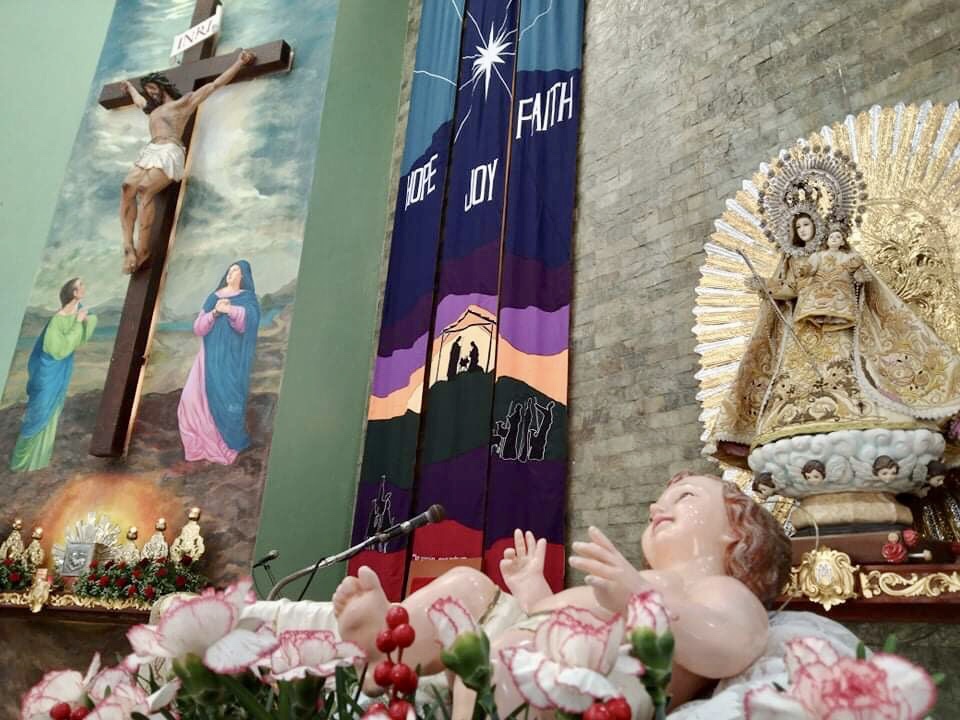
Photo by Mr. Marc Angelo Nicolas Carpio, Baby Jesus in our Parish, Christmas 2020.

Due to COVID-19 pandemic, for the first time in our churches, the traditional kissing (pahalik) of the image of the Baby Jesus is scrapped. Perhaps it is a good reminder to us all to meditate more in our hearts the meaning of Jesus being born an infant – so weak, so dependent to adults like us.

It is a call for us too to do something concrete about the many sufferings children have to go through in this time, on one end those denied of basic goods and services while on the other extreme are the children with all the material needs except the warmth and love of their parents.

One saint I have discovered before our ordination more than 20 years ago is St. Charles de Foucauld, a French priest who lived among the Tuaregs of the Sahara desert in the early 20th century. In his room, he always had a baby Jesus and an altar for the Blessed Sacrament to adore daily.

His core value is founded on “littleness” – of finding Jesus among the little ones, of being little before the Lord.

Have that tender care that expresses itself in the little things that are like a balm for the heart… With our neighbours go into the smallest details, whether it is a question of health, of consolation, of prayerfulness, or of need. Console and ease the pain of others through the tiniest of attentions. Be as tender and attentive towards those whom God puts on our path, as a brother towards brother or as a mother for her child. As much as possible be an element of consolation for those around us, as soothing balm, as our Lord was towards all those who drew near to him.

St. Chrales de Foucauld

What a beautiful reminder of the Child Jesus this Christmas and hereafter. If we can be tender with one another in the most minute detail like Jesus, then we can truly experience His coming to us, fulfilling us with His presence and love which is the spirit of Christmas. Amen.

Priesthood is loving Jesus first

Quiet Storm by Fr. Nicanor F. Lalog II on the occasion of 
the First Year Anniversary of Ordination 
to the Priesthood of Rev. Fr. Howard Tarrayo
Cathedral-Basilica of the Immaculate Conception
Malolos City, 10 December 2020
Photo by author of Lake Tiberias (Galilee) at sunrise, May 2019.

This preaching should have been last year.

Fr. Howard was the very first person to have invited me to be his predicador at his Primera Missa Solemne while still a seminarian — and that is why I think he was delayed for almost two years before getting ordained exactly a year ago today!

That gospel scene you have chosen for this occasion at the shores of Lake Tiberias is something that happens everyday in our lives as priests, from day one of ordination way into our old age in with Jesus asking us, like, “Simon, son of Jonah, do you love Me?” (Jn.21:17)

Priesthood is essentially loving Jesus Christ first of all. That is why Jesus had to ask Simon Peter thrice with the same question, “Do you love me?” because we have to love him first before we can truly follow him.

When the priesthood or the Call becomes the very core and center of our lives and not Jesus our Caller, sooner or later, we replace Christ that we become the Lord and Master in our parish, in our ministry.

Today, we are celebrating Fr. Howard your remaining in love with Jesus, of loving Him first, a year after your ordination and we pray that every year, it will always be the very reason you celebrate your ordination anniversary.


When they had finished breakfast,
Jesus said to Simon Peter, 
"Simon, son of John, do you love me
more than these?"
He said to him, "Yes, Lord, you know 
that I love you." 
He said to him, "Feed my lambs."
(John 21:15)

Loving Jesus first is growing deeper in our prayer life in him. People who love are always together; they have a ritual or a schedule that like the fox telling the Little Prince, an hour before their appointed meeting, his heart is already beating for him, excited with his presence that he is coming.

Photo by author, parish sacristy, 05 December 2020.

It is my hope that during this pandemic we priests have rediscovered the value and beauty of having that seminary schedule during our formation years that must have ingrained in us discipline. Like schedules, prayer is a discipline. Love goes through a process, it matures, becomes more disciplined. That is why a disciple is not only a follower but also a disciplined one, a true lover!

It is good to bond with brother priests and friends and family once in a while but not every night or every other night that we have practically made every Starbucks outlet a parish or even a diocese where 1/3 of the clergy get together religiously (pun intended)! Any loving husband would always be home at night to be with his wife. The same is true with every priest — be home at night in your parish to be with Jesus at prayer. He awaits you, He misses you!

Whenever people ask me what is the most difficult part of priesthood, I always tell them it is praying every day. And I mean real prayer when we have to strip ourselves naked before God in our truest selves. Kaya sabihin man nila walanghiya o salvahe ang sino mang pari, pero kung araw-araw lalo na sa gabi siya ay nananalangin, mabuting pari pa rin siya kasi maski minsan, nagiging totoo siya sa sarili at sa Diyos. And masama kapag hindi na siya nagdarasal nang tunay, iyon ang simula ng pagkaligaw ng sino mang pari.

Whatever is the fruit of our prayer, that is our homily and that is when all tests happen: the moment we deliver a homily, people measure us if we “walk our talk”. The priest is the homily himself. When a priest stops celebrating Mass, most especially refuses to give homilies, maybe Father is no longer praying. Baka may iba na siyang mahal kesa kay Jesus.

Remaining in love with Jesus is being a man of prayer.


He then said to him a second time,
"Simon, son of John, do you love me?"
He said to him, 
"Yes, Lord, you know that I love you."
He said to him, "Tend my sheep."
(John 21:16)

Loving Jesus first means keeping in mind that everything is a gift from Jesus, that whatever we have, whatever we share, whether material or spiritual things, is always from Christ. We have nothing except Him. Even if sometimes we feel bad in our ministry like going on a sick call when we are so tired or blessing a dead cat or hearing confessions of a parishioner who have maligned you, just do it! Whatever you give them, it is not yours but Jesus’!

Photo by author, parish sacristy, 05 December 2020.

Huwag maging maramot, Father. Maging mapagmahal, matulunging, maunawain, mapagpasensiya, mapagbigay, mapagpatawad — kasi ano mang pagmamahal, tulong, pang-unawa, pagpapasensiya, kapatawaran o ano mang ating maibibigay kanino man ay hindi naman talagang atin kungdi kay Kristo at Kristo pa rin!

Here lies the danger when we are so focused with our call or vocation when we feel the one who must be understood and cared for — we turn the ones being served instead of the one serving! Kasi feeling natin magaling tayo kaya tayo naging pari! Para tayong artista at politiko na “FGLG”: feeling guapo, looking gago. Parang lahat may utang na loob sa atin. Kaya kung magmayabang tayo: ako nagpagawa niyan, ako nakaisip niyan, ako, ako, ako…. Nasaan si Jesus? Nandun sa tabernakulo, nabuburo.

I wish to share with you a prayer I have written during our retreat with a Cenacle sister at the Theologate when we were in third year: “Lord Jesus Christ, you have given me with so much and I have given so little; teach me to give more of my self and more of You to others. Amen.”


He said to him a third time, 
"Simon, son of John, do you love me?"
Peter was distressed that he had said to him
a third time, "Do you love me?" and he said to him,
"Lord, you know everything; you know that I love you."
Jesus said to him, "Feed my sheep."
And when he had said this, he said to him,
"Follow me."
(John 21:17, 19)

Father Howard, we have learned in Holy Matrimony that a man and a woman marries not only each other but also their families; the same is very true in priesthood. Loving Jesus first means the priest’s family must love Jesus more than their priest son and Kuya Pari or Tito Pari.

Profession of faith by Rev. Fr. Howard with his mother and sister before Bishop Dennis, 10 December 2019.

Nanay Nelia and Mary Grace… kung mahal ninyo si Father Howard, mas mahalin ninyo si Jesus. Ang pagmamahal ng pamilya sa kanilang anak o kapatid na pari ay naroon din sa kanilang higit na pagmamahal kay Jesus. Kapag si Jesus ang minahal ninyo una at higit sa lahat katulad naming mga pari, manalig kayo lalong mamahalin ni Jesus si Father. Hindi siya pababayaan.

We are told that after this third question by Jesus “Do you love me?”, Simon Peter was distressed because he remembered how he had denied the Lord three times after His arrest on Holy Thursday evening.

What can be more distressing especially at this time of the pandemic for us priests than be caught between our family and ministry?

You were still preparing for your Diaconal ordination last year, Father Howard when your mother had a stroke, then followed by the death of your father. It must have been so difficult, so painful. But looking back, did God ever forget you, Father?

Ate Nelia and Mary Grace, give Father Howard to Jesus. Huwag ninyo siyang hahanapan. Magkusa na kayo sa inyong sarili kasi iba piniling buhay ni Father. And I address this to every parent, brother and sister, relatives and friends of Fr. Howard and every priest. Huwag ninyo siyang hanapan. Kung mayroon man kayong hahanapin palagi kay Father Howard, iyon si Jesus. Always Jesus, only Jesus.

There is still something more “distressing” for us priests with our family that I wish to share with you, Father Howard. When Jesus told us to leave our father and mother, brothers and sisters behind to follow Him, he never meant to turn our backs from them. We still have to love them but more on a different level as silent witnesses of Christ.

The most difficult part of our ministry is ministering to our own family with all our biases and past histories before us. We are so familiar with each other that inevitably, these would surely show on many occasions when least expected. Be on guard, for the pendulum swings to extremes when we sometimes become so lax or so harsh with them.

Most “distressing” is when Jesus asks us “Do you love me?” while we continue to hold on to the pains and hurts, frustrations and disappointments our families have inflicted on us.

It is in our own families when we are asked to be more like St. Francis of Assisi, of preaching the gospel, speaking only when necessary.

Father Howard, be the first to understand and to embrace the strains and the past in your family; Jesus called you despite your imperfect family to make you perfect and eventually, through your life of total love for Him, perfect your family too.

It is very difficult to love, most especially our Lord Jesus, Father Howard. How I wished you have never asked me to do this because so many times I have failed Jesus. And continues to fail Him, not loving him that much.

But that is exactly what happened at the shores of Tiberias that morning after breakfast when Jesus asked Simon Peter three times, “Do you love me?”

Don’t worry, Father. Jesus knows everything how much we love Him. You are never alone with Jesus and us. Let us keep saying “yes, Jesus, I love you” with our brother priests every day, specially during anniversaries like this. Amen.

God bless you more, Father Howard!

Our obedience in authority, our authority in obedience

The Lord Is My Chef Breakfast Recipe for the Soul by Fr. Nicanor F. Lalog II
Wednesday, Memorial of St. Martin of Tours, Bishop, 11 November 2020
Titus 3:1-7     >><)))*>   +   <*(((><<     Luke 17:20-25
Photo from blog.obitel-minsk.com.

Glory and praise to you, O God our almighty Father, the Supreme Authority over the whole universe. As we celebrate the Memorial of St. Martin of Tours, one of your most glorious saints of the fourth century, we are reminded today by this former soldier of the important relationship of obedience and authority.

St. Paul in the first reading tells us:

Beloved: Remind them to be under the control of magistrates and authorities, to be obedient, to be open to every good enterprise.

Titus 3:1

Teach us, O God, how obedience and authority always go together, never apart from each other. May we see that obedience is not a virtue when authority is taken for granted and not rooted in you, our loving Father. At the same time, authority is corrupted when exercised without obedience to higher authority.

Your Son Jesus Christ had taught us so well that he spoke with authority, even the evil spirits obey his words; however, he had always insisted though that even if all authority has been given to him, all his life is a YES and obedience to you, God our Father.

Like St. Martin of Tours who had lived obedient to you O God all his life through his superiors and the people, may we live our obedience in authority in Jesus Christ our Savior while at the same time, may we live our authority in obedience to him by trusting in you alone.

We pray that we do not fall to the trap of the nine lepers healed by Jesus who obeyed him to present themselves to the priests after being healed; they were obedient but were not rooted in God, so mechanical in their obedience, unmindful of the authority of Jesus who healed them.

Instead, may we imitate the Samaritan who upon realizing his healing, returned to thank Jesus: here is a man whose obedience is not only rooted in you, O God, but most of all, whose exercise of authority will surely be in obedience to you for he is full of gratitude.

From being a soldier of the State into being a soldier of God, pray for us St. Martin of Tours to remain rooted in God so that in our obedience to authority as well as exercise of authority in obedience, may we begin and end in him. Amen.

Photo of St. Martin of Tours from St. Martin of Tours Parish, Bocaue, Bulacan.

Our dis-ease COVID-19

Quiet Storm by Fr. Nicanor F. Lalog II, 08 October 2020
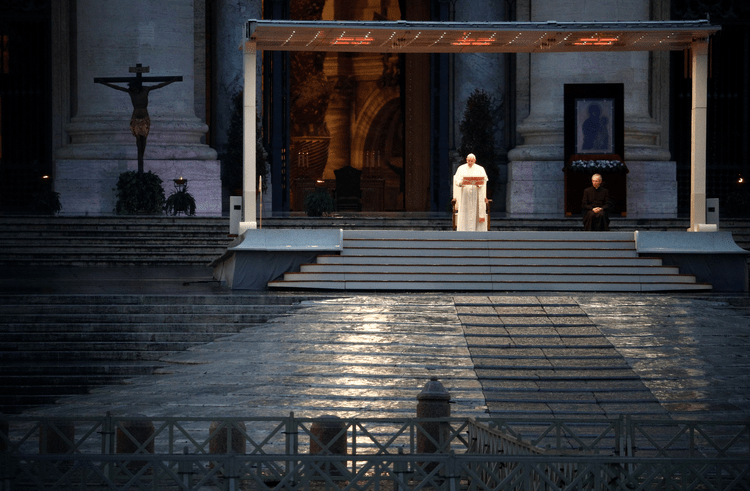
Pope Francis delivering his “Urbi et Orbi” before an empty St. Peter’s Square in Rome, 27 March 2020 at the height of COVID-19 pandemic. Photo from Vatican Media/AFP via Getty Images.
In the beginning
we were counting
the days of quarantine
but when COVID-19
spread with so many dying
then we realized this is not just passing
but could be staying 
leaving the world in a standstill
shaking our very core and being
bringing us back to God
praying, surrendering everything
to him as our sole grounding.
Finding God 
during this quarantine
is indeed a blessing 
directing us to look within
to examine our being
where every healing must begin;
Any sickness is a dis-ease
a lack of order
when things are not pleasing
because of sin and wrong-doing
exactly what we are now seeing
with COVID-19.
Photo by Mr. Jay Javier, May 2020.
Consider the following:
Long before social distancing
we have always been so far away
even from those with whom we stay
foregoing all the loving,
replaced with twitting or texting;
When we were growing
we were taught to keep our hands clean
but we have pushed it to the extreme
refusing to dirty our hands
forgetting to work with honor and dignity
keeping them free from stains of dishonesty;
Of all the most disturbing
during this quarantine
is the mask that cover our face;
but, why be fazed, objections raised
when we have long erased
to see in every face
that tremendous grace
of God's trace?
In the midst of this calamity
when air became pollution-free
we rejoiced at Nature's beauty;
the remedy for every malady
is not found only in the pharmacy
but right in our hearts when we see
everything and everyone in harmony.
Oh how I long when that day shall be
when everyone is free with nothing to worry;
at ease shall we carry within the peace and serenity 
of one big family living cleanly in God's mercy.
Photo by Ms. Anne Ramos, March 2020.

In the presence of God

The Lord Is My Chef Breakfast Recipe for the Soul by Fr. Nicanor F. Lalog II
Tuesday, Feast of Archangels St. Michael, St. Gabriel, and St. Raphael, 29 September 2020
Daniel 7:9-10, 13-14     >><)))*>   +   >><)))*>   +   >><)))*>     John 1:47-51
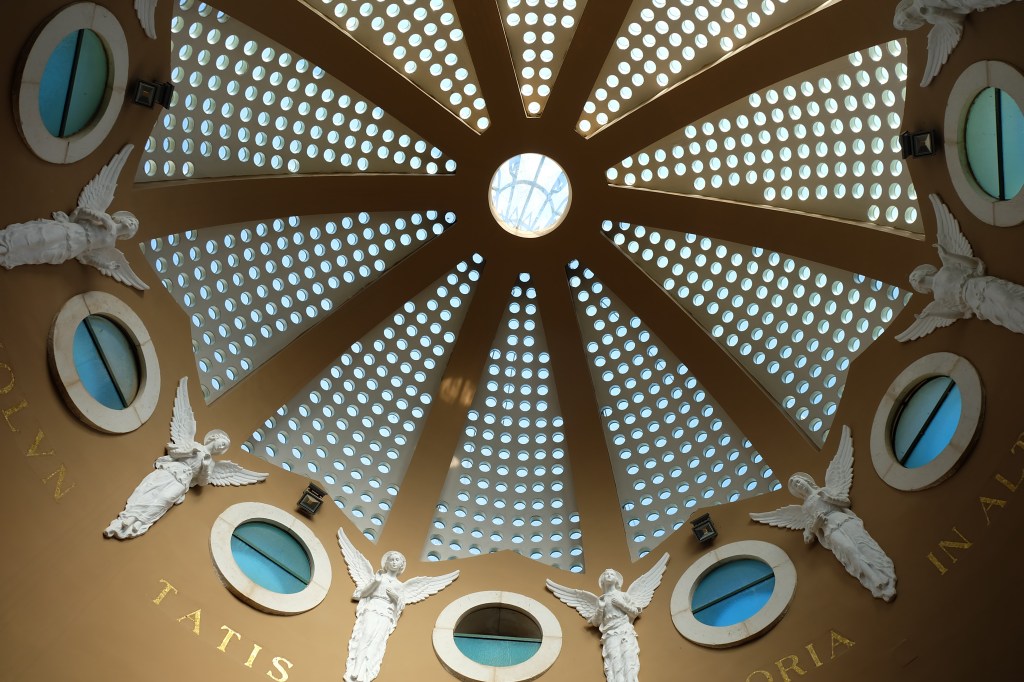
Photo by author, dome of the chapel at Shepherds’ Field in Bethlehem, the Holy Land, May 2019.

Thank you Lord Jesus Christ for opening the heaven for us to be in the presence of God the Father anew and most especially, to become like him again in his image and likeness.

As we celebrate today the Feast of your Archangels Michael, Gabriel and Raphael, we remember God’s original plan for us to be with him like his angels and Archangels, of being like him not to compete but to reflect his image and likeness.

And so today, we pray that we may have the grace to be like St. Michael whose name means “who is like unto God?” that we may be like God not to compete with him but to be holy and merciful like him, fighting evil and sins with justice and truth.

Make us strong, Lord Jesus, like St. Gabriel whose name means “God is my strength” so we may deliver always your good news of salvation to the world now numb to bad news of wars and murders, injustice and inhumanity, poverty and starvation as well as the excesses of the first world with more than half the world starving and barely surviving with bare essentials.

Lastly, we beg you Lord in this time of the pandemic to grant us the gift of healing for those sick not only with COVID-19 but with other sickness. May St. Raphael who name means “God has healed” come and guide us in this journey like he did to Tobias, providing him the medications to heal not only bodily sickness but also emotional and spiritual maladies.

These we present to God our Father through you our Lord Jesus Christ. Amen.

Photo by Pixabay on Pexels.com

The gift of tears

Quiet Storm by Fr. Nicanor F. Lalog II, 22 September 2020
Photo by Ms. Ria De Vera of our parish church, August 2020.

Lately I have been watching old movies that I wonder why I still cry even if I have seen them more than twice before at the cinema and cable TV. It seems that my being born with “mababa ang luha” (easy to cry) is getting more “mababa” as I get old.

Tears are a gift from God, the most beautiful prayer we can ever express courtesy of the Holy Spirit because when we run out of words for our pains and sadness or when we are overjoyed, he makes us cry to heal and comfort us or complete our joys, assuring us of his loving presence.

That is the reason why we call “home” in Tagalog as “tahanan”: home is where we “stop crying”, that is, “tahan na” because that is where we find all the support we need in times of crisis. Indeed, home is where the heart is.

True to its function, tears cleanse us physically, emotionally and spiritually. I have read two decades ago that researchers at a university in the US have found the chemical composition of our tears differ if we cry because of pain and sadness or due to joy and laughter.

Is it not wonderful and amazing how we take for granted crying and tears without realizing its chemical process within that can transform our very selves?

Photo from Reuters.com, July 2020.
Tears and crying mark our life's coming to full circle.

When I was five years old, I saw the picture of a newborn baby crying in the Book Section of the Reader’s Digest. I asked my mom why the baby was crying. In her usual motherly way of explaining things, she told me that if the baby cries upon birth, it means he/she is alive; if the baby does not cry, he/she is dead.

Kapag umiyak, buhay; walang iyak, patay.

My young mind easily absorbed her words that would remain to be one of the most profound lessons I had ever learned about life at a very young age. As I grew up watching TV and movies, I would always sigh with relief whenever I heard the sounds “uha-uha” because the story would surely be nice and not tragic.

Imagine the great inverse that happens with crying and tears to signal the coming to the outside world of life of another human, of how we have to cry to be alive from then on until we die when it becomes our family and friends’ turn to cry and shed tears for us when we are gone.

But there is something more deeper than this great inverse on crying in life and death I had learned only in 2013 through my best friend Gil, a classmate in our minor seminary.

It was late February of that year on the 40th day of the death of his youngest sister Claire when he was diagnosed with cancer. We could not believe the news because Gil was the most health conscious in our “band of brothers” from high school who never smoked, rarely ate meat, and was active in sports like golf and badminton. Unlike most of us, he was never overweight, looked so healthy in our mid-40’s.

Imagine the hurt within him that every time we would visit him, he would cry not really in pain but more on the why of getting cancer. We tried visiting him as often as we can to cheer him up and lift his spirits specially after his surgery when his chemotherapy sessions began.

By September on that same year, we all had to rush and visit him at Makati Med one Sunday afternoon when informed by his Ate Lily that doctors have given up on him. His cancer cells were “ferocious” and nothing could be done anymore except to wait for the inevitable.

That was when I noticed the greater inverse about crying when Gil had finally accepted his condition and life direction, that was when he was most joyous and peaceful too while we were the ones so sad and worried, crying. How our roles were reversed with Gil now telling us to stop crying – tahan na – which we used to tell him months earlier! (Gil died peacefully the following Sunday, 22 September 2013.)

“Mater Dolorosa” as “Blue Madonna” (1616) by Carlo Dolci. Photo from Wikimedia Commons.

I noticed it happening so many times with some friends and parishioners I have come to love in my ministry, those I have pastorally cared for some time after being diagnosed with serious conditions like cancer.

Yes, I have cried despite holding my tears for them while administering the Holy Viaticum and Anointing of Oil. The patients in turn would just glance at me, so dignified and calm like Mary our Lady of Sorrows as if trying to comfort me with their sweet thank you.

As I prayed on those experiences, I realized how life comes to full circle through our crying and tears.

I believe that patients cry when they start undergoing treatment of their sickness due to fears and uncertainty of what would happen next to them; later as they come to terms with their condition, they stop crying because they already knew where they were going, of what was coming next.

We who would be left behind cry and begin to shed tears at thoughts of their dying because admittedly, we are actually the ones more uncertain of where we are going to or how our lives would go through when our loved ones are gone.

That is the greatest pain we feel in the death of a beloved when we grapple with the realities of the many uncertainties of life without them.

And that is why we need to love as much as we can our family and friends while still alive. This quarantine period of the pandemic are grace-filled moments to shower them with our love and presence we have taken for granted for so long as we pursued many things in our lives.

Photo by Dr. Mylene A. Santos, MD at Infanta, Quezon, April 2020.
Tears and crying lead us to heaven.

Death and sickness, like life, become a blessing if we are filled with gratitude not regrets because we have truly loved. When a beloved is gone and we begin to cry, the tears wash away our pains of losing them, cleansing us within to leave us with all the beautiful memories and love we have shared. Then, every remembering becomes truly a re-membering, making a lost loved one a member of the present again.

When we cry, tears polish the love we have shared with everybody until later when our time comes, our visions are also cleared of what is going to happen next, of where we are going. Crying becomes wonderful and truly a grace after all not only in sharing and being one with the grief and pain of another in the present but sooner or later, in having a glimpse of the life after.

In the Gospel of John (11:1-44), we find the story of the raising of Lazarus whom Jesus loved so much that he wept – not just cried – at his death. Jesus raised him up back to life, his final miracle – or “seventh sign” according to John – to show he is the Christ before his own Resurrection at Easter after his “final hour” of Crucifixion on Good Friday.

From then on, Christ sanctified crying and tears to enable us to see beyond pains and hurts, even death especially if you have truly loved.

Sometimes in life, it is always good to let those tears flow, like love even if it is painful, to have a good cry and real cleansing inside. A blessed day to you!

Sharing the light of Christ

The Lord Is My Chef Breakfast Recipe for the Soul by Fr. Nicanor F. Lalog II
Saturday, Memorial of St. Teresa of Calcutta, 05 September 2020
1 Corinthians 4:6-15 /// Luke 6:1-5
Photo by author, 25 August 2020.

By blood, I am Albanian. By citizenship, an Indian. By faith, I am a Catholic nun. As to my calling, I belong to the world. As to my heart, I belong entirely to the Heart of Jesus.

St. Mother Teresa of Calcutta (26 August 1910-05 September 1997)

One of the great joys I have come to treasure lately, O Lord, is the grace to have lived in these interesting part of history among some of the great modern saints of our time like St. Mother Teresa of Calcutta whose Memorial we celebrate today.

I practically grew up during her time when she was called a “living saint”, a very small woman in stature clad in her usual white and blue-striped habit, always wearing a smile, radiating with your light, sweet Jesus Christ.

Yet, deep in her fragile-looking body was a rock-solid faith in you, Lord, that enabled her to accomplish so much to alleviate the sufferings of so many people!

She knew so well our time marked with material affluence amid spiritual and moral bankruptcies that she went to serve the “poorest of the poor” not only in India but in the entire world. She was a soul filled with your light, Lord, burning with love for you with the sole desire to be your love and compassion to the poor.

Thank you, dear Jesus for being present with us through saints like St. Mother Teresa.

Like her, I pray that I may remain faithful to you than be successful by becoming your light to the world plunged in darkness of sin.

Like St. Paul before her, use me, Jesus, to heal the world of its wounds and divisions by remaining faithful and true to your words that you are the “Son of Man, the lord of the sabbath.”

Like St. Mother Teresa, may I share you Jesus, only Jesus, and always Jesus. Amen.

A statue of St. Mother Teresa in their Mother House in Calcutta, India. From devdiscourse.com.

Human situation, Divine response: multiplying our blessings

The Lord Is My Chef Sunday Recipe for the Soul by Fr. Nicanor F. Lalog II
Week XVIII, Cycle A in Ordinary Time, 02 August 2020
Isaiah 55:1-3 >><}}}*> Romans 8:35, 37-39 >><}}}*> Matthew 14:13-21

Remember our reflection last Sunday? Of how parables teach us that “less is always more” because to have the kingdom of God – Jesus Christ himself – we have to learn to appreciate the little things in life?

Beginning this Sunday until August 16, our gospels will start telling us who is Jesus Christ by showing us his powers and abilities that are exactly opposite the way we see and understand them. This new series of stories are so relevant to us in this time of pandemic, giving us wonderful insights into God’s ways of responding to our human situations.

St. Matthew now leads us with Jesus to the wilderness after teaching us in parables to experience his power in transforming us like the five loaves and two fish to feed more than five thousand people.

Multi-layered story of the multiplication of bread

All four evangelists have recorded this story of Jesus Christ’s multiplication of the loaves of bread with their particular focus and stress, showing us that it truly happened and was a major event in the Lord’s ministry.

Very unique with St. Matthew’s version of this miracle story – which has not one but two! – is his economy of words in narrating it like a straight news as if it were a developing story or a “breaking news” unfolding before us, calling us to follow its updates and details due to its multi-layered meanings.

When Jesus heard of John the Baptist, he withdrew in a boat to a deserted place by himself. The crowds heard of this and followed him on foot from their towns. When he disembarked and saw the vast crowd, his heart was moved with pity for them, and he cured their sick. When it was evening, the disciples approached him and said, “This is a deserted place and it is already late; dismiss the crowds so they can go to the villages and buy food for themselves.” Jesus said to them, “There is no need for them to go away; give them some food yourselves.” But they said to him, “Five loaves and two fish are all we have here.” Then he said, “Bring them here to me,” and he ordered the crowds to sit down on the grass. Taking the five loaves and the two fish, and looking up to heaven, he said the blessing, broke the loaves, and gave them to the disciples, who in turn gave them to the crowds. They all ate and were satisfied, and they picked up the fragments left over — twelve wicker baskets full. Those who ate were about five thousand men, not counting women and children.

Matthew 14:13-21
Photo from iStock/Studio-Annika.

The consolation of Jesus.

Our situation in this time of the corona pandemic is so similar with that of Jesus. With the increasing number of COVID-19 cases, it has finally hit us hard, so close to home with news of those we know getting infected and worst, dying from this disease.

Like Jesus upon hearing the death of John the Baptist, we are all saddened that we wish to withdraw away from everyone.

We want to mourn but there are more people in need of our presence and help in this time of pandemic like the countless medical frontliners and health workers who must be so tired – even sick, physically and emotionally – by now with the growing number of COVID-19 patients and yet have chosen to remain in their posts.

And there are still the other casualties of this pandemic like those who have lost their jobs, those evicted from their rented apartments, those stranded and separated from their loved ones, those begging for food, and those afflicted with other sickness going through dialysis and physical therapy.

Jesus knows so well the “wilderness” we are all going through and he is right here with us, one with us in our sufferings, in our fears and anxieties, and in our exhaustion.

To be one with us is consolation, from the Latin “con” or with + “solare” or alone, to be one with somebody feeling alone.

Jesus did not remove our pains and sufferings, even our death; he joined us to be one with us in these that he can call us to “Come to me, all you who labor and are burdened, and I will give your rest. Take my yoke upon you… For my yoke is easy and my burden light” (Mt.11:28-30, 14th Sunday, 05 Jul 2020).

Compassion of Jesus.

Still with Christ’s reaction of being “moved with pity” at the sight of the crowds who have followed him to the wilderness, we find something more deeper with his being one with us, in consoling us that he had forgotten all about himself, his tired body that he went on to heal the sick among them.

To be moved with pity is more than a feeling of the senses but a response of his total person.

You respond for help, you reply to a call.

Ever wondered why we have the “responsorial psalm” after the first reading in the Mass? Because those words from the Psalms express our total assent and commitment to God, involving our total self like body, mind, heart and soul.

Photo by Dra. Mai B. Dela Peña, Carmel Monastery, Israel, 2016.

God cannot suffer because he is perfect.

That is why he became human like us in Jesus Christ to be one with our suffering and death so that we would one with him in his glorious Resurrection.

In the wilderness, Jesus stayed with the people, not allowing them to leave as suggested by the Twelve because he was moved with pity with the crowd because he wanted to suffer with them.

That is compassion, literally means to “suffer with” from cum + patior. Here in the wilderness, Jesus showed his compassion for the people which will reach its highest point in giving himself on the Cross on Good Friday.

Have we “responded” to God’s call to serve, to a call of duty, and to a plea for help from the poor? Have we truly given ourselves to somebody without ever thinking our own comfort or rewards? Or, are we running away from his Cross?

What a shame in this time of pandemic there are some among us who rejoice at the losses of others like the Twelve who wanted the crowd to be sent home because they were afraid of responsibilities, of taking care of the suffering people.

Consolation and compassion are the two most needed from each of us in this time of crisis.

Our scarcity mentality, the God of plenty.

We now come to the miracle of the feeding of five thousand. According to the late Fr. Henri Nouwen, this story is an example of our “scarcity mentality” when we think of not having enough, of finding what we have as too little, always looking for more; hence, our tendency to hoard everything.

The Twelve were thinking more of themselves, afraid they could go hungry with the five loaves of bread and two fish they have. They were so afraid of difficulties ahead of them in their situation where to find and how to feed those great number of people.

They were focused on what was lacking than on what they have, and who was with them, Jesus Christ! They were hungry for food in the stomach than for food to the soul unlike the crowds who have followed Jesus.

Worst of all, the Twelve got “mad” upon seeing the crowds who have followed them to the wilderness when in fact, it was Jesus who needed most to rest to mourn John’s death!

But through all these, Jesus patiently bore the people’s woes and the Twelve’s selfishness to teach them all in a very nice way something so essential in our response to every human suffering and extreme situation: opening and entrusting our selves totally to God.

And that was actually the greatest miracle that happened that day.

Photo by Pixabay on Pexels.com

In doing it, Jesus simply asked the Twelve what they have, never asking how much they have or its condition. Just whatever they have to give everything to Jesus like those five loaves and two fish that he took, and while looking up to heaven, blessed and broke the loaves, and gave them to the Twelve to distribute to the crowd.

And everyone was satisfied with a lot of left overs too!

Matthew nor any of the other Evangelists ever explained how it happened because it does not really matter at all. What is most important is what are we willing to give up to Jesus so he can transform us into better persons.

That is what we continue to do this day in every celebration of the Holy Eucharist- whatever we have, even not the best or the worst and littlest we have, when given to Jesus becomes holy and multiplied!

The power of God is immense, without doubt. But, in this miracle of the feeding of five thousand, Jesus is showing us that his power is not meant to satisfy our material or bodily needs but our deepest desires that lead to our fulfillment in him as prophesied by Isaiah in the first reading.

Why spend your money for what is not bread; your wages for what fails to satisfy? Heed me, and you shall eat well, you shall delight in rich fare. Come to me heedfully, listen, that you may have life.

Isaiah 55:2-3

Amid the pandemic worsened by our government officials’ inanities, irresponsibilities, and sheer lack of compassion with us in this wilderness, the Lord assures us today that he is with us for “nothing can separate us from the love of Christ” (Second Reading) if we are willing to give him all that we have.

It is our spiritual transformation first that leads us to our material blessings. We can all have it if we are willing to give everything to Jesus and believe in him always. What do you have for miracles to happen?

A blessed August ahead for you! Amen.

Photo by Dra. Mai B. Dela Peña, Carmel, Israel, 2016.

To be known and still be loved

The Lord Is My Chef Breakfast Recipe for the Soul by Fr. Nicanor F. Lalog II
Wednesday, Feast of St. Mary Magdalene, 22 July 2020
2 Corinthians 5:14-17 >><}}}*> >><}}}*> >><}}}*> John 20:1-2, 11-18
Painting by Giotto of the Risen Lord Jesus Christ appearing to St. Mary Magdalene from commons.wikimedia.org.

Dearest Lord Jesus Christ:

Today as I prayed on the feast of your beloved Saint Mary Magdalene, my sights were focused on your beautiful exchange of names on that Easter morning at your tomb.

It is so lovely and so deep, and very personal for all of us whom you love so much despite our many sins like St. Mary Magdalene.

When she had said this, she turned around and saw Jesus there, but did not know it was Jesus. Jesus said to her, “Woman, why are you weeping? Whom are you looking for?” She thought it was the gardener and said to him, “Sir, if you carried him away, tell me where you laid him, and I will take him.” Jesus said to her, “Mary!” She turned and said to him in Hebrew, “Rabbouni,” which means Teacher.

John 20:14-16

You called her by her name, “Mary” and she called you by your title “Rabbouni” – what a beautiful scene of two people loving each other so deeply, so truly! You – humbly and lovingly accepting the sinner, and she – submitting herself to you as disciple.

You have expelled seven demons from her, you have known her so well even her darkest secrets and sins, and despite all these knowledge, Lord Jesus, the more you have loved her that you called her by the sweetest word she could ever hear in her life, “Mary”.

The same with us, sweet Jesus: every day you call us by our names, each one of us as a person, an individual, a somebody not just a someone. You love us so much in spite and despite of everything. We are not just a number or a statistic to you but a person with whom you relate personally.

From Google.

Help us to realize this specially when darkness surrounds us, when self-doubts and mistrust abound in us without realizing your deep trust in us, in our ability to rise again in you and follow you.

Teach me to trust you more and love you more like St. Mary Magdalene, to give and offer my self to you totally as yours, calling you “Rabbouni” or Teacher and Master.

Let me give up whatever I still keep to myself, whatever I refuse to surrender so that I may enjoy the intimacy you offer me as a friend, a beloved, and a family in the Father.

What a joy indeed to be like St. Mary Magdalene, fully known and fully loved by you, dear Jesus.

May I learn to know and love others too like you so I may proclaim you to them. Amen.

Healed by God’s mercy

The Lord Is My Chef Breakfast Recipe for the Soul by Fr. Nicanor F. Lalog II
Friday, Week XV, Year II in Ordinary Time, 17 July 2020
Isaiah 38:1-6, 21-22, 7-8 >><)))*> >><)))*> >><)))*> Matthew 12:1-8
Photo by Mr. Raffy Tima of GMA-7 News at the start of COVID-19 lockdown, March 2020.

Our loving and merciful Father, every time I hear the siren of an ambulance or stories of people I know getting sick, I grapple with words in praying for them and those who take care of them.

I could not find the words what to pray for them except to beg for your mercy that whomever inside a rushing ambulance or my parishioner or friend or relative may get well soon, may be healed totally in their mind, body and soul.

There are just too much sickness and death going on these days, Lord, and the truth is, deep inside me you know very well my own prayer even if it does not pass through my lips – spare me of any sickness at least during this pandemic.

Thank you for your loving mercy, Father, that have sustained me since March, especially when I feel low and sad, even depressed thinking if I would ever survive this COVID-19 pandemic.

Your words today are very consoling and reassuring: you are more than willing to heal us of our sickness, Lord.

Like your servant King Hezekiah, I turn to you merciful Father on behalf of those stricken with COVID-19 and other illnesses in this time of the corona to give them a chance to recover their health to serve you and their families too.

I pray also for their loved ones looking after them to keep them faithful and filled with hope hurdling this sickness.

Then Hezekiah turned his face to the wall and prayed to the Lord: “O Lord, remember how faithfully and wholeheartedly I conducted myself in your presence, doing what was pleasing to you!” And Hezekiah wept bitterly. Then the word of the Lord came to Isaiah: “Go, tell Hezekiah: thus says the Lord, the God of your Father David: I have heard your prayer and seen your tears. I will heal you…”

Isaiah 38:2-5

Unlike Hezekiah who must have been so extraordinary before you, we are not asking any signs from you. Just heal us, strengthen our medical frontliners and caregivers. Most of all, spare us of any sickness in this time of the pandemic.

Father, we beg you in this most trying time of our history as a nation, that we may be filled with your mercy so that we in turn may share this same mercy to those living in the margins, that we may be more compassionate and kind to people so hard-pressed with life these days.

Yes, indeed, your Son’s reminder to the Pharisees are also meant for us today when we are so concerned with laws than with persons:

Jesus said to them: “If you knew what this meant, I desire mercy, not sacrifice, you would not have condemned these innocent men. For the Son of Man is Lord of the sabbath.”

Matthew 12:7-8

Amen.

Photo by Onnye on Pexels.com