The Lord Is My Chef Breakfast Recipe for the Soul by Fr. Nicanor F. Lalog II
Third Sunday in Easter, 18 April 2021
Acts 3:13-15, 17-19  ><)))*>  1 John 2:1-5  ><)))*>  Luke 24:35-48
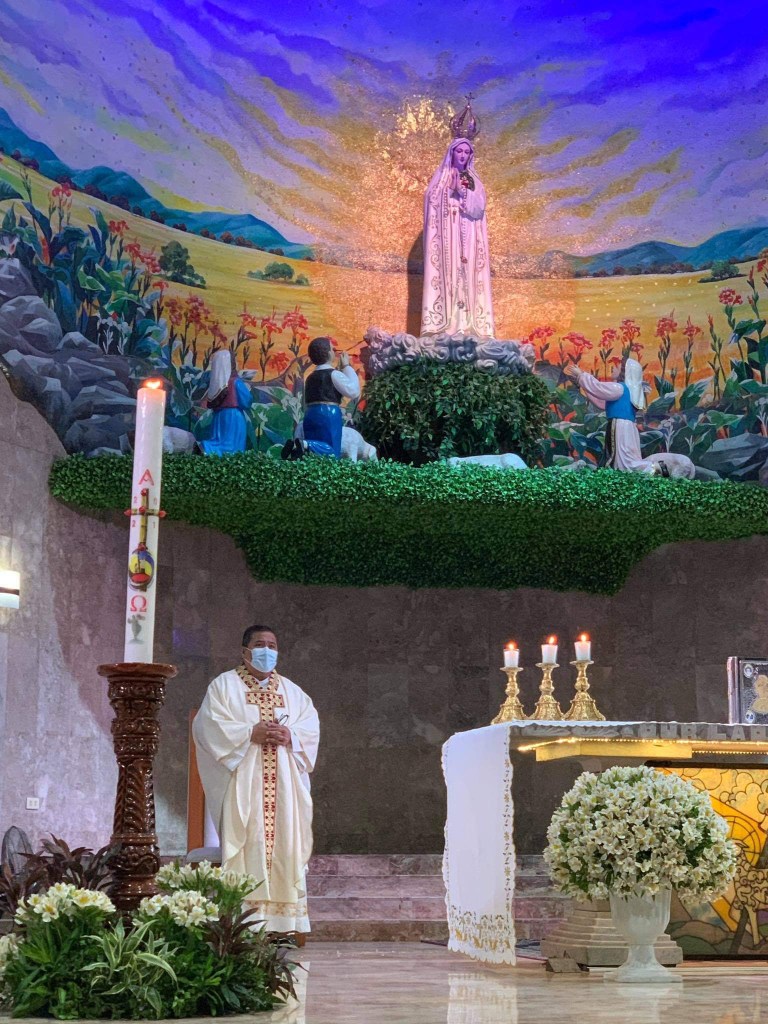
Easter Vigil 2021.
My dearest Lord Jesus Christ:
Today I am celebrating my ordination anniversary.
Twenty-three years of giftedness and grace and mystery,
until now I wonder why you called and chose me.
Thank you very much
for your love and mercy to me.
You know very well my sins and failures,
my weaknesses and limitations
that on many occasions
I have failed you.
There were times
I was like Cleopas
traveling back to Emmaus
trying to forget you
feeling at a loss and defeated
when my plans do not happen.
But you would join me,
walk with me even if I go the wrong direction
just to bring me back to Jerusalem,
back to the Cross where your Resurrection is.
So many times,
my eyes cannot recognize you appearing to me,
but surely always within me
my heart burns while you speak softly
as you tell me our stories
when you never left me.
In those twenty-three years,
dearest Jesus, what I treasure most
is when you appear and speak to me unknowingly,
an inner awakening happens in me
opening my mind, purifying my soul
that the more I see my sinfulness before you,
the more I see my worth in you
that is when you are so true!
One thing I ask you, my Lord and my God
keep me in your fellowship of the table
of your new covenant; even if I am not worthy
to receive you under my roof, but only
say the word and I shall be healed.
Be my guest always, dear Jesus,
appearing, speaking, and breaking bread
at your altar, sustaining and nourishing me
with the Blessed Virgin Mary
in this journey until you come again.  Amen.
The Lord Is My Chef Sunday Recipe for the Soul by Fr. Nicanor F. Lalog II
Third Sunday in Easter, 18 April 2021
Acts 3:13-15, 17-19  ><)))*>  1 John 2:1-5  ><)))*>  Luke 24:35-48
After listening to the accounts of the beloved disciple John, we now reflect on Luke’s story of the Resurrection which is a continuation of the gospel proclaimed in the afternoon of Easter, the Road to Emmaus.
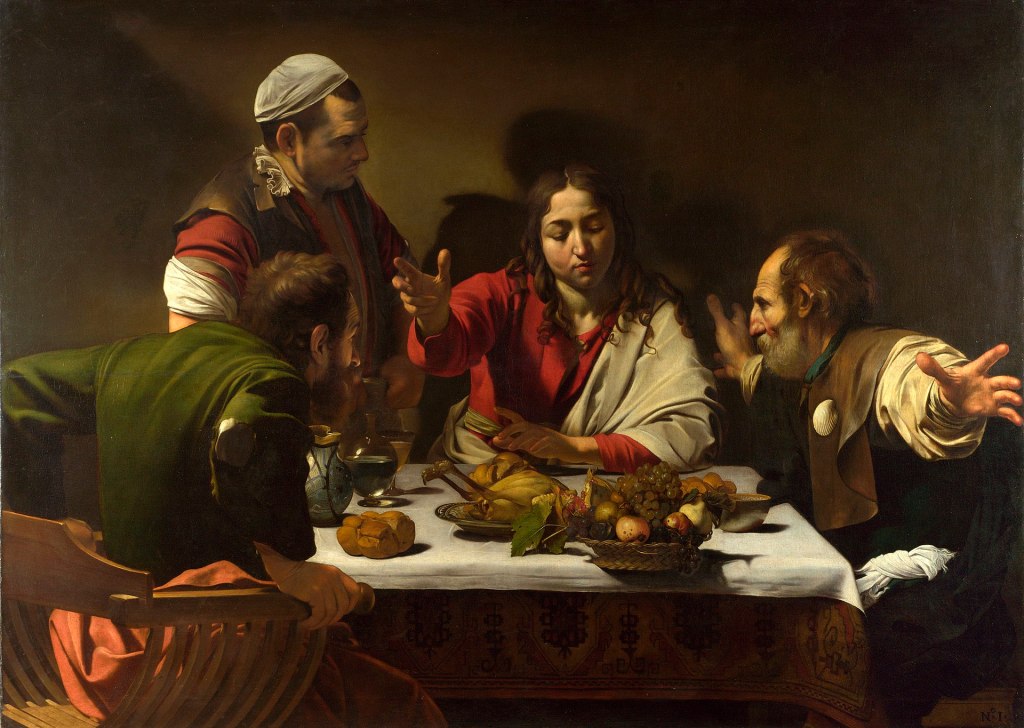
Recall how the two disciples did not recognize the Risen Lord when he joined them on their way back to Emmaus saddened with his death, doubtful of his resurrection. Upon reaching home, they invited the Lord for a meal when after breaking the bread, they recognized it was Jesus who had then vanished from their sights!
Both hurried back to Jerusalem to tell the rest of the disciples of their encounter with the Risen Lord.
While they were still speaking about this, he stood in their midst and said to them, “Peace be with you.” But they were startled and terrified and thought they were seeing a ghost. Then he said to them, “Why are you troubled? And why do questions arise in your hearts? Look at my hands and my feet, that it is I myself. Touch me and see, because a ghost does not have flesh and bones as you can see I have.” And as he said this, he showed them his hands and his feet. While they were still incredulous for joy and were amazed, he asked them, “Have you anything here to eat?” They gave him a piece of baked fish; he took it and ate it in front of them.
Luke 24:36-43
Painting by Caravaggio of the Emmaus Meal from commons.wikimedia.org.
Many times in life
 we feel it more "fearful" in the positive sense
to believe in God than in ghosts
because God is very real
when ghosts are not true at all.
Jesus appearing, speaking, and sharing meal
Both evangelists John and Luke consistently tell us in their Easter stories the three manifestations of the Risen Lord to the disciples: appearing, speaking, and sharing meal. All three acts belong together as one to remind the disciples of what transpired during their Last Supper, fulfilled on Good Friday.
But, there is something deeper in the dynamics of these three acts when seen from the perspective of Luke. And we have to look back to the beginning of this story on the road to Emmaus where we find Luke using a pattern of presenting an outward sign of Jesus appearing, speaking and sharing meal with the disciples who were then led to an inner recognition of the Risen Lord.
Notice that outwardly while walking, the disciples did not recognize Jesus as the man walking with them, speaking to them about the scriptures. Inwardly, something was happening with them: Then they said to each other, “Were not our hears burning within us while he spoke to us on the way and opened the scriptures to us?” (Luke 24:32)
This pattern of outward signs and inner recognition becomes strongest when Jesus shared meals with the disciples: And it happened that, while he was with them at table, he took bread, said the blessing, broke it, and gave it to them. With that their eyes were opened and they recognized him, but he vanished from their sight (Luke 24:30-31).
Exactly the same thing happened in this manifestation we now have in Jerusalem: the outward signs of the Risen Lord appearing to the disciples, showing them his hands and his feet. The disciples were amazed, could not speak at all upon seeing Jesus Christ alive, speaking to them, reminding them of his teachings before and most especially, shared meal with them by eating a baked fish to prove he is not a ghost.
Then, he spoke again to remind them of his earlier teachings of the scriptures being fulfilled in him through his Passion, Death and Resurrection, leading to the inner recognition by the disciples: Then he opened their minds to understand the Scriptures (Luke 24:45).
Painting by Frenchman James Tissot “Appearance of Christ at Cenacle Room” from commons.wikimedia.org.
Many times in life we feel it more fearful in the positive sense to believe in God than in ghosts because God is very real when ghosts are not true at all. “Mas nakakatakot maniwala sa Diyos kesa multo kasi ang Diyos ay totoong-totoo habang ang mga multo ay hindi.”
Amid the many outward signs we see unfolding right before our eyes, we could not help but believe as we are overwhelmed with God’s presence, with his love and mercy for us in the most personal way. The German Lutheran theologian Rudolf Otto called it as “mysterium tremendum” and “mysterium fascinans” when we feel so small like a tiny speck of dust in this vast universe yet so special, so loved by the almighty God.
There is that realization of our sinfulness, of our shortcomings before the Lord and yet still loved and forgiven like what Peter taught the people in his teaching after Pentecost at Jerusalem. Four times in four verses Peter spoke to the people with the second person pronoun YOU to stress their complicity in the crucifixion of Jesus, “you handed over and denied (v.13); you denied the Holy (v.14); you put to death (v.15)”; and finally, the saving declaration:
“Now I know, brothers, that you acted out of ignorance, just as your leaders did; but God has thus brought to fulfillment what he head announced beforehand through the mouth of all the prophets, that his Christ would suffer.”
Acts 3:17-18
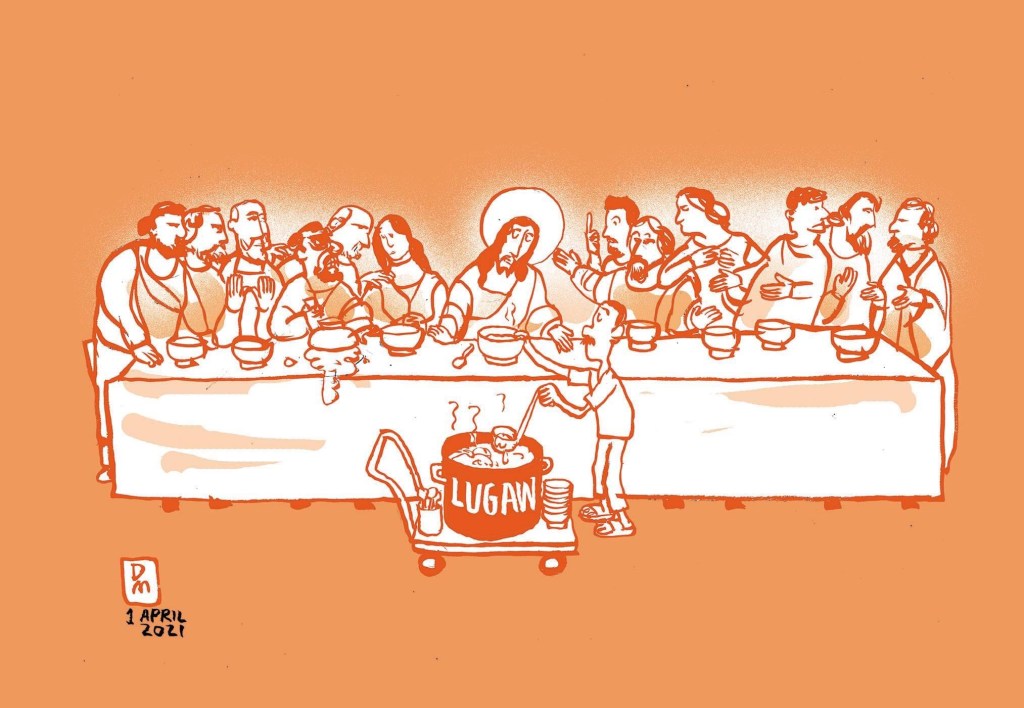
Whenever we commit sins. when we refuse to love others, we become that “YOU” of Peter who hand over and deny Jesus, putting him to death whenever we reduce persons into things or take God’s blessings like food for granted.
From the Facebook page of artist Mr. Dengcoy Miel, 01 April 2021.
The “essential” table fellowship
Aside from proving to his disciples that he is risen, Jesus Christ’s appearance, speaking, and sharing of meals with them continues to our time in the Holy Eucharist where he brings us to a new covenant in the table fellowship with him and the Father in heaven.
In the Holy Eucharist, Jesus gives us a share in his very life, allowing us to participate in his Resurrection through the purifying power of his Passion and Death.
From the days of the Apostles up to our own time, the celebration of the Mass had gone through many changes and reforms but its very essence has always remained as the Real Presence of Jesus Christ among us in outward signs perceptible to our senses like the proclamation of the Word, the sharing in the Lord’s Body and Blood, and the communion of members of the community gathered in every celebration.
Like the disciples of the Lord during that Easter evening, we continue to experience an inner awakening within us of his presence, of his very self.
That is why Vatican II as well as St. John Paul II had always insisted that the Eucharist is the summit of our Christian life, that everything in our lives and in our parish especially must flow from the Eucharist. This is the reason that even with the COVID-19 lockdowns, Masses continue to be celebrated by priests even in private without the congregation because it is our source of nourishment especially in these times of crisis.
These community pantries now sprouting
are in itself extensions of table fellowship with Jesus as the unseen guest -
appearing, speaking, sharing meals with us -
literally giving us food for the stomach, delighting our souls.

  It is another Easter and Pentecost happening in our midst,
of Jesus coming to us,
truly alive in the Holy Spirit among people
gathered in loving service for one another,
a perfection of the love of God in us!
Photo from Elijah San Fernando, Philippine Daily Inquirer, 16 April 2021.
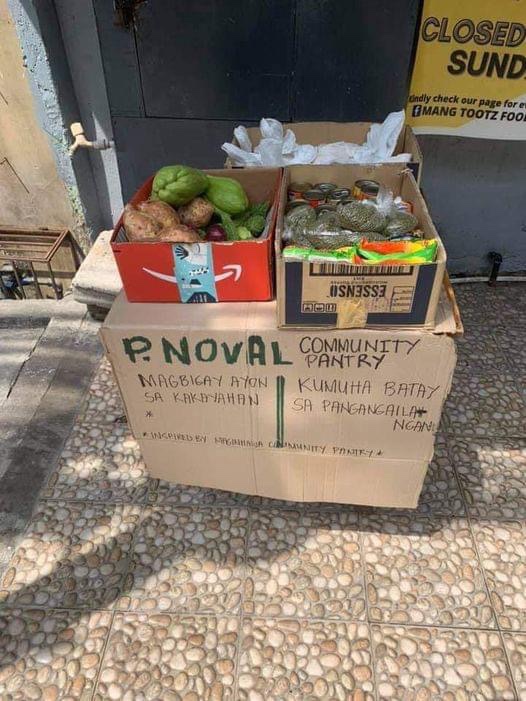
See the recent “miracles” happening lately about this “community pantry” that started in Maguinhawa Street in Quezon City now fast spreading to other areas in Metro Manila with some farmers from the provinces giving their share of farm produce.
What a beautiful proof of the fulfillment of John’s words in our second reading today: “But whoever keeps his word, the love of God is perfected in him” (1Jn.2:1-5)!
These community pantries now sprouting are in itself extensions of table fellowship with Jesus the unseen guest – appearing, speaking, sharing meals with us – literally giving us food for the stomach, delighting our souls.
It is another Easter and Pentecost happening in our midst, of Jesus coming to us, truly alive in the Holy Spirit among people gathered in loving service for one another, a perfection of the love of God in us!
Photo by Toots Vergara, Philippine Daily Inquirer, 16 April 2021.
This Sunday, let us experience Jesus our guest right in our family, in our homes as we gather in our table without our gadgets and prejudices against each other, having only our very presence and fellowship in love and mercy, kindness and care as we feed our bodies as well as our souls. Amen.
*Please say a prayer for me and my six other classmates today as we celebrate our 23rd year of ordination to the priesthood (18 April 1998, Malolos Cathedral by Abp. Rolando J. Tria-Tirona). Salamuch and God bless you all! fr nick
Quiet Storm by Fr. Nicanor F. Lalog II, 09 April 2021
Photo by author after celebrating “private Mass” first day of lockdown last year, 18 March 2020.
The reality – and gravity – of the lockdown hit me most that Wednesday morning when I celebrated Mass alone. Without the usual faces and voices of our regular Mass goers who greeted me daily upon opening our church door since I came to my former parish in 2011, I just felt something so unique.
And special.
It was as if Jesus was making some “lambing” (tender moments) with me as his priest.
For so long, I have been celebrating Mass on weekdays with at least five people present that there were times it had become mechanical like a routine, sometimes even like a “show” that it has to be good so that I look good, sound good, and everybody feels good.
But on that first day of the lockdown, as I prepared everything from removing the altar cover to bringing out the books and sacred vessels to celebrating “alone” with some birds keeping me company, I somehow felt Jesus most truly present.
Just him and me, at his altar, in his church.
Photo by author, two birds after my private Mass during the lockdown last year.
That was how I realized deep within me the beauty and sanctity of the Holy Mass not in the external things we see and hear but most of all in my intimacy and union with Jesus Christ as his priest.
With or without the congregation, every Holy Mass is the summit of the priest’s life and very existence because that is where his union in Jesus Christ our Eternal Priest is most true.
The way the priest celebrates the Mass – his disposition, his attitude, the way he looks and keep things in order – all indicate his oneness with Jesus Christ. Liturgy flows from the heart of the priest and from that springs our social action and involvement.
How sad when some priests has made the lockdown an excuse not to celebrate the Mass at all.
In depriving himself of the essential union with the Lord and Master, in effect he has deprived his flock the much needed strength from the Good Shepherd.
Even without the pictures and videos of the priest celebrating the Mass sine populo (without the people), that is the most wonderful and most treasured image of COVID-19 only God sees because it is the most sublime image of his Son Jesus Christ present amid this pandemic.
Every word in the Lectionary and the Sacramentary, every moment of that private Mass during the lockdown was like a “cosmic experience” where the eternal and the temporal converge as if time stands still, with these words echoing in the silence of the universe within me:
"...you never cease  to gather a people to yourself,
so that from the rising of the sun to its setting
a pure sacrifice may be offered to your name."
(Eucharistic Prayer III)
Images of COVID-19,
Images of Hope,
Images of Christ
Two Sundays after the lockdown last year came the Holy Week ushered in by Palm Sunday when we went around the parish blessing the palms and fronds of people who have gathered on the streets after our announcement in Facebook and online Mass.
Skies were overcast that morning that we decided to visit first the other end of our parish, Purok Gulod, where we experienced rains and saw the beautiful rainbow the other Sunday.
Nobody saw the lockdown coming. Most of the people did not have the ready-made palms and instead had branches of leaves and fronds available in their surroundings which we blessed while on board our borrowed Ford F-150 after the Mass that morning attended by a few parish volunteers.
But the most touching images of COVID-19 that Holy Week last year happened on the Good Friday procession of the Santo Entierro we have mounted on a truck, brought around the parish after the Veneration of the Cross at 3PM.
From images of COVID-19 as images of hope, the sights have transformed into images of Christ suffering and dead among the people who knelt and prayed while others cried on the streets during procession.
Since it was a Good Friday when there was no holy water, I brought the crucifix with which to bless the people not only on the streets but also those in their vehicles passing by during the procession.
It was very edifying.
How I felt Jesus described in the gospel while going around preaching the good news to all towns and villages:
At the sight of the crowds,
his heart was moved with pity for them
because they were troubled and abandoned,
like sheep without a shepherd.
(Matthew 9:36)
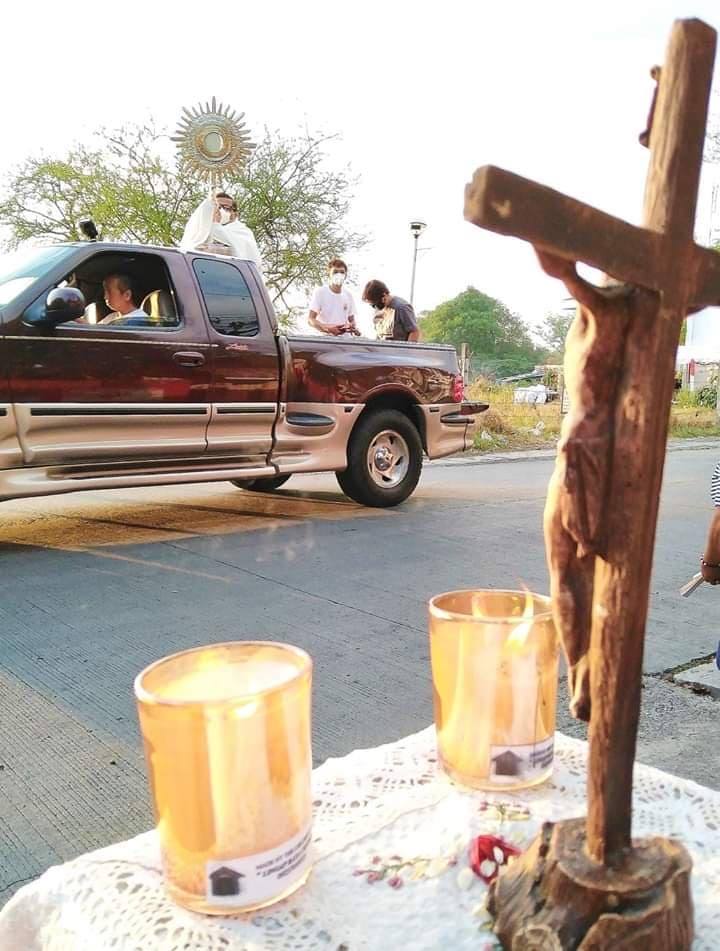
Passing through Purok Gulod where people lighted candles too.
With Kuya Ver sounding the matraca to alert the people…
With Kuya Leonardo the caretaker of the Santo Entierro. Since I came there in 2011, he always brought along the children from their Purok Gitna to pray the Rosary aloud. After each mystery, we would sing some religious songs with “Kristo” as their favorite, singing in unison, “Kristo, Kristo bakit minsan ka lang nakikilala…”
I can still remember my short homily during that Good Friday’s Veneration of the Cross: I told the people that while we were so sad with what was happening due to the pandemic, Jesus was surely more sad with what was going on in the world, in our parish community.
It was a very meaningful Good Friday after all when as the sun set, God reassured me anew and I think everybody else in our parish that we were not alone. We have him as company, consoling us in this time of the pandemic with the beautiful sights of everyone out in the streets praying.
Yes, they are images of COVID-19 but also images of hope.
Most of all, images of Christ among us, suffering and dying first among us in our community during the pandemic.
Join us again on Monday with more images of COVID-19 as images of hope and images of Christ risen among us!
It was a Tuesday within the Octave of Easter under our first – and world’s longest – Enhanced Community Quarantine (ECQ) when I started this prayer blog based on the Mass readings as a “spiritual recipe” for tired and weary souls at that time when churches were closed and public Masses were not allowed.
It was pure grace that I was able to keep it daily until now in my new assignment, never running out of inspiration from God for my prayers, poems, essays and reflections, and the usual Sunday homilies I have been sharing via email since 2003.
Some of my inspirations came from unforgettable images of COVID-19 that went viral on Facebook and the news that for me were “images of hope” of the Risen Christ reminding us of his presence during this pandemic.
They are images of hope because they tell us modern Easter stories of holiness and kindness, love and sacrifice among ordinary people willing to share Jesus in their very selves for others in need.
And this photo tops them all!
From Facebook, 25 March 2020.
I got this from the Facebook by a church-beat reporter who personally met the photographer who took that shot and interviewed the banana vendor.
What a beautiful reminder of the poor widow praised by Jesus who gave “two small coins worth a few cents” into the temple collection box, saying: “Amen, I say to you, this poor widow put in more than all the other contributors to the treasury. For they have all contributed from their surplus wealth, but she, from her poverty, has contributed all she had, her whole livelihood” (Mk.12:43-44).
My initial reaction upon seeing this image of COVID-19 was how the world never runs out of many good people, who give without expecting anything in return: “may mga tao pa rin palang tunay at dalisay ang pagmamahal at hindi naghihintay ng kapalit.”
I wonder where is that vendor now and what has happened to him. Surely, God must have blessed him abundantly!
A week before the lockdown that March 2020, another set of images appeared on Facebook of a beautiful story of miracle in the supermarket.
According to the Facebook post that became viral, people were panic buying following rumors of a lockdown to be imposed due to the pandemic.
A young lady waiting at the long line to the counter noticed a man had only a basket containing a handful of grocery items.
She turned out to be a “fairy godmother” who offered the manong to get more goods for his family assuring him she would pay for them.
Manong was hesitant at first, very shy with the kind offer by the young lady until he acceded, getting a few more canned goods.
According to the post by an eye-witness, the “fairy” asked manong again to get more goods, saying “dagdagan pa po ninyo at babayaran ko.”
That was when miracle happened…
Some of those at the counter were infected with a holy virus by the young lady’s generosity.
One by one, each customer gave manong a can or an item of their purchases so that he had a basket full of goodies to take home for his family!
Indeed, love begets love begets love… it is the kind of good virus I am sure still happening today even without being reported in social media.
What a beautiful modern version of Jesus Christ’s feeding of 5000 in the wilderness when everybody shared their baon with others (Jn.6:1-15) that filled everyone to his/her delight with still plenty of leftovers.
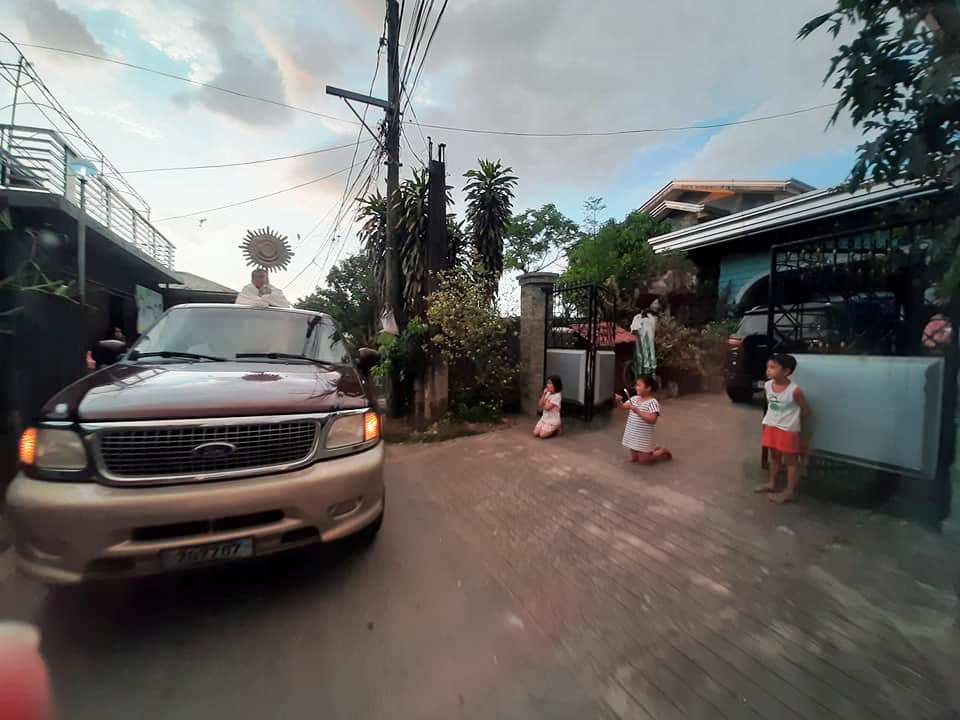
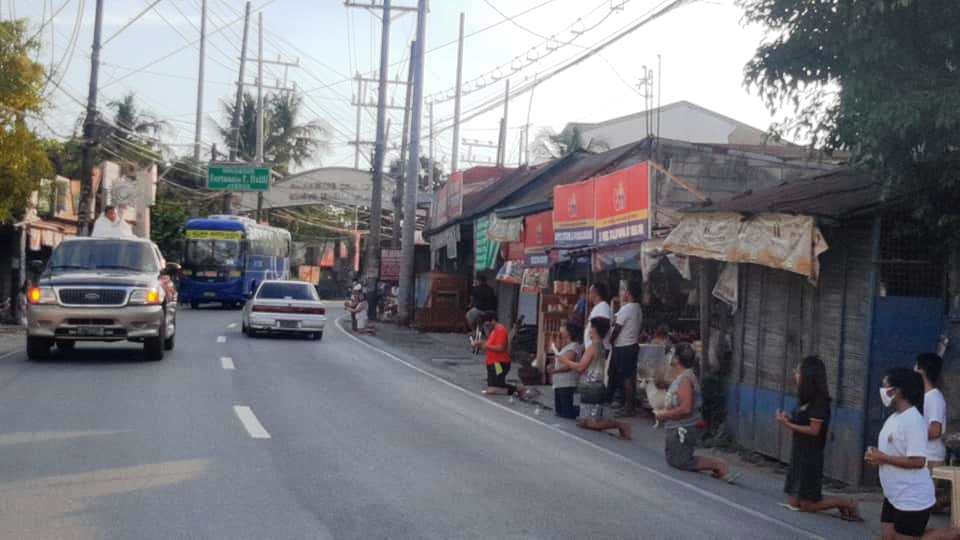
I turned 55 on March 22, the first Sunday of the start of last year’s lockdown, the fifth Sunday of Lent. It was also the first time we went online with our Mass that morning when I called on the people to wait outside their homes later at 3PM – while maintaining health protocols – for the “paglibot” (motorized procession) of the Blessed Sacrament in our Parish at Barangay Bagbaguin made up of ten purok.
How my heart was moved at the sight of people, young and old, rich and poor alike, kneeling on the streets with some crying, adoring Jesus Christ in the Blessed Sacrament!
Truly the images of hope that have sustained and blessed our parishioners at Bagbaguin with the lowest incidence of COVID infections and deaths that year in the whole town of Santa Maria, Bulacan!
Photo by Mr. Ryan Cajanding.
But the most beautiful image of hope for me that day was the appearance of a rainbow before the end of our “libot” of the Blessed Sacrament.
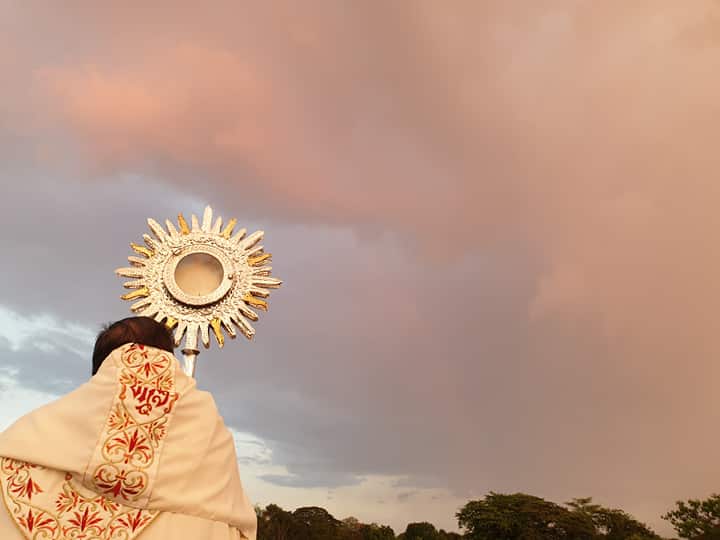
We were at the last leg of our “libot” when it started to rain with our volunteers asking whether we would still go to the next purok of Gulod or not. From the back of our truck with both my hands holding the big monstrance, my response was adamant: we proceed even if it rains!
I knew we have brought plastic to cover and protect the Blessed Sacrament from the rains and I felt what mattered most then were the people to have a glimpse of Jesus in their most difficult trials in life.
Lo and behold, after a few minutes, the rains stopped and a rainbow appeared at the horizon!
Tears rolled down to my cheeks saturated with perspirations as I held the big monstrance.
I could not contain the joy within my heart as I thanked God for the grace of that moment, of sending us with a rainbow to assure us like during Noah’s time that he would keep his promise never again to destroy earth with floods or with virus, that we would be safe during this pandemic.
It was the best birthday gift I ever had in recent years that made me decide to continue that practice of libot of the Blessed Sacrament every Sunday while public Masses were not allowed during the lockdown.
What are your images of COVID-19 that were images of hope that sustained you in this year-old pandemic?
Join us again this Friday with more images of COVID-19 and this time, images of Christ among us!
*Other photos by Ms. Ria De Vera and Ms. Anne Ramos of our Parish Commission on Social Communications.
The Lord Is My Chef Easter Triduum Recipe by Fr. Nicanor F. Lalog II
Maundy Thursday, 01 April 2021
Exodus 12:1-8, 11-14 ><)))*> 1Corinthians 11:23-26 ><)))*> John 13:1-25
"A journey of a thousand miles
begins with a single step."
- Lao Tzu
We often hear and use this wise saying that is also most applicable to our celebration of the Holy Triduum of the Lord’s Passion, Death and Resurrection also known as the “Sacred Paschal Triduum”.
From the Hebrew word pesach, a pasch is a passing over. It is a journey which is a long trip taken over long period of time to different places. A journey does not necessarily involve physical distance as it can be something within one’s self like an inner journey to God dwelling within us. Hence, a journey is also a process that leads us to growth and maturity from the many difficulties and trials we experience as we travel, entailing a lot of sacrifices from us.
And whatever journey we take outside or within our selves, we always need a companion to travel with. From the Latin words cum panis that literally mean “someone you break bread with”, a companion is someone who helps us in our journey, a friend who shares life with us, guiding us, protecting us. Like the bread we break and share, a companion sustains and nourishes us in our journey.
Let us keep these three words of journey, companion, and bread in reflecting our celebration tonight of the Lord’s Supper that begins the Sacred Triduum.
We are all pilgrims on a journey to heaven
More than 40 days ago on Ash Wednesday, we said Lent is a daily journey to Easter where we find our very selves, others, and God who is our ultimate origin and end. It is a journey that reaches its summit in the Holy Eucharist where we make present the pasch or passover of Jesus Christ
Every Mass is a journey into heaven, a dress rehearsal of our entrance into heaven when we have a foretaste of eternal life we all hope for until Christ comes again. It is the Passover of the New Testament, a perfection of the Jewish Passover when God’s chosen people led by Moses went into exodus from Egypt into the Promised Land.
This “heavenly” journey had its ancient roots among nomadic Semites who used to celebrate a feast on the first full moon of spring as they prepared to lead their flocks to summer pastures. They ate a roasted lamb from the flock with unleavened bread and bitter herbs. It was an important event of migration filled with many dangers for those nomads who marked their tent-pegs with the blood of the lamb to keep their journey safe.
Eventually this found place in the Jewish Passover which we heard in our first reading when God told his chosen people to begin their journey of exodus from Egypt “on the tenth of their first month” that happens on the second full moon of the spring equinox.
Notice that it happens at night that is coincidentally the usual start of every journey we usually make!
Before their Exodus, each family was told to roast an unblemished lamb to be eaten with unleavened bread and bitter herbs “with your loins girt, sandals on your feet and your staff in hand, you shall eat like those who are in flight. It is the passover of the Lord” (Ex.12:11). It has to be done in a hurry, as in a flight, a journey.
And to keep them safe in their journey, God instructed them to paint their door posts with the blood of the slaughtered lamb so that when his angel comes at night to strike death of every first born male child and animal, their homes would be “passed over” and be saved from death that night.
We are all travelers and journeyers on earth;
our true home is in heaven with God our Father.
We are merely "passing over" this planet temporarily.
Photo by author, Egypt, 2019.
Jesus our companion and family in the journey
The Jewish Passover or Exodus became the actual event of God’s covenant with Israel as his people on a journey to their Promised Land. Unfortunately, they would break this covenant with God so many times that it would take them 40 years of wandering in the desert before finally got into the Promised Land.
And their stubbornness continued when they would always turn away from God with sins that led to the division of their nation until its conquest by foreign powers that led them anew into another exile. God would restore them as a nation but, again, they would turn away from him until the Romans ruled over them when Jesus came to perfect God’s covenant.
In perfecting and fulfilling the Jewish Passover, Jesus became the new and everlasting Lamb, perfect without any blemish, offering himself to God for the forgiveness of our sins and our liberation from all forms of evil especially sickness and death. It is no longer the blood of the lamb that we now offer but Jesus Christ’s Body and Blood which he established in the Sacrament of the Eucharist “on the night before he was betrayed” on Holy Thursday.
By celebrating the Lord’s Supper that Thursday evening with his disciples who represented all peoples of all time, Jesus established for us the everlasting memorial of his loving presence as our companion and our very Bread and Wine in the journey back to the Father always filled with darkness and sufferings.
What he did that Thursday evening foreshadowed what he would do on Good Friday when he did his greatest act of love for us by dying on the Cross at about 3PM, the same time when the lambs were being slaughtered in the temple for the coming passover feast.
Brothers and sisters: I received from the Lord what I also handed on to you, that the Lord Jesus, on the night he was handed over, took bread, and, after he had given thanks, broke it and said, “This is my body that is for you. Do this in remembrance of me.” In the same way also the cup, after supper, saying, “This cup is the new covenant in my blood. ?Do this in remembrance of me.”
1 Corinthians 11:23-25
Here we find again the darkness of the night as the beginning of our journey back to God perfected by Jesus Christ as our companion and very bread of life to sustain and nourish us.
What is most beautiful meaning we can find here is the importance of communion, of oneness as a community, as a family.
In the Old Testament, God instructed his people to take the passover meal together as a family; at the Lord’s supper, Jesus celebrated it with his “friends”, the Twelve Apostles. Even Judas Iscariot was present at the start but had to leave in the “darkness of the night” when he broke off from the unity of Jesus.
Perhaps, one reason why we are again together this Holy Thursday not in churches but in our homes, with our family so we may be one again in Jesus Christ in prayers and celebrating Mass on-line.
Therefore, do not be a Judas Iscariot! Go back to your family, to your loved ones – your most faithful and truest companions in this journey of life. You’ll never get to heaven, as Dionne Warwick sang, if you break somebody’s heart, when you refuse to love by turning your back from those who love you.
Holy Thursday reminds us in the Eucharist that no one is saved alone. Every journey becomes wonderfulwhen done in the context of a community, with true companions beginning in our very family.
Photo from wikipediacommons.org of Christ’s washing of feet of Apostles at Montreale Cathedral in Palermo, Italy
The commandment of love
Completing the picture of our celebration tonight with the key concepts of journey, companion and bread is LOVE, the very essence of everything in this life, the reason why we are in a journey in the first place since the Exodus up to this time.
At the very core of every companionship, of every community is LOVE.
To become bread for someone in a journey is to become LOVE.
Jesus Christ as the bread broken, as the cup of wine shared is essentially LOVE.
Love can never be defined but merely described.
And on the night before he was betrayed, Jesus described to us in his actions a very beautiful expression of his love we all must imitate:
So, during supper, fully aware that the Father had put everything into his power and that he had come from God and was returning to God, he rose from supper and took off his outer garments. He took a towel and tied it around his waist. Then he poured water into a basin and began to wash the disciples’ feet and dry them with the towel around his waist.
John 13:3-5
When Jesus washed his disciples’ feet, he showed us one beautiful aspect of LOVE which is tenderness.
Yes, I have been speaking about tenderness lately as something we badly need these days of the pandemic. Tenderness is an expression of love when we realize amid our own suffering the sufferings of others too. To be tender and loving amidst many sufferings is to offer rest to fellow journeyers like what Jesus did on that Holy Thursday evening.
Again, we find here something prevalent during that time which is the concept of “restaurants” where travelers used to stop during their journey not only to eat but to rest that meant soaking their feet on a basin of water. It was therapeutic that gave travelers enough strength to travel far again.
Remember there were no other modes of transportation at that time and not everybody could afford an animal to ride on. Any hiker and mountaineer can attest that after so much trekking, one thing you would always hope for is a stream or tiny brook with cool, crisp, running water to dip your feet and rest!
Photo by Mr. Raffy Tima of GMA-7 News, April 2020.
Everybody is tired of this journey in the pandemic, almost exhausted.
What a shame especially when local officials like that one who refused food delivery because she considered the lowly lugaw as non essential. Lest we forget, Jesus chose one of the most lowly food, the unleavened bread, as the sign of his loving presence among us until the end of time when he comes again.
Indeed, this could be the holiest Holy Week of our lives in this most unholy time of history as it gives us great opportunities to love.
Just be tender with those around you!
Never get tired of loving, of understanding, of caring as everyone is already tired with this journey of ours in the pandemic that seems to be still far from over.
“Do you realize what I have done for you? You call me ‘teacher’ and ‘master’, and rightly so, for indeed I am. If I, therefore, the master and teacher, have washed your feet, you ought to wash one another’s feet. I have given you a model to follow, so that as I have done for you, you should also do.”
John 13:12-15
One of the most moving images of the pandemic for me lately is the one taken by our parishioner on the first day of the ECQ last March 22 when our Parochial Vicar, Fr. Howard John celebrated Mass without a congregation. He said, “the table of the Lord is full, but the pews are empty.”
And that is what we will continue to do in this pandemic. Even without the people, we shall continue to journey in Christ by still celebrating the Mass to give us all nourishment and sustenance and rest in this prolonged journey in the pandemic.
May we never get tired walking in love as a companion and bread to one another in Christ and like Christ by giving rest to others already tired and about to give up. Let us all be together in welcoming Easter! Amen.
El anda que en amor ni cansa ni se cansa.
(The soul that walks in love neither tires others nor grows tired.)
Saint John of the Cross
Photo by Ms. Kysia Cruz, National Shrine of Our Lady of Fatima, Valenzuela City.
40 Shades of Lent by Fr. Nicanor F. Lalog II
Holy Tuesday, 30 March 2021
Isaiah 49:1-6   ><}}}*>   John 13:21-33, 36-38
Photo by author, December 2020
Though I thought I had toiled in vain,
and for nothing, uselessly, spent my strength,
yet my reward is with the Lord,
my recompense is with my God.
(Isaiah 49:4)
So many times, dear Father in heaven, I feel like your “Suffering Servant” feeling that nothing is happening with all my efforts, with things I persevere, as if they are all useless until I realize what matters most is my being faithful to you.
Thank you for the sign of the Cross of Jesus Christ your Son, our Lord and Master: when things become so difficult and frustrating for me, I just look at him there on the cross, “dead” like me who had failed in your mission.
But as I contemplate his Cross, I remember how before all my sadness and sufferings, Jesus was there first for me to be good with others, to be kind, to be understanding, to be merciful and forgiving, to be patient, and most of all, first to be holy in being faithful to you and your call, Father.
Remind me the words of St. Mother Teresa of Calcutta that we are called to be faithful, not successful.
Let me focus more on you, Lord, instead of wondering how I have been doing, how good I have been.
Let me stop competing with others, asking who is not faithful to you, who is going to betray you like Peter during the last supper when he told the beloved disciple to clarify it with Jesus:
He leaned back against Jesus' chest
and said to him,
"Master, who is it?"
(John 13:25)
How lovely is the context of that question when what we must contemplate with is whether we have been faithful to Jesus in his Holy Eucharist.
How sad, O dear Father, that we are most unfaithful to you when we betray you right in the Eucharist – when do not listen to your words and message to us, when we do not live and practice the essence of thanksgiving to you by being faithful in witnessing Christ’s sacrifice on the Cross in our daily lives. Amen.
The Lord Is My Chef Sunday Recipe for the Soul
Fifth Week in Ordinary Time, Cycle B, 07 February 2021
Job 7:1-4, 6-7  >><}}}*>  1 Corinthians 9:16-19, 22-23  >><}}}*>  Mark 1:29-39
Photo by author, January 2021.
Mark continues to show us a slice in the daily life and ministry of Jesus Christ. We have seen last week how everything began at the synagogue where Jesus preached and healed on a day of sabbath.
The Lord is clearly telling us that everything must begin and end in God. Always.
This Sunday we see a complete 24-hour look not only into the life and ministry of Jesus but most specially to his very person as the Christ, the Son of God as he continued his preaching while proclaiming his good news of salvation to everyone.
And to truly experience him and his gospel, we have to make that effort of meeting him.
On leaving the synagogue Jesus entered the house of Simon and Andrew with James and John. Simon’s mother-in-law lay sick with a fever. They immediately told him about her. He approached, grasped her hand, and helped her up. Then the fever left her and she waiting on them.
Mark 1:29-31
Day time with the Lord…
Photo by author, morning inside our parish church during last summer’s lockdown.
We all know by heart God’s third commandment to keep holy the sabbath day. This commandment was perfected in Jesus Christ when he rose again on Easter, the day after sabbath which is our Sunday celebration.
It is true that sabbath day is Saturday but when Jesus rose from the dead on the first day of the week, the early Christians who were all Jews shifted their day of worship to Sunday. Such shift was very remarkable, proving beyond doubt the truth of the Resurrection of Jesus for the Jewish followers of Christ to abandon their Saturday worship.
In Jesus Christ, we find sabbath not just a stop in work and everything but a return to God who is our life. Such is the centrality of God in our lives that sabbath is the day of the Lord because it is the only day without any other day at par with – walang katapat kasi walang katapat ang Diyos! See there are seven days in a week, an odd number because there is one day without any “partner day” like for example Monday-Tuesday, Wednesday-Thursday, Friday-Saturday.
Photo by author, parish altar one morning in November 2019.
Sabbath which is Sunday for us Christians is solely for the Lord!
The four disciples of Jesus must have known earlier of the fever of Simon’s mother-in-law; they must have been worried but they went along with Jesus to the synagogue to pray and worship God first, casting aside all their worries for they were with the Lord.
It was after coming from the synagogue, when Mark tells us how “they immediately told him about her” that they witnessed and experienced an outpouring of grace in their home and family.
That imagery of Jesus grasping the hand and raising her up is so rich in meaning that tells us how God helps those who help themselves.
Imagine how even if we do not pray daily nor celebrate Mass weekly yet God never fails to bless us every day. How much more if we come and meet him every Sunday!
Here we find how every true worship of God with the community extends to our families when we bring home Jesus if we are with him so we can immediately tell him our concerns in life. Jesus comes daily to us, always wanting to hold our hands and raise us up to be well and better than before like Simon’s mother-in-law but, are we willing to meet him especially in the Holy Eucharist?
In the first reading, we find Job crying to God, lamenting his many sufferings and the sad condition of life in general, something like what Qoheleth had written. It is not a cry of revolt by Job but more of a complaint coming from the heart of a faithful servant caught between despair and hope who finds life’s nothingness without God. Despite his losing all his children and workers in a day along with his properties not to mention his getting sick, Job never turned away from God and kept on calling to him in the silence of his heart from daytime to evening until the Lord heard him and blessed him fourfold.
When it was evening, after sunset, they brought to him all who were ill or possessed by demons. The whole town was gathered at the door… Rising very early before dawn, he left and went off to a deserted place, where he prayed. Simon those who were with him pursued him… He told them, “Let us go on to the nearby villages that I may preach there also. For this purpose have I come.” So he went into their synagogues, preaching and driving out demons throughout the whole of Galilee.
Mark 1:32-33, 35-36, 38-39
Remaining in the Lord even in darkness…
Photo by author of seminarians meditating in silence after their evening prayers, November 2020.
It was still Saturday but sabbath day had already ended at 5PM (having started at 5PM of Friday) that people have started to come to Jesus to seek his healing from their sickness and possessions by evil spirits.
Darkness did not stop Jesus from serving the people despite the difficulties of seeing them, of being so tired and hungry at night, even sleepy. Likewise, darkness did not prevent Jesus communing with the Father by rising before dawn to go to a deserted place to pray alone. What a very beautiful image of Jesus as our Good Shepherd lovingly serving the sick and the poor and as our Eternal Priest making time to pray, ensuring prayer as center not only of his ministry but of his life.
That is 28 hours a week, meaning we lose one whole day or 24 hours weekly just for Facebook, Instagram and other social media platforms! Not included are the hours spent watching television. How about time with God and with our loved ones?
Photo by Ms. Ria De Vera during our Christ the King procession, November 2020.
Please allow me now to be a little personal as this is also my last full week in this first parish I have served for nine years and seven months.
If there is one thing I have learned so well from here is the value and importance ofless.
Since my ordination in 1998 until 2010, I have always been celebrating Masses in major parishes like the Malolos Cathedral, the Santissima Trinidad in Malolos (a pilgrimage parish), and the Parish and National Shrine of Our Lady of Fatima in Valenzuela. Every Mass, every sacrament there was really big time with large congregations coming.
Totally the opposite here in my first parish assignment under the beloved disciple of Jesus, St. John Evangelist. Small church building without a garage nor a patio in one small baranggay with about 12000 souls to care for.
Our Patron Saint, San Juan Apostol at Ebanghelista of Bagbaguin, Santa Maria, Bulacan.
My predecessors saw this as too small that they did not have daily Masses. But I felt in my prayers that is the only thing Jesus wanted me to do here: make him present in the daily Masses and other sacraments.
We started with just five people attending our daily Masses while Sundays were half-filled. Before COVID-19, we have increased attendees to our daily Masses to about 20 people and our Sunday celebrations have become almost seating capacity.
At first I felt sad and disappointed but the people here kept on telling me it is a miracle already that “so many people” were coming for the Masses. Slowly, I have come to accept our situation that that’s the way it is. And that is where I felt God blessing us so abundantly with our less!
Modesty aside, in the past nine years we have sent more children to receiving the Sacraments of Holy Communion and Confirmation (without any fees but with free snacks) since 1998 when this started as a quasi parish. We have almost baptized every adult person who have not yet received the sacrament too.
COVID-19 stopped everything, affecting our collections so bad but we just kept on serving and proclaiming Jesus with our daily Masses seen online, motorcade of the Blessed Sacrament every week, distribution of the Holy Communion every Sunday to those who attended our online Mass including through our innovative “drive-thru” Communion.
01 November 2020.
We never beg the people for donations but they all poured in, enabling us to continue helping the poor like helping them bury their dead, even renovate our church with the finest liturgical vessels and things!
One thing has become clear with me: always begin in God, keep him as our center in everything and all else follows.
Remember those days when you were centered in Christ; despite the problems and trials, we were never forsaken by the Lord. Even if we have lost some of our life’s battles, we have still emerged victorious because we have become stronger and fulfilled inside.
We all come and go, especially us priests but, our mission as disciples of Christ remains the same everywhere which is to make Jesus present, make God known to everyone like in the gospel today. This we can only accomplish when we remain one in him, totally free for him and free from other attachments to be free for all.
Like St. Paul, may we all strive especially us your priests to be “all things to all men” -omnia omnibus (1Cor.9:22) by being free to lovingly serve others especially the weak and the poor in Christ Jesus. Amen.
Photo by Mr. Red Santiago of his son praying in our parish, November 2019.
The Lord Is My Chef Breakfast Recipe for the Soul by Fr. Nicanor F. Lalog II
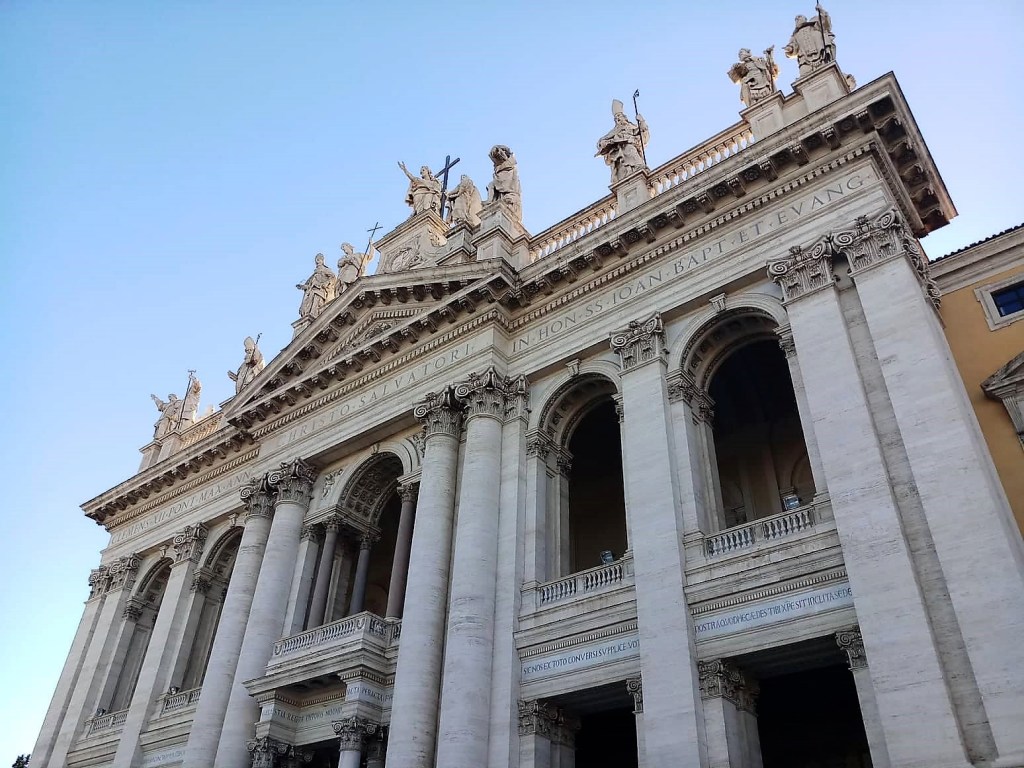
Monday, Feast of Dedication of the Lateran Basilica, 09 November 2020
Ezekiel 47:1-2, 8-9, 12  >><)))*>  1 Corinthians 3:9-11, 16-17  >><)))*>  John 2:13-22
Photo by Arch. Philip Santiago, 2018.
Glory and praise to you O God our Father who had sent us your Son Jesus Christ to establish his Body among us, both as the Church made up of his people and made of stones. As we celebrate the Feast of the Dedication the Cathedral of Rome, the Basilica of St. John Lateran, we pray also for Pope Francis, all bishops and priests, and all the faithful who make us the Body of Christ.
May our temple of stones be a symbol of the living Church, the Christian community, your Building among us as St. Paul reminds us today.
Let life flow like waters from the vision of Ezekiel in the first reading from our Church and give life to its members especially the sick and the poor, the marginalized and the forgotten.
Dearest Jesus, help us draw inspiration from the beauty and harmony of your beautiful churches despite our many flaws and sins to form a unity in you in the Holy Eucharist we celebrate day in, day out in our sacred buildings to proclaim your glory and majesty.
At the same time, as we strive to follow your will in building a spiritual temple of people who worship in truth and in spirit, may this feast remind us also to take special care in keeping your house in order where we meet you in our liturgy. Guide us with the Holy Spirit to make every sacred building a living temple of your love, a church of the poor. Amen.
Everyday
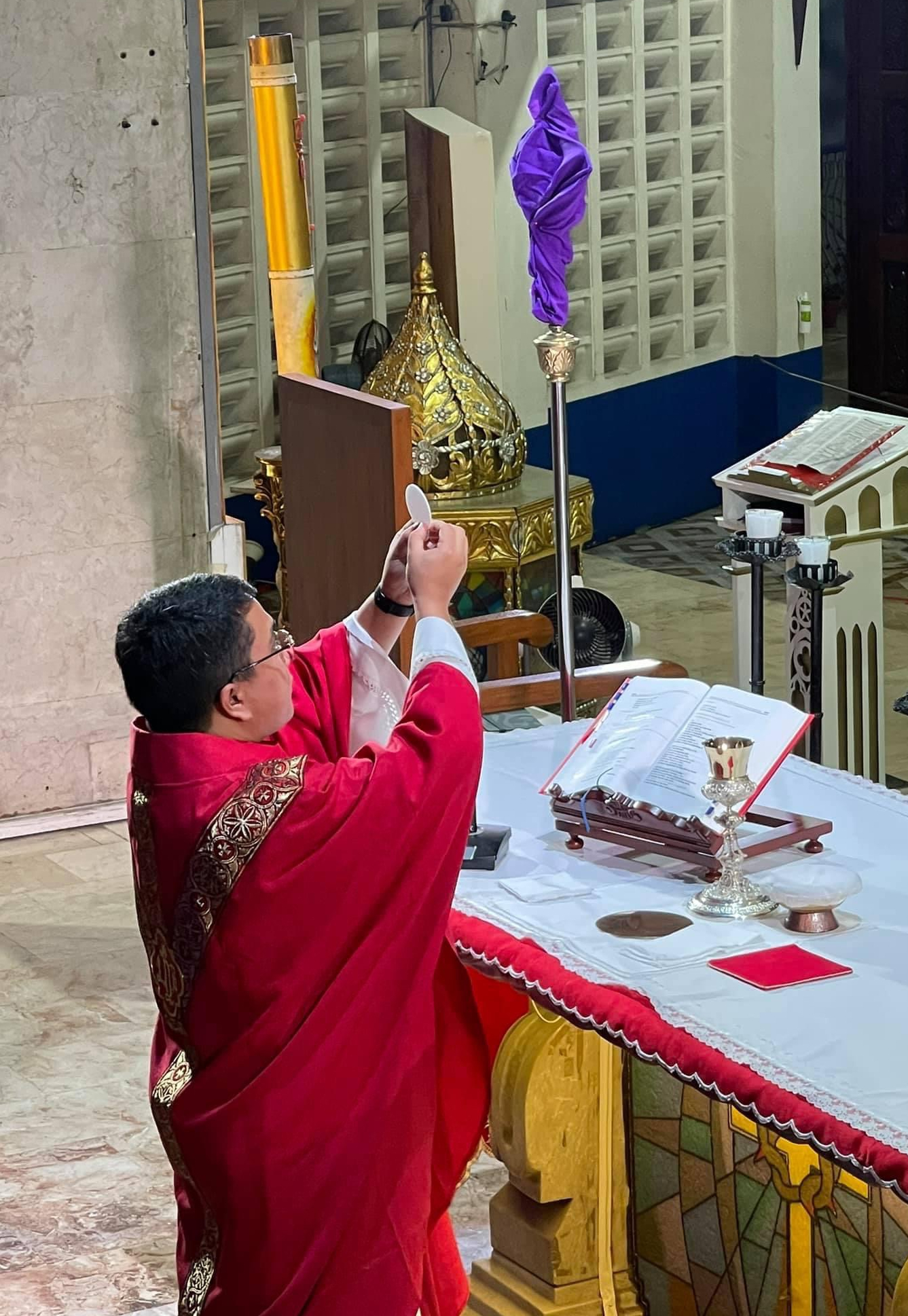
I hold your Body
for every-body to see
saying again your words
on the night before you were betrayed:
"Take this,
all of you,
and eat of it,
for this is my Body,
which will be given up for you."
THIS IS MY BODY.
We have studied and learned
theology of your Body
but it was only lately
after I have held
someone's body
with a malady
so sick, so weak, and untidy
have I truly felt your Body.
The nobility and beauty,
the awe and wonder
of holding your Body
dear Jesus came to me
after I have given up my own body
to some-body
in need of my body.
Oh, how I felt your Body
next to me after I have held another body;
it was just the tip of my fingers
touching you but as I looked at you
I felt you in my whole body
filling me with your mystery
unfolding daily in the liturgy;
why did I not see, was it due to apathy,
when some-body comes to me
and treats him a no-body?
Photo from Reuters/Lucas Jackson via The Economist, 2019.
The Lord Is My Chef Sunday Recipe for the Soul by Fr. Nicanor F. Lalog II
Week XVIII, Cycle A in Ordinary Time, 02 August 2020
Isaiah 55:1-3 >><}}}*> Romans 8:35, 37-39 >><}}}*> Matthew 14:13-21
Remember our reflection last Sunday? Of how parables teach us that “less is always more” because to have the kingdom of God – Jesus Christ himself – we have to learn to appreciate the little things in life?
Beginning this Sunday until August 16, our gospels will start telling us who is Jesus Christ by showing us his powers and abilities that are exactly opposite the way we see and understand them. This new series of stories are so relevant to us in this time of pandemic, giving us wonderful insights into God’s ways of responding to our human situations.
St. Matthew now leads us with Jesus to the wilderness after teaching us in parables to experience his power in transforming us like the five loaves and two fish to feed more than five thousand people.
Multi-layered story of the multiplication of bread
All four evangelists have recorded this story of Jesus Christ’s multiplication of the loaves of bread with their particular focus and stress, showing us that it truly happened and was a major event in the Lord’s ministry.
Very unique with St. Matthew’s version of this miracle story – which has not one but two! – is his economy of words in narrating it like a straight news as if it were a developing story or a “breaking news” unfolding before us, calling us to follow its updates and details due to its multi-layered meanings.
When Jesus heard of John the Baptist, he withdrew in a boat to a deserted place by himself. The crowds heard of this and followed him on foot from their towns. When he disembarked and saw the vast crowd, his heart was moved with pity for them, and he cured their sick. When it was evening, the disciples approached him and said, “This is a deserted place and it is already late; dismiss the crowds so they can go to the villages and buy food for themselves.” Jesus said to them, “There is no need for them to go away; give them some food yourselves.” But they said to him, “Five loaves and two fish are all we have here.” Then he said, “Bring them here to me,” and he ordered the crowds to sit down on the grass. Taking the five loaves and the two fish, and looking up to heaven, he said the blessing, broke the loaves, and gave them to the disciples, who in turn gave them to the crowds. They all ate and were satisfied, and they picked up the fragments left over — twelve wicker baskets full. Those who ate were about five thousand men, not counting women and children.
Matthew 14:13-21
Photo from iStock/Studio-Annika.
The consolation of Jesus.
Our situation in this time of the corona pandemic is so similar with that of Jesus. With the increasing number of COVID-19 cases, it has finally hit us hard, so close to home with news of those we know getting infected and worst, dying from this disease.
Like Jesus upon hearing the death of John the Baptist, we are all saddened that we wish to withdraw away from everyone.
We want to mourn but there are more people in need of our presence and help in this time of pandemic like the countless medical frontliners and health workers who must be so tired – even sick, physically and emotionally – by now with the growing number of COVID-19 patients and yet have chosen to remain in their posts.
And there are still the other casualties of this pandemic like those who have lost their jobs, those evicted from their rented apartments, those stranded and separated from their loved ones, those begging for food, and those afflicted with other sickness going through dialysis and physical therapy.
Jesus knows so well the “wilderness” we are all going through and he is right here with us, one with us in our sufferings, in our fears and anxieties, and in our exhaustion.
To be one with us is consolation, from the Latin “con” or with + “solare” or alone, to be one with somebody feeling alone.
Jesus did not remove our pains and sufferings, even our death; he joined us to be one with us in these that he can call us to “Come to me, all you who labor and are burdened, and I will give your rest. Take my yoke upon you… For my yoke is easy and my burden light” (Mt.11:28-30, 14th Sunday, 05 Jul 2020).
Compassion of Jesus.
Still with Christ’s reaction of being “moved with pity” at the sight of the crowds who have followed him to the wilderness, we find something more deeper with his being one with us, in consoling us that he had forgotten all about himself, his tired body that he went on to heal the sick among them.
To be moved with pity is more than a feeling of the senses but a response of his total person.
You respond for help, you reply to a call.
Ever wondered why we have the “responsorial psalm” after the first reading in the Mass? Because those words from the Psalms express our total assent and commitment to God, involving our total self like body, mind, heart and soul.
Photo by Dra. Mai B. Dela Peña, Carmel Monastery, Israel, 2016.
God cannot suffer because he is perfect.
That is why he became human like us in Jesus Christ to be one with our suffering and death so that we would one with him in his glorious Resurrection.
In the wilderness, Jesus stayed with the people, not allowing them to leave as suggested by the Twelve because he was moved with pity with the crowd because he wanted to suffer with them.
That is compassion, literally means to “suffer with” from cum + patior. Here in the wilderness, Jesus showed his compassion for the people which will reach its highest point in giving himself on the Cross on Good Friday.
Have we “responded” to God’s call to serve, to a call of duty, and to a plea for help from the poor? Have we truly given ourselves to somebody without ever thinking our own comfort or rewards? Or, are we running away from his Cross?
What a shame in this time of pandemic there are some among us who rejoice at the losses of others like the Twelve who wanted the crowd to be sent home because they were afraid of responsibilities, of taking care of the suffering people.
Consolation and compassion are the two most needed from each of us in this time of crisis.
Our scarcity mentality, the God of plenty.
We now come to the miracle of the feeding of five thousand. According to the late Fr. Henri Nouwen, this story is an example of our “scarcity mentality” when we think of not having enough, of finding what we have as too little, always looking for more; hence, our tendency to hoard everything.
The Twelve were thinking more of themselves, afraid they could go hungry with the five loaves of bread and two fish they have. They were so afraid of difficulties ahead of them in their situation where to find and how to feed those great number of people.
They were focused on what was lacking than on what they have, and who was with them, Jesus Christ! They were hungry for food in the stomach than for food to the soul unlike the crowds who have followed Jesus.
Worst of all, the Twelve got “mad” upon seeing the crowds who have followed them to the wilderness when in fact, it was Jesus who needed most to rest to mourn John’s death!
But through all these, Jesus patiently bore the people’s woes and the Twelve’s selfishness to teach them all in a very nice way something so essential in our response to every human suffering and extreme situation: opening and entrusting our selves totally to God.
And that was actually the greatest miracle that happened that day.
In doing it, Jesus simply asked the Twelve what they have, never asking how much they have or its condition. Just whatever they have to give everything to Jesus like those five loaves and two fish that he took, and while looking up to heaven, blessed and broke the loaves, and gave them to the Twelve to distribute to the crowd.
And everyone was satisfied with a lot of left overs too!
Matthew nor any of the other Evangelists ever explained how it happened because it does not really matter at all. What is most important is what are we willing to give up to Jesus so he can transform us into better persons.
That is what we continue to do this day in every celebration of the Holy Eucharist- whatever we have, even not the best or the worst and littlest we have, when given to Jesus becomes holy and multiplied!
The power of God is immense, without doubt. But, in this miracle of the feeding of five thousand, Jesus is showing us that his power is not meant to satisfy our material or bodily needs but our deepest desires that lead to our fulfillment in him as prophesied by Isaiah in the first reading.
Why spend your money for what is not bread; your wages for what fails to satisfy? Heed me, and you shall eat well, you shall delight in rich fare. Come to me heedfully, listen, that you may have life.
Isaiah 55:2-3
Amid the pandemic worsened by our government officials’ inanities, irresponsibilities, and sheer lack of compassion with us in this wilderness, the Lord assures us today that he is with us for “nothing can separate us from the love of Christ” (Second Reading) if we are willing to give him all that we have.
It is our spiritual transformation first that leads us to our material blessings. We can all have it if we are willing to give everything to Jesus and believe in him always. What do you have for miracles to happen?
A blessed August ahead for you!Amen.
Photo by Dra. Mai B. Dela Peña, Carmel, Israel, 2016.














 lordmychef.com