When feeling helpless

The Lord Is My Chef Breakfast Recipe for the Soul by Fr. Nicanor F. Lalog II
Saturday, Week XXX, Year II in Ordinary Time, 31 October 2020
Philippians 1:18-26     >><)))*>  +  >><)))*>  +  >><)))*>     Luke 14:1, 7-11
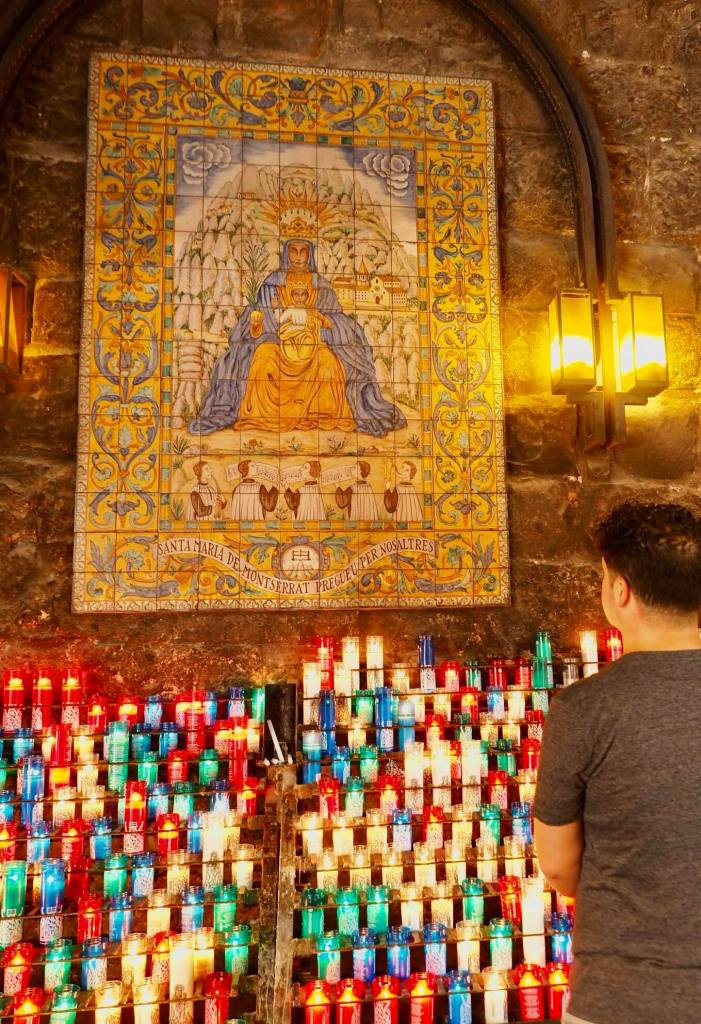
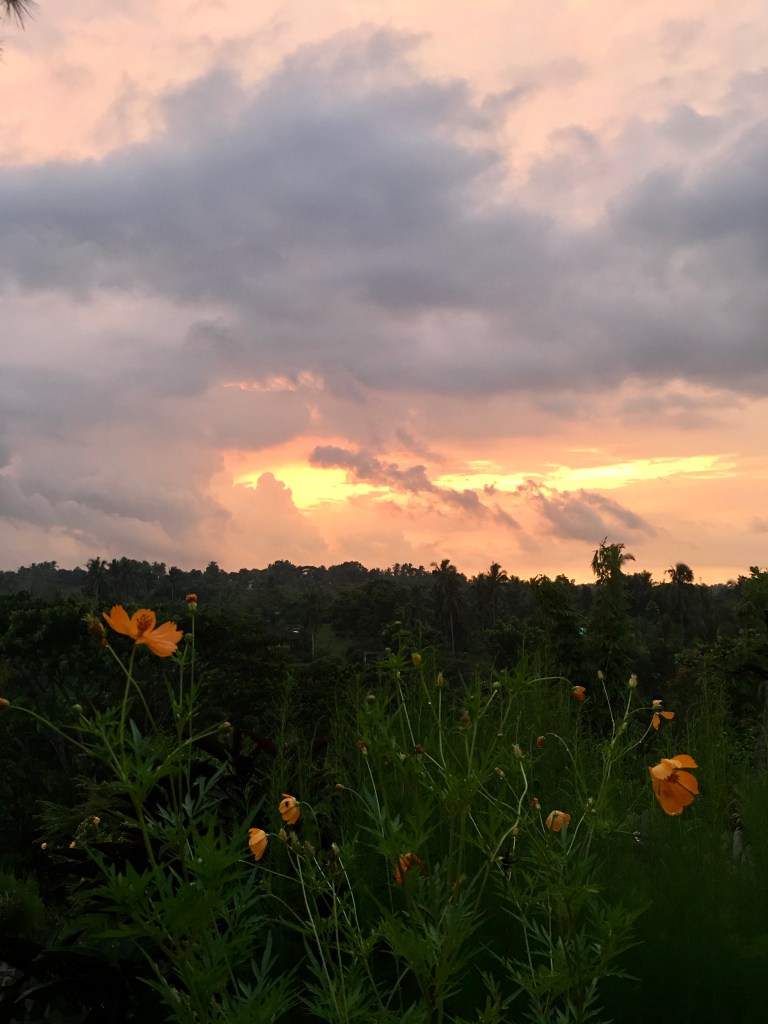
Photo by Mr. Jim Marpa, 2019.

It is the end of another month, of another week as we brace ourselves for a super typhoon directly hitting our region. And yes, God our loving Father, we are scared, we are worried, we feel helpless most specially for our little brothers and sisters, those who have always been suffering in life like the poor, the elderly, the sick, the marginalized.

But if there is one thing we have learned from COVID-19 these past eight months is to wholly entrust everything to you, O God, to completely surrender and rely on you alone.

Let us grow deeper in faith, more fervent in hope and be unceasing in our charity and love for others so that the Gospel of Jesus your Son may always be proclaimed.

Help us imitate St. Paul, though imprisoned and almost certain of facing death, no trace of helplessness is found in him; on the contrary, he was so full of power coming from his deep, personal relationship with Jesus Christ.

My eager expectation and hope is that I shall not be put to shame in any way, but that with all boldness, now as always, Christ will be magnified in my body, whether by life or by death. For to me life is Christ, and death is gain.

Philippians 1:20-21

Enable us in the power of the Holy Spirit to humbly submit ourselves to you, dear God, confident that you always have a specific place and seat, a role to play for us — if we can learn to first stand up for you like in today’s parable by Jesus.

May the coming typhoon be an opportunity for us to let our faith be expressed in words and in deeds. Amen.

A “postscript” to St. Paul’s Letter to the Galatians

Quiet Storm by Fr. Nicanor F. Lalog II, 19 October 2020
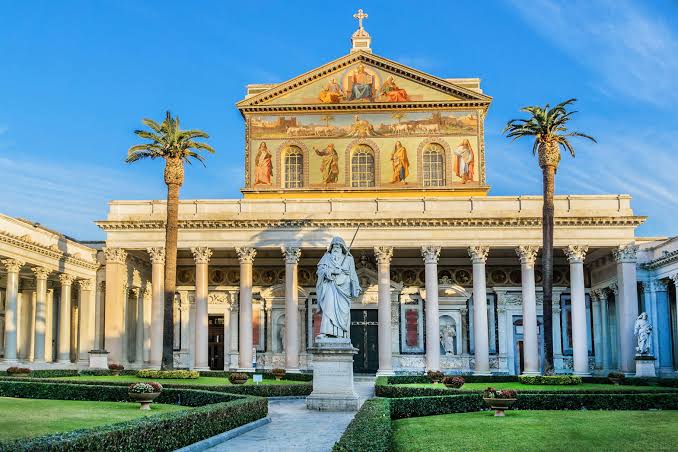
St. Paul’s Basilica in Rome from en.wikipedia.org.

It is really funny these days at how things we grew up with have changed so differently like the postscript we used with initials “P.S.” at the end of letters as an afterthought we sent relatives and friends about 40 years ago.

Today, a postscript is more of a trademark and an application in computers but for my generation, it is from the Latin “post scriptum” that means “written after”.

Consider this piece, my dear Reader, as a postscript or PS to St. Paul’s Letter to the Galatians we heard proclaimed during weekdays from October 5-14, 2020 where he explained and reflected about faith in Jesus Christ whom he loved so much.


Faith is having a relationship with God, 
not to obtain things from him.

We always hear people say “have faith” in everything we pray for. Always believe that God will hear us, God will grant us what we need and ask for.

But what happens when we do not get what we are praying for like when a loved one is not healed or recovers from a sickness and eventually dies? Or, flunk an important exam or maybe fail to close a major deal in business? Does it mean we lack faith? Or, is that the main purpose of having faith in God, to obtain things and favors from him?

See how St. Paul called the Galatians “stupid” for being misled by false teachings on the gospel of Jesus Christ: some preachers had come to Galatia at that time telling them of the need to be circumcised like the Jews who converted to Christianity in order to be saved. He wrote the Galatians primarily to rectify those errors they have seemed to believed, where he introduced the doctrine of “justification (salvation) by faith in Christ”, not by rituals and other practices men do. It is not to dismiss our traditions but to stress the primary role of faith in Jesus Christ who died for our sins to save us.

O stupid Galatians! Who has bewitched you, before whose eyes Jesus Christ was publicly portrayed as crucified. I want to learn only this from you: did you receive the Spirit from works of the law, or from faith in what you heard? Are you stupid? After beginning with the Spirit, are now ending with the flesh?

Galatians 3:1-3

Sometimes like the Galatians, we end up with the flesh, believing more in things we do like rituals and other things than truly believing Jesus because we use faith to obtain things from God.

No! We believe because we relate: every relationship like marriage always presupposes faith in the other person. Even Jesus in teaching us how to pray, he taught us the “Our Father” which is an expression of a relationship.

Wedding of my former student, Micah and Lery Magsaysay, February 2020.

Being faithful means being realistic.

Jesus himself assured us that faith can move mountains and do other great things for us if we truly believe. This is perhaps the reason we always equate faith in asking for so many things from God.

Not at all. We also have to be realistic with things we ask from God. He is not a magician who has to please and entertain us with his miracles and powers. When we were in high school seminary, the late Fr. Nick Cruz, SJ gave us a recollection and told us we cannot simply ask anything from God like a rose blooming from your toothpaste to prove he calls you to the priesthood!

Being realistic in our faith by praying first of all to have Jesus, only Jesus and always Jesus!

When Jesus told us to seek and you shall find, to ask and it shall be given to you, and to know and the door shall be opened to you (Lk.11:9-10), he was not telling us to ask for money and gadgets. If we are going to be realistic in our faith, Jesus is telling us to seek God and you shall find him, to ask God and you shall have him, and most of all, God is the only door when we knock would surely open us to new beginnings.

In explaining the unique call we have received from God in Christ, St. Paul gives us the whole reality of our being Christians, of having a faith that is realistic.

For all of you who were baptized into Christ have clothed yourselves with Christ. There is neither Jew nor Greek, there is neither slave nor free person, there is not male and female; for you are all one in Christ Jesus. And if you belong to Christ, then you are Abraham’s descendant, heirs according to the promise.

Galatians 3:27-29
Photo by author, August 2020.
Faith demands conviction and consistency.

God’s gift of faith in us is not everything; we have to cultivate and deepen our faith to experience its wondrous fruits and grace. See the kind of conviction of St. Paul in proclaiming and explaining his faith in Jesus Christ.

Now I want you to know, brothers and sisters, that the Gospel preached by me is not of human origin. For I did not receive it from a human being, nor was I taught it, but it came through a revelation of Jesus Christ.

Galatians 1:11-12

Like the Galatians, many of us are easily swayed by so many other beliefs and teachings that are misleading, claiming to be a part of the faith we have received. Without firmness and conviction in our faith, some among us have gone to accommodating modern thoughts and lifestyles that run contrary to our faith in Christ like abortion, same sex marriage, and in-vitro fertilizations or test tube babies.

A believer without conviction and consistency in faith and actions is not faithful at all. What happens with our “faith is a relationship” when the chips are down, when we are confronted of either being for God or against God?

Sometimes we try “moving the lines”, convincing ourselves that we are not crossing the line of morals and morality like when we are bent on accommodating others and ourselves in some occasions to justify personal preferences.

Sad to say, it happens even among us clergymen like when we tinker with the liturgy and the sacraments in the name of modernism and of arts and worst, with some issues pertaining to acts intrinsically sinful and immoral.

Maybe if we would have the conviction and consistency of faith, we would all be like the good Samaritan in the Lord’s parable – a neighbor to everyone especially those in need, willing to cross the street to faithfully reach out to others in Jesus Christ (Lk. 10:25-37).

Try examining our faith today. Has it bloomed into a relationship we keep with God our Father in Christ Jesus through the Holy Spirit or has it remained as it is, a given, a safety net just in case we need?

Have faith, have God and we’ll journey far, together! Amen.

From americamagazine.org.

On Wednesday, we reflect on being faithful and free, and how faith works through love. Have blessed Monday and see you again!

You may also check our prayers from October 05-14, 2020 based on St. Paul’s Letter to the Galatians at the archives of http://lordmychef.com.

Hope. And be surprised!

Quiet Storm by Fr. Nicanor F. Lalog II, 14 October 2020
Photo by author, sunrise at the Lake of Tiberias, the Holy Land, May 2019.

HOPE. A favorite word among us, used as an expression for things to get better, especially when we express our “hope” God grants what we pray for, or, in ending our letters of request with “hoping for your kind consideration”.

Even Hollywood is fond of this virtue, portraying it as a reserved power to overcome evil when Neo in the 2003 The Matrix Revolutions was summoned into action to defend their city because he was the only one with “hope”.

Or, something like a turbo charger that will boost every leap of faith when Toretto in Fast and Furious 6 handed to his rival Owen Shaw the computer chip they were tasked to retrieve in the “hope” of getting it back even if they have to chase a giant Antonov An-124 plane taking off.

Of course, Neo and Toretto succeeded in their efforts filled with hope, defeating evil.

But, that is not what hope is all about.


To hope is different from optimism, of believing things can get better;
in fact, we hope because things can get worst.

The late Fr. Henri Nouwen wrote in one of his books that to hope means having that firm conviction within that even if things get worst like death, we are certain God will never forsake us for he loves us very much.

Jesus Christ showed us this true meaning of hope when he decided to go to Jerusalem to accomplish his mission by dying on the Cross for our salvation. I love the way Luke narrated in his gospel this attitude of Jesus in showing us the path of hope amid his knowledge things would get worst than before leading to his Passion and Death (and Resurrection):

When the days for his being taken up were fulfilled, he (Jesus) resolutely determined to journey to Jerusalem…

Luke 9:51

Imagine Jesus “resolutely determined” going to Jerusalem, the very same attitude of saints witnessing the Gospel by facing martyrdom. It is also very true with us when we say our only hope is the Lord when we know of sure death while facing a serious illness.

To hope is to be “resolutely determined” like Jesus and the saints along with our loved ones to follow the arduous path of life, of putting up the good fight against sickness or injustice and evil even if they knew things will lead unto death. At first we wonder, what victory can we claim if in the end we die like the saints and martyrs?

That’s the mystery and paradox of hope: to hope is to completely trust in God that death is not the end of life or any struggle but the highest point of our transformation as we dive to life’s lowest level like defeat, loss, and death when we pray like Jesus on the Cross, “Father, into your hands I commend my spirit” (Lk.23:46).

Hope is faith severely tested, believing and abandoning everything to God, come what may.

Photo by Arch. Philip Santiago, Fatima, Portugal, 2016.

Hope is clearly not positive thinking nor optimism; hope is “faith in God” as Pope Emeritus Benedict XVI tells us in his second encyclical, Spe Salvi (2007). According to Pope Benedict, hope gives us the direction towards the future by enabling us to face the challenges of this life leading to salvation and eternal life.

In this sense it is true that anyone who does not know God, even though he may entertain all kinds of hope, is ultimately without the great hope that sustains the whole of life (Eph.2:12). Man’s great, true hope which holds firm in spite of all disappointments can only be God — God who has loved us and who continues to love us “to the end,” until all “is accomplished” (Jn.13:1 and 19:30)… If we are in a relation with him who does not die, who is Life itself and Love itself, then we are in life. Then we “live”.

Spe Salvi, #27

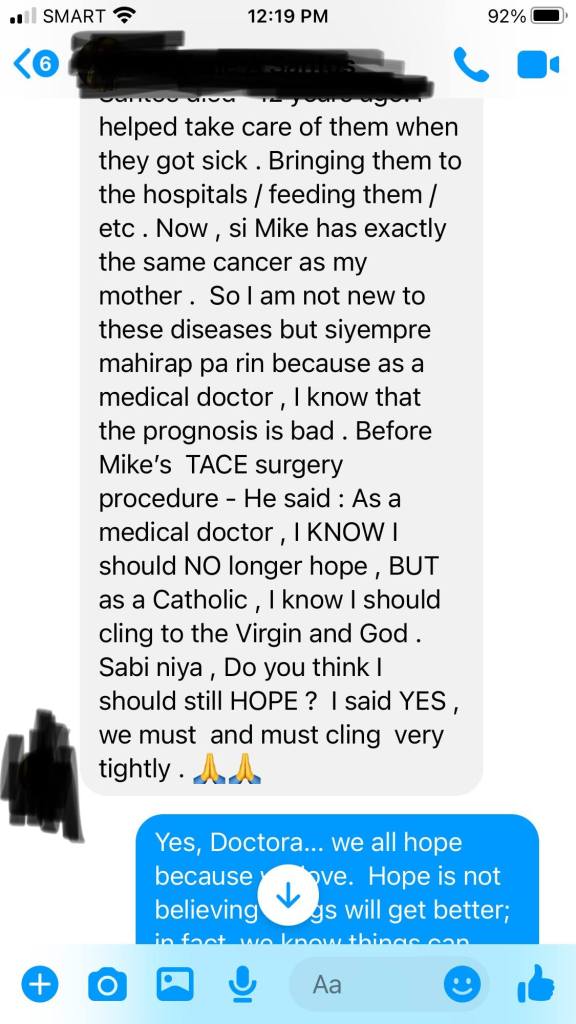
Four weeks ago, a former parishioner had asked me for prayers for her husband with liver cancer. Both are medical doctors; in fact, it was her husband who had actually diagnosed himself while going through radiological lab exam.

It was at that time they “resolutely determined” to go home and face the inevitable by praying together, hoping together in God.

Here lies the mystery and paradox of hope we were talking earlier: why and what do we really hope when we know it is going to end in death?

God. Nothing else and nobody else. God is the reason we hope and what we hope for.

It is only when we have been stripped of everything else when we truly “see” and experience God is all we have in life after all.

Then we become confident God will never abandon us until the end.

That is what my friend and her husband have realized, especially when Dr. Mike died two weeks later after going home.

When I celebrated Mass at his wake, I could not resist telling my friend how the smile of her husband is the sweetest, even most infectious one I have ever seen on the lips of a dead person in my 22 years as a priest!

Truly, the Lord loved Dr. Mike until the end that he died with a smile as the fruit of his hoping in God with his wife.

Indeed, friends have told me that God will give us the grace to face our death when that time comes; and I believe them because I have seen them transformed after accepting their terminal condition that they no longer cry of their situation getting worst while those to be left behind in turn become the ones crying knowing their beloved is passing (https://lordmychef.com/2020/09/22/the-gift-of-tears/).


Hope surprises.
Even God.

Photo by author, 2019.

When I was on my second year of seminary formation in theology, I experienced the most severe test of my vocation to the priesthood that I almost left and abandoned all plans of becoming a priest at all.

What sustained me in the seminary were prayers — and some lines from T.S. Eliot’s very long poem “Four Quartets” published in 1941:

I said to my soul, be still, and wait without hope
For hope would be hope for the wrong thing; wait without love,
For love would be love of the wrong thing; there is yet faith
But the faith and the love and the hope are all in the waiting.
Wait without thought, for you are not ready for thought:
So the darkness shall be the light, and the stillness the dancing.

Too bad I have lost the index card on which I wrote this stanza which I posted on my study lamp, reading it daily even until I have become a priest.

To truly hope, one has to get totally lost and empty, stripped naked of our very selves when darkness is our only light and hopelessness is our only hope.

It is when we have totally lost everything except God when we truly hope.

And that is when all the surprises happen, not only with ourselves but with others.

Not only here but definitely even in eternity, the biggest surprise we are all hoping for.

Photo by author at Silang, Cavite, 22 September 2020.

In 1912, the French poet Charles Pierre Péguy (1873-1914) wrote a very long poem ahead of T.S. Eliot about the virtue of hope, claiming it is God’s favorite because it is full of surprises.

Péguy portrayed Hope as a “little girl” who enlivens her older sisters Faith and Love.

I do not want to dilute its magic and power so I leave it that way for you to savor its sweetness, its truth and beauty in Péguy’s poetry:

The faith that I love best, says God, is hope. Faith doesn’t surprise me. It’s not surprising. I am so resplendent in my creation…. That in order not to see me these poor people would have to be blind. Charity, says God, that doesn’t surprise me. It’s not surprising. These poor creatures are so miserable that unless they had a heart of stone, how could they not have love for each other…. But hope, says God, that is something that surprises me. Even me. That is surprising.

Charles Péguy, The Portal of the Mystery of the Second Virtue

Sometimes in life, we have to hit rock bottom in order to truly hope. Keep hoping and you will surely be surprised by God, by others, and by our very selves that we are always blessed! Amen.

Faith to read signs

The Lord Is My Chef Breakfast Recipe for the Soul by Fr. Nicanor F. Lalog II
Monday, Week XXVIII, Year II in Ordinary Time, 12 October 2020
Galatians 4:22-24, 26-27, 31-5:1     ||| +++ |||     Luke 11:29-32
Cross of Christ atop the church of our Lady of Lourdes in France. Photo by Arch. Philip Santiago, September 2018.

Today O God our Father I thank you for the gift of faith we have always taken for granted. Faith is not just for believing in you, God; faith is for believing what is true! Without faith, life would be a drab and even senseless for there is nothing we can ever hold as reliable and true.

Without faith is like living without friction with everything sliding, slipping, escaping our grasps. There is nothing we would ever believe in. Most of all, without faith we can never read and understand any kind of signs, especially your saving work in Jesus Christ.

While still more people gathered in the crowd, Jesus said to them, “This generation is an evil generation; it seeks a sign, but no sign will be given it, except the sign of Jonah. Just as Jonah became a sign to the Ninevites, so will the Son of Man be to this generation.

Luke 11:29-30

We live in a world of so many signs and symbols but it is only through your gift of faith that they all become meaningful and useful.

Teach us, Lord, to deepen our faith so we can read your signs better like St. Paul in the first reading whose deep faith in you enabled him to interpret the meaning of the signs of Abraham’s two sons, Ishmael by Hagar and Isaac by Sarah.

May we love and care more for your gift of faith to us, Lord, because it is through our faith that we know and discover, follow and hold on to your plans for us. Amen.

Being clothed with Jesus

The Lord Is My Chef Sunday Recipe for the Soul by Fr. Nicanor F. Lalog II
Week XXVIII-A in Ordinary Time, 11 October 2020
Isaiah 25:6-10     ><)))*>     Philippians 4:12-14, 19-20     >><)))*>     Matthew 22:1-14
Photo by author, Our Lady of Mount Carmel of the Holy Family, Guiguinto, Bulacan (2018).

As we end the series of teachings in parables by Jesus directed to the chief priests and elders of the people, St. Paul concludes his Letter to the Philippians in our second reading with words so moving for a man awaiting trial and sure death, giving us a glimpse at how this great Apostle of the Lord looked at the most ordinary things in life.

Brothers and sisters: I know how to live in humble circumstances; I know also how to live in abundance. In every circumstance and in all things I have learned the secret of being well fed and of going hungry, of living in abundance and of being in need. I can do all things in him who strengthens me.

Philippians 4:12-14

Wow! Here we find St. Paul at his best and finest, with his mastery of language at the service of his innermost thoughts and feelings, indicating his transformation from the many hardships and difficulties he had gone through as an Apostle and suffered as a prisoner.

Like St. Paul, there are times we experience that perfect balance in life called equilibrium when we are able to bridge the distance between our mind and our heart with Jesus at the center amid so many trials and difficulties.

Most of all, we see in this short passage how St. Paul accepted both living in need and in abundance with calmness and composure because of Jesus Christ who strengthened him!

What an encouragement for us all in this time of pandemic to remind us of learning to adjust to situations, that true peace within comes not from abundance or scarcity of material goods but of letting go and letting God in our lives. St. Paul witnessed to us the centrality of the Lord’s teaching of denying ourselves, taking our cross and following Jesus.

Most of all, in St. Paul we find what is to be clothed in Christ or “to put on Jesus Christ” (Rom.13:14) by accepting God’s invitation to salvation through his Son as the parable of the wedding feast tells us in our gospel this Sunday.

Jesus again in reply spoke to the chief priests and elders of the people in parables, saying, “The kingdom of heaven may be likened to a king who gave a wedding feast for his son. He dispatched his servants to summon the invited guests to the feast, but they refused to come. A second time he sent other servants… Some ignored the invitation and went away, one to his farm, another to his business. The rest laid hold of his servants, mistreated them, and killed them. The king was enraged and sent his troops, destroyed those murderers, and burned their city.

Matthew 22:1-4, 5-7

Do not ignore God’s invitation; carpe diem (seize the moment).


Photo by Angelo N. Carpio, January 2020.

Jesus continues to direct his parables to the chief priests and elders of the people not really to shame them and expose their sinister plots against him but more in the hope of converting them, of giving them the chance of getting into God’s kingdom in heaven.

That is how great is his love for everyone, especially the sinful even if they would not admit it — just like us!

Keep in mind that Christ speaks always in the present and this parable is also meant for us who feel “entitled” in may ways like the chief priests and elders at that time. Interestingly, today’s parable to a large extent has to be taken in the context of the Sunday Mass, the prefiguration of the wedding feast in heaven to which we are all invited.

But how can we get to the wedding feast in heaven if we feel so sure like the chief priests and elders that we refuse to accept God’s invitation?

The Eucharist is the summit of our Christian life where we receive Jesus Christ in words proclaimed, in his Body and Blood, and among the people gathered. Every day Jesus is inviting us to partake in his Sacred Meal to be nourished and get our bearings in life through him like St. Paul.

See how before the pandemic, people refused to celebrate Mass and other Sacraments; but, when quarantine measures were implemented with the suspension of public Masses, everybody wanted to go to churches and receive the Sacraments, specially Holy Communion and Baptism, as well as Confession and Anointing of the Sick!

Photo from Shutterstock/Aleteia.

After seven months of pandemic, many of us have learned to adjust to the new situation but sadly, many have gone back to totally ignoring the Sunday Mass. Worst is at how some have considered online Masses as “video-on-demand” making Jesus Christ a “commodity” anyone can have when most convenient. Pope Francis had reminded us last summer that online Masses are not the norm but a response to the pandemic. Nonetheless, we still have to dispose ourselves properly when celebrating with online Masses like in actual live Mass in a Church and strive to be punctual and avoid doing other things during the online celebration.

In giving us these modern means of communications, God continues to invite us to come to him and gather in his name as a family in our homes for the Sunday online Masses and other liturgical activities that nourish our souls so essential in these trying times. Like the king in the parable today who had to invite guests thrice to his son’s wedding feast, God gives us all the opportunities and chances to celebrate in his gift of salvation through Jesus in the Eucharist which is the summit of Christian life.

May we not miss every opportunity!

When I was assigned to our diocesan schools during my first ten years in priesthood, I used to tell my students that God’s mercy and forgiveness are unlimited but there are acts that can have irreversible consequences like getting involved in a murder, getting pregnant outside marriage, or being caught in a video scam. I would tell them that God will surely forgive you and give you many chances in life while people like your family and friends including those you may have hurt may also forgive and accept you; however, you cannot escape the consequences of those acts that will surely limit your freedom and change forever your situations in life. Bottomline is, do not let yourself be missed out in accepting God’s invitation to his feast of life and salvation by following the path of holiness that beings in the Holy Mass.

The first reading from the Prophet Isaiah directs our attention to “that day” when God would save us and welcome us into heaven symbolized by the feast or banquet with great food and drinks. The good news is we are all invited to his feast, assured with a seat and it would only be our fault to not make it there, either by refusing it or not getting dressed properly.


Being properly dressed is always a sign of maturity.


Photo by Ezra Acayan/Getty Images, 09 February 2020, Baclaran Church.

“The servants went out into the streets and gathered all they found, good and bad alike, and the hall was filled with guests. But when the king came in to meet the guests he saw a man there not dressed in a wedding garment. The king said to him, ‘My friend, how is it that you came in here without a wedding garment?’ But he was reduced to silence. Then the king said to his attendants, ‘Bind his hands and feet, and cast him into the darkness outside, where there will be wailing and grinding of teeth.’ Many are invited, but few are chosen.”

As is often the case in his parables, Jesus pulled a surprise when he added another parable to this parable of the wedding feast that could have easily ended in the annihilation of those who rejected the king’s two earlier invitations.

God is the king who was so good that he never tired of inviting guests thrice to the wedding feast of his son, and this time he opened it to everyone! And here lies the clincher: though everyone is invited, guests were expected to come in proper attire.

We have learned at a very young age of getting properly dressed in an occasion. In fact, dressing properly is a sign of maturity. Some people especially in this age always claim what matters is the inside of the person not the outside appearance like clothes; but, they forget that the outside also indicates what is inside of us!

Clothes speak a lot of who we are and what we are that even St. Paul used several times the metaphors of clothes like “putting on the Lord Jesus” or being “clothed in Christ” as we have cited earlier.

See how the king went to meet the guests not just for pleasantries but for inspection that immediately his eyes caught the man not dressed in a wedding garment. The king was even courteous addressing the man as “my friend” when asked why he came not in a wedding garment.

Try to imagine the scene with that man “reduced to silence” meaning, he was guilty of not putting on a wedding garment even if he knew that was the occasion he was going to. He had been remiss of his duties and obligations, just like the wicked tenants last week or the merciless servant last month.


"Many are invited, but few are chosen" (Matthew 22:14) 

St. Matthew never failed to remind us these past weeks that our faith has no value if not translated into actions, if it does not bear fruits. Today, he reminds us to be properly dressed to become a part of the wedding feast of the Lord, of the need to be clothed in holiness, in charity, and kindness with others.

Moreover, with just barely two months to go before we end the liturgical year to usher in Advent in preparation for Christmas, Jesus tells us today to never feel so sure, even “safely assured” of getting into heaven like the chief priests and elders of his time that even if we celebrate Sunday Masses weekly, online or actual, nothing is final yet in this life until we all get into the hall of the wedding feast in heaven when we are judged for our good deeds.

For the meantime, let us not miss joining the “rehearsals” for that feast – the Sunday Mass we celebrate weekly when he invites everyone to come. Be sure to be properly dressed for the occasion, literally and figuratively speaking. Amen.

A blessed week to everyone!

Photo by author at Silang, Cavite, 22 September 2020.

We are God’s favorite!

The Lord Is My Chef Breakfast Recipe for the Soul by Fr. Nicanor F. Lalog II
First Friday, Memorial of Guardian Angels, 02 October 2020
Exodus 23:20-23   | + |  >><)))*>   | + |   Matthew 18:1-5, 10
Photo by author, dome of the Malolos Cathedral, December 2019.

Praise and thanksgiving to you, O God our loving Father! In your great love for us, you did not only give us your Son Jesus Christ to redeem us but also sent us guardian angels who guide and protect us in this journey in life.

What an honor in making each one of us truly your favorite child!

May we always heed the guidance and leading of our guardian angels so we may always follow and do your Holy Will, O God.

May we be respectful, devoted and grateful to our guardian angels who function as our protectors, keeping us safe from all harm and dangers.

Lastly, give us the courage and banish our fears, Lord, for we have our guardian angels always beside us, sometimes ahead of us to prepare our paths.

Let us “follow them, stay close to them so we may dwell under the protection of God’s heaven” (St. Bernard). Amen.

Photo by author, Baguio Cathedral, January 2019.

Prayer to age gracefully

The Lord Is My Chef Breakfast Recipe for the Soul by Fr. Nicanor F. Lalog II
Saturday, Week XXV, Year II in Ordinary Time, 26 September 2020
Ecclesiastes 11:9-12:8     <*(((><<   +   >><)))*>     Luke 9:43-45
Photo by author, sunset at Silang, Cavite, 22 September 2020.

It is officially the end of the week, and how true are your words through Qoheleth that everything comes to an end, that we must strive to make every ending a happy one. Especially our very lives.

Rejoice, O young man, while you are young and let your heart be glad in the days of your youth. Follow the ways of your heart, the vision of your eyes; yet understand that as regards all this God will bring you to judgment. Ward off grief from your heart and put away trouble from your presence, though the dawn of youth is fleeting.

Ecclesiastes 11:9-10

God our Father, grant me the gift of ageing gracefully by having the grace of being excited and surprised each day while still young. It is said that it is not really time that is passing by if we waste it but us who are passing by because lost time can never be recovered or brought back.

Keep me excited and full of enthusiasm of following my heart, pursuing my vision of a better and beautiful future by celebrating every present.

Let me bear in mind Lord that I am not perfect so that I may always have room for my mistakes and those of others; keep me simple so as not to be demanding and exacting. Just let me enjoy life, trust more in you, worry less among us.

And in all my pursuits in life while still young, be at the center, Lord Jesus.

Let me keep in mind as you reminded your disciples in the gospel today, that I may not be so focused and amazed with great and wondrous deeds but most of all in how you have bore all pains and sufferings to save us.

After all, you saved the world by dying on the Cross, O sweet Jesus, and not with so many activities.

And that is the meaning of ageing gracefully: that towards the end of our lives when we sum up everything, we can always look back to the past, to our youth with pride and joy at how we have followed you Jesus in your Passion and Death while awaiting our glorious resurrection in you like the twin brothers Sts. Cosmas and Damian and others saints. Amen.

The gift of tears

Quiet Storm by Fr. Nicanor F. Lalog II, 22 September 2020
Photo by Ms. Ria De Vera of our parish church, August 2020.

Lately I have been watching old movies that I wonder why I still cry even if I have seen them more than twice before at the cinema and cable TV. It seems that my being born with “mababa ang luha” (easy to cry) is getting more “mababa” as I get old.

Tears are a gift from God, the most beautiful prayer we can ever express courtesy of the Holy Spirit because when we run out of words for our pains and sadness or when we are overjoyed, he makes us cry to heal and comfort us or complete our joys, assuring us of his loving presence.

That is the reason why we call “home” in Tagalog as “tahanan”: home is where we “stop crying”, that is, “tahan na” because that is where we find all the support we need in times of crisis. Indeed, home is where the heart is.

True to its function, tears cleanse us physically, emotionally and spiritually. I have read two decades ago that researchers at a university in the US have found the chemical composition of our tears differ if we cry because of pain and sadness or due to joy and laughter.

Is it not wonderful and amazing how we take for granted crying and tears without realizing its chemical process within that can transform our very selves?

Photo from Reuters.com, July 2020.
Tears and crying mark our life's coming to full circle.

When I was five years old, I saw the picture of a newborn baby crying in the Book Section of the Reader’s Digest. I asked my mom why the baby was crying. In her usual motherly way of explaining things, she told me that if the baby cries upon birth, it means he/she is alive; if the baby does not cry, he/she is dead.

Kapag umiyak, buhay; walang iyak, patay.

My young mind easily absorbed her words that would remain to be one of the most profound lessons I had ever learned about life at a very young age. As I grew up watching TV and movies, I would always sigh with relief whenever I heard the sounds “uha-uha” because the story would surely be nice and not tragic.

Imagine the great inverse that happens with crying and tears to signal the coming to the outside world of life of another human, of how we have to cry to be alive from then on until we die when it becomes our family and friends’ turn to cry and shed tears for us when we are gone.

But there is something more deeper than this great inverse on crying in life and death I had learned only in 2013 through my best friend Gil, a classmate in our minor seminary.

It was late February of that year on the 40th day of the death of his youngest sister Claire when he was diagnosed with cancer. We could not believe the news because Gil was the most health conscious in our “band of brothers” from high school who never smoked, rarely ate meat, and was active in sports like golf and badminton. Unlike most of us, he was never overweight, looked so healthy in our mid-40’s.

Imagine the hurt within him that every time we would visit him, he would cry not really in pain but more on the why of getting cancer. We tried visiting him as often as we can to cheer him up and lift his spirits specially after his surgery when his chemotherapy sessions began.

By September on that same year, we all had to rush and visit him at Makati Med one Sunday afternoon when informed by his Ate Lily that doctors have given up on him. His cancer cells were “ferocious” and nothing could be done anymore except to wait for the inevitable.

That was when I noticed the greater inverse about crying when Gil had finally accepted his condition and life direction, that was when he was most joyous and peaceful too while we were the ones so sad and worried, crying. How our roles were reversed with Gil now telling us to stop crying – tahan na – which we used to tell him months earlier! (Gil died peacefully the following Sunday, 22 September 2013.)

“Mater Dolorosa” as “Blue Madonna” (1616) by Carlo Dolci. Photo from Wikimedia Commons.

I noticed it happening so many times with some friends and parishioners I have come to love in my ministry, those I have pastorally cared for some time after being diagnosed with serious conditions like cancer.

Yes, I have cried despite holding my tears for them while administering the Holy Viaticum and Anointing of Oil. The patients in turn would just glance at me, so dignified and calm like Mary our Lady of Sorrows as if trying to comfort me with their sweet thank you.

As I prayed on those experiences, I realized how life comes to full circle through our crying and tears.

I believe that patients cry when they start undergoing treatment of their sickness due to fears and uncertainty of what would happen next to them; later as they come to terms with their condition, they stop crying because they already knew where they were going, of what was coming next.

We who would be left behind cry and begin to shed tears at thoughts of their dying because admittedly, we are actually the ones more uncertain of where we are going to or how our lives would go through when our loved ones are gone.

That is the greatest pain we feel in the death of a beloved when we grapple with the realities of the many uncertainties of life without them.

And that is why we need to love as much as we can our family and friends while still alive. This quarantine period of the pandemic are grace-filled moments to shower them with our love and presence we have taken for granted for so long as we pursued many things in our lives.

Photo by Dr. Mylene A. Santos, MD at Infanta, Quezon, April 2020.
Tears and crying lead us to heaven.

Death and sickness, like life, become a blessing if we are filled with gratitude not regrets because we have truly loved. When a beloved is gone and we begin to cry, the tears wash away our pains of losing them, cleansing us within to leave us with all the beautiful memories and love we have shared. Then, every remembering becomes truly a re-membering, making a lost loved one a member of the present again.

When we cry, tears polish the love we have shared with everybody until later when our time comes, our visions are also cleared of what is going to happen next, of where we are going. Crying becomes wonderful and truly a grace after all not only in sharing and being one with the grief and pain of another in the present but sooner or later, in having a glimpse of the life after.

In the Gospel of John (11:1-44), we find the story of the raising of Lazarus whom Jesus loved so much that he wept – not just cried – at his death. Jesus raised him up back to life, his final miracle – or “seventh sign” according to John – to show he is the Christ before his own Resurrection at Easter after his “final hour” of Crucifixion on Good Friday.

From then on, Christ sanctified crying and tears to enable us to see beyond pains and hurts, even death especially if you have truly loved.

Sometimes in life, it is always good to let those tears flow, like love even if it is painful, to have a good cry and real cleansing inside. A blessed day to you!

The company Jesus kept

The Lord Is My Chef Breakfast Recipe for the Soul by Fr. Nicanor F. Lalog II
Monday, Feast of St. Matthew, Apostle and Evangelist, 21 September 2020
Ephesians 4:1-7, 11-13   >><)))*>   +   <*(((><<   Matthew 9:9-13
Photo by author, Lake of Galilee at the side of Capernaum where Jesus called Matthew the tax collector, May 2019.

Glory and praise to you, O God our loving Father! Your Son Jesus Christ never fails to surprise us with your wondrous plans for us, with your ways of calling us, and of coming to us!

As we celebrate today on this first working day of the week the feast of St. Matthew, you fill us with hope and inspiration to work harder and pray hardest in life to find fulfillment in you our God.

Thank you for being so kind to come and call us like St. Matthew, Lord Jesus. It was a very extraordinary call not because we are so special but actually unimportant with Matthew also known as Levi belonged to the most despised group of people at that time in Israel, the tax collectors who were always mentioned along with sinners and prostitutes. And so were Matthews’s contemporaries at Capernaum, the brothers Simon and Andrew, James and John who were all fishermen, the most ordinary folks doing the most ordinary jobs of that time.

We were all just like them – nothing special and unimportant! If not for your call, we would be nobody at all even in our family circles.

What a joy that even if some people reject us for various reasons, you O Lord never exclude anyone of us from your friendship. Most of all, you even defend us.

While he was at table in his (Matthew’s) house, many tax collectors and sinners came and sat with Jesus and his disciples. The Pharisees saw this and said to his disciples, “Why does your teacher eat with tax collectors and sinners?” He heard this and said, “Those who are well do not need a physician, but the sick do. Go and learn the meaning of the words, I desire mercy, not sacrifice. I did not come to call the righteous but sinners.”

Matthew 9:10-13

Give us the readiness and firmness of St. Matthew in leaving everything behind to follow you, Lord.

Like St. Matthew who “got up (rose in some translations) and followed you” (Mt.9:9) right after you have called him, help us realize that following you requires our detachment from our sinful situations, from things and people who prevent us from totally loving you and serving you.

Help us Lord to arise from our dark, sinful past so we can radiate your light in our version of your gospel like St. Matthew. Amen.

“The Calling of St. Matthew”, painting by Caravaggio (1599-1600) said to be one of the favorite pieces of art Pope Francis used to frequent while still a student in Rome. Photo from Wikipedia.org.

Beauty in our mortality

The Lord Is My Chef Breakfast Recipe for the Soul by Fr. Nicanor F. Lalog II
Saturday, Week XXIV, Year II in Ordinary Time, 19 September 2020
1 Corinthians 15:35-37, 42-49     || + ||     Luke 8:4-15
“The Sower” painting by Van Gogh, photo from Wikimedia Commons.

Dearest Lord Jesus,

Today I wish to repeat my prayer to you yesterday: Please grant me St. Paul’s clarity of mind and purity of heart in explaining and leading others to faith in you, most especially in believing the resurrection of the dead.

While we all profess faith in the resurrection of the dead, most of us are still puzzled like the Corinthians who could not accept it.

Here I have found St. Paul’s clarity of mind and purity of heart at its best when he wrote us the most wonderful and loveliest explanation of death and dying that lead to transformation and new life.

Brothers and sisters: Someone may say, “How are the dead raised? With what kind of body will they come back?” You fool! What you sow is not brought to life unless it dies. And what you sow is not the body that is to be but a bare kernel of wheat, perhaps, or of some other kind. So also is the resurrection of the dead. It is sown corruptible; it is raised incorruptible. It is sown dishonorable; it is raised glorious. It is sown weak; it is raised powerful. It is sown a natural body; it is raised a spiritual body.

1 Corinthians 15:35-37, 42-44

In this time of the pandemic when death has become so “ordinary” and most of all, “so closest to home”, I pray for the many people now facing death in their hospital beds, in their homes comforted by the loving presence of family, as well as for those left alone to themselves due to so many reasons only you can understand. And forgive.

Bless those with advanced stages of cancer, those awaiting transplants, for those in their terminal stages. Give them the grace of hope, to continue to love even if things are getting worst than better.

Ease their pains, Jesus, and make them feel your loving presence with them on the cross.

Most of all, transform them like the seeds after having died and sown in good soil, grew and produced fruit a hundredfold. Amen.