40 Shades of Lent by Fr. Nicanor F. Lalog II
Friday in the First Week of Lent, 23 February 2024
Ezekiel 18:21-28     <*[[[[>< + + + ><]]]]*>     Matthew 5:20-26
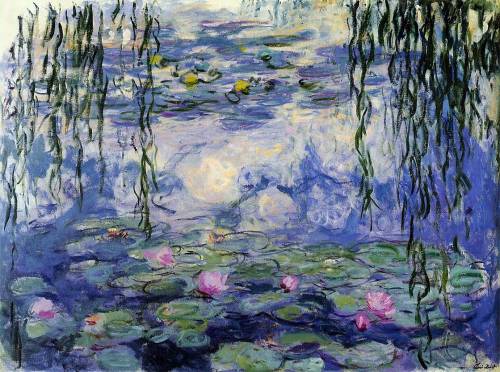
“Water Lilies” (1916-1919) painting by Frenchman Claude Monet from lopificio.it
As we come to close
 the first week of Lent today,
your words in our Responsorial Psalm
are so true, O God because nothing
can be hidden from you,
“If you, O Lord, mark iniquities,
who can stand?”
Jesus said to his disciples: “Therefore, if you bring your gift to the altar, and there recall that your brother has anything against you, leave your gift there at the altar, go first and be reconciled with your brother, and then come and offer your gift.”
Matthew 5:23-24
When does a "brother has
anything against us", Lord Jesus?

  The Filipino translation
 “kung may sama ng loob
 sa iyo ang iyong kapatid”
  implies the problem lies
with the brother, not us;
but, here you are telling us
 we are the offender,
 who are obliged,
even ought to be
 “reconciled with him first
 then offer your gift”
 as we are the guilty one!
Forgive us for acting
immaturely clean and innocent
 when our feuds and animosities
 with others are due to our pretending
 to be the offended ones
 when in fact,
we are the offender.
Let us get real with ourselves
 beginning this Lent
 for we can never fool you,
God our Father.
“When someone virtuous turns away from virtue to commit iniquity, and dies, it is because of the iniquity he committed that he must die. But if the wicked, turning from wickedness he has committed, does what is right and just, he shall preserve his life; since he has turned away from all the sins that he committed, he shall surely live, he shall not die.”
Ezekiel 18:26-28
 Thank you dear Father
for being true with us always
that we may also get real
with you and everybody else.
Amen.
The Lord Is My Chef Sunday Recipe for the Soul by Fr. Nicanor F. Lalog II
Solemnity of the Body & Blood of Jesus Christ, 11 June 2023
Deuteronomy 8:2-3, 14-16 ><}}}}*> 1 Corinthians 10:16-17 ><}}}}*> John 6:51-58
Photo by author, 2018.
There is a weird British series in Netflix called the Inside Man about a professor of criminology at the death row in the States for the murder of his own wife. He had deep perceptions and analysis of events that people came to see him in prison to consult in locating their missing loved ones. One of them is an American journalist trying to do a story about him while at the same time seeking his expertise in locating her missing friend, a math tutor in England held hostage in the basement by a pastor and his wife.
Though the series is weird, it has some interesting lines about life and death like when the wife of the pastor told him how she had spent the whole afternoon searching the internet how to kill their son’s math tutor they have thrown in their basement. The wife found it unusual there was nothing in Google that tells of ways of killing another person (so weird, is it not?); however, she was surprised that almost everything she had found in the internet and social media was mainly about sex as he teased her husband that it is not love that makes the world go round but sex!
Yes, it is very funny and weird but her observations seem to be true because nobody in his right mind would ever want to destroy life except terrorists and lunatics. People generally love life that our social media are saturated with contents that try to show how we can enjoy this life through sex, food, and travels in that order. Also with cars for boys aged 5 to 95.
Photo by author, March 2020.
Of course, we all know that is not what life is all about that is filled with mysteries.
Last Sunday we reflected in the Solemnity of the Holy Trinity that mysteries are not problems to be solved but realities to embrace to discover life’s truest meaning found in our relationships with God and with others
This Sunday we celebrate the second most important doctrine and mystery of our faith, the Incarnation of the Son of God Jesus Christ. It is a mystery not only how the Son of God became human like us in everything except sin but most of all, of how he has given us his very flesh and blood as our food and drink in this journey called life.
Jesus said to the crowds: “I am the living bread that came down from heaven; whoever eats this bread will live forever; and the bread that I will give is my flesh for the life of the world.” The Jews quarreled among themselves saying, “How can this man give us his flesh to eat?” Jesus said to them, “Amen, amen, I say to you, unless you eat the flesh of the Son of Man and drink his blood, you do not have life within you. For my flesh is true food, and my blood is true drink.”
John 6:51-53, 55
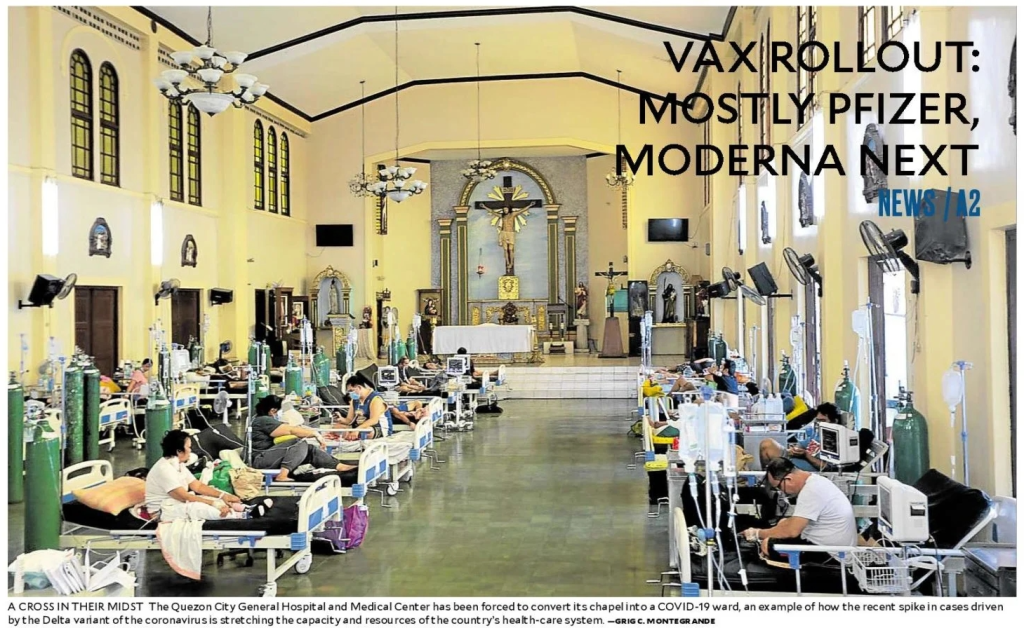
My favorite front page photo during the Delta outbreak of the COVID-19 pandemic published by the Inquirer on 20 August 2021. So evocative of the truth of Jesus himself being our true food and drink – and medicine.
As we have reflected last Sunday, a mystery is a divine truth revealed by God we learn through the gift of faith. It is non-logical but not illogical. It can be explained and understood but not fully.
Here in the mystery of the Body and Blood of Christ we call as the Eucharist, the mystery of our Triune God becomes a reality in our life truly present in perceptible signs of bread and wine. From relating, we now come to the mystery of sharing of our selves like God who shared us his Son Jesus Christ who in turn gave himself for us on the Cross that continues today in the Holy Eucharist as his everlasting sign of his loving presence and service.
See how Jesus spoke clearly in this passage of his giving us his physical body and blood that to receive it, we have to actually eat it too.
First we notice is how in other parts of the New Testament that the term soma is used to refer to the Eucharist which is the Greek word for “body” that may have symbolic meanings; but in this passage, Jesus used the word sarx which means “flesh” in Greek that means only one thing, the corporeal reality of his physical body. Jesus is telling us in no uncertain terms in this passage after the miracle feeding of more than 5000 in the wilderness that he himself is truly and really present as flesh and blood in the Eucharist. Recall that at his Prologue to his gospel, John also used the same term sarx in declaring “the Word became flesh” (Jn.1:14) to correct misunderstandings and doubts that were already developing during the first century of Christianity regarding the physical Incarnation of Jesus the Eternal Word and his true presence in the Eucharist.
Second term used by Jesus four times as he emphasized the reality of his Body and Blood in the Eucharist is the word trogein which in Greek means “to munch” or “bite”; the other Greek word for the verb to eat is phragein which evokes many symbolic meanings like “digesting” a book or “assimilating” the culture. Again, when Jesus said we have to eat his flesh and drink his blood, he truly meant himself as a true food and true drink to nourish and sustain us in this life and hereafter.
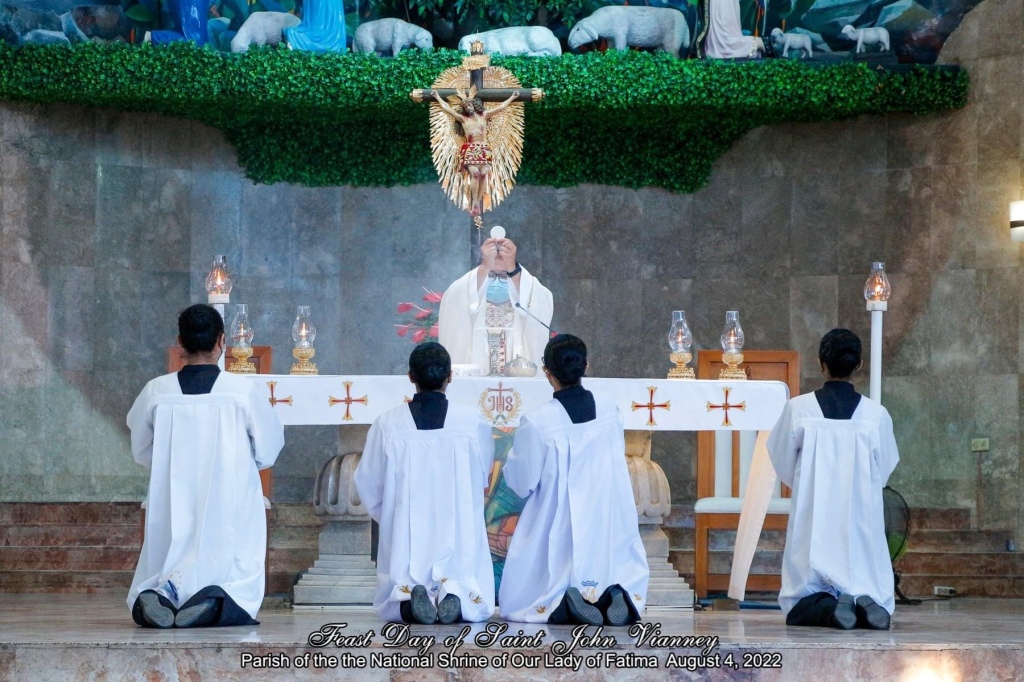
Photo by Kuya Ruben, 04 August 2022.
There lies the beauty of this mystery of the Eucharist: Jesus himself is the one we receive, who comes to us personally, physically to be one with us in our very selves. We do not have to wait for death and be in heaven to experience fullness of life in Christ because he comes truly to us while in this life when we receive him in the Holy Communion.
St. Paul reminds us in the second reading with his rhetorical questions, “The cup of blessing that we bless, is it not a participation in the blood of Christ? The bread that we break: is it not a participation in the body of Christ?” (1 Cor. 10:16) of this reality of Christ’s presence in us and among us. He was not waiting for answers of yes or no but posed those questions to affirm the very truth we all know that Jesus is really present in us and among us especially when we are broken like the Israelites in the first reading. This is where the mystery deepens, becomes more real and more fascinating. Jesus the Son of God emptying himself to be like us in everything except sin so that we may become like him, holy and divine.
This I have learned in my two years of being a chaplain in the hospital. Admittedly, it is difficult especially for me as I could easily be carried away by emotions in seeing the sick and suffering while at the same time, can often have my stomach overturned by sights of blood and wounds of others. But, there is always that indescribable feelings of joy and fulfillment after visiting and anointing our sick patients.
Photo by Kuya Ruben, June 2022.
I have no claims to holiness as I am a sinner too but the Eucharist has become most truest to me these past two years in the hospital and university as well as I get into contact with the sick and the students. When I touch patients to pray over them or help in moving them, when students cry to me or ask for hugs after confessions, they all flash to me during the consecration as I raise and say, This is my Body… This is my Blood. Jesus is most truest in the Eucharist when we too imitate him in giving ourselves to others to be broken and shared.
The Eucharist is the most wonderful gift of God to us when we receive his Son Body and Blood to make us strong and holy like him in this life.
That is why we have to go to Mass every Sunday. That is why a priest has to celebrate Mass daily for the people to be strengthened like him in this journey of life filled with trials and sufferings. That is why Moses kept on reminding the Israelites of their many hardships from their exodus into their wandering in the wilderness. That is why this coming Friday, we cap these three weeks of transition into the Ordinary Time with the Solemnity of the Most Sacred Heart of Jesus, another mystery of Christ truly among us and within us as we experience his love most truly right here in our hearts.
What an awesome God we have indeed who has become so small and so simple like us so we can be great like him. Like the simple bread and wine, in the Mass through the Holy Spirit, they become Christ’s Body and Blood. Let’s make it happen this Sunday in our celebration of the Mass. Amen.Have a blessed week ahead.
Quiet Storm by Fr. Nicanor F. Lalog II, 10 April 2023
A photo-reflection of our rootedness in God while at the Sacred Heart Novitiate last March 20-22, 2023.
In the lush rolling hills of Novaliches
that is now fast disappearing are
23 hectares of pastureland and mini forests
inside the Sacred Heart Novitiate
of the Society of Jesus.

Thank God it had opened
anew its doors to retreatants like me
wishing to have a "vacare Deo"
or vacation in the Lord.
A retreat
or a vacare Deo
is a return to our roots,
God.

While preparing for the formal
start of my retreat last March 20,
I felt the roots of the many trees
speaking to me
 in this Bethel of mine
where like Jacob in
Genesis 28:10-19,
I met God.
Sometimes,
I wrestled with Him
like Jacob too
in Peniel/Penuel
(Gen. 32:23-33).
How interesting
the words "true" and "truth"
along with its cousin "trust"
came from the old English
"treowe"
for tree.
According to experts,
the Anglo-Saxons worshipped trees
they called "treowe"
because they evoked firmness
and solidness;
the more rooted is the tree,
the more firm does it stand.
Like truth.
Whatever that is true, firmly standing
like a tree or treowe always has extensive
network of roots, creating linkages
and interconnections from which came
that image of the
"family tree".
When there are interconnections,
linkages,
there are relationships.
People with the most
wonderful relationships
are also the truthful ones
because they are trustworthy.
Reliable.
Like God.
Our root.
Our rootedness
who connects us with
everyone.
When we are rooted
and grounded in God,
nothing can ever disturb us
like a big, big, tree.
We can withstand all storm,
bear the sun's heat
remaining firm
and aglow
 with God's majesty
in daytime and in darkness.

Lovelier than the tree,
thank God
for creating me.
Hallelujah!
More than any other prophet, O Lord,
Hosea is the one who tells us most
of your immense love for us all;
his writing moves like a beautiful
love story so unbelievable
yet exists, so true.
After so many harsh words
against us your people for our
infidelity like prostitutes,
here at the last part of his book,
Hosea tells us to never lose hope
because you love us so much.
Moreover, dear God our Father,
what I like most in Hosea's writings
is how you yourself reveals to us
how we must approach you
like a teacher coaching us
for the best answers so we may pass
your final exam.
Thus says the Lord: Return, O Israel, to the Lord, your God, say to him, “Forgive us all iniquity, and receive what is good, that we may render as offerings the bullocks from our stalls
Hosea 14:2, 3
Please Lord, help us experience
your promises of "healing our defections,
loving us freely, becoming like dew
so we shall blossom like the lily,
our splendor be like the olive tree
and fragrance like the Lebanon cedar,
allowing us to dwell in your shade again
and raise grain, blossom like the vine,
and our fame be like the wine of Lebanon"
(cf. Hosea 14: 5-8).
Cast away our doubts of your love
and mercy for us, Father for as your Son
Jesus Christ had revealed, all the commandments
is summed in LOVE, your great love for us
as the very reason why we must love you
not because you need our love but
so that we can have more of your love
when we love.
May we love,
love,
and love!
Amen.
Photo by Ms. Ria De Vera, sunrise at lockdown in our Parish, March 2020.
Almost daily in my prayers I give you praise, O God, without really bothering myself to dwell on what is the meaning of your glory, of that scene from the first reading that says:
Then the glory of the Lord left the threshold of the temple and rested upon the cherubim… They stood at the entrance of the eastern gate of the Lord’s house, and the glory of the God of Israel was up above them. Then the cherubim lifted up their wings, and the wheels went along with them, while up above them was the glory of the God of Israel.
Ezekiel 10:18, 19b-20
It is so difficult to imagine of your glory, O God, when I am in dirt and sin.
Your glory is your purity.
Cleanse us, merciful Father of our many sins and iniquities that have darkened the world and our very lives with evil and sin.
At the same time, teach us to be like you in Christ Jesus, full of mercy and forgiveness for those who sin because every time we are able to bring back a sinner to you, the more we see and experience your glory.
Most of all, keep on purifying us so that our gathering together becomes your indwelling, fulfilling Christ’s words
Photo by author, sunset in our parish church, April 2020.
“For where two or three are gathered together in my name, there I am in the midst of them.”
Matthew 18:20
Lord Jesus, more sinister than all the dirt of sin and evil in us and around us today is our refusal to stand against the immoralities going on.
Worst, O Lord, is our attitude of always “moving the lines” when some people cross the boundary between what is right and wrong, good and evil, decent and indecent.
Forgive us and bring us back to your path, Lord, when truth and morality have suddenly become relative for us without realizing how these have muddled our relationships with you and with others, hiding your glory among us. Amen.
Lawiswis ng Salita ni P. Nicanor F. Lalog II, Ika-16 ng Abril 2020
Larawan kuha ni G. Raffy Tima ng GMA-7 News nang sumabog ang Bulkang Taal, Enero 2020.
Hindi lamang minsan
sumagi sa aking isipan
nakalulungkot nating kinagawian
Diyos ay ating kinakawawa
kapag may masamang karanasan
Siya ating pinagbibintangang
tayo ay pinarurusahan
kulang na nga lang
lahat ng kasamaan inatang
lahat ng sisi sa Kanyang pangalan.
Kinakawawa natin ang Diyos
sa tuwing siya ang tinuturing pinagmulan
ng bawat kalamidad at kasawian;
madalas idahilan pa ng karamihan
sa pagaakalang mabuting katuwiran
na mga ito ay pagsubok lamang
ng Maykapal na hindi ibibigay
kung hindi malalampasan
gayong Siya ay purong kabutihan
paanong ipaliliwanag iyan?
Kinakawawa natin ang Diyos
katulad noong kanyang kapanahunan
nilalapastangan at pinasasakitan
gayong tao ang may kasalanan
at palaging nagkukulang
katulad doon sa ilang nang tuksuhin ng diyablo
hinahamon Kanyang katuwiran
pati katarungan bakit Niya
pinababayaan mga kahirapan
at hindi pakinggan mga karaingan?
Ang mahirap maintindihan
Diyos ang laging tinatawagan
sa maraming pangangailangan
ngunit kapag napagkalooban
Siya ay kinalilimutan, tinatalikuran
habang ating inaangkin
lahat ng husay at galing
sa nakamit na katanyagan
at magandang kapalaran
na tila baga wala Siyang kinalaman?
Kay laking kabalintunaan
kakatwang kahangalan
at sukdulang kayabangan
nating mga nilalang
na Diyos ay kalimutan at talikuran
sa paniniwalang lahat ating makakayanan
pati kamatayan pilit iniiwasan
mga kamay ng orasan pinipigilan
habang hinahatulan sinong may karapatang mabuhay
sanggol sa tiyan at mga tinotokhang!
Lingid sa ating kaalaman
na pinalabo ng ating kapalaluan
sa bawat kalungkutan at kahirapan
pagtitiis at kabiguan
Diyos ang higit sa ating nasasaktan
sa pagpanaw ng maski isa lang
Siya ang labis nahihirapan
dahil sa ano mang ating kalagayan
Diyos ay palagi tayong sinasamahan
pilit naman nating iniiwan at sinusumbatan.
Sakaling tayo ay dumaraan
sa kahirapan at ano mang kagipitan
hindi ito nagmula sa Diyos
dahil Siya ang kabutihan;
gayon pa man ating maaasahan
lahat ng ating nararanasan
Kanyang nalalaman
hindi Niya papayagang magwagi
anumang dalamhati bagkus Kanyang titiyakin
mga ito ay humantong sa ating luwalhati.
Hindi ang Diyos ang kawawa
sa tuwing atin Siyang kinakawawa
sa salita at sa gawa
kungdi tayong kanyang mga tinubos
pagkatao natin ang nauubos
dangal nati'y nauupos
sa tuwing aasta tayong boss
gayong tayo ang nabubusabos
nitong kapalaluan nating lipos
na sana ay maubos, matapos kasabay ng corona virus.
40 Shades of Lent, Ash Wednesday, 26 February 2020
Joel 2:12-18 + + + 2 Corinthians 5:20-6:2 + + + Matthew 6:1-6,16-18
From Google.
We begin today the Season of Lent, the 40 days of prayers and fasting, contrition and alms-giving in preparation for Easter Sunday. It is the only season in our liturgical calendar that starts on an ordinary day, Ash Wednesday when we are reminded of that basic truth in life we have always evaded: that we all die and go back to God.
“Remember man that dust thou art, and unto dust shalt thou return.”
In this age of social media where many practically live in media making known to everyone everything happening to them from confinement to hospital to drinking coffee somewhere or simply saying “thank you” to someone just beside for a gift they have received, the more we need this blessed season to recover the essential realities in life like our true self and God.
So unlike Adam and Eve who went into hiding after their fall, modern men and women have shamelessly flaunt everything they think they have that actually indicate what they lack – depth and meaning, sense and respect.
Ash Wednesday enables us to find anew our bearings in life that must be centered in God, our very life and meaning of being and existence.
Life is a daily Lent.
From Google.
St. Benedict tells his followers in his Rule that “the life of a monk ought to be a continuous Lent”. And this is also very true for every Christian who follows Jesus Christ as Lord and Master.
Our life is a daily Exodus from darkness into light, from sin into grace, from failure into victory, from slavery into freedom when we experience the Paschal mystery of Jesus Christ even if we are not aware of it.
And the sooner we become aware of this reality, the better for us because that is when we find more meaning in life, the deeper our existence becomes.
Pope Francis tells us in his Lenten Message this year that “Jesus’ Pasch is not a past event; rather, through the power of the Holy Spirit it is ever present, enabling us to see and touch with faith the flesh of Christ in those who suffer.”
Life is all about God. This life we live is a sharing in his very life and the more are aware of this reality and link, the more we discover its beauty because we get to know God more in Jesus Christ who have come in flesh and blood for us.
“Brothers and sisters: We are ambassadors for Christ, as if God were appealing through us. We implore you on behalf of Christ, be reconciled to God.”
2 Corinthians 5:20
To be reconciled to God is to be one in God in Christ Jesus through daily conversion. This we achieve through the many sacrifices and corporal and spiritual works of mercy during this season. Fact is, these pious practices are meant to be done even outside the Lenten season so we never lose sight that life is all about God, not us.
From Google.
Lent is a journey into our hearts, and into the heart of God, too!
In these 40 days of Lent, we try little by little to “rend our hearts, not our garments to return to the Lord our God” (Joel 2:13) through prayers and sacrifices. These are done not for others to see but primarily for us to find and meet God waiting for us always to experience his love and mercy, his life and his fullness right in our hearts.
Like in our gospels these past two weeks when we reflected on the “education of the heart”, it is the truth of the heart that is being worked out in Lent. It is our heart that must be strengthened and converted by all these religious practices of the season.
It is in our hearts where God dwells and resides though we often try to bury and disregard.
All these fasting and abstinence, confessions and alms-giving as well as other works of mercy are meant to create a space in our hearts for God and for others. Without the proper attitude in our hearts, everything then becomes a hypocrisy that neither deceives God nor fools humans.
See how Jesus in the gospel which is also a part of his Sermon on the Mount which we have been reflecting these past three Sundays of Ordinary Time have painstakingly reminded us to guard against pleasing humans than God.
Jesus said to his disciples: “Take care not to perform righteous deeds in order that people may see them; otherwise, you will have no recompense from your heavenly Father.”
Matthew 6:1
It is not that we are encouraged to give alms, pray and fast to get rewards from God that Jesus is telling us to practice these pieties but in order to be more focused with the Father. Ultimately, getting into heaven is the reason why Jesus came to save us, to assure us of this reward of being with the Father eternally. There is nothing else greater than that.
This is why Lent is all about God, not us.
From Google.
In our journey to him this season, both as an individual and as a community, Lent enables us to free ourselves from our strong individualistic drives within so we can truly experience conversion in the midst of a community of believers.
The more we see God, we see our sinful selves, and that is when we are converted and renewed in Christ.
This is always marked with a deep realization that we are not alone, that there are also others suffering with whom we must share with God’s rich mercy and love rather than keep these for ourselves alone.
That is what that ash on our forehead reminds us, of God who loves us all, dwelling within each one of us, renewing us, loving us, and most of all, forgiving us. Amen.
Quiet Storm by Fr. Nick F. Lalog II, 04 February 2020
Photo by author, St. Paul Spirituality Center, Mt. Pico, La Trinidad, Benguet, 04 February 2020
My life may be rife
with so many strifes
causing me to struggle,
be pained leading into fruition
making life golden.
When I reviewed my life and see
the past so vast and also fast,
then I realize my life
is not all mine but His, Divine.
Here in my life
I can see within
where it is going;
calming, assuring and so promising
the Divine leading me to final joining
for my life is really in HIM.
Amen.
Photo by author, St. Paul Spirituality Center, Mt. Pico, La Trinidad, Benguet, 04 February 2020
40 Shades of Lent, Thursday in Week-1, 14 March 2019
Esther C:12, 14-16, 23-25///Matthew 7:7-12
God our loving Father, if there is one thing we wish to tell you today, it is the Psalmist’s song for today, “Lord, on the day I called for help, you answered me.”
So many times, we felt like “Queen Esther, seized with mortal anguish” with no other recourse but to you O God. We know our limits and our weaknesses as well as sinfulness, yet, you keep on trusting us, giving us so many responsibilities and missions in life. Not because we are great or so good but simply because we trust in you.
Teach us to discover anew that in prayer, our lone objective is You alone, O God: not things like money and wealth, power and honor. It is you alone whom we seek, whom we ask for, whom we knock doors for.
Give us the grace to strive to for your Person for you are more than a concept.
Give us the grace to experience your Person as you are not according to our belief or imaginations.
Just to feel your presence O God is more than enough for especially when we are in great need. Stay with us, remain in us always. Amen.
40 Shades of Lent, Tuesday of Week-1, 12 March 2019
Isaiah 55:10-11///Matthew 6:7-15
May our prayers, O God, be like rain and snow that soak and soften earth to allow seeds and plants to grow, bloom and bear fruit.
Soak and soften our hearts hardened with pride and sin with your love and divine mercy that we may eventually go back to you. Soak and soften our hearts, O God, with our prayers that we may recognize others as brothers and sisters in you our Father. Soak and soften our hearts with our prayers, O God, that we may learn to forgive others as you forgive our sins.
We have so many things to learn about prayer, O God. And perhaps, the most important of these is to keep in mind that every prayer is a God-centered activity, not man-centered. Indeed, even before we pray to you, you already know what we need; we pray so that we may know what we need most, and that is you as a Person, not as a concept but as our Father.
Like Jesus your Son and our Savior, may we always be attentive – docile – to your words O God our Father for man does not live by bread alone. Amen.













 lordmychef.com