True blessedness

The Lord Is My Chef Sunday Recipe for the Soul by Fr. Nicanor F. Lalog II
Sunday in the Fourth Week of Ordinary Time, Year A, 29 January 2023
Zephaniah 2:3, 3:12-13 ><}}}*> 1 Corinthians 1:26-31 ><}}}*> Matthew 5:1-12
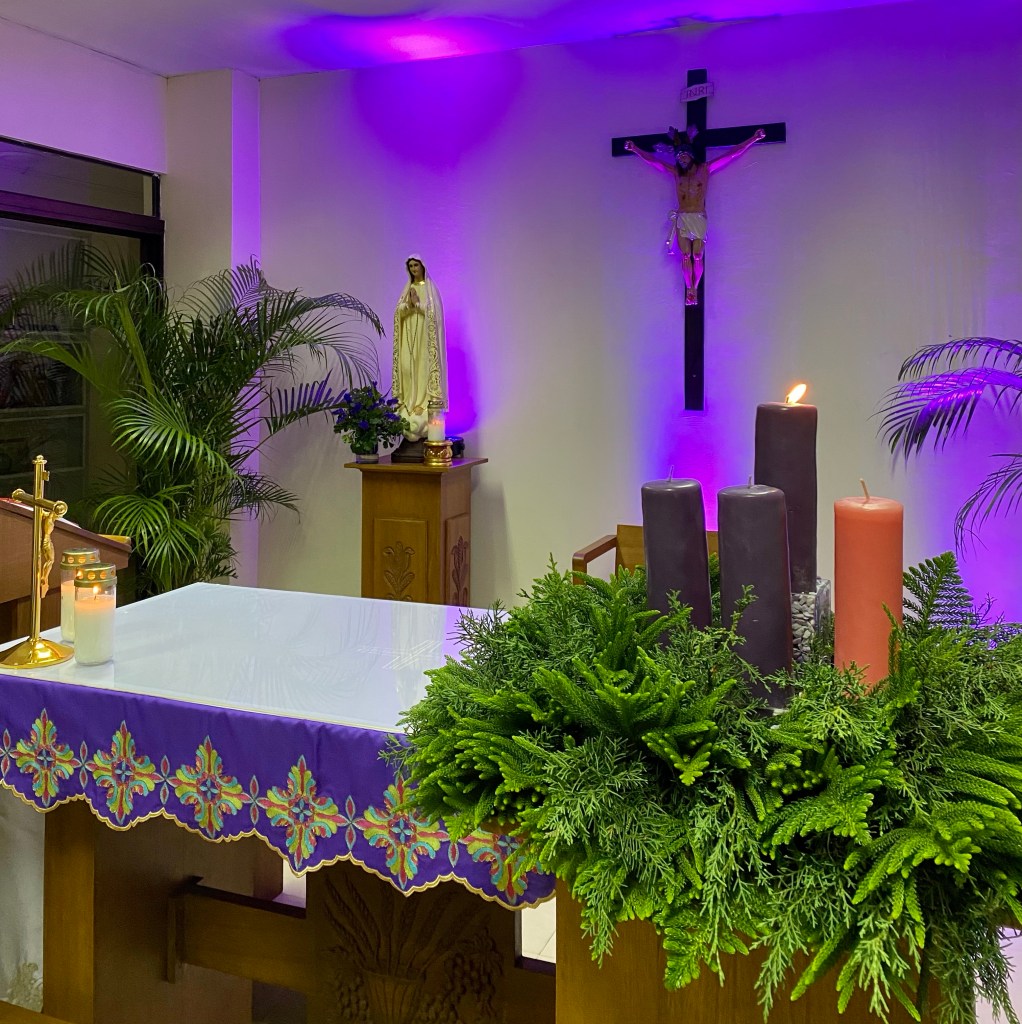
Photo by author, 2020.

Blessedness is a very contentious term for us Filipinos. Very often, we equate blessedness with being rich and wealthy like having a lot of money, a beautiful house, and the latest car model as well as clothes and gadgets. Being blessed sometimes means being lucky or fortunate like winning the lotto or having a child graduating in college or getting promoted in one’s job.

In the Visitation, Elizabeth defined for us the true meaning of being blessed like Mary as someone who believed that what the Lord had promised her would be fulfilled (Lk.1:45). Blessedness is essentially a spiritual reality than a material one; however, it implies that being blessed results from doing something good like being faithful to God.

Today in our gospel from Matthew, Jesus shows us that blessedness is still a spiritual reality than a material one but, it is more of a being – like a status in Facebook – than of doing.

Most of all, being blessed is not being in a good situation or condition when all is well and everything proceeding smoothly in life; blessedness according to Jesus at his sermon on the mount is when we are on the distaff side of life like being poor, being hungry, being persecuted and insulted – being like him!

Photo by author, Church of the Beatitudes, Israel, 2019.

“Blessed are the poor in spirit, for theirs is the kingdom of heaven. Blessed are they who mourn, for they will be comforted. Blessed are the meek, for they will inherit the land. Blessed are they who hunger and thirst for righteousness, for they will be satisfied. Blessed are the merciful, for they will be shown mercy. Blessed are the clean of heart, for they will see God. Blessed are the peacemakers, for they will be called children of God. Blessed are they who are persecuted for the sake of righteousness, for theirs is the kingdom of heaven. Blessed are you when they insult and persecute you and utter every kind of evil against you falsely because of me. Rejoice and be glad, for your reward will be great in heaven.”

Matthew 5:3-12

After going around the shores of Galilee, preaching and healing the people, Jesus went up a mountain upon seeing crowds were following him. They were mostly poor people with deep faith in God, hoping and trusting only in him for their deliverance called the anawims.

They were in painful and difficult situations, maybe like many of us, fed up with the traffic and rising costs of everything, fed up with the corruption among public officials and most of all, disillusioned with our priests and bishops!

Then, Jesus called them blessed.

Now, please consider that it is more understandable and normal to say that after being persecuted or after losing a loved one, after all these sufferings that people would be blessed, that the kingdom of God would be theirs.

But, that is not the case with the beatitudes whereby Jesus called them already blessed now, right in their state of being poor, being persecuted, being maligned!

Keep in mind that Matthew’s audience were his fellow Jewish converts to Christianity. By situating Jesus on the mountain preaching his first major discourse, Matthew was reminding his fellow Jewish converts of their great lawgiver, Moses who stood on Mount Sinai to give them the Ten Commandments from God.

However, in the sermon on the mount, Matthew was presenting Jesus not just as the new Moses but in fact more than Moses because Jesus himself is the Law. His very person is what we follow that is why we are called Christians and our faith is properly called Christianity so unlike other religions that are like philosophies or any other -ism.

To understand the beatitudes, one has to turn and enter into Jesus Christ for he is the one truly poor in spirit, meek, hungry and thirsty, merciful, clean of heart, who was persecuted, died but rose again and now seated at the righthand of the Father in heaven. Essentially, the Beatitudes personify Jesus Christ himself. Those who share what he had gone through while here on earth, those who identify with him in his poverty and meekness, mercy and peace efforts, and suffering and death now share in his blessedness.

Therefore, the Beatitudes are paths to keeping our relationship with Jesus Christ who calls us to be like him – poor, hungry and thirsty, meek, clean of heart and persecuted. The Beatitudes are not on the moral plane like the Decalogue that tells us what to do and not to do. Have you ever used the Beatitudes as a guide in examining your conscience when going to Confessions? Never, because the Beatitudes are goals in life to be continuously pursued daily by Christ’s disciples.

Photo by author, Church of the Beatitudes, Israel, 2017.

The Beatitudes are more on the spiritual and mystical plane of our lives that when we try imitating Jesus in his being poor and merciful, meek and clean of heart, then we realize and experience blessedness as we learn the distinctions between joy and happiness, being fruitful and successful.

That is when we find fulfillment while still here on earth amid all the sufferings and trials we go through because in the beatitudes we have Jesus, a relationship we begin to keep and nurture who is also the Kingdom of God. Of course, we experience its fullness in the afterlife but nonetheless, we reap its rewards while here in this life.

As we have noted at the start, we must not take the beatitudes in their material aspect but always in the spiritual meaning. This we find in the first beatitude, Blessed are the poor in spirit, for theirs is the kingdom of heaven.

Actually, this first beatitude is the very essence of all eight other blessedness. Everything springs forth from being poor in spirit, of having that inner attitude and disposition of humility before God. We cannot be merciful and meek, nor pure of heart nor peacemakers unless we become first of all poor in spirit like Jesus, who, “though he was in the form of God, did not regard equality with God something to be grasped. Rather he emptied himself, taking the form of a slave, coming in human likeness and humbled himself” (Phil. 2:6-7, 8).

The prophet Zephaniah showed us in the first reading that poverty in the Old Testament does not only define a social status but more of one’s availability and openness to God with his gifts and calls to us to experience him and make him known. Experience had taught us so well that material poverty is one of life’s best teacher as it leads us to maturity and redemption best expressed in the Cross of Jesus Christ.

In this sense, the beatitude is also the “be-attitude” of every disciple who carries his cross in following Christ. See that each beatitude does not refer to a different person; every disciple of Jesus goes through each beatitude if he/she immerses himself/herself in Christ. That is why last week Jesus preached repentance which leads to conversion. Notice that the beatitudes of Christ are clearly opposite and contrary to the ways of the world as St. Paul tells us in the second reading with God calling the weak and lowly to manifest his power and glory.

Many times in life, we fail to recognize our blessedness when we are so focused with what we are going through, with our work and duties and obligations. This Sunday, Jesus takes us up on the mountain, in the celebration of the Holy Eucharist for us to see ourselves blessed and loved right in the midst of our simplicity and bareness, sufferings and pains. Stop for a while. Find Christ in all your troubles or darkness in life. If you do not find Jesus in your labors and burdens, you are just punishing yourself. If you find Christ because you see more the face of other persons that you become merciful, you work for peace, you mourn and bear all insults and persecution… then, you must be loving a lot. Therefore, you are blessed! Amen.

Have a blessed week ahead!
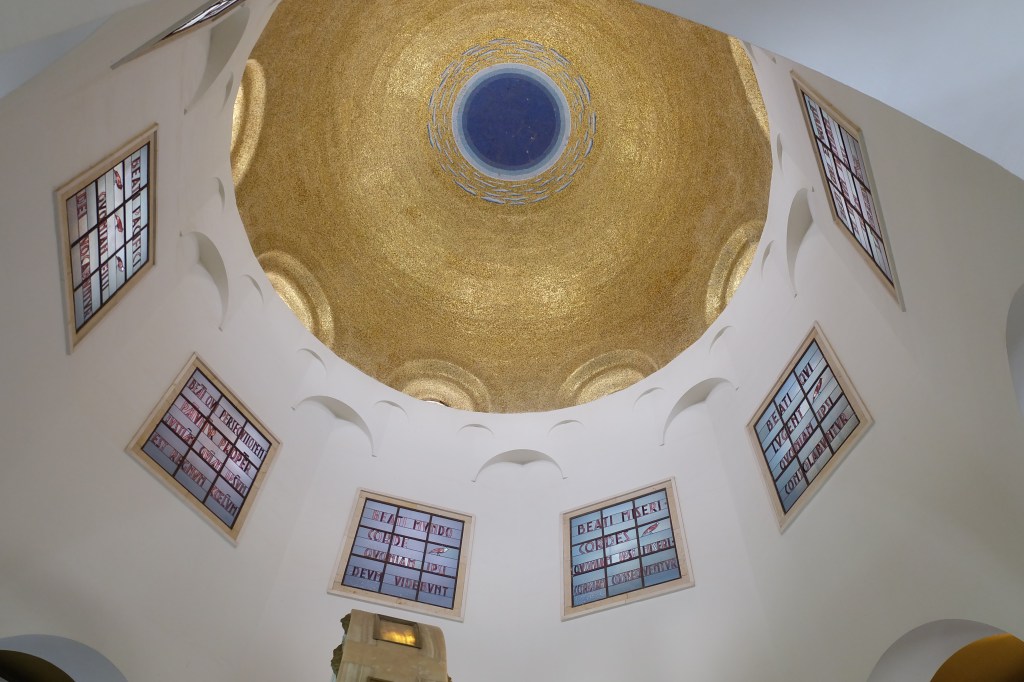
Photo by author, Church of the Beatitudes, Israel, 2017.

Christmas is family

The Lord Is My Chef Christmas Recipe for the Soul by Fr. Nicanor F. Lalog II
Friday in the Octave of Christmas, Feast of the Holy Family, 30 December 2022
Sirach 3:2-6, 12-14 ><}}}}*> Colossians 3:12-21 ><}}}}*> Matthew 2:13-15, 19-23
Photo by Ms. Janine Lloren (2015), Duomo Cathedral in Florence, Italy depicting the harsh conditions the Holy Family faced in Egypt while escaping Herod.
God our loving Father,
thank you for sending us
your Son Jesus through the
husband and wife of 
Joseph and Mary;
as we celebrate today
the feast of the Holy Family
of Jesus, Mary and Joseph,
you remind us too that
Christmas is a living story
that happens daily when you
come first in every family.
Help us imitate the Holy Family
in getting closer with you
and with one another in their
flight to Egypt when they faced
so much sufferings and hardships;
how sad that as families face
so many attacks these days from 
within and from the outside,
family members have failed to 
realize that our flights to Egypt 
when we have to go through trials
and difficulties are occasions 
to get closer to Jesus and one another; 
teach us to go back to you in prayer as
a family, to bring back our altars
of sacred images and icons now 
replaced by the giant flatscreen TV;
enable us to reach out more to one
another, to hug more, to converse more
than to spend the whole day before the
computer screen and cellphone
or with business partners and colleagues
or friends and classmates.
Most of all,
as Ben Sirach and St. Paul
reminded us in our first two readings
today, make us realize that our
relationships in the family 
mirror our relationship 
with you, O God, our Father;
let all our love and charity,
kindness and care begin at home
because that is where Christ
comes first to us!  Amen.

Christmas, our being & mission

The Lord Is My Chef Simbang Gabi Recipe by Fr. Nicanor F. Lalog II
Saturday in the Third Week of Advent, Day 2 of Christmas Novena, 17 December 2022
Genesis 49:2, 8-10     ><}}}}*> + ><}}}}*> + ><}}}}*>     Matthew 1:1-17
Photo by author, 2021.

Beginning today, we shift our focus in our Christmas preparations into the second phase of Advent, of looking back to the first coming of Jesus Christ when he was born in Bethlehem more than 2000 years ago.

The birth and origin of Jesus has always been an issue to many people then and now. It was the main reason he was put to death for the case of “blasphemy” because his enemies at that time refused to accept he is the Son of God, the fulfillment of the promises in the Old Testament, of him coming from the lineage of King David.

Until now, people continue to question his origin with so many others insisting Jesus is not God, that he is only human.

That is why all four evangelists began their gospel accounts by first establishing his identity and roots with Matthew doing a very superb job by starting right away with the genealogy of Jesus Christ.

The book of the genealogy of Jesus Christ, the son of David, the son of Abraham. Abraham became the father of Isaac, Isaac the father of Jacob, Jacob the father of Judah and his brothers. Judah became the father of Perez and Zerah, whose mother was Tamar. Perez became the father of Hezron, Hezron the father of Ram….

Matthew 1:1-3
Photo by author, November 2022.

For the early Christians, it was very important to first establish the origin of our Lord because his roots reveal his very being and mission – that indeed, he is the Christ, the promised one of God since the beginning sent to save us from sin and bring us back into one with the Father.

The same is very true with us. Unless we know our roots, our origins, we will always have those confusions in life like identity crisis and meaning of existence. All these problems about gender identity, drug addictions, teenage pregnancies, depressions and so many others are basically due to lack of our knowing of ourselves, of our being. How can we go on with our life journey and mission if we are not even sure of ourselves, of who we are, of our grounding, of where we came from?

When I was a newly ordained priest assigned to a school in Malolos, at first I felt so mad at seeing how our young people behaved, their lack of discipline and sense of responsibilities. But after three months in school, I realized that the question we should be asking even until now is not why are the young acting that way today but, “where are their parents”?

Now that I am assigned as a university chaplain, the more I see this reality so true, even at its worst and ugly faces of the many burdens and sufferings our young people have to bear and contend with right in their homes – incest and physical abuses, absentee parents and separated parents or single parents made more difficult by poverty that many of them even go without breakfast or decent meal on many occasions every week.

Now more than ever, the school has become truly the home of every student because they have no home, no parents and no love to come home to! They prefer hanging out anywhere including school and get into drugs and other vices at a young age because nobody cares for them except their equally lost peers. Many practically live in the internet and social media because nobody is around to interact with them at home.

Many young people are lost simply because their parents are lost too. They have all kinds of issues because they do not know who they are and where they are going to. They have low self-confidence and low self-esteem, depressive and yes, almost everyone contemplates committing suicide even once because they could not find meaning in their lives anymore.


... human love is imperfect,
only God can love us perfectly.

So sad, so disheartening.

This past week, I have been hearing confessions of our students who poured out everything to the point of crying. What is so moving for me was how they still professed their love for their parents and siblings despite their pains and sufferings.

After listening to them – sometimes crying with them – I tell them that human love is imperfect, only God can love us perfectly. For sure, I tell them that their parents must have also come from so many pains and hurts in their lives, even broken homes too like theirs. Widen your perspectives, I tell them. And keep your hearts wide open to God, to welcome Jesus who comes daily in our lives especially in the most trying time.

This is the meaning of all those names in Jesus Christ’s genealogy – he is so like us with many imperfect relatives and family like quarrelsome siblings, single-parents, prostitutes, unfaithful kings and husbands, illegitimate children, and probably all those things we describe or label as “dysfunctional family”.

Deep within every name is a real person, broken and sinful, hurting and lost just like us yet, loved and saved by God in Jesus Christ. All of them remind us we all came from God like Jesus and with him, in him and through him, we shall all come home to God our true Father.

Every time I administer Baptism, I remind parents to shower their children with love especially in their formative years from infancy to early teens while singing to them a few lines from James Taylor’s “Shower the People with Love” to make my point.

Recently I found in my Facebook feeds from one of the sites I follow a beautiful story and shared it on my wall, saying, “Ito ang tunay na pag-ibig” (this is true love):

From Facebook, The Language Nerds, 13 December 2022.

Our being is from God who is love. Therefore, our mission too is love. Just like Jesus Christ. That is the meaning of all those names in the genealogy of Jesus Christ. The very same meaning we shall find when we trace our own roots, when we do our family tree to find our being and mission.

This is the grace of Christmas 2022 – after two years in the pandemic with so many restrictions, we are celebrating face-to-face to personally experience one another again. Most of all, to personally experience of being loved and loving again.

Christmas is essentially a story of our first love – God – who comes to us face-to-face. Even its preparation as we have seen in the Lord’s genealogy, of God coming to us in our imperfections and weaknesses happened face-to-face in the context and spirit of love, a love that covers a multitude of sins, welcomes everyone, ready to forgive and celebrate life.

Let us see and welcome God in our hearts by rekindling that love we have always have. And upon finding him there, may we also find him in the face of everyone we meet, especially those closest to us, our family and relatives. Let us pray:

Lord Jesus Christ,
thank you for coming to us;
thank you for showing us that
like us, you came from very 
dysfunctional family too!
Thank you for assuring us
that despite our many imperfections,
sins and weaknesses,
you still come and even more present
in our hurts and wounds.
Let us find you where we are,
right here in our brokenness 
and darkness so that in the process,
we may also show you to others
lost in their many sufferings and pains.
You have given us yourself, Jesus,
let me give you to others 
in love and kindness,
in my mere presence.
Amen.
Photo by author, November 2022.

Rejoicing amid disappointments

The Lord Is My Chef Sunday Recipe for the Soul by Fr. Nicanor F. Lalog II
Third Sunday in Advent-A, Gaudete Sunday, 11 December 2022
Isaiah 35:1-6, 10 ><}}}*> James 5:7-10 ><}}}*> Matthew 11:2-11

Photo by author, 2019.

Today our altar bursts in lovely shades of pink in celebration of the third Sunday of Advent also known as Gaudete Sunday from the Latin gaudere that means “to rejoice”. We rejoice this third Sunday because the Lord’s Second Coming is getting nearer each day and so is our awaited celebration of Christmas with the start of Simabang Gabi.

There are still many reasons for us to rejoice but when we reflect deeper in life, our rejoicing in itself is a paradox.

Because rejoicing is more joyful when seen amid darkness and uncertainties, disappointments and failures.

Because joy is more than feeling happy but that certainty within us that no matter what happens in this life, even if things get worst, everything ends according to God’s plans.

Because God loves us so much!

That is why we rejoice this Sunday – and everyday in our lives – that no matter what happens to us, God is with us in Jesus Christ, loving us, saving us.

When John the Baptist heard in prison of the works of the Christ, he sent his disciples to Jesus with this question, “Are you the one who is to come, or should we look for another?” Jesus said to them in reply, “Go and tell John what you hear and see: the blind regain their sight, the lame walk, lepers are cleansed, the deaf hear, the dead are raised, and the poor have the good news proclaimed to them. And blessed is the one who takes no offense at me.”

Matthew 11:2-6
Photo by author, 2021.

How fast things happen and change in life, especially when there is a sudden change or reversal, from good to bad, from top of the world to bottom into the unknown like John the Baptist.

Last week, John was on top of the world as people were coming to him for baptism, listening and believing his preaching; today, we heard him in prison!

Herod Antipas, the son of King Herod when Christ was born, had him imprisoned after John told him that it was wrong for him to take as wife his brother Philip’s former wife, Herodias. Eventually, John was beheaded in prison upon Herod’s order after making a promise to grant whatever request the daughter of Herodias would ask him after entertaining guests in his birthday party; the daughter asked for John’s head on a platter and immediately, Herod dispatched his executioner.

Now at his lowest point in life awaiting certain death, John was “disappointed” with what he had been hearing about the works and preaching of Jesus Christ whom he had baptized at Jordan. Recall how John preached a message of “fire and brimstone” as he expected the Christ would bring punishment and destruction to those doing evil, warning them that the “ax lies at the root of the trees…ready to cut down those not bearing fruits” while his “winnowing fan in his hand is gathering his wheat into his barn, but the chaff he will burn with unquenchable fire” (Mt. 3:10, 12).

John was expecting the Christ would immediately make sweeping changes in the world, punishing the evil doers but what he heard and perhaps may have witnessed too was the gentleness of Jesus, always ready to forgive the sinful, heal the sick, and most of all, keeping company with the most sinful people of that time like the tax collectors and the prostitutes!

Many times in life we find ourselves very much in John’s situation – so disappointed with God because what happens in reality are exactly the opposite of what we expected based on what we are taught or what we have read in the Bible! That is why John sought clarification from Jesus himself. We too, when disappointments happen in life along with other pains and sufferings especially after trying our very best to serve God through others, must always have that disposition of humility to seek clarifications from God. As disciples of Jesus Christ, we must be open like John in welcoming the Lord in the way he wishes to reveal himself.

Photo by author, November 2022.

How ironic that John who stood preaching the coming of Christ Jesus, of demanding justice and kindness from the people was imprisoned, himself a victim of injustice! Sometimes in life, it is so easy to preach Jesus Christ and his values not until we find ourselves on the distaff side like getting sick or being unjustly accused of something we did not commit. Like John, when we become the very people suffering those things we preach, our expectations even of God may blind us and fail us to see Christ’s coming, becoming so difficult to see God’s mercy and healing acting in other people’s lives but not in our own lives like John who was imprisoned unjustly for telling the truth.

The Season of Advent, especially this third Sunday we call “Rejoice” or “Gaudete” Sunday invites us to examine our own expectations and knowledge of God that may sometimes blind us to his actions and presence in our world.

The key is to have that humility to just let God be God!

Let God do his work and just chill.

Let us allow ourselves to be surprised by God always! It is from those surprises by God when joys burst in our lives even in the most difficult or simplest situations in life.

Photo by author, 2018.

One of my favorite subjects in photography are mosses – lumot – those green clumps or mats found thriving in damp, shady spots and locations. I am no green thumb but I love mosses and ferns because they are very refreshing to the eyes. They evoke hopes and surprises that despite the little sunlight and care they get, they live and thrive so well, teaching us a lot of valuable lessons about darkness and failures in life.

That is what Isaiah and St. James were reminding us in the first two readings, of the need for us to be patient like the farmers in awaiting the sprouting and blooming of crops and plants in the fields, of strengthening each other because the hard times are sure to end. Most of all, the Lord is faithful, always working silently when we are in the most dead situations in life, preparing great surprises for us.

Let us set aside our expectations, even our goals and agenda in life to let God do his work in us, to surprise us with his more wondrous plans because he knows what is best for us.

There are times in life when we are disappointed even frustrated at how things are not going according to our plans even if God had confirmed it in our prayers and in many instances in life – that feeling of suddenly being abandoned by God?

There are times we complain and feel undeserving of the many failures and pains that come our way because we have been so faithful to God, even prayerful that we cry to him, asking him like John for clarifications of whether he is with us or should we still wait more.

Most often in life, we get blinded even by our noble intentions and goodness, of our image and expectations of God that in the process, we are hurt, leaving us with scars and empty spaces within…

Be patient, my friend. Trust God.

The same empty spaces and holes in life would soon be filled with blessings so unimaginable because, remember, God is “greater than our hearts and knows everything” (1 Jn. 3:20). It is only when we are hurt and bruised and emptied, even dried and dead when life and joy burst forth because that is when God can freely work in us in Christ Jesus. Amen.

Have a joyful week ahead!

Photo by Ms. Jo Villafuerte, September 2019.

Advent is God’s consolation

The Lord Is My Chef Daily Recipe for the Soul by Fr. Nicanor F. Lalog II
Wednesday in the Second Week of Advent, Memorial of St. Ambrose, 07 December 2022
Isaiah 40:25-31   ><]]]]'> +><]]]]'> + ><]]]]'>   Matthew 11:28-30
Photo by author, 02 December 2022.
How wonderful are your words
this second week of Advent,
God our loving Father:
Monday you reminded us to
strengthen each other,
Tuesday you asked us to comfort
one another,
today, you console us
with this part of Isaiah's 
"Book of Consolation":

Why, O Jacob, do you say, and declare, O Israel, “My way is hidden from the Lord, and my right is disregarded by my God?” Do you not know or have you not heard? The Lord is the eternal God, creator of the ends of the earth. He does not faint nor grow weary, and his knowledge is beyond scrutiny. He gives strength to the fainting; for the weak he makes vigor abound.

Isaiah 40:27-29
Forgive me, loving Father,
in those times I doubted you,
when I complained to you as if 
I am entitled; looking back to those
trying times when I felt alone and
abandoned, struggling and fighting
by myself, silently crying unknown to
anyone, there was YOU always with me,
standing by my side, defending me,
fighting my battles,
even carrying me when I am lost
and defeated.
Indeed, you never left me,
I was never alone for you have 
always been with me - con solare -
one with me in my pains and sorrows,
trials and sickness; in Christ Jesus,
you chose to suffer and die to be one with me
- con solare - by helping us carry our yoke,
giving us rest in you you, 
making it lighter and 
easier to carry.
Like St. Ambrose,
teach us to speak your words
of wisdom to those in darkness,
to appreciate also your silence
so we may be instruments of your
consolation to those feeling alone
to assure them you are one with us
when darkness surrounds us.
Amen.
Photo by author, 02 December 2022.

Advent is also the coming of the Cross

The Lord Is My Chef Daily Recipe for the Soul by Fr. Nicanor F. Lalog II
Wednesday in the First Week of Advent, Feast of St. Andrew the Apostle, 30 November 2022
Romans 10:9-18   ><}}}}*> + ><}}}}*> + ><}}}}*>   Matthew 4:18-22

Brothers and sisters: If you confess with your mouth that Jesus is Lord and believe in your heart that God raised him from the dead, you will be saved.

Romans 10:9
If Advent is the preparation 
for your coming, Lord Jesus Christ,
then Advent is also the preparation
for the coming of your Cross!
As St. Paul had taught us in all his
writings, there can be no proclamation of
of your salvation for us without preaching
your Cross, O Lord Jesus Christ!
Without your Cross, O Lord,
all your words and deeds
would be empty;
that is why, there is no saint
without a love for your Cross!
Teach us to love the cross 
you have assigned each of us
because it is on the Cross 
where you are found, Lord Jesus;
like St. Andrew, make us realize
that our own crosses can only have value
if we consider and accept them
as part of your own Cross;
though our crosses may be
of different shapes or colors,
each one is always a reflection of 
your eternal light, dear Jesus,
that ennobles our sufferings and pains.
Amen.

Hold on to God

The Lord Is My Chef Daily Recipe for the Soul by Fr. Nicanor F. Lalog II
Thursday, Memorial of St. Andrew Dung-Lac & Companion Martyrs, 24 November 2022
Revelation 18:1-2, 21-23; 19:1-3, 9   ><}}}*> + ><}}}*> + ><}}}*>   Luke 21:20-28
As we get closer to the end
of this liturgical year,
we get more excited with 
Advent and Christmas;
please help us, Lord Jesus,
to see more at the moment 
the meaning of the end of this
calendar, the end of time,
the end of everything that would
be renewed in you.
Many of us are so blessed
with family and friends,
jobs and education
that after two years.
we are looking forward
to a face-to-face
Christmas;
but, keep us aware
and conscious of the many others,
definitely more than most of us
who have lost so much these
past years of the pandemic;
many have lost loved ones,
until now have not moved on yet
with their lives, grieving in pain
made worst with other losses like
jobs, careers, business and livelihood;
many are still facing so many forms
of sufferings and trials in life
as individuals and communities;
we pray for them, Lord Jesus.

But when these signs begin to happen, stand erect and raise your heads because your redemption is at hand.

Luke 21:28
Help us, Lord, 
in our lives to witness 
the strength and courage
in you to forge on in life's many trials
and difficulties so that those deep 
in trouble may be encouraged to believe
and trust more in you;
more than our words of encouragement,
help us to show in our actions
and commitment to others
that always in this life,
God and good have the final say.
Amen.

Silence: the sound of the end, the sound of new beginning

The Lord Is My Chef Sunday Recipe for the Soul by Fr. Nicanor F. Lalog II
Thirty-Third Sunday in Ordinary Time, Cycle C, 13 November 2022
Malachi 3:19-20 ><}}}}'> 2 Thessalonians 3:7-12 ><}}}}'> Luke 21:5-19
Photo by Ms. Jo Villafuerte in Atok, Benguet, 01 September 2019.

Silence is perhaps the most rare thing in this life that everybody is avoiding. See how that ubiquitous cell phone and ear phone/ear plugs on everyone, always speaking/texting to somebody or listening to something by one’s self.

Nobody appreciates the beautiful sound of silence anymore especially in the privacy of our homes with 24-hour television and unlimited streaming of movies. We are so at home with noise, from our talking gadgets to talking cars and talking elevators. Even jeepneys in my province speak Japanese when it stops!

But, no matter how hard we try to avoid silence, it imposes itself on us silently, telling us so many things for a more meaningful living like the need for us to slow down because the end is near.

In fact, it is right in silence when the end is already happening inasmuch as every beginning happens too!

Our readings today invite us to put some order in our lives because the end of everything is so real which happens not in the future but right in our present moment, in every here and now.

St. Paul in the second reading used the word “disorderly” twice to describe the kind of disorderly living some Thessalonians at that time were leading: “In fact, when we were with you, we instructed you that if anyone was unwilling to work, neither should that one eat. We hear that some are conducting themselves among you in a disorderly way, by not keeping busy but minding the business of others” (2 Thess. 3:10-11).

So relevant to our time too!

Let us be wary of the devil’s greatest temptation to everyone, that there is still time – there is enough time to change, to be better, to say “I am sorry”, to say “I love you”, to be kind, to be loving and forgiving.

There is not enough time because when we waste time, it is us who pass by not time! We could not bring back time and most of all, everything ends. Period.

While some people were speaking about how the temple was adorned with costly stones and votive offerings, Jesus said, “All that you see here — the days will come when there will not be left a stone upon another stone that will not be thrown down.”

Luke 21:5-6
Photo by author, Jerusalem, May 2019.

Everything ends to begin anew

Jesus is still in the temple area of Jerusalem giving his final teachings to his disciples and the crowd. And what a great topic he had chosen before his life ends on Good Friday outside Jerusalem in order to rise again on Easter – the destruction of the Jerusalem temple!

For the Jews, Jerusalem is not just their capital city but in fact the center of the world, even of the universe because that is where God is – signified by the temple. Imagine Jesus telling us Catholics how the Vatican City with the magnificent St. Peter’s Basilica being destroyed and reduced to rubbles like the wailing wall of Jerusalem? Of course, it will happen but we do not know when as we have seen with other great churches that have collapsed due to earthquakes and fires like the famed Notre Dame Cathedral in France last year. Very often, we find the end unthinkable especially when we think of great buildings and structures like the World Trade Center in New York that collapsed following a terrorist attack on 9/11.

On the other hand, we try as much as possible to preserve in time great moments in our lives that we wish would never end like our first kiss or the significant events of triumphs and achievements we have had.

Jesus assures us today that everything ends.

But, every ending is also a beginning.

While everything ends even his life and mission here on earth as we shall see next Sunday in Christ the King, Jesus tells us that endings are not bad at all especially when seen in his light and life.

Despite his own warnings of many upheavals like wars among nations, natural calamities and disasters, and most of all, of our persecutions even by our own family members and friends, Jesus assures us these would not immediately be the end. Yes, it means there would be longer time and periods of sufferings and pains from the trials that would come our way as individuals and as a nation, most of all as a community of believers but Jesus will give us all the grace and help we need in giving testimony to him as the Christ.

“You will even be handed over by parents, brothers, relatives, and friends, and they will put some of you to death. You will be hated by all because of my name, but not a hair on your head will be destroyed. By your perseverance you will secure your lives.”

Luke 21:16-19
Photo by author, Jerusalem, May 2017.

Everything Jesus had foretold have come true, especially the fall of Jerusalem in the year 70 AD, including those wars and calamities as well as all kinds of disasters that continue to happen to our days.

But, hey! Here we are all, still alive and well. Recall how in March 2020 when we were placed under quarantine, worldwide!

The world seemed to have stood still due to the COVID-19 pandemic. At first, we thought it would only be momentary like a few days or weeks but it dragged onto weeks and months! Until now, there is still the pandemic but a lot of great things have happened to us since 2020, for better and for worst.

That is the meaning of our brief first reading from the prophet Malachi reminding us that while the day of the Lord is the “day of judgment”, it is also the “day of salvation, day of redemption”.

And here lies the good news and challenge of this Sunday: while the end is not really an end in itself much to be feared as it is also a new beginning of a better life both here and in eternity, we have to strive harder each day in being more responsible disciples of the Lord, giving testimony to his loving service and mercy to everyone especially those in the margins like the poor and the sick.

I love the words of St. Paul in the second reading “instructing and urging us in the Lord Jesus Christ to work quietly” (2 Thess.3:12).

What a lovely reminder from the great Apostle who tirelessly – and silently – worked proclaiming the gospel and being an example to his people.

His call for us to work “quietly” in the Lord is an invitation to rediscover the beauty of silence in this noisy world of ours.

It is said that modern man is afraid of silence because he is afraid of confronting the truth of himself, that is he is finite, that everything will end. When we practice silence especially in prayer and in life generally, we come to terms with our very selves, with our life, and with death. That is when we start living authentically.

When we become silent, we learn to trust, we become faithful. No wonder, saints (along with monks and every religious including us priests ideally) are connoisseurs of silence.

Because, the truth is, God works silently in human history. Then and now, we have seen and experienced God working in silence in our lives and in the world, ensuring that history would end according to his Divine plan, not just according to fate or freak accident or human folly.

In the silence of our hearts, we are certain of these things, of God never ceasing in his love and care for us. Even without the prophets proclaiming, right within each of us, we can be sure that every day is a day of the Lord, a day of his judgement and a day of his salvation. Amen. Have a blessed week ahead!

Photo by Ms. Jo Villafuerte in Atok, Benguet, 01 September 2019.

When we fall, feeling down…

Quiet Storm by Fr. Nicanor F. Lalog II, 04 October 2022
Photo by Pixabay on Pexels.com

It was a Monday morning when rains started falling as I was about to complete my first round of walks when I saw an old lady with a cane tripped on the inclined pavement. I ran to help her but in her frantic efforts to rise, she had dragged down her caregiver too.

Upon reaching the old lady, I asked her to keep herself down and take deep breaths while I checked her for possible injuries. Thank God there was none except a broken cane and perhaps a bruised amor propio as tears were rolling from her eyes while telling me, “nakakahiya naman sa inyo, Father.” I told her not to worry as I invited her to have a seat near our gate but, she seemed so embarrassed and left.

When I resumed my walking in the rains, the scene kept flashing in my mind and had me musing…

When we fall,
when we are down,
just be still
to feel the earth beneath
then roll your eyes to see
the skies above everything
between.
When we fall,
when we are down,
do not rush to rise up
do not be ashamed 
you slipped
or tripped
there is no trick.
When we fall,
when we are down,
it is better to cry
to shed some tears
surely there are pains
and aches deep within
we have not yet seen.
When we fall,
when we are down,
people standing on ground
would always offer a hand
to help us stand
shake off dirt from us
even clean our hands.
When we fall,
when we are down,
everyone will understand that
no one, nothing remains up
all must go down; 
it is time for us to be calm
Jesus is coming, our Good Samaritan.
Photo from cbcpnews.net, May 2020.

Katulad ni Job

Lawiswis Ng Salita ni P. Nicanor F. Lalog II, Ika-28 ng Setyembre 2022
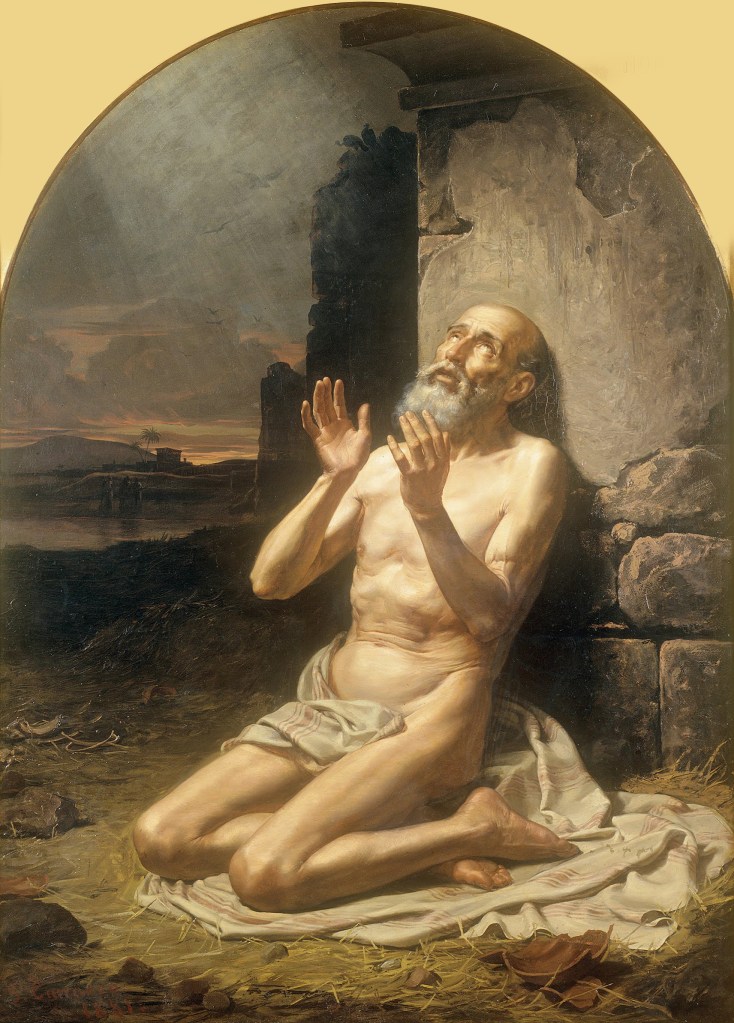
Larawan mula sa commons.wikimedia.org ng painting na “Job on the Dunghill” ni Gonzalo Carrasco ng Mexico noong 1881.
O Panginoong ko,
turuan mo ako na tularan
si Job na iyong lingkod,
tapat at walang pasubali
pananampalataya sa iyo;
katulad ni Job
ako man ay makadaing sa Iyo 
ng buong giliw at pagtitiwala 
sa dinaranas na hirap at hilahil;
katulad ni Job
ako man ay magsuri at magnilay
sa Iyong kadakilaang taglay,
magtanong at makinig,
manahimik at namnamin
kaysa Ikaw ay usisain;
katulad ni Job
mapagtanto ko mga
katanungan sa buhay ay
hindi tulad ng mga tanong sa paaralan
mga sagot ay kaagad matatagpuan
sa Google o sa computer 
o sa pormula ng matematika;
katulad ni Job
hayaan mo po ako na mabalot
ng Iyong hiwaga Panginoon
patuloy na tumugon sa 
maraming paghamon
na sa tamang panahon,
ako man ay makaaahon
matatag at dalisay
aking katauhan
matalik ang ugnayan
sa Iyo at sa kapwa nahihirapan;
katulad ni Job
mas nanaisin ko rin
na lumakad sa gitna ng dilim
hindi ka man tanaw ng aking paningin
basta Ikaw ang kapiling
kaysa tumahak sa huwad na liwanag
ng mundo, lugod at bisyo ang gusto!