Lord My Chef Recipe by Fr. Nicanor F. Lalog II
Holy Monday, 30 March 2026
Isaiah 42:1-7   +++   John 12:1-11
Photo by author, Sacred Heart Novitiate, Novaliches, QC, 20 March 2026.
Here is my servant
whom I uphold,
my chosen one with whom I am pleased,
upon whom I have put my spirit;
he shall bring forth justice to the nations,
not crying out,
not shouting,
not making his voice heard in street.
A bruised reed he shall not break,
and a smoldering wick he shall not quench...
(Isaiah 42:1-3).
Lord Jesus Christ,
our Suffering Servant,
let me be your servant too:
open my eyes
and free me from
whatever prison holding me
in darkness
like Judas
 your betrayer
at Bethany:
many times I break a bruised reed,
quenching a smoldering wick
by looking more at people
than seeing you in them,
counting things instead
of appreciating persons.
Jesus our Suffering Servant,
only you can bring peace
and justice in this world
troubled with wars waged
everywhere
but especially right in our hearts;
fill me with your Spirit
so I can love you more
and be loving like you
silently doing your work.
Amen.
Photo by author, Sacred Heart Novitiate, Novaliches, QC, 20 March 2026.
Lord My Chef Daily Recipe for the Soul by Fr. Nicanor F. Lalog II
Tuesday, Third Week in Ordinary Time, Year II, 27 January 2026
2 Samuel 6:12-15, 17-19     <*{{{{><  +++  ><}}}}*>     Mark 3:31-35
Photo by author, Sacred Heart Novitiate, Novaliches, QC, August 2017.
Your words today
are very interesting,
God our loving Father:
both the first reading and
the gospel show us a setting
of people gathered, inside and outside
a circle of crowd; but, what makes it
so interesting is the fact that more
than the location of being "inside"
and "outside" in any setting especially
in gathering and in coming to you,
what truly matters most is our action,
of what are we doing because many times,
we may be "inside" without doing your will
while be "outside" doing your will.
The mother of Jesus and his brothers arrived. Standing outside they sent word to Jesus and called him. A crowd seated around him told him, “Your mother and your brothers and your sisters are outside for you.” But he said to them in reply, “Who are my mother and my brothers?” And looking around at those seated in the circle he said, “Here are my mother and my brothers. For whoever does the will of God is my brother and sister and mother” (Mark 3:31-35).
Thank you dear Jesus
for coming to us,
bringing us closer to you,
to God our Father,
and most especially with everyone;
how sad at times when we
are seated right in your circle
yet too far from you and others
because we are away from your will,
from your very self, from your works;
it does not really matter wherever we
are seated but where we stand in you
and with you in doing the will of God.
Teach us to imitate King David
who rejoiced triumphantly in the
arrival of the Ark of the Covenant
where he was closest to God's presence
not because of the Ark but most because
of his care for the people around
to whom "he distributed to each man
and each woman in the entire multitude
of Israel, a loaf of bread, a cut of roast
meat, and a raising cake" (2Samuel 6:19).
Let us come
to you,
in you,
and through you, dear Jesus
in holy communion
welcoming everyone
with our loving service
so that no one may feel far
and outside from you
and one another.
Amen.
Lord My Chef Daily Recipe for the Soul by Fr. Nicanor F. Lalog II
Wednesday in the First Week of Advent, 04 December 2024
Isaiah 25:6-10     ><}}}}*> + ><}}}}*> + ><}}}}*>     Matthew 15:29-37
Photo by author, Pulong Sampalok, DRT, Bulacan, 22 November 2024.
Praise and glory to You,
God our loving Father
for this gift of Advent Season:
thank you in bringing us
to this brand new day
of salvation, of freedom,
of new life in Jesus;
most of all,
thank you for ending death
in Christ's advent.
On this mountain he will destroy he will destroy the veil that veils all peoples, the web that is woven over all nations; he will destroy death forever. The Lord God will wipe away the tears from all faces… (Isaiah 25:7-8).
Come to us this Advent,
dear Jesus and take away
all kinds of veils of selfishness
that cover and make us
unloving,
unkind, unmerciful,
unhappy...
set us free, Jesus,
free to love and serve
especially the sick and hungry;
set us free, Jesus,
this Advent to open our hearts
to bring out those treasures
You have filled us with like
goodwill and care for others
like the disciples in today's gospel.
Amen.
Photo courtesy of Our Lady of Fatima Tribune, 27 November 2024.
The Lord Is My Chef Daily Recipe for the soul by Fr. Nicanor F. Lalog II
Wednesday, Memorial of St. John of Capistrano, Priest, 23 October 2024
Ephesians 3:2-12     <*((((><  +  ><))))*>     Luke 12:39-48
Photo by author, Pampanga, September 2024.
Lord Jesus,
many times I find myself
like Peter asking You
so often with his same
question especially
when things get
so difficult,
so trying:
Then Peter said, “Lord, is this parable meant for us or for everyone?” And the Lord replied, “Who, then, is the faithful and prudent steward whom the master will put in charge of his servants to distribute the food allowance at the proper time? Blessed is that servant whom his master on arrival finds doing so” (Luke 12:41-42).
Forgive me, Jesus,
when there are times I exclude
myself from the rest,
when I exempt myself
from your teachings,
when I unconsciously demand
from You some perks
and privileges for following You;
let me be your faithful servant
who takes care of others
even if my other fellow servants
are remiss of their responsibilities
or worst when those You have
entrusted with authority
forget to be humble,
throwing their weight
around us,
insisting on their powers.
Give me the grace, Jesus,
to imitate St. Paul
of ably dispensing God's grace
and mystery of salvation
to everyone despite the
many hurts and pains
that often come with it.
Amen.
The Lord Is My Chef Sunday Recipe for the Soul by Fr. Nicanor F. Lalog II
Twenty-sixth Sunday in Ordinary Time, Cycle B, 29 September 2024
Numbers 11:25-29 ><}}}}*> James 5:1-6 ><}}}}*> Mark 9:38-43, 45, 47-48
Photo by author, ongoing works on the stained glass of the National Shrine of Our Lady of Fatima, Valenzuela City, 24 July 2024.
Our Sunday gospel is getting more exciting each week as Jesus gets closer to Jerusalem in fulfillment of His mission with His Passion, Death, and Resurrection.
One thing we see these past Sundays is how Mark followed a certain series of contrasts in the trajectory of his reportage. Note the contrasting scenes with every Sunday as we find today the Twelve appeared united as one unlike last week when they debated on the way who was the greatest among them.
More than that, Mark narrated today two strongly contrasting components of the Lord’s teachings to His disciples about discipleship and membership.
Photo by author in Magalang, Pampanga, 23 September 2024.
First is His tolerance on those who do good even though they do not belong to His fold, telling us to let everyone do what is good because no one has a monopoly of serving.
At that time, John said to Jesus, “Teacher, we saw someone driving out demons in your name, and we tried to prevent him because he does not follow us.” Jesus replied, “Do not prevent him. There is no one who performs a mighty deed in my name who can at the same time speak ill of me. For whoever is not against us is for us” (Mark 9:38-40).
Then in a sudden shift, Jesus severely criticized those who cause scandal, strongly urging His disciples including us today to totally eradicate whatever that leads us to sin and evil. Rejecting sin is discipleship in essence, not membership.
“Whoever causes one of these little ones who believe in me to sin, it would be better for him if a great millstone were put around his neck and he were thrown into the sea. If your hand causes you to sin, cut it off. It is better for you to enter into life maimed than with two hands to go into Gehenna, into the un quenchable fire. And if your foot causes you to sin, cut it off. It is better for to enter into life crippled than with two feet to be thrown into Gehenna. And if your eye causes you to sin, pluck it out. Better for you to enter into the kingdom of God with one eye than with two eyes to be thrown into Gehenna” (Mark 9:42-43, 45, 47).
Jesus teaching his Twelve Apostles, from GettyImages.
What a lively discussion the Twelve must have had that day with Jesus. This scene is a favorite of many Christians when discussing the scriptures, of how they are to be understood and interpreted with our ready excuses that Jesus did not literally mean what He said about cutting off our sinful hand or sinful foot and plucking out our sinful eye.
But, have we really reflected on its meanings and implications to our lives today?
Jesus reminds us this Sunday that discipleship is more than membership because in doing what is good, “the sky is the limit” so to speak. No disciple of Christ can lay claim to a monopoly in doing what is good, serving others; moreover, no disciple of Christ can belittle the good works of others even if they do not belong to the same religion or church.
Photo by author in Magalang, Pampanga 23 September 2024.
When our good deeds become “exclusive” and selective, then, that cease to be good.
Our ability to do good is always a grace of God, a gift poured out upon us by God daily so that we can be more loving and caring, more understanding and forgiving to one another. The moment we forget that, then, we start playing God.
In telling His disciples to let that man exorcize those possessed even he were not among the Twelve was clearly a command for us to recognize all who do good as brothers and sisters even if they do not necessarily share our beliefs and traditions. It is a call to respect one another.
Recall how in John’s gospel Jesus called Himself the Good Shepherd who has other sheep not in this fold. And we cannot deny that many times those who do not belong to our Church or group are doing better in serving others than us who are so entangled with bureaucracy and programs or procedures, not to mention fame and other selfish motives.
This attitude of having a monopoly of ministries and charities is one serious malady afflicting parishes today. Very often, the people with this attitude are the cordon sanitaire of priests who most likely are a Jollibee or a pabida since they were seminarians. They are the epal for short who volunteer in everything leaving nothing else for others to do, eventually spawning more pabida and epal in the church. Many parishioners refuse to serve not because they are lazy nor indifferent nor afraid but simply they are never given a chance to serve due to the monopolistic attitudes of some. It is a sad case of ministry and service based on membership than discipleship.
Photo by author in Magalang, Pampanga 23 September 2024.
Jesus is telling us this Sunday that there should be no divisions in doing good. Allow others to do good! Give them the chance to enter heaven too with their services and charities.
God wants us all to be “prophets” as explained by Moses to Joshua in the first reading when Meldad and Eldad prophesied even though they were not present in the Lord’s meeting tent. Moses rightly identified “jealousy” as one reason for such monopolistic attitude of good works by some believers.
Sin is the only obstacle in doing good, not membership. That is why, Jesus was severely stern in His words, telling how better it is for one causing others to sin to be thrown into the sea with a great millstone around one’s neck. Or, to cut off one’s hand or foot, and pluck out one’s eye that cause anyone to sin.
Photo by author at Fatima Ave., Valenzuela City, 25 July 2024.
If doing good were “sky is the limit” among disciples of Jesus, sin definitely has no room among us.
See how in this Sunday gospel Jesus implied to John and other disciples including us today of the grave sin of pride when we have that attitude of having a monopoly of good works, of relying more on membership than discipleship. It makes us proud and bloats our ego, leading us to more sins along the way until later on, we succumb to what the Greeks called as hubris.
That is why St. James in the second reading instructed us to examine our attitudes on social ills like poverty and inequality because wealth, like fame and glory, are always stained by sin.
A good disciple is always a good member of the Church – or any team and organization for that matter. Most of all, in our own family and circle of friends!
From Caesarea Philippi down to Capernaum that began three Sundays ago, Mark has continued to show us who Jesus really is, as the Christ who invites us with a personal answer to His same question to the Twelve, “who do you say that I am?” (Mk. 8:29).
The contrasts we found in Him today are not opposed to each other like His meekness with the sick and toughness with those who cause sin. Jesus is very open with anyone doing good, being kind and helpful but amid all these contrasts, He remains firm on His demands on discipleship rooted on His Cross, not just membership or being called a Christian.
When we look on His face, on His person, we find integrity and coherence, wholeness and holiness for Jesus is the Christ who had come to make us all divine, to become holy like Him “filled with His spirit” (Num. 11:29).Amen. Have a blessed week and October ahead!
Photo by Ka Ruben, the new stained glass at the National Shrine of Our Lady of Fatima, Valenzuela City, 13 September 2024.
The Lord Is My Chef Daily Recipe for the Soul by Fr. Nicanor F. Lalog II
Thursday in the Twenty-fourth Week of Ordinary Time, Year II, 19 September 2024
1 Corinthians 15:1-11     ><))))*>  +  <*((((><     Luke 7:36-50
Photo by author, St. Scholastica Spirtuality Center, Tagaytay City, 21 August 2024.
Praise and glory
to you, God our loving Father!
Thank you for your unending
gifts of grace for us
despite our many sins
and our being undeserving.

Truly like St. Paul,
we too feel so small,
"the least" for our so many sins
yet you never denied us with
that immense grace of
mercy and forgiveness,
redemption and new life in
Christ Jesus our Lord
that we so often forget.

Let us affirm
and be grateful
by cultivating this great grace
you have given us in Jesus
be who we are in your sight,
never making your grace "ineffective"
like the Pharisees in today's gospel
who could not stand
the sight of Jesus
interacting with a sinful woman,
of Jesus speaking to a sinner,
of Jesus forgiving so great a sin.
May we keep in our
heart and mind your tremendous
gift of grace to be near you,
to be like you,
to be filled with you
by living out your grace
in grateful witnessing
of loving and joyful service
to others.
Help us remember
that like in the Annunciation
to Mary, rejoicing and grace
are always together:
from the Greek words
charis for grace and
chara for rejoicing,
rejoicing and joy
are clearest signs of
grace anywhere
like that woman
who washed
and anointed
the Lord's feet.
Amen.
The Lord Is My Chef Daily Recipe for the Soul by Fr. Nicanor F. Lalog II
Monday, Sts. Cornelius, Pope, and Cyprian, Bishop, Martyrs, 16 September 2024
1 Corinthians 11:17-26, 33     <*((((><  +  ><))))*>     Luke 7:1-10
Photo by author, Alfonso, Cavite, 21 April 2024.
Therefore, my brothers and sisters, when you come together to eat, wait for one another (1 Corinthians 11:33).
Lovely words,
God our Father,
for this lovely,
cold Monday
of overcast skies
most likely with a lot of
rains ahead.
Wash us clean, O God,
with your rains of mercy
and wisdom:
it must be so easy to understand
what St. Paul meant that we
"wait for one another"
when we come to eat together
but that is exactly what has
become a rarity these days;
forgive us, Father,
for like the Corinthians
we have become like pagans,
so unChristian in our lives
especially at the Eucharist of
your Son Jesus Christ;
we no longer "wait"
for one another as in
we do not celebrate as one
due to factions and selfishness
that come in all forms;
we no longer "wait"
not serving each other
truly as brothers and sisters;
worst of all, we live for the
present moment alone,
being so unwise like unfaithful
servants not "waiting"
for Christ's return.
Let us "wait" for you,
Jesus, like the people in
Capernaum:
the locals "waiting" for the
centurion as they "strongly urged" you
to help him because of his kindness
to Jews; lovely was how
the centurion "waited"
for you, sending emissaries
asking you Jesus for the healing
of his slave; but, most wonderful of all,
was the centurion's faith in you, Lord
as he described how his slave
faithfully "waited" on him,
prompting him to tell you:
“Lord, do not trouble yourself, for I am not worthy to have you enter under my roof; but say the word and let my servant be healed. For I too am a person subject to authority, with soldiers subject to me. And I say to one ‘Go’, and he goes; and to another, ‘Come here,’ and he comes; and to my slave, ‘Do this,’ and he does it” (Luke 7:6, 7-8).
Indeed, dear Jesus,
to "wait" is to serve;
to "wait" is to be one
with others and with you;
to "wait" to find myself always
not worthy to receive you
but you chose to "wait" for us
in the Cross
with your words of mercy
and forgiveness
that we are all healed,
we are saved.
Pray for us,
holy martyrs Pope Cornelius
and Bishop Cyprian
who both waited faithfully
for their flock
especially those who have
lapsed in faith,
those who have sinned
and erred.
Amen.
The Lord Is My Chef Daily Recipe for the Soul by Fr. Nicanor F. Lalog II
Friday, Memorial of St. John Chrysostom, Bishop & Doctor of Church, 13 September 2024
1 Corinthians 9:16-19, 22-27     <*((((><  +  ><))))*>     Luke 6:39-42
Photo by Mr. Jim Marpa, 2018.
Lord Jesus Christ,
help me be like St. Paul,
a man truly free:
free from slavery of sin,
free from selfishness,
free from what others may say
so that I may be truly
free to love,
free to serve,
free to be my true self.
Although I am free in regard to all, I have made myself a slave to all so as to win over as many as possible. I have become all things to all (omnia omnibus), to save at least some. All this I do for the sake of the Gospel, so that I too may have a share in it (1 Corinthians 9:19, 22-23).
In a world when most people
insist on their rights,
you teach us Lord through St. Paul
that inasmuch as the Church is the
your Body, then being a slave to others
is actually the path to true freedom,
making no room for anyone to insist
on his or her rights superseding
the common good;
most of all, in becoming
all things to all men like St. Paul,
then we acknowledge that
the strong and powerful
 must take into consideration
the needs of the weak and powerless;
forgive us, Jesus,
for blindly leading others
to doom and more darkness;
forgive us, Jesus,
for always seeing defects of others
without recognizing our own;
cleanse us with your words
like St. John Chrysostom
who wrote us in one of his letters
on the way to his exile,
"Distance separates us,
but love unites us,
and death itself cannot divide us.
For though my body die,
my soul will live and
be mindful of my people."
Amen.
The Lord Is My Chef Daily Recipe for the Soul by Fr. Nicanor F. Lalog II
Friday in the Twenty-Second Week of Ordinary Time, Year II, 06 September 2024
1 Corinthians 4:1-5     <*((((><  +  ><))))*>     Luke 5:33-39
Photo by author, 15 August 2024.
Thank you,
our loving Father
for another week about to close;
thank you dear God
for this first Friday
in September 2024:
despite the rains and the floods
and the inconveniences
these have brought,
thank you for a new beginning
today.
Let us celebrate this gift
of life you have given us
by putting on a new attitude,
a new disposition,
a new outlook in life
for you have made everything new
in Jesus Christ.
And he also told them a parable. “No one tears a piece from a new cloak to patch an old one. Otherwise, he will tear the new and the piece from it will not match the old cloak. Likewise, no one pours new wine into old wineskins. Otherwise, the new wine will burst the skins and it will be spilled, and the skins will be ruined. Rather, new wine must be pured into fresh wineskins” (Luke 5:36-38).
Make us your trustworthy
stewards of your mysteries, Lord;
make us truly your servants
who shall reveal your many
mysteries of life and death,
of joy and sufferings,
of poverty and wealth,
of fruitfulness and fulfillment,
of redemption and forgiveness
be known in our life of witnessing
without any regard for fame
nor popularity except that
we do your work in Jesus faithfully.
Amen.
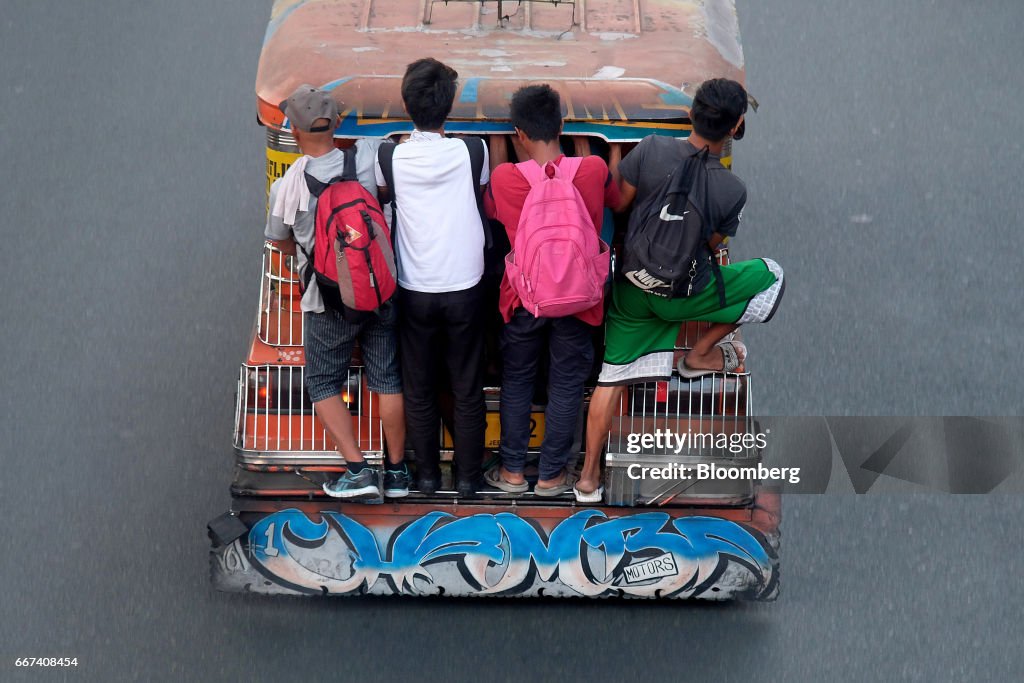
Lawiswis ng Salita ni P. Nicanor F. Lalog II, Ika-01 ng Mayo 2024
Mga pasaherong nakasabit sa PUJ, kha ni Veejay Villafranca ng Bloomberg via Getty Images, Abril 2017.
(Isang tula aking nakatha
sa inspirasyon ni Fr. Boyong
sa pagninilay ng Araw ni San Jose, Manggagawa.)
Ngayong araw ng mga manggagawa
ano nga ba aming ginagawa
bilang halimbawa ng kabanalan
at kabutihan sa paghahanap ng saysay
at katuturan nitong buhay?
Kay saklap isipin
walang kapagurang kayod
ng karamihan habang kanilang
sinusuyod alin mang landas
maitaguyod lamang pamilyang
walang ibang inaasahan,
naghihintay masayaran mga bibig
ng pagkaing kailangan
di makapuno sa sikmurang
kumakalam
habang mga pari na nasa altar
namumuwalan mga bibig sa lahat ng
kainan at inuman,
tila mga puso ay naging manhid
sa kahirapan ng karamihan!
"Samahan mo kami, Father"
sabi ng Sinodo na simula pa lamang
ay ipinagkanulo nang paglaruan
mga paksa sa usapan
tinig at daing ng bayan ng Diyos
hindi pinakinggan
bagkus mga sariling interes
at kapakanan, lalo na kaluguran
siyang binantayan
at tiniyak na mapangalagaan
kaya si Father nanatili sa altar
pinuntahan mayayaman
silang pinakisamahan
hinayaan mga kawan hanapin
katuturan ng kanilang buhay.
Aba, napupuno kayo ng grasya
mga pari ayaw na ng barya
ibig ay puro pera at karangyaan
mga pangako ay nakalimutan
kahit mga kabalastugan papayagan
puwedeng pag-usapan
kung kaharap ay mayayaman
pagbibigyan malinaw na kamalian
alang-alang sa kapalit na ari-arian
habang mga abang manggagawa
wala nang mapagpilian kungdi
pumalakpak at hangaan kaartehan
at walang kabuluhang pananalita
ni Father sa altar, kanyang bokasyon
naging hanap-buhay.
San Jose, manggagawa
ipanalangin mo aming mga pari
maging tulad mo,
simple at payak upang
samahan aming mga manggagawa
sa paghahanap
ng kahulugan ng buhay
kapiling nila.
Amen.








 lordmychef.com