Lawiswis ng Salita ni P. Nicanor F. LaLog II, 18 Pebrero 2020
Larawan kuha ng may-akda sa Mt. St. Paul, Trinidad, Benguet, 05 Pebrero 2020.
Buhat nung isang gabi
hindi ako mapakali
nang si Hesus ay hindi makapagtimpi
napabuntung-hininga ng malalim
nang makipagtalo sa kanya
mga Pariseo humihingi ng tanda
na siya nga ang Kristo.
Hindi ba turo ng matatanda
hanggang ngayon siyang laging paalala
masama magbuntung-hininga
na tila baga wala ka nang pag-asa?
Gayun pa man maski ito ay ating alam
madalas hindi natin mapigilan
kapag nahihirapan at nabibigatan.
Katulad natin marahil
si Hesus napupuno na rin:
nagbubuntung-hininga,
humuhugot ng kabutihan
sa kanyang kaibuturan
upang malampasan
mga kasamaan ng kalaban.
Iyan ang kabutihan
magandang kahulugan
nitong pagbubuntung-hininga
na pilit tinatanggihan, di naman maiwasan
dahil ating nang nakagawian
pumaloob sa kaibuturan
kaysa makipag-awayan
Hindi kaduwagan
bagkus katapangan kung minsan
dahil iyong sinasaalang-alang
katiwasayan ng ating mga ugnayan
kaya pilit sinisisid, sinasaid kabutihan
doon sa kalaliman ng kalooban
kung saan nanahan Panginoon ng Kapayapaan.
Larawan kuha ng may-akda, Poblacion ng Los Baños, Laguna, 13 Pebrero 2020.
The Lord Is My Chef Sunday Recipe for the Soul, Week VI-A, 16 February 2020
Sirach 15:15-20 ><)))*> 1 Corinthians 2:6-10 ><)))*> Matthew 5:17-37
Photo by author of pilgrims entering the Church of the Beatitudes with a painting of the Sermon on the Mount above the door, May 2019.
Jesus continues his Sermon on the Mount this Sunday, expounding the meaning of his teachings called the Beatitudes. As we have reflected last week, the Beatitudes tell us the person of Jesus Christ as being “poor, merciful, clean of heart” whom we must all imitate to become the salt and the light of the world.
Most important of all, Matthew presents to us at the Sermon on the Mount that Jesus is more than the new Moses as giver of laws like at Mt. Sinai in the Old Testament: Jesus himself is the Law, who is both our Teacher and Redeemer.
This we see in his teachings today when he claims to be the fulfillment of the Laws and the Prophets from God in the Old Testament.
Jesus said to his disciples: “Do not think that I have come to abolish the law or the prophets. I have come not to abolish but to fulfill it. Amen, I say to you, until heaven and earth pass away, not the smallest letter or the smallest part of a letter will pass from the law, until all things have taken place.”
Matthew 5:17-18
Essence of the Laws: reflection of God, the good of man
Today, Jesus is teaching us to see the laws in the right perspectives, in the light of the will of God for the good of every person. Throughout his ministry, Jesus has always been consistent in reminding everyone that the laws were made for man, not the other way around.
During Christ’s time, people have lost the real meaning of the Commandments of God as priests and religious leaders focused more on its letters than in its essence and spirit that in the process, the laws have become burdensome. It has continued in our own generation with laws taking precedence over God and persons.
Photo by author of the Church of the Beatitudes at the Holy Land, May 2019.
At the Sermon on the Mount, we find Jesus restoring and recalibrating the laws so that these become more relevant and powerful as reflections of God in the service of man.
Jesus “relectures” us the laws in this part of his Sermon on the Mount by adding more righteousness (holiness), declaring that,
“I tell you, unless your righteousness surpasses that of the scribes and Pharisees, you will not enter the kingdom of heaven.”
Matthew 5:20
By using a pattern where he would cite Laws, saying, “You have heard that it was said”– Jesus shows us his fidelity and obedience to Judaism, contrary to his enemies’ accusations that he had abolished their laws. Moreover, in fulfilling the laws, Jesus put himself in the midst of every law and precept by declaring, “Amen, I say to you” or “but I say to you”.
In following that formula, Jesus gave the laws with a human face and a human heart in himself as its fulfillment so that from then on at his Sermon on the Mount, Christ made every law, every tradition, everything else to be seen always in his person.
Black and white photo by Mr. Jay Javier in Quiapo, 09 January 2020.
Performative powers of the laws in Jesus Christ
With Jesus in the midst of every law and precept as its fulfillment, God’s laws then become not only informative but most of all, performative to borrow one of Pope Emeritus Benedict XVI’s favorite expression. This we find Jesus teaching us in three stages in our long gospel this Sunday.
Education of the heart.
The first two laws cited by Jesus in this long list of commandments are “You shall not kill” and “you shall not commit adultery”. Both laws bring us to the very core of our personhood, of what is in our hearts and in our minds. The Lord explains that being angry as well as saying bad words against another person is like murder while looking lustfully at a woman is a form of adultery because in both cases, we have ceased to regard the other individuals as persons to be loved and respected, created in the image and likeness of God.
From Google.
It is an invitation for us to purify our hearts and minds for what defiles man is not what enters him but what comes out from him (Mt.15:11). Whatever is within us will always have an effect in all of our actions, for better or for worse.
What a tragedy that right here in the middle of our wired world of social media and instant communications, we have actually grown apart than together in the last 35 year with so much animosities fed on by lies and misinformation.
How ironic also that despite the information explosion from the Net, we have more benighted souls today than ever before who have actually gone to schools who know nothing of our history and geography?!
Education of the heart is formation of the whole person, not just a training of skills. One problem we have these days is when information is geared on data and facts without integration that we forget our relationships as well as the values we keep like respect, kindness, and dedication. Unless we have an education of the heart, a wholistic and integral formation, we can never be transformed into like Jesus Christ.
2. Get into the roots of our sins.
In telling us to pluck out our right eye or cut off our right hand if these cause us to sin, Jesus is inviting us again to probe deep into our hearts and being to understand what causes us to sin.
Photo by author, water plants in my room at the Fatima Parish and National Shrine, Valenzuela City, 2010.
The key here is to be totally free. In the first reading, Ben Sirach counsels us to “choose” rightly what is good and avoid what is evil.
We can only exercise our true freedom when we have clearer knowledge and understanding of ourselves and of things within us. We fall into vices and sins because we do not know what is going on inside us; hence, we are enslaved by our desires and sins to be not free at all.
Once we understand our sins, we commit them less often. Most of all, when we understand our sins, our struggles against committing these become more persevering, resulting to more triumphs than defeats.
The Season of Lent is near. Once again, we shall be busy with fasting and abstinence, contrition and confession of sins, almsgiving and other spiritual works that make us holy. But too often, these acts become mechanical that sooner, we sometimes reach that point when we cannot find meaning in doing them anymore that we sink deeper into sins and evil.
This happens when we get focused with letters of the laws and we forget its spirit that we become mechanical because we have failed to understand our very selves as well as our sins.
3. Be true.
Jesus said it perfectly well at the end of his teachings today,
“Let your ‘Yes’ mean ‘Yes’ and your ‘No’ mean ‘No.’ Anything more is from the evil one.”
Matthew 5:37
In this last installment of reviewing the laws, Jesus underscored the problems with divorce as well as with lies that continue to this day because we always choose not to be true at all with ourselves, with God, and with others.
Photo by author of the last two Stations of the Cross at the chapel of my niece Ms. Babs Sison in Los Baños, Laguna 13 February 2020.
See the wisdom of Jesus in putting together divorce and oaths, the two great lies that until now continue to mislead so many among us who refuse to accept and carry the cross of Christ, preferring only the Easter Sunday minus the Good Friday.
Being true is embracing the Cross of Jesus Christ like St. Paul in the second reading. It is something we cannot deny in this life. There will always be pain and sufferings. As Dr. Scott Peck put it in his book The Road Less Travelled, “life is difficult.”
At his Sermon on the Mount, Jesus clearly showed in his Beatitudes that he and his values are in sharp contrast to the wisdom of the world. And this wisdom is only accessible to those willing to embrace the crucified Christ and the scandal of the cross.
It is there on the Cross with Jesus Christ we truly find the fulfillment of the laws as well as our fullness as persons. Amen.
Quiet Storm by Fr. Nick F. Lalog II, 13 February 2020
Photo by author, Mt. St. Paul, Trinidad, Benguet, 04 February 2020.
At the Ascension of the Lord, St. Luke tells us something very unique and unusual: the disciples returned to Jerusalem filled with joy.
Unusual and unique because when someone leaves us, either permanently like death or temporarily due to change of residence or jobs, we always feel sad.
But not the Apostles of Jesus along with the other disciples including Mary who were filled joy!
And so are we today because when someone dies, the person or our beloved does not leave us entirely. Though we do not see and feel them physically anymore, we continue to experience them personally.
Sometimes, we even grow more personal that there are people we feel getting closer with them after they have died.
Photo by author, Mt. St. Paul, Trinidad, Benguet, 05 February 2020
As I have been telling you, 2020 for me is tough with so many deaths in our Parish, in my family, and among my friends. Since last week of Christmas until the other week, I have been praying and celebrating funeral Masses almost everywhere.
This week, funeral Masses continue while at the same time, I have started celebrating the 40th days of those relatives and friends who have died last month.
In 1995, my father’s younger sister was stricken with pancreatic cancer. Being the eldest at that time among his nine surviving siblings, another aunt called me to ask my dad’s decision regarding their sick sister, if she would still go through surgery and just go home to Los Banos and wait for the inevitable.
He simply told me, “tell your Tita to just bring home Tita Rose; she had suffered enough and had lived a full life.”
Photo by author, Los Banos, Laguna, 13 February 2020.
That is when I realized that coming to terms with death iscoming toterms with life, and vice versa.
I know it is easier to say but that is how life is: we are often afraid to die because we know we have not fulfilled something yet, a mission or a promise made.
People who enjoy life, people with a sense of contentment are always the ones without regrets, always fulfilled, and ready to go.
And always, they are the ones who truly love that is why they live fullest, Valentine’s day or not.
God bless you and keep loving!
Photo by author, Collegeville Subd., Los Banos, Laguna, 13 February 2020.
Thank you for coming to us, Lord Jesus Christ, to save us, to cleanse us of our sins. What a tremendous grace and gift from you who are sinless to own up and wash away our sins!
Long before Mari Kondo had come advocating decluttering and tidying our homes, you were there first, O Lord, spiritually cleansing us, our inner selves in order to experience your peace and wisdom like King Solomon.
What must have impressed the Queen of Sheba in meeting King Solomon was more of his inner peace and stability, sincerity and honesty in answering all her questions: he was not hiding anything negative inside himself as he exuded with positive vibrations.
Precisely what Jesus was telling the people of his time and us today:
“Hear me, all of you, and understand. Nothing that enters one from outside can defile that person; but the things that come out from within are what defile… From within the man, from his heart, come evil thoughts, unchastity, theft, murder, adultery, greed, malice, deceit, licentiousness, envy, blasphemy, arrogance, folly. All these evils come from within and they defile.”
Mark 7:14-15, 21-23
From Google.
Cleanse our hearts, our inner selves, Lord Jesus Christ.
Please do some spiritual “Mari Kondo-ing” into our souls to discard all filth and negative vibes we have been senselessly keeping, even nurturing, holding on in the hope of avenging for the wrongs done against us.
Cleanse us inside, Lord, so we may be filled with your light of reason and sparks of joy. Amen.
Lawiswis ng Salita ni P. Nicanor F. Lalog II, Ika-11 ng Pebrero 2020
Larawan kuha ni G. Jay Javier, 09 Enero 2020 sa Quiapo, Maynila.
Deboto ang tawag sa isang tao
na malapit at namimintuho
Kay Kristong Nazareno o Sto. Niño
kasama na mga Santo at Santa
sa pangunguna ng Birheng Maria.
Kaya dapat bawat deboto totoo
uliran at huwaran sa pamumuhay
taglay ay kabanalan nang sa kanya'y
mabanaagan larawan ng kabutihan
ng Diyos sa kanyang kadakilaan.
Kay laking katatawanan at kahangalan
kung ang debosyon ng sino man
ay haggang simbahan lamang
nakikita paminsan-minsan
tuwing kapistahan at mga prusisyon sa lansangan.
Larawan kuha ni G. Jay Javier, 09 Enero 2020 sa Quiapo, Maynila.
Anong kahulugan at saysay
ng mga pagpupugay
sa Diyos at kanyang mga banal
kung sa kapwa nama'y manhid
walang malasakit at pakialam?
Nag-aalaga ng mga Poon
binibihisan tila laruan
ngunit pag-uugali at katauhan
malayo sa katuwiran at katarungan
ganyang debosyon dapat tigilan!
Ang tunay na deboto
puso ay malapit kay Kristo
at sa kanyang Ina at mga Santo
may pagmamahal, malasakit
sa kapwa tao na kanyang nirerespeto.
Larawan kuha ni G. Jay Javier, 09 Enero 2016 sa Quiapo, Maynila.
Ano mang debosyon
iyong nakagawian o nakahiligan
araw-araw itong sinasabuhay
pinaninindigan at tinutularan
aral at buhay ng sinusundang banal.
Sa dami ng mga deboto
bakit ganito pa rin tayo
walang pag-asenso
buhay ay kasing gulo
ng eksena sa senakulo.
Ay naku!
Ano nga ba tayo,
mga deboto o debobo
asal demonyo, sobrang gulo
pinapako nating muli si Kristo!
The Lord Is My Chef Recipe for the Soul, Sunday Week V-A, 09 February 2020
Isaiah 58:7-10 ><)))*> 1 Corinthians 2:1-5 ><)))*> Matthew 5:13-16
Our parish cross at night, taken with my camera phone, 02 February 2020.
For most of us, 2020 is a very tough year with all the dark clouds that have come to hover above us in January remain in this month of February.
Threats from the corona virus are growing especially in our country. And while the alert level at Taal Volcano had gone down, dangers of its major eruption remain while volcanologists observed last week a “crater glow” on Mayon Volcano, indicating a possible rising of magma in the world’s most perfect cone.
Elsewhere, more bad news are happening like the sudden deaths this week of healing priest Fr. Fernando Suarez and of our very own and beloved Fr. Danny Bermudo, just 24 hours apart due to heart attacks.
In our own circles of family and relatives, friends and colleagues are also dark clouds covering us while we go through our many trials and tests in life that seem to eclipse this early the many gains we have achieved in the whole of 2019.
Indeed, year 2020 shows us in “perfect vision” the sad realities of dark spots in life that behoove us more to heed Christ’s call to be the light of the world.
Jesus said to his disciples: “You are the light of the world. Just so, your light must shine before others, that they may see your good deeds and glorify your Heavenly Father.”
Matthew 5:14, 16
Photo by author, frost on petals, Baguio City, 04 February 2020.
Jesus is the light of the world, not us
Our gospel this Sunday follows immediately the inaugural preaching of Jesus called “the Sermon on the Mount” with the Beatitudes at its centerpiece. We have skipped that part of the gospel last Sunday due to the celebration of the Feast of the Presentation of the Lord.
For us to better appreciate this Sunday’s gospel, let us keep in mind that for Matthew, the Sermon on the Mount is the great discourse of Jesus Christ that depicts his image not only as the new Moses but as the Law himself, being both our Teacher and Savior as well.
Jesus shows us a picture of his person in the Beatitudes as someone we must imitate in being “poor in spirit, meek, and merciful” so we can follow his path to the Father. After all, as the Son of God, Jesus is “the way, the truth, and the life” (Jn. 14:6).
Hence, after enumerating the nine Beatitudes, Jesus followed up his Sermon on Mount with a call for us to be the salt and the light of the world: as salt, we merely bring out the Christ or the taste in every person and as light, it is the light of Christ that we share.
Focus remains in being like Jesus, not in replacing him who is our Savior. That is why he tells us clearly before shifting to another lesson in his Sermon that “your light must shine before others, that they may see your good deeds and glorify your Heavenly Father” (Mt.5:16).
Sharing Christ’s light with our good deeds as a community
So, how do we share the light of Jesus Christ in this age when so many others are claiming to be the light that will dispel all darkness in our lives?
As early as during the darkest period in the history of Israel in the Old Testament called the “Babylonian Captivity (or Exile)”, God had taught his people how to become light for one another during trials and sufferings.
Christ Light of the World, Red Wednesday, 27 November 2019. Photo by author.
Thus says the Lord: Share your bread with the hungry, shelter the oppressed and the homeless; clothe the naked when you see them, and do not turn your back on your own. Then your light shall break forth like the dawn… if you bestow your bread on the hungry and satisfy the afflicted; then light shall rise for you in the darkness, and the gloom shall become for you like midday.
Isaiah 58:7-8, 10
To share one’s bread with the hungry, to welcome the homeless, to clothe the hungry are some of the most concrete demands placed by God to his people since he had freed them from slavery in Egypt and later in Babylonia (Iraq today) when the third part of the Book of Isaiah was written.
Eventually, this prophecy was fulfilled in Jesus Christ who also preached exactly the same things shortly before fulfilling his mission in Jerusalem when he stressed the need to do good to one another because “whatsoever we do to one another, especially to the least among us, we also do unto him” (Mt.25:31-40).
We shall hear this part of Matthew’s gospel at the end of our current liturgical year on November 22, 2020 in the celebration of the Solemnity of Christ the King.
These instructions became the basis of our catechism’s “spiritual and corporal works of mercy” that Pope Francis stressed in 2016 during the Extraordinary Jubilee of Mercy.
From fathersofmercy.com
By saying “you are the light of the world”, Jesus is telling us that to fulfill this mission, we have to do it together as a community, as his Body, the Church!
No matter how good and holy we are, none of us is the “light of the world” on our own.
One candle or lamp, or even a light bulb today cannot produce enough light to brighten a whole town or community. But, if one Christian will be lighting just one little candle in the dark, he or she can encourage others especially those who are timid, hesitant, and indifferent until they finally set the world ablaze with Christ’s light.
Christ’s call to be the light of the world is also a call for us to be united as one community, one family, one faithful couple with all our imperfections and sinfulness. What matters is our striving to be good disciples, always charitable to one another as brothers and sisters in Christ.
Here we find the direct relationship of mission and community: every mission given by Jesus is also a call to become a community because without it, it soon becomes a cult centered on the disciple than the Lord.
Photo by Mr. Jim Marpa, 2018.
The example of St. Paul in sharing Christ’s light
St. Paul shows us the best example of being a light of Jesus is to always have it done and fulfilled in the context of a community, of the Church as the Body of Christ, avoiding chances of grabbing the light from him for personal gains.
“I came to you in weakness and fear and much trembling, and my message and my proclamation were not with persuasive words of wisdom, but with a demonstration of Spirit and power, so that your faith might rest not on human wisdom but on the power of God.”
1 Corinthians 2:3-5
It has always happened especially for us serving in the Church that in sharing the light of Christ, we get carried by our ministry and apostolate that we forget him until we claim being the light ourselves.
Sometimes, we consciously or unconsciously create clouts and personality cults for ourselves for being the best, the brightest, even the holiest and most humble of all!
We foolishly brag the great buildings and edifices we have built or the countless malnourished kids we have fed or sent to school for free through college, et cetera, et cetera, et cetera without being bothered at all where is Jesus Christ in all our efforts and projects!
How sad when we forget that what matters most in life is not what we have done or what we have achieved but what have we become as bearers of the light of Christ like St. Paul.
My dear friend, if you are going through many darkness in life today, simply be good, think only of Jesus Christ in everybody you meet and deal with. That is actually when you shine brightest as the light of Christ because people will be surprised at how calmly and gracefully you carry your cross.
In that way, you encourage others living in darkness to let their little sparks of light come out too without realizing how in their own darkness and limitations they have made Christ’s light seen. Amen.
Have a bright and blessed Sunday with your loved ones!
The thing we dearly miss in Baguio is the beautiful scenery now marred by houses and buildings sprouting everywhere that pose grave risks to lives in case of calamities.
O God our Father, you are so loving and merciful. You have only one desire for each one of us to be fulfilled in life that you always insist on our obedience and fidelity to you.
One thing we fail to see is the reality of evil that is sin found actually within each one of us, not from without or outside of us. Worst part of sin is how we kind of “assert” its reality in the world through us!
In the first reading, you have given David three options to choose from as his punishment for his grave sin (again) in ordering a census of Israel; he chose pestilence than fall into the hands of his enemies as well as three years of pestilence in his kingdom.
But upon seeing the severity of the pestilence that happened during the wheat harvest, David felt so sorry for his people. Most of all, so guilty of his sin. Just like us whenever we commit grave sins, when we never think of its serious repercussions on others, especially those dearest to us.
When David saw the angel who was striking the people, he said to the Lord: “It is I who have sinned; it is I, the shepherd, who have done wrong. But these are sheep; what have they done? Punish me and my kindred.”
2 Samuel 24:17
In the gospel, we also find ourselves among the town folks of Jesus Christ who “took offense at him” (Mk.6:3) that he was not able to perform any mighty deed there because of their lack of faith.
Yes, Lord Jesus, the problem is with us, not with you.
We are the ones who always make life so miserable and unbearable for us and for others because of our sinfulness.
Forgive us, Lord, for those many times when we were so absorbed with our selves that we totally ignored those around us who have to suffer the consequences of our sins.
Today we pray for the gift of sensitivity and consideration for others. Amen.
Quiet Storm by Fr. Nick F. Lalog II, 04 February 2020
Photo by author, St. Paul Spirituality Center, Mt. Pico, La Trinidad, Benguet, 04 February 2020
My life may be rife
with so many strifes
causing me to struggle,
be pained leading into fruition
making life golden.
When I reviewed my life and see
the past so vast and also fast,
then I realize my life
is not all mine but His, Divine.
Here in my life
I can see within
where it is going;
calming, assuring and so promising
the Divine leading me to final joining
for my life is really in HIM.
Amen.
Photo by author, St. Paul Spirituality Center, Mt. Pico, La Trinidad, Benguet, 04 February 2020
Quiet Storm by Fr. Nick F. Lalog II, 03 February 2020
Detail of the Presentation painting by Italian artist Andrea Mantegna (1431-1506) with Mary handing the Child Jesus to Simeon at the temple of Jerusalem (man at the middle Mary’s husband, Joseph).
As we come to close today’s Feast of the Presentation of the Lord, I wish to share with you a Quiet Storm brewing within me which I call “the Nunc Dimittis experience”.
Nunc dimittis is the Latin opening line of Simeon’s Canticle that says “Now you dismiss” when he was filled with joy by the Holy Spirit upon meeting our Lord and Savior on his presentation at the temple.
According to St. Luke’s account, God had promised Simeon that “he would not see death before he had seen the Christ of the Lord” (Lk. 2:26). Hence, the overflowing joy of Simeon when he finally met the Child Jesus at the temple 40 days after Christmas!
Part of St. Luke’s artistry in his Christmas story is to put songs on the lips of some of its important characters to express their profound joys in their unique experiences of the coming of Christ.
The Nunc Dimittis is the fourth canticle in the Lucan Christmas story: first is Mary’s Magnificat when she visited her cousin Elizabeth who was six months pregnant with St. John the Baptizer; second is the Benedictus by Zechariah when he regained his speech after naming his son John; and third is the Gloria sang by the angels when Christ was born in Bethlehem.
Of these four canticles recorded by St. Luke, Simeon’s Nunc Dimittis sounds the highest level of all, the fulfillment of time within each one of us when we personally recognize and meet Jesus the Christ our Savior like Simeon.
And so often, when we are overjoyed in experiencing Jesus Christ, that is also when we feel like saying “now I am ready to go, ready to die” exactly like Simeon because we have met the Lord.
That is why I call it “the Nunc Dimittis experience”: real joy can only come from that experience and intimacy with Jesus Christ, when we feel so close with him. It does not really matter whether we experience him here in this life or hereafter. What matters most is we feel so close with him, as if embracing him, here and now.
This may be a religious experience like after listening to a homily that really touched us, or after a good confession, or while attending a wonderful retreat or recollection. It may also happen when we feel so loved and accepted, when we are vindicated, or when assured of support and trust and confidence while going through difficult trials in life.
Our Nunc dimittis experience always comes at the end of each day, when we feel despite our failures and shortcomings, we are in God’s loving presence.
Simeon’s Canticle, our Night Prayer
Since the early sixth century during the time of St. Benedict, the “Nunc Dimittis” has been sung in the monks’ night prayer or “compline” from the Latin completorium or completion of the working day. Eventually, it was adopted into the Liturgy of the Hours or the prayers of the Church usually recited by priests and religious. (St. John Paul II had suggested in his encyclical Novo Millennio Innuete after the Great Jubilee of 2000 that the lay faithful also pray the Liturgy of the Hours.)
After the praying of the psalms and meditation of the Sacred Scriptures, there is a Responsory that declares, “Into your hands, Lord, I commend my spirit.” Like Jesus before he died on the Cross, we offer to God our very selves. This is takes on a beautiful dimension especially if we have done a good examination of conscience at the start of the compline, before the psalms and readings.
Then, we recite the antiphon that introduces the Nunc dimittis: “Protect us, Lord, as we stay awake; watch over us as we sleep, that awake, we may keep watch with Christ, and asleep, rest in his peace.”
The antiphon in itself is already a prayer!
It is after the antiphon that we chant or recite Simeon’s Canticle:
Lord, now you let your servant go in peace; your word has been fulfilled: my own eyes have seen the salvation which you have prepared in the sight of every people: a light to reveal you to the nations and the glory of your people Israel.
From the Compline of the Breviary
The antiphon is repeated and immediately followed by the Closing Prayer.
The cross atop our parish church at night with the moon above taken with my iPhone camera, 02 February 2020.
Capping the compline is the blessing at the end that says: “May the all-powerful Lord grant us a restful night and a peaceful death. Amen.”
Usually, a hymn to Mary is sung, then all the lights are turned off and the great silence (magnum silencium) begins until the morning prayers or lauds (Latin for praise).
See how our night prayer or the compline is oriented towards meeting God, or to put it bluntly, towards death.
Yes, it is always easy to say we are ready to die. It is a lot whole different when we are already face to face with death itself.
But, when we come to think of it, we realize that indeed, in death, “there is nothing to fear but fear itself”.
When we die, everything happens so fast. We may not even feel anything at all. And unknown to us, every night when we go to sleep, we rehearse our death, so to speak!
And what a tremendous joy to keep in mind how every night, the Lord fills us with joy and faith within us even if we often forget him. Every night when we sleep, it is automatic within us to entrust everything to God “unconsciously” without even thinking we may never wake up!
It is a “Nunc Dimittis” experience too because most of us go to bed filled with joy, full of hope the following morning would be a better day than today. And that is Jesus still coming to us at the end of the day to assure us of his love and concern, never bothering us at all of this tremendous grace gratuitously given to us.
Next time you sleep, remember how blessed you are to have come to the end of another day, blessed and loved.
Pray, and start experiencing Jesus more from the beginning to the end of each day and forevermore. Amen.
Isaiah 42:1-4, 6-7 ><}}}*> Acts 10:34-38 ><}}}*> Matthew 3:13-17
From Google.
Today is our “holy birthday” as children of God, the Feast of the Baptism of Jesus. That explains the sprinkling of Holy Water at the start of our Mass to remind us of continuing the Christmas story the whole year through as sons and daughters of God.
With this feast, we close the Christmas Season by celebrating the great mystery of Christ’s Nativity when he became human like us so that we can become divine like him as children of the Father in heaven.
Jesus came from Galilee to John at the Jordan to be baptized by him. John tried to prevent him, saying, “I need to be baptized by you and yet you are coming to me?” Jesus said to him in reply, “Allow it now, for thus it is fitting for us to fulfill all righteousness.” Then he allowed him. After Jesus was baptized, he came up from the water and behold, the heavens were opened for him, and he saw the Spirit of God descending like a dove and coming upon him. And a voice came from the heavens, saying, “This is my beloved Son, with whom I am well pleased.”
Matthew 3:13-17
We are the children of God
Sunrise at Atok, Benguet. Photo by Ms. Jo Villafuerte, September 2019.
Every morning when we wake up, the same thing happens with us with Jesus at Jordan: as we arise whether filled with joy or saddled with so many pains and worries from the previous day or night, Christ joins us in every brand new day as his brother and sister in the Father.
Despite all our anxieties and fears with every new day of work and school, the heavens open and the Holy Spirit comes down to us with our Father in heaven declaring to all his creation, “This is my beloved child, with whom I am well pleased.”
That is the mystery of Christmas we must celebrate daily when Jesus became human like us in everything except sin. In Baptism, we have become sons and daughters of the Father in his Son Jesus Christ our Lord through the power of the Holy Spirit.
That coming down of Jesus to John to be baptized in Jordan is the message of Christmas, of how God became human like us to be one with us in our dirt and stain so he may cleanse us in his Passion and Death in order to share in the glory of his Resurrection .
That is why Christmas is a continuing story we have to keep on telling and sharing with our life of holiness with others.
As children of God, we are called to holiness
Please don’t be scared with the call to “holiness”, my dear reader and follower.
Holiness is not being sinless.
Holiness is being filled with God.
Holiness is following Jesus who calls us to be holy like the Father in heaven with all of our imperfections and sinfulness.
Morning in our Parish. Photo by author, 2019.
So many times in our lives, as we strive to lead holy lives by being good individuals, we also feel so tired and exhausted that we question or wonder if we are still doing the right things in life especially when we try to be faithful to God and with others.
There are times we just cry and suffer in silence in order not to hurt with our words and actions those people dearest to us who are oblivious or even do not care at all to the pains and difficulties they cause us.
Like a slave driver boss, demanding and exacting parents, a perfectionist husband or wife or partner, a naive sibling.
It is very difficult to be holy, to be like Jesus who is so loving and merciful, kind and understanding.
And that is why he chose to come to us, to be with us, to help us, to assure us that “the Father is so well pleased with us”!
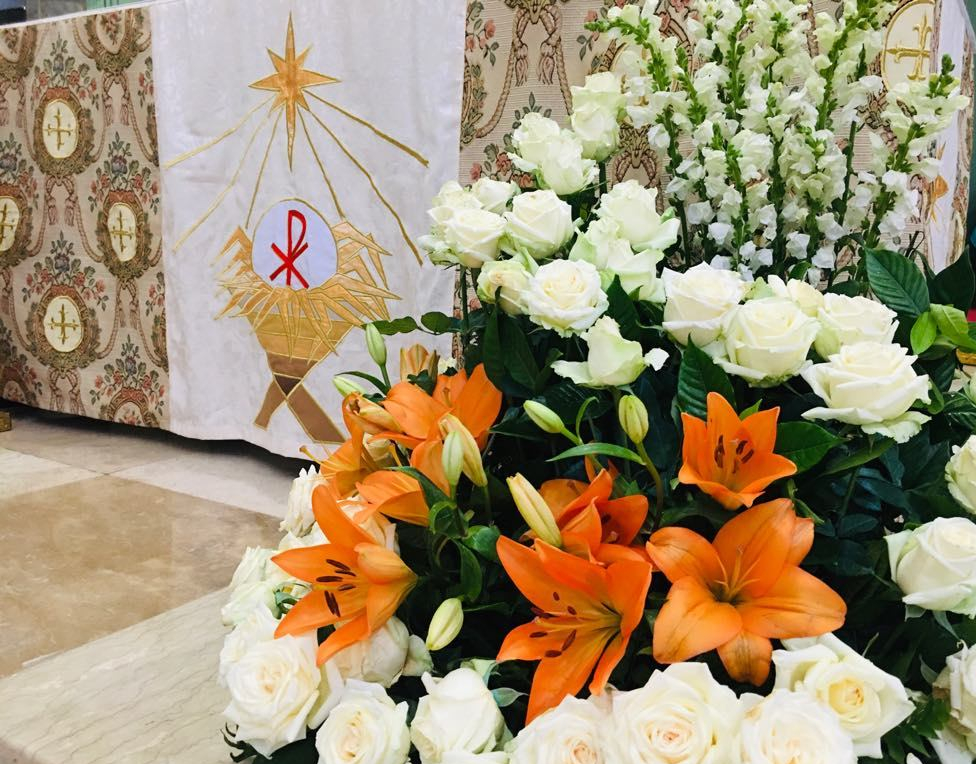
Flowers at our Altar, Epiphany Sunday 2020. Photo by author.
God is well pleased with us
Three things I wish to share with you this lovely Sunday, especially for some of us feeling tired and exhausted this early with our many tasks and responsibilities at home, the school, the office, and even the church and community.
First is get it done. We all have roles to play in life. Remain faithful and stay focused with the mission not with the person. Yes, it is easier said than done but like Jesus instructing John for his baptism, he said, “Allow it now, for thus it is fitting for us to fulfill all righteousness” (Mt.3:15). It must have been so difficult for John to baptize Jesus the Son of God but the Lord told him anyway, get it done! And just as John did his role, everything happened according to God’s plan.
Second is give others the chance to do the will of God. Sometimes many of us have that “messianic complex” as if we are the saviour of the world. No! That is Jesus alone and he has tasked all us with specific roles in doing his mission. Let others do their part. Stop monopolizing all good deeds because when there is a monopoly of holiness, certainly there is already a pervading evil. Jesus as the Christ is the definitely the holy one but he told John to baptize him and he in turn “allowed” the baptism to take place.
Third is do whatever is good. Always. That’s what Jesus told John, “Allow it now, for thus it is fitting for us to fulfill all righteousness” (Mt.3:15). Doing what is righteous is doing what is good, what is holy, what is just. But, it is not that easy. I know.
“Minsan nakakapikon na magpakabuti lalo na kapag tila walang pakialam yung mga ginagawan mo ng kabutihan.”
We have felt so many times that being good, doing what is right can take its toll. We always wonder “when is enough really enough” with people who have made it their way of life of hurting us, of stressing us, of being pain in the ass.
We want to scream, to spill the beans, to unmask them to reveal them as fakes and hypocrites!
But, don’t!
Do not be like them.
Be good like Jesus, the one prophesied by Isaiah in the first reading.
Thus says the Lord: Here is my servant whom I uphold, my chosen one with whom I am pleased, upon whom I have put my spirit; he shall bring forth justice to the nations, not crying out, not shouting, not making his voice heard in the street. A bruised reed he shall not break, and a smoldering wick he shall not quench…
Isaiah 42:1-3
Baby Jesus on a bed of white roses in our Sanctuary area, Epiphany 2020. Photo by author.
In the second reading, we heard St. Peter preaching after the Pentecost of how “Jesus went about doing good and healing all those oppressed by the devil, for God was with him” (Acts 10:38).
Whatever difficulty you are going through at this very moment, you are still God’s beloved child with whom he is well pleased. God is always with you. Continue the beautiful Christmas story with your life of loving service, even to people who hurt you.

















 lordmychef.com