Quiet Storm by Fr. Nicanor F. Lalog II, 11 October 2020
Photo by Ms. Anne Ramos, Good Friday “motororized procession” of Santo Entierro in our Parish during COVID-19, 10 April 2020.
Lately I have noticed
since month of August
when we have a spike of the virus
I have felt heavy and serious
as Sundays have become
more like a Good Friday
with the streets and church seats
both empty;  nobody seems to be happy
or Sundays have become more lazy?
How I miss the people I always see
wondering if they are safe and healthy
or maybe so wary just like me.
Sometimes I still feel
how everything is surreal
will I make it to next year
enjoying life without fear?
I have been wondering
if the Lord is still hanging
or have they crucified him again?
Life in the midst of COVID-19
has become more challenging
listening to silence so deafening
when God does not seem to be caring;
but, deep within
there is that calming
during Good Friday
that Easter Sunday
 is surely coming:
keep on believing, keep on praying
if Sundays look like a Good Friday
this may only mean one thing, that
Jesus is with us suffering COVID-19!
The Lord Is My Chef Sunday Recipe for the Soul by Fr. Nicanor F. Lalog II
Week XXVIII-A in Ordinary Time, 11 October 2020
Isaiah 25:6-10     ><)))*>     Philippians 4:12-14, 19-20     >><)))*>     Matthew 22:1-14
Photo by author, Our Lady of Mount Carmel of the Holy Family, Guiguinto, Bulacan (2018).
As we end the series of teachings in parables by Jesus directed to the chief priests and elders of the people, St. Paul concludes his Letter to the Philippians in our second reading with words so moving for a man awaiting trial and sure death, giving us a glimpse at how this great Apostle of the Lord looked at the most ordinary things in life.
Brothers and sisters: I know how to live in humble circumstances; I know also how to live in abundance. In every circumstance and in all things I have learned the secret of being well fed and of going hungry, of living in abundance and of being in need. I can do all things in him who strengthens me.
Philippians 4:12-14
Wow! Here we find St. Paul at his best and finest, with his mastery of language at the service of his innermost thoughts and feelings, indicating his transformation from the many hardships and difficulties he had gone through as an Apostle and suffered as a prisoner.
Like St. Paul, there are times we experience that perfect balance in life called equilibrium when we are able to bridge the distance between our mind and our heart with Jesus at the center amid so many trials and difficulties.
Most of all, we see in this short passage how St. Paul accepted both living in need and in abundance with calmness and composure because of Jesus Christ who strengthened him!
What an encouragement for us all in this time of pandemic to remind us of learning to adjust to situations, that true peace within comes not from abundance or scarcity of material goods but of letting go and letting God in our lives. St. Paul witnessed to us the centrality of the Lord’s teaching of denying ourselves, taking our cross and following Jesus.
Most of all, in St. Paul we find what is to be clothed in Christ or “to put on Jesus Christ” (Rom.13:14) by accepting God’s invitation to salvation through his Son as the parable of the wedding feast tells us in our gospel this Sunday.
Jesus again in reply spoke to the chief priests and elders of the people in parables, saying, “The kingdom of heaven may be likened to a king who gave a wedding feast for his son. He dispatched his servants to summon the invited guests to the feast, but they refused to come. A second time he sent other servants… Some ignored the invitation and went away, one to his farm, another to his business. The rest laid hold of his servants, mistreated them, and killed them. The king was enraged and sent his troops, destroyed those murderers, and burned their city.
Matthew 22:1-4, 5-7
Do not ignore God’s invitation; carpe diem (seize the moment).
Photo by Angelo N. Carpio, January 2020.
Jesus continues to direct his parables to the chief priests and elders of the people not really to shame them and expose their sinister plots against him but more in the hope of converting them, of giving them the chance of getting into God’s kingdom in heaven.
That is how great is his love for everyone, especially the sinful even if they would not admit it — just like us!
Keep in mind that Christ speaks always in the present and this parable is also meant for us who feel “entitled” in may ways like the chief priests and elders at that time. Interestingly, today’s parable to a large extent has to be taken in the context of the Sunday Mass, the prefiguration of the wedding feast in heaven to which we are all invited.
But how can we get to the wedding feast in heaven if we feel so sure like the chief priests and elders that we refuse to accept God’s invitation?
The Eucharist is the summit of our Christian life where we receive Jesus Christ in words proclaimed, in his Body and Blood, and among the people gathered. Every day Jesus is inviting us to partake in his Sacred Meal to be nourished and get our bearings in life through him like St. Paul.
See how before the pandemic, people refused to celebrate Mass and other Sacraments; but, when quarantine measures were implemented with the suspension of public Masses, everybody wanted to go to churches and receive the Sacraments, specially Holy Communion and Baptism, as well as Confession and Anointing of the Sick!
Photo from Shutterstock/Aleteia.
After seven months of pandemic, many of us have learned to adjust to the new situation but sadly, many have gone back to totally ignoring the Sunday Mass. Worst is at how some have considered online Masses as “video-on-demand” making Jesus Christ a “commodity” anyone can have when most convenient. Pope Francis had reminded us last summer that online Masses are not the norm but a response to the pandemic. Nonetheless, we still have to dispose ourselves properly when celebrating with online Masses like in actual live Mass in a Church and strive to be punctual and avoid doing other things during the online celebration.
In giving us these modern means of communications, God continues to invite us to come to him and gather in his name as a family in our homes for the Sunday online Masses and other liturgical activities that nourish our souls so essential in these trying times. Like the king in the parable today who had to invite guests thrice to his son’s wedding feast, God gives us all the opportunities and chances to celebrate in his gift of salvation through Jesus in the Eucharist which is the summit of Christian life.
May we not miss every opportunity!
When I was assigned to our diocesan schools during my first ten years in priesthood, I used to tell my students that God’s mercy and forgiveness are unlimited but there are acts that can have irreversible consequences like getting involved in a murder, getting pregnant outside marriage, or being caught in a video scam. I would tell them that God will surely forgive you and give you many chances in life while people like your family and friends including those you may have hurt may also forgive and accept you; however, you cannot escape the consequences of those acts that will surely limit your freedom and change forever your situations in life. Bottomline is, do not let yourself be missed out in accepting God’s invitation to his feast of life and salvation by following the path of holiness that beings in the Holy Mass.
The first reading from the Prophet Isaiah directs our attention to “that day” when God would save us and welcome us into heaven symbolized by the feast or banquet with great food and drinks. The good news is we are all invited to his feast, assured with a seat and it would only be our fault to not make it there, either by refusing it or not getting dressed properly.
Being properly dressed is always a sign of maturity.
Photo by Ezra Acayan/Getty Images, 09 February 2020, Baclaran Church.
“The servants went out into the streets and gathered all they found, good and bad alike, and the hall was filled with guests. But when the king came in to meet the guests he saw a man there not dressed in a wedding garment. The king said to him, ‘My friend, how is it that you came in here without a wedding garment?’ But he was reduced to silence. Then the king said to his attendants, ‘Bind his hands and feet, and cast him into the darkness outside, where there will be wailing and grinding of teeth.’ Many are invited, but few are chosen.”
As is often the case in his parables, Jesus pulled a surprise when he added another parable to this parable of the wedding feast that could have easily ended in the annihilation of those who rejected the king’s two earlier invitations.
God is the king who was so good that he never tired of inviting guests thrice to the wedding feast of his son, and this time he opened it to everyone! And here lies the clincher: though everyone is invited, guests were expected to come in proper attire.
We have learned at a very young age of getting properly dressed in an occasion. In fact, dressing properly is a sign of maturity. Some people especially in this age always claim what matters is the inside of the person not the outside appearance like clothes; but, they forget that the outside also indicates what is inside of us!
Clothes speak a lot of who we are and what we are that even St. Paul used several times the metaphors of clothes like “putting on the Lord Jesus” or being “clothed in Christ” as we have cited earlier.
See how the king went to meet the guests not just for pleasantries but for inspection that immediately his eyes caught the man not dressed in a wedding garment. The king was even courteous addressing the man as “my friend” when asked why he came not in a wedding garment.
Try to imagine the scene with that man “reduced to silence” meaning, he was guilty of not putting on a wedding garment even if he knew that was the occasion he was going to. He had been remiss of his duties and obligations, just like the wicked tenants last week or the merciless servant last month.
"Many are invited, but few are chosen" (Matthew 22:14)
St. Matthew never failed to remind us these past weeks that our faith has no value if not translated into actions, if it does not bear fruits. Today, he reminds us to be properly dressed to become a part of the wedding feast of the Lord, of the need to be clothed in holiness, in charity, and kindness with others.
Moreover, with just barely two months to go before we end the liturgical year to usher in Advent in preparation for Christmas, Jesus tells us today to never feel so sure, even “safely assured” of getting into heaven like the chief priests and elders of his time that even if we celebrate Sunday Masses weekly, online or actual, nothing is final yet in this life until we all get into the hall of the wedding feast in heaven when we are judged for our good deeds.
For the meantime, let us not miss joining the “rehearsals” for that feast – the Sunday Mass we celebrate weekly when he invites everyone to come. Be sure to be properly dressed for the occasion, literally and figuratively speaking. Amen.
A blessed week to everyone!
Photo by author at Silang, Cavite, 22 September 2020.
The Lord Is My Chef Breakfast Recipe for the Soul by Fr. Nicanor F. Lalog II
Tuesday, Memorial of St. Bruno, Priest and Founder of Carthusians, 06 October 2020
Galatians 1:13-24     >><)))*>   |+|   <*(((><<     Luke 10:38-42
Photo by author, antique door of a resthouse in Silang, Cavite, 22 September 2020.
What a wonderful story from St. Paul today of his conversion, Lord Jesus Christ! How lovely to read his story without any airs or pride but full of humility, focused on the mystery of your call for him to be your Apostle to the Gentiles.
Clearly, the fruit of long years of prayers, of sitting beside you at your feet.
Brothers and sisters: You heard of my former way of life Judaism, how I persecuted the Church of God beyond measure and tried to destroy it… And I was unknown personally to the churches of Judea that are in Christ; they only kept hearing that “the one who once was persecuting us is now preaching the faith he once tried to destroy.” So they glorified God because of me.
Galatians 1:13, 22-24
Lord Jesus, keep me simple and humble like St. Paul in telling my story of your call that is always both a mystery and a gift, something so special known only to you. Purify me and my story of vocation in spending silent moments at your feet contemplating, meditating on your words.
Sometimes, some people complain how their lives are not as colorful as somebody else’s life like St. Paul with a lot of dramatic twists and turns.
We do not need those things, Lord. You call each of us in the most unique and personal way. Every encounter with you Jesus is always personal, always special.
What we really need is a listening heart: no matter how colorful and dramatic our lives may be but if we do not spend time with you listening and praying like Mary in the gospel, everything will always be bland and dry.
Let us reflect more, to treasure every encounter with you by being silent and still, less distracted with the ways of the world that make us forget you to turn our very selves as the center of attention even unconsciously demanding you to focus on us like Martha!
Martha, burdened with much serving, came to him (Jesus) and said, “Lord, do you not care that my sister has left me by myself to do the serving? Tell her to help me.” The Lord said to her in reply, “Martha, Martha, you are anxious and worried about many things. There is need of only one thing. Mary has chosen the better part and it will not be taken from her.”
Luke 10:40-42
Teach us to follow the examples of St. Paul and Mary, of St. Bruno whose memorial we celebrate today so we may we strive “to seek God assiduously, to find God promptly, and to possess God fully.” After all, as his Carthusian monks motto profess, “while the world changes, the cross stands firm.”
Yes, dear Jesus, nothing is most worthy in this life than to be always at your side, doing your work, speaking your words, living your life. Amen.
The Lord Is My Chef Breakfast Recipe for the Soul by Fr. Nicanor F. Lalog II
Saturday, Week XXVI, Year II in Ordinary Time, 03 October 2020
Job 42:1-3, 5-6, 12-17   |||+|||  >><)))*> <*(((><<   |||+|||   Luke 10:17-24
Photo by author, Mt. St. Paul Spirituality Center, La Trinidad, Benguet, 2017.
God our loving Father, another week is closing and another is coming. Thank you for the many blessings you have given us, most especially for those blessings that have come our way through many trials and sufferings.
Like Job, if not for my many brokenness, pains and disappointments, I would have never been this strong and so blessed. Looking back to those days of trials, I am so grateful to you like Job, O God, in opening my eyes to so many wonderful things I cannot know nor even understand!
I have dealt with great things that I do not understand; things too wonderful for me, which I cannot know. I had heard of you by word of mouth, but now my eye has seen you.
Job 42:3, 5
I pray in a very special way today for people going through very rough times of crises, those diagnosed with cancer, those who have lost a loved one, and those whose business have hit rock bottom due to the pandemic.
Keep us all faithful to your call, God, for true blessedness is not found in doing but in being in you through your Son Jesus who told us “Nevertheless, do not rejoice because the spirits are subject to you, but rejoice because your names are written in heaven” (Lk.10:20).Amen.
The Lord Is My Chef Breakfast Recipe for the Soul by Fr. Nicanor F. Lalog II
Thursday, Memorial of St. Therese of the Child Jesus, 01 October 2020
Job 19:21-27     >><)))*>  +  >><)))*>  +  >><)))*>     Luke 10:1-12
Photo by author, white roses at our altar, 2019.
On this Memorial of the most loved saints of today, St. Therese of the Child Jesus, I pray O God parents who have lost a child, those diagnosed with serious illness, and those heavily weighed on with simultaneous trials and problems in family.
It is so refreshing on this first day of October that we celebrate the life and holiness lived in total simplicity by St. Therese, a modern Job in our time after she had undergo many hardships and trials at a very young age as a contemplative nun.
I pray dear God for those feeling almost crushed by so much tribulations in life, those about to give up, losing hope and meaning or those who could no longer find their sense of mission amid the heavy or enormous weights on their shoulders.
But as for me, I know that my Vindicator lives, and that he will at last stand forth upon the dust; whom I myself shall see: my own eyes, not another’s, shall behold him, and from my flesh I shall see God; my inmost being is consumed with longing.
Job 19:25-27
Most of all, dear God, as we go through so many difficulties in life during this pandemic, may we be more loving not only in words but in deeds, even the most simplest deeds like St. Therese:
Photo by author, 01 October 2019.
Love appeared to me to be the hinge for my vocation… O Jesus, my love, at last I have found my calling: my call is love. In the heart of the Church, my mother, I will be love, and thus I will be all things, as my desire finds its direction.
St. Therese of the Child Jesus, Office of Readings, 01 October, Volume IV
May we break all walls that divide us as brothers and sisters in Jesus Christ your Son, almighty Father.
Most of all, heeding your Son’s call, we pray to you O God our harvest-master to send us with more laborers for your abundant harvest (Lk.10:1-2) of people hungry and thirsty for you and meaning in life. Send us workers in your field whose hearts are filled with love and fervor in doing the mission of evangelization wherever they may be like St. Therese, who, despite her being a cloistered in a monastery, had become patroness of the missions in prayers and in her little ways for God.
Indeed, when there is enough love in one’s heart, there is always so much to give and share with everyone hungry and thirsty for love. Amen.
The Lord Is My Chef Breakfast Recipe for the Soul by Fr. Nicanor F. Lalog II
Friday, Week XXV, Year II in Ordinary Time, 25 September 2020
Ecclesiastes 3:1-11  >><)))*>  >><)))*>  >><)))*>   Luke 9:18-22
The wildfires created a natural Instagram filter across California. Photo from MediaNews Group/The Mercury News via Getty Images; 10 September 2020.
There is an appointed time for everything, and a time for every affair under the heavens. He (God) had made everything appropriate to its time, and has put the timeless into their hearts, without man’s discovering, from beginning to end, the work which God has done.
Ecclesiastes 3:1, 11
Thank you, dear God our Father in appointing time for everything, in creating the dimension of time and space so we can have a grasp of your vast reality in this universe. We are finite and you are not whom time and space cannot limit and hold.
Teach us to be open to your presence and grace in every moment of our lives, to make that constant effort to pray like your Son Jesus Christ our Lord.
Prayer is so difficult for us because in our limited time and space, we try to be one with you who is infinite and eternal. We find it boring and a waste of time not only because it is difficult, requiring discipline on our part but because it requires a lot on us to truly love you.
Only love can bridge the finite and infinite, the temporal and eternal. When we are with our beloved, time neither rushes nor slows but seems to stand still like eternity as if we are holding it – when time is not. It is the same experience we have when we are deeply absorbed in prayer, when we feel that intense love for you inside when time passed so easily that an hour seemed like an instant, exactly like what you have said in the Bible that a thousand years are just a day for you.
Because you love. And we also love.
How lovely it is to read in the gospel today that once when Jesus was praying in solitude and the disciples were with him, that is when he surveyed them about what people were saying who he is, later asking them the same question up and personal.
Help us to appreciate and value silence and stillness, to befriend time and eternity in prayer to express our love for you and for others. Amen.
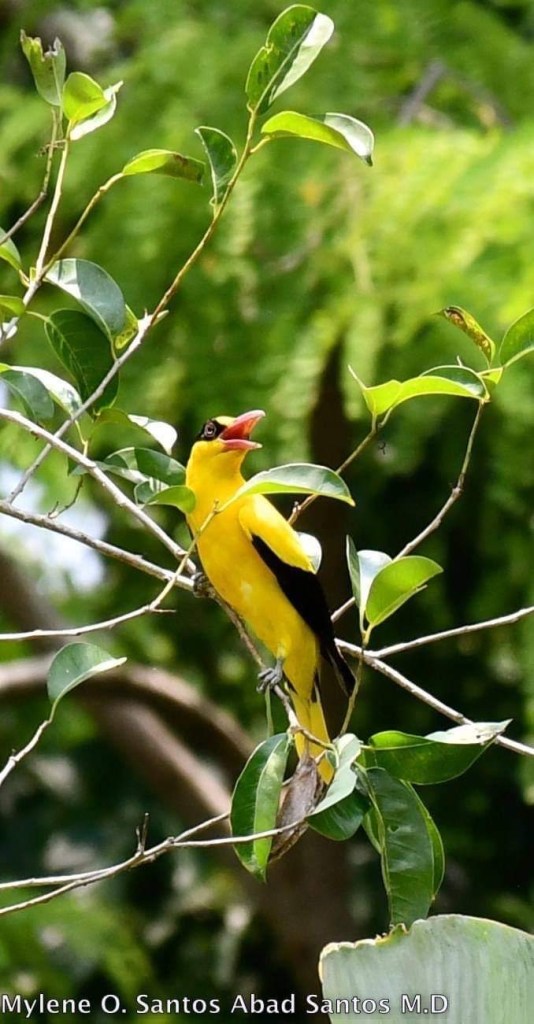
Photo by Dr. Mylene A. Santos, MD at Katmon Harbor Nature Sanctuary, Infanta, Quezon, May 2020.
Quiet Storm by Fr. Nicanor F. Lalog II, 22 September 2020
Photo by Ms. Ria De Vera of our parish church, August 2020.
Lately I have been watching old movies that I wonder why I still cry even if I have seen them more than twice before at the cinema and cable TV. It seems that my being born with “mababa ang luha” (easy to cry) is getting more “mababa” as I get old.
Tears are a gift from God, the most beautiful prayer we can ever express courtesy of the Holy Spirit because when we run out of words for our pains and sadness or when we are overjoyed, he makes us cry to heal and comfort us or complete our joys, assuring us of his loving presence.
That is the reason why we call “home” in Tagalog as “tahanan”: home is where we “stop crying”, that is, “tahan na” because that is where we find all the support we need in times of crisis. Indeed, home is where the heart is.
True to its function, tears cleanse us physically, emotionally and spiritually. I have read two decades ago that researchers at a university in the US have found the chemical composition of our tears differ if we cry because of pain and sadness or due to joy and laughter.
Is it not wonderful and amazing how we take for granted crying and tears without realizing its chemical process within that can transform our very selves?
Photo from Reuters.com, July 2020.
Tears and crying mark our life's coming to full circle.
When I was five years old, I saw the picture of a newborn baby crying in the Book Section of the Reader’s Digest. I asked my mom why the baby was crying. In her usual motherly way of explaining things, she told me that if the baby cries upon birth, it means he/she is alive; if the baby does not cry, he/she is dead.
“Kapag umiyak, buhay; walang iyak, patay.“
My young mind easily absorbed her words that would remain to be one of the most profound lessons I had ever learned about life at a very young age. As I grew up watching TV and movies, I would always sigh with relief whenever I heard the sounds “uha-uha” because the story would surely be nice and not tragic.
Imagine the great inverse that happens with crying and tears to signal the coming to the outside world of life of another human, of how we have to cry to be alive from then on until we die when it becomes our family and friends’ turn to cry and shed tears for us when we are gone.
But there is something more deeper than this great inverse on crying in life and death I had learned only in 2013 through my best friend Gil, a classmate in our minor seminary.
It was late February of that year on the 40th day of the death of his youngest sister Claire when he was diagnosed with cancer. We could not believe the news because Gil was the most health conscious in our “band of brothers” from high school who never smoked, rarely ate meat, and was active in sports like golf and badminton. Unlike most of us, he was never overweight, looked so healthy in our mid-40’s.
Imagine the hurt within him that every time we would visit him, he would cry not really in pain but more on the why of getting cancer. We tried visiting him as often as we can to cheer him up and lift his spirits specially after his surgery when his chemotherapy sessions began.
By September on that same year, we all had to rush and visit him at Makati Med one Sunday afternoon when informed by his Ate Lily that doctors have given up on him. His cancer cells were “ferocious” and nothing could be done anymore except to wait for the inevitable.
That was when I noticed the greater inverse about crying when Gil had finally accepted his condition and life direction, that was when he was most joyous and peaceful too while we were the ones so sad and worried, crying. How our roles were reversed with Gil now telling us to stop crying – tahan na – which we used to tell him months earlier! (Gil died peacefully the following Sunday, 22 September 2013.)
“Mater Dolorosa” as “Blue Madonna” (1616) by Carlo Dolci. Photo from Wikimedia Commons.
I noticed it happening so many times with some friends and parishioners I have come to love in my ministry, those I have pastorally cared for some time after being diagnosed with serious conditions like cancer.
Yes, I have cried despite holding my tears for them while administering the Holy Viaticum and Anointing of Oil. The patients in turn would just glance at me, so dignified and calm like Mary our Lady of Sorrows as if trying to comfort me with their sweet thank you.
As I prayed on those experiences, I realized how life comes to full circle through our crying and tears.
I believe that patients cry when they start undergoing treatment of their sickness due to fears and uncertainty of what would happen next to them; later as they come to terms with their condition, they stop crying because they already knew where they were going, of what was coming next.
We who would be left behind cry and begin to shed tears at thoughts of their dying because admittedly, we are actually the ones more uncertain of where we are going to or how our lives would go through when our loved ones are gone.
That is the greatest pain we feel in the death of a beloved when we grapple with the realities of the many uncertainties of life without them.
And that is why we need to love as much as we can our family and friends while still alive. This quarantine period of the pandemic are grace-filled moments to shower them with our love and presence we have taken for granted for so long as we pursued many things in our lives.
Photo by Dr. Mylene A. Santos, MD at Infanta, Quezon, April 2020.
Tears and crying lead us to heaven.
Death and sickness, like life, become a blessing if we are filled with gratitude not regrets because we have truly loved. When a beloved is gone and we begin to cry, the tears wash away our pains of losing them, cleansing us within to leave us with all the beautiful memories and love we have shared. Then, every remembering becomes truly a re-membering, making a lost loved one a member of the present again.
When we cry, tears polish the love we have shared with everybody until later when our time comes, our visions are also cleared of what is going to happen next, of where we are going. Crying becomes wonderful and truly a grace after all not only in sharing and being one with the grief and pain of another in the present but sooner or later, in having a glimpse of the life after.
In the Gospel of John (11:1-44), we find the story of the raising of Lazarus whom Jesus loved so much that he wept – not just cried – at his death. Jesus raised him up back to life, his final miracle – or “seventh sign” according to John – to show he is the Christ before his own Resurrection at Easter after his “final hour” of Crucifixion on Good Friday.
From then on, Christ sanctified crying and tears to enable us to see beyond pains and hurts, even death especially if you have truly loved.
Sometimes in life, it is always good to let those tears flow, like love even if it is painful, to have a good cry and real cleansing inside. A blessed day to you!
The Lord Is My Chef Breakfast Recipe for the Soul by Fr. Nicanor F. Lalog II
Monday, Feast of St. Matthew, Apostle and Evangelist, 21 September 2020
Ephesians 4:1-7, 11-13   >><)))*>   +   <*(((><<   Matthew 9:9-13
Photo by author, Lake of Galilee at the side of Capernaum where Jesus called Matthew the tax collector, May 2019.
Glory and praise to you, O God our loving Father! Your Son Jesus Christ never fails to surprise us with your wondrous plans for us, with your ways of calling us, and of coming to us!
As we celebrate today on this first working day of the week the feast of St. Matthew, you fill us with hope and inspiration to work harder and pray hardest in life to find fulfillment in you our God.
Thank you for being so kind to come and call us like St. Matthew, Lord Jesus. It was a very extraordinary call not because we are so special but actually unimportant with Matthew also known as Levi belonged to the most despised group of people at that time in Israel, the tax collectors who were always mentioned along with sinners and prostitutes. And so were Matthews’s contemporaries at Capernaum, the brothers Simon and Andrew, James and John who were all fishermen, the most ordinary folks doing the most ordinary jobs of that time.
We were all just like them – nothing special and unimportant! If not for your call, we would be nobody at all even in our family circles.
What a joy that even if some people reject us for various reasons, you O Lord never exclude anyone of us from your friendship. Most of all, you even defend us.
While he was at table in his (Matthew’s) house, many tax collectors and sinners came and sat with Jesus and his disciples. The Pharisees saw this and said to his disciples, “Why does your teacher eat with tax collectors and sinners?” He heard this and said, “Those who are well do not need a physician, but the sick do. Go and learn the meaning of the words, I desire mercy, not sacrifice. I did not come to call the righteous but sinners.”
Matthew 9:10-13
Give us the readiness and firmness of St. Matthew in leaving everything behind to follow you, Lord.
Like St. Matthew who “got up (rose in some translations) and followed you” (Mt.9:9) right after you have called him, help us realize that following you requires our detachment from our sinful situations, from things and people who prevent us from totally loving you and serving you.
Help us Lord to arise from our dark, sinful past so we can radiate your light in our version of your gospel like St. Matthew. Amen.
“The Calling of St. Matthew”, painting by Caravaggio (1599-1600) said to be one of the favorite pieces of art Pope Francis used to frequent while still a student in Rome. Photo from Wikipedia.org.
The Lord Is My Chef Sunday Recipe for the Soul by Fr. Nicanor F. Lalog II
Week XXV-A, Ordinary Time, 20 September 2020
Isaiah 55:6-9   >><)))*>   Philippians 1:20-24, 27   >><)))*>   Matthew 20:1-16
Photo by the author on the way to Petra in Jordan, May 2019.
There was something amusing I realized while praying this Sunday’s gospel of how in our time we no longer hear or use the word “generous” anymore — except when the topic is about food like in the expression “generous servings”!
We all love and enjoy “generous servings” of food and drinks whether in restaurants or at home or at parties because it means something more than what we pay for or come for. And that is the essence of generosity: the giving of more than what is required and just. It is love in the real sense like the prayer for generosity by St. Ignatius of Loyola.
Dearest Lord:
Teach me to be generous.
Teach me to serve you as you deserve,
To give and not to count the cost,
To fight and not heed the wounds,
To toil and not seek for rest,
To labor and ask not for reward, except
To know that I am doing your will.  Amen.
Photo by Mr. Jim Marpa, 2019.
Generosity bonds every community in Christ
Sorry if I have to start our reflection through the stomach because today is our “Pistang Pasasalamat” (Thanksgiving) in the Parish…
Going back to our reflection, my dear reader, recall how in the past two weeks we have heard Jesus teaching us important lessons how our relationships must be based on mutual love through fraternal correction and forgiving of those who have sinned against us.
This Sunday through another parable, Jesus teaches us the importance of generosity as a wonderful expression of love we forget most in our relationships and dealing with others.
Generosity is the glue that keeps our ties stronger and keeps us filled with joy because it is thinking more of the other person than of self. It is love at its finest – charming and elegant as in suave – but so disarming and revealing when overlooked as we shall see in this parable.
Jesus told his disciples this parable: “The kingdom of heaven is like a landowner who went out at dawn to hire laborers for is vineyard. After agreeing with them for the usual daily wage, he sent them into his vineyard. Going out about nine o’clock, he saw others standing idle in the marketplace, and he said to them, ‘You too go into my vineyard, and I will give you what is just.’ So they went off. And he went out again around noon, and around three o’clock, and did likewise. Going out about five o’clock, he found others standing around, and said to them… You too go into my vineyard.’ When it was evening the owner of the vineyard said to his foreman, ‘Summon the laborers and give them their pay, beginning with the last and ending with the first.’ When those who had started about five o’clock came, each received the usual daily wage. So when the the first came, they thought that they would receive more, but each of them also got the usual wage. And on receiving it they grumbled against the landowner, saying, ‘These last ones worked only one hour, and you have made them equal to us, who bore the day’s burden and the heat.’ He said to one of them i reply, ‘My friend, I am not cheating you. Did you not agree with me for the usual daily wage? Take what is yours and go. What if I wish to give this last one the same as you? Or am I not free to do as I wish my own money? Are you envious because I am generous?'”
Matthew 20:1-15
Notice how Jesus again elicited our feelings to drive home his lesson today about love as basis of our relationships. Last week we totally agreed with the king in punishing the merciless servant whose debt he had forgiven but was unmerciful to a fellow servant and debtor.
This Sunday, with whom did we take sides with? Be honest. Did you side with the workers hired in the morning and worked all day only to receive a pay exactly the same with those who worked only for an hour? Did we also feel treated unfairly like them?
But, why are we reacting the same way as those workers who toiled under the sun? What is our complaint? Are we envious because the owner is generous?
Recall our reflections last month about the parable as a simple story conveying deeper truths about life and our selves. From the French parabolein -along the way – Jesus is inviting us to read anew this parable we have heard so many times in the past so we may enter into a dialogue with him to purify and cleanse us to get its whole picture. And hopefully, become generous too.
Nuns bringing goods to the poor during the height of the Luzon-wide lockdown last summer.
Human justice, Divine kindness
The parable is not about social justice and just wages: it is about the immense love of God for us all. Jesus said it at the start, “The kingdom of heaven is like a landowner…” – it is a parable about God and his kingdom.
See the great love of the landowner who went out five times during the day, even at late afternoon so people may have a job to earn some money for the day. We have to keep in mind that the workers were hired because the owner is kind. Period.
The owner is like the good shepherd Jesus described as who would leave the rest of his flock to search for one missing sheep.
How many times have we acted like those early workers, complaining to God when we feel “shortchanged” for our work and efforts, or being better and more good perhaps than others?
It happens so many times when we question him even in the Church and specially in the society and government when we cannot understand how God who is supposed to be just and fair is allowing all injustices and evil to happen like during this time of COVID-19.
The first reading reminds us that to think that way as if we know everything is dangerous because we could be very wrong and mistaken after all. God sees and knows everything that in the end amid all the twists and turns in history and in our personal lives, it is always his will that prevails which proves best for us and mankind. In times like these, we need to have faith in God and trust him more through prayers and reflections.
Seek the Lord while he may be found, call him while he is near… As high as the heavens are above the earth, so high are my ways above your ways and my thoughts above your thoughts.
Isaiah 55:6, 9
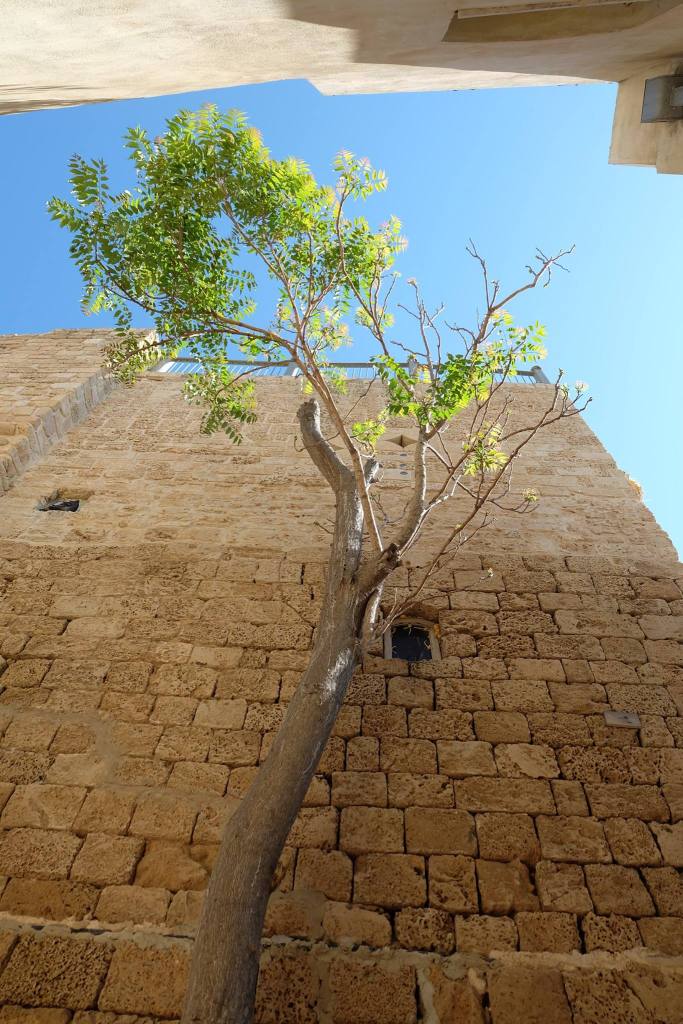
Photo by author, Jaffa in Israel, May 2017.
We keep on saying that one immediate fruit of having a prayer life is the heightening of our sensitivities when we see more of God in others than more of ourselves. The problem with those workers hired earlier in the day that instead of thanking God for his kindness in hiring them, they even wanted more in their pay than what they have agreed upon — so selfish and feeling so entitled like some among us!!!
God as the landowner is teaching us not only to be thankful for the blessings we have received from him but also to rejoice when others aside from us are also blessed. As everyone would say these days, “sana all” are blessed, not only a selected few.
Again we find here a similar situation in the parable of the prodigal son where the father told the elder one that “everything I have is yours” (Lk.15:31) when he refused to come home to celebrate the return of his younger brother, citing how he had obeyed the father all his life without being given a young goat to feast with his friends.
Like that loving father of the prodigal son, God is reminding us this Sunday in this parable to rejoice that others have been blessed, instead of grumbling and complaining, demanding for more than what we have, forgetting everything is out of God’s goodness, never because of our merits.
Looking inside our hearts
My dear friends, this time of the pandemic invites us to be generous by looking deep into our hearts, of seeing God more and others than just our self. At this time when life is so difficult and death is so closest to home with everyone, the best thing we can do is to thank God for his gift of life to us each day and to deepen our faith in him.
Lately I have been praying to God to grant me St. Paul’s clarity of mind and purity of heart as we find ourselves in his similar situation of being imprisoned: him for the gospel, us due to COVID-19.
See the faith of St. Paul in God that even in prison with his death approaching each day, he continues to rejoice and experience peace within because he had realized that the success of the gospel is not on human efforts but in Jesus whom we cannot box in our little worlds and beliefs, rites and rituals. In fact, he was so confident that even with his death, the more the gospel would spread.
Photo by Dra. Mylene A. Santos at Katmon Harbor Nature Sanctuary, Infanta, Quezon, March 2020.
Brothers and sisters: Christ will be magnified in my body, whether by life or by death… conduct yourselves in a way worthy of the gospel of Christ.
Philippians 1:20, 27
Last Sunday, Jesus taught us to forgive from the heart, that is, to see one another as a brother and sister in God our Father who forgives us without limits for our many sins.
Today, Jesus is asking us to give from the heart – to be generous – not for anything else but because we are brothers and sisters in God our Father who blesses us without limits despite our sinfulness.
Generosity comes from the heart when in that heart is Jesus whom we find dwelling, giving us peace and joy no matter how much suffering we go through because him alone suffices that we are willing to let go of everything.
Share a generous serving of God’s blessings today to someone in need. Amen.
Quiet Storm by Fr. Nicanor F. Lalog II, 10 September 2020
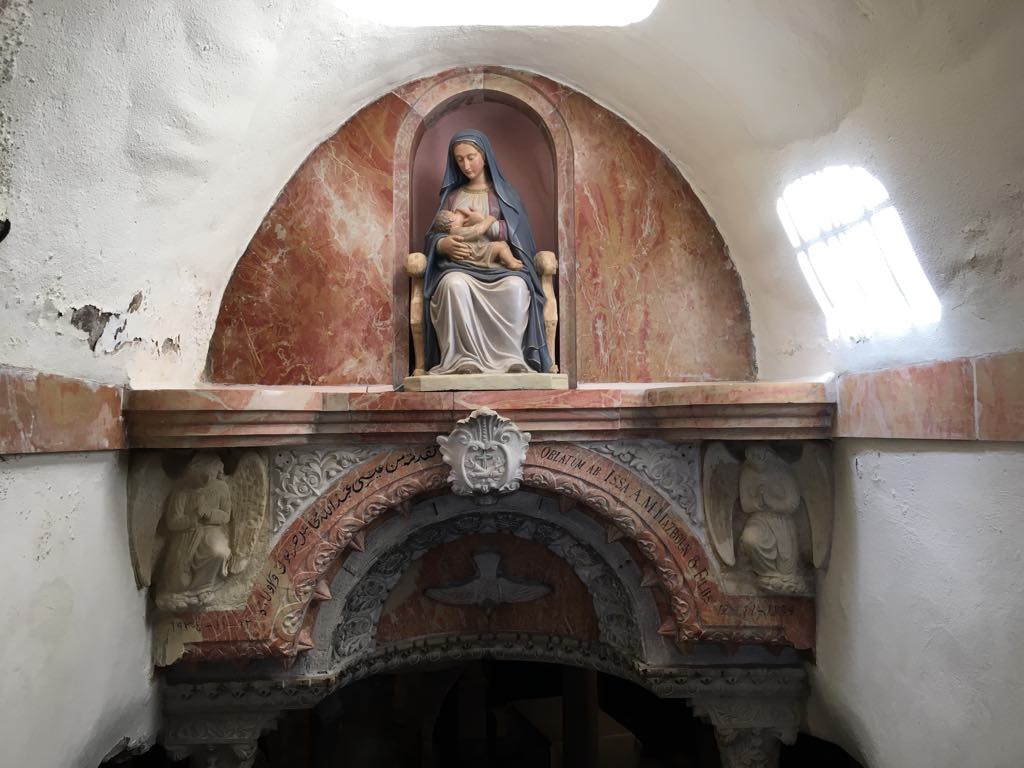
Chapel of the Milk Grotto in Bethlehem where the Holy Family hid before fleeing to Egypt to escape Herod’s murder of innocent babies. According to tradition, a drop of milk from the Virgin Mary fell on the floor of the cave that turned color of the stones to white.
We have just celebrated the Feast of the Birth of the Blessed Virgin Mary, the most perfect example of one who had experienced God’s hiddenness in her life, teaching us with some important lessons in rediscovering and keeping God’s hiddenness specially in this age of social media when everything is shown and has to be seen.
We have mentioned in our previous blog that hiddenness is different from being invisible that simply means “not visible”; hiddenness is more than not being seen per se but that feeling with certainty that God is present though hiding because he wants to surprise us. If God were not hidden, we would have not found him at all. And the more God is hidden, the more we are able to see him and experience him too as seen in the life of Mary (https://lordmychef.com/2020/09/04/the-hiddenness-of-god/).
The hiddenness of Mary.
Simplicity and humility of Mary as venue for the perfect setting of God’s coming in Jesus Christ. Consider her origins: her town of Nazareth in the province of Galilee was definitely outside the more popular city of Jerusalem that was the place to be at that time. Most of all, it is the only town in the New Testament never mentioned in the Old Testament nor by the prophets for lack of any significance in the coming of the Messiah.
Nazareth was largely unknown with some hint of notoriety as expressed by Nathanael (aka, Apostle Bartholomew) when he expressed disbelief to Philip who told him they have found the Christ, Jesus of Nazareth, by saying “Can anything good come from Nazareth?” (John 1:46)
Photo by author of chapel at the grotto believed where Mary received the good news of bearing Jesus Christ in her womb underneath the Basilica of the Annunciation at Nazareth, Israel (2019).
But that is how God works in his hiddenness, coming to us in the most ordinary places and circumstances, even least expected like Mary who was definitely not “in” if we go by today’s popular standard of “who’s in and who’s out?”
In fact, she was so “outside” the circle of influence of their time with her being promdi as we say these days, without any illustrious lineage to be proud of like her spouse Joseph who was from the royal Davidic line or her cousin Elizabeth from the priestly branch of Aaron, the brother of Moses whose husband, Zechariah belonged to another priestly clan in Israel.
Yet, God chose Mary to be the Mother of Jesus Christ because of her hiddenness expressed in her simplicity and humility. It is a far cry from our extreme “Marianism” when we almost worship Mary forgetting Jesus Christ her Son and our Savior! Worst still is the growing trend of “triumphalism” in many parishes racing for the so-called “episcopal” and “canonical” coronation of their various images of the Virgin Mary that come in all kinds of names and titles that has come to look more of a fad than authentic Marian devotion.
Without any intentions of denigrating the role and stature of the Blessed Virgin Mary in our faith as well as her proper place in the life of the Church defined by Vatican II’s Lumen Gentium, I dare ask the following questions:
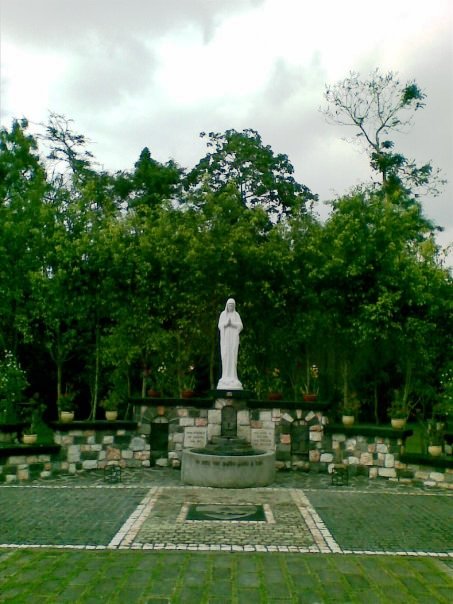
Photo by author, a replica of Our Lady of the Poor of Banneux, Belgium at Girlstown, Cavite (2009).
Is her coronation in heaven as Queen of heaven and earth not enough?
Why the need for these lavish spectacles for the coronation of the most simplest and humblest woman to have lived on earth?
It is a clear case of triumphalism – that exaggeration or overdoing our worship and rituals – especially if the Marian image is less than 200 years old without widespread devotions like the ones at Sto. Domingo (Quezon City) and Manaoag (Pangasinan).
I do not think the Blessed Mother would favor this considering her simplicity and solidarity with the poor and marginalized peoples seen in her many apparitions.
See the quaint and charming simplicity of Mary at Fatima in Portugal (1917) and lately at Banneux in Liege, Belgium (1933) where she identified herself as “Lady of the Poor”.
Note how the Virgin Mary reads “the signs of the times” in her apparitions and appearances when during the 1500’s at the height of European royalties and expeditions, she was always portrayed as victorious in regal clothes; but since Fatima in the 20th century as the world sank into the excesses of Industrial Revolution and affluence, Mary appeared simple, always in solidarity with the poor and suffering.
It is a cue we are sorely missing and sad to say, instead of renewing the world as St. Paul had asked us, we have allowed ourselves with the Mother of God to be transformed into the ways of the world by immersing in its showbiz frenzies, focusing on the material aspects like expensive clothes and jewelries.
Second example of Mary’s hiddenness is her oneness with Jesus Christ. She was never on her own, always seen in Jesus, with Jesus her Son and Lord. She believed in him so much, making him the focus at the wedding feast at Cana as well as at the foot of the Cross where she expressed in the most strongest terms her solidarity with the Savior of the world.
This has always been insisted by the Church since Vatican II regarding our devotions to Mary that must always be in relation with Jesus and his mission — never on her own.
Photo by author, 2019.
In all her apparitions, the Blessed Mother has always been consistent with her messages of conversion and return to God through her Son Jesus Christ, the frequent reception of the Sacraments of the Eucharist and Confession or Reconciliation.
Mary’s Christocentricity is best seen in her oneness with him in pains and sufferings like in the Pieta and the Mater Dolorosa where Jesus is the one standing out, not her. Nor anybody else.
When Mary, or anybody else for that matter goes on one’s own, Jesus is no longer hidden but removed from the scene. Then his Cross disappears and all that is seen is Mary in all her “beauty and glory” that are empty, very secular because these attributes come precisely from her communion in Jesus!
Perhaps, this pandemic is teaching us today to review our Marian devotions and processions that have become more of a show and a spectacle for Instagram than for deepening of our faith.
I pray that the Cofradia that holds the annual December 8 processions at Intramuros would take a rest this year until 2022 to discern their noble efforts before that have degenerated to pomp and pageantry among “devotees” specially camareros and camareras trying to outshine and outclass each other with some participation at the sidelights of their pastors and sacristans.
Keeping the hiddenness of God while we remain hidden in contemplation.
Of all the qualities of Mary we all must imitate to help people rediscover God’s hiddenness is her being hidden in prayer and contemplation.
St. John Paul II noted in Rosarium Virginis Mariae when he launched the Luminous Mysteries in 2002 that although the scriptures are silent about where was Mary during the other significant moments of the life of Jesus, especially at the institution of the Holy Eucharist, it was most likely that Mary was also present deep in prayer.
This we find clearly at the Pentecost when the Holy Spirit descended upon the apostles and the Blessed Virgin Mary while they were praying at the Upper Room in Jerusalem (Acts 1:13-14).
Modern rendition of the Pentecost with Mary among the other disciples of Jesus. From Google.
Pope emeritus Benedict XVI shares with us his profound insight in his second Jesus of Nazareth book series (Birth of Jesus) how after the annunciation of the the birth of Christ to Mary, the angel left her totally without ever coming back to warn or instruct her unlike with Joseph. After saying “Yes” to the plan of God to be the Mother of Jesus, Mary immersed herself deep in prayers and contemplation, becoming hidden herself in God.
Since then, she never doubted Jesus her Son as the Christ, nurturing her faith with prayers beautifully expressed by St. Luke in saying how “Mary treasured things in her heart” when facing difficult situations like during his birth and his finding at the temple. It is not surprising that in the contemplation by St. Ignatius of Loyola, the Risen Lord must have first appeared to his Mother upon rising from the dead because she was the first to believe totally in him (which became the basis of our tradition of the Salubong).
Mary has always been present in the hiddenness of Christ from his coming in the darkness of the night on a manger in Bethlehem, to his hidden years in Nazareth, to his ministry when he would always retreat to a deserted place to pray, to his Crucifixion and death and burial on Good Friday and finally, in the darkness of Easter.
In this age of social media where everyone and everything has to be seen and shown with nothing hidden anymore even without qualms and shame at all, part of our mission and ministry as priests and religious is to lead people back to God’s hiddenness like the Virgin Mary so they may realize anew that the best things in this life are not always seen.
To fulfill this is for us first of all to imitate God like Mary — be hidden!
How unfortunate that instead of leading the people back to God’s hiddenness, we priests and religious have in fact joined the secular world, imitating the “influencers” like bloggers and vloggers that instead of focusing on God who is hidden, we are concerned with our selves and all the “porma” for the sake of number of “likes” and “followers” we have in our posts.
The more we try so hard to make God visible in our ministry by imitating the styles and gimicks of some media personalities that make our liturgy look like a variety show complete with song and dance numbers with our altars heavily decorated like a studio set with giant tarpaulins like in EDSA, that is when we remove God totally – not only his hiddenness – from the scene and inverse proportionately, the more we priests and pastors become more popular than the Lord himself.
“The Assumption of the Virgin” by Italian Renaissance painter Titian completed in 1518 for the main altar of Frari church in Venice. Photo from wikidata.org.
And that is how cults begin, with or without Jesus. It is very sad, even tragic and ironic because we have removed God himself – even Mary! – by unconsciously making ourselves the center of attention like pop icons and idols.
Mary had shown us the most perfect example of discipleship which is more of Jesus, less of self.
Can we not post without using our own pictures – no matter how profound our thoughts are – so the people may see the hiddenness of God in a photo of a lovely flower or a magnificent sunset? Unless you are a bishop or the Pope himself, having your photo published specially in the news is part of the information process about the person in focus. It is totally different in Church communications which is all about God and his message of love, not us.
The quarantine period invites us in the Church to appreciate and share this wonderful hiddenness of God by first becoming incognito, unknown and hidden from others, preferring to be at the background or “behind the camera” as we follow God in his hiddenness until we go to that great beyond of totally hidden from everybody except God.
Do not worry. We have Mary in every step along the way. Amen.