Leviticus 19:1-2, 11-18 +++ 0 +++ Matthew 25:31-46
Photo by author, Mt. St. Paul Spirituality Center, Baguio City, 03 February 2020.
“Your words, Lord, are Spirit and life.”
Responsorial Psalm
Today, Lord, I borrow your psalmist’s words for they summarize the two beautiful readings on this first Monday of Lent 2020.
Thank you for reminding us that we are your Holy Spirit’s indwelling, that we must be holy for you, O God, are holy (Lev.19:2).
Continue to fill us with your holiness so that we continue to do whatever is good to our brothers and sisters, especially the least among them for whatever we do to anyone, that we do also to you, dear Jesus (Mt.25:40, 45).
May your holy season of Lent remind us that it is our nature to share and give life because we have you Jesus in us. That’s the implication of those like the sheep on your right side, Lord, who were surprised and could not believe asking “when were you Lord hungry we gave you something to eat, when were you Lord…?”
When we let your Spirit of holiness animate us, that is when we are never bothered to think of anything else upon seeing the poor and suffering except to love, to practice charity.
May our Lenten practices of fasting and abstinence, sacrifices and alms-giving empty us of our selves and be filled with you, sweet Jesus, the Word who became flesh to dwell in our hearts for you alone are Life and Spirit.
Teach us to examine today our attitude towards everyone who may be unknown to us silently poor and suffering. Let us reacquire that nature in us we fondly refer to as “second-nature” of being kind and charitable to everyone because he/she has you, Jesus, in him/her.
That need not be difficult for us because in the first place, YOU, O Lord, is in us too! Amen.
Genesis 2:7-9, 3:1-7 +++ Romans 5:12-19 +++ Matthew 4:1-11
From Google.
Lent has always been associated with the Sacrament of Baptism since the beginning of the Church. In fact our Sunday readings this 2020 (Cycle A) are among the oldest in our liturgy used in the preparation of candidates or catechumens to Baptism on Easter Vigil.
This intimate link between Lent and Baptism is very evident in our synoptic gospels as Matthew, Mark, and Luke present to us how after Jesus was baptized by John in Jordan River, his temptations by the devil in the desert immediately comes next.
At that time Jesus was led by the Spirit into the desert to be tempted by the devil. He fasted for forty days and forty nights, and afterwards he was hungry. The tempter approached and said to him, “If you are the Son of God, command that these stones become loaves of bread.”
Matthew 4:1-3
The Season of Lent and the Sacrament of Baptism
From Google.
Let us go back a little to that Baptism scene of Jesus at Jordan so we can understand this link between Lent and Baptism as well as to appreciate the meaning of our celebration this first Sunday of Lent.
It was during his Baptism at Jordan when the Father formally launched and made known the mission of Jesus as the Christ or the “Anointed One” of God, that is, the Messiah in Hebrew or Christo in Greek from which we derived the word Christ in English.
As a prefiguration of his coming Pasch – Passion, Death, and Resurrection – Jesus Christ’s Baptism became his “investiture” or “commissioning” when the Father declared, “This is my beloved Son, with whom I am well pleased” (Mt. 3:17).
In his Baptism, Jesus entered into solidarity with us sinners when he plunged into Jordan River to be one with us in everything except sin. It is here we find very clear the intimate link of Baptism with Lent when we are called to be faithful children of God like Jesus Christ
An anatomy of temptation and sin
Detail of the mosaic of the “Temptations of Christ” at the St. Mark Basilica in Venice. Photo from psephizo.com.
Every temptation by the devil, every sin is always a turning away from God, a deviation from our identity as children of the Father in Jesus Christ.
Whenever we would wake up, the Father reminds us like at the Baptism of Jesus at Jordan that we are his beloved son or daughter with whom he is well pleased despite our many sins, failures, and weaknesses.
And like Jesus Christ right after his Baptism at Jordan, the devil also comes every day to tempt us to turn away from the Father, echoing to us his same words in the desert with the Lord, “If you are the Son of God” to lure us into becoming someone we are not.
The tempter approached and said to him, “If you are the Son of God, command that these stones become loaves of bread.” He said in reply, “It is written: One does not live by bread alone, but by every word that comes forth from the mouth of God. Then the devil took him to the holy city, and made him stand on the parapet of the temple, and said to him, “If you are the Son of God, throw yourself down. For it is written…”
Matthew 4:3-6
See this pattern of the devil in his first two temptations, “If you are the Son of God” – very enticing to be somebody else, to prove one’s worth and being.
This pattern will significantly change at the third temptation when the devil took Jesus to a high mountain to show him all the kingdoms of the world in their magnificence. No more “If you are the Son of God” but a more direct temptation that is affront and “garapal” as we say in Filipino:
“All these I shall give to you, if you will prostrate yourself and worship me.”
Matthew 4:9
Observe how cunning was the devil in his temptations of Jesus until finally, he brings out his sinister plot: worship him, turn away from God!
The same is true with us: the devil will lure and deceive us in so many ways with just one objective which is for us to turn away from God. In every temptation, in every sin, the issue has always been the primacy of God which Jesus Christ firmly affirmed in his triumph over the devil’s temptations at the desert.
And this issue on the primacy of God is always attacked by the devil in every temptation when he confuses us on who we really are like the woman in the first reading after the serpent had told her that she would be like God:
The woman saw that the tree was good for food, pleasing to the eyes, and desirable for gaining wisdom. So she took some of its frit and ate it; and she also gave some to her husband. Then the eyes of both of them were opened, and they realized that they were naked; so they sewed fig leaves together and made loincloths for themselves.
Genesis 3:6-7
Do we not feel the same way after every sin? We feel naked – ugly, dirty, and alienated from our very selves precisely because we have not become our true selves!
These temptations of Jesus by the devil would persist up to his crucifixion where some people jeered and taunted him, telling him “if you are the Son of God” or “if you are the Messiah” so that he would turn away from the Father and forget all about his mission and Divine plan of salvation.
Notice that the last temptation of Jesus is exactly our last temptation too: abandon God the Father and simply be like the devil, with no dignity, with nothing at all because he is separated from God, our only grounding of being.
Hubris, our greatest temptation and sin
Photo by Mr. Raffy Tima of GMA-7 News, Batanes, 2018.
Last Sunday we have mentioned how the Greeks have always held that man’s first and greatest temptation and sin is hubris – that is, the arrogant presumption of man that he is god, or that he can defy the divine to do everything and have anything.
We call it pride which is at the very core of every temptation and sin. The director of the classic film “Ten Commandments”, Mr. Cecil de Mille was once asked which of the Lord’s commandments is most often violated by man?
According to Mr. De Mille, it is the first commandment of God that we always violate because whenever we sin, that is when we also have another false god or idol aside from the true God.
Very true!
Our problem in the world is not really hunger or war or poverty but our refusal to be faithful to God, to be who we really are as his blessed sons and daughters. In some instances, there are some who have totally rejected and denied God, believing more in themselves, in the sciences and technologies.
Jesus is not indifferent to hunger or wars still going on in many parts of the world today; he had come to show us the path to our problems is to reclaim our being children of the Father, listening and living his words, worshiping and trusting him alone.
In going through his Pasch, in fighting all temptations, Jesus shows us the path to see and experience the God we can meet when we come to our desert where we rely only in him alone. It involves hard work, without any shortcut and quick fixes or instants that have become our norm these days.
It is not a simplistic approach to the many problems we are facing, but if you read the newspapers or watch the news, we see how humanity is still in solidarity with Adam, with sin, with the material world as St. Paul explained in the second reading.
On this first Sunday of Lent, we are reminded anew of our identity as beloved children of the Father in Jesus Christ who showers us with every grace and blessing that we need. Let us live in him, trust in him, hold on to him to experience life anew.
Let us give Jesus a chance to work in us, rise with him to our being beloved children of the Father! Amen.
Photo by author at the ancient city of Jericho, Israel, May 2019.
40 Shades of Lent, Saturday after Ash Wednesday, 29 February 2020
Isaiah 58:9-14 +++ 0 +++ Luke 5:27-32
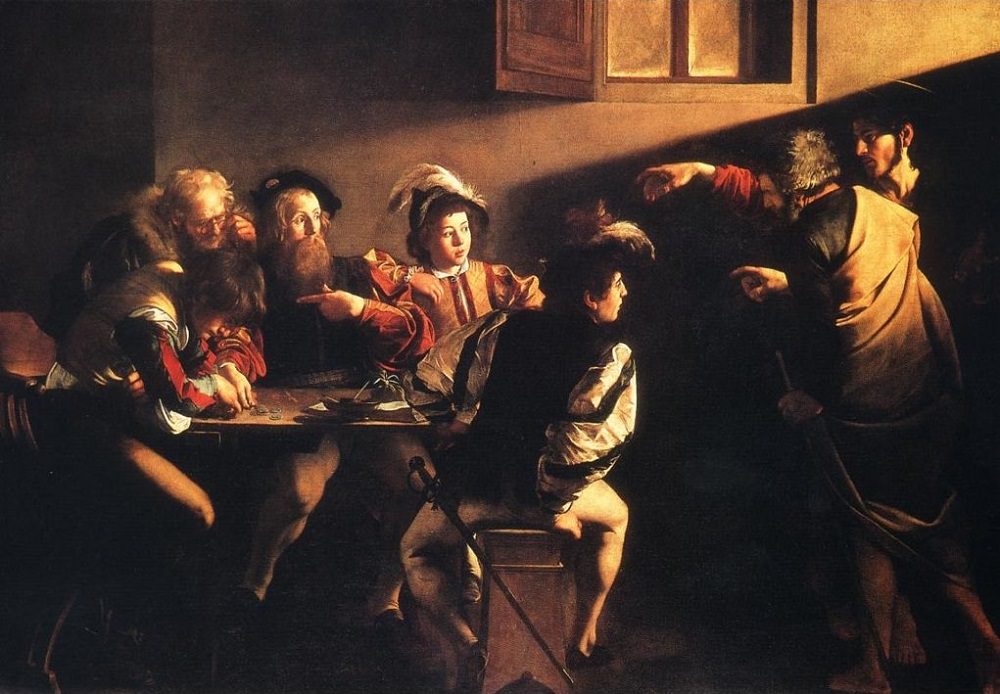
“The Calling of St. Matthew” by Caravaggio. From Google.
Dearest Jesus: I have been imagining in prayer of myself being Levi the tax collector sitting at his post.
It must be so lonely being like him, rich but deep inside longing for something deeper and meaningful than money and wealth. He had been thinking of making a “lifestyle shift” but he felt hopeless with nobody to help him.
Like in the first reading, your invitation Lord through the Prophet Isaiah seem to be too good to be true that anyone like Levi – or me – could make a big difference in life by “giving food to someone hungrier, abandoning my own comfort to care for someone afflicted, substituting a kind word for a malicious gossip, and worshipping you than pursuing my own interests”(Is.58:10,13).
I felt like Levi – there in his little customs post – that is impossible because everything is hopeless and there is no chance to change. Everything is doomed, especially for me, a sinner, Lord.
Then, suddenly you came, saying, “Follow me” (Lk.5:27).
How I love looking back, Lord, to those dark days when you suddenly came calling me to follow you!
It was so simple.
Like Levi, I just stood and followed you and everything changed in my life!
That was so nice of you, Lord Jesus, to take such a bold step of coming to Levi’s post to call him and, me. It was – and still is – a gamble on your part to call us sinners to follow you. And since then, you have never stopped calling us sinners Lord Jesus to follow you, even on our darkest and lowest days and hours, Lord, when everything seemed to be so doomed.
As we prepare for the first Sunday of Lent, remind me, O Lord, that this holy season is not all that drab and dry. After all, Lent originally means “springtime”, the coming joy of Easter which happens every time we turn our hearts to you like Levi. Amen.
40 Shades of Lent, Friday after Ash Wednesday, 28 February 2020
Isaiah 58:1-9 +++ 0 +++ Matthew 9:14-15
Have mercy on us, O God, have mercy… for we are still totally lost on the real meaning of fasting and abstinence. We have lost its spiritual meaning, focusing more on ourselves for vanity reasons like losing weight and looking good, totally forgetting fasting is all about you and others than us!
How unfortunate, dear God, that we no longer fast on Ash Wednesday and Good Friday but even on Sundays before receiving your Son Jesus in the Holy Communion by making all kinds of excuses with bold claims of having sacrificed so much in doing good deeds for you.
Thus says the Lord God: Cry out full-throated and unsparingly, lift up your voice like a trumpet blast. Tell my people their wickedness, and the house of Jacob their sins. They seek me day after day, and desire to know my ways, like a nation that has done what is just and not abandoned the law of their God. They ask me to declare what is due them, pleased to gain access to God. “Why do we fast, and you do not see it? Afflict ourselves, and you take no note of it?” Lo, on your fast day you carry out your own pursuits, and drive all your laborers. Yes, your fast ends in quarreling and fighting, striking with wicked claw. This, rather, is the fasting that I wish: releasing those bound unjustly, untying the thongs of the yoke; setting free the oppressed, breaking every yoke; sharing your bread with the hungry, sheltering the oppressed and the homeless; clothing the naked when you see them, and not turning your back on your own.”
Isaiah 58:1-4, 6-7
Make us realize that fasting is not punishing ourselves, of denying ourselves with goods and pleasures of the world that leave us empty, wanting for more but never fulfilled deep inside.
Fasting is actually rewarding ourselves with you, O God, our only wealth and treasure, our only fulfillment.
Help us create an empty space within ourselves through fasting and abstinence so that your Son Jesus may dwell and reign in our hearts, saying from within us, “Here I am!” (Is. 58:9).Amen.
40 Shades of Lent, Thursday after Ash Wednesday, 27 February 2020
Deuteronomy 30:15-20 +++ 0 +++ Luke 9:22-25
As we step forward into the second day of Lent, O Lord, you remind us today of your call to conversion which is actually a call to love and a call to life.
Forgive us, O Lord, for those times we have turned away from you in sins, thinking that is the path to life, the path to freedom, the path to fulfillment – only to find out later it is the path to destruction and death.
Moses said to the people: “Today I have set before you life and prosperity, death and doom. If you obey the commandments of the Lord, your God, which I enjoin on you today, loving him, and walking in his ways, and keeping his commandments, statutes and decrees, you will live and grow numerous, and the Lord, your God, will bless you in the land you are entering to occupy. I have set before you life and death, the blessing and the curse. Choose life, then, that you and your descendants may live, by loving the Lord, your God, heeding his voice, and holding fast to him.”
Deuteronomy 30:15-16, 19-20
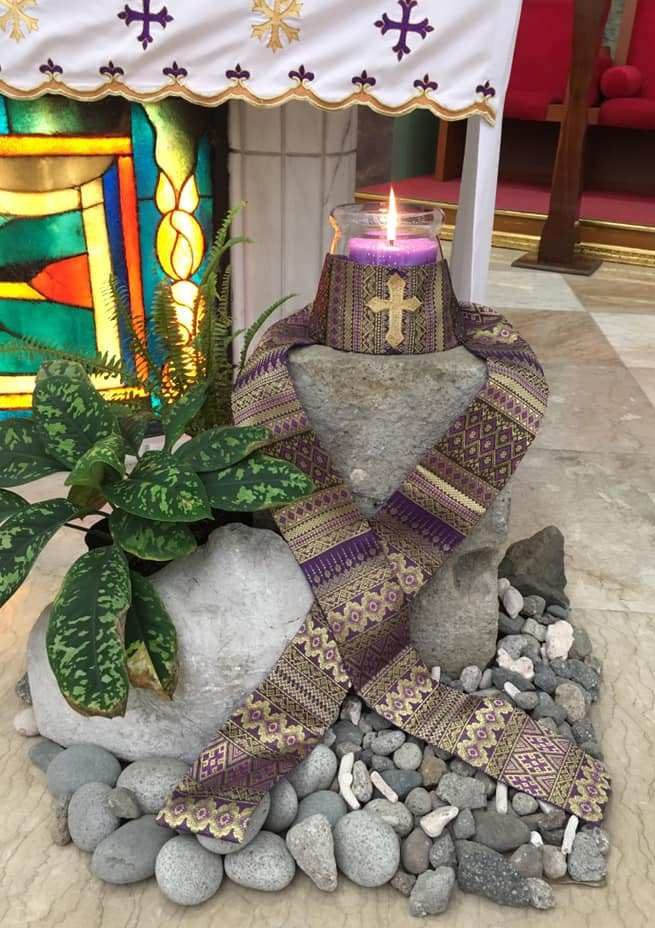
Photo by author, our Parish altar candle, Lent 2019.
Help us, Jesus, “to deny ourselves, take up our crosses daily, and follow you” (Lk.9:23) in the path of conversion and fidelity to your everlasting covenant.
Make us realize that Lent is more than a season we yearly celebrate but a reality of life itself, a life so blessed in your coming to be one with us in our sufferings and struggles.
Give us the strength, dear Jesus, to renew your covenant with us, to always choose God, choose life.
May we also share your love and mercy, understanding and patience, kindness and compassion to our fellow pilgrims in this journey of life so that together in the end, we may all enter into the house of the Father in heaven. Amen.
Lawiswis Ng Salita ni P. Nicanor F. Lalog II, ika-26 ng Pebrero 2020
Mula sa Google.
Mierculés de ceniza
araw ng pag-aayuno at abstinensiya
ngunit tila wala nang nagpapahalaga
ni nakaka-alala.
Marahil ay nalimot na nga
at binalewala mga banal na gawain
tuwing cuaresma na nagpapa-alala
kahalgahan ng Diyos higit sa lahat.
Nagtitiis ng gutom
hindi pinapayagang sayaran
ng anumang laman ang tiyan
alang-alang sa kaganapan at kabanalan.
Kaya nga kung titingnan
pag-aayuno ay higit pa sa sakripisyo
na kung saan tiyan ay walang laman
upang magkapuwang Tagapagligtas ng tanan.
Ngayong cuaresma sana iyong mabuksan
puso at kalooban tingnan ano ba kanilang mga laman
baka naman mga wala nang kabuluhan
pabigat lamang sa kalooban.
Bigyan ng puwang upang makapanahan
sa ating puso at kalooban si Kristong maasahan
upang ngayon pa lamang maranasan
hatid ng Diyos na kaligtasan sa mga sa kanya'y mayroong puwang.
Lawiswis ng Salita ni P. Nicanor F. Lalog II, Ika-24 ng Pebrero 2020
Mula sa Inquirer.net
Tuwing maiisip ko pangalang EDSA
ako ay naluluha at naaalala noong una
ang tuwa ng mapayapang pagbabago
nagmula sa makasaysayang kalsada.
Naluluha pa rin ako ngayon
tuwing masasambit pangalang EDSA
ngunit mayroon na parating sumasagitsit
mula sa langit lungkot at pait sa ating sinapit.
Masakit para sa amin na noon pa ma'y
tumutol sa mga ulol at hibang na K-B-L
ngunit pagkaraan ng EDSA,
mga halimaw din pala aming nakasama!
Inuna kanilang mga hacienda
makinarya sa pulitika
reporma anila sa ekonomiya
pagkakanya-kanya lang din naman pala.
Ano nga ba talaga nangyari
noong Pebrero mil-nueve-ochenta'y-sais?
Trahedya ng EDSA o
Trahedya sa EDSA?
Kung maari sana'y pakinggan nating muli
hindi tinig ko o ng kung sinu-sinong
magkomentaryong pilosopo o lalo naman
pinagsasabi ng sino mang pulitiko at relihiyoso!
Bawat isa sana ay magtika
dahil alin mang trahedya - ng EDSA o sa EDSA -
ay iisa:  Panginoong Diyos na siyang kumilos noon,
ating tinalikuran at kinalimutan ngayon!
Soon afterward Jesus journeyed to a city called Nain, and his disciples and a large crowd accompanied him. As he drew near to the gate of the city, a man who had died was being carried out, the only son of his mother, and she was a widow. A large crowd from the city was with her. When the Lord saw her, he was moved with pity for her and said to her, “Do not weep.” He stepped forward and touched the coffin; at this the bearers halted, and he said, “Young man, I tell you, arise!” The dead man sat up and began to speak, and Jesus gave him to his mother. Fear seized them all, and they glorified God, exclaiming, “A great prophet has arisen in our midst,” and “God has visited his people.”
Luke 7:11-16
Today, we are like at the city of Nain. Traffic is so heavy outside as many of us – family and friends, former classmates, colleagues at work from all over and neighbors – gather to pray and pay our last respects for Archie.
Celebrating a funeral Mass for a young person is always difficult for me. Like Jesus, I feel so sad for their parents. Normally, it is the children who bury their parents. It must be so painful for parents burying a son or a daughter. That is why in our gospel, Jesus was “moved with pity” with the widow of Nain.
But today, amid the pains and sorrows with the sudden death of Archie last week at a very young age, we actually celebrate life in Jesus Christ.
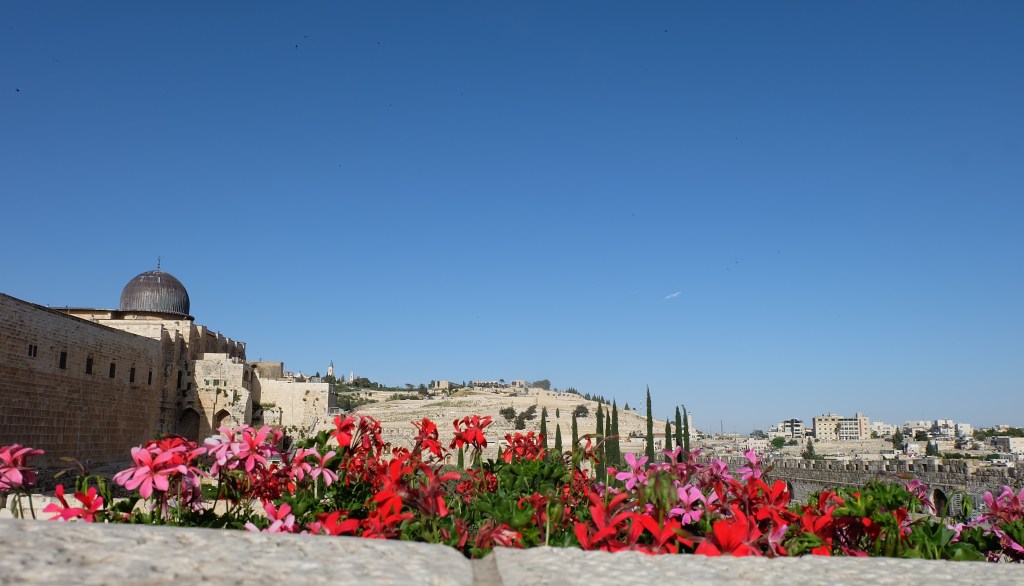
Photo by author of the hills of Galilee from the Walls of Jerusalem, May 2017.
Jesus comes to visit us always
Like in that scene at Nain, we remember and celebrate the life of Archie who had come to visit us even for a short time.
I love that part of the gospel where the people at Nain exclaimed at how “God has visited his people” when Jesus raised the dead young man.
Jesus continues to visit us everyday through one another like Archie.
Despite his many sins and imperfections, Archie made us experience Jesus Christ’s love and friendship, warmth and kindness, especially to his two sons, family, and friends.
Surely, Jesus must have visited Archie, too, during those dark moments of his life.
And the good news is, Archie visited Jesus so often especially these last two years when he started to pick up the pieces of his life.
Last time I saw Archie was last November when he came to celebrate Mass in our Parish. And I have heard how he had sought spiritual guidance from Fr. Carl, driving that far to Paco every month as he renewed his relationship with Christ, trying to follow anew the Lord he had served since elementary as a sacristan and later as a seminarian in our high school seminary.
It is Jesus who first finds us always
Photo by author at Mt. St. Paul Spirituality Center, Baguio, 04 February 2020.
We all know Archie’s tocayo is one of ancient Greece’s great scientist and inventor, Archimedes.
It is said that he discovered the principle of buoyancy – the “Archimedes’ principle” – while taking a bath.
When Archimedes sat onto his bathtub, he observed that “when a body is submerged in a fluid, it experiences an apparent loss in weight that is equal to the weight of fluid displaced by the immersed body.”
Archimedes was so ecstatic with his accidental discovery that he jumped naked from his bathtub out to the streets, shouting “eureka!” or “I have found” the solution to a problem he was trying to solve at that time.
Archimedes had not only enriched the field of mathematics and sciences with his discoveries but also the English language with the word “eureka” or “eureka moment”: when somebody discovers something very significant in business and economics, the sciences especially medicine, and practically in every field and subject.
Most especially in life.
Photo by author, Mt. St. Paul Spirituality Center, Baguio, 04 February 2020.
Archie had the same eureka moment in life: he had found Jesus Christ again that he went back to Mass and Confessions.
He had found meaning in life again after losing hope and directions.
Most of all, Archie had found love again.
Like his namesake of ancient Greece, Archie is now exclaiming “eureka” ecstatically into heaven – naked – with nothing but the love and mercy of Jesus Christ who first found him and brought him back to life a few years ago.
Today as we bring the remains of Archie into his final resting place, we thank God who never stops looking for us, finding us so that we can find him again and finally rest in him.
Today it is Jesus who is most ecstatic of all because he is the first to have found Archie and that is why, he had called him back to him, never to get lost again.
But the souls of the just are in the hand of God, and no torment shall touch them. They seemed, in the view of the foolish, to be dead; and their passing away was thought an affliction and their going forth from us, utter destruction. But they are in peace. In the time of their visitation they shall shine.
Photo by author, Laguna Lake, Los Baños, Laguna, 13 February 2020.
How often does it still happen today, Lord Jesus Christ, that like in our gospel today you would “sigh from the depth of your heart” after we, your people, would ask you for more signs from heaven?
Have mercy on us, Lord, for our lack of faith in you after all these years.
Forgive us for being “unstable in all our ways” with you, always “a man of two minds” as St. James would describe us (James 1:8) in seeking wisdom and things from you.
Forgive us for those moments we doubt your presence and power especially when we fail to win your favor, to get your blessings for our particular prayers and supplications.
The fault is really on us, Lord.
If sighing is your way of keeping your patience with our being so stubborn, teach us to reach out to you in the depths of our hearts, to remember those countless occasions you have saved us.
That instead of asking for signs from you, we may just sigh deep inside us to experience you again. Amen.
1 Kings 12:26-32; 13:33-34 ><)))*> 0 <*(((>< Mark 8:1-10
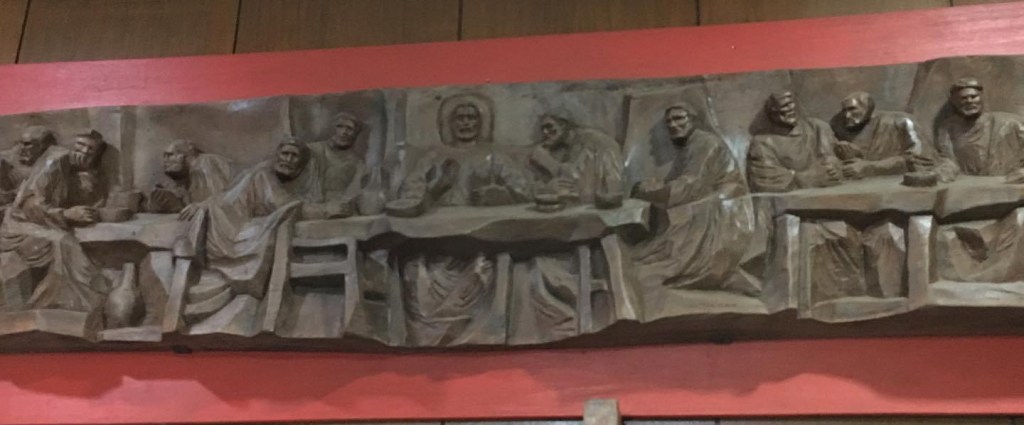
Photo by author of a wood carving of the Last Supper from Paete, Laguna at a relative’s residence in Collegeville Subd., Los Baños, Laguna, 13 February 2020.
Lord Jesus Christ, you have come to always remind us to remember your great sign of presence, the Holy Eucharist when you told us “Do this in memory of me.”
That is why in our gospel today, you have again another scene where you miraculously fed more than 4000 people from just seven pieces of bread.
Such miracles of yo feeding the people, healing them of their many sickness are properly called as “signs” of your saving and loving presence.
They are meant to be remembered always of how much you love us.
Keep us to be faithful to keep on remembering your works so we may also remind others to remember your love and mercy for us all.
Help us not to be not like Jeroboam who diverted the attention of people away from you by building altar to false gods and initiating celebrations to idols that led others into sin against you.
May we bring people closer to you, not away from you with our life of witnessing especially in practicing our faith in the sacraments. Amen.









 lordmychef.com