The Lord Is My Chef Daily Recipe for the Soul by Fr. Nicanor F. Lalog II
Friday in the Fifteenth Week of Ordinary Time, Year I, 21 July 2023
Exodus 11:10-12:14   <*(((><<< + >>><)))*>   Matthew 12:1-8
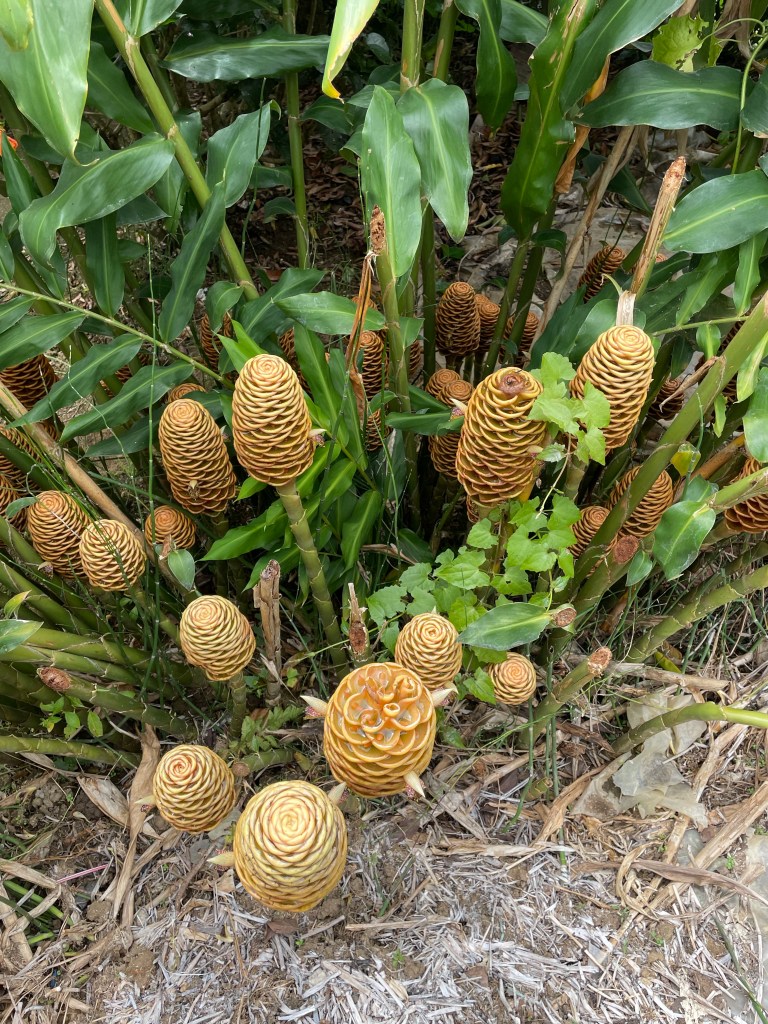
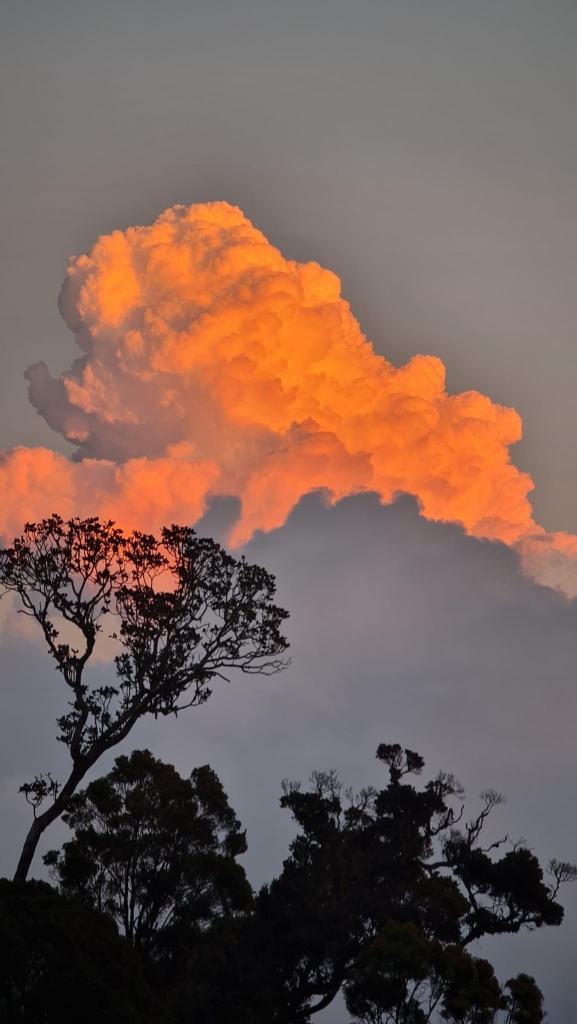
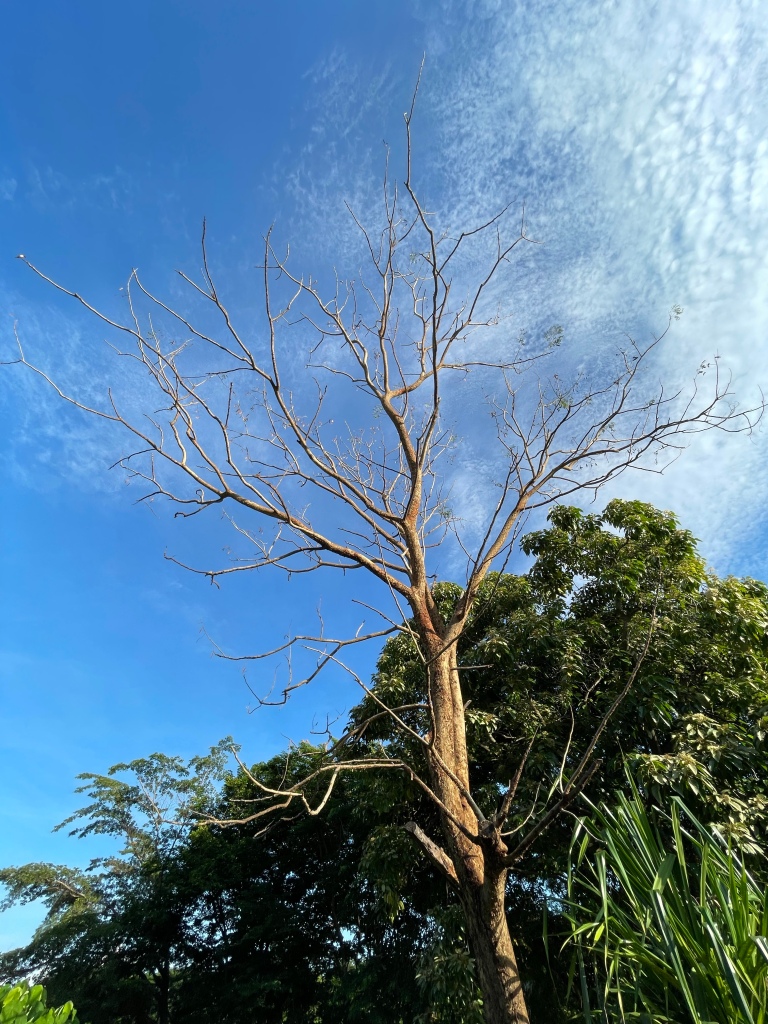
Photo by Fr. Pop Dela Cruz in San Miguel, Bulacan, 2022.
Your words today, dear God
remind us of your presence,
of your journeying with us,
of your passing over:
"But the blood will mark
the houses where you are.
Seeing the blood,
I will pass over you;
thus, when I strike
the land of Egypt,
no destructive blow will
come upon you"
(Exodus 12:13-14).
This came into fulfillment
in Jesus Christ's coming
in our midst:
"Jesus was going through
a field of grain on the sabbath"
(Matthew 12:1) when the Pharisees
noticed the day than the persons
at the scene that they sorely
missed the whole point of
the Lord's presence among them,
"I say to you, something greater
than the temple is here"
(Matthew 12:6).
Keep us aware of you
always, O God;
let us find your face
on the face of everyone we meet,
let us recognize you in the person
next to us especially those
searching for you,
in need of comfort,
and those lost
because no one sees them,
no one recognizes them
nobody loves them.
Amen.
Quiet Storm by Fr. Nicanor F. Lalog II, 17 July 2023
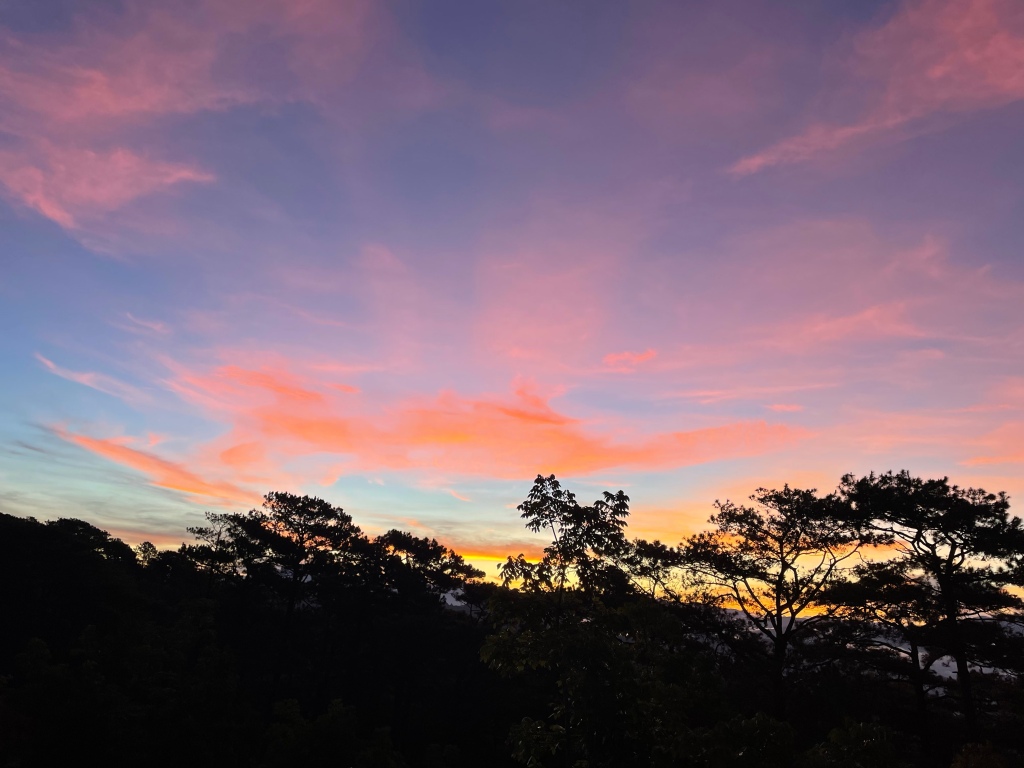
Photo by author, sunrise at Camp John Hay, 12 July 2023.
If there is one thing I have truly learned and finally got convinced more than ever, never trust “media”: what you see and hear especially in social media are not true at all. I have known it all along having worked there. Have been teaching it too for so long. But sometimes, just because I was with the bagets and younger siblings who all relied with WAZE and Tiktok while listening endlessly to Spotify, sigue na nga, maniwala na nga ako sa media.
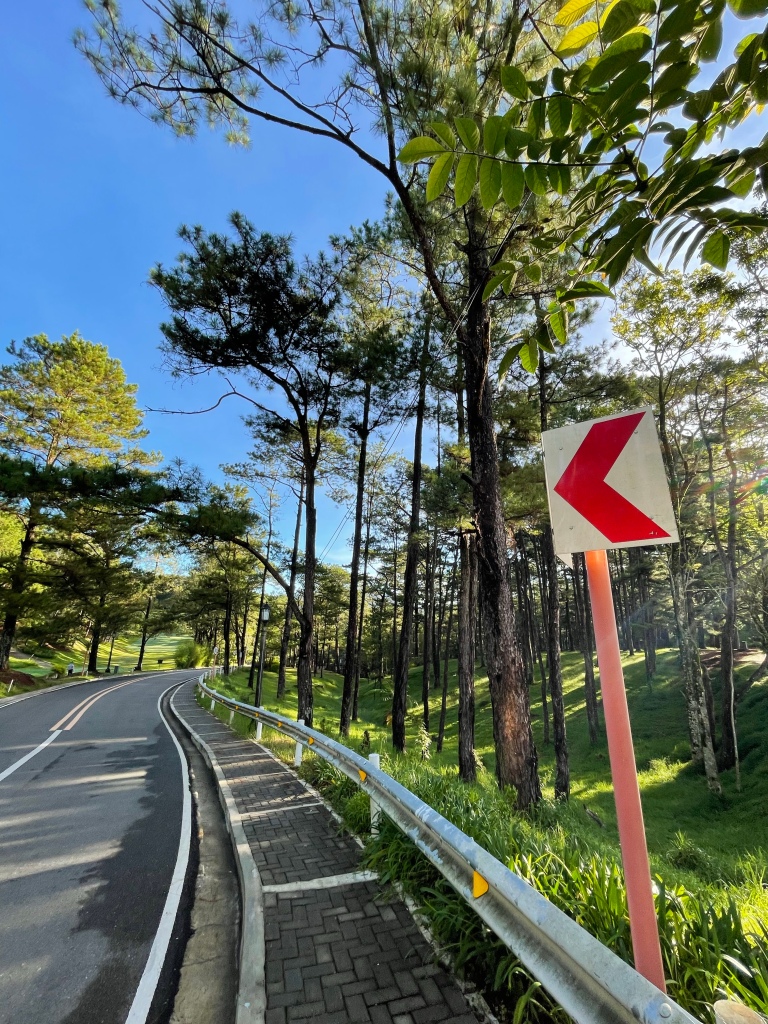
Photo by author, Camp John Hay, 12 July 2023.
And so, we got lost again on our final day in Baguio City.
But, still thankful for the experience, the fun and new discoveries not only outside but inside ourselves as siblings, as a family.
Went to bed earlier the night before hoping I could sleep longer in the city of pines. Unfortunately, I was already up before 5am, as usual, the following morning.
Sad to say, too, the weather is no longer that cold anymore in Baguio as before. Though the temperature readings indicated 19 degrees, I could hardly feel it except at about 2am.
Walked a kilometer with my only nephew Tommy and his mother, my sister Meg who enjoyed identifying the various plants and flowers with her phone app. She’s the only one among us four who had inherited our mother’s green thumb, a certified plantita as she would prove later in our misadventure.
Admiring the “naturally” thriving flowers on a street near the Good Shepherd Convent in Baguio, 12 July 2023.
After a sumptuous breakfast at the Manor House and endless pictorials, we packed our things to check out half an hour before 12 noon for the second most important itinerary of any Baguio vacation: Good Shepherd and Mines View Park shopping for pasalubong!
Traffic was not heavy when we went there, a Tuesday and Wednesday. And Baguio’s new traffic scheme with many “one ways” seem to be working well, even better than before the pandemic period.
Photo by author, 12 July 2023.
We were supposed to visit the Living Gifts Nursery also in La Trinidad town but, WAZE and Google Maps seem to be at a loss where that is located that we ended up at the Bahong Sunflower Garden.
I was already getting impatient after several misses and turns, refreshing Google map over and over when on our third try, we saw signs to a tourism office and the Bahong Sunflower Garden.
That was when we decided to forget the Living Gifts Nursery as we convinced ourselves it had changed its name to Bahong Sunflower Garden after the TikTok reel was uploaded.
Maybe next time, TikTok should also incorporate a GPS app for its featured destination spots for directions. Or, I better stop acting as navigator at all.
Photo by our youngest niece, Catherine Darla Lalog.
There’s an entrance fee so minimal, not less than 100-pesos but again, the sights are worth all the efforts. And patience.
Photo by our birthday celebrator, Bing-Bing.
Of course, first thing we looked for upon arrival was the “CR” that was “comfortable” enough to make us smile and laugh in enjoying each other with nature made better by its cool, sometimes chilly, breeze.
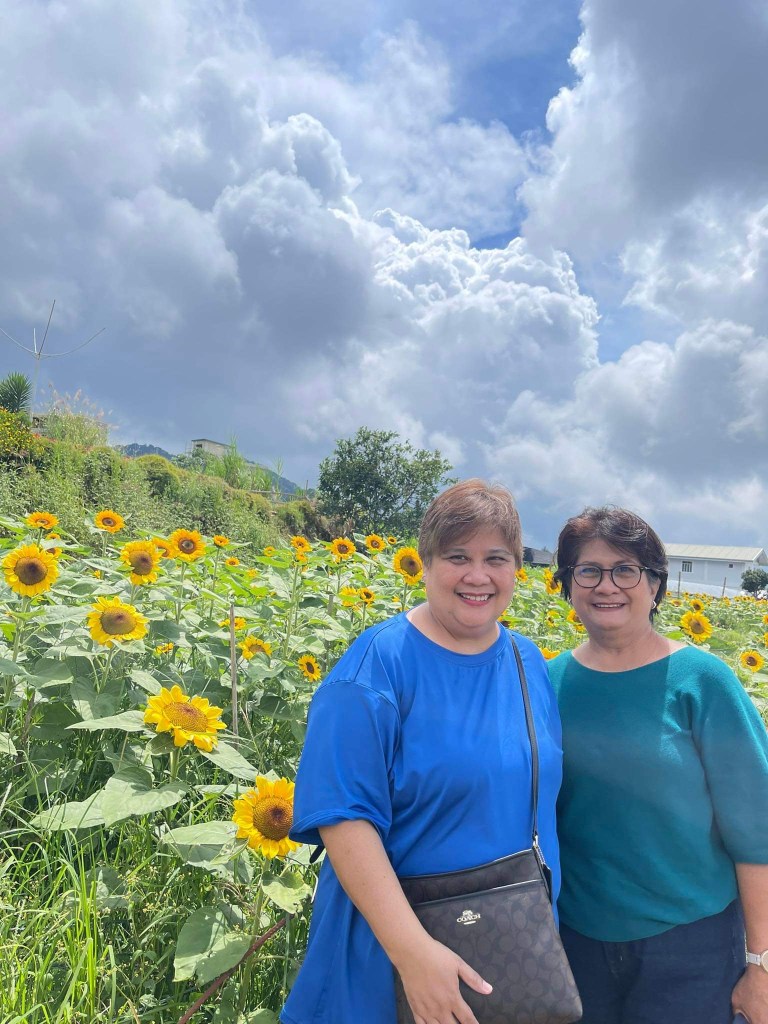
Photo by author, still at Bahong Sunflower Garden, 12 July 2023.
We left Bahong Sunflower Garden after an hour with a lot of fond memories as a family. Shortly before boarding our car, Meg could not contain herself not buying a plant from there. And the more she became insistent after finding out what she wanted cost only 300 pesos which according to her could easily fetch a price of over 3000-pesos in Bulacan.
Despite protests from her kids that there was no more space for her second plant, like my mom, Meg found a way of arranging everything at the back of her Innova with still some space – just in case – like additional pasalubong along the way.
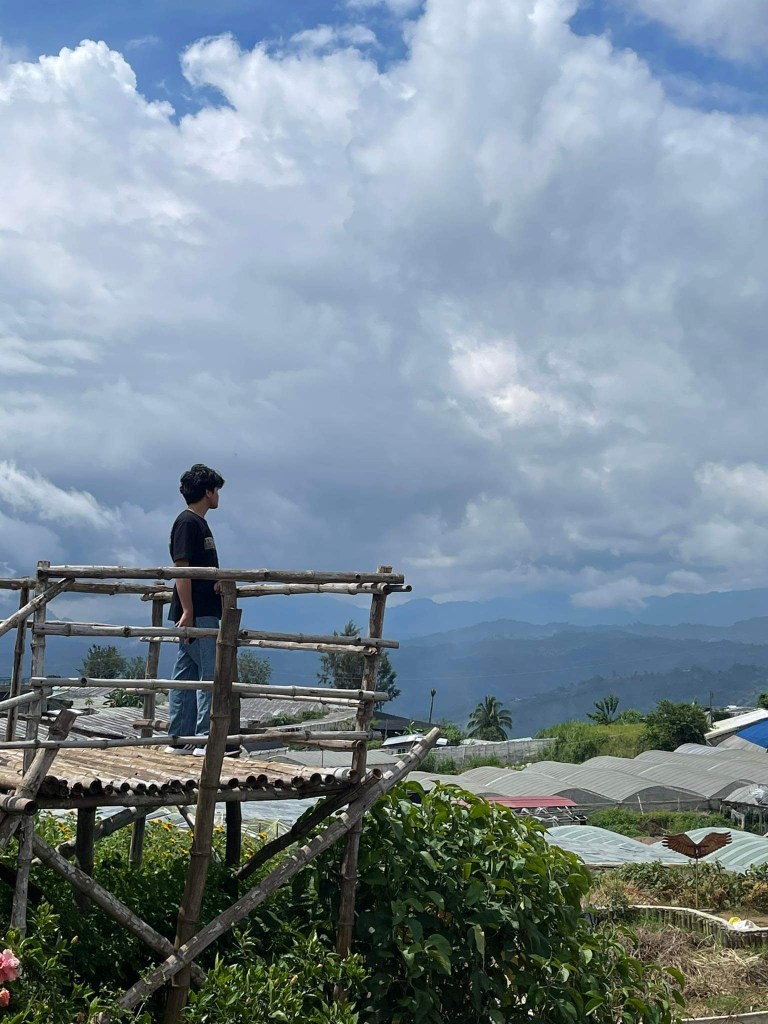
Photo by author, still at Bahong Sunflower Garden, La Trinidad, Benguet, 12 July 2023.
How true indeed that once in a while, it is good to get lost in our trips. After all, it is the journey that matters most and not the destination. Most especially, the company you keep. Primary of them is our own family.
Photo by author, 12 July 2023.
Being the eldest in the family, there were times I wished I have an Ate, an elder sister, someone I could turn to in times of difficulties. Someone to look up to. Hindi yung ako lang palagi tinitingala nila especially after Dad had passed away in 2020.
But, up there in La Trinidad, I have realized that in life, it is not really about looking up and looking down. The only time we ought to look up is to God who is above all else and everything. Our semper major. The rest, in my view, is not about looking up nor looking down but of seeing more each one as a person, a beloved. Life is about seeing – not looking – to find the giftedness of everyone that has always been ever present.
Truly, “persons are gifts of God to me, that come all wrapped so differently” as we used to sing in our daily Masses in the high school seminary. This was most true as we left the garden when we have to ascend.
Photo by author, 12 July 2023.
It was our only nephew Tommy who was most gracious and kind, and strong enough, to pull us up from the steep and sometimes slippery pathways.
Along the way, he found these plants which he called as nature’s “chocolate batirol”.
Despite his denials, he seemed disappointed when Camp John Hay’s Chocolate de Baterol was still closed when we walked there earlier.
We shall definitely go back to Baguio City to relax and unwind. And get lost again.
Thank you for joining us in our trip. God bless everyone! May you also have a great vacation soon! Amen.
In this season of graduations when we also celebrate today the feast of St. Thomas the Apostle, we are reminded that growth and maturity in Christian faith goes through a process too of “graduation”.
St. Thomas went through different stages in life as a disciple of Christ before finally graduating with honors as a martyr. Most of all, he is a good model for every graduating student to emulate because he is the one so famous for having “doubts” and being known as the “doubting Thomas”.
To doubt is not necessarily bad. In fact, it is a grace from God because every doubt is a step closer to wisdom and knowledge. Without doubts, we can never learn because we will never be able to verify and validate what we know if we do not doubt at all. We shall discuss this further as we reflect on the three graduation events in the life of St. Thomas the Apostle.
His first graduation happened when the Lord’s best friend, Lazarus, died.
“The Raising of Lazarus”, 1311 painting by Duccio de Buoninsegna. Photo by commons.wikimedia.org
Recall how Jesus and his Apostles were prevented from visiting Lazarus when he was seriously ill because he lived with his sisters Marth and Mary in the town of Bethany that was near Jerusalem where the Lord’s enemies were plotting to arrest and put him to death. It was too risky for Jesus to go to Bethany but, because of his love for Lazarus and his sisters, Jesus decided to take the risk to visit him.
It was St. Thomas who rallied his fellow apostles to come with the Lord to share in his death.
So then Jesus said to them clearly, “Lazarus has died. And I am glad for you that I was not there, that you may believe. Let us go to him.” So Thomas, called Didymus, said to his fellow disciples, “Let us also go to die with him.”
John 11:14-16
A good student is always a risk-taker. All graduating students since 2021 to present deserve a great commendation, a great congratulations for taking all the risks and difficulties in pursuing your studies in these four years of the pandemic. Despite the poor internet connections, the threats of viral infections and many other risks, you forged on and now you are a step closer in fulfilling your dreams.
The key here is to never be away from Jesus like St. Thomas who at that early stage had identified himself with the destiny of Christ in offering himself on the Cross. St. Thomas knew it then that nothing is easy in this life but if we are with the Lord, there is nothing we cannot overcome.
Graduation as a process or a passing through stages is also a passover, a pasch like the Passion, Death, and Resurrection of Jesus Christ. Recall the gospel the other Sunday when Jesus told his Apostles to fear no one, to be not afraid. The same thing is what St. Thomas is reminding us today: do not be afraid to learn, to commit mistakes, to doubt, to fail, to get hurt. These little deaths are all part of our process of growing and maturing, of getting better, of being achievers.
The second graduation moment of St. Thomas happened during their Last Supper when the Lord was telling them of his coming death that would lead to his Resurrection and return to the Father’s house where he would prepare a room for them.
“Where I am going you know the way.” Thomas said to him, “Master, we do not know where you are going; how can we know the way?” Jesus said to him, “I am the way and the truth and the life. No one comes to the Father except through me.”
John 14:4-6
Imagine the somber and serious mood of the Last Supper, of Jesus telling everyone of his coming pasch. Then suddenly, there was St. Thomas interjecting with a statement “we do not know where you are going” with a question, “how can we know the way?”
Notice the comedy twist? Funny indeed and truly, we could see St. Thomas in a low level of understanding but if he never dared to ask that question, we would never have that most quotable quote of the Lord of him being “the way and the truth and the life.”
Here, St. Thomas is teaching us to always ask for explanations, even from the Lord himself! As RiteMed would say in its commercials, “Huwag mahihiyang magtanong”!
Photo by Mr. Paulo Sillonar, 07 June 2023.
In telling St. Thomas – and us – that Jesus is the way and the truth and the life, the Lord is reminding us how it is forever valid that true learning is gained from our dealing and relating with persons, with people, not with things like gadgets. Or even pet animals nor plants.
As you go on your school break after your graduation, spend more time with people, with your parents, with your brothers and sisters and cousins. Or playmates. Leave your gadgets and pets behind. Go out and play, bond with people. Get real and stop those virtual realities.
Very often, the teachers we truly love or like and appreciate impact are those who have gone out of their ways to reach out to us, to relate with us. They were the teachers really deserving to be called mentors who not only taught us with so many knowledge and information and techniques but most of all, the ones who have made us experience life, the ones who have opened our minds and hearts to realities of life, showing us the relationships between the classroom and actual life.
Jesus is more than a teaching or a doctrine or a lesson. Jesus is a person we relate with, we experience life with, we live with through people he sends us in the family and in the school. And we learn most in life with them.
Do not be afraid to approach and ask them for explanations, directions, and clarifications. Google nor ChatGPT can never teach you life. St. Thomas must have learned so much from that simple table incident in their Last Supper that even if at first he doubted Christ had risen, he eventually made the boldest expression of faith in Jesus when they finally met on the eighth day of Easter, his final graduation.
Then he said to Thomas, “Put your finger here and see my hands, and bring your hand and put it into my side, and do not be unbelieving, but believe.” Thomas answered and said to him, “My Lord and my God!” Jesus said to him, “Have you come to believe because you have seen me? Blessed are those who have not seen and have believed.”
John 20:27-29
Caravaggio’s painting “The Incredulity of St. Thomas” (1602) from en.wikipedia.org.
Many times, our doubts lead us to more brighter outcome than any uncertainty we may have before like St. Thomas. If St. Thomas did not believe at all that Jesus had risen, he would have not come to the Upper Room to be with the other Apostles to meet Jesus the following Sunday. He believed, though, there were some doubts that were natural. After all, the Resurrection of Jesus was beyond normal, beyond logic. It was truly astounding.
After a long series of stages, here we find St. Thomas making the boldest and strongest expression of faith ever which we silently pray every consecration period in the Mass, “my Lord and my God.”
Dear students, be a man of prayer, be a woman of prayer.
Persevere in deepening your faith despite the many difficulties and challenges being posed today by modern culture characterized by relativism and individualism, materialism and consumerism. St. Mother Teresa said it well, “We are called to be faithful, not successful”. The recent dark days of the pandemic have shown that science will never be enough in this world, in this life. There is God. And the good news is he is not that far from us. He is the one calling us to believe even if we have not seen him. If the world says to see is to believe, that if there are no pictures it did not happen at all, Jesus is telling us today in the experience of St. Thomas that when you believe, then you shall see!
Let us imitate St. Thomas, a student who studied hard, worked harder, and prayed hardest to Jesus who never abandoned him especially in his doubts and weaknesses. May the example of St. Thomas strengthen our faith in Jesus who is our Lord and God. Amen.
The Lord Is My Chef Daily Recipe for the Soul by Fr. Nicanor F. Lalog II
Monday in the Thirteenth Week of Ordinary Time, 26 June 2023
Genesis 12:1-9   ><))))*> + ><))))*> + ><))))*>   Matthew 7:1-5
Photo by author, Sonnen Berg, Davao City, August 2018.
Another month soon to close,
another month soon to open
at the end of this week;
thank you very much, God
our loving Father for the wonderful
journey in life.
Continue to call us,
continue to lead us
to new directions,
to new challenges
to new stages in life
to newer selves.
Like Abraham,
teach us to leave
our comfort zones,
teach us to trust in you,
teach us to realize we are
never too old to move out
and grow; most of all,
teach us to chill,
to slow down, to stop rushing
and worrying in life.
Make us move in "stages", Lord,
like Abraham for you are the
first to know who we are,
where we are,
and how we are.
The Lord said to Abram: “Go forth from the land of your kinsfolk and from your father’s house to a land that I will show you.” Then Abram journeyed on by stages to the Negeb.
Genesis 12:1,9
Let us follow Jesus,
"the way and the truth
and the life" in this journey
in life in whatever stages
we may be;
may we stop judging
so we may not be judged
and simply enjoy this
journey in life
in whatever stage
we may be.
Amen.
*Since last night after praying for today's readings, I was struck by that passage of Abram journeyed by "stages" that instantly reminded me of David Benoit's 1982 album and single, "Stages". Blessed Monday!
Quiet Storm by Fr. Nicanor F. Lalog II, 19 June 2023
Photo by author, Sacred Heart Novitiate, Novaliches, Quezon City, 20 March 2023.
Forgive me for always having reservations in the celebration of Father’s Day as well as of Mother’s Day. I am not against these celebrations but often wary that being a secular observance, they often miss out the spiritual aspect of fatherhood (and motherhood) that are both gifts of God. In fact, the Ordo of the Mass, that little reference book we use in our daily celebrations of the liturgy, reminds us priests that Fathers’ Day celebration “should not diminish the primary focus of this Sunday as the celebration of the Paschal Mystery.”
Consider also the fact how religious celebrations like Christmas have been “corrupted” to mere commercialisms by our world so driven by consumerism and materialism; how much more a secular celebration like Father’s Day could end up that way too?
As we reel from yesterday’s celebrations with a lot of gifts, food and drinks to all the great dads, join me in reflecting on God as our Father which I have learned from one of my spiritual fathers, the late Msgr. Sabino S. Vengco Jr.
Photo by Arch. Philip Santiago, 2022.
God is our Father because he is the giver of life. This is the first meaning of fatherhood: the father is the source of life. Genetically speaking, even though we inherit equal genetic materials from our parents that make us who we are, researchers say that we “use” more of the DNA from our fathers. Maybe this is the reason why we have that expression in Filipino, “Anak ka ng tatay mo”. Recall how St. Joseph had to marry the Blessed Mother, Virgin Mary when he had to stand as the “foster father” of the Savior by giving him the name “Jesus”. Likewise, being from the house of David, his being the “foster father” of Jesus fulfilled God’s promise in the Old Testament that our Savior shall come from the lineage of King David.
Unknown to many including priests, the rite of Baptism states that in the administration of the sacrament to the infant, it is the father who gives the name to the child being baptized because that child came from him!
But Dads as giver of life is more than in the biological sense. A father inspires and motivates his children to become better and matured persons. As a giver of life, the father shows the best examples of leadership, wisdom and prudence in dealing with life’s many complexities. It is the father who opens the minds and hearts of the children to become better citizens of the nation, not as burdens of the society in the future.
Cheers to all the Dads who have stood by their sons and daughters, working hard not only to provide food and clothing to their children but most especially a brighter future for them with their good examples of being responsible and committed fathers.
Photo by author, St. John the Baptist Parish, Calumpit, Bulacan, 2022.
God is our Father because he protects life. It is always easy to be a parent but not truly a father (or a mother). How sad these days many young men have become like rabbits, lacking the maturity of giving one’s self into marriage and commitments.
A father does not only give life but must also sustain and most of all, protect life. Having lived during those times of frequent brownouts, I have learned this sense of protecting from my dad who would always tell us to be still as he rose to get the flashlight or find the match and candles whenever lights suddenly went off in the middle of our dinner. I grew up with that certainty that dads are men of courage, the ones who would always go first into dangerous situations to protect the family like my dad. When the father is the first to be scared or to scream in the event of dangers, there is surely a big problem at home.
Moreover, I have also observed that though wives outlive their husbands as proof that the female species is stronger than us males, there is still something so noble about fathers as protectors of life and family. Dads are always the first to die because they are the first to go into the great unknown called eternal life in order to watch over us his family. So many times since my father died in year 2000, I have felt him by my side whenever I faced big problems and difficulties. Many times I talked to him in my prayers, asking him for clarifications when I have to make crucial decisions for the family or in my ministry. He would sometimes appear to me in dreams or would make “paramdam” as we call it in Filipino when he sends signs of his presence to convey something important. Even in eternal life, Fathers remain close to us to protect and keep us safe from harm. And perhaps, he goes ahead of us to prepare the welcome party when our turn to die comes.
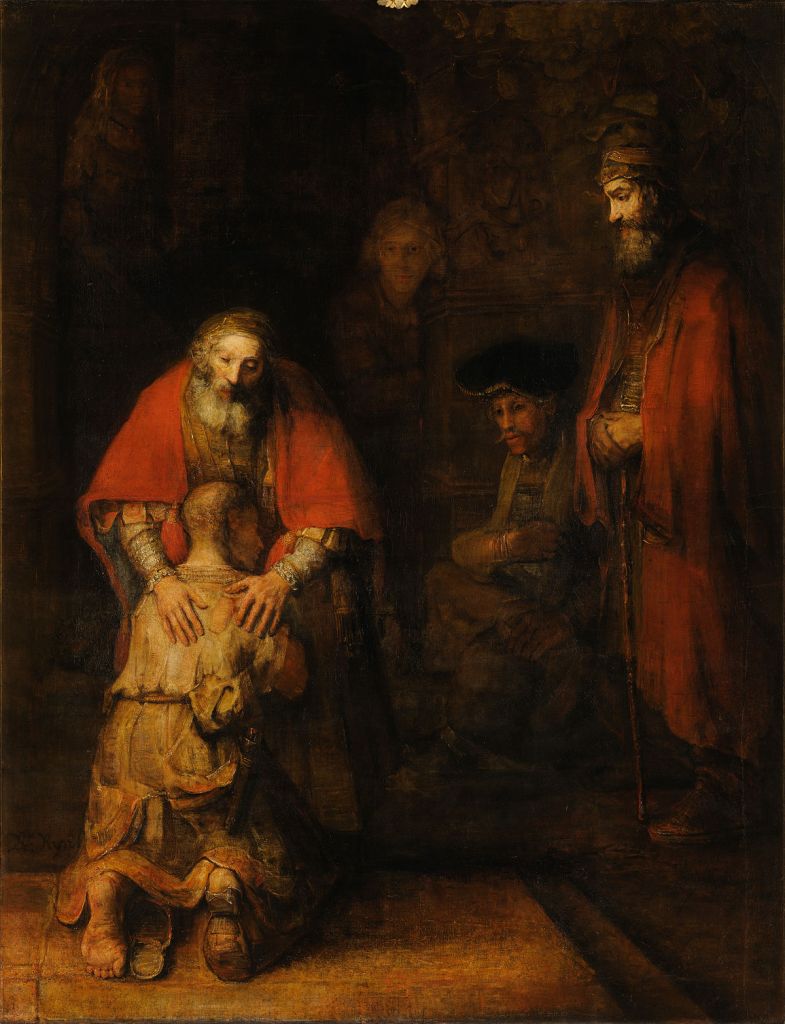
Rembrandt’s “The Return of the Prodigal Son” rom en.wikipedia.org.
God is our Father because he brings back life when we lose it. This is the most beautiful imagery of God being a Father like that loving father of the prodigal son in Luke’s gospel. That is the height of fatherhood when children even wife lost life to wrong decisions, to sins, or anything that completely alters our way of living, it is always the father who assures us of how life would go on or continue, of how he would do everything to give us back our lives.
Have you noticed how despite being considered as the authority figure at home with their being strict and firm, fathers are actually more easier to approach than mothers when it comes to serious problems? A lot often, we tell our dads first of our major mishaps or accidents or misadventures because they are more calm and serene, always thinking ahead of finding solutions. Unlike mothers who are hyper ones, tending to nag and voice out their feelings inside. When I was in the seminary, a classmate borrowed my new tennis racquet. Unfortunately, he lent it to other seminarians until it was left behind at the tennis court that was picked by some outsiders who used to enter our compound after our recreation time. As vacation time approached, I prayed hard and told my dad if he could give me 300 pesos (that was quite a fortune in the early 1980’s) so I could get a new tennis racquet lest my mom would discover it was lost and I would be scolded, even spanked!
Many times, I have heard from many young people how it was their father who literally saved them by forgiving them and even helping them pick up the pieces of their lives when they got involved into teenage pregnancies. It seems those stories of fathers disowning their children especially the daughter for being disgrasyada is more of an exception than a rule, perhaps true only in telenovelas and movies.
During my final years in my seminary formation until my ordination to the priesthood in 1998, every time I would come home I would look intently at my father’s hands and face, observing his many wrinkles, burned and sagging skin. Whenever I would look at his hands and face, I thought of those days and nights and years when my dad would take the jeep and bus to work so we could have good food and good education, those many sacrifices he had to make for us to have some of the simple pleasures in life, of his fidelity to my mom and to us all that we are his only beloved and nobody else.
That is why when he died on the eve of Father’s Day on that third Sunday of June, the 17th in the year 2000 that coincided with my mom’s birthday, I felt a great part of me had gone too. It was very difficult. The pain has always remained but somehow, in his death, I have continued to feel his fatherhood with the great love he had showered us while still alive. That is why, unlike others, I choose to remain silent on Fathers’ Day, praying and reflecting fatherhood, a most precious gift of God whom Jesus revealed to us is also a Father. God bless all the fathers of the world! Amen.
My dad at his dest at the Bureau of Forestry (later Forest Development), 1972.
The Lord Is My Chef Daily Recipe for the Soul by Fr. Nicanor F. Lalog II
Friday, Solemnity of the Most Sacred Heart of Jesus, 16 June 2023
Deuteronomy 7:6-11 ><}}}*> 1 John 4:7-16 ><}}}*> Matthew 11:25-30
Photo by Dra. Mylene A. Santos, MD in San Antonio, Zambales, 05 June 2023.
My dearest Lord Jesus,
let me come to you
and rest in your
Most Sacred Heart;
you know very well my
countless labors
and heavy burdens in life;
ease my sufferings,
I do not ask to see
the distant shore nor
end of the tunnel,
just one step is enough for me
to forge on in you.
Despite my many tears
and laments in this life,
let me listen to your silence,
Lord Jesus;
let me feel your hug and embrace;
let me learn from you
to keep on serving lovingly,
to be always gentle and humble
of heart amid the many trials
and difficulties I face that are
often unknown to many
even to those dear to me.
O Jesus in your Most Sacred Heart,
let me be present in you
by leaving my past behind
and stop worrying of the future;
help me to let go
of my many disappointments
and frustrations to see
the many opportunities you offer me
in every here and now,
to finally take your yoke that is easy,
and your burden that is light
by living in every present moment
right in your heart,
here deep inside me.
Amen.
The Lord Is My Chef Daily Recipe for the Soul by Fr. Nicanor F. Lalog II
Homily, Solemnity of the Most Sacred Heart of Jesus, 16 June 2023
Deuteronomy 7:6-11 ><}}}*> 1 John 4:7-16 ><}}}*> Matthew 11:25-30
Photo by author, Sacred Heart Novitiate, Novaliches, Quezon City, 20 March 2023.
It has been two months since I celebrated by silver anniversary of ordination to the priesthood. Until now, I still continue to reflect and relish on this immense gift of priesthood, still asking with the same sense of awe and wonder since ordination day, “why me, Lord?”
As I reflected this week the Solemnity of the Most Sacred Heart of Jesus which is dedicated for the sanctification of us priests, I have realized how I have remained the same sinful, insecure and fearful man ordained 25 years ago with my six other classmates. As I get closer to becoming a senior citizen in 2025, the more my past sins and stupidities, carelessness and vices are coming back like “Facebook Memory”, reminding me how I have them kept under control, that they could burst and be out in the open if I get careless.
But in the midst of all these darkness and weaknesses still in me, the more I feel so blessed and consoled, and overjoyed by the fact that I still have that same desire to proclaim Jesus Christ to everyone, of how beautiful this life is because of the Lord’s immeasurable love for each of us. Whenever I look back to my past with all my sinfulness and weaknesses amid my getting older, the more I am eager to make Jesus known to everyone while I am still strong and able. There is that feeling of being like St. Paul in saying, “To me, the very least of all the holy ones, this grace was given, to preach to the Gentiles the inscrutable riches of Christ, and to bring to light for all what is the plan of the mystery hidden from ages past in God who created all things” (Eph. 3:8-9).
Or, like in our first reading, I could identify with the Israelites being reminded by Moses in the wilderness that “You are a people sacred to the Lord, your God; he has chosen you from all the nations on the face of the earth to be his people peculiarly his own. It was not because you are the largest of all nations that the Lord set his heart on you and chose you, for you are really the smallest of all nations. It was because the Lord loved you” (Dt.7:6-8).
Beautiful!
Love, love, and love!
That is the “inscrutable riches of Christ”, his immense love for us, dying for us, coming for us even if we are worth nothing at all. And it is because of that love of God for us that we have become so worthy that he gave us even his only Son, Jesus Christ.
That is the essence of this celebration of the Solemnity of the Most Sacred Heart of Jesus.
Love.
A reality we all experience and know but could not define for it has no limits. Love can only be described and best expressed in actions than in words.
See this Solemnity of the Most Sacred Heart of Jesus comes right after the Solemnities of the Most Holy Trinity and of the Most Precious Body and Blood of Jesus these past two Sundays. Both celebrations speak of love: the latter is about relationships based on love and the former is about giving of self in love.
Now that we are well into the Ordinary Time of our liturgical calendar, our celebration today tells us to remember throughout this year this most basic truth and reality of our faith – that we are so loved by God.
Beloved, let us love one another because love is of God; everyone who loves is begotten by God and knows God. Whoever is without love does not know God, for God is love. In this way the love of God was revealed to us: God sent his only Son into the world so that we might have life through him.
1 John 4:7-9
Love is symbolized by the heart, the very core of every person. That is why I love the Spanish word for heart which is corazon, evocative of the core, of the deeper self. And of course, love is the very the person of God.
Of all the writers in the Bible, St. John is the one who most frequently used the word “love”, an indication of its centrality in his thoughts. Moreover, he clarified that this love is not human love because its origin, motives and effects are supernatural in nature who is God himself.
Being the very self and also the riches or wealth of Christ, love is for sharing, for giving. Never for keeping. Because of its supernatural nature, love is inexhaustible. The more you give it, the more you share, the more you have it!
In this is love: not that we have loved God, but that he loved us and sent his Son as expiation for our sins. Beloved, if God so loved us, we also must love one another. No one has ever seen God. Yet, if we love one another, God remains in us, and his love is brought to perfection in us.
1 John 4:10-12
Photo by Ms. April Oliveros, March 2023 at Mt. Pulag.
Let me repeat that last sentence, “if we love one another, God remains in us, and his love is brought to perfection in us.”
The more we love, the more we are able to see and recognize God and other people amidst the darkness around us. Likewise, the more we love the more we see our true selves too despite dark spots within us.
Love is the law of life. To love God by loving ourselves and others is not an obligation imposed from outside. It is the very proof of our faith and union with God in Jesus Christ.
Jesus makes this very clear to us today in the gospel that opens with him praising the simple people, those who were child-like who welcomed him and his preaching. They were the ones Jesus referred at his sermon on the mount, “Blessed are the poor” because love is not an intellectual structure or system to be learned or analyzed. Love is a call to be disarmed of everything we hold onto so we can totally love and follow Jesus Christ.
“Come to me, all you who labor and are burdened, and I will give you rest. Take my yoke upon you and learn from me, for I am meek and humble of heart; and you will find rest for yourselves. For my yoke is easy, and my burden is light.”
Matthew 11:28-30
Jesus came to reveal to us God our Father. And to know the Father is not through the head or intelligence but through our heart that is like Christ’s, meek and humble, filled with love.
By becoming human like us in everything except sin, Jesus who is the image of the invisible God (Col. 1:15) enables us to feel and experience God now closest to us than ever. Most of all, we are able to love and still love especially when the going gets tough and rough.
Here Jesus shows us that love is not absence of sufferings. In fact, love is truest and noblest when there are sacrifices and sufferings as exemplified by Jesus in his life and death on the Cross.
There are times we feel grouchy, so sensitive when people seem to ask even demand so much from us.
From Facebook, 2021.
Sometimes we wonder why are we the ones always giving, always loving, always forgiving. Sometimes we even ask God why are we the ones going through all these trials in life, why are we the ones afflicted with this sickness, why are we given with a special child, why your child had gone ahead of you to eternal life?
So many whys, so many questions.
Rest today in Christ. Feel his embrace. Listen to his silence. Be filled with his love. As you ask Jesus with all those questions, realize that each cry, each lamentation is the “inscrutable riches of Christ”, his very love perfected in your labors and burdens. Amen.
Jesus, meek and humble of heart,
Make my heart like thine!
The Lord Is My Chef Sunday Recipe for the Soul by Fr. Nicanor F. Lalog II
Solemnity of the Body & Blood of Jesus Christ, 11 June 2023
Deuteronomy 8:2-3, 14-16 ><}}}}*> 1 Corinthians 10:16-17 ><}}}}*> John 6:51-58
Photo by author, 2018.
There is a weird British series in Netflix called the Inside Man about a professor of criminology at the death row in the States for the murder of his own wife. He had deep perceptions and analysis of events that people came to see him in prison to consult in locating their missing loved ones. One of them is an American journalist trying to do a story about him while at the same time seeking his expertise in locating her missing friend, a math tutor in England held hostage in the basement by a pastor and his wife.
Though the series is weird, it has some interesting lines about life and death like when the wife of the pastor told him how she had spent the whole afternoon searching the internet how to kill their son’s math tutor they have thrown in their basement. The wife found it unusual there was nothing in Google that tells of ways of killing another person (so weird, is it not?); however, she was surprised that almost everything she had found in the internet and social media was mainly about sex as he teased her husband that it is not love that makes the world go round but sex!
Yes, it is very funny and weird but her observations seem to be true because nobody in his right mind would ever want to destroy life except terrorists and lunatics. People generally love life that our social media are saturated with contents that try to show how we can enjoy this life through sex, food, and travels in that order. Also with cars for boys aged 5 to 95.
Photo by author, March 2020.
Of course, we all know that is not what life is all about that is filled with mysteries.
Last Sunday we reflected in the Solemnity of the Holy Trinity that mysteries are not problems to be solved but realities to embrace to discover life’s truest meaning found in our relationships with God and with others
This Sunday we celebrate the second most important doctrine and mystery of our faith, the Incarnation of the Son of God Jesus Christ. It is a mystery not only how the Son of God became human like us in everything except sin but most of all, of how he has given us his very flesh and blood as our food and drink in this journey called life.
Jesus said to the crowds: “I am the living bread that came down from heaven; whoever eats this bread will live forever; and the bread that I will give is my flesh for the life of the world.” The Jews quarreled among themselves saying, “How can this man give us his flesh to eat?” Jesus said to them, “Amen, amen, I say to you, unless you eat the flesh of the Son of Man and drink his blood, you do not have life within you. For my flesh is true food, and my blood is true drink.”
John 6:51-53, 55
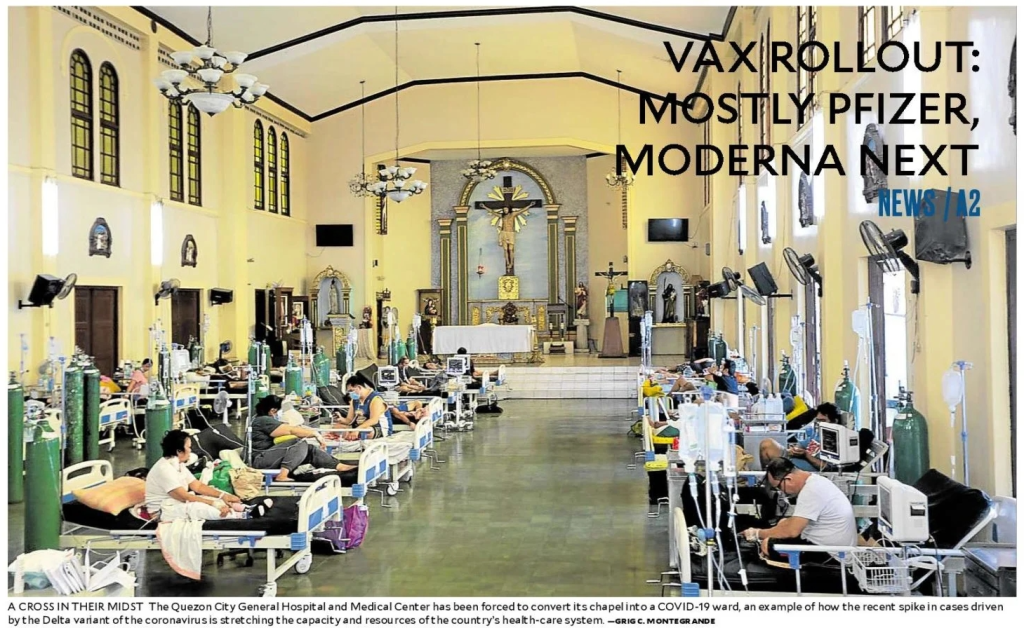
My favorite front page photo during the Delta outbreak of the COVID-19 pandemic published by the Inquirer on 20 August 2021. So evocative of the truth of Jesus himself being our true food and drink – and medicine.
As we have reflected last Sunday, a mystery is a divine truth revealed by God we learn through the gift of faith. It is non-logical but not illogical. It can be explained and understood but not fully.
Here in the mystery of the Body and Blood of Christ we call as the Eucharist, the mystery of our Triune God becomes a reality in our life truly present in perceptible signs of bread and wine. From relating, we now come to the mystery of sharing of our selves like God who shared us his Son Jesus Christ who in turn gave himself for us on the Cross that continues today in the Holy Eucharist as his everlasting sign of his loving presence and service.
See how Jesus spoke clearly in this passage of his giving us his physical body and blood that to receive it, we have to actually eat it too.
First we notice is how in other parts of the New Testament that the term soma is used to refer to the Eucharist which is the Greek word for “body” that may have symbolic meanings; but in this passage, Jesus used the word sarx which means “flesh” in Greek that means only one thing, the corporeal reality of his physical body. Jesus is telling us in no uncertain terms in this passage after the miracle feeding of more than 5000 in the wilderness that he himself is truly and really present as flesh and blood in the Eucharist. Recall that at his Prologue to his gospel, John also used the same term sarx in declaring “the Word became flesh” (Jn.1:14) to correct misunderstandings and doubts that were already developing during the first century of Christianity regarding the physical Incarnation of Jesus the Eternal Word and his true presence in the Eucharist.
Second term used by Jesus four times as he emphasized the reality of his Body and Blood in the Eucharist is the word trogein which in Greek means “to munch” or “bite”; the other Greek word for the verb to eat is phragein which evokes many symbolic meanings like “digesting” a book or “assimilating” the culture. Again, when Jesus said we have to eat his flesh and drink his blood, he truly meant himself as a true food and true drink to nourish and sustain us in this life and hereafter.
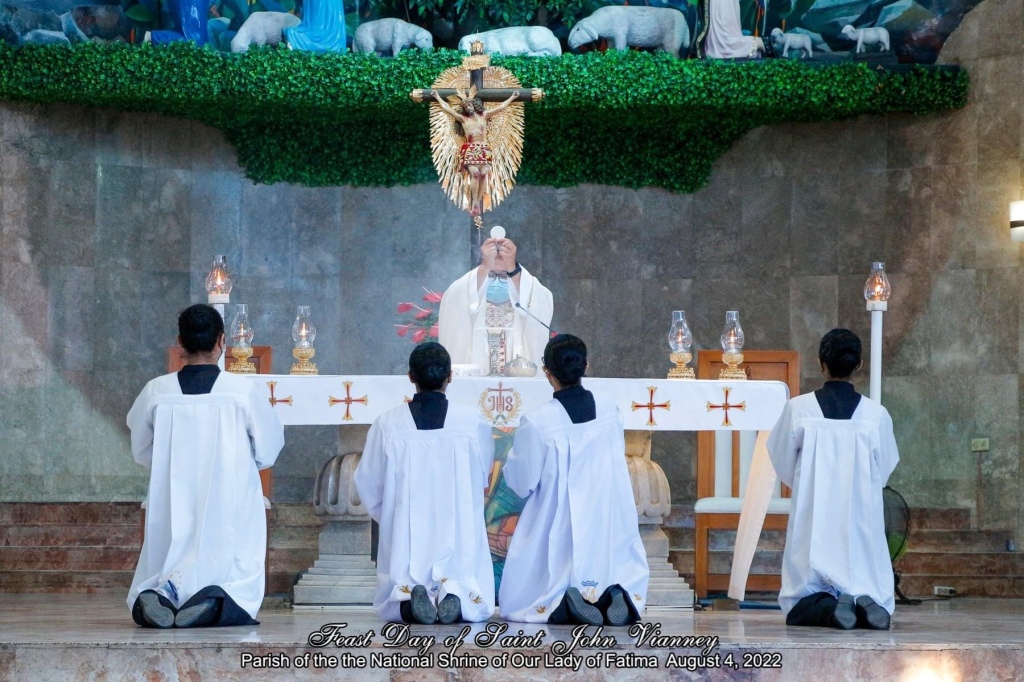
Photo by Kuya Ruben, 04 August 2022.
There lies the beauty of this mystery of the Eucharist: Jesus himself is the one we receive, who comes to us personally, physically to be one with us in our very selves. We do not have to wait for death and be in heaven to experience fullness of life in Christ because he comes truly to us while in this life when we receive him in the Holy Communion.
St. Paul reminds us in the second reading with his rhetorical questions, “The cup of blessing that we bless, is it not a participation in the blood of Christ? The bread that we break: is it not a participation in the body of Christ?” (1 Cor. 10:16) of this reality of Christ’s presence in us and among us. He was not waiting for answers of yes or no but posed those questions to affirm the very truth we all know that Jesus is really present in us and among us especially when we are broken like the Israelites in the first reading. This is where the mystery deepens, becomes more real and more fascinating. Jesus the Son of God emptying himself to be like us in everything except sin so that we may become like him, holy and divine.
This I have learned in my two years of being a chaplain in the hospital. Admittedly, it is difficult especially for me as I could easily be carried away by emotions in seeing the sick and suffering while at the same time, can often have my stomach overturned by sights of blood and wounds of others. But, there is always that indescribable feelings of joy and fulfillment after visiting and anointing our sick patients.
Photo by Kuya Ruben, June 2022.
I have no claims to holiness as I am a sinner too but the Eucharist has become most truest to me these past two years in the hospital and university as well as I get into contact with the sick and the students. When I touch patients to pray over them or help in moving them, when students cry to me or ask for hugs after confessions, they all flash to me during the consecration as I raise and say, This is my Body… This is my Blood. Jesus is most truest in the Eucharist when we too imitate him in giving ourselves to others to be broken and shared.
The Eucharist is the most wonderful gift of God to us when we receive his Son Body and Blood to make us strong and holy like him in this life.
That is why we have to go to Mass every Sunday. That is why a priest has to celebrate Mass daily for the people to be strengthened like him in this journey of life filled with trials and sufferings. That is why Moses kept on reminding the Israelites of their many hardships from their exodus into their wandering in the wilderness. That is why this coming Friday, we cap these three weeks of transition into the Ordinary Time with the Solemnity of the Most Sacred Heart of Jesus, another mystery of Christ truly among us and within us as we experience his love most truly right here in our hearts.
What an awesome God we have indeed who has become so small and so simple like us so we can be great like him. Like the simple bread and wine, in the Mass through the Holy Spirit, they become Christ’s Body and Blood. Let’s make it happen this Sunday in our celebration of the Mass. Amen.Have a blessed week ahead.
Lord My Chef Daily Recipe for the Soul by Fr. Nicanor F. Lalog II
Wednesday in the Ninth Week of Ordinary Time, Year I, 07 June 2023
Tobit 3:1-11, 16-17   ><))))*> + <*((((><   Mark 12:18-27
Photo by author, Anvaya Cove, 19 May 2023.
God our loving Father,
today I pray for those losing
hope in you; for those in so
difficult and painful situations
in life, doubting your existence,
doubting your presence,
doubting your love.
You are "not the God of dead
but of the living" (Mark 12:27),
dear Father as declared by
your Son Jesus Christ to us
in the gospel today.
With you, O God,
everything is possible
for as long as we believe,
for as long as we are alive
because our very life is your gift,
your proof of your presence,
your assurance of caring for us;
even if we feel so shortchanged in life
with all the bad things happening,
you love us; in fact, when we are
so down, so hard pressed in life,
that is when you love as most,
when you are most closest to us.
May we draw inspiration in faith,
in forging on with this life from
the examples of Tobit and Sarah
who both prayed for death to you
because they felt so nothing before
others;  sometimes, it is what we all
need to experience your life,
your loving presence
that we have nothing else but you!
At that very time, the prayer of these two suppliants was heard in the glorious presence of Almighty God. So Raphael was sent to heal them both: to remove the cataracts from Tobit’s eyes, so that he might again see God’s sunlight; and to marry Raguel’s daughter Sarah to Tobit’s son Tobiah, and then drive the wicked demon Asmodeus from her.
Tobit 3:17
May we rejoice always
in your gift of life to us
each day, Lord.
Amen.
Lawiswis ng Salita ni P. Nicanor F. Lalog II, Ika-05 ng Hunyo 2023
Hindi mabuti
ang mabait.
Malaki kaibahan
ng mabait sa mabuti;
akala ng marami
sila ay magkatulad
ngunit kung susuriin
sila na rin ang nagsasabi
kabaitan ay kaluwagan,
lahat pinapayagan
pati na rin kasamaan;
madalas tinuturing
ng karamihan kabaligtaran
ng mabait ay mahigpit
na nagpapatupad ng tama
at wasto ayon sa prinsipyo,
naaayon sa patakaran at kaayusan
na inaayawan ng mga
nasa kadiliman
upang maitago kanilang
kabuktutan
at kasamaan.
Inyong tingnan
kaisipan ng karamihan:
sasabihin nila mas
mainam ang mabait
kesa mahigpit,
lahat maipipilit
kahit katuwiran ay pilipit;
at ang mapait
kung sakaling iyong
igigiit kabutihan
at kaayusan,
ikaw ay pag-iinitan
upang kampihan
tinuturing nilang mabait
sa kanila ay sunud-sunuran
walang paninindigan
lahat pinagbibigyan
at pinapayagan
manatili lang sila
sa kapangyarihan!
Wala sa pagkakampi-
kampihan ang kabutihan
di tulad ng kabaitan
naroon sa maling pakisamahan
ng mga bata-bata at alaga;
minsa'y nagsumbong si Juan
kay Jesus upang pigilan
nagpapalayas ng demonyo sa
kanyang pangalan na hindi nila
kasamahan; sila ay sinabihan
ng Panginoon na iyon ay hayaan
sa ginagawang kabutihan sapagkat
aniya, "ang di laban sa atin
ay panig sa atin" habang mariin
niya silang pinagbilinan
mabuti pang talian sa leeg
ng gilingan bato ang sino mang
sanhi ng katitisuran sa kasalanan
(Mk.10:38-42) na mas malamang,
siyang napakabait!
Hindi kalaunan
mahahayag kabulukan
at karumihan
ng mababait
na tawag sa mga bubwit
at daga huwag lang
makapambuwisit,
aamuin, uutuin
ngunit ang katotohanan
sila ay pinagdududahan
at pinaglalaruan lang din
ng akala nilang mga
kaibigan;
kitang-kita naman
kawalan nila ng paninindigan
kaya lahat pinapayagan
huwag lang masaling
hungkag nilang katauhan
sa palakpakan lamang
nasisiyahan.
Kaya nga,
paano nga ba ilalarawan
itong katotohanang
hindi natin matutunan
na magkaibang-magkaiba
ang mabait at mabuti;
pagmasdan kahit saan -
sa paaralan o tanggapan,
sa tahanan maging sa simbahan
palaging kinakampihan
at pinipili, nagugustuhan
ang mabait
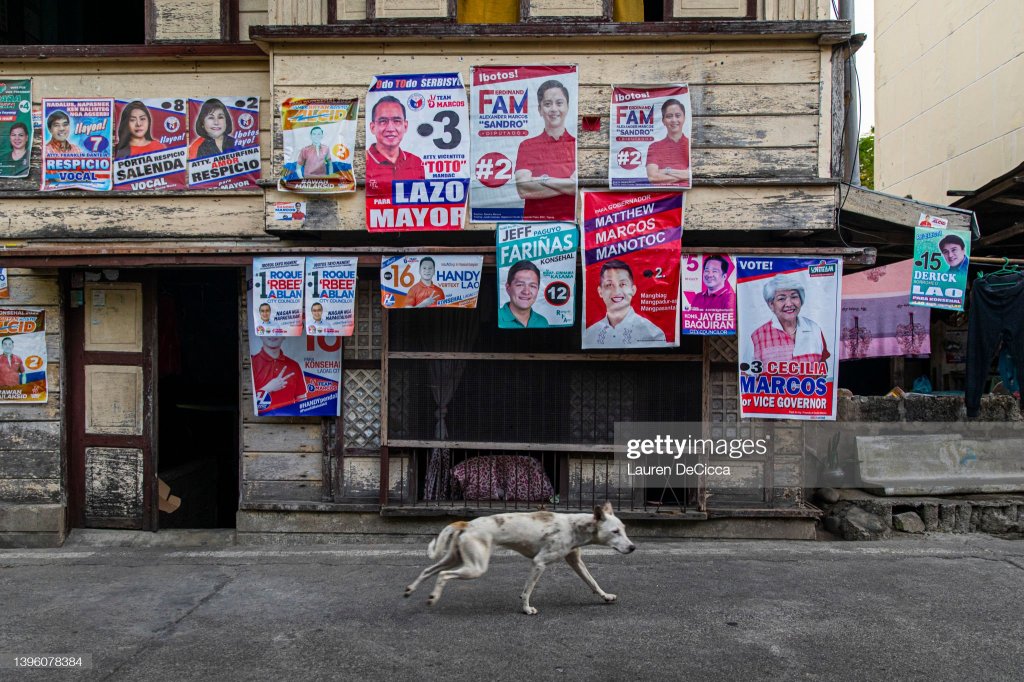
kaya ganito ating larawan
bilang sambayanan:
asong kalye
sa lansangan
inaabangan halalan
hanap ay hindi
husay at kagalingan
kungdi kapakinabangan!
Larawan kuha ni Lauren DeCicca/Getty Images sa Laoag City, 08 Mayo 2022.
















 lordmychef.com