40 Shades of Lent by Fr. Nicanor F. Lalog II
Friday in the First Week of Lent, 27 February 2026
Ezekiel 18:21-28     + + +     Matthew 5:20-26
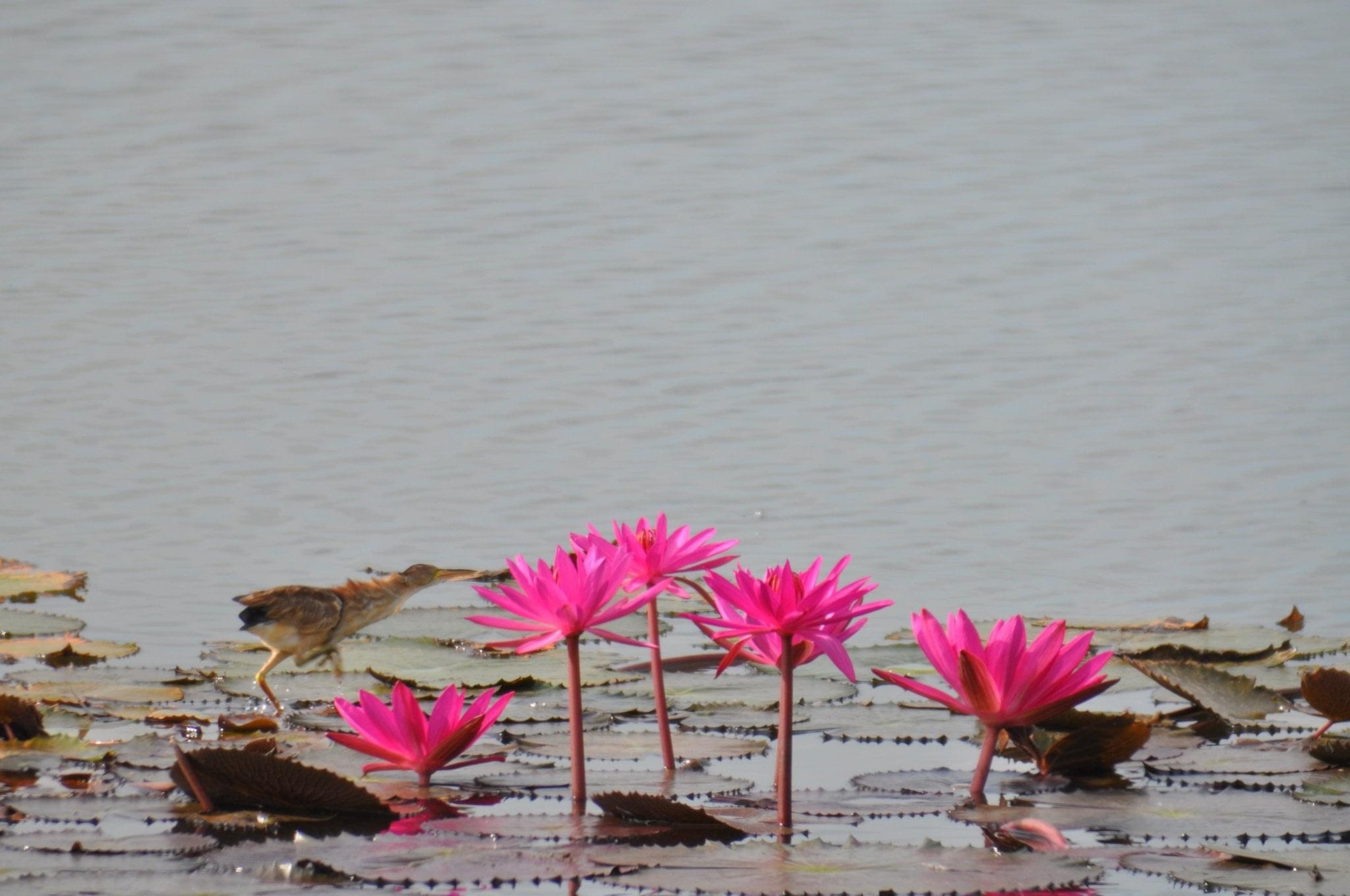
Photo by Dra. Mylene A. Abad Santos, MD, February 2021.
Thank you,
dear Father for the
first week of Lent about
to end; much is still to be
desired to be closer to you,
to be faithful to you,
to be one in you;
teach me in your Son Jesus
to go beyond the letters of
your laws,
to go beyond the minimum
requirements,
to go beyond of what is asked
of us in order to be more
loving to others in you:
Jesus said to his disciples: “I tell you, unless your righteousness surpasses that of the scribes and Pharisees, you will not enter into the Kingdom of heaven” (Matthew 5:20).
Photo by Dra. Mylene A. Abad Santos, MD, February 2021.
Teach us to be holy
or righteous
like you;
make us whole,
to be different
and be radical by
going back to you
our very roots of being
and existence;
instead taking the path
of supremacy especially
when we are angry
that we are unafraid of
breaking away from others,
insisting on what is right
than on what is good,
let us be reconciled
with you in others
and in our very selves
where peace remains
the best to have.
To go beyond
than what is required
is to be humble and gentle
like you, dear Jesus,
caring more for people
and relationships
than on being right
which often is not the case;
holiness
or righteousness
is confronting and accepting
our limitations
so that your infinite power
of love and mercy
may work in us
and through us,
Lord Jesus.
Photo by Dra. Mylene A. Abad Santos, MD, February 2021.
Lent is going beyond
the ordinary
because it is about
choosing you, Lord
above all else always:
you never condemn us
letting go and forgetting
of our past sins when we
choose to finally live in
your presence doing your will;
however,
let us not be complacent
in your presence, Lord
for our good record
can be undone completely
when we refuse to love
you in others.
O Lord Jesus,
you have given me
with so much chances
to become better;
help me to remain in you
so I can also give more
chances
more mercy
and more love
to others lost and trying
to find you.
Amen.
40 Shades of Lent by Fr. Nicanor F. Lalog II
Thursday after Ash Wednesday, 19 February 2026
Deuteronomy30:15-20     +++     Luke 9:22-25
Can my life,
or life itself be separated
from you, my God?
Then he said to all,
"If anyone wishes to come after me,
he must deny himself
and take up his cross daily
and follow me.
For whoever
wishes to save his life
will lose it,
but whoever loses his life
for my sake will save it"
(Luke 9:23-24).
As I immerse myself to your
words today, Jesus,
I remember so many occasions
when I was younger always
trying to save my life,
simply clinging to my life,
or asserting my life,
that's when I lost in every count:
it seems to me now that when
we are young - and strong -
we choose ourselves more,
insist on ourselves,
even shouting deep within
"It's my life"...!
Sad truth is,
we lost always as we
felt most empty,
no direction,
no meaning
in life.
When life is too cushy,
without any problems and
challenges,
that is when life is
deep in serious trouble.
It is not even life at all
but felt like death!
But, Lord,
I remember too
that since I took that dive,
when I thought less of my self,
when I started following you,
of losing my life for your sake,
that was when I found meaning
and fullness in life,
when I truly save my life;
it was a bumpy road, Lord -
you know it very well
how many times I stopped along
the way to choose my own path,
even dared leaving you but
you were always there waiting
for me, walking with me even
in the opposite direction just to
bring me back to you
to gain my life in you.
Glory and praise to you,
Lord Jesus!
Your words are not
just a rhetoric,
nor a poetic overstatement
of a guru or a teacher
but actualizing words of
the Son of God,
our Savior and Messiah;
you have given me with so much
and I have given you so little;
teach me to give more of myself
to you so that I can give myself to
others by giving more of you in
loving service.
Let me choose you always,
Jesus, for life itself cannot be
separated from you
who is life yourself.
Amen.
Quiet Storm by Fr. Nicanor F. Lalog II, 15 January 2026
Photo by Ar. Philip Santiago, Basilica of the Annunciation, Israel, October 2025.
Two priests and a former nun personally known to me died in our diocese last Sunday. It was also the birthdate of the late Bishop Cirilo Almario, Jr. whom I had remembered in my two early morning Masses on that Sunday, January 11, 2026.
In those two Masses too I mentioned in my homily the retreat I facilitated first week of January with my friends about “ageing gracefully” – my own realizations since joining their ranks as senior citizens last March.
Let me elaborate those two points I have shared with them and in my homily last Sunday.
From forbes.com.
First, let us embrace our being old. Stop saying “when we get old”, pagtanda natin because we are already old. Period. Matanda na tayo.
We cannot reverse our ageing process and it is useless to have all these cosmetic manipulations like dyeing our hair black or stretching our sagging skin and removing those wrinkles.
Embrace old age. It is beautiful and wonderful because it is so good. Our Filipino word for “old” says it all – matanda – which ironically so many women hate to hear as they stress that kalabaw lang ang tumatanda. That is not true.
Our word matanda is from the root word tanda which means “sign” that is why an old person is rightly called matanda because he/she is a sign of God’s goodness, a sign of God’s mercy and love, a sign of God’s beauty and majesty.
Moreover, a matanda is a sign of wisdom and grace that is why when we were young boys, we wanted to be old by putting our dad’s eyeglasses or taste his cigarettes and beer while girls put on their mom’s make up and high heeled shoes. How funny that when we are already old, we resist to accept the fact that we strive to look young again, sometimes ending up as nagmumurang kamatis.
Photo by Mr. Jim Marpa, 2019.
Technically speaking, “old” is actually harsh. Old is something about a past phase that has ran its course like being outdated. Luma in Filipino that connotes stale, passe, lacking relevance and sadly, useless. Just for display purposes. As a person, that is the one we refer to as walang pinagkatandaan. Or huklubang matanda.
To be more specific, the better English term referring to ageing gracefully is ancient that exudes with a sense of timeliness, of being perpetually relevant like the ancient ruins in Rome, Athens, and Jerusalem. Actually, some biblical experts have wanted to rename the “Old Testament” as “Ancient Testament” following this line of thinking.
Photo by author, Ephesus, Turkiye, November 2025.
Things and even persons can rightly be referred to as ancient because of their beauty still intact that inspires us and makes us wonder about life itself. They are not just old sites nor old persons that remind us of the past long gone but ancient because still lovely, “still full of sap and green” as the psalmist extolled the seniors of his time.
Persons who age gracefully like ancient sites stir our inner selves with deeper beauty and realities of life that eyes cannot see. That is perhaps the reason these days many senior men and women are so “in” and considered as attractive.
It is the same wisdom realized by St. Augustine when he wrote about God, “Late have I loved you, O Beauty ever ancient, ever new, late have I loved you. You were within me, but I was outside, and it was there that I searched for you.”
Being ancient -whether as a person or a thing – is something of the inside we must turn to not outside like our skin and physical body. From that inside realization and acceptance of being senior or elderly we experience the grace of ageing because we experience God still present in us, in fact loving us more as he makes as a sign or tanda of his loving presence.
Ageing gracefully is a modern virtue we need to cultivate in this age of instants that glorify youthfulness equated with usefulness. That is why when Pope Benedict XVI resigned from the Papacy in 2013, the more I have come to love and admire him. In his resignation, he taught us the importance of embracing and lovingly accepting our old age when we can no longer adequately perform our many tasks in office even in life itself. It was not a failure nor a surrender in the negative sense but more of a deep courage and trust in God that we accept our being weak and ready to come to him soon.
Photo by author, Pundaquit, San Antonio, Zambales, May 2025.
This brings me to my second realization since turning sigisty years old last year: corollary to embracing old age is accepting death. That is why, as seniors, let us stop saying and thinking of our coming death because we are already dying. Huwag na nating isipin yung “kapag namatay ako” dahil namamatay na nga tayo.
Being senior is doing away with those bucket lists, of thinking about things to do, places to visit before we die. We are already dying and hence, whatever you can do, do it now. There could be no more tomorrow. All we have is the present moment. Anything could happen to us, for better and for worse.
Ageing gracefully is coming to terms with life which leads us to coming to terms with death. Yes, this is easier said than done, but slowly, I am learning and loving it!
Photo by author, Bucharest, Romania, November 2025.
One of the reasons that made me decide to become a priest in the early 1990’s was the conviction that I have felt so deeply God’s love for me as a person in the many experiences I have gone through in life. I felt at that time that by becoming a priest, I could convince more people about the truth and existence of this loving God we have.
I still hold on to that but a year after turning sigisty, becoming sigisty-one in March 22, another fascinating realization I have had is how wonderful this life is. Now that I am old, the more I can boldly claim with conviction that it is good to be alive. Masarap pa rin ang mabuhay! Maganda ang buhay maski mahirap!
Accepting and embracing our ageing, our getting weak, our failing memory are all kinds of dying. And in that midst that we actually live fullest and meaningfully. I don’t know if I can write any further because I ain’t dead yet but… just in case, it was worth the trip. Amen. May you have a fruitful and fulfilling weekend ahead.
Lord My Chef Christmas Eve Recipe, 24 December 2025
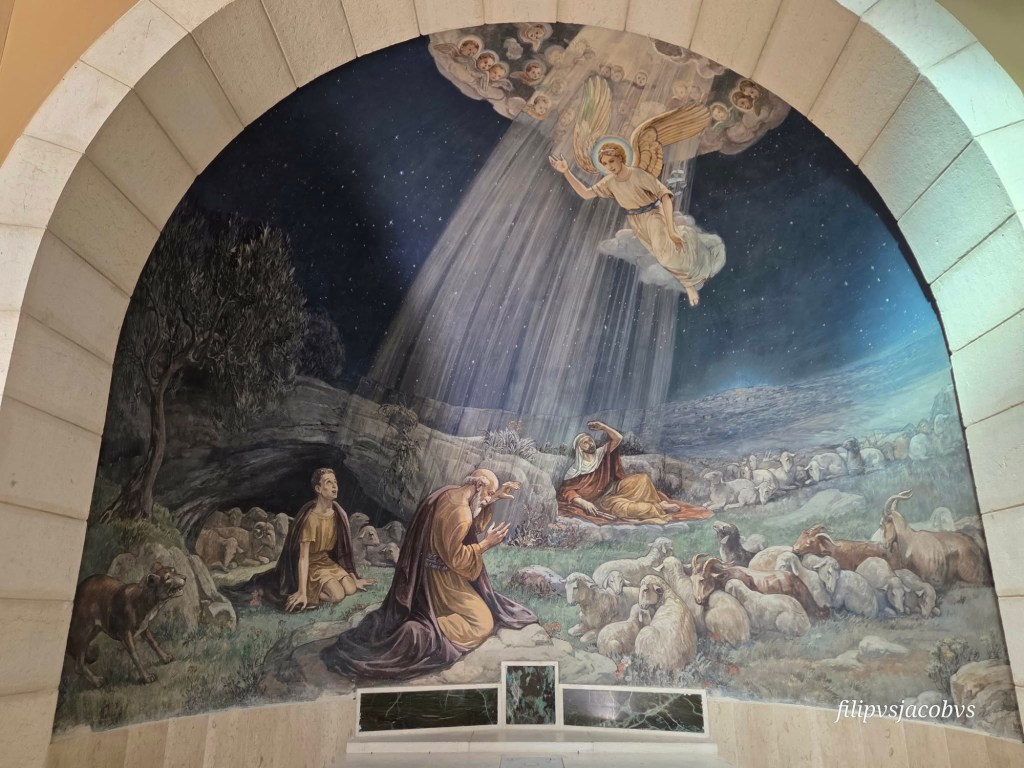
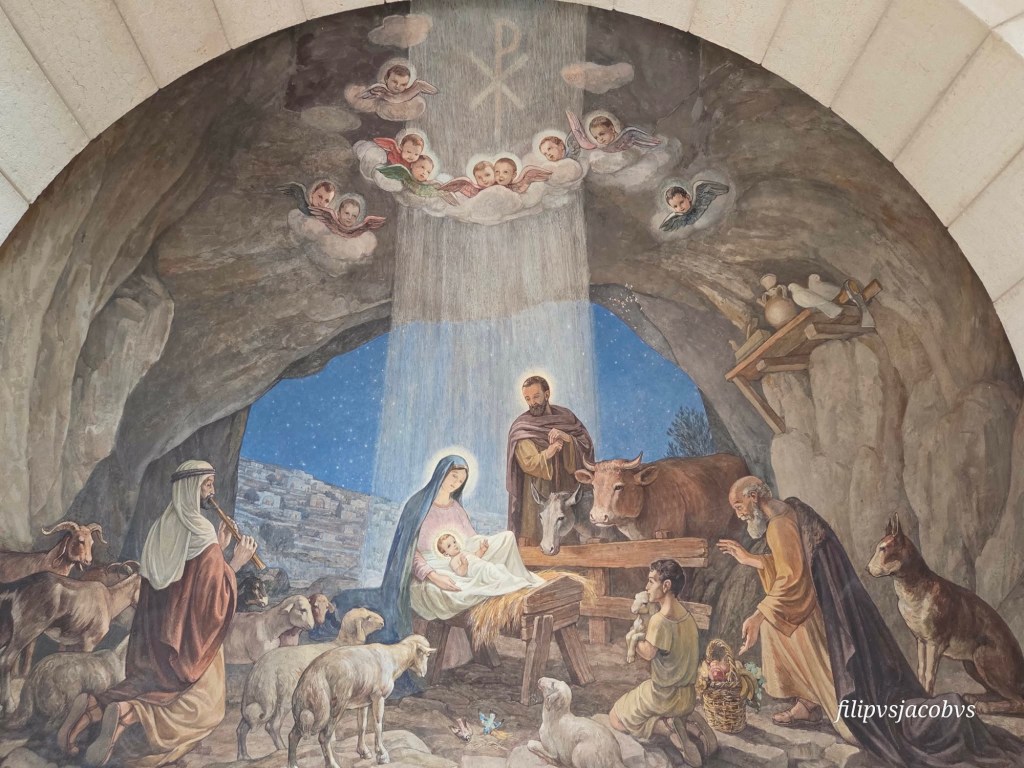
Photo by Ar. Philip Santiago, a mural of angels announcing the birth of Jesus Christ to shepherds in the field, Angels’ Field Chapel in Bethlehem, October 2025.
A blessed Merry Christmas, friends ad relatives, especially our followers. In our Monday’s Simbang Gabi when Mary sang her Magnificat during her Visitation of Elizabeth, we reflected how songs not only express our innermost thoughts and feelings but reveal our very person, too.
Allow me this Christmas to share with you a song I have recently heard to reflect on the meaning of Jesus Christ’s birth. The song is called “My Lord Has Come” written in 2010 by Will Todd, a renowned contemporary British composer and pianist who blends melodic classical compositions with jazz elements. Check YouTube to feel its moving music but for now, experience the sense of wonder in its inspiring lyrics.
Shepherds, called by angels,
called by love and angels:
No place for them but a stable.
My Lord has come.

Sages, searching for stars,
searching for love in heaven;
No place for them but a stable.
My Lord has come.

His love will hold me,
his love will cherish me,
love will cradle me.
Lead me, lead me to see him,
sages and shepherds and angels;
No place for me but a stable.
My Lord has come.
Photo by Ar. Philip Santiago, a mural of shepherds as first visitors to the newborn King of kings, Angels’ Field Chapel in Bethlehem, October 2025.
I learned and heard this song last week while researching for materials this Christmas. And the word “stable” struck me.
See its varied meanings. First, “stable” means firm and sturdy, unshakeable like a stable table, stable ground, and stable truth or opinion. But during this period, we know a “stable” also refers to the Nativity scene or creche which we Filipinos call as a Belen that is actually a translation of the Lord’s birthplace of Bethlehem.
In those days a decree went out from Caesar Augustus that the whole world should be enrolled. This was the first enrollment, when Quirinius was governor of Syria. So all went to be enrolled, each to his own town. And Joseph too went up from Galilee from the town of Nazareth to Judea, to the city of David that is called Bethlehem, because he was of the house and family of David, to be enrolled with Mary, his betrothed, who was with child. While they were there, the time came for her to have her child, and she gave birth to her firstborn son. She wrapped him in a manger, because there was no room for them in the inn(Luke 2:1-7).
How lovely that God manifested to us in the most humble way, being born on a manger, at a stable for animals!
And see now why Christmas is the greatest exchange gift of all time when God became human like us born in a stable so that we too may become divine like Him.
But, it is no easy exchange gift we often do in our Christmas parties when we just have to buy gifts that fall within the range of prices we have agreed upon. Jesus Christ the Son of God came not for any price that can be bought and paid by humans for He came with His whole life and being.
Picture the Christmas stable, of how the eternal entered the temporal, the infinite and perfect became flesh and bones and blood among us, so intimate with life and all the mess and chaos of living including death itself. He was born because He loves each one of us immensely.
And listen now to Will Todd telling us, “The Lord has come in a stable… anyone searching for Him – whether angels or shepherds or sages like the Magis, there’s no place except the stable.
Even for me and for us searching for stability in life, meaning in life, direction in life that can be found only in the stable where the Lord has come. How lovely!
In the silence of the darkest night of the year, amid the loud claims of everyone being the greatest and most powerful, the best and brightest, unknown to them the only true great and mighty one is in the stable.
In the gospel we heard too how the shepherds went in haste to visit the newborn Messiah in the stable, rejoicing afterwards at the great sight and good news they have found.
But, how about us today? How sad nobody cares at all to go to the Holy Mass which is actually the modern Christmas stable of Bethlehem which means “house of bread”. Jesus is the Bread of life as He preached later in life in the Gospel of John. On the eve of His death at the Last Supper, Jesus gave Himself as the Bread broken and shared for all lifetime to lead us to eternity.
How sad that we search for life’s meaning and sense in the most unstable of all instances like science and technology, new thoughts and ideas that overextend our rights without any regard for responsibilities and true freedom. If there is anything that merits haste these days, it is the things of God like the Mass and prayers and Sacred Scriptures. Not social media and all those viral and trending reels of our follies and stupidities we love to follow.
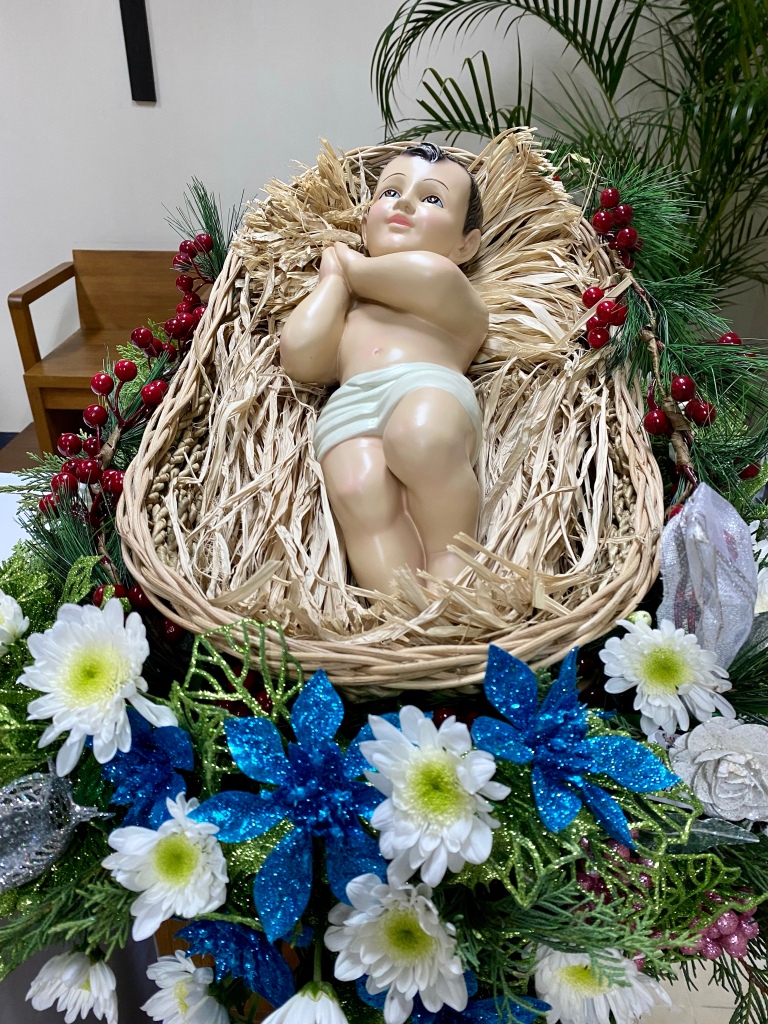
Photo by author, Christmas 2021 at Basic Education Department Chapel, OLFU-Valenzuela City.
See also the animals in the Christmas stable especially the ox and donkey who all symbolize our blindness to God who humbly came to us in the stable. Isaiah and the other prophets in the Old Testament lamented how animals particularly the ox and donkey “know” so well where to go when hungry and thirsty which is the stable while we humans wander far because we are so blinded by many things.
Christmas tells us humans to stop looking so far as Will Todd insists in his great composition My Lord Has Come inspired by our readings last night and today: it is only in Bethlehem that we find the true stable reality of life where the Son of God was born so that we now reckon time according to His birth with BC and AD because humans and civilizations do not last. “Jesus Christ is the same yesterday and today and forever” (Hebews 13:8).
Our only stability in life is found in the Christmas stable especially when the nights are dark and long. Amen. A blessed and stable Merry Christmas to you!
Quiet Storm by Fr. Nicanor F. Lalog II, 21 August 2025
Photo by author, St. Joseph Chapel, St. Paul Center for Renewal, Alfonso, Cavite, 20 August 2025.
As we ended our annual clergy retreat today when we remembered in the Mass a saint, Pope Pius X and a hero, Benigno “Ninoy” S. Aquino Jr. , I wish to reflect on the word “remember”, a very lovely word worth remembering always.
From the prefix “RE” that connotes repetition as in again and the root “MEMBER” that means a part, to remember literally is to make someone or something a part again. What and who we remember are those gone and away from us, a history in the past. More than mere recalling of a person, event or thing, remembering is making those absent present.
Though the philosopher Martin Heidegger rightly claimed that we humans are “beings of forgetfulness,” God actually programmed us for remembering: from infancy to childhood, our parents drilled into us to remember our name and address, the names of people around us, of things, and everything as we grew. That is why the expression “kalimutan mo na yun” is the most useless piece of advice anyone can give. It is impossible to forget, whether it is so good or so bad. What we need is to harness the power of remembering, to continue learning from the past whether good or bad because whatever is remembered for all its worth is always the best teacher anyone can have.
Remembering is a power because it is a grace, a gift from God himself. When we remember, we not only time travel to the past but make it present in order to perfect us. The past cannot be changed anymore as insisted by Japanese writer Toshikazu Kawaguchi in his series of novels Before the Coffee Gets Cold.
Remembering changes the person, not the past. It is in remembering the bitter lessons of the past we learn most in life because that is when we experience healing and fulfillment. Hence, remembering is at the very core of George Santayana’s warning that whoever does not learn from history is condemned to repeat it. Remembering enables us to move on in life by finding our ways and ultimately our very selves anew especially when lost and confused.
Of God’s many gifts to us, remembering is the most unique because it is never lost at all. People who refuse to remember are the most difficult to deal with like politicians, crooks and low-lifers. And the more corrupt and evil people are, the more they are forgetful, remembering or knowing nothing at all!
God meant us to keep this gift of remembering to be always reasonable and just, or simply good and sane because it keeps us in touch with reality, making us grow and mature in his love. Actually, it is remembering that continues to operate among us despite our faltering memory or even with those afflicted with Alzheimer’s and dementia because remembering is more than keeping information and details like names of people but most of all of God’s interventions through persons and events in our lives individually and collectively that significantly made us experience joy and gladness so crucial for our growth and maturity, eventually in the achievement of our goals.
Photo by author.
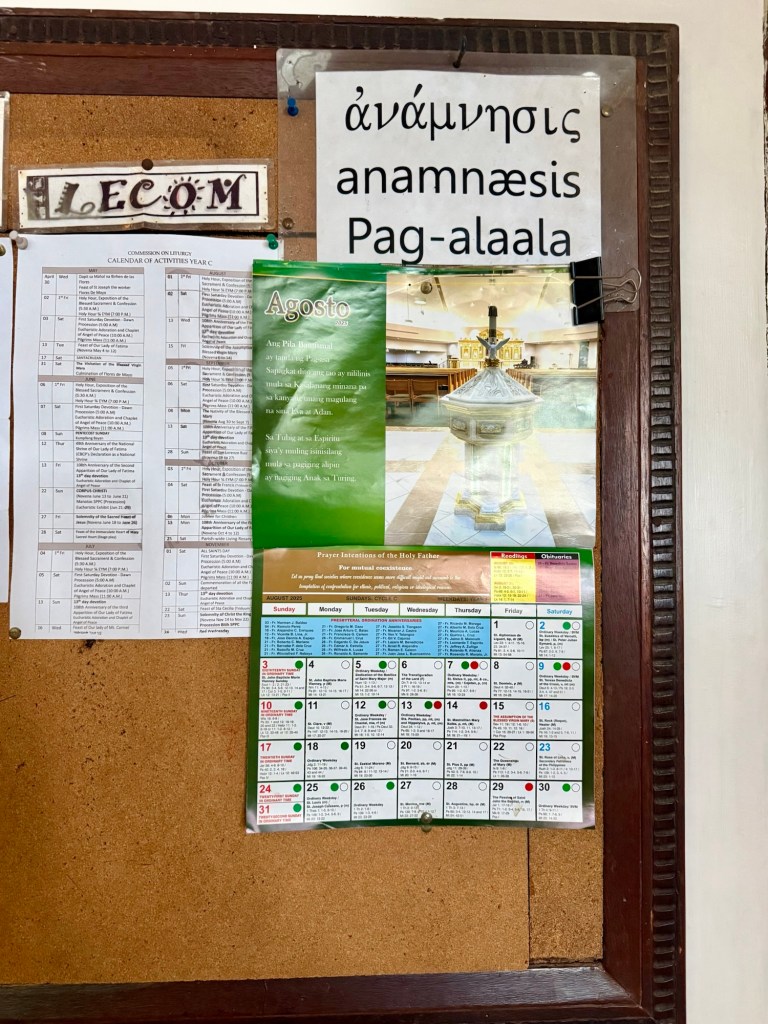
On the bulletin board of our sacristy at the National Shrine of Our Lady of Fatima in Valenzuela City is a laminated piece of bond paper with the Greek word “anamnesis” written in Greek.
It was personally printed and posted on Holy Thursday 2010 by the former rector and parish priest of the Fatima Shrine Msgr. Bart Santos now the Bishop of Iba, Zambales. I remember that so well because that was the first time I was assigned as an attached priest at the Fatima Shrine in June 2010 to June 2011 under Bishop Bart.
According to Bishop Bart who used to teach Sacred Scriptures in the seminary, he wanted to instill in all their servers of the Mass the value and meaning of the Eucharist as an anamnesis or remembering. I was so glad upon my return in February 2021 at the Fatima Shrine again as an attached priest while working full-time as chaplain at the Our Lady of Fatima University and the Fatima University Medical Center that the sign of Bishop Bart was still there – until now! I just hope the people here realize and still remember that word anamnesis as Bishop Bart had explained to them during the Holy Thursday Mass ten years ago.
Photo by author.
When everything seems dark in life with family and friends betraying us, when people we have helped turn against us, denying having known us, try remembering Jesus went through all these first at his Last Supper.
When you feel lost for directions in life, when you are into a burnout, when nothing seems to be working in your favor that you can’t find sparks of inspiration and zeal anymore, remember that first day when you embarked on this journey in life. Remember the people, the places and the things that bring you gladness and joy in pursuing your passion or fulfilling your mission. Most of all, remember when God called you to whatever mission he sent you.
Remembering is a form of stepping back to stop, to create a space and let God work in us as we have reflected last Monday (https://lordmychef.com/2025/08/18/steps-to-god/). This is what we need most in our selves and in our country as a people: the virtue of remembering, of making present the movements of God in our history. Ninoy Aquino did the supreme sacrifice of coming home in August 21, 1983 because he remembered the country he most loved; he remembered his call and mission to serve; he remembered the ideals and mission fought for by our heroes like Jose Rizal and Andres Bonifacio.
It is in remembering we remain anchored to our call and mission in life, both individually and communally. Without remembering, we cannot progress because we lack reference points of what we have covered, of where we are. That is why even the angels at Easter had to remind Mary Magdalene and companions, “He is not here; he has risen! Remember how he told you while he was still with you in Galilee…” (Lk.24:6). Most of all, let us remember always the words of Jesus at his Ascension so we may keep on pursuing our mission in him, “And remember that I am with you always until the end of time” (Matt. 28:20). May God bless you always!
Quiet Storm by Fr. Nicanor F. Lalog II, 18 August 2025
Photo by author, pilgrims awaiting their turn inside the Ascension site of Jesus outside Jerusalem, May 2019.
It has been a month since I have taken a break from my daily walking following that fall in our garage when I hurt my left knee that still aches to this day. But as I rested my onehod (twohod if both knees), I have realized in prayers that there are just two important steps we have to take for a fuller life instead of those 10,000 steps daily.
The first is to always step back one or two steps backwards and stop to make a space for God and for others in our life. Though life is a constant moving forward, it is essential that once in a while we step back and stop to see everything in ourselves and around us. Let God direct you because life is more of adjusting to the many shiftings and transitions that happen every day (https://lordmychef.com/2025/08/11/god-in-our-many-transitions/). Stepping back is being flexible in life.
Since turning 18, we have all been taking charge of our lives, each of us demanding a driver’s license, but, as we approach the age of 60, our interest in driving wane that we prefer more to be a passenger than being on the steering wheel. I have semi-retired from driving last year as I leave my car behind six days a week to take ride-hailing and ride-sharing services. Aside from reasons of convenience, taking a Grab car makes me more productive and most of all, relaxed in getting to my destinations and back home.
When life is so confusing, so dark and you feel so lost, step back and stop. Many times in life what really happens is that we unconsciously eject God from our lives as we go on with our responsibilities and projects even apostolates and ministry thinking we are doing the work of God. The moment things go wrong, when failures and problems happen, we then question God where he is or why did he allow bad things to happen with us. Truth is, God never left us, has always been with us but we never recognized him because we were so busy. Hence, the need to step back and stop to meet him. Finally.
Moses went up from the plains of Moab to Mount Nebo, the headland of Pisgah which faces Jericho, and the Lord showed him all the land… The Lord then said to him, “This is the land which I swore to Abraham, Isaac, and Jacob that I would give to your descendants, I have let you feast your eyes upon it, but you shall not cross over.” So there, in the land of Moab, Moses, the servant of the Lord, died as the Lord had said (Deuteronomy 34:1, 4).
See how Moses was portrayed in the first readings last week, slowly stepping back from the daily scene among the Israelites in the wilderness as he passed leadership to Joshua his successor. It is perhaps the earliest account in the Bible of the virtue of “ageing gracefully” in the Lord by Moses.
It is a virtue so needed these days in modern time that Pope Benedict XVI taught us in 2013 when he resigned, taking that bold step backward to stop from his active duties to spend the rest of his life in prayers. That move proved beyond doubts the true humility and holiness of Pope Benedict XVI who peacefully died right at the transition of the year on December 31, 2022.
Not only successions proceed smoothly when we learn to step back and stop as seen in Moses and Pope Benedict. Stepping back to stop and allow God to do his work among us strengthen and make better our human relationships often strained by those into sin and evil. See these as the steps proposed by Jesus in his instructions when one commits sin:
Jesus said to his disciples: “If your brother sins against you, go and tell him his fault between you and him alone… If he does not listen, take one or two others along with you, so that every fact may be established on the testimony of two or three witnesses. If he refuses to listen to them, tell the Church. If he refuses to listen even to the Church, then treat him as you would a Gentile or a tax collector” (Matthew 18:15,16-17).
Relationships are shattered when we “overstep” on family and friends into sinful situations where stepping backward is the more prudent choice to take. Stepping backward allows us to learn more the situation and avoid making rash judgments against anyone that often starts, then gets aggravated in social media. Stepping back is not just being circumspect at all but simply trying to be more fair and accurate where social media is filled with inaccurate and totally false reports or fake news.
Photo by Dra. Mylene A. Santos, MD, 2023.
The second important step that literally brings us closer to God and others is taking that first bold step into water. Yes. Stepping on water is the other special step we need to learn and make for a fuller life in God.
Recall whenever you go swimming at the pool or the beach. There is always that someone in the family or among friends or even our very self so timid or wary of the cold water who would ask that stupid question, is the water cold?
Of course – you will never know how cold the water in the pool or the sea until you take that plunge! It may sound simple but, many times we are afraid to take the first step forward into any body of water or even the shower due to the chills that quickly follow. But we also know very well from experience the great feelings that come after every plunge into water!
The spiritual value of making this crucial step forward into water is found in the first reading last Thursday at the crossing of the Jordan River by the Israelites into the Promised Land under Joshua. Leading them were the priests carrying the ark of the covenant who took the first steps on the banks of Jordan River that caused it to part and enabled the people to cross into the other side, reminiscent of the crossing of the Red Sea during their exodus from Egypt with Moses (https://lordmychef.com/2025/08/14/praying-to-step-forward-in-christ/).
Photo by Mr. Jim Marpa, 2019.
The people struck their tents to cross the Jordan, with the priests carrying the ark of the covenant ahead of them. No sooner had these priestly bearers of the ark waded into the waters at the edge of the Jordan…than the waters flowing from upstream halted, backing up in a solid mass for every great distance indeed… while those flowing downstream toward the Salt Sea of the Arabah disappeared entirely. Thus the people crossed over opposite Jericho (Joshua 3:14-15, 16).
Water is life but it also evokes death at the same time. Too much water can drown and kill us that is why we are afraid to take the first step forward into the river or the sea. We fear, we doubt even mistrust God, others and our self in taking the first step forward into water without realizing how that step could be the only thing left for us to move on in life. Stepping into water and allowing our feet to get wet in order to cross a stream or a river is one of the boldest moves we can make in life because that could be the very moment when God is actually making a way for us when our usual routes are impassable.
That is why I tried linking that first reading with the story of the saint of that day, St. Maximilian Kolbe (August 14) who “stepped forward” to their prison guards to take the place of a married man to be executed as a punishment following the escape of a prisoner at Auschwitz. Like the priests of Joshua, St. Maximilian carried the ark of the covenant – Jesus Christ – inside the gas chambers that ignited the flames of courage and faith in God to other prisoners at that time.
Photo by Mr. Jim Marpa, 2019.
These days, we need more men and women of faith, hope and love in God willing to step forward into waters that can be dark and murky, even lethal with unknown substances like the modern miseries of human trafficking, substance abuse, sex slavery, extreme poverty and other systematic inhuman conditions that now afflict mankind. Taking that bold step into water carrying Christ across the river is enabling the others to pass through from death to life, from grief to joy, and from hopelessness to love.
Pray for us your priests in the Diocese of Malolos as we go on retreat today until Thursday that we may truly step backwards and stop these days to let God take charge of our lives and ministry anew. Most of all, that we may have the grace of fervor and courage to carry and follow Jesus in crossing the many rivers and streams of life when the usual routes are impassable due to sickness and other miseries. Amen. Have a fulfilling week ahead.
Quiet Storm by Fr. Nicanor F. Lalog II, 15 July 2025
From the internet.
Bless me, for I have sinned: this Father is a “dinosaur” so afraid of modern technology, so hesitant even in upgrading my cellphone and laptop. And most of all, always suspicious of messages in social media.
Generally, I am more inclined to mistrust everything in the net. But, something happened this Monday that I feel like changing this attitude.
I have celebrated Mass of the Holy Spirit in our Cabanatuan City campus before noon when I found multiple “message requests” from some people asking if I know their former boss at NEDA, Mr. Joseph T. Lalog, a first cousin we fondly called Kuya Jojo.
My initial reaction was budol. Scam.
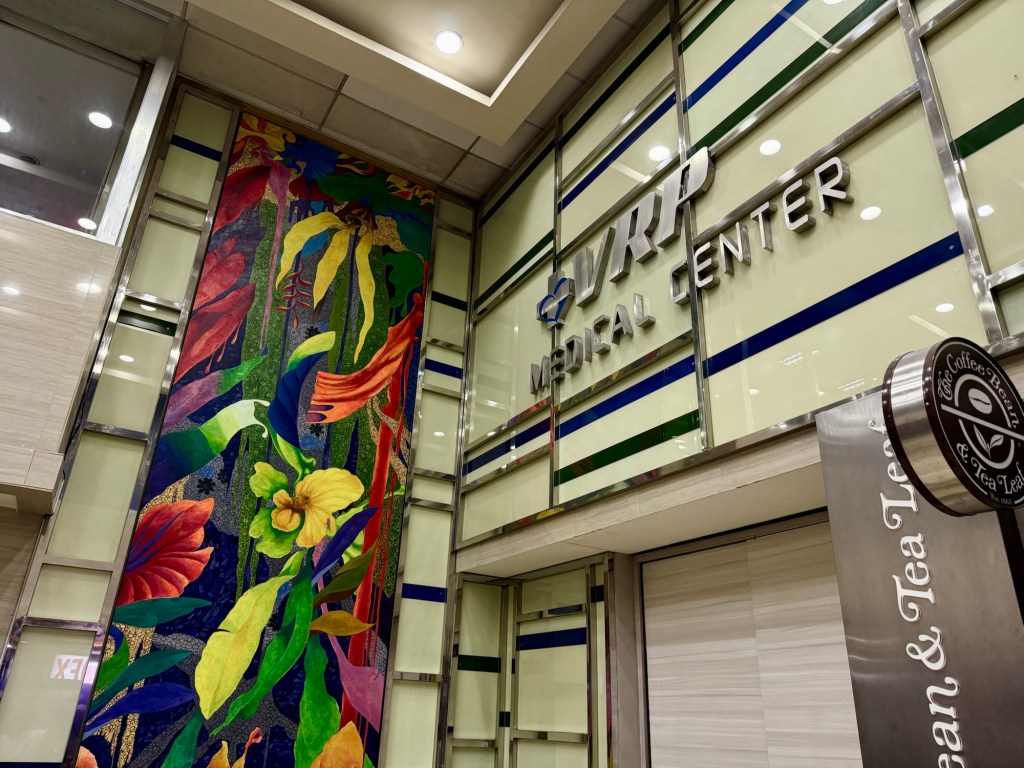
But when I read that he was in the ER of a hospital in EDSA, I prayed and finally hit the number sent to me by a certain Byron to inquire about Kuya Jojo. After a brief introduction, I was told Kuya Jojo had just died after being rushed that morning to the Victor R. Potenciano Medical Center (VRPMC) in EDSA, Mandaluyong City.
Kuya Jojo was allegedly found by a janitress lying on the floor in one of the restrooms of Shangrila Mall morning of July 14, 2025. He was rushed by the mall’s emergency response team to the ER of VRPMC where doctors tried to revive him but later declared as dead around noon that Monday.
The people at the ER checked Kuya Jojo’s contacts in his cellphone and like my initial reaction, his former staff and colleagues at work thought it was also budol until after they have personally called the hospital with some of them going there to verify the report.
That was when Byron and his colleagues at NEDA who were under Kuya Jojo tried reaching out to us by checking his Facebook contact lists of “Lalog” and “Tobias”. And similarly, we all suspected it could be a scam because Kuya Jojo had always been healthy without any vice at all. He was a varsity of the track and field team at De La Salle University where he finished AB Political Science.
What convinced me to set aside my doubts and press that number provided by Byron was his message that my Kuya Jojo would always speak to him about my being a priest. He asked in one of his texts, “kayo po ba si Father Nick pinsan ni Sir Jojo?” With that, I finally felt deep inside this must be true. Not a scam. Or budol.
Mahirap palang maging netizen, mabuhay sa internet.
You know that daily or maybe every second of struggles just to verify and check whether those messages and information in the social media are true or not.
Baka niloloko ka lang? O, ako lang ang OC, takot at duda sa social media?
Ang hirap lalo na sa gitna ng maraming kuwento ng pangloloko at mga budol ng kung sino sino sa social media at internet na kahit kaming mga pari niloloko o ginagamit sa pangbubudol!
At ang pinakamahirap sa lahat – kapag binabanggit na pangalan ng mga taong malapit sa iyo katulad ng pinsan kong buo na si Kuya Jojo. Ang hirap at nakakatakot paniwalaan mga texts na namatay o kung napano na…
That entire stretch of travel from Cabanatuan City to EDSA, I felt being warped between reality and virtual reality, between the net and the real world. What if this is not true? Paano ako?
Aside from those things running in my mind, I was also thinking of my elder relatives. How am I going to break the news? How reliable were those people if they were really the colleagues and staff of my cousin even after I spoke to one of them on phone?
As I thought of my cousin lying on the floor of the CR of the mall, suddenly I remembered last Sunday’s gospel of the good Samaritan. It was like a modern version. My cousin almost dead or already dead on the marble floor of the restroom when a janitress had the courage and mercy to call their emergency response team.
Most of all, of the most kindred souls of Kuya Jojo’s friends and colleagues who never gave up on reaching out to us. They are all the modern good Samaritans who “treated him with mercy” (Lk.10:37).
Photo by author, 14 July 2025.
I arrived 4:30 PM in the hospital where the ER doctor in charge briefed me of Kuya Jojo’s death. Soon Byron arrived and told the doctor my cousin’s medical condition while the funeral service sent by my uncle in Los Baños finally arrived at around 8:00 PM.
At the morgue, I gave the final blessings for Kuya Jojo before being transported to Los Baños where his wake will be held at the Heaven’s Gate Memorial Park in Bgy. Anos. After thanking and blessing Byron and the hospital staff, I booked my ride home as I had earlier sent home our university driver to rest for another trip to our Pampanga campus the following morning.
In less than ten minutes I was on board my Grab ride to Valenzuela City, still wondering what had happened that Monday. As I scrolled on my Facebook and Instagram with its bright light filling my ride, I felt a sense of relief that Jesus is very much present in the internet, in social media. St. Paul wrote it so well more than 2000 years ago that “where sin increased, grace overflowed all the more” (Rom. 5:20).
No matter how bad we see the world including the internet these days with its many sins and evil, God assured me that night that there are still far more good people, good Samaritans than evil ones. We simply have to make the right choice always by choosing Jesus who remains “the way, the truth, and the life” (Jn. 14:6). God bless everyone!
*Thank you to the staff and colleagues of the late Joseph T. Lalog at the NEDA. We do not have yet the details of his wake and interment as his sisters are arriving only this Thursday. On behalf of our clan, thank you and may God bless you more!
Quiet Storm by Fr. Nicanor F. Lalog II, 07 July 2025
Photo by author.
For the first time in 25 years since daddy’s passing, I did not deliver any homily during his death anniversary Mass in our home last June 17, 2025. My sisters readily agreed when I told them after the gospel proclamation “hindi na ako mag-homily at baka maiyak lang tayo.”
It was the second time we celebrated daddy’s death anniversary after mommy’s passing last May 7, 2024 but, it was only at that time when I truly felt the deeper realities of both parents being gone, of being “ulilang lubos”.
Perhaps that’s because we have been preoccupied for over two decades with mommy’s grief when dad passed away right on her 61st birthday before dawn of June 17, 2000. We were at a loss how to pacify her with such a surreal date for the two most loving couple we have known first hand. During my dad’s wake, we have to warn everybody not to mention anything about mom’s birthday.
From then on, mommy practically stopped celebrating her birthday even when she turned 70, 75, and 80 as we threw small gatherings at home for her siblings and friends but she would always remind us all not to forget it was also daddy’s death anniversary.
That is why I have always dreaded the days approaching June 17 because I felt sad for her. I thought after her death last year, it would be different because we would no longer see mommy sad on her birthday mourning dad’s death. I told myself, “hindi na malulungkot si mommy… hindi na rin kami malulungkot.”
But I was wrong.
Hindi na nga malungkot ang mommy ko ngayon pero ako naman ang malungkot – malungkot na malungkot. Noon ngang araw ng Linggo bago mag-June 17, naalala ko ang mommy at daddy bigla kaya naluha ako sa bahagi ng Ama Namin noong aming Misa sa Dambana.Wala na sila dito. Iyon una ko nadama, ulila na nga kami at saka pa lamang naisip ko magkasama na sila sa buhay na walang hanggan.
Indeed, the pains of losing our loved ones never decrease through time but actually increase. Those pains will remain until we are reunited with them in death and eternity.
There are pains in life meant to remain, that cannot be removed like a hole or a scar in our hearts not to burden nor hurt us but to uplift us actually. These wounds keep us in persevering in love to keep our relationships alive with those left behind after the deaths of our loved ones like parents or children. These wounds enable our hearts to sing of faith, hope and love in God all merciful who would one day unite us all together as one family after our days on this earth. These pains make us see the very thin line separating us from eternity, telling us that life goes on among us even after death. They open our eyes to see beyond, to have visions of the future.
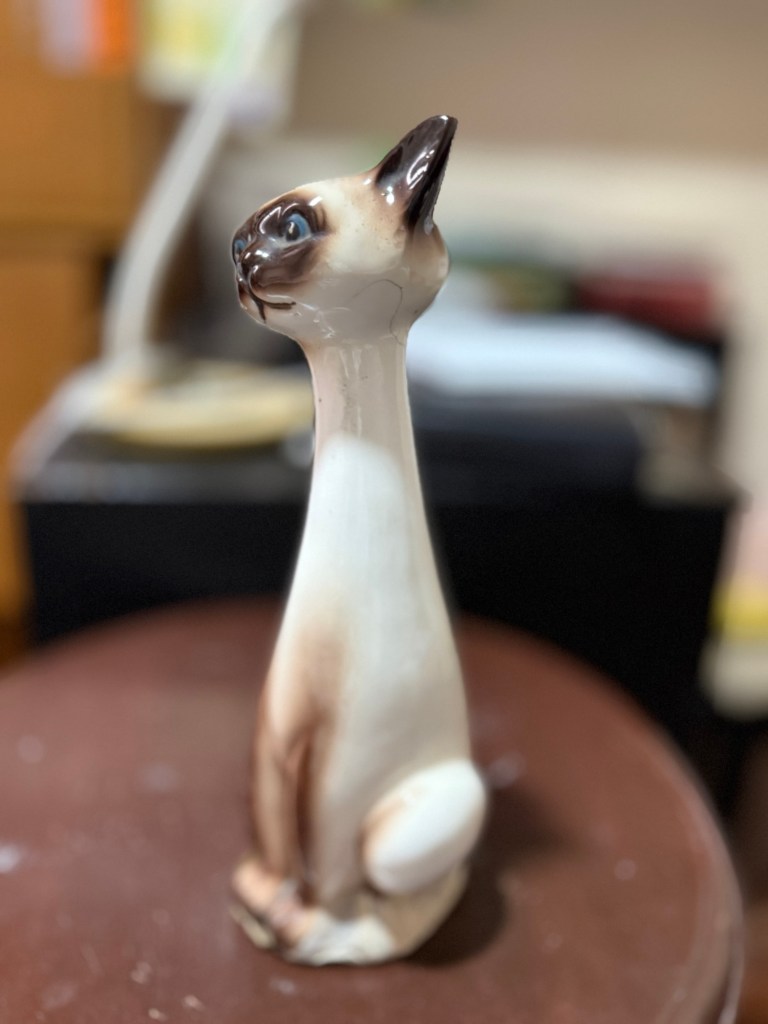
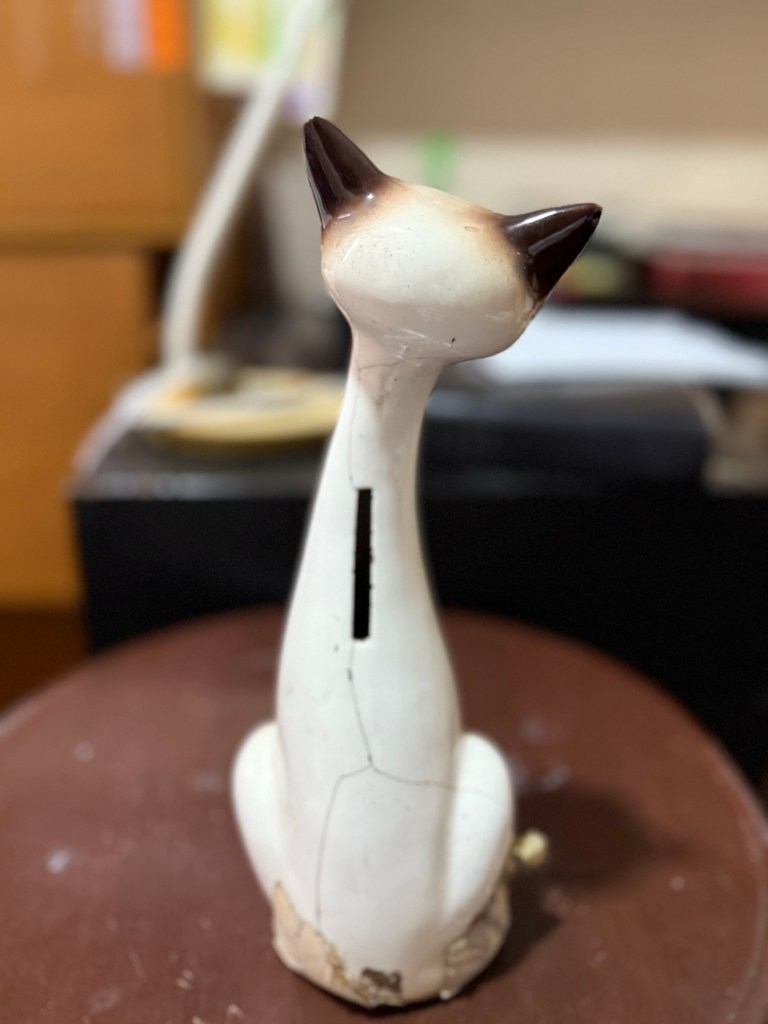
Photo by author, my mom’s kitty bank, 10.5 inches to the tip of ears.
While these things were running through me during our family dinner that night, my brother presented to me mommy’s “kitty bank” which is older than I am, 61 years old. It is one of her most cherished possessions she truly took great care as far as I can remember.
I have been thinking about it recently if it were still around though I never had any interest with it when growing up as a child except that I enjoyed counting the rare coins inside mostly dating back to the American occupation with the usual designs of the US flag and an eagle.
That evening on dad’s 25th death anniversary that could have been mom’s 86th birthday if she were still alive today, I felt a very strong attraction with that “kitty bank” whose face seemed to be speaking to me.
Photo by author, my mom’s kitty bank, circa 1964.
As I held it closer to see its many fissures and tapes following the wear and tear of over 60 years, I saw mommy again, of how she loved us and life so much, especially cats, dogs and fish, and most of all, plants- being a certified tita herself. Our house may be small but mommy lovingly took care of her pets and plants, always talking with them even after having a stroke.
Like the cat with its nine lives, death is never the end but the prelude to new life or, more lives hereafter.
And that is the nobility and giftedness of every mother – even after they are gone, they continue to bring forth and nurture life. God bless everyone… and the cats.
Quiet Storm by Fr. Nicanor F. Lalog II, 26 May 2025
Photo by author, Northern Blossoms Farm, Atok, Benguet, 26 December 2024.
Human love is imperfect; only God can love us perfectly.
Many times we get disappointed with our loved ones for not loving us enough or not loving us at all when in fact, they do love us! They come in different forms like strict parents or teachers, an OFW who has to leave his/her loved ones behind for better earnings so the children can go to good schools or an eager-beaver colleague who sometimes gets to our nerves for the things he/she does for us not to irritate us but to help us actually. And yes, parents who give away their children in the belief they can have a better future if they grow up not with them.
We all want to love perfectly or be loved perfectly but that is not possible because we humans are not perfect. We err, miscalculate situations and misjudge persons. Many times, we do not understand nor comprehend situations for we cannot know everything right away nor at all.
The good news is, the more we realize the imperfections of our love, that is when we are perfected, when we become better persons, when we actually become more loving with others by being patient and understanding, kind and forgiving. Our efforts to love though imperfect shall perfect us.
Photo by author, Northern Blossoms Farm, Atok, Benguet, 26 December 2024.
It is in our imperfect love we also learn how to sacrifice and let go because we love. The beloved disciple of Jesus wrote that “No one has ever seen God. Yet, if we love one another, God remains in us, and his love is brought to perfection in us(1 John 4:12). Every time we are bothered, when we feel guilty of not loving much or not being loved, chill. Be patient. And wait for everything to clear up. There must have been a breakdown in communication or too much presumptions on anyone’s part. Be open. Most of all, even if you felt not loved or no one loves, keep loving. For as long as we love, we grow. We mature.
Love, love, love!
It is the most potent force in the universe. We came into being because of love. We live to love. For as long as there is love, we shall not perish.
Stop loving, then we die.
Photo by author, Sakura Farm, Atok, Benguet, 26 December 2024.
When we do not love, that is when we perish because we no longer hope and believe in anyone nor anything. That is the end.
St. Paul said it perfectly, “So faith, hope, and love remain, these three; but the greatest of these is love” (1 Cor. 13:13). After we have died, only love remains in heaven: we do not need faith nor hope because love is everything we believe and hope. Even those we leave behind will just keep on loving that life will continue until we all come together in eternity. Still loving.
Hence, love cannot be defined. Love is infinite and can only be described. And though it is imperfect in human terms, our expressions of love has no limits. That is why, “tis better to have loved and lost than never to have loved at all” (Lord Alfred Tennyson in 1849). Bow. To love.
Photo by author, Angels’ Hills Retreat and Spirituality Center, Tagaytay City, 18 April 2025.
Quiet Storm by Fr. Nicanor F. Lalog II, 24 March 2025
Some people have been asking me how does it feel to be sigisty years old? I really don’t have any complete answer yet except the feeling of sudden shift in my perspectives in life.
Whether it is what experts call as the gestalt shift, I do not know. However, since I have failed in a psychological exam to the major seminary in 1982 that forced me to forget all about the priesthood momentarily (nine years), I have always thought of myself as “crazy” with weird thoughts and ideas, weird perceptions coming from weird images and illusions I see on many things
These manifest in my photography subjects that are often wala lang, as in trip trip lang talaga. Like in my recent annual retreat at the Sacred Heart Novitiate in Novaliches where I have been coming since 2016. Suddenly this year, my focus were so bent on the most ordinary features of this venerable institution that is about 75 years old.
During my stay there last week, the stairs, the windows, and the arches that are even older than me be4came so lovely and interesting. I felt so drawn to them that I had a lot of shots taken upon my arrival.
The Sacred Heart Novitiate is my “happy place” because it is my Bethel where I “dreamt” like Jacob of the stairway to heaven (Gen. 28:10-22). It is also my Peniel or Penuel (Gen. 32:23-32) where like Jacob I also wrestled with God or an angel in deep prayers every year.
In my previous article, I have explained that maybe my focus on the stairs was due to my excitement in awaiting the Netflix documentary on Led Zeppelin whose most famous song is called Stairway to Heaven.
Today, I share with you some photos I have taken with my weird perceptions of the Sacred Heart Novitiate’s windows that suddenly evoked a lot of ideas in me as a sigisty year old man so loved by God.
Being a new senior sixty cent only last Saturday, I felt the joy of being able to look at a very long past of both beautiful and sad even painful memories that have made me who I am today.
Despite the hurts and scars from the many battles in life, I am still glad and thankful for the gift of six decades.
Being a sigisty year old man is like looking out the window, marveling at how fast times have flown that many times, some scenes in my life are like some spots outside that look so near that are actually so far and distant.
I felt my getting old started the time I kept saying “40 years ago ba iyon” when commenting on an event or a song or a movie. Parang kailan lang pero matagal na pala!
Like in life itself, you can choose your focus when looking outside the window: you may include the window itself in the vista like a frame or totally disregard its existence and simply look at the world outside or the past itself. You may also focus on the sceneries you prefer, more of the lovely ones and less of the unsightly.
On the other hand, I have strongly felt too as I turned sigisty years old how my remaining days on earth are numbered. Looking back to the past seems an endless horizon while looking into the future is very definite. You can see already the end of the line, so to speak s you get that feeling my days are numbered. That is the moment when the eternal spring within tells you that at the end of that tunnel or wall is eternity. But, before that, you know the end is near.
The word “window” came from the Old Norse vindauga, from vind or “wind” that was pronounced as the English “wind” and auga for eye that phonetically sounded as “ow” that literally meant “wind-eye” that became the Old English word wind-ow or “window” as we know and use it today.
Hence, window became the term for an opening in any building like home that allows air and light to pass through. Most of all, it is an opening for people inside to see the world outside while giving those outside a glimpse of what’s inside.
How lovely is that interplay happening in every window that opens a person’s vista outside and inside. It is how one looks on windows that makes the great difference that eventually forms our perspectives in life.
About three decades ago, Bill Gates launched his company Microsoft’s operating system called Windows that greatly revolutionized our lives with computers becoming easily accessible for everyone. Unlike its funny looking predecessor called dost, Windows was aptly called as one had to simply click a box like literally opening a window to explore its many programs.
Windows – the real ones like in buildings – still present us with such great possibilities when we look outside or into them.
But of course, that still greatly depends on that one great window God had gifted us – our eyes that have both sight and vision.
Jesus told his disciples, “The lamp of the body is the eye. If your eye is sound, your whole body will be filled with light; but if your eye is bad, your whole body will be in darkness. And if the light in you is darkness, how great will the darkness be” (Matthew 6:22-23).
How unfortunate that many times, we prefer to limit the use of our eyes to just sights that limit our perspectives on what are simply obvious and visible.
Only a few called as visionaries dare to use their eyes to have vision, that is, to see and look beyond what’s visible and before us, whether from the window or into the window.
If we can have our eyes synced together with both sight and vision, then we shall see much more in this life that we become grateful with our past while at the same time filled with joyful expectations of the fast approaching beyond of this world as we age. Amen.
*All photos taken by the author using the iPhone 16 Pro Max at the Sacred Heart Novitiate, Novaliches, QC, March 17-22, 2025.

















 lordmychef.com