Rejoicing amid disappointments

The Lord Is My Chef Sunday Recipe for the Soul by Fr. Nicanor F. Lalog II
Third Sunday in Advent-A, Gaudete Sunday, 11 December 2022
Isaiah 35:1-6, 10 ><}}}*> James 5:7-10 ><}}}*> Matthew 11:2-11

Photo by author, 2019.

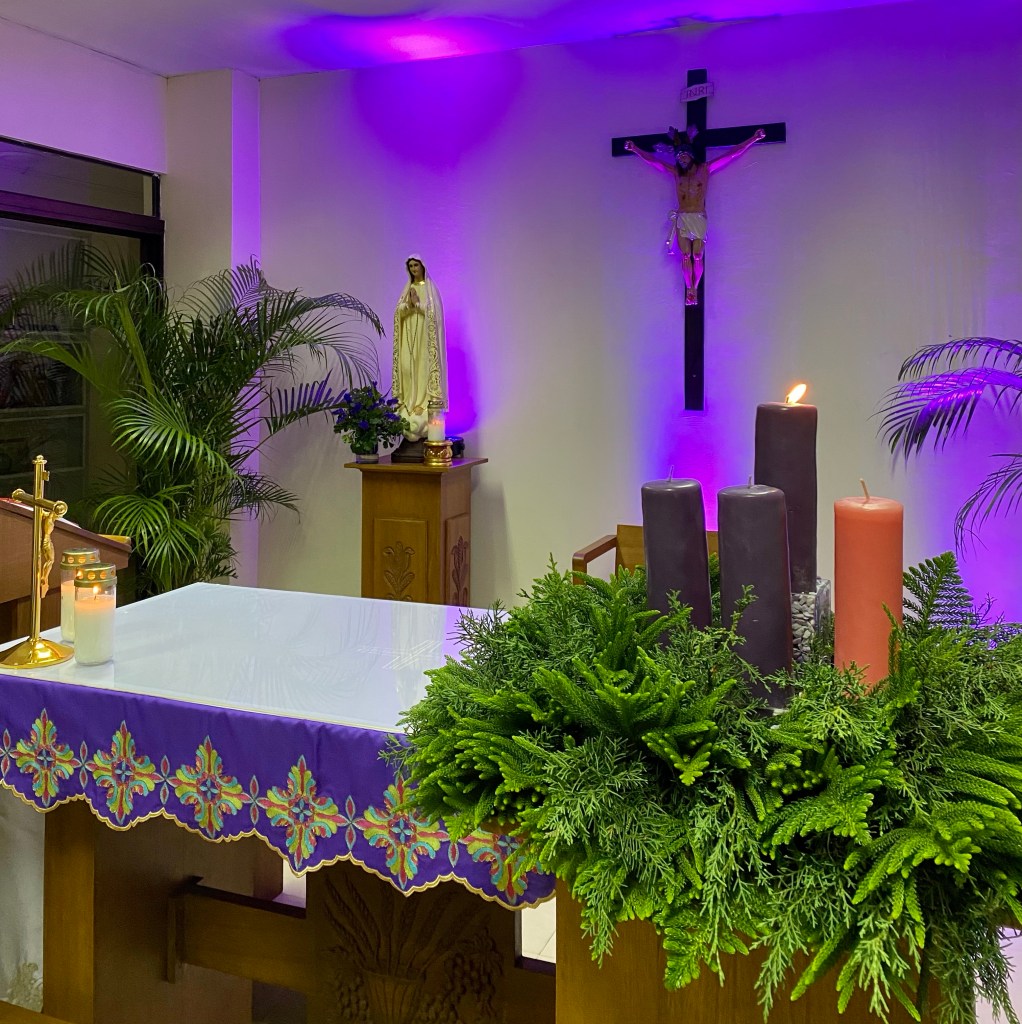
Today our altar bursts in lovely shades of pink in celebration of the third Sunday of Advent also known as Gaudete Sunday from the Latin gaudere that means “to rejoice”. We rejoice this third Sunday because the Lord’s Second Coming is getting nearer each day and so is our awaited celebration of Christmas with the start of Simabang Gabi.

There are still many reasons for us to rejoice but when we reflect deeper in life, our rejoicing in itself is a paradox.

Because rejoicing is more joyful when seen amid darkness and uncertainties, disappointments and failures.

Because joy is more than feeling happy but that certainty within us that no matter what happens in this life, even if things get worst, everything ends according to God’s plans.

Because God loves us so much!

That is why we rejoice this Sunday – and everyday in our lives – that no matter what happens to us, God is with us in Jesus Christ, loving us, saving us.

When John the Baptist heard in prison of the works of the Christ, he sent his disciples to Jesus with this question, “Are you the one who is to come, or should we look for another?” Jesus said to them in reply, “Go and tell John what you hear and see: the blind regain their sight, the lame walk, lepers are cleansed, the deaf hear, the dead are raised, and the poor have the good news proclaimed to them. And blessed is the one who takes no offense at me.”

Matthew 11:2-6
Photo by author, 2021.

How fast things happen and change in life, especially when there is a sudden change or reversal, from good to bad, from top of the world to bottom into the unknown like John the Baptist.

Last week, John was on top of the world as people were coming to him for baptism, listening and believing his preaching; today, we heard him in prison!

Herod Antipas, the son of King Herod when Christ was born, had him imprisoned after John told him that it was wrong for him to take as wife his brother Philip’s former wife, Herodias. Eventually, John was beheaded in prison upon Herod’s order after making a promise to grant whatever request the daughter of Herodias would ask him after entertaining guests in his birthday party; the daughter asked for John’s head on a platter and immediately, Herod dispatched his executioner.

Now at his lowest point in life awaiting certain death, John was “disappointed” with what he had been hearing about the works and preaching of Jesus Christ whom he had baptized at Jordan. Recall how John preached a message of “fire and brimstone” as he expected the Christ would bring punishment and destruction to those doing evil, warning them that the “ax lies at the root of the trees…ready to cut down those not bearing fruits” while his “winnowing fan in his hand is gathering his wheat into his barn, but the chaff he will burn with unquenchable fire” (Mt. 3:10, 12).

John was expecting the Christ would immediately make sweeping changes in the world, punishing the evil doers but what he heard and perhaps may have witnessed too was the gentleness of Jesus, always ready to forgive the sinful, heal the sick, and most of all, keeping company with the most sinful people of that time like the tax collectors and the prostitutes!

Many times in life we find ourselves very much in John’s situation – so disappointed with God because what happens in reality are exactly the opposite of what we expected based on what we are taught or what we have read in the Bible! That is why John sought clarification from Jesus himself. We too, when disappointments happen in life along with other pains and sufferings especially after trying our very best to serve God through others, must always have that disposition of humility to seek clarifications from God. As disciples of Jesus Christ, we must be open like John in welcoming the Lord in the way he wishes to reveal himself.

Photo by author, November 2022.

How ironic that John who stood preaching the coming of Christ Jesus, of demanding justice and kindness from the people was imprisoned, himself a victim of injustice! Sometimes in life, it is so easy to preach Jesus Christ and his values not until we find ourselves on the distaff side like getting sick or being unjustly accused of something we did not commit. Like John, when we become the very people suffering those things we preach, our expectations even of God may blind us and fail us to see Christ’s coming, becoming so difficult to see God’s mercy and healing acting in other people’s lives but not in our own lives like John who was imprisoned unjustly for telling the truth.

The Season of Advent, especially this third Sunday we call “Rejoice” or “Gaudete” Sunday invites us to examine our own expectations and knowledge of God that may sometimes blind us to his actions and presence in our world.

The key is to have that humility to just let God be God!

Let God do his work and just chill.

Let us allow ourselves to be surprised by God always! It is from those surprises by God when joys burst in our lives even in the most difficult or simplest situations in life.

Photo by author, 2018.

One of my favorite subjects in photography are mosses – lumot – those green clumps or mats found thriving in damp, shady spots and locations. I am no green thumb but I love mosses and ferns because they are very refreshing to the eyes. They evoke hopes and surprises that despite the little sunlight and care they get, they live and thrive so well, teaching us a lot of valuable lessons about darkness and failures in life.

That is what Isaiah and St. James were reminding us in the first two readings, of the need for us to be patient like the farmers in awaiting the sprouting and blooming of crops and plants in the fields, of strengthening each other because the hard times are sure to end. Most of all, the Lord is faithful, always working silently when we are in the most dead situations in life, preparing great surprises for us.

Let us set aside our expectations, even our goals and agenda in life to let God do his work in us, to surprise us with his more wondrous plans because he knows what is best for us.

There are times in life when we are disappointed even frustrated at how things are not going according to our plans even if God had confirmed it in our prayers and in many instances in life – that feeling of suddenly being abandoned by God?

There are times we complain and feel undeserving of the many failures and pains that come our way because we have been so faithful to God, even prayerful that we cry to him, asking him like John for clarifications of whether he is with us or should we still wait more.

Most often in life, we get blinded even by our noble intentions and goodness, of our image and expectations of God that in the process, we are hurt, leaving us with scars and empty spaces within…

Be patient, my friend. Trust God.

The same empty spaces and holes in life would soon be filled with blessings so unimaginable because, remember, God is “greater than our hearts and knows everything” (1 Jn. 3:20). It is only when we are hurt and bruised and emptied, even dried and dead when life and joy burst forth because that is when God can freely work in us in Christ Jesus. Amen.

Have a joyful week ahead!

Photo by Ms. Jo Villafuerte, September 2019.

Advent is God’s consolation

The Lord Is My Chef Daily Recipe for the Soul by Fr. Nicanor F. Lalog II
Wednesday in the Second Week of Advent, Memorial of St. Ambrose, 07 December 2022
Isaiah 40:25-31   ><]]]]'> +><]]]]'> + ><]]]]'>   Matthew 11:28-30
Photo by author, 02 December 2022.
How wonderful are your words
this second week of Advent,
God our loving Father:
Monday you reminded us to
strengthen each other,
Tuesday you asked us to comfort
one another,
today, you console us
with this part of Isaiah's 
"Book of Consolation":

Why, O Jacob, do you say, and declare, O Israel, “My way is hidden from the Lord, and my right is disregarded by my God?” Do you not know or have you not heard? The Lord is the eternal God, creator of the ends of the earth. He does not faint nor grow weary, and his knowledge is beyond scrutiny. He gives strength to the fainting; for the weak he makes vigor abound.

Isaiah 40:27-29
Forgive me, loving Father,
in those times I doubted you,
when I complained to you as if 
I am entitled; looking back to those
trying times when I felt alone and
abandoned, struggling and fighting
by myself, silently crying unknown to
anyone, there was YOU always with me,
standing by my side, defending me,
fighting my battles,
even carrying me when I am lost
and defeated.
Indeed, you never left me,
I was never alone for you have 
always been with me - con solare -
one with me in my pains and sorrows,
trials and sickness; in Christ Jesus,
you chose to suffer and die to be one with me
- con solare - by helping us carry our yoke,
giving us rest in you you, 
making it lighter and 
easier to carry.
Like St. Ambrose,
teach us to speak your words
of wisdom to those in darkness,
to appreciate also your silence
so we may be instruments of your
consolation to those feeling alone
to assure them you are one with us
when darkness surrounds us.
Amen.
Photo by author, 02 December 2022.

Advent is for strengthening others

The Lord Is My Chef Daily Recipe for the Soul by Fr. Nicanor F. Lalog II
Monday in the Second Week of Advent, 06 December 2022
Isaiah 35:1-10     ><]]]]'> + ><]]]]'> + ><]]]]'>     Luke 5:17-26
Photo by author, 2019.
As we move forward
in this Season of Advent,
getting closer each day to the
Second Coming of Jesus Christ
who comes in every here and now too,
grant us, O God, the grace to lead
others closer to you.
Like those men who carried
the paralyzed man closer to Jesus
by going through the roof to lower him,
enlighten us Lord in finding ways to
reach out to those who have left our fold,
those who have been disillusioned with
the human elements of the Church,
and those who find it to difficult, even scary or
discomforting to move on in life;
we are weak and limited,
ourselves also disillusioned
at times.

Strengthen the hands that are feeble, make firm the knees that are weak, say to those who hearts are frightened: Be strong, fear not! Here is your God; he comes with vindication; with divine recompense he comes save you. Then will the eyes of the blind be opened, the ears of the deaf be cleared; then will the lame leap like a stag, then the tongue of the dumb will sing.

Isaiah 35:3-6
Strengthen our hands first 
for we are the ones also feeble;
make firm our knees 
for we are also weak;
most of all, embolden our hearts 
for we are fearful too in doing
what is good,
in doing your will.
Thank you, dear God our Father,
despite our weaknesses and sins,
you still call us to do your work
in Christ Jesus.
Amen.

Finding Jesus, showing Jesus

The Lord Is My Chef Sunday Recipe for the Soul by Fr. Nicanor F. Lalog II
Second Sunday in Advent, Cycle A, 04 December 2022
Isaiah 11:1-10 ><}}}*> Romans 15:4-9 ><}}}*> Matthew 3:1-12
Photo by Ezra Acayan/Getty Images, 09 February 2020, Baclaran Church.

Many years from now, future generations will surely discuss these years of our COVID-19 pandemic, with everyone talking about the face masks we wore. Imagine your great grandchildren repeatedly asking their parents why we were covering our faces during this time.

But, these face masks were also the signs of blessing during this pandemic, teaching us to look onto the face of one another, to recognize each one as brother and sister in Christ. I believe these face masks are reminders from God of how we have forgotten to look and value each one as persons to be loved and cared for, respected and protected.

What a beautiful sight when people meet, exchanging glances, adjusting their glasses and face masks to recognize each one again!

In the Book of Genesis, we are told how God created us in his image and likeness that remind us of his “face” even if we know God is spirit. Face means more than the physical face of the person. It reveals in the most undeniable manner one’s state or condition, of what is in him/her. When a person is filled with goodness and love, joy and contentment or, bitterness and hate, evil and sin, we say it is “written all over his/her face”.

Remember Mang Dodong of Caloocan City who was detained for almost a month in Navotas for not having proper ID’s during the lockdown of March 2020 after he tried to buy fish in order to sell in their neighborhood? At the same time when it happened, there was the shameless news of police throwing a birthday bash to their chief in total disregard of the protocols? The injustice against the poor prevailing then and now was all written in Mang Dodong’s face in the news.

Mang Dodong of Caloocan City, photo by Mr. Vincent Go, May 2020.

Here lies the challenge of Advent 2022, the first face-to-face Christmas we shall have in two years since the pandemic when we have to cover our faces with face masks: have I shown God with others on my face? Or maybe, the better question should be, do I see the face of God in the people I meet?

This Second Sunday of Advent, the gospel invites us if like John the Baptist, do we see Jesus Christ coming among us? Do we see him in ourselves and in others?

John the Baptist appeared, preaching in the desert of Judea and saying, “Repent for the kingdom of heaven is at hand!” It was of him that the prophet Isaiah had spoken when he said: A voice of one crying out in the desert, Prepare the way of the Lord, make straight his paths.

Matthew 3:1-3
“St. John the Baptist Preaching in the Wilderness” by German painter Anton Raphael Mengs (1728-1779) from commons.wikimedia.org.

John is our second guide during Advent next to the Prophet Isaiah. John did not only see the coming of Christ but he also showed the Christ had come.

Why did people come to listen to him and be baptized from all over Israel at that time?

His preaching must be so powerful and convincing because people must have also seen in him Christ’s coming. In fact, people of his time thought he was already the Messiah everyone was awaiting. But John was very clear in his preaching that he was not the One.

Such was the power of John’s preaching. Everyone believed him because he did not merely point to the coming of Christ but showed them too Christ already present in him. No wonder, he would be the first to die for Jesus and like Jesus by standing for what is true and good.

How was John able to do this?

Aside from the power of the Holy Spirit that came upon him while still in his mother’s womb during Mary’s visitation, John went to a sort of quarantine too – an Advent – when he left the comforts of his affluent family to live a simple life in the desert.

John wore clothing made of camel’s hair and had a leather belt around his waist. His food was locusts and wild honey.

Matthew 3:4

Last Sunday, we have reflected that Advent is a Sabbath when we rest to be breathed on by God, to be filled with God and his Spirit by first emptying ourselves of our sins and pride. Most of all, in coming to the wilderness empty and simple, John showed the importance of prayer, of relying solely to God. It was prayer that sustained John in the desert and it is prayer that would sustain us during this Advent. In fact, we need to handle life with prayer in order to see Christ coming and most of all, to show Christ to others.

In calling for conversion, John challenged the people of his time too to bear fruits in their efforts of seeing the coming Messiah. All these emptying and sacrifices and being breathed on by God must always be evident not only for everyone to see but for each one to truly experience Christ’s coming.

A painting based on Is.11:1-10 called “Peaceable Kingdom” by American Edward Hicks, a Quaker pastor (1780-1849).

In the first reading, Isaiah reminds us that Advent is a time also of healing when we learn to be small again, even to die in our selves to give way for the coming of the Lord.

On that day, a shoot shall sprout from the stump of Jesse, and from his roots a bud shall blossom. The spirit of the Lord shall rest upon him… Not by appearance shall he judge, nor by hearsay shall he decide, but he shall judge the poor with justice, and decide aright for the land’s afflicted… Justice shall be the band around his waist, and faithfulness a belt upon his hips. Then the wolf shall be a guest of the lamb, and the leopard shall lie down with the kid; the calf and young lion shall browse together, with a little child to guide them. The cow and the bear shall be neighbors, together their young shall rest; the lion shall eat hay like ox. The baby shall play by the cobra’s den, and the child lay his hand on the adder’s lair. There shall be no harm or ruin on my holy mountain; for the earth shall be filled with knowledge of the Lord, as water covers the sea.

Isaiah 11:1-2, 3, 4, 5-9

This for me is one of the loveliest scenes in the Old Testament: aside from the poetry of Isaiah, imagine how God envisions for us a “peaceable kingdom” where humans and animals live together in harmony, when there would be no more harm or ruin on everyone!

So beautiful!

And so possible if we can be like John the Baptist with our eyes seeing more beyond the physical realities of this world by being small again like the shoot, even of dying to one’s self like a stump.

It is only in our littleness, in our barrenness and death can we truly see and find Jesus. But, the moment we see Christ in us, it is no longer difficult to recognize him on others as well as find him in all creation. If we could fine tune our eyes to Jesus and live in one accord with God and everyone as St. Paul calls us in the second reading, then Christ becomes present among us in the world with his peace.

Let us pray on this Second Sunday of Advent that we not only see Jesus coming but also show him present in us and among us so that when we go to our places of work, we do not just “earn a living” but also work on building the kingdom of God here on earth.

Let us pray that beginning this second Sunday of Advent that we not only see Jesus but also show him present in us and among us so that whenever we post on social media, we also build relationships in Christ.

Have a blessed week everyone!

Let us pray on this Second Sunday of Advent that the next time we give donations and help to people in need, it is Jesus whom we find in them so that we go the extra mile in our efforts to uplift them and truly make a “shoot sprout forth from the stump” of this dying earth so that the bud of God’s kingdom may finally blossom in us. Amen.

Advent is also the coming of the Cross

The Lord Is My Chef Daily Recipe for the Soul by Fr. Nicanor F. Lalog II
Wednesday in the First Week of Advent, Feast of St. Andrew the Apostle, 30 November 2022
Romans 10:9-18   ><}}}}*> + ><}}}}*> + ><}}}}*>   Matthew 4:18-22

Brothers and sisters: If you confess with your mouth that Jesus is Lord and believe in your heart that God raised him from the dead, you will be saved.

Romans 10:9
If Advent is the preparation 
for your coming, Lord Jesus Christ,
then Advent is also the preparation
for the coming of your Cross!
As St. Paul had taught us in all his
writings, there can be no proclamation of
of your salvation for us without preaching
your Cross, O Lord Jesus Christ!
Without your Cross, O Lord,
all your words and deeds
would be empty;
that is why, there is no saint
without a love for your Cross!
Teach us to love the cross 
you have assigned each of us
because it is on the Cross 
where you are found, Lord Jesus;
like St. Andrew, make us realize
that our own crosses can only have value
if we consider and accept them
as part of your own Cross;
though our crosses may be
of different shapes or colors,
each one is always a reflection of 
your eternal light, dear Jesus,
that ennobles our sufferings and pains.
Amen.

Praying to face, embrace every “end”

The Lord Is My Chef Daily Recipe for the Soul by Fr. Nicanor F. Lalog II
Tuesday, Memorial of St. Cecilia, Virgin and Martyr, 22 November 2022
Revelation 14:14-19    ><}}}}*> + ><}}}}*> + ><}}}}*>   Luke 21:5-11
Photo by author, 18 November 2022.
Many times, O Lord Jesus,
I find it very amusing 
that despite our facing 
of so many "endings" 
each day in our lives, 
we are still bothered
and afraid of the end,
always wishing how things
especially the most wonderful
and memorable ones to
remain and never end;
every day the sun sets,
tasks and work are
completed,
songs and movies are seen
until the end,
yet, we refuse to embrace
this reality of the end.

While some people were speaking about how the temple was adorned with costly stones and votive offerings, Jesus said, “All that you see here — the days will come when there will not be left a stone upon another stone that will not be thrown down.”

Luke 21:5-6
As you teach us today of the
certainty of the end, 
you remind us too, 
Lord Jesus,
that YOU are our only
security and surety
in this life;
everything, 
everyone 
will end
but only YOU shall remain;
give us the grace to cultivate
your gifts of faith and trust in you,
Lord Jesus;
like St. Cecilia whose memorial
we celebrate today,
may we muster all our courage
to be firm in our giving witness
to you dear Jesus every day,
every moment of our lives
for your judgment comes
surely as John had seen
in his visions;
in the same manner
as we end our prayers with
firm faith in eternal life in you,
may we befriend every ending
as your blessing leading us
to new beginnings in you.
Amen.
Photo by author, 16 November 2022 in Pulilan, Bulacan.

Christ our King & our overcoming of sin

The Lord Is My Chef Sunday Recipe for the Soul by Fr. Nicanor F. Lalog II
Solemnity of Christ the King, Cycle C, 20 November 2022
2 Samuel 5:1-3 ><000'> Colossians 1:12-20 ><000'> Luke 23:35-43
Painting of Christ’s Crucifixion by Tintoretto in 1565 portraying Jesus so “kingly”; interesting too were the people dressed as Venetians of his time as reminder that the evils that crucified Jesus continue in our own time. Photo from wikiart.org.

We now come to the final Sunday of our liturgical calendar called the Solemnity of Christ the King with a scene from his crucifixion on Good Friday. All these Sundays since June “When the days for Jesus’ being taken up were fulfilled, he resolutely determined to journey to Jerusalem” (Lk.9:51), Luke had been showing us that Christ’s crucifixion and glory are one just like John in his gospel account.

But the most beautiful part of our gospel on this solemn celebration is the fact that inasmuch as Jesus had clearly showed in all eternity his kingship while dying on the Cross, it is also right on the cross of sufferings as we strive to resist temptations of turning away from God that we proclaim Christ’s kingship. Please bear with me, my friends in reflecting Luke’s artistic presentation of Christ’s crucifixion as the expression of his kingship.

Notice how Jesus was “sneered, jeered, and reviled” at the cross, reminding us of the devil’s three temptations in the wilderness after his baptism at Jordan by John. After failing to tempt Jesus at the wilderness, Luke said the devil “departed from him for a time” (Lk.4:13), returning at his crucifixion as the most opportune time to test him.

In the wilderness, the temptations by the devil to Jesus applied very well with us too but, here on the cross, it was totally different. The devil himself was nowhere to be found because he was in the person of the rulers, the soldiers, and the thief! And that is how evil and sin have become so “powerful” in a pernicious manner among us when many times we are the devil in fact.

Here, we are reminded to be aware always of that opportune time when the devil attacks us when we see or face many sufferings in life by reflecting the last three temptations of Jesus on the Cross.

Photo by author, 2017, Sacred Heart Novitiate, Novaliches, QC.

The rulers sneered at Jesus and said, “He saved others, let him save himself if he is the chosen one, the Christ of God” (Lk.23:35).

Just like at the wilderness when the devil tempted Jesus with what he can do as the Son of God by changing stone into bread, at the Cross it was the same temptation hurled on him by the rulers of Israel, the priests and the scribes.

How sad that amid the many sufferings in the world today we contemptuously mock others like the poor for not working so hard to liberate themselves from poverty and hunger. There is the tendency among us blessed with better living conditions to look down at others without considering how they never have the same opportunities in life like us in having good education or a caring family or worse, not having the right connections.

The tragic part of this “sneering” by the rulers on Jesus is when we look at others as if they are not humans and persons like us who play gods knowing everything even who should live and who should die like in the systematic approach by state rulers to come up with what St. John Paul II called as “culture of death” in solving poverty and crime with abortions and capital punishments.

Let us examine our attitudes at the way we look at those going through sufferings and pains like sickness, poverty and other social ills we do not go through. Let us stop the mockeries of blaming them for their plight because many times like Jesus Christ, they were betrayed by loved ones like us, by the society, or even by the institutions meant to uplift them.

Photo by author, 2017.

Even the soldiers jeered at him. As they approached to offer him wine they called out, “If you are King of the Jews, save yourself.” Above him there was an inscription that read, “This is the King of the Jews” (Lk.23:36-38).

Sneering and jeering are both contemptuous mocking or insulting of others; they are both employed by those in vantage positions of power and control like the rulers of Israel. Going “higher” than the priests, the Roman soldiers sneered Jesus by rudely mocking him in loud voice. Sneering is a superfluous display of might, of superiority, of power. It is a kind of vanity that is why in the wilderness, the devil tempted Jesus to have all the kingdoms in the world for him to be famous and popular in exchange of worshipping him.

Sneering is something so prevalent these days in our use of the social media where we practically scream and insist on everyone to notice and recognize us, that we have “arrived” in having the latest and most expensive clothes, food, gadgets and everything. There is so much wild attitude among us like the soldiers at the cross when we use social media in too much talks, even of spewing foul languages and invectives as well as lies. Fake news and lies spread so fast and are sadly taken as true to the detriment of its victims because we have been so gullible for gossips and rumors too.

But the worst part of our imitation of the soldiers jeering at Jesus is when many of us are afflicted with this perversion called exhibitionism – from those salacious posts in TikTok to those “food porns” and too much display of everything about ourselves and of our loved ones. When do we get tired of all these selfies that have become so sickening that we do not realize of how we make known to everyone of our emptiness and lack of the more essential things like love and self-respect? Like the soldiers, the more we promote ourselves, the more we affirm the obvious that Jesus indeed is the King we needed most.

Photo by author, 2017.

Now one of the criminal hanging there reviled Jesus, saying, “Are you not the Christ? Save yourself and us” (Lk.23:39).

Reviling is also kind of of mocking others like sneering and jeering; however, to revile is the lowest kind because it is to insult somebody you are with in a same situation. To revile is the lack of recognition of one’s faults and sins that he would rather insult others like this thief traditionally identified as Hestas. In reviling Jesus while also hanging on the cross, Hestas went down deeper his lowest point as a convicted criminal when he had the gall to insult Jesus!

And that is the most unkind evil of all when we become so numb, so dense and stupid to even mock others we are with us in a similar situation. It happens daily when even we are in deep shit, we still see ourselves cleaner and better than others! Just read or watch the news about our politicians.

In the wilderness, the final temptation of the devil to Jesus was to jump from the top of the temple because his angels would not let him fall and even touch ground; here at the cross, Hestas saw himself no different from Jesus, feeling so entitled to be liberated. Many times, this is the problem why evil continues among us: when people from below are promoted to higher positions, they forget their roots that they also forget to fix the problems of inequalities and injustices down below where they came from. The key is to always remember. Like Dimas, the good thief.

Photo by author, 2017.

The other, however, rebuking him, said in reply, “Have you no fear of God, for you are subject to the same condemnation? And indeed, we have been condemned justly, for the sentence we received corresponds to our crimes, but this man has done nothing criminal.” Then he said, “Jesus, remember me when you come into your kingdom.” He replied to him, “Amen, I say to you, today you will be with me in Paradise” (Lk.23:40-4).

See how Luke inserted here the fourth verb “to rebuke” to break the series of sneering, jeering, and reviling of Jesus. Like Dimas, we have to strive in breaking the cycle and series of evil especially in this time.

To rebuke means to express sharp disapproval. Imagine Dimas contradicting Hestas and even the rulers and soldiers as well by defending Jesus Christ while hanging there on the cross.

How sad when we remain silent, when we just walk away from people sneering, jeering and reviling Jesus in those who suffer in life because we are afraid to make a stand for what is true and good, what is right and just. How ironic that another thief hanging on the cross was the only one who made a stand for Jesus on that Good Friday along with the Mary and the beloved disciple below.

Every time we make a stand for life and dignity of every person, when we stand for what is true, right and just, that is when we imitate the tribes of Israel in the first reading coming to David to pledge their loyalty and allegiance to him as their king.

When we submit ourselves to Jesus Christ as our only King to be obeyed and followed, that is when our celebration today becomes a daily reality.

That is when we also earn heaven right on the Cross of our sufferings like Dimas when we “remember” Jesus.

Normally in the whole Bible, it is God who remembers. People always forget. When we sin, we forget consciously and unconsciously God and all the good things he had done to us. We forget others too.

There on the Cross, see the reversals of roles Luke has presented so beautifully, from the devil replaced by the rulers, the soldiers and the other thief; and now Dimas sort of assuming God’s role who remembered everything and everyone, especially Jesus our Savior. Dimas remembered what St. Paul expressed to the Colossians that Jesus is Lord in whom, with whom and through whom everything was created and renewed because he is the Christ!

From Google.

The word “remember” literally means to make member or part again, that is, “re” + “member”.

When we remember somebody, we make that person present with us again.

In asking Jesus to remember him when he comes into his kingdom, Dimas was assured that right now as he remembered everything including his sins, he already becomes a member, a part of his kingdom.

May we not forget and always remember Jesus and others always to experience Paradise even when we are on the cross. Amen. Have a blessed week ahead!

Praying for those in tears

The Lord Is My Chef Daily Recipe for the Soul by Fr. Nicanor F. Lalog II
Thursday, Memorial of  St. Elizabeth of Hungary, Religious, 17 November 2022
Revelations 5:1-10   ><))))*> + ><))))*> + ><))))*>   Luke 19:41-44
Photo by Pixabay on Pexels.com
Lord Jesus Christ,
today I pray for those who cry,
for those who weep,
especially those who
are shedding tears
in silence.
You yourself wept over
Jerusalem when you saw it
for its hardness of her heart,
in rejecting you, O Lord,
as the Christ, our Savior:
"As Jesus drew near,
he saw the city and wept over it,
saying, 'If this day you only knew
what makes for peace ---
but now it is hidden from
your eyes'" (Luke 19:41-42).
Thank you, dear Jesus,
in making our tears blessed
that cleanse us inside,
washes away our guilt
and other dirt,
pains and sins
and everything not nice 
from the past
to fill us with your joy
and life!
But most of all, Jesus,
thank you for suffering,
dying, and rising for us
that every time we cry and weep,
when there are tears rolling
down our cheeks,
we feel assured of your 
loving presence
in times of grief and sadness,
failures and disappointments,
sickness and death
because in your pasch,
you have triumphed not only
over sin and evil here on earth
but also assured us of entrance 
into heaven as seen by John:

I shed many tears because no one was found worthy to open the scroll or to examine it. One of the elders said to me, “Do not weep. The lion of the tribe of Judah, the root of David, has triumphed, enabling him to open the scroll with its seven seals.”

Revelation 5:4-5
Praise and glory to you,
dear Jesus, the lion of the tribe of Judah,
the root of David,
the Lamb who was slain and
found worthy to save us
and lead us back to the Father,
now and forevermore.
Amen.

Inviting Jesus into our lives

The Lord Is My Chef Daily Recipe for the Soul by Fr. Nicanor F. Lalog II
Tuesday in the Thirty-Third Week of Ordinary Time, Year II, 15 November 2022
Revelation 3:1-6, 14-22   ><000'> + ><000'> + ><000'>   Luke 19:1-10
Forgive us, dear Jesus,
when many times in life
we appear to be so good and pious,
religious and devout in our religion
when in fact we lack faith in you
like the people of Sardis:

“I know your works, that you have the reputation of being alive but you are dead. Be watchful and strengthen what is left, which is going to die, for I have not found your works complete in the sight of my God. Remember then how you accepted and heard; keep it, and repent.”

Revelation 3:1c-3a
Your words are so timely, Lord,
as we ourselves often hear the same words,
of how our Church is dying
because we are already dead in our faith;
we have been so complacent in our faith,
so focused with 
duties and obligations,
rites and rituals,
tasks and schedule
but so empty of YOU.

Come, Lord Jesus!
Maranatha!
Give us the holy longing
and desire of Zacchaeus to meet you,
to exert every effort to be with you
and to be filled with you!
But the most truest of your words today Lord
and most disturbing are your words to the
Church in Laodicea:

“I know your works; I know that you are neither cold nor hot. I wish you were either cold or hot. So, because you are lukewarm, neither hot nor cold, I will spit you out of my mouth.”

Revelation 3:15-16
Let us be clear with our stand in you, Jesus;
let us be firm in our faith and in our resolve
to follow you like Zacchaeus who gave
half of his wealth to the poor and repaid four times
those he had extorted money;
let us come to you with sincere hearts
and humility, empty us of our pretensions
and fill us with your presence and truth,
Lord Jesus!
Amen.

Silence: the sound of the end, the sound of new beginning

The Lord Is My Chef Sunday Recipe for the Soul by Fr. Nicanor F. Lalog II
Thirty-Third Sunday in Ordinary Time, Cycle C, 13 November 2022
Malachi 3:19-20 ><}}}}'> 2 Thessalonians 3:7-12 ><}}}}'> Luke 21:5-19
Photo by Ms. Jo Villafuerte in Atok, Benguet, 01 September 2019.

Silence is perhaps the most rare thing in this life that everybody is avoiding. See how that ubiquitous cell phone and ear phone/ear plugs on everyone, always speaking/texting to somebody or listening to something by one’s self.

Nobody appreciates the beautiful sound of silence anymore especially in the privacy of our homes with 24-hour television and unlimited streaming of movies. We are so at home with noise, from our talking gadgets to talking cars and talking elevators. Even jeepneys in my province speak Japanese when it stops!

But, no matter how hard we try to avoid silence, it imposes itself on us silently, telling us so many things for a more meaningful living like the need for us to slow down because the end is near.

In fact, it is right in silence when the end is already happening inasmuch as every beginning happens too!

Our readings today invite us to put some order in our lives because the end of everything is so real which happens not in the future but right in our present moment, in every here and now.

St. Paul in the second reading used the word “disorderly” twice to describe the kind of disorderly living some Thessalonians at that time were leading: “In fact, when we were with you, we instructed you that if anyone was unwilling to work, neither should that one eat. We hear that some are conducting themselves among you in a disorderly way, by not keeping busy but minding the business of others” (2 Thess. 3:10-11).

So relevant to our time too!

Let us be wary of the devil’s greatest temptation to everyone, that there is still time – there is enough time to change, to be better, to say “I am sorry”, to say “I love you”, to be kind, to be loving and forgiving.

There is not enough time because when we waste time, it is us who pass by not time! We could not bring back time and most of all, everything ends. Period.

While some people were speaking about how the temple was adorned with costly stones and votive offerings, Jesus said, “All that you see here — the days will come when there will not be left a stone upon another stone that will not be thrown down.”

Luke 21:5-6
Photo by author, Jerusalem, May 2019.

Everything ends to begin anew

Jesus is still in the temple area of Jerusalem giving his final teachings to his disciples and the crowd. And what a great topic he had chosen before his life ends on Good Friday outside Jerusalem in order to rise again on Easter – the destruction of the Jerusalem temple!

For the Jews, Jerusalem is not just their capital city but in fact the center of the world, even of the universe because that is where God is – signified by the temple. Imagine Jesus telling us Catholics how the Vatican City with the magnificent St. Peter’s Basilica being destroyed and reduced to rubbles like the wailing wall of Jerusalem? Of course, it will happen but we do not know when as we have seen with other great churches that have collapsed due to earthquakes and fires like the famed Notre Dame Cathedral in France last year. Very often, we find the end unthinkable especially when we think of great buildings and structures like the World Trade Center in New York that collapsed following a terrorist attack on 9/11.

On the other hand, we try as much as possible to preserve in time great moments in our lives that we wish would never end like our first kiss or the significant events of triumphs and achievements we have had.

Jesus assures us today that everything ends.

But, every ending is also a beginning.

While everything ends even his life and mission here on earth as we shall see next Sunday in Christ the King, Jesus tells us that endings are not bad at all especially when seen in his light and life.

Despite his own warnings of many upheavals like wars among nations, natural calamities and disasters, and most of all, of our persecutions even by our own family members and friends, Jesus assures us these would not immediately be the end. Yes, it means there would be longer time and periods of sufferings and pains from the trials that would come our way as individuals and as a nation, most of all as a community of believers but Jesus will give us all the grace and help we need in giving testimony to him as the Christ.

“You will even be handed over by parents, brothers, relatives, and friends, and they will put some of you to death. You will be hated by all because of my name, but not a hair on your head will be destroyed. By your perseverance you will secure your lives.”

Luke 21:16-19
Photo by author, Jerusalem, May 2017.

Everything Jesus had foretold have come true, especially the fall of Jerusalem in the year 70 AD, including those wars and calamities as well as all kinds of disasters that continue to happen to our days.

But, hey! Here we are all, still alive and well. Recall how in March 2020 when we were placed under quarantine, worldwide!

The world seemed to have stood still due to the COVID-19 pandemic. At first, we thought it would only be momentary like a few days or weeks but it dragged onto weeks and months! Until now, there is still the pandemic but a lot of great things have happened to us since 2020, for better and for worst.

That is the meaning of our brief first reading from the prophet Malachi reminding us that while the day of the Lord is the “day of judgment”, it is also the “day of salvation, day of redemption”.

And here lies the good news and challenge of this Sunday: while the end is not really an end in itself much to be feared as it is also a new beginning of a better life both here and in eternity, we have to strive harder each day in being more responsible disciples of the Lord, giving testimony to his loving service and mercy to everyone especially those in the margins like the poor and the sick.

I love the words of St. Paul in the second reading “instructing and urging us in the Lord Jesus Christ to work quietly” (2 Thess.3:12).

What a lovely reminder from the great Apostle who tirelessly – and silently – worked proclaiming the gospel and being an example to his people.

His call for us to work “quietly” in the Lord is an invitation to rediscover the beauty of silence in this noisy world of ours.

It is said that modern man is afraid of silence because he is afraid of confronting the truth of himself, that is he is finite, that everything will end. When we practice silence especially in prayer and in life generally, we come to terms with our very selves, with our life, and with death. That is when we start living authentically.

When we become silent, we learn to trust, we become faithful. No wonder, saints (along with monks and every religious including us priests ideally) are connoisseurs of silence.

Because, the truth is, God works silently in human history. Then and now, we have seen and experienced God working in silence in our lives and in the world, ensuring that history would end according to his Divine plan, not just according to fate or freak accident or human folly.

In the silence of our hearts, we are certain of these things, of God never ceasing in his love and care for us. Even without the prophets proclaiming, right within each of us, we can be sure that every day is a day of the Lord, a day of his judgement and a day of his salvation. Amen. Have a blessed week ahead!

Photo by Ms. Jo Villafuerte in Atok, Benguet, 01 September 2019.