The joy of coming home in the Father

40 Shades of Lent by Fr. Nicanor F. Lalog II
Fourth Sunday in Lent-C a.k.a. "Laetare Sunday", 27 March 2022
Joshua 5:9, 10-12 ><}}}*> 2 Corinthians 5:17-21 ><}}}*> Luke 15:1-3, 11-32
Photo by Dr. Mylene A. Santos, MD, in Lourdes, France, 20 March 2022.

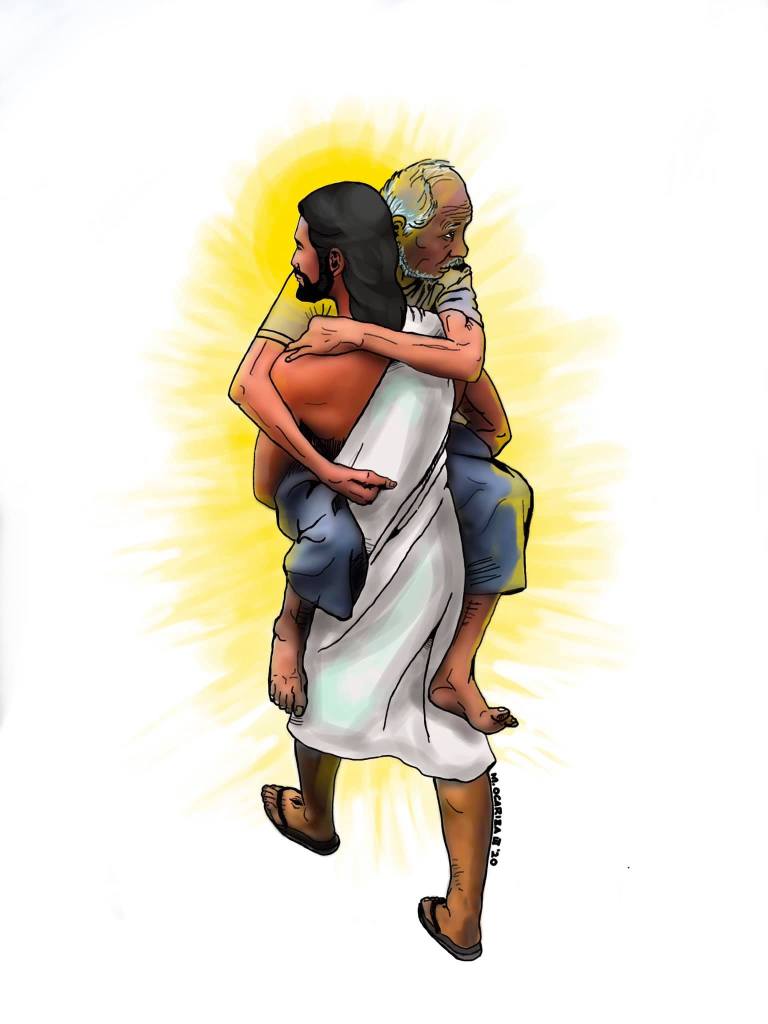
Life is a daily Lent, a coming home to the Father. As I have been telling you, the 40-days of Lent is a journey back home to God in Jesus Christ with each Sunday like a door leading us closer to Him. We rejoice this Fourth Sunday – Laetare Sunday – as we near God’s inner room, knowing Him more than ever as we experience His immense love and mercy for us like a Father welcoming his children to “enter” and celebrate home in Him.

But, are we really in the journey?

Or, are we just like the two selfish, self-centered brothers in the parable who took their father for granted by pursuing for their own very selves?

Tax collectors and sinners were all drawing near to listen to Jesus, but the Pharisees and scribes began to complain, saying, “This man welcomes sinners and eats with them.” So to them Jesus addressed this parable: “A man had two sons…”

Luke 15:1, 3, 11
Photo by author, Laetare Sunday 2019 in my former parish.

Acting like the sons…

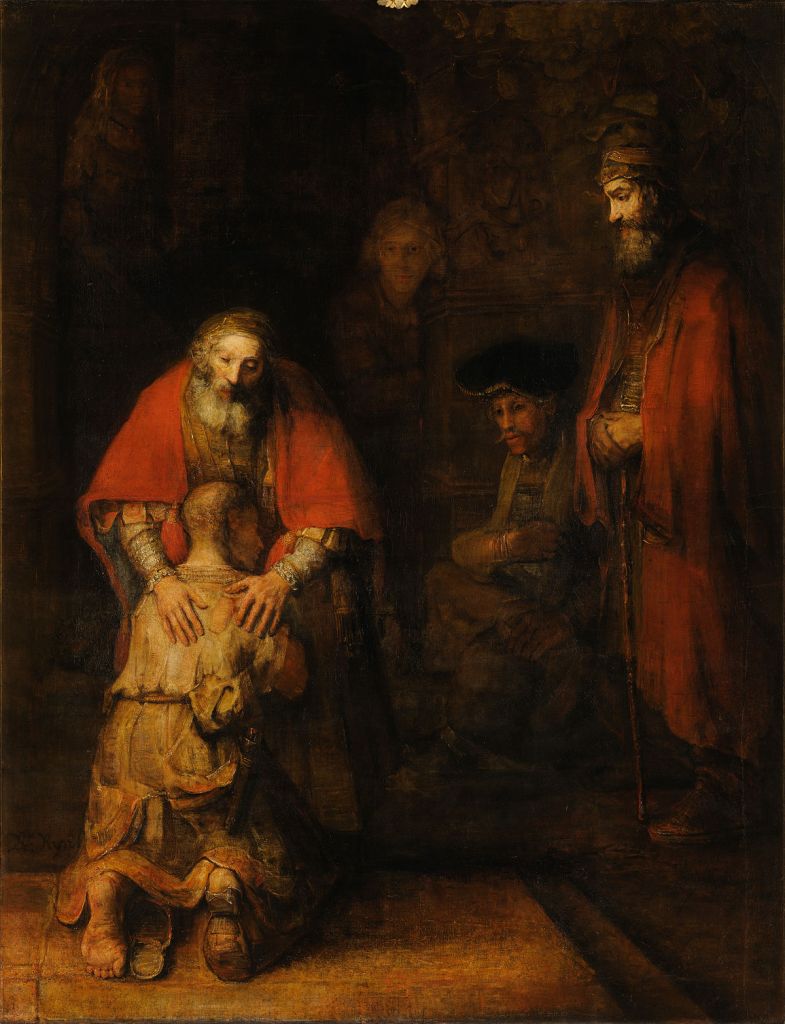
Once again, we hear another story from Luke that is uniquely his. It is more known as the parable of the prodigal son when in fact the center of the story is the loving and merciful father giving everything including his very self to his two sons.

There are two preceding parables before this third one, that of the lost sheep and of the lost coin that are in chapter 15 of Luke’s gospel. See how Jesus developed into a rising crescendo his series of parables starting with a lost sheep, a lost coin, and finally, lost sons. The common thread running through the three parables was the great joy of the shepherd, woman and father upon having their lost ones again. Clearly, God is the shepherd, the woman, and the father looking for the lost sheep, lost coin and lost sons. And here lies the very essence of the parables, especially in this third one about the loving and merciful father: “the Pharisees and scribes who began to complain why Jesus welcomes sinners and eats with them.”

We are those Pharisees and scribes who doubt and refuse to believe, even run away from our loving God in the belief there must be somebody else there who could love us truly by giving us what we need.

Photo by author, Laetare Sunday 2019 in my former parish.

Exactly like the younger son in the parable who sees God merely as a provider, an ATM or a Western Union counter who gives the cash we need to buy things we believe would complete us without realizing God is our life, our identity and root of being. This we find at what prompted the younger son to return home (return home, not come home which happens only when home is a person, not a place nor thing).

When he had freely spent everything, a severe famine struck that country, and he found himself in dire need. So he hired himself out to one of the local citizens who sent him to his farm to tend the swine. And he longed to eat his fill of the pods on which the swine fed, but nobody gave him any. Coming to his senses he thought, “How many of my father’s hired workers have more than enough food to eat, but here am I, dying from hunger. I shall get up and go to my father and I shall say to him, “Father, I have sinned against heaven and against you. I no longer deserve to be called your son; treat me as you would treat one of your hired workers.”

Luke 15:14-19

Sometimes we are like the younger son who returns home just to preserve one’s self – to have a roof and to have food so as not to starve, never go hungry. It is the first temptation of the devil, teasing Jesus and us to turn stones into bread because man lives to eat! That is why we keep on asserting our own power so we can do everything because we have forgotten our being-ness in God. We hate having nothing, being empty and would rather fill our bellies with whatever we can stuff our mouth with that in the process even swallow our pride and dignity to have, to possess everything, even everybody except God.

Photo by author, Laetare Sunday 2019.

On the other hand, we are like the Pharisees and scribes “complaining why Jesus welcomes sinners and eats with them” so personified by the elder son who refused to enter their house to join the celebrations at the return of his prodigal brother because his manipulative schemes have been unmasked. For him, serving his father was just a show because he was only an actor, everything was a movie or a teleserye playing one’s roles in exchange of a fee and fame.

He said to his father in reply, “Look all these years I served you and not once did I disobey your orders; yet you never gave me even a young goat to feast with my friends. But when your son returns who swallowed up your property with prostitutes, for him you slaughter the fattened calf.”

Luke 15:29-30

Again, we find here some semblance of the second and third temptations to Jesus and to us by the devil: worship him and you will be popular and powerful! We all want having the best for us to be the very best among our peers and neighbors. We are willing to buy time, even buy people just to be known and popular. We would not mind being patient over a long period of time believing in the end, we could end up having all.

When we think of our needs to be secured and safe, popular and powerful, the first that comes to our minds and consciousness are things that money can buy, food that fill stomach, and drinks that refresh the body. Like the two brothers, they were all concerned with material and physical, nothing spiritual nor emotional or even mental. A life without any depth like Alfie played by Michael Caine with music by Burt Bacharach asking, “What’s it all about, Alfie? Is it just for the moment we live?”

That’s the tragedy of our lives, of being like the Pharisees and scribes personified by the two brothers who were so lost in their own selves, refusing to see beyond to find others and God, now and eternity, earth and heaven.

Photo by author, view from the Old Jerusalem, May 2019.

…becoming like the Father

This is the grace of this fourth Sunday, its greatest joy and cause for celebration: our being home in God, being whole again in Him after realizing and accepting our broken and sinful selves.

Make no mistake that it was us who have found God; no, it is the other way around.

God is the Father always awaiting for us that He sent Jesus Christ to lead us home again in Him. In this parable, the late Fr. Henri Nouwen rightly said Jesus is the “prodigal son” who left heaven not out of rebellion but because of obedience and submission to lead us all back to the Father, the only One who loves us truly, our very “first love” for He is the one who loves us first and still loves us no matter what.

Stop seeking for the world’s basic staples of food and wealth, fame and power because the most basic truth in this life is we are loved by God who is love Himself because He is life. See Luke’s sense of humor: the prodigal son wanted only food and shelter but the father gave him back his status as son with the ring, fine clothes and slippers, and feast while the elder son was longing for a mere young goat without realizing it has long been his for everything the father has was his too! Like us in many occasions in life, we fail to see how much we already have in God that we turn away from Him to settle for lesser things.

See our foolishness in desiring the world when it has always been ours if we remain in God. That is why we need to celebrate because finally we have found what is truly basic and valuable, God who gave us his Son Jesus Christ so we can find our way back home to Him and learn what is most valuable in life.

In this parable, Jesus is asking us to “level up” our existence, to rise above our very selves and be who we really are as beloved children of the Father who is merciful and rich in kindness.

Like in the first reading, no more manna for we have entered the Promised Land where we can have real food and real drink – Jesus Christ who sustains us to eternal life. Let us keep in mind and heart Paul’s reminder and call in the second reading that “Whoever is in Christ is a new creation… so, let us be reconciled in God” (2 Cor. 5:17, 20). Only those who are reconciled in God in Jesus can experience true joy… so, stop complaining and whining of others getting close with God. Join us and celebrate! Amen.

Have a joyuful week ahead.

The Annunciation: the reality of God, the reality of our humanity

40 Shades of Lent by Fr. Nicanor F. Lalog II
Friday in the Solemnity of the Annunciation of the Lord, 25 March 2022
Isaiah 7:10-14, 8:10 ><}}}*> Hebrews 10:4-10 ><}}}*> Luke 1:26-38
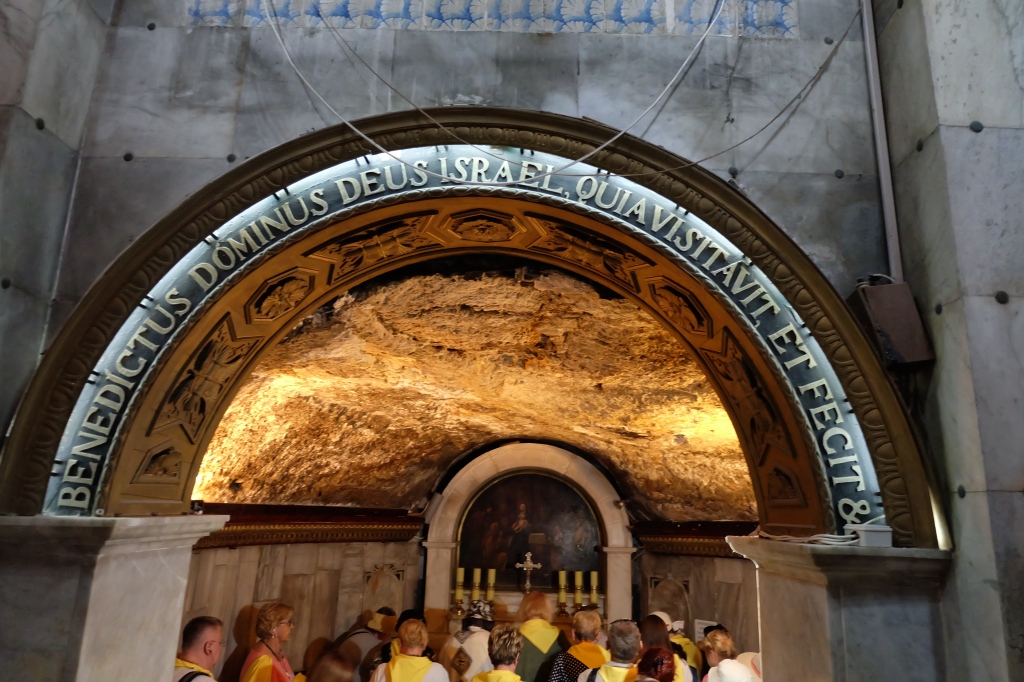
Photo by author, chapel beneath the Basilica of the Annunciation, Nazareth, Israel, May 2019.

Beneath the huge and magnificent Basilica of the Annunciation in Nazareth is a beautiful chapel where one may find a small cave converted into another little chapel with iron grills to keep off people from approaching the brightly lit altar believed to be the site where the Archangel Gabriel announced the good news of Christ’s birth to Mary.

At the base of the altar are the words, Verbum caro hic factum est, “The Word was made flesh here.”

Borrowed from John’s gospel who declared Verbum caro factum est – The Word was made flesh – the one who have thought of adding the demonstrative pronoun here to declare it as the site of the Annunciation – Verbum caro hic factum est – was definitely divinely inspired to remind us that the reality of God is something deeply ingrained in our own realities of here and now, in our very selves.

Photo by author, site of the Annunciation, May 2019.

The angel Gabriel was sent from God to a town of Galilee called Nazareth, to a virgin betrothed to a man named Joseph, of the house of David, and the virgin’s name was Mary. And coming to her, he said, “Hail, full of grace! The Lord is with you.”

Luke 1:26-28

Only Luke has this account of the Annunciation of the birth of Jesus to Mary. And true to his prologue to his gospel of “investigating everything accurately anew” about the life and teachings of Jesus, Luke tells us how the Annunciation happened with all the details like the five w’s in a news report, the who-what-where-when-why as we have heard proclaimed today.

This is very important because it tells us the factuality of the great spiritual reality that changed world history and the whole humanity when God became human, when eternity entered the temporal.

It is a beautiful presentation of this great event so profound and so touching that continues to happen within each one of us every day of our lives, of God coming to us, filling us with his grace because each of us is a beloved, a highly favored one chosen to be the indwelling of his Son, Jesus Christ like Mary.

This is the grace of this solemnity we celebrate nine months before Christmas, that God comes to us in our very humanity, always inviting us like Mary to receive Jesus, to be the vessel and instrument in fulfilling God’s great plans. We are like Mary in everything except in her being immaculately conceived – we are all poor and lowly, mostly a nobody in the society, but so loved by God!

Photo by author, flowers outside the Basilica of the Annunciation, Nazareth 2019.

God comes to us precisely where we are, in our every here and now even when we are most lowly and down, when we are deep in sin and despair, in trials and sufferings, in pains and in hurts because like Mary, even before the angel came, God had already silently started working on many things to save us.

There is always God’s perfect timing when we would meet the right people who would guide and help us.

There is always an Elizabeth that God would point us to as a signpost and proof of his reality, of his wonderful plan starting to uncover right in our very lives if we would stop like Mary to listen further to his words.

Speaking of Elizabeth, recall in Luke’s account that the angel mentioned her to Mary to allay her of her fears upon receiving the good news of Christ’s coming.

So often when God comes to us, fear naturally follows. In the Bible, it is described as “reverential fear” which comes upon an experience of the Holy; it is a feeling of being so small before the almighty God (mysterium fascinans) yet deep in this fear is a joy within about to burst because of the great honor and privilege of being loved and recognized by God. There is that normal feeling of doubts of whether we can do God’s mission or not as well as the feeling of checking the reality if it is really happening at all! Once we have verified we are not dreaming, that indeed we are called by God despite our smallness, that is when we suddenly remember our fellow mortals doing the work of God.

Then the angel said to her, “Do not be afraid, Mary, for you have found favor with God… And behold, Elizabeth, your relative, has also conceived a son in her old age and this is the sixth month for her who was called barren; for nothing will be impossible for God.” Mary said, “Behold I am the handmaid of the Lord. May it be done to me according to your word.” Then the angel departed from her.

Luke 1:36-38
Photo by author, Basilica of the Annunciation, Nazareth, 2019.

By this “will,” we have been consecrated through the offering of the body of Jesus Christ once for all.

Hebrews 10:10

Last week I underwent a surgery. It was my first time to be hospitalized and to go under the knife. Though it was a very simple procedure, I was nervous. Very nervous in fact although I tried to keep my sense of humor especially with my doctors and nurses.

The experience had taught me so many valuable lessons that I am still “masticating” them, trying to find words on how to express those learnings and realizations.

One of those is the discovery of my humanity, of my mortality. I feel I have become more human with that experience when I finally accepted my body, when slowly I have learned to look closely at my body parts I took for granted even so ashamed to look at, with all the blood and abscess and wounds.

Hindi pala puwede na hindi tayo magkakasakit, na mahina tayo, at walang perpekto sa atin na hindi kakailanganin ang tulong ng iba.

As I learned to accept my mortal body, slowly it dawned upon me how it is the true path to letting go and let God with my spiritual and emotional woundedness for it is in our humanity when God’s reality is most felt, most true. It is only when we are faced with the real threat of “harm” or being hurt, of possibly being extinct and gone from this earth when we realize what is to be afraid and finally entrust our total self to God for whatever will happen next.

That is the gift of the Incarnation of Jesus Christ that formally began in the annunciation of his birth to Mary. It is in accepting our very humanity and mortality when God truly comes, when we become one in him through Jesus Christ on the Cross. Amen.

Repenting, remaining in God present in us, with us in Christ

40 Shades of Lent by Fr. Nicanor F. Lalog II
Third Sunday in Lent-C, 20 March 2022
Exodus 3:1-8, 13-15 ><}}}*> 1 Corinthians 10:1-6, 10-12 ><}}}*> Luke 13:1-9
Photo by author, July 2020 in Bagbaguin, Santa Maria, Bulacan.

As I have told you at the start of this 40-day journey, Lent is like a coming home to God with Ash Wednesday until Saturday after as the porch and each Sunday a door leading us into the inner rooms closer to God.

At each door these past two Sundays, we were opened to God’s majesty and wonder, love and mercy in Jesus Christ who had come to help us triumph over many temptations in life, to be transformed and transfigured in him.

With Luke as our guide this year, he had opened to us each Sunday a very unique door to experience God’s majesty and mystery, his love and mercy offered in Jesus Christ.

This becomes most pronounced this Third and Fourth Sundays when we find his gospel stories as exclusively his alone: Christ’s call to repentance following the news of Pilate’s massacre of 18 Galileans during a temple worship and the parable of the Merciful Father more known as parable of the Prodigal Son.

Some people told Jesus about the Galileans whose blood Pilate had mingled with the blood of their sacrifices. Jesus said to them in reply, “Do you think that because these Galileans suffered in this way they were greater sinners than all other Galileans? By no means! But I tell you, if you do not repent, you will all perish as they did! Or those eighteen people who were killed when the tower at Siloam fell on them – do you think they were more guilty than everyone else who lived in Jerusalem? By no means! But I tell you, if you do not repent, you will all perish as they did!”

Luke 13:1-5
Photo by author, parish Via Crucis, 11 March 2022.

Our “blaming game”

At first hearing, our gospel today sounds like a news broadcast of brutalities and mishaps, trials and sufferings happening almost daily around the world. So many times, they happen closest to us personally or within our own circles of family and friends.

Only Luke has this account of teaching by Jesus; nowhere would you find in the gospels any account of Pilate ordering this massacre of Galileans but the Jewish historian Josephus had recorded many instances of the Roman governor’s ruthless reign.

And here we find the artistry of Luke in inserting this scene in his gospel the Church has chosen as part of our Lenten itinerary. So often in life, we keep on blaming somebody else except our very selves for every negative things happening to us and around us, even considering it as “divine chastisements” or karma to those people we consider as evil.

It is true that evil begets evil, but the seeming dominion of sin and evil in the world is so wide for us to attribute blame only to certain persons as if others, including ourselves, had no part in it. It always takes two to tango!

Worst case of this “blaming game” of ours is to even link our sufferings and trials with God.

Nothing bad can ever come from God like disasters and catastrophes, sickness and turmoils because God is love. God offers only life, never death nor destruction for he does only what is good. It is very wrong to think at all that God has something to do with any of these problems happening in the world like the pandemic or in our personal lives.

Photo by author, Sinai Mountain Range in Egypt, May 2019.

This is the gist of the Lord’s response to the people bringing him the bad news of the 18 Galileans ordered massacred by Pilate, “Do you think that because these Galileans suffered in this way they were greater sinners than all other Galileans? By no means!”. God does not punish at all! Bad things happen because of sins and that is what we always have to look inside us, how have we contributed to the evil happening.

And to make it clearer that God has nothing to do whatsoever with all these bad things happening to us, Jesus added, “Or those eighteen people who were killed when the tower at Siloam fell on them – do you think they were more guilty than everyone else who lived in Jerusalem? By no means!”.

However, Jesus is not telling us to be resigned to the absurdities of the world and of humankind. We can all do something to greatly prevent and reduce all these misfortunes and sufferings around us and that is the way of repentance, of conversion – the very calls of the prophets in the Old Testament and by John the Baptist.

Now, Jesus our Savior, the Son of God, is voicing out this call of repentance with urgency and new authority not only because it is the only way back to God but precisely due to his very nature of being loving and patient, merciful and forgiving.

The kind of God we have, the only one there is

The grace of this third Sunday of Lent is the revelation of the kind of God we have, the only one there is: a very loving and patient, merciful and forgiving God who is also perfectly present among us in Jesus Christ.

Photo by author, site of the burning bush in Sinai now inside St. Catherine’s Monastery in Egypt.

In the first reading, we are told of that unforgettable scene of Moses at the burning bush where God revealed himself as “I AM WHO AM” – the One who is always present with us in the past, in the future, and most especially in every here and now, the present moment.

When we think of God, what comes to our mind, what do we say about him?

God told Moses “Thus you say to the Israelites: The Lord, the God of your fathers, the God of Abraham, the God of Isaac, the God of Jacob, has sent me to you” (Ex. 3:15) to remind them that this God has always been present with his people.

With Abraham, God first made the promise of being the father of all nations (last Sunday’s first reading), to Isaac he revealed himself in the stairway to heaven, and to Jacob that he would bring them to Egypt and liberate them after. Now in Moses, everything is coming into fulfillment of this great nation to be set free by God, a prefiguration Christ and his saving mission.

Throughout history, God never left his people, working great marvels in the past to deliver them from slavery, a passing over and exodus, assuring us of his presence and salvation in the future by remaining at our side.

History is cyclic, everything seems to be happening again but with an upward trajectory towards God; in every repetition of history, the question is where are we standing with God, are we still the same the first time we encountered him, descending to vice and sins or have we grown in virtues and holiness?

Salvation history and secular history continue to unfold for both are one in God; hence, we must not waste every moment to return to God, to repent and be converted. Beware of Paul’s warning, “Therefore, whoever thinks he is standing secure should take care not to fall” (1 Cor. 10:12)! Remember those Galileans massacred by Pilate or those 18 people at Siloam crushed to death by tower that had fallen – anything can happen with us, so be ready. Never leave God who is always with us, assuring us with salvation in Jesus.

Beginning this Sunday, continuing to next week with the parable of the prodigal son and finally on the fifth Sunday of Lent when we skip Luke’s gospel to borrow from John for the story of the woman caught in adultery, we are being immersed into the deeper mystery of this God we call Father made known to us by Jesus Christ through his own passion, death and resurrection.

The more we enter God’s mystery every Sunday of Lent, the more his “height, breath and depth” (Eph. 3:18) appear to us, making us realize he is real, very true like another person we can feel and hear, always with us, patiently waiting for us to bear fruit like the owner of the fig tree in the parable.

How have you experienced God’s presence this past week?

What else do we need to be convinced of his love and mercy that we still refuse to repent and be converted in Jesus Christ?

The time is now, not yesterday or tomorrow for God is I AM WHO AM, one who is in the present. Amen. Have a blessed week.

Thank you for the prayers; I am home trying to recuperate from my surgery.

Photo by author, inside St. Catherine Monastery with Mt. Sinai at the background in Egypt, May 2019.

Lent – when “staying” and “going” merge in Christ

40 Shades of Lent by Fr. Nicanor F. Lalog II
Second Sunday in Lent-C, 13 March 2022
Genesisn15:5-2, 17-18 ><}}}*> Philippinas 3:17-4:1 ><}}}*> Luke 9:28-36
Spring blooming of poppies in Galilee near the Nazareth, against the background biblical Mount Tabor, Israel, from iStockphoto.com.

From the desert where Jesus was tempted by the devil last Sunday, Luke now takes us on top of Mount Tabor for the Lord’s Transfiguration.

In the Bible, the mountain is like the desert that signifies a deeper reality and meaning. It is more than a place that shows communion and oneness with God, indicating an inner ascent within us to unite with God especially in this season of Lent.

And like in the temptation of Jesus in the desert last Sunday, it is very interesting how Luke tells us again two important details not mentioned by Mark and Matthew in their versions of the Lord’s Transfiguration:

Jesus took Peter, John, and James and went up the mountain to pray. While he was praying his face changed in appearance and his clothing became dazzling white. And behold, two men were conversing with him, Moses and Elijah, who appeared in glory and spoke of his exodus that he was going to accomplish in Jerusalem.

Luke 9:28-31

First, only Luke tells us the reason why Jesus went up the mountain which is to pray. Here we find that the transfiguration of Jesus is a prayer event. That is why we need to pray always because prayer transfigures us like Jesus Christ.

Second, as Jesus transfigured while praying, only Luke informs us the topic Moses and Elijah discussed with the Lord which is his coming “exodus” or passion, death, and resurrection on Good Friday. When we pray, the more we accept and embrace the Cross that truly transfigures us into becoming like Jesus Christ.

But the problem is, we always refuse and avoid prayer because it is always difficult to pray. Prayer is a discipline. Despite its being a grace from God to be able to pray which he freely gives to each one of us, it is gift that also requires from us total surrender and consistency.

Prayer does not necessarily change things like stop calamities or sickness; prayer primarily changes the person, enabling us to respond properly to problems, trials and sufferings that come to us; hence, prayer in itself is an exodus, a pasch that leads us to transfiguration.

Usually, when we pray we feel nothing is happening, that it is a “waste” of time, of being “idle” in one place that could have been used to other productive activities like fixing one’s problems. But it is in prayer when we first experience how “staying” and “going” merge to become one in Jesus Christ.

This we find in the only detail that Luke shared with Matthew and Mark when Peter woke up and saw Jesus transfigured, conversing with Moses and Elijah.

As they were about to part from him, Peter said to Jesus, “Master, it is good that we are here; let us make three tents, one for you, one for Moses, and one for Elijah.” But he did not know what he was saying.

Luke 9:33
Photo from commons.wikimedia.org, mosaic inside the Basilica of the Transfiguration on Mt. Tabor, Israel.

The Transfiguration, a preview of Christ’s glory via his pasch

Very often in life, we want every beautiful and good experience we have to be preserved, wishing they would never end, like Peter asking Jesus if they could just stay on top of the mountain to keep their “cloud nine” experience.

On the other hand, we are quick to beg Jesus to end soonest every pain and suffering, trials and difficulties we are going through in life that if possible, have them erased or deleted from our memories too!

For us, “staying” and “going” are opposites but Jesus is telling us in his transfiguration that these two come together.

In his transfiguration, Jesus is telling us that discipleship is both “staying” and “going” in him. It is only in Christ that we can “keep” the good time of being one with him while we “passover” from life’s many darkness, trials and sufferings by remaining one with him.

After assuring us last Sunday that we can overcome life’s many temptations through him, Jesus tells us today that our transfiguration and glory can only come through the Cross like him. Before Easter comes, there is Good Friday first.

At his transfiguration, Jesus showed us that his divinity belongs with the Cross and cannot be separated because that is his identity as the Suffering Messiah whose glory and pasch are always together. Hence, his transfiguration was the “preview” to his coming glory whereby he remained one in the Father in prayer expressed perfectly in his exodus on Good Friday which Moses and Elijah discussed with him on Mount Tabor.

Recall that his transfiguration occurred after he was recognized by Peter as the Christ while they were at Caesarea Philippi where Jesus also bared for the first time to the Twelve his coming passion, death and resurrection. It was also at that time when Jesus laid to the Twelve the very foundations of discipleship in him which is to forget one’s self, take up one’s cross daily, and follow him.

From Caesarea in Philippi, Jesus and the Twelve made a U-turn to go back to Jerusalem with a stop-over at Mount Tabor for his transfiguration where he reiterated his teachings about himself and his mission. See that during the transfiguration as Peter, James, and John watched in awe, they were frightened when a voice was heard from the cloud that declared “this is my chosen one; listen to him” (v.35).

And what do we hear from Jesus after his transfiguration? His two other predictions of his coming passion, death and resurrection plus his repeated calls to everyone to deny one’s self, to take up one’s cross daily and to come follow him!

It is interesting to note that while the fourth gospel does not have this story of the transfiguration, John rightly refers to the Crucifixion as the “exaltation” of Jesus Christ – his going down, his suffering and dying on the Cross is actually his rising to glory!

The same thing is true to us disciples of Jesus.

Photo from custodia.org, Basilica of the Transfiguration on Mt. Tabor, Israel.

Staying and going in Christ, with Christ

The grace of this second Sunday in Lent when we hear every year the story of Christ’s transfiguration is his assurance of his love for us by going through his exodus which is his self-offering on the Cross.

The question is not whether we should stay or go but are we willing to both stay and go in Jesus, with Jesus? Discipleship is remaining in Jesus, going with Jesus up to the Cross!

According to Luke, Peter, James, and John did not tell to anyone what they saw and heard on Mount Tabor. Like Mary, they kept everything in their hearts as they remained with Jesus, going with him in all his journeys especially at the Garden of Gethsemane before he was arrested, listening to his words and teachings, witnessing and experiencing his many healings and exorcisms including his passion and death from afar except for John.

They never fully understood everything they saw and heard from Jesus until the coming of the Holy Spirit on Pentecost day but, their “staying” and “going” with him transfigured them without realizing how the Lord was already transforming them inside.

The same thing happens to us when we “stay” and “remain” in Jesus through prayers and reflections of the Sacred Scriptures, through the Sacraments especially the Holy Eucharist every Sunday, through the guidance of other faithful disciples like our family and friends who witness Christ to us with their living examples. Akala natin wala namang nangyayari pero mayroon palagi dahil kasama natin ang Panginoon!

As we stay in the glorious presence of Jesus in prayers and penance, the more we go forward in our dying to self and rising to life in our loving service to everyone, in our kindness, in our patience and understanding, and in our mercy and forgiveness. When we offer ourselves wholly to Jesus, he does everything like what God did to the animals offered by Abraham in the first reading. Notice how Abraham on that night fell into a trance as if he could not believe what was happening while in the presence of the Lord. Palagi naman ganoon sa harap ng Diyos – nakakapangilabot, nakakatakot kasi totoong-totoo!

Lent is not just a preparation for Easter but also a journey for us all to purify and renew and rekindle our faith in Christ’s resurrection by remaining in him, ascending with him through mountains of sacrifices, and being tested in the desert of temptations.

These 40 days of Lent involve many stopovers where we are invited to examine our hearts, our inner selves to see who is inside us, of who are we dwelling with, of who we are going with. Let us heed Paul’s call in the second reading to “stand firm in the Lord” (Phil. 4:1) because our “citizenship is in heaven and Jesus will change our lowly body to conform with his glorified body” (Phil. 3:20, 21).

Let me end this reflection with a quote I got and memorized as a child waiting in our former family dentist, Dr. Eddie Calalec of Meycauayan, Bulacan:

Time is fast for those who rush;
Time is slow for those who waith;
Time is not for those who Love.

Have a blessed week and please say a prayer for me on Wednesday (March 16) when I go through a surgery. Thank you and God bless you!

Lent: a return to our first love

40 Shades of Lent by Fr. Nicanor F. Lalog II
First Sunday of Lent-C, 06 March 2022
Deuteronomy 26:4-10 ><}}}*> Romans 10:8-13 ><}}}*> Luke 4:1-13
Photo by author, view of Israel from Mount Nebo in Jordan, May 2019.

Pope Emeritus Benedict XVI used to say that the imagery of the desert during the season of Lent is an invitation for us to remember, to revisit and to return to our very “first love” of all – God.

Yes! God is our first love for he is the first to love us, always calling us to come to him to have more of his love. Pope Benedict wrote in his first encyclical in 2005, Deus Caritas Est, that “Love can be commanded (by God) because it has first been given by him”, and that “love grows through love”.

And that is why every first Sunday of Lent, we hear the story of the temptation of Jesus by the devil in the desert as he invites us to go back to our first love, God our Father, teaching us and giving us the grace to overcome temptations that have brought us apart from God and everyone.

Filled with the Holy Spirit, Jesus returned from the Jordan and was led by the Spirit into the desert for forty days, to be tempted by the devil. He ate nothing during those days, and when they were over he was hungry.

Luke 4:1-2
Photo by author, view of Israel from Mount Nebo in Jordan, May 2019.

Let your love flow.

Of the three evangelists who recorded the temptation of Jesus in the desert by the devil, only Luke gives us a more detailed and sober version that you could feel Christ’s docility to the Holy Spirit; Matthew and Mark were both abrupt, as if Jesus was hurriedly led by the Spirit into the desert after his baptism at Jordan.

Luke’s version gives us a sense of peace and tranquility in Jesus who obeyed the Holy Spirit spontaneously which he would always do throughout his ministry; this his disciples would imitate as we shall see in Luke’s second book, the Acts of the Apostles.

This short introduction by Luke to the temptation of the Lord in the desert teaches us the first step in every Lent and ultimately in life: our docility to the Holy Spirit like Jesus Christ.

Photo by author, Mount Nebo, Jordan, May 2019.

And there lies the problem with us as we refuse to love God, when we refuse to mature in love as we keep on looking even inventing our own loves that in the end leaves us empty and alienated.

In this age of too much gadgets and instants plus emphasis on freedom and independence, we have forgotten to be docile and submissive in the good sense as we keep on asserting our very selves, always trying to be in command of everything.

Experience tells us that the key to truly experiencing love – to love and be loved – is to let yourself be led by your beloved, by a loved one. To simply let your love flow.

The three pillars of Lent: prayer, fasting and alms-giving rest on our willingness to submit ourselves to God, to trust him and rely only in him.

To be filled with the Spirit is to be filled with love that we first search God to love him and have more of his love to share with others.

The three “faces” of power that ruin love

Too often, we resist God by subduing our inner call to love, preferring to control everything and everyone. We prefer power than love, thinking wrongly that we can force or impose love on others.

Remember the movie “Bruce Almighty” about 20 years ago?

The turning point of the movie happened when Jennifer Aniston left her boyfriend Jim Carrey who could not submit himself and follow his heart to propose to her; Jim could not understand why can’t just God played by Morgan Freeman impose love on his girlfriend Jennifer to save him all the efforts and time in proving his love and proposing to her. Freeman as God simply told Bruce he cannot force love because that’s the way it is, so free that is why love is so wonderful!

Love and power cannot go together. Love is ruined when power and control come in any relationship. Adam and Eve desired the powers of God that led them into sin and be banished from Paradise.

This we see in the three temptations of Jesus Christ by the devil which is centered on power; notice how Jesus resisted temptation by choosing the path of love of God which is the path of powerlessness.

Photo from commons.wikipedia.org, Basilica di San Marco, Venice, Italy.

The devil said to him, “If you are the Son of God, command this stone to become bread.” Jesus answered him, “It is written, One does not live by bread alone.”

Luke 4:3-4

The first temptation of power is the ability to do everything. Every suitor is guilty of this when he tries to do everything just to win the heart of the woman of his dreams which often ends sadly, even miserably or tragic.

Too often, we feel and believe that it is love when we try to do everything just for the beloved.

No! We are not God. We cannot do everything. Love is not about doing but being.

Jesus could have turned that stone into bread but he did not do it because it is not the proof of his being the Son of God. His docility to the Father, his fidelity to his words and will expressed by his self-sacrifice at the Cross proved that he is indeed the Christ.

At the same time, his love for people is not in doing everything, especially in giving us the quick-fixes to our many problems and sufferings. In the wilderness, Jesus fed more than 5000 people from just five loaves of bread and two pieces of fish after he had found the people ready to love, ready to accept him and one anther.

The problem with power to do everything is we cease from becoming a person who “feels” and experiences pain and hunger, sadness and failures that eventually make us stronger and deeper in love and convictions. When we keep on doing everything believing in our powers, then we get burned in the process, becoming resentful and bitter later after skipping the normal courses of life.

We are loved not by what we can do nor achieve but what we could become – a nicer, kinder, forgiving and understanding and loving person.


Then he took him up and showed him all the kingdoms of the world in a single instant. The devil said to him, “I shall give to you all this power and their glory; for it has been handed over to me, and I may give it to whomever I wish. All this will be yours, if you worship me.” Jesus said to him in reply, “It is written: You shall worship the Lord, your God, and him alone shall you serve.”

Luke 4: 5-8

The second temptation of power is to dominate others. If you cannot do everything, subjugate others who can do things for you. Entice them with everything and whatever you have; buy their souls like our politicians who shamelessly forget history and values of freedom and democracy for the sake of winning an office.

Photo by author, 2019.

Love begets love. Jesus had no need to be popular, to be viral and liked by everyone. He loves us so much and the love he offers us is a love that is willing to die in one’s self, a love that goes for the Cross because that is true love. Never convenient nor comforting. Love is always difficult because it is a decision we keep and stand for every day.

This is the gist of the first reading when Moses reminded the people to always remember and review their history to be aware of how God had never left them, loving them despite their sinfulness. Remembering keeps our love alive because it always reminds us of the persons behind every events in our lives, keeping us united to the person in love even up to the present moment. Recall those time you have “lover’s quarrel” or LQ: what is usually the first thing that comes to your mind? Is it not your love story, of how you met and dreamt together, of how you love each other?

Love is about persons, not about things like wealth and fame. The Beatles said it so well in the 60’s, All You Need is Love.


Then he led him to Jerusalem, made him stand on the parapet of the temple, and said to him, “If you are the Son of God, throw yourself down from here, for it is written: He will command his angels concerning you, to guard you, and : With their hands they will support you, lest you dash your foot against a stone.” Jesus said to him in reply, “It also says, You shall not put the Lord, your God, to the test.”

Luke 4:9-12

The third temptation of power is to manipulate, even God, the all-powerful. This is the most insidious temptation that hides its sinister plans in a lot of “loving” and “caring” facades of fakeries.

It is the worst of the three as it enters one’s psyche, the highest degree of brainwashing. See how the devil had chosen the site of the temple, citing the scriptures in tempting the Lord.

The devil does the same with us, especially those toxic people who would try to massage our egos, trying to win us over unto them only to manipulate us and when worst comes to worst, play victims to us.

Love is never manipulative; the more you love, the more you become free to be your true self, your better self. Love is always a desire to become like the one you love, a movement to becoming like the beloved, not imposing one’s self to another. Love is always an invitation to journey, to be a companion, to come and follow without hidden agendas and plans.

Love is self-emptying, of giving, of baring one’s self to another to share life, never to take advantage or pull-off a big gain or profit from another. That is why St. Paul reminds us in the second reading that God is never far from us for his word is “near you, in your mouth and in your heart” (Rom.10:8).

The grace of this First Sunday of Lent is Jesus taking the first step by coming to us out of his great love for us so that we can begin the journey back to the Father, our first love, helping us overcome the many temptations not to love. May we follow his path of powerlessness, of docility to the Holy Spirit to truly experience God’s abounding love for us. Amen.

A blessed week ahead to everyone.

Photo by Ms. Jo Villafuerte, 21 February 2022.

Ash Wednesday: rising from the ruins of life

40 Shades of Lent by Fr. Nicanor F. Lalog II
Ash Wednesday, 02 March 2022
Joel 2:12-18 ><}}}}*> 2 Corinthians 5:20-6:2 ><}}}}*> Matthew 6:1-6, 16-18
Image from Google.

For the third straight year, we enter the Season of Lent in the most unusual conditions in the world. Perhaps, even surreal. We had in 2020 the start of the COVID-19 pandemic persisting through 2021 up to the present that has altered the way we live and how we look at life.

Just when we felt like “Easter” coming in 2021, there came the stronger Delta variant at around this time that claimed so many lives among us.

Now in 2022 after we have all the vaccines available to put COVID-19 in control with a “tamer” variant Omicron, we have a more serious concern with Russia invading Ukraine.

To a certain degree, it is “good” this had happened at this time when we are starting the Lenten Season with Ash Wednesday that reminds us the question we should be asking is not “where is God” but “where are we, his people”?

It has always been the same question ever since – of “where are we in relation to God” every time there are man-made and natural disasters like wars and famine, epidemics and plagues, or earthquakes, drought and floods.

It is easier to blame God for all of our troubles because he is always silent, never answering us back; but, it is in his silence when we also realize the truth that we are the ones who have drifted apart from God, who have gone lost away from him who is always looking for us, waiting for us to come back.

It is in the silence of God that he is most present especially when we are deep in sin and sufferings.

Even now, says the Lord, return to me with your whole heart, with fasting, and weeping, and mourning; rend your hearts, not your garments, and return to the Lord, your God. For gracious and merciful is he, slow to anger, rich in kindness, and relenting in punishment. Why should they say among the peoples, “Where is their God?” Then the Lord was stirred to concern for his land and took pity on his people.

Joel 2:12-13, 17b-18
From istockphoto.com by Getty Images.

Lent: A coming home to God for us mortals, sinners, and ruined

Lent is a “coming home” to God with Ash Wednesday serving like a porch that leads us inside the “house of God” with each of its five Sundays acting like a door opening us closer and closer into the innermost room where God is.

In the shadows of the war in Ukraine, the COVID-19 pandemic and the heated national elections in our country, let us focus on the practice of giving of ashes every Ash Wednesday which is a gesture often mentioned in the Bible.


Ashes remind us first of all, of our mortality, that we shall all die one day. This is the reason why we priests say “Remember that you are dust and to dust you shall return” (Gen.2:7) while imposing ashes on your foreheads in the form of a cross.

And there lies the good news too of Ash Wednesday: we do not just die, rot and return to ash because at the end of time, we shall all rise again to become whole – body and soul – like Jesus Christ!

From ravenscov.org.

Though we are marked for death, Ash Wednesday reassures us of our resurrection and salvation in Christ signified by the ash in the form of a cross on our foreheads.

Ashes signal our readiness for repentance as expressed in the new formula in the imposition of ashes, “Turn from sin and believe in the Gospel”.

Recall how in the Book of Jonah when the king of Nineveh removed his royal robe, covered himself in sackcloth, and sat in ashes upon hearing Jonah’s preaching as he ordered too his people to do the same that averted the wrath of God.

In the gospels of Matthew and Luke, we find how Jesus lambasted the people of Chorazin and Bethsaida for not repenting upon seeing his mighty deeds, so unlike the pagans at Tyre and Sidon who would have “repented long ago in sackcloth and ashes” (Mt. 11:21 & Lk.10:13).

Ashes also signify ruin, destruction and devastation in life like Job who had lost all precious to him when he said, “(God) He has cast me into the mire; I am leveled with the dust and ashes” (Job 30:19).

It is the most applicable signification of ashes to us today in this time of prolonged pandemic with its deep emotional and psychological impact on everyone trying to grapple with life’s many challenges as we try to start anew almost daily.

The feeling is best described by the Book of Lamentations in the aftermath of the destruction of Jerusalem: “Those accustomed to dainty food perish in the streets; those brought up in purple now cling to the ash heaps” (Lam. 4:5).

Indeed, that ash on our foreheads reminds us of the ruin we are into as an individual, as a nation, as citizens of the world.

How often did we have to shelve and postpone our many plans in life since 2020 due to this pandemic with its recurring surges now worsened by this war at Ukraine launched by Russian president Putin?

We were already sighing in great relief the past weeks with declining cases of COVID when suddenly – to our great disbelief and dismay that this can still happen in the 21st century when Putin invaded Ukraine, casting the world into another grave danger of unimagined proportion.

And lastly, who does not feel ruined after all these years of the pandemic worsened by decadent politics that has gone into an abyss of filth and insanity?

Now more than ever we could feel and experience the “ash heap” we are into with only God who can raise us up and cleanse us again.

Photo by Ms. Jo Villafuerte, 21 February 2022.

Lent is a joyful season!

Contrary to what most people believe, Lent is not all that drab and dry. While its prevailing mood is of sobriety and seriousness in the light of its call for penance, fasting and almsgiving, Lent is a joyful season preparing us to Easter.

St. Paul tells us in the second reading that “now is the day of salvation”:

Brothers and sisters: We are ambassadors for Christ, as if God were appealing through us. We implore you on behalf of Christ, be reconciled to God. Behold, now is the acceptable time; behold, now is the day of salvation.

2 Corinthians 5:20, 6:2

To be reconciled with God who is “gracious and merciful, slow to anger, rich in kindness, and relenting in punishment” begins right inside our hearts when we open it – rend – so it may be cleansed of sins for Jesus to dwell inside again.

Like our reflection last Sunday, it is the truth of the heart that must be expressed on this Ash Wednesday, that must be cleansed and “repaired” after so many beatings and ruins especially these past years (https://lordmychef.com/2022/02/26/taking-jesus-to-the-heart/).

It is the heart that must be strengthened and converted by our lenten practices because its purity is revealed by our very lives, the kind of life we lead, the aura we project even if half of our face is covered by the face mask.

This is the very essence of the Lord’s calls in the gospel to do these practices “in secret”, not be seen by others that it becomes more of a show. It is God whom we must please, not the people; to enter into one’s room is to enter into one’s self to meet God with our true selves, without our usual alibis, of ifs and buts.

From Google.

This is the grace of Lent that begins on this Ash Wednesday: it is God who actually comes to us, to meet us, to work in us in his “mercy and graciousness” so we may experience his loving presence again despite all our sins and troubles.

Life is a daily Lent, a cleansing of our hearts, a repairing of our hearts ruined especially when we have truly loved and ended up being misunderstood and persecuted.

Do not worry, human love is always imperfect; only God can love us perfectly. That is what Ash Wednesday is reminding us, that we are finite and sinful, ruined most of the time but always open to God who never leaves nor forsakes us his children.

In this spirit, let us also not forget that Lent is a journey we take with others, a daily exodus from darkness to light, from sickness to healing, from ruins to newness, from sin to forgiveness and grace.

Photo by author, Lent 2019.

We come home to God together as a people, as a family, as brothers and sisters in Christ.

May our gathering together on this Ash Wednesday be an occasion to free ourselves from the ever-growing threats of individualism that has marked our age with everyone feeling a celebrity, even playing God.

Please don’t forget to practice fasting and abstinence today to create a space for God and for others in your heart.

Have a blessed and safe Lenten season, everyone!
Taking Jesus to the heart

The Lord Is My Chef Sunday Recipe for the Soul by Fr. Nicanor F. Lalog II
Sunday Week VIII-C in Ordinary Time, 27 February 2022
Sirach 27:4-7 ><}}}}*> 1 Corinthians 15:54-58 ><}}}}*> Luke 6:39-45
Photo by author, 2016.

We enter the Season of Lent this week with Ash Wednesday as the Ordinary Time takes on a long break until June; hence, our gospel this Sunday is a fitting cap to the teachings of Jesus these past three weeks about discipleship.

After expounding on the need to love like God full of mercy even to enemies, Jesus now speaks in parables citing ordinary experiences in life to underscore “wholeness” in one’s self that is rooted in one’s heart where speech and being go together.

True discipleship in Christ is taking into heart his words by putting them into practice – of walking the talk – to bear fruits in our lives of holiness.

Jesus told his disciples a parable: “Can a blind person guide a blind person? Will not both fall into a pit? A good person out of the store of goodness in his heart produces good, but an evil person out of a store of evil produces evil; for from the fullness of the heart the mouth speaks.”

Luke 6:39, 45
Photo from news.abs-cbn.com, 2020.

Our heart, our center of being

People often make various gestures of the heart to convey the message of love especially when posing for pictures. But of all these gestures, nothing beats those two hands shaped like ears and put together to look like a heart.

It is the best sign of the heart, of two ear lobes joined together because a loving heart is one that listens, never judges just like what Jesus taught us last Sunday.

Most of all, one’s heart is always known by its words and actions wherein the actions speak louder than words! In this symbolism, we find the inner dynamics of speech and being perfectly together.

See in the three parables of Jesus in today’s continuation of his sermon on the plains, we find this primacy of listening to his words and putting them into practice: guides cannot guide others unless they have clear eyesight; the hypocrisy of seeing other’s faults unmindful of one’s own faults; and, how every tree is known by its fruit.

Jesus is calling us today to an “education of the heart” so that we may have open ears, open hearts, open minds, and open arms to be truly his disciples!

It is with the heart that one must listen to the Word to produce good and plentiful fruit, it is in the heart where every disciple of the Lord must meditate and treasure his Word like his Blessed Mother Mary “who kept all these things, reflecting on them in her heart” (Lk.2:19).

When the heart is cleansed of its impurities, it opens to God and to others, gets filled with the Holy Spirit to become like the Father who is merciful and loving as revealed by Jesus Christ.

Recall how in Genesis God created everything by simply speaking because his speech and being are one. In the prologue of the fourth gospel, we find how the Logos – the Word who is Jesus Christ became flesh to save us and make us experience God himself which he fully expressed while proclaiming the Book of Isaiah in the synagogue at Nazareth while launching his ministry (Third Sunday, 23 January 2022).

This Sunday we find everything coming to full circle, showing us the whole picture of Jesus and his mission, of his plans for us to be like the Father.

And here lies our problem so often when our words betray our true character, when our speech and being do not match, when what we say is far from what we live.

Image from Google.

Our sharing in the power of God to love

Of all that God has created, only humans were gifted with the ability to communicate intelligibly. Unlike the animals and other creatures, only us humans can speak to express what we feel, what we know, what we want.

Our ability to communicate is in fact a sharing in the power of God, a power to serve in love like Jesus, not power to dominate or lord it over upon others as the world sees and uses it.

This is why Ben Sirach reminds us in the first reading to hold our praises of any person, especially the eloquent speakers because words are empty unless supported by actions. One’s real worth is found in times of trials and tests like “what the potter molds in the furnace” (Sir. 27:5).

It is Jesus Christ himself, his very words who purify us his disciples to be able to preach his good news of salvation to others in words and in deeds without any duplicity and hypocrisy.

Photo by Ms. Jo Villafuerte, 21 February 2022.

The Lord is not asking us to stop criticizing nor be silent in the midst of so many injustices and evil around us. That remains an integral part of preaching the good news, of standing for what is true and just; however, Jesus is demanding us his disciples to always examine our very selves to see the kind of deeds that arise from our hearts.

Our actions, our very lives reveal the purity of our hearts, of our intentions and of our sentiments.

This is the reason why we priests and bishops are always doubted and even questioned by so many faithful whenever we denounce the many ills in the society, when we speak against social injustices, against corruption in government because our lives do not match our words. The worst and most painful part of it is when people see our “double-standard” with priests who lead lives so far from the Good Shepherd, that instead of taking care of the flock, there are some of us who take advantage of the poor sheep entrusted to us!

Today’s gospel challenges us, especially us your priests, if we lead a truly Christian life with preferential options for the poor?

Let us not be contented with outside appearances only, especially this coming Lenten Season. Take Jesus and his words into our hearts.

Discipleship is not about frequenting the church, reciting all the prayers, observing all the rites and rituals and devotions nor just denouncing the wrongs in the society nor fund-raising for so many projects for the benefit of the poor.

Discipleship is bringing to fruition all our prayers and faith expressions to loving service for one another. If not, we might just stay home so as to minimize the damages and hurts to the Body of Christ.

Let us continue to strive in purifying our hearts with the Word so that we may bear much fruits of good works in our lives, to “be firm, steadfast, always fully devoted to the work of the Lord, knowing that in the Lord your labor is not in vain” (1 Cor. 15:58). Amen.

Have a blessed week ahead!

Photo by Ms. Jo Villafuerte, 21 February 2022.

Faithful, and most loving!

Quiet Storm by Fr. Nicanor F. Lalog II
A Wedding Homily for Cristopher T. San Pedro & Fatima Macam
National Shrine of St. Jude, Manila, 22 February 2022
Photo by Ms. Jo Villafuerte, 21 February 2022.

You must have heard the saying that “God writes straight crooked lines”. And today that proves so true not only with how God wrote so crooked his straight lines in your life, Cris and Tim, but even wrote in circles to make this date your wedding day – 22 February 2022!

Cris and Tim, God has always been so sure in calling you before his altar on this date, which will similarly happen again in 200 years – 22 February 2222!

God writes straight crooked lines because everything in him is perfect, like numbers. Precise and exact.

Like this date you never chose, 02-22-2022.

When you consulted me last month when priests here offered you this date due to their recent lockdown, right away I told you it is the most wonderful date for your wedding being the Feast of St. Peter’s Chair… St. Peter as in San Pedro like Cristopher Tabafunda San Pedro and later, Mrs. Fatima Macam San Pedro!

It was God who willed in all eternity that you, Cris and Tim, be married today — not last year, not the other week nor next week because today is the day that the Lord has made!

From Facebook of couple.

You are both good with numbers like God, a mathematician who is very precise and exact like an economist and stock trader (Cris) and a marketing and sales executive (Tim) who used to do a lot of chemical research before.

But God has better and deeper plans for you that numbers cannot count nor quantify.

God wants you to always go back to basic numbers, not to those found in equations only you two can understand or multiple digits only you can count.

Jesus said it so well in the gospel today: two is equal to one, just like 1 + 1 + 1 = 1 of the Trinity.

“For this reason a man shall leave his father and mother and be joined to his wife, and the two shall become one flesh? So they are no longer two, but one flesh. Therefore, what God has joined together, no human being must separate.”

Matthew 19:5-6

Life is not about having the most but the least. That is where faith grows and deepens.

Photo by Ms. Jo Villafuerte, 21 February 2022.

When we have so much in life, when we feel so sufficient, when we are so filled with things, we forget God. We stop believing in him, we believe more in ourselves.

And when we stop believing in God, we lose our faith and then, we stop loving, too. Sooner or later, we become empty and miserable.

So, be simple, Cris and Tim.

Reduce everything to the barest and simplest. Simplify, simplify, simplify as Henry David Thoreau said: “let your affairs be two or three, and not a hundred or a thousand.”

When we get complicated like our Facebook, life becomes difficult as we can’t find right away who and what matters most to us.

Kaya nga isa lang ang asawa, Cris at Tim, kasi hindi puwede marami. Hindi lang magulo. Magastos pa. Imagine kung dalawa o tatlo wedding rings? Pag isa lang, kita agad at alam na this – married na ang mamang ito na may cute na dimple o itong girl na ito na naka glasses at dalawa pa ang dimples! Hayaan ninyo sabihin ng mga makakita singsing ninyo na sayang at taken na pala siya!

You see, the lower the number, the simpler, the better. Madaling tumaya at manampalataya.

That’s faith. Parang PBA game kung saan kayo nagkakilala. And you have both experienced, walang tatalo sa faith in God ninyong dalawa!

Photo by Ms. Jo Villafuerte, 21 February 2022.

God is greater and more than the numbers the wizkids and supercomputers of the world can calculate and predict. His thoughts are not our thoughts, nor his ways. He first created just one man and one woman – just two – to be one with each other in him, and to be faithful to him and each other.

Because the more we become faithful, the more we become loving.

That is the message of this Feast of the Chair of St. Peter which is the “Primacy of Rome” or of the Pope: it is the primacy of faith and the primacy of love together which cannot be separated.

Forget all those numbers Cris and Tim, focus only in the One – God in Jesus Christ. Just focus on Jesus, always Jesus.

Love is not about counting or keeping tabs and tallies, like how many “likes” and “followers” we get in our posts.

The true measure of love is when we love without measure, when we simply love, love, love. And love.

That is why we only have one heart so we can love with all our heart. Forget Sana Dalawa ang Puso Ko. It is just a song.

When you have LQ (lover’s quarrel), who should blink first, or smile? Who should take the first move to reconcile, the first to offer the hand of peace?

Photo by Ms. Jo Villafuerte, 21 February 2022.

Whenever lovers and couples or even friends quarrel, I always say, whoever has more love to give must be the first one to initiate reconciliation, the first to blink, or smile, the first to offer the hand of peace.

To have the most love to give and share does not mean to be better or superior than the other; to have the most love to give and share is to have more faith, to have a deeper faith the he/she is ready and willing to lose everything for the sake of the loved one.

Like Jesus Christ who gave everything for us on that Cross because of love.

God bless you more, Cris and Tim.

Amen.

Discipleship is loving like God

The Lord Is My Chef Sunday Recipe for the Soul by Fr. Nicanor F. Lalog II
Sunday Week VII-C in Ordinary Time, 20 February 2022
1 Samuel 26:2, 7-9, 12-13, 22-23 ><}}}*> 1 Corinthians 15:45-49 ><}}}*> Luke 6:27-38
Photo by author, 15 February 2022.

Jesus continues with his sermon on the plains, going into the details of his main lesson, the Beatitudes which is about love. But not just love as we know and practice: twice Jesus tells us to “Love your enemies” (Lk.6:27, 35).

His instruction to “love your enemies” captures all the other moral injunctions in his lessons this Sunday meant to teach us to love like God as revealed by Jesus Christ. Recall how these past three Sundays we have been assured of the grace of God of the paradoxical happiness in life’s many contradictions we as disciples of Christ are invited to adopt by being poor, hungry, weeping and persecuted.

Jesus is teaching us his disciples to trust in him always, to look at everything in his perspective so that we may live and act like God our Father who loves everyone without measure. And to love without measure even one’s enemies begins in foregoing revenge as shown by David in the first reading.

In those day, Saul went down to the desert of Ziph with three thousand picked men of Israel, to search for David. So David and Abishai went among Saul’s soldiers by night and found Saul lying asleep within the barricade, with his spear thrust into the ground at his head and Abner and his men sleeping around him. Going across to an opposite slope, David stood on a remote hilltop at a great distance from Abner and the troops. He said: “Here is the king’s spear. Let an attendant come over to get it. The Lord will reward each man for his justice and faithfulness. Today, the Lord delivered you into my grasp, I would not harm the Lord’s anointed.”

1 Samuel 26:2, 7, 13, 22-23
Photo by author, Dead Sea desert, 2017.

Imitating Christ in his love

David is a type of Jesus Christ, a prefiguration of his coming, of someone who completely trusts in God and his words promised to him. If we read on further, this scene beautifully ends with Saul blessing David for sparing his life as they parted ways while David tells the king, “As I valued your life highly today, so may the Lord value my life highly and deliver me from all difficulties” (1 Sam. 26:24).

To avenge one’s self on an evil doer is a “fairly” spontaneous reaction, something so automatic with our human nature. But to renounce punishment, to not retaliate like the Bishop of Belgium who was recently attacked and mocked by half-naked women recently for his stand against homosexual lifestyles is something so different and unusual. That is why the Bible teems with so many stories of similar accounts how men of God patiently bore all humiliations and pains to educate and form our conscience, forego vengeance and retaliations by trusting in the Lord always who will render to each one his and her due.

One of the most unforgettable story in modern time of such trust in God is by St. John Paul II who went to forgive assassin Mehmet Agca a year after seriously shooting him at the Vatican Square in 1981. Pope emeritus Benedict XVI shows the same confidence in God as his Savior in his latest pronouncements following recent attacks by some people regarding his handling of a sexual abuse case in Germany, not to mention his old age and sickness.

Photo by author, Tagaytay City, 15 February 2022.

Love begins with respect, seeing the worth of a person

Jesus is not asking us to be passive nor resigned in the face of injustice and violence happening around us; very clear at the inauguration of his ministry in the synagogue at Nazareth how Jesus declared he had come to heal our sickness and liberate those oppressed.

In asking us to return good for evil, to love one’s enemies is above all to love like God like he had shown us in its highest expression at the Cross. It is not something reserved only for Jesus as the Son of God nor for the saints or holy men like St. John Paul II, Pope Emeritus Benedict XVI or that Bishop in Belgium.

God does not love only those who do good or finds worthy; God loves everyone because of our very existence.

This is what Jesus is telling us to always look at, to find and see in everyone. We are persons to be loved, not things and objects to be owned and possessed that when no longer useful nor “good” who can be simply dismissed or thrown away.

An important component of love is respect which literally means “to look again” from the Latin words “re” for again and “specere” to look or see. From specere came the words spectacle/s, spectator, and spectacular.

It is when we fail or refuse to look and see an individual as a person – somebody like us with feelings and dreams, someone who cannot be simply defined by history or background, color or creed but another being with life who is from God alone – that is when we sin, that is when we fight and quarrel, making enemies.

When there is no respect, when we refuse to look and see the other as another person with a face reminding us of our very selves and God as our common Source and End, that is when hate and revenge get out of bounds because we have judged the other as somebody not like us or less than us.

It is from respect for the other person where all other virtues like justice and kindness, love and forgiveness spring form because it puts us at the same level despite the wrongs done to us. Respect is recognizing and affirming the personhood of each one of us in God that must guide us in relating.

Now that COVID seems to be waning in the country, may we keep the lessons of the face mask and social distancing which is the value of every person, to always reach out to others, and most of all, to look into the eyes, to find and feel the warmth of every person’s face as image and likeness of God.

To love is to find Jesus in everyone

All the teachings and moral instructions in the Bible – from the prophets to Jesus Christ – are not only doctrines and precepts to be followed but actually the self-revelations of our personal God who relates with each of us in every person. This is why at the end of his teachings this Sunday, Jesus reminds us that the “measure with which you measure will in return be measured out to you” (Lk.6:38).

Let us not look beyond for any other basis for our love and respect. Jesus alone is the One why we love without measure, even our enemies because in him we find the new Adam, the spiritual One according to St. Paul presents in the second reading whom we find in everyone as well as in our very selves. Amen.

You are loved. Have a blessed week ahead.

Photo by Mr. Vincent Go, 2020, Mang Dodong of Caloocan City who was forcibly quarantined in Navotas for a month after being caught without an ID while buying some fish to peddle in his neighborhood while a police general got free of any punishments celebrating his birthday mañanita.

Anniversaries are for the hearts

QuietStorm by Fr. Nicanor F. Lalog II
Homily for the 55th Anniversary of Our Lady of Fatima University and
Fatima University Medical Center, 14 February 2022
From Facebook, 14 February 2022.

Every anniversary is a celebration for the heart, of the heart.

Every anniversary is an occasion to look and examine our hearts, to fill our hearts with gratitude and joy for the gift of life and existence, of mission that continues despite and in spite of so many things; a time to cleanse our hearts of pains from the hurts of the past; and, most of all, to open our hearts anew to more challenges and opportunities for deepening and fulfillment.

In keeping with our tradition, we gather on this Valentine’s Day to praise and thank God for his outpouring of blessings in the past 55 years to Our Lady of Fatima University and the Fatima University Medical Center.

Despite the disruptions and problems COVID-19 had caused us that continues to this day, our hearts are overflowing with thanksgiving and great hopes for better tomorrow for our beloved OLFU and FUMC.

Consider it all joy, my brothers and sisters, when you encounter various trials, for you know that the testing of your faith produces perseverance. And let perseverance be perfect, so that you may be perfect and complete, lacking in nothing.

James 1:2-3
Photo from Facebook/OLFU.

St. James reminds us today of yesterday’s sermon on the plains by Jesus Christ that truly blessed are those who are poor, hungry, weeping, and maligned and persecuted for standing for what is true (Lk.6:20-26).

Inasmuch as we greatly dislike inconvenience and sufferings, failures and powerlessness, poverty and sickness, we have experienced that true growth and maturity can only happen by going through difficulties that bring out the best in us through time than the instant gratifications and feel-good sensations offered by the world.

Those who have been with us for over 30 years have witnessed how our University and Medical Center have grown from initially two buildings – the old hospital and nursing school – here at the Valenzuela campus along McArthur Highway now composed with 16 buildings with five other campuses in Quezon City, Antipolo (with another medical center), San Fernando, Cabanatuan, and Sta. Rosa in Laguna.

There were so many difficulties and even mistakes during those years but everybody persevered, hurdling all the trials to establish Our Lady of Fatima University and the Fatima University Medical Center as one of the leading centers of learning and medical sciences in the country with its innovative courses and programs available to more people.

We strived. And we never stopped.

Photo from Facebook/OLFU.

When the COVID-19 pandemic came in 2020, many of our plans were deferred but we continued to persevere in this modern crisis. It is still the most difficult trial we have ever faced in our lives, changing so much the way we live these days.

Despite the uncertainties and yes, fears, we sought ways and new methods in dealing with the crisis, becoming the first school of medicine to offer limited face-to-face classes. Eventually, we opened many of our courses to limited face-to-face classes last year still ahead of other schools and universities.

It was during these difficult years of the pandemic when our vision and mission have become most clear than ever to be a fount of “truth and mercy” during this great period of crisis by “rising to the top” through innovative new methods and approaches in the fields of education, medical sciences and management.

Truly, trials perfect and make us complete as men and women ready to serve and lead others to achieving their dreams and caring for the sick.

St. John of the Cross said “The soul that walks in love is never tired and never tires others.”

On this day of the hearts as we celebrate our 55th anniversary, let us borrow from this great mystic of the Church his words with a slight twist, “The heart that walks in love is never tired and never tires others”.

Our Lady of Fatima University and Fatima University Medical Center in Antipolo, photo from OLFU/FB.

In the gospel we have heard the story of the Mary’s visitation of her cousin Elizabeth then six months pregnant with John the Baptist. Mary had just conceived through the Holy Spirit our Lord Jesus Christ and she hurriedly went to visit Elizabeth.

A beautiful scene of two great women together, conversing and rejoicing in God. Very rare in the bible do we find two women together in one scene and Luke presents this to us to remind us of the wrong perception at that time – that sadly persists to this day – of women taken for granted and looked down upon. Most especially the Virgin Mary who came from the obscure town of Nazareth and compared with her cousin Elizabeth who came from a family of priests, the Blessed Mother was a “nobody”, a simple, country maiden.

But in Mary’s simplicity, we find an important aspect of the heart – of being open to God, of always welcoming Jesus into our hearts to allow ourselves to be his instruments of change. What a beautiful coincidence or divine will that largely behind the success of Our Lady of Fatima University and Fatima University Medical Center are three great women too! – our late co-founder Mrs. Juliet Santos, our President, Dr. Caroline Santos-Enriquez and Chairperson of the Board of Trustees, Dr. Yvonne Santos-Guevarra.

Filled with love for God and for her cousin Elizabeth, the Blessed Virgin Mary went in haste to visit her to show support and recognition to the plan of God to the baby in her womb; filled with love in her heart, Mary visited Elizabeth to share in God’s divine plan of saving mankind.

Aside from facing trials with perseverance, Elizabeth tells us today another thing about true blessedness through Mary: believing that the words of God will be fulfilled!

Photo from OLFU/FB.

My dear friends, the Administrators and Board Directors of Our Lady of Fatima University and Fatima University Medical Center, our dear students and faculty members, fellow employees, and alumni: on this Valentine’s day we not only look into our hearts but also give our hearts to Jesus as the Blessed Virgin Mary had told us at Fatima, Portugal over a hundred years ago.

Like our Lady of Fatima, let our love for God flow to our love for one another.

Like Mary at Fatima, let our love for others be more intense and encompassing in leading men and women into knowledge and wisdom, well-being and health.

Like Mary at Fatima and through her prayers, let our hearts be cleansed and purified to make our faith more firm and our hope more vibrant in Christ who calls us to follow his truth and imitate his mercy. Amen.

A blessed happy 55th anniversary to you!