Faith in Jesus, perfecter of faith

The Lord Is My Chef Sunday Recipe for the Soul by Fr. Nicanor F. Lalog II
Twentieth Sunday in Ordinary Time, Cycle C, 14 August 2022
Jeremiah 38:4-6, 8-10 ><}}}*> Hebrews 12:1-4 ><}}}*> Luke 12:49-53
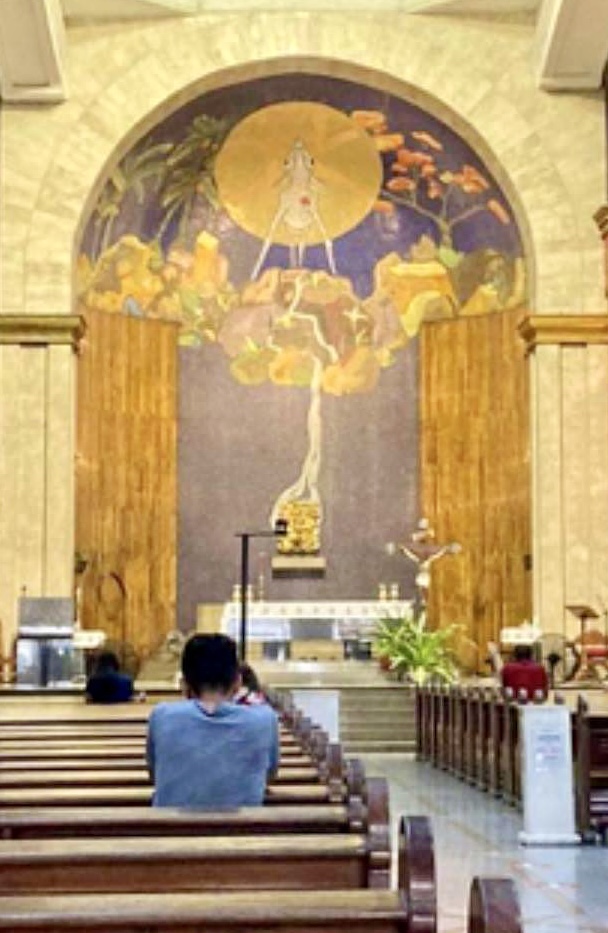
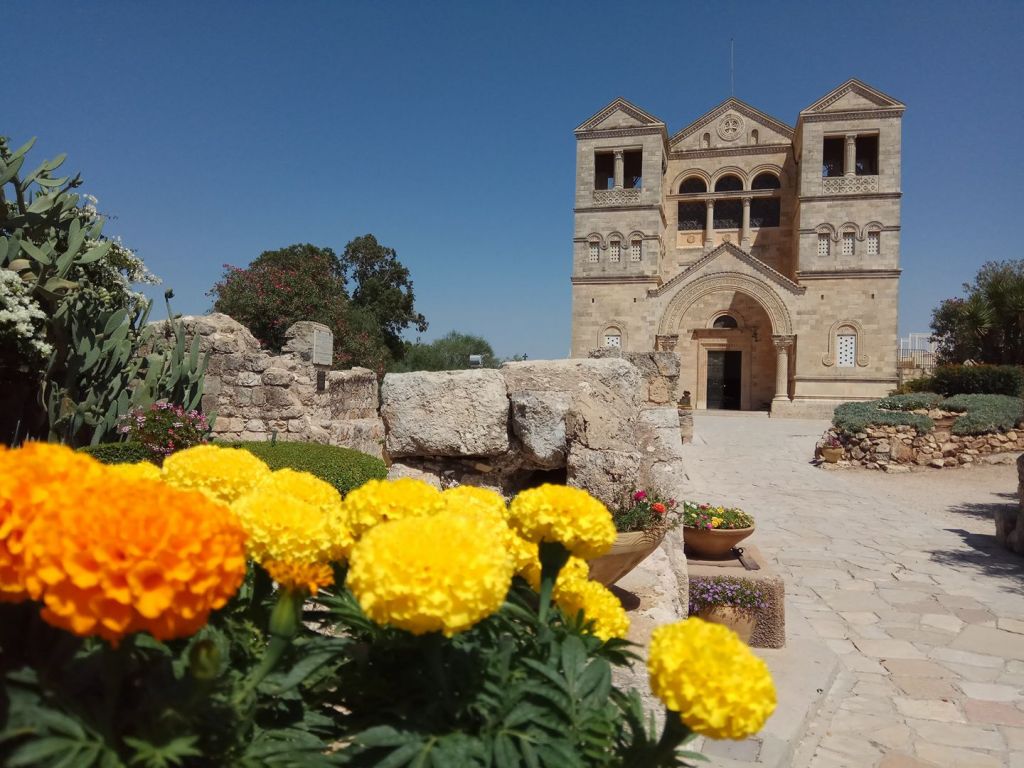
Photo by author, Chapel of the Holy Family, Sacred Heart Spirituality Center, Novaliches, QC, 2017.

Following Jesus, being a true and good Christian is always difficult. This I realized on my first month as a priest 24 years ago when I gave a “marriage encounter” (ME) to several married couples from the parish of my former professor in the seminary.

Part of the marriage encounter is the writing of one’s sins on a piece of paper with a symbolic burning before going to confession later in the evening; problem was, as a new priest, I gave a wrong instruction asking the spouses to exchange paper with their partner to see each others sins. That was when a wife collapsed after reading the sins of her husband! Actually, she had long suspected him of infidelities but that afternoon, all her doubts and suspicions were proven very true that her blood pressure shoot up, losing her consciousness in anger and pain.

After she had been revived, she kept on saying, “akala ko ME magpapatatag sa aming samahan; ito na yata maghihiwalay sa aming dalawa ng tuluyan” (I thought the ME will make our marriage stronger but it seems this will finally cause our separation as husband and wife).

I tried explaining things to her, prayed so hard for her and eventually after six months, I met them at a wedding as they thanked me how their marriage had gone stronger after surrendering everything to Jesus Christ.

Photo by author, Chapel of the Holy Family, Sacred Heart Spirituality Center, Novaliches, QC, 2017.

"Every Christian is a prophet...
a sign of contradiction."

Many times in our lives we have experienced that our faithful service in the Lord often leads us to distressing and painful situations, even tragic choices. In the first reading, we have heard how Jeremiah’s own folks threw him into a cistern to die because they could not take his preaching against their sinfulness and prophecies of the impending fall of Jerusalem which eventually happened. He was momentarily rescued from the cistern but later was eventually killed by his own people for speaking against their sinful ways and life.

Every Christian is a prophet like Jeremiah, a sign of contradiction among the people, even in one’s own family and circle of friends. To live against the corrupt and sinful ways of the world, to uphold what is true and just, to stand for what is honorable and good surely earn a lot of criticisms and condemnation from everyone. Even in the Church!

Jesus said to his disciples: “I have come to set the earth on fire, and how I wish it were already blazing! There is a baptism with which I must be baptized, and how great is my anguish until it is accomplished! Do you think that I have come to establish peace on the earth? No, I tell you, but rather division

Luke 12:49-51
Photo by author, Chapel of the Holy Family, Sacred Heart Spirituality Center, Novaliches, QC, 2017.

With all of these words, we now wonder what is good with our Good News this Sunday? Remember, Jesus Christ is on his way to Jerusalem to face his suffering and death. Today he tells us three things to remember to remain focused with the End.

First is the fire he had brought into the world. It is not a fire of destruction but fire of heat and light that give life; fire that purifies and cleanses like silver and gold that bring out its beauty and magnificence; and most of all, the fire of God’s presence like in the burning bush of Moses and the pillars of fire/cloud that guided the Chosen People in the wilderness into the Promised Land.

Fire gives light and heat that lead into life; we can survive without food and water for several days but we cannot last even ten minutes without heat! This is the kind of fire we Christians need these days, fire that will lit us up with courage ands joy in Jesus Christ by witnessing his gospel in a world that seems to be dying and lifeless despite the noise and affluence around.

As a purifying fire, it always brings pains that lead into conversion and liberation like what that couple in my first Marriage Encounter have experienced. The fire of Christ’s mercy and forgiveness taught them to forgive each other and enabled them to lead holier lives. The more we get closer to Jesus our light, the more we see our sinfulness and weaknesses, then we change and mature. That is when we are filled with the light of Christ to become his presence in the world.

Second teaching of Jesus today is about his “other baptism” which is his Passion, Death, and Resurrection. This is the reason why he was “resolutely journeying to Jerusalem” – he was so eager, so decided to face his pasch not for the pains it would bring but for its glorious effects for us.

Photo by author, Chapel of the Holy Family, Sacred Heart Spirituality Center, Novaliches, QC, 2017.

That is the real meaning of baptism, from the Greek baptizein which is to immerse in water; hence, baptism before was a literal immersion in water. In our immersion into the passion and death of Jesus Christ, we enter into a communion in him and with him so that in his Resurrection, we too rise with him and in him into new life.

Third pronouncement by Jesus this Sunday is perhaps the most baffling, especially when we consider the statistics that more than half of the conflicts going on in the world today are due to religious beliefs.

Jesus never meant to bring people apart; in fact, he came to bring us all together, to gather us again as beloved children of the Father. However, it happens that the moment we stand for Jesus, for what is true and just, inevitably, we will be with odds even with those dearest to us. Jesus himself had said that “If anyone comes to me without hating his father and mother, wife and children, brothers and sisters, and even his own life, he cannot be my disciple” (Lk.14:26).

That is one of the beautiful imageries of the Cross of Jesus Christ: it marks the end of our sinfulness and the beginning of our oneness in God.

It is the difficult aspect of discipleship when our loved ones are into sins and evil, when they are in darkness and injustice. Are we going to side with them or side with Christ?

At the Last Supper, Jesus gave us his peace (Jn.14:27) that according to him is not like the peace offered by the world that is often based on compromises; Christ’s peace is the fruit of love, of sacrifices. Love and sacrifice are one, always together; when you love, there is sacrifice, there is pain and suffering. That is why it is love!

Parents and lovers know this very well: many times they suffer and cry in silence because of their great love for their children or beloved. It is no wonder that in the Beatitudes, Jesus called the peacemakers and the persecuted blessed because to work for peace entails persecution and division.

Photo by author, Chapel of the Holy Family, Sacred Heart Spirituality Center, Novaliches, QC, 2017.

"God is dangerous."
-Fr. Hans Urs von Balthasar (+)

Last Sunday we have reflected how Jesus used the setting of night for our vigilance because faith is tested and deepened in the darkness of life like during nighttime. And, the darker the night, the longer the night always.

But, we have so many people who have gone ahead of us in this life who have found light and life amid the darkness in life, emerging victorious in their faith in God, from the patriarchs in the Old Testament and in Jesus himself and his Apostles and saints as well.

Brothers and sisters: Since we are surrounded by so great a cloud of witnesses, let us rid ourselves of every burden and sin that clings to us and persevere in running the race that lies before us while keeping our eyes fixed on Jesus, the leader and perfecter of faith.

Hebrews 12:1-2

Wonderful! Jesus is the leader and perfecter of faith. Very often, we hear the gospels and the Bible speaking always of our having faith in Jesus. But, it is only here and in some instances in Paul we find Jesus having faith; how can Jesus, the Son of God have faith when he is the object of faith?

Let us remember that Jesus is truly human, truly divine. Like us, he also had faith as the gospels attest: he had faith in the Father who sent him. He is the best example of having faith, entrusting everything to the Father that he did not feel ashamed of the Cross. In that sense, Jesus is also the perfecter of faith because in him, with him and through him, we are able to walk in faith, sustain our faith in the most difficult and trying moments of life when we felt our relationships, our world falling apart because we have stood by his Cross. As we look back, we have emerged better, stronger, and most of all, joyful, free and faithful after all those trials in life. Thanks to our faith in Christ!

One of the friends of Pope emeritus Benedict XVI and St. John Paul II was the Swiss theologian and priest named Hans Urs von Balthasar who said in his 1945 book “The Heart of the World” that God is dangerous.

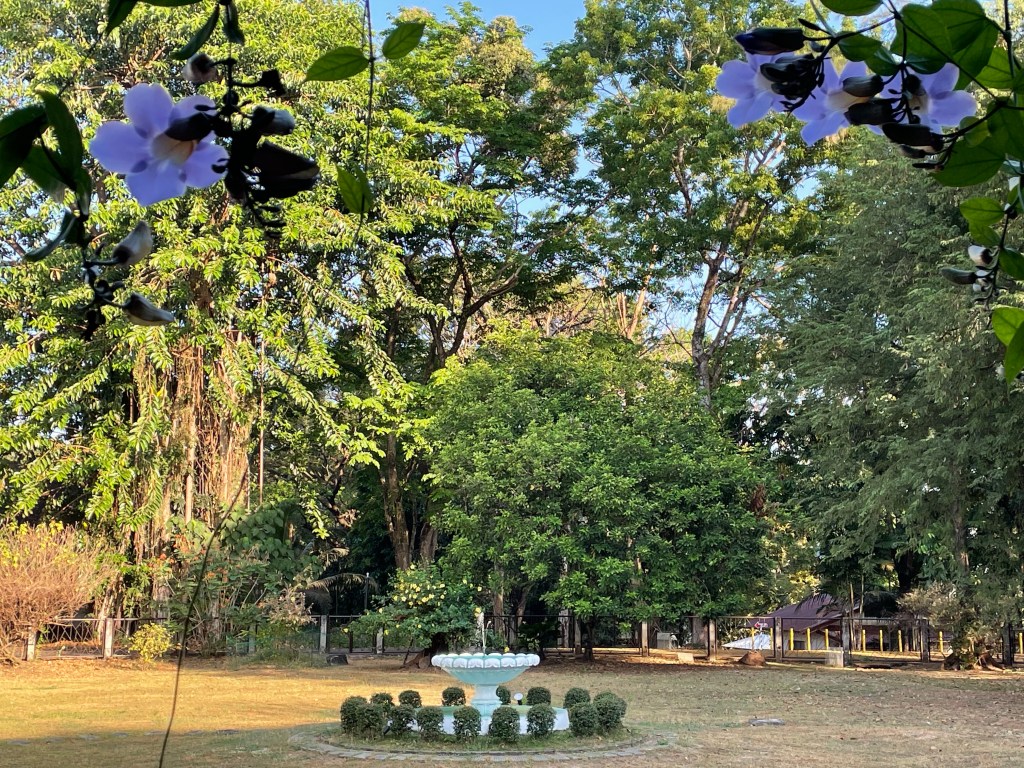
Photo by Mr. Jay Javier, Acacia trees in UP-Diliman, April 2022.

Indeed, it is very true especially when Fr. Balthasar noted how God “is inviting you to lose your soul in order to gain it. He always thinks in terms of love. He offers us the impossible… He presents his victory over death as an example to be imitated, he draws us beyond our limits, into his adventure, which is inevitably fatal.”

The blessedness of this Sunday is that Jesus had become like us to lead us the way in a life of faith, perfecting our faith in the process so that we may overcome all obstacles and trials in life like him and be with him in eternal glory in heaven in the End.

Let us keep in mind the worthy reminder of the author of the Letter to Hebrews that “In your struggle against sin you have not yet resisted to the point of shedding blood” (Heb.12:4). Amen.

Have a blessed, fiery week of faithful adherence in Christ!

Believing is living

The Lord Is My Chef Sunday Recipe for the Soul by Fr. Nicanor F. Lalog II
Nineteenth Sunday in Ordinary Time, Cycle C, 07 August 2022
Wisdom 18:6-9 ><}}}*> Hebrews 11:1-2, 8-19 ><}}}*> Luke 12:35-40
Photo by author, Liputan Island, Meycauyan, Bulacan, 31 December 2021.

Everybody believes in something, even if they believe in the emptiness and nothingness of life. But, what or who we believe in makes the difference because that determines how we live.

Those who believe in financial security live in amassing and building their wealth while those who believe in something that transcends what they see and understand live pursuing lofty ideals not necessarily in religious terms like the saints but also in civic and social concerns like national heroes and reformers. There are also extremists in various forms found in different countries and organizations who believe that any lasting change in life can only be achieved by armed struggles and use of violence, destroying everything even human lives they profess to be they are building or protecting.

This Sunday we find in our readings the importance of believing in God, of having faith in him because faith is not just a belief or knowledge as an interior conviction of the intellect but a union, that is, a “communion” in God we believe in.

Faith is the realization of what is hoped for and evidence of things not seen. Because of it the ancients were well attested.

Hebrews 11:1-2

It is faith that brings us into our final End in God by enabling us to “possess” already what is not yet fulfilled – eternal life! Little by little, as we live out our faith faithfully like the saints and most notably of all, Abraham as mentioned in our second reading from the Letter to the Hebrews. See how the author of Hebrews reminded us of the three events in Abraham’s life when he exemplified to us his firm faith in God.

By faith Abraham obeyed when he was called to go out to a place that he was to receive as an inheritance; he went out, not knowing where he was to go. By faith he received power to generate, even though he was past the normal age – and Sarah herself was sterile – for he thought that the one who made the promise was trustworthy. By faith Abraham, when put to the test, offered up Isaac, and he who had received the promise was ready to offer his only son…He reasoned that God was able to raise even from the dead, and he received Isaac back as a symbol.

Hebrews 11:8, 11, 17, 19

Here we find Abraham as the kind of dreamer with eyes wide opened who not only believed in God but cooperated completely to realize all his promises. He dared to journey to an unknown foreign land that he was thrice blessed by God with wealth and land his heirs would inherit. Despite his old age, he held on faith in God that his son Isaac was born who became the father of Jacob also known as Israel from whom came the twelve tribes of Israel. And when Isaac was an early adult, Abraham remained faithful to God, completely surrendering Isaac to him as a sacrifice that turned out be a test that God was so delighted with faith and declared him as the father of faith.

Everyday we hear of many stories not only of highly successful people but even of simple folks we personally know who have moved heaven and earth so to speak to achieve their dreams in life.

Photo by olia danilevich on Pexels.com

Yesterday after our Baccalaureate Mass at the Our Lady of Fatima University, one of the graduates texted me, accepting my invitation as their chaplain to see me at my office in the hospital for some conversations and counseling or even confession. I was so surprised when she came at exactly 2PM and turned out to be one of my former directees in Malolos City more than ten years ago.

She first came to me after delivering her baby on her third year in college in 2006 after shifting from two other courses; as a result, she never finished college and had to work when the father of her child abandoned them. Last time we met was in 2013 when she came to visit me at Radio Veritas after my program for another series of consultations when she met another man who eventually married her and five years ago, allowed her the chance to pursue a college degree in Physical Therapy. She told me how difficult it had been for her especially with the COVID-19 pandemic that she almost gave up all hopes of earning a college degree. What kept her through these years amid having two other children with her husband who joyfully accepted her and her son from her previous relationship is her deep faith in God. And that is why she was doubly happy last Friday during our Mass when she finally found me again, telling me how our spiritual direction during her dark days have made a great impact in her spiritual journey. On Monday, she graduates with her classmates at the PICC, finally earning a college degree after graduating from high school in 2003.

Photo by author, 2017

Many times in life, not all our days are bright and shiny. So often there are thunderstorms and dark clouds and worst, dark nights that are always the longest nights too. This is the meaning of our first reading from the Book of Wisdom that recalled the first passover and exodus from Egypt of God’s chosen people.

Faith is often asserted and tested in the dark, at nighttime when all the uncertainties and dangers are most pronounced when unknown to us, God is also most present in us. And this we shall find also as the setting of the Lord’s two parables for this Sunday.

Photo by Mr. Raffy Tima of GMA7-News, January 2022.

Jesus continues his journey to Jerusalem and along the way since last week, he has been teaching us the need to place our trust and security in God than in material possessions, in the importance of having faith more in God than in things.

From Qoheleth we have learned last Sunday that life is vanity if not rooted in God who is our ultimate origin and end in life so that today Jesus tells us in no uncertain terms of the need to keep that in mind through two similar parables.

Jesus said to his disciples: “Gird your loins and light your lamps and be like servants who await their master’s return from a wedding, ready to open immediately when he comes and knocks. Blessed are those servants whom the master finds vigilant on his arrival. Amen, I say to you, he will gird himself, have them recline at table, and proceed to wait on them… Be sure of this: if the master of the house had known the hour when the thief was coming, he would not have let his house broken into. You also must be prepared, for at an hour you do not expect, the Son of Man will come.”

Luke 12:35-37, 39-40

It is important for us to note that before this teaching, Jesus addressed the many fears of insecurity and insufficiency of his disciples, telling them to never worry of what to eat or wear, reminding them of how animals and birds as well nature are well taken cared of by God in all its splendor and glory (Lk.12:22-34).

Our main concern is to be faithful servants of God, seeing to it that we become his hands that care for others especially the sick and the needy, striving to be fair and just in our dealings with everyone, remaining focused with the kingdom of God.

That is the meaning of the vigilant servants in the first parable whom the master finds awake and alert upon returning from a wedding feast. It is Jesus Christ himself coming again in an unexpected time and date nobody knows at the end of time; those he shall find like the vigilant servants are assured of heaven where Jesus will be the one serving them!

Photo by Fr. Pop Dela Cruz, June 2022.

Many times in our lives, we feel that God seems to have forgotten us, falling asleep and unaware of the sufferings we are going through. It is okay to feel that way sometimes but never let your guards down: be like the vigilant servants, faithful to God in prayers and in serving others, in trying to be kind and forgiving because Jesus is surely coming again to bring us with him in paradise and end all our pains and sufferings. Do not let your fears of losing, of not having enough paralyze you to make you selfish and conceited. How often Jesus had come to you through friends and strangers or situations offering you exactly what you needed most at the perfect time? That is like the master coming from a wedding who serves his servants who faithfully waited for his return. God can never be outdone in generosity.

On the other hand, the second parable has an interesting detail from the first one: the master of the house guarding his house against the thief of the night. Actually, the thief here is the master of the house, the one who acted as if he owned everything that he is always on guard against the real master who might come to take back everything.

That is sure to happen! We are just mere stewards of God. We own nothing in this world, even our very life. When the Lord comes at the end of time, or when our time comes to die, which attitude would we have, that of the vigilant servants excited for their master returning from a wedding or that master of the house afraid of the thief to take back what he had stolen?

The grace of this Sunday as we focus about the End we shall all face, it likewise reminds us of the end with a small “e” of our little sufferings here on earth, the setbacks and failures, mistakes and sins we have committed. They will all end; what is important is we live our faith faithfully in God through prayers and good deeds. And some dashes of perseverance, patience, courage and a lot of faith in God. Amen.

A blessed week to everyone!

Photo by Ms. Danna Hazel de Castro, Kiltepan Peak, Sagada, Mountain Province, 2017.

God is the reason

The Lord Is My Chef Sunday Recipe for the Soul by Fr. Nicanor F. Lalog II
Eighteenth Sunday in Ordinary Time, Cycle C, 31 July 2022
Ecclesiastes 1:2, 2:21-23 ><}}}*> Colossians 3:1-5, 9-11 ><}}}*> Luke 12:13-21
My former parish, photo by Mr. Gelo Nicolas Carpio, January 2020.

Last Friday I officiated at the funeral Mass of a younger first cousin; a week earlier, I had anointed him with Oil for the Sick with general absolution of his sins, commending him to God as he was afflicted with a rare disease that attacks the autoimmune system.

It is one of the difficult part in our lives as priests, when sickness and death come closest at home considering that fact that I officiated his wedding about 20 years ago and baptized his eldest son now grown up. That is why our readings today are so timely for me because my cousin Gilbert was only 49 when he died, being the most silent and “goodest” of my cousins who never got into any trouble nor any sickness while we were growing up together in Bocaue, Bulacan. How I felt like Qoheleth, saying….

Vanity of vanities, says Qoheleth, vanity of vanities! All things are vanity. Here is one who has labored with wisdom and knowledge and skill and yet another, who has not labored over it, must leave the property. This is also vanity and a great misfortune.

Ecclesiastes 1:2, 2:21
Photo by author, Pangasinan, April 2022.

Qoheleth is what the author calls himself which is not a proper name but a function of a speaker or a preacher to an assembly which is in Latin ecclesia; hence, it is called the Book of Ecclesiastes.

Despite the tone of his message of “vanity of vanities”, the author is not a “kill joy” or KJ who is provoking a culture of pessimism; in fact, he is trying to search for what truly lasts, for the Absolute good who is God. We have seen how in literature and music that poems and songs of despair are often the most beautiful because the anguish we feel can paradoxically be expressions of our burning desire for something, someone more permanent, more lasting and unchanging – who else and nothing else but God who is not vanity!

If we try to own every line of Qoheleth and reflect deeply on it, we somehow feel a strong similarity with our own cries of despair in life when nothing matters anymore especially with the lost of a loved one, or something so precious that deep inside us we felt with certitude that only God could fill that void.

Yes, all is vanity if we are cut off from God, when all our efforts and our very lives are separated from him because he alone is the Reason. Everything, everyone is meaningful because of God. That is why in the second reading, St. Paul is asking us to “seek what is above, where Christ is seated at the right hand of God” (Col.3:1).

In this world where everything is measured in popularity, in being viral or trending that are all vanities because of their temporariness, so many have fallen into the trap of empty promises of modern lifestyles. See how despite the affluence we now enjoy, we have become more empty in life, more alienated from each other even from one’s self, lacking in meaning and depth in life and existence. Sometimes, results can be fatal when people realize what they have been seeing and hearing in media are not at all true and so far from reality that death becomes an escape than a direction that leads us to the Absolutely Perfect, God and eternal life.

Someone in the crowd said to Jesus, “Teacher, tell. my brother to share the inheritance with me.” He replied to him, “Friend, who appointed me as your judge and arbitrator?” Then he said to the crowd, “Take care to guard against all greed, for though one may be rich, one’s life does not consist of possessions.” Then he told them a parable.

Luke 12:13-16
Photo by Dr. Mylene A. Santos, MD, 2020.

Like Qoheleth, here we find Jesus acting like a “kill-joy” to the man requesting his help to have his share of the inheritance. His responses seems so abrupt and worst of all, very cold! But, it was not really addressed to the man asking the Lord’s intervention. Notice how Luke tells us Jesus addressing the man as “friend” before turning to the “crowd”.

Jesus is still on his way to Jerusalem and saw another opportunity today to teach the people – the crowd – not just the man asking his help of something of high importance in this life which is of being “rich in what matters to God” (Lk.12:21).

Jesus is just and fair, so loving and merciful, very mindful of our needs; however, in the light of the previous gospel scenes we have reflected, we find that Jesus concerns himself only in what matters to God. He does care about our bodily and material needs that he assures us to not worry so much about these because God will never forsake us.

Jesus had come not to be our judge and arbiter on matters about our material and worldly concerns like getting rich and famous and other vanities in life; Jesus came to teach us about what matters to God like love and mercy, kindness and care, justice and freedom. Jesus came to teach us ways of how we may inherit eternal life!

We do not have to spell out and enumerate one by one these things that matters to God of which Jesus is most concerned with; eventually, as we journey with him in life, as we carry our cross, we realize slowly in life these things that matter to God are for sure not material possessions, most often things that matter after death.

That is the grace we find ironically in every death – when somebody dies, we realize deep inside what truly matters to God. As they say, death is the best equalizer in life. And best teacher.


Last week we have the beautiful series of readings from the Book of the Prophet Jeremiah, teeming with life and assurances of love and protection from God. We see how the loving hands of God are like of the potter who molds us into fine earthen vessels of his majesty and glory.

Photo by author, March 2019.

Sometimes we sink into so much self-pity when things are not turning out according to our plans in life, forgetting how God loves us so much, of how he uses even the most tragic and painful events in our lives for our own good because he believes in us.

Yes. God believes in you! Everything is vanity without him, without you!

Would you rather spend everything just for a piece of land or some money or level of fame than living in peace, the greatest gift we can all have in life? That is the whole point of God in telling Jeremiah about being a clay in the potter’s hand – many times in our lives we have to be crushed and mashed, even reduced to being grounded for us to emerge finer and refined, better and more beautiful than before.

Recall those trying days of the past when you chose to bear it all, to be silent and patient. Maybe for a while or a few moments our opponents seemed to have won, or have the upper hand but in the long run, we find we are more fruitful, we are more peaceful because everything and everyone has become meaningful in God. That is because we love.

Photo by Pixabay on Pexels.com

Of all that things that matter with God that we should be rich is love. Love, love, love. As the Beatles said, all you need is love! True. Sometimes it could be foolish to love, to let go of things and insults and pains and hurts.

But, God is greater than our hearts (1 Jn.3:20) and can never be outdone in generosity.

The more we love, the more we are given with more love. That is when we become truly rich in what matters to God. Amen.

Have a blessed week ahead, everyone!

Meeting Jesus who comes as guest

The Lord Is My Chef Sunday Recipe for the Soul by Fr. Nicanor F. Lalog II
Sixteenth Sunday In Ordinary Time, Cycle C, 17 July 2022
Genesis 18:1-10 ><}}}}*> Colossians 1:24-28 ><}}}}*> Luke 10:38-42
An icon of Jesus visiting his friends, the siblings Sts. Lazarus, Mary and Martha. Photo from crossroadsinitiative.com.

Immediately after Jesus our “Good Samaritan” had told this parable on his way to Jerusalem last Sunday, Luke now tells us the Lord making a stop over at the home of two sisters named Martha and Mary.

The two ladies were of contrasting attitudes in receiving Jesus as guest that he took it as an occasion to teach anew on “what we must do to gain eternal life” when Martha complained to him of Mary not doing anything to help her prepare for him.

Martha, burdened with much serving, came to him and said, “Lord, do you not care that my sister has left me by myself to do the serving? Tell her to help me.” The Lord said to her in reply, “Martha, Martha, you are anxious and worried about many things. There is need only of one thing. Mary has chosen the better part and it will not be taken from her.”

Luke 10:40-42
Photo by author, Baras, Rizal, January 2021.

Focusing on Jesus more when he comes

We are again presented here with a very familiar story only Luke has like the parable of the good Samaritan last Sunday. Almost everyone feels like knowing Martha and Mary so well, that they have covered everything when Jesus dropped by to visit the two sisters.

And that’s the problem when we feel so familiar with a story by Jesus or in an event in his life that we take it lightly and miss the more essential aspects as well as learn new insights being presented to us.

In this story of Jesus visiting the two sisters, Martha is often presented as the “active” type while Mary is the “contemplative” who sat at the Lord’s feet to listen to his words. As a result, many have thought Jesus favored Mary over Martha, that praying is more important than acting.

That is absolutely wrong! Jesus is not saying it is best to be a contemplative than active, nor Mary is better than Martha.

From Facebook during the first wave COVID-19 pandemic in May 2020.

Through Mary and especially Martha, Jesus is reminding us today not to be so preoccupied or “anxious and worried about many things” in life like food and clothings, money and wealth and other material things.

Jesus had always been consistent in teaching everyone not to be so concerned with wealth, power and fame that prevent us from growing in the kingdom of heaven like in the parable of the sower, of how the seeds that fell among thorns “were choked by the anxieties and riches and pleasures of life, and they failed to produce mature fruit” (Lk.8:14).

Most of all, recall that when his pasch was approaching, Jesus became more pronounced in warning us all in having that overwhelming concern and cares for things of the world especially in relation with his second coming, “Beware that your hearts do not become drowsy from carousing and drunkenness and the anxieties of daily life, and that day catch you by surprise like a trap. For that day will assault everyone who lives on the face of the earth” (Lk.21:34-35).

Such preoccupation with things of the world detracts us from the most essential which is Christ himself and witnessing him in this world so concerned with wealth and power, with fame and ego.

And that is what Martha was missing in having Jesus as guest in their home — she was so busy preparing meals that she had entirely forgotten Jesus himself was in the house! Mary was praised because she chose the most important – Jesus himself who was their guest and the Word he spoke to them! Every time we recognize Christ’s coming in our home and in our very selves, something wonderful always happens. The good news is made known to us like a mission or a plan from God we have long been praying over.

The famous icon of The Trinity visiting Abraham at Mamre by Russian artist Andrei Rublev done in the 15th century. Photo from en.wikipedia.org.

This is the reason we have the beautiful story of Abraham welcoming three guests who turned out to be God himself, the Blessed Trinity coming to his tent at Mamre in our first reading today.

More than the story of Abraham’s hospitality is the announcement of the fulfillment of God’s promise to Abraham of finally having a child of his own with Sarah:

They asked Abraham, “Where is your wife Sarah?” He replied, “There in the tent.” One of them said, “I will surely return to you about this time next year, and Sarah will then have a son.”

Genesis 18:9-10

In both the Old and New Testaments, the Bible teems with so many lessons and admonitions from God and his prophets and later from Jesus himself on the need to always welcome and accept strangers especially the poor and the sick for “whatsoever you do the least of these, that you do unto Christ”.

Jesus comes to us daily but are we home to welcome him, to receive him and most of all, listen and act on his words? Or, are we so preoccupied with so many other affairs that we forget his presence, not only among those in need like the priest and Levite last week who just passed by a victim of robbery left half-dead in a street?

The grace of this Sunday lies in the very fact that many times, it is Jesus himself who comes to us right in our homes, in our family members and loved ones, in the ordinary people we take for granted but we are like Martha “so anxious and worried about many things” that we miss the good news he brings to us often. That is why we only get tired with all our efforts, not bearing fruits because we miss the most important of all, Jesus himself!

Let us imitate Paul in the second reading trying to see Jesus in everyone by deepening his reflection last week of Christ as the image of the invisible God and now “Christ in you, the hope for glory” (Col.1:27).

It is our task and mission like Paul to reveal in our lives of loving service to others God’s plan that Jesus came to dwell in us his believers and followers so we may participate in his glory. But how can we participate in God’s glory when we fail to meet Jesus coming daily to our lives because we are like Martha?

Photo by author, Tagaytay, February 2022.

The simplest way to receive Jesus our guest is to seriously participate in our Sunday Eucharist which we tend to take for granted. In the Eucharist, we gather as the Body of Christ with Jesus as our head, the Church.

Notice that in Rublev’s icon of the Trinity at Mamre, the three men are actually gathered in a meal, the Eucharist. When you try to view the icon, you become the fourth person in the painting sharing the meal with the three angels.

That is the mystery of Christ’s coming to our homes daily, in our loved ones and right in our hearts too to share us himself and tell us the good news daily. The Eucharist is in fact our rehearsal in entering heaven in the future, that is why this Sunday, cast away all your anxieties and simply focus in the Lord and you will never get lost! Have a blessed week ahead! Amen.

Becoming a Jesus Christ, the Good Samaritan

The Lord Is My Chef Sunday Recipe for the Soul by Fr. Nicanor F. Lalog II
Fifteenth Sunday in Ordinary Time, Cycle C, 10 July 2022
Deuteronomy 30:10-14 ><}}}*> Colossians 1:15-20 ><}}}*> Luke 10:25-37
Photo by Mr. Raffy Tima of GMA7-News, May 2022.

After telling us last week to “do not rejoice because spirits are subject to you, but rejoice because your names are written in heaven” (Lk.10:20), Jesus today answers a scholar of the law asking him what he must do to gain eternal life.

It is the very same question we often ask others because inside us we are convinced there is something else deeper than the laws and commandments of God written in the Bible. Like the scholar of the law, we have experienced that God’s commandments and statutes – his very voice, his very words – are written in our hearts.

Moses said to the people: “If only you would heed the voice of the Lord, your God, and keep his commandments and statutes that are written in this book of the law, when you return to the Lord, your God, with all your heart and all your soul. No, it is something very near to you, already in your mouths and in your hearts; you have only to carry it out.”

Deuteronomy 30:10, 14

God’s commandments and laws are not just mere codes of conduct like in other religions. The Law of God is no dead letter but his living Word right in the depths of our hearts no matter how hard we deny his existence. More than a code, the Law of God evokes a relationship that is a fruit of one’s conversion of heart and soul in union with God and with others.

It is here that we find the novel approach by Jesus in narrating the parable of the good Samaritan in answering the scholar of the law who wanted to test him by asking, “Teacher, what must I do to inherit eternal life?” (Lk.10:25) that was followed up with a second one, “And who is my neighbor?” (Lk.10:29) to justify himself. In narrating this parable, Jesus showed us how we must live as neighbors, as brothers and sisters in him who is our head.

Photo from americamagazine.org.

We are all neighbors.

We have heard so many times this beautiful parable by Jesus which only Luke had narrated while the Lord was “resolutely determined to journey to Jerusalem” (Lk.9:51). Too often, we see this parable as a reminder of something we are all aware of, that everyone is our neighbor.

Like the scholar of the law, we are not surprised at all with Christ’s question, “Which of these three, in your opinion, was neighbor to the robbers’ victim?” because we have always thought of the question in our own point of view! We are the ones looking at the victim of the robbers that it is always easy to assume we would be good Samaritan to him which is so presumptuous on our part. Fact is, so often we have failed being a good Samaritan to so many in need who came to us for help because we were like the priest and Levite with many excuses, with more important matters to attend to that they both passed by the robbers’ victim.

Like the scholar of the law, we have failed to see the whole point of Jesus who was asking us to be in the victim’s point of view, to be in his shoes: would anyone be a good Samaritan to help me if I were the victim?

Jesus had reversed the point of view – instead of looking through the window from the outside, we are asked to look at the window from the inside! Would somebody stop to be kind with us?

From inquirer.net.

Many times we have felt so disappointed at some people we were expecting to be our friends, who would be on our side but when trials came, they turned their backs from us and left us alone when suddenly, somebody we least expected or even hardly knew came to help us!

How many times have you found yourself saying, “I thought they considered me as their friend but it turned out, somebody I hardly knew was the one who helped me out of my plight!” Worst, there were times we have said strangers are even better than our family and friends, saying, “Mabuti pa yung ibang tao kesa kamag-anak o kaibigan”.

Hence, to our most Frequently Asked Question (FAQ), “What must I do to inherit eternal life?”, Jesus is asking us to act and live in such a way that everybody sees us as their neighbor, not the other way around. When it is others who see us as their neighbor, it means we are living the gospel, we are like Jesus Christ, the Good Samaritan who came to save us all. It is different when it is us who claim to see everyone as our neighbor – it holds nothing at all but an idea in the mind, a plan or mere intention no matter how noble it may be.

Most of all, to see others as one’s neighbors is a sign of a malady of our faith and religion: that we are not yet evangelized though sacramentalized wherein Jesus is just in our minds but not yet in our hearts, not yet flowing through our very being.

Photo by Lauren DeCicca/Getty Images, Laoag City, 08 May 2022.

The preeminence of Jesus Christ

This oneness in Christ is the gist of Paul’s beautiful exposition about Jesus in our second reading this Sunday. Paul wrote the Colossians while in prison to prevent them from joining some preachers encouraging them to adopt ascetic practices in order to have angelic powers as well as appease higher powers. Paul insisted Jesus Christ is God and what he had accomplished on the cross is sufficient for our salvation.

Christ Jesus is the image of the invisible God, the firstborn of all creation. For in him were created all things in heaven and on earth, the visible and the invisible, whether thrones or principalities or powers; all things were created through and for him. For in him all the fullness was pleased to dwell, and through him to reconcile all things for him, making peace by the blood of his cross through him, whether those on earth or those in heaven.

Colossians 1:15-16, 19

In presenting the preeminence of Jesus Christ, Paul is also telling us that Jesus is the foundation of our moral life. Our lives, our actions must flow from our communion and oneness in Christ. That is when others see us as a neighbor, when they see us as one of them too!

This is the fulfillment of Moses’ teaching in the first reading, that the “voice of the Lord”, the word of God is not far from you for it is in your hearts – that is Jesus Christ who is not only the fulfillment of the laws but the Law himself. After all, as John had expressed in the fourth gospel, Jesus is “the Word who became flesh and dwelt among us”, the Emmanuel, the God-with-us.

From Facebook of Marivic Tribiana, 2021.

Today, Jesus is inviting us that in order to gain eternal life, we must do what he does, that is, to love and be kind with everyone, to be seen as a neighbor and a friend others can count on. In becoming human, God became one of us in Jesus Christ, the one who crossed the street to reach out to us victims of robbers on the way to Jerusalem. He not only healed our wounds but even lifted us to regain our dignity as beloved brothers and sisters. And neighbors.

There is a very beautiful word in English that captures this reality of our being neighbors or brothers and sisters in Christ: “kind” or “kindness” which came from the root kin or kindred. When we say “she or he is kind to me”, it means he or she treats me as a kin or a kindred, not as different like a stranger.

Artwork by Fr. Marc Ocariza based on Marivic Tribiana’s photo, 2021.

We are all kins or kindred in Christ. And every time we choose to be unkind and indifferent with others especially those in need, we are bothered by our conscience because it is an affront to our very personhood. It is unnatural like what the American writer George Saunders had realized:

“So here’s something I know to be true, although it’s a little corny, and I don’t quite know what to do with it: What I regret most in my life are failures of kindness. Those moments when another human being was there, in front of me, suffering and I responded … sensibly. Reservedly. Mildly.”

George Saunders from “Congratulations, By the Way” (page 22)

Avoid having such regrets later in life. Whatever good deed you may do at the moment, do it for it could be Jesus Christ who is passing by, who is the one in need. Amen.

Have a blessed week ahead.

Tenderness and care of God – and nurses – to heal the world

Homily by Fr. Nicanor F. Lalog II, 07 July 2022 
Capping and Pinning Ceremony of Nursing Students
Our Lady of Fatima University, Valenzuela City
Photo by author, Nursing students taking their oath at their capping and pinning ceremony at the RISE Tower of the Our Lady of Fatima University in Valenzuela City, 25 June 2022.

If there is one thing that the world needs so badly now in these days of the pandemic is what we call “tender loving care” or TLC. And that is why nurses are so in demand everywhere in the world today, especially those imbued with TLC.

I had the opportunities of exercising my ministry briefly in the States and Canada in the early 2000 during my vacations there. One of the things I always heard from white people I have met in hospitals and retirement homes as well as those in parishes was the statement that “my nurse is a Filipino” or that their caregiver is from the Philippines. And they say it with pride and conviction! Fact is, I never heard people there even our own kababayan speaking so proud of us Filipino priests! Laging binibida sa akin noon yung nurse na Pinoy!

Why? Kasi mabubuti daw ang mga nurse na Filipino. And most likely, mabubyuti din!

Photo from Facebook of a nurse going to work amid the typhoon, November 2020.

“Mabuti” means good and kind, like God. And that trait is something so natural for us Filipinos because of our religiosity and high regard for good education which I can safely claim with pride you can find here at Our Lady of Fatima University. Thank you for choosing us for your education and formation as future nurses of then world.

Next to Veritas (Truth) in our University motto is Misericordia or mercy in English. In the bible we find the mercy of God is part of his quality of being tender and caring, the two qualities of nurses I wish to reflect today for you to be TLC like God, that is, with “tender loving care”.

Misericordia literally means “to move the heart” or “to stir the heart” wherein one’s heart is moved into action, into doing something to alleviate other’s sufferings. More than the feeling of pity, there were the hands doing something to help those sufferings.

Mercy implies an involvement of the person to another going through pains and sufferings like a father or a mother as the prophet Hosea described God so like our daddy in the truest sense in the first reading, full of tenderness and care for Israel representing us today; and despite our sinfulness and ingratitude to him, God spares us of his wrath.

Thus says the Lord: when Israel was a child I loved him, out of Egypt I called my son. Yet it was I who taught Ephraim to walk, who took them in my arms; I drew him with human cords, with bands of love; I fostered them like one who raises an infant to his cheeks; yet though I stooped to feed my child, they did not know that I was their healer. My heart is overwhelmed; my pity stirred. I will not give vent to my blazing anger, I will not destroy Ephraim again. For I am God not man, the Holy One present among you; I will not let the flames consume you.

Hosea 11:1, 3-4, 8-9

Hindi ba ganun din ang nurse, tatay na nanay like God?

In his book on Rembrandt’s painting of the return of the prodigal son in Luke’s gospel, the late Fr. Henri Nouwen noted how the father’s two hands are of a father and a mother. The father’s hand looked firm evoking senses of being supportive, empowering, and encouraging while the mother’s hand looked soft that is consoling, caressing and comforting.

From en.wikipedia.org.

Tenderness is being like God, of having both the hand of a father and of a mother with a big heart able to accommodate those suffering because you know and realize the gravity of what they are going through. You forego plans of getting even, of vengeance, of punishing because a tender person is one who tries not to add more insult to one’s injuries or rub salt onto one’s wounds so to speak. 

A tender person is one who tries to soothe and calm a hurting person, trying to heal his/her wounds like God often portrayed in many instances in the bible in lovingly dealing with sinners filled with mercy.  Like God, a person filled with tenderness is one who comes to comfort and heal the sick and those taking on a lot of beatings in life. 

When Jesus Christ came, he personified this tenderness of God like when he is moved with pity and compassion for the sick, the widows, the women and the children and the voiceless in the society.  Tenderness is coming to heal the wounds of those wounded and hurt, trying to “lullaby” the restless and sleepless. 

That was the tenderness exemplified by your role model, Florence of Nightingale in all her life that is why she is always portrayed holding a lamp bringing light into the world plunged to the darkness of war and sickness that continues to these days.

Later, you will be lighting your candles from those giant lamps while your professors along with the Dean put on your cap and pin to signify your going to hospital duties as part of your formation as future nurses. Totohanin ninyo na!

You are already a nurse once you receive that cap and pin.

Take care of that light that you are supposed to illumine the world. Most of all, take care of that light that also signifies every patient you shall be taking care of. Do not let the flame of life be extinguished.

Care, on the other hand, means to have compassion, from the Latin words cum patior, to suffer with. To care is to be human because care is recognizing the other person is my brother or sister, a human who is weak and vulnerable just like me.

When Jesus told his Apostles in our gospel today to “cure the sick, raise the dead, cleanse lepers, and drive our demons” (Mt.10:8), it is not literal at all. Remember before that he instructed the Twelve to proclaim “the kingdom of heaven is at hand” which means the most important is for others to realize and experience they are not alone, they have God with them amid all their miseries and sickness. And surely, amidst all of these is the certainty of death. Very often, as you would experience later, we cannot heal and cure all the sick.

What matters most is that they are cared for with all the tenderness so that even in their final moments, they feel they are not alone. That is why, nursing is more than a profession but also a vocation. A call from God to be like him, tender and caring to others, especially the sick and the dying. May God bless you more, our dear Nursing students along with all the nurses of the world. Amen.

Photo by author, Nursing students taking their oath at their capping and pinning ceremony at the RISE Tower of the Our Lady of Fatima University in Valenzuela City, 25 June 2022.

“Maintain safe braking distance”

The Lord Is My Chef Sunday Recipe by Fr. Nicanor F. Lalog II
Fourteenth Sunday in Ordinary Time, Cycle C, 03 July 2022
Isaiah 66:10-14 ><}}}*> Galatians 6:14-18 ><}}}*> Luke 10:1-12, 17-20
Photo by d0n mil0 on Pexels.com

One of the most repeated messages you see upon entering North Luzon Expressway in its electronic billboards is the call to “maintain safe braking distance” that, unfortunately, many do not observe, causing accidents daily that result into monstrous jams at the super highway.

That warning to “maintain safe braking distance” is what Jesus Christ is also telling us today in the gospel after the 72 disciples he had sent returned to him, rejoicing at their successes that even demons were subject to them because of the Lord’s name.

Jesus said, “I have observed Satan fall like lightning from the sky. Behold, I have given you the power to ‘tread upon serpents and scorpions and upon the full force of the nemey and nothing will harm you. Nevertheless, do not rejoice because the spirits are subject to you, but rejoice because your names are written in heaven.”

Luke 10:18-20
From Facebook, April 2021: “There is an urgency to announce the Joy, the joy of the Risen Lord!”

Resolutely determined in the name of Jesus

We have seen last Sunday how Jesus was “resolutely determined” to go to Jerusalem, asking us with the same resolve in following him, imitating him, and doing his work for the people; but, being resolutely determined like him is not about powers but union with the Father.

The “harvest is always abundant” – there are so many things to be done but the most important thing of all is our oneness with God in Jesus Christ. What matters most in discipleship is not the accomplishments we have but relationships we keep with God and one another. St. Mother Teresa said it so well, “We are called to be faithful, not successful.”

That is why Jesus asked us to pray for more laborers, not budget nor gadgets nor things but persons to work in the abundant harvest that refers to the kingdom of God; hence, the Lord’s reminder to “do not rejoice because the spirits are subject to you, but rejoice because your names are written in heaven.” To have our names written in heaven is to be one with God because heaven is about relationship with God, an intimacy with God. Hell is separation from God.

Hence, a disciple can only share and give peace to others when the disciple himself/herself is in good relationships with one’s self, with others and with God.


Photo by Fr. Pop dela Cruz in San Miguel, Bulacan, 15 June 2022.

Peace happens when there is the gift of presence with self, others, and God, implying a loving relationship. This is the very essence of the second reading from Paul’s letter to the Galatians wherein the apostle explained the meaning of being justified in Christ through his Cross: we are saved, our names are written in heaven not by our own doing but by the Lord’s self-giving. Our task is to nurture and deepen these relationships effected by Jesus in his coming to us, in making us one again in the Father. It is very interesting how Paul ended his letter to the Galatians by using his standard greeting in letters:

The grace of our Lord Jesus Christ be with your sprit, brothers and sisters. Amen.

Galatians 6:18

Experts say that Paul could have employed a secretary in writing this letter who altered his style by placing his usual salutations to the ending. On the other hand, other experts believe there is a hidden meaning in the construction of the conclusion, that if we let the grace of Jesus in our relationships, the more we regard each other as brothers and sisters in Christ.

When Jesus decided to resolutely determined to go to Jerusalem, his focus was not the place but the people, always stopping to interact with everyone by teaching them, healing the sick and blessing the children.

Photo by author, 19 April 2022, Pangasinan.

As we mature in life, we realize and imitate Jesus in this journey by seeing it more as a direction than a destination. We have experienced how our journey and trips have become more fulfilling and enriching from the more fun and adventure we discover in our many stops and detours than going straight to our destinations. Life is more of seeking directions than fixation on a destination to be reached that becomes very rigid and bereft of meaning and sense that can be found only among fellow human beings, not things.

In the first reading, we find a hint of this direction than destination with the prophecy by Isaiah of the coming home of the exiles to Jerusalem. There is always the joy of coming home but, we cannot all go at the same time, the tension of already here but not yet of heaven. There is always the need of keeping and nurturing our relationships and presence, peace and oneness with one another in Jesus Christ amid the abundant harvest of heaven for us all.


Going back to our analogy of the NLEX reminder of maintaining a safe braking distance, entering the super highway assures us of many directions to take in our journey to Jesus, journey with Jesus. But we have to be alert and careful in our driving, be mindful of others using the roads. We need to be alert and careful in driving to avoid causing accidents and mishaps that could misdirect us to the hospital or, worst, six feet below ground!

In the same manner, we are already in the harvest time, in this time of Christ’s presence and oneness with the Father and with everyone of us. This Sunday, Jesus reminds us to maintain safe braking distance in our many pursuits and attention in our abundant harvests that in the process we have forgotten those dearest to us, those we love and who love us truly. Amen.

Have a blessed week ahead!

Photo by Ms. Jo Villafuerte, Atok, Benguet, September 2019.

“Sleeping” in Christ, trusting in God

The Lord Is My Chef Daily Recipe for the Soul by Fr. Nicanor F. Lalog II
Wednesday, Solemnity of Sts. Peter & Paul, Apostles, 29 June 2022
Acts 12:1-11 ><}}}}*> 2 Timothy 4:6-8, 17-18 ><}}}}*> Matthew 16:13-19
Photo by Fr. Howard John Tarrayo, August 2021.

Our readings today are a parable of the Church, of what we should and would be as the Body of Christ celebrating the Solemnity of St. Peter and St. Paul, the pillars of the Church.

Despite their personalities being poles apart while their social, cultural and religious backgrounds were greatly different, both men were won over by Jesus Christ to proclaim his good news of salvation, eventually dying as martyrs like the Lord. Both apostles displayed deep trust in Jesus Christ whom they have come to know on a personal basis.

Let us reflect first on St. Peter, the “prince of the Apostles” and servant of all. Notice how Peter could sleep soundly inside prison, even between two soldiers as narrated to us by Luke.

Photo by Cristian Pasion, Easter Vigil, National Shrine of Fatima, Valenzuela City, 2021.

On the very night before Herod was to bring him to trial, Peter, secured by double chains, was sleeping between two soldiers, while outside the door guards kept watch on the prison. Suddenly the angel of the Lord stood by him and a light shone in the cell. He tapped Peter on the side and awakened him, saying, “Get up quickly.” The chains fell from his wrists. The angel said to him, “Put on your belt and your sandals.” He did so. Then he said to him, “Put on your cloak and follow me.” So he followed him out, not realizing that what was happening through the angel was real; he thought he was seeing a vision.

Acts 12:6-9

It is very amusing, even funny, but facts can truly be stranger than fiction!

How could Peter sleep soundly after being arrested and thrown into prison with two soldiers sandwiching him inside his cell while a host of other guards secured the area outside?

We think again of St. Joseph sleeping soundly in a similar critical situation when he decided to silently leave Mary who was found pregnant with a child before they were married. Too often, we find it difficult to sleep when we have problems because we cannot decide decisively as we lack trust and faith in God. Both Joseph and Peter slept soundly under critical situations because of their complete trust and faith in God.

But, Peter shows us another dimension of his trust in God – his total trust also in the Church, believing that they were all praying for him.

Photo by Cristian Pasion, Easter Vigil, National Shrine of Fatima, Valenzuela City, 2022.

It is a beautiful imagery of the Church then and now, always in darkness like during night time when Peter was imprisoned. And that is the parable of this scene: it is always a time of Exodus for us in the Church, of passing over from every trials and difficulties, always trusting our leaders, trusting our faithful and most of all, entrusting everything to God!

If there is one thing most needed these days in our Church especially in the Philippines is this attitude of being in an Exodus, of exiting from our excesses from the past, of submitting ourselves more to God than to our own thoughts and plans especially in politics that we have forgotten the more crucial proclamation of the gospel by reaching out to the grassroots level, of witnessing our faith in God instead of lording it over among people, exerting our influences. The recent elections is a dark period of our imprisonment with secular thoughts and dispositions, forgetting our sphere of influence in spiritual matters.

May we, both clergy and laypeople, imitate Peter by abandoning everything to God in deep prayers, following God not our plans as symbolized by his putting on his belt and sandals as commanded by the angel.

Photo by Cristian Pasion, Easter Vigil, National Shrine of Fatima, Valenzuela City, 2021.

Meanwhile, we find the same kind of total abandonment by Paul of himself to God while in prison where he wrote some of his finest letters like this Second Letter to Timothy, the last of his captivity letters which we heard in the second reading today.

Imagine the stress of being in prison but without any hint of duress on Paul while awaiting death amid all humiliations with his incomparable eloquence:

I, Paul, am already being poured out like a libation, and the time of my departure is at hand. I have competed well; I have finished the race; I have kept the faith. The Lord stood by me and gave me strength, so that through me the proclamation might be completed and all the Gentiles might hear it. The Lord will rescue me from every evil threat and will bring me safe to his heavenly kingdom. To him be glory forever and ever. Amen.

2 Timothy 4:6-7, 17, 18

Very evident in all his letters, Paul had always expressed his total abandonment of self to Christ, of his faith in God. Here in this portion of his second letter to Timothy, we find two important lessons so apt in our celebration of this solemnity.


First is the nature of Christian life lived as a worship: am already being poured out like a libation. That is what I like most with Paul, his mastery of language, always using the most perfect words to express his experiences and ideas. For some, especially first-time readers of Paul, they may find it so “mayabang” as we say in Filipino. But no. For me, Paul is the most sincere and most humble writer in the world of letters then and now.

A libation is a drink offered to gods in ancient Greece and Rome. Here, Paul as he approached death, summarized his entire life as an offering to God that we also see in his other writings.

And that is the challenge of this solemnity to us, that we live our lives as a form of worship to God.

Photo by Fr. Pop dela Cruz, 15 June 2022.

Our very lives in itself are a prayer, always centered on God, something so foolish when we go by the standards of the world today that is all show – palabas – with nothing substantial inside because only money and fame matter. Paul was very much like Peter who lived their lives as prayers that like Christ in the end, both offered the highest offering of all, martyrdom.

Second thing we find in this short but rich excerpt from Paul’s letter to Timothy is the deeper meaning of death as a passage to heaven, “The Lord will rescue me from every evil threat and will bring me safe to his heavenly kingdom”. Like the gospel last Sunday when we heard Jesus “resolutely determined to journey to Jerusalem” wherein Jesus freely chose to face his death to fulfill his mission and express his deep love for the Father and for us. To the Philippians Paul declared that “for me life is Christ, death is gain”. Here in his letter to Timothy, Paul freely accepts his death, making it a blessing for others, something we must emulate. Instead of having those bucket lists of things to do before dying, Paul is teaching us death comes in every present moment that we must always prepare for its happening so that the next generation may continue the good things we have started. And that is exactly how until now the Church’s missionary zeal is kept aflame by Paul’s letters and works.


Photo by author, 2019.

In the gospel proclaimed today about the investiture of Peter as the head of the church of Christ, we heard Jesus entrusting to him “the keys to the kingdom of heaven that whatever he binds on earth shall be bound in heaven and whatever he loosens on earth shall be loosed in heaven” (cf. Mt.16:19).

As I end this reflection for this Solemnity of Saints Peter and Paul, I wish to use the word “key” in a different sense – the key to unlocking how Peter and Paul achieved so much for God and for the Church lies in their personal relationship with Jesus Christ. Both apostles who have become the pillars of the Church today truly experienced Jesus in their lives in the most personal and in timate manner that in the process they have mirrored the true Christ himself.

The problems we have in the Church today, notably the declining number of the faithful following an all-time low in credibility is largely due to the many wrong answers we give Jesus to his question “who do people say I am?” Many Christians are losing their faith and interest in the Church because of the mixed signals we give them on what do we say who Jesus is.

The Church grew so wide during the time of Peter and Paul because both apostles shared the true Jesus Christ not only in their words but also in their deeds. May we have the courage to open ourselves to Jesus Christ again so we may know him more clearly, love him dearly, follow him closely and preach him daily. Amen.

Photo by author, Sacred Heart Novitiate, Novaliches, QC, 2017.

Free and faithful in Christ

The Lord Is My Chef Sunday Recipe for the Soul by Fr. Nicanor F. Lalog II
Thirteenth Sunday in Ordinary Time, Cycle-C, 26 June 2022
1 Kings 19:16, 19-21 ><]]]]'> Galatians 5:1, 13-18 ><]]]]'> Luke 9:51-54
Photo by author, Bolinao, Pangasinan, 20 April 2022.

“Free and Faithful in Christ” by the late Redemptorist Fr. Bernard Haring is one of my favorite textbooks in the seminary that I have kept all these years not because I love moral theology but due to its title I have found so true especially in life and ministry.

The more we love Jesus and others, the more we become free, the more we become faithful and committed to God and others, the more we become trusting too.

For many people, commitment and freedom do not seem to jibe well because they think freedom is being able to do whatever you want, that freedom is absolute. Of course not! St. John Paul II clarified in Veritatis Splendor that since the beginning, God had limited freedom to choosing only what is good when he told Adam and Eve they were free to eat all fruits in the garden except the fruit of the tree of knowledge.

True freedom is not defying our parents and authorities to insist on what we want, regardless of the well-being of others like driving recklessly that harm those on the streets or posting pictures and statements in social media without respecting other people’s beliefs and sensibilities.

We can only be truly free as a person if we care for other people by seeing them as brothers and sisters in Christ.

Brothers and sisters: For freedom Christ set us free; so stand firm and do not submit again to the yoke of slavery. For you were called for freedom, brothers and sisters. But do not use this freedom as an opportunity for the flesh; rather, serve one another through love.

Galatians 5:1, 13
Photo by author, wailing wall of Jerusalem, May 2019.

Jesus, the one truly free

After two Sundays of celebrating the Solemnities of the Trinity and of the Body and Blood of Jesus, we finally feel the Ordinary Time with our green motif this Sunday that shall continue until November before we end the liturgical calendar with Christ the King to usher in Advent Season and Christmas, which is just six months away from today.

But before thinking of the merry December, we are reminded this Sunday of our journey in life with Jesus guided by Luke who expertly expressed the tempo of Ordinary Time which implies the importance of being free and faithful in Christ:

When the days for Jesus’ being taken up were fulfilled, he resolutely determined to journey to Jerusalem, and he sent messengers ahead of him. On the way they entered a Samaritan village to prepare for his reception there, but they would not welcome him because the destination of his journey was Jerusalem. When the disciples James and John saw this they asked, “Lord, do you want us to call down fire from heaven to consume them?” Jesus turned and rebuked them, and they journeyed to another village.

Luke 9:51-56

Here we find the complete freedom of Jesus Christ, his fidelity and commitment to his mission from the Father to be fulfilled in Jerusalem where he would face death to rise again and usher in new life in him, new relationships with God and with others.

Photo by Mr. Lorenzo Atienza, Malolos Cathedral, 12 June 2019.

I love the way Luke wrote our opening lines of the gospel this Sunday which shows the total freedom of Jesus in fulfilling his mission, his fidelity and love to the Father, “When the days for Jesus’ being taken up were fulfilled, he resolutely determined to journey to Jerusalem”. There was no turning back for Jesus, no second thoughts about going to Jerusalem where he knew so well he would be arrested and killed. Jesus was totally free and faithful in his love for us and to the Father.

It is the same route, the same journey we take daily with Jesus to Jerusalem where we suffer and die with him in our fidelity to our vows and promises, to our loved ones, to our Motherland, and to God our Father. Like Jesus Christ, we must be focused on the mission of love, finding ways to accomplish it instead of entertaining fancy thoughts of display of powers as proposed by the brothers James and John at a Samaritan village they were rejected. To think of getting even with a revenge against bad people is not only a waste of time and energy but most of all means we are not free at all, that we are enslaved by evil and sin, by our emotions. A true disciple of the Lord leaves everything to God, especially the punishment of those who harm and do us wrong. Being resolutely determined to go to Jerusalem like Jesus is having complete faith in him that he would take care of us, that we need not worry at all of petty things like power and wealth, fame and glory.

Being free and faithful, resolutely determined like Christ

Of course, there would always be occasional “stops” for rests in the Lord along the way with some “perks” of serving him though not always in the way the world offers it. Luke would always narrate in his gospel how Jesus would ask his disciples to have some time for themselves in deserted places to rest and pray.

Being free and faithful in Christ, resolutely determined to go to Jerusalem means to go opposite the way of the world which is a folly in the eyes of human wisdom characterized by those ads shouting out to everyone to “Just do it” or “Obey your thirst”, putting premiums on wealth and power, popularity and comfort.

Photo by author, “homeless Christ” at the entrance to Capernaum, the Holy Land, 02 May 2019.

To follow Jesus to Jerusalem is to die daily to our comforts for we are not tourists but pilgrims on earth without fixed or permanent dwelling because our true home is in heaven. This is the first thing Jesus clarifies with anyone wishing to join him in his journey, “Foxes have dens and birds of the sky have nests, but the Son of Man has nowhere to rest his head” (Lk.9:58).

That is the reason we priests do not get married, trying to lead simple lives without the trappings of the material world to show everyone what is life in heaven. But, how free and faithful are we in keeping our vows of the priesthood is another topic….


Being free and faithful in Christ is to “prefer nothing to the love of Christ” as St. Benedict would insist to his followers in Rules which is the gist of the shocking reply of Jesus to the second man who asked him permission to bury first his dead father so he could follow him.

When Jesus told the man “Let the dead bury their dead. But you, go and proclaim the kingdom of God” (Lk.19:60), he was speaking about the perennial sickness of many religious people who are tied up with their religious laws without realizing its intentions like justice and love. Many times, we practice our faith without really believing in God but believing more in our laws and rituals that we forget the persons we must love. Paul expressed it so well in his letter to the Romans when he wrote, “Owe nothing to anyone except love for the one who loves his neighbor has fulfilled the law” (13:8).


Being and free and faithful in Christ means having Jesus and only Jesus as our priority in life. Notice how the third man came to Jesus wising to follow him but “first let me say farewell to my family at home” (Lk.9:61). It is very clear that for him his priority was his family which is exactly the opposite of what Christ tells us that anyone who loves his father and mother, brother or sister more than him is not worthy to be his disciple.

Jesus is not telling us to disregard our family, especially the fourth Commandment of God; Jesus here is emphasizing the primacy of the gospel, of himself. It is not an issue about morality but keeping our eyes fixed on the Lord we must follow completely like Paul who declared how he had come to consider “everything as a loss” in knowing Christ (Phil.3:8).

It is totally different from the context of Elisha who asked Elijah’s permission to bid goodbye to his family before joining him; see how he slaughtered the oxen he used in farming with his implements as firewood in cooking a meal for Elijah. Elisha literally did what Jesus told the third man trying to join him by burning his plow, indicating his resolute determination to fulfill God’s mission as his prophet by not looking back to his past life.

Jerusalem as seen from the Mount of Olives with a Jewish cemetery at the foreground facing its eastern wall where the Messiah is believed would pass through when he comes. It is the very route Jesus had taken more than 2000 years ago on Palm Sunday before his Passion, Death and Resurrection. Photo by author, 04 May 2019.

When Ordinary Time started in January and was briefly paused until three weeks ago by Lent and Easter Seasons, we have already embarked in the journey of Jesus beginning around the shores of Galilee.

As we resume the Ordinary Time with Jerusalem as destination, Jesus continues to invite us to come and follow him. His call is very simple. Follow me. And, it is sometimes funny that the first time we accepted his invitation, we just followed him without even saying yes. Oh, how free and faithful we were!

But, after many detours and changes of directions along with the many trials and sufferings, we begin to ask questions, seeking clarifications, wondering if we should still continue or just leave and go back to our old ways.

What, who is holding us from being totally free and faithful to Christ?

May the love of Jesus guide us and increase our faith in him so we may also be resolutely determined, free and faithful to continue with him in this journey to fullness of life in him. Amen.

Have a blessed week ahead, everyone!

Photo by Fr. Pop Dela Cruz in San Miguel, Bulacan, 15 June 2022.

Seeing with the heart of Jesus

The Lord Is My Chef Daily Recipe for the Soul by Fr. Nicanor F. Lalog II
Friday, Solemnity of the Most Sacred Heart of Jesus, 24 June 2022
Ezekiel 34;11-16 ><}}}}*> Romans 5:5-11 ><}}}}*> Luke 15:3-7
Photo by author, Sacred Heart Novitiate and Spirituality Center, Novaliches, Quezon City, 2017.

The three solemnities we have been celebrating these past three weeks in the resumption of Ordinary Time after the great Season of Easter – the Blessed Trinity, the Body and Blood of Jesus Christ and now the Most Sacred Heart of Jesus are meant to invite us to share in the mysteries of life and love of God himself.

Two Sundays ago we learned in the Solemnity of the Holy Trinity that God is not just a Being but most of all a Person relating within himself and with us humans despite our weaknesses and limitations, even sinfulness. And there lies the greatness of God who chose to share his life with us and love us even if we worth nothing at all by sending us his Son Jesus Christ who gave us himself, Body and Blood to be shared so that we too may be like him to give ourselves to others.

Today’s Solemnity of the Most Sacred Heart of Jesus celebrates the love of God revealed by Christ who died so that we may have life in him.

Jesus addressed this parable to the Pharisees and scribes: “What man among you having a hundred sheep and losing one of them would not leave the ninety-nine in the desert and go after the lost one until he finds it? And when he does find it, he sets it on his shoulders with great joy.

Luke 15:3-5
From todayscatholic.org.

The Sacred Heart captures the beautiful imagery of the good shepherd who leaves the “ninety-nine sheep in the desert and go after the lost one until he finds it” (Lk.15:4) because he first of all sees with his heart, not with his mind.

It is the image of Jesus Christ’s loving sacrifice for us all by dying on the Cross, offering us forgiveness of sins and redemption as Paul explained in the second reading that we have become beloved children of God, forgiven sinners for each one of us is of great worth in the eyes of God that are actually his very heart.

That is how God sees us. Always with his heart, the Sacred Heart of Jesus that even a single soul, a single sheep getting lost has to be searched and saved because every one is of great worth and value!

Anyone who had searched for a missing loved one or ever a pet had experienced the more difficult and more dangerous situation of searching than actually being lost. When we search for a missing beloved like that shepherd in the parable, it is as if the whole world is on our shoulders with our heart beating so wild while racing in our thoughts are all the dangers and worst scenarios that may happen. There are times that the one searching for the missing person or sheep or any pet is the one put at more risks than the missing person or animal.

But, when the beloved is found or like in the parable of Jesus, instead of punishing the errant sheep, the good shepherd tenderly carries it on his shoulders to bring it home full of joy. That is all because of the love, tenderness, and joy flowing from the Sacred Heart that we celebrate today.

When we see with our hearts, that is when we begin to see the goodness and beauty of everyone that our intellect cannot accomplish. Many times when we use our minds, we see people and the world as so dark and so evil. But, if we have hearts that can see, we are surprised that there are more goodness, more beauty in this world than what we hear and see in the news and social media.

Like God who knows everything about us – our sins, our past, even our thoughts – but he chooses to see with his heart because he is love himself who loves us truly.

Life and love are the most common yet most profound and deep mysteries we have as persons. And the more we dwell into its beauty and majesty, the more we are absorbed into the mystery of God, a mystery we are able to grasp little by little of how God fills us with his life and love (https://lordmychef.com/2022/06/11/the-holy-trinity-our-life-and-love/).

See how these feelings and experience of being alive, of being loved and so in love are difficult to explain and even understand but so very true that we dwell in them and even keep them to relish and enjoy often in our hearts. Let the love of Christ which is the fire that purifies and cleanses our hearts unify our intellect, will and emotion to enables us to see our oneness in ourselves before God; as we see more of our goodness, then we begin to see our oneness with others or those around us that our love is translated concretely into our loving service to others like what Ezekiel had prophesied and fulfilled in Jesus Christ.

The heart is the wholeness of the person not just concerned with feelings but translating these emotions into actions. Like that prophecy by Ezekiel fulfilled in Christ, God did not merely feel nor long to be one with his people but he did make it happen in Jesus who came to search and rescue us, heal and care for us so that we may be whole again and eventually find fullness of life in him by dying on the Cross.

Thus says the Lord God: I myself will look after and tend my sheep. As a shepherd tends his flock when he finds himself among his scattered sheep, so will I tend my sheep. I will rescue them from every place where they were scattered when it was cloudy and dark. The lost I will seek out, the strayed I will bring back, the injured I will bind up, the sick I will heal but the sleek and the strong I will destroy, shepherding them rightly.

Ezekiel 34:11-12, 16
Photo by author, 2017.

In this age of “practical atheism” when we live as if there is no God according to St. John Paul II under a “dictatorship of relativism” put forth by Pope emeritus Benedict XVI when there are no more absolute values and morality, the Solemnity of the Most Sacred Heart invites us to allow ourselves to be wrapped in the many mysteries of life and love to see again the wonder and joy of our humanness found in God.

Contrary to what most people believe or perceive, God is not controlling nor competing with us in life. In fact, in Jesus Christ, God is living with us, guiding us and leading us to fullness of life that the world has always tried but failed to give us with its many lures of power, wealth and fame now so intense with the new technologies available that have left us more empty and more lost than ever.

COVID-19 had taught us that it is not the mind but the heart that matters most in life, that we need more of love than reasons and logic, more of giving than receiving, and most of all, more of courage that comes from the heart to go out to the middle of the street to walk with Jesus in loving service and self-giving to his flock than by merely standing idle as bystanders.

Jesus meek and humble of heart, make our hearts like thine! Amen.