Stunned

Lord My Chef Daily Recipe for the Soul, 20 October 2025
Monday in the Twenty-Ninth Week of Ordinary Time, Year I
Romans 4:20-25 <*((((>< + ><))))*> Luke 12:13-21
Photo by author, Jerusalem, May 2017.

Someone in the crowd said to Jesus, “Teacher, tell my brother to share the inheritance with me.” He replied to him, “Friend, who appointed me as your judge and arbitrator?” (Luke 12:13-14)

Lord Jesus,
I felt I am
that "someone in the crowd"
asking you to tell my brother
to share the inheritance with me
and honestly,
I felt so stunned
with your answer.

I was shocked
and surprised,
could not speak a word
to explain to you my side
of the story
but wholly,
I felt so liberated.
I felt so free,
finally.
Because your reply
was so reassuring,
with you even calling me
a "friend".
How foolish for us
to be so engaged with
material pursuits in life
that never truly give us
fulfillment
except success
which is so relative;
so true are your words,
Jesus:
"one's life does not
consist of possessions."
Lord Jesus,
teach me to let go
of my many possessions
that actually possess me
and make me unfree;
instead of possessions,
let me have relationships -
with you in others;
like Abraham,
give me the grace
to know you
so that in knowing you,
I may value the truest
treasure
that remains
forever
and ever.
Amen.

When God gives us that proverbial “pat on the shoulder”

The Lord Is My Chef Daily Recipe for the Soul by Fr. Nicanor F. Lalog II
Monday, Memorial of St. Blaise, Bishop & Martyr, 03 February 2025
Hebrews 11:32-40 ><))))*> + ><))))*> + ><))))*> Mark 5:1-20
Photo by author, Atok, Benguet, 27 December 2024.
Thank you, 
dear Father in heaven
for making me feel your
proverbial pat on the shoulder
this Monday:
while the author of the Letter
to the Hebrews wrote of the
heroes and heroines of Old Testament
to remind us of their incredible deeds,
great hardships and sufferings that
led to their giving up their lives
for the sake of their faith,
you remind me too, dear God,
of my own sufferings and trials in life
far more greater and fulfilling than theirs
not on my own account but in Jesus' name.

The world was not worthy of them. They wandered about in deserts and on mountains, in caves and in crevices in the earth. Yet all these, though approved because of their faith, did not receive what had been promised. God had foreseen something better for us, so that without us they should not be made perfect (Hebrews 11:38-40).

You have rewarded so well all
those great men and women in
the Old Testament but they have to
wait until Jesus Christ's coming for
the fulfillment of your promise to them
in his life, death, and resurrection;
in Jesus, every simplest deed of
self denial and sacrifice lead to
fulfillment like in his exorcism of
that possessed man in Gerasenes
who "had been dwelling among the tombs,
and no one would restrain him any longer,
even with a chain" (Mark 5:3);
only Jesus was able to restore him to
fullness in life, just like with
everyone of us today.

Every miraculous healing by any saint,
any martyrdom is a celebration of
Christ's power over sin and evil,
a proverbial pat on our shoulder
for letting God,
and letting go.
Amen.

St. Blaise,
Bishop and Martyr,
Pray for us.
Photo by author, Mt. Olis, Atok, Benguet, 27 December 2024.

Jesus our light & fulfillment

The Lord Is My Chef Sunday Recipe for the Soul by Fr. Nicanor F. Lalog II
Feast of the Presentation of the Lord, 02 February 2025
Malachi 3:1-4 ><}}}}*> Hebrews 2:14-18 ><}}}}*> Luke 2:22-40
“Presentation at the Temple” painting by Italian Renaissance artist Andrea Mantegna done around 1455; Mary holding Baby Jesus while St. Joseph at the middle looks on the bearded Simeon. The man at the right is said to be a self-portrait of the artist while the woman at the back of Mary could be his wife. Photo from wikipedia.org.

We take a break from our regular Sunday cycle of readings today being the second of February, the Feast of the Presentation of Jesus at the Temple which is also 40 days after His birth. That is why it is technically the end of Christmas when Joseph and Mary left Bethlehem to bring Jesus to the Temple in Jerusalem.

The Presentation of Jesus at the Temple is one of the earliest major feasts celebrated by the Church in Jerusalem in the third century that reached Rome 300 years later with the designation as the Purification of Mary. Years later as it spread to France, it came to be known as Chandeleur, or Candlemas in English speaking countries and Candelaria in Spanish when the blessing of candles with a short procession was incorporated into its liturgy due to that part of Simeon’s Canticle calling Jesus as the “light of the world” (gentiles). Following the reforms of Vatican II in 1969, St. Paul VI brought it back to its original title as the “Feast of the Presentation of the Lord” due to its Christological emphasis while retaining the traditional rite of the blessing of candles and short procession into the church.

In the Eastern Churches, this Feast is called the Encounter or the meeting of Jesus with the two elderly Simeon and Anna who were both promised by God to witness the coming of His promised salvation before they died.

One thing remains clear in its long history of celebrating the Lord’s Presentation is the beautiful assurance and sign of Jesus Christ’s presence among us enlightening us, lighting our paths, meeting us most especially in our old age as our fulfillment in life.

Now there was a man in Jerusalem whose name was Simeon. This man was righteous and devout, awaiting the consolation of Israel, and the Holy Spirit was upon him. It had been revealed to him by the Holy Spirit that he should not see death before he had seen the Christ of the Lord. He came in the Spirit into the temple; and when the parents brought in the child Jesus to perform the custom of the law in regard to him, he took him into his arms and blessed God, saying: “Now, Master, you may let your servant go in peace, according to your word, for my eyes have seen your salvation, which you prepared in sight of all the peoples, a light for revelation to the Gentiles, and glory for your people Israel” (Luke 2:25-32).

Presentation in the Temple painting by Fra Angelico from fineartamerica.com.

For our reflection, let us identify ourselves with Simeon as we dwell on his actions and words in that momentous Presentation of the Lord in the Temple.

From our long gospel account this Sunday, we get a picture of Simeon as an old man; however, not just chronologically speaking in age but also in his feeling isolated and weak deep inside, waiting for so long in faith and in hope for the coming of the Christ who would bring salvation and peace to a troubled world and a troubled self like us. Let us now reflect on Simeon’s action:

"he took him into his arms and blessed God" 
(Luke 2:28)
Photo from crossroadinitiative.com.

Look at the artistry of Luke as a storyteller and a physician who knew so well how people felt when approaching death whether due to an illness or old age like Simeon and Anna. See how Luke had assembled in one scene the two old people meeting the eternally young Son of God in the temple as if telling us not only to meet Jesus Christ but also to take Him into our arms to embrace and carry Him!

To embrace and carry the Infant Jesus like Simeon and Anna is a call for us to transform and level up our way of looking at old age as a reality we must accept and appreciate than hide or avoid with many illusory tactics that only make it more difficult and leave us more fearful.

Be proud of your grey or white hair like George Clooney and Meryl Streep. Don’t be ashamed of those wrinkles for they are our badges of the many wars and battles we have fought in life, regardless whether we have won or lost. One thing is clear though and that is we are still alive. Laugh it off when our memory fails, when we get slow in everything because life is not a race nor a competition but an art that is perfected as we age.

“Simeon’s Moment” by American illustrator Ron DiCianni. From http://www.tapestryproductions.com

Taking to carry Baby Jesus like Simeon and Anna is embracing old age called “ageing gracefully” – a modern virtue that calls us to deepen our prayer life as we realize and accept the fact that it is now our “boarding time” for the final Encounter with the Lord in eternity.

In my previous parish assignment, there were three elderly men I have become friends with until their death. As they declined in their health, they came to me so often and later called for me to hear their Confessions whenever they would suddenly remember sins they have committed when they were younger. It must have been a unique grace from God to have that “Simeon moment” of carrying and embracing Jesus to be cleansed and purified before they have died. And I am convinced in my four years as a hospital chaplain that everyone is gifted with this “Simeon moment” to carry Jesus just before our final Encounter with Him in the afterlife. To carry Jesus is to cultivate a spiritual life centered in prayer like Simeon and Anna and those three friends I had.

Inversely, the young are blessed too with “Simeon moment” when like Mary and Joseph they share the Christ in them with those who are old and weak by accompanying them, understanding them, and bearing with them in their old age. It is only after we have “taken” the Child Jesus into our hands to hold and carry and embrace can we sing praise to God like Simeon:

"Now, Master, you may let your servant 
go in peace, according to your word,
for my eyes have seen your salvation"
(Luke 2:29-30)
A painting of Simeon with the Child Jesus from the dailyprayerblog.blogspot.com

To age gracefully by carrying and embracing the Infant Jesus like Simeon is realizing deep within us that getting old and weak is also part of our celebration of life because that is when we enter Life Himself and when we also let Him enter us completely.

How did Simeon recognize it was the Savior that the two poor couple with a pair of turtledoves or pigeons were presenting in the temple that day?

Long before Joseph and Mary came to offer Jesus at the temple that day, Simeon had already entered into God’s presence in his long period of waiting through prayers and sacrifices. When Mary and Joseph came to the temple to present Jesus, God entered Simeon through the Holy Spirit to recognize the coming of the awaited Christ. Simeon’s prayerful singing of his praise to God while holding the Infant Jesus on that day was the fulfillment and expression of his long fidelity to God, of his being attuned to the Divine presence and promptings all his life.

In this age of instants, nobody waits anymore because many think that waiting is empty, a weakness and a poverty. A waste of time and energy.

The Fourth Joyful Mystery portrayed in the Presentation Chapel of the Basilica of the National Shrine of the Immaculate Conception in Washington DC.

But Simeon shows us the exact opposite in his Canticle. It is in our waiting for God amidst the darkness and nothingness when Jesus really comes like that day in the temple. God is most present and closest with us when all we can do is cry “Lord” or “Jesus” because His very name is already His presence. If we keep that in mind like Simeon, we will surely find and embrace Jesus wherever, whenever.

As we celebrate the Jubilee of Hope this 2025, let us be reminded of Simeon along with the Prophetess Anna who were both Pilgrims of Hope who never lost sight of Christ in the midst of their long waiting. The first and second readings this Sunday assure us that God is coming, God has come in Jesus amid our many darkness and nothingness, weakness and decline.

Like Simeon and Anna, let us await to approach Jesus always for He alone matters most in this life found within us, among our family and friends and the people around us, expressed in love and mercy, kindness and forgiveness, and joy. Just be patient and wait, Jesus will appear for you to take Him and embrace Him in your arms like Simeon. Tell that to Jesus now with your other deep longings and you will not be disappointed. Amen.

Photo by author, sunrise bursting through thick fogs over Taal Lake in Bgy. Dayap Itaas, Laurel, Batangas, 17 January 2025.

Advent is fulfillment

The Lord Is My Chef Daily Recipe for the Soul by Fr. Nicanor F. Lalog II
Simbang Gabi-8 Homily, 23 December 2024
Malachi 3:1-4, 23-24 <'[[[[>< + ><]]]]'> Luke 1:57-66
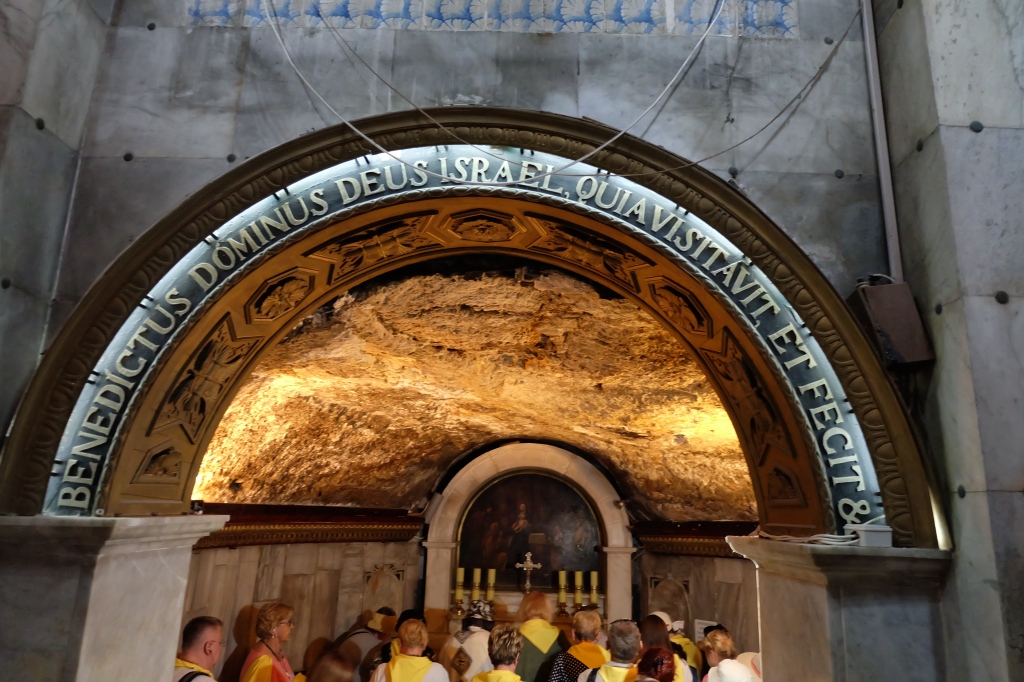
Photo by author, Church of St. John the Baptist, the Holy Land, May 2019.

We are now in our penultimate day of our Simbang Gabi. I love that word “penultimate” so often found in the sports page that means second to the last of the series.

From the Latin prefix pen- meaning “almost” + ultimatum for “last”, penultimate literally means “almost last” which gives a sense of fulfillment and of completion – exactly how we feel this eighth day of Simbang Gabi that is almost over with everything already fulfilled in our readings and prayers for Christmas.

When the time arrived for Elizabeth to have her child she gave birth to a son. Her neighbors and relatives heard that the Lord had shown his great mercy toward her, and they rejoiced with her. When they came on the eighth day to circumcise the child, they were going to call him Zechariah after his father, but his mother said in reply, “No. He will be called John.” But they answered her, “There is no one among your relatives who has this name.” So they made signs, asking his father… He asked for a tablet and wrote, “John is his name.” Immediately, his mouth was opened, his tongue freed, and he spoke blessing God. All who heard these things took them to heart, saying, “What, then, will this child be?” For surely the hand of the Lord was with him (Luke 1:57-62, 63-64, 66).

Painting of “Saint Luke Drawing the Virgin” by Flemish painter Roger van der Weyden (1400-1464); photo from en.wikipedia.org.  

See again the artistry and advocacy of Luke as an evangelist and a journalist. We can imagine the scene, experience the joy and excitement of the event in the tight-knit community with all the wonderful elements of a drama in real life.

Leading the scene is Elizabeth, the priest’s wife barren for years and beyond hope now gives birth to a son, creating excitement and gossip among the many Marites. Then Zechariah the priest who was silenced for nine months due to his doubts with the good news announced to him by the angel finally spoke praising God, filled with gratitude and wonder. And of course, the uzis (usiseros), the neighbors who shared in the joy and for a good reason and intentions wanted the baby named after his father.

That’s when Luke showed his skillful mastery of weaving together a wonderful piece of tapestry clearly designed by God that surprised everyone, including us today. “When they came on the eighth day to circumcise the child, they were going to call him Zechariah after his father, but his mother said in reply, “No. He will be called John.” But they answered her, “There is no one among your relatives who has this name.” So they made signs, asking his father… He asked for a tablet and wrote, “John is his name.” Immediately, his mouth was opened, his tongue freed, and he spoke blessing God.

Again, notice another minute detail mentioned by Luke when he called Elizabeth “his mother”.

Photo by author, Church of St. John the Baptist, the Holy Land, May 2019.

Of the four evangelists, Luke is the one who gave a lot of emphasis on the role of women in the society, especially the ancient Jewish one that was strongly patriarchal.

In the Visitation story yesterday, it was only Luke who had written a scene in the whole Bible with two women together conversing and in very positive mood. Women were so rarely put together in one scene especially in the Old Testament, a sort of what we may call as “gender bias” because women were always at odds with each other, even quarreling. Except for the Book of Ruth where we find two women not only in a single scene but a whole book and yet very pronounced there how it was Naomi the mother-in-law always portrayed in control or leading, always speaking while Ruth was silent, giving an impression of being so lovely yet very soft even submissive to elders and men.

Luke wrote the Visitation scene to clarify all these gender bias of their world then that persists even to our own time. Luke made a loud and clear statement in putting together Elizabeth and Mary in this one scene, an old, barren woman and a virgin, unmarried maiden both so blessed by God with infants in their wombs. Not only men are called by God to a special mission but most especially women who give birth. Elizabeth and Mary represent all the women of the world to remind everyone for all time that they are created in the image and likeness of God, with same dignity as men who must be respected at all times as indwelling of the Holy Spirit.

Photo by Pixabay on Pexels.com

Notice how throughout the scene from the annunciation to Zechariah and the Visitation, the wife of Zechariah was referred to by her name Elizabeth but, when controversy arose about the name to give her son, Luke emphatically wrote “his mother” to show that she has every right over her son, reaching its climax when Zechariah affirmed the mother as he wrote “John is his name.”

Think of those moments in your life when there are reversal of roles and suddenly God threw you – catapulted you – to a major role in life you only entertained in your wishful thinking and daydreaming because you have given them up, you have surrendered it due to a very long time of being disappointed like Elizabeth or Zechariah?

Think of those times when you realized, when you felt being at the center of attention for a good reason because you are good, you are so blessed, you did the right thing? How do you feel of the grace of God?

Think of those times when you did something so good that prompted others to “prepare the way of the Lord” like John the Baptist, when people around you were wondering what else you would achieve because clearly, God is with you?

On this penultimate day to Christmas, take time to speak God from your heart as you prepare for the fulfillment of His promise to you. I tell you, claim it now whatever you are asking God for Christmas. Remember what the angel told Mary at the annunciation, “nothing will be impossible for God.” Dare to open yourself to God, create a space within you for Him alone and let Him lead you like Zechariah whose name means “God remembers”, Elizabeth which means “God has promised” and John, “God is gracious.”

On this penultimate day to Christmas, we are assured God is gracious because God remembers His promise always. Amen. Have a blessed week ahead.

Photo by author, birthplace of St. John the Baptist underneath the Church of St. John the Baptist, the Holy Land, May 2019.