Lord My Chef Daily Recipe for the Soul by Fr. Nicanor F. Lalog II Wednesday, Memorial of St. Catherine of Siena, Virgin & Doctor of Church, 29 April 2026 Acts 12:24-13:5 ><}}}}*> + ><}}}}*> + ><}}}}*> John 12:44-50
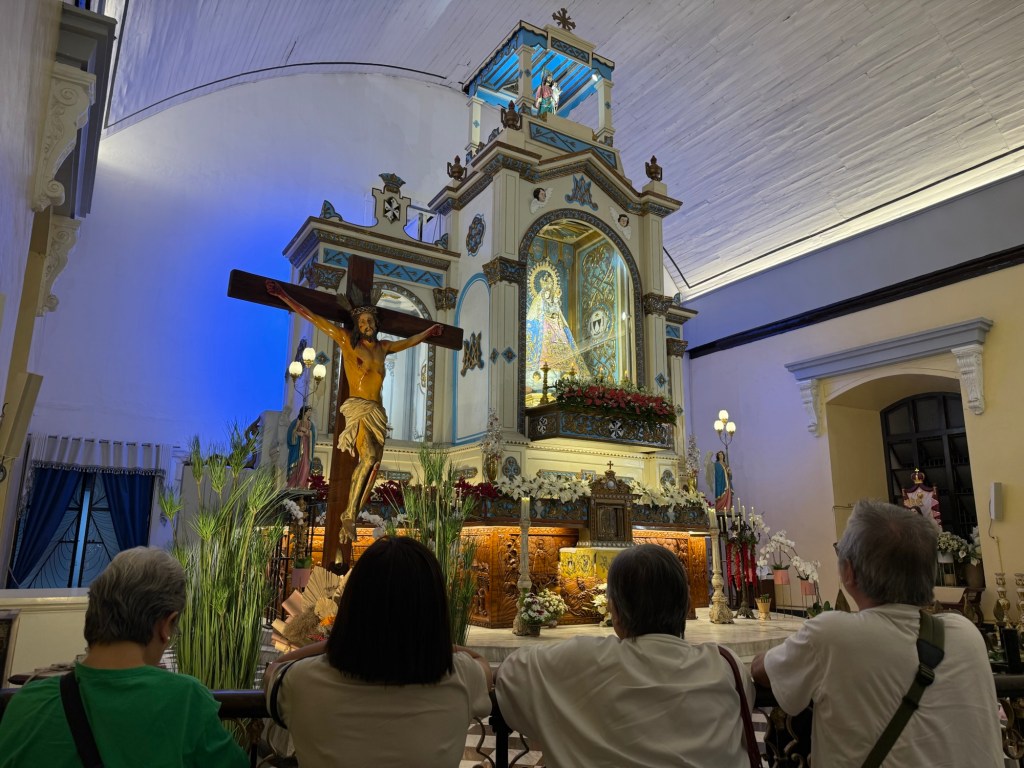
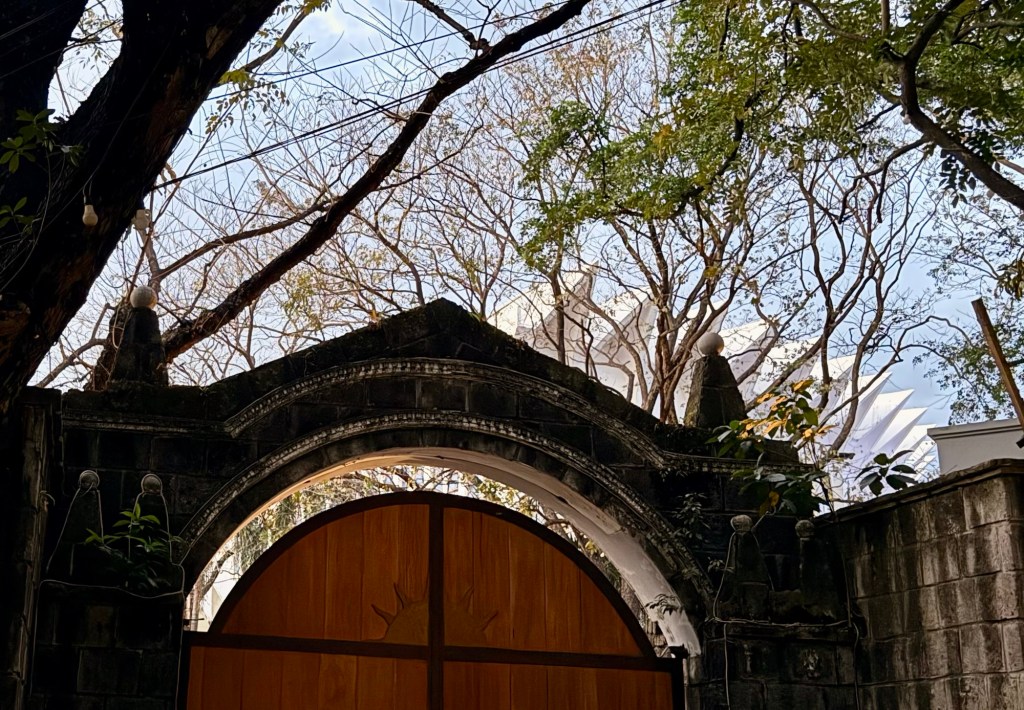
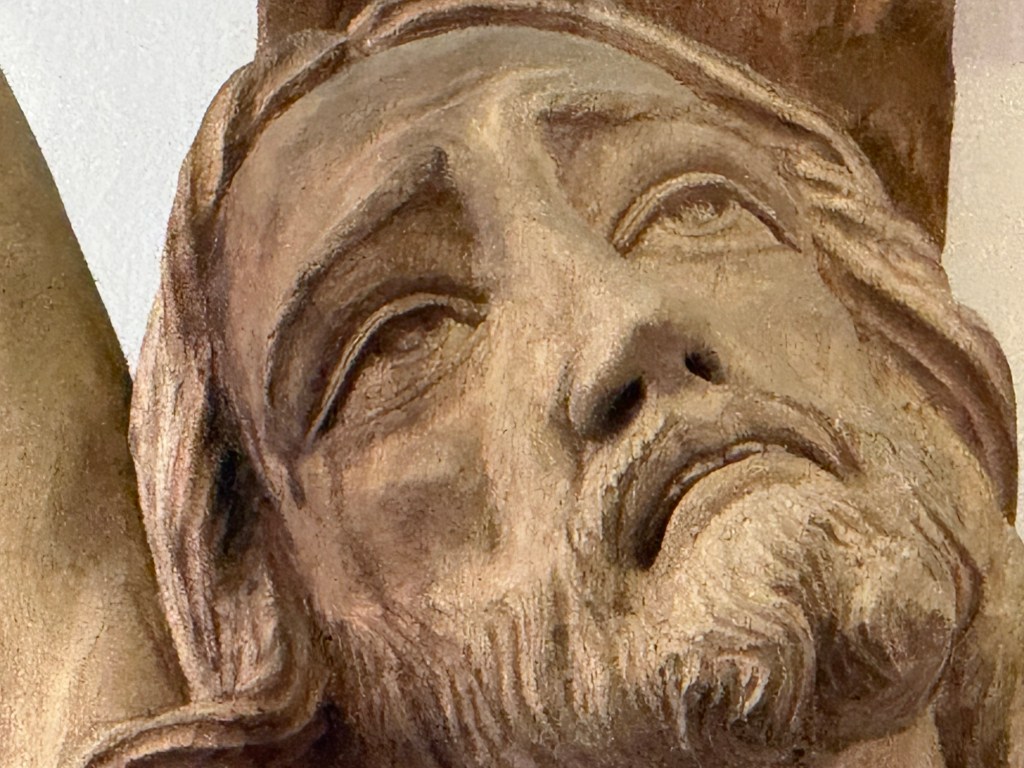
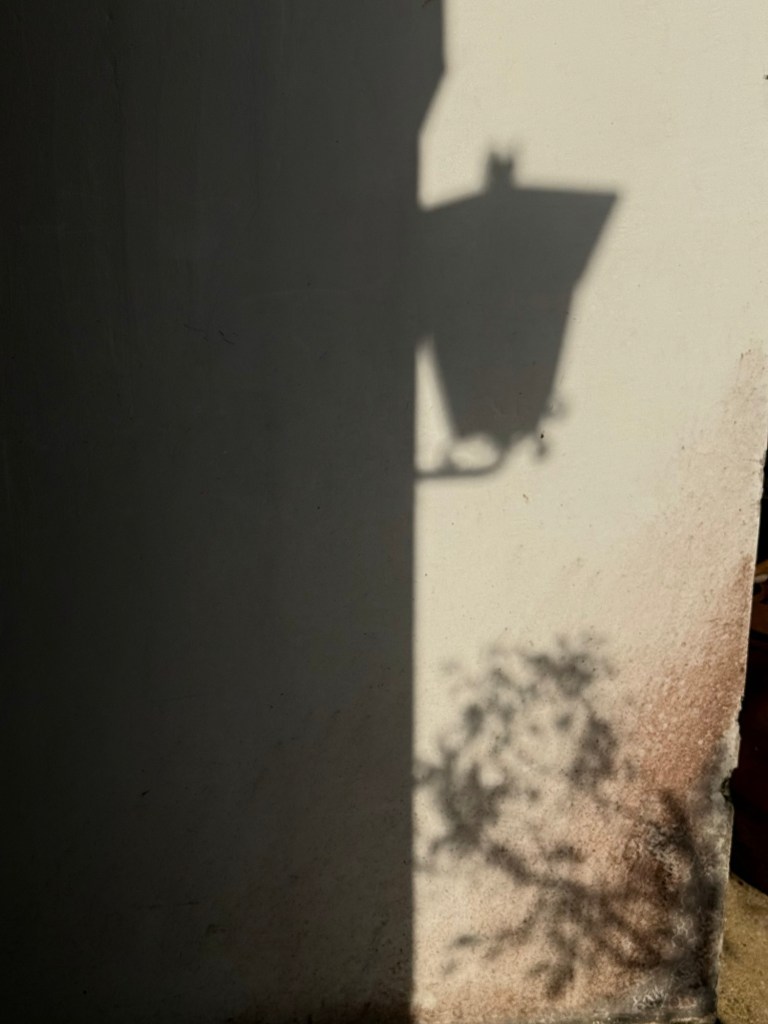
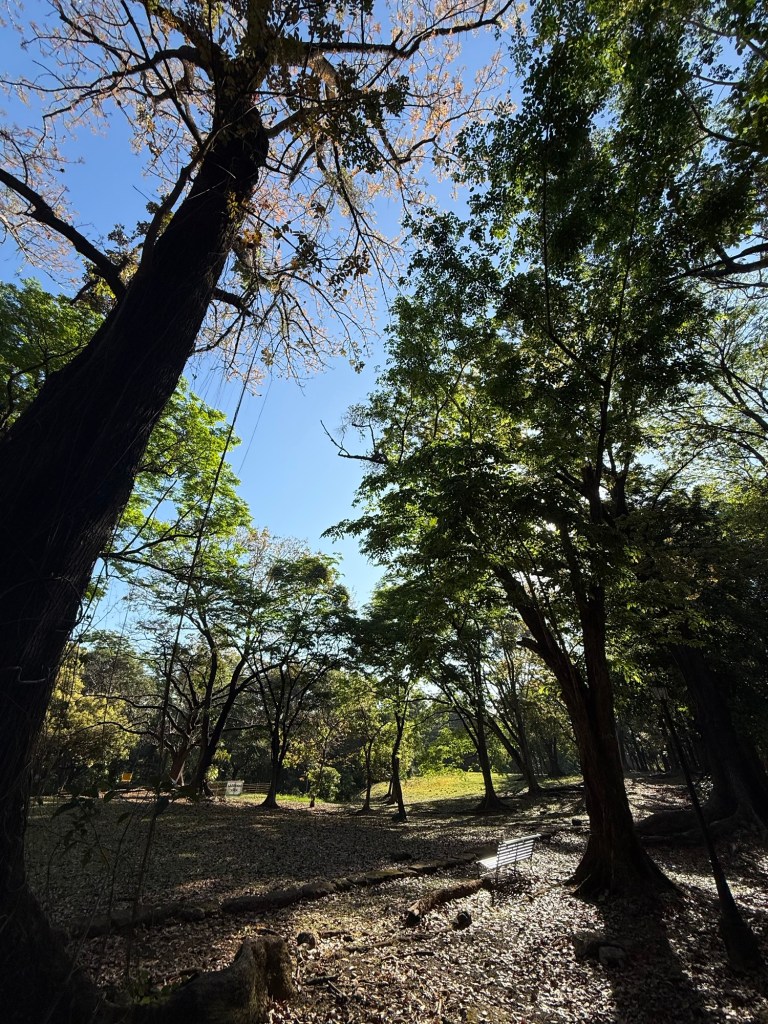
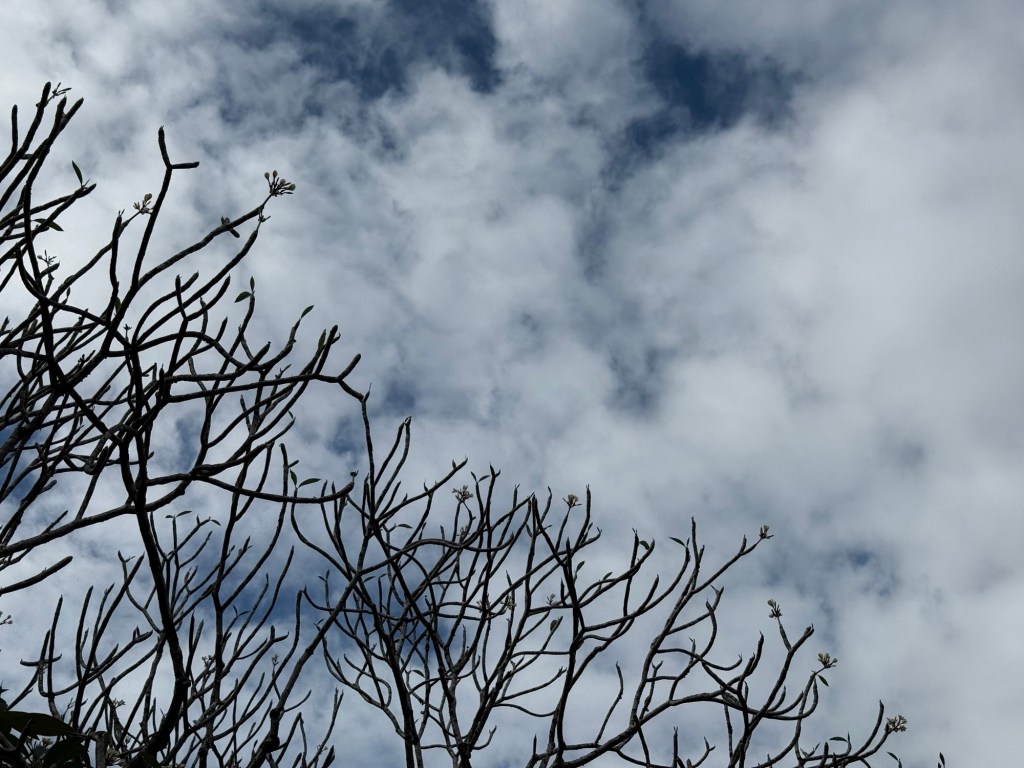
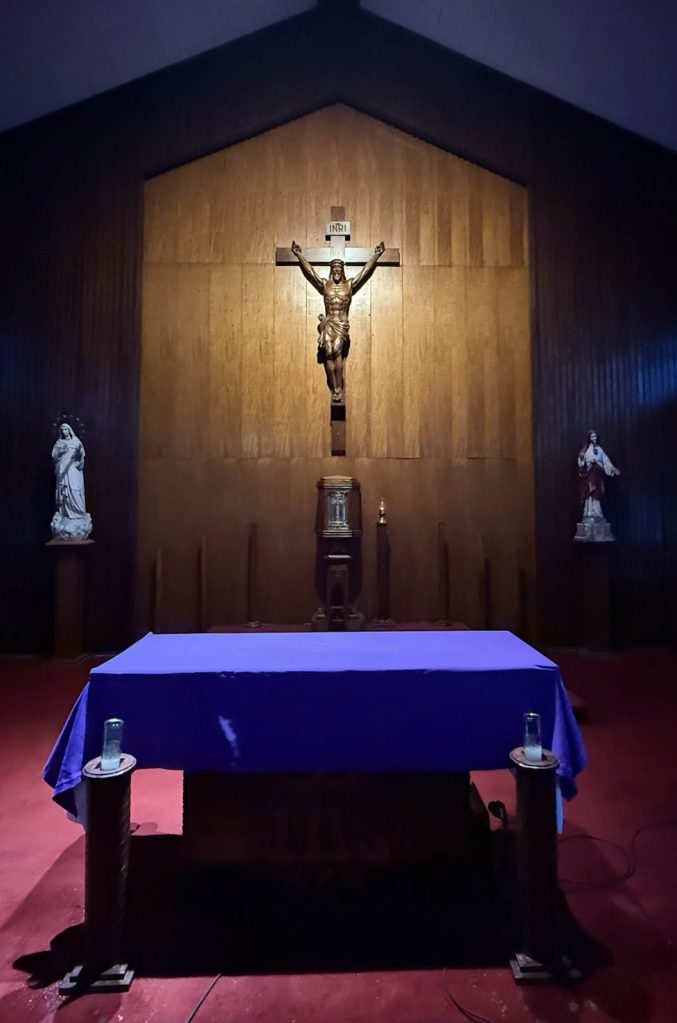
Photo by author, Bolinao, Pangasinan, April 2022.
While they were worshipping the Lord and fasting, the Holy Spirit said, “Set apart for me Barnabas and Saul for the work to which I have called them.” Then, completing their fasting and prayer, they laid hands on them and sent them off (Acts 13:2-3).
As we move in your Spirit Lord Jesus Christ, moving with you and moving to you, teach us to be set apart from the rest like what you did to Barnabas and Saul; give us the docility to follow your movement away from others we have been comfortable with in order to move where we may experience discomfort and be dislocated; give us the same grace you gave St. Catherine of Sienna who saw the whole Church as her community, recognizing the need for unity through reconciliation; in this time of too much tensions happening in the Church within and outside, give us the courage to be set apart like St. Catherine to confront the growing rifts among the clergy and the faithful.
Let us realize, dear Jesus, that sometimes we need to be set apart to speak your words that bring light into the world so darkened by sins and evil that many times I perpetrate. Amen.
Lord My Chef Daily Recipe for the Soul by Fr. Nicanor F. Lalog II Tuesday in the Fourth Week of Easter, 28 April 2026 Acts 11:19-26 ><]]]]'> + ><]]]]'> + ><]]]]'> John 10:22-30
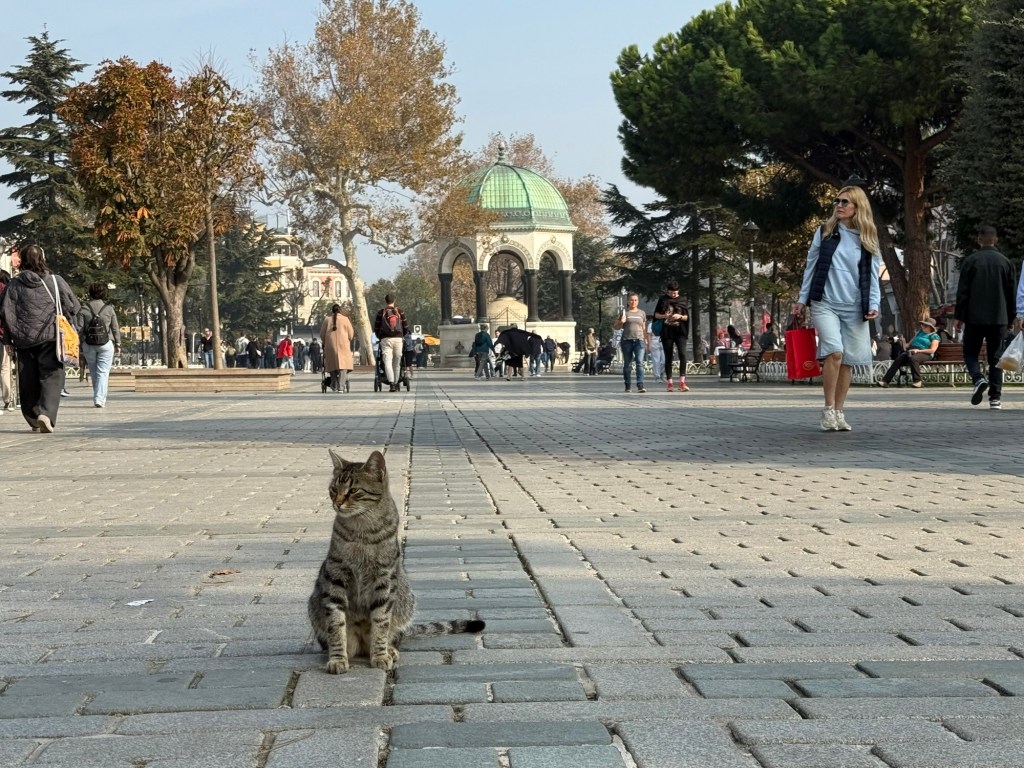
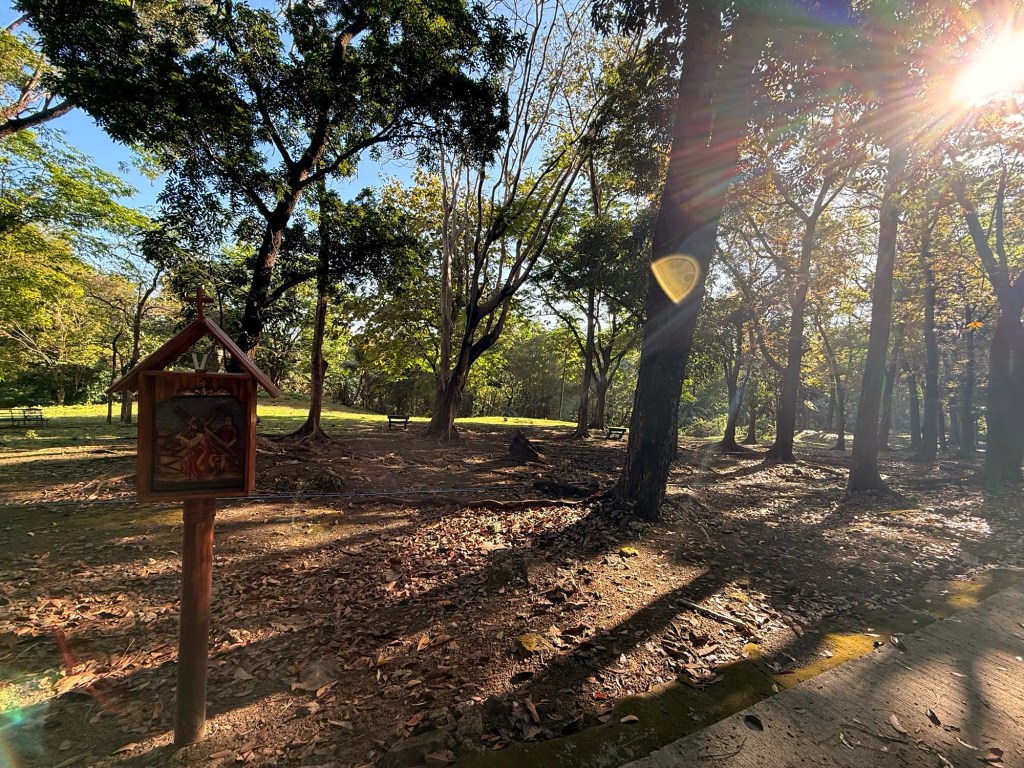
Photo by author, Fatih Square, Istanbul, Turkiye, November 2025.
Easter is about movements: of moving in Jesus, moving with Jesus, moving to Jesus.
Those who had been scattered by the persecution that arose because of Stephen went as far as Phoenicia, Cyprus, and Antioch, preaching the word to no one but Jews. There were some Cypriots and Cyrenians among them, however, who came to Antioch and began to speak to the Greeks as well, proclaiming the Lord Jesus. The hand of the Lord was with them and great number who believed turned to the Lord (Acts 11:19-21).
How lovely, dear Jesus to hear that despite the fears due to the martyrdom of Stephen in Jerusalem, your disciples moved north to Antioch now part of Turkiye not to hide but to proclaim your good news!
Strengthen my faith in you, Jesus that when things get tough, when the Gospel is challenged and dismissed, let me move boldly in upholding your message of truth of a loving God we call Father calling us to a life of holiness and freedom from sin and evil.
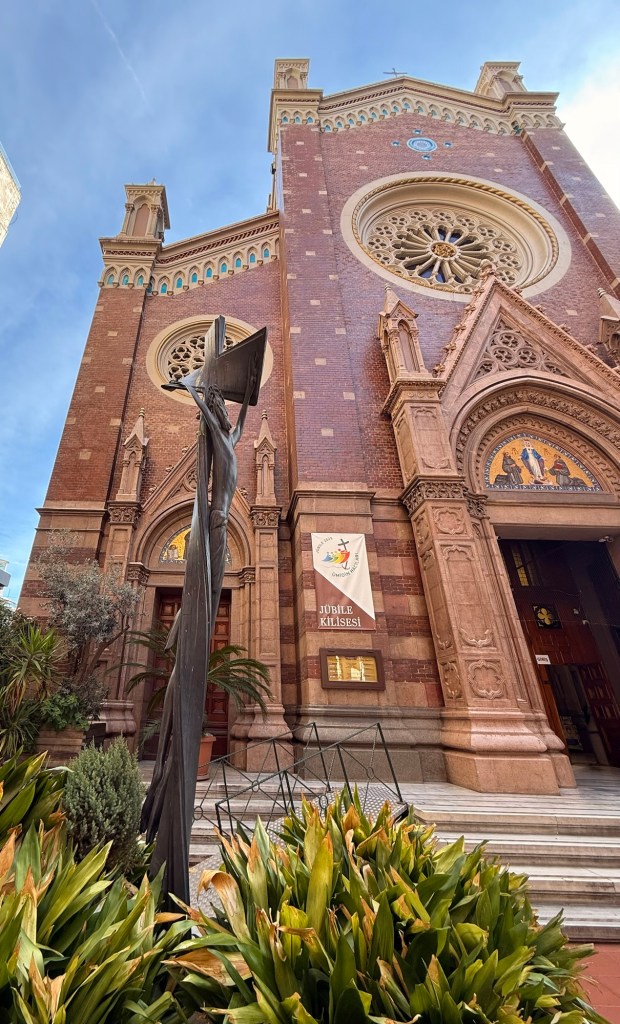
Photo by author, St. Anthony de Padua Church, Taksim Square, Istanbul, Turkiye, November 2025.
Let me move in your Spirit, dear Jesus like Barnabas filled with joy not suspicion, encouraging others to remain faithful in your teachings; most of all, let me move in compassion and brotherly love like Barnabas to search for those shy and ashamed of their sinful past like Saul who later came to be known as Paul; may our movements be more of gathering than scattering to unite and bring together other believers as one body, one community witnessing your gospel that others may know us your disciples, Christians like in Antioch.
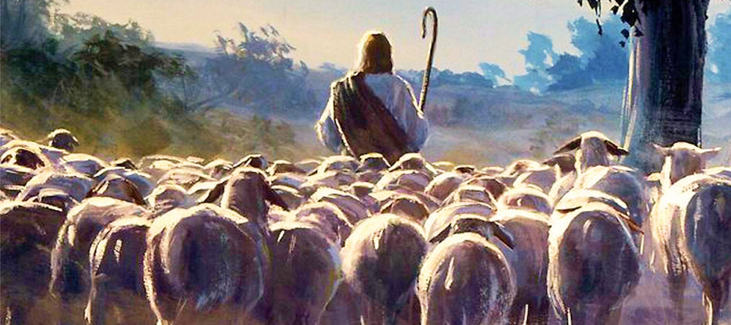
In this world with so many voices shouting and screaming for our attention to be famous, to be rich, to be powerful, teach us to be silent to distinguish your voice and call, Lord Jesus, our Good Shepherd whom we must follow in poverty, simplicity, and humility. Amen.
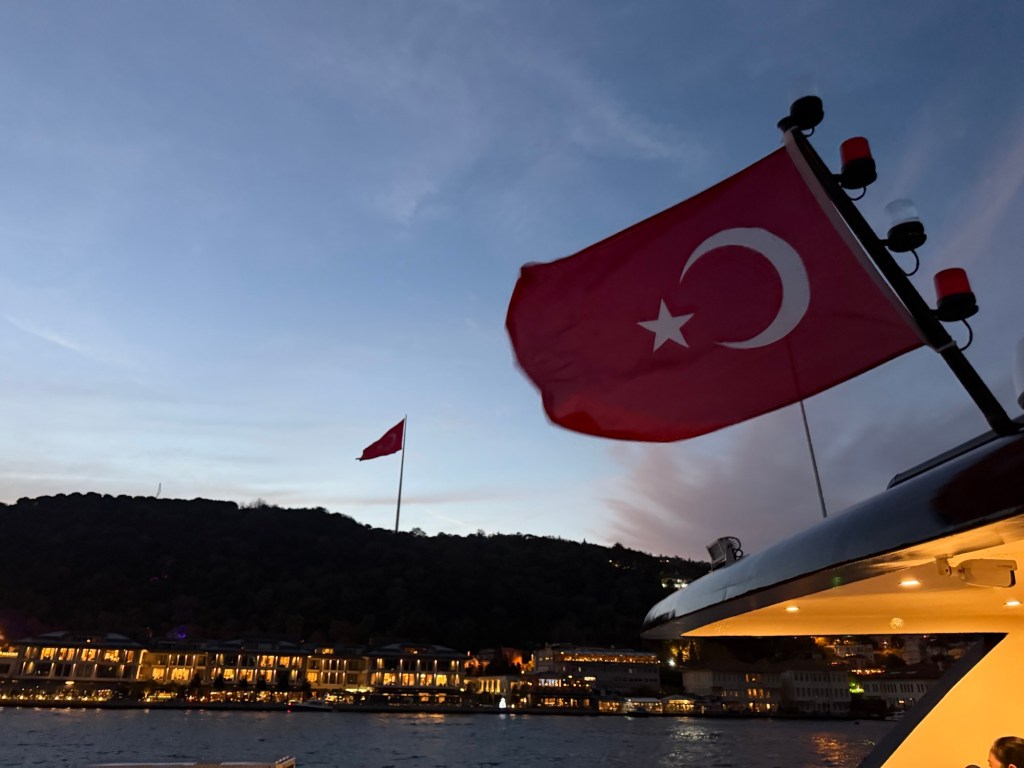
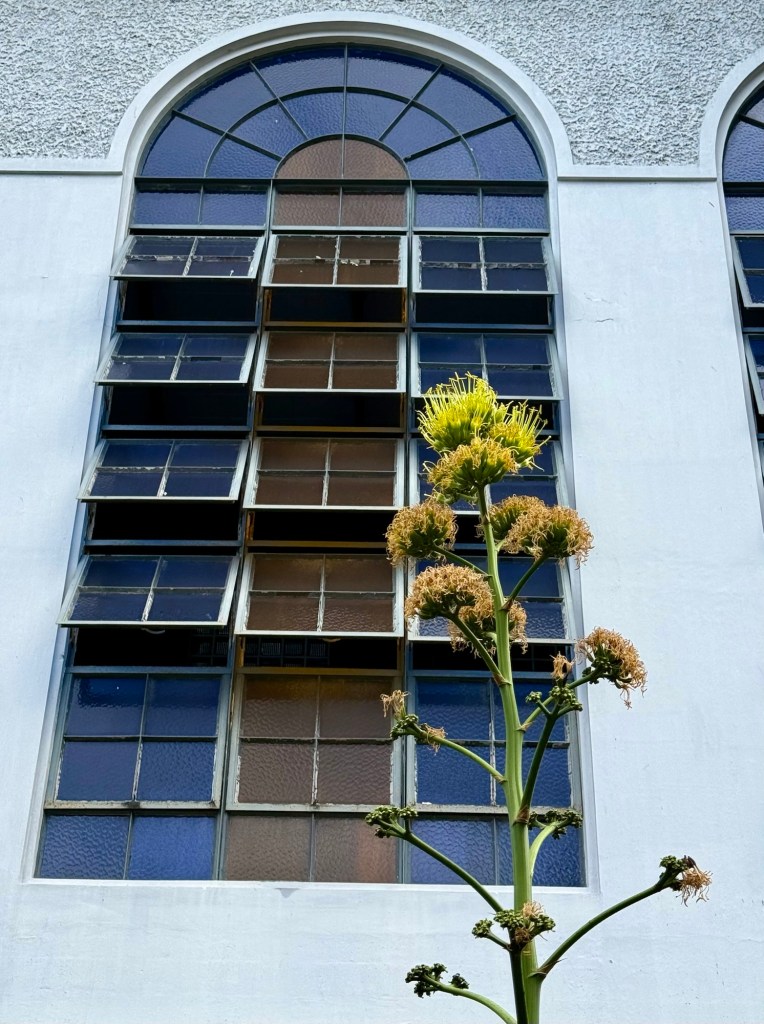
Photo by author, Bosphorus River cruise, Istanbul, Turkiye, November 2025.
Lord My Chef Daily Recipe for the Soul by Fr. Nicanor F. Lalog II Monday in the Fourth Week of Easter, 27 April 2026 Acts 11:1-18 <*((((>< + ><))))*> John 10:11-18
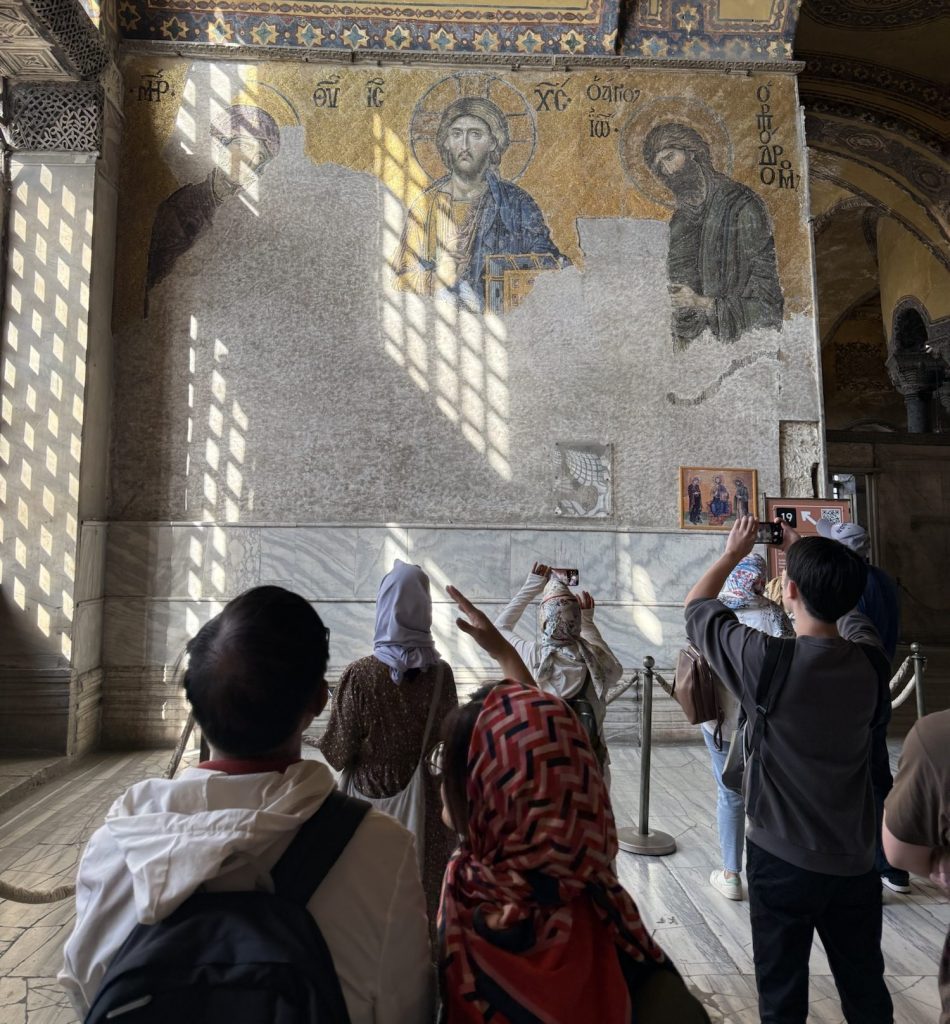
Photo by author, the Sofia Hagia, Istanbul, Turkiye, 12 November 2025.
I miss you, Lord Jesus Christ; I miss reaching out to others in prayer, sharing you with them. Like Peter in Joppa.
The Apostles and the brothers who were in Judea heard that the Gentiles too had accepted the word of God. So when Peter went up to Jerusalem the circumcised believers confronted him, saying, “You entered the house of uncircumcised people and ate with them.” Peter began and explained it to them step by step, saying, “I was at prayer in the city of Joppa…” (Acts 11:1-5).
Lord Jesus, continue to work in me, most especially, let me see you working in others too, right in their hearts, especially those different from us not only physically but most especially in background and beliefs; remind me often that God's grace cannot be contained nor limited among us nor in a particular location only; may this Easter season be an occasion for us to change how we see one another as you yourself had said, "I have other sheep that do not belong to this fold" (John 10:16).
There are so many things I need to change in myself, Jesus, our Good Shepherd especially those so different from what I have been used to like in meeting you, seeing you, and following you. Amen.
Lord My Chef Sunday Recipe by Fr. Nicanor F. Lalog II Fourth Sunday of Easter, Cycle A, 26 April 2026 Acts 2:14, 36-41 ><}}}*> 1 Peter 2:20-25 ><}}}*> John 10:1-10
Photo by author, 09 February 2026, Museo Valenzuela.
In the next three Sundays beginning today, our gospel readings will bring us back to Jesus Christ’s teachings before his passion and death because all his pronouncements then are clearest when seen in the light of his resurrection.
As we have mentioned last Sunday, it does not really matter that many or everyone would see the Risen Lord in order to believe him. Like what Jesus had told Thomas the other Sunday, blessed are those who believe without having seen him while last week we have realized in the story of the two disciples returning to Emmaus that the mystery and beauty of Easter is found in the “breaking of bread” when our eyes are opened to recognize Christ who immediately vanishes. This breaking of bread is not just the Holy Eucharist but includes our many experiences when we too experience brokenness in life like the Jews addressed by Peter after the Pentecost.
Then Peter stood up with the Eleven, raised his voice, and proclaimed: “Let the whole house of Israel know for certain that God has made both Lord and Christ, this Jesus whom you crucified.” Now when they heard this, they were cut to the heart, and they asked Peter and the other apostles, “What are we to do, my brothers?” (Acts 2:14, 36-37)
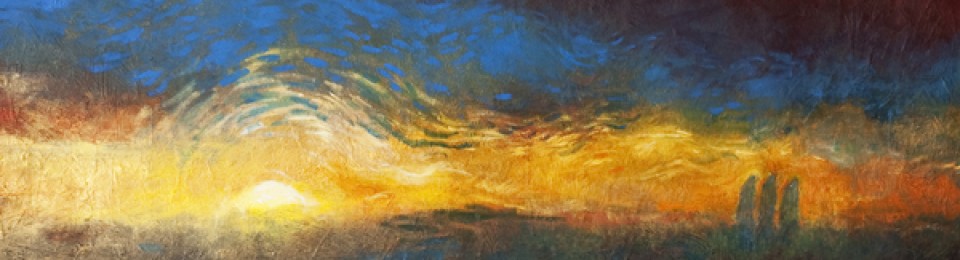
“The Road to Emmaus” painting by Ronald Raab, CSC, from ronaldraab.com.
What a beautiful expression by Luke, “they were cut to the heart” that means they were stirred, they were moved deep inside to a great reality, to a truth that led to their conversion.
It is in our own brokenness when our eyes are opened, our hearts are cut that we find Jesus and become converted.
Despite the scathing words of Peter on their sins on having Jesus crucified, the people did not feel “guilty” in the negative sense of being hopelessly mired in sin. The same thing is true with us: there are moments in life we realize deeply, truly feeling the hurt of having offended God in our many sins that actually lead us to conversion and be transformed into a better person as a disciple of Christ. True contrition does not stop in the realization and admission of our sins; true contrition always leads to conversion. Though we are broken, we are not scattered. In fact, it is in our being broken that we become one, we become whole in Jesus Christ.
Guilt buries, conversion liberates because we find Jesus as the true gate to life who leads us to freedom. In Jesus as our gate in life, we enter a new phase of being free and faithful and loving.
So Jesus said again, “Amen, amen, I say to you, I am the gate for the sheep. All who came before me are thieves and robbers, but the sheep did not listen to them. I am the gate. Whoever enters through me will be saved, and will come in and go out and find pasture. A thief comes only to steal and slaughter and destroy; I come so that they might have life and have it more abundantly” (John 10:7-10).
Photo by Dra. Mylene A. Santos, MD, at Katmon Nature Sanctuary & Beach Resort in Infanta, Quezon, 03 April 2024.
Every fourth Sunday of Easter is known as the Good Shepherd Sunday. Only John has this section of Jesus teaching actually to the Pharisees of himself as the Good Shepherd following the controversy in his healing of the man born blind on a Sabbath day.
But before Jesus spoke of his being the Good Shepherd, he first identified himself as the “gate” where the shepherd and the sheep pass through, the direct opposite of the Pharisees and priests of their time who have taken upon themselves as the final standard and arbiter of what is good and holy, of actually usurping the role of God but so stern, so strict. And impersonal.
Hence, the distinction by Jesus in this passage between “thieves and robbers” like his enemies and himself as “the gate” and “the shepherd”.
Whenever I bless homes, I always begin at the door. From the many house blessings I have made, I am not really impressed with the modern, “minimalist” doors with sleek metal handles. What fascinates me most are simple doors with bold colors like lively red or blue. For me, a door is something that exudes with security and protection, not necessarily massive, evoking power.
Photo by author, Angels’ Hills Retreat Center, Tagaytaty City, April 2025.
That’s Jesus Christ for me as the gate. My security and protection.
However, still with house blessings, I have always wondered why we Filipinos even abroad are so fond of two things so peculiar just to us: first is having a regular kitchen often for display and a dirty kitchen for daily use and second, side doors to pass through because the main door is kept locked, used only for visitors.
I think they both reveal something about our spirituality wherein we recognize Jesus our gate, our door, our shepherd yet, we still desire to have other doors and gates, perhaps even shepherds like buddhas and amulets we hung in our homes.
This we find when we examine our inner selves, the cacophony of negative voices that fill us, even entertain us like jealousy, envy, anger, resentment, bitterness, greed, and lust. There are times despite our having faith in Christ, we are filled with more negative than positive like curse than blessing, revenge than reconciliation, war than peace, and worse of all, death than life.
Photo by author, Sacred Heart Novitiate, Novaliches, QC, 20 March 2026.
Where are they coming from?
Very often, we take them for granted, allowing them to percolate inside us until they boil and burst that we hurt others, most of all, our selves in the process.
“I come so that they might have life and have it more abundantly.”
Jesus our door, our gate, our Good Shepherd invites us anew this Sunday to remain in him, to stay with him. Jesus calls us to break free from these other doors and gates that trap us within so that we may be free and faithful. Most of all, be more loving in the real sense.
Jesus invites us to examine our lives today, before having him and after having him. Like what Peter tells us in the second reading, we are reminded of the new freedom we have in Christ: “By his wounds you have been healed. For you had gone astray like sheep, but you have now returned to the shepherd and guardian of your souls” (1Pt.2:24-25).
During the Last Supper, Judas (not the Iscariot) asked Jesus why he would appear only to them and not to everyone and he replied with mysterious words, speaking about love and keeping his commandments so that he and the Father would dwell on his disciples (Jn.14:23-24). Actually, in speaking that way, Jesus was showing his disciples who include us today that his revelation is not about public display of power but of personal relationship in him based on love. In the whole discourse of Jesus during their last supper from the perspective of John, what is most essential is the love of Jesus and the love of his disciples. And this we shall explore in the next two Sundays before Jesus ascends into heaven.
Again, there is no need to see Jesus physically; the more we love, the more we believe, the more we see him in our hearts. Most especially when we pass only in him as our gate, our door to life and fullness. Amen.A blessed week ahead to everyone.
Photo by author, Sacred Heart Novitiate, Novaliches, QC, 20 March 2026.
Lord My Chef Sunday Recipe for the Soul by Fr. Nicanor F. Lalog II Third Sunday of Easter, Cycle A, 19 April 2026 Acts 2:14, 22-23 ><}}}*> 1Peter 1:17-21 ><}}}*> Luke 24:13-35
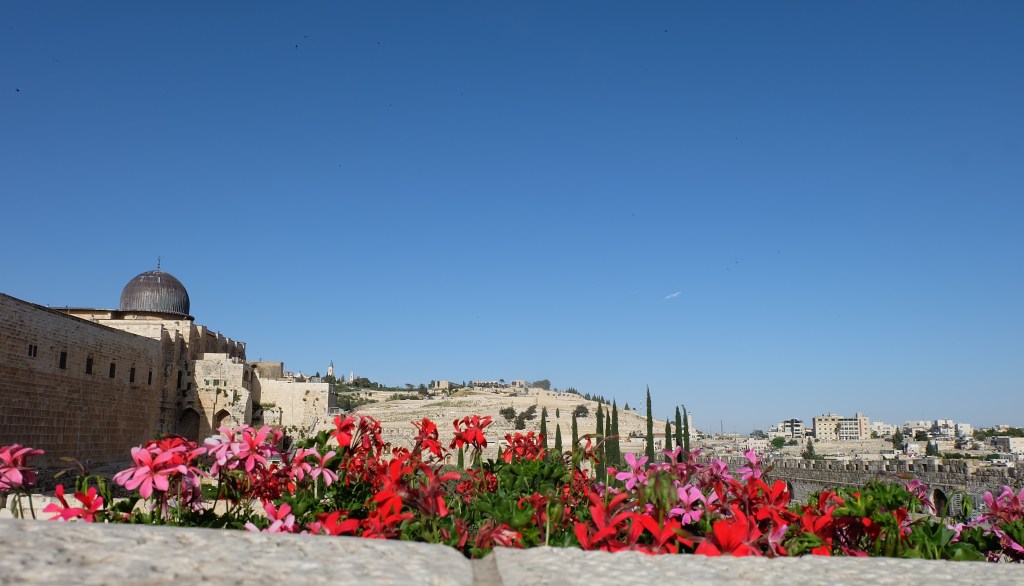
Photo by author, view from Jerusalem Temple, May 2019.
We heard last Sunday Jesus Christ’s coming to his disciples on the evening of Easter and a second time eight days later when Thomas was present, reminding us how Easter is a story of coming and believing, of believing and coming.
This Sunday we find an opposite movement and direction in the two disciples leaving Jerusalem in disbelief at the death and resurrection of Jesus Christ.
That very day, the first day of the week, two of Jesus’ disciples were going to a village seven miles from Jerusalem called Emmaus, and they were conversing about all things that had occurred. And it happened that while they were conversing a debating, Jesus himself drew near and walked with them, but their eyes were prevented from recognizing him (Luke 24:13-16).
“The Road to Emmaus” painting by Ronald Raab, CSC, from ronaldraab.com.
Easter is also about leaving in disbelief. Not necessarily because of not believin like Thomas last Sunday.
Cleopas and the other disciple were leaving Jerusalem in disbelief which our Filipino language adequately express in “hindi makapaniwala” and “matay ko mang isipin” that both indicate a strong sense of belief with a dash of doubt because the story, the event, or the very person involved is beyond comprehension.
Or, bigger than reality like Jesus Christ and his very mystery of love for us.
Many times, we could not believe how good and loving God can be to us, so personal, so real and true but how can it be he “allows” bad things to happen to us or in the world.
Like the two disciples going home to Emmaus, we walk away from God to distance from him and everything and everyone to find our selves and see the real picture of what is going on when times are rough for us.
Those are the times we silently tell ourselves “this could not be happening” especially when it is so difficult, so unbelievable simply because – we believe. Hence, our usual litany of striving to be good, of serving the poor and needy, of going to Mass every Sunday, of always praying…
Look back in our many experiences in life when we could have died or have lost more or could have been a total wreck. Amazingly, despite our being in the opposite direction in life, consciously or unconsciously, that is when we feel more blessed. That’s when we are able to declare with conviction, “hindi ako pinabayaan ng Diyos, napaka-buti ng Diyos, and binigay niya pa rin ang lahat”. This is what the first reading reminds us of Peter’s speech before the Jews at Pentecost, at how God never left us, sending us Jesus Christ as fulfillment of his promise to Abraham and David.
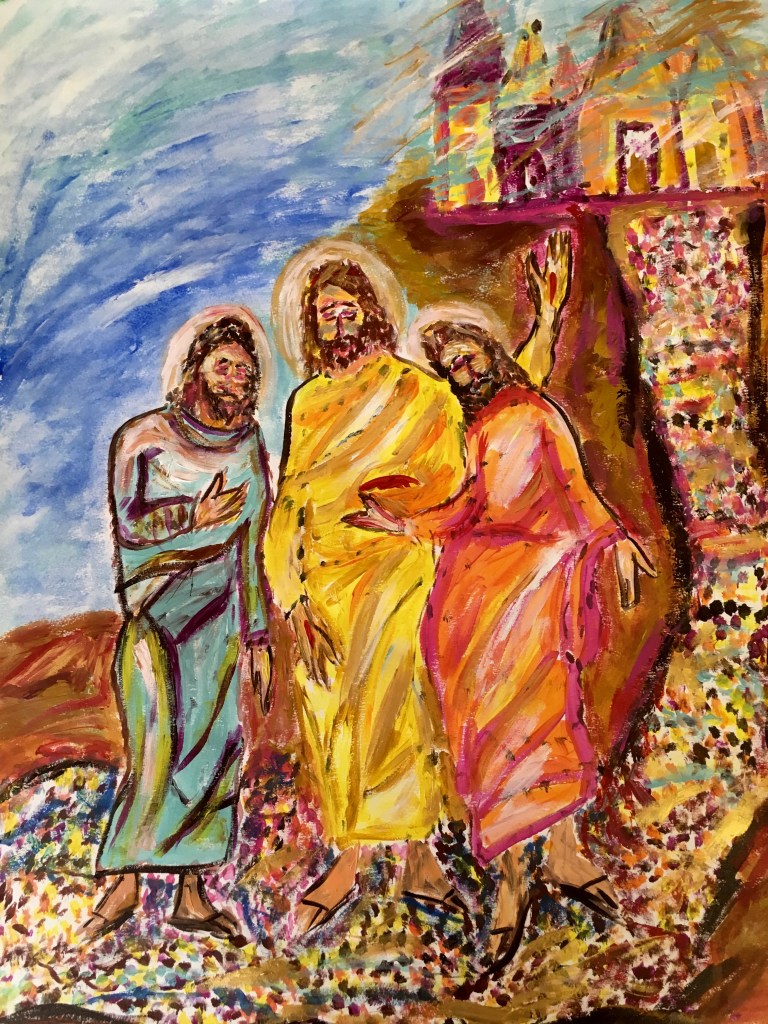
Modern painting of the road to Emmaus from the internet.
Like in the road to Emmaus, Jesus journeys with us in the opposite direction only to bring us back to Jerusalem filled with joy by reminding us how everything that happens in our lives, Jesus had gone through the same sufferings too as foreshadowed and explained in the Sacred Scriptures.
Here we are reminded of the importance of personal prayer which is more than the mere recitation of prayers but having a relationship in God who never leaves nor abandons us.
Most of all, here we are reminded too of how the Sunday Eucharist opens ourselves to Christ’s reality and loving presence among us as experienced by the two disciples after Jesus had broken bread with them. It is called a Holy Communion because in that “breaking of bread”, we share in our common experiences of suffering and death. That we are not alone. Most of all, that we too like others rise to new life in Jesus Christ who suffered, died, and rose to life first for us.
It can happen that our eyes too are prevented from recognizing Jesus like Cleopas and companion on the road to Emmaus because of our many fixations in life like that blessings can only be in positive things like good health, security like steady income, a rising career or a profitable business and endeavor.
But, experience has taught us so many times that blessings are not only found in good things but even in bad or negative ones like sickness, failures, losses and death. And when we look back, they were not really that bad at all because it was in our failures and losses, sickness and deaths when we realized and learned most in life.
Notice how Luke succinctly narrated the breaking of bread in the home of Cleopas in Emmaus, it was so swift unlike the building up of drama along the road to Emmaus. It was so simple because that’s how things happen in life too – so quick that the simplest things and gestures, even so bad can suddenly become so loaded with meanings that we realize God’s loving presence in us.
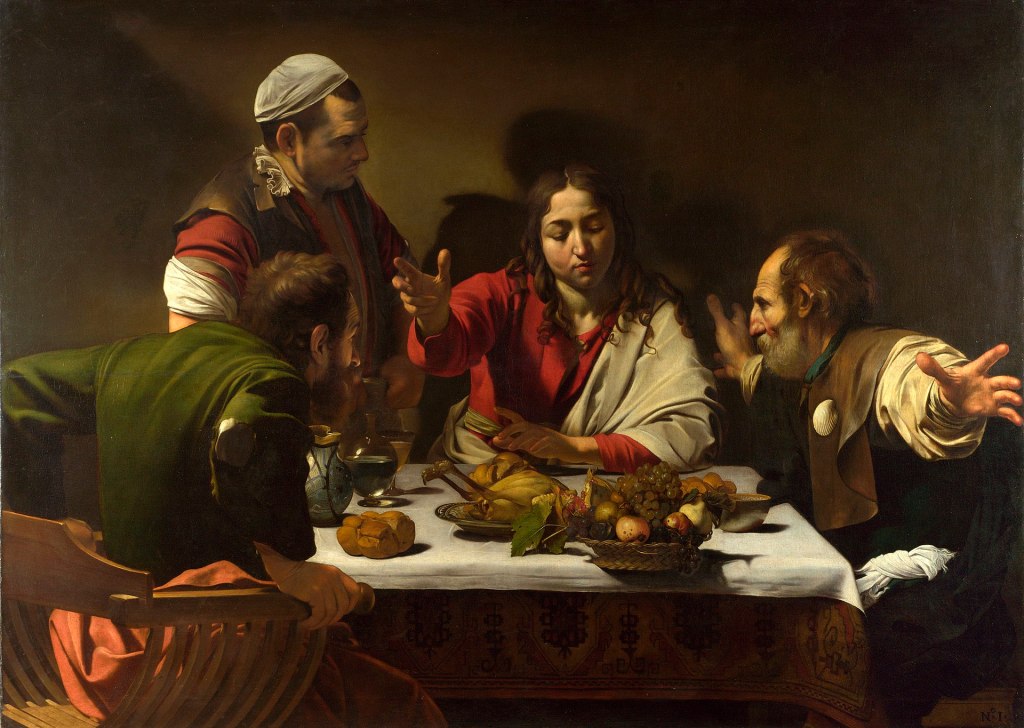
“Supper at Emmaus” by renowned painter Caravaggio. See the emotion depicted by Caravaggio with his trademark of masterful play of light and shadows. At the center is the Risen Lord blessing the bread that caught the two disciples who are seated in disbelief, one outstretching his arms and the others pushing back in his chair. The third character in the painting is the innkeeper unaware of the significance of the gesture of Jesus. It was at this instance that the two disciples recognized Christ as the travelling man with them to Emmaus.
During the COVID pandemic, on the first Sunday of lockdown when there was no public Mass, I started a motorized procession of the Blessed Sacrament in my former parish by mounting our big monstrance on the roof of a parishioner’s truck. I announced the route of our procession during our online Mass that Sunday and people waited.
What an amazing sight of the people’s deep faith in God as they knelt and bowed before the Blessed Sacrament whether on the main highway or the inside streets. Some were crying while everyone was deep in prayer.
There lies the great mystery of Easter: Jesus need not appear to us in person because as he vanishes in the Blessed Sacrament, that is when we recognize him!
In the most simple gestures of the Mass under the most simple signs of bread and wine, Jesus vanishes from our outward view and through this vanishing our interior or inner recognition opens up that we “see” him in the many instances he had touched us especially in our “heart-breaking” experiences in the past, our Emmaus road.
Photo by Ms. Anne Ramos, 22 March 2020, Bagbaguin, Sta. Maria, Bulacan.
We know with certainty that “it is the Lord” – Dominus est – present in every breaking of bread because part of the Easter mystery tells us deep within that it is only in his vanishing that he truly becomes recognizable to us. That is why we have to stop all those “theatrics” in our liturgy as noted by many netizens this past Holy Week and Easter. Unknown to many priests and their alalays, the more we have gimmicks in the Mass or even in our sacred spaces, the more we “displace” and remove Christ.
After an hour every Sunday, we leave the Mass and go back to our usual way of life, facing life’s many challenges. Peter reminds us in the second reading to hold on to that “faith and hope in God” who gave us Jesus Christ, “the spotless unblemished lamb.”
Let us not forget this mystery of Easter that, the more Jesus vanishes, the more we recognize him because Jesus is more than enough than anybody or anything else especially when we in our Emmaus experience. Let us pray like Cleopas and companion “Stay with us, Lord” so we may show him in our witnessing especially when we could not find him in others. Amen.
From Facebook, 21 April 2021: “There is an urgency to announce the Joy, the joy of the Risen Lord.”
Lord My Chef Easter Recipe by Fr. Nicanor F. Lalog II Second Sunday of Easter, Divine Mercy Sunday, 12 April 2026 Acts 2:42-47 ><}}}*> 1 Peter 1:3-9 ><}}}*> John 20:19-31
Photo by author, Don Bosco Batulao, Batangas, 07 April 2026.
My dear friends, while praying over the gospel this week, this line by the Lord kept on echoing within me. And every time it would echo, the Lord shortened the sentence like these:
“Have you come to believe because you have seen me?”
“Have you come to believe because…?”
“Have you come to believe…?”
“Have you come…?”
Easter is a story of coming and believing amid all the darkness and emptiness in life, of being locked inside like the disciples when Jesus came to visit them “On the evening of that first day of the week, when the doors were locked.”
Before we can stay and remain in the Lord, we must first come. Like Thomas.
Or Jesus who actually comes first because he believes in us his disciples.
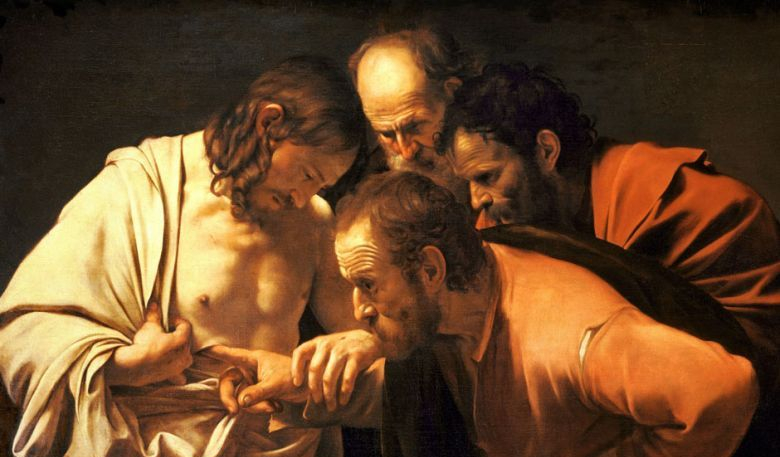
Now a week later his disciples were again inside and Thomas was with them. Jesus came, although the doors were locked, and stood in their midst… Then he said to Thomas, “Put your finger here and see my hands, and bring your hand and put it into my side, and do not be unbelieving, but believe.” Thomas answered and said to him, “My Lord and my God!” Jesus said to him, “Have you come to believe because you have seen me? Blessed are those who have not seen and have believed” (John 20:26, 27-29).
Caravaggio’s painting “The Incredulity of St. Thomas” (1602) from en.wikipedia.org.
We are now on the eighth day of Easter also known as Divine Mercy Sunday that was instituted by St. John Paul II in May 23, 2000 as a “perennial invitation to the Christian World to face with confidence in divine benevolence the difficulties and trials that humankind will experience in the years to come.”
This we can see in Thomas also known as Didymus who was not present when Jesus first came to his disciples on the evening of Easter. See how Jesus as the one actually coming first because he is also the first to believe in us his disciples despite our many flaws. And absences or tardiness.
Joining his fellow disciples, Thomas came and believed on the eighth day after Easter. What Thomas had asked as proofs to believe in the Lord’s Resurrection were not really doubts to be taken negatively. It was not that Thomas did not believe but in fact, he wanted to believe more.
That is why he came the following Sunday. Because he believed.
Photo by author, Sacred Heart Novitiate, Novaliches, QC, 20 March 2026.
Like us, there are times we feel at a loss in our faith in God when difficult and extraordinary things happen to us. We cry in desperation to God, seemingly doubting his presence or if he listens at all to our pleas but we come to pray because we believe. We cry only to someone we believe who can help us in our plight.
Coming and believing happen simultaneously: we come because we believe and we believe that is why we come.
Believing is more than an intellectual assent to a person or something.
Believing is entering into a relationship. There is something deeper that happens when we believe that is why we are moved to come, to draw near especially to a person.
When Jesus told Thomas “do not be unbelieving, but believe”, it was not a reproach but more of an exhortation he tells us too today to be intimate with him, to stay with him, to remain in him.
While the world tells everyone that to see is to believe, Jesus tells us that it is when we believe him, when we believe in him that we shall see. Even more. And clearly!
Photo by author, Sacred Heart Novitiate, Novaliches, QC, 20 March 2026.
Believing is not actually concerned with proofs and evidence because whether with God or with another person, despite the many “proofs” we have gathered from all sources, none of them is actually the reason for our faith in God and with others. Or whatever like our vocation and profession.
Believing is the gift of faith nurtured in our relationships with God and with others.
It often starts so simple like when we pray the Apostles Creed and say “I believe in God” – in our believing and relating with God, we love, and love, and love even more even if there are pains and sufferings.
This we nurture by imitating the early Christians who devoted themselves to the teachings of the apostles that have been handed down to the Church, in communal life, and in the “breaking of the bread and prayers” which is the Holy Eucharist, the summit of our life as disciples of Christ (first reading).
That is why Peter in the second reading is all praises to those who believe and love Jesus even without having seen him: we continue to strive and persevere in life’s many trials because deep inside we experience the truth and realities of Christ’s resurrection, of his loving presence among us that leads us to profound joy and rejoicing in life. Most of all, with peace, the supreme gift of the Risen Lord.
Photo by author, Sacred Heart Novitiate, Novaliches, QC, 20 March 2026.
Last March during my annual silent retreat as I turned 61 years old, my last reflection was Luke’s account of the Road to Emmaus, the gospel every evening of Easter.
In my meditation, I imagined myself joining the two disciples walking home to Emmaus. I was silent all throughout the journey, listening to their conversations until after the breaking of the bread in their home that opened their eyes to finally recognize Christ who had then vanished so quickly.
It was then when I actively joined the scene, telling the two disciples to return right away to Jerusalem. In my meditation, I felt the two disciples saying it was so dark and dangerous to travel back to Jerusalem. But I insisted, telling them, “maski na, tayo na!”
It was a turning point for me because for the past many years every time I go on my personal retreat and in my prayers, I always expressed to God my many fears in doing his will, refusing to follow him. I have always been like Jonah ever since in my relationship with God.
Last March was different. As I turned 61, I have come to believe more because I have become more daring.
There are still those fears in me about God’s will and plans but this time, I am no longer so concerned about my self but God alone – his will, his plans. And that is only when I felt truly at peace. Indeed, as John concluded his gospel today, Jesus does so many other things in our lives that is impossible to record but these few experiences we have of him are meant for us to believe him more, have life in him. Especially peace. Amen.
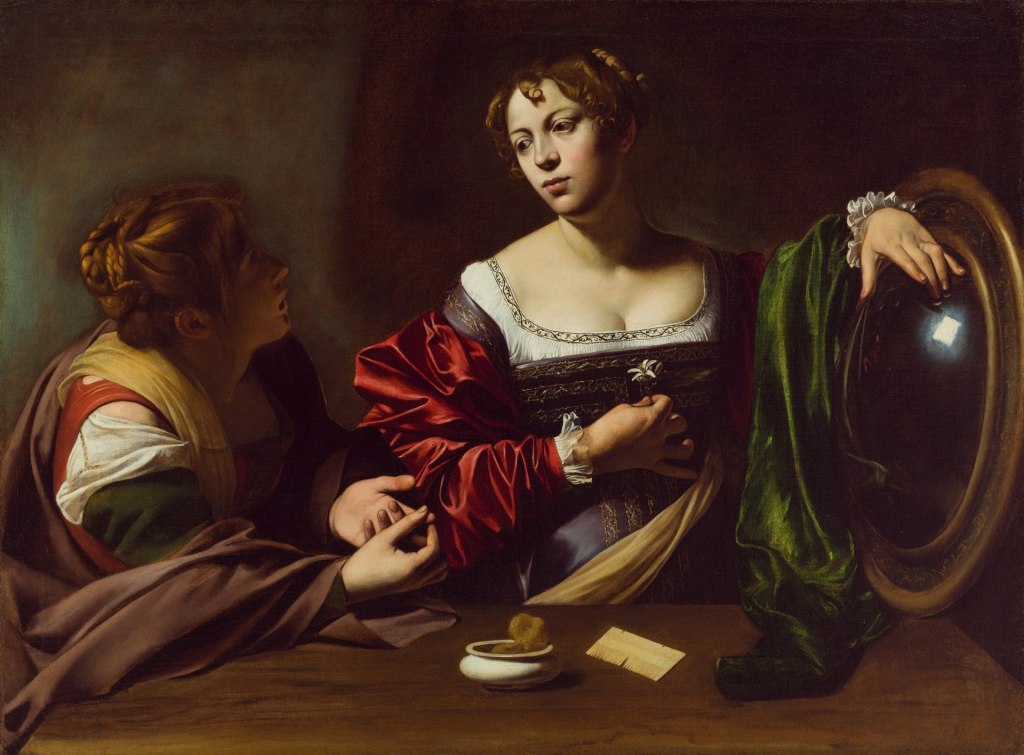
Photo by author, Sacred Heart Novitiate, Novaliches, QC, 20 March 2026.
Quiet Storm by Fr. Nicanor F. Lalog II, 05 April 2026
Photo by author, La Mesa Dam seen from Seventh floor of Our Lady of Fatima University in Lagro, QC, 12 March 2026.
Every year on my birthday, I go on a personal silent retreat. A vacation with the Lord. As I turned 62 last March that is said to be truly when one is considered “old”, I felt like those women not finding Jesus in the tomb at Easter when an angel told them, “He is not here, for he has been raised just as he said. Come and see the place where he lay” (Mt.28:6).
From then on, March 16-21, I have opted not to blog daily, preferring to rest and pray more until I find Jesus anew in my blogging
It was only on this Easter evening after returning from another retreat during the Holy Tridum that I have started to write anew, feeling like Cleopas and his companion sadly walking home to Emmaus, feeling Jesus is not here.
Photo by author, Sacred Heart Novitiate, Novaliches, QC, 20 March 2026.
I have been writing my homilies for 28 years since my ordination as a deacon. As an “old school” plus the fact of my being a former journalist, I have always been writing in preparing homilies and talkds for the people. That is why I always wear polo with a small pocket to put my small notebook and pen.
After discovering the internet in 2000, I began sending weekly homilies as emails to family, relatives, friends every Sunday to help them prepare for Sunday Mass.
Then in 2018 while head of the diocesan commission on social communications, I started this blog, Lord My Chef, to evangelize more people faster. It has always been clear with me that writing is a gift from God that I must use for his greater glory so that more people may experience even in the net his joy and mercy, healing and forgiveness, and loving presence.
Moreover, I have intended Lord My Chef to be “Spiritual recipes for the soul to gladden your heart” with daily recipes that are homilies expressed in prayer with straight homilies on Sundays and special feasts.
But lately, there was no more gladness in me.
Blogging has become tiring, even stressful.
No more joy as demands replaced the love I used to have in writing.
Because I have been self-centered.
Photo by author, Sacred Heart Novitiate, Novaliches, QC, 20 March 2026.
During my recent retreat, I also felt like Judas Iscariot betraying Jesus in exchange of the statistics of my posts, foolishly competing with myself comparing the daily, weekly, monthly and yearly metrics of my posts.
And yes, many times I felt sad why so few “like” my posts unlike other bloggers I follow and visit.
As I prayed before the Blessed Sacrament on the first day of my retreat last March, I felt being hit so hard in my heart by the Holy Spirit, of how I have been like Simon Peter denying Jesus so many times in my blogs supposed to be about him but have become more about myself.
Noble intentions are never enough because no matter how great and good are our plans even our efforts but when God is nowhere, then it is nothing.
It is a farce because despite the statistics and tangible results we have on whatever we do but if our hearts remain empty and far from God, it is nothing.
St. Paul said it so clearly in the 13th chapter of his first letter to the Corinthians, “If I have not loved, then I am nothing.”
That night, I wrote on my journal what I told Jesus in my colloquy, “I pray to blog, not for God.”
There was shame but also peace and freedom in my heart that night.
Photo by author, Sacred Heart Novitiate, Novaliches, QC, 20 March 2025.
Finally, I have found what – or who – was missing in my blogs and life itself that I have become so tired, confused, even many times lost.
God.
Some times, we can feel so well in life, obeying and doing God’s will but still feel something missing deep inside.
Or something isn’t right at all.
We may feel so happy but never fulfilled. Even successful as seen by others but not fruitful personally deep inside.
Because we lack Jesus in us and in our work and mission or ministry.
It happens when we consciously or unconsciously shift focus and attention into ourselves and other factors aside from God who is the very essence and reason of our mission and undertaking.
Worst, we may be acting or living already as if we are God.
No more Jesus who is our voice, our word, our point of view.
Most of all, our Message.
That’s the good news of Easter with Mary Magdalene and the other Mary: though they have seen the death and burial of Jesus, they still came to the tomb to anoint him with perfumes and oil. Why when he was already dead and buried in the tomb?
Because they missed him a lot, and must have mostly believed he would rise again
Is it not what we also feel with our departed loved ones, asking God even for a short glimpse or fleeting feeling to see them again for us to be assured they are here.
When the angel told Mary Magdalene and the other Mary that Jesus is not here, he was telling them too he is out there, so alive somewhere we have to find and follow.
And that is how I now feel about my blogging: Jesus is not here.
Because Jesus is risen, calling me to find him first in my blogs.
And inviting me to follow him in new directions in my ministry so that perhaps, I may write new things, new experiences, and new life in him. Amen.
*So grateful to fellow bloggers I follow and admire who have helped me find God in their writings especially Rainer, Nicola, Daryl Madden, Sr. Rene, and Pinoy Transplant in Iowa.
Empty tomb concept from iStockphoto.com, April 2022.
Lord My Chef Wedding Recipe by Fr. Nicanor F. Lalog II Homily, Wedding of Ellah and John Victor Santuario de San Jose Parish, Greenhills, Mandaluyong 27 December 2025
A former student in our girls’ high school invited me to officiate her wedding last December 27, 2025; we were supposed to meet December 20 before my Simbang Gabi in our university chapel for my formal invitation when her father died suddenly that same afternoon while on a trip down south with his fellow big-bikers.
Ellah was so devastated with the news, wanting to reset her wedding. She has been working overseas for the past three years and had saved enough for her wedding day. Her only request from her parents who have separated when she was in elementary was for them to be together when she gets married. And they willingly obliged for their unica hija. And then tragedy struck exactly a week before her wedding day that happened to be the feast day of St. John Evangelist, the beloved disciple of the Lord. Sharing with you my homily on that bittersweet day of wedding of a beloved student and funeral of her father.
Congratulations, Ellah and JV on this most joyous day of your lives.
I know, it must be so difficult for you, Ellah but I am so glad that you still pushed through with your wedding today as planned. Your dad would not be happy if you had this postponed.
Showbiz ka rin talaga, Ellah!Parang cine – a wedding and a funeral.
But, let it be clear with you both, Ellah and JV that God willed it for you get married today on the feast of Jesus Christ’s beloved disciple St. John the Apostle and Evangelist. God wanted you to be married this day – not next year nor next month, nor last year. This is the day that the Lord has made for you to seal your love at His altar in this beautiful church because God has great plans for you, Ellah and JV.
Our gospel is so beautiful – the story of Easter when Jesus Christ rose from the dead.
On the first day of the week, Mary Magdalene ran and went to Simon Peter and to the other disciple whom Jesus loved, and told them, “They have taken the Lord from the tomb, and we don’t know where they put him.” So Peter and the the other disciple went out and came to the tomb (John 20:1,2-3).
“The Three Marys” (1910), painting by American Henry Osawa Tanner from biblicalarchaeology.org.
Here we find a most beautiful image of human relationships, of how a woman needs a man, and a man’s readiness to be at her side, to comfort and accompany the woman.
Just like you today, Ellah and JV.
Of course, Mary Magdalene and Simon Peter were both disciples of Jesus. They have no romantic relationships. But, the mere fact that Mary thought of reporting the missing body of Jesus to Peter being the leader of the Apostles speaks a lot to us these days when gender equality is overextended.
A woman needs a man for leadership that is why he is the man of the house. This we find in the rite of putting on veil on the newly-weds: only the head of the woman is covered because in every family, in every couple there is only one head, one leader – the man. Wherever there are two heads, it means there is a monster. There can be no order in any relationship when everyone is the leader or the head. This is most especially true in every couple.
However, let it be clear too that these mutual need of woman for man and man for woman is always governed by love which is more than a feeling but a decision, a meeting of one’s mind and heart. If your read the letters of St. John like what we have in our first reading today, you will realize three important lessons by the beloved disciple about LOVE:
Ellah and JV, remain rooted in God for “God is love.” If there is one thing you have found so clear in your lives since college, Ellah and JV, God has always been there with you. His abiding love never forsake you both, especially in your most trying times. Keep serving Him in your parish, in your lives, in your married life. Handle life with prayer.
Second, St. John tells us that love is not merely said in words but proven in deeds and works.
Walk your talk of “I love you.” One of the things I ask couples preparing for marriage is, who should be the first to greet, to speak when you have an LQ? Sino dapat maunang kumibo kapag nag-away ang mag-asawa o magkasintahan?
Many say it should be the man but I ask them whatever happened to the principle of ladies first? On the other hand, some say whoever caused the quarrel must be the one to apologize but the problem is, would anyone admit fault? The answer is simple but difficult to practice: whoever has more love to give must be the first to blink, must be the first to make the move. Love in any relationship is not a competition. Just keep on loving and loving. Show and make your love felt in actions. Not just words.
Third, very clear with St. John that love is always self-giving.
The true measure that you have loved is when you are able to love somebody else more than yourself. Love is always the giving of self.
In another part of his letter, St. John beautifully wrote that “No one has ever seen God. Yet, if we love one another, God remains in us, and his love is brought to perfection in us” (1Jn.4:12).
Remember, Ellah and JV, Jesus is always between the two of you, not in front nor at your back. Whatever you do to each other, you do it first to Jesus. When you work hard JV and become patient with the tantrums of Ellah, you first become loving to Jesus and then to Ellah. The same with you Ellah: when you take care of JV, when you cook his favorite meal, you are first loving Jesus then JV. But, the moment you become mean to each other, when you become unfaithful to each other, Ellah and JV, you become unloving first to Jesus and then to each other.
Wedding is not everything, Ellah and JV. There will be dark days and difficult times ahead of you, just like now as you grieve at the death of your dad, Ellah.
But, remember Ellah and JV your gospel today: Easter happened when it was dark; the tomb was empty because Jesus had risen from the dead. Like in life, whenever it is dark and empty, hold on to each other Ellah and JV, have faith in God for there in your midst is Jesus Christ.
Never lose hope in life; as I used to teach you Ellah in high school, hopelessness is the opposite of love, not hatred. The moment you find no hope in everyone and in everything, then you stop loving and that is when you start destroying everything and everyone. Never lose that hope and you will always find love, Ellah and JV. God bless you more and blessed Merry Christmas!
Lord My Chef Daily Recipe for the Soul, 22 July 2025 Tuesday, Feast of St. Mary Magdalene, Sixteenth Week in Ordinary Time Song of Songs 3:1-4 ><}}}*> + ><}}}*> + ><}}}*> John 20:1-2, 11-18
“Martha and Mary Magdalene” painting by Caravaggio (1598). The painting shows Martha of Bethany and Mary Magdalene long considered to have been sisters. Martha is in the act of converting Mary from her life of pleasure to the life of virtue in Christ. Martha, her face shadowed, leans forward, passionately arguing with Mary, who twirls an orange blossom between her fingers as she holds a mirror, symbolising the vanity she is about to give up. The power of the image lies in Mary’s face, caught at the moment when conversion begins (from en.wikipedia.org).
Thank you dear Jesus in giving us a chance to revisit your Resurrection with this Feast of St. Mary Magdalene, the Apostle to the Apostles; she whom you love so much by forgiving her sins and later called her by name on that Easter morning reminds us of your lavish mercy and love for each of us; how lovely that in that crucial moment of darkness as she grieved your death with your body missing, she suddenly burst into deep joy filled with life upon seeing you!
Mary Magdalene went and announced to the disciples, “I have seen the Lord,” and what he told her (John 20:18).
“The Appearance of Christ to Mary Magdalene” painting by Alexander Ivanov (1834-1836) at the Russian Museum, St. Petersburg, Russia from commons.wikimedia.org.
"I have seen the Lord."
I have seen you, Jesus when I stop clinging to my sinful past, when I stop doubting your mercy and forgiveness, wondering how I could move the huge and heavy stone of my weaknesses and failures, addictions and vices that make me mistake you into somebody else like the gardener because I am so preoccupied with many things in life.
Teach me, Jesus to stop clinging to you, "touching" you and having you according to my own view and perception not as who you really are so that I may meet you to personally experience you right here inside my heart like St. Mary Magdalene that Easter.
The Bride says: The watchmen came upon me as they made their rounds of the city. Have you seen him whom my heart loves? I have hardly left them when I found him whom my heart loves (Song of Songs 3:1, 3-4).
"I have seen the Lord."
I have seen you, Jesus when I love truly like the Bride in the first reading when I seek you in persons not in wealth and power, in silence not in the noise and cacophony of vanity and fame; let me see you Jesus by being still, patiently waiting and listening for your coming and calling of my name to proclaim You are risen to others who believe in You, also searching You, waiting for You. Amen.
Fr. Nicanor F. Lalog II Our Lady of Fatima University Valenzuela City
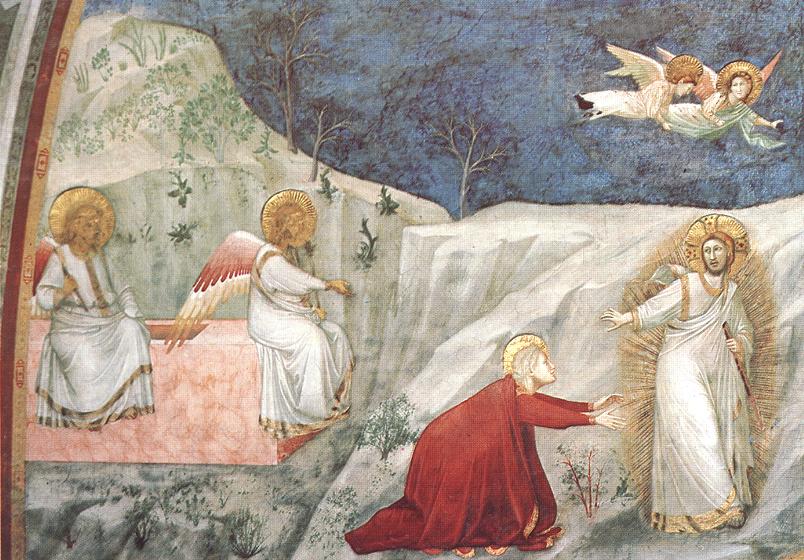
Painting by Giotto of the Risen Lord Jesus Christ appearing to St. Mary Magdalene from commons.wikimedia.org.
Lord My Chef Sunday Recipe for the Soul by Fr. Nicanor F. Lalog II Solemnity of the Pentecost, Cycle C, 08 June 2025 Acts 2:1-11 ><}}}}*> Romans 8:8-17 ><}}}}*> John 14:15-16, 23-26
VATICAN CITY, VATICAN – MAY 08: Faithful in St. Peter’s Square participate in the first blessing of Pope Leo XIV immediately after the white smoke on May 08, 2025 in Vatican City, Vatican. Photo by Ivan Romano/Getty Images.
The other “good news” I heard next to the election of Pope Leo XIV last month were reports of people from different countries and other religions who went to join the pilgrims at the Vatican Square celebrating the election of our new Holy Father.
According to news, many of those non-Catholics who came there were so attracted and drawn by the unity of the people in rejoicing and celebrating Pope Leo XIV’s election to the papacy. That is Pentecost in modern time happening whenever people are one with each other in God by the Holy Spirit.
Painting by El Greco, “Pentecostes” (1597) from commons.wikimedia.org.
When the time for Pentecost was fulfilled, they were all in one place together… Then there appeared to them tongues as of fire, which parted and came to rest on each one of them. And they were all filled with the Holy Spirit and began to speak in different tongues, as the Spirit enabled them to proclaim. Now there were devout Jews from every nation under heaven staying in Jerusalem… They were astounded, and in amazement they asked, “Are not all these people who are speaking Galileans? Then how does each of us hear them in his own native language?” (Acts 2:1, 3-5, 7-8).
The Pentecost is an old Jewish Feast commemorating the ratification 50 days after of their covenant with God through Moses at the Sinai desert; today in the Church, we celebrate it 50 days (pente) after Christ’s Resurrection that also closes the Easter Season.
Considered as the birthday of the Church, see how appropriate the way Luke described the Church “born” on that day, “When the time for Pentecost was fulfilled, they were all in one place together.”
They were all in one place. There has always been the oneness or gathering of people as one body. However, it was more than being physically together in one place but of being one heart and one mind of the Church that continue to this day in our own time despite our many physical differences. What we celebrate today is not just a remote event in the past but a reality that continues in the Church and in various churches everyday.
The Pentecost is the fulfillment of those reflections we have had these past weeks on Jesus Christ’s commandment to love so that God would dwell among us. It is again our gospel this Sunday that was experienced by the Jews from other parts of the world there in Jerusalem on that day when they were astounded at how the Apostles were speaking in their own languages of God’s mighty deeds. They felt the love among everyone that they felt home. It was the complete opposite of what happened at the Babel’s Tower in the Old Testament.
They were astounded, and in amazement they asked, “Are not all these people who are speaking Galileans? Then how does each of us hear them in his own native language? We are Parthians, Medes, and Elamites, inhabitants of Mesopotamia, Judea and Cappadocia, Pontus and Asia, Phrygia and Pamphylia, Egypt and the districts of Libya near Cyrene, as well as travelers from Rome, both Jews and converts to Judaism, Cretans and Arabs, yet we hear them speaking in our own tongues of the mighty acts of God” (Acts 2:7-11).
Biblical vector illustration series, Pentecost also called Whit Sunday, Whitsunday or Whitsun. It commemorates the descent of the Holy Spirit upon the Apostles and other followers of Jesus Christ
"We hear them speaking in our own tongues of the mighty acts of God"
The social media was recently abuzz with a post by a vlogger who brought to Facebook his misgivings with Starbuck’s for wrongfully calling him “JC” instead of “JP” notwithstanding his earlier insistence on not making a mistake with his name’s spelling.
He is labeled as OA – overacting – or maarte in bringing to social media his experience which has anyway been a trademark of most coffee shops. What really got the attention of everyone that made his post viral was his declaration of how Starbuck’s had lost one loyal customer following that mistake which became the subject of many memes with some parodies that are thought-provoking. One is by a brother priest, Fr. Ritz who called his parody with the long title NOT ONLY A COFFEEHOUSE MAY LOSE A LOYAL CUSTOMER TODAY.
Fr. Ritz satirically narrated the two common laments of parishioners almost everywhere, namely, the priest’s boring homilies and lack of transparency with the faithful’s financial contributions. Sadly true, many of our faithful have become lukewarm in their faith and have stopped coming to church especially on Sundays due to these particular reasons.
Of course, we can’t put all the blame on the priests but we can’t blame either the lay faithful who make up the Church, the flock of Christ entrusted to us to love and care for by bringing out their giftedness in order to build this mystical Body of Christ on earth. The Church is more than Starbuck’s or any food and service entity but they all essentially share the same things like love and care among others to keep their relationships for existence and relevance or meaning.
Of course, that vlogger’s post about his experience at Starbuck’s was way off the mark but it is something we need to look deeper. How did it happen that people are now more concerned and more eager in coming to Starbuck’s than to our parish church? Maybe because like him who had given albeit wrongly his loyalty to a mere coffee shop, some of our faithful have felt taken for granted. We cannot claim “para yun lang” because certain things no matter small may be the world for some like being called in their name, being greeted or simply acknowledged as present on a weekday Mass. Or being enriched by a good homily which is after all the right of every baptized Christian.
At Pentecost, imagine the great joy of the Jews from diaspora visiting Jerusalem, hearing others speaking their language. They must have felt at home!
Are we at home in our Church?
Do we find and experience solace and comfort in our parish? Is there justice and sense of being fair from the priests instead of taking sides with the rich and famous? Can we feel our pastors and church volunteers and servants one with us?
Many times some of our parish workers and volunteers are more strict than the priests, throwing their weight around with their own rules and regulations. The single most important PR department of any parish is its office but sadly, some of its staff members scrimp on their smiles, feeling grouchy when ordinary folks come to inquire or get some certificates. Some are so unmindful of people walking for an hour only to be told they are still closed or about to close for lunch.
How sad when we are left out in the singing because the choir members stage a concert every Mass, experimenting with their voicing even with the most common Christian prayer of Our Father that people just stand and stare waiting for the communion to come and get home. Worst, as a preparation for the Father’s homily that often unprepared anyway, there are also the unprepared lectors lost which readings to proclaim or totally unmindful of the dignity of the ministry.
Above all these things, is the total lack of sense of prayer and silence among church servers who lead the Maritess sessions before and after each Mass right there inside the church. Worst, they cap each service with selfies and photo sessions at the altar as if it was their last serve. Clearly many of us live in the flesh than in the Spirit as St. Paul reminded us in the second reading. Where is the love that Jesus Christ had sent us in the Holy Spirit to make us one, feel at home joyful, safe and loved?
On this Pentecost Sunday, let us start practicing silence to feel the Holy Spirit within so that we can be in touch with everyone around us in love and kindness. Let us allow the Holy Spirit to teach us everything and remind us of all that Jesus had told us (Jn. 14:26). Amen. Have a blessed week ahead everyone!