O God our Father, we praise and thank you in sending us your Son Jesus Christ to show us how in the most ordinary and essential aspect of our lives – eating – we can either be far away from you or very near you.
Yes, O Lord! Just like in the movies, eat, pray, live, and love.
How wonderful it is to think that it was in eating the forbidden fruit at Eden that we have fallen from your grace while it is in partaking in the Supper of the Lord in the Eucharist that we have become blessed to be one in you, sharing in your holiness.
Help us to sink deeper into the inner reality of “eating” that leads us to praying, living and loving.
Like your prophet, may we realize that the key in understanding fully your words is in immersing ourselves into them like eating when we savor the aroma of food, biting and chewing in pieces to let its taste cover our palate, digesting it into our whole body system to nourish our lives.
Son of man, he then said to me, feed your belly and fill your stomach with this scroll I am giving you. I ate it, and it was as sweet as honey in my mouth. He said: Son of man, go now to the house of Israel, and speak my words to them.
Ezekiel 3:3-4
So many times in life, O Lord, we complain at how difficult are your laws and teachings, your words without ever trying them.
Open our selves like Ezekiel and your saints, specially St. Clare who left everything behind after being inspired by your words through St. Francis of Assisi to be poor and spend life praying to you.
Leaving the world in exchange of a life in poverty and simplicity, of prayer and witnessing, her life was sustained by your words that eventually nourished countless souls in search of you and meaning in life.
If we can just plunge ourselves into your words and eat them like real food, digest their meaning to savor its sweetness and wonderful taste like St. Clare and other saints, then we would no longer be so concerned with things of this world like in knowing who is the greatest among us.
Give us the simplicity of children who delight in the most ordinary food offered them, enjoying life with the sense of awe and surprise of your presence. Amen.
The Lord Is My Chef Breakfast Recipe for the Soul by Fr. Nicanor F. Lalog II
Friday, Solemnity of the Most Sacred Heart of Jesus, 19 June 2020
Deuteronomy 7:6-11 ><)))*> 1 John 4:7-16 <*(((>< Matthew 11:25-30
Photo from Google.
O most Sacred Heart of Jesus, make my heart like yours — make me small and little in standing, hidden and unknown among many, simple and humble in a world now measured in influence, popularity, and following.
On this Solemnity of your Most Sacred Heart, I thank you dear Jesus in choosing to be small and little, always hidden in the simplest things of life like soft voices of kindness and mercy, reason and wisdom, gratitude and love.
You have shown us that to be truly loving like you, we have to be small and little like children.
Most of all, free to be ourselves as beloved children of the Father!
Free from inhibitions and guilt to truly express the love and joy within.
Help us, Jesus, to cast all our worries to you, to take your yoke that is easy, burden that is light.
It is so difficult to love when we are burdened by many concerns and considerations, when we cannot be our true selves that we lack spontaneity, of being natural and easy.
In the same manner, it becomes hard for us too to love or even please someone who sees him or her self bigger than reality, when they see themselves as “big shots” and “heavyweights” who have to be pleased and “followed” or affirmed.
May we always keep in mind the words of Moses so applicable also to us today:
“It was not because you are the largest of all nations that the Lord set his heart on you and chose you, for you are really the smallest of all nations.”
Deuteronomy 7:7
O Most Sacred Heart of Jesus, you have given us your heart that bleeds due to the thorns of our sins, yet aglow with the fire of your immense love and mercy.
May we come to you, today and always to find rest, to learn from your gentle and humble ways so needed in our heartless world. Amen.
The Lord Is My Chef Breakfast Recipe for the Soul by Fr. Nicanor F. Lalog II
Wednesday, Week X, Year II in Ordinary Time, 10 June 2020
1 Kings 18:20-39 ><)))*> ooo + ooo <*(((>< Matthew 5:17-19
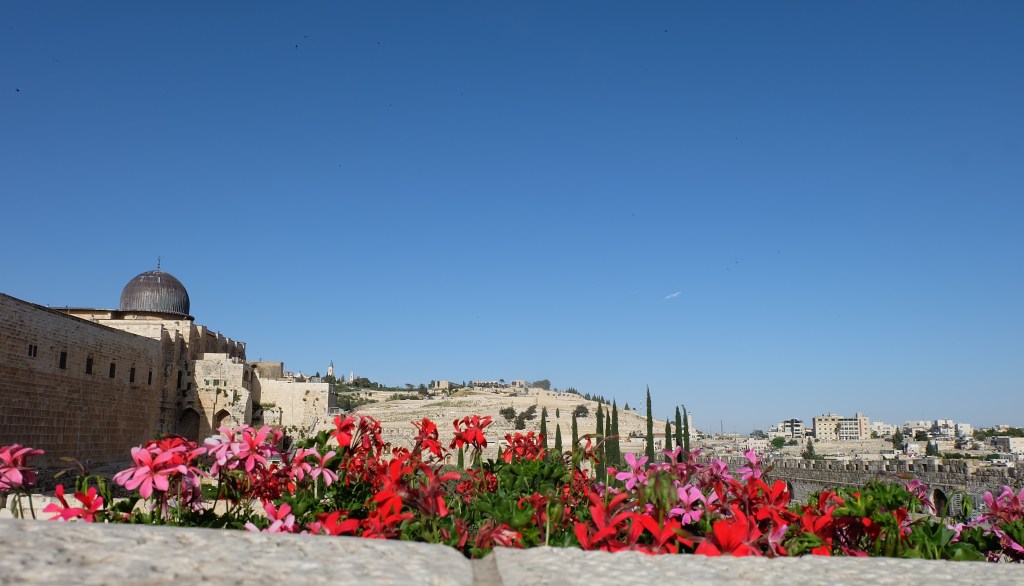
View from inside the Old Jerusalem. Photo by author, May 2017.
Jesus said to his disciples: “Amen, I say to you, until heaven and earth pass away, not the smallest letter or the smallest part of a letter will pass from the law, until things have taken place. Therefore, whoever breaks one of the least of these commandments and teaches others to do so will be called least in the Kingdom of heaven. But whoever obeys and teaches these commandments will be called greatest in the Kingdom of heaven.”
Matthew 5:18-19
O Lord Jesus, these are heavy words for things we consider too small, too little that we take them for granted because they do not have much impact unto this big, wide world.
Like the salt you spoke of yesterday when a dash or a pinch can bring out a burst of flavors from food or a taste that can awaken us.
So many times in our lives, we forget the reality that great things always start with small beginnings.
That people who can be trusted with little things can be trusted with great things; and people who cannot be trusted with small things cannot be trusted too with bigger things.
Forgive us, Jesus, when we tend to look into the size and amount and number as bases for our decision and choices in life, when we continue to hold on to the belief the bigger is always better, the more the merrier.
But you, O Lord, are so different: you chose to be small being born as an infant, waiting for 30 years before coming out in public, having only a band of 12 followers who were practically a nobody in the society then, choosing an unleavened bread and ordinary grape wine as signs of your presence and eternal covenant for all time.
And here we are, like the Israelites of the time of Elijah who chose to to be quiet and doubt you because you only had one, old prophet; but when they his saw many counterparts of Baal, they all rooted for the false god whose only edge was number.
Elijah appealed to the people and said, “How long will you straddle the issue? If the Lord is God, follow him; if Baal, follow him.” The people, however, did not answer him. So Elijah said to the people, “I am the only surviving prophets of the Lord, and there are four hundred and fifty prophets of Baal. Give us two young bulls. Let them choose one, cut it into pieces, and place it on the wood, but start no fire. I shall prepare the other and place it on the wood, but shall start no fire. You shall call on your gods, and I will call on the Lord. The God who answers with fire is God.” All the people answered, “Agreed!”
1 Kings 18:21-24
Please forgive us, Jesus, when we would rather go and accept whatever is popular, trending and viral, when we are so concerned with more likes and followers, with whatever is more and bigger without realizing you are so great because you are so small with a little voice so you can dwell inside our hearts.
Let us value whatever is little and small, uphold whatever is tiny and minute because most often you are there with most power. Amen.
Tonight is “Spy Wednesday” – the night traitors and betrayers are put on the spotlight because it was on this night after Palm Sunday when Judas Iscariot struck a deal with the chief priests to hand them over Jesus for 30 pieces of silver (Mt. 26:14-16).
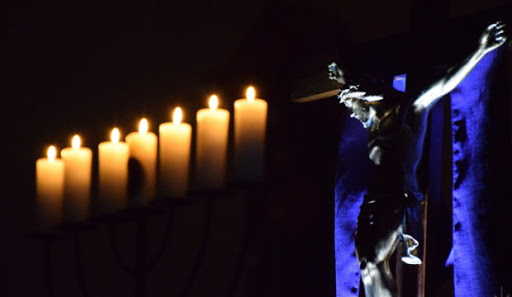
The “Tenebrae” is celebrated in some churches when candles are gradually extinguished with the beating of drums and sounding of matraca to evoke silence and some fear among people as they leave in total darkness to signal the temporary victory of evil in the world for tomorrow we enter the Paschal Triduum of Holy Thursday, Good Friday and Easter Vigil of the Lord.
From Google.
Darkness generally evokes evil and sin, uncertainties and sufferings. But, at the same time, darkness preludes light!
That is why Jesus Christ was born during the darkest night of the year to bring us light of salvation.
Beginning tonight, especially tomorrow at his agony in the garden, we shall see Christ entering through darkness reaching its climax on Friday when he dies on the cross with the whole earth covered in darkness, rising on Easter in all his glory and majesty.
Our present situation in an extended Luzon-wide lockdown offers us this unique experience of darkness within and without where we can learn some important lessons from the Lord’s dark hours beginning tomorrow evening of his Last Supper.
St. John gives us a glimpse into how we must deal with life’s darkness that plagues us almost daily with his unique story of the Lord’s washing of his disciples’ feet on the night he was betrayed.
Before the feast of Passover, Jesus knew that his hour had come to pass from this world to the Father. He loved his own in the world and he loved them to the end. The devil had already induced Judas, son of Simon the Iscariot, to hand him over. So, during supper… he rose from supper and took off his outer garments. He took a towel and tied it around his waist. Then he poured water into a basin and began to wash the disciples’ feet and dry them with the towel around his waist. He came to Simon Peter…
John 13:1-2, 4-6
Photo from aleteia.org.
It is very interesting to reflect how Judas Iscariot and Simon Peter dealt with their own inner darkness on that night of Holy Thursday when Jesus was arrested.
Though Judas Iscariot and Simon Peter are poles apart in their personalities, they both give us some traits that are so characteristic also of our very selves when we are in darkness. In the end, we shall see how Jesus turned the darkness of Holy Thursday into becoming the very light of Easter.
Getting lost in darkness like Judas Iscariot
Right after explaining the meaning of his washing of their feet and exhorting them to do the same to one another, Jesus begins to speak of Judas Iscariot as his betrayer.
When he had said this, Jesus was deeply troubled and testified, “Amen, amen, I say to you, one of you will betray me …It is the one to whom I hand the morsel after I had dipped it.” So he dipped the morsel and handed it to Judas, son of Simon the Iscariot. After he took the morsel, Satan entered him… and left at once. And it was night.
John 13:21, 26-27, 30
Photo from desiringgod.org
The scene is very dramatic.
Imagine the darkness outside the streets of Jerusalem in the stillness of the night and the darkness inside the Upper Room where they were staying.
More darker than that was the darkness among the Apostles not understanding what Jesus was saying about his betrayer because they thought when Judas left, he was being told to buy more wine or give money to the poor!
Most of all, imagine the darkness within Judas.
To betray means to hand over to suffering someone dear to you.
That’s one darkness we always have within, of betraying Jesus, betraying our loved ones because we have found somebody else to love more than them. Satan had taken over Judas. The same thing happens to us when we sin, when we love someone more than those who truly love us or those we have vowed to love always.
And the darkest darkness of all is after handing over our loved ones, after dumping them for something or somebody else, we realize deep within the beautiful light of truth and love imprinted in our hearts by our betrayed loved ones – then doubt it too!
The flickering light of truth and love within is short lived that we immediately extinguish it, plunging us into total darkness of destruction like Judas when he hanged himself.
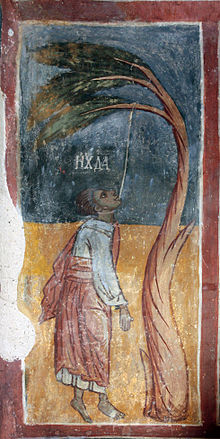
See how Judas went back to the chief priests because “he had sinned”, giving them back the 30 pieces of silver to regain Jesus.
Here we find the glow of Jesus, of his teachings and friendship within Judas still etched in his heart — the light of truth and love flickering within.
Any person along with their kindness and goodness like Jesus, our family and true friends can never be removed from one’s heart and person. They will always be there, sometimes spurting out in our unguarded moments because they are very true.
That is the darkest darkness of Judas – and of some of us – who think we can never be forgiven by God, that we are doomed, that there is no more hope and any chance at all.
See how the evangelist said it: “Judas left at once. And it was night.”
And that is getting lost in darkness permanently, eaten up by darkness within us because we refuse to believe in the reality of a loving and forgiving God who had come to plunge into the darkness of death to be one with us so we can be one in him. What a loss.
Groping in the dark into the light like Peter
Photo by author, Church of Gallicantu, Jerusalem where the cock crowed after Peter denied Jesus the third time, May 2017.
Of the Twelve, it is perhaps with Simon Peter we always find ourselves identified with: the eager beaver, almost a “bolero” type who is so good in speaking but many times cannot walk his talk.
“Master, are you going to wash my feet?” Jesus answered and said to him, “What I am doing, you do not understand now, but you will understand later.” Peter said to him, “You will never wash my feet.”
John 13:6-8
Here is Peter so typical of us: always assuming of knowing what is right, which is best, as if we have a monopoly of the light when in fact we are in darkness.
See how during the trial of Jesus before the priests, Peter denied him thrice, declaring he never knew Jesus while outside in the dark, completely in contrast with Jesus brilliantly answering every question and false accusation against him inside among his accusers!
Many times in our lives, it is so easy for us to speak on everything when we are in our comfort zones, safe and secured in our lives and career. But when left or thrown out into the harsh realities of life, we grope in the darkness of ignorance and incompetence, trials and difficulties.
How often we are like Peter refusing Jesus to wash our feet because we could not accept the Lord being so humble to do that simply because he is the Lord and Master who must never bow low before anyone.
And that is one darkness we refuse to let go now shaken and shattered by the pandemic lockdown! The people we used to look down upon are mostly now in the frontlines providing us with all the comforts we enjoy in this crisis like electricity, internet, security, food, and other basic services.
Bronze statue of the call of Peter by Jesus. Photo by author, May 2017.
We have always thought of the world, of peoples in hierarchy, in certain status where there are clear delineations and levels of importance, totally forgetting the lessons of Jesus of being like a child, of service and humility: “whoever wants to be great must be the least and servant of all.”
According to Matthew and Luke, Peter realized his sins – the darkness within him – of denying Jesus thrice after the cock crowed that he left the scene weeping bitterly, feeling so sorry. Eventually after Easter, Peter would meet Jesus again on the shores of the Lake of Tiberias, asking him thrice, “do you love me?”
Peter realized how dark his world has always been but in that instance when he declared his love that is so limited and weak did he finally see the light of Christ in his love and mercy!
Unlike Judas, Peter moved out of darkness and finally saw the light in the Risen Lord right in the very place where everything started when he was called to be a fisher of men, in his humanity as he was called by his original name, “Simon, son of Jonah, do you love me?”.
Human love is always imperfect and Jesus knows this perfectly well!
The best way to step out of darkness within us is to be like Simon — simply be your imperfect self, accepting one’s sins and weakness for that is when we can truly love Jesus who is the only one who can love us perfectly.
Overcoming darkness in, Jesus, with Jesus, through Jesus
Though the fourth gospel and the synoptic gospels of Matthew, Mark, and Luke differ in providing us with the transition from the Upper Room of the Last Supper into the agony in the garden, the four evangelists provide us with one clear message at how Jesus faced darkness: with prayer, of being one in the Father.
Even on the cross of widespread darkness, Jesus spoke only to pray to the Father.
Then Jesus came with them to a place called Gethsemane, and he said to his disciples, “Sit here while I go over there and pray.” He took along Peter and the two sons of Zebedee, and began to feel sorrow and distress.
Matthew 26:36-37
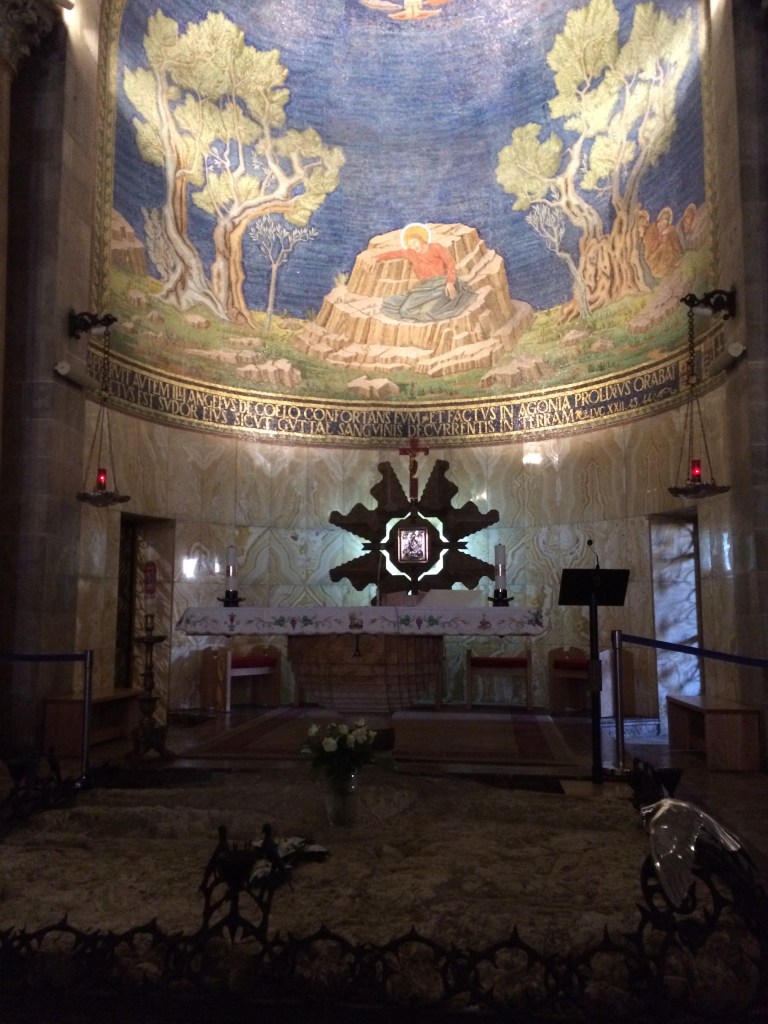
Photo by author, altar of the Church of All Nations beside the Garden of Gethsemane, May 2017. The church is always dimly lit to keep the sense of darkness during the Agony in the Garden of Jesus.
Before, darkness for man was seen more as a curse falling under the realm of evil and sin; but, with the coming of Jesus, darkness became a blessing, a prelude to the coming of light.
We have mentioned at the start of our reflection that Jesus was born during the darkest night of the year to show us he that is the light of the world, who had come to enlighten us in this widespread darkness, within us and outside us.
As the light of the world, Jesus was no stranger to darkness which he conquered and tamed in many instances like when they were caught in a storm at sea and in fact, when walked on water to join his disciples caught in another storm.
But most of all, Jesus had befriended darkness and made it a prelude to light.
How? By always praying during darkness. By prayer, it is more than reciting some prayers common during his time as a Jew but as a form of submission to the will of the Father. Jesus befriended darkness by setting aside, forgetting his very self to let the Father’s will be done.
Bass relief of agony in the garden on the wall of the Church of All Nations at Gethsemane. Photo by author, May 2019.
This he showed so well in two instances, first on Mount Tabor where he transfigured and second in Gethsemane before his arrest.
In both events, Jesus showed us the path to overcoming darkness is always through prayers, of being one in the Father.
It is in darkness when God is most closest to us because it is then when we get a glimpse of himself, of his love and mercy, of his own sufferings and pains, and of his glory.
This is something the three privileged disciples – Simon Peter, James and his brother John – did not realize while being with Jesus at both instances until after Easter. We are those three who always fall asleep, who could not keep with praying in Jesus, with Jesus, and through Jesus.
It was in the darkness of the night when Jesus spent most of his prayer periods, communing with the Father up in a mountain or a deserted place.
On Mount Tabor, Jesus showed his coming glory while in Gethsemane he showed his coming suffering and death. But whether in Gethsemane or on Mount Tabor, it is always Jesus we meet inviting us to share in his oneness with the Father, in his power in the Holy Spirit to overcome every darkness in life.
And the good news is he had already won for us!
Photo by Mr. Raffy Tima of GMA-7 News of Mt. Samat with the Memorial Cross across the Manila Bay following clear skies resulting from the lockdown imposed since March 17, 2020.
In these extended darker days of quarantine period, let us come to the Lord closer in prayer to. experience more of his Passion and Death, more of his darkness so we may see his coming glory when everything is finally cleared in this corona pandemic.
Prayer does not necessarily change things but primarily changes the person first. And that is when prayer changes everything when we become like Jesus in praying.
Jesus is asking us to leave everything behind, to forget one’s self anew to rediscover him in this darkness when we get out of our comfort zones to see the many sufferings he continues to endure with our brothers and sisters with lesser things in this life, with those in total darkness, with those groping in the dark.
Now more than ever, we have realized the beauty of poverty and simplicity, of persons than things.
And most especially of darkness itself becoming light for us in this tunnel.
May Jesus enlighten us and vanish all darkness in us so that soon, we shall celebrate together the joy of his coming again in this world darkened by sin. Amen.
40 Shades of Lent, Sunday Week II-A, 08 March 2020
Genesis 12:1-4 +++ 2 Timothy 1:8-10 +++ Matthew 17:1-9
“Creation of Adam” by Michaelangelo at Sistine Chapel, the Vatican. From Wikipedia.
Touch is a very powerful word – literally and figuratively speaking. We say “we are touched” when we are deeply moved by words or music, gestures, acts, and scenes that need not be so spectacular because to touch is about making a connection, a communion of persons.
A touch can be so powerful that when filled with love and sincerity, it can transform the person being touched. Experts say that a touch of about five seconds is worth more than 300 words of encouragement and praise!
And that is why our Lord Jesus Christ, the Son of God is a certified “touch person” who always reached out to people by physically touching them, embracing them to make them feel his loving presence, his mercy, and most of all, his healing.
Almost all his healings were done by touching the sick when he would lay his hands on them like with the blind Bartimaeus on the street of Jericho.
There were times Jesus held up the hand of the sick to raise them up from their bed like Peter’s mother-in-law and the daughter of Jairus. Sometimes in rare occasions, Jesus healed in the most bizarre ways with his sense of touch like with that deaf in Decapolis.
He (Jesus) put his finger into the man’s ears and, spitting, touched his tongue; then he looked up to heaven and groaned, and said to him, “Ephphatha!” (that is, “Be opened!”).
Mark 7:33-34
In Nain, Jesus raised to life the son of a widow by touching the coffin – not the dead – by saying, “Young man, I tell you, arise!” that everyone was amazed, saying “the Lord has visited his people”.
Jesus never missed an occasion without personally touching another person, especially the children like when he caught his disciples driving them away.
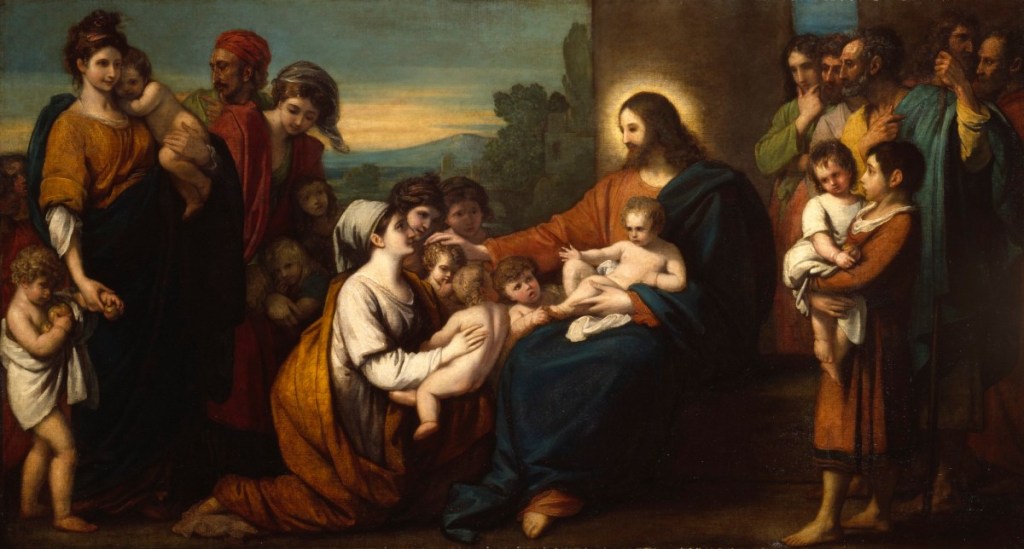
“Jesus blessing Little Children”, painting by British North American Benjamin West PRA (1781). Photo from wikipedia.
It is perhaps one of the most touching story of Jesus touching others when he told his disciples to “let the children come to me for theirs is the kingdom of heaven”, after which he embraced them, laid his hands on them and blessed them.
How blessed were those children must be to be embraced and laid with hands on by Jesus! According to tradition, one of those kids embraced and blessed by Jesus was St. Ignatius of Antioch who became a bishop and martyr in the early Church.
That is the transforming power of the touch by Jesus that children are blessed, the sick are healed by restoring their sight or cleansing their skin of leprosy, forgiving the sinners, giving hope to the poor. His touch is always a part of his proclamation of the good news to the people.
Jesus continues to touch us today in every Mass we celebrate when he first speaks to us in the scriptures, trying to make us feel our “hearts burn inside” like the disciples going home to Emmaus on Easter Sunday; and secondly, when he gives us his Body and Blood to partake in the Holy Eucharist.
Most of all, Jesus continues to literally touch us today through one another in our loving service to one another as a community of his disciples.
But, in this age of social media when every communication is mediated by gadgets and other instruments, this kind of personal communication is something we have all been missing because we have stopped touching Jesus, touching others too.
And this is what the second Sunday of Lent is trying to remind us today in the Transfiguration of Jesus.
Transfiguration of Jesus, communion of God with us
Jesus took Peter, James, and John his brother, and led them up a high mountain by themselves. And he was transfigured before them… a bright cloud cast a shadow over them, then from the cloud came a voice that said, “This is my beloved Son, with whom I am well pleased; listen to him.” When the disciples heard this, they fell prostrate and were very much afraid. But Jesus came and touched them, saying, “Rise, and do not be afraid.” And when the disciples raised their eyes, they saw no one else but Jesus alone.
Matthew 17:1-2, 5-7
“Transfiguration of Jesus” by Raphael from wikipedia.
We hear this story of the Transfiguration of Jesus twice every year: the Second Sunday of Lent and the sixth of August for the Feast of the Transfiguration. At this time of the year, the Transfiguration story is heard in relation with the Lord’s coming Passion, Death, and Resurrection.
At his Transfiguration, Jesus made it very clear that his glory and divinity must always be seen in the light of his Cross for it is only with his Cross that he can be correctly recognized as the Christ. It is on the Cross where Jesus truly touches us too in our personhood, in our humanity.
See how the three disciples were seized with fear upon hearing the voice of the Father while a bright cloud cast a vast shadow over them; but, it was right in that “tremendum fascinans” that we also find the intimacy, the closeness of God to us through Jesus Christ when he touched the three disciples.
Jesus came and touched them, saying, “Rise, and do not be afraid.” And when the disciples raised their eyes, they saw no one else but Jesus alone.
Matthew 17:7
And that is the good news for us all!
God had chosen to be so close to us in his Son Jesus Christ who touches us most not only in glory but most especially in moments of trials and tribulations! It is on the Cross where humanity and the divine truly become one in Jesus, when that personal and loving touch of Jesus becomes transformative and even performative.
This is the reason St. Paul exhorted Timothy to “bear your share of hardship for the gospel with the strength that comes from God” (2Tim.1:8) because oneness with Jesus always starts at the cross!
This is very true with us too when we only come to realize who are our true friends, our BFF’s when they are personally one with us in our trials and tribulations, not only in times we are well and good.
True transformation in Jesus can only happen when we are willing to be one with him, to be in touch with him in his passion and death for it is the only path to his Easter glory of transfiguration.
Touch communication vs. mediated communication
From Forbes.com
How sad that in this age of modern communications that have shrunk the world into a “global village” with instant communications that instead of growing together we have grown more apart than ever from each other.
We have lost real communications that lead to communion of persons or unity of people because we have become more concerned with the techniques of communication, more of skills and gadgets than of persons.
That is the meaning of media or “mediated communication” where there is always a medium between or among persons like cellphones and gadgets.
No more interpersonal relationships, making us more isolated and alienated, leading to growing problems of loneliness, depression, and suicides.
How frustrating sometimes to attend social functions like dinners and weddings where everyone is more busy and interested with their cellphones than with persons beside them!
Aside from isolation from persons, we have also grown “out of touch” with reality itself when more and more people are retreating into their own small worlds like cocoons with wires attached into their ears while their eyes fixated on screens oblivious to the world around them.
We have become so out of touch with ourselves and with others that more and more we are becoming like porcupines – we have not only stopped getting in touch with others but even hurt others if ever we touch them!
From Google.
Parents, lovers, couples, even people we trust like priests and religious sometimes hurt us with their touch instead of healing us, comforting us. Nobody would want to go through the Passion of the Cross anymore that we would rather stay on top of the mountain, of everything to be delighted with our perceived power and glory.
So unlike in our first reading where we get the feel and touch of real encounter in persons between God and Abraham. Note how in just four verses the word “bless” used five times by God to Abraham, promising to bless him more if he leaves his kin to follow him to the land he would give him.
In their conversation, we find a very personal and engaging communication, as if God and Abraham were literally in touch with each other, where there is personal contact and communication.
We know this for a fact at how effective and more reliable are personal interactions in communication than mediated ones through phones and email – personal communications always have that feel and touch that enable us to negotiate further and be more fruitful.
This Season of Lent, the Father is asking us to be in touch with him again by listening to the words of his Son Jesus who asks us only one thing: deny yourself, take up your cross and follow him. Let us heed him, touch him, and allow him to touch us again to be healed and transformed.
May you be touched as you touch also others in the most loving way this Sunday throughout the whole week! Amen.
Soon afterward Jesus journeyed to a city called Nain, and his disciples and a large crowd accompanied him. As he drew near to the gate of the city, a man who had died was being carried out, the only son of his mother, and she was a widow. A large crowd from the city was with her. When the Lord saw her, he was moved with pity for her and said to her, “Do not weep.” He stepped forward and touched the coffin; at this the bearers halted, and he said, “Young man, I tell you, arise!” The dead man sat up and began to speak, and Jesus gave him to his mother. Fear seized them all, and they glorified God, exclaiming, “A great prophet has arisen in our midst,” and “God has visited his people.”
Luke 7:11-16
Today, we are like at the city of Nain. Traffic is so heavy outside as many of us – family and friends, former classmates, colleagues at work from all over and neighbors – gather to pray and pay our last respects for Archie.
Celebrating a funeral Mass for a young person is always difficult for me. Like Jesus, I feel so sad for their parents. Normally, it is the children who bury their parents. It must be so painful for parents burying a son or a daughter. That is why in our gospel, Jesus was “moved with pity” with the widow of Nain.
But today, amid the pains and sorrows with the sudden death of Archie last week at a very young age, we actually celebrate life in Jesus Christ.
Photo by author of the hills of Galilee from the Walls of Jerusalem, May 2017.
Jesus comes to visit us always
Like in that scene at Nain, we remember and celebrate the life of Archie who had come to visit us even for a short time.
I love that part of the gospel where the people at Nain exclaimed at how “God has visited his people” when Jesus raised the dead young man.
Jesus continues to visit us everyday through one another like Archie.
Despite his many sins and imperfections, Archie made us experience Jesus Christ’s love and friendship, warmth and kindness, especially to his two sons, family, and friends.
Surely, Jesus must have visited Archie, too, during those dark moments of his life.
And the good news is, Archie visited Jesus so often especially these last two years when he started to pick up the pieces of his life.
Last time I saw Archie was last November when he came to celebrate Mass in our Parish. And I have heard how he had sought spiritual guidance from Fr. Carl, driving that far to Paco every month as he renewed his relationship with Christ, trying to follow anew the Lord he had served since elementary as a sacristan and later as a seminarian in our high school seminary.
It is Jesus who first finds us always
Photo by author at Mt. St. Paul Spirituality Center, Baguio, 04 February 2020.
We all know Archie’s tocayo is one of ancient Greece’s great scientist and inventor, Archimedes.
It is said that he discovered the principle of buoyancy – the “Archimedes’ principle” – while taking a bath.
When Archimedes sat onto his bathtub, he observed that “when a body is submerged in a fluid, it experiences an apparent loss in weight that is equal to the weight of fluid displaced by the immersed body.”
Archimedes was so ecstatic with his accidental discovery that he jumped naked from his bathtub out to the streets, shouting “eureka!” or “I have found” the solution to a problem he was trying to solve at that time.
Archimedes had not only enriched the field of mathematics and sciences with his discoveries but also the English language with the word “eureka” or “eureka moment”: when somebody discovers something very significant in business and economics, the sciences especially medicine, and practically in every field and subject.
Most especially in life.
Photo by author, Mt. St. Paul Spirituality Center, Baguio, 04 February 2020.
Archie had the same eureka moment in life: he had found Jesus Christ again that he went back to Mass and Confessions.
He had found meaning in life again after losing hope and directions.
Most of all, Archie had found love again.
Like his namesake of ancient Greece, Archie is now exclaiming “eureka” ecstatically into heaven – naked – with nothing but the love and mercy of Jesus Christ who first found him and brought him back to life a few years ago.
Today as we bring the remains of Archie into his final resting place, we thank God who never stops looking for us, finding us so that we can find him again and finally rest in him.
Today it is Jesus who is most ecstatic of all because he is the first to have found Archie and that is why, he had called him back to him, never to get lost again.
But the souls of the just are in the hand of God, and no torment shall touch them. They seemed, in the view of the foolish, to be dead; and their passing away was thought an affliction and their going forth from us, utter destruction. But they are in peace. In the time of their visitation they shall shine.
Today we are celebrating an extension of Christmas Season with the Feast of the Sto. Niño that falls every third Sunday of January.
It is a special indult granted by Rome to the Philippines in recognition of the crucial role of the image of the Child Jesus we fondly call Sto. Niño given by Magellan to Queen Juana of Cebu almost 500 years ago when the Spaniards came to our shores to colonize and Christianize us as well.
The Sto. Niño is the second most popular Catholic devotion in our predominantly Christian nation, next to the Black Nazarene of Quiapo which we celebrated two weeks ago.
“Sleeping Sto. Niño” at our altar, 19 January 2020 photo by Jasper Dacutanan.
But a lot often, people forget the deeper meaning within the Sto. Niño that the path leading to becoming true disciples of Jesus, of following him to the Cross starts in becoming like a child, “Amen, I say to you, unless you turn and become like children, you will not enter the kingdom of heaven” (Mt.18:3).
We will never be able to carry our cross and follow Jesus in selfless service and love to others unless we set aside our attitudes of being adults who know everything, insist on everything.
And that is why for this Sunday we have chosen the late Michael Jackson hit from his 1987 “Bad” album, Man in the Mirror.
It is one of the two songs in the album Michael Jackson did not write. It was written by Siedah Garrett and Glen Ballard who eventually both carved names for themselves in the music scene composing for other artists later.
According to stories, Michael and his producer Quincy Jones have asked their pool of composers to come up with a song that would serve as “an anthem” for the Bad album that would “spread some sunshine on the world”.
Michael liked the song right away and even after he had died, the song has become a classic with its timeless message that if you want to change the world, change yourself first.
And we say that looking on the man or woman on the mirror is the first step in becoming like a child as Jesus would want us all to do to enter the kingdom of heaven.
A blessed Sunday to you, dear reader and follower!
Isaiah 9:1-6 ><)))*> Ephesians 1:3-6, 15-18 ><)))*> Matthew 18:1-5, 10
The Cross and the Bell of our parish church. Photo by Gelo N. Carpio, 12 January 2020.
Looming high always at the center of our Christian faith is the Cross of Jesus Christ. Whether inside or outside any church, there is always the Cross reminding us of our salvation in Jesus and of the path we have to follow as his disciples.
But, so often we forget that the first call of the Cross is for us to be a child of God above all in order to follow his Son our Lord in his Passion, Death, and Resurrection.
Here we find the full meaning of our celebration of the Feast of the Baptism of the Lord last Sunday, of how in our Baptism we have become the children of God in Jesus Christ who became like us so that we may become like him, blessed and divine as the eternal Son of the Father.
Such is the plan of God in the very beginning of his Creation.
Blessed be the God and Father of our Lord Jesus Christ, who has blessed us in Christ with every spiritual blessing in the heavens, as he chose us in him, before the foundation of the world, to be holy and without blemish before him. In love he destined us for adoption to himself through Jesus Christ, in accord with the favor of his will, for the praise of the glory of his grace that he granted us in the beloved.
Ephesians 1:3-6
It is only in our becoming first the sons and daughters of the Father in Jesus Christ that St. Paul declares how we are saved in this part of the second reading skipped by the liturgy today:
In him we have redemption by his blood, the forgiveness of transgressions, in accord with the riches of his grace that he lavished upon us.
Ephesians 1:7-8
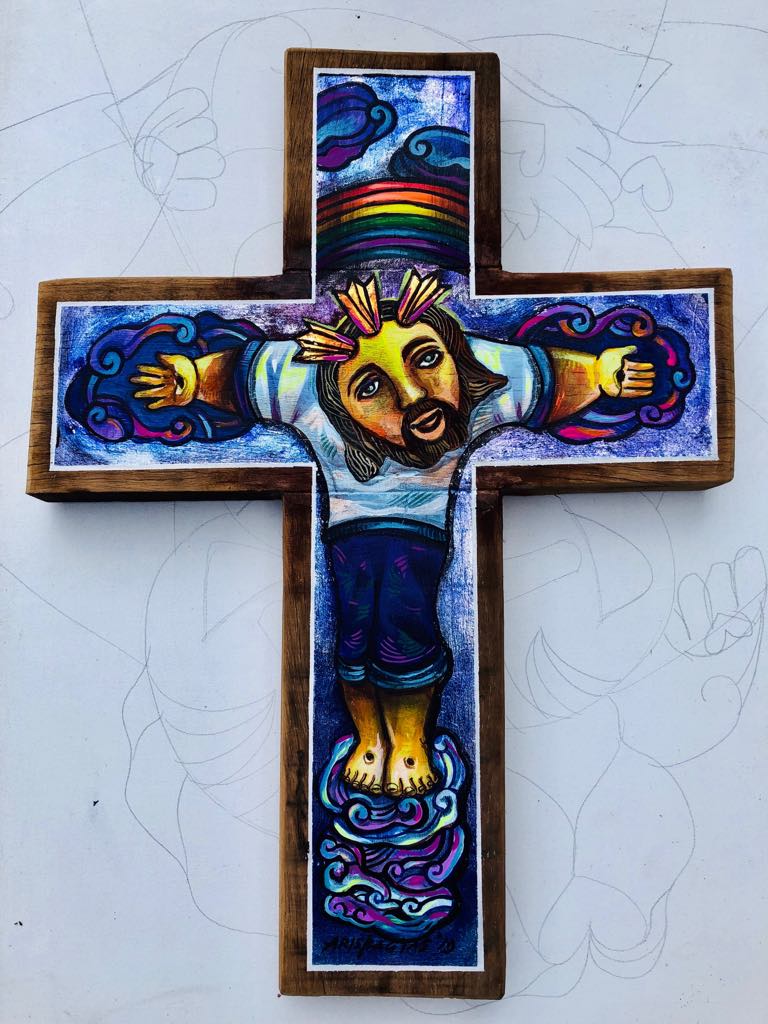
A painting of Sto. Niño devotees by Bulakenyo artist Aris Bagtas, 2018.
Work of Christmas continues
We are already into the second week of Ordinary Time in our liturgy but, we in the Philippines are still celebrating an “extension” of the Christmas Season this third Sunday of January for the Feast of the Sto. Niño, the Holy Child Jesus.
And, for a very good reason! to remind us the story of Christmas continues even after the Feast of the Lord’s Baptism or when all decors have been kept.
The work of Christmas, of sharing Jesus Christ in our loving service with others continues the whole year through. In fact, it is during the 34 weeks of Ordinary Time where we are most challenged to continue Christ’s work he started at Christmas when he became a child among us.
And there lies the very core of his teachings, of his message to us: our being like a child!
At that time the disciples approached Jesus and said, “Who is the greatest in the kingdom of heaven?” Jesus called a child over, placed it in their midst, and said, “Amen, I say to you, unless you turn and become like children, you will not enter the kingdom of heaven. Whoever humbles himself like this child is the greatest in the kingdom of heaven. And whoever receives one child such as this in my name receives me.”
Matthew 18:1-5
Jesus remained the Child of God until the end
If we examine everything in the Gospel, from the Incarnation and Nativity of Jesus, his hidden and public lives, his miracles and preaching, into his Passion, Death, and Resurrection, everything is anchored in Christ’s being like a child, the eternal Son of God.
When he was lost and found in the temple at the age of 12, right away he told his Mother his being the Son of God: “Why were you looking for me? Did you not know that I must be in my Father’s house?” (Lk.2:49)
Painting by Aris Bagtas, 2018.
At Last Supper, Jesus explained his being the Child of the Father: “The words that I speak to you I do not speak on my own. The Father who dwells in me is doing his works” (Jn.14:10).
His being one with the Father is due to his being the Eternal Son that reached its highest point of expression at the crucifixion where Jesus repeatedly called God his “Father”.
Here we find as in our gospel today the essential requirement of first becoming a child of God to make it into the kingdom of heaven. It is impossible to follow Jesus to his Cross when we remain adults who know everything!
This is the problem with the Traslacion that has become rowdy, even crazy over the years which is completely the opposite of the Pit Señor de Sto. Niño in Cebu that remains solemn and orderly despite its vast crowd of devotees.
See how in Quiapo the devotees “fight” and insist on their own ways of doing the procession, of how things are now turned upside down with the hijos lording over (pun intended) everything every January 9 with the gall to call Christ “Padre Nuestro Jesus de Nazareno”?
Everybody wants to fulfill one’s panata of jumping into the revered image of the Nazareno, in total disregard of others.
Where is the spirit of being a child, of being generous and kind with others?
What we have been seeing these past years in the Traslacion is more of machismo, of who is the greatest to be able to reach the Nazareno. And included among them are the growing members of media suddenly becoming devotees with the panata to anchor Traslacion!
Being a child is a call to daily conversion in Christ Jesus
Becoming like a child a daily call to conversion to Jesus, a going back to the story of Christmas, of being humble and small. I like that word used by Jesus today – turn – when he declared, “Amen, I say to you, unless you turn and become like children…”
To be able to carry our cross and follow Jesus, we have to turn first, that is, be transformed from world-wise, self-sufficient, all-knowing adults of the world into abiding children of the Father of Jesus Christ by the grace of the Holy Spirit.
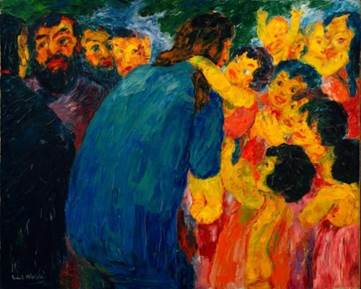
Children always have that glow within them that can disarm us of our insecurities and fears. Below is a painting by the Danish-German Modern Artist Emil Nolde (1867-1956) portrayed children with Christ in bright colors while the adults were all dark and gloomy.
“Christ Among Children” (1910) by Emil Nolde.
Being like a child is letting go of our fears and insecurities to entrust ourselves to God’s care and providence. And to others dependability and reliability too!
Maybe that is why as we get older, we mellow: we realize after all that we remain children of God and of somebody else in the end. There is always somebody out there who would look after us especially when we are already old and weak. There is always somebody whose heart would always be moved to come to our rescue or simply to warm our hearts or make us smile.
If each of us can become like a child daily, simply loving and trusting others, then we can bring light into this world deeply plunged in the darkness of sin and pride, of rat race without any winner, or arms race without any war at all.
If we can become like the child, we can become like Jesus Christ, the great light in the land of gloom bringing joy and great rejoicing (Is.9:1-2) with his life of love flowing from the great sacrifice at the Cross. Amen.
Quiet Storm by Fr. Nicanor F. Lalog II, 30 December 2019
Photo by Mr. Jim Marpa, Carigara, September 2019.
Today we conclude our series on the best Christmas gifts we have received following Christ’s coming more than 2000 years ago: the gift of childhood, of being child-like.
What a joy to keep in mind how God the Almighty chose to become human like us to show us that the path to true greatness and power is in becoming small like an infant, being like a child.
How foolish that we always “play” God to be great and powerful!
The central mystery of Christianity is our transformation from world-wise, self-sufficient “adults” into abiding children of the Father of Jesus by the grace of the Holy Spirit. All else in the Gospel, from the Incarnation of the Lord to his hidden and public lives, his miracles and preaching, his Passion, Death and Resurrection has been for this, of becoming like a child.
The late Cardinal Hans Urs von Balthasar, “Unless You Become Like this Child” (1991, Ignatius Press)
The child-like attitude of Jesus Christ
The best gift we can have this Christmas is to be child-like, to regain and reclaim our sense of childhood, of attending to that “inner child” within us when we trust more, believe more!
Photo by Mr. Jim Marpa, Carigara, September 2019.
See how Jesus Christ entrusts himself not only to his Father but most of all to us!
That is the touching message of the Nativity scene, of how our Lord and God, the King of kings through whom everything was created giving himself to us like a baby, asking us to love him, to take care of him, to be gentle with him, to protect and keep him safe from all harm.
And the key to claiming this great gift of being like a child is for us to learn again how to trust more and fear less like Jesus who showed us by example, not only with words his being child-like.
His constant acknowledgement of God his Father always speaking and doing his will tells us how Jesus from childhood into is adulthood remained like a child by entrusting his total self to God, reaching its highest point on the Cross when he cried out, “Father, into your hands I commend my spirit” (Lk.23:46).
Trust more, fear less
To be like a child according to the example of Jesus Christ is to always trust God and others, and fear less.
Like us, Jesus experienced fears, getting afraid of death but unlike us, he courageously faced death by trusting the Father by “resolutely” going to Jerusalem to be crucified!
When the days for his being taken up were fulfilled, Jesus resolutely determined to journey to Jerusalem.
Luke 9:51
It is normal to have fears, to be afraid.
Fear is not totally negative; it has its good effects that have actually led mankind to every great progress in life like the discovery of new lands and territories, new medicines, new inventions and other things.
Fear becomes a liability when it prevents us to trust more like little children.
Photo by Mr. Jim Marpa, 2018.
Kids and young people are often “positively” fearless because they trust so much nobody would hurt them or no one would forsake them.
As we age, our fears increase because our trust decreases: we fear so many things because we are afraid of losing the little we have, we are afraid of getting hurt, we are afraid of starting all over again.
We are afraid of getting old, of getting sick, and of dying.
What an irony how we started in life fearing almost nothing as babies and kids that we grew up so fast but as we aged and matured, we fear so many things that we have stopped growing and stopped living even long before we actually die.
The other day, December 28, we celebrated “Niños Innocentes” or “Holy Innocents” to remember those male children below two years old ordered killed by King Herod for fears of the “newborn king of Israel.”
Herod lived in constant fears of being deposed in power that he ordered the killing of his three sons and ten wives after suspecting them of trying to overthrow him.
We may not be like Herod with the way we react with our many fears but like him, we end up with same effects like death of friendships, death of love, death of everything, the end of life and adventure.
Maybe that explains why somehow as we get older, we “mellow” and become like children again, realizing we cannot control everything in life, that it is always best to act than to react in every situation.
Do not miss out this great gift of Christmas of becoming like a child.
Trust Jesus Christ who called on us not to be afraid for he is with us always!
Your gospel today, Lord Jesus, brought me with mixed feelings of embarrassment and joy.
Embarrassed because like your disciples then, until now we are still preoccupied with the same old question of “who is the greatest in the kingdom of heaven?” (Mt.18:1).
How funny – and shameful too, Lord, that as we grow older, the less we believe or at least disregard your guardian angels assigned to each one of us. As we get older, we feel we know everything, we can do everything, and we can be on our own.
How sad that in similar manner of dismissing our parents and elders as guardians, we have also abandoned belief and acceptance of angels.
Thank you for never abandoning us despite of this attitude, O dear God!
Thank you most of all, dearest God, for not withdrawing from our side our guardian angels!
Joy fills my heart today on this feast of the Guardian Angels that even if so many times in the past I have turned away from you, my guardian angel never left me, guiding me back to you in those many instances of discovering your wonder anew.
Our guardian angels remind us O Lord of your great love for us.
I can still recall so many instances in my life how I felt someone I do not see yet so personally present with me, personally saving me from so many occasions and situations that were harmful and even fatal.
Yes, guardian angels are not only for kids but for everyone who believe in you, Lord, to remind us of you.
Teach us to be child-like, humbly admitting there is an angel on our side, and most of all, you are always with us, Lord Jesus Christ.
As your messengers who are very close to you and closest with us, teach us to be like our guardian angels always close to you too and with others guarding and protecting them from harm. Amen.






















 lordmychef.com