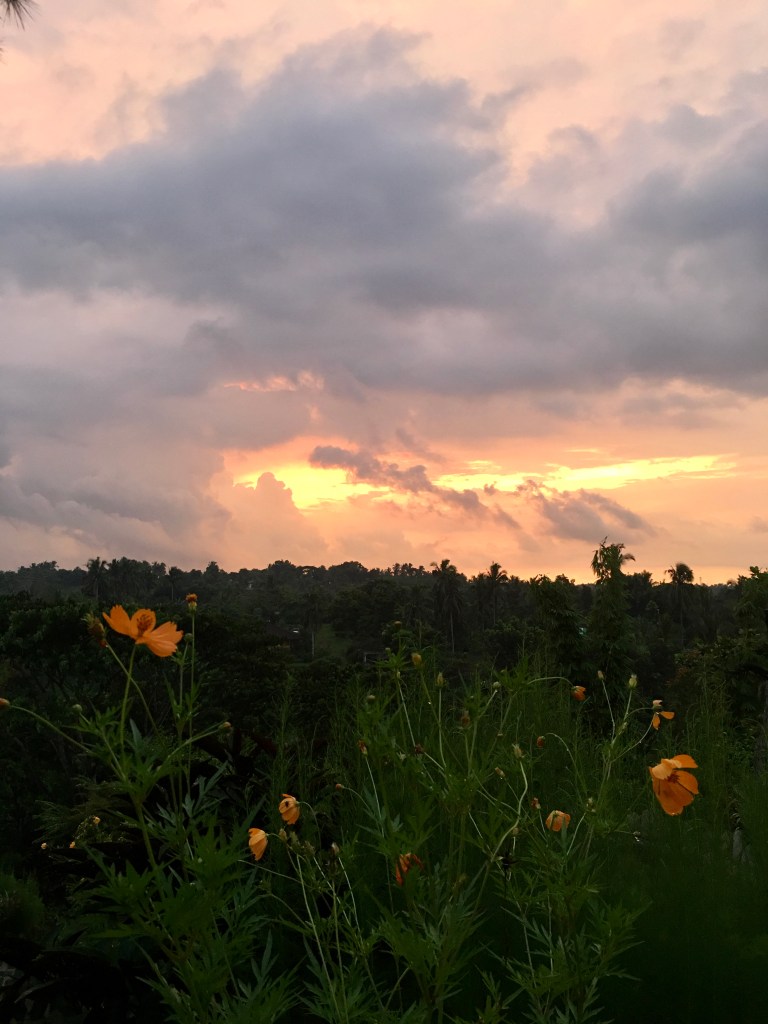
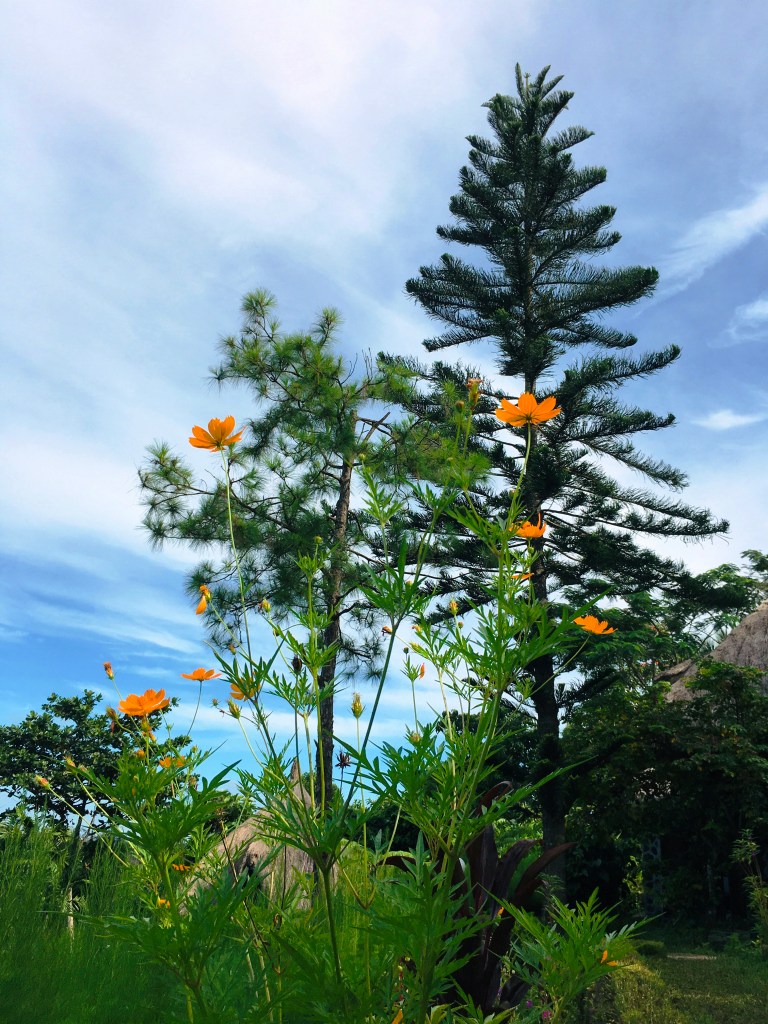
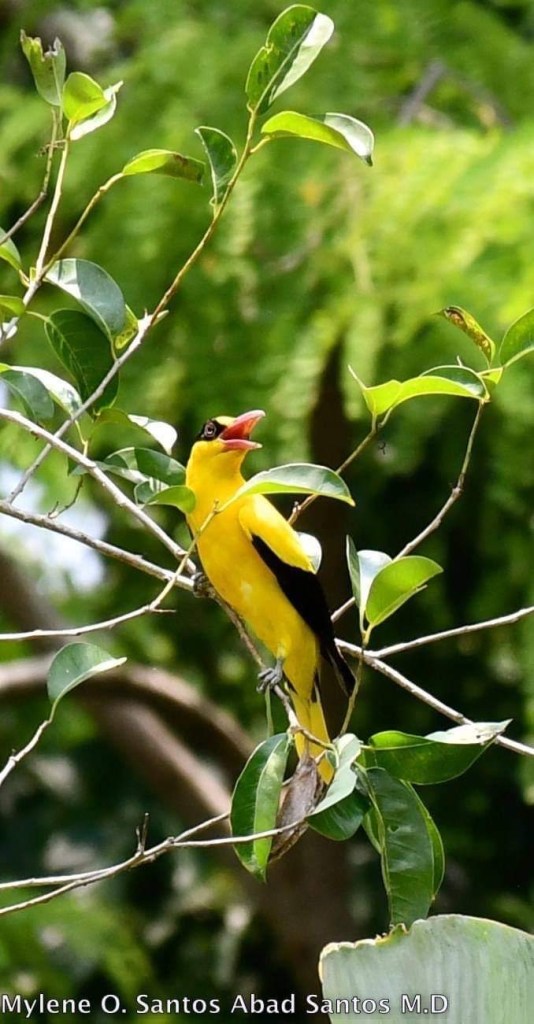
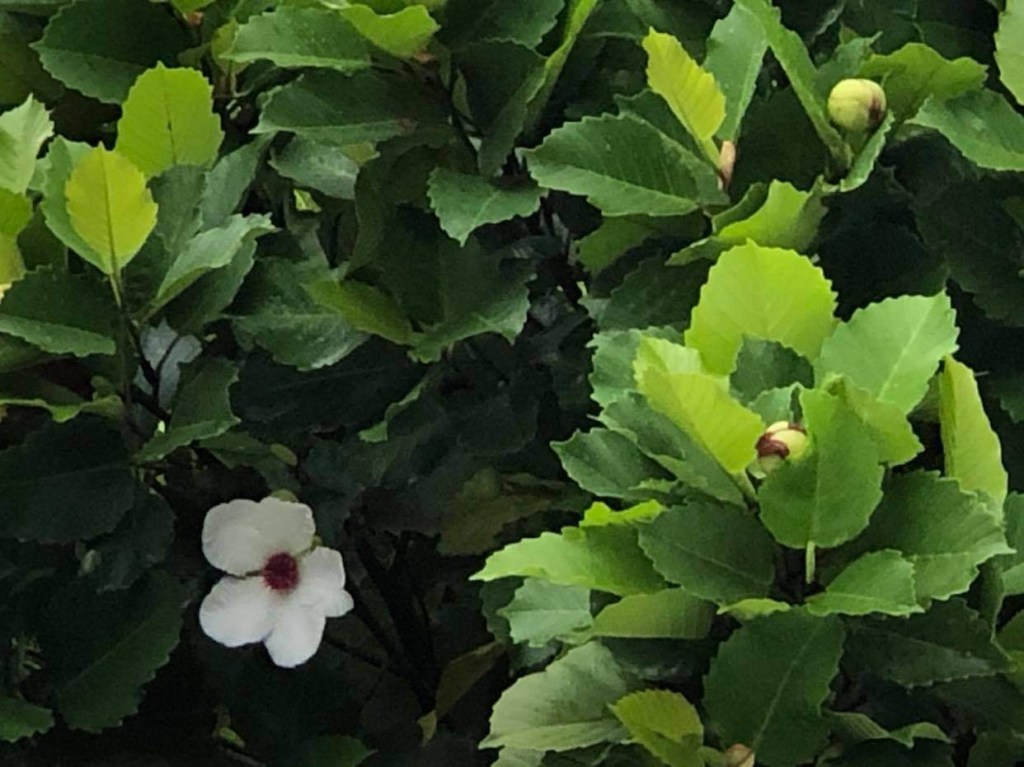
Lawiswis ng Salita ni P. Nicanor F. Lalog II, Ika-16 ng Oktubre 2020
Pitong buwan na nakakaraan
mula nang kumalat mula Wuhan
corona virus, tayo ay nag-lockdown
nang lumaon pinagaan quarantine
COVID-19 pasakit pa rin sa atin.
Nguni't huwag din namang masamain
maraming aral ipinamulat sa atin
itong COVID-19:  pananalangin
at pananalig sa Diyos,
pagpapahalaga sa pamilya at kapwa,
pangangalaga sa ating kalusugan.
Gayon din naman
maraming katatawanan
katuwaan ating naranasan
lumipas na mga buwan
kaya mga ito ating pagparoonan
kesa pabigatan ating mga isipan,
puso at kalooban.
Sa dami at tagal nang hirap ating naranasan
minsan marahil iyong inaasam-asam
makapagpahinga at magbakasyon
at saka sasagi sa isipan na hindi ba gayon
itong COVID-19 ngayon?
Bakasyon at pahinga
kaya nakapagtataka
kapag walang pasok sa eskuwela
at opisina dahil sa piyesta upisyal
gayong wala namang papasyalan
ni pupuntahan
lahat ng araw pare-pareho lang!
Nang magsimula ang lockdown
karamihan hindi naman nahirapan ni kinabahan
bagkus naging engrandeng bakasyunan
kantahan at inuman kung saan-saan
hanggang magkahawahan
nang mabatid katagay sa inuman
walang panlasa, walang pang-amoy
nang maglaon akala mo'y
aping-api, kinawawa at pinabayaan
pinag-aagawan lahat ng uri ng ayuda
pera at de lata
habang ang iba naman ay saganang-sagana.
Ang Pinoy nga naman
maski saan man
basta may kalamidad
hindi pababayaan kumalam kanyang tiyan;
aminin ang katotohanan
parusa nga ba at kahirapan ang lockdown
bakit tayo nagtabaan?
Hindi lamang iyan:
sa bawat tahanan
 mayroon isang tiyak natutuhan
bagong libangan at pagkakitaan
pagluluto at pagbe-bake.
Isang pangunahin kabutihan
nitong lockdown
luminis mga lansangan
umaliwalas kalangitan
kalikasan nabigyan
kapahingahang kailangang-kailangan;
magagandang tanawin
muling nasilayan mula kalayuan
habang sa mga tahanan
laganap na luntian ng mga halamang
 inaalagaan at pinagkakakitaan
ng mga tinaguriang plantitos at plantitas.
Mayroon pang ibang mga katatawan
nangyari sa gitna ng lockdown
at quarantine ng COVID-19
ngunit huwag nang pag-usapan
baka lamang pagmulan
labis na hapis at kalungkutan
mga kabalastugan sa pamunuan,
sakim sa kapangyarihan
katanyagan at kayamanan
ngunit walang pakialam
sa bayang nahihirapan
nagsisikap lampasan mga pagdurusa
dinaraan sa katatawan
katuwaan upang mapanatili
katinuan ng isipan
kesa tularan mga baliw
at hunghang na payaso
sa gobyernong ito.
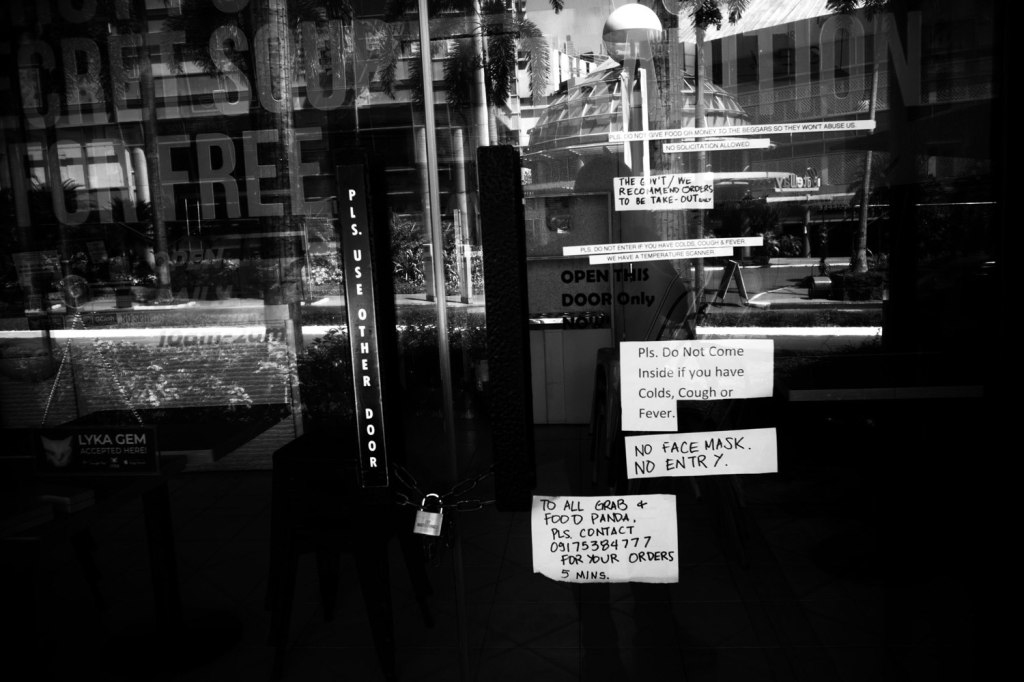
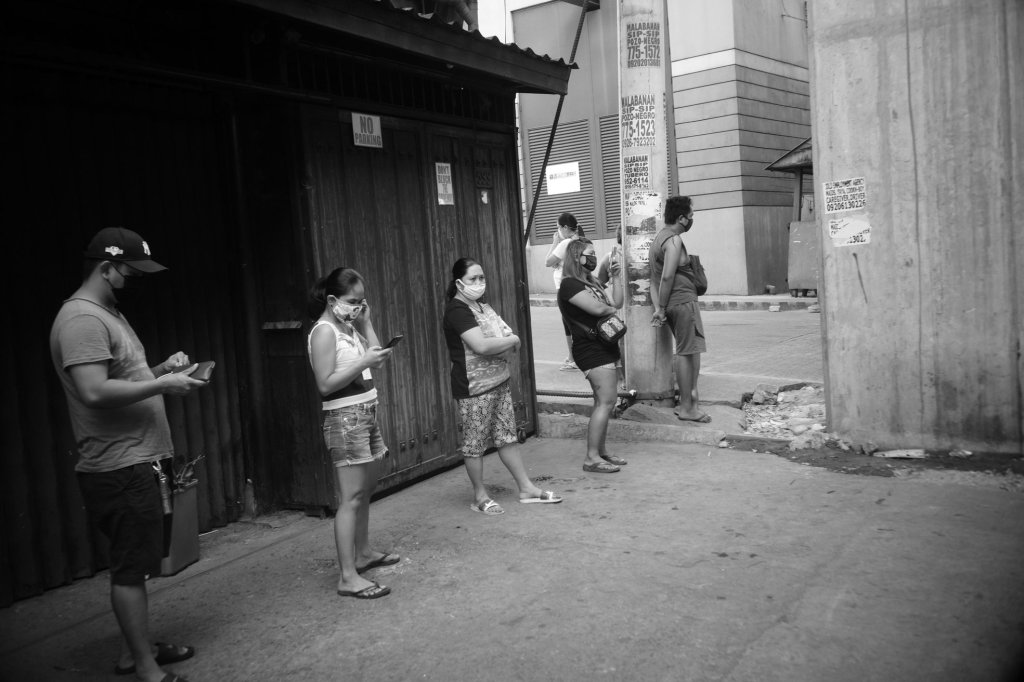
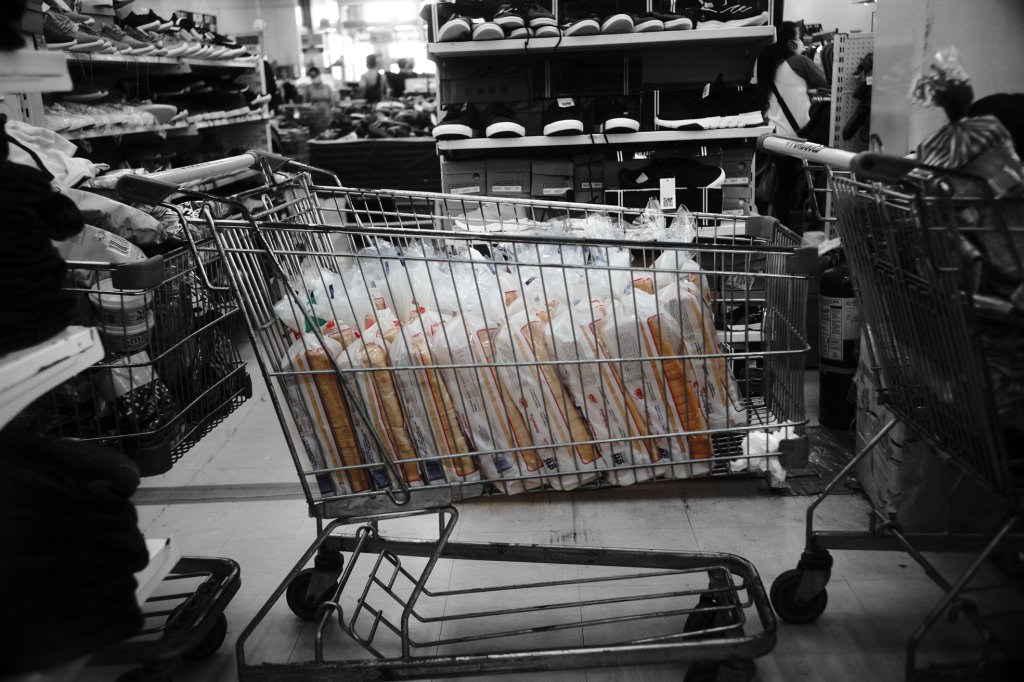
*Mga larawan sa itaas mga kuha ni G. Jay Javier, Mayo 2020; habang ang mga nasa ibaba ay kuha ng may-akda maliban sa ibong dilaw at puting bulaklak na kuha ni Dr. Mylene A. Santos, MD.
The Lord Is My Chef Breakfast Recipe for the Soul by Fr. Nicanor F. Lalog II
Friday, Week XXVIII, Year II in Ordinary Time, 16 October 2020
Ephesians 1:11-14     >><)))*> + >><)))*> + >><)))*>     Luke 12:1-7
Photo by the author, September 2020.
What a great apostle you have, O Lord God, in St. Paul indeed! Today he tells us something so unique, so understandable and relatable with us regarding our being blessed in Jesus Christ: being sealed in the Holy Spirit.
In him (Christ) you also, who have heard the word of truth, the Gospel of your salvation, and have believed in him, were sealed with the promised Holy Spirit, which is the first installment of our inheritance toward redemption as God’s possession, to the praise of his glory.
Ephesians 1:13-14
I love those two catchphrases by St. Paul: “sealed with the promised Holy Spirit” and “first installment of your inheritance”. It is both a stroke of his genius and mastery of language while at the same time, his openness to the inspiration of the Holy Spirit.
In him we find that blessedness in Christ through the Holy Spirit like having peace, kindness, generosity, forgiveness, understanding and things that bind us together in working together for the Lord’s mission.
But at the same time in speaking of the Holy Spirit as the first installment of our redemption, St. Paul had a foretaste of what we shall all experience in its fullness in eternity, an assurance of the fulfillment of Christ’s promise of salvation.
Like St. Teresa of Avila whose memorial we celebrated yesterday, St. Paul restored all things in you, Jesus Christ. And so, we pray for the grace of enthusiasm and perseverance of working for the coming of God’s Kingdom like him.
Give us the wisdom to proclaim loud and clear not only in words but also in deeds the Gospel so the world may know Jesus is here to restore everything and everyone back to you, God our Father.
We are not going to say anything new, Lord; we merely have to echo in this modern time your Good News of salvation, of love and mercy and forgiveness for everyone specially in this difficult time of the pandemic.
Likewise, give us the courage to witness the power of the Holy Spirit in this world living in front of all kinds of cameras without solid grounding on the realities of life, living in a make-believe world filled with hypocrisy. Seal us with your Holy Spirit, Lord! Amen.
The Lord Is My Chef Breakfast Recipe for the Soul by Fr. Nicanor F. Lalog II
Thursday, Memorial of St. Teresa of Avila, Virgin and Doctor of the Church, 15 October 2020
Ephesians 1:1-10     <*(((><<  || + + + ||   >><)))*>     Luke 11:47-54
Photo by Dr. Mai B. Dela Peña at a Carmelite Monastery in Israel, 2016.
You know so well, O God, how we must pray to you that you have taught St. Paul one of the most beautiful prayer – and greetings – we can all recite individually or communally when gathered in your name.
Blessed be the God and Father of our Lord Jesus Christ, who has blessed us in Christ with every spiritual blessing in the heavens, as he chose us in him, before the foundation of the world to be holy and without blemish before him.
Ephesians 1:3-4
So beautiful are these words showing to us our blessedness in Jesus Christ! If we could all be aware of our blessedness in you that springs from your infinite love for us poured by Jesus Christ at the Cross, maybe there would be less chaos in the world today.
Forgive us in wasting your blessings, exchanging them for fleeting pleasures of fame and wealth that set us apart from one another. Worst, in misleading others away from you with our sinful ways of life like the enemies of Jesus in today’s gospel.
Help us restore all things in your Son, dear Father, like St. Teresa of Avila who taught us to be mindful always of Jesus Christ’s love for us.
Whenever we think of Christ we should recall the love that led him to bestow on us so many graces and favors, and also the great love God showed in giving us in Christ a pledge of his love; for love call for love in return.
St. Teresa of Avila, Office of Readings, October xv
Quiet Storm by Fr. Nicanor F. Lalog II, 14 October 2020
Photo by author, sunrise at the Lake of Tiberias, the Holy Land, May 2019.
HOPE. A favorite word among us, used as an expression for things to get better, especially when we express our “hope” God grants what we pray for, or, in ending our letters of request with “hoping for your kind consideration”.
Even Hollywood is fond of this virtue, portraying it as a reserved power to overcome evil when Neo in the 2003 The Matrix Revolutions was summoned into action to defend their city because he was the only one with “hope”.
Or, something like a turbo charger that will boost every leap of faith when Toretto in Fast and Furious 6 handed to his rival Owen Shaw the computer chip they were tasked to retrieve in the “hope” of getting it back even if they have to chase a giant Antonov An-124 plane taking off.
Of course, Neo and Toretto succeeded in their efforts filled with hope, defeating evil.
But, that is not what hope is all about.
To hope is different from optimism, of believing things can get better;
in fact, we hope because things can get worst.
The late Fr. Henri Nouwen wrote in one of his books that to hope means having that firm conviction within that even if things get worst like death, we are certain God will never forsake us for he loves us very much.
Jesus Christ showed us this true meaning of hope when he decided to go to Jerusalem to accomplish his mission by dying on the Cross for our salvation. I love the way Luke narrated in his gospel this attitude of Jesus in showing us the path of hope amid his knowledge things would get worst than before leading to his Passion and Death (and Resurrection):
When the days for his being taken up were fulfilled, he (Jesus) resolutely determined to journey to Jerusalem…
Luke 9:51
Imagine Jesus “resolutely determined” going to Jerusalem, the very same attitude of saints witnessing the Gospel by facing martyrdom. It is also very true with us when we say our only hope is the Lord when we know of sure death while facing a serious illness.
To hope is to be “resolutely determined” like Jesus and the saints along with our loved ones to follow the arduous path of life, of putting up the good fight against sickness or injustice and evil even if they knew things will lead unto death. At first we wonder, what victory can we claim if in the end we die like the saints and martyrs?
That’s the mystery and paradox of hope: to hope is to completely trust in God that death is not the end of life or any struggle but the highest point of our transformation as we dive to life’s lowest level like defeat, loss, and death when we pray like Jesus on the Cross, “Father, into your hands I commend my spirit” (Lk.23:46).
Hope is faith severely tested, believing and abandoning everything to God, come what may.
Photo by Arch. Philip Santiago, Fatima, Portugal, 2016.
Hope is clearly not positive thinking nor optimism; hope is “faith in God” as Pope Emeritus Benedict XVI tells us in his second encyclical, Spe Salvi (2007). According to Pope Benedict, hope gives us the direction towards the future by enabling us to face the challenges of this life leading to salvation and eternal life.
In this sense it is true that anyone who does not know God, even though he may entertain all kinds of hope, is ultimately without the great hope that sustains the whole of life (Eph.2:12). Man’s great, true hope which holds firm in spite of all disappointments can only be God — God who has loved us and who continues to love us “to the end,” until all “is accomplished” (Jn.13:1 and 19:30)… If we are in a relation with him who does not die, who is Life itself and Love itself, then we are in life. Then we “live”.
Spe Salvi, #27
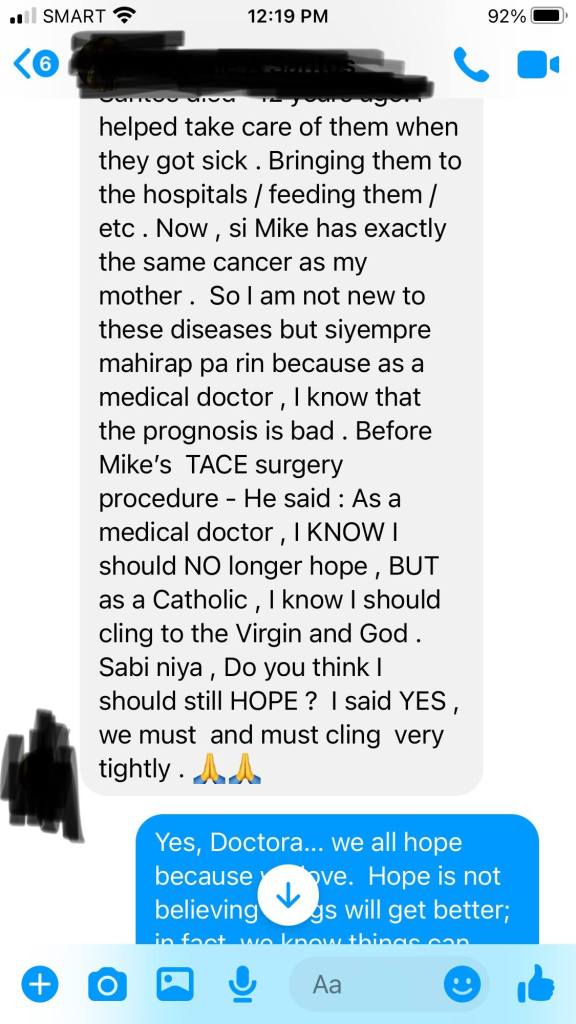
Four weeks ago, a former parishioner had asked me for prayers for her husband with liver cancer. Both are medical doctors; in fact, it was her husband who had actually diagnosed himself while going through radiological lab exam.
It was at that time they “resolutely determined” to go home and face the inevitable by praying together, hoping together in God.
Here lies the mystery and paradox of hope we were talking earlier: why and what do we really hope when we know it is going to end in death?
God. Nothing else and nobody else. God is the reason we hope and what we hope for.
It is only when we have been stripped of everything else when we truly “see” and experience God is all we have in life after all.
Then we become confident God will never abandon us until the end.
That is what my friend and her husband have realized, especially when Dr. Mike died two weeks later after going home.
When I celebrated Mass at his wake, I could not resist telling my friend how the smile of her husband is the sweetest, even most infectious one I have ever seen on the lips of a dead person in my 22 years as a priest!
Truly, the Lord loved Dr. Mike until the end that he died with a smile as the fruit of his hoping in God with his wife.
Indeed, friends have told me that God will give us the grace to face our death when that time comes; and I believe them because I have seen them transformed after accepting their terminal condition that they no longer cry of their situation getting worst while those to be left behind in turn become the ones crying knowing their beloved is passing (https://lordmychef.com/2020/09/22/the-gift-of-tears/).
Hope surprises.
Even God.
Photo by author, 2019.
When I was on my second year of seminary formation in theology, I experienced the most severe test of my vocation to the priesthood that I almost left and abandoned all plans of becoming a priest at all.
What sustained me in the seminary were prayers — and some lines from T.S. Eliot’s very long poem “Four Quartets” published in 1941:
I said to my soul, be still, and wait without hope For hope would be hope for the wrong thing; wait without love, For love would be love of the wrong thing; there is yet faith But the faith and the love and the hope are all in the waiting. Wait without thought, for you are not ready for thought: So the darkness shall be the light, and the stillness the dancing.
Too bad I have lost the index card on which I wrote this stanza which I posted on my study lamp, reading it daily even until I have become a priest.
To truly hope, one has to get totally lost and empty, stripped naked of our very selves when darkness is our only light and hopelessness is our only hope.
It is when we have totally lost everything except God when we truly hope.
And that is when all the surprises happen, not only with ourselves but with others.
Not only here but definitely even in eternity, the biggest surprise we are all hoping for.
Photo by author at Silang, Cavite, 22 September 2020.
In 1912, the French poet Charles Pierre Péguy (1873-1914) wrote a very long poem ahead of T.S. Eliot about the virtue of hope, claiming it is God’s favorite because it is full of surprises.
Péguy portrayed Hope as a “little girl” who enlivens her older sisters Faith and Love.
I do not want to dilute its magic and power so I leave it that way for you to savor its sweetness, its truth and beauty in Péguy’s poetry:
The faith that I love best, says God, is hope. Faith doesn’t surprise me. It’s not surprising. I am so resplendent in my creation…. That in order not to see me these poor people would have to be blind. Charity, says God, that doesn’t surprise me. It’s not surprising. These poor creatures are so miserable that unless they had a heart of stone, how could they not have love for each other…. But hope, says God, that is something that surprises me. Even me. That is surprising.
Charles Péguy, The Portal of the Mystery of the Second Virtue
Sometimes in life, we have to hit rock bottom in order to truly hope. Keep hoping and you will surely be surprised by God, by others, and by our very selves that we are always blessed! Amen.
The Lord Is My Chef Breakfast Recipe for the Soul by Fr. Nicanor F. Lalog II
Wednesday, Week XXVIII, Year II in Ordinary Time, 14 October 2020
Galatians 5:18-25     >><)))*> + >><)))*> + >><)))*>     Luke 11:42-46
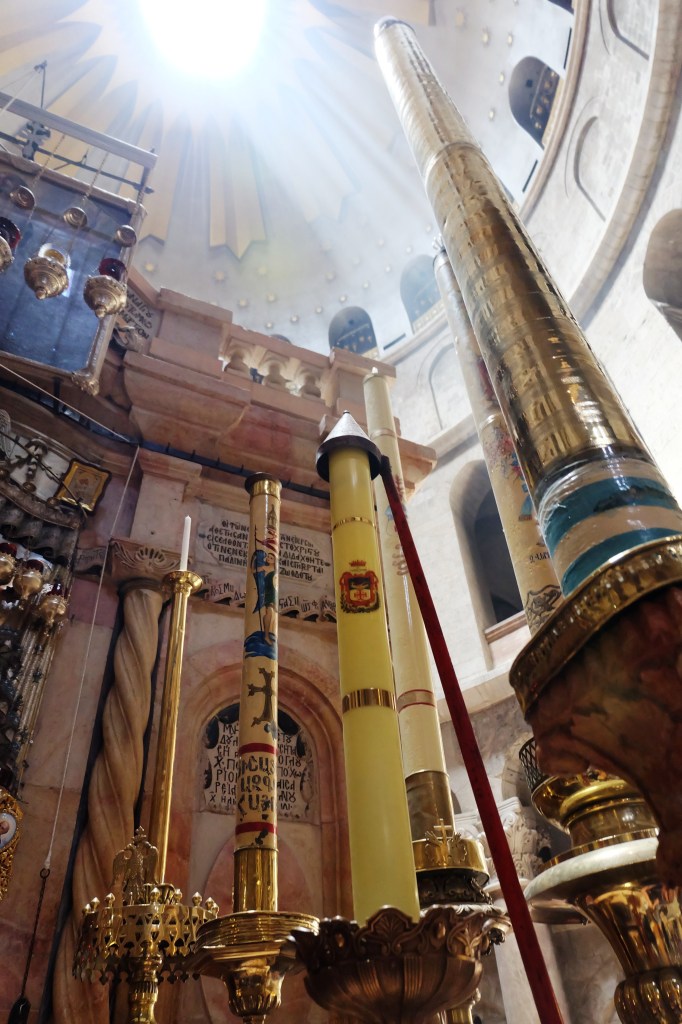
Photo by author, Church of Holy Sepulcher, May 2017.
It was a very enriching week of lessons about faith as reflected by St. Paul in his Letter to the Galatians, God our Father. We have learned so much to appreciate this gift from you we rarely recognize and give importance to.
As we end the readings from the Letter to the Galatians today, teach us through Jesus Christ how to live faithfully in your Holy Spirit to reap its fruits in our lives we badly need these days amid the pandemic and follies going on around us especially among our elected officials.
Brothers and sisters: If you are guided by the Spirit, you are not under the law. Now the works of the flesh are obvious: immorality, impurity, licentiousness, idolatry, sorcery, hatred, rivalry, jealousy, outbursts of fury, acts of selfishness, dissension, factions, occasions of envy, drinking bouts, orgies, and the like. In contrast, the fruit of the Spirit is love, joy, peace, patience, kindness, generosity, faithfulness, gentleness, self-control.
Galatians 5:18-23
Forgive us Lord when we choose to be prisoners of so many rules that govern our lives forgetting the more important things of living faithfully in you like the Pharisees in today’s gospel. We are so concerned with little things that we make so big a fuss; worst, we refuse to “lift one finger to touch them” by passing them on to others, subjecting them to so many things that they miss the beauty of your gift of life.
Make us grow deeper in faith in you and may the Holy Spirit enlighten our minds and our hearts to always seek and follow your most Holy Will. Amen.
Lawiswis ng Salita ni P. Nicanor F. Lalog II, Ika-13 ng Oktubre 2020
Larawan kuha ni Bb. Ria de Vera, Agosto 2020.
Pangunahing biyaya
ng Diyos sa ating lumikha
pananampalataya o pananalig
sa Kanya tayo magtiwala;
ngunit hindi natin alintana
itong pananampalataya
katulad ng ano mang biyaya
dapat linangin upang payabungin
pamungahin, at patatagin
hindi lamang magbigay galak sa atin
kungdi makaya nating harapin
ano mang unos sa buhay ang dumating.
Kumbinsido ba tayo
sa pinanghahawakang pananampalataya
kaya nating panindigan di lamang ipaglaban
 kungdi ipaliwanag katuwiran at katuturan?
Kung minsan akala natin
itong pananampalataya gamit para kamtin
ano mang hilingin sa Diyos Ama natin
nakakalimutan higit sa lahat ito ay ugnayan
relasyon na dapat pinalalalim
pinaiigting upang maging matalik
pagkakaibigan natin.
Ano mang samahan at ugnayan
palaging nakasandig sa pananalig
sa isa't-isa, palaging makatotohanan
walang kasinungalingan;
tiyak na palaging maasahan
dahil ang tunay na pananampalataya
consistent, hindi pabago-bago
kungdi pare-pareho
  saan man at kailan man,
sino man ating pakiharapan
nananatili katapatan
tulad ni Hesus
hanggang kamatayan.
The Lord Is My Chef Breakfast Recipe for the Soul by Fr. Nicanor F. Lalog II
Tuesday, Week XXVIII, Year II in Ordinary Time, 13 October 2020
Galatians 5:1-6     >><)))*>  +  >><)))*>  +  >><)))*>     Luke 11:37-41
Photo by author, Lovers’ Bridge, Tamsui in Taiwan, January 2019.
Thank you again, God our Father, for the gift of faith that enables us to do good, to do your works of charity and love. You have gifted us with freewill primarily because of faith itself when you believed in us and trusted us.
Yes, dear Father: like love, we are able to believe and trust you because you were the first to believe and trust us. Forgive us for those times we wrongly chose sin, when pride and selfishness, doubts and mistrust clouded our decision making. When despite our faith, we refused to love.
For in Christ Jesus, neither circumcision nor uncircumcision counts for anything, but only faith working through love.
Galatians 5:6
Indeed, it is because of faith that we are able to choose and do what is good. And the more faithful we become to you, O God, we become more loving like you!
Without faith, it is difficult for us to love because of the pains that come always in loving
Without faith, it is impossible to forgive and be merciful, to let go of others’ infidelity and lack of love and concern because these are virtues and values that come only from within, from a loving heart where faith dwells.
Photo by author, February 2020.
Sometimes, like the Pharisees, we become so focused with what is outside to cover what is missing inside us — faith!
And despite our confessions of our faith, we believe more on outside appearances and forget the more essential inside that is faith leading to love.
The Lord said to him, “Oh you Pharisees! Although you cleanse the outside of the cup and the dish, inside you are filled with plunder and evil. You fools! Did not the maker of the outside also make the inside? But as to what is within, give alms, and behold, everything will be clean for you.”
Luke 11:39-41
Teach us, Jesus, to trust in you, to grow in faith in you so we may be more loving like you! Amen.
The Lord Is My Chef Breakfast Recipe for the Soul by Fr. Nicanor F. Lalog II
Monday, Week XXVIII, Year II in Ordinary Time, 12 October 2020
Galatians 4:22-24, 26-27, 31-5:1     ||| +++ |||     Luke 11:29-32
Cross of Christ atop the church of our Lady of Lourdes in France. Photo by Arch. Philip Santiago, September 2018.
Today O God our Father I thank you for the gift of faith we have always taken for granted. Faith is not just for believing in you, God; faith is for believing what is true! Without faith, life would be a drab and even senseless for there is nothing we can ever hold as reliable and true.
Without faith is like living without friction with everything sliding, slipping, escaping our grasps. There is nothing we would ever believe in. Most of all, without faith we can never read and understand any kind of signs, especially your saving work in Jesus Christ.
While still more people gathered in the crowd, Jesus said to them, “This generation is an evil generation; it seeks a sign, but no sign will be given it, except the sign of Jonah. Just as Jonah became a sign to the Ninevites, so will the Son of Man be to this generation.
Luke 11:29-30
We live in a world of so many signs and symbols but it is only through your gift of faith that they all become meaningful and useful.
Teach us, Lord, to deepen our faith so we can read your signs better like St. Paul in the first reading whose deep faith in you enabled him to interpret the meaning of the signs of Abraham’s two sons, Ishmael by Hagar and Isaac by Sarah.
May we love and care more for your gift of faith to us, Lord, because it is through our faith that we know and discover, follow and hold on to your plans for us. Amen.
Quiet Storm by Fr. Nicanor F. Lalog II, 11 October 2020
Photo by Ms. Anne Ramos, Good Friday “motororized procession” of Santo Entierro in our Parish during COVID-19, 10 April 2020.
Lately I have noticed
since month of August
when we have a spike of the virus
I have felt heavy and serious
as Sundays have become
more like a Good Friday
with the streets and church seats
both empty;  nobody seems to be happy
or Sundays have become more lazy?
How I miss the people I always see
wondering if they are safe and healthy
or maybe so wary just like me.
Sometimes I still feel
how everything is surreal
will I make it to next year
enjoying life without fear?
I have been wondering
if the Lord is still hanging
or have they crucified him again?
Life in the midst of COVID-19
has become more challenging
listening to silence so deafening
when God does not seem to be caring;
but, deep within
there is that calming
during Good Friday
that Easter Sunday
 is surely coming:
keep on believing, keep on praying
if Sundays look like a Good Friday
this may only mean one thing, that
Jesus is with us suffering COVID-19!
The Lord Is My Chef Sunday Recipe for the Soul by Fr. Nicanor F. Lalog II
Week XXVIII-A in Ordinary Time, 11 October 2020
Isaiah 25:6-10     ><)))*>     Philippians 4:12-14, 19-20     >><)))*>     Matthew 22:1-14
Photo by author, Our Lady of Mount Carmel of the Holy Family, Guiguinto, Bulacan (2018).
As we end the series of teachings in parables by Jesus directed to the chief priests and elders of the people, St. Paul concludes his Letter to the Philippians in our second reading with words so moving for a man awaiting trial and sure death, giving us a glimpse at how this great Apostle of the Lord looked at the most ordinary things in life.
Brothers and sisters: I know how to live in humble circumstances; I know also how to live in abundance. In every circumstance and in all things I have learned the secret of being well fed and of going hungry, of living in abundance and of being in need. I can do all things in him who strengthens me.
Philippians 4:12-14
Wow! Here we find St. Paul at his best and finest, with his mastery of language at the service of his innermost thoughts and feelings, indicating his transformation from the many hardships and difficulties he had gone through as an Apostle and suffered as a prisoner.
Like St. Paul, there are times we experience that perfect balance in life called equilibrium when we are able to bridge the distance between our mind and our heart with Jesus at the center amid so many trials and difficulties.
Most of all, we see in this short passage how St. Paul accepted both living in need and in abundance with calmness and composure because of Jesus Christ who strengthened him!
What an encouragement for us all in this time of pandemic to remind us of learning to adjust to situations, that true peace within comes not from abundance or scarcity of material goods but of letting go and letting God in our lives. St. Paul witnessed to us the centrality of the Lord’s teaching of denying ourselves, taking our cross and following Jesus.
Most of all, in St. Paul we find what is to be clothed in Christ or “to put on Jesus Christ” (Rom.13:14) by accepting God’s invitation to salvation through his Son as the parable of the wedding feast tells us in our gospel this Sunday.
Jesus again in reply spoke to the chief priests and elders of the people in parables, saying, “The kingdom of heaven may be likened to a king who gave a wedding feast for his son. He dispatched his servants to summon the invited guests to the feast, but they refused to come. A second time he sent other servants… Some ignored the invitation and went away, one to his farm, another to his business. The rest laid hold of his servants, mistreated them, and killed them. The king was enraged and sent his troops, destroyed those murderers, and burned their city.
Matthew 22:1-4, 5-7
Do not ignore God’s invitation; carpe diem (seize the moment).
Photo by Angelo N. Carpio, January 2020.
Jesus continues to direct his parables to the chief priests and elders of the people not really to shame them and expose their sinister plots against him but more in the hope of converting them, of giving them the chance of getting into God’s kingdom in heaven.
That is how great is his love for everyone, especially the sinful even if they would not admit it — just like us!
Keep in mind that Christ speaks always in the present and this parable is also meant for us who feel “entitled” in may ways like the chief priests and elders at that time. Interestingly, today’s parable to a large extent has to be taken in the context of the Sunday Mass, the prefiguration of the wedding feast in heaven to which we are all invited.
But how can we get to the wedding feast in heaven if we feel so sure like the chief priests and elders that we refuse to accept God’s invitation?
The Eucharist is the summit of our Christian life where we receive Jesus Christ in words proclaimed, in his Body and Blood, and among the people gathered. Every day Jesus is inviting us to partake in his Sacred Meal to be nourished and get our bearings in life through him like St. Paul.
See how before the pandemic, people refused to celebrate Mass and other Sacraments; but, when quarantine measures were implemented with the suspension of public Masses, everybody wanted to go to churches and receive the Sacraments, specially Holy Communion and Baptism, as well as Confession and Anointing of the Sick!
Photo from Shutterstock/Aleteia.
After seven months of pandemic, many of us have learned to adjust to the new situation but sadly, many have gone back to totally ignoring the Sunday Mass. Worst is at how some have considered online Masses as “video-on-demand” making Jesus Christ a “commodity” anyone can have when most convenient. Pope Francis had reminded us last summer that online Masses are not the norm but a response to the pandemic. Nonetheless, we still have to dispose ourselves properly when celebrating with online Masses like in actual live Mass in a Church and strive to be punctual and avoid doing other things during the online celebration.
In giving us these modern means of communications, God continues to invite us to come to him and gather in his name as a family in our homes for the Sunday online Masses and other liturgical activities that nourish our souls so essential in these trying times. Like the king in the parable today who had to invite guests thrice to his son’s wedding feast, God gives us all the opportunities and chances to celebrate in his gift of salvation through Jesus in the Eucharist which is the summit of Christian life.
May we not miss every opportunity!
When I was assigned to our diocesan schools during my first ten years in priesthood, I used to tell my students that God’s mercy and forgiveness are unlimited but there are acts that can have irreversible consequences like getting involved in a murder, getting pregnant outside marriage, or being caught in a video scam. I would tell them that God will surely forgive you and give you many chances in life while people like your family and friends including those you may have hurt may also forgive and accept you; however, you cannot escape the consequences of those acts that will surely limit your freedom and change forever your situations in life. Bottomline is, do not let yourself be missed out in accepting God’s invitation to his feast of life and salvation by following the path of holiness that beings in the Holy Mass.
The first reading from the Prophet Isaiah directs our attention to “that day” when God would save us and welcome us into heaven symbolized by the feast or banquet with great food and drinks. The good news is we are all invited to his feast, assured with a seat and it would only be our fault to not make it there, either by refusing it or not getting dressed properly.
Being properly dressed is always a sign of maturity.
Photo by Ezra Acayan/Getty Images, 09 February 2020, Baclaran Church.
“The servants went out into the streets and gathered all they found, good and bad alike, and the hall was filled with guests. But when the king came in to meet the guests he saw a man there not dressed in a wedding garment. The king said to him, ‘My friend, how is it that you came in here without a wedding garment?’ But he was reduced to silence. Then the king said to his attendants, ‘Bind his hands and feet, and cast him into the darkness outside, where there will be wailing and grinding of teeth.’ Many are invited, but few are chosen.”
As is often the case in his parables, Jesus pulled a surprise when he added another parable to this parable of the wedding feast that could have easily ended in the annihilation of those who rejected the king’s two earlier invitations.
God is the king who was so good that he never tired of inviting guests thrice to the wedding feast of his son, and this time he opened it to everyone! And here lies the clincher: though everyone is invited, guests were expected to come in proper attire.
We have learned at a very young age of getting properly dressed in an occasion. In fact, dressing properly is a sign of maturity. Some people especially in this age always claim what matters is the inside of the person not the outside appearance like clothes; but, they forget that the outside also indicates what is inside of us!
Clothes speak a lot of who we are and what we are that even St. Paul used several times the metaphors of clothes like “putting on the Lord Jesus” or being “clothed in Christ” as we have cited earlier.
See how the king went to meet the guests not just for pleasantries but for inspection that immediately his eyes caught the man not dressed in a wedding garment. The king was even courteous addressing the man as “my friend” when asked why he came not in a wedding garment.
Try to imagine the scene with that man “reduced to silence” meaning, he was guilty of not putting on a wedding garment even if he knew that was the occasion he was going to. He had been remiss of his duties and obligations, just like the wicked tenants last week or the merciless servant last month.
"Many are invited, but few are chosen" (Matthew 22:14)
St. Matthew never failed to remind us these past weeks that our faith has no value if not translated into actions, if it does not bear fruits. Today, he reminds us to be properly dressed to become a part of the wedding feast of the Lord, of the need to be clothed in holiness, in charity, and kindness with others.
Moreover, with just barely two months to go before we end the liturgical year to usher in Advent in preparation for Christmas, Jesus tells us today to never feel so sure, even “safely assured” of getting into heaven like the chief priests and elders of his time that even if we celebrate Sunday Masses weekly, online or actual, nothing is final yet in this life until we all get into the hall of the wedding feast in heaven when we are judged for our good deeds.
For the meantime, let us not miss joining the “rehearsals” for that feast – the Sunday Mass we celebrate weekly when he invites everyone to come. Be sure to be properly dressed for the occasion, literally and figuratively speaking. Amen.
A blessed week to everyone!
Photo by author at Silang, Cavite, 22 September 2020.