The Lord Is My Chef Daily Recipe for the Soul by Fr. Nicanor F. Lalog II
Wednesday in the Twenty-second Week of Ordinary Time, Year II, 31 August 2022
1 Corinthians 3:1-9 ><]]]]'> + ><]]]]'> + ><]]]]'> Luke 4:38-44
Praise and glory to you,
God our loving Father for this
last day of August; in a few
hours at midnight we shall
move into the -ber months with
September first;
but most of all, praise and glory
to you, dear God, for the gift of
your Spirit in us that we often
fail to recognize and nurture
as your most wondrous gift to us.
Too often, we mistake our being
religious with being spiritual when
we measure our relationship with
you in terms of what we do for you
which is religiosity, forgetting that what
matters most is our response to
the things you have done for us,
inviting us into a communion,
a relationship which is what spirituality
is all about;
like the people of Corinth in the time
of St. Paul, what we see more are your
ministers and practices, forgetting all
about you, our Lord and God!
What is Apollos, after all, and what is Paul? Ministers through whom you became believers, just as the Lord assigned each one. I planted, Apollos watered, but God caused the growth. Therefore, neither the one who plants nor the one who waters is anything, but only God, who causes the growth. He who plants and he who waters are one, and each will receive wages in proportion to his labor. For we are God’s co-worker; you are God’s field, God’s building.
1 Corinthians 3:5-9
Dearest Jesus Christ,
you have come to bring us closer
to God our Father; you became
like us in everything except sin,
experiencing even death so that we
may rise in you into new life, new
relationships with God and others;
let us realize like the apostles who
interceded for your healing of
Simon's mother-in-law that there alone
is one God above us all with whom is all
our being as origin and end; help us
realize too that like you, we have to
move to other places, to go and see
others to experience and know God
our Father, for he alone matters most
in this life. Amen.
The Lord Is My Chef Daily Recipe for the Soul by Fr. Nicanor F. Lalog II
Monday, Solemnity of the Assumption of the Blessed Virgin Mary, 15 August 2022
Revelation 11:19, 12:1-6, 10 ><}}}*> 1 Corinthians 15:20-27 ><}}}*> Luke 1:39-56
Photo by author, view of sunrise from Our Lady of Fatima University in Antipolo City, 14 August 2022.
It is very rare to find in the Bible a story of two women together, conversing, blessing each other. And that rarity happens in our gospel scene today of the Visitation of Mary to her cousin Elizabeth in a town in Judah as we celebrate the Solemnity of the Assumption of Mary.
What kind of greeting did Mary say that when Elizabeth heard her, the child in her womb leaped in joy, filling her with the Holy Spirit to call Mary blessed? This could have not been any ordinary greeting to elicit such a response from Elizabeth, for her to be filled by the Holy Spirit!
Luke does not tell us how Mary greeted Elizabeth who was six months pregnant at that time with John the Baptist, the forerunner of Jesus who was also in the womb of Mary at that time. Most likely, she must have said something too close or similar with Gabriel’s greeting to her during the Annunciation, “Hail favored one! The Lord is with you” (Lk.1:28).
As we await of that future glory,
part of the basis for our assumption
into heaven like Mary someday depends
in the way we greet others because
that is an indication of our generosity
and selflessness to a great extent.
Perhaps some of you are wondering why the Church is using this story of the Visitation on this Solemnity of the Assumption of the Blessed Virgin Mary. One reason is of course, there is no written account of the Assumption of Mary into heaven.
However, the Visitation story which includes Mary’s Canticle of the Magnificat that she sang as a response to Elizabeth’s praises reflects the meaning of the Assumption: it is a celebration of the great things that God has done for Mary and for us including which he would also do in the future like our “assumption” into heaven like we profess every Sunday in the Apostles’ Creed, “the resurrection of body and life everlasting.”
“The Assumption of the Virgin” by Italian Renaissance painter Titian completed in 1518 for the main altar of Frari church in Venice. Photo from en.wikipedia.org.
Mary became the first human to experience fully the salvation by her Son Jesus Christ, from her Immaculate Conception which speaks of our lost glory from the beginning, and unto her Assumption which promises us of the future glory we shall have in heaven.
As we await of that future glory, part of the basis for our assumption into heaven like Mary someday depends in the way we greet others because that is an indication of our generosity and selflessness to a great extent.
When Elizabeth heard Mary’s greeting, the infant leaped in her womb, and Elizabeth, filled with the Holy Spirit, cried out in a loud voice and said, “Blessed are you among women, and blessed is the fruit of your womb. Blessed are you who believed that what was spoken to you by the Lord would be fulfilled.”
Luke 1:41-42, 45
To greet is to recognize God working in us, among us.
It is thinking more of the other person and God than one's self.
Have you noticed these past several years of a silly and inane trend especially in many churches of commentators greeting the congregation with “Magandang umaga po sa ating lahat” or “Good morning to us all”?
What kind of a greeting is that?
To greet somebody is to share something with others. In the Visitation, Mary shared Jesus Christ who was in her womb to Elizabeth that even John in her womb felt him, leaping for joy.
To greet means to extend goodwill to someone, to desire blessings and good things to others.
That was the reason Mary went to visit Elizabeth; she was thinking more of her cousin who was old and barren yet pregnant for six months by the grace of God. Mary visited Elizabeth to affirm the goodness and kindness of God, to recognize that God’s plans for Elizabeth and her baby in her womb have direct correlations with God’s plans for her and her baby in the womb, Jesus.
To greet is to recognize God working in us, among us. It is thinking more of the other person and God than one’s self.
Now, how did it happen that we Filipinos have retrogressed especially in our religious gatherings as well as civic activities when those holding the mic would always say, “Magandang gabi sa ating lahat… Pagpalain tayong lahat ng Diyos” (Good evening to us all or May we all be blessed)?
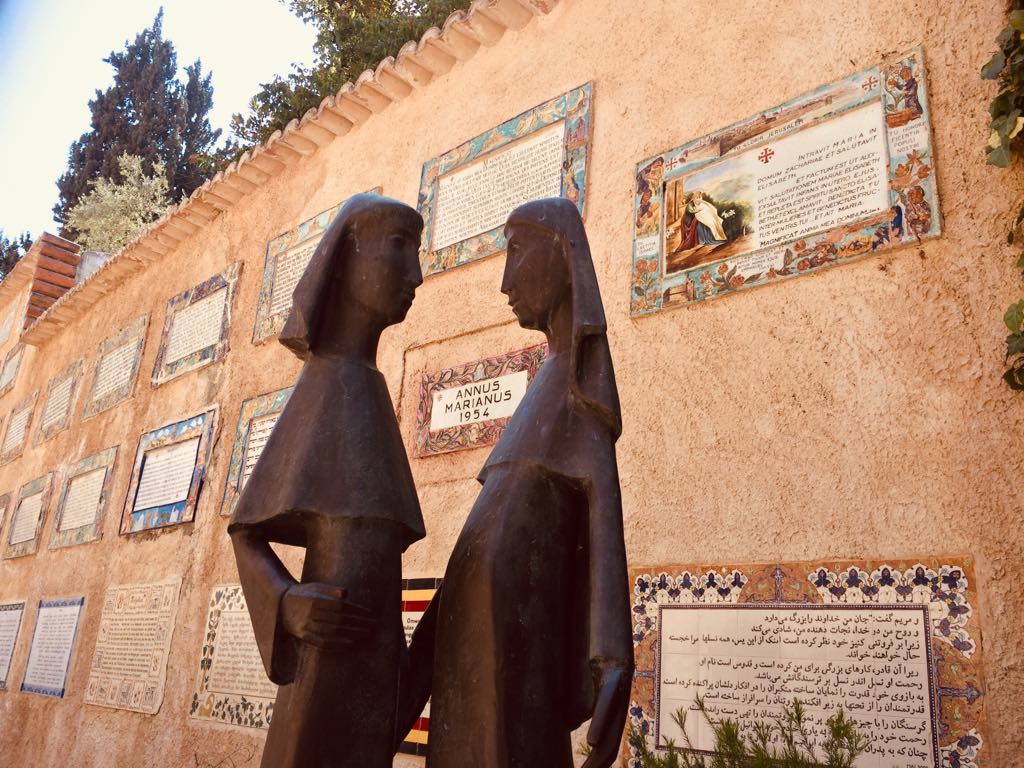
Photo by author, Church of the Visitation, Ein-Karem, Holy Land, May 2017.
Keep in mind the greeter is sharing what he/she has like a “good morning” or a “blessed day”. Then why is it there are so many among us especially commentators who include their very selves when greeting the congregation, saying “good morning to us all” and other inanities?
To greet others where the greeter includes self in the greeting is like giving a sandwich or coffee to everyone yet takes a bite first or sips too! It is very much the same as replying “me too” when someone tells you “I love you”.
If you include yourself in a greeting, it is not a greeting at all but an insult, a clear sign of callous ego and selfishness to the highest degree that one cannot wait for others to be greeted back.
See the humility and wisdom of Mary: after she had greeted Elizabeth who praised her in return by calling her “blessed” – the first to call her as one – Mary praised God. Not Elizabeth.
When we greet anybody with good morning or good evening or whatever, we do not include ourselves in the greeting because the very fact we are greeting others means we have a lot of good and blessings in us. Like Mary and Elizabeth, we feel so blessed by God that we share Jesus freely to others. Like Mary, we believe and trust that God will never forsake us, will never forget us.
If we can’t even greet somebody so well and so freely, how can we be truly Christian like Mary?
Photo by author in Nazareth, Israel, May 2019.
The Solemnity of the Assumption reminds us today of that great and powerful greeting by Mary to her cousin Elizabeth that led to an encounter and revelation to happen between two women, one old and barren to bear a child with the other too young and unmarried virgin yet both bore children in their wombs by the grace of God.
And it was not just an encounter between the two mothers-to-be but also between their two infants still in their wombs!
In their greetings, God’s mighty deeds became evident, truly present and felt through their mutual exchange of believing, of saying “yes” to Jesus.
The blessedness of this celebration today is found in God’s mighty deeds now resounding in the eternal greeting Mary gives her Son Jesus in heaven.
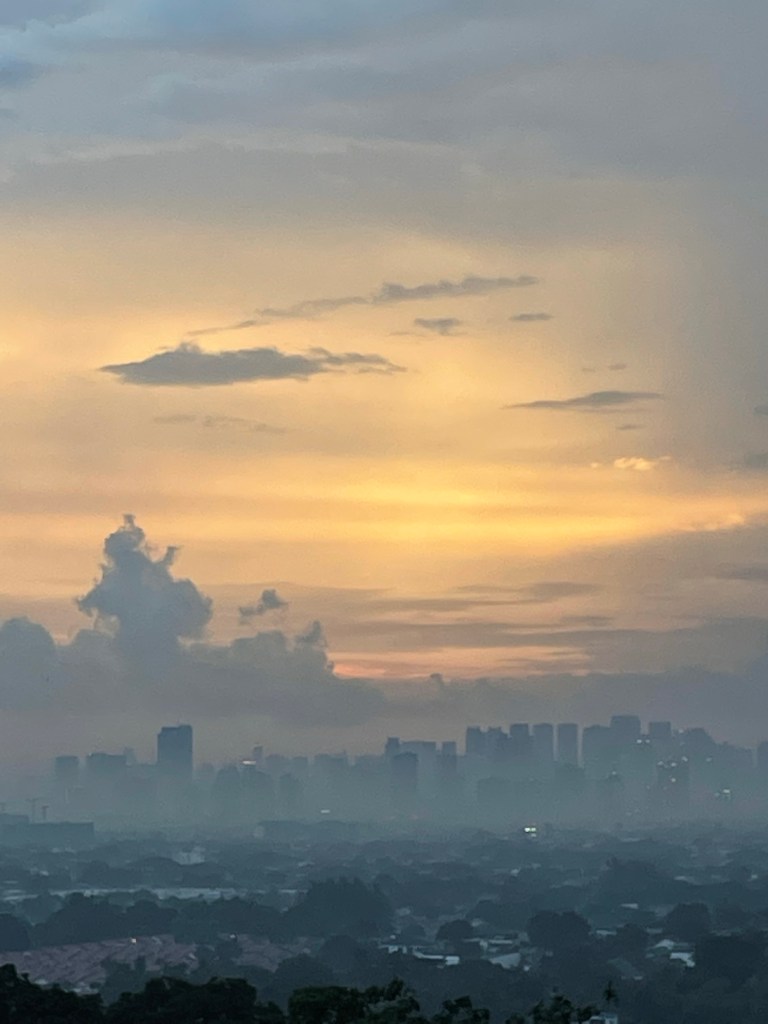
Photo by author, sunset with the Makati skyline from Antipolo City, 13 August 2022.
Do we hear Mary’s greetings in our own greetings to one another?
Do our greetings elicit responses from others?
Do our greetings lead others to leap for joy?
Or, do our greetings annoy them because we do not greet them at all, we refuse to share Jesus because we have become too conceited?
How can we be assumed into heaven body and soul if we are so filled with our very selves, when we can’t even freely and truly give away greetings to others?
Then, it must be a case of too much presumptions, of assuming everything for us. Amen.
The Lord Is My Chef Sunday Music by Fr. Nick F. Lalog II
Photo by author, Mt. Nebo, Jordan overlooking Israel, 2019.
Blessed Sunday, everyone! It was a very tiring but fulfilling week that after our Saturday evening Mass, I just thought of listening to Mr. Dennis Lambert’s music “Ashes to Ashes” released in 1972.
I have always loved the voice and music of Mr. Lambert, especially his love song “Of All the Things”; but, as I listened to “Ashes to Ashes” last night, I realized the song is perfect match with our gospel this Sunday where Jesus reminded his disciples and us to “do not rejoice because the spirits are subject to you, but rejoice because your names are written in heaven” (Lk.10:20).
Discipleship – and life in general is about relationships. It is never about the things we can do or have achieved because everything and everyone is passing. Nothing is permanent in this world except love who is God himself (https://lordmychef.com/2022/07/02/maintain-safe-braking-distance/).
When we speak of heaven, we speak of intimacy with God; its opposite, hell, is separation from God. That is why Jesus tells us to rejoice our names are written in heaven, that we are one with the Father in him now. It does not really matter to him whatever we can do or whatever we have achieved but what matters most is what we have become: have we been more loving and faithful? Kind and understanding?
That is what Mr. Lambert is telling us in his “Ashes to Ashes” which is of biblical origin: “We’re only living to leave the way we came”.
They’re tearing down the street Where I grew up Like pouring brandy In a Dixie cup
They’re paving concrete On a part of me No crime for killing off A memory
Ashes to ashes, dust to dust Can you find the Milky Way Long Tall Sally and Tin Pan Alley Have seen their dying day
Ashes to ashes, dust to dust It’ll never be the same But we’re all forgiven We’re only living To leave the way we came
But of course, it is not the end of everything.
Our Christian faith tells us we have direction in this life wherein death is not the end but the beginning of eternal life which is still, about perfect relationships with God and one another.
Have a blessed Sunday everyone – eat, pray and unwind with your loved ones.
*We have no intentions of infringing into the copyrights of this music and its uploader except to share its beauty and listening pleasure.
Photo by author, sunrise at the Lake of Tiberias (Galilee) in Israel, May 2019.
Our gospel last Sunday spoke of the Risen Lord’s third appearance to his disciples at the Lake of Tiberias. No one, except the beloved disciple recognized Jesus standing at the shore after he had told them to cast their net to the right side of the boat that led to their plentiful catch of fish.
When it was already dawn, Jesus was standing on the shore; but the disciples did not realize that it was Jesus. Jesus said to them, “Children, have you caught anything to eat?” They answered him, “No.” So he said to them, “Cast the net over the right side of the boat and you will find something.” So they cast it, and were not able to pull it in because of the number of fish. So the disciple whom Jesus loved said to Peter, “It is the Lord.” When Simon Peter heard that it was the Lord, he tucked in his garment, for he was lightly clad, and jumped into the sea.
John 21:4-7
Photo by author, sunrise at Lake of Tiberias, May 2017.
I love the way it is narrated. What a wonderful interplay of realities, of John the beloved recognizing Jesus standing at the shore upon seeing the many fish caught in their net!
The story speaks of the beauty of every sunrise many of us seem to take for granted, of how so many of us miss the beautiful sight and silence of the morning. It is a story of every new day filled not only with promises but in itself a blessing we can surely experience when we first recognize Christ present in us.
That is perhaps one problem with us who always prefer spectacular sights and events to find God.
Unlike sunset, sunrise does not have radiant displays of colors and shades. It is very simple which is the lesson of Easter to us, of how our great God comes to us in the simplest moments of life. Recall too that Jesus was born in the middle of the darkest night of the year when everyone was asleep and rose from the dead very, very early in the morning that no one had seen! And here lies one of the wonderful mysteries in life – the hiddenness of God!
It is in God’s hiddenness that we can find him not because he is hiding but inviting us to be hidden in him too. That is the beauty of sunrise when you have to wake up early to see the beauty of life unfolding, awaiting something we are totally unaware of what is going to happen next. It is easier to wait for the sunset because you have been up and going the whole day; you just have to stop and pause for a while to await the sun going down.
Photo by Ms. Jo Villafuerte, sunrise at Atok, Benguet, September 2019.
Sunrise is different. It is like awaiting a total stranger, compared with sunset after we have befriended the the day about to end.
Every morning when we wake up, we do not know what is in store for us. Some people are excited, others are not while the rest simply got the blues or too lazy to work and study that they would rather sleep more.
Maybe that is why sunrise is more subdued with its hues and shades. Like God, sunrise is so kind, very accommodating with everyone, no spectacular display of colors so that one could buy his own time on whether to go out and move or snuggle more in bed, alone or with somebody else.
Like a beloved someone or God himself, sunrise looks soft and calm, reassuring everyone the day ahead would be just fine for us all.
Its light is so gentle, though bursting filled with life but never insistent to the eyes, so gentle. This we feel in our favorite word and activity every morning – breakfast – which came from the literal “breaking of fast” the night before by the monks in the monasteries. We can feel this gentleness of sunrise in that Christian hymn Morning Has Broken, whether you sing it or listen to Cat Steven’s cover or to its original Gaelic Scottish tune. And along this line, we find sunrise as the sweetest breaking of all in Angela Bofil’s 1981 love song Break It To Me Gently.
Photo by author, sunrise at Camp John Hay, Baguio City, November 2018.
Sometimes, sunrise can be a bit wild, bursting with light that can penetrate one’s soul with its light traveling so fast, eager to cover the whole surrounding with the good news of life coming.
Think of the Beatles’ 1969 Here Comes the Sun with its lovely guitar introduction, assuring everyone, especially your beloved “little darling” that “it’s all right” with “smiles returning to the faces.”
Photo by author, sunrise at Bolinao, Pangasinan, 20 April 2022.
That is the most beautiful part of catching the sunrise when all is silent with you all alone, listening to Jesus whispering, “Little darling, it’s all right” because whatever had happened yesterday, with all your sins and mistakes, are all forgotten and forgiven. Today is a new beginning, like what he told Peter in last Sunday’s gospel when he asked him thrice, “Simon, son of John, do you love me?”
Photo by author, sunrise at Bolinao, Pangasinan, 20 April 2022.
Peter was distressed that Jesus had said to him a third time, “Do you love me?” and he said to him, “Lord, you know everything; you know that I love you.” Jesus said to him, “Feed my sheep… And when he had said this, he said to him, “Follow me.”John 21:17, 19
John 21:17, 19
It is said that whatever one feels in describing the sunrise is one’s perception of love – warm and refreshing, joyful and so alive, filled with hopes and raring to go.
Sunrise is beautiful because it is when we experience closest with our truest self, with those most faithful and loving to us, and most of all, with God, our very root and being. Every morning is the fulfillment of Zechariah’s prophecy of each of us becoming a John the Baptist whose name means “graciousness of God.” This we pray every morning in the Benedictus (cf. Lk.1:68-79):
In the tender compassion of our God
the dawn from on high shall break upon us,
to shine on those who dwell in darkness and the
shadow of death,
and to guide our feet into the way of peace.
May you be blessed every morning, every day of the week. Amen.
Photo by Ms. Jing Rey Henderson, sunrise at Dumaguete City, Negros Oriental, 27 April 2022.
The Lord Is My Chef Daily Recipe for the Soul by Fr. Nicanor F. Lalog II
Monday, Memorial of St. Athanasius, Doctor of the Church, 02 May 2022
Acts 6:8-15 ><))))*> + <*((((>< John 6:22-29
Photo by Ms. Jing Rey Henderson in Taroytoy, Aklan, 29 April 2022.
In this Season of Easter,
help us, dear Lord Jesus
to know you more clearly
so that we may deepen our
faith in you and eventually do
your work of loving service
to one another; so many times
in life we seek you for selfish
and personal reasons
like the people you have fed
at the wilderness.
And when they found him across the sea they said to him, “Rabbi, when did you get here?” Jesus answered them and said, “Amen, amen, I say to you, you are looking for me not because you saw the signs but because you ate the loaves and were filled. Do not work for food that perishes but for food that endures for eternal life, which the Son of Man will give you. For on him the Father, God, has set his seal.”
John 6:25-27
Like St. Stephen in the first
reading, fill us with passion
in "working for God" which is
primarily to believe in you as
the Christ, the one he sent;
but so many times, even in this
modern age, we doubt you,
O Jesus, as the Son of God:
like those Jews, we ask
"when did you get here" -
from where are you, Jesus,
because we always doubt you
as the Son of God like our separated
brothers and sisters until now
influenced by Arianism.
Hence, it is not enough for us
to be simply passionate like St. Stephen -
grant us the academic discipline
of St. Athanasius whose memorial
we celebrate today;
his sound mental acumen formed by
his deep spirituality based on prayers
made him a pillar of the Church in
defending your truth as the Son of God.
The more he knew you more clearly,
the more he followed you closely
even if he was banished so many
times from his posts due to his rootedness
in you; most of all, in his knowledge
and wisdom, the more he loved you dearly,
Jesus, by serving the flock entrusted to him.
Amen.
The Lord Is My Chef Daily Recipe for the Soul by Fr. Nicanor F. Lalog II
Wednesday, Week XXX, Year I in Ordinary Time, 27 October 2021
Romans 8:26-30 ><)))'> <'(((>< + ><)))'> <'(((>< Luke 13:22-30
Photo by Ms. Eunice Vergara in Victoria, Laguna, 2020.
Thank you very much, dear God
for the grace of being able to pray,
of being able to reach out to you,
to listen to you, and be with you;
indeed, "we do not know how to
pray as we ought, but the Spirit
intercedes with inexpressible
groanings" (Rom. 8:26).
How silly and sad when so often
we believe so much in ourselves
that we pray on our own abilities
that we always demand you to take
cognizance of this feat, not realizing
we are merely responding to you
who has always been communicating
with us ever since!
So many times, we pray and tell
you so many things that we need,
asking and demanding you for everything
forgetting that prayer is more of
simply being with you, listening to you
because you know everything we need.
And so, dearest God our loving Father,
today I pray that you let me pray often,
that I grow deeper in my relationship with
you because that is what prayer really is;
let me not be concerned with other things
like numbers and quantities, of whether
many or few will be saved like that man
in the gospel today because
what really matters is I strive to grow
in knowing you, loving you, and
obeying you so that in the end,
I am conformed to you and in you
through Jesus Christ your Son.
For those he foreknew he also predestined to be conformed to the image of his Son, so that he might be the firstborn among many brothers. And those he predestined he also called; and those he called he also justified; and those he justified he also glorified.
Romans 8:29-30
I pray, O Lord, that my life
becomes a prayer in itself,
a oneness in you,
now and forever.
Amen.
Quiet Storm by Fr. Nicanor F. Lalog II, 15 September 2021
Image from Pinterest.
Instead of being sick with the government’s new experiment that begins today of designating letters and numerals to our quarantine level, stay home if there is nothing really necessary for you to do outside and keep your sanity as you enjoy some series at Netflix that has become our bestest friend since this pandemic began.
Topping our recommendations are Clickbait and Blackspace that tackle relevant issues of our time, reminding us for the need to recover our sense of morals, values and virtues now becoming so rare.
What we like best with both series is its packaging into short installments of eight episodes with each running less than 50 minutes. Each episode is quick-paced, so impactful that you would be forced to finish the series in one whole day, especially if you happen to be in quarantine due to COVID-19.
Communicating responsibly
The term “clickbait” was coined by blogger Jay Geiger in December 2006 by combining the words “click” of the computer mouse and “bait” that literally means to lure the user to something in the internet. Google defines clickbait is an internet content that aims to attract attention and encourage visitors to click on a link to a particular web page.
The term has become notorious in its meaning and usage which the Netflix series Clickbait presents and explores so well that in the process every episode had in fact been a clickbait – luring you to click on the next episode to finish the series.
Clickbait is one series that may be used in computer literacy programs
that reminds us of the Church's teaching at Vatican II that
"Communication is more than the expression of ideas and the indication of emotion. At its most profound level, it is the giving of self in love" (Communio et Progressio, #11).
Photo from webseriescast.com.
Australian Tony Ayres did an excellent job creating the series with its story line that kept us “clickbaiting” too to find out if Nick Brewer really “abused women” and finally, who really killed him.
And that indeed is a good question to ask as the series unfolds with so many twists and turns happening, exactly like in real life when we are so quick to jump into conclusions “whodunnit” just because everything seems to fit with what we think, with what we know, or what we believe.
In the end, we realize like Dustin Hoffman in the 1997 movie Mad City that “we killed” a totally innocent man because of how we have allowed ourselves to fall into bait in abusing and mishandling the great powers of communication.
Clickbait teems with so many instances reminding us to be careful with this gift of communication which is a power God only shared with us humans. Recall how in the creation account that God spoke only with words and everything came into being; such is the power of communication. Hence, another movie, Spiderman reminds us too that with “great powers come great responsibilities”.
From Facebook, February 2020.
The series Clickbait presents so well how our pride and ego come into interplay for our dreams of greatness, of being somebody else who is famous, well-liked by everybody, building our own tower of Babel, only to crash and crumble in death and destruction because of the web of lies we have succumbed to and could no longer be stopped just like those nasty things we find trending and viral in the internet or simple rumors and gossips going out of proportion.
At the same time, Clickbait teaches us with so many values, primarily the importance of family relationships (first and foremost), fidelity, respect to elders and love among siblings, the value of life as against suicide, and most of all, the value of every person – that we in our very selves are good without any need to be famous and be liked by everybody.
It also focuses on the need for more trust among couples and siblings in this age of modern and instant communications that can never fully express who we are and what we feel deep inside us.
Clickbait is one series that may be used in computer literacy programs that reminds us of the Church’s teaching at Vatican II that “Communication is more than the expression of ideas and the indication of emotion. At its most profound level, it is the giving of self in love” (Communio et Progressio, #11).
Don’t miss this series. See it with your loved ones because Clickbait is one good mirror of who we are these days of the internet and smartphones, of how sincere and honest are we with one another and with our true selves.
Respect for each one’s dignity
One very good thing with Netflix is our being exposed to foreign movies and series we never had the chances before. It is very educating and enriching like this Israeli series Blackspace that is so bold and daring to discuss the dignity of every human person through prevailing issues not only there but in the whole world.
The series begins with a caution to viewers of the violent and disturbing scenes in its first episode that opens with a mass shooting inside a school during a memorial program.
As we have said, the series is bold to present how the Israeli police attempted to twist their investigation by coercing some workers found hiding on the school’s roof deck as primary suspects to the crime just because some were from the West Bank and non-Jewish.
But what is so entertaining and thought-provoking in Blackspace is how the chief investigator Rami Davidi played by Guri Alfi solved the case by proving himself right that it was an inside job by some students who were all victims of bullying – just like him!
Photo from netflix.fandom.com.
It was in fact a homecoming of sorts for Davidi to his old high school still with the same principal who was the assistant principal when he was bullied while a student that cost him his right eye.
Though the series is a bit slow in its pacing, it is still an excellent one where the creators have woven seamlessly various topics into a beautiful tapestry that present to us the many problems we adults and the young people are dealing with without getting into its very roots.
First is the value of respect for every person with equal rights and dignity that begins at home, at how parents treat their children and accept/reject them when their inclinations are different from theirs or when they have homosexual tendencies. It is very surprising how this series is able to weave into its storyline issues about fatherhood and single-parenthood, about suicide and drugs, and yes, the abuse and misuse of the internet and computer technologies!
“Blackspace” is supposed to be a meeting room of the students in the dark internet.
Everything is summarized towards the end like a scene between Pontius Pilate and Jesus (no pun intended) when Davidi finally solved the crime that involved a school official who told him, “There is no truth. Only consequences.”
It is amazing that 85 years ago today, Pope Pius XI wrote “good motion pictures are capable of exercising a profoundly moral influence upon those who see them. In addition to affording recreation, they are able to arouse noble ideals of life, to communicate valuable conceptions, to impart a better knowledge of the history and of the beauties of the Fatherland and of other countries, to present truth and virtue under attractive forms, to create, or at least, to favor understanding among nations, social classes and races, to champion the cause of justice, to give new life to the claims of virtue and to contribute positively to the genesis of aa just social order in the world” (Vigilanti Cura, #25).
Clickbait and Blackspace just did what the Holy Father wrote in 1936.
The Lord Is My Chef Breakfast Recipe for the Soul by Fr. Nicanor F. Lalog II
Tuesday, Week XVII, Year I in Ordinary Time, 27 July 2021
Exodus 33:7-11; 34:5-9, 28 ><]]]]'>><]]]]'>><]]]]'> Matthew 13:36-43
Photo by author, 2020.
As Moses entered the tent,
the column of cloud would come down
and stand at its entrance while the Lord
spoke with Moses.
The Lord used to speak to Moses
face to face, as one man speaks to another.
(Exodus 33:9, 11)
God our Father,
you never fail to surprise us;
thank you very much for
our first ever Olympic gold
last night after another usual
frustrating afternoon at the SONA.
Hidilyn's record-breaking
performance last night
at the Tokyo Olympics
tells us the same thing
when Moses would enter
your tent to converse with you:
Nothing can replace
hard work and discipline;
there can be no substitute
to sound mind and sound body
in order to achieve every goal
that we set in life and in public.
He said in reply,
"He who sows good seed
is the Son of Man,
the field is the world,
the good seed are
the children of the Kingdom.
The weeds are the children
of the Evil One,
and the enemy who sows them
is the devil. The harvest
is the end of the age, and
the harvesters are angels."
(Matthew 13:37-39)
Give us the discipline
and perseverance, Lord Jesus
to always enter your presence
in prayer like Moses inside the tent
at the wilderness meeting God,
face to face, to face and fight evil.
Let us desire more silent moments
with the you, O Lord in order to
listen more to your words
that are not only transformative
but most of all, performative
in keeping us steadfast with your laws against sin.
We pray, O God
for our decision-makers and leaders,
for us all to always seek your will
by entering your presence in silent prayers
so we may hear clearly your words
and see your face. Amen.
The Lord Is My Chef Sunday Music by Fr. Nick F. Lalog II, 11 July 2021
Photo by Mr. Raffy Tima, GMA7-News, Batanes, 2018.
Life is always beautiful, even if not all days are bright and sunny. Despite the rains and darkness above us, life is still good because of God’s great love for us expressed through the people he sends us like family and friends, even strangers sometimes.
In today’s gospel, we heard Jesus sent the Twelve to cast out unclean spirits and to heal the sick and afflicted (https://lordmychef.com/2021/07/10/we-are-missionaries-of-christ/). It is the first task given by Jesus to every missionary he sends because wherever there are darkness and sickness, you also find evil and sin. By casting out evil and sins, preaching repentance, the world is restored to its original order of beauty and truth in God.
That is why we have chosen Mr. Ryan Cayabyab’s classic composition from 1980 Tuwing Umuulan at Kapiling Ka originally recorded by Mr. Basil Valdez that was covered by other artists until recently .
One of the most beautiful OPM (Original Pilipino Music) love song courtesy of Mr. Cayabyab also known as “El Maestro” for his being a musical and lyrical genius.
The song speaks so well about the nature of life that is sometimes caught in a storm with so much rains and darkness; but, the guy is not worried at all, even asking for more rains for as long as he is with his beloved one.
Pagmasdan ang ulan, unti-unting pumapatak
Sa mga halama't mga bulaklak
Pagmasdan ang dilim, unti-unting bumabalot
Sa buong paligid tuwing umuulan
Kasabay ng ulan, bumubuhos ang iyong ganda
Kasabay rin ng hanging kumakanta
Maaari bang huwag ka nang sa piling ko'y lumisan pa?
Hanggang ang hangi't ula'y tumila na
Buhos na ulan, aking mundo'y lunuring tuluyan
Tulad ng pag-agos mo, 'di mapipigil ang puso kong nagliliyab
Pag-ibig ko'y umaapaw, damdamin ko'y humihiyaw sa tuwa
Tuwing umuulan at kapiling ka
Today, the Lord is sending us as is missionaries in his name, in his power. We merely propose but do not impose through our life of witnessing to the saving power of Jesus Christ. May we bring light and life to those going through many rains and darkness these days so they may realize that despite the storms, life is always beautiful.
*We have no intentions of infringing into the copyrights of this song and music video except to share its beautiful message of life and love. Thanks.
St. Paul reminds us on this lovely Sunday that we walk in faith, not by sight while Jesus tells us in his parables that God is always present with us, silently working in us, with us and for us in the same manner he makes a seed grow into a huge tree or a crop with abundant harvests without us knowing how it all happened (https://lordmychef.com/2021/06/12/the-silent-works-of-god/).
This Sunday’s readings perfectly match Stevie Wonder’s 1973 hit Don’t You Worry ’bout a Thing that is bursting in happiness with its lyrics telling us to focus on positive things, taking things in stride, not to worry too much and just chill.
Everybody's got a thing
But some don't know how to handle it
Always reachin' out in vain
Accepting the things not worth having but
Don't you worry 'bout a thing
Don't you worry 'bout a thing, mama
Cause I'll be standing on the side
When you check it out
They say your style of life's a drag
And that you must go other places
But just don't you feel too bad
When you get fooled by smiling faces but
It is exactly what Jesus is telling us today in his parables: the kingdom of God begins with little things like the seeds that grow without us doing much because it is God who takes care of everything and so….
Don't you worry 'bout a thing
Don't you worry 'bout a thing, mama
Cause I'll be standing on the side
When you check it out...Yeah
When you get it off...your trip
Don't you worry 'bout a thing...Yeah
Making this music so perfect after you have come from the Church’s Sunday celebrations is its joyful music so infectious in Latin beat with a lot of piano and percussions waxed perfectly by Stevie’s superb voice and usual warmth felt even if you do not see him.
The song reminds us too of AGT’s recent golden buzzer winner Nighbirde, a cancer patient said on that episode that “You can’t wait until life isn’t hard anymore before you decide to be happy.”
So true! Celebrate life in Jesus always and don’t you worry ’bout a thing as he takes care of everything!
*We have no intentions of infringing into this material’s copyrights; we wholly recognize its rightful owners. We just want to spread joy and fun…. thank you!