The Lord Is My Chef Daily Recipe for the Soul by Fr. Nicanor F. Lalog II
Thursday before the Epiphany of the Lord, 04 January 2024
1 John 3:7-10 ><]]]]'> + <'[[[[>< John 1:35-42
Photo by author, La Mesa Forest Park at the back of Our Lady of Fatima University-Quezon City, January 2023.
The two disciples heard what he said and followed Jesus. Jesus turned and saw them following him and said to them, “What are you looking for?” They said to him, “Rabbi” (which translated means Teacher), “where are you staying?” He said to them, “Come, and you will see.”
John 1:37-39
Thank you very much,
dear Lord Jesus in helping us
find new directions in life
this fourth day of 2024;
 your question to Andrew
and his companion still echoes
to us in this time,
confronting us for an answer,
for a response.
Lord Jesus,
enlighten our minds and our hearts
with your Holy Spirit
this beginning of the year;
we are constantly in search
of so many things but mostly
not essential;
thank you in giving us Andrew
and companion as guide
on what to look for -
you and nobody else!
Teach me, dear Lord,
to always first ask that important
question what matters most to me
that I am looking for
because it reveals who I am,
where I stand before you, my Lord,
and before others.
Many times,
we merely follow you
but when the going gets tough
and rough, we leave
and stay behind;
many times,
we merely follow you
without truly searching
where you stay,
where can you truly be found,
Lord Jesus
because you are never idle
nor confined in a book nor a place
nor a kind of person;
very often,
you stay dear Jesus
where it is difficult,
even agonizing,
and disturbing.
Let us come to you,
and see you,
dear Jesus,
to personally experience you
even in the most surprising
ways for there is no
place nor person nor situation
where you cannot be found.
Amen.
The Lord Is My Chef Daily Recipe for the Soul by Fr. Nicanor F. Lalog II
Wednesday, Memorial of the Most Holy Name of Jesus, 03 January 2024
1 John 2:29-3:6 <*{{{{>< + ><}}}}*> John 1:29-34
Photo by Mr. Boy Cabrido, National Shrine of Our Lady of Mt. Carmel, New Manila, QC, 21 December 2023.
On this third day of the new year,
O Lord, your words are calling us to
live as children of God,
holy and righteous like you;
many times,
we could not heed this call
and most often,
we laugh at the mere thought
of holiness because
we look down at ourselves
as incapable of being good
because we refuse
to break free from sin.
Everyone who commits sin commits lawlessness, for sin is lawlessness. You know that he was revealed to take away sins, and in him there is no sin. No one who remains in him sins; no one who sins has seen him or known him.
1 John 3:4-6
Sin is lawlessness
not only in the sense it is
a disobedience
and a breaking of your laws,
Lord;
sin is lawlessness
because it is a refusal to
love and be true like you,
Lord Jesus;
every time we refuse
to reflect your love and your truth,
there is disorder in life,
their is disharmony among us,
there is destruction and
dirt in us;
you have come precisely
O Lord Jesus,
to take away our sins
as the Lamb of God
identified by John the Baptist;
grant us courage and strength,
determination as well
to live up to our new person,
our new being as forgiven
and loved children of the Father;
may we desire order and peace,
serenity and fulfillment
in our lives,
in our selves,
in our world
by turning away from sins
and turning towards you
in love and truth,
kindness and care
because any failure to find you,
Lord Jesus,
will always lead us
to selfishness,
to conceit,
and to emptiness
because without you
and others,
we are alone
without any point reference
for our being
and existence.
Amen.
The Lord Is My Chef Daily Recipe for the Soul by Fr. Nicanor F. Lalog II
Monday, Solemnity of Mary, Mother of God, 01 January 2024
Numbers 6:22-27 ><]]]]'> Galatians 4:4-7 ><]]]]'> Luke 2:16-21
Photo from Tetra Images/Getty Images, mosaic of Virgin Mary and Jesus in the Haghia Sophia, Istanbul, Turkey.
Just like this Christmas, we start our new year reflection with another song, also controversial for some Catholics in the US, composed by two Protestant songwriters in 1994 that had become a hit this 2023 following a cover by Pentatonix.
The song is Mary Did You Know with these following lines that say:
Mary, did you know that your baby boy Would one day walk on water? Mary, did you know that your baby boy Would save our sons and daughters? Did you know that your baby boy Has come to make you new? This child that you delivered, will soon deliver you
Before Vatican II, January first being the octave of Christmas was the feast of the Holy Name of Jesus when he was circumcised and given with that name as instructed by the angel both to Mary and to Joseph.
Yes, Mary was not totally unaware, that she knew some things about Jesus, his identity as Son of God, as the Savior and Messiah. But, she knew nothing really in particular or details like what the song says in Mary Did You Know that is why we find it so appropriate in today’s celebration of the Solemnity of Mary, Mother of God.
Photo by author, St. Scholastica Retreat Center, Baguio City, August 2023.
The only thing Mary clearly knew about her child born on Christmas Day was the name to be given him, Jesus which means “God saves”. Aside from that, there was nothing else she knew.
She never knew how Jesus would die, that he would be betrayed by one of his own apostles. She never knew Jesus would perform all those miracles like feeding thousands of people from five loaves of bread or healing the sick, restoring sight of the blind, or bringing back to life the dead.
Mary did not know Jesus would walk on water nor change water into wine. All she knew was Jesus is the Messiah. And she believed with all her heart that she followed him all throughout his ministry until his death on the Cross, one of the only three followers of Jesus who remained with him when the rest fled.
After the Ascension, Mary remained with the Apostles in praying and serving, being present with them during the coming of the Holy Spirit on Pentecost day.
Like the Blessed Mother Mary when Jesus was born, we know nothing at all of what will really happen to us this 2024. It is totally useless and insane – even sinful – to consult fortune tellers and go with all those superstitious practices every new year to make it a favorable and auspicious one for us.
Photo by author, Sacred Heart Novitiate, Novaliches, QC, March 2023.
Hence, we celebrate every January first not the New Year but the Motherhood of Mary to commemorate the Blessed Virgin’s role in cooperating with God’s plan in putting into action the mystery of salvation in the Incarnation of his Son Jesus Christ.
Like Mary as modern disciples of Christ, we are called first to cultivate within us that intimacy with Christ, of immersing ourselves in his words in a prayer life reflected in our lives. Luke said it perfectly:
And Mary kept all these things, reflecting on them in her heart.
Luke 2:19
It was not the first time that Mary “kept” things and words in her heart. First was at the Annunciation when she simply yes said to the angel and then at the Presentation when Simeon spoke of the coming mission of Jesus and her own suffering too as a consequence.
Mary remained silent and kept all those words in her heart. And when Jesus was 12 years old after he was lost and later found in the temple, Mary did not understand his words but simply kept them in her heart, reflecting very well on their meanings, trying to find God’s will and her role to play in the mission of Jesus.
“The Finding of the Savior at the Temple” painting by William Holman Hunt (1860) from en.wikipedia.org.
I love that expression of Luke, of Mary reflecting in her heart. In this age of modern technology like cellphones, we have forgotten the fact that our hearts are the best and most reliable “memory bank” in the world.
Instead of keeping pictures and videos and voices in our phones and other gadgets including iclouds, let us keep things in our hearts by savoring our experiences, reflecting on their meanings that will surely enrich us as persons and most of all as disciples of Christ.
No matter how big are the storage capacities of our gadgets, they are all prone to corruption and lost. But those stored in our hearts are guaranteed to stay, even if our brain cells suffer short circuits due to Alzheimer’s and other disorders that impair our memory because what can never be erased nor deleted in us are the memories of being loved.
We will never know everything in life ahead but we can all be assured we are loved by God. The more we experience Jesus Christ like Mary, the more we find God indeed is our loving Father – Abba as St. Paul said in the second reading. Again, please forgive me, for mentioning the movie Firefly.
From GMA Films & GMA Public Affairs.
Yesterday in the Feast of the Holy Family, I reflected on how the child named Tonton became the Christ-figure in that movie who showed the light of life and love to his three co-journeyers to the fantasy island; today let us reflect on his mother Elay played by Ms. Alessandra de Rossi.
After seeing her performance in Firefly, I am now convinced Ms. Rossi is in indeed an actress. A very good one.
I first saw her in the comedy romance Kita Kita about ten years ago maybe. In Firefly, Ms. Rossi’s performance was truly impressive that one could feel her presence in the whole story even in those parts of her narrations. It is amazing how the movie remained faithful to the story line and graphics of the award-winning children’s story book that made it so appealing.
Like Mary, Elay did not know everything from the very start, especially after she had killed in self-defense her abusive husband in their former home in the island when Tonton was still a child (sorry). They went to Tondo to begin anew in her life with Tonton in a place I believe we used to call when I was still a reporter as Isla Puting Bato, a protruding land into Manila Bay and home to thousands of informal settlers – the poorest of the poor who could not even afford electricity.
The genius and artistry of the film is found in how in the dark realities of the life of Elay and Tonton – she stricken with breast cancer, so poor in the slum area while he a favorite of the bullies – still looked so light, so promising not only with the great cinematography and effects but most of all of that deeply ingrained love of mother to her child.
Parang anak talaga ni Elay si Tonton sa Firefly kaya nakakaiyak.
From GMA Films & GMA Public Affairs.
She warned Tonton that in life, it is inevitable that separation could happen like death. But, what would keep us all together even after death is love. At the end of the film, when Tonton already an adult about to receive an award for his short story, a butterfly appeared, presumably his mother Elay. He then discarded of his prepared speech and spoke instead from his heart of the great love for him by his mother.
It is the kind of motherhood of Mary to Jesus and to us today, she still appearing to remind us of going back and being converted to her Son our Lord, of being faithful, of being loving.
In celebrating this Solemnity of Mary Mother of God at the start of the New Year, we are reminded to be like Mary to faithfully and lovingly bring forth Christ into this world so badly needed these days. In this celebration, may we imitate Mary in lovingly serving others, of being the face of God (first reading) especially to those who have never known him because they have never felt being loved at all.
Like Mary, we do not know what will happen this 2024 but we all know, and we are so sure, that God loves us that he had given us his Son Jesus Christ so that not one among us shall perish but gain eternal life. Amen. A blessed new year and still, a merry Christmas to you!
The Lord Is My Chef Sunday Recipe for the Soul by Fr. Nicanor F. Lalog II
Feast of the Holy Family, Sunday in the Christmas Octave-B, 31 December 2023
Genesis 15:1-6, 21:1-3 ><]]]'> Hebrews 11:8, 11-12, 17-19 ><]]]'> Luke 2:22-40
Photo by author, 25 December 2023.
After the birth of the Christ in Bethlehem and the visit of the shepherds, Luke tells us how the Child was circumcised on the eighth day and given with the name Jesus. A short while after that, Mary and Joseph brought Jesus to Jerusalem to present him to God in the temple.
And that was when more exciting and wonderful things continued to happen to Mary and Joseph when two elderly people filled with the Holy Spirit, Simeon and Anna, took the Child Jesus and spoke great things about him to his astonished parents.
The child’s father and mother were amazed at what was said about him; and Simeon blessed them… There was also a prophetess, Anna, the daughter of Phanuel, of the tribe of Asher. She was advanced in years, having lived seven years with her husband after her marriage, and then as a widow until she was eighty-four. She never left the temple… And coming forward at that very time, she gave thanks to God and spoke about the child to all who were awaiting the redemption of Jerusalem.
Luke 2:33-34, 36-38
Photo from crossroadinitiative.com.
See again the artistry of Luke in showing to us in this scene how Jesus Christ makes every family holy. In narrating to us the story of Christmas, Luke had earlier shown us that Jesus comes first in every family, in every husband and wife and their children.
Clearly we see Luke’s consistency in telling us that in this season and beyond, our focus must always be centered on the person and mission of Jesus Christ as the Son of God, our Savior who makes every family holy like his! How they unfolded through Mary and Joseph is worth reflecting this Sunday.
I have always been amazed since our 30-day retreat in 1995 with this gospel scene of the presentation of Jesus at the temple. The situation of the Holy Family of Joseph, Mary and Jesus was simply an ordinary one with hundreds of other families making the same journey to the temple with nothing unusual happening.
Then all of a sudden, the unforeseen and unforeseeable take place amid all the crowds in the temple on that day. A great revelation by God not only for people at that time but also for us today is made known which allowed us too to perceive the hidden Jesus coming daily in our lives. See the obedience of Mary and Joseph to their Laws and customs. Most of all, their continuing openness to the many revelations still unfolding about their child Jesus.
Photo by author, Nazareth, Israel, May 2019.
It was not a case of exceptional grace to exceptional couple of Joseph and Mary nor to individuals like Simeon and Anna whom I always wondered how were they able to recognize Jesus as the Christ being offered on that day in the temple.
Again, we are invited to be attuned and opened always to the promptings of the Holy Spirit, of keeping that spark of faith within us like Abraham in the first reading who “put his faith in the Lord, who credited it to him as an act of righteousness” (Gen. 15:6). Here we find how God guides us in our steps and those of others in our long and often circuitous journeys in life to have faith in him in finding Jesus the light of our salvation and fulfillment. But faith is more than simply putting ourselves blindly in the hands of God, just moving on with life with a bahala na attitude.
Faith is more than believing and trusting God and persons. It is entering into a communion, a bond with God as our Lord and Master or anyone we love so dearly like our family. The author of the Letter to the Hebrews stressed this aspect of faith as a communion and a bond in our second reading which we find not only in Abraham but also in Joseph and Mary as well as in Simeon and Anna, too.
Recall those moments when you felt like Abraham who was already too old, when you felt it was already “game over” for our plans in life, the end of your rope or when you felt everything is down the drain that you simply accepted it as the reality when suddenly, because of that firm faith and union in God, something happens like a twist or a turn when everything in your life just falls into its right places!
Remember those moments in the past when we dared to walk in the right direction of Jesus – full of humility amid the pains and sufferings of his Cross – when we find later on how his words jibed perfectly with our experiences, so intertwined with our dreams and aspirations along with other people especially with our family that eventually get fulfilled – if not in us, in those next to us. This is the gist of the beautiful movie Firefly.
From GMA Films and GMA Public Affairs.
Firefly is one exceptional film in every aspect. Everything is so good. Watching it convinced me of a renaissance in Filipino film industry. It is a fantasy movie everyone must see this Season because it is a Christmas story, a Christ-film in fact.
Its main character is a small child named Tonton who lost his mother at a young age and embarked on a long journey to bring his mother’s ashes to her birthplace in an island in Bicol said to be inhabited by fireflies.
All Tonton had was faith and love for his mother played by Alessandra de Rossi. His map was actually his scrapbook of his colorful illustrations of the story narrated to him by his mother. Along the way, he met three individuals living in the darkness of their past, uncertain of their future: an ex-convict heading home, doubtful if he would be accepted by his wife and son; a broken-hearted man cheated by his girlfriend at a loss what to do with her name tattooed on his bicep; and a lovely lady on a backpack trip with a camera and some envelops she used to scam money from people for her supposed outreach programs for kids.
From GMA Films and GMA Public Affairs
They all found the light of life through the life and words of Tonton whom they helped reached his mother’s home island where he too eventually came to terms with his own ghosts of the past.
I won’t tell you any details any more. Do watch the movie and be enthralled with its attention to details, the many symbolisms, most of all, of the good news about the beauty of this life made manifest by the Child who opened our eyes to see the light of love and life. Amen. Have a blessed family in Christ Jesus this new year of 2024!
A short poem I wrote after watching Mallari and Firefly:
Two fantasy movies,
One so scary
The other a thing of beauty!

The best in cinematography
Indeed is Mallari:
How they sew together seamlessly
Fiction into a true story so eerie
Of the evil reality
But sadly sank deeply
In vicious circle of sin
And infamy.

But if you have to see
A movie do not miss Firefly
Everything is about beauty
Despite the ugly reality
Of life we all see;
The slum by the sea
The kid and his bullies
The story of his mommy
Led him into a journey
Intertwined with a many
Treading blankly from each one’s past
Into their present
afraid of what will be
Only to see through this kid’s story
That many times a fantasy
Is in fact the reality
We refuse to believe
That is why we can’t see;
How lovely is the movie
Though not about history
Or social malady
But deep theology
Of how a child brought
Fire and light
And made us see
We are loved so immensely
So that someday
We too can rise and fly
High to the sky.
The Lord Is My Chef Christmas Recipe for the Soul by Fr. Nicanor F. Lalog II
Monday, Solemnity of the Nativity of the Lord, 25 December 2023
Photo by author, 2017.
Of course, that is the opening line of John Lennon’s 1971 song Happy Xmas (War Is Over) he wrote and recorded with his second wife Yoko Ono. It is actually a protest song against the Vietnam War.
It was not an LSS for me because I have not heard it played anywhere except inside my mind ever since the start of the Simbang Gabi when I was visiting our patients at the Fatima University Medical Center in Valenzuela City where I serve as a chaplain. Soon, even during my prayer periods, I would hear and later hum those lines even in my office, in my room, and in the elevator. That is why I thought of making it my homily this Christmas.
Most likely, aside from being a fan of John Lennon (and Paul McArtney and the Beatles), one reason I felt Happy Xmas (War Is Over) so strongly during Simbang Gabi was due to the war in Gaza which is a Palestinian territory like the West Bank where Bethlehem is located, the birthplace of Jesus Christ.
“So this is Christmas
and what have you done?
Another year over,
a new one just begun…
A very merry Christmas
and a Happy New Year,
let’s hope it’s a good one
without any fear.”
Photo by author, Church of the Nativity in Bethlehem, the Holy Land, May 2019.
I find those opening lines so powerful, searing one’s heart amid this cold season, probing deeply our very person, examining our sense of personal responsibility and accountability in the light of all the troubles going on in the world and in our selves.
Lennon reminds me of God’s question to Cain after he had killed his brother Abel, “What have you done! Listen:Your brother’s blood cries out to me from the soil!” (Gen. 4:10).
It is the same question God is asking us on this birthday of his Son, our Lord Jesus Christ: ”So, this is Christmas, what have you done?“
Have you been like Joseph thinking more of the welfare of Mary when he found her pregnant, choosing to “quietly divorce” her before being told of the whole story by an angel in a dream or, have you jumped into conclusions and spread lies especially in social media of certain stories of people you have not verified?
Have you been like Mary lovingly saying yes to God’s plans, trusting God through your parents and those above you or, have you been stubborn and rash in your decisions that have hurt so many other people in the process, only to find out you have been misled by your friends, and now abandoned by everybody else except by those closest to you like your family and friends who dared to speak the truth to you?
Have you been like Elizabeth, the mother of John the Baptist, who chose to go into seclusion to be silent to pray more on the wondrous things done to her by God or one who refuses to be separated from all gadgets, living practically in media, without any concern for persons and nature?
Have you been like any of those innkeepers who refused to provide room for Mary and Joseph for the birth of Jesus Christ, becoming deaf and blind to the plight of the poor and marginalized around, thinking only of one’s self and welfare that despite your wealth and fame and everything, you still feel empty and unfulfilled inside?
Have you been like a Caesar Augustus or a Quirinus, acting like an emperor or governor today lording it over everybody else especially on the road madly raging against other motorists or, insisting on using the EDSA bus lane to get ahead of others or, simply having a power trip anywhere to impose your authority and superiority over others especially the weak, manipulating them for your selfish motives?
Have you been like those pretending to be the light of the world, influencing others with your false beliefs in the name of equality and freedom of expression you espouse on glossy pictures and illustrations, lively music and empty words and promises being liked and followed in social media?
Have you been like the shepherds living in the margins of the society, in the darkness of sins and evil who led others into the light of Bethlehem, listened to the calls of the angels from above to give peace a chance to look for the Mother and Child in a manger or, have you been a shepherd without any regard for your flock except your comfort and well-being?
Have you been like John the Baptist who made a stand for the weak and disadvantaged, who spoke the truth, tried to be simple and humble, most of all just and fair with everyone because with us always is the Christ whom we do not know?
I leave up to you, my dear friends, to continue the list of what have you done this Christmas.
“The Adoration of the Shepherds”, a painting of the Nativity scene by Italian artist Giorgione before his death at a very young age of 30 in 1510. From wikipediacommons.org.
And so this is Christmas (War is over)
For weak and for strong (If you want it)
The rich and the poor ones (War is over)
The road is so long (Now)
And so happy Christmas (War is over)
For black and for white (If you want it)
For yellow and red ones (War is over)
Let's stop all the fight (Now)
Notice in this last stanza how Lennon – like Luke in his Christmas account – sounded in the present moment, in every here and now, challenging us to make Christmas happen even if it is not December 25.
Most of all, the will – if you want it – to keep Christmas and its message vibrantly alive amid the great darkness enveloping us.
It has been reported that Christmas celebrations in Bethlehem, the Lord’s birthplace, have been cancelled due to the war in Gaza. Though the news is very sad, there still some sparks of light bursting from the darkness there because only the festivities are cancelled but not Christmas.
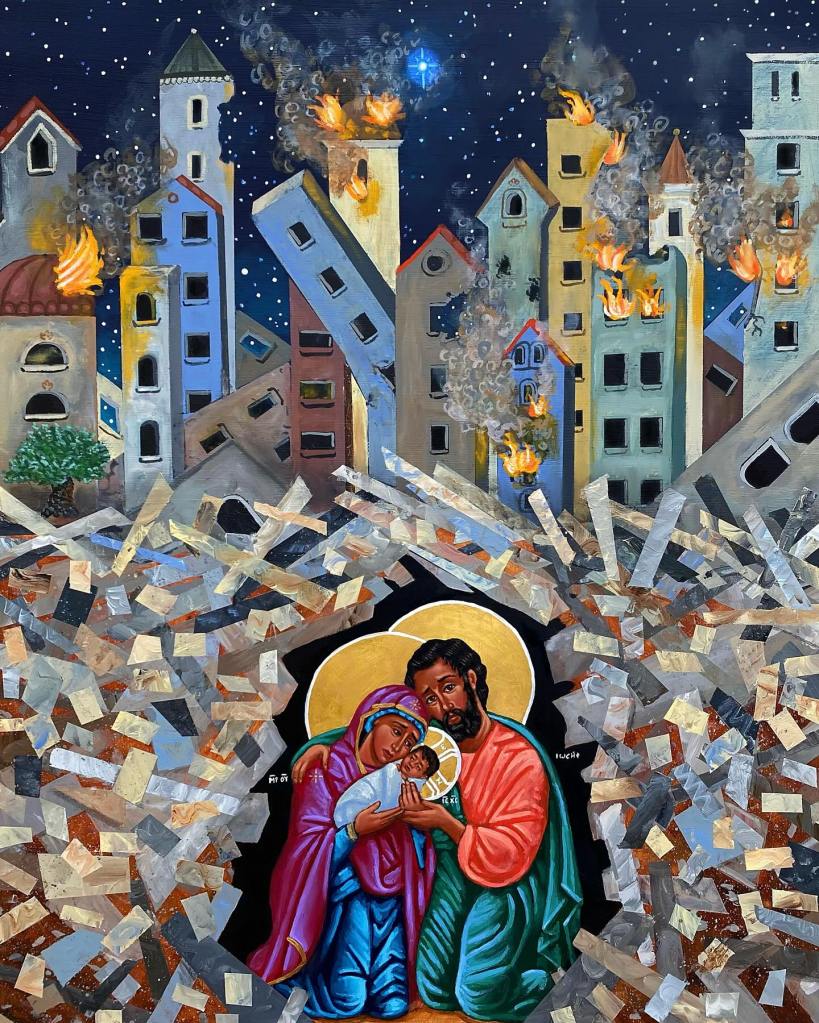
Red Letter Christians partnered with artist Kelly Latimore of @kellylatimoreicons to create this new icon, “Christ in the Rubble,” which illustrates the prophetic message that if Jesus was born today, he would be born “under the rubble.”From Facebook 23 December 2023.
Christmas is never cancelled and can never be cancelled no matter how miserable our lives would be because that is also when it truly happens: Jesus came to bring us light and life, comfort and res, peace and mercy the world badly needs, then and now. Whether we do something or nothing, Christmas happens because Jesus will never leave us. That is has always been the truth as the fourth gospel tells us this Christmas:
All things came to be through him, and without him nothing came to be. What came to be through him was life, and this life was the light of the human race; the light that shines in the darkness, and the darkness has not overcome it.
John 1:3-4
But, why not do our part like Joseph and Mary, the shepherds, including Zechariah and Elizabeth and their son John the Baptist – the ones who have done so much – to make Christmas truly a happy and merry one as God willed it so. Come and do something to share Jesus our light, especially where there is darkness and death, where there is war and rubble. Amen. Have a blessed Merry Christmas!
The Lord Is My Chef Daily Recipe for the Soul by Fr. Nicanor F. Lalog II
Saturday, Misa De Gallo VIII, 23 December 2023
Malachi 3:1-4, 23-24 <'[[[[>< + ><]]]]'> Luke 1:57-66
Photo by author, Church of St. John the Baptist (birthplace) also in Ein Kerem, other side of Church of Visitation, May 2019.
We Filipinos always thought prophets are “fortune-tellers” who predict the future because “prophecy” is wrongly translated as “hula”; thus, when somebody says something would happen and becomes fulfilled, it is often described as “prophetic” because “nahulaan niya”.
But a prophet is neither a fortune teller nor someone who sees the future: a prophet is first of all a spokesman of God. The great prophets of Israel like Isaiah, Jeremiah, Daniel, Elijah even Moses all spoke for God. It was in their task of speaking for God that they seemed like seers when everything they have spoken happened – but not because they saw the future but more because they made God’s words happened.
Being a prophet or prophetic is making things happen not seeing what is going to happen. This is the meaning of our sharing in the prophetic ministry of Jesus as baptized Christians when in our speaking and standing for the truth of the Gospel, we make Jesus present in the world.
Hence, in that sense, advent is actually making Christmas happen! And that is why John the Baptist is considered a prophet because in preparing the way of the Lord, he already made Jesus present in his time that he was mistaken to be the Christ.
When the time arrived for Elizabeth to have her child she gave birth to a son. When they came on the eighth day to circumcise the child, they were going to call him Zechariah after his father, but his mother said in reply, “No. He will be called John.” So they made signs, asking his father what he wished him to be called. He asked for a tablet and wrote, “John is his name,” and all were amazed. Immediately his mouth was opened, his tongue freed, and he spoke blessing God. All who heard these things took them to heart, saying, “What, then, will this child be?” For surely the hand of the Lord was with him.
Luke 1:57, 59-60, 62-64, 66
Photo by author, apse of Church of St. John the Baptist also in Ein Kerem, other side of Church of Visitation, May 2019.
In our first reading, we have heard the prophet Malachi declaring the coming of the great prophet Elijah, later understood in the time of Jesus as a reference to John the Baptist, with all the functions of a precursor of the Christ.
Malachi is the last of the prophets in the Old Testament who showed us the transition into the New Testament through John the Baptist that Luke beautifully employed in presenting Zechariah and Elizabeth as links from the Old Testament like the patriarch Abraham and Sarah as well as Elkanah and Hannah, parents of another great prophet, Samuel.
Recall the annunciation of John’s birth that was reminiscent of the annunciation of the birth of Isaac to Abraham and Sarah while the Temple setting was very similar to the annunciation of Samuel’s birth to Elkanah and Hannah who then prayed in the Lord’s tent who was mistaken for a drunk by the chief priest of that time, Eli.
That is the artistry of Luke who portrayed to us this Old Testament links of John the Baptist so that in some Eastern churches until now you find above their entrance doors murals of the Baptist followed by the Blessed Virgin Mary at the middle and then Jesus to show how St. John marked the end of the Old Testament leading to the New Testament that started with Mama Mary when she accepted Jesus in her womb. It is the reason Jesus himself acknowledged John the Baptist as the greatest person ever born by a woman.
Photo by author, altar of Church of St. John the Baptist in Ein Kerem, shortly before its closure for restoration, May 2019.
We today are prophets too when we link the past with the present by continuing the work of Jesus Christ, making him present in this world. We are all bridges, linking and linked with one another in Christ.
Furthermore, the naming of John in itself was very prophetic because his parents made it happened to be fulfilled as God planned it wherein Elizabeth insisted to her neighbors “John” would be his name while Zechariah who was mute at that time affirmed his wife by writing “John is his name.”
That is our mission in this world – to be a prophet who makes things happen by fulfilling God’s plans for us. As prophets, we must be open always to God’s work among us, to always listen to his words in people and events so that we make his words realized. When we become prophetic, we shall hear people say what Luke noted at the end of our gospel today, All who heard these things took them to heart, saying, “What, then, will this child be?” For surely the hand of the Lord was with him (Lk.1:66).
As we move closer to Christmas Day, the birth of John the Baptist reminds us of our prophetic role in this world of making that future a present reality by fulfilling God’s words and holy will in us.
If we would just persevere in our prayer life, of immersing ourselves in prayer, the more we become sensitive not only of God’s presence but also of everyone like this very short story I recently found on my friend’s wall in Facebook shared by a certain Therese Williams Hudson last December 15, 2023. She wrote….
"I heard my mother ask the neighbors for salt.
But we had salt at home.
I asked her why she asked the neighbors for salt.
And she replied: "Because our neighbors don't have much money
and they often ask us for something. From time to time
I also ask them for something small and economical,
so that they feel that we need them too.
That way, they will feel more comfortable
and it will be easier to keep asking us for everything they need.

And that's what I learned from my mother."
Photo by author, Fatima Avenue, Valenzuela City, 08 December 2023.
Lovely, is it not? The author added at the end of her story these words: “Let’s build empathetic, humble, supportive children”. Let’s join her but not just to have emphatic, humble, supportive children but most of all, prophetic ones, those with heightened sensitivity of God and of others made possible only by a deep prayer life where we can all be a “JOHN”, a graciousness of God who makes his divine plans realized. Amen.
The Lord Is My Chef Daily Recipe for the Soul by Fr. Nicanor F. Lalog II
Friday, Misa De Gallo VII, 22 December 2023
1 Samuel 1:24-28 <*[[[[>< + ><]]]]*> Luke 1:46-56
Photo by author, RISE Tower, Our Lady of Fatima University, Valenzuela City, 13 December 2023.
As a chaplain of our university with six campuses and two medical centers, I have always emphasized to our deans and program coordinators that I strongly advocate a “one-party system” every December – just one Christmas party each day for me!
You know very well that we are really back to normal with the many parties going on since the start of December though, we are still strongly urged to take all necessary precautions for COVID is still with us.
Next to all the food and raffles in every party, there are always the singing and dancing that make these occasions so wonderful.
But I hope that amid all these fun and celebrations, we do not forget the other side of Christmas, of those in pain and suffering this season: those who are sick or taking care of a sick loved one, those grieving at the loss of a beloved, the poor and marginalized.
Photo by author, Fatima Avenue, Valenzuela City, 13 December 2023.
That is why I cannot stop sharing with you too the beautiful gesture of our Administrators last Monday in hosting an Appreciation Dinner last Monday for our employees in their senior years, those 60 and above still working, still teaching. I was not able to join them but have heard feelings of fulfillment, deep joy, and gratitude with a lot tears rolling in the eyes of those honored for their service, dedication and passion all these years. They all felt so special that aside from our Christmas party last December 8, there was another party hosted in their honor.
I remembered how when I was still assigned in our diocesan school in Malolos 25 years ago how we taught our students to set aside a certain amount of their budget for their Christmas party so they can host a party too for students in some selected public schools, complete with gift-giving. We wanted to instill in them the spirit of love and charity by thinking always of others during this season.
While we are singing and dancing in our Christmas party, let us not forget those who could not even go to parties because of their poverty, sickness and other limitations. See how the Blessed Virgin Mary taught us this important aspect of sharing Jesus Christ concretely during this Christmas when she visited her cousin Elizabeth.
“My soul proclaims the greatness of the Lord, my spirit rejoices in God my savior. For he has looked upon his lowly servant. From this day, all generations will call me blessed: the Almighty has done great things for me, and holy is his Name. He has mercy on those who fear him in every generation. He has shown the strength of his arm, and has scattered the proud in their conceit. He has cast down the mighty from their thrones and has lifted up the lowly. He has filled the hungry with good things, and the rich he has sent away empty. He has come to the help of servant Israel, for he has remembered his promise of mercy, the promise he made to our fathers, to Abraham and to his children forever.”
Luke 1:46-55
Photo by author, Fatima Avenue, Valenzuela City, 13 December 2023.
In a certain sense, the Visitation was like a Christmas party of the Blessed Virgin Mary and her cousin Elizabeth. There was great rejoicing in their getting together as we have reflected yesterday.
Today we heard Mary singing her praises to God in Magnificat as a response to the praises she received from Elizabeth on her Visitation. Notice that instead of returning Elizabeth’s gesture like most of us would do in our “mutual praise club” especially during parties, Mary praised God through her Magnificat his outpouring of love not only to her and Elizabeth but to the whole nation of Israel.
Actually, the Magnificat was composed by St. Luke he placed on the lips of the Virgin Mary. It is a part of his artistry, of putting songs on the lips of some of his Christmas characters like Zechariah after John’s circumcision and later on Simeon at the Presentation of Jesus in the temple.
Why? Because singing, like dancing, is the highest expression of our feelings to the one we love. Mothers sing lullabies to their infants, suitors compose and sing songs to their beloved, and we Filipinos sing and dance in whatever mood we are wherever we may be! There is always music in us from the simple gesture of washing the dishes, ironing of clothes to driving and taking a shower. When we sing and dance, we show what’s inside us as well as who we are.
Photo by author, 2019.
In singing the Magnificat which St. Luke patterned after a similar song by Hannah at the birth of her son the Prophet Samuel who’s story we heard in the first reading, the Blessed Virgin Mary expressed her joy and gratitude in the nearness of God among us not only with the coming birth of her Son Jesus Christ but also through her!
All those great things done by God to Israel as per the Magnificat – “mercy on those who fear him, showing the strength of his arm, scattering the proud in their conceit, casting down the mighty from their thrones, lifting up the lowly, filling the hungry with good things, sending the rich away empty, coming to the help of Israel, for he has remembered his promise of mercy” – happened not only in the coming of Jesus Christ but every time we share and proclaim him in words and in deeds like Mary.
The late Fr. Raymond Brown, one of the great biblical scholars of our time noted in his classic “Birth of the Messiah” that Mary as the first Christian is teaching us the essential task of every disciple of the Lord, that is, after hearing the word of God and accepting it, we must share it with others, not by simply repeating it but by interpreting it so that people can see it truly as the good news.
How are we interpreting the message of Christmas this Advent so that people would realize Jesus has come?
I hope this beautiful poem from another blog I have found a long time ago could help you sing and dance like Mary the Magnificat this Christmas.
Photo by author, Fatima Avenue, Valenzuela City, 08 December 2023.
1 Corinthians 13 Christmas Style
by Sharon Jaynes
(https://sharonjaynes.com/1-corinthians-13-christmas-style/
If I decorate my house perfectly with lovely plaid bows,
strands of twinkling lights,
and shiny glass balls,
but do not show love to my family – I’m just another decorator.

If I slave away in the kitchen,
baking dozens of Christmas cookies,
preparing gourmet meals, and arranging
a beautifully adorned table at mealtime,
but do not show love to my family – I’m just another cook.

If I work at the soup kitchen,
carol in the nursing home,
and give all that I have to charity,
but do not show love to my family – it profits me nothing.

If I trim the spruce
with shimmering angels and crocheted snowflakes,
attend a myriad of holiday parties,
and sing in the choir’s cantata
but do not focus on Christ, I have missed the point.

Love stops the cooking to hug the child.

Love sets aside the decorating to kiss the husband.

Love is kind, though harried and tired.

Love doesn’t envy another home that has coordinated Christmas china and table linens.

Love doesn’t yell at the kids to get out of your way.

Love doesn’t give only to those who are able to give in return,
but rejoices in giving to those who can’t.

Love bears all things, believes all things, hopes all things, and endures all things.

Love never fails.  Video games will break; pearl necklaces will be lost; golf clubs will rust.
But giving the gift of love will endure.
The Lord Is My Chef Daily Recipe for the Soul by Fr. Nicanor F. Lalog II
Thursday, Misa de Gallo VI, 21 December 2023
Zephaniah 3:14-18 <*{{{{>< + ><}}}}*> Luke 1:39-35
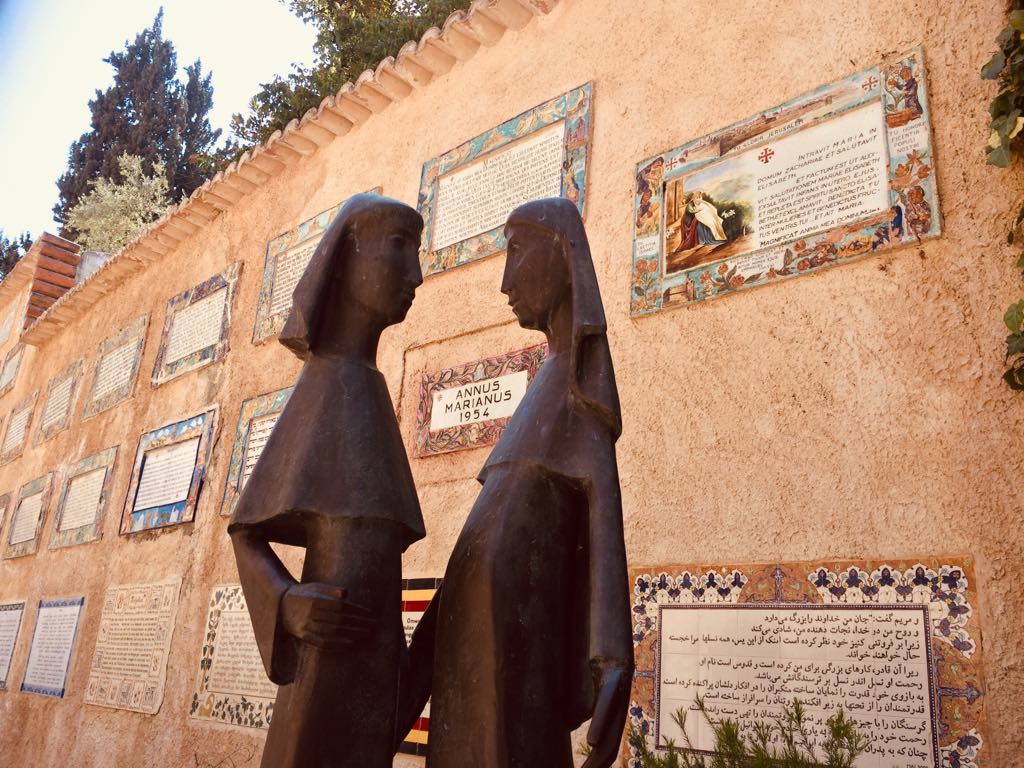
Photo by author, bronze statues of the Blessed Virgin Mary and St. Elizabeth, Church of the Visitation at Ein-Karem, Israel, April 2017.
For the third straight day since Tuesday until Saturday morning at the end of our Christmas novena, all our gospel readings will be from St. Luke, the only evangelist with the most “comprehensive coverage” of the first Christmas following his extensive research on Jesus Christ’s life and teachings (cf. Lk.1:1-4).
Hence, his gospel has the most stories and parables than the gospel accounts of Mark and Matthew. Most of all, St. Luke’s gospel account has two distinctive characteristics that showed Jesus always at prayer while at the same time gave special emphasis on women like the Blessed Virgin Mary. You must have noticed this by this time since Tuesday when we began listening to his infancy narrative.
Mary set out in those days and travelled to the hill country in haste to a town in Judah, where she entered the house of Zechariah and greeted Elizabeth. When Elizabeth heard Mary’s greeting, the infant leaped in her womb, and Elizabeth, filled with the Holy Spirit, cried out in a loud voice and said, “Most blessed are you among women, and blessed is the fruit of your womb.”
Luke 1:39-42
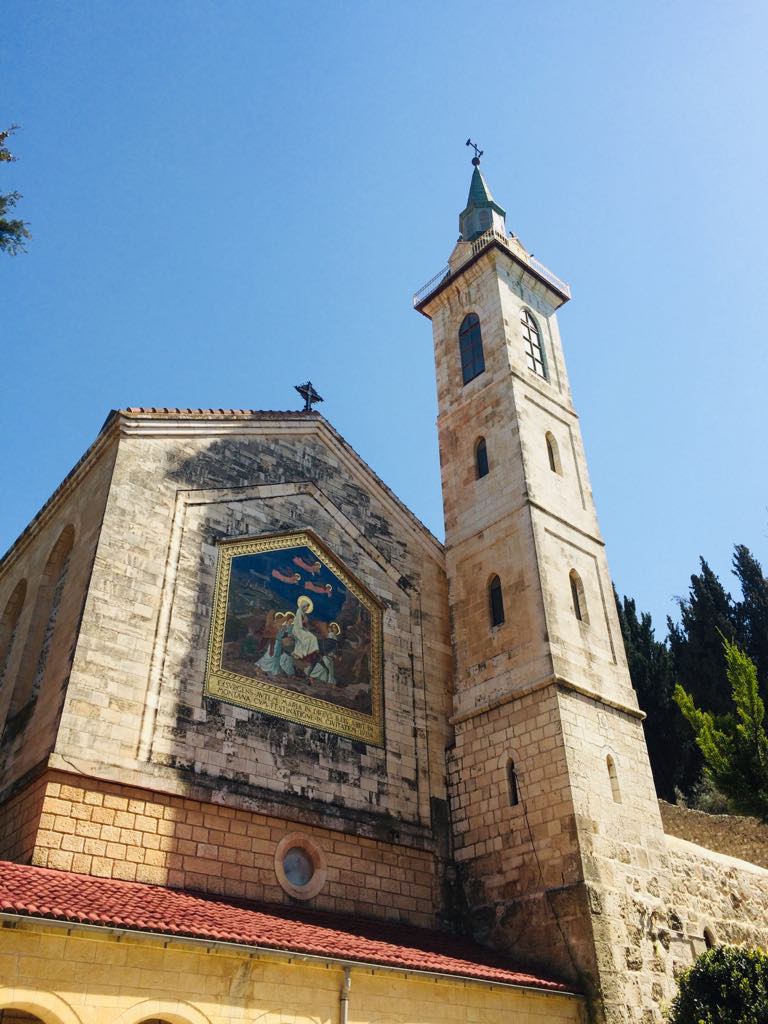
Photo by author, mural on the apse of the Church of the Visitation at Ein-Karem illustrating the Visitation (left panel) and how the angel helped St. Elizabeth hid the infant St. John the Baptist after King Herod ordered the murder of all children aged two and below.
It is rare in the Bible to find two women presented positively together in a single scene. Very often especially in the Old Testament, there is always a sort of animosity among them due to the prevailing patriarchal points of view of the time.
The only instance two women were presented together in good terms in the Old Testament is in the Book of Ruth that still hinted some sense of superiority of Naomi over her daughter-in-law Ruth who was like her a widow but childless.
Therefore, this scene of the Visitation only St. Luke has is a gem in itself as it speaks eloquently of the important place of women in God’s plan of salvation. It beautifully portrays to us the joy of two great women filled with God and humble before him, affirming and acknowledging the two great men in their wombs about to change the course of human history: Elizabeth with John the Baptist who would prepare the way of the Savior, Jesus Christ in the womb of Mary.
Photo by Mr. Boy Cabrido, Our Lady of Mt. Carmel, QC, Misa de Gallo, 18 December 2023.
The story of the Visitation reminds us how God works mysteriously in everyone without exceptions by linking or interconnecting us with each other in Jesus Christ our great Mediator and Savior. How lovely to see in this instance how John and Jesus already performing their mission even while in the womb of their mothers, of bringing together people. What a wonderful illustration of women as God’s vessels and carriers!
In both Mary and Elizabeth, we now “shout for joy” as Zephaniah prophesied in the first reading at how God saved us when he “removed the judgment against you, he has turned away your enemies; the Lord, your God, is in your midst, a mighty savior, who will rejoice over you with gladness, and renew you in his love… so that no one may recount your disgrace” (Zep. 3:14,15,17, 18).
Do we truly share in this shout for joy for the women of the world, for the women among us? How sad that until now women continue to suffer from all kinds of abuses not only from men but even from their fellow women.
Some spiritual writers say God is more like a woman because whatever was lacking in man, God put it in her. Perhaps that is why it is the woman who completes every man – including with us priests! But sadly, as we speak a lot about synodality in the Church these days, it is often among us priests with whom women are often taken for granted, and worst, abused.
One problem directly related today with how we regard women is the great number of people especially the youth trapped in the insidious effects of pornography due to prevalence of social media. At its core, the problem and evil with pornography is the failure of so many to recognize the lack of respect for women who are created equal with men in the image and likeness of God.
St. Joseph showed us the other day that true holiness is expressed in the way we respect women. According to an article by Papal Preacher Cardinal Cantallamessa I have read two decades ago where he cited a Dominican biblical scholar who’s name I could not recall, “the way we treat and regard women is a reflection of our relationship with God”.
That is very true.
When I review my life, I have found God making so many ways to lead me into the priesthood through the many women I have met and known, and many of them have remained my “bestest” friends like the three former executives of GMA-7 News Department who asked me to guide them in their Holy Land pilgrimage in Easter 2017.
Photo by author, Church of the Visitation, Ein Karem, Israel, April 2017.
It was my second Holy Land pilgrimage but my first time to visit the beautiful Church of the Visitation in Ein Karem.
Outside that lovely church are two bronze statues of Elizabeth and Mary conversing on how God had blessed them with sons under unique circumstances: Elizabeth was too old and barren while Mary was too young, a virgin, not yet married with Joseph.
What a beautiful reminder of God coming to us through women!
While there at Ein Karem, I prayed for all the women I have loved and have loved me before, all the women who have blessed me and have taken care so well of my vocation to the priesthood. I thanked God for the women like Elizabeth who have blessed me in believing that what was spoken to me by the Lord would be fulfilled in the priesthood. Blessed are the women who like Mary have helped me see the women’s perspectives that made my priesthood more complete especially in dealing with feminine issues. The women who taught me how to respect differences, to feel the society’s bias against them, and most especially feel their deep pains when they shared with me their ordeals of abuse and rape.
Let me end this reflection with an unforgettable anecdote at the funeral Mass for the mother of our late Bishop Jose F. Oliveros in Quezon province about ten years ago when he recalled how his mother held his right hand while still a child, and taught to make the sign of the Cross. On her deathbed, it became his turn, as a priest and a bishop, to hold his dying mother’s hands to make the sign of the Cross.
Hail to all women and mothers in the world who bring life into this dying world with their joy and perseverance, artistry and simplicity, warmth and presence of God almighty. May this story of the Blessed Virgin Mary’s Visitation of St. Elizabeth teach us to always respect women for they are the carriers of God to us. Amen.
The Lord Is My Chef Daily Recipe for the Soul by Fr. Nicanor F. Lalog II
Misa De Gallo V, Wednesday, 20 December 2023
Isaiah 7:10-14 <*((((>< + ><))))*> Luke 1:26-38
Photo by author, flower garden outside the Basilica of the Annunciation, Nazareth, Israel, May 2019.
Experts tell us that much of human communications are non-verbal in nature. And most often, people rely more to our non-verbal than verbal communication because it is more truthful by nature as actions speak louder than words.
For our reflection this fifth day of our Christmas novena, let us examine the two kinds of non-verbal communications employed by St. Luke to portray God’s immense love for us as well as his sublime uniqueness as perfect communicator. These are proxemics or the communication of spaces, of how places are designed or designated to convey something special and profound. The second i which is the use of time in non-verbal communication like time perceptions of punctuality, willingness to wait, and, “timing”.
Photo by author, Basilica of the Annunciation, Nazareth, Israel, May 2019.
See how St. Luke extensively employed these modes of non-verbal communications in his infancy narrative to show us that God is everywhere, any time.
In the sixth month, the angel Gabriel was sent from God to a town of Galilee called Nazareth, to a virgin betrothed to a man named Joseph, of the house of David, and the virgin’s name was Mary.
Luke 1:26-27
Right away St. Luke established here the direct correlation between John the Baptist and Jesus Christ, of how their respective mission are directly linked with each other that our Lord was conceived six months after his Precursor’s conception.
More than the time frame conveyed by the six month difference in their births, we find behind it a deeper meaning about their differences as well in stature and nature wherein John was completely human flowing with time while Jesus is both human and divine with God directly intervening in our time. John was born June 24, the summer solstice when days are longer and brightest while Jesus was born December 25 when nights are longest and darkest!
The chronemics and proxemics are undeniably hinting on something deep, of how our eternal God entered through our temporal time so that within we can have that cosmic experience of “the here and not yet” when time seems to stand still because we are being wrapped in God’s eternal embrace of love made possible by Christ’s birth, passion, death and resurrection. This we can see at the contrasting circumstances between the advent of John the Baptist and Jesus Christ where we find God most unique, immensely loving us.
Photo by author of the site of the Annunciation at the basement of the Basilica of the Annunciation in Nazareth, Israel, May 2019.
First, Zechariah was a priest while Mary was a commoner. It was natural for God to work through his ministers but in choosing Mary an ordinary woman was something else not because of any special quality she had but simply because God is good. The angel clearly told this to Mary, “you have found favor with God”. God does not call the qualified but he qualifies the call! Today, God is telling us Jesus is coming through us, no matter who we are or what we have gone through and did in life.
Second, God used the setting of the Temple of Jerusalem in yesterday’s account because that is where he is supposed to dwell but today, everything happened in a very simple house in Nazareth, the only place of significance and importance in the New Testament never mentioned in the Old Testament. It was a place looked down upon by many like St. Bartholomew asking Philip, “can anyone good come from Nazareth?”
The word “Nazoraios” or Nazarene mentioned by Matthew refers to the overall designation of Jesus by the prophets as the hope and fulfillment of God’s promise that there shall come forth a “shoot from the stump of Jesse” (Is. 11:1). Shoot in Hebrew is from the word nezer which is also the context used by Isaiah in chapters 7 and 9 found in Isaiah 11:1 cited by Matthew. Therefore, Jesus being called a Nazarene or Nazorean is more than a reference to his place of origin but most of all his very essence – a shoot from God, someone totally consecrated to God.
And that is also who we are! St. Paul’s letters teem with this beautiful theme of us being called and justified in Christ by God.
Today, God is telling us to never lose hope in life, to never give up because he will never give up on us because we are from him, we are his. For as long as we are alive, God will make a way to make a shoot or nezer bud forth from a stump to bring us back to life.
Yesterday, it was the imagery of barrenness of Elizabeth, of her being fruitless and therefore empty. Many times, that is just what God needs from us, an entry point, an opportunity when we are so weak so he can mightily work with his powers.
One of my hopes after Christmas is to celebrate Mass at the Quiapo Church, to cultivate a devotion to Jesus Nuestro Padre Nazareno. I just feel drawn to him as I have personally met so many people including non-Catholics with devotion to the Nazareno of Quiapo after granting them their almost impossible petitions and prayers.
Photo by Mr. Boy Cabrido, Quiapo Church, Misa de Gallo, 17 December 2023.
Third, there was a major feast going on, the Yom Kippur, with a lot of people present when Zechariah was informed of the birth of John; Mary was alone in her house when the angel came to announce to her the birth of Jesus on the sixth month after going to Zechariah. Again, here we find both the place and time conveying something deeper than mere locations and settings. This is what the Church has always been insisting, most especially lately after the lockdown during pandemic when people got the wrong impression that online Masses are enough or can replace actual participation in our Eucharistic celebrations especially on Sundays.
Yes, God comes to us personally as individuals but with Jesus Christ, we have been more interconnected than ever as we have seen how his birth was linked with John’s birth too. Faith and worship, life itself can never be relegated to just a personal matter. There is always the communal aspect of our faith and of life itself because man is a social being, created by God to relate which is what communication is all about.
Photo by author of a Filipino painting of the Annunciation scene on the facade of the Basilica of the Annunciation in Nazareth, Israel, May 2017.
In the first reading we found Ahaz refusing to ask for a sign on the pretext he did not want to offend God but actually because he did not want to show his faith like some people these days who try to see everything on the practical side, on the material side and most of all, the personal side. This is the tragedy of our time even in our Church that has become secularized in certain aspects. See those different guidelines of every diocese and archdiocese about the Simbang Gabi, with others allowing anticipated Masses we have long tried educating people that it is an oxymoron. Many times, we in the Church have overextended or over-interpreted many of our rubrics and traditions just to accommodate others in the name of inclusiveness and other woke ideas.
On this fifth day of our Simbang Gabi, the Annunciation of the birth of Christ invites us to ask ourselves how do we show others that the Lord is with us like Mary? If God is every where, all the time, how come so many have lost him or could not find him? Maybe we no longer have him. Let’s ger him back again today! Amen. Have a blessed Wednesday!
Photo by author, Basilica of the Annunciation, Nazareth, Israel, May 2019.
The Lord Is My Chef Sunday Music by Fr. Nicanor F. Lalog II, 17 December 2023
Photo by author, Gaudete Sunday 2019.
Glad to be back with our Sunday music offering but unfortunately, our choice is neither a Christmas song nor carol. But, we find Christopher Cross’ Baby Says No from his 1983 second studio album so perfect this Sunday because our homily is something about saying “no” (https://lordmychef.com/2023/12/16/saying-no-leads-us-to-rejoicing/).
We have always loved Mr. Cross since 1979 with his great debut album that featured his first hits Sailing and Ride Like the Wind. Truly an artist gifted with superb musical talents, we were so worried in 2020 when news came out of his being stricken with COVID-19 that resulted in some complications that almost left him unable to walk for a time.
Baby Says No is a touching story of a love lost despite one’s great efforts and how far can a man go despite the great setback.
Baby says no, she can’t let go this soon Doesn’t feel right, not tonight Even though I gave her the stars and the moon
I really think I’ve got it bad this time around
Baby says yes but I must confess It really doesn’t seem to matter ‘Cause I’d follow that girl all around the world Even if I never had her
I really think I’ve got it bad this time Really think I’ve got it bad this time Really think I’ve got it bad this time around
This is where we find Baby Says No very related with our gospel this Sunday also known as Gaudete Sunday or Rejoice Sunday. Many times in life, we are able to rejoice after experiencing losses and failures, after being down. It is in the nos and nots where great rejoicing burst forth like when we receive the negative answer to our offers like what the man is claiming here after being turned down with his love.
Gonna show ’em what love can do Gonna tell ’em ’bout me and you Gonna show ’em what love can do when it’s right And this time, it’s right
Love is the light that can shine so bright But sometimes it fades away Then you find one that can shine like the sun She comes up for you every day
Many times in life, love comes forth after we receive or make the “no” answers to sin and evil and selfishness. Here is Christopher Cross with his classic Baby Says No. Have a blessed Sunday!