The Lord Is My Chef Daily Recipe for the Soul by Fr. Nicanor F. Lalog II
Monday, Third Week in Ordinary Time, Year I, 27 January 2025
Hebrews 9:15, 24-28     ><}}}}*> + ><}}}}*> + ><}}}}*>     Mark 3:22-30
Lord Jesus Christ,
take away our colored lenses
that prevent us from seeing
the real pictures in the world
and of life; many times,
our lenses are not only colored
but even defective
that make us see distorted images
as the realities when they are not.
Like the Pharisees,
we wear different lenses
that prevent us from seeing
your true self as full of good,
of love and mercy;
like the Pharisees,
our views of others are
distorted because we see
only ourselves as better
while at the same time,
still like the Pharisees,
we debate truth because we could
not accept others as better than us,
leaving us all trapped in self-condemned
state of sinning that make us see
everything as hopeless,
worst, nothing is good at all
in the world even in our
very selves which is the sin
agains the Holy Spirit.
Make us see through
your loving and merciful
lens our selves,
others,
the world around us,
and most especially YOU;
give us your lenses
to see we have been saved
and most of all,
worth saving because
we are loved by
YOU and the Father
in heaven.
Let us rejoice and
relish your saving power,
Lord, when You as the Christ,
"Offered once to take away
the sins of many,
will appear a second time,
not to take away sins
but to bring salvation
to those who eagerly await
Him"
(Hebrews 9:28).
Amen.
The Lord Is My Chef Sunday Music by Fr. Nicanor F. Lalog II, 26 January 2025
Photo of the cast of the 1986 film “Stand By Me” from goldenglobes.com.
Glad to be back with our Sunday music after six months of absence! Hope you are doing well as we keep our good old music playing.
We cannot resist linking Ben E. King’s 1962 classic Stand By Me with our Sunday gospel about Jesus “standing” at the synagogue one sabbath day to proclaim the Sacred Scripture to his town folks in Nazareth. I have known the song all along having grown with old music at home but fell in love with it only in 1986 when it was adapted as the title of a coming-of-age movie called Stand By Me.
The song’s lyrics perfectly blended with the story of the movie based on Stephen King’s novella The Body, of how four teenagers in Oregon went on a hike to find the dead body of a missing boy. Though the song played only at the end of the movie as the main character closed his narration of what happened after to their friendship as young boys standing by each other, their hike was filled with so many misadventures and realizations that underscored the noble aspirations for fidelity and truth, love and care as well as importance of family we find exactly in the beautiful lyrics by King which is about his standing by his beloved.
When the night has come
And the land is dark
And the moon is the only light we'll see
No, I won't be afraid
Oh, I won't be afraid
Just as long as you stand
Stand by me

So darlin', darlin', stand by me
Oh, stand by me
Oh, stand
Stand by me, stand by me

If the sky that we look upon
Should tumble and fall
Or the mountain should crumble to the sea
I won't cry, I won't cry
No, I won't shed a tear
Just as long as you stand
Stand by me

And darlin', darlin', stand by me
Oh, stand by me
Oh, stand now
Stand by me, stand by me

And darlin', darlin', stand by me
Oh, stand by me
Oh, stand now
Stand by me, stand by me

Whenever you're in trouble won't you stand by me
Oh, stand by me
Won't you stand by
We remembered the song Stand By Me while praying over this Sunday’s homily as we focused on Jesus always standing for what is true and good, what is just and fair and most especially, for His standing for each one of us always despite our weaknesses and sins. That is why we said in our homily that what matters most in life is not where we sit but where we stand (https://lordmychef.com/2025/01/25/standing-with-jesus-standing-like-jesus/).
As we go on a rest this Sunday, let us recall and remember our family and friends we have stood by all these years as well as those who stood by our side too while praying for those who have left us or betrayed us including those we have deserted too. Through all these standing and falling, there is always Jesus remaining, always standing by our side because He loves us, giving us all the chances to rise and stand again for Him and with Him through our family and friends. Have a blessed Sunday!
From YouTube.com, no copyright infringements intended except to enjoy good music.
The Lord Is My Chef Daily Recipe for the Soul by Fr. Nicanor F. Lalog II
Monday, Week II in Ordinary Time, Year I, 20 January 2025
Hebrews 5:1-10     <*((((><  +  ><))))*>     Mark 2:18-22
Photo by author, sunrise at St. Paul Spirituality Center, Pico, La Trinidad, Benguet, 06 January 2025.
Praise and glory to you,
God our loving Father!
Thank you for this wonderful
Monday as we pray for one
another, especially to those
still baffled with life's many
mysteries, its many
paradoxes beginning to
appear anew as we dive
into Ordinary Time.

Teach us to take into heart
Jesus Christ's teaching today:
“Likewise, no one pours new wine into old wineskins. Otherwise, the wine will burst the skins, and both the wine and the skins are ruined. Rather, new wine is poured into fresh wineskins” (Mark 2:22).
Help us change our attitudes in life,
Jesus: make us realize that like
your life, our life is always a
mixture of joy and sufferings;
most of all,
make us experience
in your coming into our human reality
as our Eternal High Priest,
you have brought newness and
significance in storage and taste
of wine that symbolizes life itself,
as you put a new vigor of spirit
in celebrating life.
Photo by author, sunset in Atok, Benguet, 27 December 2024.
“Son though he was, he learned obedience from what he suffered; and when he was made perfect, he became the source of eternal salvation for all who obey him…” (Hebrews 5:8-9).
How lovely and
wonderful to realize
how your true humanity,
dear Jesus, actually makes you
more than less an effective Priest
to truly "bridge" us
with the Father and one another;
like you Jesus,
we pray the Father to take away
our pains but in your example
on the Cross,
we learn how God
is actually found in pain!

Change our attitudes
to be like you, Jesus
 who came to join
us in our many sufferings
to show us that in our dealing
with our own pain and the pain of others,
that is when we grow
in strength and maturity,
in love and compassion
that eventually lead us
to deeper and true joy
in you our Lord.
Help us embrace
this paradox of life, Jesus,
that a life devoid of the challenge
of pain is an incomplete life;
and when we are puzzled
by the many sufferings in us
and around us, let us gaze into
your Cross to reflect,
"Why did God not spare
you his own Son?"
Amen.
Photo by author, St. Paul Spirituality Center, Pico, La Trinidad, Benguet, 04 January 2025.
The Lord Is My Chef Sunday Recipe for the Soul by Fr. Nicanor F. Lalog II
Feast of the Sto. Niño, Cycle C, 19 January 2025
Isaiah 9:1-6  ><}}}}*>  Ephesians 1:3-6, 15-18  ><}}}}*>  Luke 2:41-52
I have never liked children especially infants not until these last twenty years of my life. Before, I could not understand when parents especially mothers giggled with joy in seeing babies, describing how handsome or pretty they are when they all look the same to me.
Everything changed when I became a priest especially when I turned 40 and had my own nieces and nephew. Suddenly, I realized how children could be so nice with their energy and laughter and wits too. As I now approach my 60th birthday serving as a chaplain in a University with a hospital since 2021, I have come to love children that I have been telling my sister to push her two daughters to get married so we could have babies again in the family!
As my attitudes with children changed, the more I understand why our Lord Jesus Christ had insisted in His teachings the need for us to become like them. Until His death, Jesus showed us the importance of being like a child not only in trusting and having faith in the Father but most of all on the true meaning of freedom.
Photo by author, Tagaytay City, 17 January 2025.
Contrary to common beliefs of many, freedom is not the ability to do whatever one likes; freedom is choosing to do what is good. That is why freedom is never absolute. In the Book of Genesis we find God telling Adam and Eve to eat every fruit of trees in Eden except the fruit of the tree in the middle of the garden (cf. Gen. 3:2-3). And we have seen how in the abuse of their freedom, they including us today have become “unfree”.
In Christ’s coming, He made us recover our freedom, giving us the grace to always choose and do what is good, to be free from sin and free to love, free to forgive, free to be kind. This essence of freedom He taught even at His early age as the true Son of God.
Each year his parents went to Jerusalem for the feast of Passover, and when he was twelve years old, they went up according to festival custom. After they had completed its days, as they were returning, the boy Jesus remained behind in Jerusalem but his parents did not know it… After three days they found in the temple, sitting in the midst of the teachers, listening to them and asking them question, and all who heard him were astounded at his understanding and his answers. When his parents saw him, they were astonished, and his mother said to him, “Son, why have you done this to us? Your father and I have been looking for you with great anxiety.” And he said to them, “Why were you looking for me? Did you not know that I must be in my Father’s house?” (Luke 2:41-43, 46-49)
“The Finding of the Savior at the Temple” painting by William Holman Hunt (1860) from en.wikipedia.org.
First thing we notice in our gospel regarding freedom as the ability to choose what is good is Luke’s portrayal of Joseph and Mary as devout Jews who regularly went on pilgrimage to Jerusalem.
Each year his parents went to Jerusalem for the feast of Passover, and when he was twelve years old, they went up according to festival custom.
What a simple expression of the essence of freedom of choosing what is good, choosing God: the parents of Jesus devoutly practiced their faith that Jesus fully imbibed. The gospels teem with many stories of Jesus regularly going to the synagogues on sabbath to proclaim the word and to preach to the people.
This is something many parents today are missing, the Sunday devotion. No wonder that many children today do not understand the meaning and importance of the Sunday Mass, even the preeminence of God in our lives. How sad that many families even on holy days of obligation choose malls and vacation than choose God to worship Him in the church.
And many have the gall to defend this as part of their freedom, an expression of unity as family. But, where is God among them? Most of all, have we really become free by not going to the Sunday Mass?
Definitely not. Even at the surface some people would not seem to have any qualms at all in skipping Sunday Masses, deep inside many are bothered. Many of them feel an emptiness within, a kind of darkness that Isaiah described in the first reading. See how despite the affluence of many people today than three decades ago yet more and more are feeling lost and depressed because they have lost their roots in God who leads us to our rootedness in ourselves and with others.
Photo by author, January 2022.
Speaking of roots, its Latin origin is radix from which the word radical came from.
When we hear the word radical, we associate it always with someone who is a revolutionary, someone who literally or figuratively “destabilizes” our status and ways of thinking like Jesus Christ.
Very often, we find Jesus presented to us as one who was radical in His teachings who was thought to have been a revolutionary member of the Zealot party that worked to overthrow the Roman occupiers in ancient Israel. It was one of the accusations hurled against Him at His trial, citing His declaration to destroy the temple that He would rebuild in three days after its cleansing. Of course, these are not true; Jesus was not a radical revolutionary like the communists or power grabbers of modern century.
However, if we examine His teachings and mission, Jesus was a radical revolutionary because He preached and worked to bring humanity back to our very “root” – radix – who is God Himself. Listen to His words to His Mother after being found in the temple…
And he said to them, "Why were you looking for me? Did you not know that I must be in my Father's house?"
Photo by author, Parish of St. Joseph, Pacdal, Baguio City, 28 December 2024.
Here Jesus showed His Mother and us today that true freedom is being one always with the Father. Jesus was a truly free person because even at His early age, He was totally united with the Father’s will.
All throughout His life and mission, Jesus helped us all attain that freedom of inner communion with God our Father to be truly free from sin and evil to be free to love, free to understand, free to serve and whatever is good.
See how Jesus spoke so plainly to Mary and Joseph, as if reminding them and us today that our roots is in God alone and that is what we must always be concerned with, of how we must remain rooted in God as His children.
In the fourth gospel, we find this imagery of remaining rooted in God in Jesus Christ so beautifully explained during the Lord’s Last Supper discourses specifically in that of the vine and the branches (Jn. 15:15:1-17).
That’s the paradox of true freedom in Christ: being one in God does not limit but rather expands one’s freedom as a person. Any freedom outside of God is a fake and most likely, leads only to bondage because it is only in doing what is good when we truly grow and mature as persons.
Photo by author, Malolos Cathedral January 2022.
This Sunday we celebrate an extra day of Christmas for the Feast of the Sto. Niño in recognition of its great role in the spread of Christianity to our country since its coming in 1521 when Magellan gifted Queen Juana of Cebu with a Sto. Niño image.
The late Nick Joaquin rightly claimed in his many writings that the Philippines was actually conquered by the Sto. Niño than by the guns and cannons of the invading Spaniards more than 500 years ago. That’s probably because of this lesson on true freedom by the Child Jesus.
Let us learn and grow in true freedom by first choosing God especially on Sundays by celebrating the Lord’s Supper, the Holy Mass. Like the Child Jesus, let us remain in the Father, be free to ask most of all to listen and learn about life.
Like Mary and Joseph, it takes time before we can truly understand the words of Jesus Christ; what matters is like them, we keep on choosing always Jesus, only Jesus because Jesus is the truth. May the Lord “enlighten the eyes of our hearts so we may know what is the hope that belongs to his call, what are the riches of glory in his inheritance” (Eph.1:18). Amen. Have a blessed and free week ahead!
The Lord Is My Chef Daily Recipe for the Soul by Fr. Nicanor F. Lalog II
Wednesday, Week I in Ordinary Time, Year I, 15 January 2025
Hebrews 4:12-16     ><))))*> + ><))))*> + ><))))*>     Mark 2:13-17
Photo by author, Northern Blossom Farm, Atok, Benguet, 27 December 2024.
therefore, he (Jesus) had to become like his brothers and sisters in every way, that he might be a merciful and faithful priest before God to expiate the sins of the people. Because he himself was tested through what he suffered, he is able to help those who are being tested (Hebrews 2:17-18).
How lovely are your words today,
dearest Jesus!
They are so true!
While others are still wondering,
asking "what if God is one of us",
we have always believed
and have experienced
God truly one of us,
among us,
and within us
in you,
Jesus Christ.
How sad that many of us humans
are more inclined to believe
in things and persons bigger than
than ourselves,
not realizing our greatness
in being small that even you,
O Son of God,
chose to be like us,
little and vulnerable
so that we can be like you,
divine and eternal.
Teach us to see more of your
person, of your being one of us,
dearest Jesus,
for us to experience your
authority and power;
like Simon and Andrew,
teach us to have that intimacy
with you Lord that,
"immediately" they told you about
Simon's mother-in-law being sick;
most of all, let me be one with
my own brothers and sisters
like you, Jesus,
"approaching them,
grasping them,
and helping them
rise up when they are
down"
(Mark 1:31)
Amen.
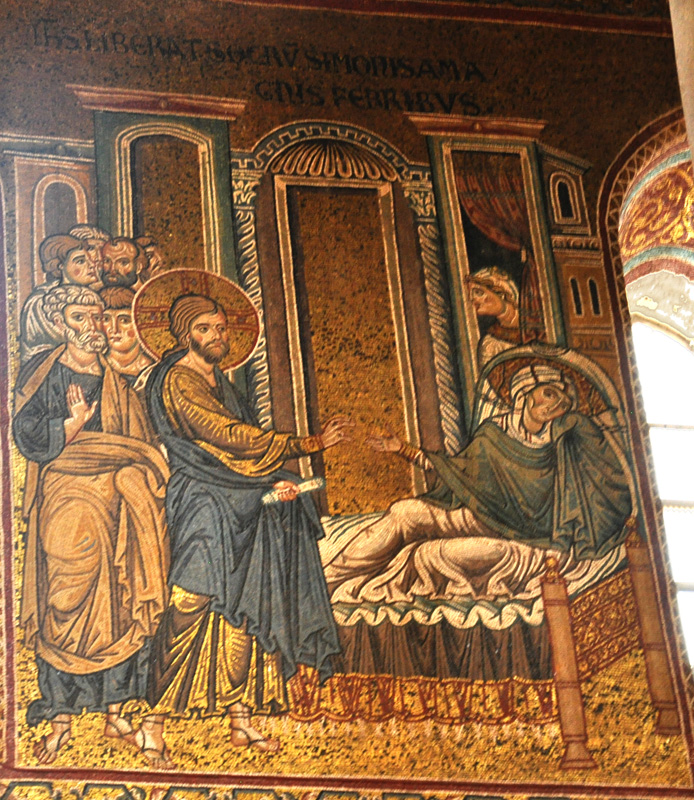
Jesus Heals Peter’s Mother-in-Law, a mosaic in the Cathedral of the Assumption, Monreale, Sicily, from christianiconography.info.
The Lord Is My Chef Sunday Recipe for the Soul by Fr. Nicanor F. Lalog II
Feast of the Baptism of the Lord, Cycle C, 12January 2025
Isaiah 40:1-5, 9-11  ><}}}*>  Titus 2:11-14; 3:4-7  ><}}}*>  Luke 3:15-16, 21-22
Photo by author, San Fernando, Pampanga, November 2021.
Today is your last chance to greet “Merry Christmas” the people you have forgotten as well as claim your gifts from Santa because this Sunday’s “Feast of the Lord’s Baptism” closes the Christmas Season.
The Lord’s Baptism shows us that Jesus did not remain an infant on the manger in Bethlehem nor a child in Nazareth. It is sad to note both the religious and secular emphasis on this child imagery of Christ have reinforced the notion among people that Christmas is for children and a time for adults to return to the innocence and joy of their childhood.
Jesus grew up and matured into an adult on a mission from the Father to save us that led to His Passion, Death and Resurrection at Easter. Through our baptism in becoming the children of God, Jesus invites us to continue His Christmas story by maturing in our faith, hope and love in Him by embracing His Cross that His Baptism anticipated.
This Sunday Feast of the Lord’s Baptism is a coming to full circle of last week’s Epiphany into a theophany. Yes, they sound Greek because both are from the Greek words “epiphanes” and “theophanes”.
Epiphany is Jesus manifesting Himself to all nations through the Magi as the King of kings last Sunday; today, it is God the Father who recognizes Jesus as His Christ, His Anointed One with the voice declaring as a theophany, “You are my beloved Son; with you I am well pleased” (Lk.3:22).
Every morning as we wake up is a theophany with God telling us “You are my beloved child; with you I am well pleased.” Three things I wish to share with you for us to hear God’s daily theophany and fulfill our mission as baptized children of the Father.
Photo by author, sunrise in Atok, Benguet, 27 December 2024.
First, let us recognize and affirm our being, identity, and existence. Many times, we are more of a “zombie” than a human person who can’t find life nor experience living at all, wasting precious time to be somebody else, living in the past or living in the future.
When Luke noted “The people were filled with expectation, and all were asking in their hearts whether John might be the Messiah”(Lk.3:15), he wished to inform us how the people at that time recognized and admitted they were sinners, that they were broken, that they were sick physically, emotionally and spiritually as they all affirmed their need for salvation. They accepted and owned the realities of their lives that they needed God, they needed the Christ whom they thought was John the Baptizer.
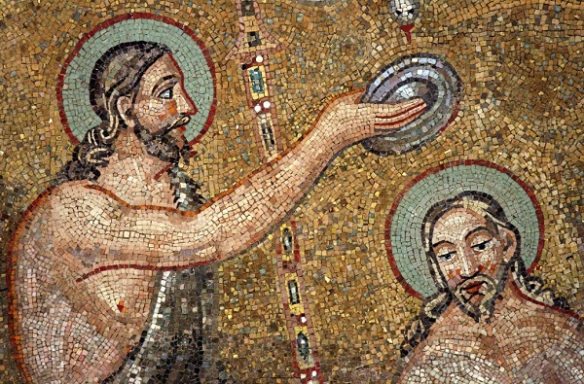
The Baptism of Christ by John the Baptist in the Jordan River. Detail of dome mosaic in the Battistero Neoniano (Orthodox Baptistery) in Ravenna, dating from 451-75. On lower right is a personification of the Jordan River as an old man rising from the water, holding a reed in one hand and offering a garment to Christ in the other. The right arm and dish of John the Baptist, the dove, and Christ’s head are 18th- and 19th-century restorations; the rest is original.
Even John the Baptizer is presented by Luke as also so sure of who he was as the precursor of the Messiah. Among the expectant people and John, we realize that indeed, growth happens the moment we accept who we are.
Examine the testimonies of many devotees of the Nazareno at Quiapo, of how they support each other in their woes and sufferings in life that we find a sort of theophanies by God, something like what we have heard from the first reading today, “Comfort, give comfort to my people, says your God”(Is.40:1). That comfort, that salvation, happened right there and then, in the now and not in a distant future.
Despite my “dislike” for their attitudes during the Traslacion, devotees of the Nazareno have always amazed me for daring to be truthful and honest with themselves, admitting their own sinfulness and weaknesses as they recognized too their need for help and most especially of their desire for God. This desire for God and admission of one’s sinfulness are very crucial to experience and hear God’s daily theophanies to us.
Photo by Mr. Jay Javier, 09 January 2019.
Second, for us to hear God’s theophany, we need to imitate Jesus Christ in taking the downward movement in life. His baptism at Jordan clearly illustrates this with His coming down to the Jordan valley through the mountains that evoked His own coming down from heaven to be born here on earth, in Bethlehem.
What is so beautiful with Jesus Christ’s downward movement is essentially a being with the sinful, the sick, the rejected, the marginalized, the poor, and those considered dirty. From being purely clean and sinless, Jesus took all our dirt to be cleansed like Him. Such is the kindness of God that Paul speaks today to Titus “so that we might become heirs in hope of eternal life”(Titus 3:7).
Our world today teaches us the opposite direction Jesus Christ had taken by climbing up the pinnacle of success, of good life, of supremacy, of power, of everything! They call it “upward mobility” that has prompted everyone even those in the Church to join the rat race for being rich and famous, of being somebody, putting on masks and taking more of the goods the world offers until we get lost in misery finding no meaning at all with one’s self because we thought life is “up there.”
Jesus Christ is not up there but down here, in our very selves, in our very hearts filled and battered with our many agonies and failures, hurts and pains, weaknesses and sins. Look down more into our very selves to find Jesus in our dirt and miseries which is the message of Jesus Nazareno.
Observe all those interviewed in Quiapo have only one prayer – well-being of a loved one. They never asked to be rich or have money. Just heal a sick child or parent was the most requested prayer of devotees. Our favorite Pope Benedict XVI explained this downward movement so well:
To accept the invitation to be baptized now means to go to the place of Jesus’ Baptism. It is to go where he identifies himself with us and to receive there our identification with him. The point where he anticipates death has now become the point where we anticipate rising again with him (Jesus of Nazareth, page 18).
Photo by author, sunset in Liputan Island, Meycauayan City, Bulacan 31 December 2022.
Last but not least for our reflection is something very peculiar with Luke alone: the theophany of Jesus happened not right after His baptism but while He was praying, “After all the people had been baptized and Jesus also had been baptized and was praying, heaven was opened and the Holy Spirit descended upon him in bodily form like a dove”(Lk.3:21-22).
In the Acts of the Apostles, Luke recorded the Pentecost happened while the Apostles with the Blessed Mother Mary were all praying when the Holy Spirit descended upon them like tongues of fires which is similar with what took place at Jesus’ Baptism. In all books of the whole Bible, divine revelation is always preceded with prayer. As we shall see this year when Luke guides us every Sunday with his gospel account, he is the one who portrayed Jesus most in prayer than any of the other evangelists.
Photo by author, Garden of Gethsemane, the Holy Land, May 2017.
If we want to hear God’s theophanies to us, let us handle life with prayer which is more of listening and being one with God. Begin and end each day with prayer. There is no other way to hear God’s voice, to hear Him affirming us, to know His plans for us until we are one with with Jesus in prayer.
In His baptism at Jordan, Jesus Christ as the Second Person in the Holy Trinity prayed not because He needed something from the Father but because He is one with Him in the Holy Spirit. That was when the Father affirmed Him as the Christ being sent on a mission.
Through the Sacrament of Baptism we have received, we are reminded today of God’s anointing of each of us as His beloved child. May we heed His voice and be one with Him for a more blessed 2025 ahead of us as we begin Ordinary Time tomorrow. Have a blessed week. Amen.
The Lord Is My Chef Sunday Recipe for the Soul by Fr. Nicanor F. Lalog II
Feast of the Holy Family, Cycle C, 29 December 2024
1 Samuel 1:20-22, 24-28 ><)))*> 1 John 3:1-2, 21-24 ><)))*> Luke 2:41-52
Photo by author of a depiction of the Holy Family near the main door of St. Joseph the Worker Parish in Pacdal, Baguio City, 28 December 2024.
You must have heard of the classic song “A House Is Not A Home” composed by the great tandem of Burt Bacharach and Hal David recorded by Dionne Warwick in 1964 for a movie of the same title. It went back to charts in 1981 when the late Luther Vandross covered it in his first album.
It is a very lovely ballad of a love lost, teaching us that indeed, “a house is made of walls and beams while a home is made of love and dreams”.
A chair is still a chair
Even when there's no one sitting there
But a chair is not a house
And a house is not a home
When there's no one there to hold you tight
And no one there you can kiss good night

A room is still a room
Even when there's nothing there but gloom
But a room is not a house
And a house is not a home
When the two of us are far apart
And one of us has a broken heart
But, in the Hebrew language and Jewish thought, the word “house” in itself connotes relationships. There are no distinctions between a house and a home for them that is why we find Jesus claiming the temple as His Father’s house.
Pope Francis opening the Jubiliee Door at St. Peter’s in Rome to launch the start of the Jubilee Year of 2025. Photo by Maurix/Gamma-Rapho via Getty Images.
In fact, the first letter of the Hebrew word for God (Yahweh) is actually shaped as a door or a house. That is why there is the blessing of church doors in dioceses today worldwide following the blessing and opening of the Jubilee Door at St. Peter’s in the Vatican by Pope Francis last Christmas Eve to launch the Jubilee Year. The Jubilee Door signifies our passing through, an entering into a relationship with God.
In John’s gospel we find Jesus as an adult using the word “house” twice when He cleansed the temple, telling everyone to “stop making my Father’s house a marketplace” (Jn.2:16) and at their last supper when He assured the disciples, “In my Father’s house there are many dwelling places or rooms” (Jn.14:2).
The only other occasion Jesus used the word “house” to mean the same thing as John was when He was found by His parents in the temple as we heard today on this Feast of the Holy Family.
Each year Jesus’ parents went to Jerusalem for the feast of Passover, and when he was twelve years old, they went up according to festival custom. After they had completed its days, as they were returning, the boy Jesus remained behind in Jerusalem, but his parents did not know it. After three days they found him in the temple… When his parents saw him, they were astonished, and his mother said to him, “Son, why have you done this to us? Your father and I have been looking for you with great anxiety?” And he said to them, “Why were you looking for me? Did you not know that I must be in my Father’s house?” But they did not understand what he said to them (Luke 2:41-43, 46, 48-50).
“The Finding of the Savior at the Temple” painting by William Holman Hunt (1860) from en.wikipedia.org.
We find in the story of the finding of Child Jesus in the temple that even at a very young age, Jesus had always been clear with His oneness in God by always referring to the temple as His “Father’s house”.
As we have reflected in December 19 in Luke’s first Christmas story, the annunciation of John’s birth to his father Zechariah while incensing at the temple in Jerusalem during a major Jewish feast that Christmas begins in the church where we gather to praise and worship God as a community. See how this Sunday after Christmas our many empty pews in the church. How sad that many Catholics after Christmas have totally disregarded the Sunday Mass, going to all the vacation spots here and abroad with many of them having no qualms at all that this is the “day of the Lord”, a Sunday obligation.
Again, here is Luke in his artistic narration of Christmas into Christ’s adolescence insisting on us the importance of communal worship and prayer. Not surprising that of the four evangelists, Luke is the one who presented Jesus always at prayer as an expression of His oneness or communion in the Father and he wants us hearers of his gospel account to cultivate that same communion with God in Jesus, with Jesus, and through Jesus.
Christmas is essentially Jesus Christ becoming human so that God may be “at home” with us humans as John beautifully wrote in his prologue we heard last Christmas Day, “And the Word became flesh and made his dwelling among us” (Jn.1:14).
But, are we at home with God in Jesus?
Photo by author, the small entrance door leading to the Church of the Nativity in Bethlehem where one needs to bow low literally and figuratively to enter Christ’s birthplace.
On this Feast of the Holy Family, our gospel reminds us this Sunday of how even Mary and Joseph had trouble with their adolescent son Jesus like most parents these days, a kind of family conflict so familiar with many people everywhere.
What a lovely scene today this Christmas season amid widespread reports of child kidnappings and so many children caught in the middle of many conflicts among adults like wars in many parts of the world and worst, right inside every family, right in their house, or homes where there are no relationships at all.
Luke was a physician who understood very well the anguish and sufferings of many people, especially parents during his time that continue to these days. In narrating to us this sad episode of his Christmas stories when Jesus was lost but eventually found in the temple, Luke is assuring us that despite all the darkness and troubles that engulf many families today, we have a very loving, personal God in Christ always with us.
Photo by author, picture taken from the inside of the Church of the Nativity in Bethlehem of its small entrance door.
Mary and Joseph did not understand what Jesus meant that He must be at His Father’s house but it did not deter them from exploring its meaning so that only Mary with John and two other women remained with Christ at the foot of the Cross on that Good Friday.
How lovely that Mary and those others at the foot of the Cross were the ones truly “at home” with the Lord, in the Lord! The same thing speaks so true with Joseph who in his silence was so “at home” with God in Jesus, whether awake or asleep. He kept that relationship with God alive through Mary and those others around him especially Jesus.
As an adult approaching His pasch, Jesus assured His disciples including us today of having a dwelling place or room in His Father’s house in heaven – that, despite our many sins, God would never cut off His ties with us in Jesus, with Jesus! That is how God loved us so much as the author of the Letter to the Hebrews reminds us “God is greater than our hearts and knows everything” (1Jn.3:20).
Like Hanna the mother of the child Samuel, let us start cultivating this relationship with God even while still very young. It does not really matter if we destroy and cut it so often; what matters is we keep on trying to let it grow anew for it is and would never ever get lost again. Thanks to Christmas!
That is why I personally insist in my homilies and writings that we keep greeting everyone with a Merry Christmas until January 12, the Feast of the Baptism of the Lord that closes the Christmas season. It is still Christmas after all!
Photo by author, Chapel of the Angel of Peace, RISE Tower, Our Lady of Fatma University, Valenzuela City, Christmas 2024.
Like Mary and Joseph, let us keep coming back to God symbolized by Jerusalem and its temple now replaced with our churches. Let us go back to prayer and to Sunday Masses to find Jesus again present in the signs and symbols of the liturgy and most of all, in everyone present celebrating His coming.
Let us continue the story of Christmas with our relationships with God through others, of our being at home with the Father in Jesus Christ who “advanced in wisdom and age and favor before God and man” (Lk.2:52) after this episode which closed Luke’s Christmas account.
Let us be at home with God and with one another in Jesus, with Jesus, and through Jesus. May you continue to have blessed Christmas Season. Amen.
The Quiet Storm by Fr. Nicanor F. Lalog II, 27 December 2024
Photo by author, DRT, Bulacan, 23 November 2024.
Many people these days claim that “budol is life” when nothing escapes hackers and scammers in stealing money from hard-working OFW’s to housewives, students and retirees including priests and religious called to always lend a hand to those in need.
One collateral damage more serious than scammers and hackers in this cashless transactions and e-wallet is the perversion of our cherished values of gift-giving especially at Christmas as well as our generosity in lending money to those struggling with their financial needs.
I am referring to the erroneous advertising efforts by the highly popular GCash that is creating a generation of people lacking in shame and respect for others. We say it so well in Filipino – kawalan ng kahihiyan or hindi na marunong mahiya.
Though I do not have a GCash without any plans of getting one, e-wallets like online banking by nature is good. It is very innovative, so helpful in providing a convenient, safe, and reliable exchange of money in a cashless manner. However, though the problem lies mostly on those who abuse its system, GCash is still guilty of perverting the values of Christmas and practically of the essence of gift-giving by promoting online or virtual pamamasko.
Photo by author, San Fernando, Pampanga, November 2021.
Like the online Mass, there is no such thing as virtual pamamasko that supposes an actual presence, a face-to-face meeting to greet anyone with a Merry Christmas.
Pamamasko is one Filipino tradition worth keeping wherein once a year we visit not only our godparents (Ninong and Ninang) but also our relatives and friends as well to personally greet and wish them a Merry Christmas. It is only on this joyous day when some people could really meet as relatives and friends next to funerals and wakes.
But, when the COVID-19 pandemic started in 2020 and limited our social interactions, some inaanak (godchildren) pushed the limits of GCash when they dared to greet their godparents with Merry Christmas via text messages that had their GCash account number included.
From Instagram, 26 December 2024.
It is a virtual hold-up in fact, the start of that dictum “budol is life”. Worst of all, it had spawned a generation of people who are bastos (rude) and kapal-muks (thick-faced)!
Sorry for the words but that’s the kind of people who use social media to get money from anyone except for purchase transactions. Christmas is about love and being together. Iyon lang!
As far as our generation is concerned (GenX and those before us), pamamasko is not about money but the spread of love and joy of Christmas. The money given was just a “consolation” that is why the amount never mattered at all. Salamat kung may bigay, okey lang kung wala because what really mattered was to be present with our elders to assure them they are loved and remembered.
Sad to say, GCash had normalized this kabastusan and kakapalan ng mukha with their ads on the internet about sending Christmas greetings with a reminder not to forget to send their QR Code. In normalizing this despicable manner of greeting Merry Christmas, GCash in effect showed its true color of being self-serving. And bastos and kapal-muks too!
We hope GCash will stop this kind of advertisement that is grossly erroneous and wrong. They are not teaching our young to be worthy people of dignity and respect, eroding our social fabric and made shamelessness as normal. Pera-pera na lang ba talaga tayo ngayon?
See how almost daily we find in social media of many friendships and relationships marred and destroyed with some people abusing GCash, borrowing money online especially by mere acquaintances. That is just a hairline difference between them and those scammers!
From Instagram, 26 December 2024.
Gift-giving even the borrowing or lending of money are things that remain on a person-to-person level. Forcing others especially the well-meaning and good ones into the virtual world as we have now witnessed spawn scams and corruption. Modern technology can only be good for as long as it remains confined to its intended application like convenience, safety and reliability of having cashless transactions. What GCash has promoted this season is actually budol – not only of a literal hold-up of Ninong and Ninang but almost of everyone when some callous people dare to borrow money on line with the tag, “i-GCash mo na lang.”
The budol now rampant in e-wallets in effect is a result of their own unconscious budol for more clients and customers.
Let us bring back our true sense of shame and delicadeza. GCash is for transactions, for things to buy and pay for. Not for friends and relatives because they are persons to be loved, not objects to be used or possessed via GCash.
Maybe “budol is life” indeed, but, beware more of scams that erode our values than steal our money. These last two weeks until the new year, visit your godparents because of love and concern, not for the gift they will give you because that is the true spirit of Christmas. God bless and Merry Christmas!
The Lord Is My Chef Christmas Recipe for the Soul by Fr. Nicanor F. Lalog II
Our Christmas Homily, 25 December 2024
Isaiah 52:7-10 ><}}}}*> Hebrews 1:1-6 ><}}}}*> John 1:1-18
From LDS_Believer on X, 23 December 2016.
A blessed merry Christmas to you and your loved ones! On this most joyous season of the year that is also the most commercialized, let us reflect about gift-giving.
During Christmas, I hear a lot of people complaining of finding it difficult in giving gifts, in finding the most suitable gift to give to their family and friends. It is the other way around for me as I find it more difficult in receiving gifts than giving.
Don’t get me wrong. I have no claims to whatsoever except that I have always preferred to be a giver than a receiver. In fact, it is my favorite “love language”. Maybe it is part of my upbringing being the eldest in the family. My father taught me the value of hard work to be independent, never to rely on others unless necessary while my mother instilled in me the importance of sacrifice and contentment as she would say, “magtiis kung ano lang mayroon at hindi lahat ng kaya ay bibilhin.”
Friends know me so well of not opening gifts immediately that so often, food given to me end up expired. That is why I always ask people if their gift is food that needs to be consumed immediately like cakes, chocolates and ice cream!
Recently I gifted a religious priest with vestments for his silver anniversary of ordination three weeks ago. Just before the Simbang Gabi started as I shopped for my Christmas vestment, I messaged him for his chasuble size (the vestment we put on top of our alb). It turned out he goes too to the same shop and told me how he had always loved one of those Roman albs made there, a surplice alb with black lining. Since he had celebrated his silver anniversary as priest, I bought one of the alb too with the chasuble delivered to him via courier that day. That afternoon, Father almost shouted in joy in his messages, thanking me for the gifts of a chasuble and a Roman alb, asking, “akala ko yung alb lang bakit may chasuble pa, Father?” I simply told him “because you are a good priest; just pray for me and don’t mention it in your posts.”
During the Simbang Gabi last week while checking on my Facebook, I saw his posts wearing my gifts in his Misa de Gallo. It looked so good on him, the nice off-white chasuble with a V-shaped design on the chest with a classic cross underneath it the surplice alb with black lining he liked. He looked so holy. And I felt so good at myself having made a brother priest so happy.
At that moment, I felt the deep sense of joy of Christmas whatever it meant, as if Jesus were touching me, speaking to me in His most genteel voice an important lesson about gifts.
Through that priest, Jesus answered my prayer at the start of the Simbang Gabi, “how can I truly share you, Lord, this Christmas?”
Through that priest, I felt Jesus speaking into my heart that for me to be able to truly share Him this Christmas, I must first receive Him. We can only be a true giver when we are a sincere and humble receiver first.
I must confess that aside from my upbringing, it is largely pride that is the reason I prefer giving than receiving. As a giver, there is that sense of pride, of having the upper-hand with power and control especially when some gifts I have received are not of my size or I already have like books. It is easier to give especially when we have so much of things without really feeling deep inside the love and freedom why we give. Very often we give to show we don’t need others because we have.
Being a receiver requires humility in the first place, that we are incomplete and dependent on others. When we are able to receive, our giving becomes meaningful because when we receive gifts, we first receive the giver, the gift of every person we must always warmly receive with joy. As I relished my joy in seeing that priest appreciating my gifts – and me – I felt God patting my shoulder, as if telling me, that is how He feels when we receive and appreciate His Christmas gift, the child Jesus on the manger, asking us to receive Him, to love Him, to take care of Him.
He came to what was his own, but his own people did not accept him (John 1:11).
Photo by author, Christmas 2022.
This Christmas, let us first realize that we are first of all receivers of God’s gift in Jesus Christ. Let us receive Him so we can share and give Him as we pray:
A most blessed happy birthday to You,
Lord Jesus Christ!
You are our most precious,
the most important gift
we have received from the Father.

Forgive me
when I refuse to receive and accept You
 among the people who love and care for me,
for the people you send me to love and care too.

Forgive me
 when I refuse to receive and accept You
among those who have hurt and offended me
that until now I have not truly forgiven,
having grudges against them.

Forgive me
 when I refuse to receive and accept You
 in my own giftedness, always doubting my goodness,
my talents that I cannot be bold enough
in sharing You because I might fail,
I might err, I might not measure up to others' standards.

Grant me the grace this Christmas,
Lord Jesus, to be small and fragile like You
as an infant, so vulnerable, trustingly accepting
even the unfavorable situations where I am
so that I can share and give You truly
to those who are willing to welcome You like me.
Amen.
The Adoration of the Shepherds”, a painting of the Nativity scene by Italian artist Giorgione before his death at a very young age of 30 in 1510. From wikipediacommons.org.
The Lord Is My Chef Daily Recipe for the Soul by Fr. Nicanor F. Lalog II
Simbang Gabi-9 Homily, 24 December 2024
2 Samuel 7:1-5, 8-12, 14, 16     <*((((><  +  ><))))*>     Luke 1:67-79
Photo by author, Advent 2022.
Finally! This may be the word and expression today, the 24th of December. Finally, a lot of you would be bragging about having completed the nine-day novena to Christmas. Finally, it would be Christmas day. And finally, we could sleep longer.
But then, finally what?
When Zechariah’s tongue was loosened after naming his son John in fulfillment of the angel’s instruction to him, it was not the word “finally” that came from his mouth but “Blessed be the Lord, the God of Israel!”(Lk.1:68). After being mute for nine months, Zechariah’s silence became praise with gratitude and wonder giving him the voice to speak again.
Zechariah his father, filled with the Holy Spirit, prophesied, saying: “Blessed be the Lord, the God of Israel, for he has come to his people and set them free. He has raised up for us a mighty Savior, born of the house of his servant David. Through his prophets he promised of old that he would save us from our enemies, from the hand of all who hate us, He promised to show mercy to our fathers and to remember his holy covenant. This was the oath he swore to our father Abraham: to set us free from the hand of enemies, free to worship him without fear (Luke 1:67-74).
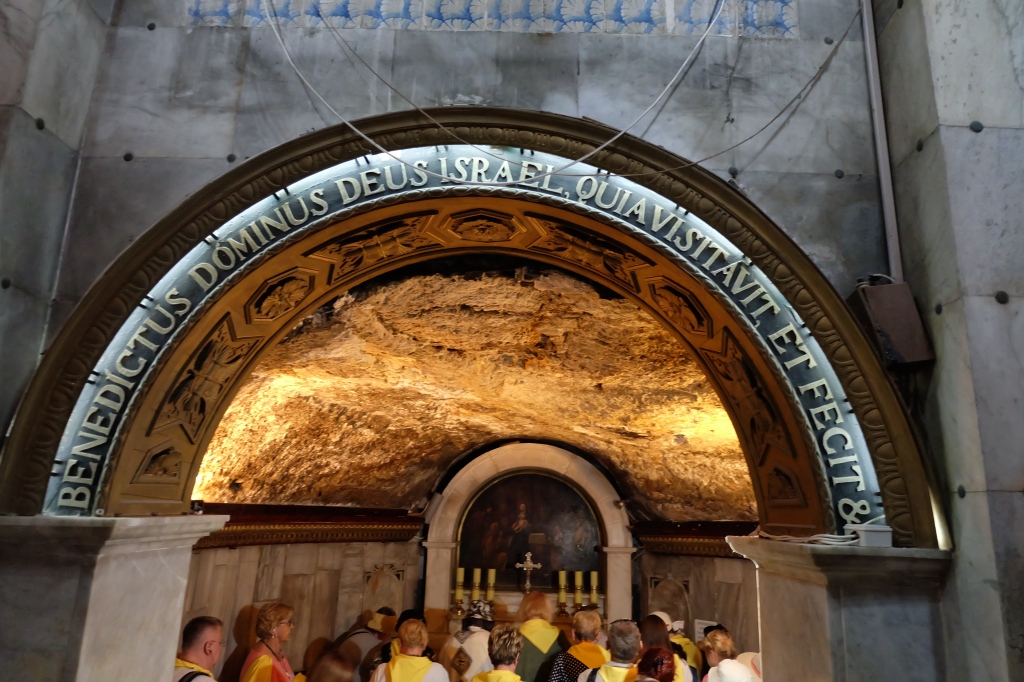
Photo by author, birthplace of St. John the Baptist underneath the church dedicated to him in Judah.
We have reflected last Thursday that Advent and Christmas is a journey that begin in the church, in the celebration of the Mass as Luke opened his Christmas story with the annunciation of John’s birth to Zechariah during their Yom Kippur at the Jerusalem Temple.
Luke’s artistry and mastery in weaving stories brought us right into every scene leading into Christmas – from Jerusalem to Nazareth then to the hill country of Judah in the home of Zechariah until John’s birth where our scene remains today. Tonight and tomorrow, he will be leading us along with Matthew and John to Bethlehem for the birth of the Lord.
But this journeys Luke recounted to us were not only about places but most of all an inner journey into our hearts. As we all know, the destination does not really matter but the journey, the trip. It is most true with our Simbang Gabi too – it is not about completing the nine-day novena that matters most but what have we become!
After tonight and tomorrow’s Masses, our churches would be empty again, only to be filled up on Ash Wednesday, and then Palm Sunday and Holy Thursday. How tragic that on Easter which is “the Mother of all feasts in the Church”, people are miserably absent because they are out in the beach and resort enjoying summer. In fact, more people come to Christmas (Pasko ng Pagsilang) than with Easter (Pasko ng Pagkabuhay) when it is actually the very foundation of our faith.
With our students after Simbang Tanghali last year at the Medicine Lobby of Our Lady of Fatima University, Valenzuela City.
So, what have we become after these nine days of waking up early or staying up late at night, praying, listening and reflecting on the word of God, sharing our material blessings in the collections and gift-giving if we stop going to Mass the whole coming new year?
American Trappist monk Thomas Merton wrote that seeking God is not like searching for a “thing” or a lost object because God is more than an intellectual pursuit or a contemplative illumination of the mind. Merton explained that God reveals Himself to us in our hearts through our communion and fellowships in the Church.
We come to church to celebrate the Mass and pray with the whole community to express our communion with one another in Jesus Christ. It is in this communal aspect of prayer we become holy, when we are transformed and as Zechariah prophesied, we are “set free” by Jesus Christ who is the main focus of his Benedictus.
Who are those enemies Zechariah mentioned twice in his Benedictus? Who are those enemies we have to be set free for God and free to love?
Photo by author, Church of St. John the Baptist, Israel, May 2019.
Again, look at this minute detail Luke used in composing Zechariah’s Benedictus when he spoke twice of the word “enemies”: first of “saving us from our enemies, from the hand of all who hate us” (Lk.1:71) and then, the fulfillment of God’s promise to Abraham “to set us free from the hand of enemies, free to worship him without fear” (Lk.1:74).
Surely, those “enemies” were not just the Romans and other pagans around Israel at that time nor the Pharisees and scribes, the priests and Sadducees of the temple who had hands in Christ’s death for they are now gone. The gospel accounts were written in the past but remain true and relevant at all time in history, especially now more than ever in our own time.
Are we the “enemies” within who think only of our selves even in our religious and spirituality, manipulating God, controlling God?
A friend asked me last week if their priest was right in saying that the Simbang Gabi is the most effective means to obtain special favors from God. I emphatically told her “no”, adding that their priest’s claim is misleading. We cannot dictate God. God blesses everyone, including sinners who do not even go to Mass. We do not need to multiply our prayers as Jesus warned us because God know’s very well our needs before we pray. Then, why pray at all?
We pray and most especially celebrate the Mass especially on Sundays to know what God wants from us because we love God. Period. And that love for God must flow in our loving service and kindness with others. If gaining favors is the main reason we go to Mass or even pray, then, we are the “enemies” who prevent ourselves to freely worship God!
Mr. Paterno Esmaquel of Rappler rightly said it in his Sunday column:
“We are a society obsessed with achievement and success, command and control… Even we who try to complete the Simbang Gabi can plead guilty. During the Simbang Gabi, for example, we are tempted to focus on achieving all the nine days and succeeding for another year. By fulfilling this tradition, we can then ask God (or “command” God, like a genie) to grant our wishes. We can therefore wield greater control over life that is otherwise unpredictable (https://www.rappler.com/voices/thought-leaders/the-wide-shot-missed-simbang-gabi-found-christmas-grace/).
And who are feeding all these misleading and erroneous thoughts on the people? We your priests and bishops!
How sad as we have mentioned last week when many priests have totally lost any sense at all of the sacred in the celebration of the Mass. Some of them not only come unprepared for the celebration without any homily, even so untidy and shabbily dressed and worst of all, make fun of almost everything and everyone that the Mass has become a cheap variety show. Online Masses continue not for evangelization for “shameful profits” in the Sacrament through “likes” and “followers” that some priests are now more concerned in finding ways to be trending and viral instead of how to effectively evangelize the people with our good liturgical celebrations flowing into our witnessing of life.
Yes, we priests and bishops are the enemies right here in the church when we align more with the rich and powerful, when we have no qualms asking/receiving gifts and favors from politicians and still, would want to collect more money and donations from people with our endless envelops that have totally alienated the poor from the church. The poor are the ones who suffer most, paying for the corruption of the politicians who help the clergy in their projects for the poor. Poor Jesus Christ!
Perhaps, on this last day of our novena to Christmas, let us all force ourselves – especially us priests and bishops – to go into silence to identify, to weed out those enemies within and outside us that prevent us from welcoming Jesus Christ in our hearts.
Let us pray to God that He may set us free from these enemies within us, around us so we can be like John the Baptist who will “go before the Lord to prepare his ways, to give his people knowledge of salvation.” Amen.See you tonight or tomorrow, Christmas in the Holy Mass!
Photo by author, Dumaguete City Cathedral, November 2024.