The Lord Is My Chef Breakfast Recipe for the Soul by Fr. Nicanor F. Lalog II
Wednesday, Memorial of St. Charles Borromeo, Bishop, 04 November 2020
Philippians 2:12-18     >><)))*>  >><)))*>  ><)))*>     Luke 14:25-33
Photo by Ms. Ria De Vera, sunrise at our Parish during COVID-19 lockdown, May 2020.
Thank you dear God our Father for the timely reminders by St. Paul to us during these last two months of 2020, the most difficult year for us in 50 years. But it is not all that bad, Lord, specially at how it had redirected many of us back to you.
For God is the one who, for his good purpose, works in you both to desire and to work. Do everything without grumbling or questioning, that you may be blameless and innocent, children of God without blemish in the midst of a crooked and perverse generation, among whom you shine like lights in the world.
Philippians 2:13-15
For so long, we have been driving our lives on our own, unmindful of your teachings and ways, O Lord.
We have come to trust and rely more Google for information than knowledge, Waze for directions and destinations than journey, Facebook and Twitter for lifestyle and trends than life itself.
We always grumble or question you and your presence and your voice if ever our social media activities are disrupted.
Oh God…! Just as when we thought we have life with all the technologies and amenities of modern life, the more we have become empty, lost and divided as a people.
Let us go back to you, God, through Jesus Christ.
Help us see anew in this COVID-19 pandemic that without you at the center of our lives and endeavors, nothing good can truly happen with us despite modern technologies.
Like the man building a tower or the king waging a war in the parable of Jesus today, may we humbly accept the truth that after everything is considered in all our plans, it will always be lacking in depth and meaning without God in every consideration because you always know what is really best for us.
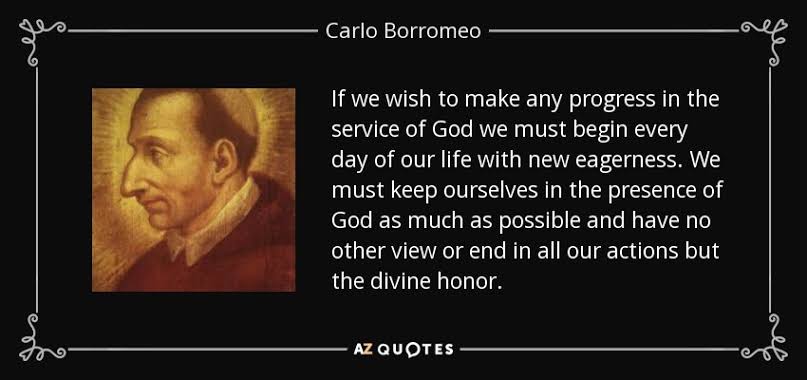
Like St. Charles Borromeo who had lived at a time when the Church had lost more than half of Europe to Protestants, he championed the calls to return to God and to go back to the basics like reforming our clergy and reinforcing catechism.
Through the prayers and inspiration by St. Charles Borromeo, may we let God working in us anew for us to have a better new year, better lives. Amen.
The Lord Is My Chef Breakfast Recipe for the Soul by Fr. Nicanor F. Lalog II
Saturday, Week XXIX, Year II in Ordinary Time, 24 October 2020
Ephesians 4:7-16     >><)))*>   +   <*(((><<     Luke 13:1-9
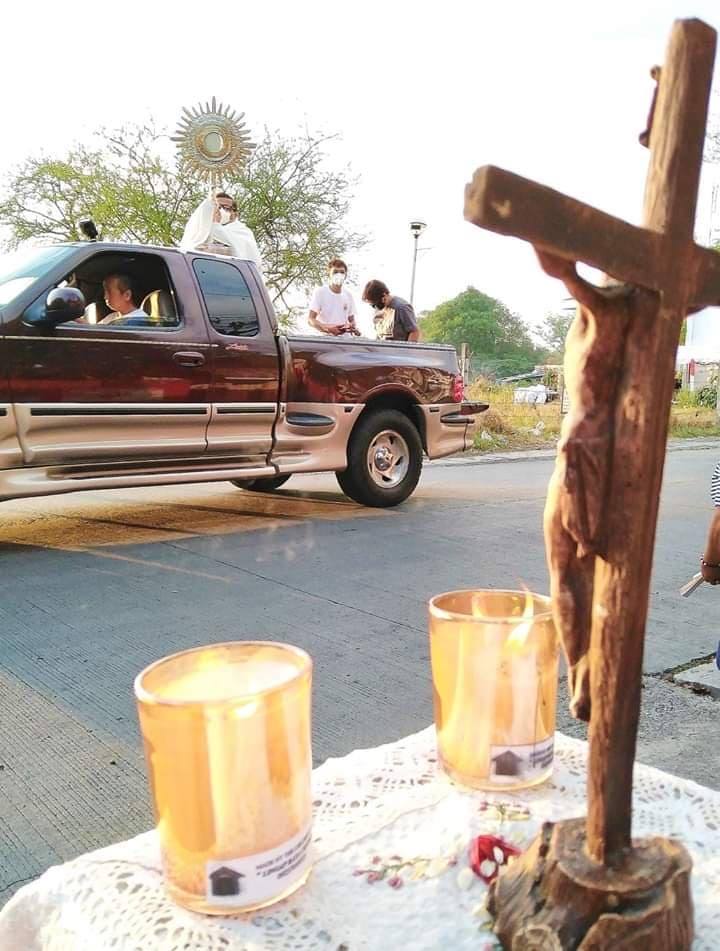
Motorized procession or “Paglilibot” of the Blessed Sacrament around our Parish last summer at the height of COVID-19.
Praise and thanksgiving to you, God our merciful Father for the grace of some bit of good news these past few days with the declining number of COVID-19 infections specially in the National Capital Region. We are still far from controlling the spread of corona virus but that is enough for us to rejoice! Thank you, dear God!
As we come to close this week and inch closer to the penultimate month of 2020, we pray like St. Paul that we may live holy and righteous lives worthy of our dignity in Jesus Christ your Son.
Rather, living the truth in love, we should grow in every way into him who is the head, Christ, from whom the whole Body, joined and held together by every supporting ligament, with the proper functioning of each part, brings about the Body’s growth and builds itself up in love.
Ephesians 4:15-16
Make us grow in you, dear Jesus: let us see and find you in things and events in our lives.
Make us see ourselves first of all in need of seeking your forgiveness and mercy for our many sins to cleanse ourselves of any claims to self-entitlement as you have warned the people in today’s gospel.
Most of all, may our lives bear fruits like in the parable of the fig tree wherein we keep in mind, always aware of our identity in you, dear Jesus so that we may live accordingly in the grace of the Father through the Holy Spirit. Amen.
The Lord Is My Chef Breakfast Recipe for the Soul by Fr. Nicanor F. Lalog II
Tuesday, Week XXIX, Year II in Ordinary Time, 20 October 2020
Ephesians 2:12-22     >><)))*> + >><)))*>  +  >><)))*>     Luke 12:35-38
Photo by Dr. Mylene A. Santos, MD in Quezon, 2020.
Glory and thanksgiving to you, God our Father, through your Son our Lord Jesus Christ in the power of the Holy Spirit for reconciling us all in you, making us one despite our many differences.
How lovely to the ears, to our being the words of St. Paul today, Lord Jesus, assuring us of our citizenship in heaven through the salvation you have brought us all, regardless of our color, race, status or even religion!
So then you are no longer strangers and sojourners, but you are fellow citizens with the holy ones and members of the household of God, built upon the foundation of the Apostles and prophets, with Christ Jesus himself as the capstone. Through him the whole structure is held together and grows into a temple sacred in the Lord; in him you also are being built together into a dwelling place of God in the Spirit.
Ephesians 2:19-22
Help us, O Lord, to embody and manifest this unity of peoples in you in the Church, your Mystical Body here on earth.
Heal us of our many divisions and make us truly Catholic by helping everyone enter into communion with you through one another.
Keep us on guard for your return, Jesus, by “girding our loins and lighting our lamps” (Lk.12:35) ready to welcome you with our good works each day, leading others closer to you.
Let us start by going back to you in prayers and silent meditations that many have forgotten or taken for granted in this 24/7 world saturated by media with all the cacophony of sounds and blinding visuals that have blurred our vision of who we really are as citizens of heaven, beloved children of God our Father in heaven.
Help us find our way back home to the Father in heaven here on earth by finding our way back home to our true selves and to our brothers and sisters in you, dear Jesus. Amen.
Quiet Storm by Fr. Nicanor F. Lalog II, 19 October 2020
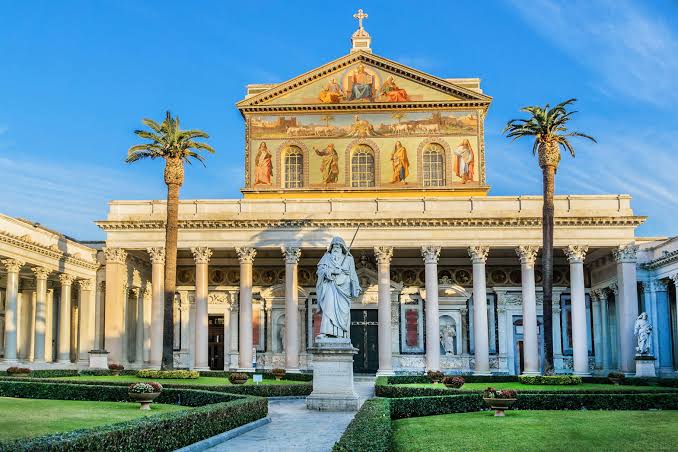
St. Paul’s Basilica in Rome from en.wikipedia.org.
It is really funny these days at how things we grew up with have changed so differently like the postscript we used with initials “P.S.” at the end of letters as an afterthought we sent relatives and friends about 40 years ago.
Today, a postscript is more of a trademark and an application in computers but for my generation, it is from the Latin “post scriptum” that means “written after”.
Consider this piece, my dear Reader, as a postscript or PS to St. Paul’s Letter to the Galatians we heard proclaimed during weekdays from October 5-14, 2020 where he explained and reflected about faith in Jesus Christ whom he loved so much.
Faith is having a relationship with God,
not to obtain things from him.
We always hear people say “have faith” in everything we pray for. Always believe that God will hear us, God will grant us what we need and ask for.
But what happens when we do not get what we are praying for like when a loved one is not healed or recovers from a sickness and eventually dies? Or, flunk an important exam or maybe fail to close a major deal in business? Does it mean we lack faith? Or, is that the main purpose of having faith in God, to obtain things and favors from him?
See how St. Paul called the Galatians “stupid” for being misled by false teachings on the gospel of Jesus Christ: some preachers had come to Galatia at that time telling them of the need to be circumcised like the Jews who converted to Christianity in order to be saved. He wrote the Galatians primarily to rectify those errors they have seemed to believed, where he introduced the doctrine of “justification (salvation) by faith in Christ”, not by rituals and other practices men do. It is not to dismiss our traditions but to stress the primary role of faith in Jesus Christ who died for our sins to save us.
O stupid Galatians! Who has bewitched you, before whose eyes Jesus Christ was publicly portrayed as crucified. I want to learn only this from you: did you receive the Spirit from works of the law, or from faith in what you heard? Are you stupid? After beginning with the Spirit, are now ending with the flesh?
Galatians 3:1-3
Sometimes like the Galatians, we end up with the flesh, believing more in things we do like rituals and other things than truly believing Jesus because we use faith to obtain things from God.
No! We believe because we relate: every relationship like marriage always presupposes faith in the other person. Even Jesus in teaching us how to pray, he taught us the “Our Father” which is an expression of a relationship.
Wedding of my former student, Micah and Lery Magsaysay, February 2020.
Being faithful means being realistic.
Jesus himself assured us that faith can move mountains and do other great things for us if we truly believe. This is perhaps the reason we always equate faith in asking for so many things from God.
Not at all. We also have to be realistic with things we ask from God. He is not a magician who has to please and entertain us with his miracles and powers. When we were in high school seminary, the late Fr. Nick Cruz, SJ gave us a recollection and told us we cannot simply ask anything from God like a rose blooming from your toothpaste to prove he calls you to the priesthood!
Being realistic in our faith by praying first of all to have Jesus, only Jesus and always Jesus!
When Jesus told us to seek and you shall find, to ask and it shall be given to you, and to know and the door shall be opened to you (Lk.11:9-10), he was not telling us to ask for money and gadgets. If we are going to be realistic in our faith, Jesus is telling us to seek God and you shall find him, to ask God and you shall have him, and most of all, God is the only door when we knock would surely open us to new beginnings.
In explaining the unique call we have received from God in Christ, St. Paul gives us the whole reality of our being Christians, of having a faith that is realistic.
For all of you who were baptized into Christ have clothed yourselves with Christ. There is neither Jew nor Greek, there is neither slave nor free person, there is not male and female; for you are all one in Christ Jesus. And if you belong to Christ, then you are Abraham’s descendant, heirs according to the promise.
Galatians 3:27-29
Photo by author, August 2020.
Faith demands conviction and consistency.
God’s gift of faith in us is not everything; we have to cultivate and deepen our faith to experience its wondrous fruits and grace. See the kind of conviction of St. Paul in proclaiming and explaining his faith in Jesus Christ.
Now I want you to know, brothers and sisters, that the Gospel preached by me is not of human origin. For I did not receive it from a human being, nor was I taught it, but it came through a revelation of Jesus Christ.
Galatians 1:11-12
Like the Galatians, many of us are easily swayed by so many other beliefs and teachings that are misleading, claiming to be a part of the faith we have received. Without firmness and conviction in our faith, some among us have gone to accommodating modern thoughts and lifestyles that run contrary to our faith in Christ like abortion, same sex marriage, and in-vitro fertilizations or test tube babies.
A believer without conviction and consistency in faith and actions is not faithful at all. What happens with our “faith is a relationship” when the chips are down, when we are confronted of either being for God or against God?
Sometimes we try “moving the lines”, convincing ourselves that we are not crossing the line of morals and morality like when we are bent on accommodating others and ourselves in some occasions to justify personal preferences.
Sad to say, it happens even among us clergymen like when we tinker with the liturgy and the sacraments in the name of modernism and of arts and worst, with some issues pertaining to acts intrinsically sinful and immoral.
Maybe if we would have the conviction and consistency of faith, we would all be like the good Samaritan in the Lord’s parable – a neighbor to everyone especially those in need, willing to cross the street to faithfully reach out to others in Jesus Christ (Lk. 10:25-37).
Try examining our faith today. Has it bloomed into a relationship we keep with God our Father in Christ Jesus through the Holy Spirit or has it remained as it is, a given, a safety net just in case we need?
Have faith, have God and we’ll journey far, together! Amen.
From americamagazine.org.
On Wednesday, we reflect on being faithful and free, and how faith works through love. Have blessed Monday and see you again!
You may also check our prayers from October 05-14, 2020 based on St. Paul’s Letter to the Galatians at the archives of http://lordmychef.com.
Quiet Storm by Fr. Nicanor F. Lalog II, 17 October 2020
Bishop Dennis Villarojo of the Diocese of Malolos leading the praying of the Rosary during the 11th Healing Rosary for the World last May 27, 2020 at the Malolos Cathedral. Photo from Sandigan.
It is the world’s most powerful weapon in any war, the most potent medicine for any ailment but has always been shunned upon by many especially in this age of sophisticated technology and modern science.
This is the Holy Rosary of the Blessed Virgin Mary, so loved by most saints in the past 800 years, encouraged by the Mother Church, and now rediscovered by many in this time of COVID-19 pandemic.
How prophetic were the words of St. John Paul II in October 16, 2002 when he declared it as “Year of the Rosary” by adding the Luminous Mysteries prayed on Thursdays.
The Rosary of the Virgin Mary… still remains, at the dawn of this third millennium, a prayer of great significance, destined to bring forth a harvest of holiness. It blends easily into the spiritual journey of the Christian life, which, after two thousand years, has lost none of the freshness of its beginnings and feels drawn by the Spirit of God to “set out into the deep” (duc in altum!) in order once more to proclaim, and even cry out, before the world that Jesus Christ is Lord and Saviour, “the way, and the truth and the life” (Jn 14:6), “the goal of human history and the point on which the desires of history and civilization turn”.
St. John Paul II, Rosarium Virginis Mariae, Introduction
It is very interesting to know that the celebration of the Our Lady of the Holy Rosary was instituted following the victory by the Spanish Armada over the Ottoman Turks at the Battle of Lepanto Bay on October 07, 1571. That decisive naval victory attributed to the praying of the Rosary ended the push towards Europe by the powerful Moslem Ottomans. That would be repeated less than a hundred years later at Manila Bay in 1646 when the Protestant Dutch navy retreated unable to break the defenses of the combined Spanish and Filipino forces who placed themselves under the patronage of Our Lady of the Holy Rosary. Following their victory at the La Naval de Manila, the surviving soldiers walked barefoot to the Santo Domingo Church then in Intramuros.
There are so many other stories of how devotion to Our Lady of the Holy Rosary have led to many kinds of victories in various battles – not only in wars but also in plagues and diseases and other crises – waged by Christians both as a nation and as individuals not because the Blessed Virgin Mary is a “fighter” like a warrior but more of a woman of peace, a disciple par excellence of Jesus Christ.
The family that prays together,
stays together;
a world at prayer is a world at peace.
- Venerable Fr. Patrick Peyton
Image of Our Lady of the Holy Rosary whose feast we celebrate every third Saturday of October at Parokya ni San Juan Apostol at Ebanghelista, Bagbaguin, Santa Maria, Bulacan.
What makes Our Lady of the Holy Rosary so unique in fighting all kinds of battle in life is the path she takes, the path of Jesus Christ which is the path of peace. Here we find how though the Rosary is Marian in character, it is in essence Christocentric.
…to rediscover the Rosary means to immerse oneself in contemplation of the mystery of Christ who “is our peace”, since he made “the two of us one, and broke down the dividing wall of hostility” (Eph 2:14).
St. John Paul II, Rosarium Virginis Mariae, #6
Jesus had told us that the peace he gives us is not like the peace of the world but a peace that is won out of love, not of violence and power. Mary as Mother of Jesus offers us the most intimate and incomparable model in contemplating Christ the Prince of Peace, his very person, his words and teachings that leads into inner peace within each person first.
And that is what every mystery of the Rosary teaches us: we remember not just by going back to the past but by making present anew Jesus Christ in the many events of his life relevant with us today because they are very similar with our own experiences.
When we contemplate the Joyful Mysteries, we realize that real joy comes from welcoming and accepting, sharing and finding Jesus who comes to us in the most ordinary ways. In the Sorrowful Mysteries, we find in whatever suffering we find ourselves into, Jesus Christ went through it all first for us, assuring us he continues to be with us even in death that leads us to the Glorious Mysteries of Easter. In these mysteries that end with the Coronation of the Blessed Virgin Mary as Queen of Heaven and Earth, we are reminded and assured of our only “destiny” in life — to be back in the presence of God in heaven with Mary.
Mary in the Holy Rosary reveals to us that our fulfillment in life is found only in her Son Jesus Christ, the light of the world in whom everything must be seen and considered. All the rough edges, the dullness and darkness within us are dispelled when seen in the light of Jesus Christ. And that is why we find in the Luminous Mysteries the most “scriptural” part of the Rosary. According to St. John Paul II, though the gospels were silent about the presence of Mary in these Luminous Mysteries, it is most likely she was there present in silence, something so rare these days as we live our lives in the glitz and glamour of social media like Facebook and Instagram.
Photo by author, 2019.
The COVID-19 pandemic is one of the most unique battle man has ever fought, not only because the enemy is not seen and have made such visibly tremendous impact to our way of life in a global scale like World War II; it happened in the most unusual way that attacked and disturbed our inmost being as human persons desiring peace right in our hearts.
It exposed the sickness we have all been afflicted with, the lack of love, a love that is like the love of Jesus Christ willing to sacrifice, willing to forgive, willing to let go simply because of loving someone more than one’s self.
We have been in chaos within, longing for peace and love that have remained elusive because we have always been busy with everything except with God and our true selves. Long before we have adopted social distancing, we have long been distant from each other, even with those we live with in our homes – so cold and without love. Meals have become needs to feed one’s body, not as events to share one’s self with others as more and more people are getting used to eating by themselves, with cellphones beside them. Everybody is complaining about the face masks and face shields we have to wear without realizing when was the last time we really had a good look at each one’s face as a brother and a sister in Christ, an image and likeness of God, a person to be loved and cherished?
In praying the Rosary meditating in silence its mysteries, we not only discover the mystery of God but most of all our own mystery of being a part of his grand design and plan. That is why we feel anxious and fearful all of a sudden because death has become truer and closest to us in this time of the pandemic when “resting in peace” has become so common. And we know so well we have not loved enough!
“The Assumption of the Virgin” by Italian Renaissance painter Titian completed in 1518 for the main altar of Frari church in Venice. Photo from wikidata.org.
By praying the Rosary, its beads make us enter the rhythm of life once again, that it is not just temporal and material but also eternal and spiritual. With Mary, the Rosary enables us to be conformed to Christ which is the very essence of Christian spirituality.
In the spiritual journey of the Rosary, based on the constant contemplation – in Mary’s company – of the face of Christ, this demanding ideal of being conformed to him is pursued through an association which could be described in terms of friendship. We are thereby enabled to enter naturally into Christ’s life and as it were to share his deepest feelings.
The Rosary mystically transports us to Mary’s side as she is busy watching over the human growth of Christ in the home of Nazareth. This enables her to train us and to mold us with the same care, until Christ is “fully formed” in us (cf. Gal 4:19). Never as in the Rosary do the life of Jesus and that of Mary appear so deeply joined. Mary lives only in Christ and for Christ!
St. John Paul II, Rosarium Virginis Mariae, #15
I have been wondering why despite our many prayers and Masses, why have we not conquered COVID-19 yet? How many rosaries do we have to pray before God answers our prayers for a cure to corona virus?
Perhaps, Our Lady of the Holy Rosary is reminding us today that the problem with COVID-19 is not just medical but deeply spiritual, calling us to be conformed in the person of Jesus Christ that calls for many battles within us against our pride, selfishness, painful past and memories, vices and addictions, so many other negativities that please our senses but leave us empty and lost because they all lack love from which peace springs forth.
Take that Rosary again, learn from Mary that true blessedness is in believing that the words of God will be fulfilled (Lk.1:45) in us by welcoming Jesus, sharing Jesus, and becoming like Jesus in love like his Mother. Amen.
The Lord Is My Chef Breakfast Recipe for the Soul by Fr. Nicanor F. Lalog II
Tuesday, Memorial of St. Bruno, Priest and Founder of Carthusians, 06 October 2020
Galatians 1:13-24     >><)))*>   |+|   <*(((><<     Luke 10:38-42
Photo by author, antique door of a resthouse in Silang, Cavite, 22 September 2020.
What a wonderful story from St. Paul today of his conversion, Lord Jesus Christ! How lovely to read his story without any airs or pride but full of humility, focused on the mystery of your call for him to be your Apostle to the Gentiles.
Clearly, the fruit of long years of prayers, of sitting beside you at your feet.
Brothers and sisters: You heard of my former way of life Judaism, how I persecuted the Church of God beyond measure and tried to destroy it… And I was unknown personally to the churches of Judea that are in Christ; they only kept hearing that “the one who once was persecuting us is now preaching the faith he once tried to destroy.” So they glorified God because of me.
Galatians 1:13, 22-24
Lord Jesus, keep me simple and humble like St. Paul in telling my story of your call that is always both a mystery and a gift, something so special known only to you. Purify me and my story of vocation in spending silent moments at your feet contemplating, meditating on your words.
Sometimes, some people complain how their lives are not as colorful as somebody else’s life like St. Paul with a lot of dramatic twists and turns.
We do not need those things, Lord. You call each of us in the most unique and personal way. Every encounter with you Jesus is always personal, always special.
What we really need is a listening heart: no matter how colorful and dramatic our lives may be but if we do not spend time with you listening and praying like Mary in the gospel, everything will always be bland and dry.
Let us reflect more, to treasure every encounter with you by being silent and still, less distracted with the ways of the world that make us forget you to turn our very selves as the center of attention even unconsciously demanding you to focus on us like Martha!
Martha, burdened with much serving, came to him (Jesus) and said, “Lord, do you not care that my sister has left me by myself to do the serving? Tell her to help me.” The Lord said to her in reply, “Martha, Martha, you are anxious and worried about many things. There is need of only one thing. Mary has chosen the better part and it will not be taken from her.”
Luke 10:40-42
Teach us to follow the examples of St. Paul and Mary, of St. Bruno whose memorial we celebrate today so we may we strive “to seek God assiduously, to find God promptly, and to possess God fully.” After all, as his Carthusian monks motto profess, “while the world changes, the cross stands firm.”
Yes, dear Jesus, nothing is most worthy in this life than to be always at your side, doing your work, speaking your words, living your life. Amen.
The Lord Is My Chef Breakfast Recipe for the Soul by Fr. Nicanor F. Lalog IITuesday, Feast of the Birth of the Blessed Virgin Mary, 08 September 2020Romans 8:28-30 >><)))*> + <*(((><< Matthew 1:18-23
Photo by author, Christmas 2018.
Praise and glory to you our great and loving God the Father! In sending us your beloved Son Jesus Christ, you have truly blessed us all in his coming. First among us is his Blessed Mother, Virgin Mary who has become our Mother too through Jesus Christ!
You never fail to surprise us, O God our Father, with your plans not only with the Virgin Mary and the Saints but most especially with each one of us in the coming of your Son Jesus Christ.
St. Andrew of Crete beautifully explained in his discourse the meaning of this Feast of Mary’s Birth:
The present festival, the birth of the Mother of God is the prelude, while the final act is the foreordained union of the Word with flesh. Today the Virgin is born, tended and formed, and prepared for her role as Mother of God, who is the universal King of the ages.
Office of Readings, 08 September, Volume IV
How lovely that on this Feast of Mary’s nativity, the story we were told “is how the birth of Jesus came about” through her and St. Joseph her spouse with of a lot of working by the Holy Spirit.
Give us, O God, the faith and the strength to heed St. Paul’s teaching so that your plans are fulfilled in us like with Mother Mary:
We know that all things work for good for those who love God, who are called according to his purpose.
Romans 8:28
Help us realize this great honor you have given us in sharing with the Motherhood of Mary by reflecting on St. John Paul the Second’s teaching that “Every birthday is a small Christmas because with the birth of every person comes Jesus Christ.” (Evangelium Vitae)
Like Mary, make us share Jesus Christ with everyone and in this world that has turned its back from you.
Like Mary, may we remain standing at the foot of Jesus Christ’s Cross when everything is dark and uncertain for that is when his light shines brightest leading to Easter.
And still like Mary, may we be faithful in our prayer life, always waiting for the coming of the Holy Spirit to fill us with fire and strength to proclaim the gospel not only in words but most of all in deeds like her.
O most blessed Virgin Mary our Mother, pray for us to grow closer with your Son Jesus Christ! Amen.
Photo by author, National Shrine of Mt. Carmel, QC, 2019.
O God our Father, we praise and thank you in sending us your Son Jesus Christ to show us how in the most ordinary and essential aspect of our lives – eating – we can either be far away from you or very near you.
Yes, O Lord! Just like in the movies, eat, pray, live, and love.
How wonderful it is to think that it was in eating the forbidden fruit at Eden that we have fallen from your grace while it is in partaking in the Supper of the Lord in the Eucharist that we have become blessed to be one in you, sharing in your holiness.
Help us to sink deeper into the inner reality of “eating” that leads us to praying, living and loving.
Like your prophet, may we realize that the key in understanding fully your words is in immersing ourselves into them like eating when we savor the aroma of food, biting and chewing in pieces to let its taste cover our palate, digesting it into our whole body system to nourish our lives.
Son of man, he then said to me, feed your belly and fill your stomach with this scroll I am giving you. I ate it, and it was as sweet as honey in my mouth. He said: Son of man, go now to the house of Israel, and speak my words to them.
Ezekiel 3:3-4
So many times in life, O Lord, we complain at how difficult are your laws and teachings, your words without ever trying them.
Open our selves like Ezekiel and your saints, specially St. Clare who left everything behind after being inspired by your words through St. Francis of Assisi to be poor and spend life praying to you.
Leaving the world in exchange of a life in poverty and simplicity, of prayer and witnessing, her life was sustained by your words that eventually nourished countless souls in search of you and meaning in life.
If we can just plunge ourselves into your words and eat them like real food, digest their meaning to savor its sweetness and wonderful taste like St. Clare and other saints, then we would no longer be so concerned with things of this world like in knowing who is the greatest among us.
Give us the simplicity of children who delight in the most ordinary food offered them, enjoying life with the sense of awe and surprise of your presence. Amen.
The Lord Is My Chef Sunday Recipe for the Soul by Fr. Nicanor F. Lalog II
Week XVI, Cycle A in Ordinary Time, 19 July 2020
Wisdom 12:13, 16-19 >><}}}*> Romans 8:26-27 >><}}}*> Matthew 13:24-43
Our Lord Jesus Christ invites us today to join him into a different kind of journey that would take us deep into God’s mystery in our very selves through the parables he has started to tell us last Sunday.
Recall, dear readers, that parables constitute the heart of the Lord’s preaching.
We have defined these as simple stories with deep realities that must be cracked open through prayers and reflections to get its meaning. From the French para bolein that literally means “along the path”, a parable is likewise a bridge that leads us into something unknown to us before.
In itself, a parable is a journey calling us to walk through it into our inner selves to discover the many inner beauties that lie within us but we take for granted. Ultimately, as we discover these giftedness within us, we then uncover God dwelling within us.
This is the reason why Jesus would always tell his audience after narrating his parables that “Whoever has ears ought to hear” (Mt.13:43) to insist on them to go deeper inside themselves for their meaning.
And that is when we are transformed, when our lives are changed into true disciples of Jesus Christ.
Greatness in littleness
First thing we notice in the three parables of Jesus today is his insistence on the coming of the kingdom of heaven or kingdom of God through him as the mysterious seed.
This kingdom of heaven is used interchangeably with “kingdom of God” that Jesus would always speak of in his entire ministry until his crucifixion is not according to our understanding of a kingdom: it is not about a territorial domain or the exercise of power over subjects using force.
St. John Paul the Second expressed it beautifully by declaring the person of Jesus Christ himself is the kingdom of God. No wonder, Christ would always liken himself and the kingdom of God with the seed being sown.
It is always good. It is for everyone as the sower scatters the seeds everywhere. And it is always small like Jesus who was born like any infant so fragile and even poor like most of us. He is like the seed we take for granted from which comes forth all kinds of plants like trees, big and small.
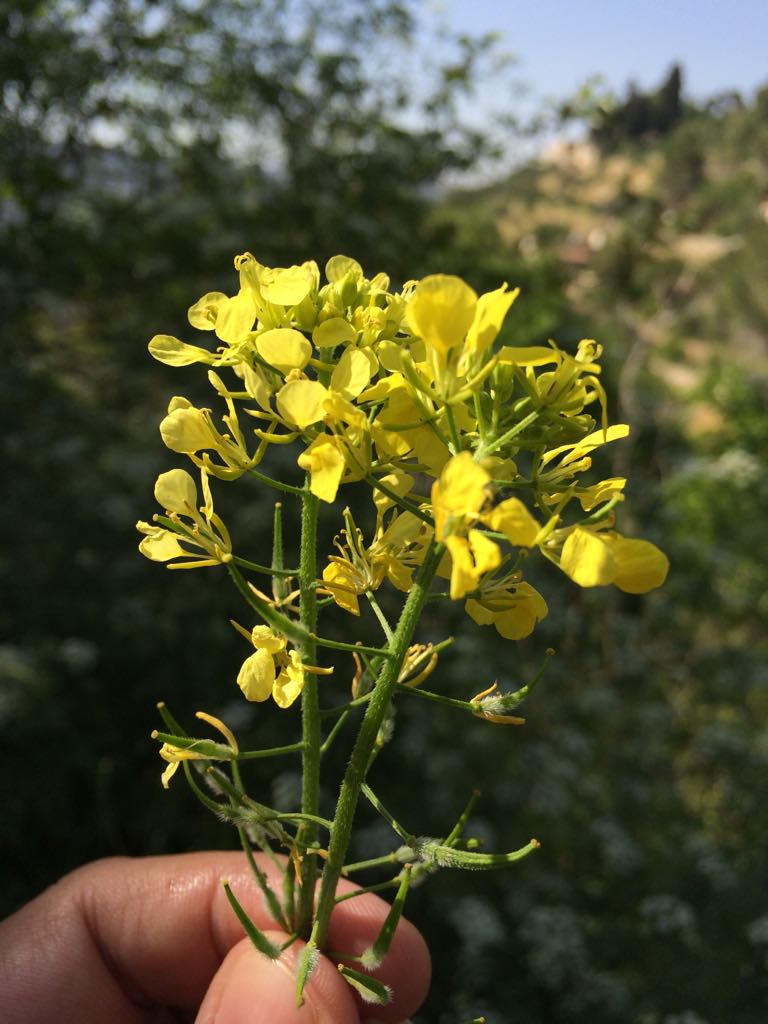
Flowers of a mustard plant from which seeds are taken. Photo by author, Israel, 2017.
Or most specially, like those seeds that turn into crops of wheat and shrubs like the mustard with leaves and branches where birds may dwell that describe the first two parables today.
Jesus then added a third parable of the yeast mixed into flour that leavened the dough into a bread.
Like him our Lord, we his disciples are also like the small seeds packed with great possibilities in God.
In all these three parables today, there is that element of smallness, of littleness that remind us how everything that is great always starts small.
When we come to think of this, we realize how we embarked on this great mission of making Jesus Christ known: it started like a small spark within us, perhaps from a single word we have heard or read, a simple inspiration by God through the most ordinary persons and situation.
Not only in things regarding our spiritual lives but even our personal lives when we recall those humble beginnings of our family and of our business.
Like a little seed or yeast, they just grew!
Now we are surprised, even amazed, how we have changed, how we have grown. Of how we are now reaping the fruits of our labors and sacrifices.
Most of all, how we have known and experienced Jesus Christ who fulfills our lives.
Weeds among the wheat
But not all days are bright and sunny. There are dark clouds that hover above us bringing storms and heavy rains that lead into floodings. A lot often in life, the darkest nights turn out to be the longest nights too.
And this is the meaning of Christ’s main parable for today.
Jesus proposed another parable to the crowds, saying: “The kingdom of heaven may be likened to a man who sowed good seeds in his field. While everyone was asleep his enemy came and sowed weeds all through the wheat, and then went off. When the crop grew and bore fruit, the weeds appeared as well. The slave of the householder came to him and said, ‘Master, did you not sow good seed in your field? Where have the weeds come from?’ He answered, ‘An enemy has done this.’ His slaves said to him, ‘Do you want us to go and pull them up?’ He replied, ‘No, if you pull up the weeds you might uproot the wheat along with them. Let them grow together until harvest; then at harvest time I will say to the harvesters, ‘First collect the weeds and tie them in bundles for burning; but gather the wheat into my barn.'”
During my prayer periods this past week, I have been filled with anger and disappointments at how things are going on in our country and even in my personal life. It pains me so much why at this time of the pandemic when we have to go through all these bad things.
Last Friday morning before our daily Mass, we discovered the glasses shattered in our windows near the office door and at the side door of the church. There were scratches outside indicating attempts to unlock the doors inside and steal from the church.
After the Mass, I grew more angry as we inspected the damages, thinking so negatively harsh against whoever tried to burglarize us.
By night time during prayers, I remembered Victor Hugo’s Les Miserables where Valjean was caught by the police stealing silver from the good bishop who had welcomed him into his rectory with food and accommodations. Instead of pinning him down for his crime, the bishop told the police he had given Valjean the silver found in his bag, even chastising him he had left behind the other silver candlesticks he had asked to take!
The wheatfield owner in our parable and the good bishop of Les Miserables are both the merciful God mentioned by the author of the Book of Wisdom in our first reading today:
But though you are master of might, you judge with clemency, and with much lenience you govern us; for power, whenever you will, attends you. And you taught your people, by these deeds, that those who are just must be kind; and you gave your children good ground for hope that you would permit repentance for their sins.
Wisdom 12:18-19
Think of our parents and elders, our mentors or those we look up to for their wisdom gifted with wonderful insights in life called perspicacity which means “a penetrating discernment… a clarity of vision or intellect which provides a deep understanding and insight.”
Being perspicacious or having perspicacity like the wheatfield owner or the good bishop of Les Miserable means having a deeper wisdom that one can keenly see and understand things beyond ordinary perception following a long process of silent reflections in life.
Many times, our sights can be limited that we do not see the other repercussions and even ramifications of our decisions on certain situations. There are times we think only of finding solutions, of winning the battle but not the war.
It is also along this line that Jesus added the third parable: the yeast is mixed with the flour to leaven the dough.
We are like the yeast who have to mix with others, including the evil ones to become bread that will feed the world.
We are the wheat, the mustard seed, the yeast thrown into the world to make a difference in Christ! We are not the ones who will change the world but Jesus Christ, the mysterious seed, the yeast in the dough who grows and effects the changes in us and among us.
Parables as inner journey in Christ Jesus
With Jesus living and nurturing within us, that is when we become fruitful like the wheat and mustard plant or leavened bread that we are able to feed more people who would eventually become bearers his in the future. That is how the kingdom of heaven comes into this world, when God is seen and felt by everyone through us
This we achieve in prayers as St. Paul reminds us in the second reading. It is not just reciting our basic prayers as Christians including the novenas we love to collect and follow through. The kind of prayer that St. Paul speaks here is a prayer guided by God’s Holy Spirit who perfectly knows God’s will.
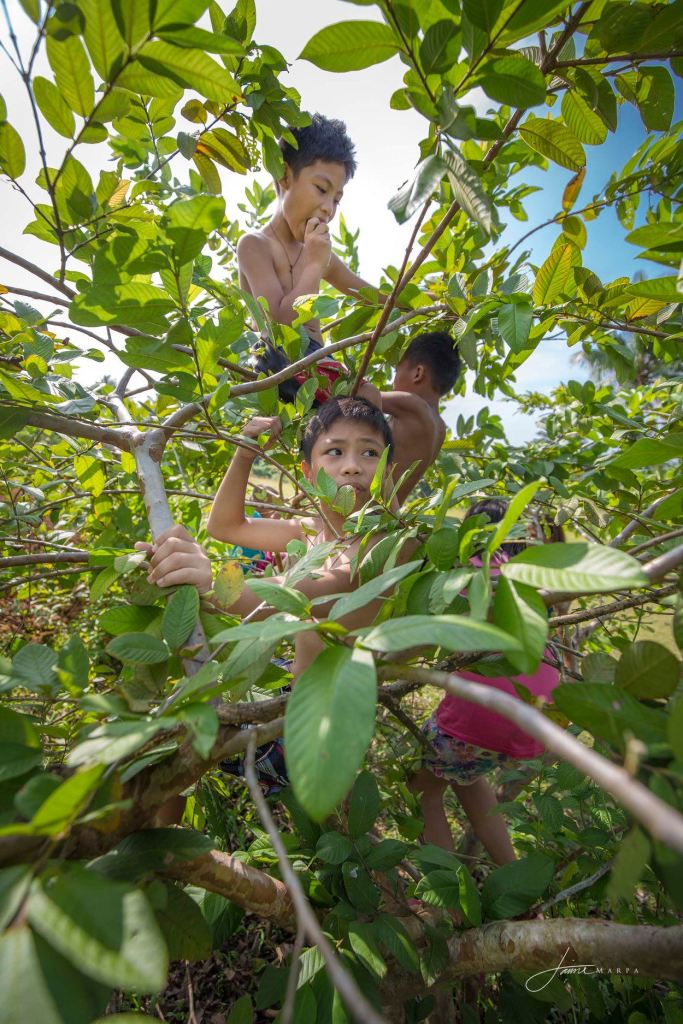
Photo by Dr. Mylene A. Santos of kids she’s teaching on the values of health, education and nature at Katmon Harbor Nature Sanctuary, Infanta, Quezon.
Brothers and sisters: The Spirit comes to the aid of our weakness for we do not know how to pray as we ought, but the Spirit himself intercedes with inexpressible groanings.
Romans 8:26
In this time of too much weeds among the wheat, of so many evil and sins prevailing over us, we can feel frustrated at times that make it so difficult for us to pray.
Sometimes, the evil and sins, or the plain sufferings we go through in our own family, in our community or at work and in school can be so overwhelming that we feel our prayers are useless, that God is not listening at all to us.
Then we stop praying, we stop journeying within even with weeds among the wheat. How can the flour be leavened if the yeast is not mixed with the dough to become bread or cake.
Remain in the Lord!
Pulling out the weeds will not solve the problem; worst, it may endanger us all too in the process that we become like our enemies in the end. Never lose hope in God who knows very well of the presence and source of weeds. Sometimes, these pains and sufferings from evils we go through from others may actually lead us to our being fruitful!
Evil and sins are a parable in themselves that can teach us so well in life if we handle them with prayers.
Photo by Dr. Mylene A. Santos, Infanta, Quezon, May 2020.
Praying in the Holy Spirit is when we spend time with Jesus to reflect and crack open his words that come to us in the Sacred Scriptures and ordinary events in daily life through long hours of silent meditation and contemplation.
The more we dive into God’s mysteries in the parables he sends us in daily living, the more we see the beauty and wonder of life because our horizons are widened and get clearer.
Praying into our parables in life is like looking into a telescope or binoculars that enable us to see something distant within reach.
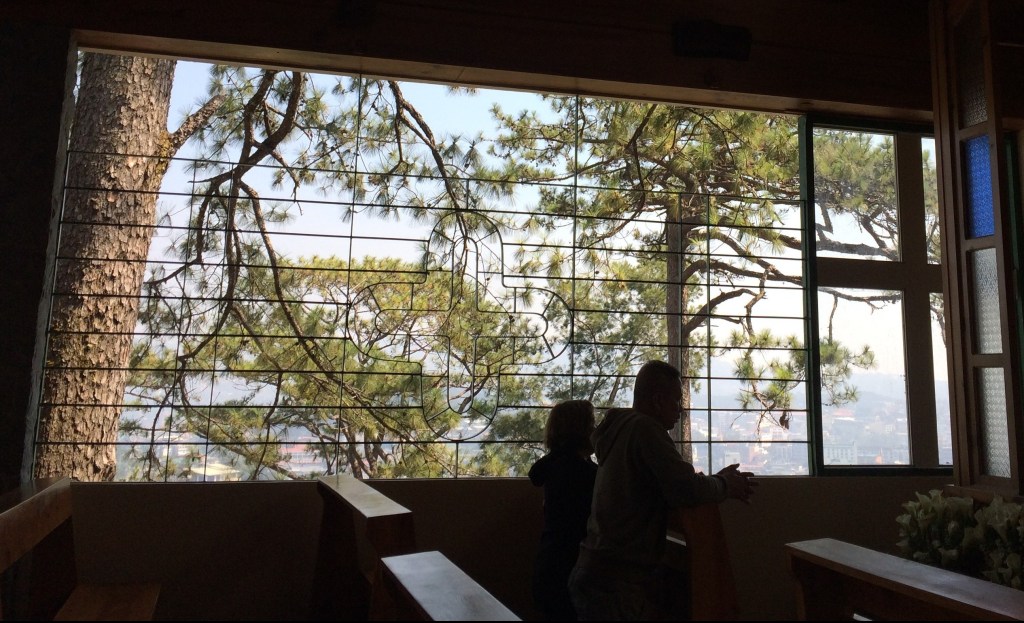
Photo by author, Our Lady of Lourdes Chapel, the Grotto, Baguio City, 2019.
God our loving Father, I have been praying to you for so long, in fact almost in my entire life. But as I prayed over your words for today, it just dawned upon me that every “existential question”: when do I really call on you?
The attitude of your King in Jerusalem struck me while praying, wondering if I have the same attitude of having you first of all when things are not going good in my life.
Hezekiah took the letter from the hand of the messengers and read it; then he went up to the temple of the Lord, and spreading it out before him, he prayed in the Lord’s presence: “O Lord, God of Israel, enthroned upon the cherubim! You alone are God over all the kingdoms of the earth… Therefore, O Lord, our God, save us from the power of this man, that all the kingdoms of the earth may know that you alone, O Lord, are God.”
2 Kings 19:14-15, 19
What a deep faith and intimate relationship with you, Lord, by Hezekiah! He went straight up to you, even presenting to you the letter of the Assyrian king threatening to conquer Jerusalem at that time. He did not mind at all the warnings about the strength and power of the Assyrians because he only had you, Lord, in his mind and in his heart.
So often, Lord, I only come to you after I have exhausted my mind thinking about my problems and situations in life; I come to you when I can no longer find solutions; worst, I come to you after I have tried everything and had failed.
Forgive me, Father, when I only think of you as a last resort — instead of being my first always!
Maybe, that is because before ever coming to you, calling on you, Lord, I try doing things first on my own that is always be easy and quick. I have no patience of waiting and of going through sufferings and inconvenience especially through paths and doors.
Jesus said to his disciples: “Enter through the narrow gate; for the gae is wide and the road broad that leads to destruction, and those who enter through it are many. How narrow the gate and constricted the road that leads to life. All those who find it are few.”
Matthew 7:13-14
Dearest Jesus Christ, you have come among us to bring us closest to the Father and yet we continue to remain far from him. Give us the grace today to be more intimate with God our Father so we may truly be centered on him in life, having him as our personal “default” in every situation, whether good or bad. Amen.















 lordmychef.com