The Lord Is My Chef Daily Recipe for the Soul by Fr. Nicanor F. Lalog II
Wednesday in the Twenty-fifth Week of Ordinary Time, Year II, 25 September 2024
Proverbs 30:5-9     <*((((><  +  ><))))*>     Luke 9:1-6
Photo by author, Sacred Heart Novitiate, Novaliches, QC, 20 March 2024.
Jesus said to them, “Take nothing for the journey, neither walking stick, nor sack, nor food, nor money, and let no one take a second tunic” (Luke 9:3).
Lord Jesus,
bless me to continue
in this journey with You,
in You,
taking nothing
but You;
at first,
I could not believe
it to be true
that many times,
I doubted,
taking so many things with me
in this journey;
but, as we walk farther,
Lord, the more I realized,
that indeed,
I need to take nothing.
The farther we journey,
Jesus, the more I take
and bring,
the more difficult,
the slower I move;
so true that the truly
rich among us is the one
whose who needs least in life;
grant me the grace,
O Lord,
the grace of integrity,
of wholeness
and harmony between my
inner self and
 outward behavior;
like the author of the Proverbs,
"give me neither poverty nor
riches; provide me only with the food
I need; lest being full,
I deny you or being in want,
I steal, and profane the name
of my God"
(30:9).
Amen.
I had published my Sunday homily that Saturday morning when I decided to unwind by watching any movie on Netflix which I do only on weekends. So glad it was the first movie I saw, very related with the story of Prophet Elijah and Jesus Christ’s “Bread of Life Discourse” that Sunday.
First think I liked with Lolo and the Kid is its fast-paced story that revolved around the two characters played by veteran Joel Torre and GMA7’s famed Firefly star Euwenn Mikael Aleta.
Second thing so interesting with me is how Lolo and Kid have no proper names at all (I just learned Lolo’s name was Mario after reading the various write ups) maybe because they stand for all of us who are caught in this great race for money and material things but deep inside longing for the more essential and truly lasting in life like love. And people who love us too, who care for us, and would stand by us.
We are Lolo and Kid who many times have traded our principles for momentary satisfaction but despite our seemingly strong facades of pragmatism and “resourcefulness” or madiskarte as Lolo taught Kid in the movie, deep inside us is still our conscience where God dwells, telling us to pursue good and shun evil. Joel Torre perfectly portrayed this beautiful side in each one of us (with his Ilonggo accent) of keeping a conscience despite our sinfulness, like a soft shell we delicately keep whole and intact inside lest we lose everything in life.
Photo from de.flixable.com
Recall our first reading last Sunday about Elijah fleeing to the mountain from an army pursuing to kill him. Elijah felt a total failure like Lolo and us many times in life when after all our goodwill and love, we are dumped by the very people we care for.
Elijah went a day’s journey into the desert, until he came to a broom tree and sat beneath it. He prayed for death, saying: “This is enough, O Lord! Take my life, for I am no better than my fathers” (1 Kings 19:4).
In one of the scenes of Lolo and the Kid, we find Lolo crying, cursing everyone and murmuring just like in last Sunday’s gospel. As he tried to end his life with a knife, Lolo suddenly heard the cry of an infant from the heap of garbage around him. What a beautiful portrayal of that infant left in the trash like Jesus Christ born on a manger becoming the savior of Lolo, a definitive message of mercy and love from God after his apparent cry of “This is enough, Lord!”
How many times have we found ourselves in the same situation, often in less momentous ones than Elijah or any prophet and saint, crying out to God in the heavens “this is enough”?
But, what is also most true behind every cry of “this is enough” that we make, we continue to believe and to hope in God that there is still a way out of our plight. And very often like in the story of Elijah last Sunday and in that scene in Lolo and the Kid, God comes at the nick of time like that infant crying in the garbage heap, a reminder of life and beauty found within us despite all the dirt we may have around us.
From netflixlovers.it
Here we find the Kid, perfectly played by Euwenn like in Firefly, as the saving grace, the Christ-figure in the movie bringing salvation to Lolo. Kid was “the bread of life from heaven” who “fed” Lolo with life with its meaning and direction. And joy found in Kid, the image of Christ Jesus.
Now, joy according to Jesus at the Last Supper is like a woman at the pangs of childbirth (Jn.16:21-22); it is deeper than happiness. True joy is borne out of self-sacrifice, a fruit of self-denial, of loving somebody more than one’s self. This we find at the end of this moving film.
Now all grown up, Kid finally met again Lolo in the hospital a day after his college graduation. Kid brought Lolo while seated on a wheelchair to visit Taba (another character without a name), their suki in fencing. From there, they went to their usual stop, a videoke bar to eat and drink, singing repeatedly Kenny Roger’s Through the Years.
Then, Lolo died, singing the only tune he knew that summed their beautiful relationship.
Photo from list23.com.
After Lolo’s body was taken out of the videoke bar, Kid opened Lolo’s bag that had a tin can of biscuit filled with old photographs taken with their stolen Polaroid camera. The photos did not merely remind Kid of their happy times together but most especially when they were already apart!
Unknown to Kid, Lolo hid to take photos when he moved to his adoptive parents, from his first ever birthday party to his college graduation! Through the years, Lolo, like God, was always there, present in all of Kid’s milestones in life because he is truly loved.
I have never liked that song Through the Years even when it was a hit during our high school days in 1981 but since Saturday, I have been humming it silently, hearing it inside me as an LSS until now. We hear the song playing throughout the end of the movie with scenes of how Lolo secretly took Kid’s photos filled with love and joy amid the strong current of pain within he had to endure to be far and away yet so near to his beloved apo.
If the Kid is the Christ figure in this film, Lolo is the God-the-Father figure, the One who seems so far from us as if He does not care at all. In Lolo and the Kid, there is that message of God never leaving us wherever we may be, whether we are in the squalor of poverty and sin or in the purity and cleanliness of affluence and grace maybe. God like Lolo to Kid is always with us but never interferes, silently doing many things to ensure that despite our many faults and failures in life, we end up in Him and His love.
We go back to Elijah’s cry of “This is enough, Lord!”, our very same cry like Lolo in the movie.
It is a cry that is also a prayer coming from our innermost being when we feel so saddled with no one to unload our woes except to God – who after all is the very reason why we cry! Watch for Lolo’s soliloquy on this reality we often do.
Photo by author, James Alberione Center, QC, 08 August 2024.
It is a cry of faith so akin with love because to believe and to love go hand in hand. It is during that moment when we feel like giving up to God, crying “this is enough” when in reality we surrender everything to God because we have been caught up by Him that we cannot resist His attraction.
It is that moment when we feel so “fed up with life” but deep inside, we hear God telling us like Lolo with the cries of an infant or like Elijah with an angel instructing him, “Get up and eat, else the journey will be too long for you!” (1 Kings 19:7).
Yes, our life journey is still long but we have a companion in Jesus, our bread of life from heaven, nourishing us, strengthening us, teaching us that essential beauty of love found only in sharing one’s life for the other. As we have said in last Sunday’s homily, it is when we cry “it is enough, Lord” when God gives us more than enough to sustain us sometimes in the form of a good movie like this one. May we have more “bread” like Lolo and the Kid that feeds our soul and gladdens our heart.
*BTW, we are not paid to endorse this movie; simply sharing with you its good news.
The Lord Is My Chef Daily Recipe for the Soul by Fr. Nicanor F. Lalog II
Monday in the Sixth Week of Ordinary Time, Year II, 12 February 2023
James 1:1-11  ><))))*> + ><))))*> + ><))))*>  Mark 8:11-13
Photo by author, Lake of Galilee in Israel, May 2019.
Dear Jesus:
I love that word "kind"
from the responsorial psalm
"Be kind to me, Lord,
and I shall live"
and that scene from the
Gospel when you "sighed":
the word "kind"
is from the root "kin"
or "kindred", that is,
someone like us,
from the same family,
or the same tribe;
being kind is treating others
as one's family or kin
and that is how you are to us -
kind!
And you were most like one of us,
and kind, dear Jesus
 when you "sighed from the depth
 of your spirit" (Mk. 8:12)
after the Pharisees
asked you for sign from heaven
 to prove you were the Christ;
of course, that meant nothing
for the Pharisees but for us
who believe in you, it was something;
like you, dear Jesus,
many times we sigh out of
exasperation and exhaustion,
acceptance and surrender,
hope and inspiration
to persevere,
to keep on,
to forge on in life.
You became like us,
dear Jesus,
in everything except sin
but, when you sighed
we felt you being so kind too,
truly a brother to us
like when St. James
addressed us 15 times
as "brothers and sisters"
in his short letter
while teaching us the important
lesson of bearing all trials
in life as you did at your
Crucifixion, Lord.
Whenever we sigh,
may we remember your kindness,
your being one with us, Jesus
because you too sighed
during those amazing moments
of difficulties and trials,
powerlessness and poverty
when we most gain character
and depth as person,
not when we are strong
and powerful
or successful.
Amen.
The Lord Is My Chef Daily Recipe for Soul by Fr. Nicanor F. Lalog II
Monday in the Thirty-fourth Week of Ordinary Time, Year I, 27 November 2023
Daniel 1:1-6, 8-20   ><}}}}*> + ><}}}}*> + ><}}}}*>   Luke 21:1-4
Photo by Dra. Mylene A. Santos, MD in Tagalag, Valenzuela City, 17 November 2023.
Praise and glory to you,
our loving Father!
Thank you
in bringing us closer to you
in Jesus everyday
especially in this final stretch
of our church calendar
as we come to prepare for Christmas soon.
But, rather than focusing
on the outside appearances
and material inclinations
of our Christmas feelings,
teach us to empty ourselves
to be filled by you in Jesus Christ!
Let us be poor, O God!
Let us embrace poverty
 and simplicity
 to experience you,
your coming,
 your presence
in Jesus,
our Emmanuel!
Let us treasure poverty
for it is our true wealth
in this life
like that “poor old widow”
who gave everything she had
into the temple collection box;
let us realize that it is in poverty
that we find true wisdom
and strength
like what Daniel and his companions
have taught the chief chamberlain
of King Nebuchadnezzar
(Daniel 1:11-20).
Let us be poor, O God,
like Jesus Christ to find
power and strength in weakness,
glory and honor in humility,
and life in death.
 Amen.
Lord My Chef Daily Recipe for the Soul by Fr. Nicanor F. Lalog II
Friday in the Twentieth Week of Ordinary Time, 25 August 2023
Ruth 1:1, 3-6, 14-16, 22   <*{{{{>< + ><}}}}*>   Matthew 22:34-40
Photo by Mr. Jay Javier at Tayabas, Quezon, 13 August 2023.
O how often,
Lord Jesus Christ
that we ask you until now
the same question by
a scholar of the law:
"Teacher,
which commandment
of the law is the greatest?"
(Matthew 22:34).
And we have always known
your answer, which is, loving God
with one's total self
and loving others as we love our
very selves.
But why do we keep on asking
the same question until now?

Because, we have always believed
that loving is having,
that loving is fullness,
when in fact, it is the
exact opposite:
loving is not having,
loving is being poor,
loving is emptiness,
loving is letting go,
loving is surrendering
for the one you love.
Just like Ruth,
that Moabite woman,
a pagan who left everything
to join her widowed
mother-in-law Naomi to go
back to Bethlehem;
both of them were
widowed, both were
childless and empty,
so poor without anything
except each other
and God.
Let the words of Ruth
be our prayer today
to those we love
without if nor buts,
especially those empty
and poor, sick and dying:
"Do not ask me to abandon
or forsake you! for wherever
you go I will go, wherever
you lodge I will lodge,
your people shall by my people,
and your God my God"
(Ruth 1:16).
God our Father,
help us to remain faithful
and to keep loving when
in the midst of sufferings
and trials, of emptiness
and nothingness like Ruth
to Naomi; how lovely to recall
that Ruth's love for Naomi led
to her becoming the grandmother
of King David and one of the four women
in Matthew's genealogy of Jesus
for it is loving without nothing in return
that we gain, and it is in loving
even in losing ourselves
that we find ourselves in you.
Amen.
The Lord Is My Chef Daily Recipe for the Soul by Fr. Nicanor F. Lalog II
Wednesday in the Thirteenth Week of Ordinary Time, Year I, 05 July 2023
Genesis 21:5, 8-20 ><]]]]'> + ><]]]]'> + ><]]]]'>   Matthew 8:28-34
Photo by author, sunset at Tagaytay City, 08 February 2023.
God our loving Father,
today we continue to pray
for those in great trials and
sufferings in life,
those in the eye of the storm
especially those driven out
from their own homes,
from their country,
from their roots
like the refugees and those
fleeing from wars and calamities;
those displaced due to economic
reasons like poverty;
the victims of the inhuman practice
of human trafficking.
Take care of those people
driven away from their homes
especially the children who
always suffer most;
look after the welfare of
those thrown into foreign
lands and environment,
so alienated in language and culture;
sustain those forced to make
ends meet after being
led to somewhere else
not of their own choice
and decision.
Hear the cries of the many
and modern
Hagar and Ishmael
of our time;
bless them too for
we all came from Abraham;
punish the human traffickers,
convert them,
take away their hearts of stone
and give them natural hearts
who respect and rejoice
humanity.
Your very own Son
and our Lord Jesus Christ
was also driven out by people
after he had exorcised two demoniacs
at the territory of Gadarenes;
how sad that until now it continues
to happen among us when we drive
people out and away because we
value more things and animals than persons.
The whole planet,
the whole land is yours,
O Lord but until now,
so many are lording over
vast tracts of land
when all we really need
at the end is a simple plot
of three-and-a-half feet wide
by eight feet in length,
six feet under.
Amen.
The Lord Is My Chef Sunday Recipe for the Soul by Fr. Nicanor F. Lalog II
Sunday in the Fourth Week of Ordinary Time, Year A, 29 January 2023
Zephaniah 2:3, 3:12-13 ><}}}*> 1 Corinthians 1:26-31 ><}}}*> Matthew 5:1-12
Photo by author, 2020.
Blessedness is a very contentious term for us Filipinos. Very often, we equate blessedness with being rich and wealthy like having a lot of money, a beautiful house, and the latest car model as well as clothes and gadgets. Being blessed sometimes means being lucky or fortunate like winning the lotto or having a child graduating in college or getting promoted in one’s job.
In the Visitation, Elizabeth defined for us the true meaning of being blessed like Mary as someone who believed that what the Lord had promised her would be fulfilled (Lk.1:45). Blessedness is essentially a spiritual reality than a material one; however, it implies that being blessed results from doing something good like being faithful to God.
Today in our gospel from Matthew, Jesus shows us that blessedness is still a spiritual reality than a material one but, it is more of a being – like a status in Facebook – than of doing.
Most of all, being blessed is not being in a good situation or condition when all is well and everything proceeding smoothly in life; blessedness according to Jesus at his sermon on the mount is when we are on the distaff side of life like being poor, being hungry, being persecuted and insulted – being like him!
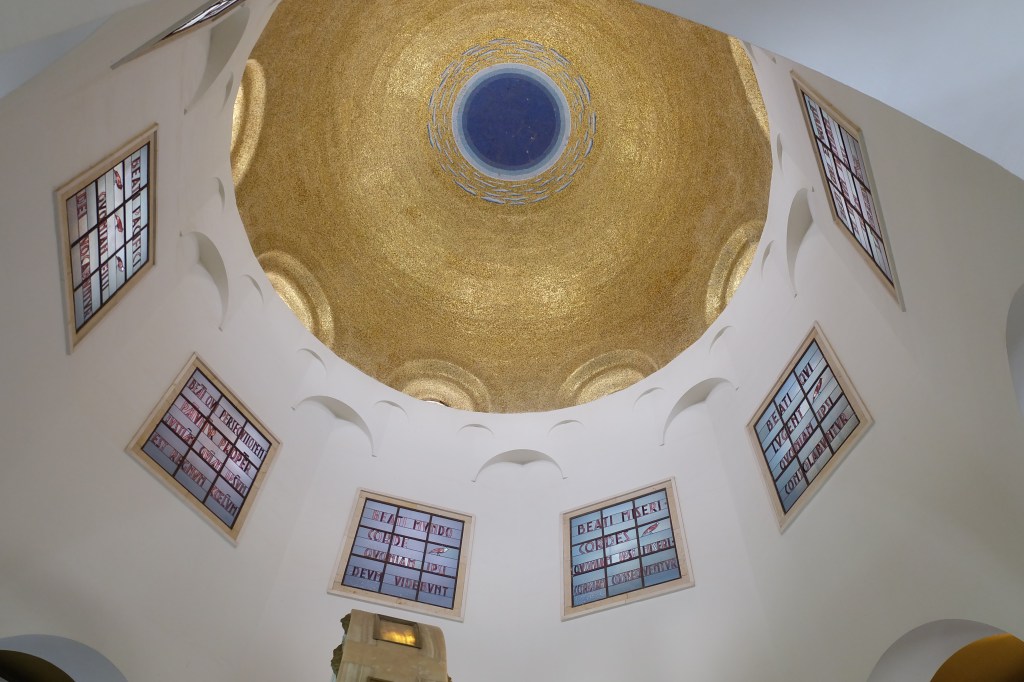
Photo by author, Church of the Beatitudes, Israel, 2019.
“Blessed are the poor in spirit, for theirs is the kingdom of heaven. Blessed are they who mourn, for they will be comforted. Blessed are the meek, for they will inherit the land. Blessed are they who hunger and thirst for righteousness, for they will be satisfied. Blessed are the merciful, for they will be shown mercy. Blessed are the clean of heart, for they will see God. Blessed are the peacemakers, for they will be called children of God. Blessed are they who are persecuted for the sake of righteousness, for theirs is the kingdom of heaven. Blessed are you when they insult and persecute you and utter every kind of evil against you falsely because of me. Rejoice and be glad, for your reward will be great in heaven.”
Matthew 5:3-12
After going around the shores of Galilee, preaching and healing the people, Jesus went up a mountain upon seeing crowds were following him. They were mostly poor people with deep faith in God, hoping and trusting only in him for their deliverance called the anawims.
They were in painful and difficult situations, maybe like many of us, fed up with the traffic and rising costs of everything, fed up with the corruption among public officials and most of all, disillusioned with our priests and bishops!
Then, Jesus called them blessed.
Now, please consider that it is more understandable and normal to say that after being persecuted or after losing a loved one, after all these sufferings that people would be blessed, that the kingdom of God would be theirs.
But, that is not the case with the beatitudes whereby Jesus called them already blessed now, right in their state of being poor, being persecuted, being maligned!
Keep in mind that Matthew’s audience were his fellow Jewish converts to Christianity. By situating Jesus on the mountain preaching his first major discourse, Matthew was reminding his fellow Jewish converts of their great lawgiver, Moses who stood on Mount Sinai to give them the Ten Commandments from God.
However, in the sermon on the mount, Matthew was presenting Jesus not just as the new Moses but in fact more than Moses because Jesus himself is the Law. His very person is what we follow that is why we are called Christians and our faith is properly called Christianity so unlike other religions that are like philosophies or any other -ism.
To understand the beatitudes, one has to turn and enter into Jesus Christ for he is the one truly poor in spirit, meek, hungry and thirsty, merciful, clean of heart, who was persecuted, died but rose again and now seated at the righthand of the Father in heaven. Essentially, the Beatitudes personify Jesus Christ himself. Those who share what he had gone through while here on earth, those who identify with him in his poverty and meekness, mercy and peace efforts, and suffering and death now share in his blessedness.
Therefore, the Beatitudes are paths to keeping our relationship with Jesus Christ who calls us to be like him – poor, hungry and thirsty, meek, clean of heart and persecuted. The Beatitudes are not on the moral plane like the Decalogue that tells us what to do and not to do. Have you ever used the Beatitudes as a guide in examining your conscience when going to Confessions? Never, because the Beatitudes are goals in life to be continuously pursued daily by Christ’s disciples.
Photo by author, Church of the Beatitudes, Israel, 2017.
The Beatitudes are more on the spiritual and mystical plane of our lives that when we try imitating Jesus in his being poor and merciful, meek and clean of heart, then we realize and experience blessedness as we learn the distinctions between joy and happiness, being fruitful and successful.
That is when we find fulfillment while still here on earth amid all the sufferings and trials we go through because in the beatitudes we have Jesus, a relationship we begin to keep and nurture who is also the Kingdom of God. Of course, we experience its fullness in the afterlife but nonetheless, we reap its rewards while here in this life.
As we have noted at the start, we must not take the beatitudes in their material aspect but always in the spiritual meaning. This we find in the first beatitude, Blessed are the poor in spirit, for theirs is the kingdom of heaven.
Actually, this first beatitude is the very essence of all eight other blessedness. Everything springs forth from being poor in spirit, of having that inner attitude and disposition of humility before God. We cannot be merciful and meek, nor pure of heart nor peacemakers unless we become first of all poor in spirit like Jesus, who, “though he was in the form of God, did not regard equality with God something to be grasped. Rather he emptied himself, taking the form of a slave, coming in human likeness and humbled himself” (Phil. 2:6-7, 8).
The prophet Zephaniah showed us in the first reading that poverty in the Old Testament does not only define a social status but more of one’s availability and openness to God with his gifts and calls to us to experience him and make him known. Experience had taught us so well that material poverty is one of life’s best teacher as it leads us to maturity and redemption best expressed in the Cross of Jesus Christ.
In this sense, the beatitude is also the “be-attitude” of every disciple who carries his cross in following Christ. See that each beatitude does not refer to a different person; every disciple of Jesus goes through each beatitude if he/she immerses himself/herself in Christ. That is why last week Jesus preached repentance which leads to conversion. Notice that the beatitudes of Christ are clearly opposite and contrary to the ways of the world as St. Paul tells us in the second reading with God calling the weak and lowly to manifest his power and glory.
Many times in life, we fail to recognize our blessedness when we are so focused with what we are going through, with our work and duties and obligations. This Sunday, Jesus takes us up on the mountain, in the celebration of the Holy Eucharist for us to see ourselves blessed and loved right in the midst of our simplicity and bareness, sufferings and pains. Stop for a while. Find Christ in all your troubles or darkness in life. If you do not find Jesus in your labors and burdens, you are just punishing yourself. If you find Christ because you see more the face of other persons that you become merciful, you work for peace, you mourn and bear all insults and persecution… then, you must be loving a lot. Therefore, you are blessed! Amen.
Have a blessed week ahead!
Photo by author, Church of the Beatitudes, Israel, 2017.
Quiet Storm by Fr. Nicanor F. Lalog II, 01 September 2022
Photo by author, Dominus Flevit Church overlooking Old Jerusalem, 2017.
Along with the vow of celibacy, the vow of poverty has become very contentious even among us priests these days which is very sad that one wonders why they got ordained in the first place if they were not totally sold out to being celibate and poor.
For most people especially Filipinos, how their priests practice poverty weighs more than their fidelity to celibacy, claiming they could understand and forgive priests getting into relationships with women than priests becoming “mukhang pera” (money-faced). For them, a priest falling in love with a woman is natural and therefore, understandable and “forgiveable”; but, a priest who worships money to the point of making his ministry a business endeavor even stealing from the church funds and donation boxes is what people detest most. In some parts of Bulacan and Cavite, they have a saying which is so vulgar to stress this point, “hindi bale madapa and pari sa puki kesa sa piso” (better for a priest to fall on a vagina than peso).
Photo by Ka Ruben, 24 June 2022.
Of course, it is always wrong to break any of these two important vows priests have made along with the third one which is obedience to his bishop because celibacy and poverty are closely related with each other for they both lead us priests to intimacy with God, our Caller. That is why, most often, when a priest has become “mukhang pera”, falling into the trap of money and luxuries, most likely he also has problems with celibacy. Even St. Ignatius had warned in his Spiritual Exercises that money is the first temptation the devil uses against every priest.
Like celibacy, poverty is a spiritual reality that is lived and felt by everyone in the material sense. More than being poor or having less in life, poverty is a choice we make for it to be real. It is our attitude with material things in life: there are priests with so much and yet still feel poor like in advanced countries where cars and appliances are very common and ordinary while there are those with almost nothing and yet so attached with the little they have or wish to have and possess! One priest may have a brand-new car extensively using it to reach and serve his parishioners while another may have a second-hand car or owner-type jeep he tinkers daily, possessing him in the process.
Poverty is not a question of how much do we have but more of the question of how much do we share. See that very often, we are preoccupied thinking what we already and must still have without ever thinking how much do we share.
It is in sharing when we truly experience poverty; a priest who hoards everything – even people like benefactors and friends – is a priest in trouble. Here we find the direct relationship of poverty and celibacy: we renounce marriage which is a wonderful kind of wealth in the spiritual sense for something higher and better which is to be solely for Jesus Christ. That is the essence of our poverty, our being poor and empty so that we are wholly for Christ alone and his Church. It is being poor, materially and spiritually do we find our true wealth as priests, Jesus Christ and his Church or “people of God” as Vatican II rightly called.
Like everyone else, no priest can have everything in life; nobody is perfect but it is always the truth that we evade, priests and lay alike. Many people including priests often convince themselves of being self-sufficient, that we are the greatest, the most powerful so that we never ran out of construction projects in the church. This is the mentality of the “dream-teams” or the “powerhouses” who claim to have everything and yet in reality, they rarely last long nor achieve much. When everybody feels like a “heavyweight” – literally and figuratively speaking, always throwing their weight around, soon enough, he/she would surely sink. The Greeks call it hubris, another common ailment among us priests.
Photo by author, Capernaum, Israel, May 2017.
In my 24 years in the ministry, I have found and experienced that the key in any community and organization including family, profession and vocation like the priesthood is not in having everything, materially and non-materially speaking like talents and abilities that always end up into a mere show, a “palabas” even if it may be spectacular. Life is not about dazzling others with our gifts and abilities but finding our limits and poverty. When we focus on what we do not have like our weaknesses and other limitations, our poverty becomes a wealth because that is when we are most creative and productive, achieving more in life. Why is it when we do not have much on the table that there is always a leftover with everyone feeling satisfied? But when there is a plethora of food, we just feel satiated, filled up but not satisfied?
Look at how many of our churches have become like birthday cakes that are so kitschy or baduy, tastelessly overdecorated looking like dirty old men (DOMs) and their counterparts, the matronix afflicted with hepatitis with all their gold trimmings. Many parishes are afflicted with a different virus more contagious than COVID without a vaccine where priests go “imeldific” in church decorations and renovations including liturgies that even the Blessed Virgin Mary is turned into a Miss Universe being “crowned” amid all pomp and pageantry. It is the virus of triumphalism with its ugly face of priests have too much of everything except God. The best priest, the holiest priest is often the poorest one, the one with less because that is when we have more of God. It is in poverty – and celibacy – we priests witness Christ’s lesson that “whoever saves his life loses it and whoever loses his life gains it” (Mk. 8:37-38).
The problem of the priesthood for me is among other things a problem of poverty. I know that not all priests are necessarily committed, by their priesthood, to absolute poverty. But for my own part it seems to me that the two are connected.
To be a priest means, at least in my particular case, to have nothing, desire nothing, and be nothing but to belong to Christ. Mihi vivere Christus est et mori lucrum. In order to have everything, desire to have nothing.
Thomas Merton, The Sign of Jonas, page 191.
Photo by Fr. Howard Tarrayo, August 2021.
Poverty is blessedness because in our weak and fragile humanity, God chose to be one with us so that we can share in his divinity and thereby share in his life. When we see each other’s wealth, the more we feel so poor and helpless; but when we see each other’s poverty, the more we see each one’s value. And we start enriching each one’s life. This is the beauty of our poverty as priests when being poor is not to be destitute but be available to God and everyone. No wonder, poverty is the first of all beatitudes taught by Christ, “Blessed are the poor in spirit for theirs is the kingdom of God” (Mt. 5:3).
When we try to have less and become poor, that is when we discover the value of life, of every person created in the image and likeness of God. Then, we begin to share and give, to sacrifice and let go, truly loving one another by being forgiving and merciful and kind like Jesus Christ, “who, though he is God, he did not deem equality with God something to be grasped at but rather emptied himself by being born in the likeness of men” (Phil.2:6-7).
Again, help us your priests live simple lives, to be poor so it would not be difficult for you to support us too. Thank you and God bless!
The Lord Is My Chef Daily Recipe for the Soul by Fr. Nicanor F. Lalog II
Thursday, Week VI, Year II in Ordinary Time, 17 February 2022
James 2:1-9   ><]]]]*> + ><]]]]*> + ><]]]]*>   Mark 8:27-33
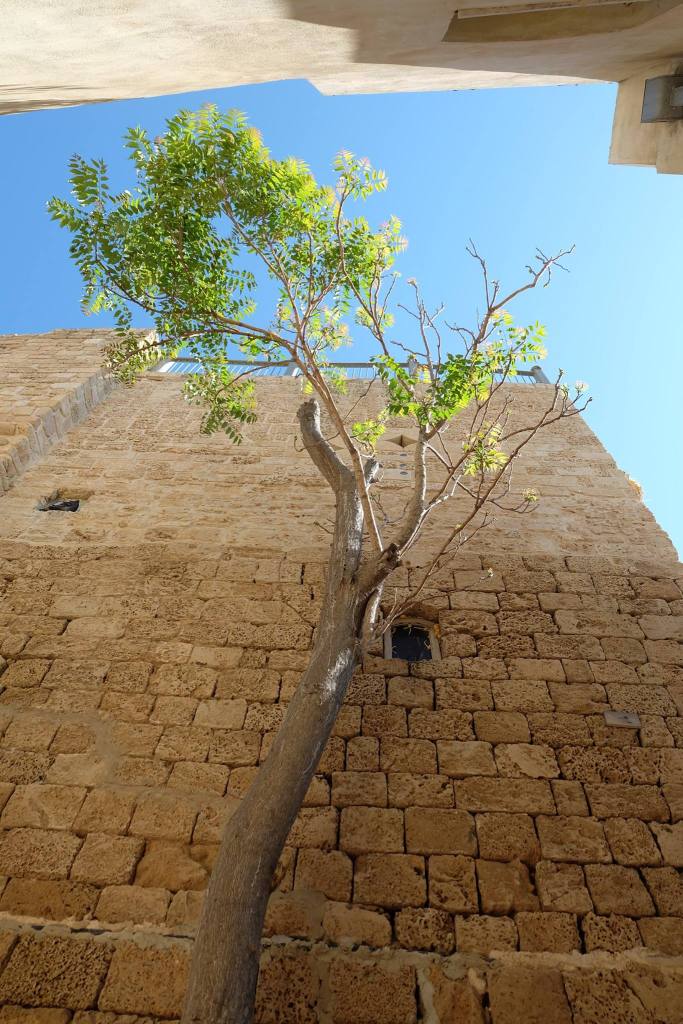
Photo by author at Jaffa, Israel 2017.
Your words today, Lord Jesus,
are disturbing, even shocking,
jolting us to our very core of
being because they are very
true, and happening among us.
Listen, my beloved brothers and sisters. Did not God choose those who are poor in the world to be rich in faith and heirs of the Kingdom that he promised to those who love him? but you dishonored the poor. Are not the rich oppressing you? And do they themselves not haul you off to court? Is it not they who blaspheme the noble name that was invoked over you?
James 2:5-7
Lord Jesus,
what is most disturbing
in James' letter is not his
indictment of the rich for
their greed and other sins;
what is very shocking is how
most of the people who have
shown partiality to the rich,
allowing them to oppress
the poor.
This sad reality continues
among us, dear Jesus when
we are shocked and refuse to
accept, when we prefer to be
blind than to see your true
person as a suffering Messiah,
when we insist in recognizing you
as a royalty of the world who must
be served and honored, not
realizing that true wealth is
being poor before God, trusting
only in him.  Amen.
The Lord Is My Chef Sunday Recipe for the Soul by Fr. Nicanor F. Lalog II
Thirteenth Sunday in Ordinary Time, Cycle B, 27 June 2021
Wisdom 1:13-15; 2:23-24 <+> 2 Corinthians 8:7, 9, 13-15 <+> Mark 5:21-24, 35-43
Photo by author, sunrise at the Lake of Galilee, the Holy Land, 2017.
Once again, we find Jesus crossing the Lake of Galilee this week with a crowd following him to listen to his teachings and experience his healing. What a beautiful image of life in Jesus, of constantly crossing the sea, sometimes in the darkness of the night amid storms.
It was something like what we had gone through last Thursday on the Solemnity of the Nativity of John the Baptist when as a nation we crossed history with the inauguration of the new Archbishop of Manila marked with the passing of former President Noynoy Aquino.
We hope and pray that like our gospel this Sunday, our recent crossing will lead us to new awakenings and realizations leading to national healing and yes, a resurrection, a rising from the dead like that young daughter of Jairus brought back to life by Jesus.
When they arrived at the house of the synagogue official, he caught sight of a commotion, people weeping and wailing loudly. So he went in and said to them, “Why this commotion and weeping? The child is not dead but asleep.” And they ridiculed him. Then he put them all out. He took along the child’s father and mother and those who were with him and entered the room where the child was. He took the child by the hand and said to her, Talitha koum, which means, “Little girl, I say to you, arise!” The girl, a child of twelve, arose immediately and walked around. At that they were utterly astounded.
Mark 5:38-42
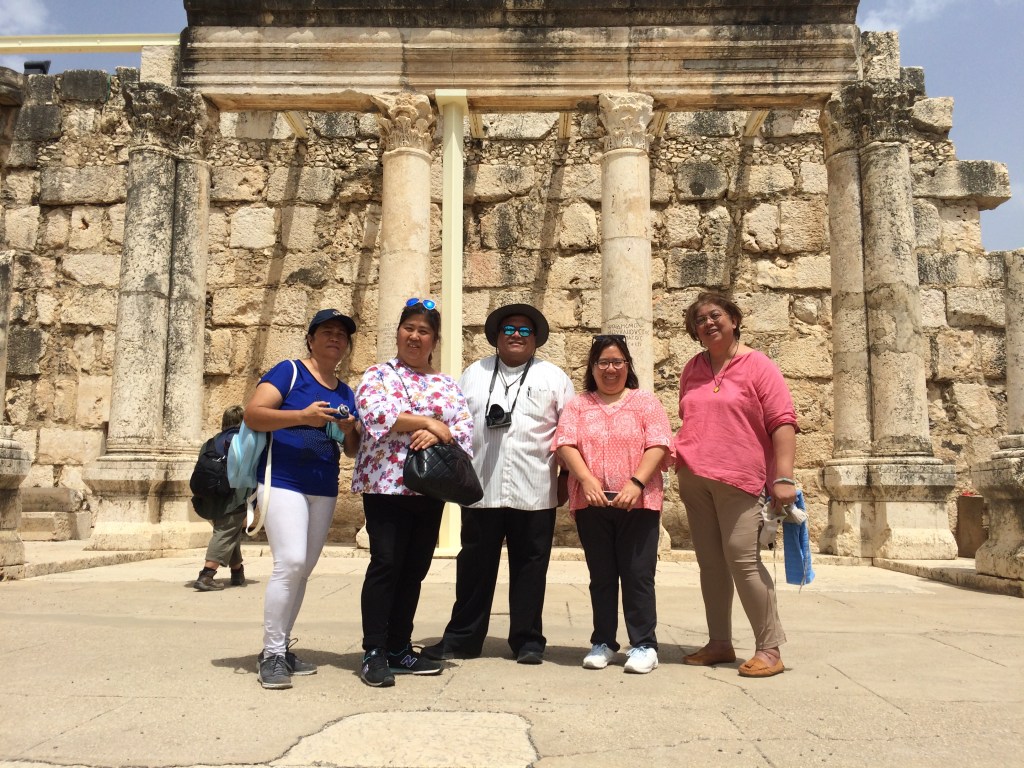
Photo by author with friends at ruins of the synagogue at Capernaum, 2017.
Examining our faith in Jesus
Notice, my dear reader, how similar is our story of Jesus raising to life the dead daughter of Jairus with that of the calming of the storm while crossing the lake last Sunday. In both instances, we find Mark “exaggerating” some details as if Jesus were somewhat oblivious to what was going on around him.
But again, Mark is not entertaining us with his stories narrating the powers and miracles by Jesus for he is telling us something deeper and very important with those surprising details of his stories. Primary of which is the supremacy of Jesus as the Son of God over nature like the sea and death both symbolizing evil and sin.
Mark affirms this truth today in telling us how Jesus brought back to life the dead daughter of Jairus, that Jesus is the Christ who had come launching a new world order where death and sin are overcome in him through his pasch.
Recall last Sunday how Mark ended his story with the disciples asking, “Who then is this whom even wind and sea obey?” (Mk.4:41).
That question is finally answered by our story today that clearly shows Jesus is the Christ, the Son of God who is life himself when he brought back to life the dead little girl.
Unfortunately, like during the time of Mark until now, many still doubt the powers of Jesus. Then and now, there is still that crisis of faith among us expressed by people from the synagogue official’s house who arrived and said, “Your daughter has died; why trouble the teacher any longer?”(Mk.5:35).
If you were in that crowd following Jesus, would you still go with him to enter the house? Would you heed his words like Jairus, “Do not be afraid; just have faith” (Mk.5:36)?
And while inside the house, knowing the little girl was already dead, would you join the rest in ridiculing Jesus who said, “The child is not dead but asleep” (Mk.5:39)?
These are the questions Mark is asking us today like the Christians of his time going through persecution and crisis in the early Church.
It is easy to “believe”, proclaiming with arms raised that Jesus is Lord, that Jesus is the Son of God but it is another thing to be truly convinced, to have faith in him when faced with the stark realities of life persistently attacked by sickness and death, of pains and sufferings that make us wonder why God could allow these to happen!
We have all felt our faith shaken when this pandemic struck us last year that took away those dearest to us so sudden, often without seeing them at all before they were cremated.
Like his story last Sunday, Mark’s narration of the raising to life of the daughter of Jairus is filled with many surprising details we find it so true with our own experiences of struggling to avoid or survive COVID-19, of having a sick child or spouse, of trying to make it to another day, of keeping our jobs to pay for food and rent and other needs of our family.
Do we really have that faith in Jesus, convinced that everything will be “okay” like Nightbirde who can brim with all smiles even if saddled with three kinds of cancer with a 2% chance of survival, claiming it is better than zero?
Today’s gospel is more than the revelation of who Jesus Christ is: the raising to life of the daughter of Jairus dares to invite us in examining our faith in God in the face of unrelenting attacks on life by sickness and death especially in this time of the pandemic.
Death and sickness are realities we face daily, that make us doubt God’s love and concern for us which the first reading clarifies with its declaration that
God did not make death, nor does he rejoice in the destruction of the living. For God formed man to be imperishable; the image of his own nature he made him. But by the envy of the devil, death entered the world, and they who belong to his company experience it.
Wisdom 1:13, 2:23-24
Photo by author, Lake of Galilee, 2019.
Arising and being whole in Jesus
Jesus came not to remove sickness and death, pains and sufferings which did not come from God for God is love. He came to be one with us in sickness and death, in our pains and sufferings so that we may rise with him too in his resurrection and be whole again in him.
Notice the words Jesus used in every healing, “your faith has saved you” to show that healing is not just a cure of the disease but making the person whole again. The words health, healing, wholeness, and holiness are all interrelated if we examine their origins and implications. Hence, we see that whenever Jesus would heal, it is not only an eradication of an illness but restoring harmony and balance in the person – physical, spiritual, mental, and emotional aspects.
It is the same in raising the dead young man in Nain and his friend Lazarus: Jesus or the evangelists used the word “arise” as a foreshadowing of Easter when Jesus himself rose from the dead, an indication of his power over death.
All these people in the gospels Jesus had healed and brought back to life eventually died but the good news is that death and sickness are no longer dark and an ending in itself.
Jesus came to bring salvation to the world, a wholeness in life which disease and physical death can no longer control and hold. That is why we need a firm faith to believe in him in spite of the many sickness and deaths now around us. It is faith that will enable us to grasp the full meaning of this pandemic and other sufferings we are going through in life. It is our deep faith in God that will also enable us to explain and show to others especially our loved ones the true meaning of healings and resurrections performed by Jesus who gives us a share in his victory over sickness and death.
May we dwell on the beautiful exposition of St. Paul today about being poor like Christ “that though he was rich, for your sake he became poor, so that by his poverty you might become rich” (2Cor. 8:9).
We can only be whole when we share whatever we have because that is when we allow Jesus to work in us, to be in us, to complete us. This happens when we wholeheartedly celebrate the Holy Eucharist where we become poor like Jesus, emptying ourselves of our sins, sharing with others our wealth through our contributions not only to the church collections but also to other charities where some of us share also time and talent aside from treasures.
The experience of the community pantry recently had taught us the value of St. Paul’s call for us to share and be poor like Christ when we were encouraged to take only what one needs and to give according to one’s ability – “kumuha ayon sa pangangailangan, magbigay ayon sa kakayahan”.
Yes, the realities of poverty and hunger remain with us but people are fed, sufferings are alleviated and most of all, the whole nation is united in believing again there is hope amidst the pandemic worsened by the systematic evil that has plagued us for so long.
Faith in God is deepened and strengthened when we become poor and weak like Jairus because that is only when we can arise and be whole again in Jesus Christ who is himself our Resurrection and Life. Amen.












 lordmychef.com