Lord My Chef Daily Recipe for the Soul, 09 July 2025
Wednesday in the Fourteenth Week of Ordinary Time, Year I
Genesis 41:55-57, 42:5-7, 17-24  <'[[[[>< + ><]]]]'>   Matthew 10:1-7
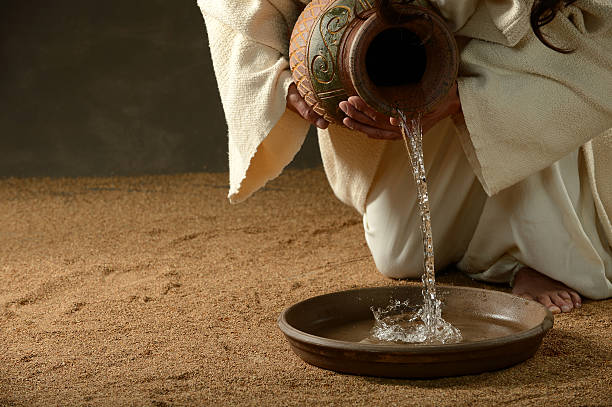
Photo by author, Sacred Heart Novitiate, Novaliches, QC, 20 March 2025.
Praise and glory
to you, most loving
God our Father
in making us so strong
beyond our knowing like
Joseph in the first reading
when he met after so many years
his brothers who have sold him
into Egypt; I could feel the strong
tensions within him,
of bursting into tears of
joy and sadness,
pain and healing when he
finally met again his
brothers who disowned him
and sold him ---
Of that lingering feeling
within him of being lost,
a lost one so sadly lost
not due to his but own brothers'
making.
When Joseph’s brothers came and knelt down before him with their faces to the ground, he recognized them as soon as he saw them. But Joseph concealed his own identity from them as soon as he saw them and spoke sternly to them. The brothers did not know, of course, that Joseph understood what they said, since he spoke with them through an interpreter. But turning away from them, he wept (Genesis 42:6-7, 23-24).
I pray dear Jesus
today for those many children
so lost these days after they
were given away by their
own mother or after their parents
have breakup in marriage;
fill their emptiness within
with your loving presence,
Lord, while making them
realize human love is always
imperfect like our relationships;
make them choose to become
better not bitter
despite their broken homes.

Most especially,
I pray for those lost in life -
those who have lost
their dreams,
their faith,
their belief in others;
help us find them,
Jesus and lead them
back to you.
Amen.

Fr. Nicanor F. Lalog II
Our Lady of Fatima University
Valenzuela City
Lord My Chef Daily Recipe, Fr. Nicanor F. Lalog II
Solemnity of Sacred Heart, 27 June 2025
Detalye ng painting ng Sacred Heart of Jesus sa Visitation Monastery, Marclaz, France mula sa godongphoto / Shutterstock.
Nag-senior citizen ako noong Marso at masasabi ko na sa tanang buhay ko, itong 2025 ang pinaka-mainit at maalinsangang taon sa lahat. Mula pa man noong dati, gabi lang ako gumagamit ng aircon ngunit mula nitong Abril, maghapon na ako kung mag-aircon sa silid. Kung minsan nga ay pati electric fan binubuksan ko kapag gabi sa labis na init ng panahon nitong nagdaang tag-araw.
Hindi lamang minsan ko narinig ang maraming nagsabing parang “impierno” ang summer 2025 dahil para sa atin, sukdulan ang apoy sa impierno kaya napaka-init.
Subalit ayon kay Dante Alighierri, isang batikang makata ng Italya noong unang panahon na sumulat ng Divine Comedy, ang kailaliman daw ng impierno ay hindi naman pagka-init-init dahil sa apoy kungdi pagkalamig-lamig parang yelo!
Ayon sa kanyang tula na nobela, ang pinaka-masaklap aniya sa lahat ng kasalanan at kasamaan magagawa ng tao ay ang manlamig ang puso. Magkaroon ng “cold heart” sa Ingles hanggang sa mawalan na ng puso ang mga tao gaya ng sinasaad sa isa pang English expression na “heartless world.”
Larawan mula sa forbes.com 2018, fashion week sa New York.
Ang mga katagang ito na cold heart at heartless world ay mas mainam na huwag nang isalin sa ating sariling wika sapagkat mas mananamnam at mailalarawan natin ang kahulugan sa wikang Ingles kesa sabihing malamig na puso o daigdig na walang puso. Kapag sinabing cold heart o malamig na puso, ito ay patay na puso, walang buhay parang bangkay. O bato. Kapag ang mga tao ay naging ganito, mismo ang daidig ay wala na ring puso, walang pagmamahal, walang awa, walang malasakit, walang pakialam.
Gayon ang kahulugan ng puso para sa sangkatauhan – hindi lamang ito sumasagisag sa pag-ibig at pagmamahal kungdi sa buhay. Sa malasakit, sa kabutihan, maging sa kaalaman gaya ng sinasaad ng English expression na “to know by heart” na ibig sabihin ay makabisado, matandaan.
At paano natin tinatandaan ang mga bagay-bagay? Ito ay ating inire-record na mula sa dalawang kataga ng wikang Latin, re (uliting muli) at cord na mula sa cor o puso. Alalaong-baga, ang tandaan, ang memoryahin at kabisaduhin ay isapusong muli sapagkat dito sa ating puso natatago ang lahat-lahat ng ating alaala at kaalaman maging pakiramdam gaya ng kutob na nagsasaad ng pakiramdam at kaalaman na di maipaliwanag ngunit totoo.
Higit sa lahat, dito sa ating puso nananahan ang Diyos sa atin gaya ng sinasaad ng dokumento ng Vatican II sa makabagong mundo (Gaudium Spes). Kaya ngayong Dakilang Kapistahan ng Kamahal-Mahalang Puso ni Jesus, pinapaala sa atin ng pagdiriwang ito ang hiwaga ng katotohanan ng pag-ibig ng Diyos sa lahat ng tao sa lahat ng panahon.
Hindi tayo nabibigo sa ating pag-asa, sapagkat ang pag-ibig ng Diyos ay ibinuhos sa ating mga puso sa pamamagitan ng Espiritu Santo na ipinagkaloob sa atin. Sapagkat noong tayo’y mahihina pa, namatay si Cristo sa takdang panahon para sa mga makasalanan. Mahirap mangyaring ialay ninuman ang kanyang buhayn alang-alang sa isang mabuting tao. Ngunit ipinadama sa atin ng Diyos ang kanyang pag-ibig sa atin nang mamatay si Cristo para sa atin noong tayo ay makasalanan pa (Roma 5:5-8).
Gayon na lamang ang pagmamahal ng Diyos sa atin – hindi masukat gaya ng pahayag ni Jesus kay Nicodemo dahil ito ibinubuhos hindi inuunti-unti, hindi tinitingi. Binubuhos. Palaging marami ang pag-ibig na kanyang binibigay sa atin sapagkat napakalaki ng kanyang puso ni Jesus.
Lahat tayo kasya sa kanyang napakalaking Puso kaya tayo man ay inaanyayahan ni Jesus na lumusong at maglublob sa kanyang puso kung saan ang kanyang pag-ibig ay naghahanap sa nawawala at naliligaw; pag-ibig na umuunawa at umiintindi sa naguguluhan at nalilito; pag-ibig na palaging bukas at tumatanggap sa sino mang ibig manahan, tumahan kung umiiyak sa lungkot at hapis.
Ito ang Puso ni Jesus na sinasaad ng larawan ng isang Mabuting Pastol gaya ng propesiya ni Ezekiel sa Unang Pagbasa at mismong kinukuwento ni Jesus sa kanyang talinghaga sa ebanghelyo ngayon.
Makakapasok lamang tayo sa Kamahal-Mahalang Puso ni Jesus kapag atin munang pinasok ating sariling puso kung saan mismo siya nananahan sa atin. Palagi nating sinasabi ang puso ang sentro ng ating katauhan at iyan ay totoo kasi nga doon din nananahan si Jesus.
Subalit dahil sa ating mga kasalanan, sa marami nating hilig at kagustuhan at sinusundang ibang diyus-diyosan, nawawala tayo sa puso ni Jesus dahil ang totoo, nawawala na rin ating puso. Ang pinaka-simpleng paliwanag ng kasalanan na aking ginagamit palagi ay ito: sin is a refusal to love.
Ang kasalanan ay pagtanggi na magmahal. Mula sa salitang ugat na sala na ibig sabihin ay sumala o magmintis o hindi magampanan dapat gampanan, ang kasalanan ay sumala sa iisang atas ni Jesus na magmahal. Sa tuwing hindi tayo nagmamahal, tayo ay nagkakasala. Kapag tayo ay nababad sa kasalanan, nagiging manhid tayo kaya di na tayo makaramdam ng iba at kapwa. ?Dito na manlalamig ang ating puso dahil tayo ay mahihiwalay na sa iba at kapwa, wala na tayong pakialam. Tayo ay napuputol at nag-iisa, hiwalay sa Diyos at kapwa, maging sa ating sariling katauhan kaya madalas ang mga makasalanan ay hindi makapagmahal kasi nga nawawala sa sarili.
At ganyan ang takbo ng daigdig ngayon, kanya-kanya, wala sa sarili tila baga bawat isa kaya lahat na lang dinaraan sa pera-pera. Ang lahat na lamang ay sinusukat, kinukuwenta, tinatantiya katulad ng algorithm sa social media kung saan nakukuha ang marami nating pattern sa buhay gaya ng mga hilig at gusto. Nagiging “commodity” na lamang ang tao ngayon, parang produkto at kasangkapan na ginagamit, binebenta at binibili.
Huwag nating hayaang magpatuloy na lamang ito na ang mundo ay manatiling materyal lamang – malamig at manhid, walang pakiramdam. Ibalik natin ang buhay, ang ating pagkatao na pakikibahagi sa buhay ng Diyos na nanahan dito sa ating puso. Gaya ng talinghaga ni Jesus, ang Diyos ay hindi isang observer na tagamasid o spectator na manonood lamang ng takbo ng ating buhay ng mga tao. Kaya sinugo ng Ama si Jesus sa atin sapagkat mula pa man noon ibig niyang makilahok sa buhay natin dangan lamang ay lagi natin siyang pinupuwera. Lalo ngayon sa makabagong panahon na pilit inaalis na ang Diyos sa buhay ng tao!
Larawan mula sa Pinterest.com.
Sa Sacred Heart ni Jesus, muling nabubuo ang tao sa kanyang sarili at ang sangkatauhan sapagkat ang pag-ibig niya ay pag-ibig na hinahanap ang mga sira at pira-piraso nating sarili upang makumpuni at mabuong muli. Ipinapaalala sa atin ng Kamahal-Mahalang Puso ni Jesus ang pag-ibig ng Diyos ay hindi isang ideya lamang o dalumat na nakalutang sa alapaap kungdi nakatapak sa lupa – isang pag-ibig na aktibo, marubdob at matalik na nakikipag-ugnayan gaya ng ating mga naranasan noong tayo ay gulung-gulo, litong-lito, nawawala at halos wala nang saysay ang buhay. Buhaying muli ating mga puso upang maranasan tunay na kagandahan ng buhay ng tao, hindi ng robot o makina. Ating dasalin palagi:
O Jesus na mayroong
maamo at mapagkumbabang Puso,
Gawin Mong ang puso nami'y
matulad sa Puso Mo!
Amen.
Lord My Chef Daily Recipe for the Soul by Fr. Nicanor F. Lalog II
Friday, Memorial of St. Anthony of Padua, Priest & Doctor of Church, 13 June 2025
2 Corinthians 4:7-15     <*((((><  +  ><))))*>     Matthew 5:27-32
Photo by author, 18 December 2018.
Your words today,
O Lord Jesus through
St. Paul are so refreshing,
so reassuring of our worth
and giftedness:
Brothers and sisters: We hold this treasure in earthen vessels, that the surpassing power may be of God and not from us. We are afflicted in every way, but not constrained; perplexed, but not driven to despair; persecuted, but not abandoned; struck down, but not destroyed; always carrying about in the Body the dying of Jesus, so that the life of Jesus may also be manifested in our body (2 Corinthians 4:7-10).
How lovely
are those words,
"we hold this treasure
in earthen vessels";
today as we come to close
the week, we are reminded to
think of the "treasures" we hold
dear most in our lives;
many times we forget the many
treasures within us or in our
very lives God has given us
or shown us that have kept us
still standing all these years,
weathering the many storms that
have come to batter us that eventually
made us more firm and strong,
most of all, fruitful; let us be mindful toda
of the many treasures you have
given us, Jesus.
Let us learn from our weaknesses
and failures, sins and mistakes
for life is always filled with many
struggles that serve not as
obstacles but opportunities
to become better
not bitter;
indeed,
life is difficult
as you have taught us
today in the gospel,
of the need to respect everyone
at all times and be faithful;
through the intercession of
St. Anthony of Padua who is invoked
for lost items,
help us find our treasures in you,
Jesus.
Amen.
The Lord Is My Chef Easter Recipe for the Soul by Fr. Nicanor F. Lalog II
Wednesday in the Second Week of Easter, 10 April 2024
Acts 5:17-26    ><}}}}*> + ><}}}}*> + ><}}}}*>     John 3:16-21
Photo by author, Sacred Heart Novitiate, Novaliches, QC, 20 March 2024.
When the captain of the temple guard and the chief priests heard this report, they were at a loss about them, as to what this would come to.
Acts 5:24
Your words, O Lord,
from the first reading are
very amusing:
after discovering the jail
securely locked
with guards stationed
outside but the apostles
nowhere,
they were the ones
who felt at a "loss";
they who have imprisoned
the Apostles
were the ones
LOST
when they were supposed
to control the situation.
How ironic
so often in life
when we feel to have
been more in control of
everything even people,
when we feel we lord
over everyone,
that is when we feel
more empty,
and more
at a loss.
And this is the verdict, that the light came into the world, but people preferred darkness to light, because their works were evil.
John 3:19
Photo by author, Jesuit Cemetery at the Sacred Heart Novitiate.
Forgive us,
Lord Jesus
in choosing darkness
of sin,
darkness of pride,
darkness of bitterness
and of unforgiving
that is why many times
we are at a loss
in life especially
when we profess
to believe in You,
when we claim to be
Your disciples;
let us go toward
Your light of truth
and justice,
Your light of loving
service,
Your light of mercy
and forgiveness
so that in our very selves,
people may truly experience
"God so loved the world."
Amen.
The Lord Is My Chef Easter Recipe by Fr. Nicanor F. Lalog II
Wednesday in the Easter Octave, 03 April 2024
Acts 3:1-10     <*[[[[>< + ><]]]]'>     Luke 24:13-35
Photo by author, Della Strada Chapel, Sacred Heart Novitiate, Novaliches, QC, 19 March 2024.
Continue to open my eyes,
my heart,
my total self
to Your coming,
to Your passing
Lord Jesus Christ;
Your tomb was empty
because You chose to walk
with me even when
I was at the wrong path,
in the opposite direction
like those two disciples
on the way back to Emmaus
from Jerusalem because You were
nowhere that Easter Sunday;
what a beautiful gesture by You,
dear Jesus,
to walk with them,
to converse with them,
most of all,
to make their hearts burn within!
With that their eyes were opened and they recognized him, but he vanished from their sight. Then they said to each other, “Were not our hearts burning within us while he spoke to us on the way and opened the Scriptures to us?” So they set out at once and returned to Jerusalem where they found gathered together the eleven and those with them…
Luke 24:31-33
Photo by author, Della Strada Chapel, Sacred Heart Novitiate, Novaliches, QC, 19 March 2024.
My dear Jesus,
many times I felt giving up
of going back to Emmaus too,
leaving Jerusalem
at those times I felt
You were gone;
but when You helped me
retrace my path
with Your words
and many signs,
my heart burned within
of love and faith in You
that before I knew it,
You have brought me back
to Your path again
with enough love
to move on;
keep me in Your path
to the Cross, Jesus;
let me immerse in
the Scripture to discover
in Your words
Your presence,
Your calling,
Your life
in my life
and relationships
with You,
with nature,
and with others.
Photo by author, Sacred Heart Novitiate, Novaliches, QC, 19 March 2024.
Keep that fire of love
burning within me, Jesus
so that I may bring Your light
and your warmth
to those seeking You,
 those lost in life,
and worst,
those resigned in their situations
like that man crippled from birth
at the Beautiful Gate of the temple:
When he saw Peter and John about to go into the temple, he asked for alms. But Peter looked intently at him, as did John, and said, “look at us.” He paid attention to them, expecting to receive something from them. Peter said, “I have neither silver nor gold, but what I do have I give you: in the name of Jesus Christ the Nazorean, rise and walk.”
Acts 3:3-6
There are times,
Jesus,
I look more into negative self,
my distaff condition,
my wounds
even if I am looking at You
like that crippled man
expecting the trivial things
than the essential ones
like fulfillment in You;
enable me to look for You
in my heart,
to see You in my self
and on the face
of others I meet.

Dearest Jesus,
keep the fire of Your love
burning inside me
so I may see You
and follow You
more closely
daily.
Amen.
Quiet Storm by Fr. Nicanor F. Lalog II, 17 April 2023
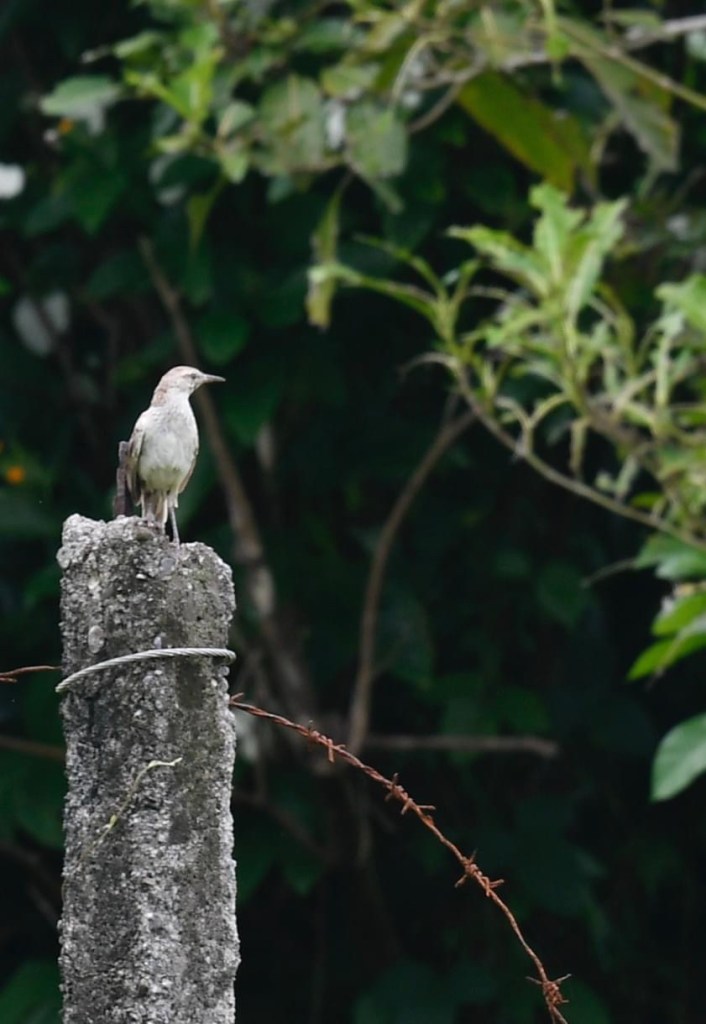
Photo by author, 08 February 2023, Taal Vista Hotel, Tagaytay City.
We all know
that feeling happening
more often lately
a foreboding of senility?
when we go like crazy
why can't we see suddenly
some things we have
held or kept momentarily
until we sound the alarm
and call everyone
to join in the search
but still nowhere to be found.
It could be the key
or the glasses or the phone
that in exasperation
we say begone
only to make us
forlorn figures
in our own home
or tiny room
but sometimes too soon
other times would take
too long, our lost
things are suddenly found!
Is it part of the riddle
of that black hole they call
when missing things
suddenly appear
without being sought
much less thought?
But here is the thrill:
when things even persons
are missing,
are we not the ones
who are lost
and waiting to be found?
More than the
naked shouts of eureka
is our profound joy
when missing things
even persons suddenly
appear because the truth
is, we were the ones lost
and could not be found
in our cluttered minds
and hearts shut and closed
by our fears and doubts,
anxieties and insecurities.
In this life
far wider than the world
where planes still go missing
amid modern technologies
and endless searching,
could it be that we are
missing our bearings
as beings, forgetting
God and others when we are
lost to our own beliefs or
locked in our small world
of lies and prejudice?
To find those missing
persons or things dear to us
it might help if we first lose
whatever is holding us
for the world is so wide
for anyone or anything
to just disappear
they surely must be here
awaiting for our hearts
to be clear until we hear
that sweet voice
giving us peace within.
On the evening of that first day of the week, when the doors were locked, where the disciples were, for fear of the Jews, Jesus came and stood in their midst and said to them, “Peace be with you.” When he had said this, he showed them his hands and his side. The disciples rejoiced when they saw the Lord.
The Lord Is My Chef Sunday Recipe for the Soul by Fr. Nicanor F. Lalog II
Divine Mercy Sunday in the Octave of Easter, 16 April 2023
Acts 2:42-47 ><}}}*> 1 Peter 1:3-9 ><}}}*> John 20:19-31
Photo by author, 08 February 2023.
The ultimate joy of Easter is God’s Divine Mercy, of how his Son Jesus Christ became human like us in everything except sin, searching and finding us to bring us back to the Father by dying on the Cross. Now he is risen, Jesus overflows us with his Divine Mercy right here, right now.
Unlike other religions, Christianity is so unique because it is about God looking for us humans by becoming like us so that we may become like him in Jesus Christ. In Christ, we have come to know and experience God as a person, relating with us in all tenderness and love because he himself had gone through all our pains and hurts, betrayals and disappointments, even death! Read the Bible and you shall see from the Old Testament to the New Testament, we find series of stories of God searching for man, beginning with Adam and Eve who hid after eating the forbidden fruit reaching its highest point in the coming of Jesus Christ who on this second Sunday in Easter came looking again for us represented by the disciples who have gone hiding in a locked room for fears of their leaders who have threatened to arrest them following reports of the empty tomb.
On the evening of that first day of the week, when the doors were locked, where the disciples were, for fear of the Jews, Jesus came and stood in their midst and said to them, “Peace be with you.” When he had said this, he showed them his hands and his side. The disciples rejoiced when they saw the Lord. Thomas, called Didymus, one of the Twelve, was not with them when Jesus came. So the other disciples said to him, “We have seen the Lord.” But he said to them, “Unless I see the mark of the nails in his hands and put my finger into the nailmarks and put my hand into his side, I will not believe.” Now a week later his disciples were again inside and Thomas was with them. Jesus came, although the doors were locked, and stood in their midst and said, “Peace be with you.” Then he said to Thomas, “Put your finger here and see my hands, and bring your hand into my side, and do not be unbelieving, but believe.” Thomas answered and said to him, “My Lord and my God!”
John 20:19-20, 24-28
“The Incredulity of St. Thomas”, painting by Caravaggio (1601-02) from commons.wikimedia.org.
“The disciples rejoiced when they saw the Lord.” But we wonder, what kind of rejoicing was it? It must have been more than the rejoicing of passing the Bar or any board exam. There was something else in their rejoicing if we try to imagine being there on that Sunday evening of the third day.
What do I mean? Have you ever felt being the one actually lost when some friends or loved ones as well valuable things have gone “missing”?
That feeling of being the one actually lost because the “missing” persons and things have never left us entirely but just there waiting to be found and rediscovered like when things get hidden underneath the car seat or misplaced somewhere else and forgotten. Once “found” again, there is that deep sense of joy coupled with a sense of wonder and astonishment because the truth is, it was not us who have found the lost person or thing but they were the ones who actually found us too! Here is a case more profound than the “eureka” experience for we were the ones who were lost and finally found again.
And that’s the rejoicing of the disciples in seeing Jesus again that evening of Easter Sunday! They were the ones who were actually lost and found by Jesus!
Just like us today in many instances in life when we have been running away from God, locking ourselves inside our very selves because of fears, insecurities and false securities, pride and sinfulness, as well as doubts and incredulity, unbelief and disbelief in God and in one another. Like Thomas, many times we have been so unreasonable in our demands for proofs of God and everything, insisting that “to see is to believe” without realizing that it is when we believe that we actually see.
Recall during the ministry of Jesus in Galilee how he kept telling his disciples to search for the “lost sheep” of Israel first and later everyone who have sinned and been away from God. That was Divine Mercy in action. Consider these other concrete expressions of Divine Mercy by Jesus:
At the Last Supper, John told us that Jesus “loved his own in the world and he loved them to the end” (Jn.13:1); this he proved by washing the feet of the Twelve! He further proved his love the following Good Friday by dying on the Cross and immediately at Easter, to prove his love again, he looked for Mary Magdalene to break the news of his resurrection to his disciples.
Jesus is the one who finds us unaware of his presence like on this second Sunday after Easter when he appeared to Thomas who was so shocked and surprised that all he could tell Jesus was “my Lord and my God”! I doubt if ever had the chance to examine the Lord’s wounds at all!
Next Sunday we shall hear in the gospel how it is always Jesus who searches and finds us when we least expect him like in the opposite directions in life when he walked with the two disciples to Emmaus Easter evening, only to be recognized by them at his breaking of bread.
Last Friday we have heard in the gospel how Jesus again for the third time appeared after finding them in a fruitless night of fishing in Lake Tiberias by telling them to cast their net to the right side of the boat; their nets almost teared with the bountiful catch of fish!
“The Road to Emmaus” painting by American Daniel Bonnell from fineartamerica.com.
In life, it is always Jesus who searches and finds us. We are the ones always getting lost. Many times in life we cry, asking where is God but the fact is he never leaves us, he is always with us, coming to us everyday, especially on Sundays in the Holy Mass where Jesus leads our celebrations.
On Tuesday, I will celebrate my 25th year of ordination to the priesthood. How I got ordained was a long story of getting lost for nine years when I was sent out of the high school seminary after graduation in 1982. I went to college in UST and finished AB Journalism in 1986, working as a writer then a reporter for GMA Channel 7 News until 1991 when I gave my vocation a second chance by entering the seminary again.
All those years from 1982 to 1991, I felt lost and empty despite a promising career with good pay and all the perks that went with it and a sense of security but, deep inside me was a big hole of being incomplete. That was how I went back to God in prayers, then slowly to the Mass and Confessions, and the more I moved closer to God, the more I felt empty yet eager for him that I finally consulted some priests. After a few years of discernment, I decided to leave everything and started anew in God in the seminary in 1991.
It was not easy going back to the seminary but God had such wonderful ways of finding me, even at the nick of time, to save my vocation. My turning point happened during our Ignatian retreat of 30 days when I finally committed myself to God as I felt his love and presence so irresistible, even himself so true. In 1998 with six other classmates, we were ordained priests at the Malolos Cathedral. Again, it was not an easy 25 years with so many times I often felt lost and empty mostly by my own making when I sin. But like before, Jesus in his Divine Mercy has always been the One searching and finding me even in the opposite directions when I hid amid rejections, failures, fears, sadness and weeping.
Like the early Christians in our first reading, I have found God most present in those 25 years as a priest and as an individual in the communal celebrations of the Holy Eucharist, aka, the breaking of bread as I realized too that priestly celibacy is lived in a community not only of priests but with you the laity.
With the responsorial psalm this Sunday as our prayer, “let us give thanks to the Lord for he is good, his love is everlasting” because as Peter tells us in the second reading, God our Father “in his great mercy gave us a new birth to a living hope through the resurrection of Jesus Christ from the dead” (1 Pt. 1:3). Let us rejoice in him who finds us always when we are lost. Amen. Have a blessed week ahead. Say a prayer for me this Tuesday. Thank you.
Prayer I have composed after our 30-day retreat in 1995 that until now, I still pray because it is so personally true. That is Divine Mercy for me. And hope with you too!
It was a Monday morning when rains started falling as I was about to complete my first round of walks when I saw an old lady with a cane tripped on the inclined pavement. I ran to help her but in her frantic efforts to rise, she had dragged down her caregiver too.
Upon reaching the old lady, I asked her to keep herself down and take deep breaths while I checked her for possible injuries. Thank God there was none except a broken cane and perhaps a bruised amor propio as tears were rolling from her eyes while telling me, “nakakahiya naman sa inyo, Father.” I told her not to worry as I invited her to have a seat near our gate but, she seemed so embarrassed and left.
When I resumed my walking in the rains, the scene kept flashing in my mind and had me musing…
When we fall,
when we are down,
just be still
to feel the earth beneath
then roll your eyes to see
the skies above everything
between.
When we fall,
when we are down,
do not rush to rise up
do not be ashamed
you slipped
or tripped
there is no trick.
When we fall,
when we are down,
it is better to cry
to shed some tears
surely there are pains
and aches deep within
we have not yet seen.
When we fall,
when we are down,
people standing on ground
would always offer a hand
to help us stand
shake off dirt from us
even clean our hands.
When we fall,
when we are down,
everyone will understand that
no one, nothing remains up
all must go down;
it is time for us to be calm
Jesus is coming, our Good Samaritan.
The Lord Is My Chef Sunday Recipe for the Soul by Fr. Nicanor F. Lalog II
Twenty-Fourth Sunday in Ordinary Time, Cycle-C, 11 September 2022
Exodus 32:7-11, 13-14 ><}}}}*> 1 Timothy 1:12-17 ><}}}}*> Luke 15:1-10
Photo by author, 2018.
Last Wednesday morning during breakfast, we heard on television news the interview of the undersecretary of agriculture blaming our farmers for the recent oversupply of garlic in Batanes and cabbage in Benguet, saying “they plant crops but they don’t think about the market for their harvests.”
We have been so used to such comments by many heartless government officials ever since; and, they also happen everywhere like in our schools where teachers blame students, at homes with parents blaming children and siblings blaming one another and of course, not to be left out is our church where priests always blame people for whatever problems and mishaps that happen in the parish.
No wonder, we feel more comfortable with God depicted in the Old Testament like in our first reading today when God was so angry and instructed to immediately get down from the mountain to punish the people who have created a golden calf to worship.
We find it so difficult to fully and truly accept despite Christ’s words and assurances that God our Father finds joy in forgiving as depicted today in our gospel. So often, we are like the Pharisees and scribes who could not understand why we have to share in the joy of God when a sinner repents.
Tax collectors and sinners were all drawing near to listen to Jesus, but the Pharisees and scribes began to complain, saying, “This man welcomes sinners and eats with them. So to them he addressed this parable.
Luke 15:1-3
Photo by author, 2018.
Jesus reminded us these past two Sundays of the demands of discipleship, of the need for us to conform to his very person and not just with morality and even religiosity. Discipleship is being like Jesus, always having him as our top priority in life.
This progression of Christ’s teaching on discipleship reaches its peak as we move into the 15th chapter of Luke’s gospel account considered as the “heart” of the Gospel in presenting to us three parables showing God full of mercy and forgiveness for sinners. Actually, it does not merely present God as forgiving but in fact as the One who finds joy in forgiving, who is inviting us to share in his joy of forgiving repentant sinners.
There are three parables in Luke chapter 15: the lost sheep, the lost coin and the lost son known as prodigal son. We have opted to consider the shorter form of the gospel which skips the third parable which we have already reflected in the recent Season of Lent.
Photo by Dr. Mylene A. Santos, MD, in Quezon, July 2022.
The first two parables deal with things that are lost, a lamb and a coin; both deal with only one person like “one of you” and “a woman”. On surface, the two parables seem very ordinary but Jesus – and Luke – have a very captivating manner of narrating them, similarly ending each parable with great sense of rejoicing after finding the lost sheep and lost coin.
Simply put, Jesus is appealing to our common experience of how one lost item would surely claim our attention, no matter how small or even insignificant it may be compared with the rest of what we have.
How do you feel when after losing something you were so worried and disturbed searching for it then someone tells you, “para yun lang?”
We feel so mad, like being rubbed with salt on our wounds because such comment “para yun lang?” betrays their lack of concern and love for us, of not knowing at all or at least recognizing how much that missing thing means to us!
How much more with persons like family and friends who have gone wayward in life like the prodigal son and suddenly coming back to us, saying sorry, trying to pick up the broken pieces of our lives to be whole again as friends and family? Would we not also rejoice when they come home, when we finally find them again?
Photo by Dr. Mylene A. Santos, MD, 2020.
In narrating the two parables in such manner so common with us, Jesus now affirms the incomparable value of every repentant sinner. Moreover, Jesus is showing us in these parables the more deeper ties we have with each other that we must rejoice when a sinner is converted. Hence, the demand too on the part of the sinner, of everyone, to recognize our sinfulness first.
Notice how Luke began this new chapter by telling us how “Tax collectors and sinners were all drawing near to listen to Jesus, but the Pharisees and scribes began to complain, saying, ‘This man welcomes sinners and eats with them.’ So to them he addressed this parable.”
Look at the attitudes of the Pharisees and scribes that are not just snobbish but recriminating against the tax collectors and sinners; for them, those kind of people were hopeless, improbable to change that no one should be socializing with them like Jesus.
But, what really got to their nerves that they were complaining why Jesus was sharing meals with them was the fact that tax collectors and sinners were not turning to the Law but to Jesus himself, following him, and even preferring him more than everything! They felt left out when in fact they were the first to separate themselves from everyone.
That’s what they could not accept, that they were no longer relevant.
And the main stumbling block to that was their lost their sense of sinfulness as they have believed so much with themselves as if they were like God, so pure and so clean. Due to their lost sense of sinfulness, they have been totally detached from God and from others as well because they were playing gods, setting them apart from everyone even from God himself because they believed they were sinless. In that sense, they felt God had nothing to do with them because they were sufficient in themselves.
There is nothing God cannot forgive.
This is the grace of this 24th Sunday in Ordinary Time.
Whenever we admit and confess our sins to him,
it is God who is first of all filled with so much joy
 for he has long been searching
and waiting for us to return to him.
Photo by author, 2019.
This is the problem we have in this modern time, when we have all kinds of excuses and alibis, reasons and arguments in doing just everything, losing our sense of sin that unconsciously, we feel like God, in fact always playing God when we presume to know everything that we would neither rejoice when people change for the better nor sympathize with those suffering and in misery. Like the Pharisees and scribes and those heartless people in power and authority in government and schools, at home and in the church, they have no time to even see and review why and what have caused people to sin.
In the first reading, Moses is teaching us the attitude of a true disciple, of one who intercedes for the people by confessing the tender mercy and fidelity of God to his promises and to his people; Moses did not bargain with God to relent in punishing the people. Notice his language, his manner of praying to God, appealing to him as “Lord” filled with faith in God’s boundless mercy and forgiveness. We all know how in a twist of humor, it was Moses who was so furious later when he saw the people worshipping the golden calf that he threw on them the two tablets of stone of God’s Ten Commandments.
In the second reading, St. Paul reminds us through Timothy of God’s boundless love expressed in his mercy and forgiveness to us all sinners. We can never experience this unless we first realize and admit and own our sinfulness like St. Paul who may be considered the worst of sinners for having persecuted the early Christians. There are so many other saints who followed after him with so dark and sinful pasts but became great men and women of faith because they first admitted their sins and sinfulness. As the saying goes, there is no saint without a sinful past and there is no sinner who is denied of a saintly future.
There is nothing God cannot forgive. This is the grace of this 24th Sunday in Ordinary Time. Whenever we admit and confess our sins to him, it is God who is first of all filled with so much joy for he has long been searching and waiting for us to return to him. Amen.
Have a blessed week ahead!
Photo by author, Mount Sinai at the Monastery of St. Catherine, Egypt, 2019.
The Lord Is My Chef Daily Recipe for the Soul by Fr. Nicanor F. Lalog II
Monday, Memorial of St. Anthony of Padua, Priest and Doctor of the Church, 13 June 2022
1 Kings 21:1-16   ><]]]]'> + ><]]]]'> + ><]]]]'>   Matthew 5:38-42
The Church of St. Anthony called Igreja de Santo António de Lisboa built at the site of his birthplace in Lisbon, Portugal. Photo by Mr. Jilson Tio taken in his 2018 pilgrimage.
Today as we celebrate the
Memorial of your beloved Saint
Anthony of Padua famous for
interceding in the recovery of
things lost, we pray to you O God
our loving Father also for the recovery
of something so precious becoming
so rare these days - decency and honor,
love and kindness, respect and justice.
Through the intercession of St. Anthony,
Lord, please help us recover our
"lost humanity" so vividly exposed
last week in that viral video of an
SUV hitting and running over a traffic
aide in Mandaluyong City.
How sad, even tragic, dear God
in this modern time of too much
sophistication in science and technology,
we have lagged behind in our humanity;
aside from the war at Ukraine, how could
violent shootings continue in the States
at the loss of so many children?
What is so tragic is how politicians there
talk about protecting children when the
same politicians push so hard for abortions,
in killing the most innocent persons of all!
Have we become like Jezebel, the pagan wife
and queen of Ahab who have no regard at all
for humans, creating fake news and gossips
against people, promoting corruption among
people for material gains?
So she wrote letters in Ahab’s name and, having sealed them with his seal, sent them to the elders and to the nobles who lived in the same city with Naboth. This is what she wrote in the letters: “Proclaim a fast and set Naboth at the head of the people. Next, get two scoundrels to face him and accuse him of having cursed God and the king. Then take him out and stone him to death.” On hearing Naboth was dead, Ahab started off on his way down to the vineyard of Naboth the Jezreelite, to take possession of it.
1 Kings 21:8-10, 16
Your Son Jesus Christ
taught us the ways to recover our
lost humanity more than 2000 years
ago but until now, we have not recovered
it yet because of our refusal to let go
of our pride and attachment with wealth
and other things of the world.
Like St. Anthony, help us to let go of
our possessions and comforts, "to give
to the one who asks of us, and to not
turn our back on one who wants
to borrow" (Matthew 5:42).
St. Anthony of the World,
Pray for us!
The room where St. Anthony was born in the year 1195 preserved in the church built at the former site of their home in Lisbon, Portugal. Photo by Mr. Jilson Tio, 2018.
The Portuguese people have always referred to St. Anthony of Lisbon than of Padua where his body is buried in Italy; in 1982, St. John Paul II visited his birthplace, and told the crowd their native saint was not St. Anthony of Padua to which the crowd cheered. Then, the Pope said he is neither St. Anthony of Lisbon and the people fell silent. But when the great Pope said their native saint is St. Anthony of the World, they cheered loudly! (Anecdote and photo courtesy of Mr. Jilson Tio)
Praying at the birthplace of St. Anthony protected by iron grills. Photo by Mr. Jilson Tio, 2018.
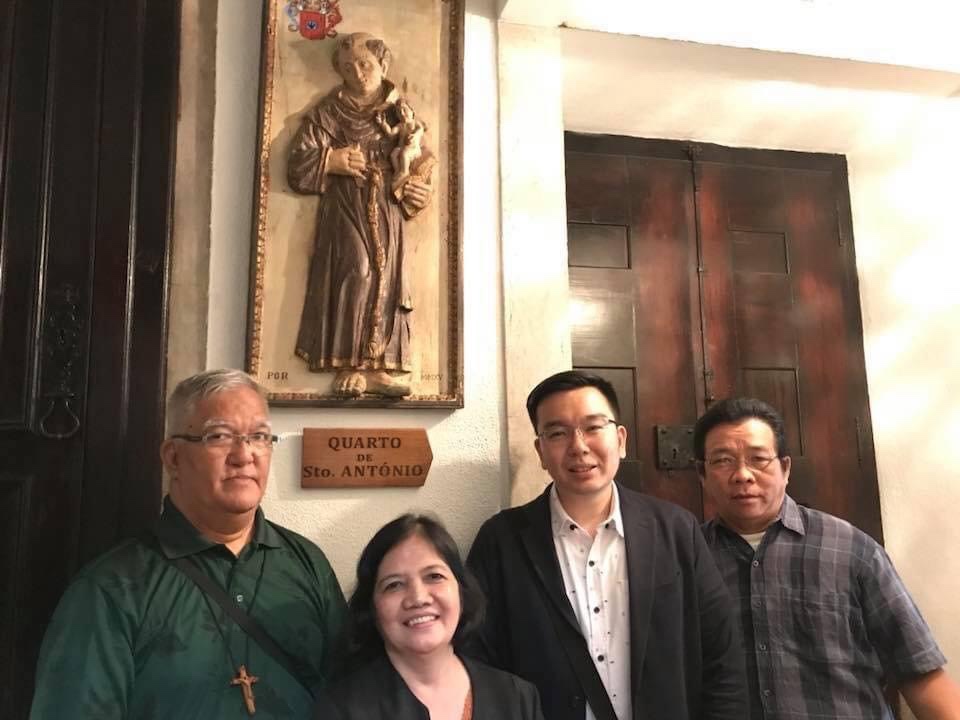
Mr. Jilson Tio (third from left) with fellow pilgrims outside the room where St. Anthony was born in Lisbon, Portugal in 2018.
















 lordmychef.com