Our hallowed hiddenness

Quiet Storm by Fr. Nicanor F. Lalog II, 31 October 2023

Whether you choose to celebrate Halloween in its truest sense which is the Christian and sacred celebration of All Saints or, the popular and pagan manner that is scary or spooky, November first reminds us always of things that are hidden and not seen.

What is really scary whenever November first approaches is the insistence of so many benighted souls including many Christians who highlight the erroneous pagan practice of dressing evil when halloween literally means “hallowed eve” or “holy evening” before the day set aside for all “holy souls” already in heaven we call “saints”. Any soul who enters heaven is considered a “saint”, that is, holy even if not recognized or canonized by the Church.

Remember the old Our Father translation when we used to say “Hallowed be thy name”? That’s it! Hallowed is the old English for holy. Where people got that idea of halloween as evil is clearly from the devil! And part of that sinister ploy by the devil in making evil funny and acceptable – and visible – is happening in the social media where everything must be seen, shown and exposed. Notice the expression “as seen on TV” to sell and market products while Facebook users brag their rule of thumb “show pictures or it never happened”.

Not everything can be seen and must be seen and shown. Recall how Genesis portrayed Adam and Eve hiding in shame, covering themselves with leaves after eating the forbidden fruit but these days, which could be the second phase of the Fall, men and women are not ashamed at all of their sins and scandals that instead of hiding, they make known to everyone deeds better kept in private, saying words better kept unsaid. They have absolutized the truth, baring all in total disregard of persons’ dignity and unity of the community. We have lost decency because we have also lost our sense of hiddenness, of privacy through silence and stillness.

Photo by author, sunrise at the Pacific from Katmon Nature Sanctuary & Beach Resort in Infanta, Quezon, 04 March 2023.

Hiddenness is a sacred presence where each of us can be all by one’s self focused on God who is the root of our being and existence no matter how one may call Him.  St. John Paul II said in one of his writings that God created man first to be alone with Him.  And that is how it will be to each of us in the end: we die alone. With God.

We all have this gift of hiddenness within each one of us. This we experience in our desires to be still, to go to the mountains or anywhere for a retreat or introspection, for some “me” time to rediscover and find one’s self anew. 

Hiddenness is the passageway to the great gifts of silence and stillness that everyone needs to maintain balance in this highly competitive world filled with so much noise where everybody is talking, including cars and elevators.  Compounding the problem of noise within and outside us are the cameras everywhere that entertain us and safeguard our well-being. But, are we really safer these days with all the CCTV’s and Face ID’s we use?

From forbes.com.

Many times, we have actually stripped ourselves of the innate mystery of being human, of the beauty and gift of personhood that some have tried to reveal using the camera but failed because we are beyond seeing. We do not notice how the cameras actually rob us of respect when unconsciously we give ourselves away to the world with our photos and videos spreading far without our knowing. Worst, we have allowed the camera to invade our hiddenness without us realizing that its effects backfire to us as we rarely have the time to analyze the possible outcomes of our photos and videos that usually tend to show what is negative and bad than what is positive and good about us. Our fascination with cameras perfectly capture our Filipino term palabas that literally means “outward”, a mere show without substance inside (loob). As a result of these sounds and images saturating us daily, the more we have become confused and lost because we do not have our grounding or “bearing” found only in hiddenness.

“In our society we are inclined to avoid hiddenness. We want to be seen and acknowledged. We want to be useful to others and influence the course of events. But as we become visible and popular, we quickly grow dependent on people and their responses and easily lose touch with God, the true source of our being. Hiddenness is the place of purification. In hiddenness we find our true selves.”

Fr. Henri Nouwen
Photo by author, Anvaya Cove in Morong, Bataan, July 2023.

We need to regain our hallowed hiddenness if we wish to grow and mature truly as persons – emotionally, psychologically and spiritually.  With the phone and TV always around us even in the church, everybody and everything has become so ordinary and cheap. 

Regaining our hiddenness is learning to put our technology in its proper place to be grounded in God in silence, the one commodity that has become so scarce these days since the invention of the Sony Walkman more than 40 years ago that spawned all these gadgets all over us now.

Silence is the language of God which leads us to Him and to our true selves. Every communication by God is always preceded by silence, something we have refused to learn as the most basic requirement of every communication. No wonder, we quarrel a lot, ending up more confused than ever because we never listen to others in silence. We never dialogue but simply talk, talk, and talk.

Genesis tells us in the beginning when God created everything, there was silence before He said, “Let there be light” while the fourth gospel solemnly tells us, “In the beginning was the Word… And the Word became flesh” (Jn.1:1, 14). Both instances evoke the beauty and majesty of God in grand silence.

All books in the Old Testament especially those of Psalms and of Job teem with many instances of God in silence amid every sunrise and sunset, in the gentle breeze and vast skies and oceans. In the New Testament, all four evangelists reported nothing Jesus said and did in childhood until the age 30 except for his lost and finding in the temple when 12 years old; Jesus was totally silent all those “hidden years” of his life in preparation for his ministry that lasted only three years, accomplishing so much whereas we speak all our lives and still end up empty. Most of all, the evangelists tell us too how Jesus frequently invited his disciples to a deserted place to pray, be silent and rest to be in communion with God his Father.

Hiddenness is God’s mode of presence that cannot be captured nor described in human terms. That is why He is hidden. It is not that God is hiding from us but He is inviting us to be intimately close with Him to exclusively and personally experience Him, be filled with Him.

Photo by Ms. Jo Villafuerte in Atok, Benguet, 01 September 2019.

It was the same thing Jesus did on Easter, remaining hidden from the disciples. When he finally appeared to Mary Magdalene who tried to touch him, Jesus stopped her to signal to her and to us all of the new level of relating with the Risen Lord in hiddenness. In all Easter stories, we are told how the disciples fell silent whenever Jesus appeared to them. In Emmaus, after the breaking of bread, the two disciples finally recognized Jesus who immediately vanished too! Why? Because Jesus wanted his disciples including us today to follow him personally in his hiddenness to find him and ourselves too.

Appearances or images and noise in life are very fleeting. Very often, the most significant moments and insights we have in life are those that come from our long periods of silence, of prayers and soul-searching.

This November 1 and 2 as we remember all those who have left us in this world, let us keep its sacred origins:  All Saints Day for those souls already in heaven and All Souls’ Day for those who have departed but still being purified in the purgatory.  Both dates invite us to “hide” in prayers, in silent remembering to experience God and our departed loved ones in the most intimate and personal manner without the gadgets and things that numb us of their presence. Amen. Have a blessed All Saints’ and All Souls’ Days!

Every kind of people

The Lord Is My Chef Daily Recipe for the Soul by Fr. Nicanor F. Lalog II
Thursday, Feast of St. Matthew, Apostle, 21 September 2023
Ephesians 4:1-7, 11-13   ><}}}}*> + ><}}}}*> + ><}}}}*>   Matthew 9:9-13
Photo by Mr. Virgie Ongleo in Singapore, 2021.
God our loving Father,
on this feast of your Son's
Apostle St. Matthew who used
to be known as Levi, a tax collector,
I pray for all the men and women
who work hard to provide food,
shelter, and clothing for their
families; through St. Matthew,
Jesus Christ had shown us
you love so dearly every working
man and woman who toil and labor
under the most harsh conditions
trying to earn a living.

As Jesus passed by, he saw a man named Matthew sitting at the customs post. He said to him, “Follow me.” And he got up and followed him.

Matthew 9:9
St. John Chrysostom rightly
noticed how the gospels mentioned
the work of some Apostles called
by Jesus:  Peter, James and John were
fishing while Matthew was collecting
taxes; oh how perceptive were the eyes
and tongue of St. John Chrysostom!
Because fishing was seen as a lowly job
during that time while the taxman was 
the most despicable person for Jews
and yet, Jesus called them!
Lord Jesus,
grant your mercy and comfort,
consolation and help to all workers
so hard pressed in this life,
especially the forgotten who strive
to earn money decently like our
farmers and fishermen,
drivers and vendors,
maidservants and nannies
who working abroad
to care for other families as they
left their own families behind;
bless the cops and traffic enforcers,
our government workers
and officials who live in the darkness
of sin, trapped in the lures of wealth
and money; in calling St. Matthew,
Jesus showed us his daily passing
and calling of everyone of us,
people of all social classes while
they go about their ordinary,
daily work.
Grant us the strength
and courage, dear Jesus,
to be like St. Matthew 
to immediately rise up and
follow you, to leave everything
behind especially sin and evil,
to be detached and to finally
stop activities that are not
compatible in following
you, Lord; like St. Matthew,
may we "write" your gospel
with our very lives of holiness,
making known to everyone
your Divine Mercy.
Dearest Jesus,
open our hearts to 
intently listen to St. Matthew's
voice and message
so we may learn to
rise and stand
then follow you,
Lord, 
with determination.
Amen.

St. Matthew,
pray for us!

Holiness is caring

The Lord Is My Chef Daily Recipe for the Soul by Fr. Nicanor F. Lalog II
Friday in the Twenty-first Week of Ordinary Time, Year I, 01 September 2023
1 Thessalonians 4:1-8   <'[[[[>< + ><]]]]'>   Matthew 25:1-13
Photo by author, Anvaya Cove, Morong, Bataan, June 2023.
Thank you very much,
God our loving Father
for this brand new month
of September;
everybody is so happy
because it is the start
of the "-ber" months
leading to your Son's
birthday in December;
please, dear God,
forgive us for this
kind of thinking,
of being focused with
outside things, 
of everything "palabas"
with nothing inside, "paloob"
nothing substantial.
As we begin the month
of September which the
Holy Father has declared as
World Day of Prayer for the
Care of Creation,
may we heed the calls
of St. Paul to "conduct ourselves
to please you, God, and do so
even more" (1 Thess. 4:1)!
Yes, dear God,
you did not call us
to impurity but to holiness
(1 Thess. 4:7);
help us realize that holiness
is not being sinless but being
filled with your Spirit,
of finding you in every person
and in your creation so that
we care for them all!

Holiness is being caring,
holiness is being loving,
holiness is being wise,
always choosing You,
always choosing 
what is good.
Amen.

Prayer to be good

The Lord Is My Chef Daily Recipe for the Soul by Fr. Nicanor F. Lalog II
Monday in the Thirty-Second Week in Ordinary Time, Year II, 07 November 2022
Titus 1:1-9   ><000'> + ><000'> + ><000'>   Luke 17:1-6

Jesus said to his disciples, “Things that cause sin will inevitably occur, but woe to the one through whom they occur. Be on your guard!

Luke 17:1, 3
Praise and glory to you,
Lord Jesus Christ for this great Monday!
Thank you for reminding us how sin
will inevitably occur in this life,
in this imperfect world.
Bless us, dear Jesus,
to be always on guard;
guide us and keep us strong
with clear mind and conscience
to never allow ourselves to 
cause others to sin;
Like St. Paul reminding Titus today,
help us to be blameless before you
and others, "not arrogant, 
not irritable, not a drunkard, 
not aggressive, not greedy for sordid gain"
(Titus 1:7).
Help us, dear Jesus,
to be on guard by being good always
like being "hospitable, a lover of goodness,
temperate, just, holy, and self-controlled,
holding fast" (Titus 1:8) 
to your Gospel message of
love and mercy, 
kindness and justice.
Amen.

Poverty in priesthood

Quiet Storm by Fr. Nicanor F. Lalog II, 01 September 2022
Photo by author, Dominus Flevit Church overlooking Old Jerusalem, 2017.

Along with the vow of celibacy, the vow of poverty has become very contentious even among us priests these days which is very sad that one wonders why they got ordained in the first place if they were not totally sold out to being celibate and poor.

For most people especially Filipinos, how their priests practice poverty weighs more than their fidelity to celibacy, claiming they could understand and forgive priests getting into relationships with women than priests becoming “mukhang pera” (money-faced). For them, a priest falling in love with a woman is natural and therefore, understandable and “forgiveable”; but, a priest who worships money to the point of making his ministry a business endeavor even stealing from the church funds and donation boxes is what people detest most. In some parts of Bulacan and Cavite, they have a saying which is so vulgar to stress this point, “hindi bale madapa and pari sa puki kesa sa piso” (better for a priest to fall on a vagina than peso).

Photo by Ka Ruben, 24 June 2022.

Of course, it is always wrong to break any of these two important vows priests have made along with the third one which is obedience to his bishop because celibacy and poverty are closely related with each other for they both lead us priests to intimacy with God, our Caller. That is why, most often, when a priest has become “mukhang pera”, falling into the trap of money and luxuries, most likely he also has problems with celibacy. Even St. Ignatius had warned in his Spiritual Exercises that money is the first temptation the devil uses against every priest.

Like celibacy, poverty is a spiritual reality that is lived and felt by everyone in the material sense. More than being poor or having less in life, poverty is a choice we make for it to be real.  It is our attitude with material things in life: there are priests with so much and yet still feel poor like in advanced countries where cars and appliances are very common and ordinary while there are those with almost nothing and yet so attached with the little they have or wish to have and possess! One priest may have a brand-new car extensively using it to reach and serve his parishioners while another may have a second-hand car or owner-type jeep he tinkers daily, possessing him in the process. 

In our previous blog, we have mentioned that people should rejoice when their priest gives away their gifts because that means Father is not selfish, acting as the vessel or conduit of God’s graces and blessings to the poor and needy (https://lordmychef.com/2022/08/08/prayerful-requests-of-a-priest-to-parishioners/). 

Photo from inquirer.net, 2021.

Poverty is not a question of how much do we have but more of the question of how much do we share. See that very often, we are preoccupied thinking what we already and must still have without ever thinking how much do we share.

It is in sharing when we truly experience poverty; a priest who hoards everything – even people like benefactors and friends – is a priest in trouble. Here we find the direct relationship of poverty and celibacy: we renounce marriage which is a wonderful kind of wealth in the spiritual sense for something higher and better which is to be solely for Jesus Christ. That is the essence of our poverty, our being poor and empty so that we are wholly for Christ alone and his Church. It is being poor, materially and spiritually do we find our true wealth as priests, Jesus Christ and his Church or “people of God” as Vatican II rightly called.

Like everyone else, no priest can have everything in life; nobody is perfect but it is always the truth that we evade, priests and lay alike. Many people including priests often convince themselves of being self-sufficient, that we are the greatest, the most powerful so that we never ran out of construction projects in the church.  This is the mentality of the “dream-teams” or the “powerhouses” who claim to have everything and yet in reality, they rarely last long nor achieve much.  When everybody feels like a “heavyweight” – literally and figuratively speaking, always throwing their weight around, soon enough, he/she would surely sink. The Greeks call it hubris, another common ailment among us priests.

Photo by author, Capernaum, Israel, May 2017.

In my 24 years in the ministry, I have found and experienced that the key in any community and organization including family, profession and vocation like the priesthood is not in having everything, materially and non-materially speaking like talents and abilities that always end up into a mere show, a “palabas” even if it may be spectacular.  Life is not about dazzling others with our gifts and abilities but finding our limits and poverty. When we focus on what we do not have like our weaknesses and other limitations, our poverty becomes a wealth because that is when we are most creative and productive, achieving more in life.  Why is it when we do not have much on the table that there is always a leftover with everyone feeling satisfied? But when there is a plethora of food, we just feel satiated, filled up but not satisfied? 

Look at how many of our churches have become like birthday cakes that are so kitschy or baduy, tastelessly overdecorated looking like dirty old men (DOMs) and their counterparts, the matronix afflicted with hepatitis with all their gold trimmings. Many parishes are afflicted with a different virus more contagious than COVID without a vaccine where priests go “imeldific” in church decorations and renovations including liturgies that even the Blessed Virgin Mary is turned into a Miss Universe being “crowned” amid all pomp and pageantry. It is the virus of triumphalism with its ugly face of priests have too much of everything except God. The best priest, the holiest priest is often the poorest one, the one with less because that is when we have more of God. It is in poverty – and celibacy – we priests witness Christ’s lesson that “whoever saves his life loses it and whoever loses his life gains it” (Mk. 8:37-38). 

The problem of the priesthood for me is among other things a problem of poverty. I know that not all priests are necessarily committed, by their priesthood, to absolute poverty. But for my own part it seems to me that the two are connected.

To be a priest means, at least in my particular case, to have nothing, desire nothing, and be nothing but to belong to Christ. Mihi vivere Christus est et mori lucrum. In order to have everything, desire to have nothing.

Thomas Merton, The Sign of Jonas, page 191.
Photo by Fr. Howard Tarrayo, August 2021.

Poverty is blessedness because in our weak and fragile humanity, God chose to be one with us so that we can share in his divinity and thereby share in his life.  When we see each other’s wealth, the more we feel so poor and helpless; but when we see each other’s poverty, the more we see each one’s value. And we start enriching each one’s life.  This is the beauty of our poverty as priests when being poor is not to be destitute but be available to God and everyone. No wonder, poverty is the first of all beatitudes taught by Christ, “Blessed are the poor in spirit for theirs is the kingdom of God” (Mt. 5:3).

When we try to have less and become poor, that is when we discover the value of life, of every person created in the image and likeness of God. Then, we begin to share and give, to sacrifice and let go, truly loving one another by being forgiving and merciful and kind like Jesus Christ, “who, though he is God, he did not deem equality with God something to be grasped at but rather emptied himself by being born in the likeness of men” (Phil.2:6-7).

Again, help us your priests live simple lives, to be poor so it would not be difficult for you to support us too. Thank you and God bless! 

Seeking the face of the Lord

The Lord Is My Chef Daily Recipe by Fr. Nicanor F. Lalog II
Wednesday, Memorial of St. Maria Goretti, Virgin and Martyr, 06 July 2022
Hosea 10:1-3, 7-8, 12   ><]]]]'> + ><]]]]'> + ><]]]]'>   Matthew 10:1-7
Photo by Mr. Jay Javier, January 2020.
Today's responsorial psalm 
perfectly says our prayer, O God,
which is to "Seek the face 
of the Lord".
But, what is your face,
O Lord that we must seek?
Do you have a face like ours,
now covered with masks due to
pandemic?  The author of Genesis
claims you created us, O God,
in your image and likeness but
how can that be if you are spirit? 
Indeed, the beloved disciple of
Jesus was right:  "nobody has ever
seen God.  Yet, if we love one another,
God remains in us, and his love is 
brought to perfection in us" (1John 4:12). 

To seek your face, O Lord, is to be one
in you, one with you.
To seek your face, O Lord, is to be
intimate with you.
To seek your face, O Lord, is to be 
like you, holy and loving.
To seek your face, O Lord, is to be
pure and chaste in thoughts and
in deeds like St. Mary Goretti who
chose death than sin.
Forgive us, merciful Father,
in choosing to love wealth and power,
in becoming to look like money -
so "mukhang pera" as we would say
in Filipino for our hearts have become
false as we turned away from you in sin.
Thank you that despite our sins,
you continue to call us in Jesus Christ
to be his apostles, being sent out to
seek those who are lost; help us to always
seek your face, Lord, for in every ministry,
it is your face of mercy and love that we
must share with everyone.  Amen.

We are God’s servant first

The Lord Is My Chef Daily Recipe for the Soul by Fr. Nicanor F. Lalog II
Wednesday, Memorial of Sts. John Fisher and Thomas More, Martyrs, 22 June 2022
2 Kings 22:8-13, 23:1-3   ><}}}*> + ><}}}*> + ><}}}*>   Matthew 7:15-20 
Photo by Ms. Ria De Vera, 22 March 2020.
God our loving Father,
we thank you again for the
gift of two great martyrs today,
Saints John Fisher and
Thomas More who stood firm on
your side, offering their very
selves to die than conspire with
their king in allowing his divorce
and break from the Church.
Both Saints John Fisher and
Thomas More proved that we are
first of all your servants, and then
of the king or civil authorities.
They are both so relevant in these days
when people insist on separating 
politics and daily life from faith
and religion, in constricting the 
spiritual life as purely private and personal,
and worst, only on Sundays.
Like in the first reading today,
may we always pray and listen 
to your words O God found in the
sacred scriptures so that we may
never steer away from your path of
truth and righteousness.

The scribe Shaphan also informed the king that the priest Hilkiah had given him a book, and then read it aloud to the king. When the king had heard the contents of the book of the law, he tore his garments and issued this command to Hilkiah the priest, Ahikam, son of Shaphan, Achbor, son of Micaiah, the scribe of Shaphan, and the king’s servant Asaiah: “Go, consult the Lord for me, for the people, for all Judah, about the stipulations of this book that has been found, for the anger of the Lord has been set furiously ablaze against us, because our fathers did not obey the stipulations of this book, nor fulfill our written obligations.”

2 Kings 22:10-13
Help us find our way back
to you, Lord; do not let our
knowledge and technologies
blind our hearts and ideals,
most especially our relationship
with you which is the basis of
our relationships with one 
another. Amen.
St. John Fisher and
St. Thomas More,
Pray for us!

Grace and blessedness of leaving

The Lord Is My Chef Daily Recipe for the Soul by Fr. Nicanor F. Lalog II
Wednesday after the Ascension of the Lord, 01 June 2022
Acts 20:28-38     ><}}}}*> + <*{{{{><     John 17:11-19
Photo by author, Ubihan Island, Obando, Bulacan, 31 December 2021.
As we begin the first day of
the end of first half of the year,
your words today, O God, are full 
of wisdom worthy for us to keep 
about the blessedness and grace
of every leaving, of every departure;
how ironic when every leaving is
characterized with sadness because
of separation, your words today, O
Lord speak of lavish joy, of your desire
that our joy may be complete in you.
In the first reading, St. Paul is bidding
goodbye to the Ephesians on his way
to Rome for imprisonment and sure death;
there was so much grief among the 
people and yet, there is the pervading 
atmosphere of blessedness and grace.
First is the grace of the gift of person,
of St. Paul and ultimately, of Jesus Christ.

Dear God, may we be like St. Paul truly a
grace to everyone with his sincerity of
love and service, dedication to your
Son Jesus Christ and his gospel of salvation;
teach us to imitate St. Paul of being a
blessing ourselves to others as we make
people experience and feel your love 
and care, your concern and goodwill;
evidently, his concern up to the end is you,
O God and your people whom he warned
on guard against those who would come
after his departure in "perverting the truth", 
reminding them how he loved and 
"admonished them with tears" 
(Acts 20:30-31).
And of course, the greatest blessing
and grace of all who have "left" us
physically is your Son Jesus Christ.
How wonderful that at the Last Supper
before his arrest, he prayed for us
all his disciples he would leave behind.

Lifting up his eyes to heaven, Jesus prayed, saying: “Holy Father, keep them in your name that you have given me, so that they may be one just as we are one… Consecrate them in the truth. Your word is truth. As you sent me into the world, so I sent them into the world. And I consecrate myself for them, so that they also may be consecrated in truth.

John 17:11, 17-19
Thank you, dear Jesus, for the
gifts of being one like you and the
Father and being consecrated to
the truth - to you yourself!
To be consecrated is to be separated
from the rest in order to be holy for you,
O Lord for the sake of the people;
you alone, Lord Jesus, are the holy one
and thank you in immersing us into you,
making us like you, apart from others in
holiness but united with everyone in
loving service.
Let us not forget this tremendous
blessing and grace you have given
us before returning to the Father,
Lord Jesus.  Keep us one in you with
the Father in loving service of others.
Let us not forget this tremendous
challenge too as part of our mission
that we always leave your marks of 
holiness and truth with everyone 
we serve and meet.  Amen.

Easter is making our lives whole again in Christ

The Lord Is My Chef Daily Recipe for the Soul by Fr. Nicanor F. Lalog II
Thursday in the Second Week of Easter, 28 April 2022
Acts 5:27-33   ><))))*> + <*((((><   John 3:31-36
Photo by author, 20 April 2022.
Lord Jesus Christ,
in this season of Easter,
help me make my fragmented
life whole again in you.
So many times, I feel like 
the many members of the
Sanhedrin in the first reading
today demanding so many things
from myself that I fail to obey God;
grant me the courage like of Peter
and the Apostles who boldly declared,
"We must obey God rather than men"
(Acts 5:29). 
Like Nicodemus in the gospel,
I am still afraid to come to you
in broad daylight, still hiding in the
night because I am afraid of what
people would say and tell about me
in being faithful to you, in being one
with you.

Whoever believes in the Son has eternal life, but whoever disobeys the Son will not see life, but the wrath of God remains upon him.

John 3:36
To believe in you, dear Jesus,
is to enter into a relationship with
you at the center; to believe in you
is to live and abide in you, Lord.
And that is why our lives are fragmented:
we are so divided and broken because
we follow the world, not you; we are
easily tempted and enticed to the 
many lures of pleasures the world
offers that only leave us more empty,
and more lost.
This season of Easter,
help me go back to you, Lord,
in prayers and silence;
let me focus on you again.
Amen.

Holiness is in silence

Quiet Storm by Fr. Nicanor F. Lalog II
Holy Saturday, 16 April 2022
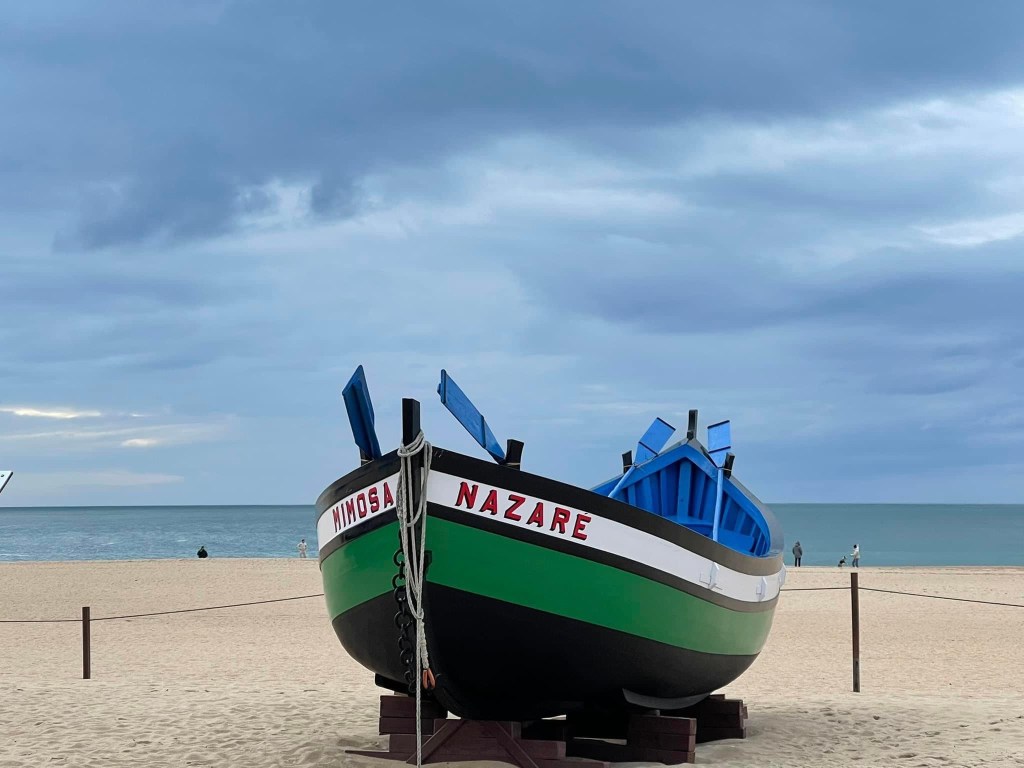
Photo by Dr. Mylene A. Santos, MD, at Nazare, Portugal March 2022.

A blessed Holy Saturday to you.  One of the most unforgettable scenes of COVID-19 pandemic when it started in the summer of 2020 was like what we have every Holy Saturday or, as we aptly call, Black Saturday: empty spaces, empty buildings, with everything and everyone so silent. 

Holiness is being at home with silence, the very language of God.  In the bible, we find that in every revelation and appearance of God to man, it is always preceded by silence.  Before everything was created, according to the Book of Genesis, there was great silence.  In his prologue to the fourth gospel, John said “In the beginning was the word” – clearly, there was only silence – “and the word became flesh” (Jn.1:1, 14)

And when Jesus, the Word who became flesh, came, he was totally silent during his growing up years in Nazareth and when he stared his ministry, he would always go into prayers and silence.

On this Holy Saturday, the whole creation comes to full circle. In the beginning, after completing God’s work of creation, God rested on the seventh day and made it holy (Gen.2:3). On the seventh day after completing his mission here on earth, Jesus Christ was laid to rest.

Photo by Dr. Mylene A. Santos, MD, at Lourdes, France, March 2022.

Silence and rest always go together. To be silent is not merely being quiet but listening more to your voice coming from the depths of our being; hence, it is not emptiness but fullness with God, in God. It is in silence where we truly hear ourselves and others better.

On the other hand, to rest is not merely to stop work nor stop from being busy. We rest to reconnect with God to be filled with the Holy Spirit. In Filipino, to rest is magpahinga which means “to be breathed on”.  To rest is therefore to be silent and be breathed on with the breath of God. Like in the creation of the first man who was breathed on by God to be alive; on the evening of Easter, Jesus came to visit his disciples locked in the upper room and after greeting them with peace twice, he breathed on them the Holy Spirit.

Holiness is therefore found in silence and in rest, when we listen more God and allow him to breathe on us that we are filled with him. And that is holiness as we have stated at the start of this series, which is not being sinless but being filled with God.

When we rest, we return to Eden, like the garden where Jesus was buried. 

Now in the place where he had been crucified there was a garden, and in the garden a new tomb, in which no one had yet been buried. So they laid Jesus there because of the Jewish preparation day; for the tomb was close by.

John 19:41-42
Photo by author, garden beside Church of St. Agnes in Jerusalem, May 2017.

How beautiful is that image, of God’s rest and silence in Eden and of Jesus laid to rest at a tomb in a garden: to rest in silence is therefore to stop playing God as we return to him as his image and likeness again!

Maybe that is why many of us these days are afraid of silence because it is the realm of trust and of truth. We have always been afraid to trust and be truthful so that we crucify Jesus Christ over and over again.

Let us be like those women who rested on the sabbath when Jesus was laid to rest. That like them, we may trust God more by being true to ourselves even in the midst of this ongoing COVID-19 pandemic.

The women who had come from Galilee with him followed behind, and when they had seen the tomb and the way in which his body was laid in it, they returned and prepared spices and perfumed oils. Then they rested on the sabbath according to the commandment.

Luke 23:55-56

Silence is the domain of trust; people afraid of silence are afraid to trust.

It is said that the Sony Walkman is the most revolutionary invention in the last 40 years that had changed our way of life.  It is not the computer.  It is the Walkman, the ancestor of that ubiquitous ear pods, earphones and bluetooth everybody is wearing these days, having each one’s own world, unmindful of others. 

Today let us cultivate anew the practice of silence, of listening to the various sounds around us and within us and most of all, trying to listen to the most faint, the softest sound that is often the voice of God, the sound of silence who reassures us always that in the midst of his silence, he never leaves us, that with him we are rising again to new life. 


Help us to be silent today, 
O God our Father 
as we remember your Son Jesus Christ’s 
Great Silence – Magnum Silentium – 
when he was “crucified, died and was buried; 
he descended to the dead and on the third day he rose again.”
Breathe on us your Spirit of life and joy,
O God as we rest in you,
listening to your voice within us
so that we may follow always Jesus Christ's
path to Easter in the Cross.
Amen.

Photo by Dr. Mylene A. Santos, MD, Lourdes, France, March 2022.