40 Shades of Lent by Fr. Nicanor F. Lalog II
Friday in the First Week of Lent, 27 February 2026
Ezekiel 18:21-28     + + +     Matthew 5:20-26
Photo by Dra. Mylene A. Abad Santos, MD, February 2021.
Thank you,
dear Father for the
first week of Lent about
to end; much is still to be
desired to be closer to you,
to be faithful to you,
to be one in you;
teach me in your Son Jesus
to go beyond the letters of
your laws,
to go beyond the minimum
requirements,
to go beyond of what is asked
of us in order to be more
loving to others in you:
Jesus said to his disciples: “I tell you, unless your righteousness surpasses that of the scribes and Pharisees, you will not enter into the Kingdom of heaven” (Matthew 5:20).
Photo by Dra. Mylene A. Abad Santos, MD, February 2021.
Teach us to be holy
or righteous
like you;
make us whole,
to be different
and be radical by
going back to you
our very roots of being
and existence;
instead taking the path
of supremacy especially
when we are angry
that we are unafraid of
breaking away from others,
insisting on what is right
than on what is good,
let us be reconciled
with you in others
and in our very selves
where peace remains
the best to have.
To go beyond
than what is required
is to be humble and gentle
like you, dear Jesus,
caring more for people
and relationships
than on being right
which often is not the case;
holiness
or righteousness
is confronting and accepting
our limitations
so that your infinite power
of love and mercy
may work in us
and through us,
Lord Jesus.
Photo by Dra. Mylene A. Abad Santos, MD, February 2021.
Lent is going beyond
the ordinary
because it is about
choosing you, Lord
above all else always:
you never condemn us
letting go and forgetting
of our past sins when we
choose to finally live in
your presence doing your will;
however,
let us not be complacent
in your presence, Lord
for our good record
can be undone completely
when we refuse to love
you in others.
O Lord Jesus,
you have given me
with so much chances
to become better;
help me to remain in you
so I can also give more
chances
more mercy
and more love
to others lost and trying
to find you.
Amen.
Lord My Chef Sunday Recipe for the Soul by Fr. Nicanor F. Lalog II
Sixth Sunday in Ordinary Time, Cycle A, 15 February 2026
Sirach 15:15-20 ><}}}}*> 1 Corinthians 2:6-10 ><}}}}*> Matthew 5:17-37
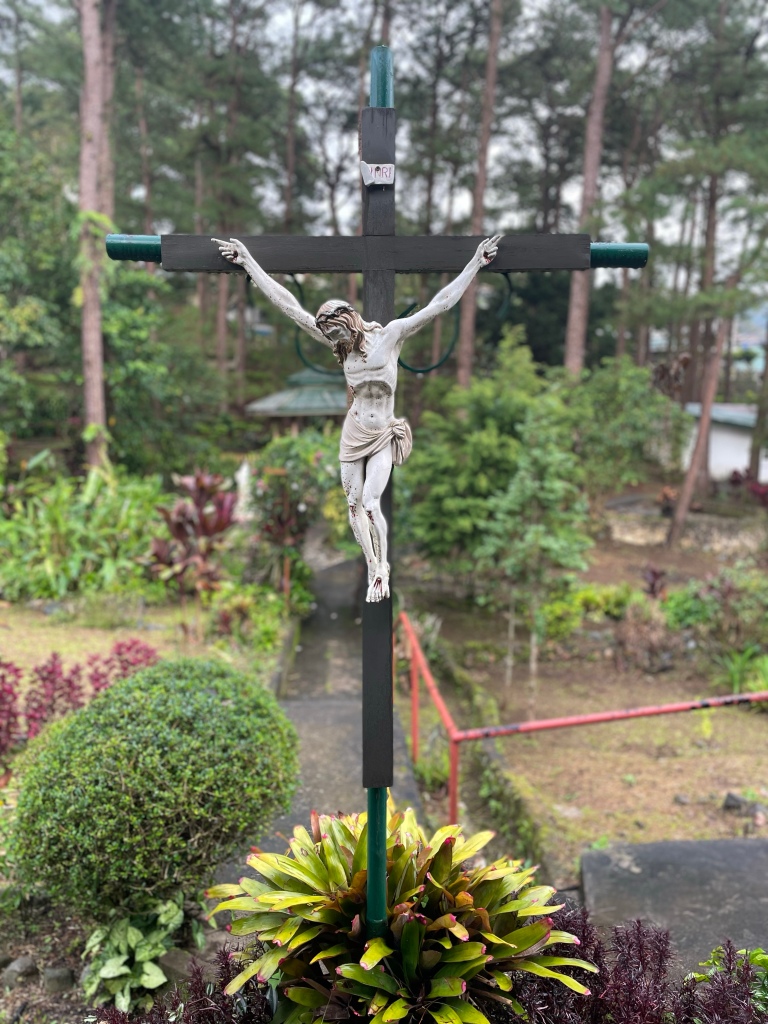
Photo by author, Benguet, July 2023.
It is a day after Valentine’s, also the final Sunday before we take a long break from Ordinary Time to start the 40 days of Lent this Ash Wednesday leading us to Easter that lasts until the month of May. It is so lovely and timely that we hear Jesus teaching us this Sunday to examine our hearts always so that we can live our faith in him daily, of remaining blessed in his beatitudes.
We are still at the sermon on the mount with Jesus giving us a series of general teachings illustrated in some concrete examples. However, keep in mind these are not new teachings as Jesus himself clarified he had come not to abolish but to fulfill the laws. In the light of the Beatitudes he taught us the other Sunday, Jesus is now directing us to look deeper into our hearts, to make it whole again in him and stay blessed unlike the scribes and the Pharisees.
Jesus said to his disciples: “I tell you, unless your righteousness surpasses that of the scribes and Pharisees, you will not enter into the kingdom of heaven” (Matthew 5:20).
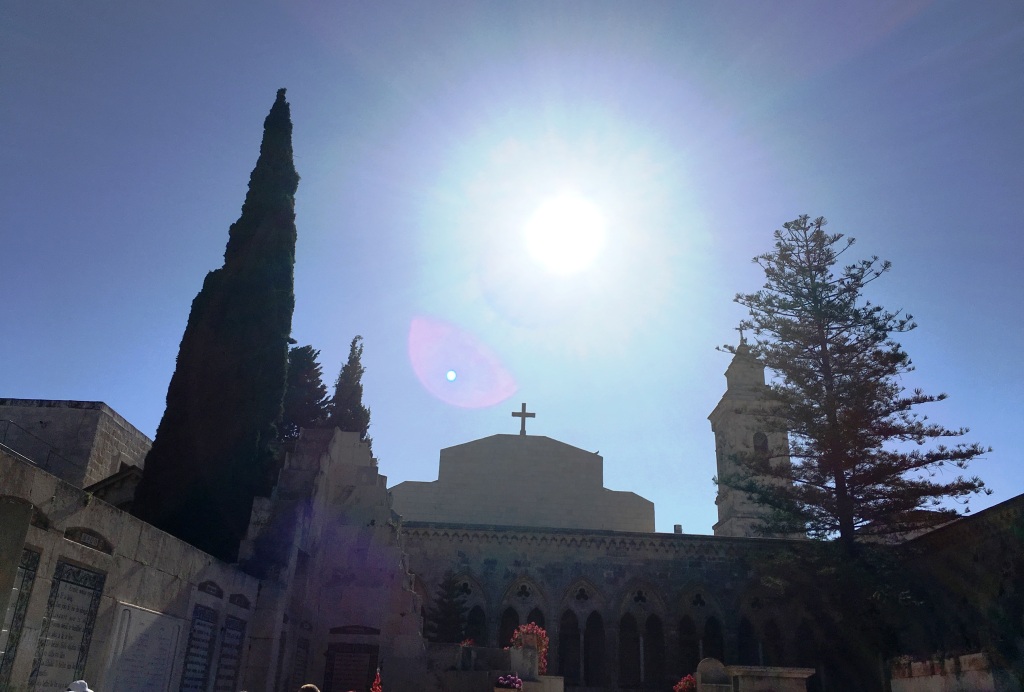
Photo by author, Jerusalem, May 2017.
This is not the first time we have heard the word “righteousness” in Matthew who used it to describe Joseph in his Christmas story as “a righteous man” (Mt.1:19).
Being righteous for the Jews is being holy which is obeying and living by the laws and commandments of God. Unfortunately, they got centered with the letters of the laws as insisted by their scribes and Pharisees. When Jesus came, they have forgotten God himself as well as the value of the human person and life itself for which the laws were meant to be. Matthew rectified this at the start of his gospel with the story of the annunciation of Christ’s birth to Joseph who obeyed God’s command expressed in his love for Mary whom he took as his wife then pregnant with the Savior he named as “Jesus”.
Righteousness or holiness is not being sinless but being filled with God, living our faith in Christ by witnessing his gospel. From the Greek word holos that means “whole” not broken, holiness in a sense is what we call as integrity.
Holiness, righteousness, and integrity all begin in the heart that we find expressed in the sixth Beatitude taught by Jesus two Sundays ago, “Blessed are the clean of heart, for they will see God” (Mt.5:8).
A clean heart is a loving heart. We can only see God and the other persons with a loving heart. The human intellect cannot know most especially God as St. Paul tells us in the second reading.
In the same manner, we know the other person not with the intellect but always with the heart as the Little Prince said, “What is essential is invisible to the eye; it is only with the heart that one can truly see” while Marvin Gaye expressed it so beautifully in his 1971 hit “What’s Going On” with the lines “we have to put some lovin’ here today” so we can understand each other.
Indeed, the heart is the very center or core of every person because everything flows from the heart. And this is what Jesus himself underscores in his three admonitions against anger, lust, and falsehoods this Sunday. In all three teachings, we find how love is severely damaged when we quarrel against each other, when we take everyone as things and objects to be used, and when we lack the sincerity in our words.
Photo by author, September 2021.
“You have heard that it was said to your ancestors, You shall not kill; whoever kills will be liable to judgment. But I say to you, whoever is angry with his brother will be liable to judgment, and whoever says to his brother ‘Raqa,’ will be answerable to the Sanhedrin, and whoever says, ‘You fool,’ will be liable to fiery Gehenna”(Mt.5:21-22).
First thing we notice in these three teachings is its construction where Jesus first mentioned what was said by the ancestors in the phrase “You have heard” immediately followed by his own take, “But, I say to you.”
Again, Jesus is not contradicting the laws given by Moses and elaborated by their elders; Jesus was actually expressing its fullness in him found in love that begins in the heart which St. Paul reiterated in his letters that love is the perfection of the laws and commandments of God.
Whenever we quarrel in words or in deeds, we not only break our ties with each other as brothers and sisters but even with God we call “our Father”. Remember, love of God is love of one another. And the sad part of this reality is our being cut off from God even if we don’t admit it. And even if we know we have nothing against anyone, we surely feel the break-up in our selves due to the lack of love and charity, most of all, of peace. That is why Jesus added that when in our worship we realize a brother or sister has anything against us, we must first reconcile with him or her. That is why before the Holy Communion, we give the greeting of peace with one another who represents the person we are at odds with. The responsibility becomes more pronounced if the person is in the same assembly we are in if we really want to have a meaningful and holy communion.
“You have heard that it was said, You shall not commit adultery. But I say to you, everyone who looks at a woman with lust has already committed adultery with her in his heart” (Mt.5:27-28).
Here we go again with the issues of marital infidelity as well as of divorce: at the very core of this is the equality of every person, of every man and woman as being created in the image and likeness of God with same equal dignity. Jesus reminds us today that there is no difference between man and woman when it comes to marriage because the same duties of fidelity bind each partner. Most of all, Jesus has consistently taught how we must go beyond the Laws when it comes to marriage because every spouse is an image of himself, of his saving grace. Hence, we must reject every temptation and inappropriate words and actions that may destroy unity and love of couples and even in our other relationships as family and friends.
Photo by author, Makati City, 09 February 2026.
“Again you have heard that it was said to your ancestors, Do not take a false oath, but make good to the Lord all that you vow. But I say to you, do not swear at all. Let your ‘Yes’ mean ‘Yes,’ and your ‘No’ mean ‘No.” Anything more is from the evil one” (Mt.5:33-34).
This last admonition is perhaps most needed these days when we are bombarded with too much fake news as well as our own words are empty. Shakespeare said it so well in Hamlet, “words, words, words” wherein we think and believe that the more we increase our words, the more it becomes true and meaningful.
Of course, it it totally untrue as Jesus reminded us today to be truthful always. In Genesis, we are told in the story of creation how God shared only this power of words, of language with humans alone. Our ability to speak is a sharing in God’s power that demands responsibilities (Spiderman). Hence in the first reading, Ben Sirach reminds us to be responsible in choosing good than evil like in choosing between “fire and water”, “life and death”. Ben Sirach’s short reminders are very timely in this age of social media where “influencers” choose for us not only the candidates to elect but even the food to eat and clothes to wear. Being free is to decide, to choose knowingly what is good.
This Sunday, Jesus invites us to look into our hearts, to cleanse it of evil and sins so that he may dwell and reign completely in our hearts so we can have integrity and remain blessed and holy in him. Amen. Have a blessed week ahead, everyone!
Lord My Chef Simbang Gabi Recipe for the Soul by Fr. Nicanor F. Lalog II
Thursday, Simbang Gabi-III, 18 December 2025
Jeremiah 23:5-8     ><}}}}*> + ><}}}}*> + ><}}}}*>     Matthew 1:18-25
Photo of St. Joseph with Child Jesus from vaticannews.va.
After presenting to us the genealogy of Jesus, Matthew now gives us the very essence of Christ’s origin who is God himself making him truly Divine but at the same time coming from the lineage of Abraham and David, truly human like us in everything except sin.
But, in the light of the corruption so rampant in our country, I find Matthew’s genealogy so timely as it also shows us so clearly the need to break away from the much vaunted and abused powers of bloodlines and kinship so common in most nations and societies where key positions and status are considered as hereditary.
Sociologists call it “familism” which is too much emphasis on one’s family line that leads to abuses like nepotism in offices, dynasty in politics and even caste systems that all degrade of the value of every human person. We reflected yesterday how in the genealogy of Jesus, we are all beloved children of God; when some people cling to power and positions as if they are the only ones capable of doing things even in bringing Christmas, they are totally wrong.
See how in our country politicians shamelessly abuse their power in a family dynasty occupying all elective positions aside from controlling major businesses in their town or city, region or province. A classic example of kawalan ng kahihiyan. And thank God Jesus was not born in the Philippines!
Sorry for the rant but let us recall Matthew’s shift yesterday in the flow of Christ’s genealogy at the end: “Eliud the father of Eleazar. Eleazar became the father of Matthan, Matthan the father of Jacob, Jacob the father of Joseph, the husband of Mary, of her was born Jesus who is called the Christ” (Mt.1:15-16). See the break from the rhythmic cadence of “is the father of, is the father of” to stress that Jesus is from God, not from any man like St. Joseph, biologically speaking. This, I think, is crucial for Matthew so that no one can ever claim an exclusive family tie or bloodline in Jesus nor brag being a “relative” or even the “son” of God like that pastor now in jail in Manila.
Francisco Goya’s painting, “Dream of St. Joseph” (El Sueno de San Jose) done in 1772; from en.wikimedia.org.
With the birth of Jesus by Mary, all mankind by faith in Christ can now trace our origin in God – thanks to both St. Joseph and Blessed Virgin Mary! They showed us that Christmas did not happen by mere bloodlines but through active cooperation in the work of God.
This is how the birth of Jesus Christ came about. When his mother Mary was betrothed to Joseph, but before they lived together, she was found with child through the Holy Spirit. Joseph her husband, since he was a righteous man, yet unwilling to expose her to shame, decided to divorce her quietly. Such was his intention when, behold, the angel of the Lord appeared to him in a dream and said, “Joseph, son of David, do not be afraid to take Mary your wife into your home. For it is through the Holy Spirit that this child has been conceived in her (Matthew 1:18-20).
Men are seldom described by their relationship to a woman as it is more often the other way around like in the tradition of wives assuming their husband’s surnames.
Most notable exception anywhere in history is St. Joseph who is known more because of his connection to Mother Mary; however, it is in this unique aspect that we also find his greatness, his holiness.
Like in any patriarchal society, it is always the father who gives the identity to the child especially among the Jews. Every pilgrim who had gone to the Holy Land knows this so well when you look at the ID of tour guides and bus drivers that always include the lines that says “bar” followed by one’s father’s name as “son of so and so.” Unlike men, women easily claim motherhood for a child as part of her nature; a man would never give his name to any child not his.
But not Joseph who was really an exception for being “righteous” according to Matthew.
Photo from vaticannews.va, 2020.
Righteousness among the Jews is also holiness which is to keep and abide by the laws of God.
Here we find Matthew as a Jew writing to his fellow Jewish converts to Christianity that holiness is more than obedience to the Ten Commandments and its over 600 precepts every pious Jew must first follow.
For Matthew, righteousness or holiness is always complementary to justice which is more than legal fairness but having the character of God who is fair and merciful, compassionate and kind especially with the weak. In the first reading, we hear Jeremiah speaking about the coming Messiah to be called “the Lord is justice” who shall restore what’s broken, primarily his people.
Actually we got this thought on the complementarity of justice and righteousness from one of our favorite bloggers at WordPress, Sr. Renee Yann who in her “Lavish Mercy” issue in March 19, 2019 cited a Protestant exegete about the matter:
“Justice in the Old Testament concerns distribution in order to make sure that all members of the community have access to resources and goods for the sake of a viable life of dignity…. Righteousness concerns active intervention in social affairs, taking an initiative to intervene effectively in order to rehabilitate society, to respond to social grievance, and to correct every humanity-diminishing activity” (Walter Brueggemann, Journey to the Common Good).
That complementarity of justice and righteousness in St. Joseph is best expressed by Matthew when he said that “When Joseph awoke, he did as the angel of the Lord had commanded him and took his wife into his home.”
When Mary was found pregnant with a child not his, St. Joseph already displayed his righteousness when he took the concrete and painful step of quietly leaving her to spare her of all the shame and even punishment their laws imposed on such cases. And after the angel had explained to him everything about the pregnancy of Mary, St. Joseph all the more showed the depth and reality of his holiness or righteousness that was willing to forget his total self for the greater good of Mary and everyone!
Photo by author, “St. Joseph Protector of the Child Jesus”, 2024.
As a sign of his righteousness in accordance with his deep sense of justice, St. Joseph showed in his very life that true relationship with God is expressed in our love for others which would become later a major teaching by Jesus Christ.
Moreover, it was in accepting Mary as his wife that Jesus finally came into the world as our Savior. Today, St. Joseph is teaching us that Christmas happens whenever we respect and accept each other because that is when Christ comes in our midst like in their eventual marriage.
It was not the first time that St. Joseph displayed his kind of righteousness complemented by the virtue of justice. After the Nativity, St. Joseph took the difficult and perilous task of fleeing to Egypt to protect and save Mother Mary and the Infant Jesus from the murderous wrath of King Herod.
Twice St. Joseph acted as a righteous man in the temple: first at the presentation of Jesus when he allowed Simeon and Anna to take the Holy Infant into their arms and praised him; and second in the finding of Jesus in the temple when St. Joseph chose to step into the background to let the Child Jesus assume his teaching vocation among the learned men there, an apparent anticipation of the ministry of Jesus later. (Recall in that scene that St. Joseph was totally silent while it was the Blessed Mother who did all the talking by speaking to Jesus how worried they have been looking for him.)
Based on these few instances found in the gospel wherein the Holy Family were presented together, St. Joseph remained righteous and just during their hidden years in Nazareth as he worked hard to provide for Mary and Jesus, actively doing good for his family and community while silently fostering, forming the personality and ministry of Jesus Christ.
Let us imitate St. Joseph working hard in silence amid the great temptations of glamor in this social media age, always rooted in Christ, our only Savior and Mediator. True holiness is purely grace and part of that is our hard work in actively bringing Jesus into this world so sick, so dark with evil and sin. Amen. Have a blessed Thursday!
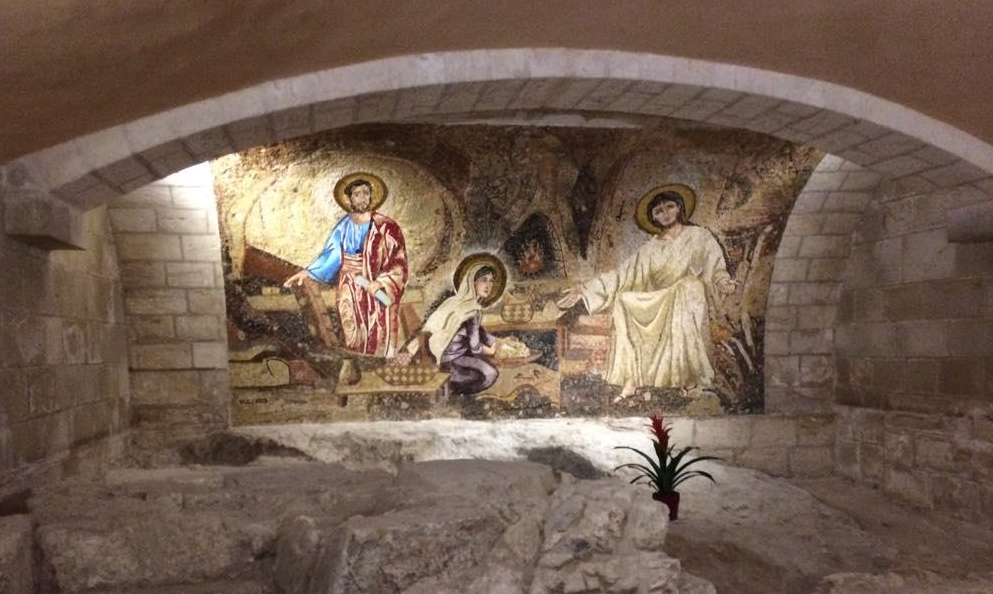
Photo by author, site of the Nazareth of the Holy Family underneath the Church of St. Joseph in Nazareth, Israel.
Lord My Chef Daily Recipe for the Soul by Fr. Nicanor F. Lalog II
Friday, Memorial of the Presentation of the Blessed Virgin Mary, 21 November 2025
1 Maccabees 4:36-37, 52-59     <*{{{{>< + ><}}}}*>     Luke 19:45-48
Photo by author, Mary’s home in Ephesus, 03 November 2025.
God our loving Father,
today I praise and thank you again
for the recent chance to travel
and experience your majesty
and beauty abroad
and among other peoples
of different culture;
most of all,
I am grateful to have been
to the home of the Blessed
Virgin Mary in Ephesus;
until now,
I am savoring,
"masticating" the blessed
experience.
Jesus entered the temple area and proceeded to drive out those who were selling things, saying to them, “It is written, My house shall be a house of prayer, but you have made it a den of thieves” (Luke 19:45-46).
As I recall
that brief moment of stay
inside the Ephesus home of Mary,
I felt my whole being emptied - hollowed -
and as I knelt and prayed
without any distractions,
no worries about pictures nor of time,
slowly I felt being filled within
by you, O God: from hollowedness
to holiness or hallowed;
that is why Jesus drove away
the merchants out of temple:
every temple,
every place of worship
including our very selves
is a home and dwelling place of God;
the chief priests, scribes
and leader of the people
felt under attack by Jesus
because they were empty of God,
filled of the world and its things;
the people were spellbound
on the other hand because
they have realized that
truly, we are the indwelling
of God; therefore, let us cleanse
ourselves always within
not only of sin but also of
so many things that distract
us away from God
to dwell in us
like social media.
O Blessed Virgin Mary,
from the very start you have
been reserved by God from any stain
of sin to be the Mother of the Christ
but it was also fulfilled because
of human cooperation: of your parents
dedicating you to God and most of all,
of your fiat to God.
Pray for us, Mama Mary
that we may cultivate a prayer life
that shall make us a home
to God; let us express our
fiat to him daily by presenting
ourselves to him like you.
Amen.
Photo by author, back of Mary’s home in Ephesus, 03 November 2025.
Lord My Chef Sunday Recipe for the Soul, 27 July 2025
Seventeenth Sunday in Ordinary Time, Cycle C
Genesis 18:20-32 ><}}}*> Colossians 2:12-14 ><}}}*> Luke 11:1-13
Photo by author, the “Our Father” Church outside Jerusalem where he is believed to have taught his disciples how to pray.
From the home of Martha and Mary, Jesus and his disciples proceeded on their journey to Jerusalem when the disciples saw him at prayer.
Of the four evangelists, Luke is the one who presents Jesus most at prayer, always making time to pray. The disciples noticed this importance of prayer for Jesus that they asked him to teach them how to pray.
More than teaching them the “Our Father”, Jesus again took the occasion to give the Twelve another lesson of things “to do” as a disciple we have seen in the past four weeks like greeting peace every home they visit as they proclaim the Kingdom of God is at hand (July 6, 14th Sunday); being a neighbor to everyone especially those in need in order to gain eternal life (July 13, 15th Sunday); and last week of choosing always the “only one thing needed” by every disciple which is to listen to him and his words.
This Sunday, Jesus deepens that by teaching us his disciples to always pray.
Photo by author, Jerusalem Temple, May 2017.
“And I tell you, ask and you will receive; seek and you will find; knock and the door will be opened to you. For everyone who asks, receives; one who seeks, finds; and to the one who knocks, the door will be opened. What father among you would hand his son a snake when he asks for a fish? Or hand him a scorpion when he asks for an egg? If you then, who are wicked, know how to give good gifts to your children, how much more will the Father in heaven give the Holy Spirit to those who ask him?” (Luke 11:9-13)
More than the mere recitation of a prayer like the “Our Father”, Jesus shows us this Sunday that prayer is the essence of discipleship that is also a relationship with God. That is why he began his lesson in prayer by telling the Twelve, “when you pray, say: Father” that clearly indicates a relationship.
During his time, God was regarded as Someone totally powerful, far from humans whose name could not even be mentioned for its holiness or “otherness”. When Jesus taught to call God “Abba” which is the equivalent to our “dad” or “daddy”, people were scandalized for God is above all to be accorded with the highest respect, never taken on a personal level with such terms of endearment like in human relationships.
Jesus clarified in many instances not only here that though our God is all-powerful and all-knowing, he is a person like us who relates with others, who is so loving and merciful to us he considers his beloved children because he is our Father. Here we find Jesus already bringing God closest to us not only as “God-with-us” but also “God-in-us” so close with each of us as our breath in the Holy Spirit! Jesus proved all these teachings on Good Friday when he died on the Cross.
Photo by author, a bass relief of Jesus Christ’s “agony in the garden” at Gethsemane, May 2019.
Prayer as a relationship is more than telling God what we need which he already knows even before we pray; prayer is more of listening to God for what he wants from us which is to become one in him in Jesus Christ.
I have realized even before my ordination to the priesthood that Jesus calls us not really for tasks he wants us to do but primarily that we may be one in him in an intimate relationship. That is why since my theological studies, I have stopped praying anything for me because God knows what I need most; I pray more for my family and friends while praying only one thing for me – that in every here and now, I am in him until my death.
This intimacy with God in prayer calls for openness that after teaching them the Our Father, Jesus encouraged the disciples to persevere in prayer with a parable of a friend asking for bread, “I tell you, if he does not get up to give the visitor the loaves because of their friendship, he will get up to give him whatever he needs because of his persistence” (Lk.11:8).
Perseverance in prayer is not a kind of “holy nagging” of God in order to change his mind so that he gives our requests. Perseverance in prayer opens us to God’s gifts and plans we acquiesce to with joy. Many complain of God not granting their prayers when in fact, the problem is many hardly pray at all, wearing God with their words without listening to him who has better plans for us by giving us something better than what we are asking for!
Photo by author, a bass relief of Jesus Christ’s “agony in the garden” at Gethsemane, May 2019.
And the best we can have is always him – God himself.
See how Jesus used the transitive verbs “to ask” and “to seek” that both require a direct object when he simply declared “ask and you shall receive, seek and you shall find.” What shall we ask for or seek at all? He did not indicate its direct objects because the answer is only God, as in ask only for God, seek only God.
When we are open to God and into a relationship in him, we are fulfilled, needing nothing at all except him who is everything.
Prayer changes us, not things and situations. There will always be sickness and death, calamities and trials in our lives which prayer cannot prevent from happening. What prayer does is make us stronger in dealing with the storms in our lives, making us better persons and disciples.
No saint had become holy without prayer which is the gateway and foundation of discipleship. This is the whole point of Abraham “bargaining” with God in the first reading: Sodom and Gomorrah were eventually destroyed because no one was left praying and therefore, no one was doing good in the forsaken cities. In their lack of any prayer at all, they have become insensitive of others and of nature that led to their destruction. These are the same dangers our present generation is falling into – a complete disregard of God and others including nature. We have become insensitive of our selves, of others and of the world that we find it so bad, so filled with evil, and so sick. How sad that fewer and fewer people are left praying with so many others not having any qualms at all in missing the Sunday Mass these days.
I have always loved this photo by our friend Ms. JJ Jimeno of GMA-7 News of a man who seemed to have lost his head in deep prayer inside the Prayer Room of the Holy Sacrifice Parish in UP Diliman last June 2019.
Prayer makes us sensitive of God, of our self and of others where we discern what is good and evil, learning what God has in store for us. The more we pray, the more we become sensitive of ourselves and of others and of the world. Yes, we lose ourselves in prayer so that it is Christ who lives in us as St. Paul asserted (Gal.2:20). Contrary to claims by some, prayer is not a flight from reality but actually a dive into the true realities of life as St. Paul tells us in today’s second reading: when we are “raised to life in Christ” (Col. 2:13) in prayers, we are abled to follow Jesus with our own crosses sustained by the gifts of the Holy Spirit in making our society more humane and just.
When we pray, we lose ourselves and we are filled with God so that his kingdom comes when his will is done here on earth as it is in heaven. Amen. Have a blessed week ahead, everyone!
Fr. Nicanor F. Lalog II
Our Lady of Fatima University
Valenzuela City
(lordmychef@gmail.com)
The Lord Is My Chef Daily Recipe for the Soul by Fr. Nicanor F. Lalog II
Wednesday, Memorial of St. Augustine, Bishop & Doctor of the Church, 28 August 2024
2 Thessalonians 3:6-10, 16-18     <*{{{{><  +  ><}}}}*>     Matthew 23:27-32
Commuters hang from the back of a jeepney as it travels along a road in Manila, the Philippines, on Sunday, April 9, 2017. Photographer: Veejay Villafranca/Bloomberg via Getty Images.
Glory and praise to you,
God our loving Father
for the gift of this great Saint,
Augustine, son of St. Monica,
Bishop and Teacher of the Church;
in him, O God,
you showed us every saint
has a sinful past
and that no sinner
can be denied of a saintly future.
It was St. Augustine who taught us
among his so many teachings that
"grace builds on nature"
which he must have learned from
his own experiences,
from his conversion to Christianity
to becoming a priest then a bishop
that did not happen like a magic trick
by God but with hard work wrapped in
intense prayers by him and St. Monica;
what a tremendous blessing that
as we honor him today,
our first is from a letter by his inspiration,
St. Paul:
For you know how one must imitate us. For we did not act in a disorderly way among you, nor did we eat food received free from anyone. On the contrary, in toil and drudgery, night and day we worked, so as not to burden any of you. Not that we do not have the right. Rather, we wanted to present ourselves as a model for you, so that you might imitate us. In fact, when we were with you, we instructed you that if anyone was unwilling to work, neither should that one eat (2 Thessalonians 3:7-10).
Remind us, O God
in Jesus Christ like St. Augustine,
what is essential is the inside
not the outside;
let us not be like the Pharisees
and scribes, hypocrites,
looking like "whitewashed tombs
that appear beautiful on then outside
but inside are full of dead men's bones
and every kind of filth"
(Matthew 23:27).
Grant us the zeal and
enthusiasm like St. Augustine
to strive in becoming a better person,
most of all a better Christian
by working hard in cultivating
the prayer life,
love for the Sacred Scriptures
so that Jesus may dwell always
in our hearts.
Amen.
Quiet Storm by Fr. Nicanor F. Lalog II, 09 August 2024
Photo by author, Parish of the National Shrine of Our Lady of Fatima, Valenzuela City, 24 July 2024.
I was recently asked to bless a little store the other day, the seventh day of August. My schedule was toxic with another appointment in another city but the owner begged because she believed it is the most auspicious date for blessing.
How I wanted to ask her why have a blessing at all if you believe in luck than in God? Para wala nang gulo, I blessed her store but explained the meaning of blessing and of superstitions during the rites. It is one of those occasions when all we can do is sigh, saying haynaku and Juice colored!
What a sad reality in our Catholic Christian country where the kind of religiosity that binds most of us is more on rites and rituals but lacking in roots and spirituality, centered on ourselves to be assured of every kind of material blessings, forgetting all about the very object of faith who is God expressed in our concern for one another.
And in the light of all these things going on especially the never ending topics in social media, we ask, pera pera na lang ba talaga ang lahat sa buhay natin?
From catholicapostolatecenter.org.
Consider the name of this month August which was borrowed from the Roman Caesar Augustus that signifies reverence or to hold someone in high regard. As an adjective, august means “respected and impressive” like when we say “in this august hall of men and women of science”.
August is not a ghost month nor any other month of the year.
Like the days of the week, every month is a blessed one. No day nor date nor time is malas because these were all created by God who is all good. Nothing bad can come from God. Period.
Moreover, when God became human like us in the coming of Jesus Christ, life has become holy, filled with God, debunking those ancient beliefs of the Divine being seen in various cosmic forces. Pope Benedict explained this so well in his second encyclical:
Photo by author, St.Scholastica Retreat House, Baguio City, 2023.
In this regard a text by Saint Gregory Nazianzen is enlightening. He says that at the very moment when the Magi, guided by the star, adored Christ the new king, astrology came to an end, because the stars were now moving in the orbit determined by Christ[2]. This scene, in fact, overturns the world-view of that time, which in a different way has become fashionable once again today. It is not the elemental spirits of the universe, the laws of matter, which ultimately govern the world and mankind, but a personal God governs the stars, that is, the universe; it is not the laws of matter and of evolution that have the final say, but reason, will, love—a Person. And if we know this Person and he knows us, then truly the inexorable power of material elements no longer has the last word; we are not slaves of the universe and of its laws, we are free. In ancient times, honest enquiring minds were aware of this. Heaven is not empty. Life is not a simple product of laws and the randomness of matter, but within everything and at the same time above everything, there is a personal will, there is a Spirit who in Jesus has revealed himself as Love[3]. (#5, Spe Salvi (Saved in Hope) by Pope Benedict XVI, 30 November 2007)
Photo by author, Sacred Heart Novitiate, Novaliches, QC, 20 March 2024.
I love this part of his encyclical, “It is not the elemental spirits of the universe, the laws of matter, which ultimately govern the world and mankind, but a personal God governs the stars, that is, the universe; it is not the laws of matter and of evolution that have the final say, but reason, will, love—a Person.”
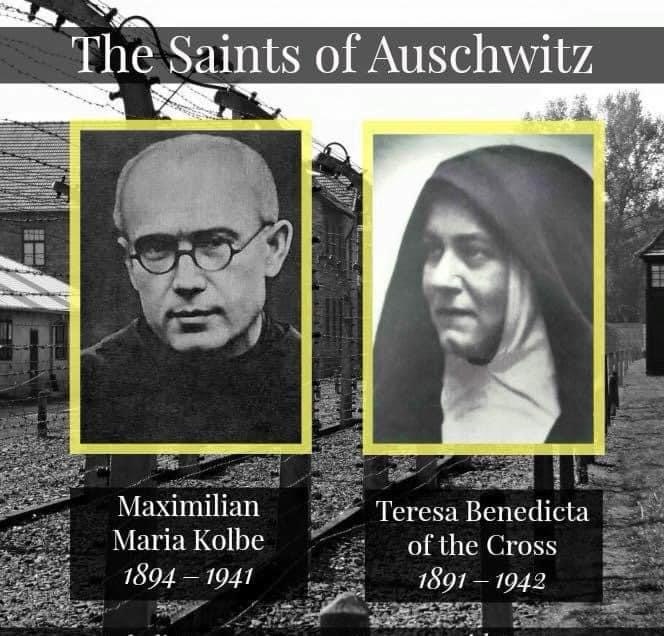
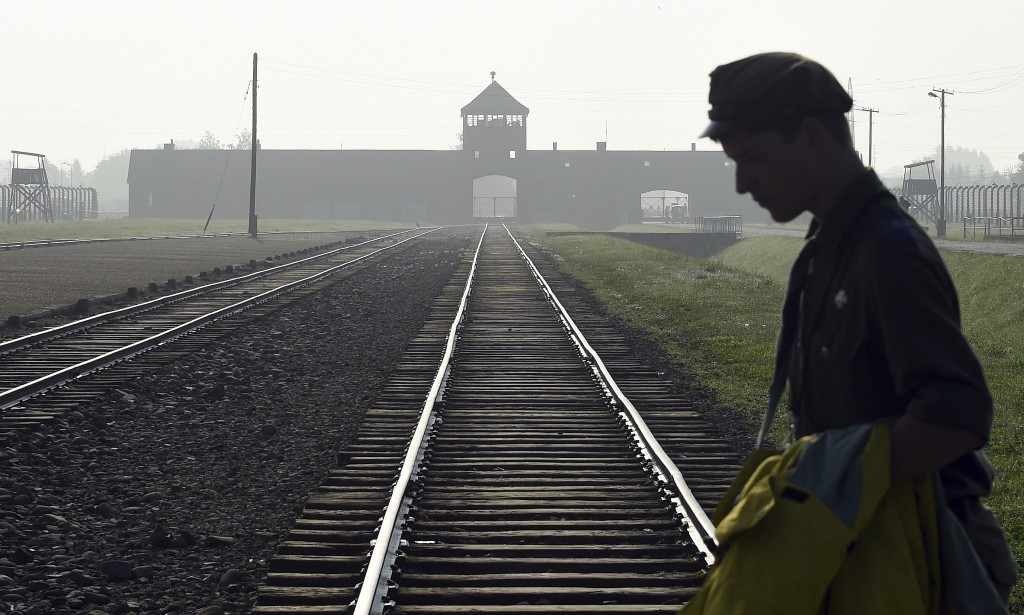
It was this Person of Jesus Christ why so many great men and women then and now have abandoned their previous ways of life to lead holy lives even in the face of death. Very interesting in this modern time are two great saints we celebrate on this month of August, St. Teresa Benedicta of the Cross (August 09) and St. Maximilian Kolbe (August 14) who died at the gas chambers of Auschwitz during the Second World War. Let’s reflect first on St. Teresa Benedicta whose memorial we celebrate today.
Photo from FB page of Scott Hahn, 09 August 2024.
St. Teresa Benedicta is the German philosopher Edith Stein. She came from a prosperous Jewish family gifted with great mind becoming one of the first female university student and later professor in Germany.
An associate of the famed Edmund Husserl of the philosophical method of phenomenology, St. Teresa Benedicta became an atheist during her teenage years; but, upon further studies and prayer, converted into Catholicism, becoming a Carmelite nun where she adopted her new name. She wrote that “Those who seek truth seek God, whether they realize it or not“.
She actually had all the chances to leave for South America and then to Switzerland to escape the Nazis but opted to stay in their monastery in the Netherlands with her younger sister Rosa who had also converted as Catholic and joined the Third Order Carmelite. When they were arrested on August 2, 1942, she told her, “Come, Rosa… we go for our people.”
St. Teresa Benedicta honored her Jewish roots by dying among them as a martyr of Christ, one who had “learned to live in God’s hands” according to Sr. Josephine Koeppel, OCD, a translator of much of her works. According to various accounts, St. Teresa Benedicta showed great inner strength by encouraging her fellow prisoners to have faith in God while helping in looking after the small children when their mothers were so distressed to do so. One woman who survived the war wrote: “Every time I think of her sitting in the barracks, the same picture comes to mind: a Pieta without the Christ.”
Dying ahead of her in Auschwitz on August 14, 1941 was St. Maximilian Kolbe, a Franciscan priest who was arrested for his writings against the evil Nazis. It was actually his second time to be arrested.
When a prisoner had escaped from the camp, authorities rounded up ten men to die in exchange of the lone escapee. Fr. Kolbe volunteered to take the place of a married man with children. They were all tortured and starved in order to die slowly in pain. A devotee of the Blessed Virgin Mary, St. Maximilian was injected with carbolic acid on the eve of the Assumption after guards found him along with three other prisoners still alive, without any signs of fear like screaming but silently praying.
Photo of Auschwitz from Google.
We no longer have gas chambers but atrocities against human life continue in our time, hiding in the pretext of science and laws. Until now, men and women, young and old alike including those not yet born in their mother’s womb are hunted and killed to correct what many perceived as excesses and wrongs in the society. Just like what Hitler and his men have thought of the Jews at that time.
The Nazi officers and soldiers of Auschwitz remind us the true “ghosts” and evil spirits of our time sowing hatred and deaths are people who may be well-dressed, even educated in the best schools, and come from devout or “normal” families. They sow evil every day without choosing any particular month, blindly following orders without much thinking and reflections or introspection.
Photo by author, James Alberione Center, QC, 08 August 2024.
Many times, they insist on following or speaking the truth – a truth so empty of the person of Jesus Christ. As we have been saying amid this growing trend of wokism and inclusivity that have badly infected the Olympics, people tend to exaggerate the truth they believe or follow when actually, they are just exaggerating themselves.
By the lives of the many great saints of August, or of any other month for that matter, we are reminded that holiness is not being sinless but simply being filled with God, being converted daily to the truth of Jesus Christ by allowing that holiness to spill over and flow onto others with our lives of authenticity expressed in charity and mercy, kindness and justice, humility and openness with one another.
Let us make every month holy and blessed with our good deeds to make everyone aware of Christ’s presence among us. Have a blessed weekend!
The Lord Is My Chef Daily Recipe for the Soul by Fr. Nicanor F. Lalog II
Tuesday in the Eleventh Week in Ordinary Time, Year II, 18 June 2024
1 Kings 21:17-29     <'[[[[><<  +  ><]]]]'>     Matthew 5:43-48
Photo by author, Sacred Heart Novitiate, Novaliches, QC, 20 March 2024.
God our merciful Father,
grant me the grace today
to understand my sins more
clearly so that I may come to
sorrow for them,
sorrow that leads to love
of your Son Jesus Christ
and not despair;
let me keep in mind
that sin is not just a breaking
of your laws and rules but
simply a refusal to love
You and others around me;
and the worst part of sin
we are not aware of is how
it seriously affects our personality,
our personhood
because whenever we sin
we become a less-loving
person.
So be perfect, just as your heavenly Father is perfect.
Matthew 5:48
Being perfect,
being holy like You,
dear Father,
means being filled
by You
which is a process
of daily conversion
when we ask
your forgiveness Father,
to gain a better self-knowledge
of ourselves
to identify our weaknesses
and sinfulness
so that in your grace,
we become a better person
than before.
Let us have within us
that sense of sinfulness
and sense of sin,
Father
so that we
we may grow in your love.
Amen.
Quiet Storm by Fr. Nicanor F. Lalog II, 11 June 2024
From stillromancatholicafteralltheseyears.com, January 2022.
What is very sad in this ongoing debate against divorce in our country is how some people claiming to be graduates and professors of Catholic institutions insist on their many “intellectual reasonings” why divorce should be allowed while at the same time declaring it is wrong to profess we are against divorce simply because we are Catholics.
What a tragedy when those educated or teaching in Catholic schools and universities who are supposed to know more and better about Jesus Christ and His teachings are the ones favoring divorce. They cite so many studies and authors even theologians to support their stand in favor of divorce without ever mentioning Christ’s teachings found in the Sacred Scriptures that were explained by the Church in our Catechism as well as in so many other documents by the Popes and bishops.
We understand how journalists could err regarding names and other details that essentially do not effect the veracity of their news like the recent sakalan blues in Gagalangin, Tondo when the interview of a priest was ascribed to another; but, to be one sided in the presentation of a story is something else like Rappler’s “The Problem with I am Catholic, I say no to divorce”. There’s a reliable maxim in journalism that says “Opinions are free but facts are sacred.”
The main fact we have been holding on the sanctity and indissolubility of marriage for over 2000 years is our Lord Jesus Christ’s teaching against divorce that the pro-divorce everywhere have refused to accept.
Yes, we need to listen to different views about divorce but not to those views condemned by the Church because they are wrong.
Divorce cannot be isolated as merely a political issue to be resolved because marriage as a natural sacrament is spiritual in nature, a path to holiness.
Marriage is a gift and a call from God for men and women to live and work together in order to attain eternal life. This we achieve firstly by having a prayer life, a relationship with God expressed in our love for one another especially between husband and wife.
In arguing against divorce, we need to look for those couples who have made it through thick and thin in their marriage in order to inspire others in following the path of Holy Matrimony.
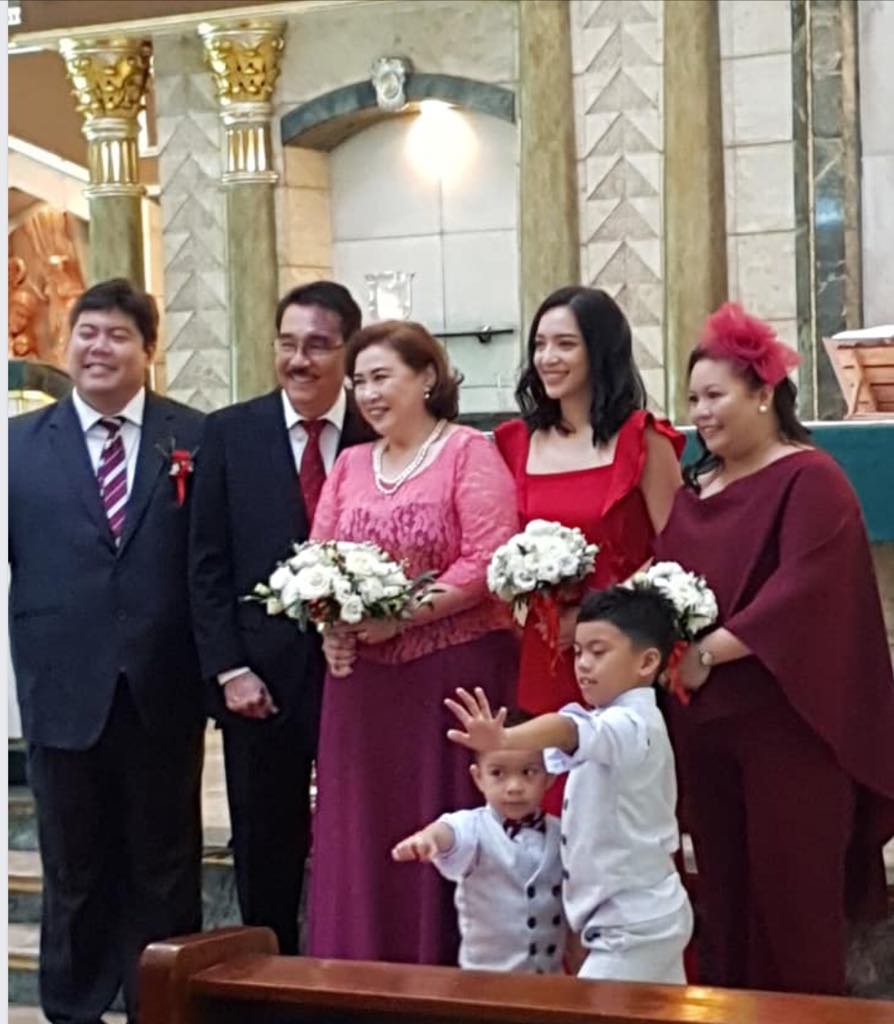
Joyce and Tony in 2019 with son Atty. JA and wife Kathleen with their two sons, and daughter Rosella.
As a contribution in our fight against divorce, I share with you my homily at the 40th wedding anniversary of my cousin Joyce Pollard to Tony Lopez in October 2019 which I titled as “Married life is a prayer”.
Oh what a joy to officiate weddings especially of relatives and friends!
Hope you find some lessons and inspirations on the beauty of marriage we have to keep.
As I prepared my homily for your anniversary, Joyce and Tony… “the moment I woke up and before your Mommy Fely put on her make-up, I said a little prayer for you.”
Of course that is not the theme song of Joyce and Tony. They haven’t met yet in 1967 when Dione Warwick recorded I Say a Little Prayer. But they were already married when it became one of the tracks in the movie “My Best Friend’s Wedding” starring Julia Roberts.
And since this is my “best cousin’s wedding anniversary” in this part of the city, I have thought of reflecting on married life as a prayer.
In our gospel we have heard Jesus Christ narrating the parable of the unjust judge and persistent widow to underscore “the necessity to pray always without becoming weary” (Lk. 18:1).
Prayer is an expression of faith.
When there is faith, there is also love.
And when there is prayer, faith, and love, what we have is a relationship, a community of believers who love each other.
People who love and believe with each other always talk and communicate. They make time to be with one another. And most often, that is what really matters with people who love and believe – simply to be together.
Even in silence.
Like prayer.
Prayer is more than asking things from God but most of all, prayer is a relationship with God expressed with others. That is the beauty of the Sacrament of Holy Matrimony: husband and wife are bound together in marriage to become signs of the saving presence of Jesus Christ.
Marriage as a sacrament means it is a prayer as well, a relationship of a man and woman with God as its source and foundation.
I am sure, Joyce and Tony along with all the other married couples here today will agree that married life requires a lot of prayers. In fact, married life is a prayer, a very difficult one that is much needed.
Like in that movie My Best Friend’s Wedding, there are real forces of evil that are trying to destroy couples. So many couples have already fallen, going their separate lives after several years of being together while on the other hand, more and more couples are refusing to get married at all due to this reality of breakups and separations.
And that is why we are celebrating today Joyce and Tony’s 40th wedding anniversary! We are praying with them in expressing our faith and love for them in Christ Jesus. Prayers have kept them together, transforming them into better persons.
At the end of the parable of the persistent widow and unjust judge, Jesus posed a very crucial question for us, especially to every married couple here today: When the Son of Man comes again at the end of time, will he find faith on earth? (Lk.18:8)
And what shall be our response?
“Yes, Lord, you shall find faith when you come again in Joyce and Tony!”
Like Moses in the first reading, they both prayed hard with arms outstretched on many occasions as they battled life’s many challenges and struggles.
“Yes, Lord, you shall find faith when you come again in Joyce and Tony” because they have both proclaimed your word with persistence, whether it is convenient or inconvenient like St. Paul in his second letter to Timothy. They have weathered so many storms in the past 40 years and your words, O Lord, have kept them together, sharing these with their children and with everyone in their life of fidelity and love.
“Yes, Lord, you shall find faith when you come again in Joyce and Tony” now before your altar to renew their vows to love and cherish each other for the rest of their lives!
“Yes, Lord, you shall find faith when you come again” among the many couples gathered here who have remained faithful to each other despite their many sins and failures, weaknesses and shortcomings.
Joyce and Tony, you are not only a prayer of faith but also a homily of the Holy Matrimony, showing us the light and power of Jesus Christ to transform people in prayer and bring them to fulfillment.
Prayer does not change things like typhoons and earthquakes. We cannot ask God in prayer to spare us from getting sick or be exempted from life’s many trials and sufferings. Prayer cannot stop those from happening.
What prayer does is change us, change our attitude so we may hurdle life’s many blows and obstacles. Especially with couples who always find God in their lives, in good times and in bad.
Prayers transform us into better persons as children of God, especially couples who eventually look like brothers and sisters after living together in faith, hope and love.
Tony and Joyce, I am sure everyone in our family and among your friends here can attest to the many good things that have transformed you in the past 40 years.
You have changed to become the best for each other.
In the bible, the number 40 means perfect.
May God continue to perfect you, Tony and Joyce.
Keep us too in your prayers as we pray for you. Amen.
The Lord Is My Chef Daily Recipe for the Soul by Fr. Nicanor F. Lalog II
Wednesday, Memorial of the Most Holy Name of Jesus, 03 January 2024
1 John 2:29-3:6 <*{{{{>< + ><}}}}*> John 1:29-34
Photo by Mr. Boy Cabrido, National Shrine of Our Lady of Mt. Carmel, New Manila, QC, 21 December 2023.
On this third day of the new year,
O Lord, your words are calling us to
live as children of God,
holy and righteous like you;
many times,
we could not heed this call
and most often,
we laugh at the mere thought
of holiness because
we look down at ourselves
as incapable of being good
because we refuse
to break free from sin.
Everyone who commits sin commits lawlessness, for sin is lawlessness. You know that he was revealed to take away sins, and in him there is no sin. No one who remains in him sins; no one who sins has seen him or known him.
1 John 3:4-6
Sin is lawlessness
not only in the sense it is
a disobedience
and a breaking of your laws,
Lord;
sin is lawlessness
because it is a refusal to
love and be true like you,
Lord Jesus;
every time we refuse
to reflect your love and your truth,
there is disorder in life,
their is disharmony among us,
there is destruction and
dirt in us;
you have come precisely
O Lord Jesus,
to take away our sins
as the Lamb of God
identified by John the Baptist;
grant us courage and strength,
determination as well
to live up to our new person,
our new being as forgiven
and loved children of the Father;
may we desire order and peace,
serenity and fulfillment
in our lives,
in our selves,
in our world
by turning away from sins
and turning towards you
in love and truth,
kindness and care
because any failure to find you,
Lord Jesus,
will always lead us
to selfishness,
to conceit,
and to emptiness
because without you
and others,
we are alone
without any point reference
for our being
and existence.
Amen.






















 lordmychef.com