On crying & giving permission to die

Quiet Storm by Fr. Nicanor F. Lalog II, 10 November 2023
Lady of Sorrows from a triptych by the Master of the Stauffenberg Altarpiece, Alsace c. 1455; photo from fraangelicoinstitute.com.

There’s a beautiful interplay between crying and living. And dying.

When we were growing up as kids, siesta was obligatory at home. It was a moral ought that my mom would tell us stories in bed to fall asleep, always holding a copy of the Reader’s Digest with its beautiful pictures and illustrations.

One siesta time, the image of a newborn baby being delivered caught my eyes from the copy of the Reader’s Digest my mom was holding. Then the next illustration struck me – I was about four or five years old – as it showed the doctor held the baby upside down, crying so hard after being spanked by the doctor! My mom explained to me that’s the way it is with babies when they are born: if they cry, that means they are alive but if they do not cry, the doctor had to spank the baby in order to cry and be alive.

That was my first lesson about life strongly etched in my mind. As I grew up and matured, especially after being ordained as priest, I realized deeper meanings from that simple explanation of my mom: crying is part of our lives. If we get hurt, if we suffer, if we cry, that means we are still alive.

Photo by Daniel Reche on Pexels.com

Many times in life for us to live, we have to kick hard and cry so hard enough like newborn babies to breathe and be alive. It is in crying we realize so many things in life, about real friendships and relationships, about joy and sadness. There are times we cry not only when in pain and agony but even when we experience joy. In fact, our most profound experiences in life are best expressed with tears when we cry, best when in silence and alone.

Crying is life’s most wonderful and effective response to any experience in life so burdened by many things (see our previous blog, https://lordmychef.com/2021/11/23/on-shedding-tears-and-crying/).

But, death had also taught me something so amazing and lovely about crying. I consider it as the other side of crying. And of life.
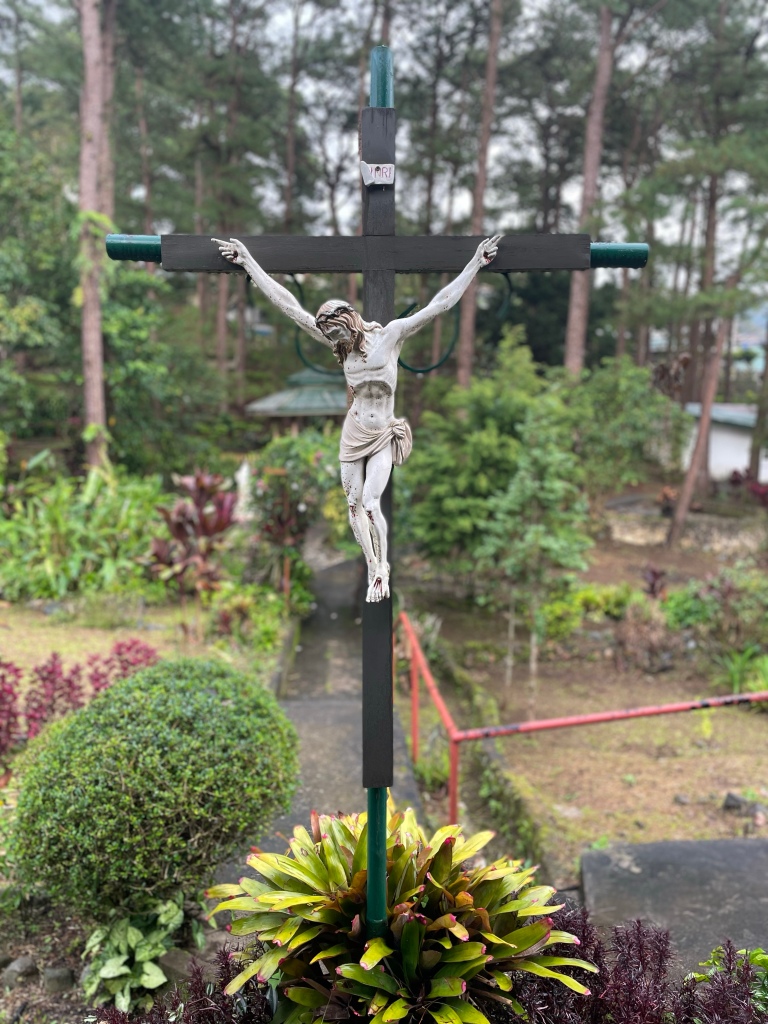
Photo by author, Baguio City, August 2023.

It happened when my best friend, Gil died in 2015. He asked me in February that year to pray for his long-delayed medical checkup; that same night, he called me again that his doctor had him confined for suspected cancer. After a series of tests, he had radiation then surgery after which followed his series of chemotherapy.

Gil cried a lot when diagnosed with cancer. He was angry and bitter with his sickness. And for a good reason because among us from high school seminary, he was the healthiest and most health conscious! I knew it because when news of that mad cow disease from Europe broke in early 2000, he stopped eating beef even burgers!

In mid September, her Ate Lily called me that doctors had told them Gil’s cancer cells were very aggressive and would have a short time to live. It was a Sunday and we his friends rushed to Makati Med that afternoon. I came to visit him for another three days before he died early Sunday morning, September 22, 2015.

It was during his final week in the hospital when he asked me for a “permission to die” (see our blog, https://lordmychef.com/2023/11/08/giving-permission-to-die/). Gil simply told me he was ready to go. His face was radiant and light, he was so at peace on his hospital bed as he gave me other final instructions for his kids and ex-wife.

I could not say anything except cried. And I cried so hard, especially as I anointed him with holy oil and prayed the commendation to the dying. It was from Gil that I realized the dying receive that special grace of knowing the end, possibly even of seeing heaven that is why they are always so composed like Jesus Christ on the Cross on Good Friday. I told him how I wish I could have that same courage in facing death when my time comes. He assured me God would give me that grace too.

From that experience, I realized when people get sick, they cry because that’s when death faced them. Who would not cry and be terrified? We their friends and family in turn, console them. The inverse happens when they approach death: they are so composed, we their family and friends are the ones crying. And the one dying are the ones consoling us! When they die, we cry. Why? Because we do not know what happens next, of what lies ahead when our loved ones are gone. Paano na tayong naiwan? That’s the saddest and scariest part of life when someone dear to us dies.

In 1999, St. John Paul II wrote a letter to his fellow elderly where he said that the grace of getting old is to be able to look back to the past with gratitude and to look forward to the future with joyful anticipation of eternity. That holy Pope must have been seeing heaven while still here on earth!

Photo by author, National Shrine of Our Lady of Fatima, 06 November 2023.

It is in death when we see its strange contrast with life, of how when we were born, we cried and kicked hard to be alive while those around us rejoiced with the gift of life; when we die, we do not cry because we are already joyful with the coming bliss while those around us are filled with grief and sadness, crying not only with our demise but because they do not know what lies ahead.

In both instances, we find the grace of God so pronounced, so present that indeed, St. Paul was absolutely right:

None of us lives for oneself, and no one dies for oneself. For if we live, we live for the Lord, and if we die, we die for the Lord; so then, whether we live or die, we are the Lord’s.

Romans 14:7-8

When we were growing up, there was a baby shampoo that advertised itself so mild that would not hurt your eyes, marketing itself with the words “No more tears”. It also played a commercial of a young boy going to shampoo his hair declaring, “a man should not cry” to bolster that old belief that crying is weakness.

At the sermon on the mount, Jesus taught us one of the beatitudes as “Blessed are they who mourn, for they will be comforted” (Mt. 5:4). I love using this gospel in funeral Masses. Where is the blessedness of mourning the death of a loved one? What is good with mourning, with crying?

Answer: love.

Blessed are those who mourn because they have love in their hearts. We cry at the death of a beloved because we love them. But, the greatest blessing we have when we mourn is from the love we have experienced from the one who had died. It is said that “if you have love in your heart, you have been blessed by God; if you have been loved, you have been touched by God.”

We are blessed when we mourn, when we cry at the death of a beloved because they loved us, they gave us a glimpse of God, they made us experience God’s love in their love! Is it not a tremendous blessing indeed?

We are so blessed these days that crying is no longer considered as a sign of weakness but actually of strength – the strength to live and the strength to forge on in life after the death of a beloved. Cheers to our tears that keep us alive! Have a wonderful weekend!
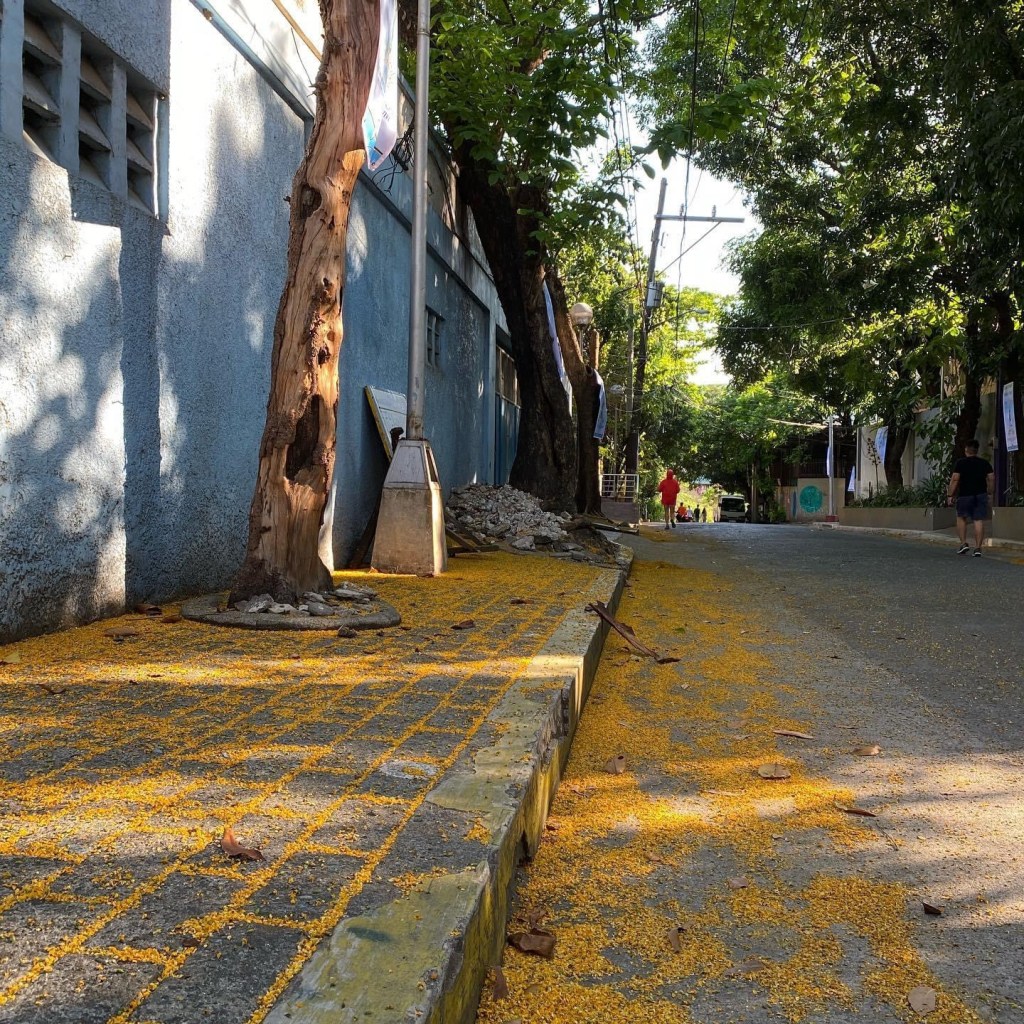
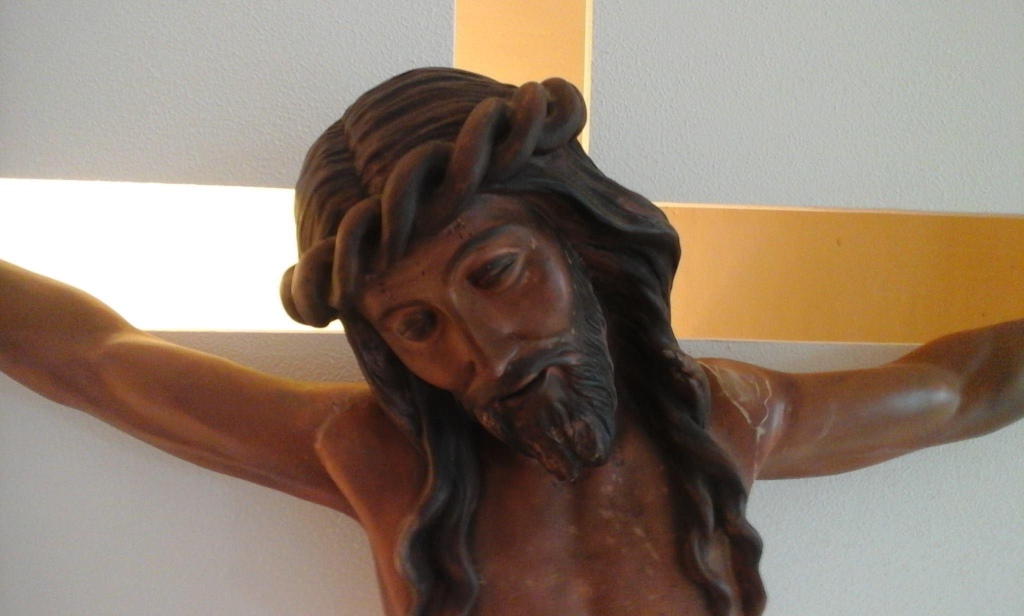
Photo by author, National Shrine of Our Lady of Fatima, Valenzuela City, 2021.

Dying well is living well

Quiet Storm by Fr. Nicanor F. Lalog II
The Seven Last Words, 07 April 2023
Photo by author, Chapel of the Holy Family, Sacred Heart Novitiate, Novaliches, Quezon City, 2014.

It was now about noon and darkness came over the whole land until three in the afternoon because of an eclipse of the sun. Then the veil of the temple was torn down the middle. Jesus cried our in a loud voice, “Father, into your hands I commend my spirit”; and when he had said this he breathed his last.

Luke 23:44-46

Do you have a “bucket list”, of things to do before turning a certain age or before dying? Very often we read in social media articles of sample “bucket lists”, of things to do, things to see, food to eat before one dies as if these are the ultimate things or cities or food in the world!

I am sorry I do not believe in such “bucket list” no matter how good is that movie of the same title. It is all non-sense! Why spend so much time and energies of things to do before dying or turning 50 or 60 or whatever age when we should be making the most out of every present moment because we could die any time!

We will all die one day for sure. But, will we die well? Our death is our most wonderful and lasting gift to our loved ones if we die for them and for others, if we lived a fruitful life we can leave for them. The question we should be asking is “how do we live our lives meaningfully now in the present so that when we die, our lives would continue to bear fruit in the generations that will follow us?” Stop wondering or asking about what we can do in the future or the years we have left to live because that is highly hypothetical. It has not happened yet and might not even happen at all if we die soon enough. Get real by living fully in the present! Coming to terms with death is coming to terms with life. The moment we realize we shall die one day, that is when we start living authentically. And joyfully.

Jesus died so well on that Good Friday because he was able to surrender everything to the Father and for us all because he lived fully that is why he was able to surrender or give or commend his spirit. How about us? How sad that many times our loved ones left us with much pain and regrets because we never fully lived with them nor enjoy precious moments with them while still alive. Live fully in love and joy, forgiveness and mercy. Celebrate life daily. Life is too short to spend it in dramas and wishful thinking.

At the hour of our death like Jesus on that Good Friday, can we also give others and God our spirit of love and mercy, our spirit of joy and kindness? Or, we are still busy thinking what else we can do in this life? What if we are called back to God now, at this very moment?

Let us pray.

Lord Jesus Christ,
grant me the grace to live 
my life in you,
with you,
and through you
to the fullest in every here and now
so that if ever I should die any moment,
I am able to commend to the Father 
my spirit back to him
without regrets,
without pains,
without sin
but only with joy and gratitude
that my loved ones would 
feel and nurture
until we all meet again
in your kingdom in heaven.
Amen.

Thank you for following our reflections on the Seven Last Words of Jesus on the Cross. May you have a meaningful Holy Week and a joyful Easter! God bless you!

Photo by author, 08 February 2023.

Believing, living like Mary

The Lord Is My Chef Daily Recipe for the Soul by Fr. Nicanor F. Lalog II
Monday, Solemnity of the Assumption of the Blessed Virgin Mary, 15 August 2022
Revelation 11:19, 12:1-6, 10 ><)))*> 1 Corinthians 15:20-27 ><)))*> Luke 1:39-56
Photo by Mr. Jay Javier, Acacias at UP-Diliman, April 2022.
Glory and praise to you,
Father, for this great solemnity
of Mary being assumed body and
soul into heaven to remind us
of our glorious future too
which she now enjoys ahead of
us all because of her fidelity and 
total submission to your will
in every stage of her life;
teach us like Mary to believe (Lk.1:45)
and live your Word who became flesh
for us in Jesus Christ.

May this faith in you prompt
us to go in sharing Jesus
with his love and mercy, 
kindness and compassion
to those doubting you, O God,
because of too much pains
and sufferings, poverty and sickness;
in this age when people believe more
in the lies peddled by social media
and advertisements, may our lives
mirror like Mary your truth and 
greatness, dear Father with our
loving service to the needy;
in this time of so many tribulations
like this pandemic with the ever growing
materialism of people that has given rise
and spawned so many social evils in the
name of wealth, power and fame,
lead us to the desert of prayers and
purification (Rev. 12:6) so we may receive 
and respond properly to the graces and 
blessings you pour upon us lavishly,
primarily Jesus whom we receive
Body and Blood in the Eucharist,
thus making us like Mary herself,
the bearer of Jesus!
Loving Father,
so many people are suffering
these days, many are about
to give up, many are so lost
that their only hope is heaven,
sometimes wishing death
as a way out, not as a way
through the Cross of Christ
who is our way, truth and life;
show us the way,
lead us like Mary
 by believing your words
and putting them into practice
so that even now,
in the midst of sufferings and
darkness, we may enable
the people to experience and
see our true destiny in eternity
while here.
Right now.
Amen.
“The Assumption of the Virgin” by Italian Renaissance painter Titian completed in 1518 for the main altar of Frari church in Venice. Photo from en.wikipedia.org.

On living and courage

Quiet Storm by Fr. Nicanor F. Lalog II, 21 July 2021
Photo by Pixabay on Pexels.com

A former classmate and friend from elementary school suddenly died of a heart attack last week. At his wake, everybody was saying of how they wish to die ahead of everybody just like Larry. “Mas gusto ko ako yung mauna” was the trending line of everyone’s conversation that there seemed a surge in courage with everyone bravely claiming readiness to die.

For me, it was like a déjà vu when suddenly it flashed to my mind our school discussions how we would prefer to die first than our parents. As kids, we were so afraid of living without parents that we deemed it better to be the first ones to die.

But, it did not mean we were not afraid of death nor of dying nor of living, too. We were just kids then.

Now that we have passed the half century mark of living, fast approaching the senior age, I think we know better the realities of life.

And of death.

On the surface, it seems that facing death and dying require super graces especially courage as we go into the threshold of the great unknown. But on deeper reflections, we realize that in dying, it could be really true that we have nothing to fear but fear itself because when we die, we don’t feel it anymore and would not even know it at all!

Death and dying can easily come to our minds when we are so hard pressed in life, when sufferings and pains are so unbearable that death wrongly becomes an escape, a cowardice than a courage no matter how hard others would romanticize it.


Yes, it takes a lot of courage to accept and face death 
but much more courage is needed to live than to die.

Yes, it takes a lot of courage to accept and face death but much more courage is needed to live than to die.

Living is different because it is filled with paradoxes unlike death that is clearly “the end” and the start of the great unknown, with or without God.

But for us believers, for those with faith in God, living in itself is already a tremendous grace to overcome all fears and difficulties of being alive than being dead.

More than ten years ago, I lost my best friend from high school to cancer. When he was first diagnosed, he cried a lot whenever we would visit him, clearly indicating his fears of dying. Six months after receiving intensive treatment from one of the best hospitals in the country, Gil finally accepted the inevitable after his doctors said his cancer cells were “so aggressive”.

On that final week of his life, I visited him thrice when I noticed a marked change in Gil as he would no longer cry, looking so calm and serene, so composed even in his manner of speaking. This time, I was the one who cried a lot whenever he spoke to me of his “habilin” or reminders upon his death. That is when I realized how God gives the courage needed to face death once the dying accepts it and surrenders one’s self to Him our Maker. That is when death becomes peaceful and a blessing too when the dying is able to make peace with everybody and with God almighty.

Photo by Ms. Ria De Vera, June 2021.

When somebody dies, we cry not only because of the pain of separation. Deep inside us is the fear of living alone without them. That is why we need more courage to live than to die because when you die, you do not feel anymore.

The pain of death is more felt by those living than by those dying, especially those blessed to have prepared for it like my friend Gil as they already knew where they were going while those left behind are still at a loss for directions in life.

Living, facing life’s challenges requires tough courage. Real courage.

Our drive or will to live and survive shows the great amount of courage and strength we muster from deep within we never knew we even have at all! That is why after hurdling every challenge we faced in life, we wonder how we did it, how we made it.

From Facebook, May 2020.

That’s because of courage.

Congratulate yourself! You are good. You are doing well.

Those bruises and scars are badges of courage, medals of valor in fighting, in living this life that prepares us to fullness in heaven with God.

For as long as you feel pains and sufferings, hardships and difficulties… you are alive! Rejoice and celebrate life! Make the most of it. You can surely make it because you are alive.

And there lies the beauty and greatness of life – we are enormously blessed to be alive, blessed with courage to go on living because we are meant for something. We have a mission. Do not lose sight of that immense blessing.

When Jesus faced his death, it was not cowardice but courage because his dying was meant to lead us all to living fully in him. Jesus is life himself when he said “I am the resurrection and life” (John 11:25).

On the Cross, Jesus showed us the realities of life- of joys and pains, of sickness and health, of poverty and wealth, of light and darkness, most of all, of life and death in our daily dying to old self and rising to new life.

On the Cross, Jesus showed us that life is living in courage that comes from him to be like him: standing for what is true and good, for what is just and fair, and most of all, for loving another more than one’s self!


"The real test of courage is in living, not in dying", 
according to the the Italian playwright 
and poet Vittorio Alfieri (1749-1803).  

“The real test of courage is in living, not in dying”, according to the the Italian playwright and poet Vittorio Alfieri (1749-1803).

Stop wishing and praying for death for it will surely come.

At the moment, activate that courage in you and start living life to the fullest.

Coming to terms with death is coming to terms with life and vice-versa. For us to have the courage to face death when that time comes means to have the courage first of all in living. It is a grace always in our heart which is in Latin called “cor”, the root of the word courage itself, meaning “coming from the heart”.

Have the heart – and courage to see and experience the many joys and beauty of life waiting for you! Don’t miss them.

Photo from intentionalinspirations.com

Loving like St. Joseph in the time of pandemic

40 Shades of Lent by Fr. Nicanor F. Lalog II
Friday, Solemnity of St. Joseph, Spouse of the Blessed Virgin Mary
2 Samuel 7:4-5, 12-14, 16  +  Romans 4:13, 16-18, 22  +  Matthew 1:16, 18-21, 24
Photo by author of the site believed to be the workshop of St. Joseph in Nazareth, 2017.

Today’s celebration of the Solemnity of St. Joseph as most chaste spouse of the Blessed Virgin Mary is a very special one being in the “Year of Saint Joseph” that began last December 8, 2020 until December 8, 2021 in commemoration of the 150th year anniversary of Pope Pius IX’s declaration of the beloved saint as Patron of the Universal Church.

In launching this Year of Saint Jospeh last year, Pope Francis wrote in his Apostolic Letter “Patris Corde” (With a Father’s Heart) how the COVID-19 pandemic has helped us see more clearly the importance of “ordinary” people who, though far from the limelight, exercise patience and offer hope every day.

The Holy Father explained that the “ordinary” people like those who kept our lives going especially during the lockdowns resemble Saint Joseph, “the man who goes unnoticed, a daily, discreet and hidden presence,” who nonetheless played “an incomparable role in the history of salvation” (Vatican News, 12 December 2020).

I really hope you can have time to read today this very short letter by Pope Francis who is a known devotee of Saint Joseph having popularized among us during his 2015 Papal Visit the image of “Sleeping Saint Joseph”.

In Patris Corde, Pope Francis gives us some helpful points on how we can love with the heart of God our Father like Saint Joseph during this time of the COVID-19 pandemic. One of these traits the Pope invites us to imitate from Saint Joseph is his “creative courage” in loving God and loving others.

If the first stage of all interior healing is to accept our personal history and embrace even the things in life we did not choose, we must now add another important element: creative courage. This emerges especially in the way we deal with difficulties. In the face of difficulty, we can either give up and walk away, or somehow engage with it. At times, difficulties bring out resources we did not even think we had.

Pope Francis, Patris Corde #5

A creative person is always someone who is deeply in love with another person or with one’s craft, art, career or whatever passion.

The most loving person is always the most creative like Saint Joseph who sought ways expressing his love for Mary and her child by deciding to silently divorce her as the gospel tells us.

This is how the birth of Jesus Christ came about. When his mother Mary was betrothed to Jospeh, but before they lived together, she was found with child through the Holy Spirit. Joseph her husband, since he was a righteous man, yet unwilling to expose her to shame, decided to divorce her quietly.

Matthew 1:18-19
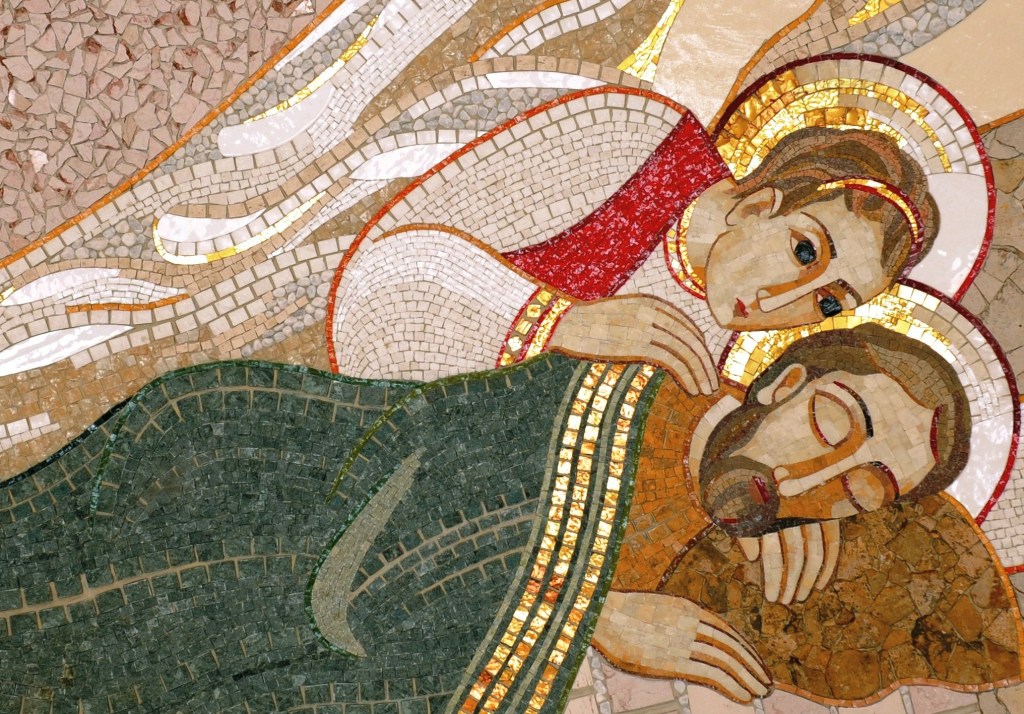
Photo by Arch. Philip Santiago of a mosaic at the San Padre Pio Shrine at Rotondo, Italy of the angel appearing to Saint Joseph in his dream.

Holiness is having creative courage like Saint Joseph.

Notice how the Pope’s description of Saint Joseph is not far from St. Matthew’s calling him a “righteous man” – a holy man – who obeys the Laws of God handed down to them by Moses, including their other traditions meant to keep them clean and pure before God.

Problem during that time is how people have lost sight of God and of others that they were so focused on the letters of the law than its spirit, becoming impersonal in the process as we have seen in instances when they would ask Jesus why he healed the sick even on sabbath day. Worst is when people brought to Jesus a woman caught committing adultery, reminding him of Moses’ instruction to stone her in public.

Such was the dilemma faced by Saint Joseph with Mary being pregnant with a child definitely not his!

In deciding to silently leave Mary, Saint Joseph expressed his righteousness or holiness wherein he showed the true interpretation of their Laws by upholding the dignity of every person, respecting life above all. Like Jesus Christ, Saint Joseph showed that real holiness is authentic love that is willing to sacrifice for the beloved by having the courage to be in pain in giving up or losing a beloved.

Here we find Saint Joseph was not only courageous in facing the painful truth about Mary having a baby not his but also very creative in the sense that because of his great love for the Blessed Virgin, he did not want her exposed to shame and public humiliation in allegedly breaking the seal of their betrothal.

Having courage is more than being able to do death-defying acts that is more on physical strength; courage is a spiritual virtue, a spiritual strength when we do extraordinary things because of higher ideals and values like the love of Jesus who offered us his life on the Cross.

Courage is from the Latin word “cor” for heart which is the seat of our being. And to have courage is to be true and loving that we have such expressions to speak from the heart, to listen to our heart, and to act from our heart when we dare to lose ourselves because of love.

Photo from Aleteia.org of “Let Mum Rest” image St. Joseph nursing the Infant Jesus while Mary sleeps, 2019.

A person who truly loves is always creative, 
finding ways in expressing one's love even sometimes 
it may be painful and difficult.

A “creatively courageous” person like Saint Joseph is someone so deeply in love with Mary and with God: after learning the circumstances surrounding Mary’s pregnancy, St. Matthew tells us “When Joseph awoke, he did as the angel of the Lord had commanded him and took his wife into his home” (Mt.1:24).

Saint Joseph’s love for Mary found ways to spare her all the pains and hurts that may result if found with a baby not his; but after learning the truth, the more we find him creatively courageous when he sought many ways to save Mother and Child from all harm and even death like bringing them to Egypt in the time of Herod.

See that when Saint Joseph accepted Mary, Jesus came forth to us while at the same time, when Saint Joseph accepted God through the angel as expression of his deep faith and love, he took Mary as wife.

And this is what Pope Francis further explains in Patris Corde that at the end of every account in which Saint Joseph plays a role, the Gospel tells us that he gets up and takes Jesus and Mary who are the most precious treasure of our faith.

Taking Jesus and Mary like Saint Joseph as creative courage calls us Christians to always love the Church and in loving the Church, we love the poor for whom Jesus came and Mary identified herself with in her Magnificat which she sang after accepting the Annunciation by the Angel of Christ’s birth which we celebrate next week on March 25.

In this time of the pandemic, we are called to be creatively courageous in finding Jesus among those people too familiar with us as well as with those so different from us. Don’t you find it so funny that the people we always take for granted are those either so close to us like family or completely strangers?

Being creatively courageous in this time of the pandemic means being more sensitive with others especially in our words and actions like Saint Joseph.

I was wondering during prayers why did he not ask Mary about the truth of her pregnancy so that he would have been spared with all the thinking and praying? That is when I realized the value of Saint Joseph’s silence: he did not speak at all to Mary as a sign of his love and oneness with her who must have been into some difficulties too with the situation of being the Mother of Christ. sympathy.

In his silence, Saint Joseph expressed his complete trust in Mary and in God. And in his being silent, Saint Joseph was creatively courageous expressing aloud his tenderness and care for Mary and her Child, something we need so much in this time of the pandemic.

Let us pray to Saint Joseph in this time of social distancing that like him, we may have the creative courage in touching others with the love of God, especially those who are sick and suffering, those in difficult situations, and those forgotten by their families and friends and even by the society. Have a blessed Friday, everyone!

Saint Joseph, Patron of the Universal Church, pray for us!

Photo from Vatican News, St. Joseph and the Child Jesus, 14 December 2020.

Active waiting, authentic living now

The Lord Is My Chef Sunday Recipe for the Soul by Fr. Nicanor F. Lalog II
Week XXXII-A in Ordinary Time, 08 November 2020
Wisdom 6:12-16   ><)))*>   1 Thessalonians 4:13-18   >><)))*>   Matthew 25:1-13
Photo from MediaNews Group/The Mercury News via Getty Images, 10 September 2020 during the widespread California forest fires.

Beginning this Sunday until the Solemnity of Christ the King three weeks from now, we hear from the gospel Jesus speaking of his Second Coming at the end of time to render judgement to everyone.

It is during this time as we come to close the liturgical year and begin the new one with the Advent Season four weeks before Christmas when the Church reminds us in our Sunday Masses the true meaning of Christ’s Second Coming that have disturbed so many people for 2000 years.

Throughout history, it has spawned many doomsday and apocalyptic scenarios among peoples everywhere, particularly religious fanatics and cult followers with disastrous aftermaths like bloodbaths and murders despite their being anchored in a religious belief in God.

Lately there is a growing trend among some people of preparing for the final end of the world without any belief in God but more based on “science” and pop cultures but still with some degree of violence too.

And between these two extremes of awaiting the end of time with and without God, we find a majority who do not seem to care at all!

Everything comes to an end in order to begin anew.

Last Sunday in our reflection on All Saints Day we have mentioned the tension of the here and not yet, of Jesus being here now and still coming again at the end of time we call parousia which we proclaim in every Mass after the consecration.

This tension was a big deal during the time of the early Church with many believers including the Apostles believing they would witness the return of Jesus in their lifetime; but, when many of them started to die without the Second Coming happening, they began to question and reflect on the nature of parousia. They wondered what will happen with those who have died already and those left behind still alive when Christ comes again?

We do not want you to be unaware, brothers and sisters, about those who have fallen asleep, so that you may not grieve like the rest, who have no hope. For if we believe that Jesus died and rose, so too will God, through Jesus, bring with him those who have fallen asleep… we who are still alive, who are left until the coming of the Lord, will surely not precede those who have fallen asleep… will be caught up together with them in the clouds to meet the Lord in the air. Thus we shall always be with the Lord. Therefore, console one another with these words.

1 Thessalonians 4:13-14

From St. Paul’s reflections developed what we call escathology, that branch of theology dealing with the end of time and everything related with it like general and particular judgements, death and resurrection, parousia or Second Coming of Christ at the end of time.

It was St. Paul who insisted the centrality of Christ’s resurrection upon which is also hinged the resurrection of the dead and of his parousia (1Cor.15:14) which we call as mystery of our faith. For him, Christ’s resurrection is the beginning of the resurrection of the dead, the beginning of the end time; therefore, the end is something we shall not fear but in fact be excited with because it is the final victory of God over sin and death. Yes, Christ had definitively won over death at the cross but it is on his Second Coming when death and sin are final vanished to give way to new heaven and new earth.

Everything will come to an end not to simply terminate all but in order to bring forth new beginnings! And the key is authentic living in every here and now.

From a post at Facebook, 2018.

Live in the present, not future; focus on life, not on dates.

It is sad when many among us Catholics specially those who celebrate Mass every Sunday acclaiming “Christ will come again” are the ones so afraid of end time, always asking for the blessing of their candles in the belief that these would save them from days of darkness.

Wrong! What will truly save us on judgement day is our firm faith in Jesus Christ, not blessed candles. Most of all, what will truly save us on judgement day is to live daily as authentic Christians witnessing the gospel values of Jesus Christ our Savior and Judge.


In today’s parable of the ten virgins awaiting the arrival of the groom, the Lord wants to instill among us the need to focus on the present moment of our lives not on any particular time or date because nobody knows when he would come like the groom in a wedding.

Jesus told his disciples this parable: “The kingdom of heaven will be like ten virgins who took their lamps and went out to meet the bridegroom. Five of them were foolish and five were wise. The foolish ones, when taking their lamps, brought no oil with them, but the wise brought flasks of oil with their lamps.

Matthew 25:1-4

We are all the virgins awaiting the coming of the groom for the wedding. We all came from God and we are designed to return to him in the end for eternal life. Here I find the late Stephen Covey so real in teaching us to always begin with the end in sight which is heaven. In one of his writings, he said “We are not human beings on a spiritual journey; we are spiritual beings on a human journey.”

In 2012, we were shocked when we heard news how he fell from a bicycle in an apparent accident and a few days later, he died. In an instant I have felt how this layman who strongly advocated the infusion of values into business and management is after all a saint, perhaps now in heaven.

His seven habits of highly successful people are all anchored in meaningful, authentic living in the present. That is being wise, of bringing extra oil of charity and kindness and goodness in life while actively waiting the coming of the groom, the coming of our death and end. Habit is something that is good we always do; its opposite is vice. (Stop saying bad habits.)


Life is keeping our lamps burning even if it produces little light than be extinguished and be plunged to total darkness. Nobody is perfect; we all have our lapses in life that is always in darkness. Like those virgins in the parable, wise and foolish alike, we feel drowsy and fall asleep.

Photo by author, Holy Thursday Mass, 2020.

Since the bridegroom was long delayed, they all became drowsy and fell asleep.

Matthew 25:5

Therefore, all the more we need to be wise, not foolish. Being wise is always seeking and following the will of God who is Wisdom himself.

In the first reading, we are told how Wisdom as the personification of God himself can always be had by anyone sincerely searching for him.

Resplendent and unfading is wisdom, and she is readily perceived by those who love her, and found by those who seek her. She hastens to make herself known in anticipation of their desire; whoever watches for her at dawn shall not be disappointed, for he shall find her sitting by his gate.

Wisdom 6:12-14

To seek and obtain wisdom is to have pure or clean hearts that try to seek what is good, free of carnal desires and worldly allurements. Again, the need to have even the faintest light than be in total darkness.


So often, many things in our lives are decisively won – or lost – in a spur of the moment, in single crucial moments when everything comes to the fore. Woe not to those caught asleep but not ready or prepared, ill-equipped for the demand of the moment.

At midnight, there was a cry, ‘Behold, the bridegroom! Come out to meet him!’ Then all those virgins got up and trimmed their lamps. The foolish ones said to the wise, ‘Give us some of your oil, for our lamps are going out.’ But the wise ones replied, ‘No, for there may be not enough for us and you. /go instead to the merchants and buy some for yourselves.’ While they went off to buy it, the bridegroom came and those who were ready went into the wedding feast with him. Then the door was locked.

Matthew 25:6-10
Photo by author, Baguio Cathedral, January 2018.

See how in the parable where everything was similar and the same: ten virgins with lamps becoming drowsy and falling asleep in the night waiting for the groom. Everything changes at midnight with the announcement of the arrival of the groom where the wise virgins were clearly distinguished from the foolish. The wise had extra oil and came into the wedding with the groom, leaving behind the foolish who had to buy for oil in the dead of the night only to return with doors locked, leaving them outside.

This is life in a nutshell: being ready when opportunity strikes is not based on luck but hard work.

And that is the saddest and difficult part we always take for granted: life is often decided on short, instant moments that in a snap of a finger can decide our rising or downfall.

This pandemic is an eye opener for everyone that caught so many of us unprepared.

Any extra oil kept in this time of the corona has proven so wise for some who have adjusted so well in the situation, coping and even managing so well amid the crisis.

What is so disappointing, even appalling are the foolish who chose to wallow in their follies, whining and blaming everyone for the troubles and mess without admitting their own shortcomings.

Let us heed the Lord’s call to “stay awake, for you know neither the day nor the hour” (Mt.25;13) by living authentically as his disciples in every here and now. Amen.

A blessed Sunday and week ahead to everyone!

Photo by author, 22 September 2020.

On being kind and loving during COVID-19

Quiet Storm by Fr. Nicanor F. Lalog II, 02 October 2020
Photo by author, resthouse in Silang, Cavite, 22 September 2020.
Methinks the saddest thing of this pandemic
is not in the restrictions it had imposed on us
from social distancing to other methods of quarantine
but more on the restrictions we have within
when we can be more loving and kind with others
then still choose to be harsh and brash.
We wash our hands to be clean
but the virus of sin clings deeper than skin
when forgiving or apologizing
can wash away that sting
of any guilty feeling within.
Even if we have to maintain social distancing
it does not mean we have to be apart;
it would be wonderful and most amazing
to everyone's part if we can let our hearts
sing the feelings deep inside like
"I love you, I miss you, I care for you"
than wring all the aching 
and sufferings we are enduring.
Lastly, always put on your masks
for everyone's safety
but let us trust and bask
in the warmth of our humanity
to keep our sanity.
In this time of COVID-19
when death is no longer lurking
but closing into our very being, 
let us be more of feeling than of thinking,
loving and caring, affirming each other
enjoying life together.
Photo by author, antique door of a resthouse in Silang, Cavite, 22 September 2020.

“Something’s gotta give”

The Lord Is My Chef Breakfast Recipe for the Soul by Fr. Nicanor F. Lalog II
First Friday, Week XVIII, Year II in Ordinary Time, 07 August 2020
Nahum 2:1, 3, 3:1-3, 6-7 >><)))*> || + || <*(((><< Matthew 16:24-28
Photo by Mr. Raffy Tima, Batanes, 2018.

While praying on your words today, O Lord, thoughts of the beach came through my mind. I do not know why; maybe this is the only year when I would have not gone to a beach that I miss so much.

But, as my former spiritual director during our 30-day retreat, the late Fr. Arthur Shea, SJ, used to assure me, “the most difficult prayer is always the most meritorious”.

Indeed, sweet Jesus!

Like your prophet Nahum in the first reading looking forward to the defeat of Nineveh, I remembered those days in the past when I felt so fearful on many occasions whether I can overcome the many trials and challenges that have come my way.

See, upon the mountains there advances the bearer of good news, announcing peace! Celebrate your feasts, O Judah, fulfill your vows! For nevermore shall you be invaded by the scoundrel; he is completely destroyed. The Lord will restore the vine of Jacob, the pride of Israel, though ravagers have ravaged them and ruined the tendrils.

Nahum 2:1, 3

Like Judah, I have won and prevailed in my many battles in life in your power, Lord, when I entrusted myself to you totally.

When I look back in my life, it is so true that it is in giving that we receive, it is in losing when we have, and it is dying when we truly live. That is the lesson of the waves at the beach that keep on coming to shore, as if trying to take it to the sea.

Photo by Mr. Jim Marpa, 2019.

How I wish I could be like the sea, always moving, always light without anything except water unlike the shore that is so adamant as if it would never budge in.

But in reality, it is the sea that always prevails because water is always willing to give up itself to follow the form of the shore, to take the shape of every container where it is poured while the shore through time, its sand and rocks eventually give into the waves to get lost in the sea.

Jesus said to his disciples, “Whoever wishes to come after me must deny himself, take up his cross, and follow me. For whoever wishes to save his life will lose it, but whoever loses his life for my sake will find it.

Matthew 16:24-25

Dearest Jesus Christ, teach me to give up myself to you completely. Teach me to learn to get lost to you in order to find myself, to find fulfillment in life.

This COVID-19 pandemic reminds us today in this age of abundance and affluence that still — the key to authentic living is in giving up, in having less.

As they always say, “something’s gotta to give”. Amen.

Forgetting God

The Lord Is My Chef Breakfast Recipe for the Soul

Wednesday, Week XXXII, Year I, 13 November 2019

Wisdom 6:1-11 ><)))*> <*(((>< Luke 17:11-19

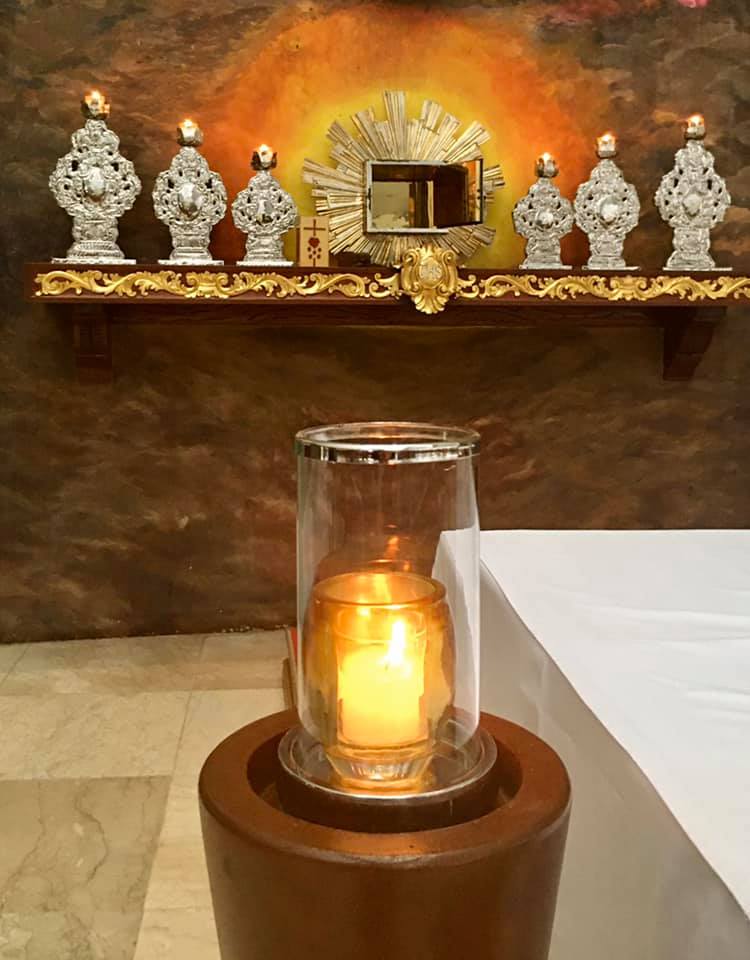
Altar of the Carmelite Monastery, Guiguinto, Bulacan, 12 November 2019.

Lord Jesus Christ, forgive us when most of the time we are more like the nine other lepers you have healed than the lone Samaritan who returned to thank you.

How easily we could forget your goodness and kindness to us!

Worst, when we are strong and powerful, in total control of almost everything in life, we deliberately forget that we share only in your authority.

Let us heed your reminder today:

Hear, O kings, and understand; learn, you magistrates of the earth’s expanse! Hearken, you who are in power over the multitude and lord it over throngs of peoples! Because authority was given you by the Lord and sovereignty by the Most High, who shall probe and scrutinize your counsels!

Wisdom 6:1-3

May we come out clean and pure before you in our exercise of your power and authority. Amen.

Hope surprises

The Lord Is My Chef Breakfast Recipe for the Soul

Tuesday, Week XXX, Year I, 29 October 2019

Romans 8:18-25 ><)))*> ><)))*> ><)))*> Luke 13:18-21

Photo by Life Of Pix on Pexels.com

But hope, says God, that is something that surprises me…

And my grace must indeed be an incredible force.

Charles Peguy, “The Portal of the Mystery of Hope”

Whenever I come across the word “hope”, O Lord, I always remember this lovely poem by your faithful writer Charles Peguy (1873-1914) of France.

And I agree with Peguy, hope is your favorite virtue because it always surprises you and everybody else!

Again Jesus said, “To what shall I compare the kingdom of God? It is like the yeast that a woman took and mixed in with three measures of wheat flour until the whole batch of dough is leavened.”

Luke 13:20-21

Hope surprises us, Lord, because it is often so small, almost negligible for some.

And that is how you work, how your wonders perform, Lord.

Hope is not positive thinking because hope is still believing in you even if things do not get any better at all. In fact, things can get worst and that is when hope surprises us!

St. Paul said it so well.

For in hope we were saved. Now hope that sees for itself is not hope. For who hopes for what one sees? But if we hope for what we do not see, we wait with endurance.

Romans 8:24-25

In positive thinking, we hold on to at least something tangible, something we can see and feel clearly like the weather or the stock market.

But in hope, we only have you, Lord, whom we cannot see but can simply feel, believe and rely on that we hope would always remain and be still with us til the end.

In this world when size always matters, when everything has to be bigger and biggest, what remains true is the fact that no matter how big or great is anything, it surely came from a minute, little something.

Like the yeast that has become a wonderful bread or any baker’s creation.

Nobody had seen how it would turn out except that hope in one’s heart and mind that teases us with something big and wonderful and surprising.

Please surprise us today, Lord and let us live differently in you! Amen.

From Google.