The Lord Is My Chef Daily Recipe for the Soul by Fr. Nicanor F. Lalog II
Friday in the Thirty-Fourth Week in Ordinary Time, 25 November 2022
Revelation 20:1-4, 11-22:2   ><]]]'> + ><]]]'> + ><]]]'>   Luke 21:29-33
God our loving Father,
your words today spoken both by
John and your Son Jesus Christ
are frightening at first hearing;
but, as we dwell more on your words,
we are comforted because your promised
end of the world is the beginning
of "new heaven and new earth"
(Revelation 21:1-2);
it has started coming already
in the birth of Jesus Christ
as we join the psalmist
in proclaiming this wonderful truth,
"Here God lives among his people"
(responsorial psalm).
"My soul yearns and pines for
the courts of the Lord.
My heart and my flesh
cry out for the living God.
Even the sparrow finds a home,
and the swallow a nest in which
she puts her young ---
your altars, O Lord of hosts,
my king and my God!
Blessed they who dwell in your house!
Blessed the men whose strength
you are!"
(Psalm 84:3, 4, 5, 6)
Despite the many trials
and sufferings we have been going
through, you never ceased to
guide us to life and fulfillment
in you through Jesus Christ.
Make us aware and conscious
of your presence among our brothers
and sisters especially those in pain
and in the margins;
may our eyes,
our minds,
and our hearts
be open to your presence
in everyone we meet inasmuch
as we can read the signs of
the fig tree and other trees
(Luke 21:29-30);
may we stop for a while
in our tasks and duties
to feel each one's humanity
and personhood to find you
and experience you.
Amen.
The Lord Is My Chef Daily Recipe by Fr. Nicanor F. Lalog II
Wednesday in the Thirtieth Week of Ordinary Time, Year II, 26 October 2022
Ephesians 6:1-9   ><]]]]'> + ><]]]]'> + ><]]]]'>   Luke 13:22-30
Photo by author, Baguio Cathedral, 2019.
Bless me, dear Jesus,
and forgive me for being like
that someone in the gospel
who asked you, "Lord, will only
a few people be saved?"
(Luke 13:23); many times
I am that someone in the
crowd, so eagerly feeling inside
you would answer with a
resounding "yes" to my
question, feeling that I am one
of those few who would be
saved because I belong
to your chosen ones,
the ones "who ate and drank
with you, the ones you taught
in the streets" (Luke 13:26).
Forgive me Lord Jesus
for feeling so entitled;
let me realize your Kingdom
is not about affiliations nor
about the company we are with
but more of the path we take
in life, your path of the Cross.
He answered them, “Strive to enter through the narrow gate, for many, I tell you, will attempt to enter but will not be strong enough. After the master of the house has arisen and locked the door, then will you stand outside knocking and saying, ‘Lord, open the door for us.’ He will say to you in reply, ‘I do not know where you are from.”
Luke 13:24-25
Entering heaven,
being a part of your
Kingdom, dear Jesus
is keeping our relationships
Christ-centered that begins
right in the family, to our parents,
of parents to children, of siblings
among each other, and with those
in the household.
How sad, dear Jesus,
when we all desire of heaven
when we make a mess of our
family life when couples are
unfaithful to each other,
when parents wrongly pursue
wealth not realizing their children
are their greatest riches,
when siblings compete with one
another instead of loving each other,
and when children do not care at
all to their parents.
O Lord Jesus Christ,
as we count the days
until Christmas,
make us realize you
came to bring salvation
to the world by coming
through the husband and
wife of Joseph and Mary;
when you came to save us,
you opened the narrow gate
to salvation there on the Cross
with your Mother and beloved
disciple standing until the end.
Let us strive to enter
through your narrow gate,
Jesus, that is found first
in our own family.
Amen.
The Lord Is My Chef Daily Recipe for the Soul by Fr. Nicanor F. Lalog II
Tuesday in the Thirtieth Week of Ordinary Time, Year II, 25 October 2022
Ephesians 5:21-33   ><000'> + ><000'> +><000'>   Luke 13:18-21
Photo of my altar in my room taken in 2021.
Praise and glory to you,
O Lord Jesus Christ!
Thank you for coming,
for dying and rising for us,
in being the sole basis of
all of our relationships;
so many times,
we forget this grace
you have given us,
not realizing this great
"mystery" of your loving
presence in us and among us.
Brothers and sisters: Be subordinate to one another out of reverence for Christ. Wives should be subordinate to their husbands as to the Lord. Husbands, love your wives, even as Christ loved the Church and handed himself over for her… This is a great mystery, but I speak in reference to Christ and the Church. In any case, each one of you should love his wife as himself, and the wife should respect her husband.
Ephesians 5:21-22, 25, 32-33
Your words today,
O Lord through St. Paul
are not only meant for
married couples
but for everyone
who believes in you,
who follows you,
and loves you -
that to be a Christian
means to see everyone
as a brother and sister
in you, Jesus the Christ.

How sad that some
couples today even try
to disregard and tone down
the real meaning of this
admonitions by St. Paul,
devising their own kind
and meaning of marriage
and relationships that
disregard its giftedness
and holiness, of being
open to life, literally
and figuratively speaking.
May we keep in mind
your beautiful lesson of the
Kingdom of God
that may be compared to
a mustard seed or yeast
mixed with flour, of how
everything in you and about
you Jesus begins small;
open our minds and our hearts
to your divine realities that
always begin and happen
in little things like simple
gestures of kindness and
goodwill to others,
so ordinary, so hidden yet
so wonderful as it could grow
and blossom into great relationships
if we could just find and
recognize you on the
face of everyone we meet,
especially on the people
you send us always.
Amen.
The Lord Is My Chef Sunday Recipe for the Soul by Fr. Nicanor F. Lalog II
Twenty-Seventh Sunday in Ordinary Time, Cycle C, 02 October 2022
Habakkuk 1:2-3, 2:2-4 ><}}}}'> 1 Timothy 1:6-8,13-14 ><}}}}'> Luke 17:5-10
Photo by Ms. Ria De Vera, Christ the King Celebration in our former parish assignment, November 2020.
Our gospel this Sunday may be short and brief but so power-packed that can put us into a knock out. In fact, the scene is very disarming that can throw off all our previously held beliefs to give us fresher perspectives on discipleship and faith.
Recall how these past consecutive Sundays that Jesus taught us the importance of God and persons above material wealth like money and possessions. Notice how these lessons were directed by Jesus to the Pharisees and scribes who were known as so obsessed with money. Hardly did we hear any reactions from the Twelve – nor from most of us – until now when they asked Jesus to “increase our faith” (Lk.17:5).
The apostles said to the Lord, “Increase our faith.” The Lord replied, “If you have faith the size of a mustard seed, you would say to this mulberry tree, ‘Be uprooted and planted in the sea,’ and it would obey you.”
Luke 17:5-6
Photo by Dr. Mylene A. Santos, MD, 2021.
When we talk of faith,
it does not really matter how long
we have known each other,
or how much we have given and received,
or how much we have shared.
Faith is being one, being together,
of going the extra mile
because we believe, we trust, we love.
What elicited a reaction from the apostles? Or from us? Let’s admit the fact that many of us have felt the parables last two Sundays were not directly meant for us considering our professed “poverty” and “simplicity” in life. But, when Jesus spoke of the need to forgive those who sin against us every time they come saying sorry, the apostles realized that needed a lot of faith.
And rightly so.
When it comes to hurting our pride and ego, something deeper is at play, something so close to our person is involved than when we lose a material thing. Like the apostles, we have felt how much faith in God is demanded from us to forgive especially those who repeatedly offend us, that on our own we cannot do it.
Photo by Dr. Mylene A. Santos, MD, 10 September 2022.
Hence, their request (that is also ours) to “increase our faith” because forgiving requires a lot of faith, a lot of love; however, faith is like love that cannot be quantified nor measured because like love, faith is also a relationship.
Our relationship with God and with one another is seen always in the kind of intensity we have for each other. My generation used to call it as “vibes” or vibrations, of how we are one with the other person, of how we are in communion or aligned and attuned with the other person. When we talk of faith, it does not really matter how long we have known each other, or how much we have given and received, or how much we have shared. Faith is being one, being together, of going the extra mile because we believe, we trust, we love.
This is the reason that Jesus followed up his answer to the Twelve’s request with a parable of the unworthy servants who came home after working from the field and still waited on their master at dinner; then, after fulfilling their tasks, they simply told their master “We are unprofitable servants; we have done what we were obliged to do” (Lk. 17:10). There was no real relationship between the master and slaves except their job or task and responsibility. If it were a faith relationship, the servants would have done more than just waiting on their master because they would have believed in him!
When our faith is true, when our faith is burning like the reminder of St. Paul to Timothy in the second reading, it means we are focused with the object of our faith who are God and our loved ones. We need not be reminded of things to do, of our obligations; when there is faith in us, our focus is keeping the relationship alive and well that we go the extra mile in lovingly serving our loved ones which is discipleship is all about.
That is how faith as a relationship
 may be described these days:
like an online class, an online meeting,
even online Mass when sometimes
you really wonder if there is somebody listening
 or paying attention at the other side of the screen
 but you just go on...
Photo by author, Makati skyline from Antipolo, August 2022.
People who are deeply in love are first of all one with their loved ones that they are able to do great things because of their intense and vibrant faith that keep them united. With a burning faith inside us, we are able to love the unloveable, forgive the most despicable, achieve what others claim as impossible.
Just think of the saints like St. Mother Teresa of Calcutta or the very young St. Therese of the Child Jesus. Or, the great martyrs of Auschwitz, St. Teresa Benedicta of the Cross (Edith Stein) and St. Maximilian Kolbe. There is no way of measuring how much faith they have in Jesus Christ and humanity but we can learn from their lives the intensity of their faith and love for God and others that they did the impossible!
Very interesting was the faith too of the late Mother Angelica who founded and started EWTN that is now the largest Catholic media organization in the world. She knew nothing about broadcasting yet, all she had was faith in God and in people that she was able to overcome every obstacle to make what EWTN right now.
Think of the big corporations and enterprises around you; they all started so small in material resources but so intense in faith and conviction that they have all grown to become the leading institutions in whatever field they are into. Sometimes, believers are described as visionaries because people with deep faith see beyond what others can perceive. Remember how Jesus would remind his apostles on different occasions to “believe so that you will see” that runs opposite what the world tells us with “to see is to believe”. People who are faithful, those who believe are the ones who can truly see, not the other way around. Faithful people have vision.
Photo by author, Pangsinan, April 2022.
Prayer is the primary expression of our faith as a relationship that we just keep on doing because we believe it is good even if it is so difficult especially when nothing seems to be happening at all. We just keep on praying, believing and hoping that God is with us, very similar to our online experiences these past two years of the pandemic when many times, we wonder if there is somebody listening or paying attention at the other side of the screen! But, call it faith and relationship that we just went on with our classes and work including prayers and Masses online because we believe someone, especially God, is at the other side, even beside us!
We have not seen God but we have all experienced his love and kindness, his mercy and forgiveness that even if nothing happens like Habakkuk in the first reading, we just keep on praying (and loving) because our relationship remains intact with God who is faithfully by our side.
When our faith is alive and vibrant, we get closer to God and with others, we become more loving and caring and kind, understanding and patient and forgiving, finding ways and means to love and serve God in others.
God knows what is best for us. He has gifted us with enough faith. Let us ask him not just to increase our faith but most of all, to deepen, strengthen, and perfect our faith so that our ties and bonds as family and friends and community of disciples be stronger in Jesus Christ, both in good times and in bad. Amen.
Have a blessed week ahead!
Photo by author, Sacred Heart Spirituality Center, Novaliches, QC, 2014.
Lawiswis Ng Salita ni P. Nicanor F. Lalog II, Ika-28 ng Setyembre 2022
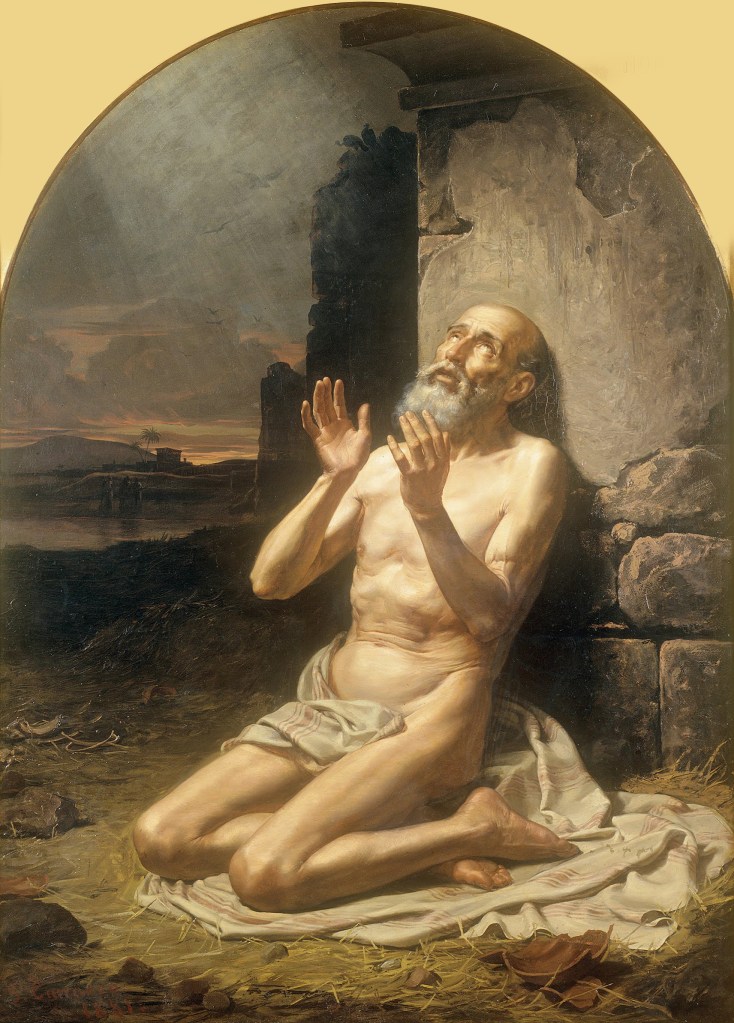
Larawan mula sa commons.wikimedia.org ng painting na “Job on the Dunghill” ni Gonzalo Carrasco ng Mexico noong 1881.
O Panginoong ko,
turuan mo ako na tularan
si Job na iyong lingkod,
tapat at walang pasubali
pananampalataya sa iyo;
katulad ni Job
ako man ay makadaing sa Iyo
ng buong giliw at pagtitiwala
sa dinaranas na hirap at hilahil;
katulad ni Job
ako man ay magsuri at magnilay
sa Iyong kadakilaang taglay,
magtanong at makinig,
manahimik at namnamin
kaysa Ikaw ay usisain;
katulad ni Job
mapagtanto ko mga
katanungan sa buhay ay
hindi tulad ng mga tanong sa paaralan
mga sagot ay kaagad matatagpuan
sa Google o sa computer
o sa pormula ng matematika;
katulad ni Job
hayaan mo po ako na mabalot
ng Iyong hiwaga Panginoon
patuloy na tumugon sa
maraming paghamon
na sa tamang panahon,
ako man ay makaaahon
matatag at dalisay
aking katauhan
matalik ang ugnayan
sa Iyo at sa kapwa nahihirapan;
katulad ni Job
mas nanaisin ko rin
na lumakad sa gitna ng dilim
hindi ka man tanaw ng aking paningin
basta Ikaw ang kapiling
kaysa tumahak sa huwad na liwanag
ng mundo, lugod at bisyo ang gusto!
Hitik sa mga kahulugan ang talinghaga ng mayaman at ni Lazaro noong araw ng Linggo (Lukas 16:19-31). Kaya namang aking napag-isipan ano nga kaya at sumulat si Lazaro doon sa mayaman? Ano kaya kanyang sasabihin?
Isang kathang-isip lamang ang liham na ito katulad na rin ng talinghaga ng Panginoong Jesu-Kristo. Gayon pa man, batay ito sa mga kuwento na aking pinakinggan at pinagnilayan mula sa mga tao na aking nakadaupang-palad sa mahabang panahon bilang pari. Sinikap ko na mahabi kanilang mga istorya ng buhay na parang hibla ng sinulid upang maging isang telon na maglalarawan ng iba’t-ibang mukha ni Lazaro at ng mayaman.
Wala akong pinatatamaan maliban sa maihatid mahalagang mga aral ng naturang talinghaga ukol sa buhay at kamatayan na tila nalilimutan na ng maraming pamilya at mag-anak kung saan maraming mayaman at Lazaro na nakalupasay, pinababayaan at tinalikdan.
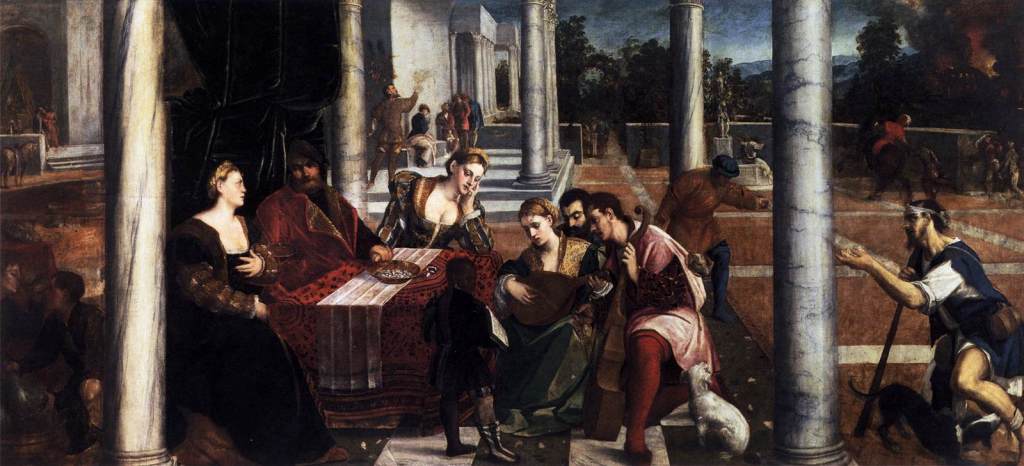
Sinabi ni Jesus sa mga Pariseo, “May isang mayamang nagdaramit nang mamahalin at saganang-sagana sa pagkain araw-araw. At may isang pulubing nagngangalang Lazaro, tadtad ng sugat, na nakalupasay sa may pintuan ng mayaman upang mamulot kahit mumong nahuhulog mula sa hapag ng mayaman. At doo’y nilalapitan siya ng aso at dinidilaan ang kanyang mga sugat.
Lukas 16:19-21
Larawan ng painting ni Bonifacio de Pitati noong 1540 ng “Dives and Lazarus” mula sa commons.wikimedia.org.
Minamahal kong mayaman,

Ako nga si Lazaro at sumusulat ako sa iyo na manhid at ayaw pumansin sa akin dahil ako ay tadtad ng sugat sa buong katawan, nakakadiring tingnan sa aking karumihan at kawalan ng kagandahang mabanaagan dahil ako ay naiiba sa iyo na kinikilala at maraming kaibigan, malakas at malinis.  Kung tingnan.

Mabuti pa ang aso, napapansin ako, dinidilaan aking mga sugat na kailanma'y hindi niya mauunawaan pinagmulan at naging mga sanhi, na pawang mga tao ang may kagagawan.

Isang bagay lang ibig kong ipahayag sa iyo, kapatid ko na mayaman:  sapat na bang dahilan na ako ay iyong talikuran at kalimutan dahil lamang sa ilang halaga ng salapi, mga gamit at ari-arian gaya ng kapirasong lupa na higit pa ang sukat sa ating libingan?

Dahil lamang sa magkakaiba nating paniniwala at sa iyong sariling katuwiran na hindi mabitiw-bitiwan ay ipagpapalit mo ako na kapwa tao gaya ng iyong ina o ama, at kapatid?

Madalas, ako si Lazaro yung magulang na kung ituring ng mga anak ay kontra-bida sa buhay nila.

Ikaw iyon, kapatid kong mayaman.

Ikaw iyong bata, yung anak na sadyang mayaman sa kaalaman at kahusayan sa maraming bagay ngunit hindi kailanman sasapat ang mga iyan upang tayo ay mabuhay; mahalaga ang mga kapwa, lalo na mga magulang na nagpalaki at nag-aruga sa atin, mga kapatid na kasabay nating lumaki at lumago, nagkamalay sa mundo, kasama at kasalo sa maraming pagkakataon ng buhay.

Walang perfect love maliban sa pag-ibig ng Diyos; ano man mga nakaraan ikaw ay nasaktan kung maari ay lampasan, pag-usapan, at magpatawaran.

Saan mang tahanan, maraming mga desisyon ang mga magulang na hindi nagugustuhan at marahil hindi rin naunawaan hanggang ngayon; sakaling nagkamali man mga magulang, hindi ba ang mga iyon din ang nagpatibay at nagpatatag upang mga anak ay maging mayaman?  Bakit sila ngayon ang iniiwan, mga Lazaro na nakalupasay sa pintuan na hindi pinapansin, ipinagpalit sa ego at prinsipyo?

Hindi ito drama dahil ang totoo, darating ang panahon tayong lahat mamamatay.

Huwag nating hintayin tulad sa talinghaga ng Panginoon na malibing at mabaon ang mayaman doon sa Hades; ibig mo ba talaga na tayo ay magkahiwalay hindi lamang sa daigdig kungdi hanggang sa kabilang buhay?

Huwag mo nang hintayin, kapatid ko na mayaman na matanawan ako, si Lazaro kapiling ni Abraham, walang dusa at sakit sa kabilang buhay habang ika'y hirap na hirap, kumakaway, tumatawag gayong kakilala mo naman pala ako.  Gayun din naman, kakilala mo rin pala si Amang Abraham --- kung gayon, ikaw ay Kristiyano katulad ko, kilala si Kristo, sumasamba sa Diyos nating Ama!  Bakit hindi mo ako nakilala noong tayo ay nabubuhay pa?

Bahala ka kung ayaw mo pa rin akong pansinin; ito na lamang iiwanan ko sa iyo, higit sa lahat:  huwag kang umasa at maniwala sa ilusyon na makapagbabago ka pa sa tamang panahon lalo na kung kapani-paniwala ang magsasabi na mayroon nga buhay sa kabila!  Ilusyon lang yan na may oras pa upang magbagong-buhay....

Habang maaga pa, magbalik-loob sa Diyos upang siya ay matagpuan at makilala sa mukha ng bawat kapwa, lalo na sa mga Lazaro na tadtad ng sugat ang katawan, nakalupasay sa iyong harapan.


Lubos na gumagalang,

Lazaro
(Mula sa salitang Hebreo
"El 'azar", ibig sabihi'y
"sinagip ng Diyos".)
Larawan kuha ni G. Jay Javier sa Taal, Batangas, 15 Pebrero 2014.
Lawiswis ng Salita ni P. Nicanor F. Lalog II, Ika-26 ng Setyembre 2022
Larawan mula sa bloomberg.com ng isang homeless sa New York habang dinaraos noon ang fashion week, 2019.
Sinabi ni Jesus sa mga Pariseo, “May isang mayamang nagdaramit nang mamahalin at saganang-sagana sa pagkain araw-araw. At may isang pulubing nagngangalang Lazaro, tadtad ng sugat, na nakalupasay sa may pintuan ng mayaman upang mamulot kahit mumong nahuhulog mula sa hapag ng mayaman. At doo’y nilalapitan siya ng aso at dinidilaan ang kanyang mga sugat.
Lukas 16:19-21
Alam na alam natin
ang talinghagang ito
na marahil isasaysay muli
sa atin ni Kristo
upang magising ating pagkatao,
makilala sinu-sino
mga tinutukoy
nitong kuwento
na walang iba kungdi tayo.
Tayo ang mayaman
sagana sa pagpapala di lamang
ng magagarang damit at gamit,
pagkain at inumin
kungdi ng biyaya ng buhay
handog ng Maykapal
na sawimpalad ay ating
sinasarili, manhid sa kapwa
sarili ang sa tuwina ay tama.
Mayaman tayo
sa mga pagpapala
ngunit hindi mabanaagan
ni masilayan aliwalas
nitong mukha, ipinagkakait
mga ngiti sa labi, hindi mabati
nakakasalubong upang mahawi
lambong ng kalungkutan,
mapawi pati mga sakbibi.
Ang tunay na mayaman
Diyos ang kayamanan
kanyang nababanaagan
sa mukha ng bawat kapwa
na kanyang pinahahalagahan
kesa sa gamit o kasangkapan;
hindi siya kailangang lapitan
ni daingan sapagkat dama niya
hirap at kapighatian ng nahihirapan.
Huwag tayong pakasigurado
na tayo ay mabuting tao
hindi tulad ng mayaman
sa talinghaga ni Kristo
sapagkat si Lazaro
ang taong pinakamalapit
sa iyo, nakalupasay,
nariyan lang sa tabi mo
nilalapitan ng aso maliban sa iyo.
Si Lazaro ang nanay
at ginang ng tahanan
tadtad sa sugat ang katawan
mula sa paglapastangan
ng mga anak at panloloko
ng sariling esposo;
ang mga lola at lolo rin
si Lazaro na namumulot ng mumo
ng pansin at kalinga mula sa mga apo.
Kung minsan si Lazaro
yaong nagtatrabaho sa barko
o malayong dako ng mundo
gaya ni tatay o nanay, ate o kuya
nasaan man sila, tanging pamilya
ang nasa puso nila
 hindi alintana kanilang
pagtitiis at pagpapagal
winawalwal ng kanilang minamahal.
Sino nga ba ako
sa talinghagang ito?
Ang mayaman na manhid
walang pakialam sa kapatid
o si Lazaro nagtitiis ng tahimik
walang imik sa kanyang sinapit
tanging sa Diyos nakakapit
nananalig sa Kanyang pagsagip
upang langit ay masapit!
I'm 15 for a moment
Caught in between ten and 20
And I'm just dreaming
Counting the ways to where you are

I'm 22 for a moment
And she feels better than ever
And we're on fire
Making our way back from Mars
The piano, the voice and the lyrics were unmistakably Five for Fighting when I heard it played again after a very long time at the 40th day of the death of a young college student in our parish recently.
It was only then when I truly appreciated this 2003 hit “100 Years” after realizing its deeper implications about life and death leading to eternity. Besides, there were some interesting things about the song and the deceased young man who was also a talented pianist like Five for Fighting himself – Vladimir John Ondasik III. Most of all, the deceased young man I have celebrated Mass for was aged 22 like the character depicted in the song 100 Years.
Celebrating Mass at the funeral of a child, whether an infant or a grown-up is the most difficult one for me. Normally, we children bury our parents but, it is so different when children die ahead of their parents and even grandparents. As a priest, I could feel the pain of the grieving parents in losing their son or daughter even if I totally do not know them at all. Yet, it is a grace of the priesthood that while we are emotionally affected by grieving parents we hardly know that we are likewise uplifted in identifying with Jesus who had brought back to life a dead young man at Nain after being moved with pity for the man’s widowed mother (Lk.7:11-15).
Photo by author, Pangasinan, April 2022.
Notice that Jesus brought back to life the dead young man because of pity for his mother, not because he pitied the dead son. God tells us in the Old Testament that he is saddened with the death of even just one of us but the event at Nain shows us how the eyes of the Lord are always with those left behind especially mothers because they are indeed the most pitiable in losing a child who would always be a part of them. Moreover, life is most difficult for those left behind who have to continue to bear all pains and sufferings while their departed loved ones rest in peace in eternity. And here lies the call of Jesus for us all to help those grieving to rise again and move on with life after the death of a beloved, especially of a child.
We shall talk about this later and let us just remain a little more with the reality of death.
Although 100 Years is a soft-rock ballad about a love relationship, it is very philosophical, in fact a Martin Heidegger, in calling for “authentic living” because we are all “being-towards-death”. While the song is generally a “feel good” piece, it reminds us of that reality we refuse to accept that coming to terms with death is coming to terms with life. It is when we are faced with the “existential” possibility of death that we begin to see the beauty of life and the joy of living.
15, there's still time for you
Time to buy and time to lose yourself within a morning star
15, I'm alright with you
15, there's never a wish better than this
When you've only got a hundred years to live

Half time goes by, suddenly you're wise
Another blink of an eye, 67 is gone
The sun is getting high
We're moving on
Truly, as the song tells us, our life is precious – whether you are 15 or 22 or 33 or 45 or 67 or 99 – because it could all be gone in a moment or a blink! Like Heidegger, Five for Fighting is calling us in his song to cherish each one’s presence with more love and kindness, care and understanding, with a lot of mercy and forgiveness because we live only for a period of time like 100 Years.
St. Paul also spoke of this constant awareness of death, of how “the world in its present form is passing away” (1 Cor. 7:31) that we should live authentically as Christians. This pandemic has taught us in the most strongest terms this truth, not only with actually dying but also of being prevented from spending precious moments with our dead’s remains! May we not forget this pandemic’s lesson of living in the present moment as if it is also your final moment in life, of cherishing each other always because true riches are found only in God through one another as Jesus reminded us in last Sunday’s gospel (Lk.16:11).
Photo by Ms. Jo Villafuerte, Atok, Benguet, September 2019.
To live is to love. What we need are more people, more children, more friends to celebrate life with. Like God, friends and family do not perish; they live on even if we do not see them because they just move on to higher level of existence. Unlike money and wealth, power and fame, and other material things that perish and become obsolete after a year.
Our weekday readings these past week teemed with so many beautiful nuggets of wisdom about people and relationships learned at the heels of death: the centurion who sent for Jesus for the healing of his slave who “was valuable to him” (Lk.7:2) on Monday; praying for those who grieve like that widowed mother in Nain (Lk.7:13) on Tuesday; and last Wednesday at the Feast of the Exaltation of the Cross we were reminded of our transformation through life’s sufferings or little deaths in life; and, finally on Thursday at the memorial of Our Lady of Sorrows, of how we are invited to imitate Mary who remained at the foot of the Cross on Good Friday with her dying Son Jesus Christ. Here we find how death has become a blessing when seen in the light of Jesus and his Cross as witnessed by the Blessed Mother and preached by St. Paul.
This positive aspect of death as a blessing is wonderfully portrayed in the music video of 100 Years set in an isolated place in soft shades of dark blue and green, with some hues of grey evoking a deep sense of peace and tranquility minus the morbidity. Laid-back and relaxed, perhaps. Of course, Five for Fighting’s trademark piano makes the music video so lovely, so appealing, giving a joyful note on death’s certainty leading to eternity.
I'm 99 for a moment
And dying for just another moment
And I'm just dreaming
Counting the ways to where you are

15, there's still time for you
22, I feel her too
33, you're on your way
Every day's a new day
At the start of the music video of 100 Years, we find a younger man playing the piano before Five for Fighting appears singing. That shifting of the younger and older Ondasik would happen about six times maybe interspersed with other characters coming to play the piano too until in the end he leaves to walk toward a big tree to meet his older self. Or God maybe.
Photo by Mr. Jay Javier, “Acacias”, UP Diliman, QC, April 2022.
That big tree seems to convey something like paradise, a gateway to eternity where time is totally held in completeness with everything at the present moment shown by Five for Fighting’s repeated returns to climb the big tree to look at his younger self kissing his first girlfriend until toward the end, he fell from the tree as if he had died only to be seen singing while playing the piano again. It was reminiscent of one of the final scenes in the 1990 movie Flatliners with Kiefer Sutherland trying to amend his childhood sin and crime in pushing to death his playmate from a similar big tree; Sutherland was eventually forgiven when during an induced “flatline” he was able to go back to his past to apologize to his dead playmate with a reversal of role, of him as an adult in the present moment falling from the big tree.
It was after that scene of falling from the big tree when Five for Fighting had awakened singing and playing the piano again when he finally stood to walk back to the big tree to meet his older self, or maybe God — something like Easter.
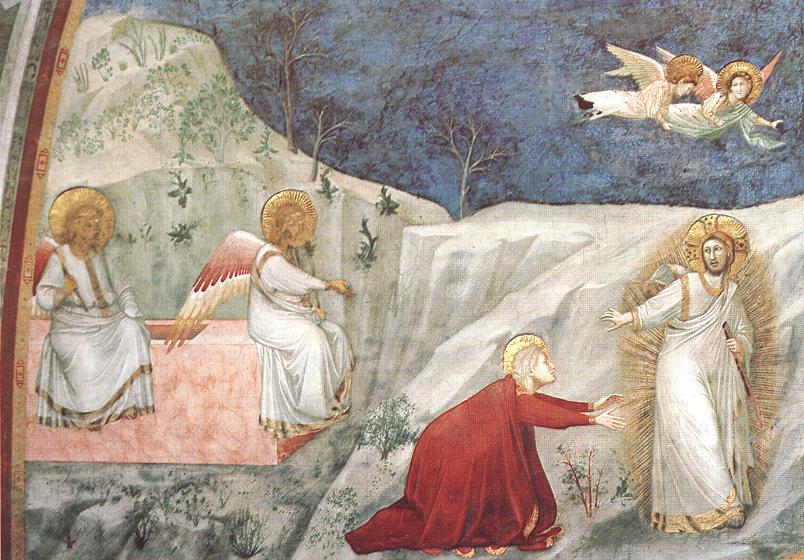
On the first day of the week, Mary of Magdalene came to the tomb early in the morning, while it was still dark, and saw the stone removed from the tomb. Mary stayed outside the tomb weeping. And as she wept, she bent over into the tomb and saw two angels in white sitting there, one at the head and one at the feet where the Body of Jesus had been. And they said to her, “Woman, why are you weeping?” She said to them, “They have taken by Lord, and I don’t know where they laid him.” When she had said this, she turned around and saw Jesus there, but did not know it was Jesus.
John 20: 1, 11-14
“Noli me tangere” (touch me not) fresco in the Lower Basilica of St. Francis Assisi Church in Italy painted by Giotto de Bondone in the 13th century from commons.wikimedia.org.
Like on that Easter morning, there will always be the darkness of death but only for a moment if we keep our eyes and our hearts open to Jesus who had risen. Many times we are like Mary Magdalene grieving and weeping that we fail to see the light of Jesus and of our deceased staying with us right in the darkness of grief and death that envelop us. And like Mary, we keep on insisting in relating with them in our old, physical level, forgetting the fact they have risen with Jesus to new life, to new realm of existence.
Jesus said to her, “Mary!” She turned and said to him in Hebrew, “Rabbouni,” which means Teacher. Jesus said to her, “Stop holding on to me, for I have not yet ascended to the Father. But go to my brothers and tell them, ‘I am going to my Father and your Father, to my God and your God.’” Mary of Magdalene went and announced to the disciples, “I have seen the Lord,” and then reported what he told her.
John 20:16-18
“Stop holding on to me” or “noli me tangere – touch me not” are the words also meant for us today who continue to cling and hold to our departed loved ones like Mary Magdalene, still hoping to hug and kiss them again, to touch and tell them how much we loved them or perhaps say sorry for our sins and lapses when they were still around. It is time to level up in our relationships with them as Five for Fighting reminds us in the last stanza that “every day is a new day”.
It does not really matter if we, or they our departed, are just 15 or 22 or 33 or 45 or 67 or 99 — what is most important is we value each moment of our lives here and now where in the present we meet them once or twice if we are living fully and not blinded by our grief and wishful thinking. Have faith in God. Someday, we shall all be together. For the moment, here is Five for Fighting with his100 Years. May the Lord console you and raise you up to move forward again in life. Amen.
*We have no intentions of infringing into the copyrights of this music and its uploader except to share its beauty and listening pleasure.
The Lord Is My Chef Daily Recipe for the Soul by Fr. Nicanor F. Lalog II
Monday in the Twenty-Fifth Week of Ordinary Time, 19 September 2022
Proverbs 3:27-34     ><]]]'> + <'[[[>< ~ ><]]]'> + <'[[[><     Luke 8:16-18
Photo from Facebook, April 2020.
God our loving Father,
let me be kind today,
not just be good but be kind
by regarding everyone as my "kin",
someone not different from me,
someone a family.
Refuse no one the good on which he has a claim when it is in you power to do it for him. Say no to your neighbor, "Go, and come again, tomorrow I will give," when you can give at once. Plot no evil against your neighbor... Quarrel not with a man without a cause... Envy not the lawless man and choose not his ways.
Proverbs 3:27-29, 30
Bless me
and let the light of Jesus
shine in me to guide others;
let me not be contented
with whatever good I have done
nor with who I have become;
grant me the grace to grow
and mature in Christ,
moving forward,
not backwards,
never stagnate.
Amen.
The Lord Is My Chef Daily Recipe for the Soul by Fr. Nicanor F. Lalog II
Friday, Memorial of St. Cornelius, Pope, & St. Cyprian, Bishop, Martyrs, 16 September 2022
1 Corinthians 15:12-20     ><]]]]'> + ><]]]]'> + ><]]]]'>     Luke 8:1-3
Photo by author, Museo Orlina, Tagaytay City, 15 September 2022.
Today I pray, dear Jesus,
for all the women of the world:
our mothers and sisters,
our nieces and aunties,
our grandmothers and girlfriends;
bless the wives and single-ladies,
the women working inside and outside
in all levels of the corporate world
and the various industries,
the women in the armed forces
and in the police;
bless and guide
the women who serve the poor
and disadvantaged,
the women who serve in the church,
the women who serve in government,
the women who take care of their
families especially those sick,
the women who are sick;
gladden the hearts and comfort
the women never appreciated
by their own family and the society,
the women who cry in silence
for being taken for granted
and neglected,
the women who hurt inside,
the women imprisoned physically,
emotionally, and mentally;
bless the women in the frontline
of health care especially those in
far-flung areas; special blessings
also O Lord, on those women
reading and praying this now.
Jesus journeyed from one town and village to another, preaching and proclaiming the good news of the Kingdom of God. Accompanying him were the Twelve and some women who had been cured of evil spirits and infirmities, Mary called Magdalene, from whom seven demons had gone out, Joanna, the wife of Herod’s steward Chuza, Susanna, and many others who provided for them out of their resources.
Luke 8:1-3
Dearest Jesus Christ,
grant us the freedom like you
to freely go out with women
frowned upon by society;
most of all, teach us to always
respect women and everyone
for we are all equal in dignity
before God our Father and Maker;
help us find you among the
misunderstood, the judged,
the boxed and labelled simply
for voicing out their thoughts and
feelings as well as those victims of
social inequalities; free us from our many
biases and prejudices against others,
especially against women.
Amen.