The Lord Is My Chef Breakfast Recipe for the Soul by Fr. Nicanor F. Lalog II
Saturday, Feast of St. James the Greater, Apostle, 25 July 2020
2 Corinthians 4:7-15 ><}}}*> >><}}}*> >>><}}}*> Matthew 20:20-28
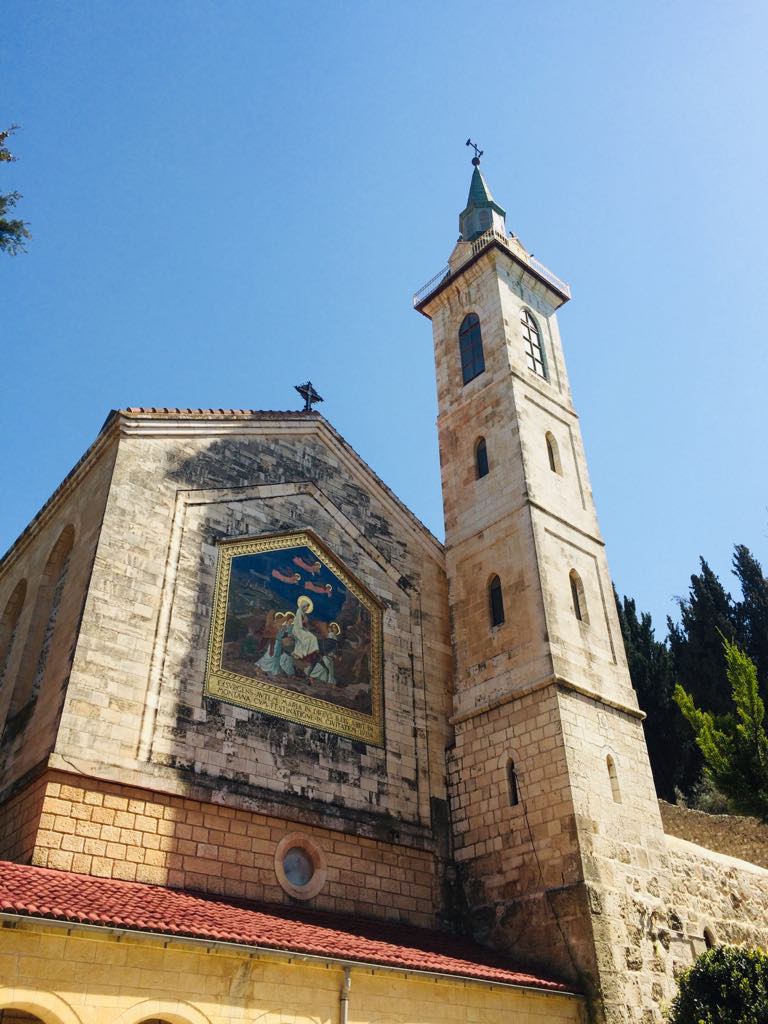
Facade of “Santiago de Compostela” in Spain in honor of St. James the Greater. Photo courtesy of Fr. Gener Garcia during their “El Camino de Santiago de Compostela”, May 09 to June 05, 2019.
Glory and praise to you, Lord Jesus Christ who had called and given us the Apostles as foundations of your Holy Church as we celebrate today the feast of St. James the Greater, the first bishop of Jerusalem and the first among the Twelve to die a martyr.
In him, O Lord, you gave us an image of hope in you, of how we can grow in holiness in you.
Through St. James the Greater, you have shown us your kindness in joining us in our earthly pilgrimage, slowly making us realize how we must adhere to you more closely to finally make it to our final destination in your kingdom in heaven.
Jesus said in reply, “You do not know what you are asking. Can you drink the chalice that I am going to drink?” They said to him, “We can.” He replied, “My chalice you will indeed drink, but to sit at my right and at my left, this is not mine to give but is for those for whom it has been prepared by my Father.”
Matthew 20:22-23
Your kindness is very evident, sweet Jesus.
I really wonder how you felt when the mother of James and John asked you that her sons be seated “one at your right and the other at your left in your kingdom” (Mt.20:21).
You were so kind to simply tell her and her sons, “You do not know what you are asking.”
Photo by Fr. Gener Garcia, image of Santiago de Compostela in Spain, 2019.
So many times, Lord, like St. James, we ask so many things from you, even demanding from you in exchange of what we believe as too great we have given you. You perfectly know so well that we do not know what we are asking at all. You know how we are blinded by fame and honor, power and wealth – things that do not matter at all in your kingdom.
You are so gentle in reminding us about the deeper realities of life, of discipleship by simplifying your demands, “Can you drink the chalice that I am going to drink?” to which we are often so naive, even oblivious for good reasons. Primarily because, we really do not know what we are asking.
And that’s when you are kindest of all, sweet Jesus: like with St. James and his brother St. John, you invite us “to drink the chalice you are drinking” by assuring us it can be done, that it is very possible, that in fact, that is the greatest honor of being with you, to drink from your chalice – without letting us know right away what it meant! St. John eventually realized and wholly accepted what you meant of drinking in your chalice when he became the first to share in your passion and death during the persecution by King Herod Agrippa (Acts 12:1-1).
Slowly, you make us realize too what is to drink in your chalice as we continue life’s journey with you, most especially into our inner self where we eventually find and rest in you when the goings get tough and rough.
It is total kindness on your part Lord to show us the beauty of sharing a meal with you, of sharing in your mission, of sharing in your life and most especially of sharing in your death that we make it with you to your kingdom.
Like St. James the Greater, continue to be kind with us, Lord, accompanying us in this journey.
In the same manner, make us kind to one another too like St. James the Greater who offered his life for the early church, for being the first to drink from your chalice. Amen.
Photo by Fr. Gener Garcia, marker along the “El Camino de Santiago de Compostela”, 2019.
The Lord Is My Chef Breakfast Recipe for the Soul by Fr. Nicanor F. Lalog II
Friday, Week XVI, Year II in Ordinary Time, 24 July 2020
Jeremiah 3:14-17 <*(((><< ) + ( >><)))*> Matthew 13:18-23
Photo by author, Sonnen Berg Mountain View, Davao City, August 2018.
It is a Friday and we thank you, O God our loving Father, for your boundless grace and mercy of another week to close and a new one to start. Amid the many struggles we have to go through this week with the staggering number of people infected with COVID-19, you continue to bless us.
Help us return to you, your “rebellious children” (Jer.3:14), so we may be renewed in you and with you.
Keep our sights looking forward to our future with your promises of growth and fulfillment.
Let us forget and learn our lessons from our past mistakes and sins so we may walk uprightly, guided by “shepherds you have appointed after your own heart who will shepherd us wisely and prudently” (Jer.3:15), never again to grow “hardhearted in wickedness” against you and others.
Thank you for sending us your Son Jesus Christ, the Sower who never gets tired sowing seeds into our hearts of all your grace necessary for us to be fruitful in life. May we become good soil who will accept and take care of your seeds. Amen.
Photo by author, ricefields in Pulilan, Bulacan, January 2020.
Photo by author of the new bypass road that cuts through vast ricefields from Baliwag to Pulilan, January 2020. And we ask anew, what price of development and, for whom?
We are all familiar with the expression that “familiarity breeds contempt” and sad to say, it has always been true to us even with our relationship with you, God our loving and merciful Father in heaven.
Day in, day out we pray, or simply mumble prayers.
We pray more of security latch, just in case something bad happens to us.
But to be one with one, nah….
Besides, even if we do not pray, there is always somebody praying for us. We believe so.
Everywhere we see churches and your images to remind us of your presence and existence, of your love and goodness to us.
But, we take you for granted. You have become so ordinary to us that sometimes, we look for something extraordinary.
Unknown to us, that is when we stop believing in you and when we also stop living in you.
Be amazed at this, O heavens, and shudder with sheer horror, says the Lord. Two evils have my people done: they have forsaken me, the source of living waters; they have dug themselves cisterns, broken cisterns, that hold no water.
Jeremiah 2:12-13
Through your Son Jesus Christ who preached using parables, open our eyes and our ears, our hearts and our very being to begin seeing anew from the ordinary and usual things the deeper realities of your presence and love.
Familiarity need not breed contempt among us and in you.
Let familiarity remind us of your consistency in relating with us, Lord.
Let familiarity lead us to the natural flow of life rooted in you, God, so that we may discover daily the many wonders and beauty of this life; that, despite the seeming cycle and repetition even routine, we may find its deeper meaning right in our hearts where you dwell. Amen.
Van Gogh’s “The Sower” from commons.wikimedia.org.
The Lord Is My Chef Breakfast Recipe for the Soul by Fr. Nicanor F. Lalog II
Wednesday, Feast of St. Mary Magdalene, 22 July 2020
2 Corinthians 5:14-17 >><}}}*> >><}}}*> >><}}}*> John 20:1-2, 11-18
Painting by Giotto of the Risen Lord Jesus Christ appearing to St. Mary Magdalene from commons.wikimedia.org.
Dearest Lord Jesus Christ:
Today as I prayed on the feast of your beloved Saint Mary Magdalene, my sights were focused on your beautiful exchange of names on that Easter morning at your tomb.
It is so lovely and so deep, and very personal for all of us whom you love so much despite our many sins like St. Mary Magdalene.
When she had said this, she turned around and saw Jesus there, but did not know it was Jesus. Jesus said to her, “Woman, why are you weeping? Whom are you looking for?” She thought it was the gardener and said to him, “Sir, if you carried him away, tell me where you laid him, and I will take him.” Jesus said to her, “Mary!” She turned and said to him in Hebrew, “Rabbouni,” which means Teacher.
John 20:14-16
You called her by her name, “Mary” and she called you by your title “Rabbouni” – what a beautiful scene of two people loving each other so deeply, so truly! You – humbly and lovingly accepting the sinner, and she – submitting herself to you as disciple.
You have expelled seven demons from her, you have known her so well even her darkest secrets and sins, and despite all these knowledge, Lord Jesus, the more you have loved her that you called her by the sweetest word she could ever hear in her life, “Mary”.
The same with us, sweet Jesus: every day you call us by our names, each one of us as a person, an individual, a somebody not just a someone. You love us so much in spite and despite of everything. We are not just a number or a statistic to you but a person with whom you relate personally.
From Google.
Help us to realize this specially when darkness surrounds us, when self-doubts and mistrust abound in us without realizing your deep trust in us, in our ability to rise again in you and follow you.
Teach me to trust you more and love you more like St. Mary Magdalene, to give and offer my self to you totally as yours, calling you “Rabbouni” or Teacher and Master.
Let me give up whatever I still keep to myself, whatever I refuse to surrender so that I may enjoy the intimacy you offer me as a friend, a beloved, and a family in the Father.
What a joy indeed to be like St. Mary Magdalene, fully known and fully loved by you, dear Jesus.
May I learn to know and love others too like you so I may proclaim you to them. Amen.
The Lord Is My Chef Breakfast Recipe for the Soul by Fr. Nicanor F. Lalog II
Tuesday, Week XVI, Year II in Ordinary Time, 21 July 2020
Micah 7:14-15, 18-20 >><)))*> ] + [ <*(((><< Matthew 12:46-50
Photo by author of sheep grazing at Sacred Heart Novitiate in Novaliches, QC, 2018.
What a beautiful prayer today to you, O God our Father by your prophet Micah:
Shepherd your people with your staff, the flock of your inheritance that dwells apart in a woodland, in the midst of Carmel. Let them feed in Bashan and Gilead, as in the days of old; as in the days when you came from the land of Egypt, show us wonderful signs.
Micah 7:14-15
Shepherd us like a true father, God, the old fashioned and right way symbolized by your staff: strong and sturdy to discipline us especially when we wander far from you, and yet at the same time, so tender and forgiving – full of clemency as Micah mentioned – when we are lost or stuck in a cliff or a crevice.
This is probably the one combination we are terribly missing these days, discipline and tenderness, the cornerstone of formation in every family expressed in the adage from the Sacred Scriptures, “Spare the rod, spoil the child” which the modern society strongly objects and frowns upon:
St. John Paul II waves to well-wishers in St. Peter’s Square at the Vatican in 1978 when elected as Pope, holding his staff, symbol of his being a shepherd.
He who spares his rod hates his son, but he who loves him takes care to chastise him.
Proverbs 13:24
Discipleship or being a disciple is primarily about discipline, of following not only the steps of the Lord and Master but also his ways.
From the word discipulos or to follow came the words follower and discipline alike.
Jesus Christ your Son perfectly said it in our gospel today when he rightly claimed that “whoever does the will of my heavenly Father is my brother, and sister, and mother” (Mt.13:50).
Give us the grace, O Lord, to take the right path anew of discipline to form our moral backbones tempered with your tenderness and mercy so we may truly work for a just and humane society here on earth so that your kingdom may finally come! Amen.
The Lord Is My Chef Breakfast Recipe for the Soul by Fr. Nicanor F. Lalog II
Monday, Week XVI, Year II in Ordinary Time, 20 July 2020
Micah 6:1-4, 6-8 <*(((><< )) + (( >><)))*> Matthew 12:38-42
Praise and glory to you, O God our loving Father for this beautiful Monday! We are midway through the month of July in this challenging year. Yes, 2020 is heavy for most of us with all the various problems we are going through but you have never left us, O Lord.
And that is why, Father, we also wonder what else have we not done that would set things right again?
Let us heed your words, O God.
Let us be reminded of your ways, of your very self by nature around us!
Hear what the Lord says: Arise, present your plea before the mountains, and let the hills hear your voices! Hear, O mountains, the plea of the Lord, pay attention, O foundations of the earth! For the Lord has a plea against his people, and he enters into trial with Israel. O my people, what have I done to you, or how have I wearied you? Answer me! You have been told, O man, what is good, and what the Lord requires of you: Only to do right and to love goodness, and to walk humbly with your God.
Micah 6:1-3, 8
Forgive us, merciful Father, for being “an evil and unfaithful generation” always looking for signs of your loving presence.
Teach us to trust you even if we cannot understand your plans.
May we learn from nature around us that thrives so well in your loving care – full of life, full of zest even without so much attention, reminding us of your saving power in Jesus Christ. Amen.
All photos by author except bougainvillea with our parish church by Gelo Nicolas Carpio in the collage above.
The Lord Is My Chef Sunday Recipe for the Soul by Fr. Nicanor F. Lalog II
Week XVI, Cycle A in Ordinary Time, 19 July 2020
Wisdom 12:13, 16-19 >><}}}*> Romans 8:26-27 >><}}}*> Matthew 13:24-43
Our Lord Jesus Christ invites us today to join him into a different kind of journey that would take us deep into God’s mystery in our very selves through the parables he has started to tell us last Sunday.
Recall, dear readers, that parables constitute the heart of the Lord’s preaching.
We have defined these as simple stories with deep realities that must be cracked open through prayers and reflections to get its meaning. From the French para bolein that literally means “along the path”, a parable is likewise a bridge that leads us into something unknown to us before.
In itself, a parable is a journey calling us to walk through it into our inner selves to discover the many inner beauties that lie within us but we take for granted. Ultimately, as we discover these giftedness within us, we then uncover God dwelling within us.
This is the reason why Jesus would always tell his audience after narrating his parables that “Whoever has ears ought to hear” (Mt.13:43) to insist on them to go deeper inside themselves for their meaning.
And that is when we are transformed, when our lives are changed into true disciples of Jesus Christ.
Greatness in littleness
First thing we notice in the three parables of Jesus today is his insistence on the coming of the kingdom of heaven or kingdom of God through him as the mysterious seed.
This kingdom of heaven is used interchangeably with “kingdom of God” that Jesus would always speak of in his entire ministry until his crucifixion is not according to our understanding of a kingdom: it is not about a territorial domain or the exercise of power over subjects using force.
St. John Paul the Second expressed it beautifully by declaring the person of Jesus Christ himself is the kingdom of God. No wonder, Christ would always liken himself and the kingdom of God with the seed being sown.
It is always good. It is for everyone as the sower scatters the seeds everywhere. And it is always small like Jesus who was born like any infant so fragile and even poor like most of us. He is like the seed we take for granted from which comes forth all kinds of plants like trees, big and small.
Flowers of a mustard plant from which seeds are taken. Photo by author, Israel, 2017.
Or most specially, like those seeds that turn into crops of wheat and shrubs like the mustard with leaves and branches where birds may dwell that describe the first two parables today.
Jesus then added a third parable of the yeast mixed into flour that leavened the dough into a bread.
Like him our Lord, we his disciples are also like the small seeds packed with great possibilities in God.
In all these three parables today, there is that element of smallness, of littleness that remind us how everything that is great always starts small.
When we come to think of this, we realize how we embarked on this great mission of making Jesus Christ known: it started like a small spark within us, perhaps from a single word we have heard or read, a simple inspiration by God through the most ordinary persons and situation.
Not only in things regarding our spiritual lives but even our personal lives when we recall those humble beginnings of our family and of our business.
Like a little seed or yeast, they just grew!
Now we are surprised, even amazed, how we have changed, how we have grown. Of how we are now reaping the fruits of our labors and sacrifices.
Most of all, how we have known and experienced Jesus Christ who fulfills our lives.
Weeds among the wheat
But not all days are bright and sunny. There are dark clouds that hover above us bringing storms and heavy rains that lead into floodings. A lot often in life, the darkest nights turn out to be the longest nights too.
And this is the meaning of Christ’s main parable for today.
Jesus proposed another parable to the crowds, saying: “The kingdom of heaven may be likened to a man who sowed good seeds in his field. While everyone was asleep his enemy came and sowed weeds all through the wheat, and then went off. When the crop grew and bore fruit, the weeds appeared as well. The slave of the householder came to him and said, ‘Master, did you not sow good seed in your field? Where have the weeds come from?’ He answered, ‘An enemy has done this.’ His slaves said to him, ‘Do you want us to go and pull them up?’ He replied, ‘No, if you pull up the weeds you might uproot the wheat along with them. Let them grow together until harvest; then at harvest time I will say to the harvesters, ‘First collect the weeds and tie them in bundles for burning; but gather the wheat into my barn.'”
During my prayer periods this past week, I have been filled with anger and disappointments at how things are going on in our country and even in my personal life. It pains me so much why at this time of the pandemic when we have to go through all these bad things.
Last Friday morning before our daily Mass, we discovered the glasses shattered in our windows near the office door and at the side door of the church. There were scratches outside indicating attempts to unlock the doors inside and steal from the church.
After the Mass, I grew more angry as we inspected the damages, thinking so negatively harsh against whoever tried to burglarize us.
By night time during prayers, I remembered Victor Hugo’s Les Miserables where Valjean was caught by the police stealing silver from the good bishop who had welcomed him into his rectory with food and accommodations. Instead of pinning him down for his crime, the bishop told the police he had given Valjean the silver found in his bag, even chastising him he had left behind the other silver candlesticks he had asked to take!
The wheatfield owner in our parable and the good bishop of Les Miserables are both the merciful God mentioned by the author of the Book of Wisdom in our first reading today:
But though you are master of might, you judge with clemency, and with much lenience you govern us; for power, whenever you will, attends you. And you taught your people, by these deeds, that those who are just must be kind; and you gave your children good ground for hope that you would permit repentance for their sins.
Wisdom 12:18-19
Think of our parents and elders, our mentors or those we look up to for their wisdom gifted with wonderful insights in life called perspicacity which means “a penetrating discernment… a clarity of vision or intellect which provides a deep understanding and insight.”
Being perspicacious or having perspicacity like the wheatfield owner or the good bishop of Les Miserable means having a deeper wisdom that one can keenly see and understand things beyond ordinary perception following a long process of silent reflections in life.
Many times, our sights can be limited that we do not see the other repercussions and even ramifications of our decisions on certain situations. There are times we think only of finding solutions, of winning the battle but not the war.
It is also along this line that Jesus added the third parable: the yeast is mixed with the flour to leaven the dough.
We are like the yeast who have to mix with others, including the evil ones to become bread that will feed the world.
We are the wheat, the mustard seed, the yeast thrown into the world to make a difference in Christ! We are not the ones who will change the world but Jesus Christ, the mysterious seed, the yeast in the dough who grows and effects the changes in us and among us.
Parables as inner journey in Christ Jesus
With Jesus living and nurturing within us, that is when we become fruitful like the wheat and mustard plant or leavened bread that we are able to feed more people who would eventually become bearers his in the future. That is how the kingdom of heaven comes into this world, when God is seen and felt by everyone through us
This we achieve in prayers as St. Paul reminds us in the second reading. It is not just reciting our basic prayers as Christians including the novenas we love to collect and follow through. The kind of prayer that St. Paul speaks here is a prayer guided by God’s Holy Spirit who perfectly knows God’s will.
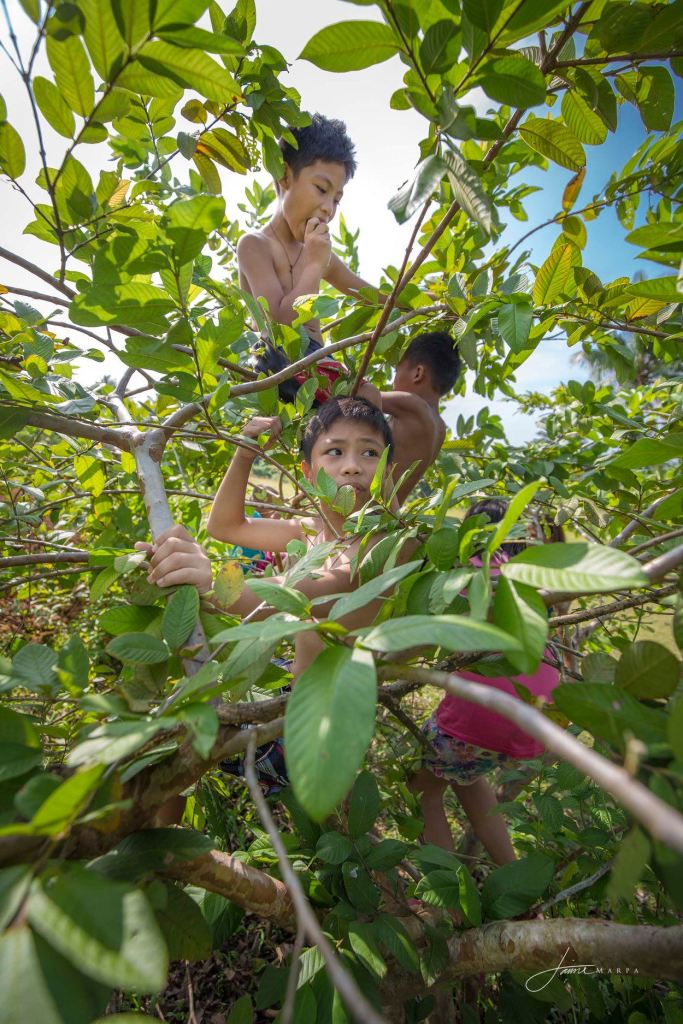
Photo by Dr. Mylene A. Santos of kids she’s teaching on the values of health, education and nature at Katmon Harbor Nature Sanctuary, Infanta, Quezon.
Brothers and sisters: The Spirit comes to the aid of our weakness for we do not know how to pray as we ought, but the Spirit himself intercedes with inexpressible groanings.
Romans 8:26
In this time of too much weeds among the wheat, of so many evil and sins prevailing over us, we can feel frustrated at times that make it so difficult for us to pray.
Sometimes, the evil and sins, or the plain sufferings we go through in our own family, in our community or at work and in school can be so overwhelming that we feel our prayers are useless, that God is not listening at all to us.
Then we stop praying, we stop journeying within even with weeds among the wheat. How can the flour be leavened if the yeast is not mixed with the dough to become bread or cake.
Remain in the Lord!
Pulling out the weeds will not solve the problem; worst, it may endanger us all too in the process that we become like our enemies in the end. Never lose hope in God who knows very well of the presence and source of weeds. Sometimes, these pains and sufferings from evils we go through from others may actually lead us to our being fruitful!
Evil and sins are a parable in themselves that can teach us so well in life if we handle them with prayers.
Photo by Dr. Mylene A. Santos, Infanta, Quezon, May 2020.
Praying in the Holy Spirit is when we spend time with Jesus to reflect and crack open his words that come to us in the Sacred Scriptures and ordinary events in daily life through long hours of silent meditation and contemplation.
The more we dive into God’s mysteries in the parables he sends us in daily living, the more we see the beauty and wonder of life because our horizons are widened and get clearer.
Praying into our parables in life is like looking into a telescope or binoculars that enable us to see something distant within reach.
The Lord Is My Chef Breakfast Recipe for the Soul by Fr. Nicanor F. Lalog II
Friday, Week XV, Year II in Ordinary Time, 17 July 2020
Isaiah 38:1-6, 21-22, 7-8 >><)))*> >><)))*> >><)))*> Matthew 12:1-8
Photo by Mr. Raffy Tima of GMA-7 News at the start of COVID-19 lockdown, March 2020.
Our loving and merciful Father, every time I hear the siren of an ambulance or stories of people I know getting sick, I grapple with words in praying for them and those who take care of them.
I could not find the words what to pray for them except to beg for your mercy that whomever inside a rushing ambulance or my parishioner or friend or relative may get well soon, may be healed totally in their mind, body and soul.
There are just too much sickness and death going on these days, Lord, and the truth is, deep inside me you know very well my own prayer even if it does not pass through my lips – spare me of any sickness at least during this pandemic.
Thank you for your loving mercy, Father, that have sustained me since March, especially when I feel low and sad, even depressed thinking if I would ever survive this COVID-19 pandemic.
Your words today are very consoling and reassuring: you are more than willing to heal us of our sickness, Lord.
Like your servant King Hezekiah, I turn to you merciful Father on behalf of those stricken with COVID-19 and other illnesses in this time of the corona to give them a chance to recover their health to serve you and their families too.
I pray also for their loved ones looking after them to keep them faithful and filled with hope hurdling this sickness.
Then Hezekiah turned his face to the wall and prayed to the Lord: “O Lord, remember how faithfully and wholeheartedly I conducted myself in your presence, doing what was pleasing to you!” And Hezekiah wept bitterly. Then the word of the Lord came to Isaiah: “Go, tell Hezekiah: thus says the Lord, the God of your Father David: I have heard your prayer and seen your tears. I will heal you…”
Isaiah 38:2-5
Unlike Hezekiah who must have been so extraordinary before you, we are not asking any signs from you. Just heal us, strengthen our medical frontliners and caregivers. Most of all, spare us of any sickness in this time of the pandemic.
Father, we beg you in this most trying time of our history as a nation, that we may be filled with your mercy so that we in turn may share this same mercy to those living in the margins, that we may be more compassionate and kind to people so hard-pressed with life these days.
Yes, indeed, your Son’s reminder to the Pharisees are also meant for us today when we are so concerned with laws than with persons:
Jesus said to them: “If you knew what this meant, I desire mercy, not sacrifice, you would not have condemned these innocent men. For the Son of Man is Lord of the sabbath.”
The Lord Is My Chef Breakfast Recipe for the Soul by Fr. Nicanor F. Lalog II
Thursday, Memorial of Our Lady of Mount Carmel, 16 July 2020
Isaiah 26:7-9, 11, 16-19 >><)))*> + <*(((><< Matthew 11:28-30
Photo by author, Our Lady of Mt. Carmel of the Holy Family, Guiguinto, Bulacan, 08 December 2019.
Your words today, O God our Father, are very comforting and consoling, so reassuring of your love and mercy for us sinners, giving us new life in you as we celebrate the memorial of Our Lady of Mount Carmel.
Like the Israelites living in exile because of their own making when they turned away from you in sins worshiping false gods, we also admit our sinfulness and failures in standing up for what is true and just, in being faithful to you.
Help us to rise again, heavenly Father, breathe into us your life-giving Spirit specially at this time we feel so down and crushed not only by COVID-19 pandemic but by public officials concerned only with their well-being and whims forgetting the people they are supposed to serve.
We conceived and writhed in pain, giving birth to wind. Salvation we have not achieved for the earth, the inhabitants of the world cannot bring it forth. But your dead shall live, their corpses shall rise; awake and sing, you who lie in the dust. For your dew is a dew of light, and the land of shades gives birth.
Isaiah 26:18-19
If there is anything we would want to have these days, it is rest, O Lord.
A lightening of our load and burdens.
But why another yoke, Jesus?
Forgive us Jesus when we feel negative with yoke because they always portray to us images of slavery and oppression. Open our eyes, Lord, as we come closer to you to take your yoke because you not only help us carry our burdens but most of all, your yoke gives us direction in our path back to the Father.
May your Blessed Mother of Mount Carmel help us to hold on to God in this hour of darkness in our lives as individuals and as a nation. Amen.
Photo by author, Our Lady of Mount Carmel of the Holy Family, Guiguinto, Bulacan, November 2019.
The Lord Is My Chef Breakfast Recipe for the Soul by Fr. Nicanor F. Lalog II
Wednesday, Memorial of St. Bonaventure, Bishop and Doctor, 15 July 2020
Isaiah 10:5-7 >><)))*> >><)))*> >><)))*> Matthew 11:25-27
Photo by author, Pyramids of Egypt, May 2019.
Praise and glory to you, O Jesus Christ! With you we praise God our Father, Lord of heaven and earth, in revealing to the little ones your power and majesty, hiding these from the wise and learned of this world.
Thank you for the gift of faith and simplicity, dear Jesus, in making us find in our smallness and sinfulness your love and mercy, your presence and comfort especially in this time of the pandemic when so much pride and power trip are going on not only in our country but also abroad when almost everyone is claiming to be the best and the brightest, of knowing everything.
Just like during the time when Assyria was threatening Israel and Judah, lording it over smaller nations and kingdoms, forgetting there is a God above us all.
Remind anew the proud and arrogant among us today that they are not gods, that they are nothing, that you O God is always above for you are the Lord of heaven and earth.
Will the axe boast against him who hews with it? Will the saw exalt itself above him who wields it? As if a rod could sway him who lifts it, or a staff him who is not wood! Therefore the Lord, the Lord of hosts, will send among his fat ones leanness, and instead of his glory there will be kindling like the kindling of fire.
Isaiah 10:15-16
Teach us, dear Jesus, to be like St. Bonaventure who showed us true wisdom and brilliance shine best in sharing in your pasch or passover by journeying with you in your pains and sufferings in order to see the Father.
Most of all, teach us to follow you more closely as your disciples, desiring only you so we may share you with others especially those suffering and those forgotten not only by their loved ones but even by the society. Amen.