The Lord Is My Chef Breakfast Recipe for the Soul by Fr. Nicanor F. Lalog II
Monday, Week XI, Year II in Ordinary Time, 15 June 2020
1 Kings 21:1-16 ><)))*> ><)))*> <*(((>< <*(((>< Matthew 5:38-42
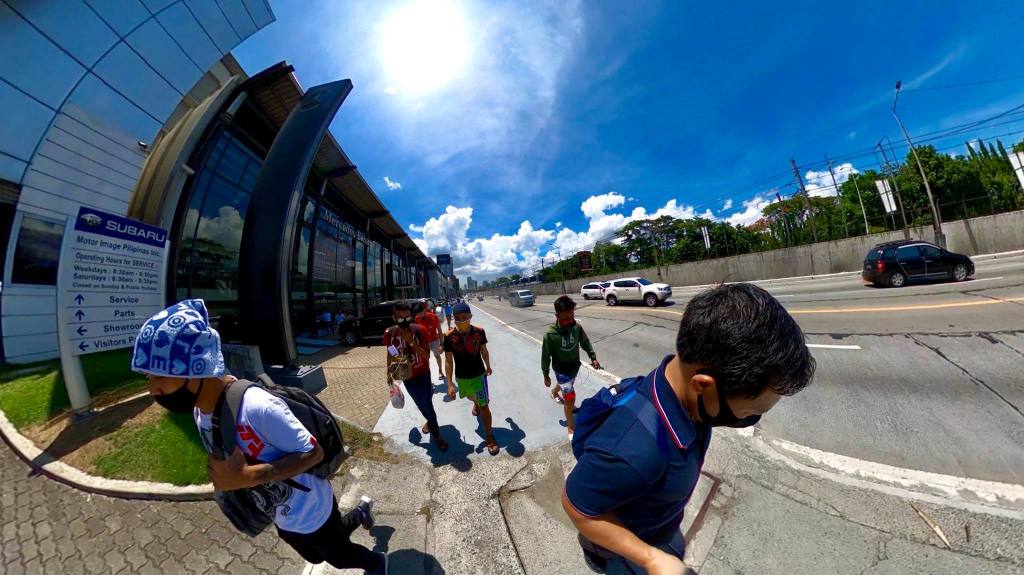
Photo by Mr. Raffy Tima of GMA-7 News, stranded people staying at the underpass near the NAIA after waiting for so long to catch their flights back to their provinces since March.
So many times in life, O God our Father, we hear so many stories of injustice, of how our neighbors are treated so badly that we feel so disgusted at how it could happen at all.
Like all these stories of people stranded in Metro Manila, of the lowly income earners who have to walk for hours just to get to work because there are not enough public transport system allowed to operate.
Of those made to suffer the strict quarantine rules when police officials and politicians were allowed to get off the hook or, the arrest and incarceration of a poor, elderly jeepney driver who had joined a protest rally while the former First Lady who was convicted of corruption charges two years ago was spared of any jail term because of her age.
So much inequalities happening shamelessly, with much impunity by those in power, O Lord!
Exactly like the evil Queen Jezebel who instructed her people to find two scoundrels to testify against Naboth so she could take his vineyard so desired by her husband King Ahab.
Two scoundrels came in and confronted him with the accusation, “Naboth has cursed God and king.” And they led him out of the city and stoned him to death. When Jezebel learned that Naboth had been stoned to death, she said to Ahab, “Go on, take possession of the vineyard of Naboth the Jezreelite which he refused to sell you, because Naboth is nbot alive, but dead.” On hearing that Naboth was dead, Ahab started off on his way down to the vineyard of Naboth the Jezreelite, to take possession of it.
1 Kings 21:13-16
Such stories are so revulsive, O God, not only of their nature but more because partly to be blamed is us — when we have refused to do anything good in fighting evil. Indeed, the only thing necessary for evil to triumph is for good men to do nothing.
Yes, O God, we are ashamed because we have unconsciously sided with the scoundrels when we chose to “see nothing, hear nothing, and say nothing” of their lies, their harsh words and vulgarities, and their systematic killing sprees to solve the problems of the society.
We have misread the words of your Son Jesus Christ by becoming passive in the face of evil.
Jesus said to his disciples: “You have heard that it was said, An eye for an eye and a tooth for a tooth. But I say to you, offer no resistance to one who is evil. When someone strikes on your right cheek, turn the other one to him as well. Should anyone press you into service for one mile, go with him for two miles.”
Matthew 5:38-39, 41
Give us the wisdom and courage to turn our other cheek, to go the extra mile in asserting to evil doers that we are all brothers and sisters in Christ who must treat one another with respect and equal dignity as a person created in your image and likeness, God our Father.
Inspire us, O God, especially our leaders in the Church who have gone so timid and silent except for a very few on how we can be more prophetic in this time of crisis under an unfriendly government. Amen.
Quiet Storm by Fr. Nicanor F. Lalog II, 11 June 2020
Painting by Raphael (1515) of St. Paul preaching at Areopagus in Athens, Greece. From wikipedia.
With houses of worship still closed despite the opening of most business establishments, here is the final installment of reflection in our series on how the life and teachings of St. Paul may help us in our ministry during this time of COVID-19 amid a perceived government “persecution” of the Catholic Church.
There is no doubt that like during his time, St. Paul would be using modern means of communication to preach the Gospel of Jesus Christ especially in this most trying time of our history, using the internet as the new “Areopagus” with social media in particular.
Then Paul stood up at the Areopagus and said: “You Athenians, I see that in every respect you are very religious. For as I walked around looking carefully at your shrines, I even discovered an altar inscribed, ‘To An Unknown God.’ What therefore you unknowingly worship, I proclaim to you. The God who made the world and all that is in it…”
Acts of the Apostles 17:22-24
Social Communication
Perhaps before we go into our reflection, it is imperative especially for bishops and priests to be reminded anew of some important terms in communications; this is more than about names or nomenclature because for as long these terms of communications are not clear with us, all our evangelization efforts would be askewed as it is now showing with an explosion of online Masses and other religious celebrations.
First priority is to stop using the words “mass media” and even “social media” in our church communications because these are very limited in scope and context.
It is important to note that in the 2000-year history of the Church, it was only in Vatican II that we have issued a conciliar document on communication wherein the Fathers also introduced the term social communication as a new name for communications in the Church.
How sad that there are still bishops and priests using the terms “mass media” or “media” and lately “social media” when more than 50 years ago the Church through the inspiration of the Holy Spirit coined social communication to refer to “the communication of and in human society including all the ways and means used in this process” (Fr. Franz-Josef Eilers, svd, 2009 BISCOM-FABC, Bangkok).
Social communication is a very prophetic term because it is theological and rooted in God who is communication himself, sharing with us his power to communicate so we may also communicate with him and with others. Most of all, God continues to communicate with us and from that lies our task as a Church to communicate him to the world.
This is the reason why we have to keep on using this term “social communication” in our Church communications to keep us Christocentric, meaning, every communication in the Church and by the Church has Jesus as Message.
And that is essentially the kind of communication process followed by St. Paul the Apostle. In fact, reviewing his letters and the various accounts about him would show us that early, this great apostle has been into social communication, specifically “pastoral communication” that is an emerging field in Church communications whose realities have long been espoused by St. Paul himself.
Pastoral Communication
Pastoral communication is anchored on Jesus Christ, the “Good Shepherd” who sets himself as the norm and standard of our Church communications.
Jesus said, “I am the good shepherd. A good shepherd lays down his life for the sheep… I am the good shepherd, and I know mine and mine know me, just as the Father knows me and I know the Father; and I will lay down my life for the sheep.”
St. Paul has always been very clear with this in all his communications that towards the end of his life, he had beautifully written his disciple this wonderful piece:
Beloved: I charge you in the presence of God and of Christ Jesus, who will judge the living and the dead, and by his appearing and his kingly power: proclaim the word; per persistent whether it is convenient or inconvenient… For I am already being poured out like a libation, and the time of my departure is at hand. I have competed well; I have finished the race; I have kept the faith.”
2 Timothy 4:1-2, 6-7
Communicating Jesus Christ is always about self-sacrifice, about giving of one’s self like our Lord and Master. In whatever form of communication we use, it is always a call to “enflesh” the Word. In short, communication is spirituality that indicates the kind of relationship we have with God. How we reflect that relationship with God in words and in deeds, in our clothings and everything is communication.
Like St. Paul, he was able to offer himself wholly to God as reflected in his writings and preaching because he was more concerned with the needs of the flock and not with his own needs.
And this is where I sadly feel our bishops sorely absent and silent except for just two, Lingayen-Dagupan’s Archbishop Soc Villegas and Manila’s Apostolic Administrator Bishop Broderick Pabillo.
Where are the other bishops?
Business establishments are almost all opening, even dine-in restaurants and yet, until now for no valid reason, the government continues to ban religious mass gatherings except for maximum of ten persons in areas under GCQ.
When are the bishops and priests going to speak out against this and open the churches so people may be spiritually nourished?
What an auspicious time for the clergy and hierarchy to speak against this continued closure of churches as we are on the eve of our 500th year of Christianization when under serious persecution. Has the Church grown timid in the face of an unfriendly government?
Worst are some priests who seem to follow more the secular world in their digital presence but empty of Jesus Christ, concerned only with popularity measured in number of likes and shares as well as followers.
Many of us have become more of personalities than as priests and ministers, unconsciously trying to be more popular than the Lord himself that we no longer have sacrifice of the Mass but a variety show, complete with sound effects and digital characters, some wit dance numbers and raffles!
When God is displaced, then our love is misplaced, then, we lose all communications too.
Communication is more than the expression of ideas and the indication of emotion. At its most profound level it is the giving of self in love. Christ’s communication was, in fact, spirit and life. In the institution of the Holy Eucharist, Christ gave us the most perfect and most intimate form of communion between God and man possible in this life, and, out of this, the deepest possible unity between men. Further, Christ communicated to us His life-giving Spirit, who brings all men together in unity. The Church is Christ’s Mystical Body, the hidden completion of Christ Glorified who “fills the whole creation”. As a result we move, within the Church and with the help of the word and the sacraments, towards the hope of that last unity where “God will be all in all”.
Communio et Progressio # 11
From Google.
Problem with online Masses and religion
Every communication presupposes presence. That is essentially the meaning of God’s “I AM” in the burning bush to Moses and the “I AM” declarations by Jesus in the New Testament, especially in the fourth gospel where we find him saying “I am the good shepherd”.
Even St. Paul in his letters always began with his standard salutations like “I, Paul…” to indicate his very presence among his “parishioners”.
However, in the digital media, presence is not so essential and can even be faked both ways, either by being “taped” or “replayed” by viewers.
And there lies the great danger of online Masses and other celebrations: whether we like or not, online religious celebrations give the impressions on people that God is a “consummable”, a product or a show that can be had when most convenient to us like video on demand or the streamed shows of Netflix.
That is why we have to open churches soon to stop these online Masses except for those in the Cathedrals and in existence long before COVID-19 that cater to the needs of the sick and elderly in their homes.
Pope Francis has always been clear with this, stressing that these online Masses and religious celebrations are very temporary due to the extraordinary situation brought about by the pandemic.
From Pinterest/Aleteia.
Imagine the problem at Corinth that reached St. Paul’s attention, prompting him to write them another letter to reprimand them but at the same time to encourage them to mend their ways. It was a problem of abusing the Eucharist when St. Paul was no longer with them.
It is the same thing happening in many of our online Masses that have become variety shows to impress viewers. Long before we got into this lockdown, many priests have crossed the boundaries without knowing they have made fools of themselves as they rely more on “likes”, on being viral or trending, dishing out shallow reflections covered with cute song numbers, litany of greetings on air, and so many other inanities that Jesus is lost in the process.
Unfortunately, many laypeople are now also having their own digital preaching or evangelization with their own “productions” taking their cue from their showbiz pastors.
If St. Paul were with us today, he would surely write again to express his dismay at the people seeking more of entertainment than having Jesus Christ.
“But I am afraid that, as the serpent deceived Eve by his cunning, your thoughts may be corrupted from a sincere and pure commitment to Christ. For I think that I am not in any way inferior to these “superapostles”. Even if I am untrained in speaking, I am not so in knowledge; in every way we have made this plain to you in all things.
2 Corinthians 11:3, 5-6
Church communication is Jesus Christ and his Cross as St. Paul reminds us in his writings (1Cor.15:1-3); it is never about techniques or gadgets.
Though we need to be present online, the cutting edge of real communication remains in pastoral communication that means being present with others who need us most including those without internet access, witnessing to the values of Jesus in relating with people, bringing people together into a communion and helping them find answers in their search for meaning and directions in life, in making the right choices and in living their convictions and faith.
What we are speaking of are real people, persons and lives that matter so much, more precious than goods and commodities.
Let us not fall into the trappings of this “media revolution” that made one futurologist describe our contemporary society as
Technologically Intoxicated Zone defined by the complicated and often paradoxical relationship between technology and our search for meaning.
John Naisbitt
According to Naisbitt and other experts, while people prefer quick fixes online of everything, from religion to nutrition, while at the same time fearing and worshipping technology that had blurred the distinction of what is real and fake, the more they live their lives distanced and distracted — something we are already seeing even before the coming of social distancing!
To communicate in the Church at this time is to imitate St. Paul: be present for and with the people wherein we help them find their way to God by being their companions and “co-journeyers” in life, witnessing to them the Cross of Jesus Christ with our very lives as an offering and sacrifice, not as a commodity or a show to be “liked” on Facebook and Instagram.
And, lest we forget, it is God whom people must follow and worship, not us.
So be imitators of God, as beloved children, and live in love, as Christ loved us and handed himself over for us as a sacrificial offering to God for a fragrant aroma.
Ephesians 5:1-2
Pope Francis praying before an empty St. Peter’s Square last March 27, 2020 at the height of COVID-19 in Italy.
Quiet Storm by Fr. Nicanor F. Lalog II, 08 June 2020
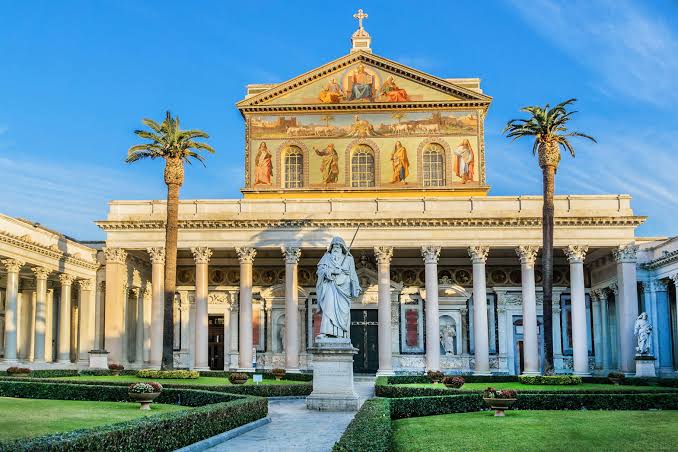
Basilica of St. Paul Outside-the-Walls, Rome, Italy. Photo from Google.
My earliest memory of St. Paul was not really so good; it was even scary.
It was summer of 1972 when we settled in our new house in my mother’s hometown of Bocaue in Bulacan. I was so skinny then (believe me, I can prove this with my pictures) and shy when my mother brought me to apply for Grade 1 at the only Catholic school there known as “SPCB” or St. Paul College Bocaue.
A male, dark teacher wearing those dark glasses like Leopoldo Salcedo clad in a barong interviewed me (the late Mr. Martin De Guzman, aka, Bagyo for typhoon). I cannot recall what he had asked me which I could not answer that made him say I cannot enroll in their school; but my mother angrily told me not to listen to him and, angrier told me to always speak louder.
That’s when I saw the statue of St. Paul at the window of the registrar’s office, eyes so intense while resting his right hand on a sword in front of him with the other hand clutching a bible with the Latin words, “Caritas Christi urget nos” – the love of Christ impels us (2 Cor. 5:14).
I stayed at SPCB for seven years and formed me into who I am today, making me so proud of being a Paulinian. Until now, that image of St. Paul with a sword is etched in my mind reminding me of how he fought so hard for Jesus Christ and his Body, the Church.
The Apostle Paul
Sometimes called the “Thirteenth Apostle”, St. Paul always stressed in his writings and teachings that he was personally called by the Risen Lord to be his Apostle sent to preach the gospel to everyone. That is why Jesus is so central in his life, declaring “whatever gains I had, these I have come to consider a loss because of Christ” (Phil.3:7), desiring only “omnia omnibus” — that is, to “become all things to all men” (1 Cor. 9:22) without any reserve.
As we have mentioned in our earlier reflection, St. Paul’s sole focus in his ministry and very life was the person of Jesus Christ: everything in our lives, especially us priests, is marked essentially by our encounter and communion with the Lord and his Word.
It is only in the light of Christ that we measure every other value in our lives and ministry.
Red Wednesday Mass and prayers in our parish for the Church persecuted last November 2019.
Even in this highly diversified and pluralistic society, while we join hands in promoting and working for a more humane and inclusive society, the more we must stand up for Jesus Christ like St. Paul as quoted by St. Luke while addressing the presbyters of the Church at Ephesus with these words:
“I served the Lord with all humility and with the tears and trials that came to me because of the plots of the Jews, and I did not at all shrink from telling you what was for your benefit, or from teaching you in public or in your homes. I earnestly bore for both Jews and Greeks to repentance before God and to faith in our Lord Jesus Christ… for I did not shrink from proclaiming to you the entire plan of God.”
Acts of the Apostles 20:19-21,27
I am so struck with that word “shrink” that St. Paul used twice to stress his dedication, fervor, and conviction in being centered in Jesus Christ alone. In what aspect did he not “shrink”? Did he raise arms and fought back against his detractors? Did he align with other forces to pursue his mission?
No! St. Paul did not shrink in proclaiming Jesus Christ by fighting back with force or with harsh words but by being more like our Lord and Master — more loving and understanding, more patient and more persevering, yet more intense in insisting the Gospel.
He did not shrink by running away from his detractors or diluting the gospel message by pleasing some powerful people or accommodating prevailing thoughts and culture. As we have mentioned in our previous reflection, St. Paul saw opportunities for the gospel in the midst of the hostile environment he lived during his time.
Despite all the pains and scars he had gone through, one can still find the light of Christ shining in this great apostle who bore everything filled with joy and pride without any complaint.
We are afflicted in every way, but not constrained; perplexed, but not driven to despair; persecuted, but not abandoned; struck down, but not destroyed; always carrying about in the body the dying of Jesus, so that in the life of Jesus may also be manifested in our body. For we who live are constantly being given up to death for the sake of Jesus, so that the life of Jesus may be manifested in our mortal flesh.
2 Corinthians 4:8-11
Standing for Christ and his Church
From 2006 to 2018, I was so blessed to have worked at our Church-run Radio Veritas as a co-host in a morning program once a week and as a host of another show on Saturdays. Aside from bishops and priests, we interviewed experts and advocates in a lot of various topics affecting our faithful in particular and our society in general.
So many times I felt something so wrong when we have to interview whom we considered as “allies” or “kakampi” in some of our advocacies because I have found no single person fully believing in our Church teachings even if some of the issues they fight for jibe with ours.
Can we really ally ourselves with lawmakers and cause-oriented groups fighting capital punishment which we strongly support and yet support artificial means of contraception for population control? Can we align with those fighting repressive laws like this anti-terror bill and yet support same-sex marriage and divorce?
And please, spare us with those labels on these people that they insist on putting on with us priests and bishops: let us keep in mind we are only for Christ, no progressives or liberals, conservatives or whatever.
We are neither lobbyists nor cause-oriented advocates pushing for something because we only stand for Jesus Christ and his Word at the Cross. There can be no any instance of partisan politics or traces of strange bedfellows whatsoever because we are either for or against Jesus Christ:
Jesus said: “Whoever is not with me is against me, and whoever does not gather with me scatters.”
Matthew 12:30
Here lies one of the greatness of St. Paul who never shrunk to other forces except Christ.
St. Paul statue at Malolos Cathedral by renowned ecclesiastical artist Mr. Willy Layug. Photo by Mr. Lorenzo Atienza, June 2019.
What a tragedy especially in our country that no amount of explanations can remove from the thoughts of ordinary people that priests and bishops do not even dabble their hands in partisan politics when it is so glaring they are beholden to these modern charlatans.
What moral ascendancy is left of our being pastors when after speaking against corruption and ineptitude in the government we turn to solicit from the same politicians and bureaucrats not only for parish projects and charities but even for our personal needs like vacations and trips abroad?
How can we reconcile all these immediate reactions by bishops and priests against the anti-terror bill urgently passed by Congress last week when not even a whimper was ever heard from them for the longest time to open our churches to serve the spiritual needs of the people?
Let me clarify like in my previous reflection that I am not saying we must be quiet about social issues; my point is, it must always be primary the Church as the Body of Christ that is primary in all our concerns.
This was very clear with St. Paul because it is the first reality he faced when he was called by Christ:
On his journey, as he was nearing Damascus, a light from the sky suddenly flashed around him. He fell to the ground and heard a voice saying to him, “Saul, Saul, why are you persecuting me?” He said, “Who are you, sir?” The reply came, “I am Jesus, whom you are persecuting.”
Acts of the Apostles 9:3-5
Next to our Lord, it is the Church that St. Paul had considered so much in his activities as subject of his thoughts and reflections. For him, adherence to the Church was directly caused by Jesus Christ himself, not by any chance or moments of realization and conversion.
And see the words of the Lord to him: “I am Jesus, whom you are persecuting.”
He was the first to speak of the Church as the Body of Christ, illustrating for us in his many Letters our being “one in Christ” (Gal.3:28) deeply rooted in the Holy Eucharist, “Because there is one bread, we who are many are one body” (1 Cor.10:17).
Pope Francis blessing the world at an empty St. Peter’s Square last March 27 when COVID-19 was ravaging the whole of Italy and many parts of the world. Photo from Vatican News.
Until now our churches remain closed in many parts of the only Christian nation in this part of the world. It behooves us priests and bishops to first fight and insist, without shrinking, the opening of our houses of worship to allow the people to experience Jesus Christ anew in this pandemic.
Most of all, may the people feel and realize at the resumption of our public Masses that God is truly in us and with us because of our deep communion in our Lord Jesus Christ and with one another when we celebrate the Sacrament of our unity, the Holy Eucharist.
Our final installment of the series this Thursday, “St. Paul in time of COVID-19: Communicating Jesus Christ”.
Quiet Storm by Fr. Nicanor F. Lalog II, 05 June 2020
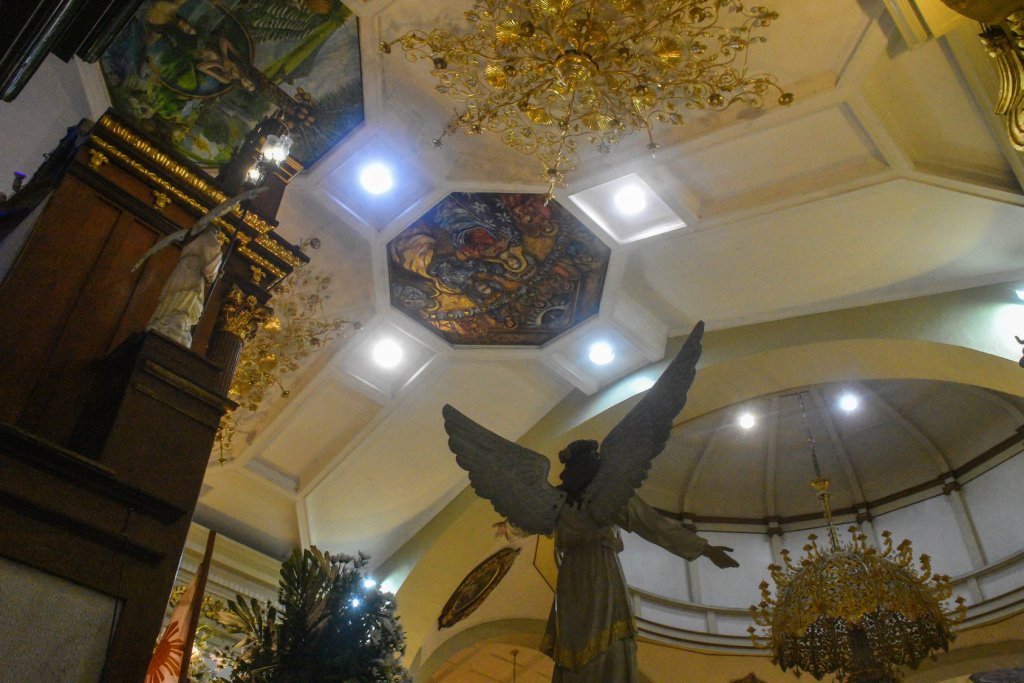
Ceiling of the main altar and dome of the Malolos Cathedral, 12 June 2019. Photo by Mr. Lorenzo Atienza.
The COVID-19 pandemic is the most severe test the Roman Catholic Church in the Philippines has ever faced, striking on the final year of her preparations for the quincentenary of the coming of Christianity in the country.
Making things worst is the “unfriendly” Administration whose policies contradict almost every known Church teaching, from the most basic GMRC and decency to the sanctity of human life.
In this three-part series of reflections, I wish to share with you my brother priests and lay partners in our ministry some lessons I have found in the life and teachings of St. Paul the Apostle that is centered on the person of Jesus Christ.
He never gave specific instructions and answers in dealing with the many issues and problems that confronted the early Church that may help us in the present generation; but, he had taught us to be always centered on Christ, measuring everything in him and his Cross.
Now I am reminding you, brothers, of the gospel I preached to you… Through it you are also being saved… For I handed on to you as of first importance what I also received: the Christ died for our sins in accordance with the scriptures.
1 Corinthians 15:1-3
A sculpture of St. Paul the Apostle upon the entrance to the Malolos Cathedral by the renowned ecclesiastical artist Mr. Willy Layug. Photo by Mr. Lorenzo Atienza, 12 June 2019.
The gospel thrives most in hostile environment
St. Paul lived in a time very similar with ours when great developments and changes were overtaking the world with the usual problems of poverty and inequalities due to growing materialism, and persecution of the Church.
Instead of seeing them as problems, St. Paul saw them as opportunities to spread the Gospel because his sole focus was the Lord Jesus himself and his Cross.
In fact, all who want to live religiously in Christ Jesus will be persecuted. But wicked people and charlatans will go from bad to worse, deceivers and deceived. But you remain faithful to what you have learned and believed…
2 Timothy 3:12-14
When the former Mayor of Davao City assumed the presidency and started lashing out us priests and bishops with his profanities and vitriol including blasphemies against God and Pope Francis, we all expressed our indignation and opposition.
And rightly so! – even in fighting for Kian and those fallen by tokhang as well as the victims of injustice and fake news.
As days moved into months and years, with more vulgarities and lies dished out by the man at Malacañang, there also appeared some silver linings over Pasig River but many of us in the clergy have refused to see and admit— that some of his accusations are true. Although these are more of the exception than the rule, there are indeed some priests leading inauthentic lives far from their vows of poverty and celibacy with others pretending to be shepherds of souls who do not smell like their sheep because they are more keen in amassing wealth and gaining fame and popularity.
Worst of all are those who have sold their souls to politicians for some petty favors and a taste of power, of being seen with the rich and famous.
I am not putting down our priests. There are more good and holy priests working faithfully and silently not only in our country but everywhere in the world.
What I am trying to say since our “persecution” by the present Administration began, this is a wake-up call for us priests to shape up and regain our bearings in Christ.
Actually, it had been coming since the previous Administration, too. For the longest time we have been lording it over the people with our abuses and excesses hiding in the excuse as “alter Christus” but, now the changing times have finally caught on us, demanding more transparency and honesty on our part.
Like with the experience of St. Paul, these situations of “persecution” with a pandemic are calls for our conversion in Christ anew, something that Pope Emeritus Benedict XVI has been insisting that we priests go back to Jesus, especially in the Blessed Sacrament.
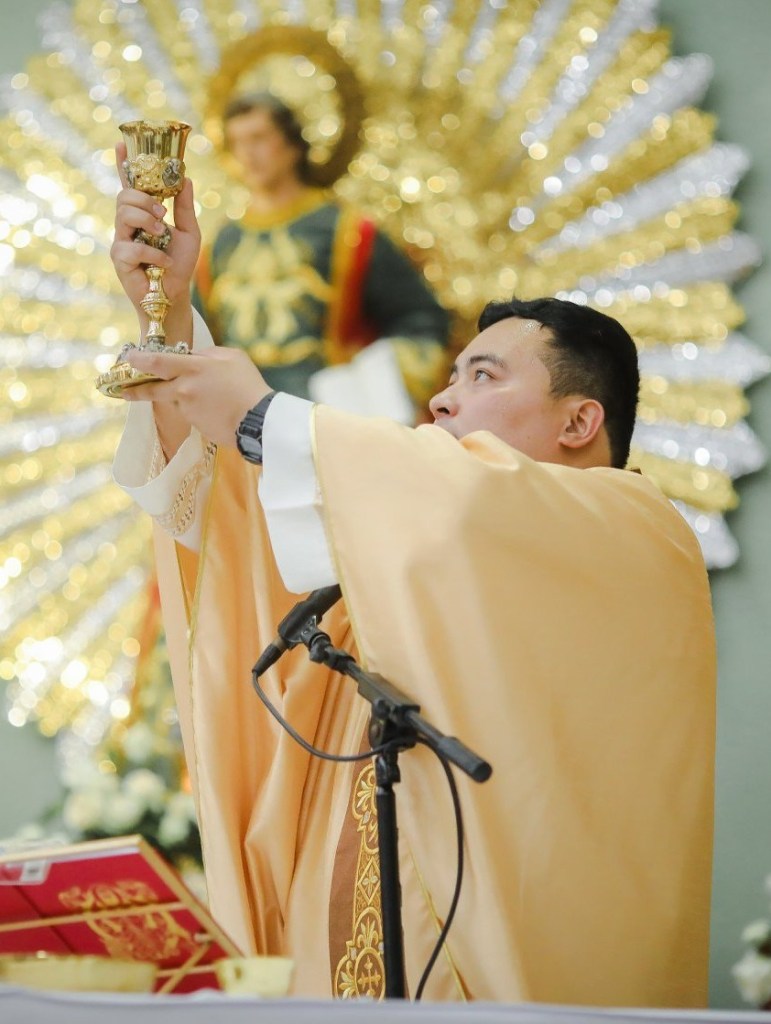
Photo by Mr. Lorenzo Atienza, ordination to the diaconate at the Malolos Cathedral, 12 June 2019.
Like St.Paul, priests are first a witness of Jesus Christ
This time of crisis due to COVID-19 and the continued “persecution” by an unfriendly administration that has continued to keep our churches closed for no sane reason at all can be a grace-filled moment for us if we allow Jesus Christ to shine in us by bringing hope and inspiration to our people saddled with so much burdens due to COVID-19 and the government’s inconsistencies in managing the pandemic.
It is here where we are most expected by the people to be at the forefront but – unfortunately – we have been silent in asserting our religious freedom to worship within the rules and protocols to prevent the spread of COVID-19.
Only Bishop Pabillo of Manila had spoken against the “laughable policy” of allowing only five and ten people inside the church in areas under ECQ and GCQ, respectively.
Making matters worst was how the CBCP issued its statement reminding us priests and bishops to follow the directives and guidelines set by the Inter-Agency Task Force (IATF) on Emerging Infectious Diseases regarding the celebration of the Mass! Instead of supporting the lone voice championing our rights to celebrate Mass in public, the CBCP just repeated the same situation when Jesus saw the crowd who have followed him to the wilderness, “sheep confused and lost without a shepherd” (Mt.9:36).
How sad we have given up the fight so easily to have our churches opened in the transition from ECQ to GCQ.
More sad now are the bishops and priests again in the news – filled with fire and courage – speaking out loudly against the anti-terror bill recently passed by Congress.
No problem fighting oppressive measures by any administration but to miss out that same fervor and zeal for our own rights and duties to provide the essential spiritual nourishment of our people at this time is something disturbing, something St. Paul would not allow to happen.
Yes, it is part of our priesthood to fight for people’s rights but always in the light of Jesus Christ.
St. John Paul II had shown us in recent history what it is when while still a priest and later as bishop in Poland, he spoke only of the words of God in the scriptures and fruits of his prayer that he was able to tore down the Iron Curtain his homeland and eventually throughout Europe.
St. Paul never played partisan politics like our Lord Jesus Christ, considering how they have lived at a time rife with occasions to be politicized. He never missed addressing social issues in the light of the gospel as he wrote one of his friends – presumably rich and influential – regarding a slave named Onesimus:
To Philemon, our beloved and co-worker… Perhaps this is why he was away from you for a while, that you might have him back forever, no longer as a slave but more than a slave, a brother, beloved especially to me, but even more so to you, as a man and in the Lord.
Philemon 1, 15-16
How sad when we priests speak of so many things like current events and other trends without giving the people the Word of God.
It is even a scandal when we priests are more busy with social advocacies forgetting we are first of all a “man of the Word” according to Vatican II.
Let us not forget St. Paul’s reminder that though we are in the world, we are not of the world:
Do not conform yourself to this age but be transformed by the renewal of your mind, that you may discern what is the will of God, what is good and pleasing and perfect.
Romans 12:2
The gospel of Christ thrives most in hostile environment and situations but that does not mean going out like activists with clenched fists and raised voices walking the streets. We are not going to change the world; Jesus will — if we can proclaim him in words and in deeds.
The other week as we neared the conclusion of the Easter Season, one of the first readings on weekdays touched me so much, wondering if we priests can also say with all sincerity St. Paul’s words at Miletus when he spoke to the presbyters of the Church of Ephesus before sailing to Jerusalem for his trial:
So be vigilant and remember that for three years, night and day, I unceasingly admonished each of you with tears… I have never wanted anyone’s silver or gold or clothing. You know well that these very hands have served my needs and my companions. In every way I have shown you that by hard work of that sort we must help the weak, and keep in mind the words of the Lord Jesus…
Acts of the Apostles 20:31, 33-35
According to St. Luke, after those words, the people wept loudly as they threw their arms around St. Paul and kissed him. He was so loved by the people because of Jesus Christ, not of his very self.
Surely, like Jesus, St. Paul stretched out his arms and hands more to pray over people after hearing their confessions and problems, spent longer hours praying in silence or writing his letters to the various churches he founded, strengthening and inspiring them in Christ than be out on the streets seething with anger against any despot and regime.
On Monday our second part in the series, Fighting our detractors like St. Paul in time of COVID-19.
St. Paul saying goodbye to Ephesians at Miletus on his way to Jerusalem to face trial.
The Lord Is My Chef Breakfast Recipe for the Soul by Fr. Nicanor F. Lalog II
Thursday, Week XIX in Ordinary Time, Year II, 04 June 2020
2 Timothy 2:8-15 ><)))*> ><)))*> ><)))*> Mark 12:28-34
Photo by Mr. Raffy Tima of GMA-7 News, 02 June 2020
Remind people of these things and charge them before God to stop disputing about words. This serves no useful purpose since it harms those who listen.
2 Timothy 2:14
Dear God:
For today I just wanted to be silent before you in prayer.
But, you spoke a lot in that silence. Or, did I?
You know very well, Lord, how we have been silent since the start of this quarantine period due to COVID-19 pandemic. We bore everything in silence as much as possible, giving our government officials and lawmakers a chance to redeem themselves.
After all, we are in this mess because of their refusal to listen what others have been saying for the safety of the country, speaking of diplomacy and friendships among the originators of COVID-19, not knowing two of them have been infected with corona while here visiting. One eventually became the first fatality of COVID-19 outside China.
Photo by author, our altar decor with a snake on first week of Lent, 2020.
Those in government have always been doing all the talking that has always been non-sense and rubbish. They thought that the more words they used, the more things get clearer.
That is the problem, Lord: those in government like many of us your people are not aware that your silence always precedes your speaking; that your words are full of power, full of life, the fullness of meaning because every word comes from silence.
We humans, especially our elected officials, are all speaking out of noise and void, not from silence which is fullness.
We keep on talking in the hope and belief that the more we talk, the more our words become meaningful.
Lately, it is the opposite that is happening: the more our government officials speak, the more their words become empty while their tongues get sharper like swords, inflicting more pain and causing more shame.
They speak of lies after lies after lies hoping they become true if repeatedly said but the more they are lost.
They speak so tough, complete with warning against violators of quarantine rules but they are the ones who fall into their own pit, becoming like dogs eating what they have spit.
They speak of opening shops and offices, but they are closed to the plight of the commuters.
Worst and most unkind of all, they speak shamelessly of blaming the people for all their woes in this time of pandemic quarantine while they were busy silencing us the people, closing ABS-CBN and just this week, surreptitiously passing the anti-terror bill that silences all critics of this administration mired in profanities, lies, and insincerity.
They make so many laws, using so many words, and yet not a single word proved to be good like the scribe who asked Jesus:
“Which is the first of all the commandments?”
Mark 12:28
Photo by Mr. Raffy Tima of GMA-7 News, commuters at start of lockdown, March 2020.
Lord God of power and might, you are the only we have always count on for our protection and salvation.
You know what is in our hearts and you know very well what we are willing to do if you just say so.
For the sake of peace in our country, let our leaders eat their words or at least, keep their mouths shut to stop all their shows and start to listen, accept and love.
Lawiswis ng Salita ni P. Nicanor F. Lalog II, Ika-03 ng Hunyo 2020
Larawan kuha ni G. Raffy Tima ng GMA-7News, 02 Hunyo 2020.
Nakapanlulumo, napakasakit
dibdib ko'y nagsisikip
sa sobrang hirap at pasakit
sinapit marami nating kapatid
dahil sa makitid na pag-iisip
nitong mga namumuno sa atin;
Niluwagan ang quarantine
mga mall at tanggapan pinabuksan
upang ekonomiya ay buhayin,
pananalapi ay paikutin.
Bukod tanging pinahalagahan
kayamanang napawalan sa lockdown
kanilang tingin nasa salaping kikitain
sadyang tinalikuran pampublikong sasakyan,
hirap ng mga mamamayan, wala silang pakialam.
Ni hindi sila naantig sa mga tanawin
at nang makarating na sa kanilang pandinig
napakaraming daing at hinaing
sa halip na unawain,
mga sisi at kasalanan sa kanila pa ibinaling!
Ano nga bang katauhan mayroon
mga namumuno na puro mga damuho?
Mga manhid at hindi na naaantig
sa pintig ng pulso ng bayan?
Hindi man nila naranasan
at marahil kailanma'y di pagdaraanan
mga hirap na tinitiis ng karamihang mamamayan
wala ba silang kamalayan ng malaking
kaibhan ng hirap at kaginhawahan?
O marahil naisangla na kanilang mga kaluluwa?
Larawan kuha ni G. Raffy Tima ng GMA-7 News, 02 Hunyo 2020.
Noong Linggo ng hapon,
dalawang kabataang dalaga nagsimba
kaya ako'y nagalak nang makita silang kasama;
pagkaraan ng Ama Namin, nahilo at nagdilim
paningin ng isa hanggang himatayin.
Nang aking tanungin baka siya ay gutom
o mayroong iniindang karamdaman,
aking nalaman dalawang kilometro
kanilang nilakad sa kainitan
makapagdiwang lamang sila muli sa Simbahan
na hanggang ngayon ayaw pabuksan
sa kabila ng kahalagahan ng espiritwal na pangangailangan.
Kaya nga napakalaking kahangalan
itong ating nasasaksihan sa gitna ng ating kahirapan
mga pinuno at upisyal kay raming pinag-aralan,
makapangyarihan at karamihan ay nakaririwasa
ngunit katauha'y nakalublob sa pusali ng kapalaluan;
mga batas dapat nilang ipatupad, kanilang niyurakan
walang iningatan kungdi kanilang pangalan;
mga tindahan at tanggapan pinabuksan,
wala namang mga pampublikong sasakyan,
malamang sila'y nagkahawahan sa katangahan
o mayroong ibang pinangingilagan at kinatatakutan
maliban sa mabangis na virus mula sa Wuhan?
Sana'y dumating ang panahon
muling maalala ng mga damuhong namumuno ngayon
mayroong Diyos sa atin ay hahatol
dahil siya lamang ang Panginoon at Hukom.
Hindi na ako nagtataka
ekonomiya kanilang pinahahalagahan
kapwa tao'y kinalilimutan, tinatalikuran
mga bahay-dalanginan ayaw nilang mabuksan
dahil walang pitak sa kanilang kalooban
Diyos na makapangyarihan
kaya naman mukha Niya ay hindi nila mabanaagan
lalo na sa mga kapwa na aba at nahihirapan.
Larawan kuha ni G. Raffy Tima ng GMA-7 News, 02 Hunyo 2020.










 lordmychef.com