What’s inside you?

The Lord Is My Chef Daily Recipe for the Soul by Fr. Nicanor F. Lalog II
Tuesday, Misa De Gallo IV, 19 December 2023
Judges 13:2-7, 24-25 <'[[[[>< + ><]]]]'> Luke 1:5-25
Photo by Taryn Elliott on Pexels.com

Here’s another beautiful story I got from a blogger I recently followed from Spain at wordpress.com. It is actually an analogy which may sound simple but very true.

You are holding a cup of coffee when someone comes along and bumps into you or shakes your arm, making you spill your coffee everywhere. 
Why did you spill the coffee?

"Because someone bumped into me!!!"

Wrong answer. You spilled the coffee because there was coffee in your cup. Had there been tea in the cup, you would have spilled tea. Whatever is inside the cup is what will spill out.

Therefore, when life comes along and shakes you - which surely happens all the time - whatever is inside you will come out. It's easy to fake it, until you get rattled. So, we have to ask ourselves, "what's in my cup?" When life gets tough, what spills over from me? 

(see, https://pkmundo.com/2023/12/17/i-love-this-analogy/comment-page-1/#respond)
Photo by Mr. Boy Cabrido, Quiapo Church, Misa de Gallo, 17 December 2023.

My dear friends, we are now on the fourth day of our Misa de Gallo and I find that story/analogy so appropriate with our readings today. 

How interesting that Zechariah with his wife Elizabeth – according to St. Luke – prayed so hard all their lives to have a child but when God was about to fulfill it, Zechariah doubted it despite being told by an angel from God. Like in that story/analogy we presented above, Zechariah was “rattled” by the angel’s good news. “What was inside Zechariah that he doubted the good news”? 

Then Zechariah said to the angel, “How shall I know this? For I am an old man, and my wife is advanced in years.” And the angel said to him in reply, “I am Gabriel, who stand before God. I was sent to speak to you and to announce to you this good news. But now you will be speechless and unable to talk until the days these things take place, because you did not believe my words, which will be fulfilled at their proper time.”

Luke 1:18-20
Photo by author, Wailing Wall of Jerusalem, May 2017, the section of the remaining parts of the temple closest to the Holy of Holies where priests used to incense once a year.

Advent is the presence of God but sometimes when we are overburdened with so many things like anxieties and problems in life, frustrations and disappointments, sickness and death in the family, we become unaware of his divine presence even if we continue to pray and do our religious duties and devotions.  Too often we lack the conscious awareness of God in our lives that we take him for granted, considering him more as a given than a presence and a reality.

This is exactly what we told you yesterday about some of us pretending to be real disciples of Christ when in reality we are merely dreaming in a sleepwalking existence. It is a kind of spiritual immaturity due to our lack of honesty and sincerity with one’s self and with God that we remain a spiritual dwarf. Like Zechariah who happened to be a priest who must be more attuned and rooted in God, we too hardly notice God’s coming or even doubt him and his powers because we want to hold on to our comfort zone or insist our own agenda. 

God is never put off by our queries in life but what “irritates” him is when we question him, when we doubt him, when we ask about his character like Zechariah.  That is a lack of faith in God, a lack of trust, and lack of personal relationship with him unlike St. Joseph in our reflection yesterday, truly a righteous man. 

Contrast Zechariah with his wife Elizabeth who is presented by St. Luke in a better position despite her being barren. In the Bible, barrenness is a sign of lifelessness and absence of God’s blessings. Worst, it was seen as a punishment from God for one’s sins.

Yet in this opening scene of St. Luke’s infancy story beginning with the annunciation of John’s birth, we find God’s power at its fullest when we are most emptied which is exactly the imagery of Elizabeth being barren and old. She had nothing at all to be proud of unlike Zechariah who still had duties to perform as a priest. 

As we have reflected yesterday too, we burst in great rejoicing actually in those moments filled with negativities, with a lot of “no” answers of rejections and failure. That was how Elizabeth felt after being pregnant with John.

After this time, his wife Elizabeth conceived, and she went into seclusion for five months, saying, “So has the Lord done for me at a time when he has seen fit to take away my disgrace before others.”

Luke 1:24-25

Earlier, we asked what was inside Zechariah that he doubted the good news of the angel; now, we imagine what was inside the barren Elizabeth who welcomed the good news rejoicing by voluntarily going into a seclusion?

The story of the elderly couple Zechariah and Elizabeth finally being blessed by God with a child shows us God’s consistency not only in keeping his promises but most of all in working best even in our worst conditions, in the most unusual circumstances. In these two stories, one from the Old Testament and in the New Testament, we find the importance of being filled with God always.

Recall our story/analogy above. What is inside us that comes out when we are shaken? What spills over from our cup, is it joy, gratitude, and peace? Or, anger, bitterness, harsh words and reactions long festering within?

In starting his Christmas story with the annunciation of the birth of John the Baptist, St. Luke is telling us an important aspect in celebrating this blessed season – the need to fill ourselves with God. 

See how Zechariah was forced to be silent and made mute so that he could spend more time listening and rediscovering God anew in his heart, of filling himself with God. On the other hand, Elizabeth opted to go into seclusion also to contemplate God already dwelling in her though she may have never known before that is why she wanted to listen more intently to his other plans with the gift of John. Similarly like her in the first reading was the wife of Manoah who remained silent and open when a man of God told her she would bear a son to be called Samson, saying that “I did not ask him where he came from” (Jgs.3: 6). Advent invites us to simply be still to be filled by God, with God.

The other day I joined my nieces and nephew for lunch. After dropping me off at the parish, they asked for a nearby Starbuck’s because my nephew had to buy a coffee mug for his exchange gift in their class. When I asked him why he had to give a Starbuck’s mug as gift, it turned out that is now the way it is in class Christmas party – your exchange gift partner can make a wish for the gift to receive for as long as it is within the agreed budget by the class.

Anyway, our life gives us the cup or the mug. We make the decision, the choice to fill it with coffee or chocolate or tea, in the same manner we fill ourselves with joy or bitterness, anger or serenity, gratitude or complaints. Or God.

Like Zechariah in the gospel today, we could be so tired already of doing so much, of banging our heads on the wall to solve everything, to answer everything.  In this final stretch before Christmas, let us empty our cups or mugs of our selves and fill it with God who alone can truly fill us with life despite our dryness and barrenness. Amen.Have a blessed Tuesday!
We are never empty & alone when waiting patiently even in the dark

The Lord Is My Chef Sunday recipe for the Soul by Fr. Nicanor F. Lalog II
First Sunday in the Season of Advent, Cycle B, 03 December 2023
Isaiah 63:16-17, 19; 64:2-7 ><}}}*> 1 Corinthians 1:3-9 ><}}}*> Mark 13:33-37
Photo by author, National Shrine of Our Lady of Fatima, 08 December 2022.

I was literally waiting the “advent” or coming of my doctors last Thursday as I wrote this homily for this first Sunday of Advent, the new year in our Church calendar. It was a hazy morning with some drizzle when I arrived for my doctors’ appointments.

But, it was a graceful moment too as I rediscovered the virtue of patience by being a patient myself again.

Sick people are called patients precisely because healing requires a lot of patience. Tons of patience in fact, especially if we are incapacitated or too weak to move. And the most difficult part of patience is waiting, from the simple waiting for doctors and nurses, waiting for the end of the day to waiting for our complete healing until we are well again.

Photo by author, First Sunday of Advent 2021, Basic Education Department, Our Lady of Fatima University, Valenzuela City.

The difficult part of waiting is that we are so conscious of time which we find to be flowing so slowly, making us irritable even doubtful if ever the one we are awaiting would ever come or materialize at all. That is why patience has become a virtue so rare these days.

Many people reject, even abhor patience in this age of instants when everybody wants to bear fruit but resent how it takes time to ripen. We want to have everything now na! We do not want to wait because we are no longer contented with whatever comes to us so that we advance our salaries and buy things in credit cards. Worst is this notorious practice of advancing public holidays to other dates closest to weekends to have “long weekend” celebrations. Even Christmas is not spared from our impatience! See how malls and local government buildings, homes and radio stations could not wait after the Halloween with all the lighting of Christmas trees and decors everywhere.

Unknown to us, we are robbing ourselves of very essence of the event of Christ’s coming to us when we manipulate time and its natural flow. When we lose patience, we stop waiting, then we miss the essence of life, of persons, of everything because we think waiting is being empty.

That is not true! Waiting is never empty. On the contrary, waiting is actually fullness because the very fact that we wait means we have.

Photo by author, lanterns for sale in San Fernando, Pampanga, November 2020.

When we were growing up, we loved waiting for dad’s coming home from work. We were filled with joy the moment we heard jeepneys stopping, hoping it was dad. Even if he would come home later in the evening when it was dark, we always felt so sure and excited of his arrival with pasalubong because he was always in our hearts.

That is the greatest joy of patient waiting – it is fullness of love due to our relationships. People who can’t wait, who are impatient are often loners, even complainers because they always feel empty within without any regard at all for relationships. Most likely, they have no relationships at all!

Photo by author, lanterns for sale in San Fernando, Pampanga, November 2020.

The first reading reminds us of this great beauty of patient waiting, of already having God himself within us with Isaiah calling God “our father, our redeemer” that both indicate kinship and relationships with him.

You, Lord, are our father, our redeemer you are named forever.

Isaiah 63:16

Very notable is the word “redeemer” that is go’el in the Hebrew language – the family relative who pays off debts or redeems a foreclosed property so that their family or tribe could keep it.

That is exactly what Jesus came for – to redeem us, to ransom us from our debt we could not repay God which is love. By dying on the Cross, Jesus saved us, redeemed us from the clutches of death and evil to be filled with life again. And that is why he is coming again to ultimately vanish all evil and sin to bring us to new heaven and new earth.

Physically we do not see Jesus but realistically, spiritually, we are certain he is with us, within us. Therefore, our waiting for him is never empty but always full of Jesus precisely due to the relationship we have in him and with him.

Photo by author, Advent 2019 in our former parish.

Waiting for Jesus is an expression of our faith. And we wait with him, just like the apostles in the agony of the garden. Notice how Mark narrated to us this calls for being watchful by Jesus; unlike Matthew, Mark mentions the time of Christ’s coming – at night.

Jesus said to his disciples: “Be watchful! Be alert! You do not know when the time will come… whether in the evening, or at midnight, or at cockcrow, or in the morning. May he not come suddenly and find you sleeping. What I say to you, I say to all: ‘Watch!'”

Mark 13:33, 35-37

This may be a minute detail for us but not for Mark who was the first to write the gospel of Jesus which happens to be the shortest and most concise. Night time in the Bible evokes darkness when evil seems to dominate the time which we continue to think of in the present.

But, we are children of light as St. Paul reminds us in one of his letters. And this Sunday he assures us in the second reading that “God is faithful” who “called us to fellowship” in him through Jesus Christ (1 Cor. 1:9). Let us not be afraid of the dark and long waiting for Jesus because he had conquered it when he walked on water, when he stilled the storm in the sea, when he rose again on Easter. Do not forget too that Jesus was born during the darkest night of the year, a reminder and assurance to us that no matter how dark our lives may be, Jesus is near, Jesus is here. So, have no fear in him, our brother and kin who had saved us!

Photo by author, Advent 2019 in our former parish.

Watch and be on guard on Christ’s coming and presence in darkness because too often, we are the ones who miss the Lord. Keep in mind that it is at night, it is in darkness when it is best to believe in the light. Here, we again find that waiting even in darkness in never empty because that is when we are so sure there would be great light bursting forth soon as Isaiah had prophesied that was eventually fulfilled in Jesus Christ. Sometimes, we get bored even impatient or sleepy waiting for Jesus like the five wise virgins who brought extra oil waiting for the groom to arrive. The key is to remain in Jesus, only Jesus, always Jesus as we pray like John the Beloved, Maranatha, “Come, Lord Jesus!” Amen.

Cross my heart?

The Lord Is My Chef Daily Recipe for the Soul by Fr. Nicanor F. Lalog II
Thursday, Feast of the Exaltation of the Cross, 14 September 2023
Numbers 21:4-9 ><]]]]'> Philippians 2:6-11 ><]]]]'> John 3:13-17
Photo by author, Sacred Heart Novitiate, Novaliches, QC, 2017.

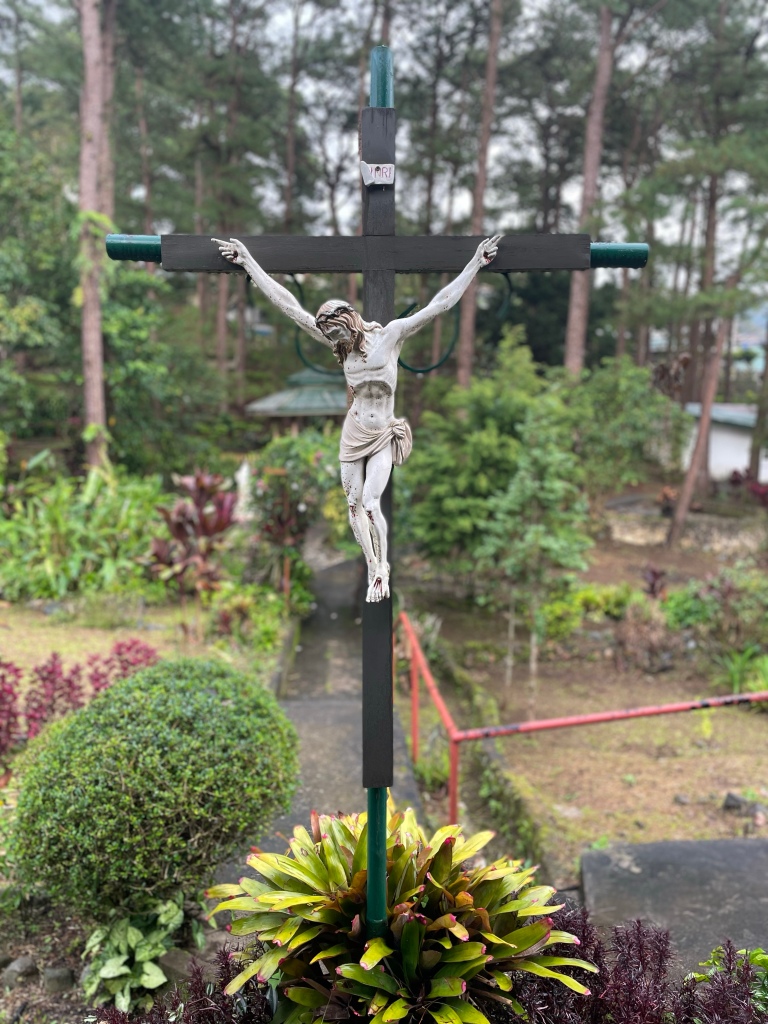
The cross is perhaps one of the most widely used but also abused and misunderstood sign in almost every generation. In fact, we are so accustomed to the cross of Jesus Christ found everywhere like in churches and cemeteries, offices and classrooms, hospitals, inside every kind of vehicle and, of course, houses. Almost everybody carry it on our persons for various reasons: as an object of veneration, as a badge, or as a jewel.

On the cross we find Jesus shown in glory, peacefully sleeping in death, sometimes with his body broken by suffering. Hence, many times we use the word “cross” like in “cross my heart” to indicate our sincerity and truthfulness. But, are we truly aware of its meaning and significance in our faith, of its centrality as the symbol of God’s love for us expressed by the self-sacrificing death of Jesus Christ his Son?

Photo by author, St. Scholastica Convent, Baguio City, 23 August 2023.

Today we celebrate the Exaltation of the Cross which started in the fourth century. According to legend it began with the miraculous discovery of the True Cross by Helena, mother of the Emperor Constantine, on 14 September 326, while she was on a pilgrimage to Jerusalem. She then ordered through her son the emperor the building of the Church of the Holy Sepulchre that was dedicated nine years later with a portion of the True Cross placed inside it in September 13, 335. The following day, the Cross was brought outside of the church to be venerated by the clergy and the faithful.

In the year 627, during the reign of the Emperor Heraclius I of Constantinople, the Persians conquered the city of Jerusalem and removed a major part of the Cross from its sanctuary. The emperor then launched a campaign to recover the True Cross which he regarded as the new Ark of the Covenant for the new People of God. Before embarking into war, Emperor Heraclius went to church wearing black as a sign of penance, then prostrated himself before the altar and begged God for courage. His prayer was granted as he won the war and recovered the Cross from the Persians. He brought the Cross back to Jerusalem in 641 amid great celebrations by carrying it on his shoulders. Upon reaching the gate leading to Calvary, the emperor could not go forward! Heraclius and his retinue were astonished and could not understand what had happened until the Patriarch Zachary of Jerusalem told him, “Take care, O Emperor! In truth, the imperial clothing you are wearing does not sufficiently resemble the poor and humiliated condition of Jesus carrying His cross.”

Upon hearing those words, the emperor removed his shoes and bejewelled robes, put on a poor man’s clothing and was eventually able to proceed to Calvary and replaced the Cross inside the Church of the Holy Sepulchre where a number of miracles happened during the occasion: a dead man returned to life, four paralytics were cured, ten lepers were healed, 15 blind men were given their sight, with several possessed people exorcised and many sick people totally healed!

Photo by author, Mirador Jesuit Villa & Retreat House, Baguio City, 24 August 2023.

Very notable in this story were the words of the Patriarch of Jerusalem. It was only after the emperor had taken off his royal clothings and put on those of the poor was he able to carry the Cross.

It is the same thing that is asked of us today: it is so easy to display the cross inside our homes and cars, or wear it as a jewelry or even as a tattoo on our skin. But that would amount to nothing unless we have the cross inside our hearts, our very being. More than the many signs of the cross and imaginary drawing of its lines we draw on our chest is the need for us to empty ourselves of our pride and sins so that we can be filled by Jesus Christ.

Brothers and sisters: Christ Jesus, though he was in the form of God, did not regard equality with God something to be grasped. Rather, he emptied himself, taking the form of a slave, coming in human likeness; and found human in appearance, he humbled himself, becoming obedient to death, even death on a cross.

Philippians 2:6-8

Called kenosis in Greek, self-emptying is the way of the Cross of Christ. It is choosing love and mercy than self-centeredness and self-righteousness; sacrifice than satisfaction; fairness and justice than greed and possession; bearing all the pains and perseverance than complaining and whining about difficulties and trials in life like the Israelites in the wilderness (first reading); and, thinking more of others than of one’s self.

Photo by author, 02 September 2023.

The recent COVID-19 pandemic had taught something very amusing about the positivity of being negative, when negative was actually positive – healthy and COVID free! Remember how during those days when we would always wish we would yield negative results in our swab tests for COVID?

When we look at the sign of the cross (+), it is a positive sign, a plus sign. Though the cross calls us to let go, to be detached and dispossessed, it is actually an invitation to have more of God, of life and fulfillment! In this time of affluence when everything is practically easily available for as long as you have the means and the resources, the sign of the Cross reminds us that life is more of letting go and of giving than of having like God who “so loved the world that he gave his only Son, so that he who believes in him might not perish but might have eternal life” (Jn.3:16). St. Francis of Assisi said it perfectly why the Cross is an exaltation, a triumph:

For it is in giving that we receive,
it is in pardoning that we are pardoned,
and it is in dying that we are born to eternal life.  

Amen.  Have a blessed Thursday!

Why love is the greatest commandment

Lord My Chef Daily Recipe for the Soul by Fr. Nicanor F. Lalog II
Friday in the Twentieth Week of Ordinary Time, 25 August 2023
Ruth 1:1, 3-6, 14-16, 22   <*{{{{>< + ><}}}}*>   Matthew 22:34-40
Photo by Mr. Jay Javier at Tayabas, Quezon, 13 August 2023.
O how often,
Lord Jesus Christ
that we ask you until now
the same question by 
a scholar of the law:
"Teacher, 
which commandment
of the law is the greatest?"
(Matthew 22:34).
And we have always known
your answer, which is, loving God
with one's total self
and loving others as we love our
very selves.
But why do we keep on asking
the same question until now?

Because, we have always believed
that loving is having,
that loving is fullness,
when in fact, it is the 
exact opposite:
loving is not having,
loving is being poor,
loving is emptiness,
loving is letting go,
loving is surrendering
for the one you love.
Just like Ruth,
that Moabite woman,
a pagan who left everything
to join her widowed
mother-in-law Naomi to go
back to Bethlehem;
both of them were
widowed, both were
childless and empty,
so poor without anything 
except each other
and God.
Let the words of Ruth
be our prayer today
to those we love 
without if nor buts,
especially those empty
and poor, sick and dying:
"Do not ask me to abandon 
or forsake you! for wherever
you go I will go, wherever 
you lodge I will lodge,
your people shall by my people,
and your God my God"
(Ruth 1:16).
God our Father,
help us to remain faithful
and to keep loving when
in the midst of sufferings
and trials, of emptiness
and nothingness like Ruth
to Naomi; how lovely to recall
that Ruth's love for Naomi led
to her becoming the grandmother
of King David and one of the four women
in Matthew's genealogy of Jesus
for it is loving without nothing in return
that we gain, and it is in loving 
even in losing ourselves
that we find ourselves in you.  
Amen.

Waiting for God who is waiting for us

The Lord Is My Chef Daily Recipe for the Soul by Fr. Nicanor F. Lalog II
Monday, Memorial of St. Ignatius of Loyola, Priest, 31 July 2023
Exodus 32:15-24, 30-34   <*((((>< + ><))))*>   Matthew 13:31-35
Photo by author Camp John Hay, Baguio City, 12 July 2023.
Glory and praise to you,
God our loving Father,
our Lord and Master,
our Origin and Home;
thank you for the gift
of St. Ignatius of Loyola
who taught us through his
"Spiritual Exercises" 
to truly pray by seeking
you and only you alone.
Teach me, O Lord, 
to be patient
and persevering
in my prayer life,
to never be contented
with mere feelings and
self-absorption that are 
manipulative like what your people
felt at the foot of Mount Sinai
while awaiting Moses; 
let me be at home
with desolation and dryness,
being still when nothing seems to happen,
 finding you when you seem nowhere,
desiring you most while amid
all of these like in awaiting the
sprouting of a mustard seed
or the leavening of bread
in Christ's parable. 
Many times we feel
we are awaiting you, God 
when actually it is you who
awaits us always to experience
you and your presence,
your love and mercy
if we could just be still and 
silent.  Amen.

St. Ignatius of Loyola,
Pray for us.

Fulness in emptiness

The Lord Is My Chef Sunday Recipe for the Soul by Fr. Nicanor F. Lalog II
Easter Sunday, Cycle A, 09 April 2023
Acts 10:34, 37-43 ><}}}"> Colossians 3:1-4 ><}}}"> John 20:1-9
Photo by author, sunrise at Katmon Nature Sanctuary & Beach Resort, Bgy. Binulusan, Infanta, Quezon, 04 March 2023.

Blessed happy Easter everyone! Rejoice, the Lord is Risen! I know it is very difficult to greet everyone with Happy Easter compared with Merry Christmas primarily due to our weather. Most of all, because Easter is so empty unlike Christmas so filled with many signs and symbols, even with gifts and other things.

But that is the mystery – and joy – of Easter.

Emptiness. Even nothingness.

Because when we are empty, when we have nothing, that is when God fills us with his abundance.

On the first day of the week, Mary of Magdala came to the tomb early in the morning, while it was still dark, and saw the stone removed from the tomb. So she ran and went to Simon Peter and to the other disciple whom Jesus loved, and told them, “They have taken the Lord from the tomb, and we don’t know where they put him.”

John 20:1-2
Photo from GettyImages/iStockphoto.

How amazing that we Filipinos are so fond of using the expression “wala lang” for nothing or empty. When a man texts a woman with a simple hi or hello plus the words, wala lang, do not believe him because that’s something! There is something in simply texting you out of the blue! Meron yun kasi di ka niya text kung wala talaga.

In the provinces if you come for a lunch or dinner, whether there is an occasion or none, it is common to hear the hosts especially the poorer ones apologizing for not having a lot of food when in fact there are more than two viands like the freshest fish and vegetables we urbanites miss most. They would always say, “wala po kaming nakayanan, mahina po ang ani/huli, pasensiya na po.” Such kind of superb graciousness among us Filipinos in the provinces is so ordinary.

Perhaps, it is a beautiful sign we have imbibed from our deep faith in Jesus Christ who was nowhere to be found inside the empty tomb.

His absence from the empty tomb meant he was present somewhere. That was what Magdalene implied when she said “They have taken the Lord from the tomb, and we don’t know where they put him” (Jn.1:2).

Though the tomb was empty, Jesus was not missing at all. He had risen from the dead! In fact later, they would meet him along the way and that very evening too until his ascension into heaven.

Emptiness and nothingness can be positive or negative.

Positive emptiness means nothingness for God who alone suffices. There is an inner feeling of emptiness for something or Someone bigger, greater. That is how a man feels when he texts a woman of his dream with wala lang: he feels empty and nothing without her! The same with God. St. Augustine perfectly said it, “my heart is restless until it rests in you, O Lord.”

Henry Osawa Tanner’s painting, “The Three Marys” (1910), photo from biblicalarchaeology.org.

Easter is positive emptiness: Jesus is no longer in the tomb because he is risen. It is the definitive sign we have been freed from the clutches of evil and sin, of death and decay. Death is not the final statement in life. The gospel at Easter Vigil is more picturesque when Matthew narrated how Magdalene saw an angel seated on the empty tomb of Jesus, a beautiful reminder of how suffering and death have become Christ’s crowing glory. From being a tomb to becoming a Throne!

Every time we experience pains and sufferings, of emptiness and nothingness in life that all we could do is surrender everything to God like Jesus on the Cross, that is positive emptiness. We know for sure and feel it inside us that there is something in this nothingness. That is why never say “walang-wala ako” (I got nothing) because we always have God in us.

Positive emptiness/nothingness is the virtue of hope which is not positive thinking that things would get better. In fact, to have hope in God is to believe and accept that things could get worst like Jesus during the days leading to his arrest and crucifixion because to hope is believe that even if everything is lost, there is always God loving us in the end.

Hope is positive emptiness because it is creating a space within us for God and for others in love. Positive emptiness and nothingness is seeking God right in that emptiness like Peter and John running into the tomb after learning it was empty because we love, we have a relationship that continues after one is gone and not seen.

That ultimately is what positive emptiness/nothingness is all about, love.

It is similar to that feeling at the end of a movie when we refuse to stand and leave the cinema because we believe – we hope – there is still another final scene, there is still a coming sequel to what we have seen. We are not totally saddened with the end of the movie as we strongly feel, there would be a part two, a part three, and a part four which has been the trend all these years of the great movies of our youth! How funny that after exhausting the sequels, there came also the prequels. Why? Because we have all established a relationship, a love among us the fans of a movie franchise like Star Wars or Die Hard and its creators.

Photo by Ms. April Oliveros, Mt. Pulag, 25 March 2023.

That is what Easter is all about. We do not simply give up for life’s many sufferings and pains, trials and tribulations because we feel and know deep inside we have Jesus Christ who have risen from the dead. We are emptied daily in order to be filled with Jesus himself every day too. There is no need to see much things. Enough to feel deep inside like what Peter explained to the people at the first reading. Their very lives proved amid the physical emptiness or absence of Jesus in the world that Jesus was present, was Someone with Something.

This is the great challenge for us these days. More and more people are spending the Holy Week and Easter in the beach or somewhere else to bond as family where they could see more of each other and see more sights than the ordinary we have during this time of the year at home and in the parish that are usually bland and dry. More people prefer to go somewhere here and abroad in the hope of still being able to pray and celebrate the sacraments there because they feel empty here at home. We really hope they have positive emptiness than negative emptiness.

Negative emptiness is feeling empty amid the plethora of things and pleasures in life. Many times these days due to mobility, it is so easy to go hiking to the mountains or to some exotic destinations to fill the emptiness we have inside, to search for our “lost selves” (hanapin ang sarili). But very often, after some time of relief, the same emptiness and nothingness occurs. Nothing happens because what we really have is positive emptiness, our desire for God, the most essential in life who cannot be replaced by anything at all.

Negative emptiness is seeking things, sights and sounds, things of the senses to fill up curiosities, to settle doubts, to find happiness not realizing it is totally different from joy and fulfillment.

Negative emptiness is insisting on holding on to what can be seen, to what is tangible despite the inner directions we have been feeling inside toward God. For some time, we can refuse to follow its directions but there are times, positive emptiness and nothingness impose itself on us like when there is death or serious illness in the family. At first, it can be scary, so frightening but eventually, liberating like in the experiences of the first disciples of Jesus.

May we heed St. Paul’s words this Easter from the second reading, “Brothers and sisters: If then you were raised with Christ, seek what is above, where Christ is seated at the right hand of God” (Col. 3:1).

Dearest Lord Jesus,
grant us the grace to seek and find
you in emptiness and nothingness,
even in darkness;
many times, our senses blur 
our sight of you;
how sad that even in our celebrations
we are so fascinated with all the colors
and antics in the rituals and processions 
we keep in our cameras and cellphones
but never in our hearts and memories
that soon enough, they fade, we forget
and see them only as pictures
bereft of meaning because it lacked relationship;
let us see you more beyond 
to have sights and insights
as well as hindsight and foresight
of your loving presence
in emptiness and nothingness
because what we have and keep
is your relationship,
your love and mercy.
Amen.

Paloob ang Kuwaresma, hindi palabas

Lawiswis ng Salita ni P. Nicanor F. Lalog II, Ika-22 ng Pebrero 2023
Larawan mula sa Google.com.
Paloob ang Kuwaresma
hindi palabas.
Katulad nitong ating buhay
na papaloob at hindi palabas.
Pagmasdan mga tanda
at kilos nitong panahon
habang Panginoon ang tinutunton
hinuhubad ating kapalaluan
upang bihisan ng kababaan,
sinasaid ating kalabisan
upang punan ng Kanyang 
buhay at kabanalan.
Paloob ang Kuwaresma,
hindi palabas.
Simula ay Miercules de Ceniza 
mga noo'y pinapahiran ng
abong binasbasan
paalala ng kamatayan
tungo sa buhay na walang-hanggan
kaya kinakailangan 
taos-pusong pag-amin 
at pagsuko ng mga kasalanan
talikuran at labanan 
gawi ng kasamaan.
Paloob ang Kuwaresma
hindi palabas.
Huwag magpapansin
tuwing mananalangin
hayaan saloobin at hiling
isalamin ng buhay natin;
pag-aayuno ay higit pa sa
di pagkain ng karne
kungdi mawalan ng laman
ating tiyan, magkapuwang
sa Diyos at sino mang 
nagugutom at nahihirapan;
ano mang kaluguran ating
maipagpaliban ay ilalaan
sa nangangailangan
buong katahimikan maglimos
tanda ng kaisahan
kay Hesus nasa mukha
ng mga dukha
at kapus-palad.
Paloob ang Kuwaresma
hindi palabas.
Sa gitna nitong panahon
ng social media na lahat
ay ipinakikita at ibig makita,
lahat ay pabongga
puro palabas;
ipinapaalala ng Kuwaresma
ang mga pinakamahalaga
pinakamaganda
at makabuluhan
ay hindi nakikita
nitong mga mata
bagkus ay nadarama
dahil sa paningin ng Diyos
ang tunay na mahalaga
ay yaong natatago,
napapaloob katulad Niya
na nananahan
sa ating puso at kalooban.
Larawan mula sa google.com.

When nothingness is fullness: creating a space for God

The Lord Is My Chef Simbang Gabi Recipe by Fr. Nicanor F. Lalog II
Monday in the Fourth Week of Advent, Day 4 of Christmas Novena, 19 December 2022
Judges 13:2-7, 24-25     ><}}}}*> + ><}}}}*> + ><}}}}*>    Luke 1:5-25

As we get closer to Christmas Day, there is this post going around social media that I think is worth sharing this blessed season of getting together like parties and reunions especially after two years of lockdown and isolation in this pandemic.

I totally agree with this list and in fact, still thinking of adding some more to finally end our penchant for insulting others.

A very classic case of being “mema”memasabi lang without thinking and caring for the well-being of other people as well as without realizing how stupid they are whenever they say these “eight things we should stop saying at family reunions for good.”

Notice how most of these are addressed to women.

First to single ladies in the family or circle of friends with the very common query “Kailan ka mag-aasawa/magpapakasal?” to the downright insensitive, “Ang tanda mo na. Bakit single ka pa rin hanggang ngayon?”.

Here we find the wrong notion of everyone that getting married is the most important thing in this life, no matter what!

It is a very rude and senseless comment to any woman, especially a family member or relative. Most guilty of this are moms and aunts.

Can a woman just get married with any man?

Of course, she has to be choosy, she has to think very, very hard about it because marriage is a lifelong commitment.

Married life is a call from God, not a cajole from relatives and crowd. Please, shut up and stop making these comments.

Next on the list are still women which shows how some of our family members and relatives -ironically also women – would not really stop in their insulting spree.

They wrongly believe that relatives and friends have no privacy at all!

Next to single ladies, the married women are the favorite target of these insensitive relatives and colleagues with their question, “Kailan mo balak magka-anak?”

Whoa! For me this is a mortal sin. Something we should not let pass our lips because we will never know how difficult and trying it must be to some couples in working and praying for a child.

Life is a gift from God and only him can truly bless every couple with a baby. It is not magic or power given to humans.

Every couple wants to have a child, a baby, but, of course, like marriage, they have to prepare for it. They need to plan. And save and work to ensure their kids would get good education and comfortable life.

It is a struggle among many couples. Again, shut up and just pray for them to have their own “little bundle of joy”.

Now, we come to the third thing we must stop saying at all.

It is a comment directed to us who comprise more than half of the world population. Imagine if all of us fat people would unite, people would never dare speak these words….

Many times I just keep silent at people who say this.

If ever you tell them you have lost 20 or 30 kilos, the more they will insult you with “pumayat ka pa niyan?”.

See what I mean. They are the worst kind of insensitive people on earth without any knowledge at all about biology and medicine, imbeciles with little brains, asking “malakas ka bang kumain?” Of course! Would you get fat by just deep breathing?

It is the fourth day of our Christmas novena and why do I tell you these, or entertain you with these?

Our readings today show us how two great prophets were conceived and born in miraculous manner. In the first reading we have the story of the conception of Samson in the Old Testament. His mother was barren. Perhaps, she was also a subject of many insults and jokes, of nasty talks and insensitive comments like what most women experience today.

Then we have the story of the annunciation of the birth of John the Baptist to his father Zechariah, himself already old unable to make a baby while his wife Elizabeth was barren. Despite their stature in the society with a pedigree equal to many of the gentry, they never have a child who would continue their lineage.

But here we find God finally answering their prayers in the midst of their nothingness.

Here are couples who have been praying all their lives for a child when God finally answered them.

Sadly, Zechariah doubted it that he was silenced by the angel, indicating the need for us to be silent always, to be empty to let God fill us with his work and grace.

Many times in life, nothingness is actually fullness.

See when a guy texts a lady, saying “hi” just because or “wala lang” or “nothing”.

But, that is something! When we tell people “wala lang”, it is “meron.”

The same in life. In fact, we have to be empty in order to be filled up by God. Zechariah was silenced while Elizabeth on her own decided to “quarantine” herself by going into “seclusion for five months, saying, ‘So has the Lord done for me at a time when has seen fit to take away my disgrace before others'” (Lk.1:24-25).

Many times in life we get impatient. We doubt and sometimes easily give up.

Like St. Joseph yesterday, we just have to accept that we have to set aside our own plans to follow God’s better plans for us. We have to accept everyone because Christ comes in everyone. We have to accept in order to understand life better.

I know it is easier said than done, especially for all single ladies, childless couples and fat people like me praying to God, asking what is most dearest to us like the vocation in life or the right man, a baby, and a good health; God hears and answers all prayers.

Just be patient. In our emptiness and nothingness, God comes. Just be sure to have that space for God always, unlike Zechariah who doubted the power of God.

Sometimes, we hurry God to answer our prayers especially when the insults and comments from others become unbearable. That is fine. God listens and understands it so well. That is why today, we pray for those with urgent prayers before God:

God our loving Father,
we praise and thank you in sending
us Jesus Christ your Son,
our Lord and Savior,
the one whom you raised from 
the root of Jesse;
come now, do not delay any longer!
Come and deliver us, O Lord,
remember your promise to us,
and keep us open always like
Elizabeth to find you still in our
barrenness and nothingness;
help us create and preserve
that sacred space for you within
us always so that even in life's
emptiness, we are fulfilled in you.
Amen.

Rejoicing amid disappointments

The Lord Is My Chef Sunday Recipe for the Soul by Fr. Nicanor F. Lalog II
Third Sunday in Advent-A, Gaudete Sunday, 11 December 2022
Isaiah 35:1-6, 10 ><}}}*> James 5:7-10 ><}}}*> Matthew 11:2-11

Photo by author, 2019.

Today our altar bursts in lovely shades of pink in celebration of the third Sunday of Advent also known as Gaudete Sunday from the Latin gaudere that means “to rejoice”. We rejoice this third Sunday because the Lord’s Second Coming is getting nearer each day and so is our awaited celebration of Christmas with the start of Simabang Gabi.

There are still many reasons for us to rejoice but when we reflect deeper in life, our rejoicing in itself is a paradox.

Because rejoicing is more joyful when seen amid darkness and uncertainties, disappointments and failures.

Because joy is more than feeling happy but that certainty within us that no matter what happens in this life, even if things get worst, everything ends according to God’s plans.

Because God loves us so much!

That is why we rejoice this Sunday – and everyday in our lives – that no matter what happens to us, God is with us in Jesus Christ, loving us, saving us.

When John the Baptist heard in prison of the works of the Christ, he sent his disciples to Jesus with this question, “Are you the one who is to come, or should we look for another?” Jesus said to them in reply, “Go and tell John what you hear and see: the blind regain their sight, the lame walk, lepers are cleansed, the deaf hear, the dead are raised, and the poor have the good news proclaimed to them. And blessed is the one who takes no offense at me.”

Matthew 11:2-6
Photo by author, 2021.

How fast things happen and change in life, especially when there is a sudden change or reversal, from good to bad, from top of the world to bottom into the unknown like John the Baptist.

Last week, John was on top of the world as people were coming to him for baptism, listening and believing his preaching; today, we heard him in prison!

Herod Antipas, the son of King Herod when Christ was born, had him imprisoned after John told him that it was wrong for him to take as wife his brother Philip’s former wife, Herodias. Eventually, John was beheaded in prison upon Herod’s order after making a promise to grant whatever request the daughter of Herodias would ask him after entertaining guests in his birthday party; the daughter asked for John’s head on a platter and immediately, Herod dispatched his executioner.

Now at his lowest point in life awaiting certain death, John was “disappointed” with what he had been hearing about the works and preaching of Jesus Christ whom he had baptized at Jordan. Recall how John preached a message of “fire and brimstone” as he expected the Christ would bring punishment and destruction to those doing evil, warning them that the “ax lies at the root of the trees…ready to cut down those not bearing fruits” while his “winnowing fan in his hand is gathering his wheat into his barn, but the chaff he will burn with unquenchable fire” (Mt. 3:10, 12).

John was expecting the Christ would immediately make sweeping changes in the world, punishing the evil doers but what he heard and perhaps may have witnessed too was the gentleness of Jesus, always ready to forgive the sinful, heal the sick, and most of all, keeping company with the most sinful people of that time like the tax collectors and the prostitutes!

Many times in life we find ourselves very much in John’s situation – so disappointed with God because what happens in reality are exactly the opposite of what we expected based on what we are taught or what we have read in the Bible! That is why John sought clarification from Jesus himself. We too, when disappointments happen in life along with other pains and sufferings especially after trying our very best to serve God through others, must always have that disposition of humility to seek clarifications from God. As disciples of Jesus Christ, we must be open like John in welcoming the Lord in the way he wishes to reveal himself.

Photo by author, November 2022.

How ironic that John who stood preaching the coming of Christ Jesus, of demanding justice and kindness from the people was imprisoned, himself a victim of injustice! Sometimes in life, it is so easy to preach Jesus Christ and his values not until we find ourselves on the distaff side like getting sick or being unjustly accused of something we did not commit. Like John, when we become the very people suffering those things we preach, our expectations even of God may blind us and fail us to see Christ’s coming, becoming so difficult to see God’s mercy and healing acting in other people’s lives but not in our own lives like John who was imprisoned unjustly for telling the truth.

The Season of Advent, especially this third Sunday we call “Rejoice” or “Gaudete” Sunday invites us to examine our own expectations and knowledge of God that may sometimes blind us to his actions and presence in our world.

The key is to have that humility to just let God be God!

Let God do his work and just chill.

Let us allow ourselves to be surprised by God always! It is from those surprises by God when joys burst in our lives even in the most difficult or simplest situations in life.

Photo by author, 2018.

One of my favorite subjects in photography are mosses – lumot – those green clumps or mats found thriving in damp, shady spots and locations. I am no green thumb but I love mosses and ferns because they are very refreshing to the eyes. They evoke hopes and surprises that despite the little sunlight and care they get, they live and thrive so well, teaching us a lot of valuable lessons about darkness and failures in life.

That is what Isaiah and St. James were reminding us in the first two readings, of the need for us to be patient like the farmers in awaiting the sprouting and blooming of crops and plants in the fields, of strengthening each other because the hard times are sure to end. Most of all, the Lord is faithful, always working silently when we are in the most dead situations in life, preparing great surprises for us.

Let us set aside our expectations, even our goals and agenda in life to let God do his work in us, to surprise us with his more wondrous plans because he knows what is best for us.

There are times in life when we are disappointed even frustrated at how things are not going according to our plans even if God had confirmed it in our prayers and in many instances in life – that feeling of suddenly being abandoned by God?

There are times we complain and feel undeserving of the many failures and pains that come our way because we have been so faithful to God, even prayerful that we cry to him, asking him like John for clarifications of whether he is with us or should we still wait more.

Most often in life, we get blinded even by our noble intentions and goodness, of our image and expectations of God that in the process, we are hurt, leaving us with scars and empty spaces within…

Be patient, my friend. Trust God.

The same empty spaces and holes in life would soon be filled with blessings so unimaginable because, remember, God is “greater than our hearts and knows everything” (1 Jn. 3:20). It is only when we are hurt and bruised and emptied, even dried and dead when life and joy burst forth because that is when God can freely work in us in Christ Jesus. Amen.

Have a joyful week ahead!

Photo by Ms. Jo Villafuerte, September 2019.