Lawiswis ng Salita ni P. Nicanor F. LaLog II, 18 Pebrero 2020
Larawan kuha ng may-akda sa Mt. St. Paul, Trinidad, Benguet, 05 Pebrero 2020.
Buhat nung isang gabi
hindi ako mapakali
nang si Hesus ay hindi makapagtimpi
napabuntung-hininga ng malalim
nang makipagtalo sa kanya
mga Pariseo humihingi ng tanda
na siya nga ang Kristo.
Hindi ba turo ng matatanda
hanggang ngayon siyang laging paalala
masama magbuntung-hininga
na tila baga wala ka nang pag-asa?
Gayun pa man maski ito ay ating alam
madalas hindi natin mapigilan
kapag nahihirapan at nabibigatan.
Katulad natin marahil
si Hesus napupuno na rin:
nagbubuntung-hininga,
humuhugot ng kabutihan
sa kanyang kaibuturan
upang malampasan
mga kasamaan ng kalaban.
Iyan ang kabutihan
magandang kahulugan
nitong pagbubuntung-hininga
na pilit tinatanggihan, di naman maiwasan
dahil ating nang nakagawian
pumaloob sa kaibuturan
kaysa makipag-awayan
Hindi kaduwagan
bagkus katapangan kung minsan
dahil iyong sinasaalang-alang
katiwasayan ng ating mga ugnayan
kaya pilit sinisisid, sinasaid kabutihan
doon sa kalaliman ng kalooban
kung saan nanahan Panginoon ng Kapayapaan.
Larawan kuha ng may-akda, Poblacion ng Los Baños, Laguna, 13 Pebrero 2020.
The Lord Is My Chef Sunday Recipe for the Soul, Week VI-A, 16 February 2020
Sirach 15:15-20 ><)))*> 1 Corinthians 2:6-10 ><)))*> Matthew 5:17-37
Photo by author of pilgrims entering the Church of the Beatitudes with a painting of the Sermon on the Mount above the door, May 2019.
Jesus continues his Sermon on the Mount this Sunday, expounding the meaning of his teachings called the Beatitudes. As we have reflected last week, the Beatitudes tell us the person of Jesus Christ as being “poor, merciful, clean of heart” whom we must all imitate to become the salt and the light of the world.
Most important of all, Matthew presents to us at the Sermon on the Mount that Jesus is more than the new Moses as giver of laws like at Mt. Sinai in the Old Testament: Jesus himself is the Law, who is both our Teacher and Redeemer.
This we see in his teachings today when he claims to be the fulfillment of the Laws and the Prophets from God in the Old Testament.
Jesus said to his disciples: “Do not think that I have come to abolish the law or the prophets. I have come not to abolish but to fulfill it. Amen, I say to you, until heaven and earth pass away, not the smallest letter or the smallest part of a letter will pass from the law, until all things have taken place.”
Matthew 5:17-18
Essence of the Laws: reflection of God, the good of man
Today, Jesus is teaching us to see the laws in the right perspectives, in the light of the will of God for the good of every person. Throughout his ministry, Jesus has always been consistent in reminding everyone that the laws were made for man, not the other way around.
During Christ’s time, people have lost the real meaning of the Commandments of God as priests and religious leaders focused more on its letters than in its essence and spirit that in the process, the laws have become burdensome. It has continued in our own generation with laws taking precedence over God and persons.
Photo by author of the Church of the Beatitudes at the Holy Land, May 2019.
At the Sermon on the Mount, we find Jesus restoring and recalibrating the laws so that these become more relevant and powerful as reflections of God in the service of man.
Jesus “relectures” us the laws in this part of his Sermon on the Mount by adding more righteousness (holiness), declaring that,
“I tell you, unless your righteousness surpasses that of the scribes and Pharisees, you will not enter the kingdom of heaven.”
Matthew 5:20
By using a pattern where he would cite Laws, saying, “You have heard that it was said”– Jesus shows us his fidelity and obedience to Judaism, contrary to his enemies’ accusations that he had abolished their laws. Moreover, in fulfilling the laws, Jesus put himself in the midst of every law and precept by declaring, “Amen, I say to you” or “but I say to you”.
In following that formula, Jesus gave the laws with a human face and a human heart in himself as its fulfillment so that from then on at his Sermon on the Mount, Christ made every law, every tradition, everything else to be seen always in his person.
Black and white photo by Mr. Jay Javier in Quiapo, 09 January 2020.
Performative powers of the laws in Jesus Christ
With Jesus in the midst of every law and precept as its fulfillment, God’s laws then become not only informative but most of all, performative to borrow one of Pope Emeritus Benedict XVI’s favorite expression. This we find Jesus teaching us in three stages in our long gospel this Sunday.
Education of the heart.
The first two laws cited by Jesus in this long list of commandments are “You shall not kill” and “you shall not commit adultery”. Both laws bring us to the very core of our personhood, of what is in our hearts and in our minds. The Lord explains that being angry as well as saying bad words against another person is like murder while looking lustfully at a woman is a form of adultery because in both cases, we have ceased to regard the other individuals as persons to be loved and respected, created in the image and likeness of God.
From Google.
It is an invitation for us to purify our hearts and minds for what defiles man is not what enters him but what comes out from him (Mt.15:11). Whatever is within us will always have an effect in all of our actions, for better or for worse.
What a tragedy that right here in the middle of our wired world of social media and instant communications, we have actually grown apart than together in the last 35 year with so much animosities fed on by lies and misinformation.
How ironic also that despite the information explosion from the Net, we have more benighted souls today than ever before who have actually gone to schools who know nothing of our history and geography?!
Education of the heart is formation of the whole person, not just a training of skills. One problem we have these days is when information is geared on data and facts without integration that we forget our relationships as well as the values we keep like respect, kindness, and dedication. Unless we have an education of the heart, a wholistic and integral formation, we can never be transformed into like Jesus Christ.
2. Get into the roots of our sins.
In telling us to pluck out our right eye or cut off our right hand if these cause us to sin, Jesus is inviting us again to probe deep into our hearts and being to understand what causes us to sin.
Photo by author, water plants in my room at the Fatima Parish and National Shrine, Valenzuela City, 2010.
The key here is to be totally free. In the first reading, Ben Sirach counsels us to “choose” rightly what is good and avoid what is evil.
We can only exercise our true freedom when we have clearer knowledge and understanding of ourselves and of things within us. We fall into vices and sins because we do not know what is going on inside us; hence, we are enslaved by our desires and sins to be not free at all.
Once we understand our sins, we commit them less often. Most of all, when we understand our sins, our struggles against committing these become more persevering, resulting to more triumphs than defeats.
The Season of Lent is near. Once again, we shall be busy with fasting and abstinence, contrition and confession of sins, almsgiving and other spiritual works that make us holy. But too often, these acts become mechanical that sooner, we sometimes reach that point when we cannot find meaning in doing them anymore that we sink deeper into sins and evil.
This happens when we get focused with letters of the laws and we forget its spirit that we become mechanical because we have failed to understand our very selves as well as our sins.
3. Be true.
Jesus said it perfectly well at the end of his teachings today,
“Let your ‘Yes’ mean ‘Yes’ and your ‘No’ mean ‘No.’ Anything more is from the evil one.”
Matthew 5:37
In this last installment of reviewing the laws, Jesus underscored the problems with divorce as well as with lies that continue to this day because we always choose not to be true at all with ourselves, with God, and with others.
Photo by author of the last two Stations of the Cross at the chapel of my niece Ms. Babs Sison in Los Baños, Laguna 13 February 2020.
See the wisdom of Jesus in putting together divorce and oaths, the two great lies that until now continue to mislead so many among us who refuse to accept and carry the cross of Christ, preferring only the Easter Sunday minus the Good Friday.
Being true is embracing the Cross of Jesus Christ like St. Paul in the second reading. It is something we cannot deny in this life. There will always be pain and sufferings. As Dr. Scott Peck put it in his book The Road Less Travelled, “life is difficult.”
At his Sermon on the Mount, Jesus clearly showed in his Beatitudes that he and his values are in sharp contrast to the wisdom of the world. And this wisdom is only accessible to those willing to embrace the crucified Christ and the scandal of the cross.
It is there on the Cross with Jesus Christ we truly find the fulfillment of the laws as well as our fullness as persons. Amen.
Lawiswis ng Salita ni P. Nicanor F. Lalog II, Ika-11 ng Pebrero 2020
Larawan kuha ni G. Jay Javier, 09 Enero 2020 sa Quiapo, Maynila.
Deboto ang tawag sa isang tao
na malapit at namimintuho
Kay Kristong Nazareno o Sto. Niño
kasama na mga Santo at Santa
sa pangunguna ng Birheng Maria.
Kaya dapat bawat deboto totoo
uliran at huwaran sa pamumuhay
taglay ay kabanalan nang sa kanya'y
mabanaagan larawan ng kabutihan
ng Diyos sa kanyang kadakilaan.
Kay laking katatawanan at kahangalan
kung ang debosyon ng sino man
ay haggang simbahan lamang
nakikita paminsan-minsan
tuwing kapistahan at mga prusisyon sa lansangan.
Larawan kuha ni G. Jay Javier, 09 Enero 2020 sa Quiapo, Maynila.
Anong kahulugan at saysay
ng mga pagpupugay
sa Diyos at kanyang mga banal
kung sa kapwa nama'y manhid
walang malasakit at pakialam?
Nag-aalaga ng mga Poon
binibihisan tila laruan
ngunit pag-uugali at katauhan
malayo sa katuwiran at katarungan
ganyang debosyon dapat tigilan!
Ang tunay na deboto
puso ay malapit kay Kristo
at sa kanyang Ina at mga Santo
may pagmamahal, malasakit
sa kapwa tao na kanyang nirerespeto.
Larawan kuha ni G. Jay Javier, 09 Enero 2016 sa Quiapo, Maynila.
Ano mang debosyon
iyong nakagawian o nakahiligan
araw-araw itong sinasabuhay
pinaninindigan at tinutularan
aral at buhay ng sinusundang banal.
Sa dami ng mga deboto
bakit ganito pa rin tayo
walang pag-asenso
buhay ay kasing gulo
ng eksena sa senakulo.
Ay naku!
Ano nga ba tayo,
mga deboto o debobo
asal demonyo, sobrang gulo
pinapako nating muli si Kristo!
Lawiswis ng Salita ni P. Nicanor F. Lalog II, Ika-17 ng Enero 2020
Larawan mula sa Inquirer.net, 12 Enero 2019
Lahat ay nagimbal
nang pumutok bulkan ng Taal:
nagdarasal, nagninilay
kahulugan at mga aral
na sa atin sana'y gumabay.
Isang katiyakang ating mapananaligan
hindi kaparusahan pagsabog ng bulkan
na batay sa kaayusang tinakda
noon pa man nitong kalikasan
sa karunungan ng Poong Maykapal.
Gayon pa man,
mahalaga nating mapaglimi-limihan
kung ano baga mga aral
sa atin ay inuusal nitong
pagsabog ng bulkang Taal.
Larawan ay kuha ni G. Raffy Tima ng GMA-7 News, 12 Enero 2020.
Una kong napagtanto
laganap na pagkalat ng abo
mula nang pumutok ang Taal
upang ipaala-ala sa ating mga tao
ating pinagmulan at hahantungan.
Iyon nga lang
sa inyong pakundangan
bakit nga ba yaring mga kinauukulan
pati na rin sambayanan
tila baga mga isipan walang laman kungdi abo lamang?
Kanya-kanyang bidahan kinabukasan
mayroong ibig magpaulan upang abo ay mahugasan
habang isa pang kasamahang hunghang sa batasan
nagmungkahing imbestigahan diumano'y
kapabayaan ng mga nagbabantay sa bulkan.
Natuyot nang islang kinaroonan ng bulkang Taal. Larawan ay kuha ni G. Raffy Tima ng GMA-7 News, 15 Enero 2020.
Iyan unang aral ng bulkang Taal:
huwag nang ihalal mga upisyal na hangal
na walang ibang kayang gawin kungdi
samsamin kaban ng bayan at palitan
pangalan ng mga lansangan.
Ngayon ibig nilang pakialaman
gawain ng mga nasa agham
matapos pabayaan at bawasan
pondong kinakailangan
sakaling mayroong mga di inaasahang kalamidad.
Mas makakapal pa sila sa abo ng Taal
masangsang pa kanilang amoy sa asupre
mga salot ng lipunan, mga upisyal na walang pakialam
maliban dilaan sino mang nasa Malakanyang
na lihis din takbo ng isipan kahit may kaguluhan.
Mapayapang tanawin ng Taal bagama’t umuusok pa rin. Larawan kuha ni G. Raffy Tima ng GMA-7 News, 17 Enero 2020.
Larawan ng kagandahan at kaayusan
sa kanyang katahimikan itong bulkan
sa loob ng lawa ng Taal na ngayo'y
kay hirap na ring masilayaan
dahil sa mga gusaling nagtataasan sa daanan ng Tagaytay.
Marahil isang hinaing
at pinag-aalburoto ng Taal
ating kawalang galang sa kanya
sampu ng buong kalikasan
na ating winawasak at sinalaula.
Gayon din mga nagkabitak-bitak
na lupa waring nagsasaad
malaon nang mga pitak
sa ating mga kapatiran
maging kaisahan sa Inang Kalikasan.
Kung sakali mang
puputok at sasabog ng tuluyan
yaring bulkan ng Taal
nawa'y walang mapahamak sino man
ngunit aral niya ating matutuhan at matandaan.
Quiet Storm by Fr. Nick F. Lalog II, 15 January 2020
From The Times.
Now streaming at Netflix is this excellent original 2019 BBC production, Giri/Haji (Duty/Shame), a Japanese story of two brothers set almost entirely in London seemingly inspired by French existentialist writer Albert Camus with closing scenes set in Paris.
Midway through the series, one notices right away the complexities or, absurdities of life that one cannot simply categorize it between “duty and shame”, or good and evil, right and wrong, black and white.
It is a series that hits our innermost core when we find ourselves in those gray areas of confronting what we believe as right and just versus the value of every human person that Camus beautifully expressed in his 1947 novel “The Plague”:
“A loveless world is a dead world, and always there comes an hour when one is weary of prisons, of one’s work, and of devotion to duty; and all one craves for is a loved face, the warmth and wonder of a loving heart.”
Albert Camus, The Plague
Like most Netflix series, Giri/Haji is rated 18+ for its violence, language, substance, and nudity but everything is done beautifully and artistically.
It is a masterpiece that shows some common threads among us humans regardless of our color and culture, gender and age, belief and language. How the creators were able to perfectly blend these all with the excellent cinematography, music, and fine prints into uncluttered and pure simplicity of Japanese Zen principles are a work of art and film genius.
Simple plot but very personal and universal
The plot is simple: an elder, straight brother is a cop with a younger brother who is a Yakuza member hiding in London after being presumed dead when he got the daughter of his boss pregnant. He staged his revenge in London where he killed a Japanese executive with the knife of his former boss that had sparked a war among Yakuza families in Tokyo that was going out of control. Cop-brother comes to London to bring his gangster brother back to Japan to atone for his sins so that peace is restored among the Yakuzas.
Along the way, the two brothers’ stories converged with the stories of three other main characters that provided the many uneventful twists to be united by the element of deaths in various forms and circumstances.
From Google.
Giri/Haji honestly confronts our basic issues of love and acceptance so lacking or taken for granted in our own families that lead to a host of so many other problems and situations like drugs and other crimes, infidelity and promiscuity, as well as homosexuality and sexual orientations.
What is so unique with the series is how it was able to take these sensitive issues as subjects to be seen in relation with persons, not as objects to be studied or examined apart from anyone that it becomes more of an experience, not just an entertainment.
Giri/Haji is so personal, you can feel yourself “slashed” so you experience the subjects’ pains and hurts, longings and desires, dreams and aspirations.
Like the samurai blade that can cut through almost anything, the series hits you at almost every turn that you find yourself laughing and weeping without realizing that along with the characters, you have also laid your soul bare for serious self-confrontation and examination about your very self and the people around you in the relationships you keep as well as skipped or taken for granted.
Death and new life
There is no glorification of evil and immoralities but Giri/Haji invites us to see these as realities in our imperfect world that must be seen more with our hearts than with our minds and convictions. The series contrasts the Western frame of mind of morals as codes to be followed to the minutest details that slashes even persons into categories with the Oriental point of view of seeing morality in the totality of the person.
How it is resolved in the end is amazing!
And despite its genre being crime and violence, I would still say Giri/Haji is so lovely, even quaint and as Japanese as it can be especially with the depiction of changing of seasons that peaked at autumn.
Despite the dark and gloomy nature of the topics of death in all of its forms, there is the radiance of hope always that will lead to new life. The series teems with other symbolisms and signs including great music selections that add intensity to its drama and tragedy that make us hope the new season comes soonest.
For the meantime, listen to the beautiful music theme of the Giri/Haji by British singer Tom Odell.
Take my mind And take my pain Like an empty bottle takes the rain And heal, heal, heal, heal
And take my past And take my sense Like an empty sail takes the wind And heal, heal, heal, heal
Sirach 3:2-7, 12-14 ><}}}*> Colossians 3:12-21 ><}}}*> Matthew 2:13-15, 19-23
One of the many bas reliefs at the Cavern Church complex in Cairo, Egypt where the Holy Family fled to escape Herod’s wrath when he ordered the murder of all male children below three years old after learning from the Magi the birth of the “new king of the Jews”.
Among the celebrations during this Christmas Season, the Feast of the Holy Family is something peculiar because it was not borne out of liturgical origins but more of the changing times in the past 126 years since it was first celebrated as a devotion.
In the beginning, it was designed to counteract the growing attacks against family life and morality of the rapidly changing times.
Since 1969 when Vatican II designated its feast to be celebrated within the Christmas octave, the feast of the Holy Family has proven to be a major contribution in helping us understand the mystery of the Lord’s nativity in our modern time.
When the magi had departed, behold, the angel of the Lord appeared to Joseph in a dream and said, “Rise, take the child and his mother, flee to Egypt, and stay there until I tell you. Herod is going to search for the child to destroy him.” Joseph rose and took the child and his mother by night and departed for Egypt. He stayed there until the death of Herod, so that what the Lord had said through the prophet might be fulfilled, out of Egypt I called my son.
Matthew 2:13-15
A diptych mosaic depicting the story of the flight to Egypt of the Holy Family on the walls of the Saint Virgin Mary’s Coptic Church in Cairo, Egypt beside the Cavern Church. It is one of the oldest churches in Egypt that dates back to the third century.
Christmas, a living story continuing in our family
The feast of the Holy Family reminds us that Christmas is a living story that continues to this day wherein God comes first in and through our family.
We go back to Matthew’s gospel to hear again the important role of Joseph not only in taking Mary as his wife in order to give name to Jesus but also to protect them from all harm.
We have seen during Christmas how Jesus had always been subjected to suffering right in his mother’s womb when Joseph and Mary have to travel from Nazareth to Bethlehem to comply with Augustus Caesar’s directive to all subjects of the empire to register.
Now, they have to travel outside Israel to flee to another country to escape the murderous plot of Herod against Baby Jesus.
We have heard again the continuation of Joseph’s mission revealed again to him by an angel in a dream. But, Matthew added something very interesting that is the key to understanding our gospel today and our feast of the Holy Family.
He (Joseph) stayed there until the death of Herod, so that what the Lord had said through the prophet might be fulfilled, out of Egypt I called my son.
Matthew 2:15
Entrance to the Cavern Church where the Holy Family lived for about three years while in Egypt before going back to Israel.
Remember Matthew’s audience and followers were Christians of Jewish origins.
The Holy Family’s flight to Egypt is very similar to the story of Jacob’s migration into that country during the great famine when one of his sons, Joseph the dreamer, became a governor there.
Many years later, the Egyptians would make them suffer that God sent them Moses to bring them back to the Promised Land through Exodus that has become the single most important date in their entire history. Also known as the “passover”, it was at that time when Israel passed over from slavery in Egypt into freedom in the Promised Land.
But, the result was not favorable because after settling back into the Promised Land, the people would repeatedly break God’s covenant by worshipping foreign gods and idols that eventually led to their Babylonian exile, not to mention the division of the kingdom into two after David’s death.
By citing a prophecy by Hosea, Matthew is now telling us how Jesus, the Son of God, is the new beginning of fidelity to the covenant. Like Moses, God took out Jesus from Egypt; but greater than Moses and unlike him, Jesus would never be unfaithful to the covenant.
As the new beginning not only for Israel but also for the whole world, Jesus in fact passed us over from sin to grace with his own passover or pasch – his Passion, Death and Resurrection.
Welcoming Jesus in our family through our love and care for each member
The family is the basic unit of every society. Destroy the family, we destroy the society. Eventually, we destroy our nation.
The same is true with us in the Church: the family is a domestic church. Jesus comes first in our family.
But how can he now come when our family is disintegrating, when it is right in the family where women and children are first abused?
How can Jesus come in our family when we have lost all senses of the holy, of God that we no longer pray and gather together in the Sunday Mass and other sacraments?
See how the giant flatscreen has become every family’s altar and deity, replacing the Christ the King or any other Poon in our homes. Malls have replaced our places of worship. Worst of all, the great feasts and seasons of Christmas and Easter have become so commercialized, reduced to become our modern excuses for much needed breaks and supposed family bonding in beaches and abroad.
The Holy Family’s flight to Egypt brought them closer with one another and most especially with God. Unfortunately, our own “flight to Egypt” has become our excuse to leave God behind and focus more with our own lives.
A portion of a larger mix of bronze reliefs on one of the doors of the Duomo Cathedral in Florence, Italy depicting the harsh conditions the Holy Family have to face in Egypt while escaping Herod. Photo by Ms. Janine Lloren, 2015.
A friend had shared this photo with me which she had taken while on a trip in Italy, home to thousands of our OFW’s who, like the Holy Family, have to leave our country to find life, to escape “death”.
Like Jesus, Mary, and Joseph, God “sends” us out to our own, different “flight to Egypt”, pulling us out from the comforts of our family and home, career and other comfort zones in order to gather ourselves so we can start anew in Christ to be more free to love and be faithful to him and our loved ones.
Many times in our lives, separations and other adversarial situations make us better persons, enabling us to be more fruitful in life than just having everything for granted and so easily.
The adversarial conditions the child Jesus have experienced very early on – from his birth to early childhood in Egypt – strike many similarities with our situations today.
It is hoped that with this Feast of the Holy Family, we may be reawakened again with our sense of mission in bringing Jesus Christ more present especially when life is threatened, when persons are denied of justice and freedom.
May the first and second readings remind us that every relationship we have here on earth, starting in our families must always be based on our relationship with God our Father. Amen.
Isaiah 2:1-5 ><}}}*> Romans 13:11-14 ><}}}*> Matthew 24:37-44
From Google.
A blessed first Sunday of Advent to you my dear reader and follower! Today we begin another new year in our Church calendar with this season of Advent. Both the word “Advent” and its concept were borrowed from ancient Rome when provinces prepared for the coming, or “adventus” of the emperor to visit the occupied territories of his empire.
But, Jesus is more than any emperor of the world for he is true God and King of kings, the one who had come, always comes, and will be coming again at the end of time to judge us, both the living and the dead. This Season of Advent gives us the opportunities to intensely prepare for the Lord’s adventus that always begins in our hearts.
Advent has a two-fold character: beginning today until December 16, the readings and prayers set our sights to the Second Coming of Christ at the end of time or the parousia. From December 17-24, focus shifts to the first Christmas when Jesus was born in Bethlehem more than 2000 years ago.
According to St. Bernard of Clairvaux, between these two comings of Christ is his third coming that happens daily in our lives, so ordinary but very sudden like in the time of Noah.
Photo by author, sacristy of our Parish, Advent 2018.
Jesus said to his disciples: “As it was in the days of Noah, so it will be at the coming of the Son of Man. In those days before the flood, they were eating and drinking, marrying and giving in marriage, up to the day that Noah entered the ark. They did not know until the flood came and carried them all away. So will it be also at the coming of the Son of Man.
Matthew 24:37-39
Staying awake, actively waiting for the Lord.
Jesus is definitely coming at the end of time. It is useless to be concerned when that would be because it will be sudden and unexpected. What matters most is our attitude of “staying awake, actively waiting” for the Lord’s coming again.
The Lord cites to us the example of Noah whom God had instructed to build an ark in the Old Testament for the coming great flood meant to cleanse the earth of sins and evil.
To actively wait for the Lord’s parousia means to be a sign of contradiction like Noah who faithfully obeyed God’s will in building an ark and later gathering into it all the animal species of earth.
Imagine the insults Noah had to endure from people laughing at him while building the ark. Yet, he never wavered and faithfully fulfilled his task before the Lord.
From Google.
Jesus cites three other instances of displaying the right attitude in actively waiting for his Second Coming: the two men out in the field, the two women grinding, and the master of the house.
One of the two men in the field was taken while one of the two women grinding was also taken because they were responsibly fulfilling their tasks when the parousia comes; their respective counterparts were most likely doing nothing or very lazy that they were left behind.
The mini parable Jesus inserted at the end shows us the imagery of the master of the house staying awake to keep the thief from breaking into the house in the middle of the night.
These are all about having the right attitude as disciples of Jesus actively awaiting his return. From Noah to the other man in the field, the other woman grinding, and the master of the house, we find from their attitudes of active waiting budding forth their hope in God.
Generally speaking, the way we live our lives determines also how we hope in the Lord.
And this we find in St.Paul’s exhortation to the Christians of Rome:
Brothers and sisters: you know the time; it is the hour now for you to awake from sleep. For our salvation is nearer now than when we first believed; the night is advanced, the day is at hand. Let us then throw off the works of darkness and put on the armor of light; let us conduct ourselves properly as in the day, not in orgies and drunkenness, not in promiscuity and lust, not in rivalry and jealous. But put on the Lord Jesus Christ, and make no provisions for the desires of the flesh.
Romans 13:11-14
Altar table at the Parokya ng San Juan Apostol at Ebanghelista, Bagbaguin, Santa Maria, Bulacan, Advent 2018.
Putting on Christ to show his light to dispel darkness.
St. Paul wrote the Christians in Rome more than 2000 years ago to remind them of the fierce spiritual warfare between good and evil, light and darkness while they were living in the midst of a pagan world and culture.
It was a very difficult time to be truly Christians but St. Paul felt the need to remind everyone of the ever-present reality of the parousia. Like in most of his letters, he captured by the grace of the Holy Spirit the beautiful imagery of disciples with the right attitude awaiting the Second Coming as “putting on the Lord Jesus Christ”.
Putting on our Lord Jesus Christ is not just a mere call to be morally perfect persons but for us to strive in making the light of Christ shine on us so that we may manifest Jesus more in us and in our lives.
Simply put, it is becoming “Christ-like”, a true Christian who is “dead to sin but alive for God in Christ Jesus” (Rom. 6:11), one who lives differently by making Jesus more present especially in these difficult and troublesome times.
The time of St. Paul was no different with our present age with growing materialism and consumerism among peoples, including Christians afflicted with Pope Emeritus Benedict XVI’s “dictatorship of relativism” that have removed God from every aspect of human life, including Christmas itself!
See how we are so focused on Christmas countdowns than with the very reason of the Season, Jesus Christ. See how the media equate Christmas with material things, sugarcoating it with sentimental feelings as most Christmas songs nowadays indicate.
Advent is seeing more of Jesus, than of time.
On this first Sunday of Advent, our sights are redirected anew into Christ’s Second Coming with our important task of making him present in our very selves.
As children of the light, we slowly discover and realize how our definitive salvation is slowly moving towards its fullness in Christ’s parousia when everything is totally changed by God with peace finally reigning supreme over all.
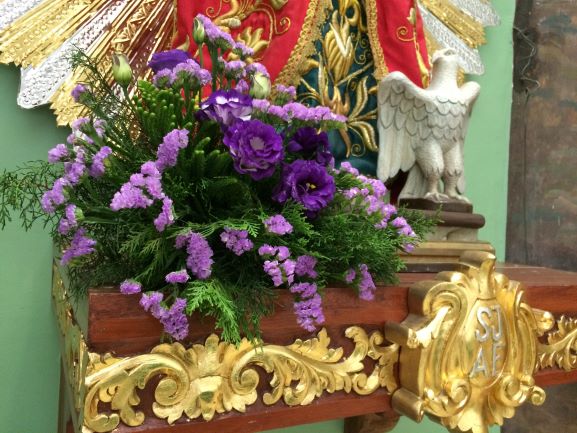
Violets on the pedestal of our Patron Saint, John the Evangelist.
This was the vision of Isaiah a long, long time ago.
It had been fulfilled in Christ’s first coming in Bethlehem over 2000 years ago and it is being fulfilled daily through people filled with hope in God’s justice and love.
In the days to come, the mountain of the Lord’s house shall be established as the highest mountain and raised above the hills. All nations shall stream toward it; many people shall come and say: “Come, let us climb the Lord’s mountain…” They shall beat their swords into plowshares and their spears into pruning hooks; one nation shall not raise the sword against another, nor shall they train for war again. O God of Jacob, come, let us walk in the light of the Lord!
Isaiah 2:2-3, 4-5
People who keep on wondering and asking when will Jesus come again are not really interested with the Lord’s Second Coming but only with themselves like the people during the time of Noah – oblivious to anything else and busy with their own pursuits.
The more we think of the WHEN, the less we think of the WHO of Advent. Let us put on the Lord Jesus Christ to be filled with his light until all darkness in life is dispelled. Amen.
Quiet Storm by Fr. Nick F. Lalog II, 20 November 2019
A chef is basically a person who loves people. And that is why for any chef, cooking is both a passion and an art. His menu are not only meant to feed the body but most especially enrich the heart and soul of every diner.
Welcome to Netflix original series “Midnight Diner: Tokyo Stories”!
Each episode is exactly like every recipe the main character called “Master” dishes out to his patrons and customers who come from all walks of life with their unique burdens and story to share and eventually, resolve after tasting his fresh and easy to cook meals.
Midnight Diner is as Japanese as the ramen and sake the Master serves his guests. Everything is in Nihongo with English subtitles that demand one’s total attention to understand the conversations briefly interspersed with first person accounts by the Master.
At the opening, the Master gives us the warm and nice ambience of the series set at midnight until seven in the morning for people who do not wish to go home straight after their office hours.
It turns out that they are not only looking for good food but for warm company as well which the Master ably provides with his total attention and communion.
Very interesting to note that the Master is a celibate, reason why he can devote himself wholly to his diners, listening to their joys and sorrows, victories and defeats. So far, from what I have seen in its two seasons, he has no love interests although it won’t be surprising if in the third season he turns out to be a character from one of Murakami’s novels or short stories.
Though he is a fictional character, he is rightly called “Master” for his commanding presence that is not intimidating but so warm and gentle, so unlike the celebrity chefs we see on TV.
The Master can cook anything, including fancy corndogs and pancakes that are very American. He always has a “menu of the day” as title of each episode.
Should anyone ask for any kind of dish, he willingly prepares it subject to availability of ingredients that turns out he always has or sometimes, like a true chef, finds other alternatives just to fulfill a customer’s cravings. In one episode, a patron comes nightly with his own three pieces of bread so the Master can make him “yakisoba sandwiches” — exactly how we Filipinos eat pancit with another carbohydrate!
What makes the series so good is that the Master is more than a chef — he is the Tokyo counterpart of Paris’ Cafe Anglais famed lady chef “Babette” of the 1987 Danish film “Babette’s Feast” and James Taylor’s 1977 hit single “Handy Man” rolled into one.
More than the food he passionately serves, the Master delights and comforts every troubled heart and lonely soul longing for love and relationships, forgiveness and kindness they finally find in his Midnight Diner.
Most of all, neither the Master nor his food is the main focus of each episode but the story of every customer who comes to his diner at the most unholiest hours – between 12 midnight and seven in the morning – searching for food for their souls!
Mainstays of the Midnight Diner.
Helping the Master in processing every customer are his interesting mix of characters of regular patrons: LGBTQ members, career ladies mostly single, retirees, professional gamblers and of course, Yakuza gang members.
They are the Master’s “secret spices” who bring out all the flavors and aroma of every customer’s life story like a widowed lawyer searching for his lost step brother to a nightclub stripper sought and saved from miserable life by her high school teacher suffering the early stage of Alzheimer’s disease. Sometimes they act like the Master’s garnishings, adding taste and beauty with some sprinklings of life lessons to lost customers.
Though most stories are understandably peculiar to Japanese culture, they all touch a common chord within us for our basic need of acceptance which the Master warmly provides like his steaming hot dishes.
Unlike most TV series, Midnight Diner’s pacing is so fast and without any pretensions that prevent it from becoming dragging and boring. In less than 30 minutes, each episode is deftly resolved just as magically how the Master came out with a superb meal from his limited resources and tiny kitchen.
But the best attraction of the show is how the viewer eventually finds one’s self warmly welcomed into the diner, laughing or crying, sympathizing or objecting to whatever situation is presented by every guest.
It is a very lovely series that transcends language barriers and cultures because it nourishes and warms our soul that never rest nowadays due to the demands of modern living. Somehow, inside the little Midnight Diner, there is always a space welcoming everyone including us viewers to unwind and be fulfilled with good food, nice people, and meaningful conversations.
Nasaan na mga liham
ng ating mga samahan
at pagkakaibigan
na ngayo'y napalitan
ng maramihang balanang
kaisipan at mga larawan
pati katatawanan?
Walang umiiral na ugnayan
bagkus mga palitan
at pasahan na lamang
ng sari-saring nararanasan
at nararamdaman;
mabuti kung iyong masasakyan
maski mga kababawan.
Iba pa rin
ang karanasang
mararamdaman
na higit mapagyayaman
ng sino mang sumusulat
at tumatanggap ng liham
mula kay Mister Postman.
Maraming kabutihan
at mga kagandahan
ginagawa nating usapan
sa pamamagitan ng internet
kagaya ng e-mail,
messenger at viber
na sadya namang super ang bilis.
Ngunit kailanman
hindi kayang palitan
ng mga makabagong
pagsusulatan
ating kinagawiang
mga liham
na laging kinasasabikan, inaabangan.
Hindi agad binubuksan
mga kamay pinupunasan
at baka marumihan
mamantsahan
tinanggap na liham
mula sa kanino man
na turing ay isang kaibigan.
Itong pagsusulat
maging pagtanggap ng liham
maituturing nating
ritwal ng ating pagkakaibigan:
walang minamadali
bawat sandali kinakandili
pilit pinanatili sana'y kapiling kang lagi.
Nakakahinayang itong kaugalian
ng pagliham napalitan,
pati ating pagkakaibigan,
mga ugnayan tila nakalimutan;
balikan mga lumang liham nasaan
hindi ba't nakatago, iniingatan
upang basahin, sariwain, palalimin ating samahan?
Lawiswis ng Salita ni P. Nicanor F. Lalog II, 04 Oktubre 2019
Mula sa Be Like Francis Page sa Facebook.
Minsan daw ay nagimbal
kaibigang Kardinal ni San Francicso
na banal
nang kanyang malaman
dukha nilang pamumuhay
na sa kanyang palagay
labis na kahirapan hindi naman
dapat nilang pagdaanan.
Katuwirang ipinaliwanag
ni San Francisco kay Kardinal Hugolino
kay gandang pagnilayan
sa malalim nitong kahulugan:
"kung tayo'y maraming kayamanan,"
aniya ng ating banal
"kakailangan din natin mga sandata
upang mga ito'y ipaglaban at pangalagaan."
Sa kanyang isipan
at banal na kalooban,
ang pag-ibig ay namamatay
kapag tao'y nagkamal maraming ari-arian;
hanapin kanyang paliwanag
kung masasagot kanyang mga katanungan
na tila bugtong di lamang sa isipan
kungdi pati na rin sa puso at kalooban:
"Mapagnanakawan mo ba
na tao na walang ano man?
Maari mo bang gutumin
ang nag-aayuno?
Mayroon ka bang sisirain
sa taong namumuhi
sa parangal at pagkilala?
Ano nga ba magagawa sa taong aba at dukha?"
Para kay San Francisco
ang mga dukha ang tunay na malaya
kayang ipaubaya lahat
pati sarili sa Bathala
upang makagawa
ng kabutihan sa kapwa
na siyang simula ng ating kapatiran
at ugnayan pati sa kalikasan.
Mula sa Reuters.
Sa ating panahon ngayon
karukhaan ay pinag-uusapan
batay sa kawalan
ng ari-arian na kabaligtaran
ng kung ano mayroon
ang mayayaman na kadalasan
mga bagay nabibilang
at nabibili gaya ng kapangyarihan.
Ngunit kung ating pagninilayan
ano mang mayroon ang mayaman
ay wala pa rin o "NOTHING"
kung Inglesin natin
dahil ang higit na mahahalaga
ay hindi nakikita
ni nabibili o nabibilang
gaya ng pera at iba pang kayamanan.
Gayun din naman
hindi masasabi ng sino man
na siya ay dukha
at "walang wala" ika nga
dahil kung tutuusin natin
ang lahat ay palaging mayroon pa rin
o "SOMETHING"
kung Inglesin din natin.
Harinawa'y mapagtanto natin
sa pagdiriwang ng kapistahan
ni San Francisco na butihin
ito mismong buhay natin
ay dakilang kayamanan
na dapat ipagpasalamat natin
sa karukhaan ng loobing maialay
gaya ng Panginoon Hesus natin.
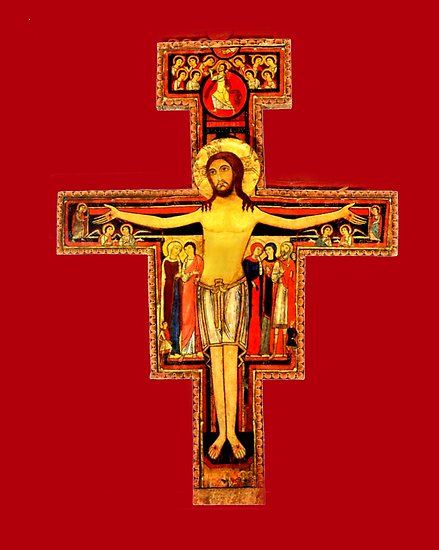
Ang Krus ng kapilya ng San Damiano na isinaayos ni San Francisco batay sa tinig na kanyang narinig habang nananalangin doon.



















 lordmychef.com