Sana ay huwag ninyong masamain
itong aking puna at pansin
sa marami nating kababayan
ngayong panahon ng COVID-19
palaging daing walang makain
ating sinasambit
saan mang bahagi ng mundo sumapit
kapag tayo ay nagigipit.
Hindi naman sa kung ano pa man
pagkain lamang ba ang sadya nating kailangan
na siyang laging pinahahalagahan
kaya naman kadalasan ito ang sanhi
ng ating mga alitan at di pagkakaunawaan?
Anong sakit mapakinggan, malaman na
nag-aagawan, pinag-aawayan
ay pagkain lamang?
Larawan mula sa Google.
Sa Banal na Kasulatan ating matutunghayan
habilin ng Diyos sa ating unang magulang
maari nilang kainin mga munting butil
pati na rin mga bunga ng punong kahoy sa hardin
huwag na huwag lamang nilang kakanin
mahigpit Niyang bilin
bunga ng puno ng karunungan
dahil magiging sanhi ng ikasasawi natin.
Hindi napigilan kanilang tinikman
pinagbabawal na bunga kaya lumuwa mga mata
sa katotohanang lumantad sa kanila na di nakaya
kaya't dating kapwa hubad ay nagdamit na!
Nang pumarito si Jesu-Kristo upang tubusin ang tao
unang tukso na kanyang pinagdaanan sa ilang
sa gitna ng kanyang kagutuman
ay gawing tinapay mga bato upang busugin Kanyang tiyan.
Hindi nalito si Kristo nang sagurtin niya ang diyablo
na hindi lamang sa tinapay nabubuhay ang tao
kungdi sa bawat salitang namumutawi sa bibig ng Diyos;
kaya noong gabing ipagkanulo siya habang kumakain sila,
nangunsap Siya sa mga alagad Niya
habang hawak-hawak ang tinapay na pinaghati-hati
"Tanggapin ninyong lahat ito at kanin
ito ang aking katawan na ihahandog para sa inyo."
Mula noon hanggang ngayon
nakikilala, naaalala natin ang Panginoon
sa hapag ng kanyang piging, sa mesa ng Misa
nang kanyang inangat katayuan at kahulugan
nitong pangkaraniwang gawain natin na kumain:
hindi lamang upang busugin mga tiyan at laman natin
kungdi upang punuin din kamalayan at kaluluwa natin
ng diwa ng piging na mismo tayo ay maging pagkain din!
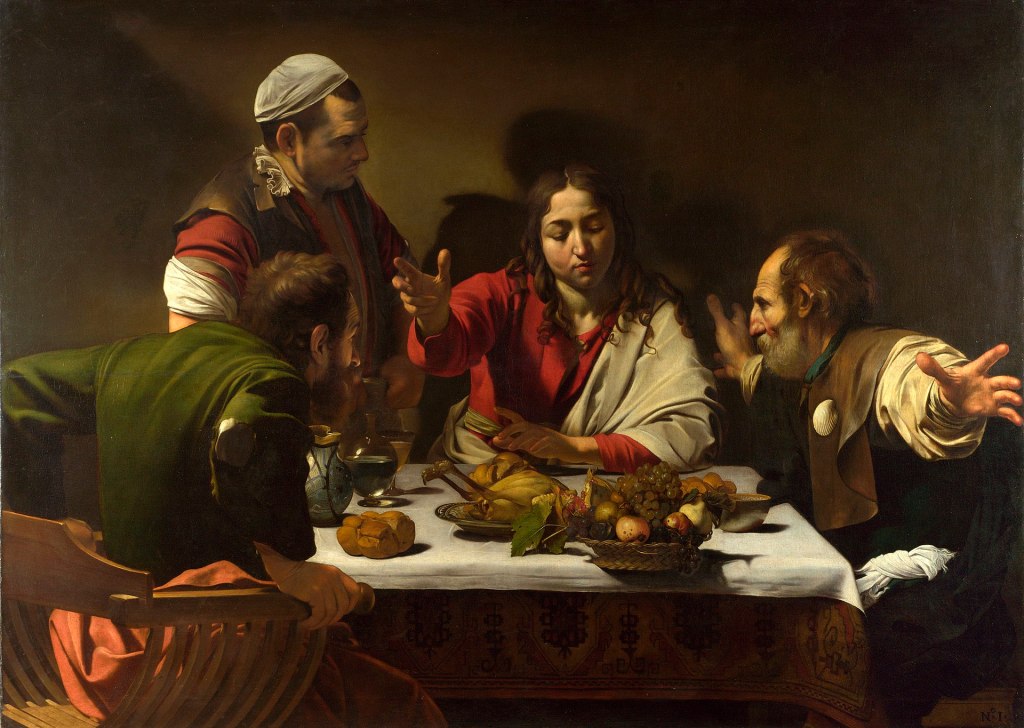
Larawan ng “Supper at Emmaus” ni Caravaggio mula sa Google.
Nakikila pag-uugali ng tao
kapag nakita paano siyang kumain
sapagkat doon lamang sa mesa ng piging
nawawala mga pagkukunwari natin
nabubunyag tunay nating saloobin
kaya naman sa bawat pagdiriwang natin
palaging mayroon pagkain upang
magkasalu-salo, magkaniig at magkaisa mga kumakain.
Alalahanin si Hudas noong Huling Hapunan
lumisan na kaagad dahil siya ay tumiwalag
di lamang sa hapag kungdi sa kaisahan at
pakikipag-kaibigan kay Jesus at mga kasamahan;
iyon din ang sinasaad sa bawat piging ng mga
dumadalo at hindi dumarating
mga kumakain at nanginginain
kay daming pagkain ngunit makasarili pa rin!
Sa tuwing tayo ay kumakain
laging alalahanin kaisa palagi natin
Diyos na bukal ng lahat ng pagpapala sa atin:
huwag mangangamba o mag-aalinlangan
kung sakali mang tayo ay gutumin
sapagkat hindi iyan ikamamatay natin
kungdi pagkabunsol sa labis na pagkain
lahat-lahat ay inaangkin.
Ang tunay na sarap ng pagkain
nalalasap pa rin
maski tapos nang kumain
kapag nabusog di lamang tiyan
kungdi puso at kalooban;
mga alitan nahuhugasan sa inuman
mapanghahawakan pagsasamahan at pagkakapatiran
upang huwag masabi ninuman na wala silang makain!
The Lord Is My Chef Breakfast Recipe for the Soul, Feast of St. Joseph the Worker, 01 May 2020
Genesis 1:26-2:3 ><)))*> ><)))*> ><)))*> Matthew 13:54-58
Photo by author of the site of St. Joseph’s shop in their home at Nazareth found beneath the Chapel of St. Joseph near the Basilica of the Annunciation, Nazareth, Israel. May 2019.
As we start the third extension of our quarantine period, you have gifted us O God, our loving Father, with this Feast of St. Joseph the Worker to guide many of us working at home during this time of the corona pandemic.
St. Joseph must have been a very good father to Jesus at Nazareth and a very wonderful carpenter too to their neighbors that long after he had died, the people still remembered him being the father of the Lord.
Jesus came to his native place and taught the people in their synagogue. They were astonished and said, “Where did this man get such wisdom and mighty deeds? Is he not the carpenter’s son? Is he not his mother named Mary and his brothers James, Joseph, Simon, and Judas? Are not his sisters all with us? Where did this man get all this?”
Matthew 13:54-56
Remind us always, O Lord, that like St. Joseph, our main task in life is to do your work in the way you would want it to be done because all our work is just a sharing in your creation completed in six days, setting aside the seventh day of sabbath as a day of rest in you.
In this time of the corona virus when many of us are working at home with almost all establishments including churches are closed, may we find again the true meaning and value of all work and material endeavors in the light of Jesus Christ who did and spoke only what you willed, our heavenly Father.
May we break free from our works and be not their slaves that have destroyed our personal and family lives as well as our environment as we pursued in recent years material wealth and fame now useless in the face of COVID-19.
May we always find you, Lord, in all our work and undertaking as our only fulfillment. Amen.
Photon by Mr. Raffy Tima of GMA-7 News, March 2020.
Lawiswis ng Salita ni P. Nicanor F. Lalog II, Ika-30 ng Abril 2020
Isang matandang kasabihan
itong ating masasandigan
na nagsasaad ng katotohanan
na hindi nalilikha ating pag-uugali
sa panahon ng krisis, bagkus dito
ito nahahayag at nalalantad din.
Sa gitna nitong quarantine ng COVID-19,
maraming pag-uugali natin ang nabuking:
nakilala sino ang may tunay at dalisay
na pagtingin at malasakit sa kapwa
sariling kaluguran at kapakanan ipinagkait
upang madamayan, masamahan higit nangangailangan.
Gayon din naman napatunayan higit kailanman
hindi lahat ng kumikinang ay ginto
kungdi tanso din naman
dahil sa asal at pag-uugali
hindi lamang magaspang
kungdi kamuhi-muhi, nakakapangiwi!
Sa kaunting halaga
o anumang ayuda maaring makuha
ipinagpalit ang kaluluwa
dangal ay ipagpapaliban
matiyak lamang hindi siya malalamang
sapagkat sariling kaluguran tanging panuntunan.
Pagkaraan nitong lockdown
kawawa mga nanlamang
hindi na sila pagkakatiwalaan
makitid na isipan, sarili lamang ang tanaw
kaya pag-uugali ay gayon na lamang;
sa kabilang dako naman, pakatandaan
yaong mga sa gitna ng kagipitan
nanatili sa atin at hindi nang iwan
pasalamatan at ituring na tunay na kaibigan
dahil kanilang pagdamay at pag-agapay
nadalisay pang tunay nitong kahirapan.
The Lord Is My Chef Breakfast Recipe for the Soul, Memorial of St. Pius V, 30 April 2020
Acts of the Apostles 8:26-40 <*(((>< 000 ><)))*> John 6:44-51
Photo by Mr. Raffy Tima of GMA-7 News, 2020.
It is the last day of April 2020 and we still cannot rejoice, Lord, because we still have to continue with our enhanced community quarantine until the 15th of next month to further control the spread of the dreaded COVID-19 virus.
Yes, it is very difficult and sad for everyone but deep inside each one of us is the excitement too of seeing that day finally when the pandemic is finally over and the corona virus wiped away.
And that is why we have to believe in you, O God our Father for you alone is the God of history, you have the final say at how things are in this life and the good news is, you always ensure that even tragedies and miseries end for our own good.
“Amen, amen, I say to you, whoever believes has eternal life.”
John 6:47
Yes, Lord Jesus, we believe in you because we want to see how all these things will end, if not in this life then in the eternity.
We have to believe to understand further and accept how things are in this life.
Like St. Pius V, the first Dominican Pope, he believed in your presence and power in the praying of the Holy Rosary that helped the Spanish Armada crushed the Ottoman Turks in Lepanto Bay to finally stop them from getting into Europe any further.
Incidentally, every Rosary begins with the Credo, “I believe in God…”
He believed in your works, O Lord, that despite the gargantuan tasks ahead of him, St. Pius pushed for the reforms of the Council of Trent that revitalized the whole Church after the Protestantism movement that swept the whole of Europe at that time.
We have to believe because believing is the starting point of everything in you; without it, we can never see through and look beyond to discover more meanings in life here and thereafter. Amen.
Quiet Storm by Fr. Nicanor F. Lalog II, 29 April 2020
Photo by author, 2010.
This is again for my brother priests and fellow workers in Church communication: our extended “enhanced community quarantine” is a call for us to rediscover the contemplative spirit so essential in our communication apostolate. It is best that before we go in front of the camera, before we post anything at all, or even before we go out doing our social action, let us first have Jesus Christ in us.
After all, it is always Jesus and only Jesus we bring as priests in everything we say and do. Jesus is our life as priests and without him, our works mean nothing. Worst, it may be happening that it is not Jesus whom we are following when we fail to spend time with him in serious prayers that unknown to us, we are already replacing him by creating our own ministry apart from him.
Incidentally, we are celebrating today the Memorial of St. Catherine of Siena who is considered as one of the patron saints for those working in telecommunications and TV stations.
In one of her numerous “ecstatic” visions, it is said that when she was so sick in her room, she begged the Lord to give her a glimpse of the celebration of the Mass in their chapel. The Lord heard her prayer and thus, she became the first person in history to have celebrated Mass by “remote telecast”!
From Google.
Faith and technology
We have mentioned in our previous reflection that we now live our faith in a mass-mediated culture. Media is all around us. And there is always that intense temptation by the devil to put us on TV and the internet to be popular.
So, how do we interact with technology on a daily basis?
What are we posting on Facebook? Are we like the rest who are also hooked into TikTok with all the inanities that go with it?
How much time do we spend for social media and Netflix these days?
And how many hours do we spend before the Blessed Sacrament, excluding our Liturgy of the Hours and praying of the Holy Rosary?
From Google.
We are familiar with Marshall McLuhan’s dictum “the medium is the message”.
This we have seen in the past very evident in our ministry when some priests have transformed the South American telenovelas and later Koreanovelas into a gospel too that people felt like listening to reviews during the homily. And it had given some people the idea that every homily of the priest must say something about television shows! In fact, about three years ago, some priests have to be reminded by the CBCP during the Simbang Gabi to focus only on the Word of God and not on TV shows and jokes to get the attention of their congregation during Mass.
But let us not forget that later in his life, McLuhan added to his dictum that “the medium is the massage” to warn us that sooner or later, we can be eaten up by media that everything is reduced into a show – or a palabas in Filipino that means outward.
That is what a show is, a palabas which is empty or walang laman.
And shallow, mababaw.
That is the sorry state of our many social communication efforts in the Church when we have Masses that have become like entertainment shows, priests becoming entertainers, church buildings and decors that look like videoke bars evoking none of the sacred, and tarps and posters that are all hype without any evangelical meaning.
Observe also how our presentations and shows in our Catholic schools and parish halls have become mere repetitions of what are on television that have left many of us now stuck in Emmaus who could no longer find the way back to Jerusalem, even to Jesus because all we see are the fun and excitement, the glitz and the glamor of media.
And of our massaged ego.
Road to Emmaus from clarusonline.it
Keeping technology in its place in the Church
We are not saying modern communications is evil; the Church has always been clear that these modern means of communications are in fact a gift from God. Vatican II asserts that it is Church’s “birthright” to use and own these modern means of communication for evangelization (Inter Mirifica, 3)
Our challenge in the Church is to keep these modern technologies in its proper place.
A technological culture is not the most hospitable environment for religious belief, but neither is it necessarily hostile. If we are to find a way of expressing our faith in this technological culture and of speaking to and with the people formed by this culture we need to take time to consider how we, as individuals and as a faith community, interact with technology on a daily basis.
James Mcdonnell, Communicating the Gospel in a Technological Age: Rediscovering the Contemplative Spirit (1989)
In a story posted by the CBCP News two days ago, it reported the experience of Filipino priest Fr. Jun Villanueva who contracted the dreaded COVID-19 disease in New York City last March shortly after he had arrived to study there.
Assigned in a parish in the heart of the Big Apple, Fr. Villanueva tells how he spent his days of being “alone literally and emotionally” as “moments with God”. But, his turning point came after recovering from the corona virus when he began celebrating Mass alone:
“I really cried when I first celebrated Mass without churchgoers. There’s no one in the Church except Jesus,” he recalled. “Then I realized that the Mass is not a show but our union with Jesus, whether there are people or none,” he said. “I started to look at the situation from that perspective”.
Fr. Jun Villanueva, CBCP News, 27 April 2020
That is the first step needed to put technology in its proper place in the Church: that we bring back Jesus Christ whom we have banished in the name of our ministry and vocation. The more we think of putting so much “art” and other things to “enhance” our liturgies, then we banish Jesus Christ.
This is the other pandemic we have refused to stop in the Church: triumphalism, the overdoing of things for God that in the process we actually put more of ourselves in the ministry and liturgy than of the Holy.
Is there anyone or anything greater than the Lord?
Remember St. Theresa of Avila: Solo dios basta!
And, like our saints who guide us closer to God, the only way to have Jesus and bring him back in our lives and ministry, in the church as institution and building is through the contemplative spirit of the priests.
It is a good thing that the catch call these days is that the “return to normal” is actually a “return to basics” like washing of hands, covering of mouths when sneezing, and most of all, a return to God.
From Google.
The spirits of modernity characterized by constant changes and technological efficiency do not jibe so well with the demands of the Gospel of Jesus Christ who have always reminded us of guarding against the temptations of the material world.
Jesus tells us to practice poverty but the world tells us to be wealthy.
Jesus asks us to forget ourselves and follow him but the world tells us to be popular and follow the limelight.
Jesus tells us to go down and be humble but the world tells us to rise up and go higher!
The other day, Jesus reminded us in the gospel:
“Do not work for food that perishes but for the food that endures eternal life, which the Son of Man will give you. For on him the Father, God, has set his seal.”
John 6:27
Most of the time in the Church and in our lives as priests, we have to be “inefficient” like “waste time” doing nothing in front of the Blessed Sacrament; have less of everything like food, money and clothing; be silent to listen more than to speak and talk more.
The contemplative spirit is about poverty and going down while the world tells us to be wealthy and to rise and go upwards.
The contemplative spirit is to be silent and trusting always in the Lord rather than relying on our own powers and abilities.
Here is James McDonnell again on the need to rediscover the contemplative spirit in communicating the gospel in this modern time.
“The contemplative spirit is an attitude of mind and heart that enables us to focus on the essential, important things. It refuses to be hurried or rushed into premature rejection or acceptance of technology. If we Christians allow it to inform our use of communication technologies we shall learn to be realistic, but always hopeful, able to love and reverence our culture even as we strive, with God’s help, to transform it.”
Communicating the Gospel in a Technological Age: Rediscovering the Contemplative Spirit (1989)
Take heart, my dear brother priests: we are representatives of Jesus Christ, our Eternal Priest. We are not entertainers and pleasers of anyone but of God alone. We do not need followers and likers. And we have so many other things to do than TikTok and Facebook or Instagram.
Let us go back to Nazareth to be silent and hidden so we can return to Jerusalem to await for further instructions from the Lord. Amen.
The Lord Is My Chef Breakfast Recipe for the Soul, Memorial of St. Catherine of Siena, Virgin and Doctor of the Church, 29 April 2020
Acts of the Apostles 8:1-8 ><)))*> 000 <*(((>< John 6:35-40
Our empty church since March 17, 2020.
Once again, O Lord Jesus Christ, your Body the Church is facing severe trials and difficulties at this moment of history with the pandemic COVID-19 that have closed churches worldwide even in Rome, Italy which is one of the worst hit countries of the corona disease.
Since the martyrdom of St. Stephen, the Church has always been persecuted but never defeated. On the contrary, it was during the persecutions when your Church had really grown beyond leaps and bounds, so to speak.
St. Catherine lived at that time when she was able to unite warring factions in Europe as well as in the Church with her counsels while through her, many individuals found directions in life with her holiness, teachings and directions.
And while churches remain closed with dim prospects of opening soon, you never fail to send us men and women full of devotion to you who continue to work tirelessly in building your Body, the Church.
One of them is Fr. Jun Villanueva from the Diocese of Balanga in Bataan who was infected with COVID-19 while serving in New York.
As he recovered from the deadly disease celebrating Mass in his parish, he had a wonderful realization that many of us priests have seem to forget:
“Then I realized that the Mass is not a show but our union with Jesus, whether there are people or none… from then on I started to look at the situation from that perspective”.
CBCP News, 27 April 2020
In the first reading we are told of the zeal of Saul in destroying the early church alongside the devotion of the early disciples in keeping the young church alive.
Devout men buried Stephen and made a loud lament over him.
Acts of the Apostles 8:2
Only St. Luke used that adjective “devout” in the New Testament to describe people of “good heart, ready to believe, and then act openly and with courage” according to Timothy Clayton of the book “Exploring Advent with Luke”.
Devout people make thing happen for God like St. Stephen and the early Christians.
From Google.
Devout people give themselves to God wholly like St. Catherine and all the saints who remained attuned with the Holy Spirit like Philip in the first reading today, ready to follow its promptings and leads.
Give us the same gift of devotion to you, Jesus, the “Bread of Life” who had come down from heaven so we can build up your Church as your body here on earth.
Help us avoid the pitfalls of pride and self-centeredness that tend to destroy the unity of your Body, the Church.
Most specially, keep us devoted to you in the Blessed Sacrament like St. Catherine of Siena with whom you have shown in a vision while she was sick the celebration of the Eucharist in their chapel making her a patroness of those in television. Amen.
Thank you… and forgive us also, Lord Jesus, in this time of the corona virus.
Thank you in giving us the much needed time to be with you and with our loved ones in this time of quarantine. Thank you most of all, Lord, in giving us this chance to meet our true selves too.
The enhanced community quarantine has brought out the best in us, like with St. Stephen in the first reading who was filled with the Holy Spirit while being stoned to death by the people in proclaiming your gospel.
Thank you for the gifts of humility and courage to confront our true selves to see your true glory.
Forgive us also, Lord, because this same quarantine period has brought out the worst in us: every day in the news we see disturbing reports of people getting into all kinds of troubles displaying arrogance and pride that have wounded many bloated egos and, sadly even led to death.
We have been playing gods more than ever in this time of the corona virus, Lord Jesus.
Are we the ones also being referred to by St. Stephen in the first reading?
Stephen said to the people, the elders, and the scribes: “You stiff-necked people, uncircumcised in heart and ears, you always oppose the Holy Spirit; you are just like your ancestors.”
Acts of the Apostle 7:51
On the other hand, sometimes we act like the people of your time in Capernaum who, despite the many signs you have shown as being the Christ, we continue to doubt you, Lord Jesus, even daring you to do more than Moses and others!
The crowd said to Jesus: “What sign can you do, that we may see and believe in you? What can you do? Our ancestors ate manna in the desert, as it is written: He gave them bread from heaven to eat.”
John 6:30-31
Forgive us, Lord Jesus in playing gods when we neither see you among others nor in your very self because the sad truth, all we can see, that we choose and insist on seeing is only our very selves.
Open our eyes, dear Jesus. And if needed, humiliate us so we may be humble again to see you are our Lord and our God and nobody else before we end up inflicting more harm to one another than the corona virus . Amen.
The Lord Is My Chef Breakfast Recipe for the Soul, Monday, Easter Week-III, 27 April 2020
Acts of the Apostles 6:8-15 <*(((>< 000+000 ><)))*> John 6:22-29
Photo by Mr. Jim Marpa, Panglao Beach, 2019.
Thank you very much, our loving Father for this very different Monday: it is the last for the month of April, but most of all, so unlike of all the other Mondays of our lives as we continue to stay home under our enhanced community quarantine extended until May 15, 2020.
We have been so used in our entire lives that Monday is always the start of work, the start of everything when in fact, Sunday is the first day of the week.
Due to COVID-19, we have started to lose track of dates and days, thus making us less mechanical and more natural, giving us with enough time to review our selves and our lives, to see the peoples and things we value most, and finally, to make a stand on so many things we have taken for granted and even disregarded in the past.
We have never been like your deacon Stephen in the first reading who at a very young age chose to stand for Jesus Christ and his teachings, never giving into the fear of going against prevailing thoughts and sentiments. Most of all, he never gave into the lies thrown against him by his many detractors.
Enlighten us, dear Jesus, to seek for “food that endures for eternal life so we can accomplish your works, O Lord” (Jn.6:27-28).
Let us believe in you always, Jesus.
Nourish and sustain us with your words of life so that we can remain firm in our faith and conviction in you, always willing to go back to Jerusalem and Galilee to start anew in you like the two disciples you walked with to Emmaus on Easter. Amen.
The Lord Is My Chef Sunday Recipe, Easter Week III-A, 26 April 2020
Acts of the Apostles 2:14.22-33 ><)))*> 1 Peter 1:17-21 ><)))*> Luke 24:13-35
Photo by author, sunset at Laguna de Bay (Los Banõs), February 2020.
I am sure all of us can identify with the two disciples going home to Emmaus on that evening of Easter. And surely, as we accept with a heavy heart the extension of this enhanced community quarantine (ECQ) until May 15, we pray like them, saying, “Stay with us, Lord.”
As they approached the village to which they were going, he (Jesus) gave the impression that he was going on farther. But they urged him, “Stay with us, for it is nearly evening and the day is almost over.” So he went in to stay with them. And it happened that, while he was with them at table, he took bread, said the blessing, broke it, and gave it to them. With that their eyes were opened and they recognized him, but he vanished from their sight. Then they said to each other, “Were not our hearts were burning within us while he spoke to us on the way and opened the Scriptures to us?”
Jesus always walking with us, without us recognizing him
Once again we see the presence of darkness in this story of Easter found only in St. Luke’s gospel. And that is the beauty of Easter – like Christmas – showing us the immense love of God for us that he sent us his Son Jesus Christ in the darkest moments of our lives to lead us to light and life.
And it always happens when we least expect it like that Easter evening when Cleopas and his companion were on their way to Emmaus.
Jesus comes to us as a stranger and most of all, joins us in the “wrong direction” to bring us back to the right path we must take especially when things go against our plans and expectations.
Until now, we cannot still believe how these things are happening to us: the lockdown, the sufferings and uncertainty of life when everything is on a “wait-and-see” situation especially in business and education while houses of worship remain closed and mass gatherings prohibited to control the spread of COVID-19.
But, if we look back and see how we are today, do we not also feel our “hearts burning within” that despite all the sickness and deaths almost everywhere, we are still here, alive, forging on in darkness, and most of all, somehow being led by Jesus even though we do not recognize him right away to be always on our side?
Yes, we worry, we ache deep inside but, more than these, we hope, we love, we live because we firmly believe in the Risen Lord present in us, present among us.
Deep in our hearts we experience Jesus with us, feeling with us, listening to our cries and worries just like that Easter evening to Emmaus. As we would say in Filipino, “ah basta!” that means without doubt, we are certain of someone or something from deep within not visibly seen.
“Supper at Emmaus” by renowned painter Caravaggio. See the emotion depicted by Caravaggio with his trademark of masterful play of light and shadows. At the center is the Risen Lord blessing the bread that caught the two disciples who are seated in disbelief, one outstretching his arms and the others pushing back in his chair. The third character in the painting is the innkeeper unaware of the significance of the gesture of Jesus. It was at this instance that the two disciples recognized Christ as the travelling man with them to Emmaus.
Our inner recognition of Christ in the breaking of bread
Notice that in all resurrection stories, the followers of Jesus did not recognize him immediately. There is always that feeling within them, like what we feel when we see somebody and we try to recall where we have met him/her, trying to dig into our memories when and how did we get to know the seemingly not “stranger” before us.
It is a funny feeling that is finally resolved with a very simple memory of an instance long ago or a small detail that leads into an “inner recognition” of the person before us.
This is how the disciples of Jesus recognized him — not through his external appearances but more from within like when Cleopas and his companion invited him into their home in Emmaus or when the seven apostles led by Simon Peter met him by the shore of the lake when no one would dare ask who he is because deep within, they knew it was the Lord (Jn.21;12-14).
And this happens always in the context of a meal, a table fellowship when Jesus instituted the Sacrament of the Eucharist on Holy Thursday evening before he was arrested to be crucified.
Here we find the mystery of this sign left to us by Jesus to be his very presence among us in his Body and Blood under the perceptible signs of bread and wine as well as the Sacred Scriptures proclaimed in every liturgical gathering: the more we do not see his outward appearances, the more we recognize Jesus!
Every time we celebrate the Mass and listen to the scriptures proclaimed, we realize within us like the people of Jerusalem in the first reading that this Jesus of Nazareth is a true person present in our lives fulfilling his works of salvation despite our sinfulness.
Like some people we meet, we recognize Jesus Christ not with the outward appearances but from within, from what we have experienced beyond explanations that gives us always a sense of awe because as St. Peter tells us in the second reading, “he had ransomed us from our futile conduct with his most precious blood” (1 Pt. 1:18-19) which is affirmed to us in every celebration of the Holy Eucharist.
The Easter mystery of recognizing Jesus when he vanishes
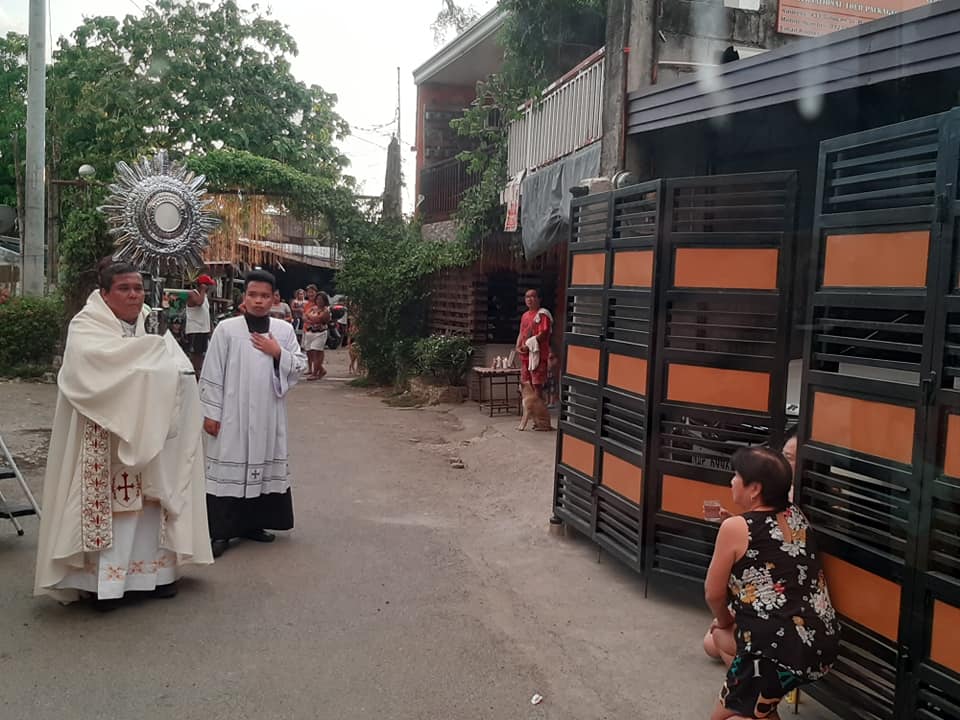
Every Sunday afternoon since this lockdown began due to COVID-19, we have been bringing the Blessed Sacrament around our Parish to remind the people of Christ’s presence among us.
And every Sunday, I am amazed at the faith of the people who would kneel on the side of the road, totally believing that it is Jesus himself who visits them in the Blessed Sacrament.
The sight is so moving with people from all walks of life bowing their heads or raising their hands, recognizing Jesus in the Blessed Sacrament as they pray in silence with others crying. The few motorists passing by stop at the side of the road to see Jesus and be blessed while others get near our truck for a blessing.
Here lies the great mystery of Easter: Jesus need not appear to us in person because as he vanishes in the Blessed Sacrament, that is when we recognize him!
In the most simple gestures of the Mass under the most simple signs of bread and wine, Jesus vanishes from our outward view and through this vanishing our interior or inner recognition opens up that we “see” him in the many instances he had touched us especially in our “heart-breaking” experiences in the past.
We know with certainty that “it is the Lord” – Dominus est – present in every breaking of bread because part of the Easter mystery tells us deep within that it is only in his vanishing that he truly becomes recognizable to us.
What a shame and a tragedy especially in these days of live television or internet Mass when priests do all the gimmicks and antics to wow the people as if they are audience in a show than faithful in a sacred gathering.
May we not forget this mystery of Easter that, the more Jesus vanishes, the more we recognize him because Jesus is more than enough than anybody or anything else especially in the Mass. And when we pray “Stay with us, Lord”, we actually ask for more faith to believe in him to see him in his vanishing. Amen.
A blessed week ahead to everyone! Stay safe, stay in the Lord.
The Lord Is My Chef Breakfast Recipe for the Soul, Saturday, Feast of St. Mark the Evangelist, 25 April 2020
1 Peter 5:5-14 ><)))*> ><)))*> ><)))*> Mark 16:15-20
Statue of St. Mark and his symbol the lion below him at the western facade of St. Mark Cathedral in Venice, Italy. Photo from Google.
Lord Jesus Christ, as we move into the final week of April and face – with dismay – the extension of this enhanced community quarantine into May 15, the celebration of the feast of your evangelist St. Mark today gives us the much needed boost to persevere in these trying times.
In writing the first gospel account, St. Mark stressed two important things that are very helpful for us today in this time of the corona virus: urgency in proclaiming your gospel and trust in you.
It is something very similar to Stephen Covey Jr.’s concept of “the speed of trust” that when there is trust among people like in a relationship or a team, speed goes up wherein costs are minimized, productivity is increased due to trust.
Give us the grace to trust in you, Lord Jesus, so we can urgently proclaim your gospel of salvation most especially at this time when people are feeling worn out by this lockdown.
So many people are already suffering not only physically but also emotionally and spiritually.
Help us to bring them more joy and hope, healing and renewal not only through our gifts and financial aid but also with our presence and concern for them.
Let us not worry in doing your work with the assuring words of St. Peter in the first reading:
The God of all grace who called you to his eternal glory through Christ Jesus will himself restore, confirm, strengthen, and establish you after you have suffered a little.
1 Peter 5:10
Like in the beginning of the gospel by St. Mark, may we always proclaim your good news Lord whenever and wherever there is a wilderness, emptiness, and weariness among peoples for you are always faithful in enabling us to fulfill your work. Amen.
Nuns bringing relief goods to remote villages in this time of Luzon-wide lockdown due to COVID-19.




















 lordmychef.com